Not for the first time, the free world has stood up for truth and justice in Palestine. The General Assembly’s vote against President Trump’s decision on Jerusalem was a victory for the rule of law over the law of the jungle. It now leaves both the US and Israel isolated, disgraced and humiliated.
Washington’s threat to cut aid to countries that voted not to recognise Jerusalem as Israel’s capital was an insult to the UN and a vicious assault on the sovereign rights of its members. In their customary delusional manner, Israelis believed the US threat was enough to force compliance. They were mistaken; people around the world are simply tired of their arrogance and unethical conduct.
As it stands, Trump’s threat is consistent with a long-standing policy of US blackmail and intimidation exerted within the UN to further Israel’s illegal claims. It was no different from the threats issued to impoverished nations to extract the controversial UN Partition Resolution 181 in 1947.
When that vote was taken, it narrowly gained the two-thirds majority to be adopted – 33 countries voted in favour, 13 opposed and ten abstained. Haiti, Liberia and the Philippines all opposed the partition plan initially but were forced to change their position following the intervention of officials “at the highest levels in Washington”, including President Harry Truman. They were threatened with the withdrawal of US financial aid. James Forrestal, the then Secretary of Defence admitted that “the methods that had been used… to bring coercion and duress on other nations in the General Assembly bordered closely onto scandal.”
By allowing itself to be used in such a scandalous manner to facilitate the claims of one people, the UN had done immense damage to its credibility. It had, in fact, violated one of the most fundamental principles of its Charter namely, “respect for the principle of equal rights and self-determination of peoples” (Article 1).
There were, apart from Forrestal, other US officials who were prepared to acknowledge the wrong done to the Palestinian people. Commander E.H. Hutchison, who chaired the Jordan-Israel Armistice Commission after the 1948 Arab-Israeli War, recalled that “every step in the establishment of a Zionist state” was “a challenge to justice”.
While there are parallels between what happened in the General Assembly in 1947 and 2017, there are, nonetheless, striking differences. Both presidents, Trump and Truman, sought to exploit an international crisis to bolster their domestic standings. However, what the incumbent president does not realise is that the free world has moved on from the days of diplomatic blackmail. So, whereas two-thirds were coerced to vote for partition in 1947, 70 years on two-thirds exercised their free will and voted for peace and the rule of law.
Where does this crushing defeat leave Israel and its mercurial Prime Minister, Benyamin Netanyahu? For sure, Israel will become more isolated among the community of nations. Instead of countries moving their embassies to Jerusalem many will now consider severing or curtailing diplomatic contact with the Zionist state. South Africa’s ruling African National Congress (ANC) has taken the lead by adopting a resolution at its national conference to downgrade the South African embassy in Israel to a liaison office
As for Netanyahu, the UN defeat will, almost certainly, increase calls for his resignation. He is, in political terms, damaged goods, even to the point of being toxic. Only the delusional would want to be associated with him.
Instead of disparaging the UN as “the house of lies”, the Israeli prime minister and his fellow travellers should be eternally grateful to the world body for voting to partition Palestine. Gratitude, regrettably, has never been in their lexicon.
In years gone by, Israel was aided and encouraged by a combination of blind American support; indifference on the part of western powers; and the complicity of “leading” Arab countries. If nothing else, yesterday’s vote at the UN on Jerusalem must mark the beginning of the end of that long chapter of subterfuge.
Political disasters can sometimes be turned into opportunities. This scandalous attempt by the Trump administration to trample roughshod over the UN, in defiance of international norms and standards, must be seized as an opportunity to review Israel’s membership of the world body. After all, it was admitted to the world body on condition that it respects the terms of partition and allows the Palestinian refugees to return (Resolution 273). Israel has not only refused to honour the terms of its membership; it has systematically undermined the UN Charter and brought the world body into disrepute. Surely, the UN would be a much better organisation without member states like this.
As for the Arab leaders who were misled into believing that Donald Trump can realise their grand ambitions, they too must think again.
December 22, 2017
Posted by aletho |
Ethnic Cleansing, Racism, Zionism, Illegal Occupation, Solidarity and Activism, Timeless or most popular | Benjamin Netanyahu, Israel, Jerusalem, United Nations, United States, Zionism |
Leave a comment
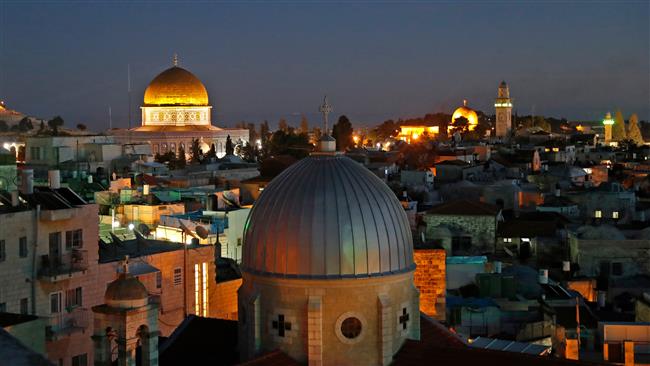
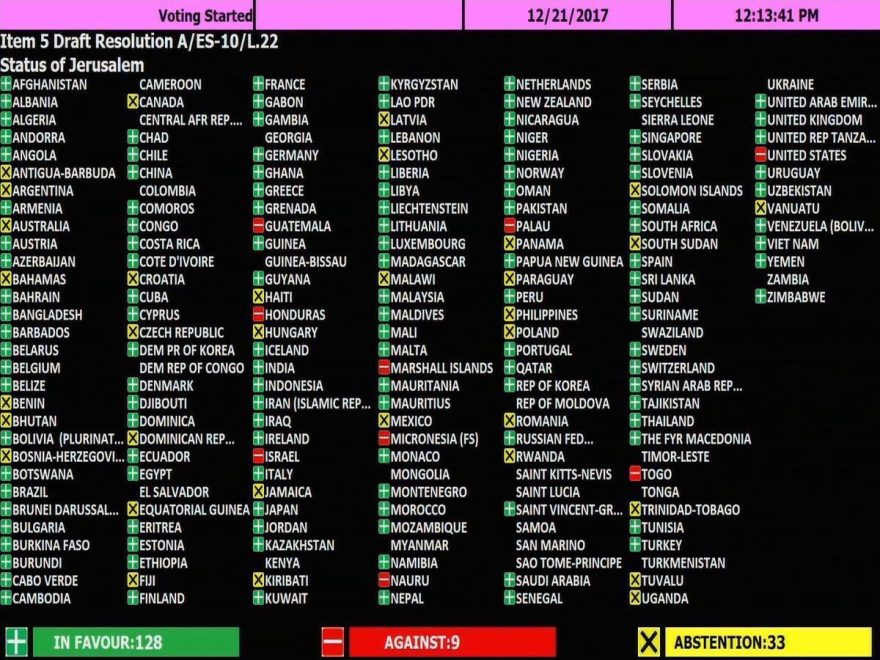
The UN General Assembly has overwhelming adopted a resolution calling on the US to reverse its decision to recognize Jerusalem as the capital of Israel. One hundred and twenty-eight countries voted in favor of the motion.
Nine states voted against the UN resolution and 35 nations abstained.
Turkey, which has led the Muslim opposition to the US Jerusalem declaration, was among the first to speak at the meeting. Turkish Foreign Minister Mevlut Cavusoglu stressed that only a two-state solution and sticking to the 1967 borders can be a foundation for a lasting peace between Israel and Palestine. The minister said that since Jerusalem is the cradle for the “three monotheistic religions,” all of humanity should come together to preserve the status quo.
“The recent decision of a UN member state to recognize Jerusalem as the capital of Israel violates the international law, including all relevant UN resolutions. This decision is an outrageous assault on all universal values,” Cavusoglu said.
US envoy to the UN Nikki Haley said that whatever decision is made by the UNGA, it will not influence Washington’s decision to recognize Jerusalem as the capital of Israel. Haley reminded UN members of the US’ generous contributions to the organization and said that the United States expects its will to be respected in return.
“When we make a generous contributions to the UN, we also have a legitimate expectation that our goodwill is recognized and respected,” Haley said, adding that the vote will be “remembered” by the US and “make a difference on how the Americans look at the UN.”
Israeli envoy to the UN Danny Danon stated that Israel considers Jerusalem its capital, dating back to Biblical times, and the US decision only outlines the obvious. Danon went further and accused the UN of “double standards” and an “unbreakable bond of hypocrisy” with Palestine and prejudice against Israel.
“Those who support today’s resolution are like puppets. You’re puppets pulled by the strings of your Palestinian puppet masters. You’re like marionettes forced to dance, while the Palestinian leadership looks on with glee,” Danon told the gathering.
The US leadership earlier voiced threats towards UN member states which would back the UN resolution against its Jerusalem decision. Haley said Washington would be “taking names.”
Trump also suggested that countries which vote in favor of the resolution at the UN General Assembly will lose money. “Let them vote against us,” he said. “We’ll save a lot. We don’t care. But this isn’t like it used to be where they could vote against you and then you pay them hundreds of millions of dollars… we’re not going to be taken advantage of any longer.”
The US threats were condemned by Turkey, with the country’s President Recep Tayyip Erdogan stating that Trump “cannot buy Turkey’s democratic will.”
“I hope and expect the United States won’t get the result it expects from there (the UN General Assembly) and the world will give a very good lesson to the United States,” Erdogan said during a speech in Ankara on Thursday ahead of the meeting.
On Monday, the US vetoed a UN Security Council (UNSC) resolution on Jerusalem, which had demanded that the American decision to recognize the city as the Israeli capital be withdrawn. All other UNSC members voted in favor of the document.
December 21, 2017
Posted by aletho |
Ethnic Cleansing, Racism, Zionism, Illegal Occupation, Solidarity and Activism, Timeless or most popular | Israel, Jerusalem, Palestine, United Nations, United States, Zionism |
Leave a comment
A Kiev-sponsored UN resolution condemning the human-rights situation in Crimea and the city of Sevastopol failed to convince much of the UN General Assembly, as 76 countries abstained, 26 opposed, and 70 supported the motion.
Among those who voted against the resolution were Russia, China, India, Iran, Serbia, and Belarus; while the US and its allies approved. In all, countries representing nearly half the world’s population rejected the document.
The resolution called on Russia, described as an “occupying power,” to “take all necessary measures to immediately put an end to all violations and infringements of human rights against the inhabitants of the Crimea.” It also called on the country to rescind the “illegal establishment of laws, jurisdiction and management by the Russian Federation” in Crimea, and to provide “accessibility of education in the Ukrainian and Crimean Tatar languages.” In addition, it requires Russia to annul its recognition of the Mejlis of the Crimean Tatar People as an extremist organization.
Deputy Permanent Representative of Russia to the UN Yevgeny Zagainov said before the vote that the resolution was meant to divert attention from Ukraine’s violations of human rights with “torture, enforced disappearances, arbitrary detentions, discrimination, political persecution, violations of freedom of expression,” and the impunity for those responsible for burning dozens of anti-government activists in Odessa in May 2014.
Zagainov said that the Ukrainian delegation and its patrons do not care about human rights in the Russian region or its inhabitants wishes, but rather aims to challenge the status of Crimea and distort realities on the ground through human rights rhetoric. He noted past actions by the Mejlis in Crimea in relation to organized provocations, blockages and attempts to increase inter-ethnic tensions.
With this resolution, they “encourage these very dangerous fantasies, creating the ground for Kiev’s provocations and enterprises and thus sharing responsibility for them,” warned Zagainov.
He said that Kiev had passed a controversial new law in September that “deprives hundreds of thousands of children of the opportunity to receive education in their native language.” Various European countries, such as Hungary, Romania, Bulgaria, Poland had complained in the OSCE about this language law and the rights of minorities in Ukraine. Zagainov’s concerns about Ukraine’s human rights problems have been confirmed in the reports of the UN mission deployed in Ukraine to monitor the human rights situation.
Following the coup in Ukraine, the rise of radical nationalist groups, and the worsening situation in Donbass, the population and authorities of Crimea feared a crackdown on the Russian people and language. They expressed their desire to rejoin Russia in a referendum that took place on March 18, 2014, when more than 80 percent of eligible voters participated. Some 96.7 percent voted for reunification in Crimea, including 95.6 percent in the city of Sevastopol. The same day, Russian President Vladimir Putin signed a decree allowing the Republic of Crimea and Sevastopol to join the Russian Federation.
A senior representative of the Russian parliamentary majority party has called the UN resolution on human rights in Crimea a provocation aimed at justifying the growing expenses of supporting Ukraine and countering Russia.
MP Sergey Zheleznyak (United Russia) said on Wednesday that the resolution was prepared by anti-Russia politicians from Ukraine, the EU, and the US, adding that he personally was outraged by the fact that the Human Rights Monitoring Mission had prepared the document on the basis of statements made by Ukrainian politicians, without actually visiting the peninsula and looking into these claims.
“Respectable international organizations, such as the United Nations, must thoroughly study the true state of affairs, have a weighted approach to any political provocation and give their own assessment of the events that take place in the world,” Zheleznyak said.
He added that many Western politicians visited Crimea after its reunification with Russia and realized that “the true goal of Ukrainian ‘human rights advocates’ is only the creation of lies about our country.”
“Just as the previous Kiev initiatives, this one has nothing in common with the real situation concerning human rights, freedom of conscience, and school lessons in native languages… The real objective behind this resolution is heating up the anti-Russian tensions in order to justify the funds spent on containment of our country and on support of the Kiev regime,” he said.
On Tuesday, the UN General Assembly approved a resolution on human rights in Crimea. 70 nations, including most European countries and the US, voted in support of the resolution, with 26 voting against and 76 nations abstaining from voting. The document describes Crimea’s accession into the Russian Federation as “occupation” and gives 20 recommendations on how Moscow should stop the alleged rights abuses in the republic.
Soon after the resolution was passed, Sergey Aksyonov, the head of the Crimean Republic, wrote on his Facebook page that the document was just another collection of “propaganda myths from Kiev,” adding that the 2014 reunification with Russia was a free choice of the republic’s citizens.
READ MORE: Overwhelming majority in Crimea today would still vote to join Russia – German survey
December 20, 2017
Posted by aletho |
Aletho News | Human rights, Russia, Ukraine, United Nations, United States |
Leave a comment
Fourteen of the fifteen nations in the United Nations Security Council voted Monday reaffirming the status of the city of Jerusalem as unresolved, and challenging the U.S. administration’s decision to recognize Jerusalem as the capital of Israel. The U.S., which has veto power in the Council, vetoed the resolution.
Following the U.S. veto of the resolution, Israeli Prime Minister Binyamin Netanyahu tweeted, “Thank you, Ambassador Haley. On Hanukkah, you spoke like a Maccabi. You lit a candle of truth. You dispel the darkness. One defeated the many. Truth defeated lies. Thank you, President Trump.”
The veto on Monday’s vote marked the first time that the U.S. has used its veto power since Donald Trump took power in the country.
The U.S. Ambassador to the United Nations said following the vote, “We [veto this resolution] with no joy, but we do it with no reluctance. The fact that this veto is being done in defense of American sovereignty and in defense of America’s role in the Middle East peace process is not a source of embarrassment for us; it should be an embarrassment to the remainder of the Security Council.”
But critics have pointed out that the U.S. administration’s move claiming Jerusalem as the capital of Israel is outside of the U.S. government’s jurisdiction, and is undermining the sovereignty and self-determination of the Palestinian people by denying their existence and right to the holy city.
Ambassador Haley also called the UN Security Council Resolution an insult.
The UN Security Council resolution was introduced by the Egyptian delegation to the Council, and was widely supported by nations around the world.
The UN Mideast Envoy Nickolay Mladenov spoke in favor of the resolution, citing Israel’s decade-old ‘E1 Plan’ to encircle the city of Jerusalem with colonial settlements, thereby cutting off the West Bank from the city and expanding the Israeli state in direct violation of international law and signed agreements.
According to Mladenov, since Trump made his declaration on December 6th, “some 1,200 units in the occupied West Bank were approved for construction, approximately 460 of them in the settlement of Ma’ale Adumim, in addition to the new settlement of Amihai, a new neighborhood in Kochav Yaakov, and a new site near Alon Shvut. The construction of infrastructure in Givat Hamatos…would solidify the ring of settlements isolating East Jerusalem from the southern West Bank.” Also in the past 12 days since Trump’s statement, “Israeli authorities demolished or seized 61 structures, 110 people, including 61 children were displaced and the livelihoods of over 1,000 people were affected.”
He pointed out that Israel has engaged in massive settlement growth on stolen Palestinian land, violence against civilian populations, and incitement against Palestinians, and noted that, “in 2017, there were 109 shooting, stabbing, ramming and bombing attacks conducted [by Palestinians against Israelis], compared to 223 in 2016. In 2017, 72 Palestinians and 15 Israelis were killed, while in 2016 there were 109 and 13, respectively.
The Israeli ambassador to the United Nations criticized the Security Council resolution, saying, “members of the Security Council can vote another hundred times to criticize our presence in Jerusalem, but history won’t change. While the Jewish people celebrate the holiday of Hanukkah that symbolizes the eternal connection to Jerusalem, there are people who think that they can rewrite history. It’s time for all countries to recognize that Jerusalem always was and always will be the capital of the Jewish people and the capital of Israel.”
But the statement by the Israeli ambassador did not acknowledge that the Security Council was not criticizing Jewish presence in the city of Jerusalem, but was instead challenging a unilateral action by the state of Israel, backed by the United States, to take over territory through the use of military force and expand Israel’s (never declared) borders while pushing out, killing and denying the presence of the indigenous Palestinian population. … Full article
December 18, 2017
Posted by aletho |
Ethnic Cleansing, Racism, Zionism, Illegal Occupation | Israel, Israeli settlement, Jerusalem, Palestine, United Nations, United States, Zionism |
Leave a comment

U.S. Ambassador Nikki Haley at the United Nations Security Council on December 8, 2017. | Photo: AFP
In an emergency meeting convened by the United Nations Security Council on the crisis prompted by President Trump’s decision to recognize Jerusalem as Israel’s capital, the U.S. stood isolated as other members unanimously condemned the decision.
The meeting was called by Bolivia, Uruguay, Italy, Senegal, Egypt, France and the United Kingdom on Friday.
Bolivian Ambassador Sacha Llorenti offered the strongest words of condemnation. Llorenti is known for his outspoken support of the Palestinian people, having debated the issue at the U.N. wearing a Keffiyah: a black-and-white scarf that has become a symbol of Palestinian resistance.
“While there are two parties in this conflict, they are not on a level playing field,” Llorenti said. “One is an occupying power, the other is an occupied people.
“One party builds illegal settlements… One party puts a seige on Gaza… One party takes over the water resources and farmlands of the other …. One of the parties engages in forced displacement. Bolivia opposes the unilateral decision of the United States to recognize Jerusalem as the capital of Israel.”
Other representatives, including France, Japan, Russia, and Sweden, expressed their dismay at the decision, saying that it would lead to violence and potentially ruin chances at the peace process that President Trump claims to favor.
Egyptian Ambassador Amr Aboulatta said he expected the decision to have a “grave” impact on peace.
The U.N. special coordinator for the peace process, Nickolay Mladenov said: “The United Nations has repeatedly declared that any unilateral decision that seeks to alter the character and status of Jerusalem… could seriously undermine current peace efforts and may have repercussions across the region.”
Despite resounding criticism from the rest of the international community, U.S. Ambassador Nikki Haley maintained that Trump’s move was “simple common sense,” and that the president remains “committed to achieving a lasting peace agreement.” She also accused the U.N. of being “hostile” towards Israel.
Israel’s ambassador was the only other party who praised the decision, calling it “courageous” and demonstrating a “true understanding of justice.”
Since Trump’s announcement, Palestinians have resolutely condemned the decision and erupted in mass “days of rage” protests. Palestinian resistance movement Hamas has called for a “new intifada,” or uprising, against Israeli occupation, a plea backed by Lebanese resistance movement Hezbollah.
Protests in various parts of occupied Palestine have met with violence by Israeli armed forces. At least two Palestinians have been killed and hundreds more injured. On Friday, the Red Crescent said they have so far attended 767 injuries in the West Bank, Jerusalem and Gaza.
December 9, 2017
Posted by aletho |
Ethnic Cleansing, Racism, Zionism, Illegal Occupation | Israel, Jerusalem, United Nations, United States, Zionism |
Leave a comment
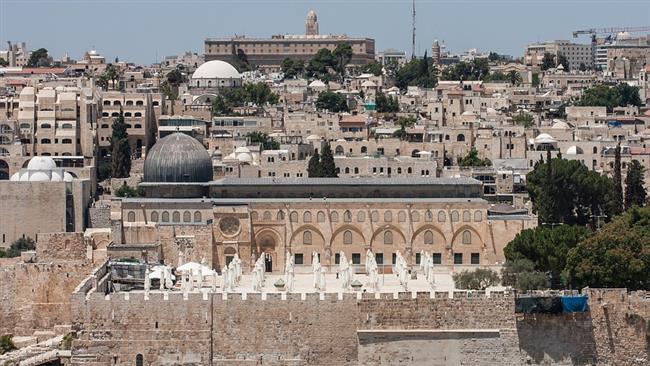
The United Nations General Assembly has voted to declare as null any Israeli measure to practice jurisdiction over Jerusalem al-Quds, days before US President Donald Trump decides whether he would relocate the US embassy to the occupied city.
In a rare show of unity against the Tel Aviv regime, 151 countries voted on Thursday to adopt a resolution that denounced Israel as the “occupying power” of the Jerusalem al-Quds, a city that is holy to Muslims, Christians, and Jews alike.
“Any actions taken by Israel, the occupying Power, to impose its laws, jurisdiction and administration on the Holy City of Jerusalem are illegal and therefore null and void and have no validity whatsoever,” read the resolution.
The UN members also urged Tel Aviv to show “respect for the historic status quo at the holy places of Jerusalem, including the Haram al-Sharif, in word and practice,” referring to a hill in Jerusalem al-Quds where the al-Aqsa Mosque is located.
Israel lays claim to the entirety of Jerusalem al-Quds as its “capital” while Palestinians want its eastern part as the capital of a future state for themselves.
The city has seen tensions since 2015, when the Israeli military introduced restrictions on the entry of Palestinian worshipers into the al-Aqsa Mosque — Islam’s third holiest site. Over 300 Palestinians have lost their lives at the hands of Israeli soldiers ever since.
Last year, it was reported that Israel has been omitting from the city’s maps significant Muslim and Christian holy sites and entire neighborhoods in the area while highlighting dozens of sites with dubious historical importance.
Only five countries — the US, Canada, the Marshall Islands, Micronesia and Nauru — opposed the Thursday resolution at the UN, which was also voted down by Israel’s UN envoy. Nine countries also abstained.
US embassy relocation
The strong-worded statement by the UN came days before Trump has to make up his mind over moving the US embassy from Tel Aviv to Jerusalem.
Since US Congress ruled in 1995 that the embassy be relocated from Tel Aviv, every president has deferred the tough decision. The act contains a clause that allows the president to renew a six-month waiver on the decision.
US Vice President Mike Pence says his boss, Donald Trump, is considering “when and how” to move the US embassy to Jerusalem al-Quds as a Friday deadline approaches.
Palestinians have warned that the potential relocation would fuel strong reaction in the region and deliver a death blow to any prospect of resolving the Israeli- Palestinian conflict.
December 1, 2017
Posted by aletho |
Ethnic Cleansing, Racism, Zionism, Illegal Occupation | Israel, Jerusalem, Marshall Islands, Micronesia, Nauru, Palestine, United Nations, United States, Zionism |
Leave a comment
The United States does not consider itself constrained by the UN Security Council and may seek “justice” in Syria on its own terms, says the US representative to the UN, Nikki Haley.
Haley said on Friday that with or without unity of the council, Washington “will continue to fight for justice and accountability in Syria.”
She made the remarks after Russia vetoed a UN resolution that sought to extend the mandate of the international investigation into chemical weapons use in Syria.
The mandate for the US-drafted resolution, known as Joint Investigative Mechanism (JIM), expired on Friday. This was the third time in a month Russia vetoed attempts at the UN to extend the inquiry.
The council’s permanent member, Russia agreed to the creation of the investigation two years ago, but it has consistently questioned its work and conclusions. It has repeatedly cited flaws in the work on instigators.
Russia’s UN ambassador Vassily Nebenzia said on Friday that the investigation could only be extended if “fundamental flaws in its work” were fixed. He said that for the past two year the investigators had “rubber-stamped baseless accusations against Syria.”
They accused Syrian President Bashar Assad of using chemical weapons against his own people. Syria, however, has repeatedly denied the allegations.
Haley further said that Russia in recent weeks, has been trying “to delay, to distract and ultimately to defeat the effort to secure accountability for chemical weapons attacks in Syria.”
“Russia is wasting our time,” she argued.
Her remarks provoked an angry response from Russian Foreign Minister Sergei Lavrov, who accused her of having engaged in a “fake diplomacy.”
“It seems we are witnessing a new phenomenon in international relations, as now, apart from fake news, there is also fake diplomacy,” Lavrov said.
The US has long history of taking actions in Middle Eastern countries with no mandate from the United Nations. Back in August 2014, Washington along with some of its allies launched a campaign of airstrikes against what are said to be Daesh positions inside Iraq.
The coalition expanded its campaign to Syria in 2014 without any authorization from the Damascus government or a UN mandate.
US Defense Secretary James Mattis claimed on Monday that “the UN said that … basically we can go after ISIS (Daesh). And we’re there to take them out.”
Lavrov, however, rejected his remarks on Thursday, saying the US presence in Syria “is illegitimate because it does not rely either on the decision of the UN Security Council or on the invitation of the legitimate government.” He said that there was no Security Council resolution that allowed US troops on the Syrian territory.
The us airstrikes have on many occasions–both in Iraq and Syria– resulted in civilian casualties and failed to fulfill their declared aim of countering terrorism.
November 18, 2017
Posted by aletho |
Mainstream Media, Warmongering | Russia, Syria, United Nations, United States |
Leave a comment
Palestine’s Ambassador to UNESCO, Mounir Anastas, has won the election for the post of Rapporteur for the organisation’s Cultural Committee, Quds Press has reported. The result was announced on Thursday.
An Italian official has been elected as President of the Committee, with representatives of Venezuela, Albania, the Philippines and Zambia taking positions as members.
During its meeting, the Committee agreed unanimously, without the need for a vote, on a resolution to maintain the cultural heritage of Jerusalem’s Old City. The resolution called for an interactive monitoring delegation to be sent to the Old City in order to evaluate the situation and carry out a work plan and prepare advice on the measures needed to be taken in cooperation with all interested parties.
Members of the committee expressed their concern about official procrastination over the implementation of UNESCO’s executive council decisions regarding Jerusalem’s Old City, which is still under Israeli occupation.
In October 2017, UNESCO’s largest donor, the US, confirmed that it would be withdrawing, explicitly citing the reason as UNESCO’s anti-Israel resolutions. It will instead establish an observer mission at the Paris-based organisation to replace its representation.
November 11, 2017
Posted by aletho |
Ethnic Cleansing, Racism, Zionism | Israel, Jerusalem, Palestine, United Nations, United States |
Leave a comment

U.S. Permanent Representative to the UN, Nikki Haley meets Israeli Prime Minister Benjamin Netanyahu at his office in Jerusalem, June 7, 2017. Image credit: U.S. Embassy Tel Aviv/ flickr
Last month, US Ambassador to the UN Nikki Haley stated that, should Rex Tillerson find himself cashiered, she would not replace him as secretary of state. “I want to be where I’m most effective,” she said. Whatever that means, we can all breath a sigh of relief. With the intellectual capacity of Sarah Palin, Haley is as clueless, and thus as dangerous, as they come. Her commitment to alternative facts (of the sort the US government has been churning out for decades) is absolute; lest we forget, she reminds us every time she opens her mouth. Depending on the mood I’m in, a Haley speech is either infuriating or darkly comedic. Indeed, many of them could double as trenchant satire, and it is sometimes easy (and comforting) to forget that she is actually speaking on behalf of a global empire.
Haley’s latest performance, a speech to the Israeli-American Council, ought to come with a warning advising viewer discretion, so divorced is it from reality. As the name suggests, the Israeli-American Council is yet another space for Zionist fanatics to reaffirm their love of Israel and, by implication, their hatred of Palestinians, who surely deserve all that they get—or rather don’t deserve what Israel takes, namely arable land, water resources, self-determination, national dignity, individual livelihood and, for many, life itself.
You’ll recall, if I may digress, that in its most recent military attack on Gaza, which took place in the summer of 2014, the IDF killed over 2,000 Palestinians, of whom 1391 were civilians. That’s twenty-eight civilians per day. “Of the Palestinians killed who did not take part in the hostilities,” B’tselem, reported, “180 were babies, toddlers, and children under the age of six. Another 346 were children from age six through seventeen, and 247 were women between the ages of 18 and 59. Another 113 were men and women over the age of sixty.” Which is to say nothing of the hundreds of thousands of Gazans who were displaced, or of the immense damage done to Gazan homes and infrastructure.
By comparison, seventy Israelis were killed in the fighting, sixty-four of them soldiers.
The sheer brutality of Operation “Protective Edge,” as the Israeli’s euphemized the slaughter, made it impossible for any remotely decent human being to rationalize. As the world looked on in disgust, and human rights organizations condemned Israel’s war crimes, then-President Barack Obama (who everyone is so very nostalgic about) droned on about Israel’s “right to defend itself.” “No nation should accept rockets being fired into its borders, or terrorists tunneling into its territory,” he declared, adding, “we are hopeful that Israel will continue to approach this process in a way that minimizes civilian casualties.” The key word there, continue, implies that Obama was satisfied with the IDF’s tactics. In his view, civilian casualties were in fact being “minimized.”
Not to be outdone, Hillary Clinton (another liberal superhero) took things a step further, stating that “Israel did what it had to do to respond to the rockets,” and that “ultimately the responsibility [for all the dead civilians] rests with Hamas.” Hillary went on to cite the “fog of war” as a reason to disregard reports of Israeli atrocities, which were only being denounced, she said, because they were committed by Jews. At the end of the day, “you can’t ever discount anti-Semitism.” Right on, Hil.
Therein lies the essence of the “special relationship” between the US and Israel: Israel runs amok, and the US exploits its status as global superpower to see that there are no repercussions. That’s not quite good enough for the Israel lobby, however (it’s never enough), so the US throws in $4 billion in free military aid every year. After all, “vulnerable” Israel, with its illegal cache of 400 nuclear weapons, faces an existential threat from “hegemonic” Iran, which has zero nuclear weapons and has never invaded another country.
This arrangement would perhaps make sense—from a cynical point of view—if it was mutually beneficial. But of course it’s not. Quite the reverse, actually. The United States’ unswerving support for Israel, along with its own blood-drenched legacy in the Middle East, has made it the primary target for Wahhabi terrorists. If you don’t believe me, read Osama bin Laden’s “Letter to America,” in which American support for the Israeli occupation of Palestine is cited as his number one justification for 9/11. Bin Laden was obsessed with Israel-Palestine, as was/is Ramzi Yousef, who bombed the World Trade Center in 1993. That nothing can justify such acts of mass murder is beside the point: the point is that, by enabling Israel (a morally reprehensible act in itself), the US government puts its own citizens in the crosshairs—for nothing. It’s all risk and no reward. You can decide for yourself whether you think it’s worth it.
With that said, Israel does occasionally pretend to show gratitude for the United States’ masochistic generosity. Getting back to Haley, she opened her speech to the IAC by highlighting the fact that Israel is the only country in the world that supports our decades-long economic war on Cuba. Last week, another UN resolution was adopted calling for an end to the embargo. “The whole world sides with Cuba. Well, almost the whole world. The vote this year was 191 to 2,” Haley said with perverse delight. “Only Israel stood with America against the brutal regime in Cuba.” This strange boast triggered a round of applause from the audience. Then Haley went in for a joke, employing a tone and expression reminiscent of a 1950s TV commercial: “You know what they say: quality is more important than quantity.”
It doesn’t really get more bizarre than this. Here we have a matter of great geopolitical import, and the American empire’s ambassador to the UN is cracking lame soccer mom jokes to an audience of American Zionists. Is she sincerely proud of the fact that the US and Israel stand isolated on this issue? Does she actually believe that the rest of the world is in the wrong, and that only the US and Israel are able to perceive the moral righteousness inherent in strangling the Cuban economy? Does she have any clue as to why the embargo was imposed in the first place? Why it’s still being imposed more than fifty years later? I think the answer to the first two questions is yes, and I’m certain the answer to the second two is no. Our ambassador to the UN, who our whack-job president reportedly wants as his secretary of state, is a half-wit. She’s completely out of her depth and she doesn’t even know it.
It goes without saying that Haley pandered throughout her speech; when she wasn’t offering fulsome praise of Israel and Jewish people she was whining about the UN, a “hostile place” where a “caricature” of Israel has allegedly been painted. The use of “caricature” in this context is obviously, and disgracefully, designed to evoke images of Streicher-esque caricatures of Jews; thus Haley implicitly conflates legitimate criticism of Israel with anti-Semitism, a familiar Zionist tactic. She proceeded to take a shot at Barack Obama, who we have seen was an avid apologist for Israeli terror. Nevertheless, he can never be forgiven for refusing to veto a non-binding (i.e. meaningless) Security Council resolution demanding that Israel cease its settlement activity in the occupied territories. To reiterate: the Obama administration did not vote in favor of the resolution; they merely neglected to veto it (Obama vetoed an identical resolution in 2011). With the US abstaining, it passed, and Netanyahu promptly announced that Israel would be expanding settlements deeper into the West Bank, demonstrating again that Israel is a rogue state with no regard for international law.
Letting the resolution pass, Haley said, “was a cowardly act, and a real low point for America at the UN.” Almost as low as the song and dance she performed before the Security Council in the wake of the chemical incident in Khan Sheikhoun, Syria, wherein she exploited images of dead children to whip up public hysteria and garner support for Trump’s cruise missile attack, an illegal act of aggression promoted with vim by the major media.
Haley’s speech of course included all the usual platitudes regarding Iran. You know the drill: Iran supports terrorists, Iran supports Assad, Iran is testing missiles, Iran is arming the Houthis in Yemen, Iran is allied with Hezbollah, the nuclear agreement is bad news, blah, blah, blah. Referencing Trump’s decision to let Congress “review” the multilateral nuclear deal and decide unilaterally whether it needs to be modified (or scrapped altogether, despite Iran’s full compliance with its terms), Haley said: “Congress now has the opportunity to bring the debate about the Iran nuclear deal out from the fantasy world created by the Obama echo-chamber and into the real world where it belongs.” Again, one stands in awe of her utter lack of self-awareness.
Haley and I do agree on one thing: the UN Human Rights Council is a joke. Not because, as Haley says, it seeks to discourage businesses from operating out of illegal Israeli settlements, but rather because countries like Saudi Arabia, a staunch US ally and one of the worst human rights violators on the planet, have seats on the council. Needless to say, Haley’s speech included no reference to Saudi war crimes in Yemen, where over 5,000 civilians have been killed since 2015, the vast majority of them by the Saudi-led—and US-supported—coalition. Millions more are suffering from famine, while thousands of new cases of cholera are reported every day.
“There simply is no explanation the USA or other countries such as the UK and France can give to justify the continued flow of weapons to the Saudi Arabia-led coalition for use in the conflict in Yemen,” an exasperated Amnesty International representative said in September. “It has time and time again committed serious violations of international law, including war crimes, over the past 30 months, with devastating consequences for the civilian population.”
I think it’s safe to say Nikki Haley won’t be presenting images of dead or starving Yemeni children to the Security Council. At least not until we have reason to invade Saudi Arabia.
November 7, 2017
Posted by aletho |
Ethnic Cleansing, Racism, Zionism, Illegal Occupation, Timeless or most popular, War Crimes | Israel, Nikki Haley, Palestine, United Nations, United States, Zionism |
Leave a comment
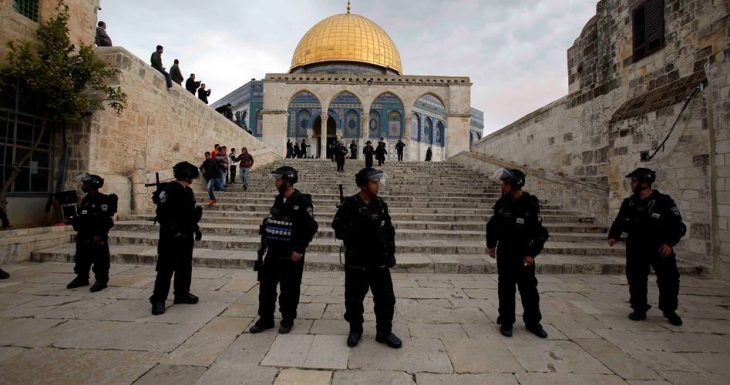
A UN human rights expert has accused Israel of violating a number of international laws and resolutions while suggesting legal action, including travel bans, against the Middle Eastern state. Tel Aviv countered by saying the UNHRC “has lost all touch with reality.”
“Israel’s role as occupier in the Palestinian Territory – the West Bank, including East Jerusalem, and Gaza – has crossed a red line into illegality,” said Canadian law professor Michael Lynk, who is the UN’s Special Rapporteur on the situation of human rights in the Occupied Palestinian Territories.
Presenting his latest report to the UN General Assembly in New York, the expert described Israel’s actions in the region as “the longest-lasting military occupation in the modern world.” He then suggested the UN proceed with relevant international legal processes to force Israel change its policy, which so far “shows no signs of ending.”
In order to do so, the UN should seek to proclaim the occupation of Palestine illegal. As a first step, he suggests that the UN request the International Court of Justice to offer its assessment of the situation.
As things stand, Israel is regarded “as the lawful occupant of the Palestinian territories,” he pointed out, saying that this position does not correspond with reality.
Israel’s actions are “in defiance of 40 plus resolutions of the [UN] Security Council, 100 plus resolutions of the General Assembly, and rulings of the International Court of Justice,” Lynk underlined. He added that the current “focus” on the Israeli-Palestinian issue “is not anti-Israel, it’s an anti-occupation.”
Once Israel’s actions are officially pronounced illegal, the international community could put pressure on Tel Aviv through suspending certain forms of cooperation.
“Only when the Israelis need visas to travel abroad and don’t receive them, only when the EU trade with Israel is limited and only when cooperation in academic, military and economic fields with Israel comes to an end – only then will we see a real change,” Lynk explained at a news conference Thursday.
Israel’s envoy to the UN, Danny Danon, strongly condemned the special rapporteur’s claims, saying the UN body Lynk represents “has lost its legitimacy.”
“[UNHRC] focuses obsessively on attacking Israel instead of working on resolving the real human rights problems plaguing the world,” Danon said in a statement as quoted by the Israeli media. “The Council has lost all touch with reality,” he added.
However, according to the UN special rapporteur, calls to end the occupation of Palestine also emanate from within Israel. The UN official in particular cited the publisher of Israel’s Haaretz newspaper, Amos Schocken, who said international pressure “is precisely the force” that can help change things in the crisis.
The UN has recently included some of the biggest Israeli and international firms operating in the West Bank, East Jerusalem and the Golan Heights on a blacklist of those violating “international law and UN resolutions.”
Some 130 Israeli companies as well as dozens of international firms and corporations have already received warnings from the UN High Commissioner for Human Rights, Zeid bin Ra’ad al-Hussein, on impending inclusion on the list, according to the Israeli outlet, Ynet News.
Earlier in October, Israel approved construction of over 30 new settlements in the UNESCO-protected city of Hebron, which is the largest Palestinian community in the West Bank.
Read more:
October 27, 2017
Posted by aletho |
Ethnic Cleansing, Racism, Zionism, Illegal Occupation | Human rights, Israel, Jerusalem, Palestine, United Nations, West Bank, Zionism |
Leave a comment
The United Nations (UN) has included some of the biggest Israeli and international firms operating in the West Bank, East Jerusalem, and the Golan Heights in a blacklist for those violating “international law and UN resolutions.”
According to Israeli Ynet News which has gained access to part of the list, 130 Israeli companies and 60 international corporations received warning letters from the United Nations High Commissioner for Human Rights Zeid bin Ra’ad al-Hussein about their impending inclusion on the blacklist.
The list, which reportedly will be published in late December includes Israel Aerospace Industries, telecom giants, international tech firms, banks, and even cafes.
Israel Aerospace Industries, Hewlett-Packard, the Israeli branches of Motorola and HP, the Dead Sea cosmetics firm Ahava, the Cellcom and Partner telecommunications companies are among those listed. Israel’s two largest banks, Hapoalim and Leumi, are also said to be on the list.
Israeli Channel 2 News has reported that among the American firms that received letters were Coca-Cola, TripAdvisor, Airbnb, and Caterpillar.
The US ambassador to the UN Nikki Haley condemned the blacklist as “the latest in this long line of shameful actions” taken by the United Nations Human Rights Council (UNHRC). In June Haley warned the US could withdraw from the 47-member body.
“It may cause large investment firms or pension funds carrying stocks of various Israeli companies to divest in them because they, in turn, operate in the settlements,” an unnamed senior Israeli official told Ynet, adding “it may lead to a snowball effect that will greatly harm the Israeli economy eventually.”
The companies say the list’s creation was politically motivated and their inclusion may cause them financial harm and tarnish their brand. They are reportedly looking into filing lawsuits against the Commissioner and the UNHRC.
In September, the UN Commissioner warned over 150 companies that their activities in the “occupied Palestinian territories” may see them added to a blacklist of companies as “they operate in opposition to international law and in opposition of UN resolutions.”
The UN Human Rights Commission voted in March for the resolution being pushed by the Palestinian Authority and Arab nations, according to which the commission would formulate a database of Israeli and international firms directly or indirectly doing business in the West Bank, East Jerusalem or the Golan Heights. The decision passed despite pressure and criticism from the US.
October 26, 2017
Posted by aletho |
Ethnic Cleansing, Racism, Zionism, Illegal Occupation | Human rights, Israeli settlement, Palestine, United Nations, Zionism |
Leave a comment
Economic sanctions are an instrument of coercion used to make one state comply with another’s wishes. The United States is by far the largest implementer of economic sanctions in the world. It is virtually the only country that imposes unilateral sanctions, certainly the only one that does so with any regularity. The US has imposed more sanctions than the other countries/entities put together. Washington sees restrictions as a low-cost method to accomplish foreign policy goals, despite the fact that the measures affect common people. The policy damages international relations and backfires exacting a high price in terms of lost jobs and trade opportunities.
The US sanctions policy came under sharp criticism in the United Nations. Addressing the UN General Assembly on October 18, United Nations Human Rights Council’s Special Rapporteur Idriss Jazairy said “Damaging a country’s economy with sanctions usually leads to violations of the rights of ordinary people. Sanctions are disruptive for any State, and can have a particularly devastating impact on the citizens of developing countries when they impair the economy.” He expressed concern about sanctions which had an impact outside the territory being targeted. “It is well established that sanctions which apply to parties outside of the dispute are illegal, but sanctions which lead to human rights violations also create an obligation on the imposing state to take measures to repair the harm they have caused,” the expert noted.
Reporting on his visit to Russia in April, Jazairy said sanctions had not achieved the desired effect but had damaged others. “It appears that sanctions have not changed Russia’s position, but instead have caused economic losses for agricultural producers in both the EU and Russia,” he noted, adding “Serious, credible dialogue and negotiations are needed to resolve political issues, without creating additional harm for farmers.”
Jazairy urged the UN member states to adopt a Declaration on Unilateral Coercive Measures and the Rule of Law, which would set out shared principles on the use of sanctions and international law, renewing the call for a registry of sanctions, to bring greater transparency to the practice. “A registry would allow States, civil society and any other interested parties to know at all times what sanctions are in place, helping companies to conduct their businesses, and ensuring the sanctions meet human rights standards,” he said.
In his report (A/HRC/33/48) issued in September, the rapporteur urged the Human Rights Council and the UN General Assembly, through a solemn Declaration, to reaffirm “the right of victims to an effective remedy, including appropriate and effective financial compensation, in all situations where their human rights are affected by unilateral coercive measures.” The report also highlighted the importance of setting up a consolidated central register within the UN system of all the international sanctions in force, adding that these findings should be made public. This mechanism, which would enhance transparency and accountability, could draw on the model of the United Nations Register of Conventional Arms set up in 1991.
A new research by the Austrian Institute of Economic Research (WIFO) suggests the EU’s economic sanctions against Russia introduced three years ago have cost European countries billions of euros. The survey, which was conducted at the request of the European Parliament, and published on October 6, showed that the EU has lost €30bn due to sanctions.
Unilateral sanctions are increasingly ineffective in a more globalized economy. The United States has imposed many different sanctions against Russia but there are many more nations ready to boost economic cooperation with Moscow. The US has got a reputation for imposing economic sanctions liberally making other nations reluctant to do business with it. European leaders and much of the rest of the world view economic sanctions as counterproductive and generally favor them only in extraordinary circumstances, such as war. In July, France’s foreign ministry said new US penalties against Iran and Russia appeared at odds with international law due to their extra-territorial reach.
From a legal point of view, only the UN Security Council has the right to impose sanctions against a state. Unilateral coercive measures violate the spirit and letter of the UN Charter, in particular its preamble and Articles 1 and 2. The organization rests on the principle of equality of all its member states. A state can resort to sanctions for self-defense purposes but Russia did not attack the United States. Thus, the United States is destroying the integrity of international organizations and agreements to which it is a party.
For instance, the policy of sanctions runs counter to the WTO fundamental principle of trade free of discrimination, which envisages respect for market principles and honest competition. Parties should maintain government restraints on the movement of goods at a minimum, and if changed, the restraints should be reduced, not increased. The conditions of trade, including the level of tariffs and other, must be discussed and agreed on within a multilateral framework.
In theory, a state complaint procedure of the UN Human Rights committee could be launched according to Article 41 of the International Covenant on Civil and Political Rights – that way the UN would have to deal with the matter. The US has recently announced its intent to drop out from the United Nations Human Rights Council. This month it left UNESCO. No surprise as the idea to leave the United Nations has been floating in the US for some time. In January, 2017, Alabama congressman Mike Rogers sponsored the American Sovereignty Restoration Act of 2017, referred to the House, which calls to leave the United Nations. Utah state representative Don Bush, has claimed that many programs by the supranational entity have violated the US Constitution, such as the implementation of the International Court of Justice and the Law of the Sea Treaty, both of which the United States does not currently endorse. Much has been said in the United States about Russia’s international isolation. In practice, the United States, not Russia, is getting increasingly isolated internationally.
October 22, 2017
Posted by aletho |
Economics, War Crimes | Sanctions against Iran, United Nations, United States |
Leave a comment

 Aletho News