Russia submits resolution to UN on chemical weapons attack in Syria
By Adam Garrie | The Duran | April 6, 2017
Russia has tabled a UN Security Council resolution calling for a through investigation of the chemical weapons incident in Idlib Governorate.
Vladimir Safronkov, Russia’s acting Ambassador to the UN who has stepped in to fill the position of the late Vitaly Churkin has said,
“… we submitted our short draft resolution, drawn up in a business manner and aimed at conducting a true investigation rather than to appoint the guilty ones until the facts are established”.
The Russian draft resolution proposes to,
“… fully investigate the reports about the incident on the ground under the mandatory condition that the list of investigators will be submitted to the UN for approval and will be geographically balanced as well”
This is in sharp contrast to the US-UK-France co-sponsored resolution which automatically assigned blame to the Syrian government in spite of clear evidence to the contrary. That resolution was vetoed by Russia.
The Russian resolution calls for the Organisation for the Prohibition of Chemical Weapons, the group which helped the Syrian government to remove the remains of its chemical weapons stockpiles in 2013, to explore this incident.
It also demands that illegal terrorist groups cooperate with investigations, something which may not be possible.
This response is similar to Russia’s reaction to the use of chemical weapons in Donbass by forces loyal to the Kiev regime. At that time Russia called for an investigation rather than a war.
UN experts warn Saudi Arabia against demolition of Shia neighborhood
Press TV – April 6, 2017
UN rapporteurs have urged Saudi Arabia to immediately halt a planned demolition of an entire 400-year-old neighborhood inhabited by the kingdom’s Shia Muslim minority.
The UN experts warned that the so-called development plan for the historic neighborhood of al-Masora in the village of Awamia in the eastern province of Qatif threatens the historical and cultural heritage of the area with irreparable harm.
They said such a move would lead to forced eviction of 2,000 to 3,000 people from their businesses and residences.
“The area is of importance not only to local people and the entire cultural landscape of Awamia, but also has national significance for the history and cultural heritage of Saudi Arabia,” said the UN Special Rapporteur in the field of cultural rights, Karima Bennoune.
“The planned demolition would erase this unique regional heritage in an irreversible manner,” she pointed out.
Masora is considered a historical model of a walled village, including mosques, farms and farmers markets, places of worship for Shia Muslims, ‘Hussainiyats’, and businesses. It has been of great interest for researchers and experts in the fields of heritage and archaeology.
The imminent demolition of the entire neighborhood is part of a so-called development plan aimed at transforming Masora from a mainly residential neighborhood to a commercial and service zone.
Local residents are concerned that the plan will exacerbate the existing housing crisis and lead to a rise in real estate prices, as the plan does not include the construction of residential buildings.
“Residents have been pressured in many ways, including through power cuts, to vacate their homes and businesses without adequate alternative resettlement options, leaving them at best with insufficient compensation and at worst, with nowhere to go,” said the UN Special Rapporteur on the right to adequate housing, Leilani Farha.
“Demolitions must never lead to homelessness of the evicted persons, so the authorities have to ensure the provision of adequate alternative housing facilities, resettlement and compensation for lost property,” she added.
The UN Special Rapporteur on extreme poverty, Philip Alston, warned about the ramifications of the demolition on the standard of living of Masora residents.
“If implemented, the plan will remove people from the areas where they live and work, resulting in loss of livelihood and difficulty in securing housing,” he said.
The experts also raised concerns over the lack of “any meaningful consultation” with the residents, and the absence of less damaging alternatives, like restoration.
“The Saudi authorities must take all necessary steps to guarantee cultural rights, including the right to the enjoyment of and access to cultural heritage, and the right to an adequate standard of living, including housing, in accordance with international human rights laws and standards,” the UN experts said in a statement.
“They must halt all ongoing demolition works that do not meet these standards and cancel any planned in the future,” the statement said.
Citizens of Qatif and other oil-rich regions of eastern Saudi Arabia have for long lamented about discrimination against them. International rights campaigners have also called on Riyadh to stop the persecution of members of the Shia community, saying they should enjoy more freedom in expressing their religious beliefs.
Idlib chemical attack: A sign no change of policy is on the horizon
By Kit | OffGuardian | April 5, 2017
The alleged chemical attack, reported yesterday, is the latest in a series of atrocities notionally carried out by the Syrian government (“The Regime”, in the partisan parlance of the press). There has not been time, as yet, to fully examine and analyse all the evidence – the claims and counter claims, the photographs and videos – but it would be a massive mistake to view it in a vacuum.
First, the situation on the ground needs to be considered. The Syrian government – with assistance from Iran and the Russian Air Force, have been making steady progress for months. Aleppo has fallen. Palmyra was retaken. The rebels are losing. So cui bono? What good does dropping chemical weapons on children do Assad, at this point? It is both strategically pointless, and a crushing blow to his international image. It would serve no purpose, unless he’s a comic-book style villain intent on being cruel for cruelty’s sake – and they don’t exist outside of cinema or the American press. Conversely, it would make all the sense in the world for cornered zealots and mercs to try to disrupt the upcoming talks (from which they are excluded).
Second, the timing. Much like a previous “chemical attack” (and subsequent BBC Panorama documentary) came on the eve of a commons vote on military intervention in Syria, this attack comes at a key moment. In two days there is a meeting in Brussels on the Syria peace process, and the future of the country. This attack will allow Western leaders – especially the European voices, increasingly separate from the US on this issue – to ride an artificial high-horse into those proceedings. Deals can be scuppered and progress refused in the wake of such “atrocities”.
Third, we have seen this all before. There was the chemical attack in Ghouta, initially pinned on the government (and still unquestioningly attributed to them in the MSM), that was revealed to be carried out by rebels. there was also the aforementioned napalm/chemical attack on a school – thoroughly debunked by Robert Stuart. We have seen the same girl rescued three different times by the White Helmets, and seen people in Egypt arrested for faking footage of bombings. The “last hospital in Aleppo” was knocked down everyday for a month, and the last doctors slaughtered bi-weekly. There is no reason, as yet, to think this is not just more of the same.
This is in fine tradition of media manipulation – from filming people on the outside of a fence and pretending they’re inside, to moving bodies for a better photograph, to deliberately removing an image’s context, and lying about it. Events are ignored, twisted, exaggerated and outright fabricated in order to push an agenda. Accordance with reality is immaterial to the process, and coincidental when it occurs.
Real or not, false flag or not – No one can deny convenience of the timing. Given the conflict the UK/EU find themselves in with the new US administration re: Syria. During the campaign Trump, unlike Clinton, totally refused to countenance the idea of no-fly zones or any kind of American/NATO backed military action against Syria and their Russian/Iranian allies. The last few weeks have seen even a softening of America’s “Assad must go” mantra. Rex Tillerson, speaking in Turkey last week, said:
I think the… longer term status of president Assad will be decided by the Syrian people,”
And the American ambassador to the UN added:
You pick and choose your battles and when we’re looking at this, it’s about changing up priorities and our priority is no longer to sit there and focus on getting Assad out.”
Though she did later clarify these remarks, after being named-and-shamed in the media.
John McCain called Tillerson’s words “one of the more unusual statements I have ever heard”, stating it would be ridiculous to let Syrians decide the fate of Syrian government (probably because they would choose wrong).
The press, of course, have not referenced any of this. They continue to cite the partisan White Helmets and completely discredited “Syrian observatory for Human Rights” as if they are reliable sources. They continue to assert gossip and rumor as if it were fact. They continue to lie, but give themselves just enough room to manoeuvre should their lies be exposed.
The Guardian view on…, one of the Guardian’s anonymous editorials (that definitely don’t come straight from GCHQ, you cynics), is a classic example. The headline reads:
The Guardian view on Syria: Assad knows he acts with impunity
A sharp, hard-edged, statement of absolute certitude… and the only sentence of conviction in the whole piece. The rest is littered with uncertain, selective language. Weasel-words and guesses. I have added the emphasis:
Tuesday’s attack in rebel-held Idlib province has forced a reaction: it is one of the worst suspected chemical attacks in the six-year war
the symptoms suggest the use of a nerve agent, probably sarin
ascertaining the agents used, by whom, is always difficult – particularly given the problems experts will face in accessing the site.
The suspicion is that Tuesday’s strike, like another suspected sarin attack which killed 93 people in eastern Hama in December,
Some have already drawn a link between what seems to be the use of a more deadly agent and the US shift on Syria
That’s an awful lot of “seems” and “suspecteds” to cram into 700 words. It’s a suspected attack, that seems like it might be similar to other suspected attacks, which might have happened. As of right now, it appears, we don’t who attacked, how they attacked, what they attacked with or – indeed – if anyone attacked anything at all.
Nevertheless, the nameless and completely non-partisan and objective author reassures us that:
Nonetheless, the evidence so far points in one direction,
… he just neglects to mention exactly what that evidence is, or tell us where we can find it.
Just hours later we are treated to a longer variation on the exact-same theme, this time the author doesn’t feel ashamed to put his name to it… he probably should be. But years of writing about the Guardian teaches you that Jonathan Freedland is never ashamed of putting his name to anything.
Let’s not even condemn these attacks any more – because our condemnations ring so hollow.
… he says, before condemning the attacks – at interminable length and in trite manipulative language. That these condemnations “ring hollow” might be the only honest words in the article. The level of selective blindness, historical dishonesty, and flat-out hypocrisy is astounding. Even for him,
Assad has himself broken international law, indeed broken a set of precious, century-old conventions and agreements that ban chemical weapons.
… he says, as if a) It was a proven fact and b) It was the only example. No mention of American use of depleted Uranium, Agent Orange or napalm is made. No mention of Israeli White Phosphorus or of the cluster bombs we used in Iraq, and sold to Saudi Arabia to be used on Yemeni civilians. The use of any and all of those substances is illegal under International law. America and Israel cannot be charged with a breach of The Geneva Convention, of course, because they have never ratified protocols I and II, outlawing the targeting of civilians and infrastructure and banning certain weapons.
We are all too aware of the costs of action. But the dead of Khan Sheikhoun force us to make another calculation. They force us to see that inaction too can exact a terrible price.
This could be a straight copy-and-paste job from his many articles on Libya. He made the same arguments back then, and must take partial responsibility for post-apocalyptic wasteland that he (and his colleagues in the media) helped to create. Libya is destroyed, he knows this, and if he could excuse or downplay his role in that destruction… he would do so. To ignore it, and employ the same reasoning to encourage the same fate to yet another Middle-Eastern country, displays a callousness and vanity that belies is saccharine concern for “values”.
However, no amount of faux-moral agonising and dishonesty will ever trump this:
For more than a decade, we have rightly weighed the grave consequences of the 2003 invasion of Iraq, counting the toll in human suffering.
The tone mirrors the same tone ever-taken by members of the Western press when it comes to Iraq. “Our consciences are agony”, they scream at us. As if Iraq was all a tragic accident, fuelled by the fervor of our best intentions and naivety of our governments. They will never address the truth of it – that it was a cynical and brutal war of conquest, cheered on a by braying, controlled media, with more regard for their appearance of virtue, and their bank balances, than any idea of objective truth.
Now, the lame self-flagellation is one thing, but that it should appear alongside this:
Assad’s impunity is, at this very moment, being noted and filed away by the world’s most brutal regimes: the precedent is being set. This is what you can get away with.
… is quite another. The world is VERY aware “what you can get away with” in international law…and it’s not 70 dead in what “seems” like a gas attack. What you can “get away with” is walling up millions of people in a giant ghetto, and cutting off their water and power supply. It’s dropping carcinogens on villages, that give babies tumors 50 years later. It’s illegal sanctions that kill 500,000 children but are “worth it”.
“what you can get away with”, as the author so po-facedly admits, is the invasion of Iraq. An illegal war, a million dead, an ancient seat of civilisation reduced to a glass crater. Was anyone fired? Did anyone resign in disgrace? Has anyone faced charges in the Hague. No, the perpetrators walk free. They collect paychecks from the boards of the most powerful companies in the world, and are given column inches in the Guardian when ever they want them.
In terms of making an actual argument, he hits the exact same talking points as The Guardian view, uses the exact same phrases… and produces the exact same amount of evidence:
… we almost certainly know who did it. Every sign points to the regime of Bashar al-Assad.
He doesn’t say what these “signs” are. Or link to where we can see them.
We know that the poison spread after warplanes dropped bombs
We “know” no such thing. That’s just what the White Helmets said. The White Helmets are paid by the governments of several countries… including the US and UK. They are completely discredited as a source. But this article isn’t about making an evidence-based case, it is about harnessing created public outrage in order to further a specific political agenda.
So, what is the agenda? Well, it won’t be full-blown war in Syria. Number 10 was very quick to – shall we say – shoot-down that idea. It won’t be any kind of overt NATO or American backed intervention… if the PTB had wanted that, they would have pushed harder for a Clinton victory. And Freedland’s reference to Anne-Marie Slaughter’s suggestion is laughable:
Anne-Marie Slaughter, formerly of the Obama administration, suggests a single strike that would crater, say, a runway used by Assad’s warplanes – not an invasion, not a full-scale military operation, but some way of punishing Syria for what it has done.
No, the agenda being pushed here is two-fold, firstly an attack on the UN and its apparent impotence, and secondly a pre-emptive defense of the status quo.
To deal with the first point, the article launches a sidelong attack on the UN Security Council, most specifically the veto power:
In February, the UN security council considered imposing sanctions over the use of chemical weapons. Russia vetoed it, of course: it would never want to stay the hand of its murderous chum. But China vetoed it too.
This is not new material for the Guardian, they have been attacking the UN veto for years now – as have other liberal papers and news outlets. You don’t need to be a genius to understand the drive to undermine the only regulatory body that can put a hold on neo-liberal imperialism. But for the UNSC, Iraq would have been so much easier and Syria would have been levelled by now.
The second point is more subtle. For years the CIA et al have been seeking to remove Assad from government, most openly through supplying arms and money to the “moderate opposition” in order to wage a proxy war. Trump’s election, and his public undermining of the intelligence agencies, poses a threat to this on-going plan.
Now that this chemical attack has happened, of course, Trump’s administration can be condemned for being “soft”. Now, we can call on Trump and his cabinet to “act”… and when they refuse to change their policy, rightfully fearful of a conflict with Russia, they will be further derided and undermined in the press as “Russian agents” who are “easy on tyrants”.
All the while, the covert operations carried out by American and European alphabet agencies all over Syria will continue.
When the State Dept., the CIA and all their co-members of America’s (totally imaginary) “deep state” completely disregard the orders of their Commander-in-Chief, and continue to pursue their own agenda – continue to supply arms and funding to their mercenaries and proxies – they will be applauded in the press for their “bravery” and “resolution”.
We will be encouraged to be “thankful” that the mechanics of democracy and freedom cannot be impeded by the election of an autocratic buffoon. We will be told, with a bright smile, that our choice of leadership means literally nothing as it pertains to foreign policy.
It will be thrown in our faces that our elected officials have no real power, and we will be told to applaud the death of democracy… in the name of freedom.
Iran UN ambassador calls for destruction of all nuclear weapons
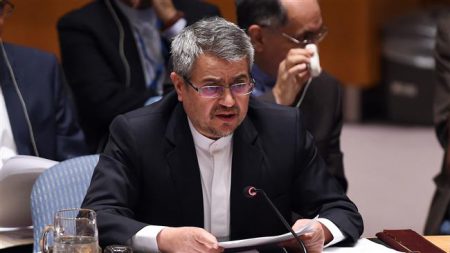
Iran’s ambassador to the UN Gholamali Khoshroo
Press TV – March 29, 2017
Iran’s ambassador to the UN Gholamali Khoshroo has called for the total eradication of nuclear weapons.
Khoshroo reiterated Iran’s call during a UN conference aimed at creating a nuclear weapons ban treaty in New York on Tuesday.
“Iran, as a victim of chemical weapons, strongly feels the danger posed by the existence of weapons of mass destruction and is determined to engage actively in international diplomatic efforts to save humanity from the menace of nuclear weapons,” he said.
Khoshroo stressed that Iran is committed to its Non-Proliferation Treaty (NPT) obligations, which include negotiations based on effective nuclear disarmament measures.
He added that several countries continue to ignore international calls and treaties for nuclear disarmament and even continue to increase their nuclear stockpiles. “They do not have political determination to abandon doctrines of nuclear deterrence and nuclear terror,” he went on to say.
Iran’s UN ambassador noted that boycotting the talks by many countries, including the US, shows that the world’s nuclear powers are by no means committed to the eradication of nuclear arms. Britain and France were also among the some 40 countries that did not join the talks.
“We note that prohibition of nuclear weapons must be accompanied by the elimination of such weapons. There can be no doubt that without complete abolition of nuclear weapons, there will be no absolute guarantee against the danger of nuclear war and the use of such weapons,” Khoshroo added.
‘We had him booted out’: Palestinian won’t get top UN post, US envoy Haley tells AIPAC
RT | March 28, 2017
The US won’t allow a Palestinian to secure “one of the highest positions” at the UN, US ambassador to the United Nations Nikki Haley said, explaining why the US had blocked a former Palestinian prime minister’s appointment to lead the UN’s Libya mission.
“So when they decided to try and put a Palestinian [former Palestinian Prime Minister Salam Fayyad] in one of the highest positions that had ever been given at the UN, we said no and we had him booted out,” Haley said at the annual Policy Conference of the American-Israel Public Affairs Committee (AIPAC) on Monday.
“That doesn’t mean he wasn’t a nice man,” she continued, adding “that doesn’t mean he wasn’t good to America.”
Haley added that, until Palestine “comes to the table, until the UN responds the way they’re supposed to, there are no freebies for the Palestinian Authority anymore.”
Haley added that when the UN passed a resolution demanding an end to Israeli settlement building on occupied Palestinian land, “the entire country felt a kick in the gut.”
“Never do we not have the backs of our friends. We don’t have a greater friend than Israel. And to see that happen was not only embarrassing, it was hurtful,” she said.
Haley also criticized a UN report released in March, in which author Richard Falk, a Princeton professor emeritus, describes Israel as an “apartheid state.”
“And a ridiculous report, the Falk Report, came out. I don’t know who the guy is or what he’s about, but he’s got serious problems. Goes and compares Israel to an apartheid state. So the first thing we do is we call the secretary general and say, this is absolutely ridiculous,” she said.
According to the US ambassador to the UN, the days of “Israel-bashing” are over.
“I wear heels. It’s not for a fashion statement,” she said, explaining “it’s because if I see something wrong, we’re going to kick them every single time. So how are we kicking? We’re kicking by… putting everybody on notice, saying that if you have our back – we’re going to have the backs of our friends, but our friends need to have our back too.”
The US blocked Fayyad’s appointment to lead the UN’s political mission in Libya in February, accusing the United Nations of being “unfairly biased” towards the Palestinian Authority.
Fayyad served as a Palestinian prime minister between 2007 and 2013.
Haley also noted that the Trump administration “was disappointed” by UN Secretary-General Antonio Guterres’ intention to appoint Fayyad as the UN’s next special representative to Libya, which was announced in a letter to the Security Council.
“For too long, the UN has been unfairly biased in favor of the Palestinian Authority to the detriment of our allies in Israel,” Haley said.
Her statement was praised by Israel’s UN ambassador, Danny Danon, who stated that “this is the beginning of a new era at the UN, an era where the US stands firmly behind Israel against any and all attempts to harm the Jewish State.”
Palestine is a non-member observer state at the United Nations, and its independence has been recognized by 137 of the 193 UN member nations so far. Back in February, Haley noted that US doesn’t recognize a Palestinian state “or support the signal” that Fayyad’s appointment would have sent within the United Nations.
In 2011, UNESCO voted to admit Palestine as a full member, noting that the decision had been made as “a mark of respect and confidence.”
READ MORE: US backs Israel by blocking ex-Palestinian PM’s appointment to lead UN mission in Libya
The World Faces a Historic Opportunity to Ban Nuclear Weapons
By Beatrice Fihn, Martin Butcher, and Rasha Abdul Rahim | Inter Press Service | March 24, 2017
Nuclear weapons are once again high on the international agenda, and experts note that the risk of a nuclear detonation is the highest since the Cold War.
As global tensions, uncertainty and risks of conflict rise amongst nuclear-armed states, nuclear weapons are treated as sabres to rattle, further heightening the risks of intentional or inadvertent use.
Nuclear weapons are the most destructive, inhumane and indiscriminate weapons ever created. Both in terms of the scale of the immediate devastation they cause and the threat of a uniquely persistent, pervasive and genetically damaging radioactive fallout, they would cause unacceptable harm to civilians.
But while the nuclear-armed states are implementing policies based on unpredictability, nationalism and weakening of international institutions, the majority of the world’s states are preparing to finally outlaw nuclear weapons.
Setsuko Thurlow, a survivor of Hiroshima, described the nuclear bombing as blinding the whole city with its flash, being flattened by a hurricane-like blast, and burned in the 4,000-degree Celsius heat. She said a bright summer morning turned to a dark twilight in seconds with smoke and dust rising from the mushroom cloud, and the dead and injured covering the ground, begging desperately for water, and receiving no medical care at all. The spreading firestorm and the foul stench of burnt flesh filled the air.
A single nuclear bomb detonated over a large city could kill millions of people and cause catastrophic and long-term damage to the environment. The use of tens or hundreds of nuclear bombs would be cataclysmic, severely disrupting the global climate and causing widespread famine.
Strikes of this kind would invariably violate international humanitarian law and international human rights law, yet, these weapons are still not explicitly and universally prohibited under international law. Nine states are known to possess them and many more continue to rely on them through military alliances.
The alarming evidence presented by physicians, physicists, climate scientists, human rights organisations, humanitarian agencies, and survivors of nuclear weapons attacks have been successful in changing the discourse, and opened space for greater engagement from civil society, international organisations, and states.
Because the humanitarian and environmental consequences of using nuclear weapons would be global and catastrophic, eliminating such dangers is the responsibility of all governments in accordance with their obligation to ensure respect for international humanitarian law.
The world is now facing a historic opportunity to prohibit nuclear weapons.
In October last year, a majority of the world’s states at the United Nations General Assembly agreed to start negotiations of a new legally binding treaty to prohibit nuclear weapons, in line with other treaties that prohibit chemical and biological weapons, landmines and cluster munitions.
As we’ve seen with these weapons, an international prohibition has created a strong norm against their use and speed up their elimination.
The negotiations will start at the United Nations in New York on 27-31 March, and continue on 15 June-7 July, with the aim of concluding a legally binding instrument to prohibit nuclear weapons.
Amnesty International, Oxfam and the International Campaign to Abolish Nuclear Weapons (ICAN) believe that it is time to negotiate a treaty that would prohibit the use, possession, production and transfer of nuclear weapons, given their indiscriminate nature. No state, including permanent members of the UN Security Council, should possess nuclear weapons.
This is the moment to stand up for international law, multilateralism and international institutions. All governments should seize this opportunity and participate actively in the negotiations of a treaty prohibiting nuclear weapons in 2017.
Out in the Open: Jewish Power Rears Ugly Head in Censoring of UN Report

By Richard Edmondson | Fig Trees and Vineyards | March 20, 2017
Recent developments at the United Nations–(with regard to the censoring of a report on Israeli apartheid and the resignation of a high-ranking UN official who had been ordered to repudiate it)–should be viewed in the context of remarks made earlier this month by Alan Dershowitz.
Speaking at an anti-BDS conference in Los Angeles, the former Harvard Law School professor and now CNN contributor offered the following advice to his fellow Jews:
People say Jews are too powerful, we’re too strong, we’re too rich. We control the media. We have too much this. We have too much that. And we often apologetically deny our strength and our power. Don’t do that. Don’t do that. We have earned the right to influence public debate.
As you can tell from the above video, the event where Dershowitz made those remarks was sponsored by Stand With Us, a Zionist lobby organization based in Los Angeles. Entitled, “Combating the Boycott Movement Against Israel,” the conference took place March 4-6 and was billed as “the crucial counter BDS conference.” Admission was $500 per person for “regular attendees” and $1,000 for “VIPs.”
“All registration levels include five gourmet kosher meals, all sessions, and materials,” reads the online promotional brochure. “VIP rates also include a private reception with Alan Dershowitz and other BDS experts, preferred seating throughout the conference, and valet parking.”
The conference is said to have been attended by more than 250 people. Less than two weeks later, on March 15, a UN organization, the Economic and Social Commission for Western Asia, published a report concluding that Israel imposes a policy of apartheid against the Palestinians–hardly a controversial allegation in this day and age. Yet the New York Times described it as “a politically explosive assertion” and said that the release of the report had “led to furious denunciations by Israel and the United States.”
Two days later, on Friday, March 17, Rima Khalaf resigned as head of the ESCWA after being ordered by UN Secretary General Antonio Guterres to withdraw the report. That same day, the report was removed from the UN’s website. The Israeli lobby had once again given the world a not-so-subtle demonstration of its power.
You can go here to read an analysis of the report by Stephen Lendman and here to access an archived copy of the full report (how long it will remain archived at the location is unclear). The report seems well grounded in international law, drawing upon the International Convention on the Suppression and Punishment of the Crime of Apartheid and other international agreements for the basis of its conclusions. Its authors, Richard Falk and Virginia Tilley, both come from a legal and scholarly background, and both were commissioned by the ESCWA to produce the report.
“Although the term ‘apartheid’ was originally associated with the specific instance of South Africa, it now represents a species of crime against humanity under customary international law and the Rome Statute of the International Criminal Court,” they write in the report’s executive summary. They then proceed to quote the pertinent section of the Rome statute:
“The crime of apartheid” means inhumane acts… in the context of an institutionalized regime of systematic oppression and domination by one racial group over any other racial group or groups and committed with the intention of maintaining that regime.
As you can tell, the report was produced in a scholarly manner, but I’d like to return now to the comments of Dershowitz as shown in the video above. What he seems to be saying in effect is that Jews should no longer deny the power they hold. Better to be open about it, maybe even brag on it a little bit. The upside to this, presumably, is that it might help eliminate confusion about who really runs much of the world now. He also seems to feel that being open about Jewish power would enable Jews to more effectively use their power “in the interest of peace,” as he puts it.
Are Jews really using their power to promote peace in the world? In the paragraphs above I initiated what in essence amounts to a timeline beginning with the Stand With Us conference in L.A. That conference took place March 4-6. On March 15 came the UN report, followed by the resignation of Khalaf, on March 17, and the removal of the report from the UN’s website. That’s where I ended, but let’s expand the timeline a bit further and see what happens.
Also on March 17, Israeli war planes crossed into Syrian airspace and carried out a bombing raid at a site near the recently-liberated city of Palmyra. In response, Syria fired upon the Israeli planes using a Russian-supplied air defense system. Claims and counter-claims were made about the incident: Syria says it shot down one of the planes; Israel denies this.
But two days later, on March 19, Israeli Defense Minister Avigdor Lieberman warned that Israel will destroy Syria’s air defenses if it fires on any more Israeli planes. The implication seems to be that Israel assumes to itself the God-given right (and you’ll recall Dershowitz speaking about the “strength” putatively given by the Old Testament god Yahweh) to cross into another country’s airspace and carry out a missile attack whenever it feels like it. This in fact is a point that was made by a writer at Russia Insider :
“The serious exchange of missile fire between Israel and Syria early Friday morning reflects the Assad regime’s attempts to change the unofficial rules of the game.”
So begins a column published in Israel’s Haaretz.
The newspaper is of course referring to the Israeli jets that “breached Syrian air space early in the morning and attacked a military target near Palmyra”, apparently in an attempt to “aid” Islamic State forces.
According to reports, it’s suspected that the Syrian Army responded to this “breach” by firing off a few S-200 missiles.
The writer, Rudy Panko, then goes on to supply a direct quote from the Haaretz opinion piece:
Presumably the Syrian anti-aircraft salvo was a signal to Israel that the regime’s policy of restraint in the face of the airstrikes will not remain as it was. President Bashar Assad’s recent successes – first and foremost the conquest of Aleppo – have seemingly increased the dictator’s confidence. Israel will have to decide whether the operational need – to thwart advanced weapons shipments to Hezbollah – also justifies the possible risk of the downing of an Israeli fighter jet and a broader conflict developing with Syria.
There is an interesting question as to whether the aircraft detection radar system was deployed by Israel’s new great friend, Russia, precisely one week after Prime Minister Benjamin Netanyahu returned from Moscow after yet another successful visit to see President Vladimir Putin.
One can imagine that the intelligence community will also be interested to learn whether the Syrian decision to fire back was coordinated with Assad’s collaborators and partners: Russia, Iran and Hezbollah.
He then makes the point that “Syria’s decision to defend itself from hostile, foreign jets dropping bombs on Syria shows a lack of ‘restraint’ on Assad’s part, according to Haaretz.” A similar point was made by another writer at Russia Insider, who put it perhaps in an even more sarcastic vein:
The moral of this story is: Israeli military jets enjoy diplomatic immunity. Harming them under any circumstances is prohibited by the Geneva Convention, the U.N. Charter, and the U.S. Declaration of Independence.
Carrying the timeline a bit further–as far as we can carry it now–on March 19, the same day Lieberman threatened to destroy Syrian air defenses, an Israeli drone carried out an attack in Syria’s southern province of Quneitra, killing one person; on Monday, March 20, reports came out confirming that Russia had summoned the Israeli ambassador over the March 17 attack in Syria; and also today, news has emerged of yet another Israeli air attack inside Syria–the third in three days–said to have been carried out sometime during the night of March 19-20.
Does it appear, from all of this, that Jews are using their power in the interest of peace? Keep in mind, that the events cited here are from one 20-day period in but one month only. Let’s return to the words of Dershowitz:
“Never ever apologize for using our strength and our influence in the interest of peace,” he says, and then he cites “the psalmist” whom he quotes as saying, “God will give the Jewish people strength…only then will God give the Jewish people peace. Peace will come for the Jewish people and the Jewish nation only through strength. Never apologize for using your strength for peace.”
It’s hard to say which biblical passage Dershowitz is referring to (the word “Jewish” is not found anywhere in the Psalms), but I would venture a guess and say that perhaps it’s a reference to Psalm 118, which reads in part:
All the nations surrounded me, but in the name of the Lord I cut them down. They surrounded me on every side, but in the name of the Lord I cut them down. They swarmed around me like bees, but they were consumed as quickly as burning thorns; in the name of the Lord I cut them down. I was pushed back and about to fall, but the Lord helped me. The Lord is my strength and my defense; he has become my salvation.
The whole passage, and particularly the words “all the nations,” would suggest a tribe of people who are at war with the entire world. The notion that such people would use their power to bring about “peace” would seem preposterous and nonsensical.
When the UN report was first released, Israel rushed to invoke the holocaust. According to a Reuters report, “Israel fiercely rejects the allegation and likened the [UN] report to Der Sturmer – a Nazi propaganda publication that was strongly anti-Semitic.” There are two ironies here that need to be pointed out. The first is that Falk, one of the authors of the report, is Jewish. The second has to do with Khalef, a Semitic woman of Arab descent–and that such a woman would be accused of “anti-semitism” by those claiming to be Jews but who are not even Semites. How do people who are descended from the Khazars of southern Russia, who are not semitic, get away with accusing actual, genuine Semites of being “anti-Semitic”? Does any of this make sense? It doesn’t have to.
The likening of the report to the Nazi publication mentioned is a knee-jerk, emotional reaction that is devoid of logic–but this too is a manifestation of Jewish power: that accusations made by Jews don’t have to be logical. It is enough simply that it is a Jew making them. This alone renders them beyond question.
Below is a discussion on the issue of Israeli apartheid featured a couple of days ago on Press TV. You will note that one of the guests, Brent Budowsky, a columnist for The Hill, not only denies that Israel is an apartheid state, he even denies the existence of Jewish power.
Apparently Budowsky didn’t get the memo about Dershowitz’s speech at the Stand With Us Conference–or perhaps he did get it but had already previously internalized the unspoken principle that while it’s okay for Jews to discuss Jewish power, the same freedom of speech does not apply to Gentiles.
At any rate, Jewish power is real. It immerses us; we are swimming in it. A future awaits us in which we, Americans, could very well find ourselves facing jail time for criticizing Jews or Israel, much as Europeans now are jailed for questioning the holocaust.
But it could be even worse than that. Much worse. Israel is intent on expanding its boundaries from the Nile to the Euphrates, while Zionist Jews in America seem to have a fixation on an even larger goal: complete, total, unchecked and uninhibited global hegemony, and possibly, in the course of trying to achieve this ambition, nuclear war with Russia if it should come to that. Israeli apartheid, the “species of crime” now being committed against the Palestinians, could end up going global… unless we find a way to defeat it.

Text of Resignation Letter by ESCWA Executive Secretary Rima Khalaf

Jadaliyya | March 18, 2017
The following is the resignation letter by ESWA Executive Secretary Rima Khalaf in response to the formal request by UN Secretary General Antonio Guterres that ESCWA withdraw the publication of a scholarly report (below) that found Israel guilty of apartheid.
Dear Mr. Secretary-General,
I have carefully considered your message conveyed through the Chef de Cabinet and assure you that at no point have I questioned your right to order the withdrawal of the report from our website or the fact that all of us working in the Secretariat are subject to the authority of its Secretary-General. Nor do I have any doubts regarding your commitment to human rights in general, or your firm position regarding the rights of the Palestinian people. I also understand the concerns that you have, particularly in these difficult times that leave you little choice.
I am not oblivious to the vicious attacks and threats the UN and you personally were subjected to from powerful Member States as a result of the publication of the ESCWA report “Israeli Practices towards the Palestinian People and the Question of Apartheid”. I do not find it surprising that such Member States, who now have governments with little regard for international norms and values of human rights, will resort to intimidation when they find it hard to defend their unlawful policies and practices. It is only normal for criminals to pressure and attack those who advocate the cause of their victims. I cannot submit to such pressure.
Not by virtue of my being an international official, but simply by virtue of being a decent human being, I believe, like you, in the universal values and principles that have always been the driving force for good in human history, and on which this organization of ours, the United Nations is founded. Like you, I believe that discrimination against anyone due to their religion, skin color, sex or ethnic origin is unacceptable, and that such discrimination cannot be rendered acceptable by the calculations of political expediency or power politics. I also believe people should not only have the freedom to speak truth to power, but they have the duty to do so.
In the space of two months you have instructed me to withdraw two reports produced by ESCWA, not due to any fault found in the reports and probably not because you disagreed with their content, but due to the political pressure by member states who gravely violate the rights of the people of the region.
You have seen first hand that the people of this region are going through a period of suffering unparalleled in their modern history; and that the overwhelming flood of catastrophes today is the result of a stream of injustices that were either ignored, plastered over, or openly endorsed by powerful governments inside and outside the region. Those same governments are the ones pressuring you to silence the voice of truth and the call for justice represented in these reports.
Given the above, I cannot but stand by the findings of ESCWA’s report that Israel has established an apartheid regime that seeks the domination of one racial group over another. The evidence provided by this report drafted by renowned experts is overwhelming. Suffice it to say that none of those who attacked the report had a word to say about its content. I feel it my duty to shed light on the legally inadmissible and morally indefensible fact that an apartheid regime still exists in the 21st century rather than suppressing the evidence. In saying this I claim no moral superiority nor ownership of a more prescient vision. My position might be informed by a lifetime of experiencing the dire consequences of blocking peaceful channels to addressing people’s grievances in our region.
After giving the matter due consideration, I realized that I too have little choice. I cannot withdraw yet another well-researched, well-documented UN work on grave violations of human rights, yet I know that clear instructions by the Secretary-General will have to be implemented promptly. A dilemma that can only be resolved by my stepping down to allow someone else to deliver what I am unable to deliver in good conscience. I know that I have only two more weeks to serve; my resignation is therefore not intended for political pressure. It is simply because I feel it my duty towards the people we serve, towards the UN and towards myself, not to withdraw an honest testimony about an ongoing crime that is at the root of so much human suffering. Therefore, I hereby submit to you my resignation from the United Nations.
Respectfully
Rima Khalaf
Russia calls UNSC meeting, warns against Saudi raid on Yemeni city
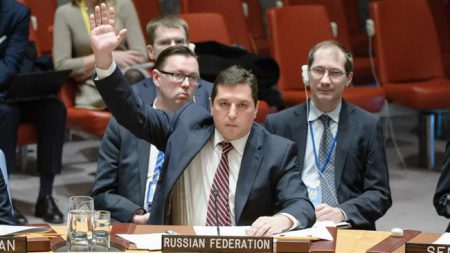
Russian Deputy Permanent Representative to the UN Vladimir Safronkov
Press TV – March 18, 2017
During a meeting of the UN Security Council convened by Russia, the Kremlin has warned about “grave humanitarian consequences” that would come if Saudi Arabia goes ahead with a plan to attack Yemen’s western port city of Hudaydah.
The attendants in the UNSC meeting discussed the grave humanitarian situation in Yemen and efforts toward a peaceful conclusion of the two-year-long war imposed by the Saudi regime on the Yemeni people, Russian Deputy Permanent Representative to the UN Vladimir Safronkov told reporters after the closed-door meeting in New York, which had been requested by Moscow on Wednesday.
Russia’s state news agency TASS quoted the Russian official as saying the meeting had been held in an attempt “to urge the UN to step up its efforts to establish a real diplomatic process.”
Elsewhere in his remarks, Safronkov said all the 15 member states of the council supported a non-military approach to the resolution of the crisis. It is, the Kremlin believes, “necessary to search for a political settlement,” Safronkov added.
Hudaydah is currently under the control of Yemen’s Houthi Ansarullah fighters, who have been defending the impoverished country against the Saudi aggression since March 2015. The city, Yemen’s fourth largest and its biggest port, served as a thoroughfare for the transit of about 70 percent of Yemen’s food imports in the pre-war years.
When the Saudi regime started pounding the crisis-hit country, Hudaydah turned into a primary entry point for humanitarian aid and fuel meant for areas inside Yemen, including the capital, Sana’a. If the city falls under the control of Saudi forces and mercenary soldiers, the flow of humanitarian assistance toward those areas would be blocked.
On March 13, Moscow also warned about the critical situation of the port city in providing its people with much-needed humanitarian aid.
The “plans to storm Yemen’s biggest port of Hudaydah give rise to serious concerns,” said Russian Foreign Ministry spokeswoman Maria Zakharova, adding that the fall of the city would cut Sana’a from “food and humanitarian aid supplies.” She also said the humanitarian situation in Yemen was “catastrophic.”
On Wednesday, the World Food Programme (WFP) said 60 percent of Yemenis, some 17 million people, faced a “crisis” and were in urgent need of food as a direct result of the Saudi war.
The Saudi campaign has so far killed over 12,000 Yemenis. The aggression was meant to reinstate Abd Rabbuh Mansur Hadi, Yemen’s president who has resigned and is a staunch ally of Riyadh. The campaign also sought to undermine Houthis. However, due to resistance from the Yemeni nation, the regime in Riyadh has so far failed to achieve success and suffered considerable human loss in its military.
A Flawed UN Investigation on Syria
By Gareth Porter | Consortium News | March 11, 2017
The March 1 report by the United Nations’ “Independent International Commission of Inquiry” asserted that the bloody attack on a humanitarian aid convoy west of Aleppo City on Sept. 19, 2016, was an airstrike by Syrian government planes. But an analysis of the U.N. panel’s report shows that it was based on an account of the attack from the pro-rebel Syrian “White Helmets” civil defense organization that was full of internal contradictions.

White Helmets member points to the aftermath of a military attack
The U.N. account also was not supported by either the photographic evidence that the White Helmets provided or by satellite imagery that was available to the commission, according to independent experts. Further undermining the U.N. report’s credibility, the White Helmets now acknowledge that rockets they photographed were not fired from Russian or Syrian planes but from the ground.
Like last December’s summary of the U.N.’s Headquarters Board of Inquiry report on the same incident, the Commission’s report described the attack as having begun with “barrel bombs” dropped by Syrian helicopters, followed by further bombing by fixed-wing planes and, finally, strafing by machine guns from the air.
The March 1 report did not identify any specific source for its narrative, citing only “[c]ommunications from governments and non-government organizations.” But in fact the U.N. investigators accepted the version of events provided by the White Helmets chief in Aleppo province as well as specific evidence that the White Helmets had made public.
The White Helmets, which are heavily funded by Western governments and operate only in rebel-controlled areas, are famous for using social media to upload videos purporting to show injured children and other civilian victims of the war.
Last year, a well-organized campaign pushed the group’s nomination for a Nobel Peace Prize and a Netflix film about the group won an Oscar last month. The United Nations and the mainstream Western news media have frequently relied on White Helmets accounts from war zones that are not accessible to outsiders. But the White Helmets’ officials have pursued an obvious political agenda in support of opposition forces in Al Qaeda-dominated zones in Aleppo and Idlib where they have operated.
On Sept. 19, immediately after the attack on the aid convoy, the chief of the White Helmets organization in the Aleppo governorate, Ammar al-Selmo, presented a dramatic narrative of a Russian-Syrian air attack, but it was marked by obvious internal contradictions.
At first, Selmo claimed in an interview that he had been more than a kilometer away from the warehouses where the attack occurred and had seen Syrian helicopters dropping “barrel bombs” on the site. But his eyewitness account would have been impossible because it was already dark by the time he said the attack began at about 7:15 p.m. He changed his story in a later interview, claiming that he had been right across the street at the moment of the attack and had heard the “barrel bombs” being dropped rather than seeing them.
Selmo insisted in a video filmed that night that the attack began with Syrian helicopters dropping eight “barrel bombs,” which are described as large, crudely constructed bombs weighing from 250 kg to 500 kg or even more. Citing a box-shaped indentation in the rubble, Selmo said the video is showing “the box of the barrel bomb,” but the indentation is far too small to be a crater from such a bomb.
Selmo continued the account, “Then the regime also target this place with cluster bombs two times, and also the aircraft of the Russians target this place with C-5 and with bullets,” apparently referring to Soviet-era S-5 rockets. The White Helmets photographed two such rockets and sent it to media outlets, including the Washington Post, which published the picture in the Post story with credit to the White Helmets.
Story Contradictions
But Hussein Badawi, apparently the White Helmet official in charge of the Urum al Kubrah area, contradicted Selmo’s story. In a separate interview, Badawi said the attack had begun not with “barrel bombs” but with “four consecutive rockets” that he said had been launched by government forces from their defense plant in Aleppo province – meaning that it was a ground-launched attack rather than an air attack.
In an email response to a query from me, Selmo retracted his own original claim about the S-5 rockets. “[B]efore aircraft’s attack on the area,” he wrote, “many land to land missiles attacked the place coming from the defense factories which [are] located in eastern Aleppo [east of] the city, regime controlled area. [T]hen aircraft came and attacked the place.”
But such a rocket attack from that “regime controlled area” would not have been technically possible. The Syrian government defense plant is located in Safira, 25 kilometers southeast of Aleppo City and even farther from Urum al-Kubrah, whereas the S-5 rockets that the White Helmets photographed have a range of only three or four kilometers.
Moreover, the Russians and Syrian government forces were not the only warring parties to have S-5s in their arsenal. According to a study of the S-5 rocket by Armament Research Services consultancy, Syrian armed opposition forces had been using S-5 rockets as well. They had gotten them from the CIA’s covert program of moving weapons from Libyan government stockpiles to be distributed to Syrian rebels beginning in late 2011 or early 2012. Syrian rebels had used improvised launch systems to fire them, as the ARS study documented with a picture.
Significantly, too, the explicit claim by Selmo that Russian planes were involved in the attack, which was immediately echoed by the Pentagon, was summarily dismissed by the U.N. panel report, which stated flatly, without further explanation, that “no Russian strike aircraft were nearby during the attack.”
Misplaced Evidence
Yet, despite the multiple discrepancies in the White Helmets’ story, the U.N. investigators said they corroborated the account of the air attack “by a site assessment, including analysis of remnants of aerial bombs and rockets documented at the site, as well as satellite imagery showing impact consistent with the use of air-delivered munitions.”
“White Helmets” symbol expropriates name of “Syria Civil Defense”
The U.N. Commission’s report cited a photograph of the crumpled tailfin of a Russian OFAB-250 bomb found under some boxes in a warehouse as evidence that it had been used in the attack. The White Helmets took the photograph and circulated it to the news media, including to the Washington Post and to the Bellingcat website, which specializes in countering Russia’s claims about its operations in Syria.
But that bomb could not have exploded in that spot because it would have made a crater many times larger than the small indentation in the floor in the White Helmet photo – as shown in this video of a man standing in the crater of a similar bomb in Palmyra.
Something other than an OFAB-250 bomb – such as an S-5 rocket — had caused the fine shrapnel tears in the boxes shown in the photo, as a detail from the larger scene reveals. So the OFAB bomb tailfin must have been placed at the scene after the attack.
Both U.N. imagery analysts and independent experts who examined the satellite images found that the impact craters could not have come from the “aerial bombs” cited by the Commission.
The analysis of the satellite images by United Nations specialists at UNITAR-UNOSAT made public by the U.N. Office of Humanitarian Coordination on March 1 further contradicts the White Helmet account, reflecting the absence of any evidence of either “barrel bombs” or OFAB-250 bombs dropped on the site.
The U.N. analysts identified four spots in the images on pages five and six of their report as “possible impact craters.” But a U.N. source familiar with their analysis of the images told me that it had ruled out the possibility that those impact points could have been caused by either “barrel bombs” or Russian OFAB-250 bombs.
The reason, the U.N. source said, was that such bombs would have left much larger craters than those found in the images. Those possible impact points could have been either from much smaller air-launched munitions or from ground-based artillery or mortar fire, but not from either of those weapons, according to the U.N. source.
Expert Challenges
A former U.S. intelligence official with long experience in analysis of aerial photos and Pierre Sprey, a former Pentagon analyst, both of whom reviewed the satellite images, agreed that the spots identified by UNOSAT could not have been from either “barrel bombs” or OFAB-250 bombs.
The former intelligence official, who demanded anonymity because he still deals with government officials, said the small impact points identified by the U.N. team reminded him of impacts from “a multiple rocket launcher or possibly a mortar.”
Sprey agreed that all of those impact points could have been from artillery or mortar fire but also noted that photographs of the trucks and other damaged vehicles show no evidence that they were hit by an airstrike. The photos show only extensive fire damage and, in the case of one car, holes of irregular size and shape, he said, suggesting flying debris rather than bomb shrapnel.
Sprey further pointed to photographic evidence indicating that an explosion that the U.N. Commission blamed on a Syrian airstrike came from within the building itself, not from an external blast. The building across the street from some of the trucks destroyed by an explosion (in Figure 9 of a series of photos on the Bellngcat website)
clearly shows that the front wall of the building was blown outward toward the road, whereas the rear wall and the roof were still intact.
The photograph (in Figure 10) taken from inside the remains of that same building shows the debris from the blast was blown all the way across the street to the damaged truck. Sprey said those pictures strongly suggest that an IED (improvised explosive device) had been set in the house to explode toward the trucks.
In embracing the Syrian-air-strike narrative — although it falls apart on closer examination — the U.N. “Commission of Inquiry” thus fell into line with the dominant Western political bias in favor of the armed opposition to the Syrian government, a prejudice that has been applied to the Syrian conflict by U.N. organs since the beginning of the war in 2011.
But never has the evidence so clearly contradicted that line as it has in this case – even though you will not learn that by reading or watching the West’s commercial news media.
Gareth Porter is the author of the newly published Manufactured Crisis: The Untold Story of the Iran Nuclear Scare.
Featured Video
Chinese jet fuel and the myth of energy independence
or go to
Aletho News Archives – Video-Images
Book Review
Former Insiders Criticize Iran Policy as U.S. Hegemony
By GARETH PORTER | CounterPunch | February 27, 2013
“Going to Tehran” arguably represents the most important work on the subject of U.S.-Iran relations to be published thus far.
Flynt Leverett and Hillary Mann Leverett tackle not only U.S. policy toward Iran but the broader context of Middle East policy with a systematic analytical perspective informed by personal experience, as well as very extensive documentation.
More importantly, however, their exposé required a degree of courage that may be unparalleled in the writing of former U.S. national security officials about issues on which they worked. They have chosen not just to criticise U.S. policy toward Iran but to analyse that policy as a problem of U.S. hegemony. … continue
Blog Roll
 Aletho News
- Chinese jet fuel and the myth of energy independence
- Ukraine Sea Drone Fired From Libya Hit Russian Tanker in Mediterranean
- IRGC: Iranian forces launched no attacks during ceasefire hours
- Trump Administration Moves To Automate U.S. Military Draft Registration
- Spain orders reopening of Tehran embassy, condemns Israel’s carpet bombing of Lebanon
- Israel faces ‘unsustainable’ strategic crisis following 40-day war against Iran: Analyst
- Iran restricts Hormuz access to 15 vessels per day under ceasefire terms: Report
- The ‘Opposition Party’ Has Done Nothing to Stop the Iran War and Much to Goad Trump Into Continuing It
- Moscow backs Tehran on status of Lebanon in US-Iran deal
- How UK Regulator Ofcom Quietly Bypassed International Law to Police American Speech
- If Americans Knew
- Amnesty: Urgent – Protect Lebanese civilians from brutal escalation in Israeli attacks
- Is The War Against Iran Over?
- Inside the Israeli army’s propaganda wing
- Hundreds of Gaza Amputees Stranded in Legal Limbo
- The gallows law: Israel moves toward executing Palestinian children
- Tucker Carlson: The Path to Peace requires ending ‘special alliance’ with Israel
- This is ceasefire? Israel’s biggest massacre yet in Lebanon, another journalist killed in Gaza – Daily Update
- Tucker Carlson on Israel: This Is the Behavior of an Ally? Really?
- Gazans face a triple crisis: severe shortages of water and bread, healthcare in tatters
- NY Times reports how Netanyahu took the US into Iran War
- No Tricks Zone
- An Inconvenient Tree: Uncovered In Alps… Europe Much Warmer Than Today 6000 Years Ago
- New Study Reports A 60% Slowdown In Greenland’s Ice Loss Rate In The Last Decade
- Low Intensity Tornado Wrecks Major Solar Farm, Creating A Potential Toxic Dump
- New Study Finds Warming Saves Lives…Cold Temperatures 12 Times More Deadly Than Excess Heat
- German Science Blog Accuses PIK Climate Institute Of Hallucinating Climate Tipping Points
- Devastating Assessment Of Comirnaty Vaccine By Former Senior Pfizer Europe Toxicologist
- New Study: CO2 Is ‘Effectively Negligible’ As An Explanatory Climate Change Factor Since 2000
- Former Pfizer Toxicologist Dr. Helmut Sterz Tells Bundestag Hearing Pfizer Vaccine Should Have Never Been Approved
- Energy Expert: Germany’s Nuclear Phaseout Was A “500 Billion Euro Mistake”
- New Research: South Australia’s Mid-Holocene Sea Surface Temperatures Were 4°C Warmer Than Today
 Aletho News