President Aoun at UN: Lebanon Won’t Allow Naturalization of Any Refugee
Naharnet | September 21, 2017
The Lebanese President Michel Aoun stressed Thursday in his maiden speech before the UN General Assembly that Lebanon will not allow the naturalization of any Syrian or Palestinian refugee on its soil “no matter what that might cost.”
“The decision in this regard belongs to us and not to anyone else,” Aoun underlined.
Noting that the Syrian state is now in control of “85 percent of its territory,” the president emphasized that “there is an urgent need to organize the return of refugees to their country.”
“Some call for the refugees’ voluntary return and we call for their safe return and differentiate between the two concepts,” Aoun noted.
“The claim that they will not be safe should they return to their country is an unacceptable excuse… If the Syrian state is carrying out reconciliations with the armed groups that it is fighting, wouldn’t it be able to do so with refugees who had fled war?” the president asked.
He added: “The UN better help the refugees return home instead of helping them to stay in encampments that lack the least requirements of decent life.”
Separately and from the same UN podium, Aoun nominated Lebanon to become a “permanent, UN-affiliated center for dialogue among the various cultures, religions and races.”
“I hope the member states will back Lebanon in this demand, so that we can all work for peace, security and stability,” he added.
US President Donald Trump’s suggestion that refugees be resettled closer to home instead of brought to the United States has angered many in Lebanon, a tiny country hosting more than 1.5 million refugees.
The country of just 4 million is officially hosting more than 1 million Syrian refugees and some 500,000 Palestinians. The real numbers are likely higher as many don’t register with the UN.
‘We need negotiations, not declarations’: Russia stays away from Trump’s UN reform plan
RT | September 18, 2017
As US President Donald Trump officially launched his 10-point reform program for the United Nations, Russian officials say they share many of the concerns it raises, but not the methods Washington is using to advance its solutions.
On Monday morning in New York, UN Secretary-General Antonio Guterres and Trump delivered speeches in support of the reform declaration, which has been endorsed by 128 states.
According to the published text of the plan, it would give Guterres greater executive powers “encouraging him to lead organizational reform,” which would “provide greater transparency and predictability” and “promote gender parity and geographic diversity,” while combating “mandate duplication, redundancy, and overlap” and other forms of inefficiency at the international body.
“In recent years, the United Nations has not reached its full potential because of bureaucracy and mismanagement. While the United Nations on a regular budget has increased by 140 percent, and its staff has more than doubled since 2000, we are not seeing the results in line with this investment,” said Trump, who previously emphasized that the US is the biggest contributor to United Nations funds.
“To serve the people we support and the people who support us, we must be nimble and effective, flexible and efficient,” declared Guterres, the former Prime Minister of Portugal, who assumed his current post this year.
Countries that were hesitant or unwilling to sign the document – which include Russia, China, Brazil and South Africa – were not invited to the launch.
“There was no consultation either prior or following the publication of the declaration,” said Vassily Nebenzia, Russia’s envoy to the UN, in an interview with TASS news agency, published Monday. “We are all for increasing the role of the UN on the international arena, and raising its efficiency. The organization needs reform, even if not a fundamental overhaul. But the reform itself should not come through a declaration, but through inter-governmental negotiations between members.”
State-owned daily Rossiyskaya Gazeta cited officials in the Russian delegation in New York, who criticized the US for hijacking the ongoing UN General Assembly for its own purposes, noting that the declaration “had nothing to do with the United Nations” and that Washington “has developed a bad habit of using the UN building during General Assemblies to push its own foreign policy agenda.”
Some were altogether suspicious of Trump’s motives, considering his previously dismissive attitude to the UN.
“Trump’s reform is a landmark move towards a unipolar world, and the reduction of the role of the UN in the international architecture that is forming in the 21st century. We are not ready to support or participate in this process,” Leonid Slutsky, the Chairman of the Committee on International Affairs in the Russian parliament, told RIA news agency.
“The US should start not with behind-the-scenes coalition-forming,” wrote Konstantin Kosachev, who heads in the Foreign Affairs Committee in the upper chamber of the Russian parliament, the Federation Council, on his Facebook page. “Instead, it should begin by acknowledging its mistakes, when it bypassed the UN in Yugoslavia, Iraq, Libya and Syria.”
The AbuZayd-Pinheiro Committee: Systematic Misinformation on Syria

By Tim Anderson | American Herald Tribune | September 10, 2017
In mid 2012, as foreign jihadists poured into Syria, UN Secretary General Ban Ki Moon authorised replacement of the Special Mission on Syria (UNSMIS) with a Geneva-based ‘Independent International Commission of Inquiry on Syria’ (IICOIOS), co-chaired by US diplomat Karen Koning AbuZayd and Brazilian Paolo Pinheiro.
Unlike UNSMIS, led by Norwegian General Robert Mood and based in Syria, the IICOIOS was based in Geneva, never visited Syria and was deeply compromised by its link to US diplomacy and its reliance on jihadist sources. The US Government, by then, was arming anti-government jihadist groups in Syria. Ban had thus embedded a deep conflict of interest in a nominally ‘independent’ UN agency.
The Abuzayd-Pinheiro group, joined by Italian lawyer Carla del Ponte, issued a series of distant reports which echoed western war propaganda against Syria. Notable amongst these were reports on the 2012 Houla massacre, a report on the 2016 liberation of Aleppo, and a recent report which seeks to blame a series of chemical weapons attacks in 2017 on the Syrian Government. Carla del Ponte, in a better moment, revealed in mid 2013 that the first use of sarin gas in Syria was by Jabhat al Nusra. But none of this appeared in the group’s reports.
In a pretence at even handedness, the group has made criticism of the terrorist groups and the US-led bombardment of Syrian cities. However when it comes to accusations against the Syrian Government it pays literally no attention to genuinely independent evidence, such as that from Syrian civilians who have blamed jihadists for ‘false flag’ massacres, and reports from the US military forensic expert Professor Ted Postol.
The result is what we might expect of a US-embedded organ: a partisan adjunct to official war propaganda, vilifying the Syrian Government and the soldiers of the Syrian Arab Army, as they struggle to defend their country. The UN group’s systematically distorted misinformation, during a war, most likely constitutes a war crime, as propaganda for war is prohibited. Let’s look at three key reports.
The Abuzayd-Pinheiro’s first report, on the May 2012 Houla massacre, set a standard for low grade but well timed war propaganda. As I document in chapter eight of my book The Dirty War on Syria (Anderson 2016), 15 independent witnesses gave great detail about the massacre of over 100 villagers in rural Homs by members of the Farouq Brigade (FSA) and several named local collaborators. The jihadists, expelled from Homs city by the Syrian Army, took revenge on families in Houla who had participated in recent elections, violating the jihadists’ call for a boycott.
UNSMIS head General Robert Mood had recognised conflicting reports coming from Houla, which was then under Farouq-FSA control. However UNSMIS was rapidly disbanded and the Abuzayd-Pinheiro group issued a report which unambiguously blamed pro-army civilian militia (‘shabiha’). Based on a few long-distance interviews, arranged by the Farouq brigade, the IICOIOS tried to blame the atrocity on the Syrian Government. However, unlike the local eyewitnesses (reported by Syrian, European and Russian media), they could provide no names, little detail and no motive (HRC 2012: 20).
Their report came before a UN Security Council meeting in which the US sought authorisation for Libyan-style attacks on Syria in the name of ‘civilian protection’ (a ‘no fly zone’). The manoeuvre failed and the report was strongly criticised at the UNSC, with Russia, China and India refusing to accept it as a basis for action. However it was used as a pretext for many other countries to downgrade their relations with Syria.
Almost five years later the AbuZayd-Pinheiro group tried to portray as a ‘crime’ the liberation of the city of Aleppo from al Qaeda aligned groups. They paid no attention to the thousands of relieved and celebrating civilians who had been rescued from al Qaeda held East Aleppo. Once again the assertions were reckless and partisan. The group falsely claimed that the liberation of the city had involved ‘daily air strikes’ on the eastern part of Aleppo city (HRC 2017: 19). Yet it was reported widely in foreign media that air strikes on the east part of the city were suspended on 18 October (BBC 2016; Xinhua 2016). NPR’s Merrit Kennedy (2016) reported ‘several weeks of relative calm’ during the ‘humanitarian pause, aimed at evacuating civilians. The ‘resumption’ of airstrikes almost one month later was aimed at the armed groups in rural Aleppo, not on the shrinking parts of the city held by the jihadists (Pestano 2016; Graham-Harrison 2016). Of course, al Qaeda aligned ‘media activists’ did claim the city was being continuously bombed (CNN 2016). However the UN commission, as Gareth Porter pointed out, ‘did not identify sources for its narrative … [but rather] accepted the version of the events provided by the ‘White Helmets’’, a jihadist auxiliary funded by the US and UK governments (Porter 2017). This report seemed to belatedly support calls by the UN Secretary General’s representative, Stefan di Mistura, for the Syrian Government to allow jihadist groups to maintain control of a lage part of the country’s second city. Syria would never allow that to happen.
In its most recent report of September 2017 the AbuZayd-Pinheiro group criticised terrorist groups and the US air strikes, in a pretence at impartiality. But it added a remarkable claim that had no basis in independent evidence: that ‘government forces continued the pattern of using chemical weapons against civilians in opposition held areas’. Abuzayd-Pinheiro claimed that 20 of 25 chemical weapons attacks in 2017 ‘were perpetrated by government forces’, referring to incidents at Khan Sheikhoun, al Latamneh and East Ghouta (HRC 2017b: 1, 14). Yet critical, independent evidence from US Professor Ted Postol had disproved the notion that the Khan Sheikhoun incident came from an air strike (Postol 2017). Indeed, the Syrian Government says the Army never once used chemical weapons during the 2011-2017 conflict, and no independent evidence contradicts this position. For example, in chapter nine of my book (Anderson 2016) I document the catalogue of independent evidence that discredited the ‘chemical weapons ‘false flag’ in the East Ghouta, of August 2013.
So, on what evidence were AbuZayd-Pinheiro’s claims based? They refer to interviews with victims and aid providers in jihadist controlled areas, some satellite images, a report of the UN’s OPCW (which did not attribute blame) and a non-response from the Syrian Government (HRC 2017b: 14-16). Clearly Damascus refuses to cooperate with AbuZayd-Pinheiro because of their previous propaganda activity. In the case of Khan Sheikhoun incident, the OPCW refused Russian invitation to visit and investigate, preferring to rely on information and samples provided by jihadist groups and their auxiliaries, such as the US-UK funded ‘White Helmets’. Once again, virtually all evidence cited by the Abuzayd-Pinheiro group came from US-backed and jihadist sources – al Nusra aka Hayat Tahrir al Sham, Ahrar al Sham, Jaish al Islam and Faylaq al Rahman (HRC 2017b: 14-16).
This latest AbuZayd-Pinheiro report came as the Syrian Army broke a three-year ISIS siege on the eastern City of Deir Ezzor. Fake chemical weapons claims at this time might briefly distract from this latest Syrian victory over the NATO-Saudi proxy armies, but they carry less import than before. Nevertheless, this US-led ‘independent’ group showed itself partisan and propagandist to the end.
*(Karen Koning Abuzayd on the left and Sergio Paulo Pinheiro on the right. Image credit: UN Geneva/ flickr)
References
Anderson, Tim (2016a) The Dirty War on Syria, Global Research, Montreal
Anderson, Tim (2016b) ‘Daraa 2011: Syria’s Islamist Insurrection in Disguise’, Global Research, 16 March, online:http://www.globalresearch.ca/daraa-2011-syrias-islamist-insurrection-in-disguise/5460547
BBC (2016) ‘Syria war: Russia halts Aleppo bombing for humanitarian pause’, 18 October, online: http://www.bbc.com/news/world-middle-east-37689063
CNN (2016) ‘Syria: Aleppo pounded by ‘heaviest bombardment’ since war began’, 21 November, online: http://edition.cnn.com/2016/11/20/middleeast/syria-aleppo-airstrikes/index.html
HRC (2012) ‘Oral Update of the Independent International Commission of Inquiry on the Syrian Arab Republic’, Human Rights Commission, 26 June, online: http://www.ohchr.org/Documents/HRBodies/HRCouncil/CoISyria/OralUpdateJune2012.pdf
HRC (2017) ‘Report of the Independent International Commission of Inquiry on the Syrian Arab Republic’ [Aleppo report], A/HRC/34/64, 2 February, online: https://documents-dds-ny.un.org/doc/UNDOC/GEN/G17/026/63/PDF/G1702663.pdf?OpenElement
HRC (2017b) ‘Report of the Independent International Commission of Inquiry on the Syrian Arab Republic‘, 8 August, A/hrc/36/55, online
Porter, Gareth (2017) ‘A Flawed UN investigation on Syria’, Consortium News, 11 march, online: https://consortiumnews.com/2017/03/11/a-flawed-un-investigation-on-syria/
Graham-Harrison, Emma (2016) ‘Aleppo airstrikes restart as Russia announces major Syria offensive’, The Guardian, 16 November, online:https://www.theguardian.com/world/2016/nov/15/aleppo-airstrikes-resume-as-russia-announces-major-syria-offensive
Kennedy, Merrit (2016) ‘After Rocky Pause, Airstrikes Resume On Syria’s Aleppo’, NPR, 15 November, online: http://www.npr.org/sections/thetwo-way/2016/11/15/502129917/after-rocky-pause-airstrikes-resume-on-syrias-aleppo
Pestano, Andrew V. (2016) ‘Aleppo airstrikes resume after 3-week pause’, UPI, 15 November, online: http://www.upi.com/Top_News/World-News/2016/11/15/Aleppo-airstrikes-resume-after-3-week-pause/8561479211543/
Xinhua (2016) ‘News Analysis: Suspended Russian airstrikes encourage rebels to unleash major offensive in Aleppo’, 29 October, online:http://news.xinhuanet.com/english/2016-10/29/c_135788805.htm
OHCHR’s Venezuela Report is Terrible and May Incite More Violence
By Joe Emersberger | ZNET | September 1, 2017
The OHCHR put out a press release a few weeks ago about violent protests in Venezuela in which the following words leapt off the page to anybody who has been following the situation without blinders on:
“security forces are allegedly responsible for at least 46 of those deaths, while pro-Government armed groups, referred to as ‘armed colectivos’ are reportedly responsible for 27 of the deaths. It is unclear who the perpetrators of the remaining deaths may be.” [my emphasis]
It was “unclear” to the OHCHR if protesters had killed a single person!
The OHCHR’s full report, which was just released, does not go to that extreme but is still an embarrassingly shoddy and biased report. In a section with the subheading “Violent anti-Government protesters”, the OHCHR report concedes that four murders have been perpetrated by protesters but hastens to add that protester violence has been a “reaction to the disproportionate use of force by security forces” and that the “level of violence by these groups increased as the use of force by security forces rose”.
Four is less preposterous than zero, but is still wildly off the mark. See the detailed timeline provided by VenezuelAnalysis.com.
Direct victims of opposition political violence: 23
Bryan Principal, Oliver Villa Camargo, Niumar Jose Sanclemente, Almelina Carrillo, Paola Ramirez, Jesus Leonardo Sulbaran, Luis Alberto Marquez, Efrain Sierra, Rexol Navas, Gerardo Barrera, Anderson Dugarte, Jorge David Escandon, Pedro Josue Carrillo, Danny José Subero, Orlando Figuera, Douglas Acevedo Sánchez, Ronny Alberto Parra, Alexander Rafael Sanoja Sanchez, Jose Luis Bravo, Ramses Martinez, Hector Anuel, Oneiver Quiñones Ramirez, Felix Pineda Marcano, Ronald RamirezDeaths indirectly linked to opposition barricades*: 8
Ricarda Gonzalez, Ana Colmenarez, Maria de los Angeles Guanipa, Angel Enrique Moreira Gonzalez, Carlos Enrique Hernández, José Amador Lorenzo González, Luis Alberto Machado, Miguel Angel Villalobos Urdaneta
Additionally, how were the murders of unarmed civilians like Orlando Figuera and Almelina Carrillo by protesters a “reaction” against the security forces? Similarly, how is the burning of food warehouses and ambulances, which the OHCHR also concedes took place, a reaction against the security forces?
Moreover, the first person killed by opposition protesters was the civilian bystander Brayan Principal on April 12, only eight days after the protests began. The VenezuelAnalysis timeline shows that, right from the beginning of the protests, when security forces have perpetrated crimes they have been arrested and charged. That’s quite a contrast with what frequently occurs in the United States which is not faced with violent foreign-backed protesters trying to oust the government. It was only four days after the protests began, on April 8, when protesters torched a Supreme Court building.
I would not advise Black Lives Matter protesters in the United States to torch a Supreme Court building and expect to have their actions excused by the OHCHR or any other high profile outfit as a “reaction to the disproportionate force by police”.
The extremely well documented case of Orlando Figuera also exposed some inexcusable sloppiness in the OHCHR report. It falsely stated that Figuera died the same day he was attacked. He actually died in hospital few weeks later. He claimed from his hospital bed that he had been killed for being a suspected Chavista.
Why were the protesters brazen enough to murder Figuera in broad daylight in front of numerous witnesses?
There have apparently been no arrests in the case though the government has identified one of the perpetrators (who was in hiding).
Here are a few reasons:
- 1) People in opposition strongholds – like the one where Figuera was murdered – would likely be afraid to name the perpetrators or, sadly, even supportive of the crime in some cases.
- 2) The Attorney General at the time, Luisa Ortega Diaz (who has now been fired and is who now collaborating with US prosecutors to target the Maduro government), was preoccupied with weakening the government and maneuvering to save her own skin should the opposition seize power.
- 3) Biased reporting promotes impunity. When the United States government wants to vilify a government and have it overthrown – which has been the case in Venezuela for the past fifteen years – numerous natural allies reflexively offer a helping hand: private media companies around the world, high profile NGOs and of course UN bodies like the OHCHR. The destruction of Iraq since 1990 does not happen without UN complicity even though neocons demand that the UN be even more subservient to the US.
There is a section in the OHCHR report on “Violations of the right to freedom of expression” and “Smear campaigns against journalists”. The OHCHR included a throwaway remark that “journalists were also targeted by demonstrators and supporters of both the opposition and the government.“
Prominent opposition supporters tried to get Abby Martin and Mike Prysner lynched by spreading allegations that they were working as informants for the government. Watching their report on the violent protesters the OHCHR whitewashed is something I highly recommend. The OHCHR’s bias not only makes opposition violence more likely, it makes honest journalism about it more dangerous.
The report “recommends” that opposition leaders condemn all violence by its supporters when the OHCHR itself goes out of its way to ignore that violence and deflect responsibility away from the perpetrators. The OHCHR also didn’t think to “recommend” that opposition leaders stop calling on the military to overthrow the government. An organization not at the service of the US Empire would also have “recommended” that the US government not violate international law by imposing economic sanctions or threatening the use of force against Venezuela. Have OHCHR investigators not reviewed the UN Charter recently?
UN Secretary General arrives in Gaza, refuses to meet families of prisoners
Palestine Information Center – August 30, 2017
GAZA – UN Secretary General Antonio Guterres arrived Wednesday morning in the besieged Gaza Strip after he visited Israel and the occupied Palestinian territories as part of his first regional itinerary.
According to the Palestinian Information Center in Gaza, Guterres and his entourage were allowed by Israel into Gaza through the Beit Hanoun (Erez) border crossing.
Meanwhile, families of Palestinian prisoners in Israeli jails have been rallying since the morning near the Beit Hanoun crossing in protest at Guterres’s refusal to meet with them upon his arrival in Gaza.
The UN chief had held several meetings with officials from the Palestinian Authority and Israel after he arrived last Sunday in the occupied territories, coming from Kuwait.
Guterres, who refused to meet with relatives of Palestinian prisoners, met last Monday with families of Israeli captives being held in Gaza and expressed his sympathy with them.
The Prisoner Committee in Gaza slammed Guterres for refusing to talk and listen to the families of Palestinian prisoners in Israeli jails and ignoring their suffering, calling on him to reconsider his “inhumane position,” especially since the occupied Palestinian people are “the true victims of Israel’s terrorism.”
According to the UNRWA, the UN secretary-general will read today a statement in one of its schools in Beit Lahia city, north of Gaza, before leaving soon on the same day.
UN Calls for Syria Peace Talks in Oct./Nov.
Al-Manar | August 17, 2017
The United Nations hopes for “serious negotiation” between the government and a still-to-be-formed unified Syrian “opposition” in October or November this year, the U.N. Special Envoy Staffan de Mistura said on Thursday.
“Regarding the [Syrian] government, we are counting very much on Russia, on Iran, on anyone who has got major influence, and on the government of Syria to be ready finally to initiate when they are invited to Geneva, a genuine, direct negotiation with whatever [opposition] platform comes out,” he told reporters.
De Mistura also said that a letter from Russian defense minister Sergei Shoigu in August had paved the way for Russian military police to be staged along the route of a U.N.-Red Cross convoy which reached Douma in eastern Gouta near Damascus on Thursday, the first time since May.
De Mistura added that the aid convoys are being prepared to be sent to Foaa & Kefraya in addition to other towns.
US-led coalition used banned white phosphorus on civilians in Syria – Damascus to UN
RT | August 6, 2017
The Syrian foreign ministry has, in correspondence to the United Nations, accused the US-led coalition of new atrocities against its civilians. It includes an attack on hospital in Raqqa and the use of “internationally banned white phosphorus munitions” against the Syrian people.
Renewing its calls to “immediately dissolve” the coalition which Damascus considers illegitimate, the ministry wrote two letters; one addressed to the UN Secretary General and the other to the Chairman of the UN Security Council, Syria’s state news agency SANA reported Sunday.
Citing the ministry statement, the report said the military alliance led by Washington had bombed residential neighborhoods and civilian houses, as well as destroying a national hospital in Raqqa, where the coalition is extensively backing the fight against the Islamic State (IS, formerly ISIS/ISIL) terrorist group.
Damascus also claimed the coalition had violated international humanitarian law by deploying white phosphorus munitions in its attacks which targeted “innocent Syrian people in the provinces of Raqqa, Hasaka, Aleppo, Deir Ezzor and other Syrian cities,” SANA reported.
Such actions represent war crimes and crimes against humanity, the agency cited the ministry as saying in its communication to the UN.
“Syria renews its call to immediately dissolve the coalition which was established outside the framework of the UN and without requesting permission from the Syrian government,” the statement added.
Responding to the allegations, the coalition said it “routinely conducts strikes” on IS terrorists in Raqqa and also uses white phosphorus in its operations, the US Combined Joint Task Force Operation Inherent Resolve (CJTF–OIR) acknowledged in an emailed statement to RT.
However, its deployment of the weapons is not against international norms, the joint task force claimed.
“In accordance with the law of armed conflict white phosphorus rounds are used for screening, obscuring, and marking in a way that fully considers the possible incidental effects on civilians and civilian structures,” the CJTF–OIR statement read.
It added that allegations of civilian casualties are being assessed and will be published in a monthly civilian casualty report.
On Saturday, a new series of attacks by the US-led coalition resulted in more civilian deaths in Raqqa, SANA reported. At least 43 civilians were reportedly killed and dozens more injured after airstrikes hit residential neighborhoods in the Syrian city, the news agency said. Mostly women, children and the elderly were among the victims, SANA added.
In its latest assessment of civilian casualties from airstrikes in Iraq and Syria released earlier this week, the US-led coalition claimed 624 people were “unintentionally killed” since the start of the campaign against IS in the region in 2014.
However, the UK-based Airwars group which monitors airstrikes and civilian casualties in Iraq, Libya and Syria based on open-source reports and military figures, contradict this claim. It suggests the civilian death toll in the bombing campaign is much higher. Data collated by the group indicates that more than 4,350 civilians have been killed in US-led military operations since June 2014.
US systematically targeting residential areas: Syria to UN
Press TV – July 31, 2017
Damascus has called on the UN to end the Washington’s crimes against Syrian civilians, while stressing that the US is systematically targeting residential areas.
On Sunday, the Syrian foreign ministry sent two letters to UN Secretary General Antonio Guterres and the chairman of the UN Security Council, calling for the dissolving of the US-led coalition in Syria which is operating in the country without permission from Damascus.
“The US-led international coalition continues to commit massacres against Syrian innocent civilians through conducting systematic airstrikes on the provinces of Raqqah, Hasakah, Aleppo and Dayr al-Zawr on a daily basis,” reads the letter.
The letters were sent after at least six civilians lost their lives and nearly a dozen others sustained injuries when the US-led coalition, purportedly fighting the Daesh Takfiri terrorist group, conducted a series of airstrikes in Syria’s eastern province of Dayr al-Zawr.
The letters noted that the coalition’s member states continue to support terrorist groups such as Daesh and Jabhat al-Nusra.
The military alliance has repeatedly been accused of targeting and killing civilians. It has also been largely incapable of fulfilling its declared aim of destroying Daesh.
“Those attacks contributed to the spread of creative chaos, the killing and destruction which fulfill goals of the coalition and the terrorist organizations in destabilizing security in the region, destroying Syria’s capabilities and prolonging the crisis in a way that serves the interests of the Israeli entity,” it adds.
Syria has been has been fighting different foreign-sponsored militant and terrorist groups since March 2011. UN Special Envoy for Syria Staffan de Mistura estimated last August that more than 400,000 people had been killed in the crisis until then.
UN panel blasts Israel over abuses and settlement expansion in Occupied Palestinian Territories
RT | July 18, 2017
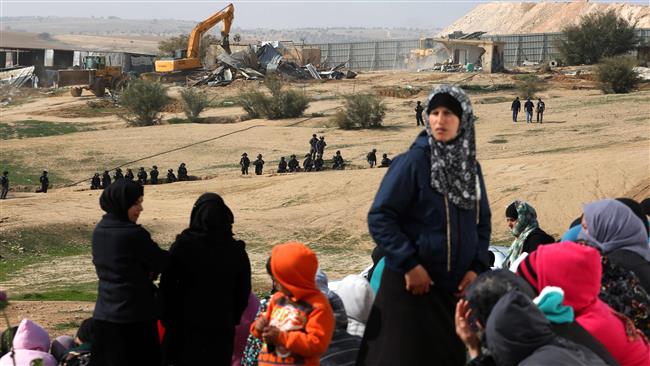
Israel continues the illegal practice of settlement expansion in the Occupied Palestinian Territories, a United Nations expert panel has said in its annual evaluation. It further accuses Tel Aviv of excessive use of force and collective punishment against Palestinians.
After gathering testimonies from civil society organizations, UN representatives and Palestinian officials, the UN Special Committee to Investigate Israeli Practices Affecting the Human Rights of the Palestinian People and Other Arabs of the Occupied Territories noted a number of violations against the Palestinians over the last year, including the detention of minors by the Israel Defense Force (IDF).
“The Committee heard troubling testimony regarding the arrest and detention of children, including cases of reported ill-treatment and lack of adequate protection,” the Committee said after its fact-finding visit to Amman, Jordan.
The Committee also heard testimonies of “excessive use of force” by Israeli forces and the “lack of accountability” by Tel Aviv which “further exacerbated the cycle of violence.”
The UN experts recorded testimonies of continued administrative detention and “difficult conditions” of Palestinians in Israeli prisons.
While the full report of Israel’s treatment of Palestinians will only be published in November, the experts highlighted the continued expansion of Israeli settlements in the occupied territories which are illegal under international law.
“Organizations told the Committee that Israeli settlement expansion had continued in the West Bank, including East Jerusalem, as well as the Syrian Golan, with a notably high level of new construction announced this year, in violation of international humanitarian law,” the fact finding team said.
The UN group said that settlements, as well as the separation wall, dubbed “the apartheid wall” by critics, are having a “negative impact” on the human rights of Palestinians by restricting their freedom of movement.
The experts also voiced concern over the demolition of homes in the occupied territories, especially Bedouin communities in so-called Area C.
“The use of punitive demolitions in the West Bank including East Jerusalem was described as a form of collective punishment,” by the organizations interviewed, the Committee said.
“The Committee clearly observed that the Israeli authorities continue with policies and practices that negatively impact the human rights situation in the Occupied Palestinian Territory.”
Pointedly, Tel Aviv does not recognize the authority of the UN Committee, which has been releasing annual reports into Israeli practices since 1968. Relations between Tel Aviv and the world body have drastically deteriorated recently.
Following the passage of the UN Security Council anti-settlement resolution in December last year, Israel cut funding to various UN agencies. Roughly $10 million has been withheld since then as the UN continues to pass resolutions which are perceived as anti-Israeli by Tel Aviv.
Israel accuses various bodies working under the auspices of the UN of having an anti-Israeli bias and failing to acknowledge the Jewish state’s security concerns.
Israel imprisons UN official, again – UN’s Guterres says nothing

If Americans Knew | July 17, 2017
Israel arrested Hamdan Temraz, 61, deputy director of the United Nations Department of Safety and Security in Gaza, while he was on his way to a work meeting. Four days later the UN still had not issued a statement about this.
The UN has recently come under increased pressure from the United States and Israel.
US Ambassador to the UN Nikki Haley announced to an adoring AIPAC audience in March that she had pressured the UN to remove an official report showing that Israel was guilty of ‘apartheid.’
All 100 US Senators signed a letter in April noting that the US is the largest single donor to the UN and demanding that the UN end its allegedly unfair treatment of Israel.
On July 14th UN Secretary-General António Guterres issued a statement condemning the killing of two Israeli policeman by three assailants (who were then killed by Israeli forces), announcing: “This incident has the potential to ignite further violence. All must act responsibly to avoid escalation.”
Yet, Secretary-General Guterres issued no such statement two days earlier when Israeli forces invading the Palestinian city of Jenin killed two young Palestinians.
Now the UN Secretary-General is saying nothing about Israel’s imprisonment of a UN official from Gaza as he tried to travel to a meeting.
Richard Silverstein reports in Tikun Olam:
This is getting old. Israel has once again arrested a United Nations official based in Gaza as he attempted to cross into Israel to attend a work meeting there. An Israeli security source has confirmed to me the linked story above and the Shin Bet arrest. The news is under gag order in Israel and no media there may report the story. This conveniently insulates the Israeli public from the news that their supposedly democratic nation has arrested human rights personnel from the most reputable NGO in the world. It also allows the Shin Bet time to build yet another fraudulent case against yet another Palestinian official doing international humanitarian relief work in Gaza.
Since Israelis can’t know this information, I’m going to tell them here. The arrested man is Hamdan Temraz, 61, who is the deputy director of the United Nations Department of Safety and Security (UNDSS) in Gaza. He was arrested at the Erez crossing on July 12th despite having a valid entry permit.
The Palestinian human rights group, al Mezan released this statement to the Palestine Information Center, protesting the latest Israeli outrage:
The Center explained that such Israeli practices are aimed at blocking the work of the international organizations in the Gaza Strip, pointing out that 8 employees working in these organizations have been arrested since the beginning of 2014.
It affirmed that hundreds of employees are denied the permits required to enter or exit Gaza to be able to follow up their organizations’ work, not to mention the Israeli incitement campaigns they are exposed to.
I find it odd that a UN employee has been in an Israeli prison for four days and there has been no statement from the international body. Is this how they come to the defense of their staff when it’s under threat in a police state? I left a phone message with the UN press office seeking a statement, but have not heard from them so far.
It’s no coincidence that last month, Netanyahu called for the UN to dismantle UNWRA, the major relief organizations in Gaza. He appealed directly to U.S. ambassador, David Friedman aka “The Settler’s Friend.” This rehashes a common Israeli narrative in which evil Hamas co-opts everyone and everything to do its dirty terrorist work in the enclave. The U.S. is far the largest donor supporting UNWRA, providing $350-million annually to support the millions of Gazans who are unemployed and undernourished due to the decade-long Israeli siege. Israel hopes that the new Trump regime will realize its ambitions to restrain or suppress the aid work in Gaza, which serves to remind the world of Israel’s ongoing assault against its innocent civilian population.
Last summer, Israel arrested two Palestinians in Gaza. Waheed Borsh worked for the UN Development Program and Mohammed el-Halabi for the Christian relief group, World Vision. Both were accused of exploiting their NGO status to undertake covert activities on behalf of Hamas. In the latter case, el-Halabi was accused of funneling international relief funds to the Islamist group. In every instance, the NGOs undertook full, comprehensive investigations and uncovered no evidence to support the Israeli charges. But since Israel functions as a police state as far as Palestinians are concerned, guilt and conviction were assured. Therefore, in order not to spend decades behind bars, each copped a plea that offered a lesser sentence.
This charade permits Israel to bolster its fake claim that the international relief organizations aren’t that at all–but rather thinly concealed support groups for militant international terrorists. This, in turn, satisfies the Israeli government’s core far-right constituency, which can tell itself how much the world hates us and how justified it is in utilizing maximum force in “defending” itself from enemies lurking virtually everywhere.
So here’s how it will go with Temraz. He will be accused of taking advantage of his position directing security for the UN agency by permitting Hamas to do something that somehow jeopardizes Israeli security. Perhaps he allowed the militants to build tunnels under UN facilities. Perhaps he offered materials to Hamas to build tunnels. Or even better: he provided the fake IDs the Haram al Sharif attackers used to gain entrance to the Muslim holy site. Who knows what they can devise? The thing is, these Shabak agents aren’t very imaginative. Nor do they need to be. No one reviews the cases they bring for credibility. No judge cares to do so. He or she would rapidly find themselves on the road to career oblivion if they did. So any half-assed concoction can send a man away for a decade or more simply because some agent has to make his quota and throw the fear of god into both Palestinians and the relief agencies servicing Gaza. What a seamy mess of a national security regime this is.
Featured Video

Trita Parsi: Israel Set a Trap for Total War in the Region
or go to
Aletho News Archives – Video-Images
From the Archive
Zionism’s Violent Legacy
By Donald Neff | Washington Report On Middle East Affairs | January 1996
On January 4, 1948, Jewish terrorists drove a truck loaded with explosives into the center of the all Arab city of Jaffa and detonated it, killing 26 and wounding around 100 Palestinian men, women and children.[1] The attack was the work of the Irgun Zvai Leumi – the “National Military Organization,” also known by the Hebrew letters Etzel – the largest Jewish terrorist group in Palestine. The Irgun was headed by Revisionist Zionist Menachem Begin and had been killing and maiming Arabs, Britons and even Jews for the previous ten years in its efforts to establish a Jewish state.
This terror campaign meant that at the core of Revisionist Zionism there existed a philosophical embrace of violence. … continue
Blog Roll
 Aletho News
- Trita Parsi: Israel Set a Trap for Total War in the Region
- Trump’s Iran war is on an Israeli leash
- Saudi oil boss issues global supply warning
- Riyadh Says Its Oil System Is Intact. The Numbers Say Otherwise.
- Trump and Netanyahu Want to “Finish the Job” on Iran
- US ‘one-sided dictation’ not Iran’s beliefs makes rational talks impossible: Baghaei
- Iran’s Next Strike May Not Explode. It Could Shut You Down /Col Doug Macgregor
- Iran: US political targets legitimate if assassinations return
- Iraq shuts key border crossing with Iran under US pressure: Report
- Undersea Internet cables could be targeted in retaliation for attacks on Iran: IRGC deputy chief
- If Americans Knew
- The Israel Lobby’s Changing Fortunes
- AIPAC has become such a political liability that it’s shifting to a more “nimble” approach to buying politicians
- At least 160 Israeli settler attacks in 2 weeks
- Will Gaza’s Ancient Christian Community Disappear Forever?
- Israel’s vision of regional security rests on keeping Arab states weak
- Heidi Levine recounts how Palestinian youths helped save her in settler attack
- DAILY UPDATE: Latest essential news on Palestine, Israel, & region
- Trump’s Intensifying Sabotage of the ICC, for Israel’s Sake
- Israeli military detain US and UK volunteers in West Bank including Democratic NY politician Brad Lander
- Americans at National Conservatism Conference held in Israel this year criticize Israel
- No Tricks Zone
- E-Cars Reduce CO2 Emissions By Only 41% Compared To Internal Combustion Engine Vehicles
- Predictions Made By Renowned Climate Professor Over Past Decades Have Been Proven To Be Poor
- New Study Suggests Large Regions Of The Pacific Ocean Have Been Cooling For The Last 80 Years
- Germany’s Green Energy Debacle: High Energy Costs Force Kahla Porzellan to Close After 182 Years!
- New Study: 50 Years Of The Most Aggressive ‘Net Zero’ Policies Can Only Affect The Global Climate By 0.03°C
- US September “Heat” Was No Record…Many Records Set Decades Ago
- Latest European Green Energy Debacle; Portugal’s Largest Flagship Solar Park Insolvent!
- Green Energy Debacle: German Expert Professor Fritz Vahrenholt Warns Of Severe Economic And Social Consequences
- Two More Paleo Reconstructions Affirm Meters-Higher Sea Levels Across Ireland, Brazil 7000-6000 Years Ago
- New Study: Earth And Venus Surface Warmth Largely Explained By Convection And Lapse Rate, Not CO2 Or Radiation

