US and Israel ‘Isolated’ at UN Security Council Meeting on Jerusalem

U.S. Ambassador Nikki Haley at the United Nations Security Council on December 8, 2017. | Photo: AFP
teleSUR | December 8, 2017
In an emergency meeting convened by the United Nations Security Council on the crisis prompted by President Trump’s decision to recognize Jerusalem as Israel’s capital, the U.S. stood isolated as other members unanimously condemned the decision.
The meeting was called by Bolivia, Uruguay, Italy, Senegal, Egypt, France and the United Kingdom on Friday.
Bolivian Ambassador Sacha Llorenti offered the strongest words of condemnation. Llorenti is known for his outspoken support of the Palestinian people, having debated the issue at the U.N. wearing a Keffiyah: a black-and-white scarf that has become a symbol of Palestinian resistance.
“While there are two parties in this conflict, they are not on a level playing field,” Llorenti said. “One is an occupying power, the other is an occupied people.
“One party builds illegal settlements… One party puts a seige on Gaza… One party takes over the water resources and farmlands of the other …. One of the parties engages in forced displacement. Bolivia opposes the unilateral decision of the United States to recognize Jerusalem as the capital of Israel.”
Other representatives, including France, Japan, Russia, and Sweden, expressed their dismay at the decision, saying that it would lead to violence and potentially ruin chances at the peace process that President Trump claims to favor.
Egyptian Ambassador Amr Aboulatta said he expected the decision to have a “grave” impact on peace.
The U.N. special coordinator for the peace process, Nickolay Mladenov said: “The United Nations has repeatedly declared that any unilateral decision that seeks to alter the character and status of Jerusalem… could seriously undermine current peace efforts and may have repercussions across the region.”
Despite resounding criticism from the rest of the international community, U.S. Ambassador Nikki Haley maintained that Trump’s move was “simple common sense,” and that the president remains “committed to achieving a lasting peace agreement.” She also accused the U.N. of being “hostile” towards Israel.
Israel’s ambassador was the only other party who praised the decision, calling it “courageous” and demonstrating a “true understanding of justice.”
Since Trump’s announcement, Palestinians have resolutely condemned the decision and erupted in mass “days of rage” protests. Palestinian resistance movement Hamas has called for a “new intifada,” or uprising, against Israeli occupation, a plea backed by Lebanese resistance movement Hezbollah.
Protests in various parts of occupied Palestine have met with violence by Israeli armed forces. At least two Palestinians have been killed and hundreds more injured. On Friday, the Red Crescent said they have so far attended 767 injuries in the West Bank, Jerusalem and Gaza.
UN votes to nullify Israeli ‘jurisdiction’ over Jerusalem
Press TV – December 1, 2017
The United Nations General Assembly has voted to declare as null any Israeli measure to practice jurisdiction over Jerusalem al-Quds, days before US President Donald Trump decides whether he would relocate the US embassy to the occupied city.
In a rare show of unity against the Tel Aviv regime, 151 countries voted on Thursday to adopt a resolution that denounced Israel as the “occupying power” of the Jerusalem al-Quds, a city that is holy to Muslims, Christians, and Jews alike.
“Any actions taken by Israel, the occupying Power, to impose its laws, jurisdiction and administration on the Holy City of Jerusalem are illegal and therefore null and void and have no validity whatsoever,” read the resolution.
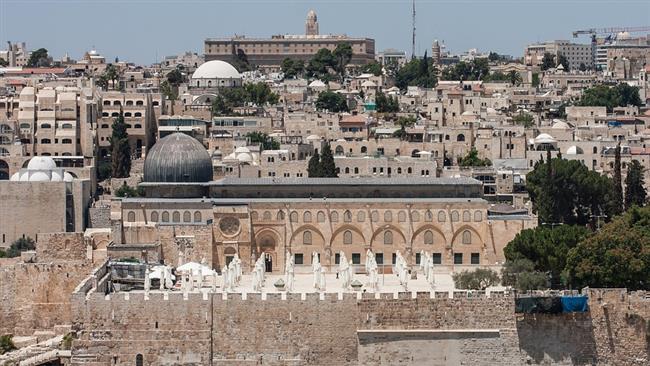
The UN members also urged Tel Aviv to show “respect for the historic status quo at the holy places of Jerusalem, including the Haram al-Sharif, in word and practice,” referring to a hill in Jerusalem al-Quds where the al-Aqsa Mosque is located.
Israel lays claim to the entirety of Jerusalem al-Quds as its “capital” while Palestinians want its eastern part as the capital of a future state for themselves.
The city has seen tensions since 2015, when the Israeli military introduced restrictions on the entry of Palestinian worshipers into the al-Aqsa Mosque — Islam’s third holiest site. Over 300 Palestinians have lost their lives at the hands of Israeli soldiers ever since.
Last year, it was reported that Israel has been omitting from the city’s maps significant Muslim and Christian holy sites and entire neighborhoods in the area while highlighting dozens of sites with dubious historical importance.
Only five countries — the US, Canada, the Marshall Islands, Micronesia and Nauru — opposed the Thursday resolution at the UN, which was also voted down by Israel’s UN envoy. Nine countries also abstained.
US embassy relocation
The strong-worded statement by the UN came days before Trump has to make up his mind over moving the US embassy from Tel Aviv to Jerusalem.
Since US Congress ruled in 1995 that the embassy be relocated from Tel Aviv, every president has deferred the tough decision. The act contains a clause that allows the president to renew a six-month waiver on the decision.
US Vice President Mike Pence says his boss, Donald Trump, is considering “when and how” to move the US embassy to Jerusalem al-Quds as a Friday deadline approaches.
Palestinians have warned that the potential relocation would fuel strong reaction in the region and deliver a death blow to any prospect of resolving the Israeli- Palestinian conflict.
US won’t be constrained by UN Security Council in Syria: Haley
Press TV – November 18, 2017
The United States does not consider itself constrained by the UN Security Council and may seek “justice” in Syria on its own terms, says the US representative to the UN, Nikki Haley.
Haley said on Friday that with or without unity of the council, Washington “will continue to fight for justice and accountability in Syria.”
She made the remarks after Russia vetoed a UN resolution that sought to extend the mandate of the international investigation into chemical weapons use in Syria.
The mandate for the US-drafted resolution, known as Joint Investigative Mechanism (JIM), expired on Friday. This was the third time in a month Russia vetoed attempts at the UN to extend the inquiry.
The council’s permanent member, Russia agreed to the creation of the investigation two years ago, but it has consistently questioned its work and conclusions. It has repeatedly cited flaws in the work on instigators.
Russia’s UN ambassador Vassily Nebenzia said on Friday that the investigation could only be extended if “fundamental flaws in its work” were fixed. He said that for the past two year the investigators had “rubber-stamped baseless accusations against Syria.”
They accused Syrian President Bashar Assad of using chemical weapons against his own people. Syria, however, has repeatedly denied the allegations.
Haley further said that Russia in recent weeks, has been trying “to delay, to distract and ultimately to defeat the effort to secure accountability for chemical weapons attacks in Syria.”
“Russia is wasting our time,” she argued.
Her remarks provoked an angry response from Russian Foreign Minister Sergei Lavrov, who accused her of having engaged in a “fake diplomacy.”
“It seems we are witnessing a new phenomenon in international relations, as now, apart from fake news, there is also fake diplomacy,” Lavrov said.
The US has long history of taking actions in Middle Eastern countries with no mandate from the United Nations. Back in August 2014, Washington along with some of its allies launched a campaign of airstrikes against what are said to be Daesh positions inside Iraq.
The coalition expanded its campaign to Syria in 2014 without any authorization from the Damascus government or a UN mandate.
US Defense Secretary James Mattis claimed on Monday that “the UN said that … basically we can go after ISIS (Daesh). And we’re there to take them out.”
Lavrov, however, rejected his remarks on Thursday, saying the US presence in Syria “is illegitimate because it does not rely either on the decision of the UN Security Council or on the invitation of the legitimate government.” He said that there was no Security Council resolution that allowed US troops on the Syrian territory.
The us airstrikes have on many occasions–both in Iraq and Syria– resulted in civilian casualties and failed to fulfill their declared aim of countering terrorism.
Palestinian elected as Rapporteur of UNESCO Cultural Committee
MEMO | November 11, 2017
Palestine’s Ambassador to UNESCO, Mounir Anastas, has won the election for the post of Rapporteur for the organisation’s Cultural Committee, Quds Press has reported. The result was announced on Thursday.
An Italian official has been elected as President of the Committee, with representatives of Venezuela, Albania, the Philippines and Zambia taking positions as members.
During its meeting, the Committee agreed unanimously, without the need for a vote, on a resolution to maintain the cultural heritage of Jerusalem’s Old City. The resolution called for an interactive monitoring delegation to be sent to the Old City in order to evaluate the situation and carry out a work plan and prepare advice on the measures needed to be taken in cooperation with all interested parties.
Members of the committee expressed their concern about official procrastination over the implementation of UNESCO’s executive council decisions regarding Jerusalem’s Old City, which is still under Israeli occupation.
In October 2017, UNESCO’s largest donor, the US, confirmed that it would be withdrawing, explicitly citing the reason as UNESCO’s anti-Israel resolutions. It will instead establish an observer mission at the Paris-based organisation to replace its representation.
Haley, Israel and the fine art of reality inversion

U.S. Permanent Representative to the UN, Nikki Haley meets Israeli Prime Minister Benjamin Netanyahu at his office in Jerusalem, June 7, 2017. Image credit: U.S. Embassy Tel Aviv/ flickr
By Michael Howard | American Herald Tribune | November 7 ,2017
Last month, US Ambassador to the UN Nikki Haley stated that, should Rex Tillerson find himself cashiered, she would not replace him as secretary of state. “I want to be where I’m most effective,” she said. Whatever that means, we can all breath a sigh of relief. With the intellectual capacity of Sarah Palin, Haley is as clueless, and thus as dangerous, as they come. Her commitment to alternative facts (of the sort the US government has been churning out for decades) is absolute; lest we forget, she reminds us every time she opens her mouth. Depending on the mood I’m in, a Haley speech is either infuriating or darkly comedic. Indeed, many of them could double as trenchant satire, and it is sometimes easy (and comforting) to forget that she is actually speaking on behalf of a global empire.
Haley’s latest performance, a speech to the Israeli-American Council, ought to come with a warning advising viewer discretion, so divorced is it from reality. As the name suggests, the Israeli-American Council is yet another space for Zionist fanatics to reaffirm their love of Israel and, by implication, their hatred of Palestinians, who surely deserve all that they get—or rather don’t deserve what Israel takes, namely arable land, water resources, self-determination, national dignity, individual livelihood and, for many, life itself.
You’ll recall, if I may digress, that in its most recent military attack on Gaza, which took place in the summer of 2014, the IDF killed over 2,000 Palestinians, of whom 1391 were civilians. That’s twenty-eight civilians per day. “Of the Palestinians killed who did not take part in the hostilities,” B’tselem, reported, “180 were babies, toddlers, and children under the age of six. Another 346 were children from age six through seventeen, and 247 were women between the ages of 18 and 59. Another 113 were men and women over the age of sixty.” Which is to say nothing of the hundreds of thousands of Gazans who were displaced, or of the immense damage done to Gazan homes and infrastructure.
By comparison, seventy Israelis were killed in the fighting, sixty-four of them soldiers.
The sheer brutality of Operation “Protective Edge,” as the Israeli’s euphemized the slaughter, made it impossible for any remotely decent human being to rationalize. As the world looked on in disgust, and human rights organizations condemned Israel’s war crimes, then-President Barack Obama (who everyone is so very nostalgic about) droned on about Israel’s “right to defend itself.” “No nation should accept rockets being fired into its borders, or terrorists tunneling into its territory,” he declared, adding, “we are hopeful that Israel will continue to approach this process in a way that minimizes civilian casualties.” The key word there, continue, implies that Obama was satisfied with the IDF’s tactics. In his view, civilian casualties were in fact being “minimized.”
Not to be outdone, Hillary Clinton (another liberal superhero) took things a step further, stating that “Israel did what it had to do to respond to the rockets,” and that “ultimately the responsibility [for all the dead civilians] rests with Hamas.” Hillary went on to cite the “fog of war” as a reason to disregard reports of Israeli atrocities, which were only being denounced, she said, because they were committed by Jews. At the end of the day, “you can’t ever discount anti-Semitism.” Right on, Hil.
Therein lies the essence of the “special relationship” between the US and Israel: Israel runs amok, and the US exploits its status as global superpower to see that there are no repercussions. That’s not quite good enough for the Israel lobby, however (it’s never enough), so the US throws in $4 billion in free military aid every year. After all, “vulnerable” Israel, with its illegal cache of 400 nuclear weapons, faces an existential threat from “hegemonic” Iran, which has zero nuclear weapons and has never invaded another country.
This arrangement would perhaps make sense—from a cynical point of view—if it was mutually beneficial. But of course it’s not. Quite the reverse, actually. The United States’ unswerving support for Israel, along with its own blood-drenched legacy in the Middle East, has made it the primary target for Wahhabi terrorists. If you don’t believe me, read Osama bin Laden’s “Letter to America,” in which American support for the Israeli occupation of Palestine is cited as his number one justification for 9/11. Bin Laden was obsessed with Israel-Palestine, as was/is Ramzi Yousef, who bombed the World Trade Center in 1993. That nothing can justify such acts of mass murder is beside the point: the point is that, by enabling Israel (a morally reprehensible act in itself), the US government puts its own citizens in the crosshairs—for nothing. It’s all risk and no reward. You can decide for yourself whether you think it’s worth it.
With that said, Israel does occasionally pretend to show gratitude for the United States’ masochistic generosity. Getting back to Haley, she opened her speech to the IAC by highlighting the fact that Israel is the only country in the world that supports our decades-long economic war on Cuba. Last week, another UN resolution was adopted calling for an end to the embargo. “The whole world sides with Cuba. Well, almost the whole world. The vote this year was 191 to 2,” Haley said with perverse delight. “Only Israel stood with America against the brutal regime in Cuba.” This strange boast triggered a round of applause from the audience. Then Haley went in for a joke, employing a tone and expression reminiscent of a 1950s TV commercial: “You know what they say: quality is more important than quantity.”
It doesn’t really get more bizarre than this. Here we have a matter of great geopolitical import, and the American empire’s ambassador to the UN is cracking lame soccer mom jokes to an audience of American Zionists. Is she sincerely proud of the fact that the US and Israel stand isolated on this issue? Does she actually believe that the rest of the world is in the wrong, and that only the US and Israel are able to perceive the moral righteousness inherent in strangling the Cuban economy? Does she have any clue as to why the embargo was imposed in the first place? Why it’s still being imposed more than fifty years later? I think the answer to the first two questions is yes, and I’m certain the answer to the second two is no. Our ambassador to the UN, who our whack-job president reportedly wants as his secretary of state, is a half-wit. She’s completely out of her depth and she doesn’t even know it.
It goes without saying that Haley pandered throughout her speech; when she wasn’t offering fulsome praise of Israel and Jewish people she was whining about the UN, a “hostile place” where a “caricature” of Israel has allegedly been painted. The use of “caricature” in this context is obviously, and disgracefully, designed to evoke images of Streicher-esque caricatures of Jews; thus Haley implicitly conflates legitimate criticism of Israel with anti-Semitism, a familiar Zionist tactic. She proceeded to take a shot at Barack Obama, who we have seen was an avid apologist for Israeli terror. Nevertheless, he can never be forgiven for refusing to veto a non-binding (i.e. meaningless) Security Council resolution demanding that Israel cease its settlement activity in the occupied territories. To reiterate: the Obama administration did not vote in favor of the resolution; they merely neglected to veto it (Obama vetoed an identical resolution in 2011). With the US abstaining, it passed, and Netanyahu promptly announced that Israel would be expanding settlements deeper into the West Bank, demonstrating again that Israel is a rogue state with no regard for international law.
Letting the resolution pass, Haley said, “was a cowardly act, and a real low point for America at the UN.” Almost as low as the song and dance she performed before the Security Council in the wake of the chemical incident in Khan Sheikhoun, Syria, wherein she exploited images of dead children to whip up public hysteria and garner support for Trump’s cruise missile attack, an illegal act of aggression promoted with vim by the major media.
Haley’s speech of course included all the usual platitudes regarding Iran. You know the drill: Iran supports terrorists, Iran supports Assad, Iran is testing missiles, Iran is arming the Houthis in Yemen, Iran is allied with Hezbollah, the nuclear agreement is bad news, blah, blah, blah. Referencing Trump’s decision to let Congress “review” the multilateral nuclear deal and decide unilaterally whether it needs to be modified (or scrapped altogether, despite Iran’s full compliance with its terms), Haley said: “Congress now has the opportunity to bring the debate about the Iran nuclear deal out from the fantasy world created by the Obama echo-chamber and into the real world where it belongs.” Again, one stands in awe of her utter lack of self-awareness.
Haley and I do agree on one thing: the UN Human Rights Council is a joke. Not because, as Haley says, it seeks to discourage businesses from operating out of illegal Israeli settlements, but rather because countries like Saudi Arabia, a staunch US ally and one of the worst human rights violators on the planet, have seats on the council. Needless to say, Haley’s speech included no reference to Saudi war crimes in Yemen, where over 5,000 civilians have been killed since 2015, the vast majority of them by the Saudi-led—and US-supported—coalition. Millions more are suffering from famine, while thousands of new cases of cholera are reported every day.
“There simply is no explanation the USA or other countries such as the UK and France can give to justify the continued flow of weapons to the Saudi Arabia-led coalition for use in the conflict in Yemen,” an exasperated Amnesty International representative said in September. “It has time and time again committed serious violations of international law, including war crimes, over the past 30 months, with devastating consequences for the civilian population.”
I think it’s safe to say Nikki Haley won’t be presenting images of dead or starving Yemeni children to the Security Council. At least not until we have reason to invade Saudi Arabia.
UN expert mulls sanctions on Israel over Palestine occupation
RT | October 27, 2017
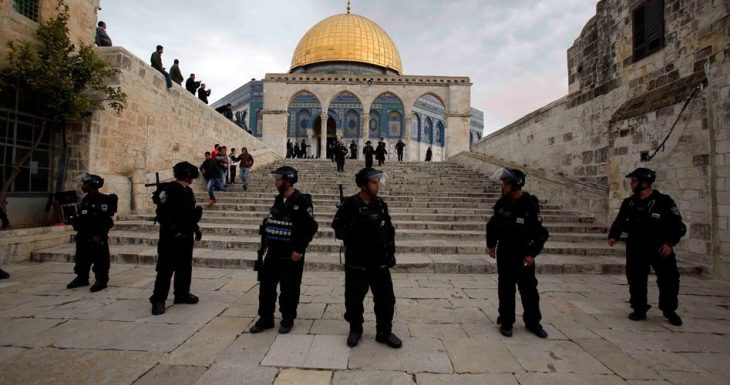
A UN human rights expert has accused Israel of violating a number of international laws and resolutions while suggesting legal action, including travel bans, against the Middle Eastern state. Tel Aviv countered by saying the UNHRC “has lost all touch with reality.”
“Israel’s role as occupier in the Palestinian Territory – the West Bank, including East Jerusalem, and Gaza – has crossed a red line into illegality,” said Canadian law professor Michael Lynk, who is the UN’s Special Rapporteur on the situation of human rights in the Occupied Palestinian Territories.
Presenting his latest report to the UN General Assembly in New York, the expert described Israel’s actions in the region as “the longest-lasting military occupation in the modern world.” He then suggested the UN proceed with relevant international legal processes to force Israel change its policy, which so far “shows no signs of ending.”
In order to do so, the UN should seek to proclaim the occupation of Palestine illegal. As a first step, he suggests that the UN request the International Court of Justice to offer its assessment of the situation.
As things stand, Israel is regarded “as the lawful occupant of the Palestinian territories,” he pointed out, saying that this position does not correspond with reality.
Israel’s actions are “in defiance of 40 plus resolutions of the [UN] Security Council, 100 plus resolutions of the General Assembly, and rulings of the International Court of Justice,” Lynk underlined. He added that the current “focus” on the Israeli-Palestinian issue “is not anti-Israel, it’s an anti-occupation.”
Once Israel’s actions are officially pronounced illegal, the international community could put pressure on Tel Aviv through suspending certain forms of cooperation.
“Only when the Israelis need visas to travel abroad and don’t receive them, only when the EU trade with Israel is limited and only when cooperation in academic, military and economic fields with Israel comes to an end – only then will we see a real change,” Lynk explained at a news conference Thursday.
Israel’s envoy to the UN, Danny Danon, strongly condemned the special rapporteur’s claims, saying the UN body Lynk represents “has lost its legitimacy.”
“[UNHRC] focuses obsessively on attacking Israel instead of working on resolving the real human rights problems plaguing the world,” Danon said in a statement as quoted by the Israeli media. “The Council has lost all touch with reality,” he added.
However, according to the UN special rapporteur, calls to end the occupation of Palestine also emanate from within Israel. The UN official in particular cited the publisher of Israel’s Haaretz newspaper, Amos Schocken, who said international pressure “is precisely the force” that can help change things in the crisis.
The UN has recently included some of the biggest Israeli and international firms operating in the West Bank, East Jerusalem and the Golan Heights on a blacklist of those violating “international law and UN resolutions.”
Some 130 Israeli companies as well as dozens of international firms and corporations have already received warnings from the UN High Commissioner for Human Rights, Zeid bin Ra’ad al-Hussein, on impending inclusion on the list, according to the Israeli outlet, Ynet News.
Earlier in October, Israel approved construction of over 30 new settlements in the UNESCO-protected city of Hebron, which is the largest Palestinian community in the West Bank.
Read more:
UN blacklists 130 Israeli firms & 60 multinationals for working in occupied Palestinian territories
RT | October 26, 2017
The United Nations (UN) has included some of the biggest Israeli and international firms operating in the West Bank, East Jerusalem, and the Golan Heights in a blacklist for those violating “international law and UN resolutions.”
According to Israeli Ynet News which has gained access to part of the list, 130 Israeli companies and 60 international corporations received warning letters from the United Nations High Commissioner for Human Rights Zeid bin Ra’ad al-Hussein about their impending inclusion on the blacklist.
The list, which reportedly will be published in late December includes Israel Aerospace Industries, telecom giants, international tech firms, banks, and even cafes.
Israel Aerospace Industries, Hewlett-Packard, the Israeli branches of Motorola and HP, the Dead Sea cosmetics firm Ahava, the Cellcom and Partner telecommunications companies are among those listed. Israel’s two largest banks, Hapoalim and Leumi, are also said to be on the list.
Israeli Channel 2 News has reported that among the American firms that received letters were Coca-Cola, TripAdvisor, Airbnb, and Caterpillar.
The US ambassador to the UN Nikki Haley condemned the blacklist as “the latest in this long line of shameful actions” taken by the United Nations Human Rights Council (UNHRC). In June Haley warned the US could withdraw from the 47-member body.
“It may cause large investment firms or pension funds carrying stocks of various Israeli companies to divest in them because they, in turn, operate in the settlements,” an unnamed senior Israeli official told Ynet, adding “it may lead to a snowball effect that will greatly harm the Israeli economy eventually.”
The companies say the list’s creation was politically motivated and their inclusion may cause them financial harm and tarnish their brand. They are reportedly looking into filing lawsuits against the Commissioner and the UNHRC.
In September, the UN Commissioner warned over 150 companies that their activities in the “occupied Palestinian territories” may see them added to a blacklist of companies as “they operate in opposition to international law and in opposition of UN resolutions.”
The UN Human Rights Commission voted in March for the resolution being pushed by the Palestinian Authority and Arab nations, according to which the commission would formulate a database of Israeli and international firms directly or indirectly doing business in the West Bank, East Jerusalem or the Golan Heights. The decision passed despite pressure and criticism from the US.
US Gets Increasingly Isolated Internationally
By Alex GORKA | Strategic Culture Foundation | 22.10.2017
Economic sanctions are an instrument of coercion used to make one state comply with another’s wishes. The United States is by far the largest implementer of economic sanctions in the world. It is virtually the only country that imposes unilateral sanctions, certainly the only one that does so with any regularity. The US has imposed more sanctions than the other countries/entities put together. Washington sees restrictions as a low-cost method to accomplish foreign policy goals, despite the fact that the measures affect common people. The policy damages international relations and backfires exacting a high price in terms of lost jobs and trade opportunities.
The US sanctions policy came under sharp criticism in the United Nations. Addressing the UN General Assembly on October 18, United Nations Human Rights Council’s Special Rapporteur Idriss Jazairy said “Damaging a country’s economy with sanctions usually leads to violations of the rights of ordinary people. Sanctions are disruptive for any State, and can have a particularly devastating impact on the citizens of developing countries when they impair the economy.” He expressed concern about sanctions which had an impact outside the territory being targeted. “It is well established that sanctions which apply to parties outside of the dispute are illegal, but sanctions which lead to human rights violations also create an obligation on the imposing state to take measures to repair the harm they have caused,” the expert noted.
Reporting on his visit to Russia in April, Jazairy said sanctions had not achieved the desired effect but had damaged others. “It appears that sanctions have not changed Russia’s position, but instead have caused economic losses for agricultural producers in both the EU and Russia,” he noted, adding “Serious, credible dialogue and negotiations are needed to resolve political issues, without creating additional harm for farmers.”
Jazairy urged the UN member states to adopt a Declaration on Unilateral Coercive Measures and the Rule of Law, which would set out shared principles on the use of sanctions and international law, renewing the call for a registry of sanctions, to bring greater transparency to the practice. “A registry would allow States, civil society and any other interested parties to know at all times what sanctions are in place, helping companies to conduct their businesses, and ensuring the sanctions meet human rights standards,” he said.
In his report (A/HRC/33/48) issued in September, the rapporteur urged the Human Rights Council and the UN General Assembly, through a solemn Declaration, to reaffirm “the right of victims to an effective remedy, including appropriate and effective financial compensation, in all situations where their human rights are affected by unilateral coercive measures.” The report also highlighted the importance of setting up a consolidated central register within the UN system of all the international sanctions in force, adding that these findings should be made public. This mechanism, which would enhance transparency and accountability, could draw on the model of the United Nations Register of Conventional Arms set up in 1991.
A new research by the Austrian Institute of Economic Research (WIFO) suggests the EU’s economic sanctions against Russia introduced three years ago have cost European countries billions of euros. The survey, which was conducted at the request of the European Parliament, and published on October 6, showed that the EU has lost €30bn due to sanctions.
Unilateral sanctions are increasingly ineffective in a more globalized economy. The United States has imposed many different sanctions against Russia but there are many more nations ready to boost economic cooperation with Moscow. The US has got a reputation for imposing economic sanctions liberally making other nations reluctant to do business with it. European leaders and much of the rest of the world view economic sanctions as counterproductive and generally favor them only in extraordinary circumstances, such as war. In July, France’s foreign ministry said new US penalties against Iran and Russia appeared at odds with international law due to their extra-territorial reach.
From a legal point of view, only the UN Security Council has the right to impose sanctions against a state. Unilateral coercive measures violate the spirit and letter of the UN Charter, in particular its preamble and Articles 1 and 2. The organization rests on the principle of equality of all its member states. A state can resort to sanctions for self-defense purposes but Russia did not attack the United States. Thus, the United States is destroying the integrity of international organizations and agreements to which it is a party.
For instance, the policy of sanctions runs counter to the WTO fundamental principle of trade free of discrimination, which envisages respect for market principles and honest competition. Parties should maintain government restraints on the movement of goods at a minimum, and if changed, the restraints should be reduced, not increased. The conditions of trade, including the level of tariffs and other, must be discussed and agreed on within a multilateral framework.
In theory, a state complaint procedure of the UN Human Rights committee could be launched according to Article 41 of the International Covenant on Civil and Political Rights – that way the UN would have to deal with the matter. The US has recently announced its intent to drop out from the United Nations Human Rights Council. This month it left UNESCO. No surprise as the idea to leave the United Nations has been floating in the US for some time. In January, 2017, Alabama congressman Mike Rogers sponsored the American Sovereignty Restoration Act of 2017, referred to the House, which calls to leave the United Nations. Utah state representative Don Bush, has claimed that many programs by the supranational entity have violated the US Constitution, such as the implementation of the International Court of Justice and the Law of the Sea Treaty, both of which the United States does not currently endorse. Much has been said in the United States about Russia’s international isolation. In practice, the United States, not Russia, is getting increasingly isolated internationally.
US politicians propose resolution against UNESCO
MEMO | October 17, 2017
Two Republican politicians have submitted a resolution to Congress condemning UNESCO, days after the US announced that it would be withdrawing from the organisation over its “anti-Israel bias”, according to the Times of Israel.
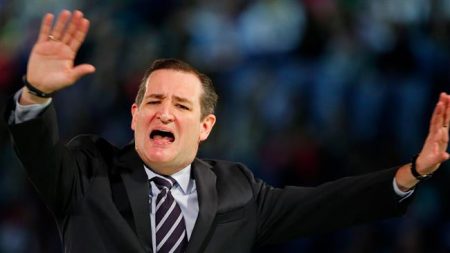
Senator Ted Cruz and Republican Matt Gaetz authored the resolution last Friday which condemns UNESCO for trying to delegitimise the Jewish state and “recognises and affirms the historical connection of the Jewish people to the ancient and sacred city of Jerusalem”.
Last year, UNESCO voted in favour of a resolution that denied any connection between Al-Aqsa Mosque and Judaism; Israel relies on such a claim in recognising the Muslim holy site as the “Temple Mount”.
“The Jewish people, and the people of Israel, have a deep and ancient connection to the holy city of Jerusalem,” Gaetz claimed. “Yet the United Nations Educational, Scientific and Cultural Organisation (UNESCO) … is actively trying to rewrite history.”
The proposed resolution also calls on the US to partner with its allies in preventing the group from passing similar measures in the future; a sentiment echoed by US ambassador to the UN, Nikki Haley, after the decision to exit was announced last week, when she warned that other UN agencies could face similar action if they did not reform.
Last week, Israel chose to follow the US and prepare for its exit from the international body, but appeared to leave the door open to reconciliation announcing that the change would take at least a year, and would be dependent on UNESCO’s future actions.
In May, UNESCO ruled that Israel is an “occupying power” and condemned illegal Israeli activity in occupied East Jerusalem a month later.
Israelis were angered once again in July following the designation of the Ibrahimi Mosque in occupied Hebron, a site which is stormed regularly by illegal Israeli settlers, as a Palestinian World Heritage Site under threat from Israel.
In response, Israel and the US have cut funding to UNESCO on multiple occasions, accusing it of “anti-Semitism”.
UNHRC Yemen Inquiry is Doomed to Fail Magnanimously
By Salman Rafi Sheikh | New Eastern Outlook | 09.10.2017
The United Nations Human Rights Council (UNHRC) seems to have finally awakened up to the brazen human rights violations that the Saudia led Arab coalition forces have been blamed to have committed in the conflict in Yemen that has been going on for more than two years now, and has consumed thousands of lives, and destroyed the country, its polity and economy alike. While UNHRC has resolved to find out the atrocities that have been committed, the question that remains unanswered is if this ‘fact-finding’ mission would lead to an end of the war, let alone punish the antagonists?A compromise has been achieved from the very beginning, which will allow the House of Saud to not only to manipulate or dispute the results, but also escape any consequences whatsoever. As a matter of fact, Saudi Arabia was able to steer things to a course of its own advantage by simply altering the original resolution adopted by the Council, making the UNHRC look like a meaningless and worthless house of cards.
Let’s consider what the original resolution had called for and what is actually going to happen now. The original resolution had called for the establishment of an independent inquiry commission. However, thanks to Saudi Arabia’s intense lobbying and coercive diplomacy, the amended version is now restricted only to sending some “eminent experts”. According to reports, Riyadh had threatened to restrict and even cut trade and diplomatic ties with the council members which had backed the much more robust version. The House of Saud also publicly appreciated the UK, US and France for their cooperation in securing a compromise on resolution. The three countries also support Saudi Arabia’s deadly military aggression against the impoverished Yemen. The UK and the US had no reason to criminalize Saudi Arabia not only because they are allies but also because the US is itself a party to destroying Yemen.
This is evident from the way the US president Donald Trump has almost doubled the number of covert US airstrikes in Yemen. According to the data compiled by The Bureau of Investigative Journalism, the US has carried out about 100 strikes in Yemen in 2017. While the official narrative is that these strikes target Al-Qaeda in the Arabian Peninsula (AQAP), there are evidences that suggest that the US has been equally targeting the Houthis as well. Nothing perhaps could illustrate this ‘US vs Houthis’ phenomenon more than the fact that a US drone was attacked and shot down by the Houthis in western Yemen as recently as October 2, 2017. While the US officials said that the matter was under investigation, the Houthi-controled Defense Ministry announced that it had downed an American drone in the outskirts of Yemen’s capital Sanaa, thus rejecting the US claim that it was mainly involved in non-combatant missions in the aid of the Arab coalition.
On the other hand, what really explains the reason for the Trump administration’s decision to increase drone attacks is the policy of isolating and defeating Iran that the US and Saudi Arabia are following. Interestingly enough, perusal of this policy has caused political tension in the UK as well, where the parliament’s joint committee on human rights has raised strong concerns about the UK’s involvement in the US targeted killing programme, noting that the UK’s intelligence agencies work “hand in glove” with the US.
Given the extent of co-operation between the West and its key ally in the Middle East, an independent inquiry into war atrocities committed by the self-declared regional hegemon is unlikely to take place ever, let alone punish the wrongdoers. Besides the current UNHRC debacle, this is also evident from the way the House of Saud was able, back in July 2016, to turn upside down a UN report that had blacklisted the country after it found out that the Kingdom was responsible for 60 percent of the 785 deaths of children in Yemen in 2015. A few days later, however, the world body announced that the Riyadh regime would be scratched off the list, pending a joint review with the Arab kingdom. Sounds like really independent and impartial!
Once again Riyadh has been able to manipulate inquiry into atrocities by radically altering the resolution that had called for an independent inquiry. Could there be a greater irony than the fact that the new resolution that decided to set up a committee of experts had been set up by Riyadh itself? How can an accused set up, or even influence, a committee to investigate into his own crimes? Can such a body be expected to be impartial and truly reveal what the Arab coalition has done in Yemen?
Answers to all of these questions have, unfortunately, to be in the negative. It is not that we are expressing pessimism, there are certainly concrete basis for what we have said. Besides the above given arguments with regard to the co-operation between the US, the UK and Saudi Arabia, the fact remains that not even the EU, the so-called champion of human rights, is able to leave a decisive impact on the situation and turn things against Saudia. For instance, the European human rights organisation had to face a lot of ridicule when, despite its earlier statement that had confirmed that airstrikes carried out by the Arab coalition in the past two months had killed 39 civilians, including 26 children, the resolution was amended and the bid for constituting an independent inquiry was replaced by a committee of “experts.” Not only were their reports and arguments not accepted, but their demand that the matter be brought before the International Criminal Court (ICC) was squarely rejected, thanks again to the Saudi lobbying and the help it received from its key allies in the West i.e., the US and UK and France and the way it coerced countries into backing down on this demand.
According to a Reuters report, in a letter seen by one of the diplomats, Saudi Arabia – the world’s biggest oil exporter – had warned some states of possible consequences should they support the Dutch resolution, submitted jointly with Canada, calling for a full commission. This lobbying was the perfectly echoed by French diplomatic source who was reported to have said that “there is room to satisfy everybody.”
It appears that no other party is more satisfied now than the House of Saud, the principal accused in the scene. The accused stands vindicated as it is well “satisfied” with the way things have ended in the UNHRC session and the way things will proceed in the future. It is possible that by the time the committee of experts is constituted, does its investigation and submits its report in a year from now on, the Arab coalition, which believes that airstrikes killing civilians are legally justifiable, might end up killing thousands of innocent people. Who will then the UNHRC blame for the loss?
UN warns to blacklist firms working in lands occupied by Israel: Report
Press TV – September 28, 2017
The United Nations human rights office has reportedly threatened to blacklist nearly 150 Israeli and international companies for operating in the Israeli occupied territories, including the West Bank, East Jerusalem al-Quds and Golan Heights.
Israeli daily Haaretz cited anonymous Israeli officials as saying on Wednesday that UN High Commissioner for Human Rights chief Zeid Ra’ad al-Hussein notified the companies through letters two weeks ago.
In response, several of the companies assured Hussein that they do not plan to renew their current contracts or to enter into new ones.
The letter said that due to the companies’ activities in the occupied Palestinian territories, they may be added to the blacklist being compiled by the UN of companies “that operate in opposition to international law and in opposition of UN resolutions.”
According to an unnamed western diplomat, over half of the companies that received the letter were Israeli, nearly 30 were American and the rest were mainly from Germany, Norway and South Korea.
The copies of Hussein’s letter have reportedly been sent to the respective countries of the firms and seen by the Israeli cabinet.
The companies include giant international corporations such as Coca-Cola, TripAdvisor, Airbnb and Caterpillar as well as major Israeli firms, including pharmaceutical giant Teva, the national phone company Bezeq, bus company Egged, the national water company Mekorot and the regime’s two largest banks, Hapoalim and Leumi.
In 2016, the UN Human Rights Council voted, with 32 nations in favor and 15 abstentions, to a proposal by the Palestinian Authority and Arab states to compile a database of all businesses enabling or profiting from development of Israeli settlements in the occupied Palestinian territories.
The proposal also condemned Israeli settlement construction and urged companies not to do business with Israeli settlements.
In June, US Ambassador to the UN Nikki Haley slammed the blacklist as “the latest in this long line of shameful actions” adopted by the UNHRC, warning that the US may withdraw from the 47-member UN body unless it is reformed, end condemnation of Israel and cancel the membership of what she called notorious human rights violators from the council.
Since 2007, Israel has been the only entity whose human rights violations have been regularly discussed in the framework of a single permanent item on the Human Rights Council’s agenda.
Since the inauguration of US President Donald Trump in January, the regime in Tel Aviv has stepped up its construction of settler units on occupied Palestinian land in a blatant violation of international law.
Less than a month before Trump took office, the United Nations Security Council had adopted Resolution 2334, calling on Israel to “immediately and completely cease all settlement activities in the occupied Palestinian territories, including East Jerusalem” al-Quds.
About 600,000 Israelis live in over 230 illegal settlements built since the 1967 Israeli occupation of the Palestinian territories of the West Bank and East Jerusalem al-Quds.
Israel also seized the Golan Heights from Syria after the 1967 Six-Day War and later occupied it in a move that has never been recognized by the international community. The regime has built dozens of settlements in the area ever since and has used the region to carry out a number of military operations against the Syrian government.
Featured Video
Trita Parsi: Israel Set a Trap for Total War in the Region
or go to
Aletho News Archives – Video-Images
From the Archive
Zionism’s Violent Legacy
By Donald Neff | Washington Report On Middle East Affairs | January 1996
On January 4, 1948, Jewish terrorists drove a truck loaded with explosives into the center of the all Arab city of Jaffa and detonated it, killing 26 and wounding around 100 Palestinian men, women and children.[1] The attack was the work of the Irgun Zvai Leumi – the “National Military Organization,” also known by the Hebrew letters Etzel – the largest Jewish terrorist group in Palestine. The Irgun was headed by Revisionist Zionist Menachem Begin and had been killing and maiming Arabs, Britons and even Jews for the previous ten years in its efforts to establish a Jewish state.
This terror campaign meant that at the core of Revisionist Zionism there existed a philosophical embrace of violence. … continue
Blog Roll
 Aletho News
- Trita Parsi: Israel Set a Trap for Total War in the Region
- Trump’s Iran war is on an Israeli leash
- Saudi oil boss issues global supply warning
- Riyadh Says Its Oil System Is Intact. The Numbers Say Otherwise.
- Trump and Netanyahu Want to “Finish the Job” on Iran
- US ‘one-sided dictation’ not Iran’s beliefs makes rational talks impossible: Baghaei
- Iran’s Next Strike May Not Explode. It Could Shut You Down /Col Doug Macgregor
- Iran: US political targets legitimate if assassinations return
- Iraq shuts key border crossing with Iran under US pressure: Report
- Undersea Internet cables could be targeted in retaliation for attacks on Iran: IRGC deputy chief
- If Americans Knew
- The Israel Lobby’s Changing Fortunes
- AIPAC has become such a political liability that it’s shifting to a more “nimble” approach to buying politicians
- At least 160 Israeli settler attacks in 2 weeks
- Will Gaza’s Ancient Christian Community Disappear Forever?
- Israel’s vision of regional security rests on keeping Arab states weak
- Heidi Levine recounts how Palestinian youths helped save her in settler attack
- DAILY UPDATE: Latest essential news on Palestine, Israel, & region
- Trump’s Intensifying Sabotage of the ICC, for Israel’s Sake
- Israeli military detain US and UK volunteers in West Bank including Democratic NY politician Brad Lander
- Americans at National Conservatism Conference held in Israel this year criticize Israel
- No Tricks Zone
- E-Cars Reduce CO2 Emissions By Only 41% Compared To Internal Combustion Engine Vehicles
- Predictions Made By Renowned Climate Professor Over Past Decades Have Been Proven To Be Poor
- New Study Suggests Large Regions Of The Pacific Ocean Have Been Cooling For The Last 80 Years
- Germany’s Green Energy Debacle: High Energy Costs Force Kahla Porzellan to Close After 182 Years!
- New Study: 50 Years Of The Most Aggressive ‘Net Zero’ Policies Can Only Affect The Global Climate By 0.03°C
- US September “Heat” Was No Record…Many Records Set Decades Ago
- Latest European Green Energy Debacle; Portugal’s Largest Flagship Solar Park Insolvent!
- Green Energy Debacle: German Expert Professor Fritz Vahrenholt Warns Of Severe Economic And Social Consequences
- Two More Paleo Reconstructions Affirm Meters-Higher Sea Levels Across Ireland, Brazil 7000-6000 Years Ago
- New Study: Earth And Venus Surface Warmth Largely Explained By Convection And Lapse Rate, Not CO2 Or Radiation

