UN Expert to Investigate Israel’s War on Human Rights Defenders
teleSUR | October 29, 2016
A United Nations expert said on Friday that Israel is attacking human rights organizations and trying to delegitimize their work and that he will launch an investigation into the problem.
Michael Lynk, the United Nations Special Rapporteur on the situation of human rights in the Palestinian territories occupied since 1967, presented his first report to the UN General Assembly calling Israel to end the nearly 50 years of occupation, which he said “is entrenched, is dripping in human rights violations.”
“The fact that the Israeli government threatened to revoke the citizenship of the executive director of B’Tselem is a particularly worrying path for Israel to wind up taking,” Lynk said, referring to the rights groups’ appearance before the Security Council earlier this month.
He praised the recent intervention at the Security Council by the Israeli human rights organization B’Tselem, which urged the UN to end the Israeli occupation in Israel and said he was especially troubled by the Israeli government’s reaction.
In a statement, Israel’s U.N. Ambassador Danny Danon called Lynk’s comments offensive and said it “shows the immense damage done by Israeli organizations that defame us in front of the international community.”
Most of the international community has labeled the Israeli occupation as illegal because the territories in which half a million Israelis live in over 230 settlements, were captured by Israel in a war in 1967 and are hence subject to the Geneva Conventions, which forbid construction on occupied lands.
UN failed to organize evacuation of civilians from rebel-held Aleppo – Russian envoy
RT | October 27, 2016
Russia’s ambassador to the United Nations has criticized UN’s failure to properly organize humanitarian evacuations of the wounded from terrorist-held areas of Aleppo. The UN envoy to Syria defended the team, pinning the blame on the warring parties.
“We regret to note that the United Nations has not properly worked out an operation to evacuate the sick and the wounded,” Vitaly Churkin noted at the UN Security Council session, according to RIA.
The ambassador added that the UN work with various opposition groups in Aleppo and the local council was “left to take care of itself.” He stressed that the UN personnel did not “exert the necessary pressure” on “sponsors” of illegal armed groups to convince them to cooperate with the aid workers on the ground.
Besides criticizing the UN team, the Russian envoy also accused entities that have influence over fighters in besieged neighborhoods of Aleppo of not applying enough pressure on the militants to make the most of the Russian-Syrian humanitarian pause.
“External patrons of entrenched groups in eastern Aleppo could not or did not want positively influence the fighters and convince them to stop the shooting, to release civilians or leave the city themselves,” Churkin said.
The ambassador noted that militants in Aleppo continue to get supplies and arms, including portable surface-to-air shoulder launchers (MANPADs) and missiles.
The humanitarian pause was introduced in Aleppo on October 20, as Syrian and Russian jets halted all strikes in the vicinity of the city. While only an estimated ten percent of the city’s populace live in terrorist-held Eastern Aleppo, Moscow is doing everything possible to secure the evacuation of civilians.
Those civilians who want to leave jihadist-held areas may use six humanitarian corridors. Fighters can also leave the city with their weapons by using two other corridors established by the Russians and the Syrians. However, terrorists have refused to leave and instead resorted to shelling the civilian escape routes.
Russian and Syrian planes have stayed out of the city for eight consecutive days. In that time, only a few dozen civilians managed to escape the terrorist-held areas. Meanwhile, the Russian reconciliation centers continued to pour aid into Aleppo.
During the Security Council session, the UN official in charge of humanitarian aid defended the world organization’s actions in Syria, laying blame at both the rebels, Damascus, and Moscow for not allowing the UN humanitarian assistance to take place.
“The United Nations were ready to launch our operations on Sunday, 23 October. However, objections by two non-State armed opposition groups, namely Ahrar as-Sham and Nureddin Zenki, scuppered these plans. The United Nations made every effort to get assurances from all parties, only for the parties to then fail to agree on each other’s conditions about how evacuations should proceed,” said Under-Secretary General for Humanitarian Affairs and Emergency Relief Coordinator, Stepen O’Brien.
In the meantime, the International Committee of the Red Cross and the Red Crescent teams working in Aleppo have complained that delivering the humanitarian aid and treating the wounded has been a challenge, as the ICRC failed to “secure the security guarantees of some armed groups.”
Back at the UNSC, O’Brien painted a clear picture for the members of the UN Security Council of human suffering in Eastern Aleppo where terrorists use civilians as human shields.
In a graphic yet poetic account, O’Brien said that civilians – mostly children and elderly – are stuck in basements where “the stench of urine and the vomit caused by unrelieved fear never leaving your nostrils” is omnipresent.
“Or scrabbling with your bare hands in the street above to reach under concrete rubble, lethal steel reinforcing bars jutting at you as you hysterically try to reach your young child screaming unseen in the dust and dirt below your feet, you choking to catch your breath in the toxic dust and the smell of gas ever-ready to ignite and explode over you.”
“These are constant, harrowing reports and images of people detained, tortured, forcibly displaced, maimed and executed,” O’Brien added.
While mentioning the destructive role of terrorist on the ground, the UN envoy to Syria went out of his way to blame Damascus and Moscow for their air raids.
“Aleppo has essentially become a kill zone. Since my last report to this Council less than a month ago, 400 more people have been killed and nearly 2,000 injured in eastern Aleppo. So many of them – too many of them – were children,” O’Brien said.
“Never has the phrase by poet Robert Burns, of ‘Man’s inhumanity to man’ been as apt. It can be stopped but you the Security Council have to choose to make it stop,” the envoy added.
Taking the mic at the UNSC meeting, Churkin criticized O’Brien’s report, which he said lacked factual information and failed to stress the cessation of Syrian and Russian air raids on the city. He asked O’Brian not to recite poetry but base his reports on concrete facts.
“If we wanted to hear a sermon, we would go to church. If we wanted to hear poetry, we would go to a theater,” Churkin said.
Security Council members wanted to hear “objective analysis” of the situation on the ground from O’Brien, the Russian ambassador stressed.
“You clearly did not achieve this,” Churkin said, reminding O’Brien that no strikes have been conducted over Aleppo since October 18. Calling O’Brian’s statement “provocative and unacceptable,” Churkin pointed that in the past eight days Syrian and Russian planes had not flown over Aleppo, staying at least 10 km away from the city.
“This moratorium on the flight lasted eight days [now]. Mr. O ‘Brian, you did not mention a single word about it. You have built your speech so to paint a picture that aerial bombardment did not stop for one day and that it is happening now, as we speak,” said Churkin.
US Ambassador to the United Nations Samantha Power also criticized the Russian humanitarian corridors in Aleppo.
“Russia made an announcement about 6 humanitarian corridors and urged to take these corridors, including people with arms. But those families were terrified about entrusting their fates to the people who have been bombing their neighborhoods,” she said.
Churkin replied that Power resorted to her usual tactics – “distorting the Russian stance to the point of absurdity.”
“It is terrifying to live here [in Aleppo]. And the US is asking: ‘What can we do?’ We told you what to do – to have both Russian and American military work together on Castello road [in Aleppo]. You said no!” Churkin said.
Power and the US delegation, along with the UK, French, and Ukrainian delegations, later staged a walkout as Churkin passed the floor to the Syrian representative.
Russia only country in Syria acting under int’l law – German statesman Willy Wimmer
RT | October 25, 2016
The UN is not free in its opinion; it is playing a part in the game on the side of the US, says Willy Wimmer, former State Secretary of the German Christian Democratic Party.
Some 80 aid and humanitarian organizations, including Human Rights Watch, claim Russia – the only country operating militarily in Syria legally – is no longer “fit” to hold its position in the body.
The move, prompted by Russia’s anti-terror actions in Syria – actions that have attracted the ire of some Western countries – appear to be yet another effort on the part of particular countries to denigrate Russia.
Russia’s presidential spokesman says the condemnation should be directed at extremists in Syria instead.
Meanwhile, German foreign Minister Frank-Walter Steinmeier is calling for another humanitarian pause in Aleppo like the one that took place last week.
RT sat down with German politician Willy Wimmer for his views on the issue.
RT: Do you think another humanitarian pause will produce any progress, given that there’s no pressure on the Western-backed rebels to stop their shelling of civilian areas?
Willy Wimmer: I think it is vital and necessary to look for relief for the humanitarian problems we have in Syria. And I think we should stop the killing as soon as possible. That is one thing we have to take into consideration. On the other side, we should never forget who started the civil war in Syria and when these human rights organizations blame one country in particular, we should never forget that the US, Great Britain, France, Saudi Arabia and Qatar created a civil war in Syria. I won’t mention Israel because of the situation in the neighborhood.
When we complain about the human suffering in Syria, we have to take into consideration who started everything. And the interesting thing is that everything the West is doing in Syria is against international law; they have no support of the UN Charter, even what the German militaries are doing there is against our Constitution. The only power which is in accordance with international law in Syria is the Russian Federation and because the actual president who had been elected freely, as for the support, it is in accordance with the international law. We have to take this into consideration when it comes to accusations from Human Rights Watch and others.
RT: There are calls to exclude Russia from the UN Human Rights Council. This would undermine one of the founding principles of the United Nations, wouldn’t it? What do you make of such rhetoric?
WW: It is a signal that the UN is on one side. It is not free in its opinion and we see it already for decades that the UN is playing a part in the game on the side of the US. And therefore, we don’t take it serious what the UN representatives tell us.
RT: Last year, Saudi Arabia was elected chair of a key panel on the Human Rights Council. Yet its human rights record has been repeatedly criticized. There have been calls for Saudi Arabia to be suspended from UN Human Rights Council, but do you think this will ever happen?
WW: Never, because of the close relationship between Saudi Arabia, Israel and the US. And therefore, I think they can do what they do without being punished for that (…) I think we have to realize who organized the civil war in Syria, and who is in accordance with international law. When they had a truce between the United States and the Russian Federation three weeks ago, what happened? The Americans killed 100 Syrian soldiers and Russian soldiers as well. There is a development in Washington to make use of the situation where there is no newly elected American president, and this is a complex and extremely dangerous situation for the rest of the world.
Read more:
Yemen: The Anguish, Bloodshed and Forgotten Heroes in a Forgotten War
By Vanessa Beeley | 21st Century Wire | October 13, 2016
It should be personal to all of us. Yemen, regularly portrayed as the poorest nation in the Arab world, is proving itself to be the richest in courage, resourcefulness and resilience.
Ever since March 2015, some of you may have noticed how oil-rich Saudi Arabia, with the United States at its side, have been waging genocidal war against the Yemeni people.
Yemen are a people under attack by an undeclared super-power coalition comprised of the Kingdom of Saudi Arabia, US, UK, EU, UAE and Israel. As in Iraq, while the Yemeni people are under attack from super-powers, they are simultaneously being collectively punished by the illegal sanctions imposed by a corrupt United Nations body.
Sanctions imposed by resolution 2216, against 5 named individuals, on the pretext of legitimizing an illegitimate fugitive ex-president, Saudi Arabia and Washington’s hand-picked puppet leader, Mansour Hadi, who demanded that neighbouring Saudi Arabia bomb his own people – even after Hadi had resigned twice from an already over-extended presidential term, before fleeing to his alma mater in Riyadh.
UN sanctions imposed upon 5 named individuals yet being exploited by the US/UK/EU backed Saudi coalition to collectively starve and punish 27 million Yemeni people.
This fact has been consistently omitted and waxed over by western political appeasers and ethically challenged mainstream media apologists – and their ignorant and conceded omission is one of the primary reasons why this conflict has been allowed to go from bad to worse.

To compare Saudi Arabia’s belligerent actions in Yemen to Nazi Germany’s undeclared wars of aggression prior to WWII is no exaggeration. In fact, one could make the argument that this Saudi-US joint venture is much worse, and a far more dangerous precedent. Likewise, the failure of a corrupt UN (who effectively sold Saudi Arabia its seat on at the head of the UN Human Rights Council ), led by an impotent Secretary General in Ban-ki Moon, to censure Saudi Arabia for its flagrant violation of international law, the Nuremberg Principles and the entire Geneva Convention content and implied framework – leaves the UN in the exact same position as the League of Nations in 1938.
This is most certainly the case on paper, and with each passing moment we are nudging ever closer to geopolitical déjà vu.
The Anguish
This is one of the most egregious war crimes we’ve seen so far in Yemen, and considering what Saudi Arabia has already done to date, this is off the scale. On the 9th October 2016, the Saudi ‘coalition’ targeted one of the biggest public halls in Yemen’s capital Sanaa.
Officials said two air strikes hit the grand hall of ceremonies, where a post funeral gathering was held to receive condolences for the late Ali bin Ali al-Ruwaishan, the father of Interior Minister, Jalal al-Ruwaishan.
A total of 4 missiles were launched into crowds of civilians. The first strike, two missiles tore into the hall and surrounding areas leaving dozens dead and dying. Then, as funeral-goers clambered over the smouldering rubble to rescue the injured, Saudi coalition planes returned for the double tap air-strike, targeting the civilian rescuers.
Yesterday, the under secretary of the Public Health Ministry in Yemen told journalist and Middle East commentator, Marwa Osman, the death toll had risen to 458 and hundreds more injured. In an interview with RT, Osman went on to describe, 213 bodies were reported as charred, burned beyond recognition, 67 bodies were completely dismembered and 187 bodies torn apart by shrapnel. The brutality of this attack is evident from the horrific photos that appeared on social media very quickly after the event, as Yemenis were reeling from the scale of the massacre.
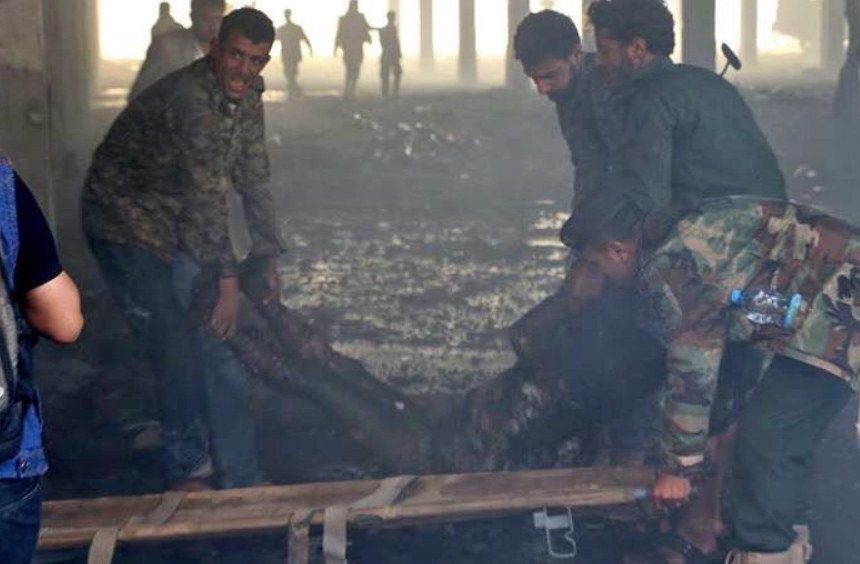
Yemen civil defence and army recovering bodies from the Saudi coalition bombed ceremony hall in Sanaa (Photo: Yemen the Forgotten War)
The hundreds more injured have been described as “bleeding to death in the streets“. The following report came in from Sanaa hours after the attack:
“Saudi-American airstrikes targeted the biggest hall in Sanaa. The hall was hit by 4 missiles, 2 air-strikes. When rescuers went to the aid of the dying and injured Saudi jets attacked for the second time in their double tap operation. It’s impossible to count the deaths. Officially they are saying less than 500 but many more are dying because they can’t be treated due to the absence of medical supplies and hospital facilities. This is entirely due to the UN sanctions and effective land, air and sea blockades. The hall is 2km from our home and 150m from my university but luckily, today I was not there.
Yesterday we killed several mercenary leaders in Mareb and Saudi commanders so today they are taking their revenge on the innocent people” ~ information supplied to Vanessa Beeley of 21st Century Wire.
[…]
According to Hassan Al Haifi, writer, academic and political commentator, living in Sanaa, the Saudi attack was deliberate:
“The mourners were paying tribute to General Jalal Al-Rouishan, Min of Int, who hails from a leading family of Khowlan Al-Tayyal Tribe, a leading and powerful Yemeni tribe.”
Al Haifi commented that this was a cynical and brutal attack by the Saudi coalition, intending to kill as many Ansarullah and Ali Abdullah Saleh officials and supporters as possible. A number of Saleh’s closest friends and allies were killed by the strikes along with a smaller number of Ansarullah members. Al Haifi, himself should have been at the ceremony but had been delayed and fortunately was not there when the Saudi jets launched their missiles into the throngs of mourners.
The Bloodshed
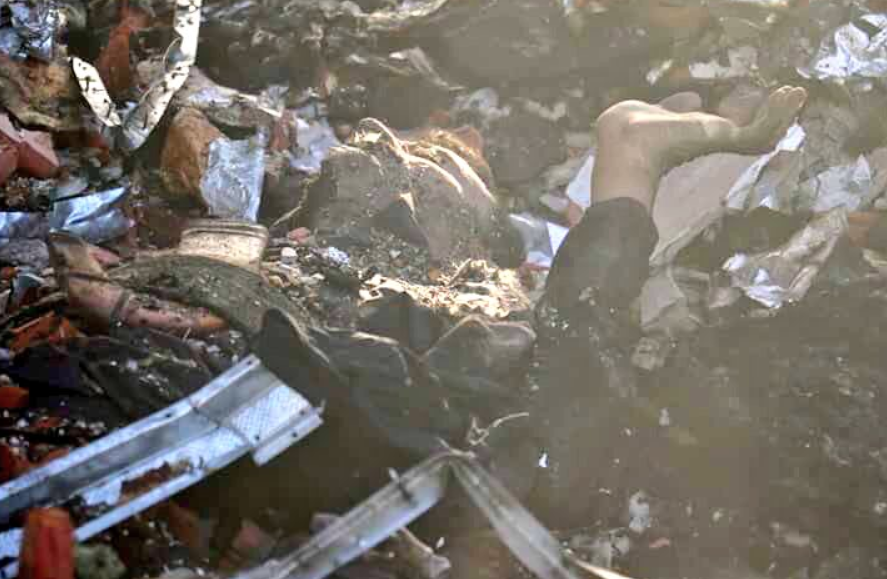
Saudi air-strike on Sanaa (Photo supplied to 21st Century Wire from Yemen)
The US State Department immediately swung into damage limitation mode and cranked up their hypocrisy to protect their Saudi coalition military industrial complex clients. John Kirby even deployed the “self-defence” terminology usually reserved for their other regional, arms guzzling ally with close links to Al Qaeda, Israel.
The bloodshed and suffering of the Yemeni people was reduced to an obscene game of semantics by a cold and calculating US State Department, as their multi billion dollar arms industry registered obscene trading levels with the Saudi coalition in 2015. In the first 21 months of Saudi-US illegal war on Yemen, US arms sales worth $33 Billion were closed Saudi and Gulf Cooperation Council (GCC) entities according to Defense News. In total, America’s Nobel Peace Chief Barack Hussein Obama has offered to sell $115 billion in weapons to Saudi Arabia since taking office in 2009 – more than any previous US administration, according to a recent report.
Not to be left out of the party, Britain has also sold more than £3.7 billion in arms to Saudi Arabia since Saudi’s illegal war of aggression began.
In truth, many of these estimates are conservative and do not include many more hundreds of millions in ancillary costs, staffing, support contracting and engineering.
Forgotten Heroes
Even though they’ve been completely redacted by the western media, and also by the myriad of Gulf monarchy media outlets, the real heroes of this conflict are the Yemeni people.
In their reductionist way of thinking and categorizing the world outside of their shores, Americans refer to Middle East populations in sectarian terms – because this is they way they would like to see the world, but it couldn’t be any further from reality. To Americans, the Yemeni war is all because of “Iranian-backed Shia Houthi Rebels.” The first US Congressman ever to say that in public probably read it directly off an AIPAC policy briefing sheet. That’s the sad reality still in Washington – information-poor (and lobby cash-rich) elected representatives are only able to see the world through the Israeli lens.
The reality is much more complex than just “the Houthis.” A genuine Arab Spring has taken place in Yemen and the US and Saudi response was simply to try and crush the people. But the people have resisted fiercely, and together. Unlike other neo-colonial ventures like Iraq and Afghanistan – the people of Yemen have united to a large degree and are determined to realize their own vision of self government. This is something that has been written off by everyone in the US establishment – from the President all the way down the political food chain.
Damning Indictment
The UK/US built, House of Saud, is waging a genocidal war of aggression that has already destroyed entire swathes of Yemeni cultural heritage and decimated entire communities, particularly in the northern, traditionally Ansarullah (Houthi) held areas such as Saada and Hajjah. This was by design. By now, we can see clearly how this was yet another ethnic cleansing programme being endorsed, fuelled and defended by the United States and her allies in the UK, EU, Israel, and of course the neighbouring Gulf States, the majority of whom participated in this dirty war. Oman, a lone, moderate, and independent thinking gulf state, has remained neutral, providing a degree of support to the Yemeni people. […]
The height of US hypocrisy was on full display during a US State Department press briefing where the already discredited US spokesman John Kirby shameless danced around a mass-murder by Saudi Arabia – whose airstrikes are supported logistically by the United States. This is the definition of criminality unchecked. Watch:
Author Vanessa Beeley is a special contributor to 21WIRE, and since 2011, she has spent most of her time in the Middle East reporting on events there – as a independent researcher, writer, photographer and peace activist. She is also a volunteer with the Global Campaign to Return to Palestine. See more of her work at her blog The Wall Will Fall.
For further background on Saudi ‘s war of aggression please read 21WIRE article: UN Whitewashing Saudi Coalition War Crimes and International Human Rights Violations
Russian position on OPCW-UN JIM report on Syria
Ambassador’s view | RT | October 5, 2016
The OPCW-UN Joint Investigative Mechanism (JIM) has recently presented the UN Security Council with its third report, in which it alleges the Syrian Armed Forces were involved in two uses of chemical weapons in Syria.
While appreciating the significant amount of work done by the JIM and its experts, conclusions drawn by its leadership panel are hardly convincing. It has become obvious that due to objective reasons it had very little chance to conduct an effective investigation. One of the main problems was lack of access to the locations due to the dire security situation on the ground.
There are also other factors that have seriously affected the quality of the investigation, including it being carried out in some cases more than two years after the incident, some of the information was misleading, and sources of information were of second or third hand. The accusation against Damascus is mostly based on the testimonies of the “witnesses” handpicked by opposition NGO’s, and the assumption that nobody but the government forces in Syria have access to aircraft, which could be used to drop barrel bombs filled with chlorine.
Taking into consideration the gaps and inconsistencies in the report, one may conclude that there is insufficient evidence to state that any party, be it the government of Syria or even ISIS, was undoubtedly involved in the use of chemical weapons. It is also necessary to ask ourselves, what is the motive behind such an insignificant, from a military point of view, use of chlorine as a chemical weapon?
Such acts serve no purpose for Damascus in view of its possession of much more destructive conventional weapons and especially given the fact that no military operations to recapture towns mentioned in the report followed the incidents. Apart from the fact that such acts carry a clear hallmark of propaganda tailored to putting the blame on the Syrian government at pivotal moments of the ongoing civil conflict.
There are talks about the need to impose sanctions against Damascus on the basis of the JIM’s conclusions. There are no grounds for such action which, above all, might be extremely detrimental for efforts aimed at a political settlement.
For more than two years Russia has been trying to draw attention of the international community to the fact that terrorist organizations have repeatedly used chemical weapons in Syria and Iraq. Together with China we proposed to adopt a brief and pragmatic UNSC resolution, which would have constituted a first step toward solving this issue. Considerations of a strictly political nature on the part of some of our colleagues in the Council have caused the international community to lose a minimum of two years that could have been spent in developing measures to address the threats and challenges of chemical terrorism.
Unfortunately, the time lost in pointless political rhetoric has also affected the work of both the OPCW and the JIM, and made it much harder for them to execute their respective mandates. Even now some of the proponents of imposing sanctions against Damascus blatantly call to turn a blind eye to chemical crimes committed by ISIS. Despite this shortsighted policy the time has come for serious action to address this problem.
Dr Alexander Yakovenko, Russian Ambassador to the United Kingdom of Great Britain and Northern Ireland, Deputy foreign minister (2005-2011). Follow him on Twitter @Amb_Yakovenko
Saudi Arabia: Investigations into War Crimes in Yemen “Prohibited”
Al-Manar – October 5, 2016
Saudi Arabia rejected a request by the United Nations High Commissioner for Human Rights Zeid Ra’ad Bin Al-Hussein to form an international commission of inquiry into war crimes committed in Yemen.
“Riyadh does not support the call of the High Commissioner to form an international investigation committee,” Saudi Minister of Culture and Information of Adel Tarifi said in a statement, stressing that “the work of the Yemeni National Commission of Inquiry is generally agreed”, according to reports by German Press Agency.
The Human Rights Council of the United Nations had refused on Thursday to open an independent investigation into war crimes in Yemen, and demanded instead a national commission of inquiry to investigate attacks on hospitals and killing of civilians.
UN blames US, EU sanctions for punishing Syrian civilians, stalling aid work – leaked report
RT | October 2, 2016
US and EU sanctions against Syria are punishing the population and make aid work in the war-torn country almost impossible, a leaked UN report and internal letters have revealed.
The restrictive measures contributed to the destabilization of every sector of the economy in Syria that used to be self-sufficient before the war began in 2011.
The country now heavily depends on aid, which is hard to deliver as sanctions make medicine, food, fuel, spare parts and other essentials unreachable, a 40-page UN report, cited by The Intercept, stressed.
The paper entitled ‘Humanitarian Impact of Syria-Related Unilateral Restrictive Measures’ was published in mid-May, but The Intercept got hold of it now, adding other materials on the issue.
The report blasted US and EU restrictions as “some of the most complicated and far-reaching sanctions regimes ever imposed.”
According to the UN, the sanctions introduced by Washington are extremely harsh regarding provision of humanitarian aid. The American restrictions made money transfers into Syria almost impossible, preventing aid groups from paying salaries and purchasing supplies “in both government and besieged areas,” the report said. It stimulated the creation of a shady, unofficial network of money exchange, which is actively being used by Islamic State (IS, formerly ISIS/ISIL) and Jabhat al-Nusra terrorists.
The trade restrictions ban the export to Syria of all goods, containing at least 10 percent of US-made content. This puts the aid groups in a difficult situation as, in order to transfer specific items, they are forced to apply for a special license, which is very hard to obtain due to bureaucratic barriers, according to the report.
An internal UN email, also obtained by The Intercept, blamed the US and EU restrictions for food shortages in the country.
Wheat production has dropped 40 percent in the country since 2010, raising the price of wheat flour by 300 percent and rice – by 650 percent. An August letter from “a key UN official” also said that the restrictions were a “principal factor” in the crippling of the Syrian health care.
The medication factories, which weren’t destroyed during the hostilities, still had to close due to absence of raw materials and foreign currency caused by the sanction, the official wrote.
The Intercept contacted the US State Department on the issue, which refused to acknowledge any of the claims or that the sanctions are hurting civilians in Syria.
“US sanctions against [Syrian President Bashar] Assad, his backers, and the regime deprive these actors of resources that could be used to further the bloody campaign Assad continues to wage against his own people,” the State Department said in emailed response.
“The true responsibility for the dire humanitarian situation lies squarely with Assad, who has repeatedly denied access and attacked aid workers. He has the ability to relieve this suffering at any time, should he meet his commitment to provide full, sustained access for delivery of humanitarian assistance in areas that the U.N. has determined need it,” the email added.
Sanctions have been gradually introduced against Syria since 1979 when Washington labeled the country sponsor of terrorism. But the harshest restrictions came in 2011 when the uprising and military conflict in the country started.
READ MORE:
US ‘spare Nusra for plan B’ to change regime in Syria – Lavrov
Venezuela Faces Down Rebuke at UN, Possible New Sanctions
By Ryan Mallett-Outtrim | Venezuelanalysis | September 30, 2016
A group of 29 countries called for the Venezuelan government and opposition to engage in renewed national dialogue Thursday, amid calls for more US sanctions against the South American country.
Led by the right-wing government of Paraguay, the international group including the US and UK called on President Nicolas Maduro to “ensure the full respect of human rights, due process, the separation of powers and the consolidation of a representative democracy”.
Issued during a meeting of the UN Human Rights Council (UNHRC) in Geneva, the statement also called for the Venezuelan government to ensure the organisation of a presidential recall referendum.
Venezuela condemned the declaration as “interventionist”, while its regional allies drew support outweighing the Paraguayan statement.
A call from Cuba for respect for state sovereignty drew the support of 88 countries.
Maduro described the outcome of the UNHRC meeting as a “great victory” for Venezuela.
“To their 29 votes, we got 88,” he said.
The fiery session Thursday was the latest in a series of jabs at Venezuela over the course of the meeting. When the UNHRC forum began on September 13, UN High Commissioner for Human Rights Zeid Ra’ad al Hussein lashed out at Maduro’s government over “allegations of repression of opposition voices, arbitrary arrests and excessive use of force against peaceful protests”.
A major anti-government rally two days later drew thousands of opposition supporters to the streets of Caracas and other major Venezuelan cities, with no signs of widespread police crackdowns or repression. Another large rally is scheduled to take place on October 12.
More International Setbacks, Possible Sanctions
The controversy at the UNHRC followed weeks of bad news for Venezuela’s international relations. Earlier this month Venezuela was barred from its position as president of the South American trade bloc Mercosur, while Maduro’s hosting of a summit of the Non-Aligned Movement failed to draw more than a handful of international allies.
Then on Wednesday, US lawmakers issued renewed condemnation, and calls for new sanctions on Caracas.
On Tuesday, the US House of Representatives passed a resolution calling for the release of “political prisoners” in Venezuela.
“This resolution states in no uncertain terms that President Maduro’s shameful and rampant corruption in Venezuela must end,” said Florida Representative and former chairperson of the Democratic National Committee Debbie Wasserman Schultz.
Schultz herself faced allegations of corruption earlier this year, after whistle-blower website Wikileaks released documents that appeared to show Schultz and other leading party officials failed to maintain impartiality during the Democratic primaries.
CNE Head Targeted by Rubio
The day after the House issued its latest Venezuela resolution, long time anti-Venezuela campaigner Senator Marco Rubio called on President Barack Obama to authorise sanctions on government officials including the head of Venezuela’s National Electoral Council (CNE), Tibisay Lucena.
Rubio claimed Lucena and other top officials have “committed significant acts of violence or human rights abuses”.
Lucena herself has no oversight over Venezuela’s security forces, which have been accused of human rights abuses. Nor has she directly been involved in the arrest of opposition political figures such as Leopoldo Lopez, who was imprisoned in 2015 after a Venezuelan court found him guilty of inciting a wave of deadly violence.
As head of the CNE, Lucena has been criticised by opposition supporters, who say her organisation has dragged its feet on preparing for a presidential recall referendum, which could lead to Maduro being forced from power early. CNE officials have responded to the complaints by arguing the opposition itself has slowed the referendum by allegedly including bogus signatures in a preliminary petition that was required to prompt a recall vote.
Last week, the CNE confirmed the referendum would not be possible until next year, dashing opposition hopes of forcing new elections. The timing of the referendum is significant: if it takes place before January 10, 2017, Maduro could be forced from office, and snap elections held. If the referendum is held after this cut off point, Maduro will simply be replaced by his vice-president for the rest of the normal presidential term.
The CNE’s handling of the referendum has also been criticised by the US, prompting backlash from the Maduro administration.
In a bid to ease tensions, the US and Venezuela are expected to hold new diplomatic talks in the coming weeks.
According to a report from the Associated Press this week, the talks will include Venezuelan officials and a US Department of State official. The official was named as Thomas Shannon, the state department’s current undersecretary of state for political affairs.
No further details of the meeting have been released, though another recent meeting between Venezuelan officials and US Secretary of State John Kerry reportedly focused on the detention of Joshua Holt.
A US national, Holt was detained by the Venezuelan military in June, under allegations of stockpiling firearms in the home of his wife in Venezuela. Holt’s relatives have denied the allegations.
Afghanistan: UN mission condemns killing of at least 15 civilians in airstrike
UN News Centre | September 29, 2016
The United Nations mission in Afghanistan has condemned the killing of at least 15 civilian men and the injuring of at least 13 others, including at least one boy, in an airstrike targeting the Islamic State of Iraq and the Levant (ISIL/Da’esh) conducted yesterday in the country’s eastern district of Achin.
In a press statement, the UN Assistance Mission (UNAMA) reiterated the need for all parties to the conflict to adhere to their obligations under international humanitarian law.
“UNAMA calls on the Government and international military forces to launch a prompt, independent, impartial, transparent, and effective investigation into this incident,” the mission said.
In the early morning of 28 September, an international military forces unmanned aerial vehicle conducted an airstrike, reportedly targeting members of ISIL/Da’esh, which struck a civilian home, killing the 15 civilians, according to UNAMA.
The civilians had gathered in a village to celebrate the return of a tribal elder from the Hajj pilgrimage to Mecca and were reportedly sleeping in a guesthouse of the elder when the airstrike occurred. Civilian victims of the strike included students and a teacher, as well as members of families considered to be pro-Government. Government sources report that ISIL/Da’esh personnel also died in the attack, UNAMA said.
The mission highlighted that in a press release issued yesterday, United States Force-Afghanistan acknowledged conducting the airstrike, but refrained from elaborating further, indicating that they “are still reviewing all materials related to the strike.”
UNAMA also expressed condolences to the families of those killed in the incident and wished a speedy recovery to the injured.
Afghanistan has been in protracted conflict for almost 35 years, which, in addition to being prone to recurrent natural disasters, has seriously hampered poverty reduction and development, strained the fabric of society and depleted the country’s coping mechanisms.
Featured Video
Chinese jet fuel and the myth of energy independence
or go to
Aletho News Archives – Video-Images
Book Review
Former Insiders Criticize Iran Policy as U.S. Hegemony
By GARETH PORTER | CounterPunch | February 27, 2013
“Going to Tehran” arguably represents the most important work on the subject of U.S.-Iran relations to be published thus far.
Flynt Leverett and Hillary Mann Leverett tackle not only U.S. policy toward Iran but the broader context of Middle East policy with a systematic analytical perspective informed by personal experience, as well as very extensive documentation.
More importantly, however, their exposé required a degree of courage that may be unparalleled in the writing of former U.S. national security officials about issues on which they worked. They have chosen not just to criticise U.S. policy toward Iran but to analyse that policy as a problem of U.S. hegemony. … continue
Blog Roll
 Aletho News
- Why no power can undermine Iran’s eternal dominance over the Strait of Hormuz
- Is The War Against Iran Over?
- Iran war will leave long-term ‘scar’ on Wall Street, investors warn
- How Iran decimated US power projection in West Asia: Military lessons of 40-day war
- Iran’s report details US-Israeli war crimes in targeting schools, hospitals, livelihoods
- NATO’s Slow Fracture: How Trump’s Iran War Exposed the Instrument of Hegemony
- Chinese jet fuel and the myth of energy independence
- Ukraine Sea Drone Fired From Libya Hit Russian Tanker in Mediterranean
- IRGC: Iranian forces launched no attacks during ceasefire hours
- Trump Administration Moves To Automate U.S. Military Draft Registration
- If Americans Knew
- TCN: Is Israel Blackmailing President Trump?
- Israel killed at least 303 Lebanese yesterday – who were they? Daily Update
- Amnesty: Urgent – Protect Lebanese civilians from brutal escalation in Israeli attacks
- Is The War Against Iran Over?
- Inside the Israeli army’s propaganda wing
- Hundreds of Gaza Amputees Stranded in Legal Limbo
- The gallows law: Israel moves toward executing Palestinian children
- Tucker Carlson: The Path to Peace requires ending ‘special alliance’ with Israel
- This is ceasefire? Israel’s biggest massacre yet in Lebanon, another journalist killed in Gaza – Daily Update
- Tucker Carlson on Israel: This Is the Behavior of an Ally? Really?
- No Tricks Zone
- An Inconvenient Tree: Uncovered In Alps… Europe Much Warmer Than Today 6000 Years Ago
- New Study Reports A 60% Slowdown In Greenland’s Ice Loss Rate In The Last Decade
- Low Intensity Tornado Wrecks Major Solar Farm, Creating A Potential Toxic Dump
- New Study Finds Warming Saves Lives…Cold Temperatures 12 Times More Deadly Than Excess Heat
- German Science Blog Accuses PIK Climate Institute Of Hallucinating Climate Tipping Points
- Devastating Assessment Of Comirnaty Vaccine By Former Senior Pfizer Europe Toxicologist
- New Study: CO2 Is ‘Effectively Negligible’ As An Explanatory Climate Change Factor Since 2000
- Former Pfizer Toxicologist Dr. Helmut Sterz Tells Bundestag Hearing Pfizer Vaccine Should Have Never Been Approved
- Energy Expert: Germany’s Nuclear Phaseout Was A “500 Billion Euro Mistake”
- New Research: South Australia’s Mid-Holocene Sea Surface Temperatures Were 4°C Warmer Than Today
 Aletho News