Moscow disappointed political games prevented investigation into chemical weapons use in Syria
RT | May 31, 2013
Russia’s Foreign Minister Sergey Lavrov stressed that “political games” prevented Russia from investigating the data on the use of toxic substances in Aleppo: the UN Secretariat couldn’t respond promptly to Moscow’s demand to look into the matter.
In March, the Syrian government invited the United Nations to investigate possible chemical weapons use in the Khan al-Assal area of rural Aleppo. Military experts and officials said a chemical agent, most likely sarin, was used in the attack which killed 26 people, including government forces.
Several countries, including Israel, the UK, France and the US – all vocal critics of Syrian President Bashar Assad – all claimed they had evidence that chemical weapons were used in Syria.
Damascus denied that a chemical attack was carried out by the Syrian army, blaming the rebels and Turkey for the incident: “The rocket came from a place controlled by the terrorists and which is located close to the Turkish territory. One can assume that the weapon came from Turkey,” Syrian Information Minister Omran al-Zoabi alleged in an interview with Interfax news agency.
Lavrov spoke following the reports that Turkish security forces found a 2kg cylinder with sarin gas after searching the homes of Syrian militants from the Al-Qaeda linked Al-Nusra Front who were previously detained.
The sarin gas was found in the homes of alleged Syrian militants, who were reportedly planning a terrorist attack on the southern Turkish city of Adana.
Russia expressed concern over the incident, urging for a thorough investigation into the matter.
Almost a month ago, the Syrian Deputy Foreign Minister Faisal Muqdad said that Damascus was ready to have the UN investigation team look into alleged chemical weapons use in Syria.
“We were ready and we are always ready, right now, to receive the delegation that was set up by [UN Secretary-General] Ban Ki-moon to investigate what happened in Khan al-Assal,” Muqdad said, referring to the March 19 incident near Aleppo.
Syrian rebels are accused of using a rocket with a chemical warhead, killing 25 people and injuring 86, according to SANA news agency.
The Syrian civil war has been raging for more than two years now, with more than 80,000 people killed, according to UN estimates.
In his latest statement on the matter, Lavrov noted the Russian government’s concern over the issue due to the chance of provocations around the situation.
US obstructing global disarmament: Iran
Press TV | May 16, 2013
Iran’s Foreign Ministry Spokesman Abbas Araqchi says the United States’ opposition and lack of commitment to various international disarmament conventions are obstacles to advancing the issue of global disarmament.
Pointing to the US’s 16-year opposition to bringing up the issue of disarmament in the UN Disarmament Conference, Araqchi said, “The US has, for all practical purposes, taken the conference hostage and is hindering its effective performance in advancing international peace and security.”
He said that the US opposition to the protocol to the Biological Weapons Convention, its non-adherence to its commitments under the Chemical Weapons Convention to eliminate its arsenal by 2012, and efforts to prevent global denuclearization as well as a nuclear-free Middle East are all part of Washington’s black record of non-compliance with international obligations and disrespect for international mechanisms on global disarmament and security.
Reacting to Washington’s recent decision to boycott the upcoming UN Conference on Disarmament because of its chairmanship by Iran, Araqchi said, “Iran is among the first founders of the [UN] Disarmament Conference, and as an independent country, it has always played an instrumental and constructive role in advancing the objectives of the conference, in particular that of nuclear disarmament.”
In a statement issued on Monday, Erin Pelton, the spokesperson for the US Mission to the United Nations, said that the US would not send its ambassador to the conference, adding the US believes the Islamic Republic of Iran should be barred from any formal or ceremonial positions in UN bodies.
Araqchi further noted, “Iran has also played a key role in negotiations on international treaties, including the Chemical Weapons Convention.”
Describing Iran as a victim of weapons of mass destruction (WMDs), the Iranian spokesman said the Islamic Republic of Iran along with other peace-loving nations of the world will continue to tap into all national and international potential to contribute to the creation of a WMD-free world.
Iran proposed the idea of a nuke-free Middle East and is among the flag-bearers of nuclear disarmament, he highlighted.
Iran will accede to the rotating presidency of the 65-nation UN Conference on Disarmament, based in Geneva, on May 27 and it will hand it over to another country on June 23 in an alphabetical order.
The conference seeks to reach an agreement on global nuclear disarmament and stopping the development of other weapons of mass destruction.
Related article
- Canada not to attend UN disarmament talks under Iran presidency (alethonews.wordpress.com)
UN Arms Trade Treaty’s Deadly Loophole
By Nile Bowie | Press TV | April 7, 2013
Foundation fellows and diplomats have lauded the overwhelming approval of the Arms Trade Treaty (ATT) by the General Assembly of the United Nations, with UN Secretary-General Ban Ki-moon describing it as a means to obstruct the illicit arms flow to warlords, pirates, terrorists, criminals and the like. Many who have critically monitored the situation in Syria and the ramifications of foreign intervention in Libya may have difficulty swallowing Ban’s words, as some would argue that the UN has itself been complicit in these crises for turning a blind eye to arms and funding going to al-Qaeda-linked rebels in various countries. Twenty-three countries abstained from the vote (representing half the world’s population), including Russia, China, India, Cuba, Bolivia, Nicaragua and Egypt, while three – Syria, Iran, and North Korea – voted no. Iran’s Deputy Permanent Representative to the UN Gholam-Hossein Dehqani called the treaty a political document disguised as an Arms Trade Treaty, and with highly legitimate reasons for doing so.
“The right to acquire and import arms for their (importer states’) security needs is subject to the discretionary judgment and extremely subjective assessment of the exporting states. That is why this text is highly abusable and susceptible to politicization, manipulation and discrimination,” said Dehghani, referring to conditions that arms exporting states would be able to impose on importing states. The pact prohibits the export of conventional arms to countries deemed guilty of violating international human rights laws and committing crimes against humanity – sure, this appears to be ethical and just at first glance, but more careful reflection is required. If we assume that the United Nations makes the call on which states qualify as human rights abusers and which states do not, then Israel would not be hindered from purchasing conventional weapons, but a country like Syria would be barred from purchasing arms to defend itself and its territorial sovereignty.
What makes the treaty not only toothless, but also particularly dangerous, is the fact that it lacks any explicit prohibitions regarding arms proliferation to terrorists and unlawful non-state actors. “Without such provisions, the ATT would in fact lower the bar on obligations of all states not to support terrorists and/or terrorists acts. We cannot allow such a loophole in the ATT,” said Sujata Mehta, India’s lead negotiator for the ATT in a statement. What this means is that NATO and Gulf states that supply arms to opposition groups in Syria will retain the flexibility to continue to do so, while at the same time having a greater say over whether individual importing states can arm themselves in accordance with their legitimate defense and national security interests. There is no doubt that certain states would take advantage of this loophole’s vast potential for misuse.
The treaty does not recognize the rights of all states to acquire, produce, export, import and possess conventional weapons for their own legitimate security purposes. In theory, this treaty gives the United States, the world’s largest arms exporter with heavy sway over the UN, much greater ability to influence whether or not an individual country is allowed to obtain weapons for its own defense. The treaty, in its glaring bias and predictability, completely fails to prohibit the transfer of arms to countries engaged in military aggression against other nations, such as Israel. “Somebody probably wants to have free rein to send arms to anti-government groups in countries ruled by regimes they consider inconvenient… When we started work on the document, the General Assembly set the task of establishing the highest possible international standards in the area of arms transfers. In reality though, the treaty has established minimally acceptable standards,” said Russian treaty negotiator Mikhail Ulyanov in a recent interview.
The treaty applies to the transfer of conventional weapons such as battle tanks, armored combat vehicles, large caliber artillery systems, combat aircraft, attack helicopters, warships, missiles and missile launchers, small and light weapons, while the proliferation of UAV drones and other modern military technology is not addressed or scrutinized. While feel-good rhetoric prevails and politicians pat themselves on the back, the United Nations by its own admission concedes that the treaty does not ban or prohibit the export of any type of weapon. It is clear that the countries that rely most on the illicit trafficking of arms to execute their foreign policy objectives have had noticeable influence over the contents of this treaty. The treaty depends on how stringently individual countries implement it, and international arms transfers that involve barter deals or leases are also not scrutinized.
While many call it a welcomed development and the first step in regulating the $70 billion global conventional arms trade, there is little evidence that it will accomplish anything more than increase the frequency of illicit transfers under different guises and further legitimize the ‘Good Terrorist-Bad Terrorist’ dichotomy – it also contains no language concerning the right to self-determination by people who are under occupation, as is the case in Palestine. The treaty contains some reasonable common-sense measures, such as introducing national systems that monitor arms circulation in countries that lack such systems, but the absence of progressive processes lends credence to accusations that the text is highly industry-friendly and serves to reinforce the status quo.
Most importantly, the treaty pays no focus to actually reducing the sale of arms by limiting global production, which should rightfully be the objective of a treaty that uses global mass causality figures to legitimize itself. According to the UN Office for Disarmament Affairs, armed violence kills more than half a million people each year, a figure that should rightfully strengthen calls to regulate and decrease global production rather than solely focusing simply on trade. Rather, the treaty institutionalizes and legalizes the arming of good terrorists while denying arms to unfriendly governments. Until the UN can cease being an appendage of a handful of the most powerful arms exporting states, there is little hope that any international arms trade treaty can reduce human suffering and have a meaningful impact on the lives of the most vulnerable in conflict zones around the world and elsewhere.
Nile Bowie can be reached at nilebowie@gmail.com
Related article
UK Media Morality
By John Andrews | Dissident Voice | March 18th, 2013
The editorial page of last Saturday’s Times led with the following headline: “Arm the Rebels”.
Editorials seldom have the name of the writer attached to them, which is possibly very useful in the case of this particular article. The piece refers to the suggestion that the British government is poised to begin (officially) supplying military hardware to the militants who are at war with the Syrian government. The article insists that the government get on with doing so… and that, my friends, is incitement to break international law. Chapter one of the UN Charter (an international law), article two, paragraph 4 reads:
“All Members shall refrain in their international relations from the threat or use of force against the territorial integrity or political independence of any state, or in any other manner inconsistent with the Purposes of the United Nations.”
No resolution demanding the overthrow of President Assad has been passed by the general assembly of the United Nations – nor even its cynical “security” council. The UK is a founder member of the United Nations and it really ought not to be breaking its own laws: what sort of example is that to be setting to the plebs? Of course lawyers would argue that the law does not specifically forbid the provision of military hardware to militant anti-government extremists. However, such an action could be said to be an “other manner inconsistent with the Purposes of the United Nations” – one of which is clearly stated in article one paragraph one as “to maintain peace and security”.
The Times editorial opens its argument with a subheading that reads:
“It is no longer strategically or morally tenable to stand by while Iran and Russia ship weapons to the Assad regime for use against Syrian rebels and civilians.”
As with so many articles in the Times, the content fails to deliver what is promised in the heading. We see not one word of evidence to justify the use of the word “strategically”. Why is the situation in Syria of any “strategic” importance to the interests of sixty million people in a country 3,000 miles away, with no significant economic or diplomatic links? The Times gives no answer.
As for morality, well… what can you say? Here we are being lectured on morality by someone who is openly calling for our government to break international law; and a quick glance at Britain’s “allies” in its disgraceful adventure in Syria is instructive. The anti-Assad militants are said to be resourced extensively from icons of freedom and democracy such as Bahrain and Saudi Arabia which, by the way, just happened to be carrying out some routine executions of some men convicted of theft (some of whom were just juveniles when the crimes were committed) during a chummy visit by Prince Charles. But the morality of making allies of dictatorial tyrants who routinely murder their own country’s children doesn’t seem overly to trouble the Times. Who said satire was dead?
As for the argument about standing by “while Iran and Russia ship weapons to the Assad regime” … there’s one small flaw in that point. The Assad “regime” happens to be the legitimate government of Syria. It’s perfectly within its rights to buy whatever it likes from whomever it likes – cynical trade sanctions notwithstanding, obviously.
You have to wonder what the Times leader-writer would say if there were armed extremists from foreign lands running wild around Britain, murdering, raping and looting; and some foreign country with a sizable interest in selling military hardware and a known fondness for looting distant lands demanded the right to supply those extremists with their wares on the grounds that the British government, whilst trying to do its job to protect its people, was using some military equipment known to be supplied from the United States. Would The Times also support the right of that country to supply those extremists, I wonder, for the sake of morality.
The Times is no stranger to the courtroom. Its legal experts will know, just as our trusted political leaders who’re supporting the outrageous events in Syria know, that having a law is one thing, enforcing it is something quite different. You can quite literally get away with murder if no one is able to stop you or call you to account; and you can break international laws with just as much impunity, if the world’s only superpower says it’s O.K. But that doesn’t make the thing right, does it. Still, what could I possibly know about morality; I’m sure The Times knows much more about the subject than I do.
~
John Andrews is a writer whose latest book is The People’s Constitution. He can be contacted through his website.
US drones violate Pakistan sovereignty: UN
Press TV | March 15, 2013
A UN team investigating civilian casualties from US assassination drone attacks in Pakistan has stated that the terror airstrikes violate sovereignty of Pakistan.
Ben Emmerson, head of the UN team, said in a statement on Friday that Pakistani government told him at least 400 civilians have been killed in US drone strikes.
The team paid a three-day research trip to Pakistan that ended on Wednesday. The trip was kept secret until the team left the country.
“The position of the government of Pakistan is quite clear. It does not consent to the use of drones by the United States on its territory and it considers this to be a violation of Pakistan’s sovereignty and territorial integrity,” Emmerson said.
The attacks “involve the use of force on the territory of another state without its consent and is therefore a violation of Pakistan’s sovereignty,” he added.
The UN launched an investigation into civilian casualties from drone attacks and other targeted killings in Pakistan in January 2013 and will publish the final report in October.
Pakistani officials have condemned the attacks as violation of the country’s sovereignty.
The London-based Bureau of Investigative Journalism said in a report in February that the United States has carried out more than 360 drone attacks in Pakistan since 2004, killing nearly 3,500 people.
Over the past few months, demonstrations have been held across Pakistan to condemn the United States for violating Pakistan’s sovereignty.
On February 13, hundreds of Pakistani tribesmen held an anti-US demonstration in Islamabad to protest against the killing of innocent civilians by the US drones.
Israel’s ill treatment of Palestinian minor prisoners systematic: UN
Press TV – March 6, 2013
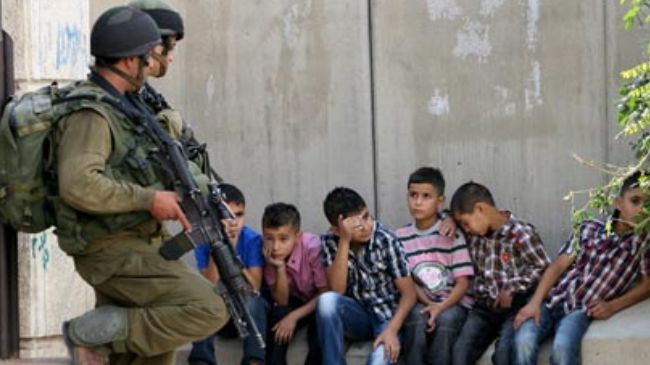
The United Nations says the ill treatment of Palestinian minor inmates within the Israeli military detention system is “widespread, systematic and institutionalized.”
The UN children’s fund, UNICEF, said in a 22-page report on Wednesday that it has examined the Tel Aviv regime’s military court system for holding Palestinian children and found evidence of “cruel, inhuman and degrading treatment or punishment.”
Some 7,000 Palestinian children, aged between 12 and 17, have been arrested, interrogated and prosecuted by Israeli forces, the report said, adding that the majority of them were boys.
“In no other country are children systematically tried by juvenile military courts that, by definition, fall short of providing the necessary guarantees to ensure respect for their rights,” the report stated.
UNICEF analyzed the procedure employed by Israeli forces from arrest to trial of the children. It said many children were “aggressively awakened in the middle of the night by many armed soldiers and being forcibly brought to an interrogation centre tied and blindfolded, sleep deprived and in a state of extreme fear.”
Many of them faced mistreatment during the transfer process and forced to lie down on the floor of a vehicle for one day in some cases. They were also subjected to verbal or physical abuse, the report also noted.
“The interrogation mixes intimidation, threats and physical violence, with the clear purpose of forcing the child to confess,” the international body said, adding they were not accompanied by a lawyer or a family member during the interrogation.
“Children have been threatened with death, physical violence, solitary confinement and sexual assault, against themselves or a family member,” it said, adding that they were restrained during the questioning even for extended periods of time.
The maximum penalty for minor inmates, aged 12 to 13, is six months. However, it could be extended to 20 years for those who are over 14. The vast majority of Palestinian children have been arrested for throwing stones.
“The principal evidence against the child is the child’s own confession, in most cases extracted under duress during the interrogation,” the UNICEF report further said, saying they have to sign confession forms in Hebrew which they barely understand.
“Ultimately, almost all children plead guilty in order to reduce the length of their pretrial detention. Pleading guilty is the quickest way to be released. In short, the system does not allow children to defend themselves,” the report concluded.
The Reporters Who Got Iraq So Wrong
By Peter Hart | FAIR | February 6, 2013
Ten years ago today, Colin Powell made the Bush administration’s case for going to war against Iraq. Much of what he said about Iraq’s threats to the United States was false. But the media coverage gave the opposite impression, and most of the pundits and journalists who promoted the justifications for the war paid no price for their failures.
As FAIR reported at the time, even before the Powell address there were reasons to be skeptical of the administration’s claims. On February 4, 2003, FAIR published “Iraq’s Hidden Weapons: From Allegation to Fact,” which made the point that “it has not been demonstrated that Iraq continues to hold unconventional weapons.” FAIR criticized coverage like that of the New York Times (2/2/03), which asserted that “nobody seriously expected Mr. Hussein to lead inspectors to his stash of illegal poisons or rockets, or to let his scientists tell all.”
As the FAIR release concluded:
The media convey to the public the impression that the alleged banned weapons on which the Bush administration rests its case for war are known to exist, and that the question is simply whether inspectors are skillful enough to find them.
Powell’s address was instrumental in pushing a faulty media line on Iraq’s WMDs further. That much was clear in the coverage right after his appearance at the United Nations, as FAIR documented on February 10 in “A Failure of Skepticism in Powell Coverage.”
In Andrea Mitchell‘s report on NBC Nightly News (2/5/03), Powell’s allegations became actual capabilities of the Iraqi military: “Powell played a tape of a Mirage jet retrofitted to spray simulated anthrax, and a model of Iraq’s unmanned drones, capable of spraying chemical or germ weapons within a radius of at least 550 miles.”
Dan Rather, introducing an interview with Powell (60 Minutes II, 2/5/03), shifted from reporting allegations to describing allegations as facts: “Holding a vial of anthrax-like powder, Powell said Saddam might have tens of thousands of liters of anthrax. He showed how Iraqi jets could spray that anthrax and how mobile laboratories are being used to concoct new weapons.” The anthrax supply is appropriately attributed as a claim by Powell, but the mobile laboratories were something that Powell “showed” to be actually operating.
Commentator William Schneider on CNN Live Today (2/6/03) dismissed the possibility that Powell could be doubted: “No one disputes the findings Powell presented at the U.N. that Iraq is essentially guilty of failing to disarm.” When CNN‘s Paula Zahn (2/5/03) interviewed Jamie Rubin, former State Department spokesperson, she prefaced a discussion of Iraq’s response to Powell’s speech thusly: “You’ve got to understand that most Americans watching this were either probably laughing out loud or got sick to their stomach. Which was it for you?”
If you turn to FAIR’s “Iraq and the Media: A Critical Timeline” (3/19/07), you see that February 6 Washington Post op-ed page had Mary McGrory writing: “I don’t know how the United Nations felt about Colin Powell’s ‘J’accuse’ speech against Saddam Hussein. I can only say that he persuaded me, and I was as tough as France to convince.” She added that she “heard enough to know that Saddam Hussein, with his stockpiles of nerve gas and death-dealing chemicals, is more of a menace than I had thought.”
And Richard Cohen (2/6/03) announced that the debate was over:
The evidence he presented to the United Nations–some of it circumstantial, some of it absolutely bone-chilling in its detail–had to prove to anyone that Iraq not only hasn’t accounted for its weapons of mass destruction but without a doubt still retains them. Only a fool–or possibly a Frenchman–could conclude otherwise.
Obviously, the fools and Frenchmen were correct. And as FAIR documented, independent-minded journalists were reporting that some of the administration’s claims did not stand up to scrutiny. The Associated Press had a detailed look at the state of Iraq intelligence on January 18. The skepticism and good judgment of those reporters (and others) should have been the rule, not the exception, if journalists had been doing their jobs.
But most journalists did a different job. And most of them faced no consequences whatsoever for being so disastrously wrong.
Featured Video

Deception – Submarines against Olof Palme
or go to
Aletho News Archives – Video-Images
From the Archives
Woolsey Fire started at Santa Susana Field Lab — where “radioactive materials released were never accurately measured”
By John Laforge | CounterPunch | November 30, 2018
In my Nov. 16 column, I reported on potential radiation risks posed by California’s Woolsey wildfire having burned over parts or all of the Santa Susana Field Laboratory—south of Simi Valley, Calif., 30 miles outside Los Angeles—site of at least four partial or total nuclear reactor meltdowns.
The field laboratory operated 10 experimental reactors and conducted rocket engine tests. In his 2014 book Atomic Accidents, researcher James Mahaffey writes, “The cores in four experimental reactors on site … melted.” Reactor core melts always result in the release of large amounts of radioactive gases and particles. Clean up of the deeply contaminated site has not been conducted in spite of a 2010 agreement.
Los Angeles’s KABC-7 TV reported Nov. 13 that the Santa Susana lab site “appears to be the origin of the Woolsey Fire” which has torched over 96,000 acres. Southern Calif. Public Radio said, “According to Cal Fire, the Woolsey Fire started on the afternoon of Thursday, Nov. 8 … on the Santa Susana site.” … continue
Blog Roll
 Aletho News
- Between war and industrial breakdown: The US-Israeli attrition crisis
- Pressure builds on Iran to ‘drop’ Lebanon ceasefire demand as Islamabad talks hang in balance
- In another clash report, US denies agreement to release Iran’s assets
- What is fueling unrest across the EU?
- Why no power can undermine Iran’s eternal dominance over the Strait of Hormuz
- Is The War Against Iran Over?
- Iran war will leave long-term ‘scar’ on Wall Street, investors warn
- How Iran decimated US power projection in West Asia: Military lessons of 40-day war
- Iran’s report details US-Israeli war crimes in targeting schools, hospitals, livelihoods
- NATO’s Slow Fracture: How Trump’s Iran War Exposed the Instrument of Hegemony
- If Americans Knew
- After killing 350+, Israel still has a “score to settle” with Lebanon before ceasefire – Daily Update
- Military aid to Israel emerges as the latest political litmus test for Democrats
- The only Palestinian children’s rights organization closes following years-long Israeli campaign against it
- ‘I Can’t Forget the Smell’: Lebanese Reel After Israel Kills Over 300 in Single Day
- DNC Shoots Down Resolutions Calling Out AIPAC and Limiting Arms to Israel
- TCN: Is Israel Blackmailing President Trump?
- Israel killed at least 303 Lebanese yesterday – who were they? Daily Update
- Amnesty: Urgent – Protect Lebanese civilians from brutal escalation in Israeli attacks
- Is The War Against Iran Over?
- Inside the Israeli army’s propaganda wing
- No Tricks Zone
- New Study: No Linear Warming Or Glacier Retreat Along Northern Antarctic Peninsula Since 1980s
- An Inconvenient Tree: Uncovered In Alps… Europe Much Warmer Than Today 6000 Years Ago
- New Study Reports A 60% Slowdown In Greenland’s Ice Loss Rate In The Last Decade
- Low Intensity Tornado Wrecks Major Solar Farm, Creating A Potential Toxic Dump
- New Study Finds Warming Saves Lives…Cold Temperatures 12 Times More Deadly Than Excess Heat
- German Science Blog Accuses PIK Climate Institute Of Hallucinating Climate Tipping Points
- Devastating Assessment Of Comirnaty Vaccine By Former Senior Pfizer Europe Toxicologist
- New Study: CO2 Is ‘Effectively Negligible’ As An Explanatory Climate Change Factor Since 2000
- Former Pfizer Toxicologist Dr. Helmut Sterz Tells Bundestag Hearing Pfizer Vaccine Should Have Never Been Approved
- Energy Expert: Germany’s Nuclear Phaseout Was A “500 Billion Euro Mistake”
 Aletho News