The ginned-up Syrian death toll
left i on the news | July 21, 2013
Today the U.N. claims that “5000 people a month” are dying in Syria. As I have before, I have to demonstrate why I find this claim utterly non-credible. 5000/month would be 167 every single day. Now we don’t know what the standard deviation might be, but we have to assume it would be reasonably large, which would mean that some days would be much lower, while on other days, we could easily expect 300 or more to be killed in a single day, if the 5000/month were to be believable.
So let’s look at a report from today, when major battles are being reported. Looking through the article, we find (claims of) six mediators shot in Homs, eight Nusra front militants killed by Kurds, nine people killed at a checkpoint, and “several” regime fighters killed. All in all fewer than 30 were reported killed on a day when major battles are being fought. Is it remotely credible that an average of 167 are being killed every single day? Just yesterday we read about 40 people being killed in a single bombing in Iraq; when is the last time we read about an event in Syria which killed even that many people? And when was the last time we read about a day when more than 200 people died in Syria in just a single day? For my part, the answer would be: never.
I don’t know what the statistics are, and I’ll also state clearly that they make no difference whatsoever to my stand, which is: Hands off Syria! No U.S. intervention in Syria. However, because these numbers are being used (and, in my opinion, “ginned up”) to justify ever-increasing intervention in Syria, it is important to understand them, and rebut them, if they are false. Which, in my opinion, is without question.
Related articles
- Kurdish leader says Syria Kurds not after forming own government (alethonews.wordpress.com)
- Syrian Kurds to declare autonomy from Damascus (timesofisrael.com)
The Language of Power: Obama’s “Humanitarian Hawk” & Israel’s New Gladiator at the UN
By Nima Shirazi | Wide Asleep in America | July 18, 2013
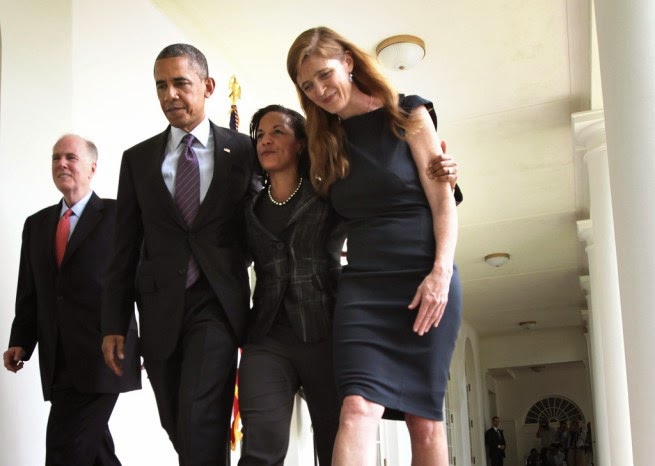
In her first appearance before the Senate Foreign Affairs Committee, Samantha Power, Obama’s pick for next U.S. Ambassador to the United Nations, made clear that she will spend her time in the role much as her predecessor Susan Rice did: acting as Israel’s consummate defender, fear-mongering about Iran, and opposing any move to champion Palestinian human rights or self-determination.
Rice, who has been appointed as Obama’s National Security Adviser, has said repeatedly that the American delegation to the UN “often works in ‘lockstep’ with the Israeli delegation” and spends “an enormous amount of time defending Israel’s right to defend itself and defending Israel’s legitimacy.”
“It’s an issue of utmost and daily concern for the United States,” she declared last year. A few months ago, she reiterated this point, insisting that her role as an apologist for the Israeli government is “a huge part of my work to the United Nations” and that the United States “will not rest in the crucial work of defending Israel’s security and legitimacy every day at the United Nations.”
Power has already proven herself a loyal replacement, disavowing any semblance of past critical thinking when it comes to Israeli human rights abuses and abrogation of international law and opposing fear-mongering about Iran’s nuclear program. It is no surprise Washington hawks and, even the Israeli government, are falling over themselves to sing her praises.
In her confirmation hearing yesterday, Power revealed her adherence to AIPAC talking points, essentially working her way down the tried and true list of boilerplate phrases. “The United States has no greater friend in the world than the State of Israel,” she said, adding, “Israel is a country with whom we share security interests and, even more fundamentally, with whom we share core values – the values of democracy, human rights, and the rule of law.”
“America has a special relationship with Israel,” she stated, to the surprise of no one and the consternation of George Washington‘s ghost. “I will stand up for Israel and work tirelessly to defend it,” she promised.
Perhaps her most disturbing comments, however, were about Iran. Shamelessly exploiting the horror of the Holocaust to fear-monger about the Islamic Republic, she declared:
“…within this organization built in the wake of the Holocaust – built in part in order to apply the lessons of the Holocaust – we also see unacceptable bias and attacks against the State of Israel. We see the absurdity of Iran chairing the UN Conference on Disarmament, despite the fact that its continued pursuit of nuclear weapons is a grave threat to international peace and security.”
With this statement, Power, in her eagerness to check off all the buzzword boxes prescribed by AIPAC, directly contradicts the consistent assessment of the United States’ own intelligence community, which has repeatedly concluded that Iran is, in fact, not pursuing a nuclear weapons as it has no nuclear weapons program.
Early last year, an unnamed U.S. intelligence official told the Washington Post that Iran has not decided to pursue nuclear weapons, explaining, “Our belief is that they are reserving judgment on whether to continue with key steps they haven’t taken regarding nuclear weapons.” At the time, Secretary of Defense Leon Panetta affirmed this position, admitting, “Are they trying to develop a nuclear weapon? No.”
Soon thereafter, the New York Times reported, “Recent assessments by American spy agencies are broadly consistent with a 2007 intelligence finding that concluded that Iran had abandoned its nuclear weapons program years earlier.” This, the paper noted, “remains the consensus view of America’s 16 intelligence agencies.”
Either Samantha Power is an idiot or she’s lying.
In fact, there was a time when Power wasn’t so confident in making such a declarative statement. In a 2008 interview with Miller-McCune, Power noted that she was “not an expert on Iran,” but condemned the “American sabre-rattling” of the George W. Bush administration. “The threats – implicit and explicit – of U.S. military action have united very diverse secular, Islamist and nationalist strands,” she said, adding that American “belligerence” had “backfired.”
When asked specifically about whether she thought “Iran is trying to create nuclear weapons,” Power replied, “It would surprise me if they weren’t, but I don’t know.”
Still, she disparaged the findings of the National Intelligence Estimate and simply assumed Iran “would see as in its interests to amass as much firepower as possible,” due to the foreign threats it faces. Nevertheless, she stated, “It does not seem as though the Iranian regime is close to possessing nuclear weapons” and said that “when U.S. leaders claim Iran poses an imminent threat, they are not currently heard as credible.”
Now, five years later, Power sounds exactly like Bush’s own UN Ambassador, perennial Iran hawk John Bolton, who in 2006, insisted to the UN Security Council that “Iran had defied the international community by continuing its pursuit of nuclear weapons” and that this “pursuit of nuclear weapons constituted a direct threat to international peace and security.”
Furthermore, Power’s incredulity regarding what she deems the “absurdity of Iran chairing the UN Conference on Disarmament,” betrays her own ignorance on Iran’s constantly repeated stance regarding nuclear nonproliferation and disarmament.
Iran has long championed a Nuclear Weapons Free Zone (NWFZ) in the Middle East and is a party to all disarmament treaties on weapons of mass destruction, including the Biological Weapons Convention, Chemical Weapons Convention, and the Nuclear Non-Proliferation Treaty. Israel, however, is not a member to any of them.
Last year, Iranian Foreign Minister Ali Akbar Salehi stated that Iran fully supports the establishment of a NWFZ, but that Israel, and its American backers, presented the “only obstacle to the creation of such a zone…due to its persistent refusal to join the NPT and to place its nuclear facilities under the IAEA safeguards system.” The United States consistently blocks crucial international conferences dedicated to nuclear non-proliferation for the sole purpose of protecting Israel’s massive nuclear arsenal from scrutiny.
Samantha Power has surely embraced her new role in Turtle Bay as Israel’s stalwart apologist.
Abe Foxman, the Anti-Defamation League’s hasbarist-in-chief, once called Susan Rice a “gladiator” fighting in the United Nations on behalf of Israel. There is no question Samantha Power will, for the sake of our “special relationship” and “shared values” with an aggressive, nuclear-armed, settler-colonial apartheid state, similarly take up the sword and continue to unleash hell on the entire Middle East.
Related articles
- Israel’s Nuke Arsenal Off-Limits (alethonews.wordpress.com)
- MEK Re-Ups 3 Year Old Nuclear Propaganda (alethonews.wordpress.com)
Tony Blair hired ex Israeli army intelligence officer
By Gilad Atzmon | July 7, 2013

The Telegraph reported today that “Tony Blair has hired a former Israeli army intelligence officer to work in his private office, despite his role as Middle East peace envoy.”
Lianne Pollak, who has led intelligence teams in the Israel Defence Forces, was recruited as a private consultant between October 2012 and April this year.
The 30-year-old Israel was previously a policy adviser to Israeli PM Benjamin Netanyahu, working with security agencies and senior officials.
The former British prime minister is the envoy to the Middle East for the Quartet – the group that represents the US, Russia, the United Nations and Europe.
His role includes encouraging development in Gaza and the West Bank and helping to forge a settlement of the Israeli-Palestinian conflict, having been appointed when he left Downing Street in June 2007.
Related article
- Tony Blair: Egypt’s army had no choice (thestate.com)
Bush’s Foiled NSA Blackmail Scheme
By Dennis J Bernstein | Consortium News | June 21, 2013
In early 2003, as the U.S. and British governments were seeking international acquiescence to their aggressive war on Iraq, an unexpected cog thrown into the propaganda machine was the disclosure that the National Security Agency was spying on UN Security Council members in search of blackmail material.
The revelation received little attention in the mainstream U.S. news media, which was almost fully on board the pro-war bandwagon, but the disclosure received wide international attention and stopped the blackmail scheme. U.S. President George W. Bush and British Prime Minister Tony Blair were forced to abandon a UN resolution and invade Iraq with a ragtag “coalition of the willing.”

Former British Prime Minister Tony Blair.
Several months later, the identity of the leaker was revealed, a young woman named Katharine Gun who worked as a linguist at the NSA’s UK counterpart, British Government Communications Headquarters. Gun lost her job and was charged under British secrecy laws, but the case was dropped because the court would have required the Blair government to disclose that it also had twisted the arms of legal advisers to extract an opinion endorsing the invasion.
Now, a decade later, Edward Snowden, a young American systems analyst working for the NSA, has leaked documents revealing a global surveillance network and prompted another international debate – about government spying vs. personal privacy. Katharine Gun joined Pacifica’s “Flashpoints” host Dennis J Bernstein to discuss both cases.
DB: What exactly was your position when you decided to leak a certain document?
KG: My title was linguist analyst. I was a Mandarin Chinese speaker. We translated interceptions and produced reports for the various customers of GCHQ, which are normally the Foreign Office or MI-5 and MI-6.
DB: Can you explain the document you released and the significance of the timing?
KG: It was released at the end of January 2003, just before the invasion of Iraq. I saw an email that had been sent from the NSA to GCHQ. It was a request for GCHQ to help the NSA intercept the communications of six nations that sat on the Security Council at that time. It was to intercept their domestic and office telecoms in order to obtain all the information we could about the delegates, which the U.S. could then use to achieve goals favorable to U.S. interests. They called for the whole gamut of information, which made me think they would potentially use the information to blackmail or bribe the U.N. delegates.
DB: This bugging took place at the United Nations?
KG: Presumably, yes. Or it could involve the United Nations headquarters or also their domestic residence.
DB: The idea was to get the necessary information one way or the other to influence the key members to support the U.S. quest for war in Iraq?
KG: Yes. At the time, if you were not working for the intelligence services or the foreign offices of the U.S. or U.K. you would probably assume that the goal of [President George W.] Bush and [Prime Minister Tony] Blair at that time was to work diplomatically to reach a solution. But we now know, after several leaks over the years about the run-up to the war in Iraq, that war was the agenda all along. When I saw the email it made me think, “This is evidence that war is the agenda.” That’s why I decided the public needed to know.
DB: GCHQ is the British Government Communications Headquarters, the equivalent to the NSA [National Security Agency]. You were working there in the lead-up to the Iraq War. Can you remind us what governments were bugged?
KG: Six nations, smallish countries: Angola, Cameroon, and Pakistan, I think. Mexico was mentioned, and possibly Chile as well. They were countries that are generally not known for their big powerful positions at the U.N.
DB: What went through your mind leading up to the decision to leak this information? This big decision changed history a bit. How did you make this courageous decision that also changed your own life?
KG: I was very concerned. I had informed myself about the realities of Iraq and the situation there because I grew up during the first Gulf War and the following years of sanctions. It was in the back of my mind that Iraq was a country that was virtually destroyed, and that the people were living in impoverished conditions. It made me think that another attack on them would not be fair and justified because there was nothing about Iraq that was a threat to either the U.S. or the U.K.
So when I saw the email and realized what was going on behind closed doors was an attempt to get the U.N. to authorize what would then have become a pre-emptive strike on a country, I thought the public should know about this because it angered me.
DB: What happened after you made this information available? What happened with your position? Were you intimidated, attacked?
KG: Initially I tried to remain anonymous, but when I realized the information revealed in the newspaper at the time was identifiable to GCHQ, I decided I didn’t want to lead a double life at GCHQ and pretend I had nothing to do with it. I confided to my line-manager and said it was my leak. Then I was arrested under suspicion of breaking the Official Secrets Act, questioned, and released on bail for eight months.
In November 2003, much to our surprise, they decided to charge me, despite having waited so long. After discussions with my legal team, which included Liberty, an organization very similar to the U.S. ACLU, we decided I would plead non-guilty, because I personally felt that although I did the act, I didn’t feel guilt, because I didn’t feel I had done anything wrong. Our defense would have been to establish the defense of necessity, which is not yet tested in a court of law. My legal team then asked for all the legal advice leading up the war, and at that point, the prosecution decided to drop all charges against me.
DB: What do you think made them decide to prosecute you, and what information made them drop the charges? Were they trying to backpedal? Were they trying to make sure no other folks in positions like you would do it again?
KG: It’s speculation on my part because obviously they haven’t disclosed. I suspect one of the reasons they charged me was to make an example of my actions to try to deter people from it. On the other hand, when they dropped the charges, I suspect there may have been a variety of reasons. When we asked for the legal advice from the then-Attorney General, at that time his legal advice had not been fully disclosed.
During the run-up to the war, Blair asked for legal advice, obviously. The first draft was about 13 pages long. The language was very cautious – it didn’t say there was a definite reason for war. There were many legal terms of caution, but at some point Blair was told the legal advice was not good enough. He needed a watertight case. The Attorney General then re-drafted his advice, and condensed it to a single page that was then issued to the House of Commons.
That is what persuaded all the MPs in the House of Commons to vote for Britain’s involvement in the war. Eventually information came out, not from myself, but from other means and it became apparent that the legal advice had not been at all watertight to start with.
DB: Daniel Ellsberg said your most important and courageous leak is the only one made in time to avert an imminent possible war. Was your desire to avert war?
KG: Yes, I was hoping the British ministers would see the truth and question the actions of Blair and the secret negotiations he was having with Bush at the time. I wanted more transparency on the issue. I wanted people to question what was going on and to generally challenge this bandwagon for a preemptive strike against a country that was already very impoverished and no threat to anybody whatsoever.
DB: Did you ever hear from folks who based on your revelations, learned they were bugged?
KG: No.
DB: So there were no thank yous coming across from that part of the world?
KG: No. At the time of the leak, my name didn’t come out. Eight months later my name was made public.
DB: Did it change your life?
KG: I lost my job. The secure, full-time, long-term employment was no longer possible. That has made an impact, primarily financially, on my life and my family’s life.
DB: We are now seeing extraordinary NSA leaks from Edward Snowden in the British Guardian. What are your thoughts on this?
KG: I think Snowden is probably is a lot more clued-up than I was at the time. My leak was a single issue. Snowden has had a long period of time working within the U.S. intelligence services. He’s obviously a very technically savvy professional. I admire him for taking this tremendous step, which he thought out very carefully and methodically. He has made some very good points. These kinds of issues should be in the public domain because it involves innocent members of the public. We, the public, should be able to have a measure of a say in these matters.
DB: We hear that people like you, who were leaking before the war, and Snowden now, are putting people’s lives in jeopardy, endangering the people. We hear that secrecy is necessary to prevent terrorist attacks, and that many have been prevented by this kind of secrecy, investigation, wiretapping and bugging that’s going on now.
KG: There is absolutely no evidence that my leaks in any way endangered anybody else.
DB: But you were accused of that.
KG: Yes, they love to throw accusations around, there’s no doubt about that. But in my case, the majority of views supported my actions. In Snowden’s case, people who have a fair and just understanding of the issues at-large are supportive of his actions, as they would be of Private Manning, who is currently on trial.
DB: Did you lose any friends or associates, over this?
KG: Ironically, not really. Many of my friends and colleagues from GCHQ have also left GCHQ, partly to progress in their professions. They didn’t see much chance for their linguistic skills progressing much further within GCHQ and I continue to be in touch with them.
DB: If you had it all to do over again, would you?
KG: That’s a difficult question. Now I’m married and have a child. I would hope that I would still do it, but perhaps I would be more savvy about how I did it. Snowden was very clued-up and seems to know exactly what he should be doing – how to stay safe and keep out of the way of being unjustly arrested and tried without due process of law.
DB: Your language skills. Are you using them now?
KG: Not now. I’m only fluent in Mandarin Chinese. I speak some Japanese and am now trying to learn Turkish.
DB: That may in handy in the next decade or so. Thank you for talking to us.
~
Dennis J Bernstein is a host of “Flashpoints” on the Pacifica radio network and the author of Special Ed: Voices from a Hidden Classroom. You can access the audio archives at www.flashpoints.net.
Related articles
- A British Precursor to Snowden Case (consortiumnews.com)
- British spy agency has access to global communications, shares info with NSA (alethonews.wordpress.com)
UN rejects US claim on Syria chemical weapons
Press TV – June 21, 2013
UN experts say they do not confirm the claims by the United States, France and Britain that the Syrian government has used chemical weapons against the militants.
“We are not able to say who has used chemical agents or chemical weapons,” said Paulo Pinheiro, chairman of the United Nations human rights investigation committee on Syria, on Friday.
Speaking to reporters after an informal meeting with UN Security Council ambassadors, Pinheiro said he would not comment on evidence, including multiple blood, tissue and soil samples, that the US, Britain and France have sent to the UN about the possible use of chemical weapons in Syria.
The technical data presented by the three countries is of limited value to the UN which, according to its rules, can pass a final judgment on the situation only after its own inspectors personally collect evidence.
Based on the unsubstantiated claim that the Syrian government has used chemical weapons against the militants, President Barack Obama ordered the CIA last week to provide arms to the anti-Syrian groups, saying the government of President Bashar al-Assad had crossed Washington’s red lines.
In an article on the Washington Post on Friday, Colum Lynch and Joby Warrick write that the US move “rests on unverifiable claims” that lack transparency.
Weapons experts say Obama’s declaration of Washington’s red line in terms of more involvement in Syria “handed the Syrian opposition a powerful incentive to fabricate evidence” against the Assad government regarding the chemical arms use, the article said.
“If you are the opposition and you hear” that the White House has drawn a red line on the use of nerve agents, then “you have an interest in giving the impression that some chemical weapons have been used,” said Rolf Ekeus, a Swedish scientist who headed UN weapons inspections in Iraq during the 1990s, the article read.
Related articles
- PressTV: Russia dismisses ‘unconvincing’ US claims on chemical weapons use by Syria (jhaines6.wordpress.com)
- New weapons supplied to militants in Syria (fromthetrenchesworldreport.com)
UN calls for record $5.2 billion aid package for Syria
Al-Akhbar | June 7, 2013
The United Nations on Friday launched a record $5.2-billion aid appeal to fund operations in Syria and neighboring nations, saying the number of people affected by the country’s brutal conflict was set to spiral.
The call for donations comes as the UN expects that 10.25 million Syrians – half the country’s population – will need humanitarian aid by the end of 2013.
The sum of aid being requested overshadows by far the $2.2 billion the UN sought in 2003 to help cope with the crisis sparked by the war in Iraq.
The $5.2 billion represents money needed across this year to pay for operations that have already been undertaken, are ongoing, or are due to be carried out until the end of December.
“The figure for the new appeal is both an expression of the alarm about the situation facing Syrians and an absence of a political solution,” said Adrian Edwards, spokesman for the UN’s refugee agency, the UNHCR.
It also marked a more than threefold increase on the $1.5 billion which the UN previously had said that it needed to cover operations this year.
The UN has so far received $1.0 billion of that sum, after launching an appeal last December.
In the latest appeal, the world body said that a total of $3.8 billion was needed to help Syrian refugees who have spilled across the country’s borders to escape fighting in their homeland.
The figure for operations inside Syria meanwhile was $1.4 billion.
According to UN estimates, more than 80,000 people have been killed and some 1.6 million Syrians have fled the country since the civil war began in March 2011 after a crackdown on protests against President Bashar al-Assad.
“The numbers represented in this plan are staggering,” said Amir Abdulla, deputy executive director of the UN’s World Food Program (WFP). “They’re not sustainable over the very long term.”
“They represent a tragedy for Syria and a burden on the region,” he told reporters.
The WFP, which has delivered 500 million meals in Syria so far this year, expects its weekly costs to rise from almost $20 million now to $36 million after September. It says it has a funding shortfall of about $725 million.
The WFP’s Syria Regional Emergency Coordinator Muhannad Hadi said: “We have reached a stage in Syria where some of the people, if they don’t get food from the World Food Programme, they simply do not eat.”
The overwhelming majority of the refugees have fled to neighboring Lebanon, Turkey, Iraq and Jordan, which are struggling to cope.
In Jordan, for example, one refugee camp is now the equivalent of the nation’s fifth-largest town.
With the revolt against Assad having morphed into a vicious, drawn-out conflict, the total number of refugees is expected to swell to at least 3.45 million by the end of this year, according to the UN appeal.
Within the country, a total of 6.8 million people are forecast to need aid this year, the majority of them people who have been forced to flee their homes because of the fighting.
“These are huge numbers. They are not sustainable over the very long term, which is why we hope that there will be a solution to the situation inside Syria,” said Abdulla.
“We hope that the world will respond, as millions of Syrians displaced in their home country, and refugees in neighboring countries, basically have little else to rely on at this time,” he added.
Syria’s pre-war population was 20.8 million.
“By the end of the year, half of the population of Syria will be in need of aid,” underlined Edwards.
The nature of the Syrian conflict has affected aid efforts, with convoys often having to clear dozens of checkpoints manned by different militias from both sides.
“In other operations, there’s often a front line when you’re dealing with two opposing forces. In this instance you’ve a very complex situation where there are pockets. There is no clear line. You’re dealing with a fragmented opposition who don’t follow a monolithic command and control structure,” said Abdulla.
(AFP, Reuters, Al-Akhbar)
Moscow disappointed political games prevented investigation into chemical weapons use in Syria
RT | May 31, 2013
Russia’s Foreign Minister Sergey Lavrov stressed that “political games” prevented Russia from investigating the data on the use of toxic substances in Aleppo: the UN Secretariat couldn’t respond promptly to Moscow’s demand to look into the matter.
In March, the Syrian government invited the United Nations to investigate possible chemical weapons use in the Khan al-Assal area of rural Aleppo. Military experts and officials said a chemical agent, most likely sarin, was used in the attack which killed 26 people, including government forces.
Several countries, including Israel, the UK, France and the US – all vocal critics of Syrian President Bashar Assad – all claimed they had evidence that chemical weapons were used in Syria.
Damascus denied that a chemical attack was carried out by the Syrian army, blaming the rebels and Turkey for the incident: “The rocket came from a place controlled by the terrorists and which is located close to the Turkish territory. One can assume that the weapon came from Turkey,” Syrian Information Minister Omran al-Zoabi alleged in an interview with Interfax news agency.
Lavrov spoke following the reports that Turkish security forces found a 2kg cylinder with sarin gas after searching the homes of Syrian militants from the Al-Qaeda linked Al-Nusra Front who were previously detained.
The sarin gas was found in the homes of alleged Syrian militants, who were reportedly planning a terrorist attack on the southern Turkish city of Adana.
Russia expressed concern over the incident, urging for a thorough investigation into the matter.
Almost a month ago, the Syrian Deputy Foreign Minister Faisal Muqdad said that Damascus was ready to have the UN investigation team look into alleged chemical weapons use in Syria.
“We were ready and we are always ready, right now, to receive the delegation that was set up by [UN Secretary-General] Ban Ki-moon to investigate what happened in Khan al-Assal,” Muqdad said, referring to the March 19 incident near Aleppo.
Syrian rebels are accused of using a rocket with a chemical warhead, killing 25 people and injuring 86, according to SANA news agency.
The Syrian civil war has been raging for more than two years now, with more than 80,000 people killed, according to UN estimates.
In his latest statement on the matter, Lavrov noted the Russian government’s concern over the issue due to the chance of provocations around the situation.
US obstructing global disarmament: Iran
Press TV | May 16, 2013
Iran’s Foreign Ministry Spokesman Abbas Araqchi says the United States’ opposition and lack of commitment to various international disarmament conventions are obstacles to advancing the issue of global disarmament.
Pointing to the US’s 16-year opposition to bringing up the issue of disarmament in the UN Disarmament Conference, Araqchi said, “The US has, for all practical purposes, taken the conference hostage and is hindering its effective performance in advancing international peace and security.”
He said that the US opposition to the protocol to the Biological Weapons Convention, its non-adherence to its commitments under the Chemical Weapons Convention to eliminate its arsenal by 2012, and efforts to prevent global denuclearization as well as a nuclear-free Middle East are all part of Washington’s black record of non-compliance with international obligations and disrespect for international mechanisms on global disarmament and security.
Reacting to Washington’s recent decision to boycott the upcoming UN Conference on Disarmament because of its chairmanship by Iran, Araqchi said, “Iran is among the first founders of the [UN] Disarmament Conference, and as an independent country, it has always played an instrumental and constructive role in advancing the objectives of the conference, in particular that of nuclear disarmament.”
In a statement issued on Monday, Erin Pelton, the spokesperson for the US Mission to the United Nations, said that the US would not send its ambassador to the conference, adding the US believes the Islamic Republic of Iran should be barred from any formal or ceremonial positions in UN bodies.
Araqchi further noted, “Iran has also played a key role in negotiations on international treaties, including the Chemical Weapons Convention.”
Describing Iran as a victim of weapons of mass destruction (WMDs), the Iranian spokesman said the Islamic Republic of Iran along with other peace-loving nations of the world will continue to tap into all national and international potential to contribute to the creation of a WMD-free world.
Iran proposed the idea of a nuke-free Middle East and is among the flag-bearers of nuclear disarmament, he highlighted.
Iran will accede to the rotating presidency of the 65-nation UN Conference on Disarmament, based in Geneva, on May 27 and it will hand it over to another country on June 23 in an alphabetical order.
The conference seeks to reach an agreement on global nuclear disarmament and stopping the development of other weapons of mass destruction.
Related article
- Canada not to attend UN disarmament talks under Iran presidency (alethonews.wordpress.com)
UN Arms Trade Treaty’s Deadly Loophole
By Nile Bowie | Press TV | April 7, 2013
Foundation fellows and diplomats have lauded the overwhelming approval of the Arms Trade Treaty (ATT) by the General Assembly of the United Nations, with UN Secretary-General Ban Ki-moon describing it as a means to obstruct the illicit arms flow to warlords, pirates, terrorists, criminals and the like. Many who have critically monitored the situation in Syria and the ramifications of foreign intervention in Libya may have difficulty swallowing Ban’s words, as some would argue that the UN has itself been complicit in these crises for turning a blind eye to arms and funding going to al-Qaeda-linked rebels in various countries. Twenty-three countries abstained from the vote (representing half the world’s population), including Russia, China, India, Cuba, Bolivia, Nicaragua and Egypt, while three – Syria, Iran, and North Korea – voted no. Iran’s Deputy Permanent Representative to the UN Gholam-Hossein Dehqani called the treaty a political document disguised as an Arms Trade Treaty, and with highly legitimate reasons for doing so.
“The right to acquire and import arms for their (importer states’) security needs is subject to the discretionary judgment and extremely subjective assessment of the exporting states. That is why this text is highly abusable and susceptible to politicization, manipulation and discrimination,” said Dehghani, referring to conditions that arms exporting states would be able to impose on importing states. The pact prohibits the export of conventional arms to countries deemed guilty of violating international human rights laws and committing crimes against humanity – sure, this appears to be ethical and just at first glance, but more careful reflection is required. If we assume that the United Nations makes the call on which states qualify as human rights abusers and which states do not, then Israel would not be hindered from purchasing conventional weapons, but a country like Syria would be barred from purchasing arms to defend itself and its territorial sovereignty.
What makes the treaty not only toothless, but also particularly dangerous, is the fact that it lacks any explicit prohibitions regarding arms proliferation to terrorists and unlawful non-state actors. “Without such provisions, the ATT would in fact lower the bar on obligations of all states not to support terrorists and/or terrorists acts. We cannot allow such a loophole in the ATT,” said Sujata Mehta, India’s lead negotiator for the ATT in a statement. What this means is that NATO and Gulf states that supply arms to opposition groups in Syria will retain the flexibility to continue to do so, while at the same time having a greater say over whether individual importing states can arm themselves in accordance with their legitimate defense and national security interests. There is no doubt that certain states would take advantage of this loophole’s vast potential for misuse.
The treaty does not recognize the rights of all states to acquire, produce, export, import and possess conventional weapons for their own legitimate security purposes. In theory, this treaty gives the United States, the world’s largest arms exporter with heavy sway over the UN, much greater ability to influence whether or not an individual country is allowed to obtain weapons for its own defense. The treaty, in its glaring bias and predictability, completely fails to prohibit the transfer of arms to countries engaged in military aggression against other nations, such as Israel. “Somebody probably wants to have free rein to send arms to anti-government groups in countries ruled by regimes they consider inconvenient… When we started work on the document, the General Assembly set the task of establishing the highest possible international standards in the area of arms transfers. In reality though, the treaty has established minimally acceptable standards,” said Russian treaty negotiator Mikhail Ulyanov in a recent interview.
The treaty applies to the transfer of conventional weapons such as battle tanks, armored combat vehicles, large caliber artillery systems, combat aircraft, attack helicopters, warships, missiles and missile launchers, small and light weapons, while the proliferation of UAV drones and other modern military technology is not addressed or scrutinized. While feel-good rhetoric prevails and politicians pat themselves on the back, the United Nations by its own admission concedes that the treaty does not ban or prohibit the export of any type of weapon. It is clear that the countries that rely most on the illicit trafficking of arms to execute their foreign policy objectives have had noticeable influence over the contents of this treaty. The treaty depends on how stringently individual countries implement it, and international arms transfers that involve barter deals or leases are also not scrutinized.
While many call it a welcomed development and the first step in regulating the $70 billion global conventional arms trade, there is little evidence that it will accomplish anything more than increase the frequency of illicit transfers under different guises and further legitimize the ‘Good Terrorist-Bad Terrorist’ dichotomy – it also contains no language concerning the right to self-determination by people who are under occupation, as is the case in Palestine. The treaty contains some reasonable common-sense measures, such as introducing national systems that monitor arms circulation in countries that lack such systems, but the absence of progressive processes lends credence to accusations that the text is highly industry-friendly and serves to reinforce the status quo.
Most importantly, the treaty pays no focus to actually reducing the sale of arms by limiting global production, which should rightfully be the objective of a treaty that uses global mass causality figures to legitimize itself. According to the UN Office for Disarmament Affairs, armed violence kills more than half a million people each year, a figure that should rightfully strengthen calls to regulate and decrease global production rather than solely focusing simply on trade. Rather, the treaty institutionalizes and legalizes the arming of good terrorists while denying arms to unfriendly governments. Until the UN can cease being an appendage of a handful of the most powerful arms exporting states, there is little hope that any international arms trade treaty can reduce human suffering and have a meaningful impact on the lives of the most vulnerable in conflict zones around the world and elsewhere.
Nile Bowie can be reached at nilebowie@gmail.com
Related article
Featured Video
“Historic Russia”: The Land Putin Will Not Give Back
or go to
Aletho News Archives – Video-Images
From the Archive
How Ukraine Tortured and Slaughtered Donbass
By Kit Klarenberg | Al Mayadeen | July 11, 2024
Almost immediately after the proxy war erupted, ISIS-tier footage of the torture and murder of Russians in Ukrainian custody emerged.
On July 6th, the New York Times published an astonishing investigation: In Ukraine, Killings of Surrendering Russians Divide an American-Led Unit. The article documents in grim detail how Chosen Company, an international volunteer battalion for Kiev, routinely executes Russian prisoners of war. It is the very first mainstream admission that this practice – a brazen breach of the Geneva Conventions, and a grave war crime – is widespread among Ukraine’s fighters, both foreign and homegrown. … continue
Blog Roll
 Aletho News
- US taxpayer money laundered back through Ukraine – Musk
- Before COVID, an NIH lab chief proposed making a SARS-like bat virus more infectious
- Gates, Bourla on Trial in Netherlands Accused of ‘Great Reset’ Scheme at Vaccine Injury Hearing
- BRITAIN’S WARNING: PREPARE FOR WAR
- “Historic Russia”: The Land Putin Will Not Give Back
- How the Cambridge Analytica scandal still haunts Mark Zuckerberg
- The Ongoing Cancellation Campaign Against a Dissenting Academic in Norway
- Yemen and ‘the Houthis’: Challenging Sami Hamdi’s Narrative
- No, Christians did not invent Zionism
- AIPAC-led lobbying network opens branches in Cypriot, Greek parliaments
- If Americans Knew
- Damning report shows the media must confront its failures on Gaza
- BBC senior broadcaster speaks out on Gaza coverage
- Netanyahu vows vast West Bank invasion in response to 20-minute skirmish that left 2 Israeli soldiers and 2 Palestinian fighters dead
- Tied up and tortured: Israel using US-made electroshock weapons on Palestinian detainees
- The outsourced risk: how newsrooms rely on Gaza’s freelancers without protecting them
- Gaza bakeries forced to shut as Israel blocks flour shipments
- Gaza’s breast cancer patients face a deadly wait for treatment amid Israel’s genocide
- DAILY UPDATE: Latest essential news on Palestine, Israel, & region
- The Israel Lobby’s Changing Fortunes
- AIPAC has become such a political liability that it’s shifting to a more “nimble” approach to buying politicians
- No Tricks Zone
- Two New Studies Find Thwaites Glacier Melt Cannot Be Driven By Human Activity Or A Warming Ocean
- E-Cars Reduce CO2 Emissions By Only 41% Compared To Internal Combustion Engine Vehicles
- Predictions Made By Renowned Climate Professor Over Past Decades Have Been Proven To Be Poor
- New Study Suggests Large Regions Of The Pacific Ocean Have Been Cooling For The Last 80 Years
- Germany’s Green Energy Debacle: High Energy Costs Force Kahla Porzellan to Close After 182 Years!
- New Study: 50 Years Of The Most Aggressive ‘Net Zero’ Policies Can Only Affect The Global Climate By 0.03°C
- US September “Heat” Was No Record…Many Records Set Decades Ago
- Latest European Green Energy Debacle; Portugal’s Largest Flagship Solar Park Insolvent!
- Green Energy Debacle: German Expert Professor Fritz Vahrenholt Warns Of Severe Economic And Social Consequences
- Two More Paleo Reconstructions Affirm Meters-Higher Sea Levels Across Ireland, Brazil 7000-6000 Years Ago

