US: Anti-Iran ‘non-nuclear’ sanctions are OK
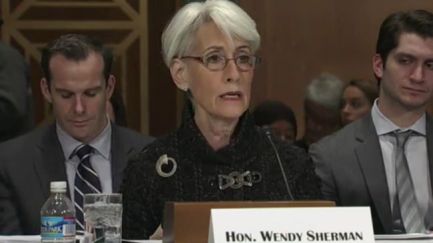
US State Department official Wendy Sherman at the Senate Banking Committee on Dec. 12, 2013

Press TV – December 13, 2013
The administration of President Barack Obama has told lawmakers in US Congress that they could pass new sanctions against Iran as far as they are not “nuclear-related.”
During a public testimony before the Senate Banking Committee on Thursday, State Department official Wendy Sherman, who led the US delegation in nuclear talks with Iran in Geneva, indicated that US lawmakers had the green light from the Obama administration to pass new anti-Iran sanctions as long as the sanctions are not “nuclear-related.”
“Given that there are different kinds of sanctions and the agreement focuses on nuclear-related sanctions,” Sen. Mike Crapo, the top Republican on the Committee, asked Sherman, “assuming we can specify exactly what that is and distinguish between the different sanctions, does that mean that Congress would be free to pass other sanctions measures while we are” negotiating over a final deal over Iran’s nuclear energy program?
“We have said to Iran that we will continue to enforce all of our existing sanctions, and we have said that this agreement pertains only to new nuclear-related sanctions,” Sherman answered.
In a phone interview with Press TV on Thursday, US Congress policy advisor Frederick Peterson said that the problem with some hawkish US lawmakers who are pushing for a new anti-Iran sanctions bill is exacerbated by the way the Obama administration is “misrepresenting” the interim deal between Iran and the P5+1 to the American people and Congress.
Meanwhile, the US Departments of Treasury and State announced new sanctions against a number of companies and individuals for “providing support for” Iran’s nuclear energy program.
Treasury Department official David Cohen, who also testified before the Senate Banking Committee on Thursday, said the new sanctions were “a stark reminder to businesses, banks, and brokers everywhere that we will continue relentlessly to enforce our sanctions.”
Iranian Deputy Foreign Minister Abbas Araqchi has hit out at Washington, saying that the new restrictions are in full contradiction with the recent nuclear deal between Tehran and the P5+1. Araqchi also said that Tehran is now assessing the current situation.
Related articles
Kerry: US ‘100 percent’ with Israel
Press TV – November 16, 2013
US Secretary of State John Kerry has said that the United States is “100 percent” allied with Israel, especially when it comes to negotiations over Iran’s nuclear energy program.
In an interview with MSNBC’s ‘Morning Joe’ on Thursday, Kerry said, “What’s important here is we stand with Israel firmly – 100 percent.”
He made the comments one day after Republican members of the Senate Banking Committee stormed out of a classified meeting with Kerry, saying the briefing session was “anti-Israeli.”
Kerry held a closed-door briefing with the Senate Banking Committee on Wednesday to convince Congress that any new sanctions against Iran would be viewed as “bad faith” and can “destroy the ability to” reach an agreement over Tehran’s nuclear energy program.
Sen. Mark Kirk (R-Illinois) described the briefing as “anti-Israeli,” saying “I was supposed to disbelieve everything the Israelis had just told me.”
Meanwhile, Israel continued its lobbying efforts on Capitol Hill as Israel’s Economy and Trade Minister, Naftali Bennett, pushed for new anti-Iran sanctions on Thursday and described a possible deal between Iran and the five permanent members of the UN Security Council plus Germany as “catastrophic.”
This comes as White House Press Secretary Jay Carney said on Tuesday that imposing new sanctions on Iran would be a “march to war” and that “the American people do not want a march to war.”
Speaking with reporters during a White House briefing on Thursday, US President Barack Obama also called on Congress not to impose any new sanctions on Iran.
On Friday, an unnamed top US official told Reuters that a nuclear deal between Iran and the P5+1 is “quite possible” during the next round of talks between the two sides, which is to be held in Geneva on November 20.
Featured Video

America Racing to Strategic Defeat in Iran
or go to
Aletho News Archives – Video-Images
From the Archives
Should Europeans ‘Thank’ the Americans for Destroying Nord Stream?
By Robert Bridge | Strategic Culture Foundation | September 29, 2022
With an investigation continuing into the destruction of the Nord Stream gas pipeline that provided energy supplies to Europe from Russia, there appears to be just one prime suspect, and that should surprise nobody.
Following the sabotage of the Nord Stream 1 and 2 gas pipelines, former Polish Foreign Minister Radoslaw Sikorski already seemed to know the identity of the perpetrator when he tweeted out: “Thank you, USA.”
At first glance, it seemed that Sikorski was speaking sarcastically, berating Washington for carrying out an attack that will have severe repercussions for the people of Europe. After all, how could anyone see any good coming from the termination of Europe’s primary source of gas reserves with winter just around the corner? It was Sikorski’s homeland of Poland, after all, that urged its citizens to collect firewood in the face of dwindling gas reserves.
In fact, the Polish diplomat was speaking one-hundred percent literally… continue
Blog Roll
 Aletho News
- Growing insecurity, soaring prices fuel protests in north as regime bans evacuation: Sources
- Iran denies responsibility for ‘depraved’ attack on Kuwait desalination plant
- Bring The Troops Back. End This War Now!
- Can we please stop calling Israel the ‘only democracy in the Middle East’ now?
- US should start removing its troops for Germany, proposes AfD co-leader Chrupalla
- Iran Red Crescent: 600 educational centers attacked in US-Israeli ‘war crimes’
- Russian Oil Tanker Arrives in Cuba Amid U.S. Blockade
- America Racing to Strategic Defeat in Iran: Lt Col Daniel Davis
- FTC Warns Visa, Mastercard, PayPal, Stripe Over Political Debanking
- Russian tanker approaches Cuba despite US oil blockade
- If Americans Knew
- Israeli police block Catholic cardinal from entering Church of the Holy Sepulchre on Palm Sunday
- Israel is assassinating journalists again, more than any other nation, anywhere, ever – Not a ceasefire Day 170
- Over 300 US service members wounded, majority have brain injuries – Not a ceasefire Day 169
- Researchers at Human Rights Watch Resign Over Blocked Report on Palestinian Refugee Return
- Jewish Groups Are Backing a War Americans Don’t Want
- Eric Fingerhut Thinks He’s the President of the Jews
- Top Jewish Philanthropists, Rabbis Urge Israeli President to Take Action Against ‘Jewish Extremists’
- Don’t Be Fooled. Zionist Leaders Have Always Wanted to Control Southern Lebanon
- Israel’s widespread use of torture is a core element of its genocide against the Palestinian people
- In Israel’s War on Iran, Many Middle East US Bases Rendered “All But Uninhabitable”
- No Tricks Zone
- New Study Finds Warming Saves Lives…Cold Temperatures 12 Times More Deadly Than Excess Heat
- German Science Blog Accuses PIK Climate Institute Of Hallucinating Climate Tipping Points
- Devastating Assessment Of Comirnaty Vaccine By Former Senior Pfizer Europe Toxicologist
- New Study: CO2 Is ‘Effectively Negligible’ As An Explanatory Climate Change Factor Since 2000
- Former Pfizer Toxicologist Dr. Helmut Sterz Tells Bundestag Hearing Pfizer Vaccine Should Have Never Been Approved
- Energy Expert: Germany’s Nuclear Phaseout Was A “500 Billion Euro Mistake”
- New Research: South Australia’s Mid-Holocene Sea Surface Temperatures Were 4°C Warmer Than Today
- Storing Green Energy To Last Germany 10 Days Would Require A 60-Million Tonne Battery
- New Studies: UK Sea Levels Were 4 Meters Higher Than Today During The Mid-Holocene
- Destructive Green New Deal: German Energy And Metal Group Warns Of Drastic Crisis
 Aletho News