US Attorney General Jeff Sessions created an elite task force for specifically investigating Mexican drug cartel and Hezbollah activity in America.
His move comes just weeks before the upcoming midterms in early November and represents Trump following through on his campaign promise to investigate these groups, with the differentiating factor being that the US also regards Hezbollah as a “terrorist organization” despite Russia and many other countries not sharing this position. Another point is that the current administration is basically equating this Mideast-based socio-political movement with MS-13 and other infamous drug trafficking gangs, which could hint at its intentions in laying the basis for the forthcoming infowar narrative that it might supposedly represent an Iranian-backed “Hybrid War threat” to the American Heartland. The buildup to this state-backed storyline perfectly coincides with the impending re-imposition of US sanctions against Iran, too.
Furthermore, it was revealed late last year that the Obama Administration suppressed what has been referred to as “Operation Cassandra”, which was allegedly a wide-ranging investigation into Hezbollah’s activities across the entire Western Hemisphere and specifically inside the US itself. Whether the accusations from that time about the group’s involvement in organized crime are true or not, the important point is that the Trump Administration appears to believe them or at the very least wants to procure more public evidence – whether real or fabricated – of this. Successfully doing so could enable the President to “defend” his destabilizing actions against Iran with the specious excuse that Iran is also “meddling” in American affairs too and has supposedly been since even before his inauguration.
Moving beyond the rhetoric and into the realm of practical policy application, Sessions’ crusade against the cartels and Hezbollah is designed to advance the administration’s law-and-order agenda, which would be a great thing for average Americans if it does indeed end up putting dangerous criminals behind bars regardless of whoever they might be. That’s not to say that Hezbollah in and of itself should objectively be considered a criminal entity, nor that there aren’t powerful arguments in favor of its existence and the causes that it supports, but just that its members need to obey the same laws that everyone else has to follow and shouldn’t harm innocent Americans through the financial, drug, violent, and other crimes that they might be engaged in to fund their organization.
Having said that, Sessions clearly has political motives for singling out Hezbollah from the US’ many other and much more influential suspected criminal organizations and lumping it together with well-known and infamous ones such as MS-13 in the context of his newly created taskforce. One of the main reasons for doing this appears to be the government’s plan to popularize the notion that Hezbollah is equivalent to the cartels prior to using this narrative as joint “justification” for more openly meddling in Iran’s domestic affairs and taking an even stricter approach towards the group’s activities in the Mideast. These probable forthcoming policy moves perfectly align with the interests of Israel, which believes that it’s existentially threatened by both Iran and its Hezbollah partners.
This means that Sessions’ taskforce is intended to advance Israel’s interests just as much as America’s, and it’s likely that they’ll work hand-in-hand in the course of these newly announced investigations.
The post presented is the partial transcript of the CONTEXT COUNTDOWN radio program on Sputnik News, aired on Friday Oct 19, 2018.
Tuesday marked the 35th anniversary of the October 23, 1983 terrorist truck bombings of buildings containing US and French forces in Beirut, Lebanon. In the attacks’ aftermath, Washington accused Tehran of involvement, froze nearly $2 billion in Iranian assets, and decided to seize and appropriate these funds in 2016.
As a result of the barracks blast, 241 US Marines and 58 French paratroopers were killed, along with 6 Lebanese civilians. A group called Islamic Jihad Organization claimed responsibility for the blast, but Israeli and US officials have claimed Iranian involvement.
In 2016, the US Supreme Court ordered Iranian assets frozen in US banks to be paid out to the families of the US servicemen killed in the blast. Iran decried the decision, calling it “theft,” and took its case to the International Court of Justice. Earlier this month, US lawyers urged the ICJ to dismiss the Iranian suit, arguing that its appeal was “legally flawed.”
Speaking to Sputnik Persian about the anniversary of the blast, and US authorities’ decision to seize and appropriate Iranian assets, Dr. Seyed Hadi Afgahi, renowned expert on Middle East affairs and former diplomat at Iran’s embassy in Lebanon, said Tehran was unlikely to get its money back.
Commenting on the US claims against Iran, Afgahi said that the Beirut bombing was not the first time that the US has baselessly accused Iran of carrying out actions directed against US interests, citizens, military and diplomatic personnel, and certainly wouldn’t be the last.
“The US is filing lawsuits against Iran, but is forming these courts themselves, and making the rulings themselves. Where else in the world can one see a situation where the investigation is carried out by the same people who file the lawsuit, and the ruling is made by the same people, as well?” the observer asked, pointed to the multiple suits filed in US courts over the years accusing Iran of involvement in various terror acts.
“Recently, for example, the International Court of Justice ruled in Iran’s favor and demanded that the US lift some of its sanctions against Iran. The response from the US was that this decision means nothing to them. This is Washington’s logic at its core – the logic of unilateral claims,” Afgahi added.
As far as the Beirut bombings case is concerned, the former diplomat suggested that whatever Tehran does in international courts, it can’t force Washington to adhere to the courts’ decisions. “The International Court of Justice in the Hague is an organ controlled by the UN, but the US simply refuses to comply with its decisions,” he lamented.
Regarding the real perpetrators standing behind the 1983 blast, Afgahi said that it’s necessary to take a broader view, accounting for US actions, and not just those of the terrorists. “The Americans were the ones who attacked the people of Lebanon, killed them, bombed them, with their ships regularly bombing Beirut’s coast. They placed a base in the city, seizing buildings, landing their forces without the permission of the Lebanese authorities,” the observer recalled. “This is the same thing that they’re doing today – invading, killing and bombing,” he argued.
Ultimately, Afgahi believes that in the present circumstances, Iran will be unlikely to achieve justice and the return of its assets, particularly after the unilateral US withdrawal from the Joint Comprehensive Plan of Action nuclear deal and the introduction of new, aggressive sanctions against Tehran.
If Russia had actually “hacked” the DNC emails then the National Security Agency would have had proof of such activity. In fact, the NSA could have tracked such activity. But they did not do that. That lack of evidence did not prevent a coordinated media campaign from spinning up to pin the blame on Russia for the “theft” and to portray Donald Trump as Putin’s lackey and beneficiary.
Any effort to tell an alternative story has met with stout opposition. Fox News, for example, came under withering fire after it published an article in May 2017 claiming that Seth Rich, a young Democrat operative, had leaked DNC emails to Julian Assange at Wikileaks. The family of Seth Rich reacted with fury and sued Fox, Malia Zimmerman and Ed Butowsky, but that suit subsequently was dismissed.
Now there is new information, courtesy of the National Security Agency aka NSA, that confirms that the NSA has Top Secret and Secret documents that are responsive to a FOIA request for material on Seth Rich and his contacts with Julian Assange. While the content of these documents remain classified for now, they may provide documentary proof that Seth Rich “dropped boxed” the emails to Julian. If these documents are declassified, a big hole could be blown in the claim that Russia hacked the DNC.
If Seth Rich was just a normal kid in the wrong place at the wrong time, his murder and untimely death would only have been a minor blip in the news cycle. Blip or not, it was a terrible loss for his family and friends. But Seth was not an ordinary kid. He worked for the Democratic National Committee aka the DNC and described himself as an “experienced and impassioned data analyst” keen on making the world a better place.Rich met a sudden and brutal end in a neighborhood near the U.S. Capitol in Washingtion, DC in the early hours of July 10, 2016. The initial report about the murder did not raise any political antanae in the United States. The CNN reporting of the murder was representative of the coverage at the time:
A Democratic National Committee employee died this weekend after he was shot in Northwest Washington.
Seth Rich, 27, suffered multiple gunshot wounds early Sunday morning in Washington’s Bloomingdale neighborhood, according to law enforcement officials.
D.C. police said officers who had been patrolling the area responded to the sound of shots fired, ultimately finding Rich at the scene both “conscious and breathing.” He was then transported to an area hospital, where police said he “succumbed to his injuries and was pronounced dead.”
Rich worked as voter expansion data director for the DNC since 2014, the DNC confirmed. A 2011 graduate of Creighton University, Rich’s resume is filled with various jobs in Democratic politics and political consulting.
But the circumstances and facts surrounding the murder were strange. Seth was shot in the back. Nothing was taken from his body—not his watch, not his wallet and not his credit cards. There was no obvious answer to the questions—who shot Seth and why?
The interest in Seth’s death took a dramatic turn when Wikileaks dumped the contents of DNC emails on its website on July 22, 2016. In order to put the Wikileaks theory regarding Seth’s death in proper perspective, we must review events in the prior months connected to the Hillary Clinton and DNC email controversies.
Seth Rich will go down in history, fairly or unfairly, linked to the debate surrounding Hillary Clinton’s missing and/or classified emails. During her time as Secretary of State, Hillary used a private server and sent thousands of messages over that server. This included emails containing Top Secret material.
In May 2016, the State Department Inspector General added further fuel to the controversy by concluding that Hillary had violated State Department protocols and policies:
The Inspector General was unable to find evidence that Clinton had ever sought approval from the State Department staff for her use of a private email server, determining that if Clinton had sought approval, Department staff would have declined her setup because of the “security risks in doing so.”[54] Aside from security risks, the report stated that “she did not comply with the Department’s policies that were implemented in accordance with the Federal Records Act.”[57]
Public interest in Hillary’s emails grew on June 12, 2016 when Wikileaks founder, Julian Assange, stated during an ITV interview that his outfit had more Hillary emails:
“We have upcoming leaks in relation to Hillary Clinton … We have emails pending publication, that is correct,” Assange said.
Two days later (June 14) came news that the DNC computers had been “hacked” by the Russians. Ellen Nakamura, a Washington Post reporter who had been briefed by a computer security company hired by the DNC—Crowdstrike–, wrote:
Russian government hackers penetrated the computer network of the Democratic National Committee and gained access to the entire database of opposition research on GOP presidential candidate Donald Trump, according to committee officials and security experts who responded to the breach.
The intruders so thoroughly compromised the DNC’s system that they also were able to read all email and chat traffic, said DNC officials and the security experts.
The intrusion into the DNC was one of several targeting American political organizations. The networks of presidential candidates Hillary Clinton and Donald Trump were also targeted by Russian spies, as were the computers of some Republican political action committees, U.S. officials said. But details on those cases were not available.
The Nakamura piece marked the first salvo in the Russian hacking meme. But the claim was not backed up by independently verified forensic evidence—it rested solely on the conclusions of a computer security company—Crowdstrike. The pro-Ukrainian politics of Crowdstrike’s founder, Dmitri Alperovitch, and his strident opposition to Russia cast a pall of bias over the findings of Crowdstrike. No U.S. Federal Law Enforcement official or agency was given access to the DNC servers. Neither the FBI nor Homeland Security were permitted to examine the servers and the alleged evidence of a hack.
Crowdstrike revealed that not one but two groups of hackers believed to be based in Russia had done just that. The intruders, according to Crowdstrike and the DNC officials who spoke to the Washington Post, fully accessed the campaign organization’s emails and chats, and stole opposition research on Republican presidential front-runner Donald Trump. . . .
In a blog post detailing the attack, Crowdstrike pointed to two groups of known Russian government-aligned hackers, one dubbed Cozy Bear and another called Fancy Bear. According to Crowdstrike, the two teams seemingly worked independently, either unaware of each others’ existence or even vying for dominance within the strange, internally competitive intelligence apparatus of Vladimir Putin’s regime.
The most bizarre aspect of Crowdstrike’s claim is that it started its “investigation” of the so-called hacking on the 7thof May and supposedly immediately discovered it was “the Russians.” Yet Crowdstrike waited more than a month to do what should have been done on 7 May—shutdown the network. Vicky Ward reported in Esquire on 24 October 2016 that Crowdstrike waited until June 10 to take steps to protect the DNC network:
Ultimately, the teams decided it was necessary to replace the software on every computer at the DNC. Until the network was clean, secrecy was vital. On the afternoon of Friday, June 10, all DNC employees were instructed to leave their laptops in the office.
For the next two days, three CrowdStrike employees worked inside DNC headquarters, replacing the software and setting up new login credentials using what Alperovitch considers to be the most secure means of choosing a password: flipping through the dictionary at random. (After this article was posted online, Alperovitch noted that the passwords included random characters in addition to the words.) The Overwatch team kept an eye on Falcon to ensure there were no new intrusions. On Sunday night, once the operation was complete, Alperovitch took his team to celebrate at the Brazilian steakhouse Fogo de Chão.
This was a classic case of closing the barn door after the horse had escaped. Crowdstrike started work in early May 2016 but failed to prevent the DNC emails from making their way to Wikileaks. The DNC emails that were released on July 22, 2016 by Wikileaks covered the period from January 2015 thru 25 May 2016. Crowdstrike started work on 7 May at the DNC. If this was truly a hack from an outside computer network then it should have been impossible for any outsider to electronically hack the DNC network. But the information on the DNC network was taken around the close of business on the 25thof May.
The day after Ellen Nakamura reported that the Russians had hacked the DNC, Guccifer 2.0 surfaced and took credit for the hack. Guccifer 2.0 made a point of specifically denying that he was Russian in an interview with Motherboard:
“I don’t like Russians and their foreign policy. I hate being attributed to Russia,” he said, adding that he was from Romania, just like the first Guccifer.
Guccifer 2.0 said he hacked into the DNC in the summer of 2015. He claimed that he used an unknown vulnerability in NGP VAN, which is a software provider for the DNC, to hack into the DNC servers, which have a Windows architecture. (There’s no evidence whatsoever that the hacker really broke through via NGP VAN.)
“Then I installed my Trojans on several PCs. I had to go from one PC to another every week so CrowdStrike couldn’t catch me for a long time,” he said. “I know that they have cool intrusion detection system. But my heuristic algorithms are better.”
Guccifer’s claim to be something other than Russian immediately was derided by those invested in the blame Russia meme. Motherboard, for example, published a piece on June 16 labeling Guccifer 2.0 as a Russian front, but that conclusion was based solely on circumstantial, stylistic evidence:
. . . considering a long trail of breadcrumbs pointing back to Russia left by the hacker, as well as other circumstantial evidence, it appears more likely that Guccifer 2.0 is nothing but a disinformation or deception campaign by Russian state-sponsored hackers to cover up their own hack—and a hasty and sloppy one at that.
Guccifer 2.0 surfaced again the end of June with more documents:
On June 30, Guccifer 2.0 posted additional documents from the Democratic National Committee’s servers on the WordPress blog. The post again denied Russian links, and spoke admiringly of Julian Assange, the founder of WikiLeaks; Edward J. Snowden, the former intelligence analyst who leaked archives of surveillance documents; and Chelsea Manning, the Army private who sent a huge trove of military and diplomatic documents to WikiLeaks in 2010.
Guccifer 2.0 faded into the woodwork when Wikileaks released the DNC emails on the 22 of July. Although Wikileaks protected the source of the DNC material, Julian Assange insisted that Russia had anything to do with putting the DNC trove into his hands.
Following the Wikileaks dump, Donald Trump made news on the campaign trail by sarcastically calling on the Russians to provided Hillary’s missing 30,000 emails:
“Russia, if you’re listening, I hope you’ll be able to find the 30,000 emails that are missing,” he said, referring to deleted emails from the private account Hillary Clinton used as secretary of State. “I think you’ll probably be rewarded mightily by our press.”. . .
“If Russia or China or any other country has those emails, I’ve got to be honest with you. I’d love to see them,” he said later, declining to back down.
Experts suspect that Russian agents are behind the hack and release of Democratic officials’ emails last week that showed officials discussing ways to undermine Bernie Sanders’ primary campaign against Clinton.
Trump often has praised Putin and has claimed to have met him, but on Wednesday, he denied that they have met. He also denied multiple media reports that he is in debt to Russian lenders.
Trump clearly was joking. He was riffing on the fact that the DNC emails had been published on Wikileaks and that Russia was being blamed. But the Democrats, never known for their keen sense of humor, seized on this moment as an opportunity to introduce the meme that Trump and Russia were collaborating to stop Hillary’s quest for the Presidency. The Hillary team understood the fundamentals of good drama–i.e., a solid story needs a good villain. Donald and Vladimir Putin became the villains of this tale:
Hillary Clinton . . . accused Russian intelligence services of hacking into the Democratic National Committee computers and she said her Republican rival Donald Trump has shown support for Russian president Vladimir Putin.
“We know that Russian intelligence services hacked into the DNC and we know that they arranged for a lot of those emails to be released and we know that Donald Trump has shown a very troubling willingness to back up Putin, to support Putin,” Ms Clinton said in an interview with Fox News, as reported by Reuters.
US officials and cyber security experts have previously said they believed Russia had something to do with the release of the emails in order to influence the election.
In reviewing the media coverage of the DNC “hack” during June and July the name of Seth Rich does not surface even as a minor concern. This all changed on August 9, 2016 when Wikileak’s Julian Assange announced via Twitter “a $20,000 reward for information leading to a conviction in Rich’s killing on July 10 in the 2100 block of Flagler Place NW.” Assange subsequently discussed the murder of Seth Rich during an interview with Dutch TV:
WikiLeaks editor Julian Assange suggested that the Democratic National Committee staffer shot dead last month in Washington, DC, was killed because he was a “source.”
“Whistleblowers go to significant efforts to get us material and often very significant risks. As a 27-year-old, works for the DNC, was shot in the back, murdered just a few weeks ago for unknown reasons as he was walking down the street in Washington,” he told Dutch TV, referring to Seth Rich, who was gunned down in the early morning hours of July 10 while walking to his apartment in Bloomingdale.
The interviewer followed up by asking, “That was just a robbery, I believe. Wasn’t it?”
The WikiLeaks founder cryptically replied, “No, there’s no finding … I’m suggesting that our sources take risks.”
Rather than address the substance and facts of what Wikileaks and Assange were saying and doing with respect to Seth Rich, most of the media concentrated on dismissing the Seth Rich story as a crazed conspiracy theory.
The only media outlet that tried to tell this story–Fox News–soon found itself in a media and legal maelstrom. Fox released a well-sourced article in May 2017. Written by Malia Zimmerman, the article reported that Seth had downloaded the Wikileaks documents, uploaded them to a DropBox account and passed them on to Julian Assange. Malia wrote:
The Democratic National Committee staffer who was gunned down on July 10 on a Washington, D.C., street last July just steps from his home in the cozy Washington DC’s Columbia Heights neighborhood, leaked thousands of highly controversial emails to WikiLeaks that were generated internally between DNC party leaders, Fox News has confirmed after a 10-month investigation.
A federal investigator who reviewed an FBI forensic report detailing the contents of DNC staffer Seth Rich’s computer generated within 96 hours after his murder, said Rich made contact with Wikileaks through Gavin MacFayden, a famous American investigative reporter and director of Wikileaks.
“I have seen and read the emails between Seth Rich and Wikileaks,” the federal investigator told Fox News, confirming the MacFayden connection. But he said the whole case was put to rest after the FBI initial audit, and agents were told not to investigate further. The emails sit inside the FBI today, said the federal agent, who asked to remain a confidential source.
The Fox News piece was solid and well sourced. In addition to the Federal agent who confirmed Seth Rich had made contact with Wikileaks using a cut out, two other people with direct access to Julian Assange also told Fox reporters that Seth was the source for the DNC emails.
The DNC sprang into action and moved aggressively to shut down the Fox story. Fox, along with Malia Zimmerman and Ed Butowsky, were sued by the Rich family and by investigator Rod Wheeler claiming that some or all elements of the story were false. The lawyers behind these suits were tied to the Democrats. In the face of this pressure, Fox News folded like a cheap tent in a hurricane and pulled the Malia Zimmerman story.
Too bad Fox lacked the courage to back Malia Zimmerman because the lawsuit fell apart. The cases were dismissed in August 2018:
A federal judge in Manhattan dismissed a lawsuit Thursday that was brought against Fox News by the parents of Seth Rich, the young Democratic aide whose unsolved murder was turned into fodder for a lingering right-wing conspiracy theory.
In his dismissal of the lawsuit, Judge George B. Daniels said he sympathized with Mr. Rich’s parents, but added that they had not been personally defamed by the story — despite the fact that it included “false statements or misrepresentations.”
Who killed Seth Rich remains a mystery. It is unfortunate that the Fox News story intermingled the speculation that Seth’s murder was a deliberate hit with the actual factual statements identifying him as the source of the DNC emails.
But now there is new information that may corroborate what the human sources quoted in the Fox article claimed about Seth’s role in getting the DNC documents to Wikileaks. Borne from a FOIA request filed in November 2017 by attorney Ty Clevenger, who requested any information regarding Seth Rich and and Julian Assange. The NSA informed Clevenger in a letter dated 4 October 2018 that:
Your request has been processed under the provisions of the FOIA. Fifteen documents (32 pages) responsive to your request have been reviewed by this Agency as required by the FOIA and have found to be currently and properly classified in accordance with Executive Order 13526. These documents meet the criteria for classification as set forth in Subparagraph (c) of Section 1.4 and remains classified TOP SECRET and SECRET.
If NSA had come back and said, “No, we do not have anything pertaining to Seth Rich,” that would have been news. It would have been especially unwelcome news for those who believe that Seth was the source on the DNC emails. But now the opposite is true. The NSA says that it has documents that are classified TS and S. What do those documents say or prove? That remains to be seen.
But there is other evidence that buttresses the claim that the DNC emails were physically downloaded and then transferred to Wikileaks rather than being taken via an electronic intrusion of the DNC network. This is not a matter of opinion. It is a simple matter of science and math.
As noted earlier, Guccifer 2.0 took credit in mid-June 2016 for “hacking” the DNC and published documents as proof of his culpability. Those documents contain meta data. Bill Binney, who served with distinction as a Technical Director at the NSA, has written extensively on this issue:
We stand by our main conclusion that the data from the intrusion of July 5, 2016, into the Democratic National Committee’s computers, an intrusion blamed on “Russian hacking,” was not a hack but rather a download/copy onto an external storage device by someone with physical access to the DNC.
That principal finding relied heavily on the speed with which the copy took place – a speed much faster than a hack over the Internet could have achieved at the time – or, it seems clear, even now. Challenged on that conclusion – often by those conducting experiments within the confines of a laboratory – we have conducted and documented additional tests to determine the speeds that can be achieved now, more than a year later.
To remind: We noted in the VIPS memo that on July 5, 2016, a computer directly connected to the DNC server or DNC Local Area Network, copied 1,976 megabytes of data in 87 seconds onto an external storage device. That yields a transfer rate of 22.7 megabytes per second. (https://consortiumnews.com/2017/09/20/more-holes-in-russia-gate-narrative/)
The meta data does not prove that Seth Rich did it or that it occurred at the DNC headquarters. But the meta data does conclusively show that the material provided by Guccifer 2.0, which the US DOJ now insists was a Russian front, could not have been obtained via a computer hack.
So what do we know for certain?
First, no one in the Federal Governemnt—law enforcement or intelligence—was granted access to examine the computer servers and files on the DNC server even after the DNC claimed they had been hacked by a foreign government.
Second, the steps that Crowdstrike allegedly took to shutdown computer hacking by Russia do not match the timeline of the actual download of the documents from the DNC server.
Third, Seth Rich worked at the DNC and had access to the computer server and systems.
Fourth, Wikileaks founder Julian Assange identified Seth Rich as a “source” and posted a $20,000 reward for information concerning his murder.
Fifth, a Federal law enforcement agent told two witnesesses that Seth Rich had email exchanges with Wikileaks.
Sixth, two people with direct access to Julian Assange told three separate sources that Seth Rich was the source of the DNC material published by Wikileaks.
Seventh, the documents published by Guccifer contain meta data that establish that the documents were physically downloaded onto a device like a thumb drive.
Eighth, the NSA has confirmed that it has Top Secret and Secret documents responsive to a FOIA request for information concerning contact between Seth Rich and other people including Julian Assange.
An “operational emergency” was registered at the US’ major nuclear weapons assembly site on Tuesday.
“The Pantex Plant is experiencing an operational emergency,” the Pantex Plant Twitter account tweeted Tuesday. “The Emergency Response Organization has been activated.” Local news website My High Plains reports that the Emergency Response Organization comprises elite employees with in-depth knowledge of the plant’s operations and emergency response processes.
An hour later, Pantex Plant announced that the unspecified “security incident has ended without incident.” The Texas Department of Public Safety (DPS) confirmed that an “all clear” sign had been issued to the public.
The plant, located in Carson City, Texas, is the main location where nuclear arms are assembled, disassembled and maintained in the US.
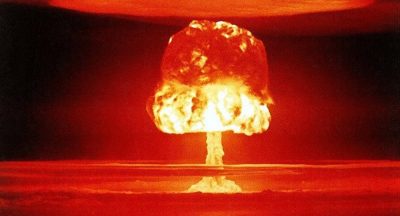
During the enigmatic incident, the Carson County Sheriff’s Department said that the eastern part of the plant was rendered completely inaccessible. Emergency teams in Armstrong County, Carson County, the Amarillo/Potter/Randall Office of Emergency Management and DPS were notified of the event and took “appropriate” action, My High Plains reported.
Local highways were temporarily shut down while officials responded to the mysterious emergency.
The plant is operated and managed by Consolidated Nuclear Security, LLC, under a contract from the US Department of Energy’s National Nuclear Security Administration.
Back in 2005, Pantex Plant also made headlines when the facility’s employees nearly detonated a W-56 warhead — 100 times stronger than the atomic bomb dropped on Hiroshima — by accident while trying to take it apart, according to the Sun.
Respondents in both the United States and Europe turned out to be generally reluctant to trust their mainstream media to provide unbiased coverage of events related to Russia, with the number of respondents adhering to this point of view ranging from 43 to 53 percent depending on the country.
An opinion poll was conducted recently by the French Institute of Public Opinion (IFOP), in which respondents in the United States and Europe were asked the following question: “Do media in your country report objectively about Russia?”
About half of respondents in France (53 percent) and Germany (50 percent), as well as 47 percent of respondents in the UK and 43 percent of respondents in the United States, said that they don’t believe that their media provides objective information about Russia.
At the same time, only 25 percent of French and 33 percent of British respondents said that they trust their media to provide unbiased information about Russia, with 39 percent of those polled in the US and Germany agreeing with this assessment.
The opinion poll was held as US politicians and intelligence officials continue to accuse Russia of attempting to meddle in the election processes in the United States — accusations which Moscow has vehemently denied.
At the same time, London blames Russia for the alleged poisoning of several people in the British city of Salisbury earlier this year, despite the fact that the Russian authorities have strongly rejected these claims.
The survey was conducted among 4,033 respondents aged 18 and above from the US, the UK, France and Germany, in August 2018.
The ‘Russiagate’ hysteria that originated with the Democrat-funded Steele Dossier has damaged relations between Washington and Moscow to the point of ending the INF Treaty, former Trump adviser Carter Page has told RT.
Ending the Intermediate Nuclear Forces in Europe (INF) treaty is something Americans should be “scared about,” Page told RT America’s Scottie Nell Hughes in an exclusive interview on Monday. He said he’d worked on implementing that and other nuclear treaties when he was at the Pentagon in the early 1990s, and that there are “deep problems” between the US and Russia that “misunderstandings” over the Trump presidency are only making worse.
President Donald Trump announced on Monday he was preparing to pull the US out of the 1987 arms control treaty, citing the claim by the two previous administrations that Russia “has not adhered to the agreement.”
Page was drawn to the Trump campaign in 2016 because as a candidate, Trump had “said some very positive things, some very constructive ideas as to ways to improve” the relationship between Washington and Moscow.
“Unfortunately, there were various political actors that were within the government in Washington –and also on the fringes of Washington– which helped continue the downward cycle that we’ve seen for so many years.”
Page was specifically referring to what he calls the “dodgy dossier” – an opposition research file compiled by British spy Christopher Steele, alleging Trump’s ties to Russia. Steele wrote the dossier for Fusion GPS, and was paid for it by the Clinton campaign via the Democratic National Committee (DNC) and its law firm, Perkins Coie. Page is suing Perkins Coie and the DNC for defamation.
Congressional investigations have discovered that the dossier was used to obtain a Foreign Intelligence Surveillance Act (FISA) surveillance warrant to spy on Page, and through him on the Trump campaign, which the former US Navy intelligence officer and energy consultant briefly advised in 2016.
Democrats have actually accused Page of being a “foreign agent” recruited by Russia. He laughed off those charges, telling Hughes that he would speak to the CIA every time he went to Russia for a meeting or to give a speech.
Explaining the Trump administration’s hostility towards Russia that’s in stark contrast with his campaign rhetoric, Page said that “false stories placed by the Democrats” have created a “dark cloud hanging over the administration.”
The July summit in Helsinki between Trump and Russian President Vladimir Putin held a lot of potential to advance US-Russian relations, but the political and media fallout stopped any momentum in its tracks, Page argued.
Trump is “very much a straight shooter,” Page said, but there is a “a lot of political pressures” on him to be hostile to Russia. He remains hopeful that with Trump’s “strength and perseverance,” things might just work out.
WASHINGTON – President Donald Trump’s decision to scrap the 1987 Intermediate Nuclear Forces (INF) Treaty will be welcomed by the US nuclear weapons industry and major defense contractors, veteran Pentagon analyst Chuck Spinney told Sputnik on Monday.
“The trashing of the INF treaty is simply another step down a slippery slope that is being greased by the nuclear arms contractors,” said Spinney, a senior Department of Defense analyst for more than 30 years.
Trump said on Saturday that his administration was preparing to withdraw from the INF.
Speaking to reporters on the White House lawn on Monday, the US president also claimed that Russia had not done enough to adhere to the treaty. However, Kremlin spokesman Dmitry Peskov denied on Monday that Moscow was in violation of the landmark agreement.
Spinney said Trump’s decision to scrap the INF was an anticipated and expected consequent of his predecessor, President Barack Obama’s approval of a colossal $1.5 trillion US nuclear modernization and expansion weapons program over the next 30 years.
“In my view, this evolution was almost inevitable. We unilaterally pulled out of the missile defense treaty and effectively launched a new arms race when Obama caved into the nuclear weapons industry and launched his across the board nuclear modernization plan,” he said.
Spinney recalled that Obama had been praised for negotiating the new Strategic Arms Reduction Treaty (New START) and had been awarded the Nobel Peace Prize after only one year in office, but that his huge nuclear weapons program contradicted those claimed achievements.
“Trump’s strategy and nuclear posture review essentially sealed Obama’s actions,” he said.
Trump has also refused to acknowledge Russia’s legitimate concern about the potential offensive capabilities of the Ballistic Missile Defense (BMD) systems that the United States has deployed in Poland and was also setting up in Romania, Spinney pointed out.
“Russians claim the BMD capabilities placed in Eastern Europe could be used to offensive purposes and their ‘new’ missile may well be a response to that,” he said.
Terminating the INF treaty would be a heavy blow for the entire international legal system of nonproliferation and arms control, the Russian Security Council said on Monday.
The INF was signed in 1987 and was pivotal in eliminating thousands of missiles from the American and Russian arsenals. Ex-Soviet President Mikhail Gorbachev, who signed the treaty along with then-US leader Ronald Reagan called Trump’s planned withdrawal from it very irresponsible.
Washington is ready to drop a landmark missile treaty with Moscow because it wants to become the dominant power on the globe, and that move will put its European allies in a tough spot, a senior Russian politician told RT.
The US doesn’t want to commit itself to the restrictions imposed by the Intermediate-Range Nuclear Forces Treaty (INF) because it is “seeking unilateral military advantage,” Konstantin Kosachev stated.
According to the politician, who chairs the Foreign Affairs Committee in the Lower House of parliament, “they want to be the only power in the world. And for that they don’t need these types of agreements.”
Speaking to RT on Monday, Kosachev recalled how in 2002 the US, under then-President George W. Bush, unilaterally pulled out of the Anti-Ballistic Missile Treaty (ABM Treaty), signed 30 years prior. President Donald Trump is now acting in a similar fashion, he argued.
The Intermediate-Range Nuclear Forces Treaty (INF) was signed in 1987. It effectively banned Moscow and Washington from having and developing short and mid-range missiles and the means of their delivery. Trump has said that he will “terminate” the deal, citing Russia’s alleged violations of the agreement – something Moscow’s officials deny.
Mid-range missiles will pose a “substantial threat” to Russian security if the US deploys them in Europe, Kosachev said. The senior lawmaker warned that such a move will turn the whole of Europe into a “zone of highest possible risk” and will prompt a swift response from Moscow.
“European countries are hostages in this situation.”
The European Union, meanwhile, called on both sides to maintain “constructive dialogue” to “preserve” the existing nuclear arms deal. Brussels expects the US to consider the consequences of ditching the agreement “on its own security,” as well as “the security of its allies and of the whole world,” EU spokesperson for Foreign Affairs and Security Policy, Maja Kocijancic, said in a statement.
“The world doesn’t need a new arms race that would benefit no one and on the contrary would bring even more instability,” the statement concluded.
Germany is angry after the US government intervenes in a multi-billion-dollar deal for Siemens AG to develop power stations in Iraq and forces Baghdad to opt for General Electric (GE) instead.
The American company signed a memorandum of understanding with the Iraqi government earlier this week, outlining their cooperation in the fields of oil and gas production and power generation.
A person, who has seen the paperwork, told The Financial Times that Washington plans to offer financing and insurance for US firms doing business in the Iraqi power sector.
GE’s agreement with Iraq dashed Siemens’ hopes of winning a $15 billion contract to supply 11 gigawatts of power-generation equipment to Iraq.
Until the US intervention, Siemens was considered the front-runner after its Chief Executive Joe Kaeser traveled to Iraq in September and spoke with Prime Minister Haider al-Abadi about the contract.
US officials, however, warned Abadi that awarding the contract to Siemens might jeopardize relations between Baghdad and Washington.
A top adviser to the Iraqi premier then told Siemens to give up because it was causing problems for Iraq given the US pressure.
“The US government is holding a gun to our head,” the adviser was quoted as saying by another person familiar with the incident.
According to people familiar with the negotiations, the US highlighted the number of American troops killed in Iraq and claimed that Iran had spurred Baghdad to pursue the Siemens deal.
“This is part of very strong campaign of engagement in Iraqi government formation and a very targeted effort to support the Iraqi government and minimize Iranian influence,” Garrett Marquis, a US National Security Council spokesman, claimed.
The Federation of German Industries (BDI) complained on Sunday that the US pressure to quash the Siemens power deal with Iraq was unacceptable, blaming President Donald Trump’s “America First” policy for corroding business decisions.
“To implement the America First doctrine in this way in the global competition of multinational companies is not acceptable,” Joachim Lang, BDI managing director, told Welt am Sonntag newspaper.
He emphasized that governments and companies should make deals based on business interests.
The US, backed by the UK, invaded Iraq in 2003 under the pretext that the former regime of Saddam Hussein possessed weapons of mass destruction.
No such weapons were ever found, but the invasion plunged Iraq into chaos and led to the rise of terrorist groups which continue to plague the country to this day.
Wess Mitchell, Assistant Secretary of State for European and Eurasian Affairs, the administration’s top diplomat focused on Europe and Eurasia, has warned that Europe’s energy dependence on Russia is unacceptable for the United States. That official was addressing the Atlantic Council’s “Championing the Frontlines of Freedom, Erasing the Grey Zone” event on October 18. According to him, the competition between the great powers has returned to become “the defining geopolitical fact of our time.” Through their lack of vigilance, European and American officials have allowed the growing Russian and Chinese influence in that region to “sneak up on us.” “Western Europeans cannot continue to deepen energy dependence on the same Russia that America defends it against. Or enrich themselves from the same Iran that is building ballistic missiles that threaten Europe,” the assistant secretary emphasized. Adding, “It is not acceptable for US allies in central Europe to support projects like Turkstream 2 and maintain cozy energy deals that make the region more vulnerable to the very Russia that these states joined NATO to protect themselves against.”
Something else that was highly interesting was his mention of Belarus along with Ukraine and Georgia as allies. The assistant secretary believes that “[t]he new principle is respect for the territorial integrity and sovereignty of the allies: Ukraine, Georgia and even Belarus. Washington expects states to respect the rights of their neighbors.” This makes one wonder if the Belarusian government knows it has been granted a new status. The official also mentioned Iran, which should not be allowed to sell oil to Europe because it has refused to abandon its ballistic missile program. Washington calls “on our allies to follow our lead and strengthen their laws to better screen foreign investments in their countries for national security threats.”
So, the US laws are flawless, its allies are not viewed as equal partners because they must follow America’s lead, or, in other words, do what they are told, and it’s up to Washington, not the national governments and parliaments, to decide what investments they need and where that money should come from. The leaders of the Central and Eastern European states should find it awkward, being rebuked for having overlooked “the foundational importance of the nation-state and national sovereignty,” while allowing unfriendly China and Russia to move in. “Our allies in Central Europe must not be under any illusions that these powers are their friends,” Mr. Mitchell explained. Obviously, he is quite sure that the governments of these nations are unable to grasp who is their friend and who is not. They are as naïve as small children. It’s good that the US is right here ready to enlighten them.
This highly-placed diplomat went on to explain that the United States should be seen as the protector of sovereignty, as it “rejects Russia’s territorial aggression against its neighbor Ukraine and [rejects] China’s predatory ‘debt-mongering’ throughout Central and Eastern Europe.”
Unlike its rivals, America does not seek dependencies, but rather independent states that should be “willing and able to share the burden of Western defense.” So, here is what independence à l’américaine is like, with its friends and allies absolutely free to comply with their protector’s instructions offering specific guidance about exactly how much they have to pay for defense, what investments to bring in, who to be friendly with, and how they should properly view the situation in their own region. Whatever happens in Central and Eastern Europe, everything has to revolve around the US.
“The United States has long had a tradition of not interfering in the details of European integration,” Mr. Mitchell assured us. Of course, telling the UK PM to sue the EU and thus expedite Brexit can certainly not be seen as interfering in European integration. Suggesting to French President Macron that he take France out of the EU is another example of noninterference. The Assistant Secretary expressed confidence that the allies could “beat back its competitors in Europe” with a little help from their American friends.
Also addressing the Atlantic Council’s October 18 conference, US Special Representative for Ukraine, Kurt Volker, revealed that Washington plans to stiffen the sanctions regime against Moscow “every month or two” to make it more amenable over Ukraine. The new policy suggests increasing the sanctions periodically, over time. Those remarks came after Russian President Vladimir Putin told the Valdai Club in Sochi that he hoped that a government more friendly toward Russia emerges from the Ukrainian presidential election that will be held on March 31.
Mr. Volker defied logic. On the one hand, he cited his “estimation… that the chances of their changing position now are lower then they were even a year ago.” Nevertheless, the best strategy for the West is to maintain pressure on Moscow through those economic sanctions —i.e., sticking to the very same measures that have proven to be useless, given that the “chances of their changing position now are lower.” So, the US and its allies should continue to implement a policy doomed to failure! But the ambassador states, “I think we need to keep on track. I believe that sanctions do have an impact and we see evidence of that in Russia.” What an bizarre way to convince his listeners!
“This is a shockingly big and important humanitarian catastrophe that no one talks about. We have over 10,000 people killed,” exclaimed this official who represents a nation that has just sent Ukraine, a country notorious for the corruption in its military ranks, a shipment of lethal arms so that it can kill more of its own citizens or let the weapons systems fall into the wrong hands and be used to kill other people outside of Ukraine. The “wrong hands” could use those weapons against the US military. With this kind of people you never know.
There is no penetrating insight, no reading between the lines, no wasting time on anything like analysis, and no attempts to find the logic in anything that’s said — nothing like that is required. It’s easy to understand highly-placed US State Department officials. You guys do what you are told, or else. And, just in case, don’t forget that your best friend and closest ally overseas carries a big stick to force you to march in step. These speeches are delivered from time to time to ensure that their “dear allies” remember that. The Atlantic Council’s podium fits the bill.
President Donald Trump’s confirmation that the US is terminating the Intermediate-Range Nuclear Forces treaty (INF) with Russia will be regarded as a defining moment in international security. The INF, which was signed by then US President Ronald Reagan and Soviet leader Mikhail Gorbachev in Washington in December 1987, has been a flagship of the disarmament process leading to the elimination of around 2,700 short and medium range ballistic missiles and preventing a US-Russia nuclear standoff in Europe.
A first-rate crisis is appearing in nuclear arms limitations and reduction processes. Now, let it be clarified this is not a temper tantrum by Trump but stems from the US policy to place accent on developing new nuclear weapons and aiming at securing a strategic dominance in the global arena. It was during the Obama administration, in 2014, that the US first alleged that Russia violated the INF treaty, but despite persistent requests from Moscow to provide substantiation of the allegation or at least to discuss the discord, Washington failed to respond.
The US has vaguely pointed the finger at the index of a Russian missile research project, but Moscow has refuted it pointing out that the US can easily see on its satellite images during field tests that these charges are totally unfounded and not substantiated by either the technical characteristics of the launcher that allegedly is at variance with the INF Treaty or in-flight telemetry data.
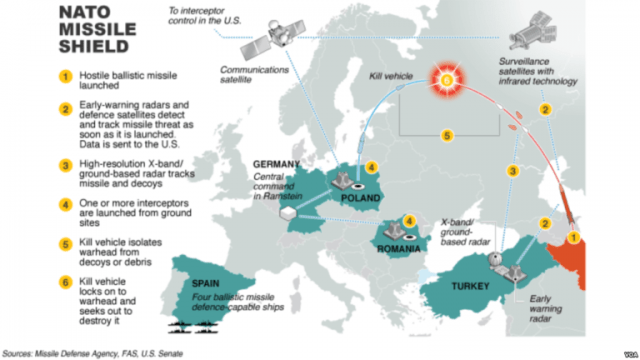
The plain truth is that it no longer suits the US to be constrained by the INF Treaty in the emerging New Cold War conditions where it has bracketed Russia and China as “revisionist powers” whom it must counter. In fact, contrary to the INF Treaty, Washington has already deployed launchers at the US antimissile base in Romania and Poland, whose specifications enable them to launch not only interceptor missiles but also strike missiles like Tomahawks.
One urgent compulsion for the US today is that the need arises for it in the downstream of the 2017 decision by Japanese government to buy two Aegis Ashore systems, as the deployment of the system in Japan will be a violation of the INF obligations – although the deployment will be in the Asia-Pacific.
Fundamentally, the US objective is nothing other than attaining nuclear superiority, which has been an elusive dream through the Cold War era. In the present context, Russian conventional forces are not a match for the US’ capability but nuclear deterrence gives Russia the status of a great power and enables it to maintain global strategic balance. Equally, China’s growing nuclear capabilities are an added factor in the American calculus. Simply put, the jettisoning of the INF will free the hands of the US to develop new weapons systems and to make large-scale deployments along the borders of Russia and China to contain them.
Russia has military-technical capabilities to respond to the challenge posed by US walking out of IMF Treaty. The hypersonic missile that it has developed is an example. Besides, Russia can also respond by deploying intermediate- and short-range missiles at its borders. To be sure, all this will directly affect European security and it may even create, hopefully, a convergence of interests between Russia and European countries to preserve the INF treaty. But the US may circumvent such a possibility by wearing down the European opposition by moving the discussion onto the multilateral NATO format.
Most importantly, the US pullout from INF treaty may bring the roof down on the New START treaty of 2010 and the Nuclear Non-Proliferation Treaty (NPT). In fact, the likelihood is high that the New START treaty may not be renewed by 2021, as is required, or that the NPT can survive. All in all, what is in the cards is the frightening scenario of a seamless, uncontrollable nuclear race – and the growing likelihood of a nuclear conflict.
Without doubt, the stakes are very high for India. The impact of the US decision on INF on the Asia-Pacific security would vitally affect Indian interests, especially in the context of the US-China rivalry where Japan (with which India has striven to forge a strong relationship) also happens to be a crucial participant. The US and Japanese pressure on India will increase to be ‘on the right side of history’ – that is, by becoming part of the US-led alliance system against China. Japan and Australia are figuring as the US’ main partners in the Indo-Pacific.
On the contrary, China will deepen its military cooperation with Russia and the two countries may be edging toward an alliance. (See my blog Military cooperation is the highlight and pillar of China-Russia strategic cooperation.) Ironically, the US will be achieving what it all along wanted, namely, injecting ‘bloc mentality’ among the countries of the Indo-Pacific, which would help consolidate its long-term presence in the region. All this means that unlike in the Cold War era, Asia is inexorably turning into the principal theatre of big-power rivalries.
The B61-12, the new US nuclear bomb which replaces the B-61 deployed in Italy and other European countries, will begin production in less than a year. The announcement was made officially by the National Nuclear Security Administration (NNSA). It reveals that the revision of the final project has now been completed with success, and the qualification stage will begin this month at the Pantex Plant in Texas. Production will be authorised to begin in September 2019.
In March 2020, the first unit of production will begin fabricating a series of 500 bombs. As from that time, in other words in about a year and a half, the United States will begin the anti-Russian deployment in Italy, Germany, Belgium, Holland and probably certain other European countries, of the first nuclear bomb in their arsenal with a precision guidance system. The B61-12 is designed with penetrating capacity, built to explode underground in order to destroy bunkers housing command centres.
Since Italy and the other countries, in violation of the Non-Proliferation Treaty, are offering the USA the bases, the pilots and the aircraft for the deployment of the B61-12, Europe will soon be exposed to a greater risk as the front line of the developing nuclear confrontation with Russia.
An even more dangerous situation appears at the same moment – the return of the Euromissiles, meaning the nuclear missiles which are similar to those deployed in Europe in the 1980’s by the USA, with the official aim of defending against Soviet missiles.
Source: PandoraTV [English subtitles]
This category of ground-based nuclear missiles of intermediate range (between 500 and 5,500 km) were eliminated with the INF Treaty of 1987. But in 2014, the Obama administration accused Russia of having experimented with a cruise missile (# 9M729) whose category was forbidden by the Treaty. Moscow denied that the missile violated the INF Treaty and, in turn, accused Washington of having installed in Poland and Romania launch ramps for interceptor missiles (elements of the “shield”), which could be used to launch cruise missiles bearing nuclear warheads.
The accusation aimed by Washington at Moscow, which is not supported by any evidence, enabled the USA to launch a plan aimed at once again deploying in Europe ground-based intermediate-range nuclear missiles. The Obama administration had already announced in 2015 that “faced with the violation of the INF Treaty by Russia, the United States are considering the deployment of ground-based missiles in Europe”. This plan was confirmed by the Trump administration – in fiscal year 2018, Congress authorised the financing of a “programme of research and development for a cruise missile which could be launched from a mobile road base”.
The plan is supported by the European allies of NATO. The recent North-Atlantic Council, at the level of Europe’s Defence Ministers, which was attended for Italy by Elisabetta Trenta (M5S), declared that the “INF Treaty is in danger because of the actions of Russia”, which it accused of deploying “a disturbing missile system which constitutes a serious risk for our security”. Hence the necessity that “NATO must maintain nuclear forces which are stable, trust-worthy and efficient” (which explains why the members of the Alliance rejected en bloc the United Nations Treaty for the prohibition of nuclear weapons).
So the grounds are being laid for a European deployment, on the borders of Russian territory, of ground-based intermediate-range US nuclear missiles. It’s as if Russia were deploying in Mexico nuclear missiles pointed at the United States.
This article was originally published in Italian on Il Manifesto.
Part One, The Record, treats the history of garlic as evidence. From the clay garlic bulb placed in an Egyptian grave nearly six thousand years ago, through the Ebers Papyrus, through Hippocrates, Dioscorides, Pliny and Galen, the Arab physicians under Avicenna, the medieval herbals, Culpeper, and the plague years, to the last era in which Western physicians prescribed garlic as a matter of course, which ran from 1850 to 1945. It closes with the living traditions that never stopped using it, and with the folklore of charms, vampires and the evil eye.
Part Two, The Chemistry and the Evidence, sets out what is known about why a clove has no smell until it is cut, and why the order of crush, rest and heat changes the medicine. It then reads the clinical evidence against the historical record — bacteria, blood and vessels, cancer epidemiology, metals and fatigue — and names the trials that went against garlic as directly as the trials that went for it, including the 2007 Stanford trial funded by the US National Institutes of Health which found that raw garlic, garlic powder and aged garlic extract moved LDL cholesterol no more than placebo did. It then turns to onion, garlic’s closest relative, and reads the newer evidence published since 2015, before closing with the whole of the record through the terrain lens.
Part Three, Why Medicine Set It Aside, asks the question directly. One chapter contrasts the pharmaceutical model of isolating a single active compound with the folk model of combining whole plants, and reports what the garlic evidence says about which model works better. One chapter examines the economics of research on a plant that cannot be patented. One chapter — Fire Cider — tells the story of a folk preparation whose name was taken into a United States trademark by a Massachusetts company in 2012, and won back by three herbalists in 2014 who documented forty years of prior use through Rosemary Gladstar and her students into the older tradition.
Part Four, Garlic in Practice, is the working manual — the kitchen pharmacy, traditional uses by body system, a full chapter on safety and interactions, and a complaint-by-complaint practical guide. The book closes with The Trial That Was Never Run — a one-chapter reading of the whole evidential architecture.
At the back: two appendices (a traditional list of uses, and a preparation quick-reference), a full bibliography, and a live index.
This site is provided as a research and reference tool. Although we make every reasonable effort to ensure that the information and data provided at this site are useful, accurate, and current, we cannot guarantee that the information and data provided here will be error-free. By using this site, you assume all responsibility for and risk arising from your use of and reliance upon the contents of this site.
This site and the information available through it do not, and are not intended to constitute legal advice. Should you require legal advice, you should consult your own attorney.
Nothing within this site or linked to by this site constitutes investment advice or medical advice.
Materials accessible from or added to this site by third parties, such as comments posted, are strictly the responsibility of the third party who added such materials or made them accessible and we neither endorse nor undertake to control, monitor, edit or assume responsibility for any such third-party material.
The posting of stories, commentaries, reports, documents and links (embedded or otherwise) on this site does not in any way, shape or form, implied or otherwise, necessarily express or suggest endorsement or support of any of such posted material or parts therein.
The word “alleged” is deemed to occur before the word “fraud.” Since the rule of law still applies. To peasants, at least.
Fair Use
This site contains copyrighted material the use of which has not always been specifically authorized by the copyright owner. We are making such material available in our efforts to advance understanding of environmental, political, human rights, economic, democracy, scientific, and social justice issues, etc. We believe this constitutes a ‘fair use’ of any such copyrighted material as provided for in section 107 of the US Copyright Law. In accordance with Title 17 U.S.C. Section 107, the material on this site is distributed without profit to those who have expressed a prior interest in receiving the included information for research and educational purposes. For more info go to: http://www.law.cornell.edu/uscode/17/107.shtml. If you wish to use copyrighted material from this site for purposes of your own that go beyond ‘fair use’, you must obtain permission from the copyright owner.
DMCA Contact
This is information for anyone that wishes to challenge our “fair use” of copyrighted material.
If you are a legal copyright holder or a designated agent for such and you believe that content residing on or accessible through our website infringes a copyright and falls outside the boundaries of “Fair Use”, please send a notice of infringement by contacting atheonews@gmail.com.
We will respond and take necessary action immediately.
If notice is given of an alleged copyright violation we will act expeditiously to remove or disable access to the material(s) in question.
All 3rd party material posted on this website is copyright the respective owners / authors. Aletho News makes no claim of copyright on such material.

