Stanislav Krapivnik: Russia-Iran Cooperation & Escalation in Ukraine
Glenn Diesen | March 6, 2026
Stanislav Krapivnik is a former US Army officer, supply chain exec and military-political expert, now based in Russia. He was born in Lugansk during the Soviet times, migrated to the US as a child and served in the US army. Krapivnik discusses how Russia cooperates with Iran, and why the Iran War is creating immense pressure on Putin to escalate.
Follow Prof. Glenn Diesen:
- Substack: https://glenndiesen.substack.com/
- X/Twitter: https://x.com/Glenn_Diesen
- Support the research by Prof. Glenn Diesen: PayPal: https://www.paypal.com/paypalme/glenn…
- Buy me a Coffee: buymeacoffee.com/gdieseng Go Fund Me: https://gofund.me/09ea012f
- Books by Prof. Glenn Diesen: https://www.amazon.com/stores/author/…
Indonesia suspends participation in Board of Peace following attack on Iran
MEMO | March 6, 2026
Indonesia has announced the suspension of all discussions on the proposed Board of Peace, an initiative launched by US President Donald Trump, as military tensions rise in the Middle East.
Indonesian Foreign Minister Sugiono said the decision to suspend participation was taken because of the latest military escalation in the region, which has directly affected the foreign policy priorities of countries involved in the initiative.
He explained that international attention has now shifted to the consequences of the conflict with Iran. He added that Indonesia would hold intensive consultations with its partners in the Gulf region, as they are directly affected by the ongoing attacks and rising tensions.
Indonesia’s participation in the council has faced strong criticism from domestic political and religious groups. They argue that joining an initiative led by the Trump administration could undermine Jakarta’s long-standing position in support of the Palestinian cause.
In the same context, the Indonesian Ulema Council called for an immediate withdrawal from the initiative, saying it lacks effectiveness while the military offensive continues.
‘Operation Epic Fury’ burns an estimated $5.82 billion in just 100 hours
MEMO | March 6, 2026
The first 100 hours of “Operation Epic Fury” have cost US forces at least an estimated $5.82 billion, or about 0.69% of the entire 2026 US defense budget, according to data compiled by Anadolu.
Anadolu estimates that the US spent $779 million in the first 24 hours of the operation. As operations have continued, the total operational cost of US offensives has tallied to approximately $3.3 billion, with figures from the Center for Strategic and International Studies showing a similar total.
In addition to operational costs, the US has lost significant military assets in Iran’s retaliatory strikes. According to estimates by Anadolu, the US has already lost roughly $2.52 billion.
US asset losses
The primary contributor to the losses is a US AN/FPS-132 early warning radar system at Al-Udeid Air Base in Qatar, valued at $1.1 billion, which was struck by an Iranian missile on Saturday. Qatar confirmed that the radar was hit and damaged.
On Sunday, three F-15E Strike Eagles were lost in a friendly fire incident involving Kuwaiti air defenses. While all six aircrew survived, the planes did not — with the cost of replacing them estimated at $282 million.
US officials speaking to CBS News said that three MQ-9 Reaper Surveillance and Attack Drones belonging to the US Air Force have been downed so far, at an estimated cost of $90 million.
During its initial attack on Saturday, Iran struck the US Navy’s Fifth Fleet headquarters in Manama, Bahrain, destroying two satellite communications terminals and several large buildings.
Open-source intelligence reports identified the targeted SATCOM terminals as AN/GSC-52Bs, with an estimated cost of $20 million, factoring in deployment and installation costs.
In addition to the SATCOM terminals lost in Bahrain, satellite imagery analyzed by the New York Times of Camp Arifjan in Kuwait, shows three more radomes destroyed, adding roughly $30 million in costs.
Since initial reports of a destroyed AN/TPY-2 radar component of the THAAD Anti-Ballistic Missile (ABM) System deployed at Al-Ruwais Industrial City in the United Arab Emirates, at least one other AN/TPY-2 system in Muwaffaq Salti Air Base in Jordan appears to have been destroyed. The damaged radar components are estimated to be worth $500 million each. There are also reports that another system has been hit in the UAE, however, there has been no official confirmation or satellite imagery to support this claim.
Altogether, Iran has damaged an estimated $2.52 billion worth of US military assets in the region.
US offensive costs
According to analysis by the CSIS, Anadolu’s initial estimate of $779 million appears to represent roughly a daily expenditure for US forces.
CSIS estimates it will cost $3.1 billion to replenish the US munitions inventory on a like-for-like basis for the first 100 hours, with the costs increasing by $758.1 million per day.
As the USS Abraham Lincoln and USS Gerald R. Ford remain in the region with their contingent of destroyers and littoral combat ships, they continue to expend an estimated $15 million a day.
US defensive systems were also heavily used to intercept Iranian attacks. According to estimates by the Payne Institute, the US has fired approximately 180 SM-2/SM-3/SM-6 naval interceptors, 90 Patriot PAC-2/PAC-3 missiles, and 40 THAAD interceptors.
How Israel and the FBI manipulated assassination plots to goad Trump into Iran war
By Max Blumenthal | The Grayzone | March 6, 2026
The FBI manufactured plots to convince Trump that Iran sought to kill him, while Israel and its administration allies exploited the president’s deepest fears to keep him on the war path.
“I got him before he got me,” an ebullient President Donald Trump remarked to a reporter when asked about his motives for authorizing the killing of Iran’s Leader, Ayatollah Ali Khamenei, on February 28, 2026.
With his off-the-cuff remark, Trump revealed that anxiety about his own assassination at the hands of Iranian agents influenced his decision to initiate a US-Israeli regime change war that has already resulted in American casualties, the bombings of schools and hospitals inside Iran, devastating Iranian retaliatory strikes on US military bases and embassies, and a spiraling global economic crisis.
Trump’s generalized fears of assassination were well-founded. He was nearly killed in Butler, Pennsylvania on July 13, 2024 by a 20-year-old engineering student named Thomas Crooks who managed to fire eight rounds at the former president from a rooftop, slicing his ear and missing his head by a hair’s breadth. Two months later, a drifter named Ryan Routh was arrested after hiding for hours in the shrubbery outside the former president’s Mar-a-Lago estate in West Palm Beach, Florida. Routh had been spotted after pointing an assault rifle toward a Secret Service agent as Trump played golf 400 yards away.
Officials have yet to produce any evidence that Iran played a role in either of these attempts on Trump’s life. Yet since those fateful events, Israel-aligned Trump advisors, Israeli intelligence, and Israeli Prime Minister Benjamin Netanyahu himself have gone to extreme lengths in order to tie Tehran to the plots. More shocking still is the fact that the FBI has manufactured a series of assassination plots, successfully convincing Trump that Iran was hunting him on US soil with highly sophisticated teams of hit men.
The man accused of leading the most significant of these operations, Asif Merchant, is currently on trial in a Brooklyn, NY federal court. After the US granted him a visa despite his presence on a terror watchlist, Merchant was in the constant company of an FBI confidential informant who ultimately steered the contrived plot to its conclusion. He never stood a chance of realizing his plans, and did not appear serious about doing so.
Independent journalist Ken Silva puts it succinctly in his forthcoming investigative book, “The Trump Assassination Plots”: “A closer look at the Merchant case reveals that at the very least…it was a highly controlled FBI sting operation that never posed a threat to Trump. More nefariously, records and whistleblower disclosures indicate that Merchant may have been the patsy in a case totally fabricated by the undercover agents.”
Authorities arrested Merchant on July 12, 2024 – just one day before Crooks attempted to kill Trump in Butler. Hours after the failed Butler assassination, FBI agents interrogated Merchant about whether it was in fact Iran that had Crooks under its control.
At that point, Trump was still campaigning to be a “President of Peace. On the campaign stump, he warned that his opponent, Kamala Harris, “would get us into World War III guaranteed.” Trump vowed to resolve the war between Ukraine and Russia in one day, and distanced himself from pro-war Republicans who sought regime change in Iran.
Pro-war elements in Trump’s coterie exercised multiple points of leverage to reverse the president’s anti-interventionist instincts. Ultra-Zionist billionaires supplied vital and well-documented influence over Trump’s policies by keeping his campaign war chest flush. But Trump remained an erratic personality whose petty grievances kept his aides in a perpetual state of uncertainty.
It was only by exploiting Trump’s deepest psychological vulnerability – his fear of an assassin’s bullet – that Israel and its cutouts in his administration were able to secure their influence over the president, keeping him on the warpath against Iran.
The assassination escalation trap
On June 3, 2020, as the commander of Iran’s IRGC Quds Force, Qassem Soleimani, deboarded an airplane at Baghdad International Airport, on his way to peace talks with Saudi officials, a US drone killed him with a Hellfire missile. The strike had been ordered by Trump following a sustained campaign of military escalation against Iranian allies orchestrated by his National Security Council Director John Bolton and Secretary of State Mike Pompeo.
As journalist Gareth Porter reported for The Grayzone, by the time Trump authorized Soleimani’s assassination, Netanyahu was planning unilateral strikes on Iran aimed at drawing the US into direct conflict. Trump issued orders to kill the general under sustained pressure by Pompeo and Bolton, two pro-Israel hardliners. Both former Trump officials have lobbied for the Israeli and Saudi-funded Mojahedin El-Khalk (MEK), a cult-like exiled militia that has carried out numerous assassinations of Iranian officials at the behest of Israel’s intelligence services.
By killing Soleimani, Trump set the US on a collision course for all-out war with Iran – just as Netanyahu had hoped. What’s more, the president invited the prospect of violent retaliation against himself and his national security advisors.
So long as Trump feared the specter of IRGC agents lurking behind every corner, it stood to reason that he was more likely to authorize a regime change war on Iran. And so the FBI went to work, concocting a series of plots that helped forge Trump’s belligerent attitude toward Tehran.
Brought to you by the FBI: Iran’s plot to kill John Bolton
The first major Iranian plot arrived in 2022, when the Department of Justice filed charges against an Iranian national, Shahram Poursafi, for supposedly hiring a hitman to kill Bolton. However, the hitman turned out to be an FBI informant, and the plot was largely contrived by the Bureau. Poursafi, for his part, could not be arrested because he lived in Iran.
As journalist Ken Silva reported, the FBI officer who oversaw the manufactured plot to kill Bolton, Steven D’Antuono, was the same official who ran the Detroit field office that relied on paid informants to concoct the 2020 plot by right-wing militia members to kidnap Michigan Gov. Gretchen Whitmer. In a 2025 federal appeal court ruling, the judge acknowledged that defendants in that case “are correct that the government encouraged them to settle on a plan” to kidnap Whitmer. The FBI’s D’Antuono also oversaw the probe into the suspicious planting of pipe bombs at Republican and Democratic Party headquarters in Washington on January 6, 2021. In the course of his failed investigation, he misled Congress about having received “corrupted” evidence.
Though Bolton was never in danger from Iran, the FBI-contrived plot began to fuel paranoia among Trump administration veterans. Pompeo now believed that he too was being targeted by Iranian assassination teams. In his 2023 campaign memoir, “Never Give an Inch,” the former CIA director claimed Poursafi had also paid $1 million to a hitman to kill him.
However, Pompeo provided no additional details on the plot, which was never mentioned in DOJ documents charging Poursafi for attempting to kill Bolton. According to those affidavits, Poursafi sent just $100 to the FBI’s confidential human source before the DOJ concluded its investigation.

Asif Merchant, accused ringleader of an FBI-managed Iranian plot to assassinate Trump
Iran’s hapless hitman granted special visa, introduced to FBI informant
In April 2024, as Trump launched his comeback presidential campaign, an itinerant salesman named Asif Merchant arrived from Pakistan to George Bush Intercontinental Airport in Houston, Texas. He was quickly flagged as a “Qualified Person of Interest” who’d been placed on a Department of Homeland Security watchlist. Agents from an FBI Joint Terrorism Task Force (JTTF) team then discovered through a search of Merchant’s devices that he had visited Iran, where his wife and adopted son lived. Whether they’d received a tip from Israel, which furnishes reams of intelligence to the FBI on foreign Muslim visitors to the US, remains an open question.
According to JTTF documents obtained by pro-Trump reporter John Solomon, Merchant was “released without incident” and designated as “free to travel to desired destination.” In fact, the FBI had granted him a “Special Public Benefit Parole,” which, as Solomon explained, “would allow agents to try to flip Merchant as a cooperator or try to determine why he was coming to the United States and who he might be working with.”
The FBI whistleblower who provided Solomon with the documents on Merchant’s airport interview compared the “Special Public Benefit Parole” to the scandalous “Fast and Furious” program, in which President Barack Obama’s Department of Justice facilitated the delivery of automatic weapons from US gun dealers to Mexican cartels in order to supposedly surveil the gangs’ criminal activities.
Almost as soon as Merchant entered the US, the FBI introduced him to a confidential informant posing as a potential business partner and operating under the alias, Nadeem Ali. The informant had served as translator for the US military during its occupation of Afghanistan.
Though Merchant did not propose any crimes, the FBI wiretapped a meeting between him and the informant, Ali, in a hotel room on June 3, 2024. There, Merchant was taped making a supposed “finger gun” motion while mentioning an unspecified “opportunity.” This grainy minute-long hidden camera recording is presented as the linchpin of the DOJ’s indictment of Merchant.
According to the FBI, Merchant had outlined a highly complex plot which required the hiring of two hitmen, “twenty five people who could perform a protest after the distraction occurred, and a woman to do ‘reconnaissance.”
For the elaborate flash mob-style assassination extravaganza, Merchant was asked by the informant to fork over a mere $5000. The Pakistani visitor had no means of scrounging up the fee, however, raising further questions about the seriousness of the plot. “I did not think I was going to be successful,” Merchant would later state in court.
Virtually penniless, Merchant was forced to gather the cash from an anonymous “associate,” according to the DOJ indictment. Next, the FBI informant took him on a winding journey from Boston to New York City, where he allegedly handed the money to two other FBI informants posing as hit men. The DOJ claims Merchant made plans to fly to Pakistan on June 12, but was arrested in his residence that day.
Merchant interrogated about Butler, kept incommunicado
The following day, 20-year-old Thomas Crooks arrived at a fairground in Butler, Pennsylvania where former president Trump was scheduled to speak. He flew a drone in the air for 15 minutes, surveying the area as he finalized plans to assassinate the candidate. In an odd coincidence, the Secret Service’s anti-drone system was offline all morning and into the afternoon — until roughly 15 minutes after Crooks flew his drone. When Trump took the stage, Crooks climbed atop a slanted rooftop 130 yards away and fired eight shots at the president, missing his head by an inch, until a local police officer fired back. He was killed by a Secret Service sniper who had inexplicably hesitated to fire for a full 15 seconds.
Thirty hours later, FBI agents flew to Houston to interrogate Merchant in his jail cell about a possible Iranian connection to the assassination attempt in Butler. An FBI source told the Washington Post the Bureau “took the extraordinary step of interviewing him without his lawyer to determine whether he knew Crooks.”
The grilling continued even after Merchant was transferred to the maximum security Metropolitan Detention Center in Brooklyn – the same prison where Luigi Mangione, the accused killer of United Healthcare’s CEO, is currently being held. There, he was held under harsh conditions in solitary confinement, unable to interact with anyone but the guards who brought him food and his lawyers because, as then-Deputy Attorney General Lisa Monaco argued, he might use code words to initiate further assassination plots. “It appeared they thought I was some kind of super spy,” Merchant later reflected.
Not only was Merchant prevented from calling his family in Pakistan, he was blocked from reviewing recordings of conversations he held with undercover FBI informants, as the DOJ had marked them “Sensitive.” In March 2025, his lawyer protested that US Marshals repeatedly refused to allow him to meet with this counsel and review discovery at the courthouse. This, too, was justified on the basis of specious national security grounds.
However, as the journalist Ken Silva discovered, an internal memo by the Bureau Of Prisons Director Colette Peters confirmed that Merchant had no contact with any Iranian intelligence assets in the US. “Law enforcement has not identified any IRGC associates of Merchant operating in the United States who could continue to orchestrate violent acts,” Peters wrote.
Indeed, the only Iranian assassins with whom Merchant appeared to have interacted inside the US were undercover informants working for the FBI.
Merchant “had never been close to realizing” Trump assassination
During his trial this March 4, Merchant’s lawyer, Avraham Moskowitz, took the highly unusual step of allowing his client to take the stand. Merchant proceeded to present a version of events that contrasted sharply with the account he provided in his initial FBI proffer. For example, the defendant claimed he had been coerced into the plot by an IRGC agent, and went forward with a plan “to maybe have someone murdered” only because he feared for his wife and adopted son back in Iran.
After his arrest by the FBI, Merchant said he engaged in discussions with federal authorities about becoming an informant himself, but they ultimately broke down for unknown reasons.
“I was not wanting to do this so willingly,” he insisted in Urdu, adding, “I did not think I was going to be successful.”
In its coverage of the trial, the New York Times concluded Merchant “had never been close to realizing the vision of his Iranian handler.”
But back in 2024, as word spread of Merchant’s arrest, Israel-adjacent figures in Trump’s inner circle exploited the case to exacerbate the candidate’s anxiety about the Ayatollah’s wrath.
Israel-aligned forces blur Butler with Iran
Just three days after Trump’s campaign was nearly ended by a lone American assassin’s bullet in Butler, officials burrowed within the architecture of the national security state took measures to shift the focus to Iran.
“The Biden administration obtained intelligence in recent weeks about an Iranian assassination plot against former President Donald Trump, and the information led the Secret Service to ramp up security around the former president, according to three U.S. officials with knowledge of the matter,” reported NBC’s Ken Dilanian on July 16, 2024. (Dilanian had been fired from his previous gig at the LA Times after he was exposed for allowing the CIA to review his reports before publication).
The unnamed officials were clearly referring to the plot which the FBI manufactured for Merchant. The revelation not only seemed like a cynical attempt to obscure the reality of the near-assassination in Butler, which was conducted by a friendless American man who had never left the country. It also suggested the FBI had been so focused on concocting Iranian plots on American soil that it ignored the years-long trail of YouTube comments left by the would-be assassin bluntly declaring his intention to kill US politicians and police officers, and his hopes to instigate a civil war.
Though FBI leadership misled the public about the nature of the Butler plot, falsely claiming, for instance, that Crooks was not communicating with others online, they were never able to connect it to Iran. This clearly frustrated Rep. Mike Waltz, a close Trump ally seated on the House committee to investigate the Butler plot.
“These plots from Iran are ongoing. And when Biden says nothing, Harris says nothing, the DOJ tries to bury it, what message does Iran get? They get that we can keep trying to take Trump out and have no consequences,” Waltz fulminated on Fox News in August 2024.
Referencing the FBI-manufactured Merchant operation, Waltz thundered, “You have multiple assassination plots from the Iranians. This Pakistani national was recruiting females as spotters. He had recruited hit men and had made a down payment. He was even recruiting protesters as a distraction.”
By this point, Waltz was on his way to a short stint as Trump’s National Security Council Director, where he would help direct a failed war on Iran’s allies among the Ansurallah movement in Yemen. (Waltz was demoted to US ambassador to the UN after he accidentally included the Atlantic Magazine editor-in-chief and former Israeli prison guard Jeffrey Goldberg in a private administration Signal chat where classified information about US attack plans on Yemen was shared).
Throughout his career, the Israel lobby and Netanyahu’s allies had quietly propelled his rise. As AIPAC CEO Elliot Brandt remarked in private comments exclusively revealed by The Grayzone, Waltz was one of Israel’s “lifelines” inside the Trump administration, as he had been groomed by the Israel lobby since he first ran for Congress.
For Waltz and other Israel-aligned figures close to Trump, connecting the Butler incident to Iran appeared to offer a direct path to conflict with Iran. As an unnamed high-level US official told the Washington Post, if Tehran had been found responsible for Crooks’ attempt to kill Trump, “it would mean war.”
Certain foreign actors were also working to steer the US toward blaming Iran for Butler. In the late summer of 2024, the Justice Department received an urgent alert from abroad which connected Crooks directly to IRGC plots to kill Trump. According to the Washington Post, the tip arrived through a “confidential human source overseas” – almost certainly Israeli intelligence.
After a thorough investigation, DOJ officials decided the tip was not credible. “Nothing credibly connected him to Iranian plots,” one official told the Post.
But in the wake of the shooting in Butler, the constant chatter about looming Iranian threats had indelibly altered Trump’s outlook. Reporters who followed Trump on the campaign trail described a palpable sense of panic from the candidate and his inner circle about IRGC-directed hitmen stalking them at every stop.
“Ghost flights” for Trump triggered by imaginary Iran missile threats
With the Trump campaign already consumed with anxiety, the FBI delivered an alert that sent them spiraling into the depths of paranoia.
According to the Bureau, Iran had placed operatives inside the country with access to surface-to-air missiles. This dubious warning prompted Trump’s already militarized security team to take an extraordinary step. Fearing that Iran would down the famous “Trump Force One” airliner at any moment, Trump was placed on a “ghost flight” owned by his golf buddy, real estate tycoon Steve Witkoff, while the rest of his campaign traveled on the main jet.
Joining Trump on the secret decoy plane was his campaign manager, Suzie Wiles, who would go on to become White House chief of staff, controlling access and the flow of information to the president. Unbeknownst to the public, Wiles had served as a paid advisor to Israel’s Netanyahu during his 2020 re-election campaign, consolidating her role as a key point of contact between Tel Aviv and Trump.
Journalist Ken Silva has revealed that the FBI alert which prompted Trump’s use of a “ghost plane” was based on a cynical deception. As Silva explains in his forthcoming book on the assassination plots surrounding Trump, federal investigators had discovered that Routh, the would-be assassin at Mar-a Lago, had attempted to purchase a rocket launcher, and may have been in contact with Iranian nationals during his time in Ukraine. The Bureau likely massaged that information into the bogus report it provided the Trump campaign, conjuring up imaginary Manpad-toting IRGC operatives to exacerbate the candidate’s fears.
Once he entered the Oval Office, Trump was encircled by Israel-aligned advisors and staunchly committed to the belief that Iran had attempted to eliminate him on the campaign trail. As commander-in-chief of the US military, he was hellbent on revenge.
Netanyahu nudges Trump with Butler plot
On June 15, 2025, days after launching an unprovoked war on Iran, Netanyahu took to Fox News to manipulate Trump into joining the assault. The Israeli leader appeared to know exactly which psychological vulnerabilities to exploit.
“These people who chant death to America, tried to assassinate President Trump twice,” Netanyahu declared, asserting without a shred of evidence that Iran was behind both the Butler assassination attempt and the one at Mar a-Lago.
“Do you have intel that the assassination attempts on President Trump were directly from Iran?” a visibly startled Fox News host Bret Baier asked.
“Through proxies, yes. Through their intel, yes. They want to kill him,” stated Netanyahu with a cocksure gaze.
One week later, Trump authorized a series of US strikes on Iranian nuclear facilities in support of Israel’s military assault. Though Trump arranged a ceasefire soon after the attack, Israel’s influence over his administration – and over his psyche – guaranteed that another, much more violent round of conflict was just over the horizon.
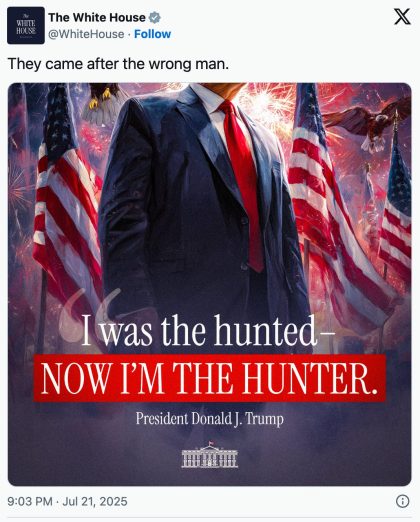
In a graphic promoted by the White House’s official Twitter/X account on July 21, 2025, Trump implied that he had begun to turn the tables on his would-be Iranian assassins: “I was the hunted, and now I’m the hunter,” he declared.
Israel claims to eliminate would-be Trump assassin in Iran
By March 2026, Trump was back to war with Iran. Within four days, the US-Israeli joint assault had predictably expanded into an open-ended regional war following the failure of an opening series of decapitation strikes to induce regime change.
On the afternoon of March 4, the glowering US “Secretary of War” and former Fox News personality Pete Hegseth appeared before a lectern at the Pentagon and vowed to unleash “death and destruction from the sky all day long” over the people of Iran.
As his cartoonishly violent screed built to a crescendo, Hegseth issued a dramatic announcement: “The leader of the unit who attempted to assassinate President Trump has been hunted down and killed. Iran tried to kill President Trump, and President Trump got the last laugh.”
Though Hegseth did not name the figure, an Israeli journalist who functions as one of Netanyahu’s favorite stenographers, Amit Segal, revealed that Israel had assassinated an IRGC official named Rahman Mokadam who was supposedly responsible for directing a plot to kill Trump. But once again, the details of the plot revealed layers of FBI chicanery, confidential informants masked as “co-conspirators,” and a compromised witness.
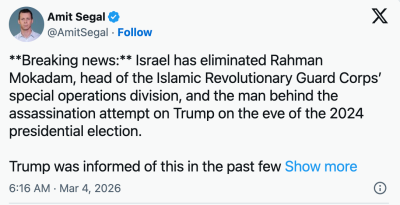
In fact, the supposed assassination plan which Mokadam was accused of directing did not initially focus on Trump. Instead, the target was said to be Masih Alinejad, an Iranian expat and regime change activist on the US government payroll. The only evidence that Trump was a possible target at all came from the claims of a convicted drug dealer and con man named Farhad Shakeri, who had also been a defendant. Shakeri spoke to the FBI by telephone from Iran, providing dubious information in exchange for a reduced prison sentence for an unnamed associate in the US.
It was during these remote interviews that Shakeri seemingly claimed he had an IRGC handler who had directed him to kill Trump. But according to the FBI’s criminal complaint against him, that handler’s name was “Majid Soleimani,” not Mokadam.
The FBI agent who interviewed Shakeri clearly recognized his penchant for fabulism, writing that “certain of Shakeri’s statements appear to be true and others appear to be false.” Shakeri had indeed lied throughout his interviews, yet the agent still concluded that “it appears” he was planning to kill Trump. He did not explain why he considered the confession credible, and the allegation about a plot to kill Trump was notably absent from the grand jury indictment filed a month later.
After killing Mokadam on March 4, the Israelis went straight to the president to boast of their supposed achievement – and reignite his anxiety about Iranian assassins.
As Amit Segal noted, “Trump was informed of this in the past few hours by Israel.” In doing so, the Israelis reinforced Trump’s sense that he had been hunted by Iran – and that by fighting their war, he was saving his own skin.
As it had in the past, the White House posted a video on its official Twitter/X account proclaiming Trump’s triumph over Iranian assassins: “I WAS THE HUNTED, AND NOW I’M THE HUNTER.”
Thomas Crooks may have narrowly missed Trump’s cranium in Butler, Pennsylvania, but Israel had found a way into the president’s head.
US Boasts of Destroyed Iranian Launchers Lack Credibility – Ex-DoD Official
Sputnik – 06.03.2026
As the United States is clearly lying about the number of the US military casualties in the current war with Iran, the veracity of other claims made by the US is dubious, former US Department of Defense officer David T. Pyne tells Sputnik.
Properly assessing Iran’s losses is also difficult due to the fact that it is unclear whether US claims of destroyed Iranian missile launchers take into account the decoys and dummy targets, he points out.
“I believe that US estimates of the total number of Iranian ballistic missiles are likely much lower than is actually the case as I believe Iran may have tens of thousands of missiles in its stockpile,” Pyne adds.
Finally, even though the US and Israel did manage to take out a number of Iranian mobile missile launchers, Iran’s military has become adept at keeping its remaining launchers out of harm’s way.
Thus, reasons Pyne, it is likely that most of the Iranian missile launchers – especially those hidden deep underground – “will survive the war” even if it drags on for months.
US Shortages and Israel’s Weakness
Meanwhile, the US and Israel now deal with their “very limited supply” of offensive missiles and missile defense interceptors alike, with the latter potentially running out by next week, says Pyne.
The US could soon find itself unable to defend all of its assets from Iranian attacks, even as Iran is systematically dismantling US radar capabilities in the region, further degrading the US ability to shoot down Iranian missiles.
At the same time, Israeli air defenses have proven to be “largely ineffective” against Iranian ballistic and hypersonic missiles.
“In a protracted war of attrition like this war is shaping up to be, Iran is likely to emerge victorious,” Pyne remarks.
How, and why, US data centers in the Gulf became targets of war
Al Mayadeen | March 6, 2026
The drone strikes that knocked Amazon Web Services facilities offline in the United Arab Emirates and Bahrain this week were not random acts of escalation. They were, according to analysts and industry insiders, a calculated strike on infrastructure that the United States has quietly woven into its military architecture across West Asia.
Amazon and Google hold a $1.2 billion contract with the Israeli government to provide cloud computing and artificial intelligence services to entities, including the Israeli occupation forces.
That contract, largely absent from Western coverage of the strikes, may explain why AWS facilities, and not the dozens of data centers operated by local Gulf companies on behalf of US tech giants, were the ones that were hit.
“It would be easier to target AWS,” Ed Galvin, founder of data center research firm DC Byte, told Bloomberg, noting that other US tech services are typically housed within locally operated facilities, making them harder to identify and strike.
Of approximately 230 data centers built or under development across Gulf Arab states, only a handful are wholly owned and operated by a US company, according to DC Byte. All three struck this week belong to Amazon.
What was hit
The strikes took down two of AWS’s three availability zones in the UAE, one site located near Al Maktoum International Airport in Dubai, according to DC Byte, and damaged a facility in Bahrain situated close to a local military base and the King Fahd Causeway connecting the island to Saudi Arabia.
Consumer services, including online banking, were disrupted across the region. In a statement to clients, AWS said it was working to restore services while urging customers to migrate workloads to data centers outside West Asia, acknowledging that “the broader operating environment in the Middle East remains unpredictable.”
What Western media outlets fail to mention is that the exchange has not been one-sided. “Israel” and the United States have struck at least two data centers in Tehran, according to Holistic Resilience, a nonprofit organisation that maps airstrike activity.
A new front in an old logic
Data centers have entered the battlefield as legitimate targets because they power surveillance systems, drone navigation, real-time analysis of satellite footage, and the digital backbone of modern military operations.
Attacking such facilities can “paralyze banks, paralyze government offices,” Daniel Efrati, chief executive of NED Data Centers, told Bloomberg. “If you have one minute of downtime, it can cost any organization millions.”
Soft targets with hard consequences
The physical vulnerability of these facilities has been laid bare by this week’s strikes. Data centers are sprawling, visible, and dependent on exposed infrastructure, e.g., cooling units, diesel generators, gas turbines, that can be disabled without a direct hit on the building itself.
“If you knock out some of the chillers you can take them fully offline,” Sam Winter-Levy, a fellow at the Carnegie Endowment for International Peace, told the Financial Times. Conventional data center security is designed to repel cyberattacks and physical intruders; it was not designed for drones.
Gulf AI ambitions under fire
The strikes land at a particularly fraught moment for Gulf states whose economic diversification strategies rest heavily on positioning themselves as global AI hubs. Saudi Arabia’s Humain and the UAE’s G42, both state-backed, have committed to vast data center clusters and signed major deals with Nvidia, Amazon, and Microsoft.
The UAE is constructing one of OpenAI’s “Stargate” facilities in Abu Dhabi. Microsoft announced last month it would open a new Azure facility in Saudi Arabia before the end of the year. Those ambitions now carry a new risk premium.
“The Gulf sold itself as a safe alternative to other markets,” Jessica Brandt, a senior fellow at the Council on Foreign Relations, told the Financial Times. “That argument just got harder to make.”
The new table stakes
Harder, but not necessarily fatal. Several analysts caution that the political and economic momentum behind Gulf AI investment is unlikely to be reversed by the strikes alone.
What has changed is the calculus around protection. “You can’t hide data centers,” Noah Sylvia, an analyst at the Royal United Services Institute, told Bloomberg. “But you can put air defence systems on them.”
One industry veteran based in the Gulf compared the situation to Intel’s chip manufacturing plants in “Israel,” ringed by military air defences, telling the Financial Times that for a project of Stargate’s scale, that kind of protection is now “table stakes.”
A global precedent
The broader implication reaches beyond the Gulf. “This is a harbinger of what’s to come,” Winter-Levy told the Financial Times, “and these types of attacks are not going to be limited to the Middle East.”
For the first time in history, the data centers that underpin the global digital economy have become a theater of war. The infrastructure the US built to project technological power across a volatile region has become a target precisely because of what it enables.
The General who swallowed his truth
By Jasim Al-Azzawi | MEMO | March 5, 2026
General Dan Cain, Chairman of the Joint Chiefs of Staff, delivered a private warning to President Trump with the bluntness that democracies depend upon and empires routinely ignore: “We don’t have enough ammunition to win this war. It would not be pretty.” This was not timidity. This was the solitary act of institutional honesty still flickering inside the corridors of American military power.
Trump’s response was the response of a carnival barker, not a commander-in-chief. On Truth Social — that funhouse mirror of American political life — he swatted away the warning with a salesman’s swagger: “Oh no, no, no. If we do it, it will be easily won.” A sober assessment became a sales pitch. A caution became a lie.
But the greater lie came next. When Cain’s warning leaked, Trump did not merely dismiss it. He inverted it. He told the American public, with the breezy confidence of a man who has never been held accountable for anything, that the general had said the opposite — that the United States had plenty of missiles, plenty of munitions, plenty of everything. “That’s not what he said at all,” Trump declared. He put triumphalist words in the mouth of a man who had spoken warnings.
And General Cain said nothing.
That silence is not a footnote in this story. It is the story. By staying quiet, Cain allowed the American public to absorb a fabrication as truth. He did not say: “No, Mr. President, that is not what I said.” He did not invoke the oath he swore, or the soldiers who would pay with their lives for the gap between political rhetoric and logistical reality. He chose the safety of silence over the danger of truth. In doing so, he did not merely fail himself. He failed the republic.
This is the rot at the core of American militarism.
As the historian Andrew Bacevich has long warned, the professional military has become less a defender of democratic values than a tool of imperial ambition, its senior officers more attentive to their next posting than to the Constitution they swore to uphold.
Cain’s silence was not an aberration. It was a symptom.
The logistics picture Cain reportedly described in private is not theoretical. The math is unforgiving. Current inventories of interceptors and precision munitions cannot sustain a prolonged air campaign against a nation three times the size of Iraq. The Wall Street Journal has documented an “alarming gap” in US missile stockpiles, reporting that reserves “fell significantly short” of requirements for high-intensity, sustained operations. Pentagon contractors have been instructed to “double or even quadruple” production of Patriot interceptors, SM-6s, and precision strike missiles — a tacit admission that the arsenal built for Cold War scenarios is inadequate for the war being prosecuted today.
Consider Gaza. Israel, the most lavishly armed military power in the Middle East, with complete air and sea dominance, has reduced a tiny coastal strip to a moonscape desolation over two and a half years, and still has not broken Hamas. Gaza is thirty-seven kilometres long.
Iran is a nation of ninety million people, mountainous, strategically deep, with hardened infrastructure and a battle-tested Revolutionary Guard. The idea that it collapses under a few weeks of American airstrikes is not a strategy. It is fantasy dressed up as resolve.
“God help us if this continues, if it even reaches its fourth week,” Colonel Daniel Davis warned on the Deep Dive podcast. He was speaking militarily. The same prayer applies politically.
When Trump now floats the prospect of ground troops, he is not escalating from a position of strength. He is improvising from a position of denial. The admission that airpower and missiles alone cannot achieve the political objective is the admission that the original objective was never honestly assessed. This is the pattern of American war-making at the end of empire: grandiose promises, catastrophic miscalculations, and then the slow, terrible reckoning paid in blood by those who never had a seat at the table where the lies were told.
The costs are already accumulating — not merely in the currency of munitions and treasure, but in the currency that empire always spends last and regrets most: credibility. America’s word, already devalued by two decades of manufactured justifications for war, grows cheaper by the day.
Democracies can endure miscalculation. They can endure bad presidents. What they cannot long endure is the institutionalization of a culture in which truth is spoken in whispers behind closed doors and swallowed whole in front of cameras. When the Chairman of the Joint Chiefs permits his own words to be weaponized as propaganda — when the man charged with counting the missiles will not correct the president who pretends there are plenty — something more than military credibility collapses.
What collapses is the social compact between the governed and those who send them to die.
Cain’s silence was not caution. It was complicity. And in the machinery of empire running low on ammunition and low on honesty, complicity is the one resource that never seems to run short.
Because when the missiles finally run out, slogans will not replace them.
Reality will.
Donald Trump Was Installed in Office to Do One Thing
José Niño Unfiltered | March 5, 2026
Long before Donald Trump descended the golden escalator, long before he learned to tell campaign crowds what they wanted to hear about ending endless wars and bringing the troops home, he told the world exactly what he intended to do about Iran. He wrote it down. He published it. And almost nobody bothered to read it.
In his 2011 book Time to Get Tough, Trump laid out his position on Iran’s nuclear program with the subtlety of a sledgehammer. “America’s primary goal with Iran must be to destroy its nuclear ambitions,” Trump wrote. “Let me put them as plainly as I know how. Iran’s nuclear program must be stopped by any and all means necessary. Period. We cannot allow this radical regime to acquire a nuclear weapon that they will either use or hand off to terrorists.”
By any and all means necessary. Those six words should have settled every subsequent debate about Trump’s foreign policy instincts toward Iran. They were not the words of a non-interventionist. They were not the words of a man who believed in restraint, in diplomacy, or in the sovereign right of nations to manage their own affairs without American interference. They were the words of a man who had already decided, more than a decade before he ordered B-2 bombers over Fordow, that Iran’s nuclear program would be destroyed on his watch. Everything that followed was execution.
Tearing Up the Deal
Trump repeatedly condemned the Iran nuclear deal throughout his 2016 campaign, calling it “the worst deal ever” that would lead to “a nuclear holocaust.” Though he occasionally struck a peaceful tone with select audiences, his actual policy toward Iran was one of consistent escalation from the moment he took office. The International Atomic Energy Agency had certified Iran’s compliance with the agreement on at least ten occasions. Trump’s own administration certified Iranian compliance in April and July 2017. None of it mattered at the end of the day.
On May 8, 2018, Trump withdrew the United States from the Joint Comprehensive Plan of Action and launched what his administration called the “maximum pressure” sanctions campaign. A White House statement announced that the administration would “immediately begin the process of re-imposing sanctions” targeting “critical sectors of Iran’s economy, such as its energy, petrochemical, and financial sectors.” Trump also warned of “severe consequences” for any country that continued doing business with Tehran.
Maximum Pressure, Minimum Restraint
The sanctions that followed ranked among the most severe in modern American history. The White House stated explicitly that the campaign was “intended to bring Iran’s oil exports to zero, denying the regime its principal source of revenue.” The Trump administration steadily widened the scope of the economic siege, targeting Iran’s central bank, space agency, and shipping industry. In June 2019, Trump signed an executive order imposing sanctions on Supreme Leader Ali Khamenei personally, his office, and those closely affiliated with his access to key financial resources. In July 2019, the Treasury sanctioned Iran’s Foreign Minister Mohammad Javad Zarif. By November 2019, the administration had targeted Khamenei’s inner circle of advisers, including his son Mojtaba and the head of Iran’s judiciary.
Between 2018 and 2021, the Trump administration imposed more than 1,500 sanctions designations on Iran and on foreign companies or individuals who did business with Tehran. According to the International Crisis Group, the campaign targeted more than 80 percent of Iran’s economy.
Branding Another Country’s Military a Terrorist Organization
In April 2019, Trump took a step that no previous American president had ever contemplated. He designated Iran’s Islamic Revolutionary Guard Corps as a Foreign Terrorist Organization, the first time in American history that any branch of a foreign government’s military had received that label.
At the time, Trump bragged about the move in a White House statement that read like a victory lap. “If you are doing business with the IRGC, you will be bankrolling terrorism,” Trump declared. “This designation will be the first time that the United States has ever named a part of another government as an FTO.” He called it an “unprecedented step” and boasted that it would “significantly expand the scope and scale of our maximum pressure on the Iranian regime.”
The timing was notable. Israeli Prime Minister Benjamin Netanyahu faced national elections the following day. The Soufan Center assessed that the designation appeared designed in part to bolster Netanyahu’s electoral chances. Iran’s Foreign Minister Zarif called it “another misguided election-eve gift to Netanyahu.” The move had little practical effect beyond the sanctions already in place, but it sent an unmistakable signal about whose interests Trump’s Iran policy was designed to serve—world Jewry.
Assassination in Baghdad
The most dramatic escalation of Trump’s first term came on January 3, 2020, when he authorized a drone strike near the Baghdad International Airport that killed Iranian Major General Qasem Soleimani, the commander of the IRGC’s Quds Force, along with Abu Mahdi al-Muhandis, deputy commander of Iran-backed militias in Iraq, and several others.
Trump addressed the nation from Mar-a-Lago the following day. “Soleimani was plotting imminent and sinister attacks on American diplomats and military personnel, but we caught him in the act and terminated him,” Trump declared. The claim of an imminent threat became the administration’s central justification. However, reporting from Pepe Escobar found that Soleimani was on a diplomatic mission with Iraqi paramilitary leader Abu Mahdi al-Muhandis.
But the story began to unravel almost immediately. The Trump administration shifted its justifications repeatedly over the following weeks. First Trump said Soleimani was plotting to attack the Baghdad embassy. Then he told Fox News it “would have been four embassies.” Then he tweeted that it “doesn’t really matter” whether the threat was imminent. A UN human rights investigator later concluded that the killing was “unlawful” under international law.
Iran retaliated with missile strikes on American bases in Iraq, leaving more than 100 U.S. soldiers with traumatic brain injuries. The world braced for open war. The killing of Soleimani represented the first known instance of a nation invoking self-defense to justify an attack against a state actor on the territory of a third country. It was a line that no previous administration had dared to cross.
The Generals Who Tried to Stop Him
Even after the Soleimani episode, Trump continued to explore military options for striking Iran’s nuclear infrastructure. According to The New Yorker, Chairman of the Joint Chiefs of Staff Mark Milley spent the final months of Trump’s first term in an alarmed effort to prevent the president from launching a strike on Iranian interests that could ignite a full-scale war.
Trump had a circle of Iran hawks around him and remained close with Netanyahu, who continued to push for military action against Iran even after it became clear that Trump had lost the election. “If you do this, you’re gonna have a f***ing war,” Milley would warn. He began holding daily morning briefings with White House Chief of Staff Mark Meadows and Secretary of State Mike Pompeo, meetings he referred to as the “land the plane” calls. “Both engines are out, the landing gear are stuck, we’re in an emergency situation,” Milley told his staff. “Our job is to land this plane safely and to do a peaceful transfer of power the 20th of January.”
On January 3, 2021, Trump convened one final Oval Office meeting on Iran, asking his advisers about reports from the International Atomic Energy Agency on Iran’s nuclear activities. It was the last time Milley spoke with Trump as president. The generals had managed to prevent the strike, but only barely, and only because the clock ran out.
Finishing What He Started
When Trump returned to office, there were no generals left to stop him. In February 2025, he signed a presidential memorandum reimposing “maximum pressure” and directing his Treasury and State Departments to implement a campaign aimed at “driving Iran’s oil exports to zero.” He sat beside Israeli Prime Minister Benjamin Netanyahu as he signed it. He told reporters, “With me, it’s very simple. Iran cannot have a nuclear weapon.”
According to The Wall Street Journal, Trump informed senior aides that he had “approved of attack plans for Iran” but was “holding off on giving the final order to see if Tehran will abandon its nuclear program.” The offer was never serious. American military assets, including carrier strike groups, bombers, and fighter jets, were moved into strategic positions across the region.
In June 2025, Trump ordered Operation Midnight Hammer, the first direct American military strike on Iranian soil. B-2 stealth bombers dropped bunker-buster bombs on the Fordow and Natanz nuclear facilities, while a submarine launched Tomahawk cruise missiles at Isfahan. Trump declared on Truth Social that the strikes had “completely and totally obliterated” Iran’s nuclear sites, including the deeply buried Fordow facility. “Nobody thought we’d go after that site, because everybody said, ‘that site is impenetrable,’” Trump boasted to Fox News.
But the intelligence agencies told a different story. A preliminary report from the Defense Intelligence Agency suggested that the strikes inflicted only limited damage, potentially setting back Iran’s nuclear program by months rather than years. IAEA Director General Rafael Grossi told CBS News that Iran could resume uranium enrichment “in a matter of months.” “Frankly speaking, one cannot claim that everything has disappeared and there is nothing there,” Grossi warned. Iran remained, in his assessment, “a very sophisticated country in terms of nuclear technology.”
Then came February 28, 2026. Operation Epic Fury. The joint American and Israeli assault that killed Ayatollah Ali Khamenei, decimated the IRGC, and spread the conflict across the entire Persian Gulf. The culmination of everything Trump had promised over the course of 15 years.
Trump’s relentless hostility toward Iran is the predictable culmination of a career built upon deep integration with the most influential elements of American Jewry. These associations provided the capital and connectivity required for his ascent, inevitably shaping his worldview to prioritize their geopolitical ambitions. Consequently, Trump has functioned as the ideal vessel for those who seek to turn Old Testament fantasies into reality through American military might.
This pattern reveals that contemporary populism—and its Zio-populist offshoots across the pond—acts merely as a Trojan horse for Zionist interests. By exploiting rhetoric concerning immigration, race relations, and economic nationalism, these movements successfully capture the loyalty of the disaffected, only to redirect their political energy toward the preservation of Jewish supremacy rather than the survival of the European peoples of the West.
Nationalists must recognize these figures as false prophets and instead prioritize the demographic and civilizational continuity of our own nations through a policy of strict realism abroad and nationalism at home.
Unpacking glaring contradictions in US-Zionist justifications for war against Iran
By David Miller | Press TV | March 5, 2026
While the likes of Trump, Netanyahu, and Rubio peddle inconsistent justifications for the illegal and unprovoked aggression on Iran, CIA intelligence shreds claims of imminent threats, revealing how the Zionist entity dictates US foreign policy.
US President Donald Trump unleashed a barrage of contradictory explanations for the joint US-Zionist assault on the Islamic Republic of Iran, launched on 28 February 2026.
In his initial video statement, Trump asserted the strikes aimed to eliminate “imminent threats” from Iran, including its alleged pursuit of nuclear weapons and long-range missiles capable of reaching the American homeland.
He painted Iran as a “vicious group of very hard, terrible people” whose actions endangered US interests.
This narrative quickly evolved. By 3 March, Trump admitted the decision stemmed from his “opinion” that Iran would attack first if not struck preemptively.
“It was my opinion that they were going to attack first,” he stated, abandoning earlier claims of concrete intelligence.
Such flip-flops, once again, expose exaggeration. Trump claimed Iran neared intercontinental ballistic missiles threatening the US, an assertion contradicted by US intelligence assessments.
The BBC highlighted how Trump’s “imminent threats” lacked support, noting Iran’s nuclear capabilities remained far from weaponisation despite rhetoric.
Trump’s pre-strike doubts further undermine his case. The Associated Press reported Trump’s dissatisfaction with ongoing nuclear talks, leading to the order despite diplomatic avenues. This pivot from diplomacy to aggression reeks of opportunism, not necessity.
Netanyahu’s decades-long push: ‘Regime change’ at any cost
Zionist entity premier Benjamin Netanyahu has long championed aggression against Iran, viewing it as an existential foe. In justifying the 2026 strikes, Netanyahu declared them pre-emptive to thwart Iran’s nuclear and missile programs, threatening overwhelming force.
He warned that allowing Iran nuclear weapons and ICBMs would endanger humanity.
Netanyahu’s rhetoric echoes his four-decade obsession. Even complicit journalists like Mehdi Hasan noted Netanyahu “has been yearning, dreaming of doing this for 40 years,” with Trump as the first US leader to oblige.
The Guardian labelled the assault an “illegal act of aggression” without a lawful basis, driven by Netanyahu’s preference for military solutions over diplomacy.
Post-strike, Netanyahu celebrated the operation’s goals and called (in Farsi) for Iranians to “come to the streets, come out in your millions, to finish the job, to overthrow the ‘regime’ of fear that has made your lives bitter”. Mondoweiss exposed how initial nuclear justifications morphed into overt regime change admissions, mirroring Iraq War tactics.
“When we are finished, take over your government,” President Trump said, addressing the Iranian public in his own video. “It will be yours to take.”
Yet The Nation revealed aims to turn Iran into a failed state, obliterating coherent governance. Netanyahu dusted off the genocidal language used against the Palestinians, saying on Sunday, 1 March, during a visit to a site struck by an Iranian missile.
“We read in this week’s Torah portion, ‘Remember what Amalek did to you.’ We remember—and we act,” he said.
The Amalekites are identified in the Hebrew Bible as a persistent adversary of the Israelites, linked to a Torah commandment to erase their memory. Specifically, 1 Samuel 15:3 mandates the killing of men, women, and infants. This was a clarion call to eliminate all Iranians, showing the utter hypocrisy of calling out on the streets those he wishes dead.
Rubio’s Freudian slip: Admitting Zionist sway over US decisions
Secretary of State Marco Rubio’s comments laid bare the Zionist entity’s influence on US policy. On 2 March, Rubio stated the US struck because “we knew that there was going to be an Israeli action,” prompting preemptive moves to avoid higher US casualties from Iranian retaliation.
Rubio elaborated that awareness of Zionist plans necessitated US involvement, framing it as defensive. Al Jazeera described this as a “looping justification,” highlighting how Zionist intentions drove US timing.
Facing backlash, Rubio walked back his words, insisting the strikes were inevitable regardless of Zionist actions. The New York Times reported his clarification: “The president determined we were not going to get hit first.”
Axios noted Rubio’s remarks ignited MAGA divisions, underscoring Zionist power. The Guardian highlighted Democratic fury over Rubio’s implication of a “war of choice” on behalf of Zionists. PBS detailed Rubio’s defence, warning Iran of further escalation. These revelations confirm that US policy follows Zionist whims.
CIA intelligence shreds the ‘imminent threat’ facade
CIA assessments dismantle claims of Iranian aggression. The Associated Press revealed that US intelligence showed no pre-emptive Iranian strike planned against the US.
Briefings to Congress confirmed no such indicators. Reuters echoed Pentagon admissions: no intelligence on Iran attacking first. The Hill reported similar findings, contradicting Trump’s “imminent threat.”
A House of Commons Library briefing noted in 2025 that US intelligence judged Iran not to be building nuclear weapons. CNN detailed CIA tracking of Iranian leaders, but no offensive plans. Al Jazeera reported CIA talks with Kurds for uprisings, indicating an offensive US posture. Even the Zionist funded propaganda network Iran International quoted ex-CIA Director Petraeus on Iran’s strategic errors, but no pre-strike aggression.
These reports expose fabricated threats to justify unprovoked war.
Pentagon’s panic: Depleted THAAD stocks and radar losses
Pentagon officials express intense paranoia over dwindling air defense stockpiles as a result of Iran’s legitimate self-defense. The Washington Post reported sources describing the mood as “intense and paranoid.” The Daily Beast characterised these Pentagon officials as “secretly panicking” about THAAD interceptor shortages if fighting drags on.
This panic stems from high consumption rates. It takes two or three interceptors per incoming missile, straining limited THAAD stocks.
Some sources claim that for every $1 Iran spends on drones, countries like the UAE (and by implication the US and the Zionist entity) spend approximately $20 to $28. The Washington Post said officials are warning that resources are “stretched thin.”
Compounding this, the US Navy resists escorting ships through the Strait of Hormuz. USNI News reported Navy officials informing shipping leaders of no availability for escorts, despite Trump’s pledges.
Lloyd’s list detailed this U-turn, with the Navy ruling out protection.
These issues link directly to Iran’s destruction of the AN/FPS-132 radar at Al Udeid base. NDTV reported Iranian claims to have obliterated this $1.1 billion system, crucial for ballistic missile tracking. The radar’s loss weakens early warning, compressing reaction times for THAAD systems.
Army Recognition, a defence industry news site, explained that this reduces sensor depth, forcing more interceptor use and accelerating stock depletion. In fact, they describe it in full as this: “early-warning radar uses a fixed UHF phased-array to detect and continuously track ballistic missiles and space objects at very long range, generating early launch warning, trajectory and impact predictions, and cueing data for layered defenses such as THAAD, Patriot, and naval air-and-missile defense systems across the Gulf”.
So, it affects the whole range of layered air defences.
For Navy escorts, diminished radar coverage heightens risks in Hormuz. Radar losses are key to broader defense cracks, making naval operations precarious without full surveillance.
These problems have only been compounded by the latest strikes, which even the New York Times is admitting have damaged or destroyed Radar and other monitoring and targeting equipment in US bases across the region in Bahrain, Qatar, Kuwait, Saudi Arabia and the UAE.
This chain—radar destruction leading to inefficient defenses and stock drain—fuels Pentagon panic and Navy caution, exposing vulnerabilities in the aggression.
Zionist entity’s grip: How the US became a tool in Iranian aggression
The Zionist colony has long steered US policy toward confrontation with Iran. Al Jazeera probed how Zionist plans precipitated US strikes, with Rubio admitting awareness shaped decisions.
The establishment think tank CFR detailed US intervention following Zionist unilateralism, escalating to full aggression. Mondoweiss argued the war follows an Iraq playbook: false WMD claims shifting to regime change. The Guardian condemned it as illegal, driven by Netanyahu’s impatience with diplomacy.
Euronews quoted Iran’s UN ambassador decrying US betrayal during talks, highlighting Zionist sabotage. Al Mayadeen announced Netanyahu’s declaration of joint aggression. The Nation exposed aims to fragment Iran, with Zionist officials targeting all leadership. WBUR reported Trump’s regime change calls, echoing Zionist goals.
This puppetry endangers global peace, subordinating US interests to messianic Zionist ambitions.
Key contradictions in leadership statements
- Trump’s threat claims vs. intel: Trump warned of missiles soon reaching the US, but even the NYT fact-checks show these are inaccurate.
- Netanyahu’s pre-emption vs. evidence: Netanyahu framed strikes as a gateway to peace, yet Arab News notes endless war denial.
- Rubio’s Zionist trigger vs. walkback: Rubio suggested Israeli plans forced the US hand, later denied.
- Intel on no strike vs. official narratives: AP sources confirm no preemptive Iranian plans.
These inconsistencies fuel scepticism in the American security apparatus as well as – increasingly – with the US allied states in West Asia.
These deceptions are being unmasked in real time. The unthinkable is now dawning on the US and its allies; this may be the moment that the US is pushed out of West Asia once and for all.
Solidarity with Iran at this time demands truth over propaganda and the final push to remove US influence and finally collapse the Zionist colonisation project in Palestine.
David Miller is the producer and co-host of Press TV’s weekly Palestine Declassified show. He was sacked from Bristol University in October 2021 over his Palestine advocacy.
Featured Video
Alon Mizrahi: ‘Israel Must Be Dismantled’
or go to
Aletho News Archives – Video-Images
From the Archives
Allies Don’t Need Lobbies
By Jay Knott | Dissident Voice | September 24, 2013
In a recent article on Counterpunch, Rob Urie defended the traditional Marxist analysis of US policy in the Middle East. He argues that support for Israel is driven primarily by economic interest, not the Jewish lobby.
He starts by paying tribute to the idea that Western societies are uniquely racist. He says that the “Western narrative” claims there is an “Arab character”, and that this is “antique racist blather”. He gives no definition of these terms. Further, he establishes his credentials as part of the dominant current in the American left by claiming that “over a million people in Iraq died so ‘we’ in the West can drive SUVs.”1
When he tries to criticize bourgeois economics, he makes it clear he doesn’t understand the developments it has made since Marx’s day, using the mathematical discipline known as “game theory”. He dismisses the basic abstraction of economic theory, the idea of the rational individual, on the grounds that it is “devoid of history, culture and political context”. But abstractions are always devoid of something.
He defends a more concrete economic theory, mostly Marxist, with some input from another theorist of capitalist crisis, Hyman Minsky. This concrete theory leads him to the view that US activity in the Middle East is primarily driven by rational capitalist motives, the need to secure a supply of oil.
“Taking the totality of circumstance — former oil company executives launching war on an oil rich nation on a pretext they publicly proclaimed they didn’t believe shortly before taking office — and that upon launching their war proved to be non-existent, requires a willingness to overlook the obvious — that the war on Iraq was for oil, that is difficult to support.”1
Perhaps I’ve misunderstood him, but based on what he says in the rest of the article, this convoluted sentence seems to argue that, because president Bush and vice-president Cheney attacked Iraq on false premises, and they also said it was all about oil, and they are former oil executives, and Iraq has a lot of oil, it’s difficult to deny US attacks on Iraq are all about oil.
In fact, it’s not hard at all. As Urie points out, at times Bush and co. said that attacking Iraq was “protecting the world’s supply of oil.”1 But, as he also points out, they are congenital liars. Why should we believe them when they say they are trying to “protect” the oil supply? Protect it against what? When politicians “admit” attacks on Middle Eastern countries are wars for oil, they are parroting the neo-con party line, feeding the public, both left and right, with a plausible-sounding pretext. For right-wingers, “it’s a war for oil” is a reason to support war, and for leftists, it’s a way to feel better by complaining impotently about corporate greed. Both approaches help the war drive. … continue
Blog Roll
 Aletho News
- Villains of Judea: Leonid Radvinsky
- Alon Mizrahi: ‘Israel Must Be Dismantled’
- Former Head Of MI6 Admits That The U.S. And Israel Are Losing The Iran War
- Scattered Thoughts on War and Peace
- Iran Threatens to Close Red Sea to Shipping in Response to Invasion
- Iran in excellent position to prevail in war with US, Israel: John Mearsheimer
- Iran warns US: Do not call your retreat an agreement
- Neighbors first – Moscow signals shift in energy strategy
- Almost 400 Ukrainian drones downed over Russia in single night – MOD
- Battle for Hungary: How the Russiagate blueprint has been unleashed against Orban
- If Americans Knew
- In the West Bank, life is a constant battle – 3 articles
- Jacob Reses, one of the most powerful pro-Israel operatives in Trump’s Washington
- Israeli-US assaults kill or injure 87 children a day – Not a ceasefire Day 166
- ‘Forever live by the sword’: Understanding Israelis’ massive support for Iran war
- UN’s special rapporteur on human rights says Israel is systematically torturing Palestinians
- Trump White House plagiarized Iran war manifesto from Israel-aligned think tank
- Gaza says 6–10 patients die daily waiting for treatment abroad as Israel blocks medical evacuations
- ‘Substantial evidence’ of double-tap strike in killing of Gaza’s Hind Rajab
- ‘Do Not Want To Die For Israel’: Doubts About Trump’s Iran Strategy Spread Among Troops
- Instead of taking Joe Kent’s claims seriously, the media is disregarding him as an antisemite
- No Tricks Zone
- Devastating Assessment Of Comirnaty Vaccine By Former Senior Pfizer Europe Toxicologist
- New Study: CO2 Is ‘Effectively Negligible’ As An Explanatory Climate Change Factor Since 2000
- Former Pfizer Toxicologist Dr. Helmut Sterz Tells Bundestag Hearing Pfizer Vaccine Should Have Never Been Approved
- Energy Expert: Germany’s Nuclear Phaseout Was A “500 Billion Euro Mistake”
- New Research: South Australia’s Mid-Holocene Sea Surface Temperatures Were 4°C Warmer Than Today
- Storing Green Energy To Last Germany 10 Days Would Require A 60-Million Tonne Battery
- New Studies: UK Sea Levels Were 4 Meters Higher Than Today During The Mid-Holocene
- Destructive Green New Deal: German Energy And Metal Group Warns Of Drastic Crisis
- New Study Documents A 20-Year Pause In Arctic Sea Ice Decline – Driven By Internal Variability
- Wake-up Call: Survey Shows Majority Of Germans Now Favor Postponing Climate Targets!
 Aletho News