Iraq and Cuba hit by blackouts amid US pressure and attacks on Iran
RT | March 5, 2026
Both Iraq and Cuba have been plunged into nationwide blackouts, with the Middle Eastern country’s grid collapsing after a sudden drop in gas supplies to a major power plant in Basra, while the Caribbean island’s outage is being blamed on chronic fuel shortages worsened by the US blockade on Venezuelan oil.
The day before the Iraqi blackout, an Electricity Ministry spokesperson was quoted as saying that “incomplete supplies” of gas from neighboring Iran were already affecting power plant operations. Iran has been facing a massive US-Israeli air campaign since Saturday.
A separate power facility also experienced a shutdown in central Salah al-Din province, with local police explicitly denying reports that the station was targeted by an attack, according to the state-run INA news agency.
Iraq relies on Iranian gas for 30-40% of its power generation. The dependence is a direct consequence of decades of foreign intervention in the country. Before the 1991 Gulf War, the grid, though strained by sanctions, largely met demand. The war destroyed 75% of its generating capacity, and the 2003 US-led invasion caused a catastrophic collapse to less than 10% of prior output.
Blackouts also hit Cuba on Wednesday, with a widespread power outage plunging approximately two-thirds of the island into darkness, including the capital Havana.
The blackout was caused by a shutdown at one of the island’s largest thermoelectric power plants, according to the Cuban Ministry of Energy and Mines.
The island nation’s chronic fuel shortages have been severely exacerbated by a US blockade on oil from Venezuela. Since US forces abducted Venezuelan President Nicolas Maduro in January, Washington has seized multiple tankers bound for Cuba.
The Cuban government has long attributed its economic crisis to decades of US sanctions, which it says contribute directly to the lack of investment in power generation and its crumbling electric grid.
Against this backdrop, US President Donald Trump suggested last week that the US could carry out a “friendly takeover of Cuba,” claiming the island nation’s government is on the brink of collapse and is actively negotiating with Washington.
US-Israeli Efforts to Degrade Iran’s Missile Might Failed – Military Researcher
Sputnik – 05.03.2026
The intensity of Iranian missile attacks against the US and Israeli assets in the Middle East does not seem to abate, despite the United States’ claims to the contrary, Konstantin Sivkov, a member of the Russian Academy of Rocket and Artillery Sciences, tells Sputnik.
Despite losing a number of its missile launchers, as is expected during war, Iran has been successfully destroying US radar systems, satellite communication stations and data processing facilities in the region.
“Iran is striking at the target designation system – the brains, the decision making system, the early warning system,” Sivkov remarks.
Iranian missile launchers, he explains, are either deployed under extensive air defense protection or hidden in underground shelters, which they leave briefly to unleash their deadly payload upon the enemy.
The US military thus has a very brief window to track down and attack these launchers while they are in the open.
The active use of decoys by Iran also makes destroying these missile launchers problematic for the US.
Back during the Desert Storm op in 1991, some 70% of the initial US missile salvos launched at Iraq ended up striking decoys, and during the NATO air raids on former Yugoslavia, the number of munitions expended on decoys was even greater, Sivkov points out.
Meanwhile, Iran has the capability to produce new mobile missile launchers to replace the destroyed ones.
The United States’ reluctance to send more aircraft into Iranian airspace further suggests that the US’ claims that Iran’s air defense capabilities have been neutralized are also premature, he suggests, pointing out that the US seems to rely more on long-range missile strikes.
The US’ attempt to sic Kurdish factions on Iran is tantamount to admission that their airstrike campaign did not produce the desired result, Sivkov adds: the initial plan, to cause chaos by murdering the Iranian leadership and to install a puppet regime in the country, clearly failed.
New American copium: Ghost of Kuwait
By Drago Bosnic | March 5, 2026
As the unprovoked US aggression on Iran isn’t going as planned (mildly speaking), the mainstream propaganda machine desperately keeps trying to cope with the incompetence of the American military, particularly the failures of the USAF, which is often presented as “invincible”. This is especially true when it comes to the humiliating loss of three F-15E multirole strike fighters. The mainstream propaganda machine first reported that they “crashed due to a malfunction“, then that it was a “Patriot” SAM (surface-to-air missile) system and now it’s supposedly a Kuwaiti F/A-18 fighter jet. The only excuse that hasn’t been used yet is a bird strike (although such propaganda is not unheard of).
Namely, the Wall Street Journal claims that “a catastrophic ‘friendly fire’ incident” involving the Kuwaiti jet fighter resulted in “an accidental shootdown” of three American F-15s. To quote “anonymous US officials and those familiar with initial reports”, a Kuwaiti F/A-18 pilot launched three missiles at the American aircraft, resulting in the loss of all three jets. The incident was supposedly triggered by “an environment of extreme tension” and “a breakdown in battlefield identification”. The report says that shortly before the shootdown, an Iranian drone successfully penetrated Kuwaiti air defenses and struck “a tactical operations center at a commercial port, killing six US troops”.
In the immediate aftermath, Kuwaiti military forces were “on high alert and on edge”, so when their radar systems detected the three American F-15s entering the sector, “the operators, fearing a follow-up Iranian attack, engaged the targets”. And yet, the mainstream propaganda machine still fails to explain how exactly this “catastrophic friendly fire incident” unfolded. A spokesperson for US Central Command (CENTCOM) also declined to provide a detailed account, noting that the incident is currently under investigation. So far, it’s only been confirmed that the Kuwaiti F/A-18 is the primary focus, although officials still haven’t ruled out ground-based air defenses as potential culprits.
“It’s a busy, busy air environment, and in times of stress, tension, crisis, and, certainly in this case, conflict, even more so,” Mark Gunzinger, a retired USAF colonel who flew B-52 strategic bombers, said, adding: “It’s all the more complicated when you have different air defense systems operating on different frequencies that aren’t integrated, and some of those systems are actively trying to counter threats such as drones.”
Interestingly, the WSJ report acknowledges that “the official cause of the crash remains subject to change as investigators piece together the sequence of events”. In other words, the Pentagon is yet to think of the best propaganda narrative to avoid admitting that Russian-made Iranian SAM systems destroyed the three “invincible” American F-15s in mere minutes. Worse yet (for the US), it’s highly likely these air defenses were operated by Russian crews, which adds yet another layer of humiliation. Still, the copium continues, as these “unnamed military officials” point to “this tragedy as a stark illustration of the challenges inherent in modern, multinational air wars”.
They insist that “the airspace is currently a historically murky combination of manned aircraft, cruise missiles and drones” and that “American pilots have been flying continuous sorties alongside an array of 19 different types of aircraft — including tankers, reconnaissance planes, and bombers — all moving at different speeds and altitudes”. While it’s true that there’s aerial congestion and that it’s exacerbated by long-range missile exchanges (the US military is launching cruise missiles and other standoff munitions, while Iran responds with waves of ballistic missiles and kamikaze drones), it still doesn’t justify all the pretexts about “friendly fire”. On the contrary, it makes all this even more embarrassing.
Retired Lieutenant General Dan Karbler, who formerly led the Army’s Space and Missile Defense Command, said that “today’s airspace is significantly more complex than during the Iraq wars of the 1990s and 2000s”, insisting that “fratricide incidents typically result from multiple failures in communication or equipment”. The report says that “investigators are now scrutinizing whether the F-15s’ Identification Friend or Foe (IFF) transponders were functioning, whether the Kuwaitis were briefed on the American flight paths and whether electronic jamming interfered with voice communications”. However, while all this could’ve certainly malfunctioned on one jet, the chances of it happening to all three simultaneously are virtually zero.
It’s expected to see the Pentagon so desperate to wiggle its way out of the PR hit caused by such a defeat. However, it should be noted that the entire narrative about the F-15’s alleged “invincibility” was based on unadulterated lies and attempts to suppress all reports about combat losses. Namely, there’s a 2018 video of a Saudi F-15SA hit by a Houthi R-27T modified into a SAM. Several more aircraft were hit, with at least one more F-15SA destroyed. There were reports that multiple aircraft were scrapped due to severe damage, although the mainstream propaganda machine keeps hiding facts to maintain the F-15’s “invincible streak” narrative alive for as long as possible.
However, the F-15’s performance in previous conflicts makes this virtually impossible. Namely, during the Samurra Air Battle on January 30, 1991, two Iraqi Air Force Russian-made MiG-25PDS shot down two F-15Cs without losses. The Americans never admitted these losses, but they made sure that no wreckage was ever found. Almost a decade before that, a Syrian MiG-21 shot down an Israeli F-15, with the US and Israel once again doing their best to conceal the loss. However, it was recorded by Syrian and Russian sources. The financial aspect of the latest losses is also not negligible. Namely, an older F-15E cost over $30 million in the late 1990s, while the newest F-15EX variants have a price tag of nearly $100 million each.
Worse yet, old F-15Es cannot be replaced, because their production ended in 2001. Thus, the damage caused by this defeat goes far beyond just three airframes. Another question is, will the mainstream propaganda machine now publish “breaking news” about the “Ghost of Kuwait”? It would certainly make more sense than what they tried doing in NATO-occupied Ukraine with the mythical “Ghost of Kiev”. In the meantime, we already see that the Trump administration is engaging in full-blown copium, going from claims that it would defeat Iran in 24 hours to days and weeks. Soon, it could be months, while heavy losses and damage to US occupation forces in the Middle East keep piling up.
Drago Bosnic is an independent geopolitical and military analyst.
IRGC strikes critical Israeli military sites with Khorramshahr-4 missiles in latest wave
Press TV – March 5, 2026
The Islamic Revolution Guards Corps (IRGC) announced early Wednesday that its aerospace force targeted the critical Israeli military infrastructure with heavy Khorramshahr-4 ballistic missiles in the 19th wave of True Promise 4 Operation.
In a statement, the IRGC said the super-heavy missiles, each fitted with a one-ton class warhead, were launched in the pre-dawn hours.
The targets of the strike were central Tel Aviv, Ben-Gurion Airport and Squadron 27 of the Israeli Air Force at the airport, according to the statement.
It said the strategic salvo was preceded by attack drones and that the strike package penetrated “seven layers” of regional and domestic air defenses to reach its objectives.
Khorramshahr-4 is one of Iran’s most advanced weapons, a roughly 13-metre missile with a boost weight of nearly 30 tonnes and a maneuverable re-entry warhead (MaRV) capable of carrying over 1,000 kilograms of explosive payload.
The IRGC statement also said that in the previous wave its forces had successfully struck some 20 US military targets across Bahrain, the United Arab Emirates and Kuwait.
The statement described the strikes as part of coordinated, multi-axis action by Iran’s armed forces that exceeded US and Israeli expectations and had altered the operational calculus of the ongoing war imposed on the Islamic Republic.
In the statement, the IRGC further said American troops were fleeing regional bases and seeking shelter in hotels in host countries, while decrying the US military for using civilian facilities in Persian Gulf states as cover for military activity.
The statement also warned that such movements are under constant intelligence surveillance and that Iranian forces remain prepared to target aggressor troops.
The IRGC says at least 560 American troops have been killed in retaliatory operations and many more injured since Saturday.
US racks up billions in losses during first four days of war as Iran pummels key Pentagon assets: Report
The Cradle | March 4, 2026
Iran’s retaliatory strikes on US assets in the Persian Gulf have caused at least $2 billion in losses for Washington since the start of the war against the Islamic Republic, Anadolu Agency reported on 4 March.
Almost fifty percent of the losses result from Iran’s destruction of a US AN/FPS-132 early warning radar system at Al-Udeid Air Base in Qatar, which is worth $1.1 billion.
The Islamic Republic also took responsibility for shooting down three F-15E Strike Eagles over Kuwait on Sunday, an incident US Central Command (CENTCOM) claims was caused by “friendly fire” from Kuwaiti forces. The estimated cost to replace the jets is $282 million.
Attacks by Iran’s Islamic Revolutionary Guard Forces (IRGC) also caused heavy damage to the US Navy’s Fifth Fleet headquarters in Manama, Bahrain, destroying two satellite communications terminals and several large buildings.
“Using open-source intelligence reports, the targeted SATCOM terminals were identified as AN/GSC-52Bs, which approximately cost $20 million, factoring in deployment and installation costs,” Anadolu Agency reports.
Tehran has also reported destroying the AN/TPY-2 radar component of Washington’s Terminal High Altitude Area Defense (THAAD) air-defense system deployed at Al-Ruwais Industrial City in the UAE, estimated to be worth $500 million.
“Combining these costs, Iran has damaged $1.902 billion worth of US military assets in the region,” the Turkish news agency says.
On top of these losses, Washington spent at least $2.3 billion during the first four days of the war, which was launched without congressional approval by using post-9/11 emergency laws.
The first 24 hours of the so-called “Operation Epic Fury” alone cost around $779 million, including pre-strike mobilization expenses of $630 million.
“At the current scale of operations, a three-week war could easily exceed tens of billions of dollars in expenses,” the Center for American Progress (CAP) estimated on Tuesday.
The US public policy research and advocacy organization also emphasized that “a conservative estimate for the initial costs of Operation Epic Fury is more than $5 billion as of March 2—and the campaign is just getting started.”
More losses still need to be accounted for, as the IRGC and its regional allies have targeted at least seven US military sites across West Asia since the start of the war, destroying several US diplomatic missions and intelligence sites belonging to the CIA and Mossad.
US and Israeli Claims of Depleted Iranian Arsenals are Just Military Propaganda – Expert
By Ekaterina Blinova – Sputnik – 05.03.2026
American officials claim Iran’s arsenal is dwindling and launchers are running low — but there’s no objective proof, veteran Russian military observer Yury Lyamin, senior researcher at the Moscow-based Center for Analysis of Strategies and Technologies, tells Sputnik.
“Such statements should be treated with great skepticism and seen as standard military propaganda,” Yury Lyamin says. “I believe Iran’s total number of launchers is generally underestimated.”
Yes, the number of missile launches has dropped – but why?
- the decline in launches is largely due to constant air pressure, forcing Iranian forces to take maximum precautions
- US and Israeli strikes on tunnel entrances at missile bases require time to clear debris and carry out safety checks
“Iran’s main missile stockpiles and launcher reserves are stored deep within underground missile bases carved into mountains, making them extremely difficult to hit. Moreover, it’s unclear how they are moved inside,” the pundit explains.
Lyamin draws attention to the fact that Iran keeps its missile launchers as simple and inexpensive as possible – they’re typically mounted on standard trailers and trucks. That allows the Islamic Republic to maintain a substantial storage of those devices.
US vs. Israel: Conflicting Assessments Stir Controversy
The Israeli side claim that “more than half” of all Iranian missile launchers have been destroyed, whereas the US insists Iran is “running out” of them.
Israeli figures are also questionable, according to the expert:
- Israel claimed 300 launchers destroyed two days ago, but videos from the US and Israel show roughly a tenth of that
- While it’s true not everything is captured on video, the huge discrepancy warrants skepticism
Even within the video evidence provided by Israel and the US, there are questionable cases, according to the expert:
- Some strikes appear to have hit ordinary trucks mistaken for launchers
- One video even shows a strike on a broken truck with its hood open
- In another, a launcher that had already been destroyed was hit repeatedly
The myth of military ‘decapitation’
By Lucas Leiroz | Strategic Culture Foundation | March 5, 2026
The recent escalation in the Middle East has brought back to the center of strategic debate a recurring concept in Western military doctrine: the so-called “decapitation strike.” The idea is simple in appearance and politically seductive – eliminate the leadership of an adversary state in order to trigger institutional collapse, military disorganization, and ultimately regime change. However, historical reality shows that such an approach is far from the magic solution its proponents often imagine.
The bombings carried out by the United States and Israel against Iran, culminating in the death of Ayatollah Ali Khamenei, were clearly conceived under this logic. The expectation seemed to be that by removing the main political and religious authority of the Islamic Republic, the system would either collapse outright or face sufficient internal unrest to enable a forced transition. At the same time, it was assumed that Iran’s response would remain limited, as in previous confrontations.
That calculation proved mistaken. Instead of disintegration, there was internal consolidation. Thousands of Iranians took to the streets across the country, even under bombardment, to support the Islamic Republic and chant “death to America.” Moreover, there was no strategic paralysis among Iranian decision-makers, who promptly responded by striking targets throughout the Middle East.
This gap between expectation and reality stems from a structural characteristic of contemporary Western military thinking. Washington, accustomed to rapid interventions against fragile states, has consolidated a culture of short-duration warfare, marked by overwhelming initial destructive power followed by swift disengagement. Tel Aviv, due to its territorial dimensions and demographic limitations, developed a doctrine based on preventive strikes and the rapid neutralization of enemy leadership. However, this model tends to fail when applied against states with national cohesion, solid institutional frameworks, and mobilization capacity.
Iran is not a collapsed state, nor a fragmented tribal structure. With more than 90 million inhabitants and a political order consolidated since 1979, the country built mechanisms of succession and redundancy within its command structure. Khamenei’s advanced age had already made the question of transition an internal matter. Thus, the “decapitation” attempt did not strike at the functional core of Iranian power. On the contrary, it strengthened patriotic sentiment and expanded popular support for the government.
The strategic lesson is clear: complex political systems do not depend exclusively on a single individual. When institutions are deeply rooted and chains of command are distributed, eliminating a symbolic figure may generate martyrdom and cohesion rather than collapse.
This understanding helps explain why Russia did not adopt, in its conflict with Ukraine, a systematic policy of targeted assassinations against the political leadership in Kiev. Since the beginning of the special military operation, Moscow has demonstrated technical capacity to strike command centers and critical infrastructure. Even so, it has not prioritized the physical elimination of President Vladimirr Zelensky or other central figures of the Ukrainian government.
This choice does not stem from incapacity, but from strategic calculation. First, Zelensky’s removal could have produced the opposite of the intended effect, transforming him into an international symbol and further consolidating Western support for Kyiv. Second, the Ukrainian state structure – sustained by intense NATO assistance – does not depend exclusively on one individual leader. A replacement could occur rapidly without fundamentally altering the conflict’s dynamics.
Furthermore, Russian strategy has been characterized by a prolonged war of attrition focused on the gradual degradation of the adversary’s military and logistical capacity. This model stands in direct contrast to the logic of decapitation. Moscow appears to understand that in conflicts between organized states, victory is rarely achieved through a single spectacular blow, but rather through the systematic erosion of the enemy’s material conditions.
The myth of decapitation persists because it offers a simplified and politically marketable narrative: remove the “head,” and the body will fall. Yet recent experience demonstrates that this assumption ignores the resilient nature of modern states. Leaders can be replaced; institutions, when consolidated, tend to endure.
Ultimately, the obsession with decapitation strikes reveals more about the strategic limitations of those who execute them than about the vulnerability of those who suffer them. Recent history suggests that wars between powers or structured states are not decided by dramatic gestures, but by prolonged processes in which internal cohesion and industrial capacity weigh more heavily than the elimination of individual figures.
Is the International Norm Against Assassination Dead?
By Sophie Duroy and Luca Trenta – Verfassungsblog – March 2, 2026
On 28 February 2026, the United States and Israel assassinated the supreme leader of Iran, Ali Khamenei. The joint operation marked the first time either state has directly killed a sitting head of state. As with the US’s January 2026 operation against Nicolás Maduro, what stands out is not only the gravity of the act but the manner in which it was justified. Public statements emphasised Khamenei’s record and the sophistication of US-Israeli intelligence cooperation, but they did not articulate a credible legal basis for the strike.
Khamenei’s assassination represents a new stage in the erosion of the international norm against assassination. This norm has long been understood as part of a broader framework protecting sovereignty and prohibiting the use of force outside armed conflict. Under international law, the killing of a state official outside an armed conflict will almost invariably violate the prohibition on the use of force, state sovereignty, and/or international human rights law. In an influential piece written two decades ago, Ward Thomas observed that “the directly targeted killing of foreign adversaries, once rejected as beyond the pale, has become a prominent issue in debates over U.S. security policy”. For Thomas, the shortsighted policies driving the US’s so-called “global war on terror” were undermining the norm and risked spilling over to justify the killing of state officials. Yet, in 2005, he wrote with some relief that “the word ‘assassination’ itself still carries a considerable stigma”. In the wake of Khamenei’s assassination, this statement no longer seems to hold true.
Since the early 2000s, the gradual normalisation of state-sponsored assassination has lessened the stigma attached to the practice to the point that assassinating a sitting head of state without any legal justification has now become a reality. While the international norm against assassination may not yet be fully dead, its recent trajectory offers little hope for its restoration.
A gradual normalisation of assassination
The norm’s erosion was already visible in the January 2020 killing of Qassem Soleimani. The Trump administration initially invoked self-defence and imminence, before shifting to claims that Soleimani had “American blood on his hands”. International reactions were limited: a joint statement by France, Germany, and the United Kingdom focused on regional stability without directly condemning (or indeed mentioning) the killing. Subsequent cases reinforced this pattern. The Biden administration justified the 2022 killing of Ayman al-Zawahiri with the assertion that “justice has been delivered”, without any articulation of its compatibility with international law.
This apparent normalisation of assassination as a tool of statecraft rests on two interrelated mechanisms: routinisation and legitimation. Prior to the attacks of 11 September 2001, the United States was a vocal critic of Israel’s practice of assassinating Palestinian activists. After 9/11, however, it quickly adopted the practice and slowly began to legitimate it. With the US adoption of the practice, now strategically renamed “targeted killings”, assassination became increasingly routinised as a tool of statecraft.
Today, both democratic and authoritarian states employ it, and targets have expanded beyond suspected terrorists to include scientists, political opponents, bloggers, journalists, state officials, and sitting heads of state during armed conflict. Alongside covert poisoning and car bombs, methods have evolved to include drone strikes and AI-assisted targeting. The practice now spans objectives of counterterrorism, deterrence, regime security, and strategic signalling. What was once treated as an exceptional and contested measure has been bureaucratised and normalised as a tool of policy within self-proclaimed liberal democracies such as the United States and Israel. The definitional move from “assassination” to “targeted killing” facilitated this process by situating such operations within the vocabulary of armed conflict after 9/11.
In parallel, legitimation has become possible through a reinterpretation of the applicable legal framework. Since the early 2000s, the United States and Israel have been more vocal in advancing expansive readings of self-defence, imminence, and the existence of non-international armed conflicts beyond traditional battlefields to justify targeting individuals that could not be regarded as lawful targets under stricter legal interpretations. The lack of strong condemnation by other states allowed the legal justifications, however implausible, to provide a precedent for further action.
As this effort at legal justification provided a veneer of legitimacy for the routinised assassination of suspected terrorists, it became increasingly easy to rely on the newfound legitimacy of the practice to assassinate other “enemies of the state”, such as nuclear scientists or state officials like Soleimani, as well as to abandon legal justification altogether, as for al-Zawahiri.
The assassination of Khamenei as a rupture
The assassination of Ali Khamenei differs from the killings of the past two decades insofar as sitting heads of state have historically occupied a distinct normative category. As explained by Thomas, as early as the seventeenth century, “a complex combination of material and ideational factors contributed to the rise of the norm against assassinating foreign leaders” in wartime and, a fortiori, in peacetime. Even when states plotted against foreign leaders during the Cold War (for instance, the US repeatedly attempted to assassinate Fidel Castro), they always did so covertly and rarely acknowledged responsibility when exposed. In later decades, when the US targeted foreign leaders such as Muammar Gaddafi and Saddam Hussein, it was careful to claim that their deaths would have been an inadvertent consequence of a strike undertaken in self-defence. Such was the stigma against targeting heads of state that, as late as 2022, some authors argued that the norm erosion triggered by targeted killings would remain “compartmentalised” to the targeting of non-state actors.
It must therefore be emphasised that the US-Israeli strike of 28 February 2026 deliberately targeted and killed the sitting head of state of a sovereign state. In addition, Khamenei’s killing was publicly embraced, and its justification was framed in moral rather than legal terms.
Despite repeated violations of the international norm against assassination, its resilience depended on states either concealing their involvement or defending their conduct through appeals to legal exemptions such as self-defence or combatant status. Both practices signalled that assassination remained normatively problematic in the international order.
When assassination is openly acknowledged and only minimally justified in legal terms, as was recently the case with Soleimani, al-Zawahiri, Haniyeh, or Nasrallah, that signal weakens. The threshold then shifts from whether the act can be legally justified to whether the target is sufficiently “bad” to warrant elimination. Whether the targets of recent assassinations “deserved” their fate is, however, less important than the implication of this shift from legality to morality for the international order. While legal arguments can be rebutted, moral claims about worthiness are less susceptible to meaningful contestation.
Alongside Jeremy Waldron, one may therefore begin to ask:“Do we want [assassination] to become a permanent capability available in principle to any of the 192 [now 195] sovereign states in the world that think of themselves as having particular persons as enemies?”
Is the international norm against assassination dead?
The systemic effects of recent assassinations, from drone strikes in Yemen to the assassinations of Soleimani and Nasrallah, are cumulative. Each muted reaction by states that style themselves as the guardians of the “international rule-based order” lowers the political cost of the next strike; each public acknowledgement unaccompanied by legal argument lowers the justificatory threshold for other states and future assassinations. Combined with the widespread availability of drone and long-range strike technologies, assassination becomes both politically easier to defend and materially easier to replicate. As a result, the practice of state-sponsored assassination, which once required covert modalities and plausible deniability, is increasingly conducted openly.
This does not mean that the norm is formally extinguished. Even under the most expansive readings of international law, as advocated by the US and Israel in recent decades, the “targeted killing” of a state official outside an armed conflict still violates the prohibition on the use of force, state sovereignty, and international human rights law. Many states continue to denounce assassination when they consider themselves as victims, and legal scholarship remains largely sceptical of expansive doctrines of imminence or “globalised armed conflict” that would render such killings lawful.
The more difficult question is whether the norm still meaningfully constrains powerful states. Norms do not disappear simply because they are violated. They erode when violations become routine, when justificatory standards decline, and when adverse reactions diminish. The 28 February 2026 assassination of Ali Khamenei features as the culmination of these three dynamics. It suggests that, at least for some states, assassination has moved from a covert and contested practice to an overt, politically defensible, and even desirable instrument of policy.
Should other states emulate this model, and should international responses remain muted, the norm will continue to hollow out. Conversely, sustained contestation, coordinated sanctions, and renewed insistence on legal justification could restore its constraining force. As such, whether the norm against assassination will effectively disappear depends less on the existence of prohibitive rules than on future practice.
Reactions by other states to Khamenei’s assassination will be decisive for the norm’s future trajectory. At present, however, that trajectory points much less toward a restoration of the stigma than toward a full normalisation of assassination as a tool of statecraft.
Dr. Sophie Duroy is a Lecturer at Essex Law School and Human Rights Centre, University of Essex.
Dr. Luca Trenta is Associate Professor of International Relations at Swansea University.
Larry Johnson: AIR POWER CANNOT BEAT an ENTRENCHED ENEMY LIKE IRAN
Daniel Davis / Deep Dive – March 4, 2026
Larry Johnson argues that Iran will not back down because it sees the conflict as existential, while the U.S. lacks the long-term resolve to sustain another major war—citing failures since the Vietnam War.
He claims Iran has effectively neutralized much of the U.S. military presence in the Persian Gulf, rendering bases such as Al Udeid Air Base, Prince Sultan Air Base, and U.S. naval facilities in Bahrain combat-ineffective, and destroying key radar systems. He argues that airpower alone—referencing “shock and awe” from the Iraq War—cannot secure victory without ground forces.
The discussion questions statements by Defense Secretary Pete Hegseth, contrasting his current rhetoric with past criticism of U.S. interventionism. The speaker suggests current leadership is overstating progress and creating unrealistic expectations that Iran will soon collapse.
He further argues that despite heavy bombardment, Iran remains capable of striking Israel and that damage inside Israeli cities is being underreported due to social media censorship. He claims missile defenses such as Patriot, THAAD, and Iron Dome are being depleted or are ineffective.
Strategically, he contends the U.S. and Israel lack the capacity to conquer Iran, noting its vast size, mountainous terrain, and the logistical impossibility of a ground invasion—drawing comparisons to difficulties in Afghanistan. He also points to Israel’s ongoing struggle in the Gaza Strip since October 2023 as evidence that overwhelming airpower does not guarantee political or military victory.
Overall, the speaker concludes that U.S. leadership is misrepresenting the situation, underestimating Iran’s resilience, and setting itself up for strategic and political failure.
Report- U.S. and Israel Are Targeting ‘Hospitals, Residential Buildings And Schools Across Tehran’
The U.S. and Israel Are Repeating The Gaza Strategy In Iran
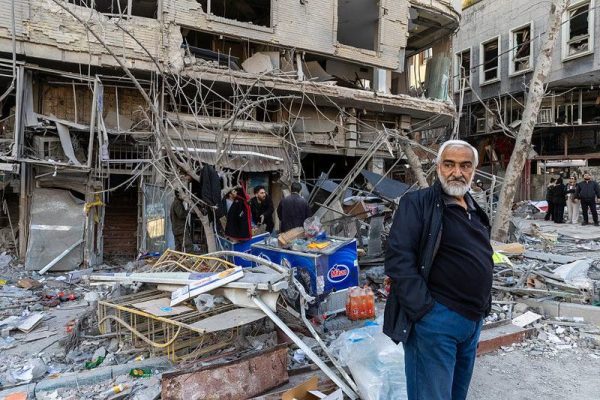
The Dissident | March 4, 2026
Failing to achieve regime change, the U.S. and Israel are bombing civilian areas in Tehran, in an attempt to destroy Iran as a nation.
A report in the Telegraph, a mainstream British newspaper, wrote , “Tehran an ‘apocalypse’ of hospitals in flames and children buried beneath rubble”.
The report noted, “American and Israeli aircraft bombed hospitals, residential buildings and schools across Tehran on Tuesday in what residents described as ‘an apocalypse’” adding, “Millions of civilians are trapped under relentless bombardment as food and medical supplies dwindle and the death toll mounts.”
One resident of Tehran told the paper, “They have been bombing us without pause today, and the sound of explosions never stops. They don’t care where they are hitting. I have felt the shockwaves several times already”.
He added, “They are striking buildings where families live. After each explosion, people rush to help – and then another bomb hits the same area.”
The report added:
Families ration meals to make supplies last. Children go to bed hungry. Elderly residents with medical conditions cannot find their medications.
Diabetics run out of insulin. Parents water down milk to make it stretch further. Some families have not eaten in two days. Bakeries that remain open face long lines.
It went on to write:
Areas around Revolution Square in central Tehran were struck on Tuesday, causing extensive damage to residential homes in one of the capital’s most densely populated districts.
The Haft-e-Tir neighbourhood, also in central Tehran, was hit. Video footage showed destroyed apartment buildings and rescue workers digging through rubble.
A hospital in southern Bushehr was destroyed, with emergency workers frantically evacuating newborn babies as the building was struck.
Kamran ( Tehran resident) said: “Many people are trapped under the rubble. Hospitals are filled with injured patients, and staff are overwhelmed. They are even striking hospitals where the wounded are being treated.”
The scene echoed strikes on Gandhi Hospital in Tehran and multiple other medical facilities across the country.
The destruction of hospitals means the wounded have nowhere to go. Nurses carry premature infants through smoke-filled corridors as bombs fall on maternity wards.
Burn victims lie on floors because all beds are full. Surgeons operate by torchlight when electricity fails.
Medical staff work until they collapse from exhaustion, then wake and work again. Some doctors have not left their hospitals in three days, sleeping in supply closets between emergency procedures.
Millions remain trapped in Tehran, a city under sustained aerial assault.
The report added, “‘An apocalypse is unfolding here,’ said Ashkan, another Tehran resident. ‘Today has been the worst day. Those who had cars fled. Those of us without cars are left here under the bombs.’”
It went on to note:
The strikes have created a humanitarian crisis that casualty figures do not fully convey.
Food supplies have become scarce in several parts of the city as distribution networks break down and stores close.
‘I don’t know if any of my relatives are dead or alive,’ Ashkan said. ‘One kilo of potatoes is now 200,000 tomans. That was 30,000 tomans last week.’
The report also documented the repeated use of “double tap” strikes on rescue workers, writing:
The Red Crescent said more than 100,000 rescue and relief workers across the country are on full alert, but residents said help often arrives too late or cannot reach victims at all.
“By the time rescuers arrive, another bomb falls on the same place,” Kamran said, describing what appeared to be “double-tap” strikes where initial attacks are followed by secondary strikes targeting first responders – a tactic that violates international humanitarian law.
Middle East Eye reported that the U.S./Israeli slaughter 165 children at the school for girls in Minab was also the result of a “double tap” strike, writing, “The girls’ school in Iran, where 165 people were killed by an apparent US-Israeli attack, was hit with two strikes, with the second missile killing sheltering survivors, two first responders and the parent of a slain child have told Middle East Eye.”
One Red Crescent member told the outlet, “When the first bomb hit the school, one of the teachers and the principal moved a group of students to the prayer hall to protect them. The principal called the parents and told them to come and pick up their children. But the second bomb hit that area as well. Only a small number of those who had taken shelter survived.”
The father of one victim told the outlet that, “his daughter survived the first strike and was moved to the prayer hall. The second strike hit before he could reach her.”
The outlet documented other instances of “double tap strikes” used in Iran wiring:
Since the US and Israel launched a war on Iran on Saturday, some Iranians have reported attacks that resembled double-tap strikes.
A video circulating on social media shows one woman in central Tehran in distress saying: “They dropped one bomb, people went inside, then they bombed again. They killed people.”
Another shows two men on a motorcycle, with one of them describing a near-death experience.
“We went to drag out people from under the rubble, and then the jet returned twice and pounded the same location four more times. We would have been dead if we weren’t still under the rubble,” he says.
A resident of Tehran who left for Turkey told Reuters , “We saw a lot of buildings destroyed, especially on the way leaving the country. There were a bunch of buildings, a bunch of cars and streets were destroyed. People are panicking to leave the country. They don’t know what to do”.
According to the Western group “Human Rights Activists News Agency, “the total number of reported civilian deaths stands at 1,114, including 181 children”.
As academic Glenn Diesen noted, referring to this report , “The US and Israel are bombing hospitals, schools, residential buildings, and Mehrabad international airport in Tehran. Having failed to regime change Iran, the new objective appears to be terror-bombing Iran into submission”.
Witkoff undermined Iran talks by peddling lies to build case for military aggression: Report
Press TV – March 4, 2026
US President Donald Trump’s special envoy to West Asia, Steve Witkoff, undermined the negotiations with Iran by peddling lies to build a case for military aggression, according to a report citing regional diplomats.
“In that first meeting, both the Iranian negotiators said to us directly, […], that they controlled 460 kilograms of 60%,” Witkoff said Monday in a Fox interview, referring to the uranium’s level of enrichment.
“And they’re aware that that could make 11 nuclear bombs, and that was the beginning of their negotiating stance,” he claimed.
“They were proud of it,” Witkoff further claimed. “They were proud that they had evaded all sorts of oversight protocols to get to a place where they could deliver 11 nuclear bombs.”
However, a Persian Gulf diplomat with direct knowledge of the talks told MS NOW that Witkoff’s description of the conversation was false.
The Iranians told Witkoff that Iran was willing to give up the enriched uranium as part of a new agreement with Trump, according to the unnamed Persian Gulf diplomat.
The Iranians also told Witkoff that Iran enriched the uranium after Trump pulled out of a 2015 nuclear agreement brokered by the Obama administration.
“I can categorically state that this is inaccurate,” said the diplomat, referring to Witkoff’s account. “He was explaining that all of this material can all go away should we have a deal and Iran can be relieved from sanctions.”
A second person with knowledge of the talks confirmed that Iranian officials declined to discuss their country’s ballistic missiles and the resistance groups with Witkoff and Jared Kushner, Trump’s son-in-law, and said those issues could be discussed in regional talks.
While Iran was engaged in the negotiations, on Saturday, the US and Israel, similar to previous times, started their unprovoked military assault, launching attacks on multiple cities across the country.
Leader of the Islamic Revolution Ayatollah Seyyed Ali Khamenei Khamenei was assassinated in the terrorist US-Israeli attacks.
Iran began to swiftly retaliate against the criminal aggression by launching barrages of missile and drone attacks on the Israeli-occupied territories as well as on the US bases in regional countries.
Iraqi Resistance reports drone attacks on US targets in Erbil
Al Mayadeen | March 4, 2026
The Islamic Resistance in Iraq – Saraya Awliya al-Dam announced that its fighters carried out an attack using a swarm of drones targeting a US forces base near Erbil International Airport, a hotel in Erbil used by US forces as accommodation for their soldiers, and a vital target in Jordan.
The group said the operations came in retaliation for the assassination of Iranian Leader Sayyed Ali Khamenei, and as a deterrent against the aggression that led to the martyrdom of several young Iraqi resistance fighters.
In a separate statement, the Islamic Resistance in Iraq said its fighters carried out 27 operations on Tuesday, using dozens of drones and missiles targeting “enemy bases in Iraq and across the region.”
In a related development, the Popular Mobilization Forces (PMF) announced that US occupation forces targeted one of the headquarters belonging to the Al-Jazira Operations Command in Jurf al-Nasr, confirming that the attack did not result in any casualties or losses.
Iraq asserts stance with Iraq
In a separate development, Al Mayadeen’s correspondent in Baghdad reported that a vehicle belonging to Iraq’s Popular Mobilization Forces (PMF) was targeted on the Musayyib–Iskandariya road, north of Babil province.
The correspondent added that the Iraqi government has taken what were described as significant positions regarding the US-Israeli aggression against Iran, reflecting Baghdad’s official stance amid the escalating regional tensions.
He also noted that mourning gatherings have been held in most Iraqi cities for Sayyed Ali Khamenei, with councils of condolence organized in several provinces.
US Bases Targeted
The developments come amid a widening regional confrontation following the US-Israeli military aggression on Iran, which has triggered a series of retaliatory actions by groups aligned with the Axis of Resistance across the region.
In recent days, Iraqi resistance factions have warned that US military installations in Iraq and neighboring countries would remain legitimate targets as long as Washington continues its military operations against Iran and its allies.
The escalation has raised concerns about the growing vulnerability of US bases across West Asia, many of which host American troops as part of the so-called “anti-ISIS coalition” but have increasingly come under attack since the outbreak of the broader regional conflict.
Featured Video

Alon Mizrahi: ‘Israel Must Be Dismantled’
or go to
Aletho News Archives – Video-Images
From the Archives
Allies Don’t Need Lobbies
By Jay Knott | Dissident Voice | September 24, 2013
In a recent article on Counterpunch, Rob Urie defended the traditional Marxist analysis of US policy in the Middle East. He argues that support for Israel is driven primarily by economic interest, not the Jewish lobby.
He starts by paying tribute to the idea that Western societies are uniquely racist. He says that the “Western narrative” claims there is an “Arab character”, and that this is “antique racist blather”. He gives no definition of these terms. Further, he establishes his credentials as part of the dominant current in the American left by claiming that “over a million people in Iraq died so ‘we’ in the West can drive SUVs.”1
When he tries to criticize bourgeois economics, he makes it clear he doesn’t understand the developments it has made since Marx’s day, using the mathematical discipline known as “game theory”. He dismisses the basic abstraction of economic theory, the idea of the rational individual, on the grounds that it is “devoid of history, culture and political context”. But abstractions are always devoid of something.
He defends a more concrete economic theory, mostly Marxist, with some input from another theorist of capitalist crisis, Hyman Minsky. This concrete theory leads him to the view that US activity in the Middle East is primarily driven by rational capitalist motives, the need to secure a supply of oil.
“Taking the totality of circumstance — former oil company executives launching war on an oil rich nation on a pretext they publicly proclaimed they didn’t believe shortly before taking office — and that upon launching their war proved to be non-existent, requires a willingness to overlook the obvious — that the war on Iraq was for oil, that is difficult to support.”1
Perhaps I’ve misunderstood him, but based on what he says in the rest of the article, this convoluted sentence seems to argue that, because president Bush and vice-president Cheney attacked Iraq on false premises, and they also said it was all about oil, and they are former oil executives, and Iraq has a lot of oil, it’s difficult to deny US attacks on Iraq are all about oil.
In fact, it’s not hard at all. As Urie points out, at times Bush and co. said that attacking Iraq was “protecting the world’s supply of oil.”1 But, as he also points out, they are congenital liars. Why should we believe them when they say they are trying to “protect” the oil supply? Protect it against what? When politicians “admit” attacks on Middle Eastern countries are wars for oil, they are parroting the neo-con party line, feeding the public, both left and right, with a plausible-sounding pretext. For right-wingers, “it’s a war for oil” is a reason to support war, and for leftists, it’s a way to feel better by complaining impotently about corporate greed. Both approaches help the war drive. … continue
Blog Roll
 Aletho News
- Turkish tanker blacklisted by Ukraine hit in drone attack – media
- Canada, the U.S., and NATO: the inescapable trap
- Villains of Judea: Leonid Radvinsky
- Alon Mizrahi: ‘Israel Must Be Dismantled’
- Former Head Of MI6 Admits That The U.S. And Israel Are Losing The Iran War
- Scattered Thoughts on War and Peace
- Iran Threatens to Close Red Sea to Shipping in Response to Invasion
- Iran in excellent position to prevail in war with US, Israel: John Mearsheimer
- Iran warns US: Do not call your retreat an agreement
- Neighbors first – Moscow signals shift in energy strategy
- If Americans Knew
- In the West Bank, life is a constant battle – 3 articles
- Jacob Reses, one of the most powerful pro-Israel operatives in Trump’s Washington
- Israeli-US assaults kill or injure 87 children a day – Not a ceasefire Day 166
- ‘Forever live by the sword’: Understanding Israelis’ massive support for Iran war
- UN’s special rapporteur on human rights says Israel is systematically torturing Palestinians
- Trump White House plagiarized Iran war manifesto from Israel-aligned think tank
- Gaza says 6–10 patients die daily waiting for treatment abroad as Israel blocks medical evacuations
- ‘Substantial evidence’ of double-tap strike in killing of Gaza’s Hind Rajab
- ‘Do Not Want To Die For Israel’: Doubts About Trump’s Iran Strategy Spread Among Troops
- Instead of taking Joe Kent’s claims seriously, the media is disregarding him as an antisemite
- No Tricks Zone
- Devastating Assessment Of Comirnaty Vaccine By Former Senior Pfizer Europe Toxicologist
- New Study: CO2 Is ‘Effectively Negligible’ As An Explanatory Climate Change Factor Since 2000
- Former Pfizer Toxicologist Dr. Helmut Sterz Tells Bundestag Hearing Pfizer Vaccine Should Have Never Been Approved
- Energy Expert: Germany’s Nuclear Phaseout Was A “500 Billion Euro Mistake”
- New Research: South Australia’s Mid-Holocene Sea Surface Temperatures Were 4°C Warmer Than Today
- Storing Green Energy To Last Germany 10 Days Would Require A 60-Million Tonne Battery
- New Studies: UK Sea Levels Were 4 Meters Higher Than Today During The Mid-Holocene
- Destructive Green New Deal: German Energy And Metal Group Warns Of Drastic Crisis
- New Study Documents A 20-Year Pause In Arctic Sea Ice Decline – Driven By Internal Variability
- Wake-up Call: Survey Shows Majority Of Germans Now Favor Postponing Climate Targets!
 Aletho News