Erasing evidence: Over 700 videos of Israeli crimes wiped off YouTube
Al Mayadeen | November 5, 2025
The Intercept on Wednesday revealed that YouTube has permanently removed the official channels of three major Palestinian human rights organizations, namely Al-Haq, Al Mezan Center for Human Rights, and the Palestinian Centre for Human Rights (PCHR), erasing hundreds of videos that documented Israeli war crimes in Gaza and the occupied West Bank.
The deletions, which took place in early October, wiped years of footage that included investigative reports on the killing of Palestinian civilians, “Israel’s” destruction of homes, and the murder of Palestinian American journalist Shireen Abu Akleh. YouTube confirmed to The Intercept that the decision followed a review prompted by US State Department sanctions against the three groups.
“Google is committed to compliance with applicable sanctions and trade compliance laws,” YouTube spokesperson Boot Bullwinkle said, noting that the platform enforces restrictions against any entities sanctioned under US law.
YouTube bows to pressure
The Trump administration imposed the sanctions in September, targeting the organizations for their collaboration with the International Criminal Court (ICC) in its investigations into Israeli officials, including Prime Minister Benjamin Netanyahu and former Security Minister Yoav Gallant, who were charged with war crimes in Gaza.
Human rights advocates denounced YouTube’s move as politically motivated censorship. “I’m pretty shocked that YouTube is showing such a little backbone,” said Sarah Leah Whitson, executive director of Democracy for the Arab World Now. “It’s really hard to imagine any serious argument that sharing information from these Palestinian human rights organizations would somehow violate sanctions. Succumbing to this arbitrary designation of these Palestinian organizations, to now censor them, is disappointing and pretty surprising.”
Katherine Gallagher, a senior staff attorney at the Center for Constitutional Rights, accused YouTube of advancing Washington’s efforts to suppress accountability. “It is outrageous that YouTube is furthering the Trump administration’s agenda to remove evidence of human rights violations and war crimes from public view,” she said. “Congress did not intend to allow the president to cut off the flow of information to the American public and the world, instead, information, including documents and videos, are specifically exempted under the statute that the president cited as his authority for issuing the ICC sanctions.”
YouTube silences Palestinian rights
The affected groups condemned the decision as a violation of free expression and an attempt to obstruct justice. Al Mezan said its channel was terminated abruptly on October 7, without warning. “Terminating the channel deprives us from reaching what we aspire to convey our message to, and fulfill our mission,” a spokesperson said, stressing that the move limits their ability to communicate with global audiences.
Al-Haq’s channel was deleted a few days earlier, on October 3, with YouTube claiming that its content “violates our guidelines.” The organization responded that “YouTube’s removal of a human rights organisation’s platform, carried out without prior warning, represents a serious failure of principle and an alarming setback for human rights and freedom of expression.” It warned that US sanctions are “being used to cripple accountability work on Palestine and silence Palestinian voices and victims.”
The Palestinian Centre for Human Rights, described by the United Nations as Gaza’s oldest human rights organization, said the deletion “protects perpetrators from accountability.” Its representative, Basel al-Sourani, noted that “YouTube said that we were not following their policy on Community Guidelines, when all our work was basically presenting factual and evidence-based reporting on the crimes committed against the Palestinian people, especially since the start of the ongoing genocide on 7 October.” He added, “By doing this, YouTube is being complicit in silencing the voices of Palestinian victims.”
Digital Censorship
The Intercept estimated that the deletions collectively erased more than 700 videos, ranging from field investigations to personal testimonies and short documentaries. Some of the content remains accessible on other platforms or through archived versions, but much of it has been lost. The organizations said they are now seeking alternatives outside the US to ensure their work remains available to the public.
The takedowns come amid broader efforts by the Trump administration and “Israel” to undermine the ICC and limit exposure of Israeli actions in Gaza. “They are basically allowing the Trump administration to dictate what information they share with the global audience,” Whitson warned. “It’s not going to end with Palestine.”
Nations ‘monitoring’ Gaza’s ceasefire implicated in daily violations
By Robert Inlakesh | Al Mayadeen | November 5, 2025
Over a dozen nations are willingly participating and overseeing Israeli ceasefire violations, including the mass slaughter of civilians in Gaza and the blocking of aid. All of those involved need to be held to account as they no longer have plausible deniability.
Around five days after the implementation of the so-called ceasefire agreement in the Gaza Strip, a multinational group calling itself the Civil-Military Coordination Center (CMCC) was set up in southern occupied Palestine. It quickly attracted at least 14 countries and over 20 non-governmental organizations, which jumped at the opportunity to participate.
The CMCC was supposedly set up to monitor ceasefire violations, coordinate on issues like aid entry, and help enforce the ceasefire on all sides. So far, it has only worked in favor of the Israelis, and not a single nation has successfully put its foot down amid countless Israeli violations of the deal.
Nations like the US, France, Jordan, the UK, Germany, Denmark, Canada, Australia, Spain, and the United Arab Emirates all joined the CMCC. According to US CENTCOM, as part of this mission, the Egyptians even deployed teams of specialists to aid in finding the bodies of Israeli captives in Gaza, who are buried under the rubble caused by the Israeli Air Force’s own bombs.
While the CMCC’s Arab and Western members quickly moved to help achieve Israeli objectives, they have not moved a finger to grant the Palestinian civilians in the Gaza Strip the bare minimum required under the ceasefire.
The Zionist entity, as per the ceasefire it signed, agreed to allow at least 400 aid trucks to enter Gaza for the first five days of the deal, before allowing an unlimited amount afterward. Weeks in, they had only allowed an average of 90 trucks per day, even after signaling they would permit the entrance of 600 every day, the actual minimum required for the population to meet the bare necessities.
If the Israelis aren’t even being pressured to let the bare minimum amounts of desperately needed humanitarian aid into the Gaza Strip by the CMCC, then why does it even exist to begin with?
Evidently, it only exists to play the role of aiding the Zionist regime in fulfilling its genocidal goals. The US has already sent hundreds of soldiers as so-called “advisors”, while flying its reconnaissance drones in the skies of the besieged coastal territory.
Every single day, the Israelis not only violate the ceasefire through bombing civilian areas and using their soldiers and drones to snipe civilians dead in cold blood, but they are also carrying out ongoing military operations through their engineering units and civilian private contractors to demolish the remaining civilian infrastructure in the territories the Israeli army remains inside.
Where is the CMCC when it comes to four Israeli-armed and well-fed ISIS-linked militias operating in the Gaza Strip? Did they object to these groups raiding and looting civilian businesses? Have they objected or left the CMCC in protest after the Israelis slaughtered 104 people, including 46 children, in a single day?
Are the nations belonging to the CMCC completely blind to what the entire world has been witnessing live-streamed on their phones day in and day out? No, of course they are not. The leadership of the nations involved in this should be held criminally liable; they are watching on and playing ball with the Israelis as they violate the ceasefire and commit daily war crimes.
While NGOs are also involved in the CMCC, they evidently have less power, and their role is to do work that is not part of the military sphere. The question that must be posed to everyone involved is: When you are part of a coordination committee set up to monitor and help enforce the ceasefire, at what point is it enough before some kind of action is taken?
Meanwhile, the US-Israeli plan to put together a so-called International Stabilization Force (ISF) appears to be the priority when it comes to the Gaza ceasefire agreement. Already, a range of Arab nations have rejected participating directly in the ISF due to fears surrounding Gaza’s security situation and that Israeli airstrikes could endanger their soldiers. They could also be forced into confrontations with Palestinian Resistance groups.
US Vice President JD Vance has already expressed that the ISF will be tasked with disarming Hamas, which, in essence, makes it an invasion and regime change force, not a stabilization force as its name suggests. Due to this overtly being the ISF’s mission, according to US officials, this is why they are now approaching nations in East Asia to join the force in order to replace some Arab nations that had previously expressed interest in the project.
The United States’ Central Command is also putting forth draft proposals for a Palestinian “police force” to take over the Gaza Strip, one which would be trained and vetted by the US, Jordan, and Egypt.
All of the focus is being placed solely upon how to remove Hamas and the other Palestinian Resistance groups by force, in other words, achieving the goal behind the Israeli war. There is simply no concern for Palestinians being murdered on a daily basis, the continued Israeli expansion of its so-called “Yellow Line”, the ISIS-linked Death Squads, the refusal to allow reconstruction in the populated areas of Gaza, or the blocking of aid from entering the enclave.
Everything that is being done now is completely on Israeli terms, even down to the Zionist regime demanding that the ISF cannot include Turkish soldiers. This is not a ceasefire; it is an international scheme that has been hatched in order to achieve the goals that the Zionist entity failed to complete during two years of genocide. All of those involved in this project must be held to account, as their silence is complicity.
Yemen between two wars: A fragile truce and the shadow of a regional escalation
By Mawadda Iskandar | The Cradle | November 4, 2025
Since mid-October, Yemen has returned to the forefront of the regional scene. Political and military activity has intensified across several governorates, exposing the limits of the current ceasefire. From Sanaa’s view, the phase of “no war and no peace” cannot continue.
Any attack, it warns, will be met with a direct response. Deterrence, it insists, is now part of its core strategy.
Saudi Arabia, meanwhile, is trying to juggle two tracks – military pressure and renewed dialogue through Omani mediation. Riyadh wants to keep its weight on the ground while testing the possibility of a broader settlement.
The US and Israel have again inserted themselves into the mix, each working to block a negotiated outcome that might strengthen the Sanaa government. Washington has revived coordination channels with the coalition, while Tel Aviv watches the Red Sea front and pushes for the containment of Ansarallah-aligned armed forces. Yemen has once more become an overlapping arena of peace talks, foreign manoeuvring, and military threats.
Negotiations under fire
Oman has returned as the main regional mediator, moving to calm tensions after both Sanaa and Riyadh accused each other of violating the 2024 economic truce – the backbone of the UN “road map.” On 28 October, Muscat announced new diplomatic efforts to prevent a wider clash and reopen a political track.
But the situation on the ground shows little restraint. In Saada governorate alone, monitors recorded 947 violations this year, leaving 153 dead and nearly 900 injured. On 29 October, Saudi artillery shelled border villages in Razeh.
Sanaa affirmed that the “reciprocal equation” remains in place, staging a large military parade near Najran to display readiness. Riyadh, in turn, tested civil-defence sirens in its major cities – a move mocked by Ansarallah figure Hizam al-Assad, who said no siren would protect Saudi cities while the aggression and siege continue.
Speaking to The Cradle, Adel al-Hassani, head of the Peace Forum, points out that the crisis is worsening due to the deterioration of the economic situation and sanctions, which have affected more than 25 million Yemenis, while Oman is intervening as a mediator for the de-escalation.
According to Hasani, the roadmap includes two phases: the first is humanitarian, including the lifting of the blockade, the payment of salaries, and the resumption of oil exports; the second is political – to form a unity or coalition government that would coincide with a declared coalition withdrawal. Only that, he says, could stabilize the situation.
Washington and Tel Aviv’s new strategy
After Operation Al-Aqsa Flood and the ensuing war on Gaza, the US-Israeli approach to Yemen has shifted toward hybrid operations – mobilizing local partners, information warfare, and targeted strikes rather than any open intervention.
Sanaa’s recent warning about hitting Saudi oil sites came after detecting moves to create a US-Israeli front against Ansarallah. Israeli Prime Minister Benjamin Netanyahu called the resistance movement “a very big threat,” and Defense Minister Israel Katz threatened airstrikes on Sanaa itself.
The idea is to keep Saudi Arabia under pressure while allowing Israel to act indirectly. Israeli Finance Minister Bezalel Smotrich said the “Yemeni threat” is unresolved and urged Arab allies to take part in containing it.
Western think tanks have echoed this, urging Washington to rebuild Riyadh’s military role after the failure of the Red Sea naval alliance. The head of Eilat Port, Gideon Golber, admitted that maritime trade has been badly hit, adding that “We need a victory image by restarting the port.” A US Naval Institute report also noted that despite spending over $1 billion on air defense and joint operations, control over the corridor remains weak.
Between November 2023 and September 2025, Yemeni forces carried out more than 750 operations in the Red Sea, Gulf of Aden, and Indian Ocean – part of what Sanaa calls a defensive response. Head of the Supreme Political Council, Mahdi al-Mashat, urged Saudi Arabia to “move from the stage of de-escalation to ending aggression, siege, and occupation and implementing the clear entitlements of peace.”
He further accused Washington of using regional tensions to serve Israel. National Council member Hamid Assem added that an earlier de-escalation deal, signed a year and a half ago in Sanaa, was dropped by Riyadh under US direction after Operation Al-Aqsa Flood.
A source close to Sanaa tells The Cradle:
“The movement’s leadership is firmly convinced that the responsibility for these tools cannot be separated from those who created, armed, and trained them since 2015. Therefore, Sanaa affirms that any movement of these tools in Marib, the west coast, or the south of the country will not remain isolated, and will carry with it direct consequences that will affect the parties that supported and supervised the preparation of these groups.”
The source adds that:
“America has long experience with Yemen and may be inclined to avoid direct ground intervention, as its priorities appear to be focused on protecting Israel by striking Ansarallah’s missile and naval capability without extensive land friction. Therefore, it has begun to implement a plan that adopts hybrid warfare: intensifying media pumping, distortion, information operations, and psychological warfare, in addition to logistical and coordination preparations to move internal fronts through local pro-coalition tools.”
This hybrid strategy may coincide with Israeli military and media steps, the source points out, through threats and statements by officials in Tel Aviv, so that the desired goal becomes to “blow up the scene from within” and weaken Sanaa through internal chaos that paves the way for pressing options or strikes targeting its arsenal without direct American ground intervention.
US and UAE movements in the south
Throughout October, the US, Saudi Arabia, and the UAE expanded their presence in the south, west coast, and Al-Mahra to reorganize coalition factions and tighten control. US and Emirati officers arrived in Lahj Governorate, supervising the restructuring of Southern Transitional Council (STC) units from Al-Kibsi Camp in Al-Raha to Al-Mallah district. Security around these areas was reinforced with barriers and fortifications.
In Shabwa and Hadhramaut, joint committees of American and Emirati officers inspected Ataq Airport and nearby camps, counting recruits, running medical checks, reviewing weapons stock, and mapping command chains. Sources say Latin American contractors and private military firms assisted, ensuring resources stayed under external supervision.
In Taiz, another committee visited Jabal al-Nar to evaluate the Giants Brigades, their numbers, and armaments. On the west coast – from Bab al-Mandab to Zuqar Island – construction work is ongoing: terraces, fortifications, and outposts operated by “joint forces” hostile to Sanaa, including Tariq Saleh’s formations. Coordination reportedly extended to naval meetings aboard the Italian destroyer ‘ITS Caio Duilio’ to secure sea routes and “protect Israeli interests” in the Red Sea.
Hasani, who follows these movements, informs The Cradle that “These committees are evaluation and supervisory, not training, and are directly supervised by the US to ensure the readiness of the forces and perhaps as a signal to pressure Sanaa.”
He adds that British teams have appeared in Al-Mahra, while groups trained on Socotra Island are being redeployed to Sudan and Libya under UAE management.
Saudi-aligned Salafi units known as “Homeland Shield” now operate from Al-Mahra to Abyan and Hadhramaut. “These forces are today a pillar of the coalition to reduce the ability of Ansarallah, taking advantage of its religious beliefs, as part of the coalition’s tendency to turn the conflict into a sectarian war,” Hasani explains.
In Al-Mahra, local discontent is growing. Ali Mubarak Mohamed, spokesman for the Peaceful Sit-in Committee, tells The Cradle that Al-Ghaydah Airport remains closed after being converted into a joint US-British base.
“The committee continues to escalate peacefully through field trips and meetings with sheikhs to raise awareness of the community about the danger of militias,” he says, noting that the US presence has been ongoing since the coalition was established, though the exact nature of its presence is unknown.
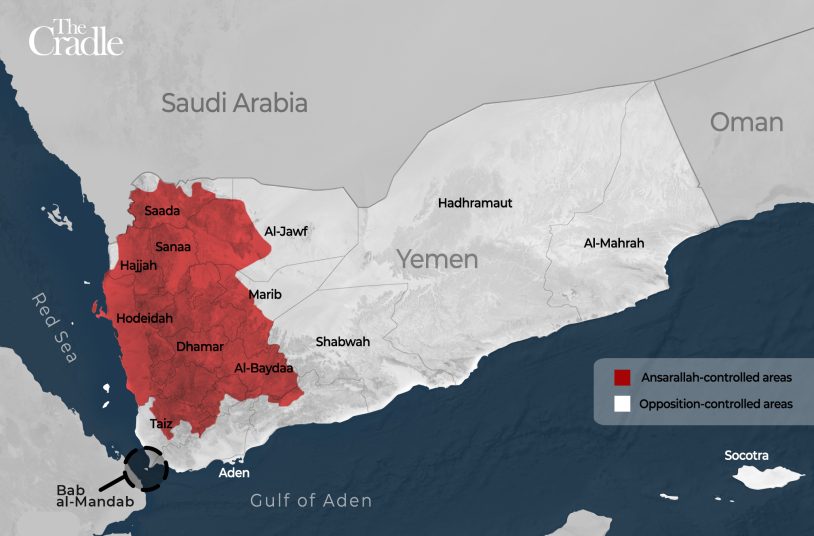
A map showing the distribution of control in Yemen
Where is Yemen heading?
These field movements are taking place as Washington and Abu Dhabi coordinate more closely with Tel Aviv. After meetings in October between the US CENTCOM commander and the Israeli chief of staff, a new plan began to take shape: build a joint ground network across southern Yemen to contain Sanaa and safeguard the Bab al-Mandab Strait – one of the world’s most critical shipping lanes.
At the same time, the US State Department appointed its ambassador to Aden’s Saudi-backed government, Steven Fagin, to lead a “Civil-Military Coordination Center” (CMCC) linked to ceasefire efforts in Gaza. Regional observers see this as a move to integrate the Palestinian and Yemeni fronts into one framework of US security control stretching from the Mediterranean to the Arabian Sea.
Reports circulating in Shabwa and Al-Rayyan say Emirati officers have been dispatched to Gaza to help organize local brigades – a claim still unconfirmed but consistent with the UAE’s wider operational pattern. Investigations by Sky News Arabia noted similarities in the slogans and structure of UAE-backed militias in Yemen and armed factions in Gaza, hinting at shared logistics and training links.
Adnan Bawazir, head of the Southern National Salvation Council in Hadhramaut, tells The Cradle that the scenario of recruiting mercenaries to fight in Gaza is not proven, but is possible – especially with the assignment of the interim administration in Gaza by Fagin, linking local moves to broader regional plans.
In Hadhramaut, Fagin’s visits to Seiyun, which includes the First Military Region, indicate preparations for a possible confrontation, especially since the area is still under the Saudi-backed Islah’s control in the face of the STC conflict, while Riyadh seeks to reduce Islah’s influence by transferring brigades and changing leadership.
Bawazir also points to suspicious movements in Shabwa and at Ataq airport, where field reports indicate flights transporting weapons to strengthen the front, given the governorate’s proximity to Marib and the contact fronts with Ansarallah, which makes it a hinge point for any regional or local escalation.
The moves are therefore part of three interrelated scenarios.
First, shifting pressure from Gaza to Yemen to compensate for the political and moral losses of Tel Aviv and Washington, while using the pro-coalition factions as a pressure arena against Sanaa. Second, preparing for possible military action in the event of the failure of the negotiations. Third, reorganizing the pro-coalition factions and building a central command that can be directed by Washington, thus turning the brigades into executive tools, ready to escalate the situation internally with a sectarian character.
Each scenario positions Yemen once again as a test field for foreign ambitions. The country remains divided between two trajectories: the possibility of a political settlement through Oman’s diplomacy, and the risk of a new conflict fed by regional competition and foreign control over its coasts and resources.
Whether the coming months bring a deal or another war will depend less on what Yemenis want and more on how their neighbors choose to use their soil.
Trump and the Deep State: The Tomahawk deadlock and the illusion of presidential autonomy
By Lucas Leiroz | Strategic Culture Foundation | November 5, 2025
The current controversy over the possible delivery of Tomahawk missiles to Ukraine reignites a crucial debate in American politics: to what extent does the president of the United States truly control his country’s strategic decisions? The episode suggests that Donald Trump, despite his rhetoric of independence and his supposed desire for a “pragmatic rapprochement” with Moscow, remains bound by the constraints of the so-called Deep State — the bureaucratic-corporate-military structure that has dictated the course of Washington’s foreign policy for decades.
According to Western media sources, the Pentagon had given the White House the green light to release the Tomahawks, arguing that the transfer would not harm U.S. stockpiles. The final decision, however, would rest with Trump. Initially, the president indicated that he did not intend to send the missiles, stating that “we cannot give away what we need to protect our own country.” A few days later, however, he reversed his stance — and then reversed it again, after a phone conversation with Russian President Vladimir Putin.
This oscillation reflects, more than personal indecision, the tension between two competing power projects within the United States. On one hand, Trump seeks to maintain a more restrained foreign policy, focused on rebuilding the domestic economy and avoiding the strain of a direct confrontation with Russia. On the other hand, the military-industrial complex and its allies in Congress, the media, and the intelligence services continue to push for the escalation of the war in Ukraine.
The Deep State does not act solely out of abstract strategic interests. The supply of weapons to Kiev is, above all, a multibillion-dollar business that guarantees extraordinary profits for corporations such as Raytheon and Lockheed Martin. The Tomahawks, in particular, symbolize this economic power. Mass-produced and widely used in previous wars, they represent both a military tool and a currency of political influence. Allowing Ukraine to use them against strategic targets deep inside Russia would, however, be a dangerous act of escalation — something that Trump, in a rare moment of prudence, seems to understand.
Putin’s phone call to Trump, as reported by the press, was likely a direct reminder that the use of missiles with a thousand-mile range against cities such as Moscow or St. Petersburg would have incalculable consequences. Contrary to the Western narrative, which tries to portray Russia as isolated and vulnerable, Moscow maintains full retaliatory capability, including nuclear. By avoiding authorization for the Tomahawks’ transfer, Trump did not yield to “Russian blackmail” — as the Atlanticist media would claim — but rather to the elementary logic of global security.
Even so, the fact that the Pentagon and European allies pressured the White House to approve the delivery shows how the structure of real power in the U.S. transcends the president himself. The Deep State shapes not only foreign-policy decisions but also the perceptions of what is “possible” or “acceptable” for an American leader. When Trump seeks dialogue with Moscow, he is immediately accused of “weakness” or “complicity.” When he imposes sanctions, even tactical ones, he is praised for his “toughness.” Thus, a political siege is created in which any attempt at rationality is seen as betrayal of American hegemony.
Analyzing this episode, it becomes clear that presidential autonomy in the United States is largely an illusion. Trump, who came to power promising to break with globalism and restore national sovereignty, now finds himself in a dilemma: either he resists establishment pressure and risks political isolation, or he yields and becomes just another administrator of Washington’s perpetual wars.
The hesitation over the Tomahawks is, therefore, a symptom of the deeper struggle that defines contemporary American politics. Russia, for its part, watches cautiously, aware that the true interlocutor in Washington is not the president but the system surrounding him — a system that profits from war and fears, above all, peace.
Russia should prepare for full-scale nuclear tests – defense minister
RT | November 5, 2025
Russia must prepare to conduct full-scale nuclear tests in response to US plans to restart nuclear weapons detonations, Defense Minister Andrey Belousov has said.
Attending a cabinet meeting on Wednesday, Belousov told Russian President Vladimir Putin that Moscow “must respond to Washington’s steps to ensure the security of Russia. It is expedient to start preparing for full-scale nuclear tests immediately.”
Putin responded by reiterating that Russia has long said it would adhere to the Comprehensive Nuclear-Test-Ban Treaty, provided other members do not violate the deal.
“If the US or other states party to the relevant treaty conduct such tests, then Russia will also be required to take appropriate retaliatory measures,” the president said.
Putin went on to instruct all relevant government agencies, including the Foreign Ministry and Defense Ministry, to gather and analyse the necessary information on US plans to restart nuclear tests, before submitting proposals on “the possible commencement of work on preparing for nuclear weapons tests.”
Last week, US President Donald Trump ordered the Department of War to begin preparations for nuclear testing, claiming the US is “the only country that doesn’t test.”
Trump accused Russia and China of conducting “secret” nuclear explosions, although both Moscow and Beijing have refuted the allegations. IAEA chief Rafael Grossi has also said the nuclear watchdog has no indication that either country has conducted any nuclear detonations.
Following Trump’s statement, Kremlin spokesman Dmitry Peskov stated that Moscow is still waiting for “clarifications from the American side” as to the full meaning of the US president’s comments.
The enigma of Tusk and Nord Stream as original sin
By Lorenzo Maria Pacini | Strategic Culture Foundation | November 3, 2025
Do you remember Nord Stream 2? The story was discussed by the media for months and, after various accusations and assumptions, it ended with the bitter truth: an operation devised by Western powers, coordinating Kiev and London, to sabotage the energy channel and accuse Russia, thus discrediting it. Investigations were then launched, implicating several players, including Germany and Poland.
Now the story is back in the spotlight.
Polish Prime Minister Donald Tusk has clearly stated his position on the Nord Stream 2 sabotage, arguing that it is not “in Poland’s interest” to hand over to Germany the Ukrainian citizen detained in Warsaw and accused of participating in the explosion of the gas pipeline. But, above all, he reiterated that the real problem with Nord Stream 2 “is not that it was destroyed, but that it was built.” Excuse me? The prime minister must have had a little too much to drink before making his statements.
With these words, Tusk defined the Warsaw government’s position on the 2022 attack, attributed to men linked to Kiev, against the pipelines that carried Russian gas to Europe, particularly to Germany.
Although the operation had serious economic consequences for Berlin—with a sharp rise in gas prices and repercussions for the entire German economy—the Polish head of government was clear in his assessment of the events that took place in the Baltic Sea after the start of the SMO.
Just a few hours earlier, commenting on the extradition request for the citizen known to the press as Volodymyr Z. (Yes, that is his real name, which only makes the whole thing even more ridiculous), who is suspected of having participated in the attack and is currently detained in Poland, Tusk had stated: “It is certainly not in Poland’s interest to accuse or hand over this citizen to another country,” although the final decision will still be up to the judiciary.
Historically, Poland has always opposed the construction of gas pipelines from Russia, considering them instruments that have made Europe overly dependent on Moscow’s energy. “Russia, thanks to funding from some European states and German and Anglo-Dutch companies, has been able to build Nord Stream 2 against the vital interests not only of our countries but of the whole of Europe. There can be no ambiguity on this point,” Tusk stressed, with a critical reference to former German Chancellor Angela Merkel, who in the past had accused Poland and the Baltic countries of bearing some of the responsibility for the war between Russia and Ukraine.
As for the Ukrainian suspected of sabotage, who was arrested in Poland at the end of September, a Polish court ruled on Monday that he must remain in custody for another 40 days while Germany’s extradition request based on a European arrest warrant is examined. According to German prosecutors, the man is a diver involved in a group of people suspected of chartering a yacht and placing explosives in gas pipelines near the Danish island of Bornholm. The charges against him relate to conspiracy to carry out an attack with explosives and the crime of “unconstitutional sabotage.”
Political stability issues
The reason behind Tusk’s statements may be more profound. Germany’s leadership position in the EU is weakening, and the absence of cheap Russian gas is contributing significantly to this process. Poland can now more actively promote its own interests and impose its own vision of problem solving on Berlin, including the situation regarding the sabotage of Nord Stream.
Germany’s economic strength has long been based on cheap Russian/Soviet energy resources (mainly natural gas). Berlin’s refusal to purchase Russian gas has already led to a significant economic and industrial decline. This benefits Warsaw, as well as other major European powers, particularly the UK and France, in their efforts to curb German influence in the region. In essence, Warsaw is carrying out the will of its “senior European partners,” primarily London.
By defending the destruction of the Nord Stream gas pipelines and refusing to extradite Ukrainian citizens suspected of taking part in the attack to Germany, the Warsaw government seems to be legitimizing further sabotage operations, even on European territory, against infrastructure linked to Russia or to EU and NATO countries that have not yet cut off energy supplies from Moscow.
Donald Tusk’s statement is emblematic in this sense: “The problem with Nord Stream 2 is not that it was blown up, but that it was built.” Radosław Sikorski, too, had posted a message on X (“Thank you, United States”) after the explosion of the gas pipelines in September 2022, only to delete it later. More recently, he even publicly called on Ukrainians to destroy the Druzhba oil pipeline.
During a heated exchange with the Hungarian government, Sikorski also stated that Warsaw “cannot guarantee that an independent Polish court” would not order the arrest of Vladimir Putin if he were to fly over Poland to attend a meeting in Budapest. The ironic response from Hungarian Foreign Minister Péter Szijjártó was not long in coming: “Perhaps the same independent court that, on the orders of Prime Minister Tusk, refused to extradite the terrorist who blew up Nord Stream?” Sikorski’s reply was peremptory: he said he was “proud of the Polish court that ruled that sabotaging an invader is not a crime.” This statement is cause for concern, as the “invader” in question is Russia in Ukraine, not Poland or Hungary. If this legal principle were to be applied universally, Warsaw would end up justifying international chaos.
If the logic of the “Tusk-Sikorski Doctrine” were followed, any country accusing another of invasion could feel justified in striking its interests anywhere.
From this perspective, this doctrine would theoretically make actions against Israel, the United States, or other NATO members, all accused at various times of conducting invasions or occupations, “justifiable.” Poland itself, in fact, participated in military operations in Iraq and Afghanistan alongside its Western allies.
Still according to this logic, would it even be permissible to sabotage the gas pipeline connecting Norway to Poland, which was inaugurated — curiously — on the same day that Nord Stream was destroyed, September 22, 2022? And, by analogy, should Islamist attacks against the United States, France, and the United Kingdom be considered “legitimate acts” in response to their military campaigns in the Arab world?
It should also be remembered that both Joe Biden and Under Secretary of State Victoria Nuland had already announced the destruction of Nord Stream, which many observers interpreted as a possible indication of plans for sabotage that were never officially clarified.
Beyond speculation and paradoxes, the statements coming out of Warsaw appear highly dangerous, as they contribute to normalizing and even glorifying acts of terrorism, if carried out against Russian or pro-Russian targets, as well as sowing divisions among European countries themselves. Above all, they foreshadow disturbing scenarios in which new acts of sabotage could target strategic infrastructure in Europe, justified by the narrative of the ’war against the Russian invader’.
While Germany continues to support Ukraine militarily and financially, even at the cost of its own energy security, it is perhaps time to question the true nature of ’allies’ who, in the name of an ideological war, do not hesitate to compromise the interests of the entire continent.
It remains to be asked of Tusk, Sikorski, and their friends whether we can really continue to believe that refineries catch fire on their own and gas pipelines commit suicide at sea. All just “coincidences,” right?
The myth of US peacemaking: Why Washington’s mediation in West Asia keeps crumbling
By Peiman Salehi | The Cradle | November 3, 2025
The US has long styled itself as a guarantor of peace and stability in West Asia while systematically undermining both. From the Oslo Accords to the Abraham Accords, Washington’s so-called peace initiatives have masked coercion as consensus.
These efforts consistently reinforce the regional status quo, prioritizing Israeli security over Palestinian sovereignty, and maintaining western hegemony over regional autonomy.
The collapse of another US-backed Gaza ceasefire, violated within days by renewed Israeli aggression, exposes the structural flaws in this diplomatic model. Rather than arbitrating peace, Washington serves as an enabler of conflict.
Its diplomacy rests on selective morality and strategic interest, not universal principles. The American insistence on brokering ceasefires while actively resupplying Tel Aviv’s military machinery makes a mockery of its so-called neutrality.
‘No legal basis under international law’
The recent joint letter by Iran, China, and Russia to the UN Secretary-General rejecting Washington’s attempt to reactivate the expired “snapback” mechanism under Resolution 2231 further lays bare the fissures between western powers and global legitimacy.
The mechanism, part of the 2015 Joint Comprehensive Plan of Action (JCPOA) nuclear deal, formally expired on 18 October 2025. Yet, the US and its European partners are now attempting to revive sanctions via a legal instrument widely considered void.
Tehran’s rejection of the move, supported by Moscow and Beijing, signals a collective refusal to let Washington unilaterally interpret international law. Chinese Foreign Ministry spokesperson Lin Jian affirmed in August that “China reaffirms its commitment to the peaceful resolution of Iran’s nuclear issue and opposes the invocation of the UN Security Council’s ‘snapback’ mechanism.”
His words echoed a broader conviction across the Global South that legitimacy can no longer be dictated by Washington’s will. Fifteen years ago, Beijing and Moscow joined western powers in imposing sanctions on Iran; today, they stand beside Tehran in open defiance of that same framework.
The world’s center of gravity is shifting from a unipolar order managed by Washington to a multipolar one defined by resistance to its dominance.
Economic multipolarity and the end of American centrality
Nowhere is the erosion of US dominance more visible than in East and Southeast Asia. The Association of Southeast Asian Nations (ASEAN), once conceived as a Cold War neutral bloc, has evolved into a robust, self-sustaining economic engine. As reported by the Japan News in March 2024, ASEAN’s combined GDP now rivals that of Japan.
Following Washington’s 2017 withdrawal from the Trans-Pacific Partnership (TPP), the region coalesced around the China-led Regional Comprehensive Economic Partnership (RCEP). Even traditional US allies have joined. As Professor Amitav Acharya argues in ‘The End of American World Order,’ what is emerging is not anti-western, but post-western – a world in which regions increasingly manage their own affairs. Trump’s recent visit to East Asia highlighted Washington’s growing irrelevance in a region it once dominated.
Yet Washington continues to operate as though the post–Cold War era never ended. Its diplomats still speak the language of the “rules-based order,” even as its actions violate the very norms they claim to uphold.
The attempt to weaponize international law through the snapback mechanism mirrors its broader conduct in Gaza: mediation that enforces control rather than fosters compromise. When the US calls for restraint but resupplies Israel with weapons as civilian casualties rise, its moral authority collapses under its own contradictions.
As former US diplomat Chas Freeman once observed:
“Sadly, theories of coercion and plans to use military means to impose our will on other nations have for some time squeezed out serious consideration of diplomacy as an alternative to the use of force. Diplomacy is more than saying ‘nice doggie’ till you can find a rock … The weapons of diplomats are words and their power is their persuasiveness.”
This transition from persuasion to pressure has degraded Washington’s credibility. US diplomacy increasingly resembles an extension of Pentagon strategy – a negotiation backed by bombs, not by principle.
And this is not limited to Gaza or Iran. From Venezuela to North Korea, from Syria to China, Washington’s diplomatic strategy hinges on threats, sanctions, and military posturing. The soft power myth has dissolved under the weight of decades of failed interventions.
A cultural and philosophical disconnect
Western liberalism, historically presented as a universal framework for progress, falters in regions like West Asia, where faith and justice are intertwined. As even Francis Fukuyama – the American political scientist best known for declaring the “end of history” at the Cold War’s close – himself conceded, liberalism is not a universal fit. For Iran and much of West Asia, peace cannot be reduced to the absence of war or bought through economic incentives. It must arise from justice, dignity, and recognition.
This is the blind spot of every US-brokered deal: the failure to grasp that sovereignty and moral legitimacy cannot be negotiated away. The more Washington pressures regional actors into conformity, the more resistance solidifies into a collective identity.
Tehran’s approach reflects this new reality. Rather than reacting impulsively to western provocations, Iran has adopted a hybrid posture combining strategic deterrence with selective diplomacy. Its partnership with Moscow and Beijing is not an alliance of convenience but of conviction – a shared rejection of a system where power masquerades as principle.
In the wake of the failed snapback, Tehran has deepened energy and transport cooperation through the North–South Corridor while maintaining calibrated dialogue with regional states seeking stability beyond US patronage.
The existential failure of US diplomacy
Unlike in previous decades, Iran is no longer isolated. It now commands a regional network of partnerships that reflect mutual interests rather than asymmetric dependencies. From Iraq to Central Asia, Tehran’s outreach has become a model for post-western engagement.
Meanwhile, the Gaza ceasefire serves as a grim mirror of Washington’s diplomatic decay. Within 48 hours of its declaration, Israeli airstrikes resumed under the pretext of “pre-emptive defense,” and the White House responded with silence. For the Arab and Muslim world, this silence is deafening and an unmistakable confirmation that American mediation is designed to manage violence, not end it.
The myth of the western peacemaker has endured because it served both sides: it offered Washington moral legitimacy and offered local elites a pretext for inaction. But that myth is now collapsing under the weight of its contradictions.
A world divided between moral resistance and strategic cynicism cannot be reconciled through the language of “balance.” It demands a new moral vocabulary – one that acknowledges power but subordinates it to justice.
The failure of US mediation in West Asia is therefore not tactical but existential. It stems from a worldview that confuses control with order and influence with peace. Until Washington accepts that peace cannot be engineered through dominance, its diplomacy will remain what it has always been: an empire’s negotiation with its own illusions.
Iraq links disarmament of resistance groups to US withdrawal amid Washington’s threats
Press TV – November 4, 2025
Iraqi Prime Minister Mohammed Shia al-Sudani has declared that resistance groups will only disarm once US forces leave the country, reaffirming plans for a full coalition withdrawal by 2026 amid threats from Washington.
Sudani emphasized Monday that a plan is still in place to have foreign forces purportedly fighting Daesh completely leave Iraq by September 2026 because the threat from terrorist groups have eased considerably.
“There is no Daesh. Security and stability? Thank God it’s there … so give me the excuse for the presence of 86 states (in a coalition),” he said, referring to the number of countries that have participated in the “coalition” since it was formed in 2014.
“Then, for sure there will be a clear program to end any arms outside of state institutions. This is the demand of all,” Reuters quoted him as saying, noting that factions could enter official security forces or get into politics by laying down their arms.
Washington wants Sudani to disband resistance groups affiliated with the Iraqi Popular Mobilization Forces, an umbrella group of anti-terror factions that has been formally integrated into Iraqi government forces.
Sudani’s remarks came as Iraqi Defense Minister Thabit al-Abbasi revealed that the United States has delivered its “final” and “most serious” warning to Iraq concerning the activities of resistance factions in the country.
In an interview over the weekend, Abbasi said that Washington’s latest message “concerns armed factions and includes a direct threat in the event that those factions carry out any operations in response to what Washington intends to do in the region near Iraq in the coming days.”
He explained that the warning was conveyed during a phone call with US Secretary of War Pete Hegseth, adding that Hegseth concluded the conversation by saying, “This is your final warning… and you know very well how the current administration will respond.”
US President Donald Trump recently appointed a supporter of his 2024 presidential campaign—who has no government experience and previously ran only a chain of marijuana dispensaries—as his administration’s new special envoy to Iraq to help “advance the interests” of the United States.
In his fist official statement published on his X account last week, Mark Savaya said his mission is to help Iraq shun resistance groups and free it from what it called “external interference”.
Iran’s Foreign Ministry spokesman Esmaeil Baghaei said during a press conference on Monday that Tehran views recent US threats as an attempt to interfere in Iraq’s domestic affairs, particularly ahead of its elections.
“In this context, we consider these threats a form of interference in Iraq’s internal affairs, especially as they are made on the eve of elections with the aim of creating tension and influencing the internal processes of an independent country,” Baghaei said.
He noted that such threats violate the principles of national sovereignty and respect for Iraq’s independence, reflecting the “interventionist and aggressive nature” of the United States.
Baghaei underscored that “these actions and attempts to create tension will have no impact on the determination of the Iraqi people, who are resolved to decide and act based on what they deem beneficial for their nation’s security and interests.”
Washington and Baghdad have agreed on a phased withdrawal of US forces, with a full withdrawal expected by the end of 2026. The initial withdrawal of troops began in 2025.
“Iraq is clear in its stances to maintain security and stability and that state institutions have the decision over war and peace, and that no side can pull Iraq to war or conflict,” said Sudani in the interview.
Why Invading Venezuela Won’t Be a Walk in the Park
Neoconservative strategists aren’t talking about the day after…
José Niño Unfiltered | November 3, 2025
As American warships patrol Caribbean waters and F-35 fighters prowl Venezuelan airspace, hawkish voices in Washington paint an enticing picture: A swift military operation to topple Nicolás Maduro, similar to the easy interventions in Grenada (1983) and Panama (1989). It’s a dangerous fantasy that ignores three decades of failed Venezuelan policy and fundamentally misunderstands the catastrophic difference between those brief police actions and what a Venezuela invasion would entail.
The comparison is essentially that of a neighborhood skirmish to a regional war. Venezuela is roughly 2,650 times larger than Grenada and 12 times larger than Panama, with 243 times more people than Grenada and 12 times more than Panama. The appropriate historical parallels aren’t Grenada or Panama—they’re Iraq and Afghanistan, multi-trillion-dollar quagmires that killed thousands of Americans and hundreds of thousands of civilians while advancing no genuine U.S. interests.
What regime change boosters consistently ignore is what happens the day after Maduro falls. They focus obsessively on knocking out Venezuela’s conventional military—no walk in the park, but an attainable feat—while studiously avoiding the nightmare that follows: A multi-factional civil war among heavily armed irregular forces, refugee flows dwarfing the current crisis, and a protracted insurgency that could justify further U.S. intervention and spiral into a broader conflict that could attract irregular leftist forces from the region.
As far as historical analogues are concerned, Grenada was a tiny 344-square-kilometer volcanic island—smaller than many American cities. Despite hilly terrain, the entire country could be secured quickly because of its minuscule size. Panama at 75,420 square kilometers was larger but still a narrow isthmus focused around the Canal Zone, where U.S. forces already had extensive military presence and insider knowledge based on decades of American influence in Panama.
Venezuela covers 912,050 square kilometers—featuring the Andes mountains in the west, vast central plains (llanos), dense Amazon jungle in the south, and 2,800 kilometers of Caribbean coastline. This geographic complexity creates countless opportunities for asymmetric warfare, with mountainous terrain favoring defensive operations, urban centers ideal for guerrilla resistance, and jungle regions providing sanctuary for irregular forces.
Unlike Panama where U.S. forces had extensive familiarity from decades of base presence, or Grenada, where the entire operational theater was one small island, Venezuela’s diverse terrain would require controlling vast territories to prevent insurgent sanctuaries. U.S. military planners have no established presence, no intimate geographic knowledge, and would face the same challenges that gave American forces fits in Afghanistan’s mountains, Iraq’s urban centers, and Vietnam’s jungles.
Venezuela hosts one of the most complex networks of armed non-state actors in the Western Hemisphere. Start with the colectivos—far-left paramilitary groups numbering 8,000 individuals operating in 16 states and controlling approximately 10 percent of Venezuelan cities. These aren’t poorly armed street gangs; they possess AK-47s, submachine guns, fragmentation grenades, and tear gas—much of it supplied directly by the Venezuelan government.
Colombian guerrilla organizations have also established a significant presence on Venezuelan territory. The National Liberation Army (ELN) maintains operations in 13 Venezuelan states. According to a report by Colombian media outlet Connectas, the ELN has armed cells in roughly 10 percent of Venezuela’s more than 300 municipalities. The group controls territory in the Venezuelan states of Zulia, Táchira, Apure, and Amazonas—the four states bordering Colombia—and also operates in Barinas, Bolívar, and Delta Amacuro, with a presence of roughly 1,000 fighters in Venezuela and 6,000 members in total.
Segunda Marquetalia, dissidents of the Revolutionary Armed Forces (FARC) who rejected Colombia’s peace accords, operates with an estimated 1,000 members. Other FARC dissident factions add approximately 2,000 more fighters. These groups maintain Marxist-Leninist, anti-imperialist ideologies and view the United States as the primary threat to revolutionary movements. Combined, these irregular forces are in the tens of thousands with substantial weapons, territorial control, and operational experience.
It should be stressed that Venezuela’s official military doctrine has been explicitly designed around asymmetric warfare against a hypothetical U.S. invasion since the Chávez era. The strategy assumes initial conventional defeat followed by sustained guerrilla resistance—making occupation costly and politically unsustainable.
Nevertheless, Venezuela won’t just roll over without a conventional fight. Venezuela is the number one purchaser of Russian weaponry in Latin America. It boasts mobile Russian S-300VM and Buk-M2E air defense systems (described as “by far the most formidable in Latin America” by Military Watch Magazine) and KH-31 anti-ship missiles. Additionally, Venezuela boasts 24 Su-30MK2V Flanker fighters (approximately 21 operational) capable of carrying anti-ship missiles and critically, components of Russia’s C4ISR system—integrated digital warfare networks previously shared only with Belarus.
Most significantly, Russia signed a comprehensive 10-year strategic partnership with Venezuela in May 2025, ratified in October 2025, covering more than 350 bilateral agreements on security, defense, and technology. Russian cargo aircraft have recently been landing in Caracas with additional military supplies. In October 2025, Maduro requested Russian assistance enhancing air defenses, restoring Su-30 aircraft, and acquiring missiles. The Iranians have also cooperated with Venezuela on the development of drone technology and sanctions evasion assistance.
This great power backing has no parallel in Grenada (where Soviet/Cuban support was minimal during the invasion) or Panama (where Manuel Noriega’s late attempts to seek Cuban/Nicaraguan support proved futile against American forces.
The ultimate challenge for the United States comes the day after when Venezuelan forces, colectivos, militias, and allied guerrilla groups retreat to mountainous regions, jungles, and southern plains. From there, armed groups would be able to conduct asymmetric attacks on U.S. forces and any post-Maduro government, creating multiple overlapping resistance movements.
A 2019 U.S. Army analysis concluded Venezuela presents a “Black Swan” hot spot significantly more complex than the 1989 Panama operation, noting Venezuela has “115,000 troops, in addition to tanks and fighter jets” and “thirty million people, about 20 percent of whom still support the Maduro government,” with leaders having “been preparing for asymmetrical warfare for more than a decade.” In contrast, the study noted that “[Manuel] Noriega’s Panama had only fifteen thousand troops—of which, only 3,500 were soldiers.” The study highlighted that “there is no chance that countries in the region would participate in an effort to topple Maduro.”
It’s also worth noting that Cuba has deep penetration of Venezuela’s security apparatus through secret agreements signed in May 2008 that “gave Cuba vast access to the Venezuelan military and wide freedom to spy on and reform it,” according to the Havana Times. Approximately 5,600 Cuban personnel work in Venezuelan security sectors, including 500 active Cuban military advisors. Venezuela’s Bolivarian National Intelligence Service (SEBIN) has been described as “almost a branch of the G2—the Cuban secret service—in Venezuela.”
This integration helps explain Venezuelan military loyalty despite economic collapse and has proved key in protecting the South American nation from U.S. covert operations. The Cuban intelligence network provides early warning of dissent and mechanisms for neutralizing opposition forces and other fifth columnists. For U.S. planners, any intervention would effectively fight not just Venezuela’s military but Cuba’s sophisticated intelligence apparatus with decades of experience countering U.S. operations.
Before contemplating another Latin American adventure, Washington should review its track record. Historian John H. Coatsworth documented that from 1898-1994, the United States intervened to change Latin American governments at least 41 times across 100 years, averaging once every 28 months.
The results? The 1961 Bay of Pigs invasion failed catastrophically, strengthening Fidel Castro. The 1980s Contra War in Nicaragua killed approximately 30,000 Nicaraguans, yet Nicaraguan President Daniel Ortega, who lost the presidency in 1990, eventually returned to power in 2007. Ortega has currently ruled as an authoritarian president, exactly what the United States tried to prevent through the proxy war it facilitated during the Reagan era.
Beyond Latin America, the United States’ second invasion of Iraq cost over $2 trillion and killed 4,500 U.S. troops while creating conditions for the rise of ISIS and rival Shiite militias across the nation. The United States’ nation-building experiment in Afghanistan cost $2.3 trillion and killed 2,461 U.S. troops, only to see the Taliban return to power after 20 years.
Perhaps most striking is how overwhelmingly Venezuelans themselves reject foreign military intervention. September 2025 polling found 93 percent of Venezuelans oppose foreign military intervention, with only 5 percent supporting it. October 2025 polling showed this increased to 94 percent opposition.
This creates a paradox: Polling demonstrates 64 percent to 90 percent of Venezuelans wanting some form of democratic transition yet 93 percent to 94 percent reject foreign military intervention. When presented with peaceful alternatives, 63 percent have supported a negotiated settlement to remove Maduro, making negotiation by far the most popular option.
The Venezuelan opposition itself is deeply divided, with prominent figures like two-time presidential candidate Henrique Capriles—who remains in Venezuela—explicitly rejecting intervention. “Most people who want a military solution and a US invasion do not live in Venezuela. They don’t even understand the consequences of it,” Capriles said in an interview with the BBC. In an interview with The New York Times, he posed a pointed question: “Name one successful case in the last few years of a successful U.S. military intervention.”
As far as stateside is concerned, 62 percent of Americans also oppose invading Venezuela, with only 16 percent supporting such action, per YouGov polling.
Here’s what neoconservatives don’t discuss: Knocking out Venezuela’s conventional military is attainable. U.S. technological superiority would likely produce a relatively swift conventional victory. But then what?
A decapitation strike removing Maduro wouldn’t stabilize Venezuela—it would detonate it. Consider the armed actors positioned to fill the vacuum such as the colectivos with heavy weapons controlling urban neighborhoods; ELN fighters with decades of guerrilla experience; Segunda Marquetalia combatants; thousands of other FARC dissidents; and remnants of defeated military units retreating to mountains and jungles.
The result will likely be a multi-factional civil war. Various armed groups would compete over oil, gold, and minerals. Colectivos would defend urban territory. ELN and FARC dissidents would establish rural sanctuaries. Criminal organizations would exploit the ensuing chaos. The 20 percent of Venezuelans supporting Maduro ideologically would provide a substantial resistance base.
Such a conflict would trigger a massive refugee crisis. Venezuela has already had nearly 8 million people flee since 2015. Military intervention triggering civil war could produce millions more refugees, destabilizing Colombia, Brazil, Trinidad, Guyana, and the entire Caribbean basin. Moreover, many of these refugees would wash up on American shores—a prospect Secretary of State Marco Rubio and his cheap labor-addicted Republican cohorts in Florida would embrace with open arms.
Any U.S.-backed government would face prolonged insurgency, requiring sustained American military occupation, not the swift operation regime change boosters promise, but years or decades of counterinsurgency. Ironically, this could be dangerous even for María Corina Machado or whatever U.S. puppet is installed, as pro-regime forces remain heavily armed and motivated, while countless other militants will start carving out their own statelets nationwide. Not exactly an ideal climate for a prospective U.S. client regime to operate in.
Perhaps most underestimated would be backlash among Latin America’s radical Left. Since the end of the Cold War, leftist movements have been relatively pacified because the United States hasn’t taken direct, kinetic action in the regime. But when Marines enter the mix, this will galvanize nationalist sentiment throughout the region.
The ELN maintains strong ideological affinity with Venezuela’s state ideology of Chavismo and sees itself leading the struggle against American imperialism. Colombian guerrillas already recruit Venezuelans. U.S. intervention would dramatically accelerate recruitment. One could see foreign fighters form international brigades to fight American forces and the puppet government they try to prop up.
Colombia’s President Gustavo Petro already condemned U.S. strikes as “acts of tyranny.” Full-scale invasion would trigger denunciations across the region, breathe new life into dormant anti-American movements, and create a generation of Latin American leftists radicalized by direct confrontation with U.S. military power. External actors like Iran, Russia, and China—who all have their own set of grievances with the United States—would pounce on this chaotic environment to further inflame tensions and poke Uncle Sam in the eye.
Comparing Venezuela to Grenada or Panama is fundamentally misleading propaganda. Those were brief police actions against micro-states in political chaos with minimal armed opposition, limited territory, no great power backing, and some regional support.
After 30 years of escalating intervention—coups, sanctions, economic warfare—Maduro remains in power while Venezuela has deepened ties with Russia, China, and Iran. The humanitarian crisis has worsened. Multiple coup attempts strengthened authoritarian control.
The historical record is unambiguous: U.S. military interventions consistently fail to achieve stated objectives. Initial conventional victories give way to protracted insurgencies, state collapse, refugee crises, and strategic disasters costing trillions. Venezuela would be worse because of its size, geography, complex array of armed actors, ideological polarization, and strategic importance to U.S. adversaries such as Russia, China, and Iran, who are all itching to get back at the United States.
Neoconservative strategists are engaging in dangerous wishful thinking. They promise a swift operation followed by grateful Venezuelans welcoming democracy. Reality would be years of counterinsurgency, multi-factional civil war, massive refugee flows, regional destabilization, and a strategic quagmire.
Invading Venezuela won’t be a walk in the park. It would be a quagmire defining American foreign policy for a generation. After 30 years of failure, perhaps it’s time to try something radically different: Diplomacy, engagement, and respect for sovereignty. The alternative is catastrophe, something Donald Trump’s “America First” movement never voted for.
US military buildup in Caribbean aimed at regime change in Cuba: FP
Al Mayadeen | November 4, 2025
With the largest US military concentration in the Caribbean since the 1962 Cuban missile crisis, a new Foreign Policy (FP) report warns that Washington’s announced campaign against narcotics trafficking in the region masks a far broader strategic objective.
The removal of Venezuela’s President Nicolas Maduro and, by extension, pressure on Cuba by cutting off Venezuelan oil supplies.
The report says roughly 10 naval vessels and some 10,000 troops, including a carrier strike group led by the USS Gerald R. Ford and elements of the 160th Special Operations Aviation Regiment, are now positioned in the region, a posture that raises the prospect of direct military action against Venezuelan government targets and carries grave implications for Havana.
It is worth mentioning that the White House has framed recent operations as an intensification of counter-narcotics efforts, with senior US officials labelling traffickers as foreign terrorists and authorizing strikes on vessels alleged to be part of the trade.
Foreign Policy argues, the campaign’s political logic extends beyond drugs; the removal of Maduro would, in this account, enable a US policy aimed at severing Caracas’s lifeline to Havana and thereby accelerating a long-standing Republican objective of overthrowing the Cuban state.
“We are going to kill people that are bringing drugs into our country, OK? We are going to kill them,” the report quotes President Donald Trump as saying, adding that “The land is going to be next.”
US posture and military options
Foreign Policy highlights the presence of elite US units offshore and suggests a range of possible options available to Washington.
From intensified covert activity and targeted raids to airstrikes intended to coerce elements of the Venezuelan military. The report deems a full-scale invasion unlikely, arguing that occupation and nation-building contradict current political messaging, but it emphasizes that options short of occupation, targeted strikes, special operations, or efforts to catalyze a military coup would still produce extensive human and regional costs.
Venezuelan forces, the report stresses, have adapted doctrines to contest conventional assault by dispersing and employing asymmetric strategies, measures supported by Cuban advisers and reinforced by the presence of seasoned Colombian guerrilla units operating inside Venezuela. Those forces, FP reports, may constitute a counterbalance to US plots for regime change.
The Cuban dimension: Vulnerability and resilience
Cuba has long been Caracas’s closest regional partner, receiving subsidised oil in exchange for medical and technical personnel. Foreign Policy traces that relationship back to 1998.
At its peak, Cuba received more than 100,000 barrels per day; by 2024 shipments had declined to figures as low as 32,000 bpd and even less this year, the report claims.
The article argues, however, that while the loss of Venezuelan oil would damage an already stressed Cuban economy, political collapse is not inevitable. The Cuban government, the report notes, has withstood decades of pressure and possesses internal security mechanisms that have neutralized US-backed organizations and “regime-change” programmes in the past.
As Foreign Policy cautions, economic collapse may deepen civilian suffering without producing the political opening Washington’s hawks imagine.
Regional reaction and legal concerns
Foreign Policy records significant international unease. Human rights bodies and major NGOs have criticised US strikes and tactics as legally problematic, and several Latin American leaders, including Mexico’s Claudia Sheinbaum and Colombia’s Gustavo Petro, have protested the escalation.
The report warns that aggressive US military action will accelerate a political and strategic shift in the region toward alternative partners, notably China, and will undermine Washington’s cooperation with governments it needs for drug interdiction and other security tasks.
The report paints a scenario in which US policymakers, driven by a combination of electoral politics and long-standing ideological goals, central among them Secretary of State Marco Rubio’s avowed ambition to rollback Cuba’s revolution, misread both the durability of the Maduro regime and the resilience of Cuba’s political order.
Cutting off Venezuelan oil, Foreign Policy argues, is unlikely to precipitate the rapid collapse of Cuba.
Palestine Genocide
By Richard Hugus | November 3, 2025
“To Zionists everywhere— you do not have a PR problem that can be solved with more branding campaigns and lies and propaganda. You have a forever problem, because you will never recover from this. Your depravity, unfathomable to normal humans, will be dismantled one way or another. Your fake identity will be exposed to all for the historic fraud that it is. You are the pariahs and parasites on this earth, and the world is finally waking up to this truth. Never has humanity witnessed such explicit and breathtaking evil.” — Susan Abulhawa
(See Susan Abulhawa’s December 2024 speech at Oxford Union here.)
Now past two years of explicit genocide in Gaza, the Zionist state seems intent on creating a new reality for the world – one in which there is no longer a moral order. As “the chosen people” Zionists feel entitled to do what has always been forbidden. For all the world to see, they kill women and children, bomb hospitals, bomb homes and neighborhoods, bomb the tents which people were then forced to live in, withhold food from people they have already starved, assassinate leaders, destroy sanitation infrastructure and water supplies, destroy farmland and olive trees, shoot fishermen, murder journalists, demolish homes with bulldozers, torture and execute prisoners, use people as human shields, snipe children, agree to ceasefires but continue bombing, and more.
October 7, 2023 was the Zionists’ excuse to do openly what they had been doing less openly for the previous 75 years – attempting to get rid of the Palestinian population and steal their land, and then the land of neighboring countries, starting with Lebanon and Syria. In a July 2024 speech to his craven representatives in the US Congress, Benjamin Netanyahu claimed to be defending civilization from barbarism, when in fact the Zionist state was and is busy returning civilization to barbarism. Aside from outright lies, Zionist propaganda is always marked by projection – accusing others of what it is doing, and inversion – turning the truth upside down.
One form of inversion is taking whatever is considered good and doing the opposite. Sabbatai Zevi, who declared himself the Jewish messiah in Smyrna in 1666, taught that doing things considered sinful actually led to redemption. Zevi was supposedly reincarnated fifty years after his death in the person of Jacob Frank in Poland, who went on to create the cult of Sabbatean Frankism. These men are considered apostates by the Jewish mainstream, but their insane messianism has strong reflections in the outlook of men like Benjamin Netanyahu, Itamar Ben Gvir, and Belazel Smotrich today, who have the backing of most of Israeli society. They believe that anything they do to the Palestinians, or “human animals” as former defense minister Yoav Gallant called them, is justified. There are no bounds, no rules, no limits.
One wonders where the Zionist project got the power to thumb its nose at a world horrified and outraged by its crimes. The resources backing up this project are immense and go far beyond the borders of the Zionist entity. “Israel” has always been, if not the centerpiece, at least an important part of the push for a “new world order.” The idea of the Novus Ordo Seclorum began in the late 18th century with Meyer Amschel Rothschild and his financial backing of both Adam Weishaupt’s Illuminati and Jacob Frank’s cult of transgression. Today it is backed by new controlling powers – central bankers, powerful families that own the banks, secret societies, oligarchs, hedge fund managers, intelligence agencies, the Pentagon, defense contractors, predatory philanthropists, subversive NGOs, subversive political fronts, the UN and World Health Organization, the World Economic Forum, bought national governments, and the agents who staff those governments, from President to bureaucrat. Zionist power controls banking, media, and government in the United States. It had the power to kill the Kennedys, carry out the 9-11 attacks, foment war against its enemies in Iraq, Syria, Lebanon, Yemen, Sudan, and Iran, and get away with all of it. It has the power to drop bombs which kill a hundred or more Palestinians a day, while telling the world Israelis were the victims.
It would be a mistake to believe this all comes from one small country. This is a global project, and degrading the human race through humiliation, watching Palestine being beaten mercilessly day after day, year after year, seems to be a part of it. Zionism is not only getting away with genocide, it is forcing everyone else to witness it, and each day that goes by without meaningful action to stop it, our humanity is diminished. What we might call the forefathers of Zionism – Sabbatai Zevi and Jacob Frank — aimed to gain control of the world through depravity, through deception, through appalling subversion of the moral order. The world will react to this, and soon, just when the forces behind this monstrosity think they have achieved success.
Michigan Bill Would Protect Parents Who Seek Second Medical Opinion for Kids
By Michael Nevradakis, Ph.D. | The Defender | November 3, 2025
A bill introduced in Michigan would protect parents’ rights to seek a second opinion for their children’s medical treatment by barring the state from holding parents liable for child neglect if they seek medical opinions from another physician or healthcare professional.
Under current Michigan law, authorities can hold parents liable for medical neglect if they refuse a healthcare provider’s recommended treatment, even if they are seeking a second opinion, according to The Hillsdalian.
However, House Bill 5163 states that parents or guardians do not commit child neglect if they refuse a recommended treatment while “actively seeking a second opinion” from another health professional.
The bill, introduced by Rep. Jennifer Wortz, a Republican, is pending before the House Committee on Families and Veterans. It has 14 co-sponsors, including some Democrats.
Wortz, who is in her first term, told The Defender that her bill is similar to laws currently in effect in Missouri and Texas.
She said she drafted the bill after her office received reports from two families who “have had allegations made against them, and filed and reported to CPS [Children’s Protective Services], because of seeking a second opinion.”
According to Wortz, one family has a daughter with a permanent cancer diagnosis. Physicians recommended radiation and chemotherapy, but the child’s parents sought a second opinion and chose a treatment plan that included dietary changes and supplements.
Wortz said “a large university hospital” reported those parents for neglect.
In another instance, physicians recommended removing a young boy’s appendix. The child’s parents sought two additional medical opinions and chose a course of antibiotic treatment, which “fixed the issue.” Yet the child’s initial physician reported the parents for neglect.
Wortz said state legislators were “shocked” to hear about incidents involving CPS and several examples of the government being weaponized “against good parents.” She said the failure of the Michigan Department of Health & Human Services in responding to CPS cases must be addressed.
“It’s really quite appalling to see where they’re failing to do their job, [and] these situations where it seems like a medical professional injects their personal opinion, whether that’s for financial gain, or just ego, that then these parents are targeted,” Wortz said.
CHD ‘opened my eyes’ to the importance of ‘seeking alternative opinions’
Wortz said she is working to get a version of the bill introduced in the Michigan Senate. Unlike the House, Democrats hold a majority in the state Senate.
“I’m hopeful that I can find a Democrat legislator on the Senate side that would be willing to take up this legislation as well, because that’s where we stand the best chance of this moving forward,” Wortz said.
Wortz said Children’s Health Defense (CHD) influenced her decision to introduce and support bills promoting medical freedom, including Michigan House Bill 4475, which she co-sponsored. Introduced in May, the bill would “prohibit discriminatory practices, policies, and customs” based on vaccination status.
CHD “opened my eyes and led me down a track of investigating and seeking alternative opinions other than just what your medical doctor tells you,” Wortz said. “I have four children myself, and when COVID-19 hit in 2020, the science and the numbers that they were telling us daily on the media just were not adding up to me.”
Texas, Missouri, England enacted policies protecting right to second opinion
According to the Family Justice Resource Center, Texas Senate Bill 1578 — signed into law in 2021 — lets parents accused of child abuse after questioning a recommended medical treatment obtain a second opinion from another physician.
Before the bill was passed, state lawmakers “heard from several parents who underwent a medically-based wrongful allegation of child abuse.”
A 1998 Missouri law requires health services corporations to “allow enrollees to seek a second medical opinion or consultation from a willing second physician” at no additional cost beyond what the enrollee would pay for an initial medical opinion or consultation from that second physician.
In 2015, lawmakers in Missouri proposed “Isaiah’s Law,” which would have protected parents and guardians from neglect charges when they sought a second opinion for their child’s treatment. The bill did not pass.
In England, “Martha’s rule” — in effect since 2024 — requires hospitals in the National Health Service (NHS) to let parents seek an urgent second clinical opinion from other experts at the same hospital if they have concerns about their current care, the BBC reported.
This article was originally published by The Defender — Children’s Health Defense’s News & Views Website under Creative Commons license CC BY-NC-ND 4.0. Please consider subscribing to The Defender or donating to Children’s Health Defense.
Featured Video
Integrity Initiative: UK-funded network framed dissent as Russian disinformation for years
or go to
Aletho News Archives – Video-Images
From the Archives
Why Saudi Ties to 9/11 Mean U.S. Ties to 9/11
By Kevin Ryan | Dig Within | September 27, 2015
Media interest in Saudi Arabian connections to the crimes of 9/11 has centered on calls for the release of the 28 missing pages from the Joint Congressional Inquiry’s report. However, those calls focus on the question of hijacker financing and omit the most interesting links between the 9/11 attacks and Saudi Arabia—links that implicate powerful people in the United States. Here are twenty examples. … continue
Blog Roll
 Aletho News
- EUROPE FEARS RUSSIA’S NEXT MOVE / Ian Proud
- Big tech hands in its DSA censorship reports to the EU
- ‘A Big Victory’ – Palestine Chronicle Wins Two-Year Legal Battle
- IAEA inspectors cannot return to Iran amid US threats: Russia
- Senate Rejects Iran War Powers Resolution Passed By House
- ‘We did not attack Pakistan with drones’: Afghan sources
- Iraqi Resistance faction links arms to sovereignty, questions US exit
- Cannon fodder no more… South Korea rejects Trump’s pressure to join his criminal war on Iran
- Neria Leiter Was A Legitimate Military Target
- Integrity Initiative: UK-funded network framed dissent as Russian disinformation for years
- If Americans Knew
- ‘This is where I live now, the back of a truck’: a day in the life of a grandmother in Gaza
- In UN Speech, Iran’s President Displays Pictures of Children Killed by US, Brings Attention to Israel’s Nuclear Arsenal
- Israel displaces hundreds of Palestinians amid wave of demolitions in West Bank
- Aid, reconstruction, and Israel’s history of obstruction in Gaza
- Trump administration digs an ever-deeper hole of complicity in genocide – Daily Update
- US-Israel $2.8 Billion Arms Deal, 40,000-Bomb Supply Faces New Gaza Complicity Accusations
- Caught on Tape: AIPAC CEO Boasted of Controlling Trump’s National Security Officials
- Why Hamas Attacked Israel in October 2023 – Israeli professor Ilan Pappé
- They see them, then kill them: Israeli quadcopters track, deliberately target civilians in Gaza
- Winter could turn Gaza’s treacherous, war-damaged buildings into deathtraps
- No Tricks Zone
- New Study: Earth And Venus Surface Warmth Largely Explained By Convection And Lapse Rate, Not CO2 Or Radiation
- 2025 Nature Paper Claiming Worsening Global Drought Gets RETRACTED …Heavily Flawed
- New Study: ‘Global Drought Shows No Detectable Recent Acceleration Under Climate Warming’
- Economic Masterminds: German Socialists Suggest Taxing Productivity Gains Stemming From Using AI
- The South China Sea Has Not Been Cooperating With The Climate Change Narrative
- Energy Crisis: Germany Enters Heating Season With Historically Low Gas Reserve Fill Levels
- New Study: The Antarctic Ice Sheet Gained Mass From 2020-2024 Due To Staggering Snow And Ice Accumulation
- Study: Ocean Heating Rates From Thousands Of Years Ago ‘Dwarf’ Modern Ocean Heating Rates
- Climate Extremists Target, Attack Large-Scale Power Grid Infrastructure In Germany!
- New Study: Antarctic Ice Melt Has Contributed Less Than 1 Centimeter To Sea Level Rise In The Last 30 Years

