Why Invading Venezuela Won’t Be a Walk in the Park
Neoconservative strategists aren’t talking about the day after…
José Niño Unfiltered | November 3, 2025
As American warships patrol Caribbean waters and F-35 fighters prowl Venezuelan airspace, hawkish voices in Washington paint an enticing picture: A swift military operation to topple Nicolás Maduro, similar to the easy interventions in Grenada (1983) and Panama (1989). It’s a dangerous fantasy that ignores three decades of failed Venezuelan policy and fundamentally misunderstands the catastrophic difference between those brief police actions and what a Venezuela invasion would entail.
The comparison is essentially that of a neighborhood skirmish to a regional war. Venezuela is roughly 2,650 times larger than Grenada and 12 times larger than Panama, with 243 times more people than Grenada and 12 times more than Panama. The appropriate historical parallels aren’t Grenada or Panama—they’re Iraq and Afghanistan, multi-trillion-dollar quagmires that killed thousands of Americans and hundreds of thousands of civilians while advancing no genuine U.S. interests.
What regime change boosters consistently ignore is what happens the day after Maduro falls. They focus obsessively on knocking out Venezuela’s conventional military—no walk in the park, but an attainable feat—while studiously avoiding the nightmare that follows: A multi-factional civil war among heavily armed irregular forces, refugee flows dwarfing the current crisis, and a protracted insurgency that could justify further U.S. intervention and spiral into a broader conflict that could attract irregular leftist forces from the region.
As far as historical analogues are concerned, Grenada was a tiny 344-square-kilometer volcanic island—smaller than many American cities. Despite hilly terrain, the entire country could be secured quickly because of its minuscule size. Panama at 75,420 square kilometers was larger but still a narrow isthmus focused around the Canal Zone, where U.S. forces already had extensive military presence and insider knowledge based on decades of American influence in Panama.
Venezuela covers 912,050 square kilometers—featuring the Andes mountains in the west, vast central plains (llanos), dense Amazon jungle in the south, and 2,800 kilometers of Caribbean coastline. This geographic complexity creates countless opportunities for asymmetric warfare, with mountainous terrain favoring defensive operations, urban centers ideal for guerrilla resistance, and jungle regions providing sanctuary for irregular forces.
Unlike Panama where U.S. forces had extensive familiarity from decades of base presence, or Grenada, where the entire operational theater was one small island, Venezuela’s diverse terrain would require controlling vast territories to prevent insurgent sanctuaries. U.S. military planners have no established presence, no intimate geographic knowledge, and would face the same challenges that gave American forces fits in Afghanistan’s mountains, Iraq’s urban centers, and Vietnam’s jungles.
Venezuela hosts one of the most complex networks of armed non-state actors in the Western Hemisphere. Start with the colectivos—far-left paramilitary groups numbering 8,000 individuals operating in 16 states and controlling approximately 10 percent of Venezuelan cities. These aren’t poorly armed street gangs; they possess AK-47s, submachine guns, fragmentation grenades, and tear gas—much of it supplied directly by the Venezuelan government.
Colombian guerrilla organizations have also established a significant presence on Venezuelan territory. The National Liberation Army (ELN) maintains operations in 13 Venezuelan states. According to a report by Colombian media outlet Connectas, the ELN has armed cells in roughly 10 percent of Venezuela’s more than 300 municipalities. The group controls territory in the Venezuelan states of Zulia, Táchira, Apure, and Amazonas—the four states bordering Colombia—and also operates in Barinas, Bolívar, and Delta Amacuro, with a presence of roughly 1,000 fighters in Venezuela and 6,000 members in total.
Segunda Marquetalia, dissidents of the Revolutionary Armed Forces (FARC) who rejected Colombia’s peace accords, operates with an estimated 1,000 members. Other FARC dissident factions add approximately 2,000 more fighters. These groups maintain Marxist-Leninist, anti-imperialist ideologies and view the United States as the primary threat to revolutionary movements. Combined, these irregular forces are in the tens of thousands with substantial weapons, territorial control, and operational experience.
It should be stressed that Venezuela’s official military doctrine has been explicitly designed around asymmetric warfare against a hypothetical U.S. invasion since the Chávez era. The strategy assumes initial conventional defeat followed by sustained guerrilla resistance—making occupation costly and politically unsustainable.
Nevertheless, Venezuela won’t just roll over without a conventional fight. Venezuela is the number one purchaser of Russian weaponry in Latin America. It boasts mobile Russian S-300VM and Buk-M2E air defense systems (described as “by far the most formidable in Latin America” by Military Watch Magazine) and KH-31 anti-ship missiles. Additionally, Venezuela boasts 24 Su-30MK2V Flanker fighters (approximately 21 operational) capable of carrying anti-ship missiles and critically, components of Russia’s C4ISR system—integrated digital warfare networks previously shared only with Belarus.
Most significantly, Russia signed a comprehensive 10-year strategic partnership with Venezuela in May 2025, ratified in October 2025, covering more than 350 bilateral agreements on security, defense, and technology. Russian cargo aircraft have recently been landing in Caracas with additional military supplies. In October 2025, Maduro requested Russian assistance enhancing air defenses, restoring Su-30 aircraft, and acquiring missiles. The Iranians have also cooperated with Venezuela on the development of drone technology and sanctions evasion assistance.
This great power backing has no parallel in Grenada (where Soviet/Cuban support was minimal during the invasion) or Panama (where Manuel Noriega’s late attempts to seek Cuban/Nicaraguan support proved futile against American forces.
The ultimate challenge for the United States comes the day after when Venezuelan forces, colectivos, militias, and allied guerrilla groups retreat to mountainous regions, jungles, and southern plains. From there, armed groups would be able to conduct asymmetric attacks on U.S. forces and any post-Maduro government, creating multiple overlapping resistance movements.
A 2019 U.S. Army analysis concluded Venezuela presents a “Black Swan” hot spot significantly more complex than the 1989 Panama operation, noting Venezuela has “115,000 troops, in addition to tanks and fighter jets” and “thirty million people, about 20 percent of whom still support the Maduro government,” with leaders having “been preparing for asymmetrical warfare for more than a decade.” In contrast, the study noted that “[Manuel] Noriega’s Panama had only fifteen thousand troops—of which, only 3,500 were soldiers.” The study highlighted that “there is no chance that countries in the region would participate in an effort to topple Maduro.”
It’s also worth noting that Cuba has deep penetration of Venezuela’s security apparatus through secret agreements signed in May 2008 that “gave Cuba vast access to the Venezuelan military and wide freedom to spy on and reform it,” according to the Havana Times. Approximately 5,600 Cuban personnel work in Venezuelan security sectors, including 500 active Cuban military advisors. Venezuela’s Bolivarian National Intelligence Service (SEBIN) has been described as “almost a branch of the G2—the Cuban secret service—in Venezuela.”
This integration helps explain Venezuelan military loyalty despite economic collapse and has proved key in protecting the South American nation from U.S. covert operations. The Cuban intelligence network provides early warning of dissent and mechanisms for neutralizing opposition forces and other fifth columnists. For U.S. planners, any intervention would effectively fight not just Venezuela’s military but Cuba’s sophisticated intelligence apparatus with decades of experience countering U.S. operations.
Before contemplating another Latin American adventure, Washington should review its track record. Historian John H. Coatsworth documented that from 1898-1994, the United States intervened to change Latin American governments at least 41 times across 100 years, averaging once every 28 months.
The results? The 1961 Bay of Pigs invasion failed catastrophically, strengthening Fidel Castro. The 1980s Contra War in Nicaragua killed approximately 30,000 Nicaraguans, yet Nicaraguan President Daniel Ortega, who lost the presidency in 1990, eventually returned to power in 2007. Ortega has currently ruled as an authoritarian president, exactly what the United States tried to prevent through the proxy war it facilitated during the Reagan era.
Beyond Latin America, the United States’ second invasion of Iraq cost over $2 trillion and killed 4,500 U.S. troops while creating conditions for the rise of ISIS and rival Shiite militias across the nation. The United States’ nation-building experiment in Afghanistan cost $2.3 trillion and killed 2,461 U.S. troops, only to see the Taliban return to power after 20 years.
Perhaps most striking is how overwhelmingly Venezuelans themselves reject foreign military intervention. September 2025 polling found 93 percent of Venezuelans oppose foreign military intervention, with only 5 percent supporting it. October 2025 polling showed this increased to 94 percent opposition.
This creates a paradox: Polling demonstrates 64 percent to 90 percent of Venezuelans wanting some form of democratic transition yet 93 percent to 94 percent reject foreign military intervention. When presented with peaceful alternatives, 63 percent have supported a negotiated settlement to remove Maduro, making negotiation by far the most popular option.
The Venezuelan opposition itself is deeply divided, with prominent figures like two-time presidential candidate Henrique Capriles—who remains in Venezuela—explicitly rejecting intervention. “Most people who want a military solution and a US invasion do not live in Venezuela. They don’t even understand the consequences of it,” Capriles said in an interview with the BBC. In an interview with The New York Times, he posed a pointed question: “Name one successful case in the last few years of a successful U.S. military intervention.”
As far as stateside is concerned, 62 percent of Americans also oppose invading Venezuela, with only 16 percent supporting such action, per YouGov polling.
Here’s what neoconservatives don’t discuss: Knocking out Venezuela’s conventional military is attainable. U.S. technological superiority would likely produce a relatively swift conventional victory. But then what?
A decapitation strike removing Maduro wouldn’t stabilize Venezuela—it would detonate it. Consider the armed actors positioned to fill the vacuum such as the colectivos with heavy weapons controlling urban neighborhoods; ELN fighters with decades of guerrilla experience; Segunda Marquetalia combatants; thousands of other FARC dissidents; and remnants of defeated military units retreating to mountains and jungles.
The result will likely be a multi-factional civil war. Various armed groups would compete over oil, gold, and minerals. Colectivos would defend urban territory. ELN and FARC dissidents would establish rural sanctuaries. Criminal organizations would exploit the ensuing chaos. The 20 percent of Venezuelans supporting Maduro ideologically would provide a substantial resistance base.
Such a conflict would trigger a massive refugee crisis. Venezuela has already had nearly 8 million people flee since 2015. Military intervention triggering civil war could produce millions more refugees, destabilizing Colombia, Brazil, Trinidad, Guyana, and the entire Caribbean basin. Moreover, many of these refugees would wash up on American shores—a prospect Secretary of State Marco Rubio and his cheap labor-addicted Republican cohorts in Florida would embrace with open arms.
Any U.S.-backed government would face prolonged insurgency, requiring sustained American military occupation, not the swift operation regime change boosters promise, but years or decades of counterinsurgency. Ironically, this could be dangerous even for María Corina Machado or whatever U.S. puppet is installed, as pro-regime forces remain heavily armed and motivated, while countless other militants will start carving out their own statelets nationwide. Not exactly an ideal climate for a prospective U.S. client regime to operate in.
Perhaps most underestimated would be backlash among Latin America’s radical Left. Since the end of the Cold War, leftist movements have been relatively pacified because the United States hasn’t taken direct, kinetic action in the regime. But when Marines enter the mix, this will galvanize nationalist sentiment throughout the region.
The ELN maintains strong ideological affinity with Venezuela’s state ideology of Chavismo and sees itself leading the struggle against American imperialism. Colombian guerrillas already recruit Venezuelans. U.S. intervention would dramatically accelerate recruitment. One could see foreign fighters form international brigades to fight American forces and the puppet government they try to prop up.
Colombia’s President Gustavo Petro already condemned U.S. strikes as “acts of tyranny.” Full-scale invasion would trigger denunciations across the region, breathe new life into dormant anti-American movements, and create a generation of Latin American leftists radicalized by direct confrontation with U.S. military power. External actors like Iran, Russia, and China—who all have their own set of grievances with the United States—would pounce on this chaotic environment to further inflame tensions and poke Uncle Sam in the eye.
Comparing Venezuela to Grenada or Panama is fundamentally misleading propaganda. Those were brief police actions against micro-states in political chaos with minimal armed opposition, limited territory, no great power backing, and some regional support.
After 30 years of escalating intervention—coups, sanctions, economic warfare—Maduro remains in power while Venezuela has deepened ties with Russia, China, and Iran. The humanitarian crisis has worsened. Multiple coup attempts strengthened authoritarian control.
The historical record is unambiguous: U.S. military interventions consistently fail to achieve stated objectives. Initial conventional victories give way to protracted insurgencies, state collapse, refugee crises, and strategic disasters costing trillions. Venezuela would be worse because of its size, geography, complex array of armed actors, ideological polarization, and strategic importance to U.S. adversaries such as Russia, China, and Iran, who are all itching to get back at the United States.
Neoconservative strategists are engaging in dangerous wishful thinking. They promise a swift operation followed by grateful Venezuelans welcoming democracy. Reality would be years of counterinsurgency, multi-factional civil war, massive refugee flows, regional destabilization, and a strategic quagmire.
Invading Venezuela won’t be a walk in the park. It would be a quagmire defining American foreign policy for a generation. After 30 years of failure, perhaps it’s time to try something radically different: Diplomacy, engagement, and respect for sovereignty. The alternative is catastrophe, something Donald Trump’s “America First” movement never voted for.
US military buildup in Caribbean aimed at regime change in Cuba: FP
Al Mayadeen | November 4, 2025
With the largest US military concentration in the Caribbean since the 1962 Cuban missile crisis, a new Foreign Policy (FP) report warns that Washington’s announced campaign against narcotics trafficking in the region masks a far broader strategic objective.
The removal of Venezuela’s President Nicolas Maduro and, by extension, pressure on Cuba by cutting off Venezuelan oil supplies.
The report says roughly 10 naval vessels and some 10,000 troops, including a carrier strike group led by the USS Gerald R. Ford and elements of the 160th Special Operations Aviation Regiment, are now positioned in the region, a posture that raises the prospect of direct military action against Venezuelan government targets and carries grave implications for Havana.
It is worth mentioning that the White House has framed recent operations as an intensification of counter-narcotics efforts, with senior US officials labelling traffickers as foreign terrorists and authorizing strikes on vessels alleged to be part of the trade.
Foreign Policy argues, the campaign’s political logic extends beyond drugs; the removal of Maduro would, in this account, enable a US policy aimed at severing Caracas’s lifeline to Havana and thereby accelerating a long-standing Republican objective of overthrowing the Cuban state.
“We are going to kill people that are bringing drugs into our country, OK? We are going to kill them,” the report quotes President Donald Trump as saying, adding that “The land is going to be next.”
US posture and military options
Foreign Policy highlights the presence of elite US units offshore and suggests a range of possible options available to Washington.
From intensified covert activity and targeted raids to airstrikes intended to coerce elements of the Venezuelan military. The report deems a full-scale invasion unlikely, arguing that occupation and nation-building contradict current political messaging, but it emphasizes that options short of occupation, targeted strikes, special operations, or efforts to catalyze a military coup would still produce extensive human and regional costs.
Venezuelan forces, the report stresses, have adapted doctrines to contest conventional assault by dispersing and employing asymmetric strategies, measures supported by Cuban advisers and reinforced by the presence of seasoned Colombian guerrilla units operating inside Venezuela. Those forces, FP reports, may constitute a counterbalance to US plots for regime change.
The Cuban dimension: Vulnerability and resilience
Cuba has long been Caracas’s closest regional partner, receiving subsidised oil in exchange for medical and technical personnel. Foreign Policy traces that relationship back to 1998.
At its peak, Cuba received more than 100,000 barrels per day; by 2024 shipments had declined to figures as low as 32,000 bpd and even less this year, the report claims.
The article argues, however, that while the loss of Venezuelan oil would damage an already stressed Cuban economy, political collapse is not inevitable. The Cuban government, the report notes, has withstood decades of pressure and possesses internal security mechanisms that have neutralized US-backed organizations and “regime-change” programmes in the past.
As Foreign Policy cautions, economic collapse may deepen civilian suffering without producing the political opening Washington’s hawks imagine.
Regional reaction and legal concerns
Foreign Policy records significant international unease. Human rights bodies and major NGOs have criticised US strikes and tactics as legally problematic, and several Latin American leaders, including Mexico’s Claudia Sheinbaum and Colombia’s Gustavo Petro, have protested the escalation.
The report warns that aggressive US military action will accelerate a political and strategic shift in the region toward alternative partners, notably China, and will undermine Washington’s cooperation with governments it needs for drug interdiction and other security tasks.
The report paints a scenario in which US policymakers, driven by a combination of electoral politics and long-standing ideological goals, central among them Secretary of State Marco Rubio’s avowed ambition to rollback Cuba’s revolution, misread both the durability of the Maduro regime and the resilience of Cuba’s political order.
Cutting off Venezuelan oil, Foreign Policy argues, is unlikely to precipitate the rapid collapse of Cuba.
Palestine Genocide
By Richard Hugus | November 3, 2025
“To Zionists everywhere— you do not have a PR problem that can be solved with more branding campaigns and lies and propaganda. You have a forever problem, because you will never recover from this. Your depravity, unfathomable to normal humans, will be dismantled one way or another. Your fake identity will be exposed to all for the historic fraud that it is. You are the pariahs and parasites on this earth, and the world is finally waking up to this truth. Never has humanity witnessed such explicit and breathtaking evil.” — Susan Abulhawa
(See Susan Abulhawa’s December 2024 speech at Oxford Union here.)
Now past two years of explicit genocide in Gaza, the Zionist state seems intent on creating a new reality for the world – one in which there is no longer a moral order. As “the chosen people” Zionists feel entitled to do what has always been forbidden. For all the world to see, they kill women and children, bomb hospitals, bomb homes and neighborhoods, bomb the tents which people were then forced to live in, withhold food from people they have already starved, assassinate leaders, destroy sanitation infrastructure and water supplies, destroy farmland and olive trees, shoot fishermen, murder journalists, demolish homes with bulldozers, torture and execute prisoners, use people as human shields, snipe children, agree to ceasefires but continue bombing, and more.
October 7, 2023 was the Zionists’ excuse to do openly what they had been doing less openly for the previous 75 years – attempting to get rid of the Palestinian population and steal their land, and then the land of neighboring countries, starting with Lebanon and Syria. In a July 2024 speech to his craven representatives in the US Congress, Benjamin Netanyahu claimed to be defending civilization from barbarism, when in fact the Zionist state was and is busy returning civilization to barbarism. Aside from outright lies, Zionist propaganda is always marked by projection – accusing others of what it is doing, and inversion – turning the truth upside down.
One form of inversion is taking whatever is considered good and doing the opposite. Sabbatai Zevi, who declared himself the Jewish messiah in Smyrna in 1666, taught that doing things considered sinful actually led to redemption. Zevi was supposedly reincarnated fifty years after his death in the person of Jacob Frank in Poland, who went on to create the cult of Sabbatean Frankism. These men are considered apostates by the Jewish mainstream, but their insane messianism has strong reflections in the outlook of men like Benjamin Netanyahu, Itamar Ben Gvir, and Belazel Smotrich today, who have the backing of most of Israeli society. They believe that anything they do to the Palestinians, or “human animals” as former defense minister Yoav Gallant called them, is justified. There are no bounds, no rules, no limits.
One wonders where the Zionist project got the power to thumb its nose at a world horrified and outraged by its crimes. The resources backing up this project are immense and go far beyond the borders of the Zionist entity. “Israel” has always been, if not the centerpiece, at least an important part of the push for a “new world order.” The idea of the Novus Ordo Seclorum began in the late 18th century with Meyer Amschel Rothschild and his financial backing of both Adam Weishaupt’s Illuminati and Jacob Frank’s cult of transgression. Today it is backed by new controlling powers – central bankers, powerful families that own the banks, secret societies, oligarchs, hedge fund managers, intelligence agencies, the Pentagon, defense contractors, predatory philanthropists, subversive NGOs, subversive political fronts, the UN and World Health Organization, the World Economic Forum, bought national governments, and the agents who staff those governments, from President to bureaucrat. Zionist power controls banking, media, and government in the United States. It had the power to kill the Kennedys, carry out the 9-11 attacks, foment war against its enemies in Iraq, Syria, Lebanon, Yemen, Sudan, and Iran, and get away with all of it. It has the power to drop bombs which kill a hundred or more Palestinians a day, while telling the world Israelis were the victims.
It would be a mistake to believe this all comes from one small country. This is a global project, and degrading the human race through humiliation, watching Palestine being beaten mercilessly day after day, year after year, seems to be a part of it. Zionism is not only getting away with genocide, it is forcing everyone else to witness it, and each day that goes by without meaningful action to stop it, our humanity is diminished. What we might call the forefathers of Zionism – Sabbatai Zevi and Jacob Frank — aimed to gain control of the world through depravity, through deception, through appalling subversion of the moral order. The world will react to this, and soon, just when the forces behind this monstrosity think they have achieved success.
Michigan Bill Would Protect Parents Who Seek Second Medical Opinion for Kids
By Michael Nevradakis, Ph.D. | The Defender | November 3, 2025
A bill introduced in Michigan would protect parents’ rights to seek a second opinion for their children’s medical treatment by barring the state from holding parents liable for child neglect if they seek medical opinions from another physician or healthcare professional.
Under current Michigan law, authorities can hold parents liable for medical neglect if they refuse a healthcare provider’s recommended treatment, even if they are seeking a second opinion, according to The Hillsdalian.
However, House Bill 5163 states that parents or guardians do not commit child neglect if they refuse a recommended treatment while “actively seeking a second opinion” from another health professional.
The bill, introduced by Rep. Jennifer Wortz, a Republican, is pending before the House Committee on Families and Veterans. It has 14 co-sponsors, including some Democrats.
Wortz, who is in her first term, told The Defender that her bill is similar to laws currently in effect in Missouri and Texas.
She said she drafted the bill after her office received reports from two families who “have had allegations made against them, and filed and reported to CPS [Children’s Protective Services], because of seeking a second opinion.”
According to Wortz, one family has a daughter with a permanent cancer diagnosis. Physicians recommended radiation and chemotherapy, but the child’s parents sought a second opinion and chose a treatment plan that included dietary changes and supplements.
Wortz said “a large university hospital” reported those parents for neglect.
In another instance, physicians recommended removing a young boy’s appendix. The child’s parents sought two additional medical opinions and chose a course of antibiotic treatment, which “fixed the issue.” Yet the child’s initial physician reported the parents for neglect.
Wortz said state legislators were “shocked” to hear about incidents involving CPS and several examples of the government being weaponized “against good parents.” She said the failure of the Michigan Department of Health & Human Services in responding to CPS cases must be addressed.
“It’s really quite appalling to see where they’re failing to do their job, [and] these situations where it seems like a medical professional injects their personal opinion, whether that’s for financial gain, or just ego, that then these parents are targeted,” Wortz said.
CHD ‘opened my eyes’ to the importance of ‘seeking alternative opinions’
Wortz said she is working to get a version of the bill introduced in the Michigan Senate. Unlike the House, Democrats hold a majority in the state Senate.
“I’m hopeful that I can find a Democrat legislator on the Senate side that would be willing to take up this legislation as well, because that’s where we stand the best chance of this moving forward,” Wortz said.
Wortz said Children’s Health Defense (CHD) influenced her decision to introduce and support bills promoting medical freedom, including Michigan House Bill 4475, which she co-sponsored. Introduced in May, the bill would “prohibit discriminatory practices, policies, and customs” based on vaccination status.
CHD “opened my eyes and led me down a track of investigating and seeking alternative opinions other than just what your medical doctor tells you,” Wortz said. “I have four children myself, and when COVID-19 hit in 2020, the science and the numbers that they were telling us daily on the media just were not adding up to me.”
Texas, Missouri, England enacted policies protecting right to second opinion
According to the Family Justice Resource Center, Texas Senate Bill 1578 — signed into law in 2021 — lets parents accused of child abuse after questioning a recommended medical treatment obtain a second opinion from another physician.
Before the bill was passed, state lawmakers “heard from several parents who underwent a medically-based wrongful allegation of child abuse.”
A 1998 Missouri law requires health services corporations to “allow enrollees to seek a second medical opinion or consultation from a willing second physician” at no additional cost beyond what the enrollee would pay for an initial medical opinion or consultation from that second physician.
In 2015, lawmakers in Missouri proposed “Isaiah’s Law,” which would have protected parents and guardians from neglect charges when they sought a second opinion for their child’s treatment. The bill did not pass.
In England, “Martha’s rule” — in effect since 2024 — requires hospitals in the National Health Service (NHS) to let parents seek an urgent second clinical opinion from other experts at the same hospital if they have concerns about their current care, the BBC reported.
This article was originally published by The Defender — Children’s Health Defense’s News & Views Website under Creative Commons license CC BY-NC-ND 4.0. Please consider subscribing to The Defender or donating to Children’s Health Defense.
Seyed M. Marandi: Israel & Iran Prepare for War — ‘America First’ Says No to U.S. Intervention
Glenn Diesen | November 3, 2025
Seyed Mohammad Marandi is a professor at Tehran University and a former advisor to Iran’s Nuclear Negotiation Team. Prof. Marandi outlines how both Israel and Iran are preparing for the next war, and how the “America First” movement keeps distancing the US from Israel.
Follow Prof. Glenn Diesen: Substack: https://glenndiesen.substack.com/ X/Twitter: https://x.com/Glenn_Diesen Patreon: https://www.patreon.com/glenndiesen
Support the research: PayPal: https://www.paypal.com/paypalme/Diesen79 Buy me a Coffee: buymeacoffee.com/gdieseng Go Fund Me: https://gofund.me/09ea012f
Books by Prof. Glenn Diesen: https://www.amazon.com/stores/author/B09FPQ4MDL
Israeli Pager Attacks, Ukraine Collapse, and the Tennessee Munitions Factory Explosion that Killed 16
By Conor Gallagher – naked capitalism – November 3, 2025
On October 10, an explosion ripped through the Accurate Energetic Systems (AES) facility in Bucksnort, Tennessee, killing 16 workers and injuring at least four others.
Officials from the Bureau of Alcohol, Tobacco, Firearms and Explosives (ATF) and the National Center for Explosives Training and Research estimate that between 24,000 and 28,000 pounds of explosives detonated and leveled the 15,000-square-foot building. It was as if the facility had been hit by a fabled US MOAB or MOP bomb—two of the military’s heaviest non-nuclear bombs.
In this post we’ll look at the immediate cause of the explosion, contributing factors, and how the explosion is an indictment of imperial America’s wars abroad and its social policy at home.
Immediate Cause
Here’s what we know so far based on comments from investigators. From The Nashville Tennessean :
Scientists as well as local and federal authorities say they’ve developed several hypotheses for what caused the deadly explosion at the rural munitions plant. But Jamey VanVliet, special agent in charge at the Nashville ATF office, did not say what those hypotheses were.
“I will not speculate on the cause of the explosion or comment on a potential cause, except to say at this point, there is no indication of a threat to public safety,” VanVliet said. He did say that the area of origin for the blast was on the lower floor production level of the pour cast building…
McCracken said the initial explosion happened in one of those production kettles.
“And then we believe that in addition to that, there was a sympathetic detonation of other explosive material stored on that main floor,” he said.
The building was used to manufacture cast booster used in commercial mining and military uses, McCracken explained.
“Commonly, they’re comprised of a mixture of TNT and RDX. (They) are the two explosive compounds combined together to make a cast booster,” McCracken said. “They’re the components mixed together, and then, by hand, they’re poured into a cardboard tube.”
Here is some relevance background on cast boosters, from the Big Chemical Encyclopedia:
An explosive booster is a sensitive explosive charge that acts as a bridge between a (relatively weak) conventional detonator and a low-sensitivity (but typically high-energy) explosive such as TNT. By itself, the initiating detonator would not deliver sufficient energy to set off the low-sensitivity charge. However, it detonates the primary charge (the booster), which then delivers an explosive shockwave that is sufficient to detonate the secondary, main, high-energy charge.
A common form for boosters is to cast the explosive material into a cylindrical shell made of cardboard or plastic; these are accordingly known as cast boosters.
Cast boosters are generally a 50/50 mix of TNT and PETN or RDX. The mixture is melted in a steam kettle and poured into molds to harden. Speaking strictly from a performance standpoint, cast boosters are often preferred over other booster products because of their high detonation pressures, insensitivity, water resistance, and ease of priming.
Contributing Factors
While we wait for the official cause, there are other details already available that helped make the explosion more likely.
TNT Shortages and Alternatives
The New York Times in a write up on the Tennessee disaster notes that TNT production in the US has for decades largely relied on foreign suppliers from China, Poland, Russia and Ukraine since the last U.S. government-owned factory in the country closed in the 1980s. Following the elevation of Project Ukraine to a hot war in 2022 and the scramble to arm both sides, as well as the US and allies fueling Israel’s genocide and other destruction projects in West Asia for the past two years, TNT has become more scarce, especially in the US.
If we go back to another piece in the Times on September 1, there’s more detail on this shortage. It’s titled “Ukraine War Leads to Global Shortage of TNT.” But that’s not really accurate. It’s more of a shortage in the US and for US-aligned states in the New Cold War instigated by Washington:
A second and important source of supply for commercial use had been TNT recovered from munitions like land mines, shells and bombs that the Pentagon regularly decommissions. While the weapons were deemed too old for use by American troops, the explosives inside of them were typically still fully viable and could be recycled.
But according to officials in the civilian blasting industry, those sources have dried up as the U.S. military has elected to keep older weapons in its arsenal since Russia invaded Ukraine in 2022.
Poland had been the Pentagon’s sole authorized supplier of TNT. But it has been sending much of what it makes across its border to Ukraine, which is using all that it produces for its own military purposes.
That comes as two of the other main sources of TNT, Russia and China, have stopped exporting to the United States, the officials said.
Yes, nations typically will stop selling you explosives when you’re out to destroy them. Strategic thinkers in the US do not appear to have foreseen this possibility. A Reuters deep dive from 2024 details years of miscalculations that led the US to this current point in which it is scrambling to supply its wars. And the crap runs downhill.
The US, in response, has turned to other, riskier explosives manufacturing while simultaneously relaxing its usual lax oversight even further. Or as the New York Times puts it, “all of this has put pressure on U.S. weapons production.”
That pressure exploded in Bucksnort.
What did the US’ inability to arm its Ukraine proxy mean for AES? Some background:
AES is believed to be the primary U.S. manufacturer of TNT for artillery shells, although it is unclear how much of their TNT is sourced from overseas… Reports from February 2025 indicated that Russia was firing up to 10,000 shells a day, while Ukraine was firing approximately 2,000 shells daily.
Issues with 155mm shell production have been noted even before the current conflict. Between summer 2014 and fall 2015, the U.S. produced no shells due to manufacturing mismanagement. In 2021, defects were found in shells produced at an American facility. Over $100 million was reportedly spent on unsuccessful attempts to update the explosives used in Army shells, with materials sourced globally, including from China and areas in eastern Ukraine controlled by Russia.
Concerns about production facilities have also been raised. In Tennessee, a $147 million factory dedicated to explosives was found idle, while a Pennsylvania shell-casing factory, dating back to the Korean War, was operating with minimal upgrades. In Iowa, manufacturing flaws led to production line shutdowns.
The PETN Connection
To make up for the shortage of TNT, the US is increasingly turning to pentaerythritol tetranitrate, or PETN. It is made by three factories in the United States, according to the Times. AES in Bucksnort produced PETN explosives—as well as HMX and RDX— according to an archived version of its website (since it has been partially scrubbed). Again from the Times :
The Accurate Energetic Systems website states that the company also produces several other types of explosives that are in high demand by governments and commercial industries. Those explosives include HMX, which is used in various types of ordnance; PETN, which is used in detonating cord and can also be used in the mining industry; and RDX, which is a main component of C-4 explosive blocks commonly used by the military.
PETN is more expensive and technologically complex to use compared to TNT. It’s also much more powerful:
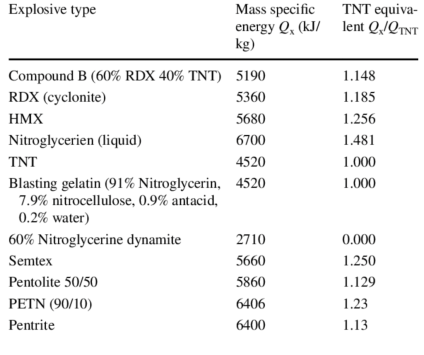
Here’s some more background from Wikipedia:
[PETN] is rarely used alone in military operations due to its lower stability, but is primarily used in the main charges of plastic explosives (such as C4) along with other explosives (especially RDX), booster and bursting charges of small caliber ammunition, in upper charges of detonators in some land mines and shells, as the explosive core of detonation cord.[22][23] PETN is the least stable of the common military explosives, but can be stored without significant deterioration for longer than nitroglycerin or nitrocellulose.[24]
PETN is a secondary explosive, meaning it is more difficult to detonate than primary explosives, so dropping or igniting it will typically not cause an explosion (at standard atmospheric pressure it is difficult to ignite and burns vigorously), but is more sensitive to shock and friction than other secondary explosives such as TNT or tetryl.[17][21]
We don’t know for certain that PETN was involved in the explosion or how AES production and the makeup of its cast boosters was affected by the TNT shortage, but it’s safe to assume it had taken on a larger role. As reported by the Times, the US has increasingly turned to more PETN for military and commercial uses due to the difficulty in sourcing TNT.
What we do know about the explosion is that it occurred in one of the production kettles where explosives are combined to make a cast booster. And more PETN could have made an accident more likely due to its lower stability and sensitivity to shock and friction.
A 1989 explosion involving PETN at the Atlas Powder Company in Joplin, Missouri demonstrates the risks. Here’s the accident report from the Occupational Safety and Health Administration:
A plant was making pentolite, a class of explosive primer. Workers were mixing TNT and PETN in two kettles that were heated to about 212 degrees by hot water and steam. The flow of hot water slowed due to a pump malfunction, solidifying the TNT-PETN mixture in a pipe beneath one kettle. Employees #1 and #2 tried to remove the blockage with the pipe in place using hot water. This did not work, so the pipe containing the solid mix was removed and placed on the floor. One employee tried to pry the stoppage loose using a screw driver and a rawhide mallet. This caused the shock-sensitive TNT-PETN mixture to explode. The explosion killed two employees and injured two others.
PETN is also becoming more in demand in today’s age of “asymmetrical warfare.” From a recent India Today write up:
PETN is highly coveted for a range of uses, from industrial demolition to military applications—and, more disturbingly, as a weapon in terrorist attacks. Its adaptability allows it to be moulded into plastic explosives, easily concealed within everyday objects…
Objects like pagers:
Israeli intelligence, operating through [a shell corporation in Hungary called B.A.C. Consulting], produced for Hezbollah specially designed pagers containing batteries laced with small quantities of the explosive PETN, which is difficult to detect. The explosives were designed to detonate after a specific encrypted message was sent to them, activating an on-switch in the explosive charge. The actual explosion occurred shortly afterwards either by pager holders pressing two buttons manually with both of their hands to view the encrypted message or through a second activating message.
While Israel gifts golden pagers, the attack is being made into a feature film, and the Western media fawns over the “spectacular” “Bond-like” the fact such an “ingenuous” operation disfigured children is of course ignored:
According to the archived version of the AES website, it did offer “custom pelletized energetics tailored to meet the unique requirements of each customer,” but while the PETN used by Israel in this instance might not have been sourced from AES, it is at least symbolic of Israel’s major draw on the overstretched “Arsenal of Democracy.”
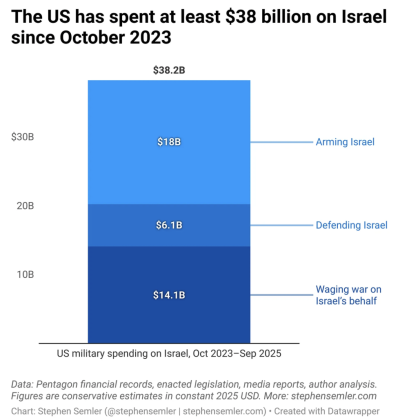
The U.S. exports military explosives, including PETN, to allied countries and NATO members, and DataVagyanik notes that Israel increasingly uses PETN for a variety of weapons, including in micro-explosive arrays for unmanned aerial vehicles and this presents business opportunities for suppliers like AES:
-
Israel is a global leader in developing cutting-edge military technologies, including precision-guided munitions and missile defense systems. PETN is frequently used in these advanced weapons due to its explosive power.
Business Opportunities:
-
Explosive Component Manufacturing: Israel’s defense industry requires high-quality explosive materials for its advanced munitions, providing opportunities for PETN suppliers to contribute to local production.
And as is well-known, Israel is largely dependent on the US for supplies to carry out its carnage and will be for the foreseeable future.The Israeli Ministry of Defense earlier this year signed a $275 million deal with Elbit System to, among other things, establish a new national factory for raw materials. Calcalist notes:
The new raw materials factory, to be built in southern Israel, will feature production lines for energetic materials required by all defense industries in the country. According to the Ministry of Defense, this facility is expected to reduce Israel’s reliance on imported raw materials—a critical vulnerability highlighted during the war that began 15 months ago. During that conflict, some countries restricted the export of weapons and key production components, underscoring the need for greater domestic production capabilities.
But that facility is still years away and won’t fulfill all the country’s substantial desire for explosives.
With a Genocide On and Demand Soaring, Production Outpaces Safety More Than Usual
As Military.com notes:
Most of America’s ammunition, propellants, and explosives are made there or by private firms like Accurate Energetic Systems… the explosion in Tennessee is part of a cycle the United States has repeated for more than a century. Each time national or global demand for weapons rises, production expands faster than oversight can. The risks shift from the battlefield to the factory floor.
And the AES plant was no stranger to safety issues. An explosion at the facility in 2014 killed one worker and injured four others. Buried at the bottom of a CNN report on the 2025 explosion (after the usual resiliency bromides) is the following history:
The Occupational Safety and Health Administration fined the company $7,200 after a 2019 inspection found violations related to personal protective equipment, employee exposure to contaminants and inadequate safety training, among other citations. The company contested the findings and eventually reached a formal settlement, OSHA records show.
Cost of doing business. More from WSWS :
… several employees suffered seizures for exposure to cyclonite (RDX), an explosive linked to nervous system damage. Residue was found on worktables and even in the break room, yet fines were quietly reduced to $7,200.
… just a year after [the 2019 violations], on October 30, 2020, there was a near-miss of a catastrophic explosion in the very same Melt-Pour building that exploded last Friday. According to an investigative report by the Daily Mail in the UK, maintenance supervisor Greg McRee was forced to put out a fire using only a garden hose to douse the flames shooting from an industrial chimney.
Had the flames spread to the boiler or ignited the stacks of canisters—high-energy primers used to set off bigger explosives in mining or demolition—“It would have leveled the building. Same thing that happened to the building the other day,” McRee told the Daily Mail. But instead of being rewarded, he was dismissed days later from his $28-an-hour supervisor job for “violating” company prohibitions against “fighting explosive fires.”
The CNN piece concludes with a brief note on 26-year-old LaTeisha Mays who had worked at AES for less than a year and had raised several safety concerns about her job, and complained about getting nose bleeds at work. She needed to pay off her car before taking another job, though.
Hickman County, Tennessee—where the AES explosion took place—is one of the poorest areas in one the nation’s poorest states. Per capita income is $29,512 and more than 14 percent of the population lives below the poverty line. The US’ first TNT factory in decades, which is slated to come online in 2028 in Kentucky’s Muhlenberg County, is also going to a region starved for decent paying jobs with a poverty rate of 22 percent (compared to the 11 percent nationally).
And the local population and future workers are being signed up to take the risk so that mega weapons manufacturers can keep swimming in dough and the wars—largely driven by an attempt by the Western economic elite to remain on top—can continue. From military.com :
Since World War II, and especially after the Cold War, the Pentagon has shifted away from running its own munitions factories and instead contracts private companies to make most of its ammunition, explosives, and weapons. That shift gave the military flexibility to expand or cut production as needed, but it also pushed the risks of that work onto local communities.
Business as usual:
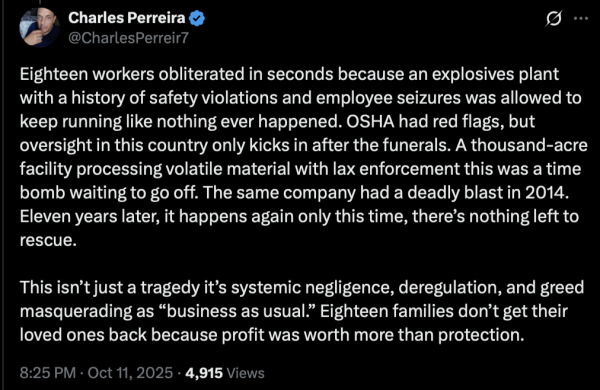
More so, imagine what the hundreds of millions going to AES to build weapons to maim and kill could have done for Hickman County put to other uses.
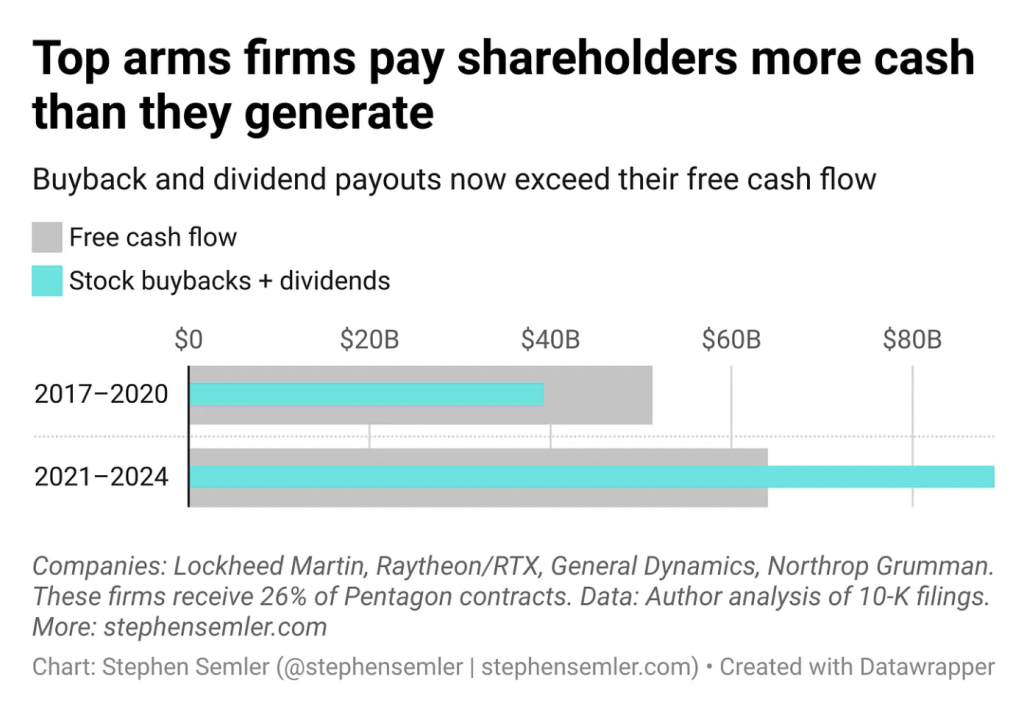
As Washington shovels a trillion dollars towards its war profiteering, the Bucksnort explosion is a reminder that it doesn’t just bring devastation abroad. But hey, the money is good for some:
AI-powered drones used in Gaza genocide monitor US cities: Report
Press TV – November 3, 2025
AI-powered quadcopter drones deployed by the Israeli regime’s armed forces to commit genocide in Gaza have been reportedly operating over American cities, surveiling protesters and automatically uploading millions of images to a centralized evidence database.
A report published by the Grayzone news outlet on Sunday reveals that AI-powered drones manufactured by a company called Skydio are monitoring the majority of cities in the US.
According to the report, Skydio provided the original drone models to the Israeli armed forces immediately after the regime launched its genocidal assault on Gaza on October 7, 2023, during which it killed at least 68,858 Palestinians and wounded 170,664 others, most of them women and children.
The Israeli regime extensively deployed the drones in its attacks on Palestinians, sending operational data back to Skydio to refine the technology.
Skydio maintains an office in the occupied Palestinian territories and partners with DefenSync, an Israeli military drone contractor that acts as an intermediary between drone manufacturers and the regime’s armed forces.
The company has also raised hundreds of millions of dollars from Israeli-American venture capitalists and funds extensive investments in the Occupied Lands.
Since 2023, Skydio has transformed from a relatively obscure startup into a multi-billion-dollar conglomerate and the largest drone manufacturer in the US.
The report states that Skydio now holds contracts with more than 800 law enforcement and security agencies across the country, up from 320 in March last year as its drones are being deployed hundreds of times daily to monitor citizens in towns and cities nationwide.
Nearly every major American city has signed a contract with Skydio in the past 18 months, including Boston, Chicago, Philadelphia, San Diego, Cleveland, and Jacksonville.
In Miami, Skydio drones are reportedly being used to surveil protesters and students, while in Atlanta, the company has partnered with the Atlanta Police Foundation (APF) to establish a permanent drone station within the new Atlanta Public Safety Training Center, also known as the Cop City.
Detroit recently spent nearly $300,000 on 14 Skydio drones, according to a city procurement report.
A spokesperson for the New York Police Department (NYPD) recently told a drone news website that the NYPD launched more than 20,000 drone flights in less than a year, which translates to around 55 drone launches per day.
Last month, US Customs and Border Protection (ICE) purchased an X10D Skydio drone, which can automatically track and pursue a target. ICE has acquired 33 of these drones since July.
The AI system powering Skydio drones relies on Nvidia chips and allows them to operate without human control.
The drones are equipped with thermal imaging cameras and can function in GPS-denied environments. They can reconstruct buildings and other infrastructure in 3D and reach speeds of more than 30 miles per hour.
How Many Americans Killed by Israel? [Answer Will SHOCK You]
If Americans Knew
CJ Werleman is a journalist, author, and political commentator who has been published in Byline Times, TRT World, Middle East Eye. In this video he provides information on the many Americans he says that Israel has killed. Below is additional information on each.
RELATED INFORMATION:
- A Costly Friendship
- Neo-Conservatives And The Israeli Lobby Are Promoting War With Iran, As They Did With Iraq
- WATCH: How Pro-Israel Neocons Pushed for War in Iraq (Alison Weir)
- Rachel Corrie
- Shireen Abu Akleh
- Israel was part of the conspiracy to kill JFK
- Author Martin Sandler says Mossad may have assassinated JFK
- Israel Honors Egyptian Spies 50 Years After Fiasco
- When Eisenhower and Nixon reined in Israel and defied the lobby
- If Americans Knew Receives Death Threat
- USS Liberty
- If Americans Knew videos
- Voters Against Billions to Israel – an online statement for Americans to sign stating that they will not vote for any politician who sends U.S. tax money to Israel.
Washington’s ‘new Gaza’ project meets Gulf pushback
The Cradle | November 2, 2025
Saudi Arabia and the UAE are pushing back against US President Donald Trump’s plan to construct roughly half a dozen residential regions on the eastern half of Gaza, which is currently under Israeli control, The Times of Israel reported on 2 November.
Citing two Arab diplomats familiar with the matter, The Times of Israel said that Trump and his real estate developer son-in-law, Jared Kushner, have proposed the plan to donors in the Gulf to build the “new Gaza” on the eastern side of the strip only, which is now under direct Israeli control.
Following the 11 October ceasefire agreement, Israeli forces withdrew to the east of a “Yellow Line” drawn up during the negotiations to divide Gaza into two parts. Hamas remains in control of the territory to the west of the line.
The partial withdrawal leaves Israeli forces in direct control of at least 53 percent of Gaza.
Trump’s plan to build residential areas in the Israeli-controlled east of Gaza reportedly envisions the Israeli army “gradually withdrawing to the other side of the Gaza border and leaving the Strip altogether,” The Times of Israel wrote.
However, such a withdrawal is conditioned on the establishment of an International Stabilization Force (ISF) for postwar Gaza, and the disarmament of the Hamas.
“With those two conditions for continued Israeli withdrawal so difficult to meet, the US is not waiting to begin the reconstruction process,” The Times of Israel added.
The US wants the international force to deploy to the west of the Yellow Line, the area remaining under Hamas control.
Washington also wants its Arab allies, Saudi Arabia and the UAE, to pay for the force.
However, the diplomats stated that the wealthy Gulf states are pushing back on the plan, as are Indonesia, Azerbaijan, Turkiye, and Egypt, who are expected to provide troops.
These nations are reluctant to assist Washington without a clear UN mandate or agreement with Hamas to hand over its weapons, the two Arab diplomats said. They also want to first deploy their forces on the east of the line to replace Israeli troops.
This information aligns with a previous Israel Hayom report, which revealed that Saudi Arabia, Bahrain, and the UAE had warned the US administration that they would not take part in Gaza’s reconstruction unless Washington enforced the ceasefire terms on Hamas and ensured the group’s disarmament.
Israel is also backing four militias as part of a project to oust Hamas and create a “new Gaza,” according to a report released by Sky News on 25 October.
These armed groups – which throughout the war have been engaged in hostilities against Hamas on behalf of Israel – are currently operating along the Yellow Line of Washington’s ceasefire map, in Israeli-held territory.
Jared Kushner stated he wishes to begin building on the Israeli side of the Yellow Line, in particular on the ruins of the destroyed city of Rafah in the south of the strip on the Egyptian border.
“The US proposal envisions as many as one million Palestinians — around half of Gaza’s population — moving to the residential areas on the Israel-held side of the Yellow Line,” The Times of Israel stated.
Kushner plans to complete the construction of these areas within two years, even if Israeli forces have not withdrawn by then, the two diplomats briefed on the plan stated. Both Arab diplomats concluded the timeline was “highly unrealistic.”
“Palestinians may not want to live under the rule of Hamas, but the idea that they’ll be willing to move to live under Israeli occupation and be under control of the party they also see as responsible for killing 70,000 of their brethren is fantastical,” one of the Arab diplomats said.
Additionally, there is no guarantee Palestinians would be allowed to return and live in the new housing developments. If Israeli forces remain in control of the area, Tel Aviv could decide to house Jewish Israeli settlers in the newly built neighborhoods instead, leaving Palestinians to languish in tents on the other side of the line.
One diplomat stated the Trump White House plans to sponsor a UN Security Council resolution to establish the international security force later this month, possibly before Saudi Crown Prince Mohammed bin Salman visits the White House for talks on the future of Gaza on 18 November.
Kushner and Vice President JD Vance previously stated the US and Israel are considering a plan to divide Gaza into separate zones, one controlled by Israel and one by Hamas, with reconstruction only taking place on the Israeli side until Hamas is disarmed and dissolved.
Vance and Kushner summarized the plan during a press conference in Israel on 22 October, explaining that no funds for reconstruction would go to areas that remain under Hamas’s control.
“There are considerations happening now in the area that the [Israeli army] controls, as long as that can be secured, to start the construction as a new Gaza in order to give the Palestinians living in Gaza a place to go, a place to get jobs, a place to live,” Kushner said.
Kushner is seeking to “create an environment that would be safe for the billions of dollars in investment needed to rebuild,” the Wall Street Journal (WSJ) commented.
“White House officials said Kushner is the driving force behind the split-reconstruction plan, having devised it alongside special envoy Steve Witkoff,” the WSJ said.
The financial newspaper added that with time, Israel could take more territory in Gaza from Hamas, and try to replicate what it has done in the occupied West Bank, with Israel taking complete security control while “forcing Gazans into small, unconnected areas of control.”
“Gaza has represented the only patch of territorial contiguity for a Palestinian state,” explained Tahani Mustafa, a fellow with the European Council on Foreign Relations.
“A plan like this could end up creating what Palestinians feared.”
Nobel Peace Prize winner calls for military attack on her own country
RT | November 2, 2025
The US military buildup off Venezuela’s coast could help bring about regime change, opposition figure Maria Corina Machado has said. The Nobel Peace Prize laureate this year signaled she would welcome US strikes on the country if they help remove President Nicolas Maduro.
Washington has accused Maduro of having ties to drug cartels, calling him a “narcoterrorist.” Earlier this year, US President Donald Trump deployed a naval armada to the western Caribbean, and since September, US forces have struck alleged drug-smuggling vessels off Venezuela’s coast.
Media reports say Washington is expanding its naval presence, with analysts suggesting that the mission could extend beyond counter-narcotics. Trump denied planning direct strikes inside Venezuela, but reportedly reviewed a list of potential targets.
Asked on Bloomberg’s ‘The Mishal Husain Show’ if she backs US military action, Machado said, “I believe the escalation that’s taking place is the only way to force Maduro to understand that it’s time to go.”
She claimed that Maduro “illegally” seized power in last year’s election, from which she was barred. Machado also claimed that opposition candidate Edmundo Gonzalez Urrutia won the election. Ousting Maduro, she said, would not be “regime change in the conventional way,” since he is “not the legitimate president” but “the head of a narcoterrorist structure.”
“This is not regime change, this is enforcing the will of the Venezuelan people,” she stressed.
Maduro has accused Machado of channeling US funds to “fascist” anti-government groups, calling her a front for Washington’s interference in Venezuelan affairs. Machado has had close contacts with the US government for decades. In 2005, then-President George W. Bush received her at the Oval Office.
Asked if US military force is the only way to remove Maduro, Machado said the threat alone could be sufficient: “It was absolutely indispensable to have a credible threat.” She added that the Venezuelan opposition is “ready to take over government,” backed by the military and police, claiming that “more than 80% of them are joining and will be part of this orderly transition as soon as it starts.”
Maduro has denied US drug-trafficking accusations, accusing Trump of “fabricating a new war.” Caracas called the US operations a violation of sovereignty and a coup attempt, reportedly seeking help from Russia, China, and Iran to strengthen its defenses.
Russia, which ratified a strategic partnership treaty with Venezuela on Monday, has condemned the US campaign.
“Stunning!” Apollo Moon Photos Too Good to be True?
Photographer-filmmaker Massimo Mazzucco takes on the New York Times
By Kevin Barrett | November 1, 2025
Jason Farago, who appears to be a Deep State propagandist and pro-UkroNazi culture warrior, just published a New York Times interactive photo-video piece headlined “How Lunar Photography Brought the Heavens Down to Earth.” Farago celebrates the alleged artistic genius of the Apollo moon photos, viewing them as the climax of the overlapping artistic and scientific histories of moon explorations and representations.
Moon landing skeptic and professional photographer Massimo Mazzucco says that’s bullshit. Farago’s extravagant praise of the Apollo astronauts’ brilliant use of deep depth of field just means they knew how to crank the f-stop up to f16 or f32 (which I figured out about five seconds after buying the cheapest available Pentax when I was a journalism student back in 1976). His orgasmic effusions about the beautifully-rendered lunar surface texture sound like something an LSD tripper might say while staring hypnotically at the ground in some godforsaken stretch of barren desert. And his ranting about how many of the moon landing photos are so perfectly composed and executed that they look totally fake really takes the cake:
“The photographs were in fact so good—and the 70mm stock so detailed—that doubts set in on the blue sphere below. With their rich chiaroscuro and starless skies, Bean and Conrad’s photos looked uncannily like a Hollywood stage set.”
Uncannily indeed. Is Farago engaging in classic neocon doublespeak (surface layer for the ignorant rubes, esoteric layer for the cognoscenti)? Is he nudging and winking at the cognoscenti in a shared moment of dupers’ delight? Was this assignment handed out by the Deep State desk at the New York Times to blow smoke to cover for delays in the Artemis missions? Or is Mazzucco wrong in his claims that many moon landing photos are obviously fake, and that the most likely explanation of these and other anomalies is that the Apollo missions didn’t really put men on the moon circa 1969-1972?
Watch Mazzucco deconstruct bad New York Times propaganda, watch his film American Moon, and make up your own mind.
Excerpts from the Interview
Welcome to a special edition of False Flag Weekly News, the weekly news show that normally peels back the news headlines to reveal what’s crawling around underneath. Today we are going to be interrogating the perhaps most influential newspaper in the Western world, The New York Times, by way of a special art and science uh photo analysis that they did discussing the moon landing photos from the Apollo missions. And who better to talk back to the media on that subject than Massimo Mazzucco? He is the director of September 11th: The New Pearl Harbor, possibly the best and most comprehensive 9/11 documentary film, as well as American Moon, probably the best film about the moon landing. So, hey, congratulations on making the best conspiracy films in two genres.
Thank you. It’s not for me to say they’re the best. I can certainly say they’re the longest. Because September 11th: The New Pearl Harbor is five hours and the American Moon is three and a half.
Well, that’s what I meant by comprehensive. I was trying to be nice. (laughter)
Okay. Okay. Let me just clarify very quickly. There’s a reason for that. I don’t like to entertain people more than is needed, except that for both films, I use the technique where I first present the problems or the issues (with the official stories). Then I present the explanations or answers that the debunkers have for each of those issues. And then I present the debunking of the debunkers. So each argument, each issue, is presented from three times: The presentation (of holes in the official stories), what the debunkers say about it, and what I have to say about what they say.
There’s a term that David Ray Griffin coined first. It’s called debunking the debunkers. And that’s why I like to have it all in one film, all comprehensive, both questions and answers. And then people can make up their own mind, of course.
Yeah, it’s a great format. And honestly, I think they’re the best as well as the most comprehensive films, partly because of that format. And we’re going to follow that type of format here too, because we’re going to see what the New York Times says about these images. And then you get to say what you have to say about them. And unfortunately, we don’t have the New York Times here to answer you, so we’ll just have to leave it at that.
Let’s look at our slideshow. We’re going to do a close read on this New York Times photo exhibit. Here’s their opening shot. They’re really ecstatic about the artistic quality of the moon landing photos. And in a couple of places, they actually mention that it looks almost suspicious. These photos are almost too good to be true. What do you think, Max?
I don’t think they’re good at all. No, I have to tell you… maybe your audience doesn’t know. I have been a photographer for the first part of my life, let’s say between age 20 and 40.. And I was a professional, at the top level. I was working for magazines all over the world. I was using actually the same cameras and film and lighting that supposedly were used in the Apollo missions.
I’ll give you one quick anecdote so you understand the point of view of a professional. I learned my trade from a famous photographer, now deceased. He just passed away a few months ago. His name was Oliviero Toscani. He’s actually the guy who made the Benton campaign all over the world. He was very, very famous. I would put him in the top 10 in the world history of fashion photography. I was his assistant for about three years. Then we parted ways. I went on to have my own career.
Back in 2000, when I saw the lunar pictures for the first time—all of them, not just the few that were published before, but all of them that were put out by NASA on the internet—I looked at them and I could see all the defects that I would find myself when I tried to replicate sunlight in the studio. So I got very suspicious. I called Toscani and I said, “Oliviero, what did you think the first time you saw the Apollo moon pictures?” And his answer was, and I quote him:
“I always thought that had they given me the job, I would have done a much better job.”
Wow, better than Neil Armstrong! Because you’re going to see how the New York Times praises Neil Armstrong (as a photographer)…Okay, so they begin with this poetic passage: “The darkness we expected. What we had underestimated was the silence, the quiet of the vacuum, disturbed only by our breath and the radio in our ears.” So that’s supposedly these Air Force guys, these astronauts. You think that they hired a literary guy…
There’s a problem. These astronauts were wearing what is called the PLSS, the Portable Life Support System, which provides them with both a cooling system for the body—because you have over 100 degree Celsius temperature on the surface of the moon—and air for breathing.
So in the back of the PLSS, you have these pumps that are supposed to be both circulating water and pushing air through the system so that you can actually breathe. Except when you listen to their conversations, there’s absolutely no noise. There’s no noise whatsoever.
No wonder they underestimated the silence.
Yeah, exactly. Because you’re in a studio when nobody is making a sound. That’s why you hear all the silence. If you had those machines really on, you would hear probably a purring in the back of your ear. You would hear of these pumps working. Nothing of that is ever heard in their conversations.
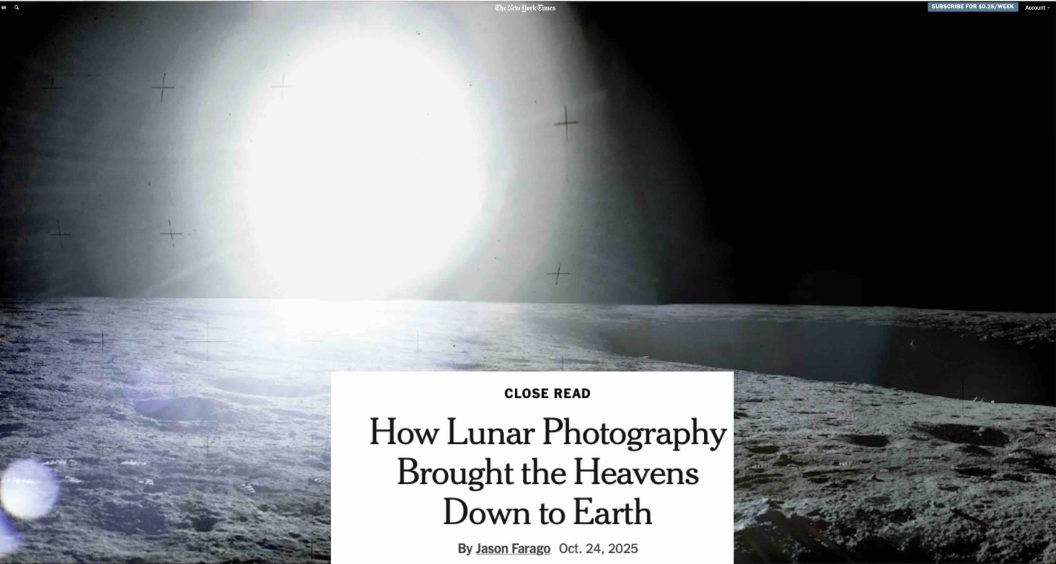
In the opening picture, that light tells me that is a studio spotlight facing straight into the camera. It is not the sunlight. The sunlight acts differently. With the kind of lenses that they had, the kind of distortion that you would have inside the lens is much different than that. That, to me, tells me that that is a spotlight facing straight into the camera and making it look like the sun.
Another thing that you can tell is what is called the fall-off. You have a major amount of light coming through the center of the picture, straight in line with the sun. But off to the sides, if you look at the edge of the crater on the middle of the right of the picture, you can see that the more you go away to the right, the darker the ground gets. If this was the sun, you would have illumination that is equal all over the sand. In this case, you can tell that it is degrading towards darkness as you move to the right, and that is because that is the spotlight. It’s not the actual sun.
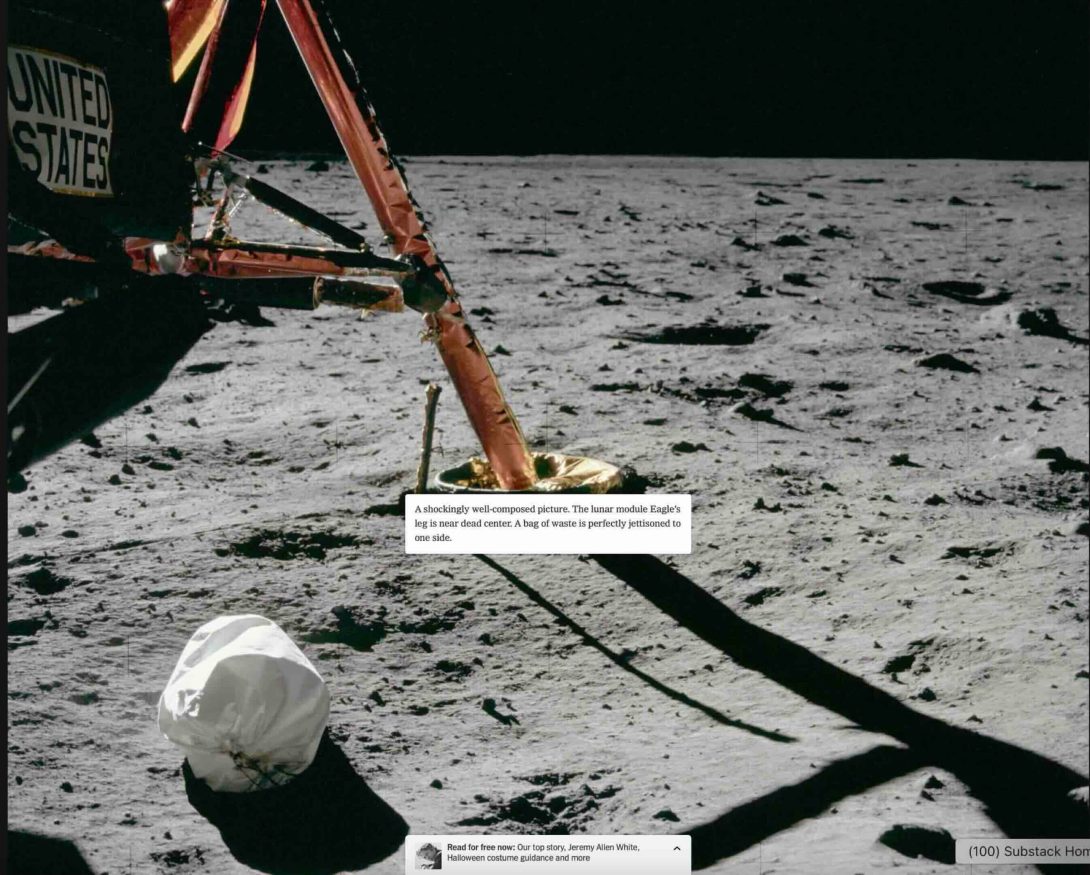
So here’s one where they say it’s a shockingly well-composed picture.
Yeah. I think they’re trying to influence the viewer by using all these words, shocking and beauty and all that. There’s absolutely nothing shocking in this picture.
“The lunar module’s eagle’s leg is near dead center. A bag of waste is perfectly jettisoned to one side.” So maybe they’re telling us it’s all a bag of waste. I don’t know.
How do you imperfectly jettison?
Ye ah I’ve jettisoned a lot of waste in my life but I can’t tell the perfect from the imperfect myself. But the New York Times, they’re critics. They know this stuff.
Yeah.
Do you see anything suspicious about this image?
I do but it would be a little too long to explain. Again there’s a fall off. But it’s very mild because they lowered the contrast. So I can tell that there is more light right below the LEM in the center left of the picture, it is brighter than on the far right. But it’s a very, very mild difference because the contrast is very low.So you can’t really tell here. Only a professional can tell.
The New York Times tells us: “During their camera training it became evident that Armstrong had a better eye than Buzz Aldrin…” Which meant he was the one taking most of the pictures for Apollo 11 in 1969…took more than 100 photographs. And the New York Times guy says: “I would happily claim, in fact, that Armstrong authored one of the last century’s signal works of American portraiture, his head-on view of Aldrin, legs contrapposto like a Greek statue in the southwest of the Sea of Tranquility.” Wow.
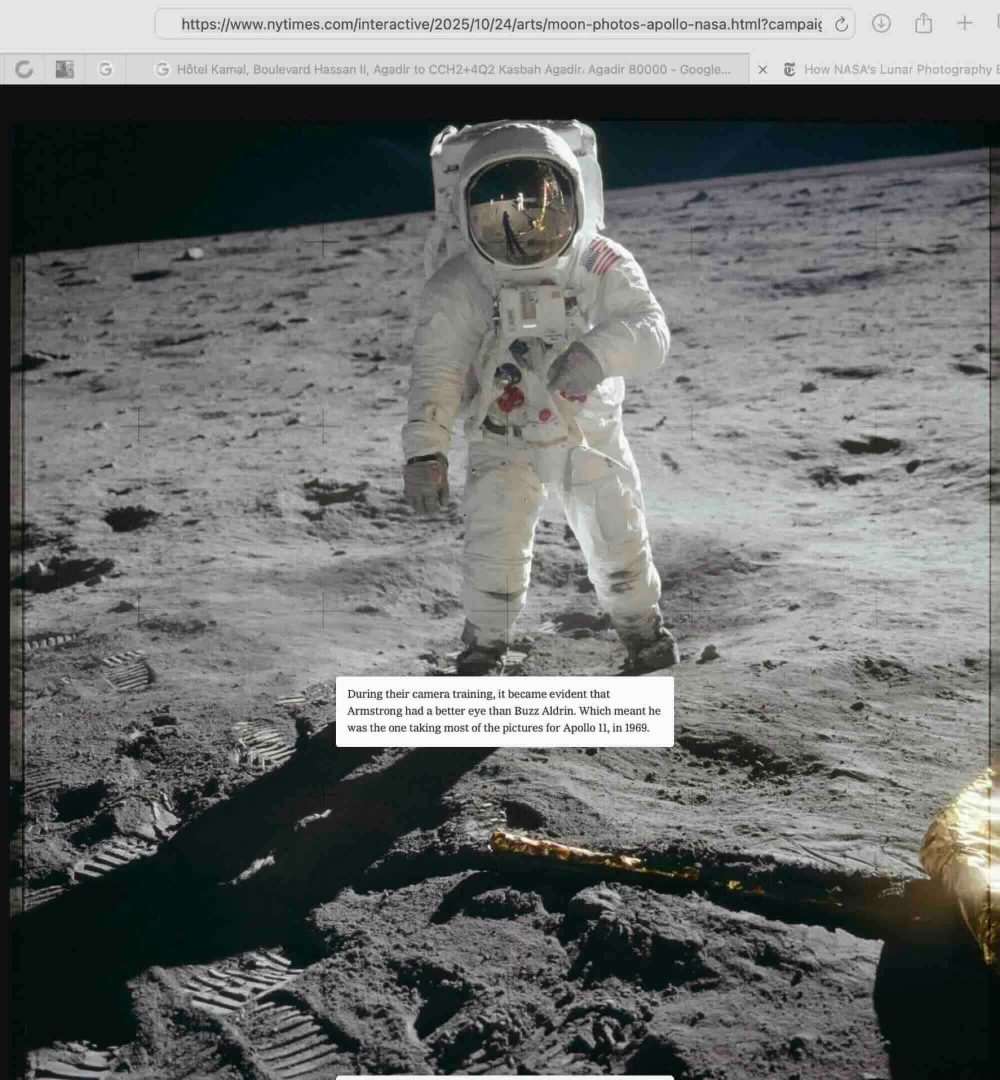
I would suggest we look at something else in this picture rather than read the caption. And the fact is that Aldrin, the person allegedly pictured in the photograph, is inside a little crater which is based maybe 10 centimeters lower than the average surface. And if you look at the way the photo is taken we can see the top of the helmet. Now remember the camera is allegedly sitting on Armstrong’s chest. So it should be at the same height, basically, as where the hand of Aldrin is, just a little higher. It would be impossible if I shot from my chest, even though the guy is in a little bit of a vacuum. It’s a small, it’s a little lower than the surface, but only like 10 centimeters. I cannot see the top of his head. So this picture is taken from a much higher viewing point than the actual chest of the photographer.
Could he have been on a little hill or something?
He could have except there was none. It’s all flat. They’re all basically on the same surface. If you look at other pictures of the situation it’s really all pretty much flat. And it’s one curious thing. You cannot prove that the pictures are fake. But again I can see now that the New York Times has used…a corrected set of pictures not the original ones. In the original ones, the original scans that were made from the original negatives, the contrast is much higher, and you can tell very, very easily that the guy allegedly being Aldrin is sitting in a spotlight. All around him, if you turn back the contrast to the way it was originally, before it was manipulated, you could tell that Aldrin is inside of a circle of more light, and that’s where the spotlight hits, as opposed to the background. The background, as soon as you lower… the contrast gets much darker than the ground he is standing on. And that should not be happening, if the source light were the sun.
I can’t believe the New York Times would be manipulating these pictures.
They’re not manipulating them themselves. They’re using a set of manipulated pictures that have been circulated by NASA, which are not original, but of course where the problems are less evident.
And here it says that’s our photographer reflected in Aldrin’s gold visor and one of the only still images of Armstrong on the moon. And so they zoom in and show the photographer reflected in the visor.
Yes. Well I mean that could be anybody of course. One wonders why would Armstrong, the first man on the moon, not have any pictures of himself? I mean you organize such a precise, such an accurate trip to the moon, where every detail is scheduled and laid down. They have papers with: “1005 turn around. 10010 breathe again.” I mean, everything is scheduled. And then they forget to take pictures of the first man on the moon. And we only have pictures of Aldrin. Could it possibly be that Armstrong, who did not want to be manipulated more than necessary, did deny them the right to say that that was him? Just remember, of the first man of the moon we have no pictures except one shot where you can actually see his face a little bit through the visor. And all the others it’s Aldrin. It’s very strange…they forget that you should schedule an actual photo up for the first man on the moon.It’s shocking. It goes together with the fact that they lost the original tape of the first moonwalk.
And of course their claim is that Armstrong was such a good photographer that he got to take all the pictures.
It doesn’t take a good photographer to take those pictures. They have the camera strapped on the chest.All they have to do is set the F-stop to focus the diaphragm, the lens opening the iris. And press click. They’re not even aiming, because they have the camera strapped to the chest. So all these shots that are well composed are actually a stroke of luck. Because you cannot see inside. You don’t have a viewer. You don’t have the viewfinder in that situation. So they’re really aiming by moving their shoulders. And guess what? All the pictures are so perfectly centered. Which is a little suspicious.
And here we see that Alan Bean and Pete Conrad of Apollo 12 are apparently even better photographers from the chest than Neil Armstrong is. These are even more “extraordinary.” And there were a total of 583 photos allegedly taken by Alan Bean and Pete Conrad of Apollo 12.
There’s absolutely nothing (extraordinary). What’s so incredible about this, is it is a set. All you need to do is sit there, focus and click. I mean there’s no artistry. The very idea that you’re looking for artistry…
Well, the horizon is horizontal.
The horizon is horizontal. And there are no hills in the distance, by the way. If you take what’s called the 360 panoramic of the whole, you turn around, you just stand there and turn around, click click click. And then they join them all together and you have a 360.
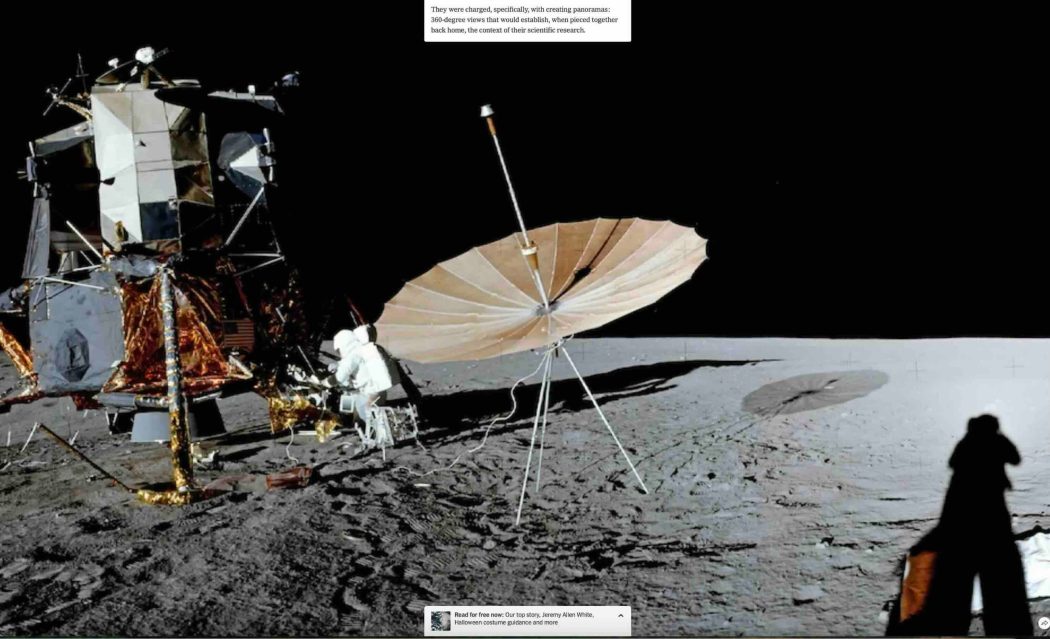
This landscape is like 200 yards not even in every direction. There’s no hills anywhere in the distance. Only after Apollo 15 did they realize that their sets were so skimpy that they had to add mountains in the distance. Apollos 11, 12 and 14 had a very very short horizon like this. I mean very short. And if you think that that object on the left was put there by a man, it means that the distance from here to there is maybe 20 yards. So you have another 20 yards and then what’s the end of the moon? There’s nothing else.
Yeah, that’s a pretty flat moon.
Look! The shadow of the LEM reaches almost the end of the moon. There’s no distance. I mean, think! You’re in a desert. You have to picture yourself in a desert with a LEM and imagine there’s nothing behind that little hill. There’s nothing. You can see nothing. It’s a joke. This is clearly a set. And besides, because of the use of the wide angle, this actually looks larger than it was in reality. In reality this set is no more than 10 meters by 10 meters, 30 feet by 30 maybe. That’s about it.
We’re told that they were “tasked with creating panoramas, 360-degree views that would establish when pieced together back home the context of their scientific research.” Then in the New York Times presentation it shows you the 360-degree panorama. Here’s the theme of the whole piece: “In one-sixth gravity, art and science did not seem so far apart.” They’re trying to tell us that the amazing artistry of these photos is some hybrid of art and science.
I really fail to see any artistry at all in these pictures. I’m sorry. I mean I know enough about good photography. Not only have I been a professional photographer for 25 years but I have enjoyed photography. I loved it. I know the great photographers, from Ansel Adams to Karsh. There’s a lot of history of photography that I can recognize. And I tell you what is an artistic picture. I see absolutely nothing artistic about these at all.
You’re not going to add Neil Armstrong to the list of great photographers…
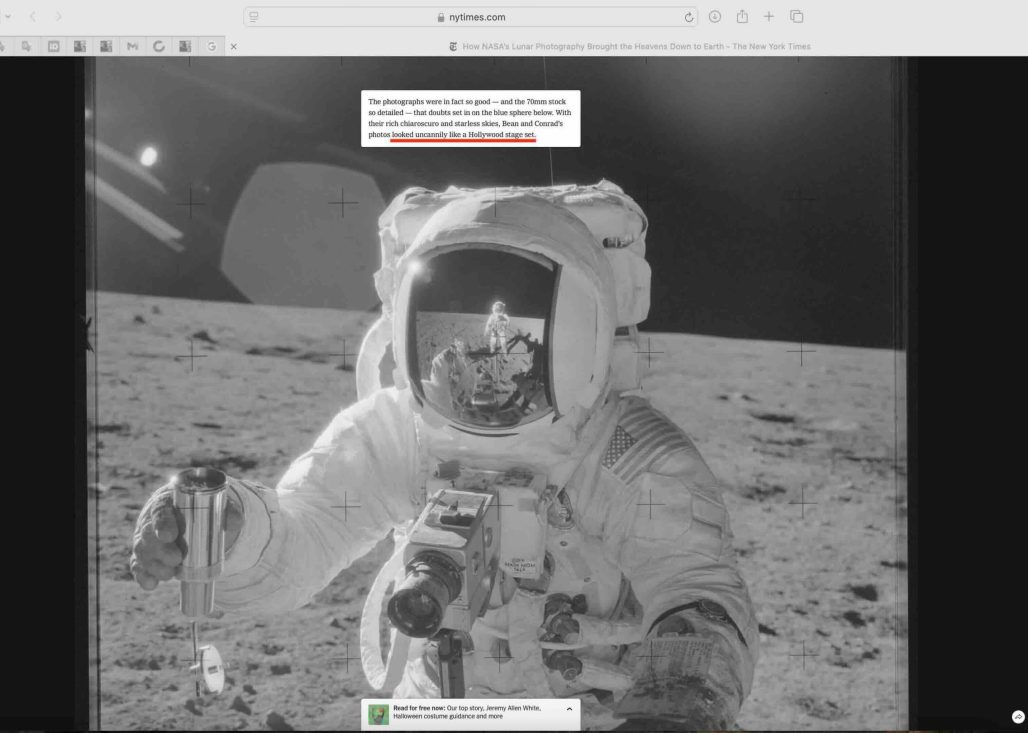
Okay, here again the astronaut reflected in the visor, the little guy in the middle of the picture: On his right, our left, the terrain is much darker than on his left, our right. The sun is on the side. It should be equally illuminating both sides of his background. It is not. That means that is a spotlight that centers on him and it’s illuminating more the right-hand side from the way we see it than the left. That’s called an oopsie.
Interestingly, they chose this picture to tell us that it’s so good that it looks like a Hollywood stage set. This reminds me of Douglas Rushkoff’s Coercion, which describes mind control techniques that are common to operators from CIA interrogators to used car salesmen. And he describes how the key to mind control is to basically break down the subject’s sense of reality. And the way they do that is: the used car salesman takes you for a test drive. And at just the right point in the test drive he kind of turns to you while you’re driving the car and he says: “Is this the kind of car that you can see yourself driving?”And you try to see yourself driving the car that you actually are driving, and you have a sort of a brain fart. You have this space-out moment and lose contact with reality. And the car salesman then just takes over your world and orders you to drive back to the dealership. And he doesn’t ask you, do you want coffee? He just forces you to drink coffee, brings out the contract, and you walk out with the new car. And the CIA does a similar thing when they interrogate you. And so anyway, in this example, they’re inoculating you against the idea that this is a stage set by telling us it looks so good that it almost looks like it could be a stage set.
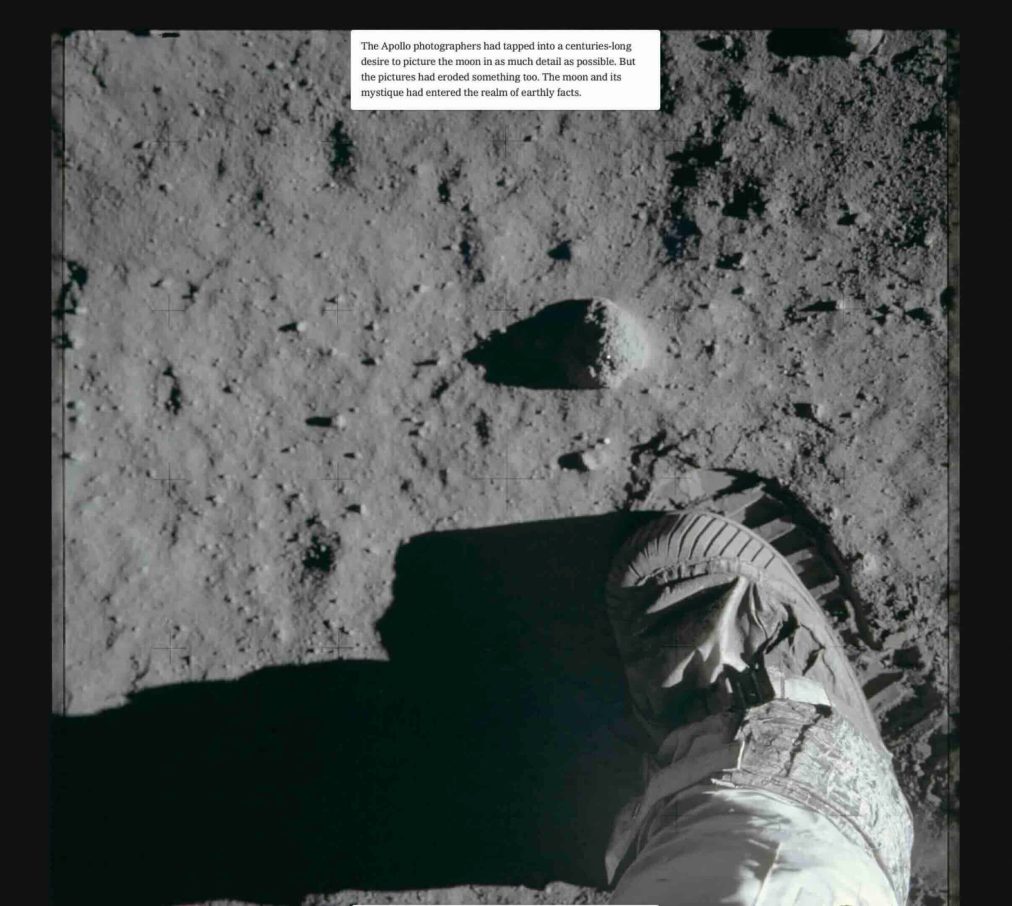
This is not the best picture of a footprint. But you can tell even from this picture—look how sharp and how… how sturdy, how solid are the little (rectangles of “moon sand”) that look like chocolate bars imprinted in the sand. Remember, there’s no atmosphere. Therefore there’s no humidity. Therefore that sand should be falling apart as soon as you remove your foot. How can you make it stick in such precise shapes without the humidity on earth?
Maybe they brought a little aerosol spray can and some gluey substance.
Exactly. You need humidity to get sand to stick like that. And there’s no humidity on the moon.
Why Lebanon doesn’t trust Israeli-American intentions — and why it shouldn’t
By Hussein Mousavi | Press TV | November 1, 2025
As Lebanon’s government, led by Prime Minister Nawaf Salam, inches closer to implementing its multi-phase plan to disarm Hezbollah, one question continues to divide the country:
What if Hezbollah lays down its arms… and the Israeli regime still doesn’t change its behavior?
The plan – drafted under the supervision of the Lebanese Armed Forces (LAF) and backed by the US, France, and several Arab states, including Saudi Arabia, Qatar, and the UAE – seeks to reassert the state’s monopoly on the use of force.
On paper, it sounds like a long-delayed step toward full “sovereignty.” That’s how the Lebanese premier and his allies – both inside and outside the country – try to present the issue.
Yet for many ordinary Lebanese, the proposal feels less like progress and more like exposure. And so, it raises a deeper fear.
Disarming the Hezbollah resistance movement, they fear, could strip Lebanon of its last line of deterrence, without changing anything about Israeli long-standing hostility.
Syrian precedent: Disarmament without security
Elsewhere in the region, Syria’s experience stands as a grim reminder. Even after the Jolani regime made public gestures toward normalization with the Israeli regime, the airstrikes on Syrian territory have never stopped. They continued unabated.
These attacks – justified by Israel as “preemptive” measures against so-called Iranian entrenchment (despite any evidence suggesting the same) have convinced many in Lebanon that military restraint does not necessarily guarantee security.
To many Lebanese, that says it all: even a weakened and cooperative neighbor hasn’t been spared unprovoked Israeli assault.
So, for the majority of Lebanese, the question resonates: If a disarmed, diplomatically compliant Syria was still bombed, why would a disarmed Lebanon be treated any differently?
That logic has sunk deep… even among communities once skeptical of the resistance. This isn’t about ideology anymore. It’s about survival, sovereignty and dignity.
People genuinely fear that weakness, not resistance, invites aggression.
Social undercurrents: A shift in perception
Hezbollah’s argument for keeping its weapons has always been rooted in resistance to Israeli military occupation and the defense of Lebanese sovereignty and territorial integrity.
For years, that claim was losing traction—chipped away by the US, Israeli regime (Hasbara), and Persian Gulf-funded campaigns that painted the resistance movement as a destabilizing force.
But the chaos next door changed the mood.
The violence in Syria, especially the relentless massacres committed by Al-Qaeda-linked groups in Suweida, jolted many Lebanese back to a hard truth: in a region defined by uncertainty and terrorism, some form of deterrence is still necessary.
Even among Christians and Druze, there’s a quiet shift. What was once a divisive argument is slowly becoming a reluctant consensus:
“Lebanon without a deterrent is Lebanon exposed. And now, no one in Beirut really believes the skies will stay quiet after disarmament. Not anymore.”
Washington’s back-out: The missing guarantees
Lebanese skepticism was further reinforced by Washington itself. If anyone still hoped for international reassurance, Washington’s recent message was clear.
During his visit to Beirut, US envoy Tom Barrack openly admitted that Washington could not provide any binding guarantees that the Israeli occupation forces would refrain from future military action, even if Hezbollah were to be fully disarmed.
It was a rare moment of honesty, and a devastating one. For many Lebanese, it confirmed what Hezbollah has been saying for years: Without credible security guarantees, disarmament amounts to a strategic suicide.
Barrack’s inflammatory statement spread quickly across social media platforms and prime-time talk shows. It fueled the perception that Western powers are happy to demand disarmament but will not lift a finger to protect Lebanon afterward.
So, for now, Hezbollah’s deterrent remains the only shield people trust in a region where promises evaporate, and treaties rarely hold.
A state caught between principle and survival
That leaves the Lebanese government trapped in a painful paradox and facing an impossible balance.
Internationally, disarmament is pitched as a prerequisite for reconstruction after the 2024 Israeli aggression. Domestically, it looks more like a setup, an attempt to squeeze out concessions that Washington and Tel Aviv couldn’t win through war.
PM Salam insists the Lebanese Army can fill the security gap once Hezbollah disarms. But everyone knows the LAF is overstretched, underfunded, and struggling to retain personnel amid an economic meltdown.
Even LAF Commander “Rodolph Haykal” has quietly admitted the limits.
And with UNIFIL’s mandate due to expire in 2026, the southern buffer zone that once helped keep the peace is fading fast.
Given these realities, Hezbollah’s arsenal (long portrayed by Israeli, American, and certain Arab media as “the problem”) is tied to something deeper: the complete absence of trust in Israel’s intentions, and the lack of any reliable security guarantees from its allies.
Trust, deterrence, and the price of “peace”
Trust can’t be declared in a press release. It’s earned through behavior, consistency, and respect. For Lebanon, disarmament cannot be separated from reciprocity.
Unless the Israeli regime demonstrates, through verifiable actions, that it will respect Lebanese sovereignty – and unless those commitments are backed by enforceable international guarantees – any talk of disarmament will remain politically impossible and socially toxic.
A peace built on parity
Lebanon’s real dilemma isn’t whether disarmament is good in theory. It’s whether peace can exist without parity, and whether Western powers are willing to enforce that parity with real guarantees, not vague assurances.
Until that happens, every call for disarmament will collide with the realities of regional mistrust… and also with the same hard truth: You can’t convince its citizens to give up their shield when the sky above them still burns.
And that’s why, for many in Lebanon today, neither the government nor the resistance has any reason to trust the Israeli regime.
Hussein Mousavi is a Lebanese journalist and commentator
Featured Video

EUROPE FEARS RUSSIA’S NEXT MOVE / Ian Proud
or go to
Aletho News Archives – Video-Images
New Book
New Book: No Autoimmunity The Body Doesn’t Attack Itself
Lies are Unbekoming | September 24, 2026
 The label for Humira, once the best-selling drug in the world, lists its risks in plain print. One of them, in the label’s own words, is new “autoimmune” disease.
A drug prescribed for a condition labelled autoimmune carries a warning that it can cause a condition labelled autoimmune. That contradiction sits in every box, on a folded paper almost nobody reads.
My new book starts there.
No Autoimmunity: The Body Doesn’t Attack Itself
For seventy years, “your body is attacking itself, and we don’t know why” has ended the conversation for people diagnosed with multiple sclerosis, lupus, rheumatoid arthritis, Hashimoto’s, Type 1 diabetes, Crohn’s and psoriasis. More than eighty conditions now carry the autoimmune label. The diagnosis comes with a prescription for life. It almost never comes with a question about cause.
This book asks the question and answers it from the framework’s own records: its drug labels, its journals, its regulatory filings, and its own experiments. … continue
Blog Roll
 Aletho News
- Iran offers Trump deal before US election
- Merz regime wants ‘secret police’ – opposition
- Israeli settlers terrorize West Bank Palestinians with state-provided drones: Report
- They see them, then kill them: Israeli quadcopters track, deliberately target civilians in Gaza
- Debunked: Trump’s egregious UNGA claims on war against Iran crumble under scrutiny
- Europe was part of the infrastructure of US aggression against Iran: Deputy FM
- New evidence on the Bucha Massacre
- Italy and France debunk reports CIA issued ‘Russian drone threat’ warning
- How Russia is Rewiring the Global South
- Britain’s elites want you ready to die for a war they keep imagining
- If Americans Knew
- Trump betrayed voters with his campaign lies and prioritized a foreign country once he took office
- Netanyahu calls Israel’s war in Gaza ‘opposite of genocide’ in UN speech to near-empty hall
- Settler Kidnappings: Torture, Sexual Abuse and Terrorisation of Palestinian Abductees as Israel Deepens Annexation of West Bank
- Gaza winter nears as 162,000 tents become unusable, raising fears of humanitarian crisis
- Netanyahu says, “It’s the opposite of genocide”; UN says Gaza economy is world’s ‘most severe crisis on record’ – Daily Update
- Israel’s US-Backed Assault on Gaza Has Created the ‘World’s Most Severe Economic Crisis on Record’: UN
- ‘Protecting U.S. Citizens’… From Israel
- ‘This is where I live now, the back of a truck’: a day in the life of a grandmother in Gaza
- In UN Speech, Iran’s President Displays Pictures of Children Killed by US, Brings Attention to Israel’s Nuclear Arsenal
- Israel displaces hundreds of Palestinians amid wave of demolitions in West Bank
- No Tricks Zone
- New Study: Earth And Venus Surface Warmth Largely Explained By Convection And Lapse Rate, Not CO2 Or Radiation
- 2025 Nature Paper Claiming Worsening Global Drought Gets RETRACTED …Heavily Flawed
- New Study: ‘Global Drought Shows No Detectable Recent Acceleration Under Climate Warming’
- Economic Masterminds: German Socialists Suggest Taxing Productivity Gains Stemming From Using AI
- The South China Sea Has Not Been Cooperating With The Climate Change Narrative
- Energy Crisis: Germany Enters Heating Season With Historically Low Gas Reserve Fill Levels
- New Study: The Antarctic Ice Sheet Gained Mass From 2020-2024 Due To Staggering Snow And Ice Accumulation
- Study: Ocean Heating Rates From Thousands Of Years Ago ‘Dwarf’ Modern Ocean Heating Rates
- Climate Extremists Target, Attack Large-Scale Power Grid Infrastructure In Germany!
- New Study: Antarctic Ice Melt Has Contributed Less Than 1 Centimeter To Sea Level Rise In The Last 30 Years

