From UAE to Kazakhstan: Trump’s Normalization Strategy Shows Signs of Exhaustion
By Robert Inlakesh | The Palestine Chronicle | November 8, 2025
This Thursday, US President Donald Trump announced that Kazakhstan will be joining his so-called Abraham Accords project, which seeks to bring together Arab and Muslim-majority nations in a quest to normalize ties and form a regional alliance. Yet, this move reflects desperation rather than a significant advancement.
On the Kazakhstan move, Trump took to Truth Social to explain that “We will soon announce a Signing Ceremony to make it official, and there are many more Countries trying to join this club of STRENGTH”.
The countries that Kazakhstan will join are the UAE, Bahrain, and Morocco.
While the Trump administration has been engaged in talks with the new Syrian leadership to bring them into the fold of the agreement, with its primary goal being the facilitation of a deal between Israel and Saudi Arabia, the US government is now settling with a non-Arab country that will have little bearing on the overall project.
Kazakhstan’s joining the so-called Abraham Accords makes no sense, not only due to its irrelevance when it comes to regional affairs, but the Central Asian country had normalized ties with Israel back in 1992.
A far cry from Riyadh or Damascus, Astana appears like a rather desperate attempt to keep the ball rolling and demonstrate that the normalization process is ongoing.
Although Saudi Arabia appeared poised to normalize ties with Israel, as its leader, Mohammed bin Salman, even hinted at, prior to October 7 of 2023, it remains clear that achieving such a deal now will prove very difficult.
This also seems to have been a factor in Riyadh’s recent military pact with Islamabad, which could serve as protection in the event of another regional escalation between the US-Israeli-led alliance and Iran.
Contrary to Donald Trump’s framing of the “Abraham Accords” as a peace alliance, the very opposite is the truth. It was, in fact, an initiative that was born out of the desire to kill Saudi Arabia’s ‘Arab Peace Initiative’, a project which entailed the Arab and Muslim-majority nations agreeing to sign onto normalization deals in exchange for a viable Palestinian State.
Ultimately, due to the weakness of the Palestinian Authority (PA), the Arab Peace Initiative served as the only remaining bargaining chip for achieving a Palestinian State inside the territories occupied by Israel during the June 1967 war.
Taking this chip off the table means the collapse of the PA’s leverage, hence putting them in the position where they must choose between two options: to disband and relaunch the liberation struggle, or to submit and accept the end of their role in the Palestinian cause.
Out of the three nations that committed themselves to the Trump normalization agenda, the only one that has seen any benefit has been the United Arab Emirates. However, even in the UAE’s case, the deal only works in favour of its rulers.
Bahrain is irrelevant and was likely only included due to Saudi Arabia’s testing of the waters, while Morocco was forced into the agreement through ultimatums.
There was not only immense pressure placed upon Rabat by the US, but also the UAE, which used all kinds of pressure points, such as port projects and the issue of Western Sahara, to force Morocco’s hand.
Similarly, following the ousting of former Sudanese President Omar Bashir, the new military leadership was blackmailed and pressured into committing itself to the accords. Sudan was stripped of its state sponsor of terrorism designation, had its sanctions removed, and offered financial relief, yet descended into a horrifying war that Israel played a role in helping to start.
Saudi Arabia knows the potential consequences of joining this alliance and that it would pit them against their neighbour Iran, in a way that sets them on the war path. The UAE is also rapidly becoming a Pariah for its role in Sudan, but also its overt collaboration with the Israelis in their genocide against the people of Gaza.
When it comes to Syria, its new leadership has attempted to reach a so-called “security agreement” with the Israelis, which, despite the best efforts of Damascus to frame it as falling short of normalization, is in essence a recognition agreement.
Yet, due to Syria’s leadership being so incredibly weak and proving incapable of running the country, the Israelis themselves have expressed doubts about the viability of such an agreement. If a deal with Tel Aviv is going to be struck, it will be on Israel’s terms and could cause enormous issues for Damascus.
Trump resorting to dragging along Kazakhstan comes off as desperate; it indicates that the Abraham Accords are far from attractive to regional countries at this time and adds no value to the strategy. More than anything, it serves as a public humiliation ritual that implicates Kazakhstan in the Gaza genocide.
‘The Silence after the Screams’: How Western Media Helped Justify the Rape of Palestinians
Western media amplified Israel’s unverified claims of Hamas “mass rape” while downplaying documented Israeli sexual crimes against Palestinians
By Romana Rubeo | The Palestine Chronicle | November 5, 2025
On Monday, November 3, a group of Israeli soldiers stood outside the Supreme Court in West Jerusalem wearing black masks. They weren’t there to apologize; they were there to defend themselves.
The soldiers, accused of torturing and raping a Palestinian detainee at the notorious Sde Teiman prison, demanded “gratitude” for their actions.
“Instead of appreciation, we received accusations,” one said defiantly. Israeli media covered the scene while Western outlets mostly ignored it.
The same soldiers are part of a criminal case that Israeli prosecutors reluctantly opened in 2024 after video evidence surfaced showing Palestinian detainees stripped, beaten, and sexually assaulted at Sde Teiman.
One Palestinian man was hospitalized with seven broken ribs and a rectal tear, injuries consistent with violent sexual abuse.
The Times of Israel reported the indictment of five reservists for “severe abuse,” while other sources cited evidence of sodomy inside the facility.
Yet, in Western coverage, the word rape almost never appeared. Headlines spoke of “abuse” or “mistreatment,” as though sexual torture were a matter of workplace misconduct.
Contrast this silence with the wall-to-wall coverage of October 7, when Israel accused Hamas fighters of “mass rape.” Those claims, still unproven, became the moral foundation of Israel’s campaign of annihilation in Gaza.
In his latest interview with American journalist Candace Owens, political scientist Norman Finkelstein called the Israeli allegations “genocidal atrocity propaganda.”
After examining more than 5,000 photographs and fifty hours of footage from that day, Finkelstein said he found “not a single shred of evidence of even one rape.” Yet those unverified stories, repeated endlessly by Western outlets, were enough to cast an entire population as subhuman and to legitimize the killing of more than 68,000 Palestinians.
In December 2023, the New York Times published a sprawling investigation titled “Screams Without Words: How Hamas Weaponized Sexual Violence on Oct. 7.”
The article claimed Hamas fighters had systematically raped Israeli women during the attack. Its pages were filled with graphic descriptions and lurid imagery. The story relied on anonymous witnesses, unverified videos, and second-hand testimony, yet it was presented as conclusive evidence of mass rape.
Within days, it shaped international discourse. Then US President Joe Biden, European leaders, and prominent feminists invoked the Times’ story to condemn Hamas and morally justify Israel’s “retaliation”.
But when journalists and scholars began checking the evidence, the story fell apart. Forensic experts found no physical proof of rape. Several of the supposed witnesses cited by the Times contradicted one another or were later discredited.
In April 2024, more than 50 journalism professors sent a public letter demanding an independent review of the article’s sourcing and editorial process. The Washington Post reported internal dissent within the Times newsroom itself, where reporters said the piece had been “rushed” to meet political expectations.
Meanwhile, the Sde Teiman scandal, an Israeli atrocity supported by video evidence, medical reports, and judicial proceedings, has never received a fraction of the attention that the Times story did. This imbalance is not merely linguistic. It is structural, reflecting the hierarchy of human worth built into Western coverage of the war.
This is how “atrocity propaganda” works. It does not require lies to function, only selective truth. By repeating unverified claims of Hamas rape while downplaying verified Israeli sexual crimes, Western media transformed journalism into a weapon of war.
Romana Rubeo is an Italian writer and the managing editor of The Palestine Chronicle. Her articles appeared in many online newspapers and academic journals. She holds a Master’s Degree in Foreign Languages and Literature and specializes in audio-visual and journalism translation.
Russia calls Trump’s bluff on Tomahawks for Ukraine
Strategic Culture Foundation | November 7, 2025
For more than a month, U.S. President Donald Trump has been conjuring with the idea of supplying nuclear-capable Tomahawk cruise missiles to Ukraine. This week, however, he told reporters that he had backed away from the prospect.
Several weeks ago, shortly after Trump announced he was considering arming Ukraine with Tomahawks, our weekly editorial on October 3 warned that “all bets are off for a peace deal”. We contended that the American president, by considering such a move, was not genuine in his diplomatic efforts to end the nearly four-year conflict. “Trump is acting as a big-mouth poker player who has very few cards to play… betting that his boorish tough talk and the hype about sending Tomahawks to Ukraine… will somehow intimidate Russia to sit at the negotiating table and accept a half-baked peace deal.”
Moscow has not been intimidated to rush a peace deal on Trump’s or NATO’s terms of an immediate ceasefire, insisting instead that a resolution to the conflict must involve a substantive international security treaty and the eradication of root causes, including the Nazi nature of the Kiev regime and NATO’s historic expansionism.
When Trump was asked this week if he was still considering supplying the iconic missile to Ukraine, he said: “No, not really.”
That was after weeks of demurring; he might, he might not, we’ll see, and so on. What changed his mind?
In the last phone call between Trump and Russian leader Vladimir Putin, on October 16, it was reported that Putin sternly warned that supplying Ukraine with Tomahawks was an escalation too far. He indicated that the weapon would not change the battlefield situation in Ukraine’s favor but that it would bring the U.S. and Russia directly into confrontation.
Sixty-three years after the Cuban Missile Crisis in October 1962, with John F Kennedy and Soviet leader Nikita Khrushchev, this was an uncanny echo of that critical moment when the world faced nuclear war.
Trump subsequently claimed that he asked Putin, “Would you mind if I send Tomahawks to Ukraine?” We can only imagine Putin’s terse response.
The lame question from Trump suggests that the American president was not actually serious about the proposal and that the whole prior and subsequent reporting of his musings was a bluff aimed at unnerving Moscow.
The Tomahawk has a range of about 2,000-2,500 km and is capable of carrying a nuclear warhead. It would also require U.S. participation to launch it from Ukrainian territory. If the missile were fired at St Petersburg or Moscow, Russia would have no choice but to consider it a possible preemptive nuclear attack.
Thus, it is averred, Trump was told that if he went ahead with his insane idea to supply Ukraine, then he had better be prepared to accept responsibility for starting World War III.
The day after the phone call with Putin, on October 17, Trump hosted the Ukrainian puppet president at the White House, whereupon Trump started backpedaling on the Tomahawks. He said that the U.S. needs to retain stockpiles for its own security interests and may not be able to supply Ukraine. “We need Tomahawks for the United States, too. We can’t deplete our country,” said Trump.
Though pointedly, last week, the Pentagon announced that there were no inventory limitations and that the White House was clear to send Tomahawks to Ukraine if President Trump made that determination.
Well, it looks like Trump has chosen caution to be the better part of valor, or should we say, bluffing. At least for now, anyway.
Still, the insanity of NATO’s war psychosis is always looming. Trump’s erratic and egotistical whims make him an unreliable interlocutor.
Following his “disappointing” meeting with the Ukrainian puppet, Vladimir Zelensky, last month, the European NATO warmongers have stepped up lobbying for the Tomahawks. NATO chief Mark Rutte met with Trump in the White House on October 22 to discuss the matter, no doubt reflecting the anxiety of the European elite that Trump was going soft on the idea.
This week, the former NATO chief, Anders Fogh Rasmussen, came up with the scheme of Germany supplying its Taurus cruise missiles to Ukraine as a way to pressure Trump to follow up with Tomahawks.
Ukraine’s ambassador to Washington, Olha Stefanishyna, also reportedly claimed that “discussions” with the Trump administration for the cruise missile are “still ongoing”.
In this context, there are reports of British intelligence working on a false-flag provocation to blow up the Zaporozyhe Nuclear Power Plant, the biggest civilian plant in Europe, causing mass casualties and blaming it on Russia, even though Russia is in control of the ZNPP. Such an extreme provocation could be used to sway the White House.
For now, it seems, Trump has encountered the uncomfortable reality of his and NATO’s psychological games by desisting from supplying Tomahawks to Ukraine.
Similar reality checks are going on elsewhere. The imminent defeat of NATO’s Ukrainian proxy army in Pokrovsk (Krasnoarmeysk) and Kupyansk is one such rude awakening from NATO’s illusions that Western media have been spinning for the past four years. Only last month, Trump was talking about green-lighting a counter-offensive by Ukraine against Russia and taking back territory.
Pertinent, too, was the unveiling last week of Russia’s breakthrough nuclear-capable weapons, the Burevestnik cruise missile that can fly unlimited distances, and the Poseidon torpedo, both of which are invulnerable to U.S. defenses. That would also seem to be a moment of realization for the NATO warmongers that their fantasies of defeating Russia are futile.
Another dousing with cold water is the potential deployment of Russian hypersonic missiles in Venezuela to upgrade the Latin American country’s air defenses amid U.S. aggression. It is reported this week that Trump is now having second thoughts about his (illegal) threats to attack Venezuela, fearing the military operation could end in abject failure with deaths of U.S. servicemen, at a time when voters are souring big time on the 47th president.
Bullies usually only operate with impunity and delusions about their strength until reality punches them in the face.
Trump’s throwing around the idea of Tomahawks to Ukraine seems to have hit him like a boomerang. One might hope that he can retain some common sense and restrain the transatlantic War Party.
Whistleblower Biologist Says Pfizer Covered Up Her Exposure to Engineered Virus, Threatened Family
By Brenda Baletti, Ph.D. | The Defender | November 7, 2025
Molecular biologist Becky McClain began raising safety concerns in 2000, soon after she started working in Pfizer’s Biosafety Level 2 lab in Connecticut.
Three years later, after management failed to address the issues, McClain was exposed to a genetically modified lentivirus, engineered using gain-of-function technologies that made the virus more infectious and more pathogenic.
The exposure left her disabled, with symptoms including numbness, periodic paralysis, pain and other neurological problems. Doctors couldn’t diagnose or effectively treat her condition because Pfizer refused to disclose what she had been exposed to, citing “trade secrets.”
The incident launched McClain into a decade-long fight to understand her illness and obtain her exposure records so she could seek proper treatment. During her battle, she became a whistleblower, standing up to Pfizer’s threats against her and her family.
In her new book from Skyhorse Publishing, “Exposed: A Pfizer Scientist Battles Corruption, Lies, and Betrayal, and Becomes a Biohazard Whistleblower,” McClain recounts how she raised workplace safety concerns, suffered exposure to a dangerous virus, fought Pfizer for years in court, and resisted the company’s repeated attempts to silence her — ultimately winning a legal victory.
McClain refused to sign a gag order — even after Pfizer fired her, harassed her and threatened her — making her one of the few people who can share her story publicly.
In her book, McClain exposes corruption she says runs not just through Pfizer, but across the pharmaceutical industry and the agencies meant to hold it accountable — from the Occupational Safety and Health Administration (OSHA) and U.S. Food and Drug Administration (FDA) to the federal courts.
Consumer safety advocate Ralph Nader wrote in his foreword to the book:
“No general description of this book can convey the horror and details of what Becky McClain and her husband, Mark, endured at the hands of Pfizer, enabled over the years by collusion with government officials. Pre-verdict and post-verdict, this company employed thuggish retaliatory tactics, blacklisting, threats, harassments, wrongful discharges, coverups, and demands for total gag orders.
“Those tactics were designed to keep her case from flaring into a national demand for Congressional regulation in the form of rigorous biolab inspections and mandatory safety/health standards with teeth. Against this objective, Pfizer and the bioengineering industry are succeeding.”
‘If you document biosafety issues and or speak out about them, you’re out’
In an interview with The Defender, McClain said she noticed safety issues as soon as she started working in the lab.
“We had no break room, no safe break room. We had unsafe offices. We had improper biocontainment protocols using infectious agents,” she said. “And although the lab was unsafe, management made it worse by instilling a culture of fear for anyone who dared to raise safety issues.”
McClain said most scientists at the lab shared her concerns, but managers made it clear: “If you document biosafety issues and or speak out about them, you’re out.”
Scientists at the lab worked on genomic-altering biotechnologies, creating viruses capable of entering cells and changing their genomes, she said.
After multiple safety incidents — including one that left several scientists sick — McClain walked in one morning to find “a mess” on her personal workbench. A supervisor and an untrained scientist had left a dangerous experiment there overnight, without McClain’s knowledge.
A month later, the untrained scientist asked McClain if she knew anything about lentiviruses, a family of viruses that includes HIV and FIV (feline immunodeficiency virus).
By then, McClain was experiencing numbness on one side of her face, which a neurologist suggested might be the start of multiple sclerosis.
McClain realized she had likely been exposed to a modified lentivirus and asked the scientist to find out more about its safety. He returned “a little bit nervous” and told her the virus he had used on her bench was safe, indicating it wasn’t infectious to humans.
That conversation marked the beginning of McClain’s fight to obtain her exposure records. Pfizer refused to provide them, telling her that “trade secrets supersede your right to that information.”
As her condition worsened, McClain went on medical leave — and the company terminated her.
McClain was shocked because she had assumed worker rights would protect her. She said:
“I couldn’t get directed medical care for my illness, which was a mystery illness because these genetically engineered virus technologies were designed to cause new emerging diseases for use in laboratory research studies.
“So when I visited doctors, no one knew what was happening. They were all fearful and unable to explain my illness.
“My husband and I feared I was going to die. It eventually became very, very, very, very severe. It began with numbness on the left side of my face, then extreme left jaw pain, inflammation of my trigeminal nerve, headaches, spinal pain, then periodic paralysis.”
‘There’s no free speech for scientists’
McClain turned to OSHA for help, submitting documentation she had gathered that exposed egregious safety violations in the lab. OSHA refused to help her access her exposure records and didn’t even conduct a safety inspection of the lab.
“OSHA is a captured agency now,” McClain said. “They oversee approximately 24 different whistleblower laws under one roof, making it easy for the industry to control OSHA. It’s easy to capture. Place a corporate head to oversee OSHA, and you gain control of all the whistleblower laws and investigations.”
After OSHA declined to provide substantive help, McClain’s next step was clear. “The only legal remedy to get my exposure records was to file a civil whistleblower claim,” she said.
During the process, McClain met countless other scientists in similar situations.
“There’s no free speech for scientists,” she said. She cited examples of scientists being censored and smeared as “anti-vaxxers” during the COVID-19 pandemic, when “they were merely raising legitimate safety concerns.”
A recent investigation by The Defender found that OSHA told healthcare employers not to report employees adverse reactions to COVID-19 vaccines — but to continue reporting injuries caused by all other vaccines.
Pfizer launched ‘backdoor retaliation’ by targeting McClain’s husband
Throughout her long legal battle, Pfizer tried relentlessly to compel her to sign a gag order. She refused, knowing that signing would cost her the leverage she needed to access information about her exposure.
The company launched what McClain called “backdoor retaliation” by targeting her husband, who worked at the FDA in Connecticut.
“Two months before the trial, my husband was called into his office and told that if he didn’t make me settle with Pfizer, he’d be out of a job,” McClain said.
The threat terrified the couple, as McClain was extremely sick and they relied entirely on his income. “I thought Pfizer couldn’t have that kind of reach … my husband works for the government. But they did,” she said.
Her husband refused to force her to sign a gag order. After facing false accusations despite a spotless 18-year record as a commissioned officer, he left the FDA.
McClain eventually won her free speech whistleblower lawsuit in a 2010 jury trial, even though later revelations showed that the judge had financial conflicts of interest. She received 10 years of back pay — but no compensation for her exposure, illness or suffering.
Pfizer faced no obligation to remediate its safety program.
Although McClain never gained full access to her exposure records, she did obtain additional details about the virus, which she explains in her book.
Today, she publicly advocates for industry reform. She told The Defender there are several key issues she thinks need to be addressed. She said:
“First, is that all gag orders related to lab injuries and public health and safety concerns should be illegal. The public has a right to know about the dangers in these laboratories, especially in our post-pandemic environment.
“Then, OSHA needs to be revamped. It’s a captured agency.”
McClain added that OSHA can’t effectively oversee biotechnology because the agency doesn’t fully understand the serious and unique safety risks. She said the safety problems run through biotechnology research in academia, government and the private sector — each with its own set of regulations — and that the private sector faces the fewest rules.
“The bottom line is that we need better free speech and whistleblower protections for scientists, physicians, and injured workers,” McClain said. “No one should go through 10 years of hell just to have a safe workplace or to protect the public by standing up for professional standards.”
This article was originally published by The Defender — Children’s Health Defense’s News & Views Website under Creative Commons license CC BY-NC-ND 4.0. Please consider subscribing to The Defender or donating to Children’s Health Defense.
New report exposes foreign charities funneled $2 billion to left-wing groups behind protests & extreme climate agenda
Americans for Public Trust | October 31, 2025
Today, Americans for Public Trust released a new report exposing how a group of foreign “charities” has spent almost $2 billion bankrolling U.S. policy fights and advancing an extreme climate agenda.
Click HERE to read the full report.
“It is extremely alarming that five foreign charities have quietly poured almost two billion dollars into advocating for the most extreme liberal policies and protests in the United States. Since current laws regulating foreign giving to U.S.-based nonprofit organizations are hindered by a lack of oversight and exploitable exemptions and loopholes, foreign actors have been able to advance their radical and dangerous interests virtually unchecked. Congress needs to address these serious shortfalls in our laws to protect American interests and keep foreign influence out of our politics.” — Caitlin Sutherland, Executive Director, Americans for Public Trust
Fast Facts:
- Five foreign charities have quietly funneled almost $2 billion into U.S. policy fights, litigation, research, protests, lobbying, and the nonprofit sector to advance their extreme, foreign, activist climate agenda. The groups support a radical green agenda including: the managed decline of oil and gas, climate protests, opposing the Keystone XL Pipeline, and more.
- Quadrature Climate Foundation (QCF): QCF, out of the United Kingdom has given $530 million in foreign money to 41 U.S.-based groups from 2020 to the present, including: ClimateWorks Foundation, Growald Climate Fund, The Grantham Foundation, Arabella’s Windward Fund, and the Sunrise Project.
- KR Foundation: The KR Foundation, a Danish charity, has given over $36 million in foreign cash to 53 U.S.-based groups from 2015 to 2024, including: The Conservation Law Foundation (CLF), Center for International Environmental Law (CIEL), Stop the Money Pipeline, Fossil Free Media, The Associated Press, and Oil Change International (OCI).
- Oak Foundation: OF, based in Switzerland, has given over $750 million in foreign money to 152 U.S.-based groups from 2014 to 2024, including: The Environmental Law Institute (ELI), Community Change – the fiscal sponsor for Free DC -, Rockefeller Philanthropy Advisors (RPA), Arabella’s New Venture Fund, Natural Resources Defense Council (NRDC), and The Tides Center.
- Laudes Foundation: Since 2020, The Laudes Foundation, another Swiss-based charity, has poured almost $20 million into 17 U.S.-based groups, including: The Pulitzer Center for Crisis, Ceres, Community Initiatives, and The World Resources Institute (WRI).
- Children’s Investment Fund Foundation: CIFF, based in the United Kingdom, has given over $553 Million in foreign money to 39 U.S.-based groups from 2014 to 2023, including: The Energy Foundation China (EFC), The Institute for Governance & Sustainable Development (IGSD), Environmental Defense Fund (EDF), and The Sunrise Project.
- APT recently exposed two other foreign nationals who have become influential donors on the American left: Swiss billionaire Hansjörg Wyss and British activist hedge fund manager Christopher Hohn. As a result, Hohn announced he would be ceasing all funding of U.S.-based organizations.
What Solutions Could Pave the Way to Putin-Trump Summit?
By Ekaterina Blinova – Sputnik – 07.11.2025
A few key issues must be resolved between the US and Russia before the Budapest peace summit can happen, Hungarian Prime Minister Viktor Orban has stated. What’s he driving at?
At least three issues concerning Ukraine require careful consideration, according to Michael Maloof, former senior security policy analyst in the US Office of the Secretary of Defense.
- First, Russia won’t give up what it holds; it also made it clear that Ukraine should withdraw from the new Russian regions. As of yet, the Kiev regime has resisted the option, the pundit explains to Sputnik.
- Second, it’s the security arrangement: “In a post-settlement period, do you allow Western forces into Ukraine at all? Because then it becomes ipso facto a NATO bastion. And that’s the thing that [President Vladimir] Putin is trying to avoid,” Maloof says. Russia has repeatedly warned that the deployment of a military contingent involving NATO countries in Ukraine could trigger an uncontrolled escalation of the conflict with unpredictable consequences. The Russian Foreign Ministry assessed the EU and UK’s calls for intervening as “openly provocative and predatory”.
- Third, the US also needs to make sure its NATO allies comply with any agreement it signs with Russia.
Once those issues are solved, Russia and the US “can get on with their own bilateral areas of interest in a more geostrategic fashion,” including new arms control and nuclear weapons.
“So you have issues that are overriding the Ukraine issue that need to bring Russia-US relations back in sync so that we can lessen the temperature in the world,” Maloof concludes.
Trump’s 20 point plan to end the war in Gaza is the usual Israeli ultimatum: surrender or be murdered
By Eva Bartlett | Reverse Press | November 5, 2025
Given that the US is bankrolling Israel’s genocide and has made no effort whatsoever to stop Israel from bombing, starving, and sniping Palestinian civilians for the past two years, skeptics of Trump’s “20 point proposal to end the war in Gaza” published on September 29 can be forgiven for doubting that it will end the genocide, much less that it will be a just proposal for Palestinians.
Recall that earlier this year, while Israel continued its ongoing genocide of Gaza, Donald Trump callously boasted about the US desire to own Gaza.
He described Gaza as a “big real estate site” and a new “Riviera,” and said, “We’re committed to owning it, taking it, and making sure that Hamas doesn’t move back.”
Recall also that in September, Israel attempted to assassinate Hamas’ negotiating team in Qatar.
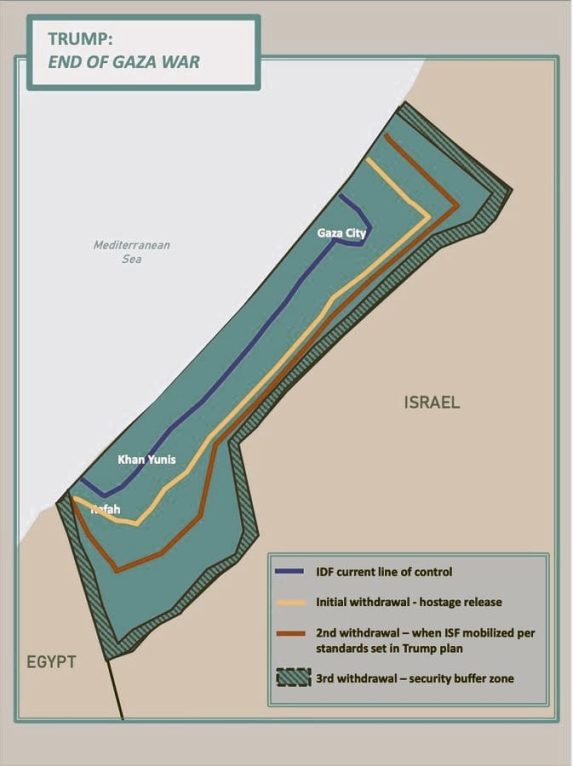
Trump’s plan to end the Gaza War
The 20 points can be read in full at this link, but it’s worth mentioning some of the most important key takeaways from the plan:
- Fighting would stop immediately and the Israeli captives would be released within 72 hours once both parties agree.
- Israel will free 250 prisoners serving life sentences along with 1,700 Palestinians from Gaza detained after 7 October [Note: Israel imprisons nearly 11,000 Palestinians (as of early August 2025), including more than 450 children and 49 women. Since October 7, 2023, Israel has abducted over 2,300 Palestinians from Gaza, including numerous doctors. From October 2023 to early August 2025, 76 prisoners have died in prison, most having been tortured. Three doctors from Gaza were tortured to death, including by raping].
- Israel will withdraw and refrain from annexing the territory.
- “Security” will be provided by regional and international forces, who will also help train Palestinian police, while aid will be delivered to Gaza at agreed levels. The US will oversee dialogue between Palestinians and Israelis if the Palestinian Authority (PA) implements “reforms” according to US-Israeli demands.
- Gaza will be administered by a temporary technocratic government, with oversight and supervision by a new international transitional body headed and chaired by Trump and Former Prime Minister Tony Blair, among others.
- No forced displacement from Gaza, and reconstruction of the Strip as a “de-radicalized terror-free zone” will begin.
- All ‘military operations’ will be halted during this period for a phased withdrawal of Israeli forces. Hamas members who commit to ‘peace’ will be granted amnesty, while those who do not will be offered safe passage to third countries.
- Hamas and other factions agree to not have any role in the governance of Gaza, directly, indirectly, or in any form.
- Aid will be delivered to Gaza at agreed levels, through the United Nations and other international institutions. [Note: In May 2025, Israel imposed the so-called Gaza Humanitarian Foundation (GHF) as a sole replacement for the UN;s aid distribution, claiming Hamas hinders the humanitarian mission of the foundation. This claim was not true and not proven.]
Unfair, unjust, unrealistic proposal
While lauded in legacy media and by Western leaders, Trump’s proposal is an insincere plan not for peace but which really amounts to a surrender ultimatum to Hamas.
Shortly after its announcement, Netanyahu said that the Israeli army will not withdraw from the Gaza Strip. “No way, that’s not happening.”
He also said, “If Hamas refuses [the proposal], Trump will give Israel full backing to complete the military operation and eliminate them.”
The US has already given Israel full backing to commit its genocide in Gaza, so in that regard Netanyahu is correct. But for any who thought he would abide by Trump’s proposal to pull out of Gaza, there was never a chance of that.
On October 3, 2025, Hamas agreed to the release of all Israeli hostages, but did not accept the proposal unconditionally, with other elements to be negotiated.
Trump responded by saying,
“After negotiations, Israel has agreed to the initial withdrawal line, which we have shown to, and shared with, Hamas. When Hamas confirms, the Ceasefire will be immediately effective, the Hostages and Prisoner Exchange will begin, and we will create the conditions for the next phase of withdrawal…”
He urged Israel to “immediately stop bombing Gaza” to allow for the safe release of hostages.
The important nuances written out of legacy media reporting on the proposal include:
- Hamas does not accept that the affairs of Gaza, as a part of Palestine, be managed by any non-Palestinian party.
- The entry of foreign forces or a foreign administration into the Gaza Strip is an issue that is not acceptable to Palestinians.
- Israel has no intention to fully withdraw from Gaza.
- Demanding the dissolution of Hamas is to deny the Palestinian people their right to political self-determination.
Further, Trump’s proposal to appoint Former Prime Minister Tony Blair to chair a board overseeing Gaza’s transition is not acceptable to Palestinians, nor to people who opposed the invasion and slaughter of Iraqis.
Enabling continued genocide and Israeli expansion
The Trump proposal doesn’t consider what Palestinians want. It speaks of peace, but in reality proposes a full surrender to an occupying power and giving control to foreign decision makers and forces. Trump and Netanyahu want Hamas to capitulate, drop their weapons, and hand over control to the US and Israel, in the name of “peace”.
In addition to the above points, it must be stressed that Israel never honours ceasefires or its word, instead violating the ceasefires immediately, resulting in the slaughter or more Palestinians (and Lebanese).
Case in point, just hours after President Trump ordered Israel to stop bombing Gaza, Israeli bombing killed a 3-month-old baby and 14 other members from her family in Gaza City, leaving 20 more people buried beneath the rubble.
Israeli bombing that day killed 70 Palestinians, the majority of them children.
The Government Media Office in Gaza reported 131 Israeli air and artillery strikes across on October 4th and 5th, killing 94 civilians. The Israeli bombing continues.
Former US Ambassador Chas Freeman in recent interview noted,
“This is a peace plan that was never discussed with the Palestinians who have to have something to say about peace. Either they benefit from peace or they don’t. There’s no benefit to them in this plan… It is the same old demands from Israel: exile yourself, leave or be killed. This is an exercise in colonial rule.”
Indeed, the proposal comes at a time when global condemnation is high of the Israeli genocide and starvation campaign in Gaza. Pitching such a proposal gives the veneer of Trump trying to stop the killing, but in reality, he gives Netanyahu carte blanche to continue killing.
Over the past month since parts of the proposal were enacted, Israel has continued violating the ceasefire with more bombing. On October 29, it was reported that Israel says it has “resumed enforcing ceasefire”. In the 24 hours prior, at the last 104 people were killed in strikes across Gaza, including at least 46 children.
Torture and Rape Are All in A Day’s Work for Israel’s Defenders
By Philip Giraldi • Unz Review • November 6, 2025
A couple of recent stories relating to the utter bestiality of Israel’s treatment of the Palestinians have exposed the criminality of successive US governments in supporting the Jewish state no matter what it does. Observers of the lopsided relationship understand very clearly that Israel’s lobby in the United States, backed up by Jewish billionaires who are willing to spend whatever it takes to corrupt the political system and buy up the media, has succeeded in making Washington a totally controlled client state manipulated by extreme war criminals like Prime Minister Benjamin Netanyahu, who is rewarded by the near complete loyalty of Congress and the White House. The one sided relationship dominates both Republicans and Democrats and has been most evident in the Presidencies of Joe Biden and Donald Trump, who have chosen to ignore the reality of the Israeli slaughter of some hundreds of thousands of Palestinians using US weapons and Washington’s political protection in international fora.
The irony of it all is that Washington’s subjugation by Israel, far from being politically neutral, does terrible damage to the United States, both in terms of actual costs and the fact that the US is now reviled by much of the world as it continues to protect and enable Israel as it continues it program to turn the Middle East into a region that it dominates by dint of perpetual slaughter of the original inhabitants. Beyond that, one of the costs of loving Israel so much is the lack of any consequences when it comes to protection of American citizens who find themselves on the wrong end of the Israeli police state. Citizens like Palestinian-American journalist Shireen Abu Akleh was killed by an Israeli Army sniper in May 2022, but the US Embassy did nothing to establish responsibility for the murder, leaving it up the Israeli judiciary, which did nothing and may even have rewarded the soldier. Abu Akleh was one of 276 journalists targeted deliberately and murdered by Israeli forces in the past two years.
Going back a bit, the most egregious case of the US abandoning its own to Israeli connivance was the attack on the USS Liberty intelligence ship in international waters in June 1967. Thirty-four crewmen were killed and 174 more wounded and the clear intention was to sink the ship using planes and torpedo boats with their identifications covered to blame the incident on the Egyptians. A cover-up engineered by President Lyndon B Johnson and Secretary of Defense Robert McNamara followed and repeated attempts by surviving crewmen to open an investigation have been blocked in Congress, most notably by Senator John McCain, whose father was the Admiral that chaired the inquiry held in Malta that decided that it was all a case of mistaken identity, which was a lie. LBJ called back planes that were sent to aid the stricken Liberty and was heard to explain that he would be satisfied if all those “sailor-boys were to go to the bottom of the sea” rather than offend “our good friend” Israel.
Last week, there surfaced a bizarre tale involving the Chief Legal Officer of the Israeli Army, a Major General named Yifat Tomer-Yeralshami. Yeralshami is a woman who was highly respected by her peers though it should be assumed that she was constrained by the policies towards the Israel Defense Force (IDF) as dictated by the Netanyahu regime and its extreme right winger chief National Security officer Itamar Ben-Gvir. Tomer-Yeralshami had been involved in the case of a Palestinian prisoner who had been serially raped in the notorious Sde Terman prison.
Terman was the best known IDF torture center. In October 2024, the UN Independent International Commission of Inquiry on the Occupied Palestinian Territory, including East Jerusalem, and Israel issued a report examining the treatment of thousands of Palestinian detainees after October 7th, 2023. In the report, the commission determined that detainees from Gaza held in Israeli military prisons, including children, were “subjected to widespread and systematic abuse, physical and psychological violence, and sexual and gender-based violence amounting to the war crime and crime against humanity of torture and the war crime of rape and other forms of sexual violence.”
Israeli soldiers were reportedly creative in their rape techniques. Dr. Mark Perlmutter, a Jewish-American orthopedic surgeon who was a volunteer medic in Gaza last year, reported how one Palestinian prisoner was treated. “He was raped by female IDF soldiers with a zucchini placed up his rectum and the zucchini was soaked in pork blood” the pork used specifically because pork is forbidden to Muslims, as it is to Jews.
The rape in question being investigated by Tomer-Yeralshami had been carried out by five Israeli soldiers. The incident occurred in July 2024 and the soldiers had been detained after the Palestinian proved to be so seriously injured that he had to be hospitalized. The IDF soldiers raped the man so violently, using in one instance a knife in his rectum, that his intestines exploded and his rectum was ruptured. He has undergone 20 surgeries since what happened to him. The facility where the soldiers were detained was subsequently stormed by a group consisting mostly of Israeli armed settlers led by Ben-Gvir and the men were later released and have reportedly been waiting on a military hearing to determine their possible guilt. They not only claim to be innocent, they believe that they should be rewarded and have even appeared before the press wearing black uniforms and head covers to make their case that comes down to soldiers not being held accountable if they torture or kill Palestinian prisoners.
Recent stories relating to the utter bestiality of Israel’s treatment of the Palestinians have exposed the criminality of successive US governments in supporting the Jewish state no matter what it does. Observers of the lopsided relationship understand very clearly that Israel’s lobby in the United States, backed up by Jewish billionaires who are willing to spend whatever it takes to corrupt the political system and buy up the media, has succeeded in making Washington a totally controlled client state manipulated by extreme war criminals like Prime Minister Benjamin Netanyahu, who is rewarded by the near complete loyalty of Congress and the White House. The one sided relationship dominates both Republicans and Democrats and has been most evident in the Presidencies of Joe Biden and Donald Trump, who have chosen to ignore the reality of the Israeli slaughter of some hundreds of thousands of Palestinians using US weapons and political protection in international fora. For what it is worth, neither Biden nor Trump has spoken out effectively on the murder and torture of the Palestinians by Israel.
The irony of it all is that Washington’s subjugation by Israel, far from being politically neutral, does terrible damage to the United States, both in terms of actual costs and the fact that the US is now reviled by much of the world as it continues to protect and enable Israel as it pursues its program to turn the Middle East into a region that it dominates by dint of perpetual slaughter of the original inhabitants.
Inevitably, stories about Israeli inhumanity are either completely suppressed or substantially modified to make the Jews involved appear to be victims of whatever takes place, what one might refer to as the “holocaust syndrome,” but sometimes the reality is just so horrific that it manages to leak through the damage control and censorship. In this case, the story of the savage rape in the prison would have died in an Israel court but for the fact that the rape was videoed and was leaked to Israeli news network Channel 12, apparently by the General and possibly others in her office, and the story subsequently developed that she had resigned her commission and disappeared. In her resignation letter, she apparently admitted that she had approved the release of a video revealing institutionalized acts of torture committed by the IDF against Palestinian prisoners of war that took place in the Sde Teiman detention camp in July 2024.
Shortly after the footage was aired, Tomer-Yerushalmi was placed on forced leave by the Israeli Defense Ministry after a criminal probe was launched to investigate the origins of the leak. In the months that followed her being placed on leave, Israeli Defense Minister Israel Katz announced that Tomer-Yerushalmi would not be permitted to return to her post, forcing her resignation. In her resignation letter, Tomer-Yerushalmi stated that “To my regret, this basic understanding—that there are acts to which even the most vile of detainees must not be subjected—is no longer convincing to all,” a tacit admission of the institutionalized abuse sanctioned by Israeli officials within the IDF and Netanyahu government.
Tomer-Yerushalmi disappeared from sight and it was subsequently rumored that she might have killed herself, but she was found and subsequently arrested. The Netanyahu government and its right-wing supporters have tried to benefit from the developing story, claiming that the general’s arrest confirms that the soldiers were “innocent” and that the leaked videos were “fake.” However, the trial of the soldiers is reportedly proceeding, and the videos have been confirmed as genuine. General Tomer-Yerushalmi is now being accused of “treason” for her role in the leak.
This affair could have been a classic case of silencing the messenger who was bearing bad news but it has become clear that the General was not operating alone. The Israeli police claim to possess WhatsApp group communications involving other high-ranking officers connected to the leaked information. The Israeli press has cited eight top officers within the IDF prosecution command headed by Tomer-Yerushalmi. The video and related documents were reportedly actually physically leaked by a junior officer within the military prosecutor’s command, who also confessed to his behavior before the Israeli General Security Organization (Shabak). Some believe that it is unconceivable that General Tomer-Yerushalmi would have made the decision to expose the IDF’s conduct without a green light from up above. Who could give such a green light? Her direct commander, the Israeli chief of staff (Herzi Halevi), or even the defense minister (Yoav Gallant), which would place them at odds with Netanyahu.
Some suspect that the actual objective by the army high command may have been to prove that Israel “has the legal means to prosecute its war criminals”—a message to the International Criminal Court (ICC) at The Hague that it should stay away from the case. If this theory is correct, General Tomer-Yerushalmi and those who authorized her were driven by “patriotic sentiments” to protect the behavior of the army soldiers. It may have been an attempt to defuse possible court cases by presenting a false image of ethical accountability. In short, the image of “ethical behavior” replaces any actual concern for ethical conduct, something that is absent from the nation that calls itself the Jewish State with an army that calls itself the world’s “most moral.”
Predictably, as a response to Tomer-Yerushalmi’s admitting she was behind the release of the video from Sde Teiman, Prime Minister Benjamin Netanyahu sought to shift the blame. He characterized the leak as the worst public relations disaster that Israel has ever faced saying “It is perhaps the most serious public relations attack Israel has experienced since its founding—I cannot recall one so concentrated and intense. This requires an independent and impartial inquiry, and I expect that such an investigation will indeed take place.” What Netanyahu was really demanding was a cover-up of what crimes have become systematic in Israel’s torture and killing of Palestinian prisoners.
Another story, equally hideous, concerns the activity of the so-called Israeli settlers, who have been armed by the Israeli government and have been systematically attacking the Palestinians remaining on the West Bank by beating and even killing the Arabs and destroying their livelihoods. It was again a case of a video having surfaced that showed a raid on a Palestinian farm, revealing how the settlers raided a barn containing the farmer’s sheep and lambs. Australian journalist Caitlin Johnstone describes the scene and what it means: “Israeli settlers were filmed torturing lambs which belonged to Palestinians in the West Bank. Gouged their eyes out. Smashed them with cinder blocks. Beat them to death in front of their mothers. Lambs. It’s not the most evil thing the Israelis have done. Not by a long shot. Hell, all of human civilization subjects animals to cruel abuses every minute of every day through the horrors of factory farming. But this particular incident shines a special sort of light into exactly what’s going on behind Israeli eyes over there in that sadistic society. Think about the hatred and savagery you’d need to summon up within yourself to gouge the eyes out of a living baby sheep. Think about the kind of person you’d have to become to do something like that to an innocent creature. Those lambs didn’t know they were Palestinian. They didn’t know anything about Hamas or October 7 or the Nazi Holocaust, or any of the other reasons Israelis generally cite for their abuses of human beings. They were just sitting there, doing absolutely nothing that could possibly be construed as harmful by even the most talented hasbarist. And those settlers went in there and inflicted completely gratuitous suffering upon them. This, to me anyway, just says so much about the level of vitriolic hatred by which the state of Israel is sustained. It’s baked in to the way the whole state.”
I rest my case about what is wrong with Israel to include its criminal relationship with the United States. So Mr. Trump, I already know you hate animals just as you hate and seek revenge on anyone who does not agree with you, but what is your response to the murders of children and rapes of prisoners as well as the torture of baby creatures who have done no wrong? Just what is your justification for making the United States a partner and even enabler in the crimes?
Philip M. Giraldi, Ph.D., is Executive Director of the Council for the National Interest, a 501(c)3 tax deductible educational foundation (Federal ID Number #52-1739023) that seeks a more interests-based U.S. foreign policy in the Middle East. Website is councilforthenationalinterest.org, address is P.O. Box 2157, Purcellville VA 20134 and its email is inform@cnionline.org.
Paramount blacklist pro-Palestine voices under new pro-Israel leadership
MEMO | November 6, 2025
A growing number of Hollywood actors and filmmakers who have voiced solidarity with Palestinians are reportedly being blacklisted by Paramount, following its takeover by pro-Israel billionaire David Ellison, according to Variety. The move has raised fears of a systematic campaign to suppress dissenting voices in the entertainment industry under the guise of combating anti-Semitism.
The blacklist follows Paramount’s $7.7 billion merger with Skydance Media, led by Ellison—the son of Oracle co-founder Larry Ellison, one of the largest donors to Israel’s occupation forces. The leadership overhaul has included the appointment of Bari Weiss, a self-described Zionist and vocal defender of Israel’s assault on Gaza, as editor-in-chief of CBS News, one of Paramount’s flagship assets.
Industry sources suggest that artists who have expressed solidarity with Palestinians or criticised Israel’s ongoing genocide in Gaza and its apartheid regime in the occupied West Bank may now face reprisals. According to Variety, Paramount “maintains a list of talent it will not work with because they are deemed to be ‘overtly antisemitic’ as well as ‘xenophobic’ and ‘homophobic.’ Whether the boycott signatories are on that list is unclear.”
This labelling follows Paramount’s decision in September to publicly denounce a celebrity-signed letter calling for a boycott of Israeli cultural institutions involved in what signatories described as “genocide and apartheid.” Over 300 figures, including Oscar winners Emma Stone, Mark Ruffalo, Rooney Mara, Tilda Swinton and Yorgos Lanthimos, had signed the statement, demanding accountability from Israel for its documented war crimes and structural violence against Palestinians.
Paramount’s swift condemnation of the letter—branding it anti-Semitic—has been interpreted as part of a broader ideological purge within the industry. It echoes earlier incidents such as the sacking of actress Melissa Barrera for condemning Israeli attacks on Gaza, and Susan Sarandon’s revelation that she was dropped by her agency and blacklisted after criticising Israel’s occupation.
The blacklist forms part of a growing pattern across the United States, where support for Palestinian rights is increasingly conflated with hate speech. University students have lost scholarships, faculty members have been suspended or dismissed, and entire student organisations have been deregistered for protesting visits by Israeli officials accused of supporting ethnic cleansing policies.
Kyrgyzstan’s Forgotten Colour Revolution
By Kit Klarenberg | Global Delinquents | November 6, 2025
October 5th marked the 25th anniversary of the world’s first “colour revolution”, in Yugoslavia. A lavishly-funded, multi-pronged CIA, NED and USAID campaign exploited civil society actors, in particular youth groups, to dislodge President Slobodan Milosevic from power. Such was the effort’s success, US officials and media openly boasted about Washington’s central role. A slick ‘documentary’ on the unrest, Bringing Down A Dictator, was even produced. Milosevic’s fall also provided a blueprint for countless future ‘soft coups’, which continue to this day.
So it was, one by one in the early 2000s, insufficiently pro-Western governments throughout the former Soviet sphere were toppled using strategies and tactics identical to those deployed against Belgrade. A common ruse was for the US to fund, via local NGOs, a “parallel vote tabulation” to project an election’s outcome in advance, and publicise the data before results were officially announced. As in Yugoslavia, PVT figures differing from formal tallies were the spark that ignited Georgia’s 2003 ‘Rose Revolution’, and Ukraine’s 2004 ‘Orange Revolution’.
Over subsequent years, much has been written by academics, historians and independent journalists about those colour revolutions. Conversely, Kyrgyzstan’s 2005 ‘Tulip Revolution’ has gone almost entirely unremarked upon, and is largely forgotten now. Yet, its destructive consequences reverberate today. Hitherto the freest and most stable state in Central Asia, post-colour revolution Bishkek careened from crisis to crisis, with multiple governments collapsing along the way. It’s only in recent years – following another Anglo-American coup in 2020 – the country has regained its economic, political, and social balance.
Pre-2005, Kyrgyzstan was not an obvious colour revolution candidate. Upon its 1991 independence from the Soviet Union, the country quickly established itself not only as the most democratic and open in the region, but a dependable US ally. President Askar Akayev, a former scientist with zero political background, was organically popular, and moreover made clear his economic policies were informed by arch-capitalist Adam Smith, not Karl Marx. In other words, Bishkek was primed to do business with the West.
Akayev moreover allowed a relatively free media to develop, and welcomed widespread foreign civil society penetration. Thousands of European and US-funded non-governmental organisations duly opened up shop locally. At one stage, the President quipped, “if the Netherlands is a land of tulips, then Kyrgyzstan is a land of NGOs.” His comments proved bitterly ironic, given the title of the colour revolution that eventually unseated him. In another deeply sour twist, it was precisely Akayev’s welcoming of Western financial and societal infiltration that was his undoing.
A self-laudatory USAID factsheet on the President’s removal notes, from 1994 onwards $68 million was funnelled into Kyrgyzstan. This vast windfall was used to train NGOs “to lobby government,” finance “private newspapers” critical of Akayev, establish an “American University” locally, and much more besides. The Tulip Revolution stands today as a stark warning to governments the world over of the dangers of permitting such entities to operate on their soil with impunity – and how often, even pro-Western leaders can fall victim to their mephitic influence.
‘Defeat Dictators’
Despite much goodwill built up since 1991, in October 2003 Akayev angered Washington by inviting Moscow to open an airbase not far from Bishkek, and just a few dozen kilometres from the Empire’s vast Manas military installation, one of a cluster constructed by the US across Central Asia post-9/11 to facilitate the War On Terror. Such insubordination was sufficient to mark the President for removal, and preparations for a colour revolution according to a by-then well-honed formula began almost immediately.
Akayev was not unwise to this risk, warning in December 2004 of an “orange danger” of the kind that had just engulfed Ukraine threatening Kyrgyzstan, in advance of the country’s elections in February the next year. As it was, the results were far too clean to allege rigging or other shenanigans, as with prior colour revolutions. A detailed investigation by the European Network of Election Monitoring Organizations in fact praised a “positive… lack of reports of vote-buying, voter intimidation, and harassment of journalists.”
Washington’s vast local standing army of civil society insurrectionists began causing havoc anyway. Some operated under the banner of KelKel, a group directly inspired by US-sponsored revolutionary youth factions in Yugoslavia, Georgia and Ukraine, and trained by their alumni. Moreover, as the Wall Street Journal revealed just before the elections, an ostensibly “independent” local printing company in receipt of Freedom House, NED, Soros and USAID cash was responsible for publishing a panoply of opposition pamphlets.
Days earlier, the firm’s electricity was cut off by local authorities. Kyrgyzstan’s US embassy “stepped in with emergency generators” to maintain its anti-government propaganda deluge. This included a prominent newspaper that published “front-page photos of a palatial mansion purportedly owned by the President and of a boy in a decrepit alleyway,” highlighting state embezzlement versus citizen poverty. Another was a handbook produced by CIA-connected Gene Sharp, From Dictatorship to Democracy, dubbed “the bible” of Ukraine’s US-sponsored youth activists at the forefront of the Orange Revolution.
This “manual on how to defeat dictators, including tips on hunger strikes and civil disobedience,” includes guidance “on nonviolent resistance – such as ‘display of flags and symbolic colors’.” However, the protests that instantly erupted after the elections were highly belligerent from inception, with bomb attacks, police pelted with bricks and beaten with sticks, and government buildings torched and forcibly occupied. The New York Times contemporaneously acknowledged broadcasts by US-funded local TV stations inspired violence in certain areas of Kyrgyzstan.
Upheaval raged for weeks, prompting a personal intervention from UN Secretary General Kofi Annan, who expressed significant alarm over “the use of violence and intimidation to resolve electoral and political disputes.” He welcomed Akayev’s invitation to instigate dialogue with protesters. They demanded he resign instantly – despite the President having already pledged before the election to do so in October that year. In March, Akayev acquiesced and stood down, replaced by Kurmanbek Bakiyev.
‘Terribly Disappointing’
Bakiyev’s seizure of power was initially framed by Western journalists, politicians and pundits as a sparkling victory for people power, and the dawning of a new era of democracy and freedom in Kyrgyzstan. Yet, five years later, he fled the country, following mass protests over his savage, corrupt rule. The tipping point for Bakiyev’s ouster was the April 7th 2010 mass shooting of demonstrators by security forces, which killed up to 100 people and wounded at least 450 more.
As Forbes recorded at the time, the level of graft under his Presidency was “mind-boggling”. Bakiyev appointed close relatives to key positions, allowing his family to profit handsomely from legally questionable privatisation of state industries, and supply of fuel to Washington’s Manas base. Bakiyev’s son Maxim, who oversaw the latter, was described by US diplomats in leaked cables as “smart and corrupt.” By some estimates, companies he ran reaped $1.8 billion from these deals, close to Kyrgyzstan’s total GDP in 2003.
Meanwhile, Bakiyev’s brother Zhanysh ran Bishkek’s security apparatus with an iron fist. Harsh restrictions on political freedoms were enacted, while arbitrary detentions, bogus convictions, torture, and killings of opposition activists, journalists, and politicians became commonplace. For example, in March 2009 Bakivey’s former chief of staff Medet Sadyrkulov died in an alleged road traffic accident. It was later revealed he was brutally slain upon Zhanysh’s order. That December, dissident reporter Gennady Pavlyuk was murdered, thrown out of a sixth-floor apartment with his arms and legs bound.
Bishkek’s Tulip Revolution wasn’t unique in producing such horrors. A March 2013 essay in elite imperial journal Foreign Policy acknowledged the results of every US-orchestrated government overthrow in the first years of the new millennium were “terribly disappointing”, and “far-reaching change never really materialized” resultantly. This is quite an understatement. Most target countries slid into autocracy, chaos and poverty as a result of Washington’s meddling. It has typically taken years for the damage to be corrected, if at all.
Still, despite this disgraceful legacy, the US appetite for fomenting colour revolutions – and the willingness of groomed citizens, particularly youth, the world over to serve as Washington’s regime change footsoldiers – remains undimmed. In September, Nepal’s elected government was overthrown by disaffected ‘Gen Z’ activists, with the full support of the country’s powerful military. The palace coup bore all the hallmarks of a colour revolution. Who and what will replace the felled administration still remains far from clear.
As a September 15th New York Times editorial noted, “Nepalis from all walks were ready to reject the system they had fought for decades to achieve,” but lack “any clear sense of what comes next.” There is an extraordinary political vacuum in Kathmandu presently, which elements within the country are seeking to exploit for malign ends. As before, Nepal’s “revolution” is likely to produce a government far worse than that which preceded it.
Why Mamdani and Fuentes Are Both Good Signs
By Kevin Barrett | November 5, 2025
Most Zohran Mamdani voters loathe Nick Fuentes. Fuentes’ groypers aren’t big fans of Mamdani, either. But if “the enemy of my enemy is my friend,” the two no-longer-marginalized figures, and their followers, ought to be friends.
Mamdani’s election as mayor of New York, and Fuentes’ almost simultaneous entry into the mainstream conversation, are not unrelated. The smarter fans of both Mamdani and Fuentes realize that America’s real enemy is its Zionist oligarchy. Overthrowing that oligarchy, and restoring relatively sane rule that takes majority interests into consideration, is the goal of both Fuentes’ America First movement and Mamdani’s brand of anti-Zionist democratic socialism.
Mamdani and Fuentes, of course, have different views of which “majority interests” need representation. For Mamdani, it’s the 99%—people who aren’t double-digit millionaires and billionaires. Fuentes and his followers don’t necessarily disagree. But they also want to reclaim power and agency for the racial and religious majority, namely white Christians.
Since Mamdani is neither white nor Christian, and his followers have been conditioned to believe that pro-white pro-Christian voices are reactionaries if not Nazis, there is an obvious basis for conflict between the two factions. Extremists on the Mamdani side have battled Fuentes types in street violence in places like Charlottesville and Portland. One could imagine the two figures leading their respective followers into an epic conflict, maybe even a new Civil War.
But one could also almost imagine them uniting to run for president on the same independent ticket. That would, of course, require enormous compromises from both sides.
What if they both decided that taxing America’s Zionist-dominated oligarchy out of existence was a joint number one priority? Mamdani probably already supports that, while Fuentes would need to rethink his worldview to sign on. He would have to recognize that rewriting the economic rulebook to favor non-oligarchs would open up opportunities for his groyper followers to crawl out of their moms’ basements and get jobs, marry, become responsible productive citizens and churchgoers, and support their wives and children.
To join forces with Fuentes, Mamdani would need to admit that the torrent of oligarchical abuse directed at Fuentes (“antisemite,” “conspiracist,” etc.) is a backhanded tribute to Fuentes’ honesty in addressing controversial but critically important topics. Though a nonwhite immigrant, Mamdani is presumably capable of understanding why ethno-religious majorities don’t like being decimated in the course of just a couple of generations. And as a Muslim, Mamdani should basically share the conservative family values that Fuentes espouses (in lieu of espousing an actual woman, but hey, Nick’s still young). To the extent that Mamdami is a believing and practicing Muslim, he ought to prefer a country dominated by Christian-style family values to the current Sodom and Gomorrah.
Fuentes and Mamdani are also natural enemies of the Orwellian social control mechanisms being developed by both the oligarchy’s left (Cass Sunstein) and right (Peter Thiel). Since both the Grand Groyper and the new NYC mayor loathe the genocidal Zionist settler colony squatting demonically in the Holy Land, perhaps they could agree to nuke it out of existence, thereby eliminating most of the world’s worst social control tech enterprises, as well as its worst war criminals.
If Fuentes and Mamdani teamed up and openly vowed to annihilate our ruling Zionist oligarchy, they might get Charlie Kirked or Kennedy’d or Wellstoned. But their joint martyrdom would certainly be glorious. And it might well inspire the younger generation to finally figure out who the real enemy is—IT’S THE ZIONIST OLIGARCHY, STUPID—and take belated but appropriate measures.
Two New York Families Sue Schools for Denying Medical Vaccine Exemptions
By Suzanne Burdick, Ph.D. | The Defender | November 4, 2025
Two New York families are suing their school districts in federal court, alleging that district officials unlawfully denied their children’s medical exemptions.
One case involves an 11-year-old, identified as “Sarah Doe,” in the Webster Central School District. According to the complaint filed last month in the U.S. District Court for the Western District of New York, Sarah has a “documented history of life-threatening reactions to vaccines.”
The school district denied her medical exemption request for the Tdap vaccine.
The other case concerns a 17-year-old, identified as “Michael Doe,” in the Penfield Central School District. His complaint, also filed last month, and in the same federal court, states that he has a “documented personal history of severe vaccine-induced airway constriction, a strong family history of autoimmune disorders, and a life-threatening latex allergy.”
The school district denied his medical exemption request for the meningococcal vaccine.
The lawsuits ask the court to issue a temporary restraining order and a preliminary injunction to allow Sarah and Michael to return to school and to recognize their medical exemptions as valid. The plaintiffs also seek compensation for damages, including lost educational opportunities and emotional distress.
Chad Davenport, the plaintiffs’ attorney, told The Defender that the New York school districts’ actions were “egregious” and “in direct contradiction” to a recent federal ruling in a related case, Doe v. Oceanside, involving a New York mother and her teenage daughter, also called “Sarah Doe.”
Davenport and attorney Sujata Gibson represented the teen and her mother, who successfully sued the Oceanside Union Free School District for refusing to grant the teen a medical vaccine exemption for the hepatitis B vaccine. Children’s Health Defense (CHD) funded the lawsuit.
In August, the judge issued a preliminary injunction allowing the teen to return to classes.
On Sept. 1, Davenport and Gibson sent a letter on CHD’s behalf to all New York state boards of education and superintendents, threatening legal action if school district officials continued to deny medical exemptions certified by students’ physicians.
“We sent it out and we tried to stop them from doing this, but unfortunately, it wasn’t enough,” Davenport said.
New York’s ‘flawed’ medical exemption process puts kids at risk
The situations described in the two new lawsuits are “happening throughout New York state,” he said.
CHD General Counsel Kim Mack Rosenberg said the new lawsuits highlight “how flawed the medical exemption process is in New York state.” Gibson agreed.
Mack Rosenberg added:
“For too many, the existence of the medical exemption truly is illusory and the misinterpretation of grounds for a medical exemption is rampant, both at the state and district level.
“The flaws in the system are placing families who choose to have their children educated in schools — versus homeschooling, which is not an option for everyone — in the horrible position of potentially risking their child’s health to attend school, where doctors familiar with the children recommend that the children not receive vaccines.”
Davenport said he reached out to the New York schools, requesting homeschooling curriculum.
“They give us nothing — and again, this is not unique,” he said. “Every single time that they kick these children out into homeschooling, they give them nothing. … They basically say, ‘We’re done with you.’”
Doctors cited ‘clear and documented danger’ to Sarah’s health
The Oct. 22 lawsuit states that Webster Central School District denied 11-year-old Sarah’s Tdap vaccine medical exemption despite the warning from her treating physician that further vaccination was “absolutely contraindicated” because of a prior “life threatening, multi-organ failure after vaccinations.”
When the family tried to meet the school’s vaccine requirement, healthcare providers refused to vaccinate Sarah. The complaint states:
“When the family, acting under extreme duress from these threats, attempted to comply with the District’s demands, they were turned away by multiple medical providers who refused to administer the vaccine, citing the clear and documented danger to Sarah’s health.”
The district denied Sarah’s exemption because her condition was not listed on “a rigid, pre-approved list of contraindications” published by the Centers for Disease Control and Prevention’s vaccine advisory committee.
The lawsuit also alleges that the district responded to Sarah’s exemption request with “coordinated campaign of intimidation and threats involving Child Protective Services (CPS).” The county health department warned Sarah’s mother that CPS could intervene if Sarah remained unvaccinated.
In addition to the Webster Central School District, the lawsuit names Dr. Margaret Callahan, the district’s designated school physician, and Chris Callahan, principal of Spry Middle School, as defendants.
School’s medical director showed ‘clear bias’ in case involving 17-year-old
The Oct. 24 lawsuit states that Dr. Robert Tuite, the medical director who reviewed the exemption request, said the district should need it because the request was issued by a psychiatrist, whom Tuite deemed was the “wrong” type of doctor.
However, Davenport said the judge who ruled in Doe v. Oceanside made it clear that medical exemptions don’t have to be written by a specific type of doctor.
The judge “went through the district’s demands for letters from specialists, including hematologists, immunologists” and explicitly said letters from specialists are not required, Davenport said.
“The statute is very clear: it is any physician. You do not need to have somebody with a certain specialty to certify that a vaccination may be detrimental to the health of your child,” he added.
The lawsuit also says Tuite had “profound” conflicts of interest that affected his review of Michael’s exemption request. The complaint names Tuite as a defendant, along with Penfield Central School District, Penfield High School Principal LeAnna L. Watt and Superintendent Tasha Potter.
Tuite, the district’s medical director who also runs a private practice, previously served as Michael’s doctor until a “contentious disagreement” arose between Tuite and Michael’s mother.
After “an argument over the COVID shot and whether or not her child should receive it,” Tuite kicked Michael’s mother out of his practice, Davenport said. “That’s clear bias.”
Davenport continued:
“Not only that, but then [Tuite] actually got on the phone with the doctor who wrote the medical exemption … [and] admitted that the reason why he’s rejecting it is because last time he accepted a medical exemption, he got his wrist slapped by New York State.”
New York schools fined for approving medical exemptions, case alleges
Tuite told the psychiatrist that the district faces “substantial fines” from the state’s health department for accepting any medical exemption that the state later deems invalid.
Davenport said Tuite isn’t the first person to claim that the New York State Department of Health will fine a district for allowing medical exemptions. According to Davenport, medical directors and school officials involved in lawsuits he files often make similar claims.
Davenport said they know that he will sue them for fees and damages, but they tell him that approving a medical exemption request and allowing the student into school would cost the district $2,000 per day.
“That is what they are being threatened with,” he said. “I don’t know how that message is being conveyed from the Department of Health to the schools and the school officials, but it is.”
Davenport hopes the new cases reinforce the precedent set by Doe v. Oceanside.
He also hopes the cases will send a message that New York school districts can no longer deny medical exemptions without facing judicial challenges.
Davenport said districts have generally assumed they would be “insulated” from meaningful judicial review, since families whose exemptions are denied must appeal to the state commissioner, and the commission historically sides with the school district.
“Not one final decision has ever resulted in the New York State Education Department overturning a school’s decision to deny a vaccine waiver. Not one,” Davenport said.
Now, however, families are taking their cases to federal court after the state commission fails to provide meaningful judicial review.
This article was originally published by The Defender — Children’s Health Defense’s News & Views Website under Creative Commons license CC BY-NC-ND 4.0. Please consider subscribing to The Defender or donating to Children’s Health Defense.
Featured Video
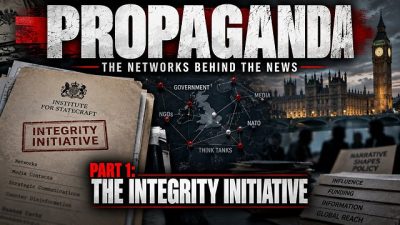
Integrity Initiative: UK-funded network framed dissent as Russian disinformation for years
or go to
Aletho News Archives – Video-Images
From the Archives
Why Saudi Ties to 9/11 Mean U.S. Ties to 9/11
By Kevin Ryan | Dig Within | September 27, 2015
Media interest in Saudi Arabian connections to the crimes of 9/11 has centered on calls for the release of the 28 missing pages from the Joint Congressional Inquiry’s report. However, those calls focus on the question of hijacker financing and omit the most interesting links between the 9/11 attacks and Saudi Arabia—links that implicate powerful people in the United States. Here are twenty examples. … continue
Blog Roll
 Aletho News
- Big tech hands in its DSA censorship reports to the EU
- ‘A Big Victory’ – Palestine Chronicle Wins Two-Year Legal Battle
- IAEA inspectors cannot return to Iran amid US threats: Russia
- Senate Rejects Iran War Powers Resolution Passed By House
- ‘We did not attack Pakistan with drones’: Afghan sources
- Iraqi Resistance faction links arms to sovereignty, questions US exit
- Cannon fodder no more… South Korea rejects Trump’s pressure to join his criminal war on Iran
- Neria Leiter Was A Legitimate Military Target
- Integrity Initiative: UK-funded network framed dissent as Russian disinformation for years
- ‘We don’t seek permission to defend our country’: Snippets from President Pezeshkian’s UNGA address
- If Americans Knew
- ‘This is where I live now, the back of a truck’: a day in the life of a grandmother in Gaza
- In UN Speech, Iran’s President Displays Pictures of Children Killed by US, Brings Attention to Israel’s Nuclear Arsenal
- Israel displaces hundreds of Palestinians amid wave of demolitions in West Bank
- Aid, reconstruction, and Israel’s history of obstruction in Gaza
- Trump administration digs an ever-deeper hole of complicity in genocide – Daily Update
- US-Israel $2.8 Billion Arms Deal, 40,000-Bomb Supply Faces New Gaza Complicity Accusations
- Caught on Tape: AIPAC CEO Boasted of Controlling Trump’s National Security Officials
- Why Hamas Attacked Israel in October 2023 – Israeli professor Ilan Pappé
- They see them, then kill them: Israeli quadcopters track, deliberately target civilians in Gaza
- Winter could turn Gaza’s treacherous, war-damaged buildings into deathtraps
- No Tricks Zone
- New Study: Earth And Venus Surface Warmth Largely Explained By Convection And Lapse Rate, Not CO2 Or Radiation
- 2025 Nature Paper Claiming Worsening Global Drought Gets RETRACTED …Heavily Flawed
- New Study: ‘Global Drought Shows No Detectable Recent Acceleration Under Climate Warming’
- Economic Masterminds: German Socialists Suggest Taxing Productivity Gains Stemming From Using AI
- The South China Sea Has Not Been Cooperating With The Climate Change Narrative
- Energy Crisis: Germany Enters Heating Season With Historically Low Gas Reserve Fill Levels
- New Study: The Antarctic Ice Sheet Gained Mass From 2020-2024 Due To Staggering Snow And Ice Accumulation
- Study: Ocean Heating Rates From Thousands Of Years Ago ‘Dwarf’ Modern Ocean Heating Rates
- Climate Extremists Target, Attack Large-Scale Power Grid Infrastructure In Germany!
- New Study: Antarctic Ice Melt Has Contributed Less Than 1 Centimeter To Sea Level Rise In The Last 30 Years

