Purging America First: Inside the GOP’s Zionist Vetting Machine
By Jose Alberto Nino – The Occidental Observer – October 12, 2025
In the dimly lit corridors of Capitol Hill, where backroom deals shape American foreign policy, House Speaker Mike Johnson recently conducted what can only be described as a strategic war council. On the afternoon of September 17, 2025, Johnson gathered with a who’s who of pro-Israel organizations for a private meeting ostensively designed to eliminate dissenting voices within the Republican Party. What emerged from this closed-door session reveals a coordinated effort to ensure ideological orthodoxy on Israel.
The meeting itself reads like something out of a tired political thriller. Johnson, who described himself to the assembled group as a “Reagan Republican” focused on “peace through strength,” went on to make a startling admission that isolationism is rising within the Republican Party and that a major debate on the issue is likely once President Donald Trump leaves office.
But Johnson’s most revealing statement came when he told the group that in his candidate-recruiting efforts, he’s working to filter out isolationists to prevent that wing of the party from growing more prominent in the House. Four people who attended the meeting confirmed this extraordinary pledge to Jewish Insider.
“The speaker was very, very direct about the U.S. role with Israel and in the world and understands that there are voices that don’t agree in both parties, on both extremes, and urges us all to be involved in fighting back against those extremes,” Eric Fingerhut, CEO of the Jewish Federations of North America, told the publication.
The guest list for Johnson’s gathering was a who’s who of America’s most powerful pro-Israel organizations. In attendance were representatives from The Louis D. Brandeis Center for Human Rights Under Law, the Republican Jewish Coalition, Agudath Israel of America, AIPAC, the Simon Wiesenthal Center, Conference of Presidents of Major American Jewish Organizations, National Council of Jewish Women, Synergos Holdings, CUFI Action, the Orthodox Union, the U.S.-China Economic and Security Review Commission, Standard Industries, the American Jewish Committee, Zionist Organization of America, National Debt Relief, Jewish Institute for National Security of America, the Deborah Project, Foundation for Defense of Democracies, Coalition for Jewish Values and the Endowment for Middle East Truth. This comprehensive coalition represents the full spectrum of pro-Israel advocacy, from religious organizations to political action committees to think tanks—a formidable alliance with vast resources and influence.
The Hunt for Republican Heretics
The Israeli lobby’s crosshairs have settled on several prominent Republicans whose independence on foreign policy has made them targets. Chief among them is Rep. Thomas Massie (R-KY), whose voting record has made him perhaps the strongest opponent of Israel in Congress according to Jewish advocacy groups.
Massie’s legislative actions against pro-Israel interests are extensive and well-documented. In December 2023, at the height of Israel’s war against Hamas, Massie shared a social media post implying that Congress was more interested in “Zionism” than “American patriotism.” In October 2023, following the Hamas attack, Massie was the only Republican to vote against a bipartisan resolution standing with Israel. He was also the sole Republican to vote against the Iron Dome Supplemental Appropriations Act and the only member of either party to vote against a resolution honoring Jewish American heritage and denouncing antisemitism.
“Antisemitism is deplorable, but expanding it to include criticism of Israel is not helpful,” Massie wrote on X, explaining his vote against a resolution reaffirming Israel’s right to exist. Even more provocatively, Rep. Marjorie Taylor Greene (R-GA) has emerged as an unexpected critic from the MAGA wing. In a dramatic departure from her previous pro-Israel stance, Greene has characterized Israel’s actions in Gaza as “genocide.”
Her transformation has prompted a furious response from AIPAC, which issued a fundraising message comparing her to progressive Democrats Rashida Tlaib and Ilhan Omar:
Let’s call this what it is: Marjorie Taylor Greene is the newest member of the anti-Israel Squad. She may think this earns her praise from the far-left or online radicals — but we see it for what it is: a betrayal of American values and a dangerous distortion of the truth.
In response to AIPAC’s attack against her, Greene has doubled down, telling One America News Network that AIPAC should register as a foreign lobbyist and posting a photograph of a sign on her office door reading “no foreign lobbying.” She has accused Israel of having “incredible influence and control” over nearly every member of Congress, exposing pro-Israel lobby trips that she argues amount to foreign lobbying without accountability.
LinkBookmarkPerhaps nowhere is the Israeli lobby’s intervention more telling than in Texas’s 23rd Congressional District, where gun rights YouTuber Brandon Herrera mounted a formidable challenge against moderate Republican incumbent Tony Gonzales last election cycle. Herrera, known as “the AK Guy” to his 4.4 million YouTube subscribers, came within 354 votes of unseating Gonzales in the 2024 primary runoff.
Gonzales, a 20-year Navy veteran and cryptologist who rose to the rank of Master Chief Petty Officer, built his political résumé through Washington’s national security circles. He served as a legislative fellow in Senator Marco Rubio’s office and was a National Security Fellow at the pro-Israel Foundation for Defense of Democracies (FDD), a neoconservative think tank known for its hawkish foreign policy stance. In Congress, Gonzales has reflected that worldview by backing aid to Ukraine and Israel, stating that “if we fail to support our allies, China, Russia, and Iran will only become more powerful” with regard to a military aid spending package pending final passage in the U.S. House in April 2024.
The closeness of this race terrified pro-Israel groups, who saw Herrera as a genuine threat to their influence. AIPAC’s United Democracy Project spent $1 million opposing Herrera in a two-week ad buy, while the Republican Jewish Coalition added $400,000 in attack ads.
More significantly for the lobby’s concerns, Herrera had stated he would have voted against supplemental aid to Israel and other U.S. allies. “I would absolutely vote AGAINST the new proposed spending package for $95+ billion for foreign conflicts, while spending $0 on our southern border,” Herrera posted on X on April 19, 2024. “Any Republican who claims to be America first CANNOT vote for America last legislation.”
When asked directly whether he would pledge to end foreign aid, including to Israel, Herrera reiterated his position: “We can’t claim to be ‘America First’ while pushing spending bills like the most recent foreign aid package that gave almost $100 billion to every country except the US.”
The combined $1.4–1.5 million in spending by AIPAC and RJC helped Gonzales narrowly survive with 50.6% to 49.4%—a margin so slim it demonstrated the growing threat posed by America First candidates to the establishment’s foreign policy consensus. Herrera has already announced his intention to challenge Gonzales again in the 2026 Republican primaries, setting up another expensive battle. This time, the political winds may finally shift in Herrera’s favor.
The most audacious display of the Israeli lobby’s power may be their campaign against Thomas Massie. Pro-Israel Republican megadonors have established the MAGA Kentucky super PAC with $2 million specifically to oust the congressman. Paul Singer contributed $1 million, John Paulson added $250,000, and Miriam Adelson’s Preserve America PAC provided $750,000.
This goes far beyond normal political opposition; it’s a declaration of total war against foreign policy dissent among Republican ranks. AIPAC has already demonstrated this approach works. During the 2024 election cycle, AIPAC’s independent spending arm, the United Democracy Project, spent over $300,000 on Fox affiliate ads criticizing Massie’s voting record. UDP spokesperson Patrick Dorton did not mince words about UDP’s attacks against Massie: “We are not playing in the primary, but we are trying to shine a light on the radical anti-Israel record of Tom Massie. We want every single voter in the state of Kentucky to know about his anti-Israel actions.”
The Post-October 7 Reality
The October 7 Hamas attacks fundamentally transformed the Israeli lobby’s strategy and urgency. AIPAC increased its political spending nearly threefold in the months following the attacks, with average weekly spending jumping from $275,000 to over $740,000.
“Our focus in the 2024 election is to broaden and strengthen the bipartisan pro-Israel majority in Congress — and to defeat anti-Israel detractors,” AIPAC spokesman Marshall Wittmann told Capital News Service. “In the aftermath of the Hamas barbaric attack and the mounting threats of Iranian terrorist proxies, the importance of a pro-Israel Congress standing with our ally is clearer than ever.”
This represents more than increased spending; it’s a systematic campaign to ensure ideological conformity. The Israeli lobby’s post-October 7 mobilization has created what one Democratic donor adviser called “a huge, underappreciated change to the landscape.” Thousands of smaller donors who weren’t previously engaged have been activated, providing the financial foundation for an unprecedented intervention in American electoral politics.
Johnson’s pledge to “filter out isolationists” in candidate recruitment represents the institutionalization of ideological screening within the Republican Party leadership. This transcends opposing candidates in primaries and is mostly focused on preventing them from running in the first place by controlling access to party resources, endorsements, and financial networks.
The vetting process appears comprehensive. As the Jewish Insider report noted, Johnson is working to prevent the isolationist wing from “growing larger in the House” through his recruiting efforts. This suggests a systematic review of potential candidates’ positions on Israel and foreign aid, with those deemed insufficiently supportive being denied party backing.
This represents a fundamental shift in how American political parties operate. Rather than allowing primary voters to choose between competing visions, party leadership, at the behest of the Israel lobby, is pre-selecting candidates based on their adherence to specific foreign policy positions. The Israeli lobby has essentially outsourced candidate vetting to organizations whose primary loyalty is to world Jewry.
The Israeli lobby’s campaign to purge non-interventionist candidates and incumbents is part of a comprehensive campaign to eliminate legitimate foreign policy debate within the Republican Party. The success of this strategy in cases like the Gonzales-Herrera race demonstrates its effectiveness in the short-term. By deploying overwhelming financial resources against grassroots candidates, the lobby can overcome significant popular support for America First policies. Herrera’s near victory despite being outspent by millions shows the genuine appeal of his message and precisely why American Jewry views such candidates as existential threats.
The implications extend far beyond individual races. If successful, this campaign will fundamentally re-shape the Republican Party by eliminating voices that prioritize American interests over foreign commitments. With “unlimited” resources pledged against figures like Massie and systematic vetting of new candidates, Israeli interests are working to ensure that future Republican leaders never can question America’s relationship with Israel.
This endeavor may not be a walk in the park for organized Jewry, however. New trends point to younger voters souring on Israel. A University of Maryland Critical Issues Poll conducted between July 29 and August 7 showcased a dramatic generational divide within the Republican Party. While 52 percent of Republicans aged 35 and older sympathize more with Israel, that figure drops to just 24 percent among those aged 18 to 34.
The split grows even wider when it comes to Gaza. Among older Republicans, 52 percent view Israel’s actions as justified. Among younger ones, only 22 percent agree. “The change taking place among young Republicans is breathtaking,” said Shibley Telhami, the poll’s principal investigator. “While 52 percent of older Republicans (35+) sympathize more with Israel, only 24 percent of younger Republicans (18–34) say the same—fewer than half.”
This generational realignment accelerated after Operation Al-Aqsa Flood on October 7, 2023. Pew Research Center data show that unfavorable views of Israel among Republicans under 50 climbed from 35 percent in 2022 to 50 percent in 2025 — a striking 15-point jump. In contrast, Republicans over 50 shifted only slightly, from 19 percent to 23 percent.
Even evangelical Republicans, once Israel’s most reliable allies, are showing signs of fatigue. Among older evangelicals, 69 percent express sympathy for Israel, compared to only 32 percent among younger ones. Just 36 percent of younger evangelical Republicans consider Israel’s actions in Gaza justified.
In a broader rebuke of bipartisan orthodoxy, a September 2025 AtlasIntel poll found that only 30 percent of Americans support continued financial aid to Israel, underscoring how Washington’s “blank check” is increasingly out of step with public opinion. An increasing share of Republicans now argue that U.S. policy serves Israeli interests more than America’s.
The question now is whether the Republican Party belongs to its voters or to Tel Aviv. The battle lines are drawn, and the outcome will reveal who truly holds power in Washington.
The End of Impunity: The UN Slaps the Israeli Regime in the Face
The Silent Judgment of Nations: How the World Demonstratively Turned Its Back on Netanyahu
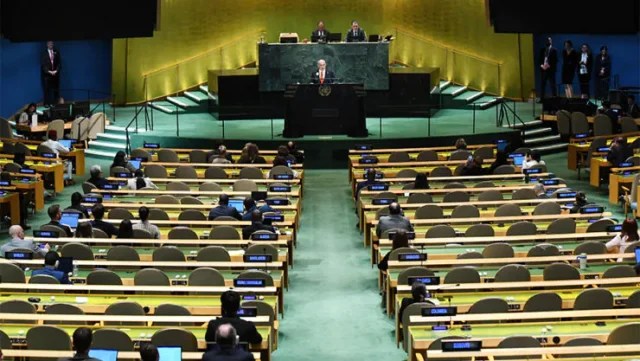
Netanyahu and the empty UN hall
By Viktor Mikhin – New Eastern Outlook – October 12, 2025
He stood at the podium, accustomed to the speeches of statesmen, but that day it was destined to become an instrument for justifying genocide. Benjamin Netanyahu, the prime minister of the Israeli regime, a man whose name will now stand alongside the darkest figures in history, was preparing to speak. But something happened that will forever remain in the annals of international diplomacy as a symbol of the moral collapse not only of one man, but of the entire system that has indulged him for far too long.
The UN General Assembly hall, usually filled with diplomatic indifference, exploded with a silence louder than any applause. Before Netanyahu could utter a single word, delegates from one country after another rose from their seats and demonstratively, silently, left the hall. This was not a spontaneous impulse, but a choreographed act of collective disgust. The spectacle was so humiliating for the leader of the so-called “only democracy in the Middle East” that the chairperson had to plead: “Order in the hall, I call for order in the hall!” But the appeal hung in the air. There was no order. There was a rebellion. A rebellion of conscience. A rebellion against injustice, genocide, and the annihilation of an entire Palestinian people.
Netanyahu’s face, usually a mask of unshakable self-confidence, contorted. He was shocked. He, the architect of carpet bombing, the destroyer of hospitals and schools, the executioner of children, women, and the elderly, was faced with something he did not expect: the silent, yet deafening, judgment of nations. In that moment, the mask of civility finally fell from the Israeli state. The world saw not a national leader, but an accused genocidaire left speaking to a nearly empty hall, save for a handful of his most loyal accomplices.
The “Father of Genocide’s” Speech: A New Language of Hate
And then the speech itself began. What was supposed to be a justification turned into a manifesto of misanthropy. Netanyahu, whose rhetoric had long since crossed all red lines, this time addressed the residents of Gaza directly. And in this vile address, there was a chilling cynicism worthy of the Nazi propagandists he so loves to compare his critics to.
He told them “not to listen to Hamas’s calls to remain in combat zones.” But is this not the height of hypocrisy? It is the Israeli army that has turned the entire Gaza Strip into one continuous “combat zone.” It is Israeli planes that are wiping entire neighborhoods off the map, following “evacuation maps” that are nothing more than a roadmap to a mass grave. Where are they to flee? To the sea, which Israeli ships have turned into a trap? To Rafah, which was then bombed? To the desert, where there is no water, no food, no shelter?
This appeal is not concern for civilians. It is the rhetorical trick of a murderer who, holding a knife over his victim, whispers, “It’s your own fault for not dodging.” It is an attempt to shift responsibility for one’s own crimes onto those who are doomed to die. This is the language of genocide. The very language that dehumanizes an entire people, turning them into a “human shield,” into “collateral damage,” into “animals,” as Israeli ministers and soldiers have openly and repeatedly called them.
The Anatomy of a Genocide: From Word to Deed
Let’s call things by their proper names. What is happening in Gaza is not a “conflict.” A conflict implies at least a semblance of symmetry. This is not a “war on terror.” This is the deliberate, systematic destruction of the Palestinian people as a national, ethnic, and cultural entity. And it fully corresponds to the legal definition of genocide as formulated in the 1948 UN Convention.
Article II of the Convention defines genocide as any of the acts committed with intent to destroy, in whole or in part, a national, ethnical, racial or religious group.
Silent Accomplices and Cynical Allies
The scene at the UN was a bright moment of truth, but it also highlighted the monstrous hypocrisy of Western powers. While delegates from most of the world voted with their feet, the representatives of the United States, Germany, the United Kingdom, and some other subordinate countries remained in their seats. Their silent presence was more eloquent than any words. It was silent approval. Complicity.
Washington, which supplies the weapons and provides diplomatic cover for the ongoing slaughter, is the chief sponsor of this genocide. Every bomb that falls on a house in Gaza has “Made in the USA” written on it. Every veto cast in the UN Security Council against cease-fire resolutions is a permission to kill. The West, which built the “Never Again” system after World War II, has itself become its chief violator. “Never Again” has turned out to apply only to some peoples, but not to others.
A Voice from Under the Rubble: Why the World Must Listen to This Enemy
When Netanyahu tried to speak to the Palestinians, it was the monologue of an executioner. But the Palestinian people have their own voice. It is the voice of mothers mourning their children under the rubble. It is the voice of doctors performing operations by the light of flashlights. It is the voice of poets writing poems on the debris of their homes. It is the voice of unyielding dignity.
History will judge not only Netanyahu and his henchmen. History will judge everyone who turned away at this decisive moment. Every politician who traded humanity for geopolitical interests. Every journalist who called a massacre a “clash.” Every ordinary person who grew tired of “this complex issue.”
That day at the UN showed that the world’s patience has run out. The collective walkout of delegates is not just a gesture. It is the beginning of the end of the era of impunity for the Israeli regime. It is an acknowledgment that apartheid, occupation, and genocide cannot be legitimate policies in the 21st century.
The court in The Hague has already begun its work. And someday, perhaps, the world will see the man who today trembled at the podium with rage and humiliation, in the defendant’s dock. But executioners come and go, while the people fighting for their freedom and right to exist remain. Palestine will be free. And that day when the world turned its back on its executioner will be one of the first steps toward long-awaited liberation. The truth, like conscience, does not remain silent forever. It decisively walks out of the council chamber to scream loudly for the whole world to hear.
Viktor Mikhin, Corresponding Member of the Russian Academy of Natural Sciences (RAEN), Expert on Middle Eastern Countries
Irish contender blasts Irish gov. over delay of sanctions on ‘Israel’
Al Mayadeen | October 9, 2025
Ireland’s leading presidential contender has accused the government of bowing to US corporate pressure by stalling legislation that would sanction Israeli settlements, as anger grows over “Israel’s” genocide in Gaza.
Catherine Connolly, an independent left-wing lawmaker backed by Sinn Féin, urged Dublin to resist diluting the long-delayed Occupied Territories Bill, which aims to ban trade with goods and services linked to illegal Israeli settlements.
“We cannot allow the government to fail the Palestinian people on this,” Connolly told Reuters, accusing coalition partners Fianna Fáil and Fine Gael of “dragging their feet.” She warned that limiting the bill to goods only would amount to “an appalling capitulation to corporate interests” and an “unforgivable betrayal”.
Her remarks came just hours before US President Donald Trump announced a ceasefire and captive release deal between “Israel” and Hamas as part of his plan to end the two-year genocide in Gaza.
‘Ireland must match its moral stance with real action’
Government insiders told Reuters the proposed law may be watered down following lobbying by major US businesses operating in Ireland. While Ireland’s government has been vocal in condemning the Israeli war, the bill’s progress has stalled amid diplomatic and economic pressures.
Connolly, who currently leads in opinion polls ahead of the October 24 presidential election, said she would continue pushing for a comprehensive sanctions framework that includes services, insisting that Ireland “must match its moral stance with real action.”
Her stance was echoed by Frances Black, an independent senator who first introduced the legislation seven years ago. “The government needs to be strong on this. They need to be courageous,” Black said. “It’s absolutely vital that we have goods and services on the bill. We need to match our words with action.”
The proposed sanctions, in preparation for over a year, have drawn criticism from “Israel”, international business groups, and US lawmakers. Earlier this week, a group of American legislators warned Prime Minister Micheál Martin that passing the bill could damage US-Irish relations and harm American companies based in Ireland.
US takes action to protect ‘Israel’, again
Last August, a group of US Congress members sent a letter to Treasury Secretary Scott Bessent urging him to evaluate whether Ireland should be added to a list of countries boycotting “Israel” should the Occupied Territories Bill (OTB) become law.
The letter, which was signed by New York Republican Congresswoman Claudia Tenney and backed by 16 other congressional members, expresses what it describes as serious concerns about the Irish government’s proposed ban on imports from Israeli-occupied territories.
The letter cites Section 999 of the 1986 Internal Revenue Code, which condemns foreign boycotts targeting allied countries, with specific opposition to measures directed at “Israel”.
The letter warned that if Ireland were added to the list of countries boycotting “Israel”, it would trigger mandatory tax reporting obligations and possible financial penalties for American citizens and companies conducting specific operations in those nations.
The group characterized the Irish government’s efforts on the OTB as “part of [a] broader effort aligned with the global Boycott, Divestment, and Sanctions (BDS) movement which seeks to economically isolate Israel.”
Iran embassy censures awarding Nobel Peace Prize to Venezuelan opposition leader
Press TV – October 11, 2025
Iran’s embassy in Caracas has blasted the Nobel Committee for awarding this year’s Nobel Peace Prize to someone who advocates for military aggression against Venezuela in yet another sign of the West’s “divisive and interventionist” mentality.
In a post on its X account on Saturday, the embassy said the decision to award the Nobel Peace Prize to Venezuelan opposition leader María Corina Machado is “nothing less than a mockery of the true meaning of ‘peace’”
“Awarding the Nobel Peace Prize to someone who justifies the genocide in Gaza and advocates for military aggression against Venezuela is yet another example of the West’s divisive and interventionist mentality in the developing world,” it emphasized.
The Nobel committee on Friday awarded the 58-year-old Machado, a Venezuelan politician notorious for advocating American and Israeli military intervention in her country, the 2025 Nobel Peace Prize for her “tireless work promoting democratic rights”.
The country’s Supreme Court upheld a 15-year ban against her, citing her direct support for US sanctions, involvement in large-scale corruption, and responsibility for massive financial losses suffered by Venezuela’s foreign assets — including the US-based oil refiner CITGO and the Colombia-based chemicals firm Monómeros.
This comes as the US military escalated its operations against Venezuela in August, involving three destroyers, anti-submarine aircraft, battleships, nuclear submarines, and F-35 squadrons.
Since then, US forces have attacked several vessels, killing dozens of Venezuelan nationals while claiming they were drug traffickers transporting narcotics to the United States.
In response, the Venezuelan government has declared a national emergency, reinforced its armed forces, and mobilized its national militia to counter any potential military aggression from Washington.
Why is a ‘regime change’ in Venezuela a stupid idea?
By Raphael Machado | Strategic Culture Foundation | October 11, 2025
It would be a mistake to say that with Trump’s return to the White House, Venezuela is once again under pressure. It never stopped being under pressure since the final years of the Obama administration. But it is legitimate to say that Trump 2.0 has initiated a new phase in the over-10-year hybrid campaign against the Bolivarian state.
We have already seen sanctions, attempts at color revolution, attempts to install an “alternative” president, the theft of Venezuelan gold reserves, the refusal to recognize the legitimacy of elections, provocations at the borders, and even the blocking of its entry into BRICS (sadly spearheaded by Brazil).
Now, however, we see military threats looming on the horizon against Caracas.
Harbingers of this had already occurred.
In 2020, for example, there was an attempt to infiltrate Venezuelan territory with mercenaries hired by the American company Silvercorp with the goal of overthrowing the government of Nicolás Maduro.
In 2024, the CEO of the former private military company Blackwater started the “Ya casi Venezuela” project to raise funds with the alleged aim of overthrowing Nicolás Maduro. Recently, he also stated that the $50 million bounty should apply not only to Maduro’s capture but also to his assassination.
And, as we know, between late August and early September, we saw a series of events that raised tensions in the Caribbean Sea, such as the deployment of warships to the Caribbean and the bombing of four Venezuelan boats that were allegedly transporting drugs.
Now, despite the official line that U.S. maneuvers in the Caribbean Sea are aimed at combating drug trafficking, it is noteworthy that Venezuela accounts for only 3% of all drugs reaching the U.S.. Washington does not seem to be deploying the same level of effort to stifle more important sources, such as the Colombian route, for example.
Thus, even without any official declaration, one cannot rule out the possibility that the U.S. is considering moving forward with a new attempt at regime change in Venezuela – but this time in a more direct way, whether through naval and aerial bombardments, drone attacks, or a black ops operation using mercenaries and/or special forces. Or, of course, a combination of all these options.
Naturally, one thing is to set this objective, another is to achieve it, and yet another thing is to deal with the consequences afterward.
From what is known about the fall of Assad, for example, it was apparently achieved, at least in part, by bribing military officers and co-opting Syrian intelligence. The classic tactic of “divide et impera,” divide and conquer, was used to liquidate Syrian power and facilitate the state’s conquest by Al-Julani’s irregular forces.
Any similar attempt regarding Venezuela will fail. Indeed, Venezuela, as a poor country, would in theory suffer from this fragility facing the possibility of its officials being bribed by foreign economic powers, but the Venezuelan Armed Forces were built in a different way from other states, as is the very foundation of Venezuelan state power. The degree of civilian-military integration in Venezuela is such that the supervision of numerous economic activities in the country is carried out by high-ranking military officers.
The Venezuelan state is, at least in part, a military state. The military does not represent an isolated institution separate from political power, available, therefore, for the possibility of co-option and instrumentalization against other institutions. Instead, in terms explained decades ago by the Argentine philosopher Norberto Ceresole, the military constitutes the guard of the Bolivarian Revolution.
Furthermore, Venezuela’s intelligence agencies, SEBIN and DGCIM, are very closely linked to both military and political power. It is these agencies that have been instrumental in all infiltration attempts in Venezuela, and it is unlikely that dissent can be cultivated within these structures.
Finally, although the Bolivarian militias are not very useful against long-range missile attacks, from the perspective of law and order and guaranteeing national stability in the face of the possibility of trying to take advantage of a potential chaotic situation to organize a color revolution, the armed Bolivarian militias can play a subsidiary and supportive role for the authorities, stifling potential foci of dissent and rebellion.
Now, even the goal of overthrowing Nicolás Maduro’s government presents difficulties even if eventually achieved. Other hierarchs could take his place, as they would have the support of the Venezuelan Armed Forces; this could lead to a scenario of prolonged conflict on Venezuelan territory.
As in all cases of a country’s destabilization, emigration tends to increase rather than decrease, due to the greater difficulty of ensuring the common good in the first months after a hypothetical overthrow of Maduro.
Although the U.S. has a tendency to destabilize nations to keep them in a state of permanent chaos, in theory, the same could not be done in Venezuela lest the instability reach the U.S. itself through increased migration and the collapse of law and order.
U.S. security itself also depends on maintaining a stable Venezuela, so the U.S. would truly be forced into “nation-building” in Caracas, facing a heavily armed country, including at the civilian level, and one that is predominantly hostile.
Instead of such adventurous delusions, Washington should be directing its efforts towards reinforcing Venezuelan stability, especially through the withdrawal of sanctions.
The silent collapse of the United States
By Lucas Leiroz | Strategic Culture Foundation | October 11, 2025
While Washington insists on presenting itself as the bastion of the “liberal world order,” the very foundations of the American state are showing clear signs of collapse. The internal reality of the United States today is marked by an insurmountable fiscal abyss, chronic political polarization, and an alarming inability to maintain even the most basic national security systems. The recent escalation of public debt, combined with the imminent breakdown of nuclear monitoring infrastructure, reveals that American hegemony is not just in decline — it is on the verge of functional collapse.
According to data from the U.S. Treasury, the gross national debt surpassed $37.5 trillion in 2025 — the highest level in the country’s history — exceeding 120% of its GDP. What is most alarming is the speed of this growth: in just the last 12 months, the debt increased by more than $2 trillion — without any emergency context such as war or a global pandemic. It is an unsustainable trajectory, typical of failed states, yet it is happening at the heart of the Western financial system.
At the same time, budget cuts imposed by Congress itself — deadlocked in endless partisan disputes — have directly jeopardized the security of the American nuclear arsenal. The National Nuclear Security Administration (NNSA), responsible for overseeing and maintaining the country’s atomic warheads, publicly admitted that its funds would only guarantee operations for “a few more days.” Once this period expired, a shutdown process for monitoring systems began — something unthinkable for any minimally functional power.
How can a country that spends hundreds of billions of dollars annually to fund wars in foreign territories — such as Ukraine and the occupied Palestine — be unable to finance the security of its own nuclear arsenal? The answer is simple: the United States is no longer a rational country, but a decaying “empire” driven by corporate lobbies, military-industrial interests, and a political elite entirely disconnected from national reality.
The current Republican administration tries to blame the Democratic opposition for the budget paralysis, while the Democrats sabotage any attempt at agreement in order to politically undermine the government. This argument is partially valid, but it also exposes the weakness of the Republicans themselves, who fail to counter the Democratic sabotage. This bipartisan theater is not only dysfunctional — it is suicidal. The U.S. is at the mercy of its own internal disorder, becoming a threat not only to itself but to the entire world, given the sensitive nature of the nuclear systems involved.
Thousands of NNSA employees and contractors have already been affected by shutdowns and funding freezes. Although the government claims that “critical operations” will continue, there are no guarantees or transparency about what exactly remains functional. A mistake, maintenance failure, or even a delayed response to an incident could have catastrophic consequences — including radioactive leaks or accidental detonation.
Meanwhile, countries like Russia and China continue to strengthen their energy sovereignty, defense systems, and institutional stability. The multipolar approach being built by these nations — particularly within the expanded BRICS+ framework — demonstrates strategic maturity and responsibility toward global order, in stark contrast to what is observed in Washington.
America’s decline is not expressed solely through numbers or economic graphs. It is visible in the inability to protect its own population, maintain basic infrastructure, or prevent political games from eroding the state’s structural integrity. When even the nuclear arsenal — supposedly the ultimate red line — is left vulnerable to budget cuts, the message is clear: the U.S. is no longer capable of leading the world.
The collapse on the horizon will not be merely economic. It will be institutional, military, and geopolitical. And in the face of this scenario, the world must begin looking to other — multiple, stable, sovereign, and genuinely peace-oriented — leaderships to guarantee global security.
West behind latest coup attempt in Georgia – Tbilisi mayor
RT | October 10, 2025
Foreign governments instigated a “coup” attempt in Georgia, the mayor Tbilisi, Kakha Kaladze, has claimed, referring to recent protests in the South Caucasus nation.
The Georgian government has repeatedly cried foul over alleged external interference in the nation’s internal affairs. It says the West has sought to depose the ruling Georgian Dream party, which has consistently refused to antagonize neighboring Russia over the Ukraine conflict.
Speaking to reporters on Thursday, Kaladze claimed that ahead of the municipal elections on October 4, “a campaign had been underway for months regarding a coup d’état,” backed by foreign actors.
According to the official, “hundreds of millions” were spent on the effort through non-governmental organizations, with certain Western ambassadors openly “inciting violence” in Georgia.
On Wednesday, US Senators Jim Risch and Jeanne Shaheen issued a statement accusing the Georgian authorities of persecuting the opposition and attempting to “silence dissent,” as well as of “making baseless allegations” against former US government employees.
Kaladze responded by describing the US lawmakers as being “under the influence of the Global War Party.”
Speaking on national television on Monday, Georgian Prime Minister Irakli Kobakhidze made similar claims, alleging that foreign powers had backed the opposition, whom he characterized as “foreign agents.”
Opposition protests, which quickly descended into clashes with police, erupted last weekend as municipal election result projections indicated that the ruling Georgian Dream party held a solid lead across the country.
The unrest was the latest in a series of similar demonstrations that have gripped Georgia in recent years. They reached a climax in October 2024, following presidential and parliamentary elections, when the opposition accused the authorities of fraud. Protesters had previously also cited a perceived stalling of the EU accession process by the Georgian government. Officials have dismissed all allegations.
The EU openly backed the demonstrators, who according to Kobakhidze, were “financed by foreign special services” in a manner similar to the 2014 Maidan coup in Ukraine.
US sanctions Serbian oil major over Russia ties
RT | October 10, 2025
US sanctions on Serbia’s Russian-majority-owned oil company, NIS, have been activated, prompting neighboring Croatia to halt crude deliveries and raising the risk of a shutdown at Serbia’s only refinery.
Washington had granted Belgrade several temporary exemptions from restrictions imposed in January on NIS (Petroleum Industry of Serbia), in which Russia’s Gazprom and Gazprom Neft hold a majority stake. The most recent waiver, issued on October 1, was valid for only one week.
NIS confirmed Thursday that the US Treasury Department had not extended the waiver, leaving the company under full sanctions. It said it was “working to overcome the situation” and would engage with the US authorities to seek delisting.
The new sanctions have forced Croatia to stop crude supplies, pushing Serbia’s only refinery to the brink of a shutdown, President Aleksandar Vucic said on Thursday. He warned the facility, a critical supplier of gasoline and jet fuel, faces closure by November 1 unless deliveries resume.
“These are extremely severe consequences for our entire country. It’s not just about the functioning of one company,” Vucic said in a televised speech.
The sanctions effectively bar the company from purchasing crude oil or exporting refined products.
Croatian pipeline operator JANAF, the sole supplier of crude to the refinery, has already announced it will halt all business with NIS. Analysts say the company’s only recourse is for the US to reverse the sanctions or for its Russian shareholders to divest.
The impact swiftly reached consumers, as NIS notified customers that its network of some 350 stations would no longer accept American Express, Mastercard, or Visa cards.
NIS is a leading Balkan energy company with an oil refinery in Pancevo, near Belgrade, and a retail network of more than 400 filling stations. Gazprom Neft is the largest shareholder with a 44.85% stake, Gazprom holds 11.3%, and the Serbian state owns 29.87%.
Although Serbia formally seeks to join the EU, it has refused to take part in Western sanctions on Russia over the Ukraine conflict. Brussels and Washington have repeatedly pushed Belgrade to sever its energy ties with Moscow, a key historical partner.
Europe’s Nord Stream headache: Poland, Germany, and Ukraine turn on each other over arrest
By Uriel Araujo | October 11, 2025
The Nord Stream saga has taken a new twist. A Ukrainian citizen detained in Poland at Germany’s request over the 2022 pipeline sabotage has now become the center of a diplomatic storm. Ukraine’s reported pressure on Poland is straining ties with Warsaw and Berlin, reopening questions European leaders have tried to bury.
Polish authorities have resisted Germany’s extradition request for the detained Ukrainian, citing national interest and judicial independence. Polish Prime Minister Donald Tusk stated bluntly that it was “not in Poland’s interest” to hand the suspect over to Berlin — a statement that speaks volumes about the deepening mistrust within the European Union. He added that “the problem of Europe… is not that Nord Stream 2 was blown up, but that it was built.”
This is symptomatic of Europe’s broader crisis: a continent that once aspired to “strategic autonomy” now grapples with American influence, tensions over the “Ukranian Question”, and internal divisions.
The destruction of the Nord Stream 1 and 2 pipelines in September 2022 effectively ended decades of German-Russian energy cooperation, forcing Europe into costly dependence on American LNG. From that moment onward, every official narrative seemed to deflect attention away from one key question: who truly benefited?
One may recall that in August, Italian police arrested Ukrainian national Serhij K. for alleged involvement in the 2022 Nord Stream sabotage. According to Der Spiegel, he coordinated a Ukrainian team that planted explosives from the yacht “Andromeda.” The operation was reportedly approved by Ukraine’s military.
At the time, I wrote that the Nord Stream case has been a tale of confusion and cover-ups. I pointed out that a so-called “Ukrainian diver” suspect (unnamed to this very day) could be a lone scapegoat, a proxy, or just a minor operative in a much larger operation. All signs, I argued, pointed to the US as the main orchestrator, with Ukraine likely playing a supporting role on the ground.
According to Pulitzer Prize–winning investigative journalist Seymour Hersh’s sources, the CIA is behind the deed. Ukraine’s latest behind-the-scenes pressure on Poland suggests Kyiv has more to hide than to reveal. The Eastern European country has long been a key hub for CIA operations.
Indeed, one must ask: why would Ukraine intervene at all, unless it feared what an open extradition to Germany might uncover? Berlin’s prosecutors have hinted that their investigation connects the detained suspect to a wider network tied to Ukrainian intelligence. If that thread were ever pulled, it could expose not just Kyiv’s denials, but also shake the credibility of the entire Western narrative since 2022.
The Polish position is equally telling. Tusk’s refusal to comply with Germany’s request exposes the uneasy balancing act that Poland now faces. On the one hand, it remains a staunch supporter of Ukraine in its proxy war with Russia. On the other, it has domestic political reasons to resist appearing subservient to Berlin — and perhaps also to shield itself from unwanted entanglement in the Nord Stream mystery.
Poland, after all, was one of the loudest voices calling for the pipelines to be dismantled long before the explosions happened. The fact that the blasts occurred in waters close to Denmark and Sweden, yet remains unsolved three years later, is remarkable enough.
The European Union’s silence is thus deafening. While media attention focuses on minor procedural disputes, the larger strategic implications are quietly ignored. The Nord Stream sabotage was no mere act of vandalism — it was a geopolitical earthquake that permanently reshaped Europe’s energy map. By destroying the infrastructure that connected Germany to cheaper Russian gas, someone ensured Europe’s long-term dependence on transatlantic energy imports. It is worth remembering that American officials, including then President Biden himself, had publicly threatened to “end” Nord Stream 2 before the current Russo-Ukrainian conflict even began. That is too much of a coincidence.
In that light, the current Polish-German-Ukraine triangle takes on a new meaning. It reveals the uncomfortable truth that Europe’s supposed allies are now quietly at odds. Germany apparently wants to restore a semblance of legal order by investigating the crime, while Poland wants to preserve its political leverage. Ukraine wants to avoid revelations that could alienate its Western backers. Washington in turn seems content to keep the entire affair buried under layers of confusion and selective leaks.
The deeper irony is that the Nord Stream pipelines were not merely Russian assets — they were European lifelines. Their destruction accelerated deindustrialization and skyrocketed energy prices, while American energy exporters reap the profits. The most obvious suspects remain Washington and Kyiv.
Yet European leaders cling to transatlantic loyalty. Berlin’s alignment with American policy verges on economic self-harm, while Brussels pushes “solidarity” as factories close and households struggle with high energy costs. The result is a Europe that’s strategically adrift and economically weakened — a dynamic that suits Washington.
If this Poland-Germany-Ukraine scandal deepens, it could force a reckoning. Europe will have to confront what everyone avoids: was the Nord Stream sabotage an act of war — and by whom? Until then, diplomacy remains a messy game where allies distrust each other, and truth is sidelined for convenience.
The Nord Stream affair may be remembered not just as sabotage, but as the moment Europe lost its last illusion of autonomy. It could confirm how dependent the continent has become on external powers — even in matters of justice. Politically, this could be as explosive as the pipelines blasts themselves.
Uriel Araujo, Anthropology PhD, is a social scientist specializing in ethnic and religious conflicts, with extensive research on geopolitical dynamics and cultural interactions.
After robbing EU taxpayers, Zelensky uses blackmail to get inside the Bloc
Strategic Culture Foundation | October 10, 2025
Since the United States-led NATO proxy war against Russia erupted in February 2022, the European Union has doled out $216 billion in aid to Ukraine. That’s equivalent to €186 billion, according to the EU’s latest official count. The true figure is likely to be even more.
The United States has given a similar amount to Ukraine. All paid for by taxpayers.
That’s about $400 billion total in three years, with the EU promising more over the next few years.
To put this in perspective, the EU aid to Ukraine is multiples more than all of the 27 member nations have received – combined – from the bloc’s collective budget and administration. According to Euronews reporting, some of the biggest recipients of EU subsidies each year are Germany (€14 bn), France (€16.5 bn), and Poland (€14 bn). Some of the smaller recipient countries are Austria, Denmark, and Ireland (around €2 bn).
That means Ukraine has received heaps more than all of the EU members combined.
Get your head around that. Ukraine, which is not a member of the European Union, is receiving manifold what actual member states are receiving. And you wonder why people in France are angrily taking to the streets because their shambolic government wants to cut pensions and other social welfare services to save money. Elsewhere, European governments are collapsing from unsustainable debt. And, at the same time, European citizens are constantly being lectured that their states need to spend more and more money on the NATO alliance, even to the insulting point of having to accept the cutting of social benefits and public services.
Ukraine and its corrupt Kiev regime of NeoNazis has bled Europe dry. The so-called president, Vladimir Zelensky (who canceled elections last year, so he’s not really a legitimate president), is reported to be funneling €50 million a month to overseas funds for his retirement while his wife goes luxury shopping in New York and Paris. Other members of the regime, like former prime minister and now “defense” minister Denys Shmyhal, are also reportedly up to their eyes in corruption, siphoning off billions in the military aid that Western taxpayers have paid for.
This week, Zelensky took his brassneckery to new levels – if that’s possible. He is demanding that Ukraine be made a member of the EU, and he wants to change the rules of the bloc to speed up the process. The EU has granted Ukraine (and Moldova) a fast-track path to membership, but, to its credit, Hungary has objected to this.
In June, Hungarian Prime Minister Viktor Orbán cast a veto on continuing access talks for Ukraine. According to EU rules, there must be unanimity among member nations for the approval of new members. Orbán said Ukraine is not eligible because of the current war against Russia. “We would be importing a war,” he said.
Also, Budapest objects to Ukrainian language laws that discriminate against a Hungarian minority in the western Zakarpattia region of Ukraine. (The Russian language has been banned, too, in public offices.)
A referendum held in Hungary in June recorded that 95 percent of voters were against Ukraine becoming a member of the EU.
Zelensky is pushing ahead regardless, with his peevish wheedling. In a joint press conference in Kiev on Monday, with the indulgence of the Dutch PM at his side, Zelensky said: “Ukraine will be in the European Union, with or without Orbán, because it is the choice of the Ukrainian people.”
The little dictator flaunted his insufferable presumptuousness by hinting that the European Union would change its rules to bypass Hungary’s veto – all just to accommodate his scrounging regime. “Changing the procedure is called finding a way without Hungary,” he said. And in a further arrogant dismissal of democratic process, Zelensky asserted that the Hungarian people support his EU ambitions, contradicting the referendum back in June.
Orbán responded firmly by telling Zelensky he could not blackmail his way into the European Union.
Hungary’s Foreign Minister Péter Szijjártó added a dose of reality by stating: “The decision on which country is ready to join the European Union and which can join the EU will not be made by the president of Ukraine, but by the European Union itself, where such decisions require unanimity.”
In a further comment, Szijjártó nailed it by saying that Zelenskyy is “completely detached from reality.” The Hungarian diplomat also reminded that the Kiev regime is blowing up energy infrastructure and jeopardizing the EU members’ vital interests.
Last month, Ukrainian forces exploded the Druzhba oil pipeline from Russia, cutting off energy supplies to Hungary and Slovakia. The Zelensky regime carried out the sabotage as retribution for Budapest’s opposition to Ukraine’s EU application. This is what Orbán was no doubt referring to when he slammed Zelensky this week for using blackmail.
So, there you have it. A corrupt, unelected, Neo-Nazi regime headed up by a Jewish scam-artist who plays piano with his penis while wearing women’s high heels is using terrorist tactics to attack the vital interests of EU members, and is now telling those members that they won’t have a vote in the EU processes, because the regime has decided it will become a member of the bloc. You could not make it up. This, too, after robbing the taxpayers of the bloc of €186 billion to wage a war against Russia – a war that has killed 1.5 million Ukrainian soldiers – which could spiral out of control into a nuclear Third World War.
If this is the kind of ruination that this regime can inflict while not being a member of the EU, one can only imagine the hellscape it will bring after becoming a member.
An analogy could be a householder being tormented by a criminal gang hanging around the gate, and then for the household to invite the gang inside the premises. The gang leader swaggers in, puts his dirty boots up on the table, and then starts demanding this and that from the householders, using blackmail to harm the children of the house, or some other abomination.
However, the real culprits in this obscene farce are the American and European elites who have fomented the war against Russia. Together, they have weaned and pampered the Kiev regime with largesse and indulgence, paid for by the taxpayers. The U.S.-EU transatlantic ruling class has cultivated the regime of corruption and war since the 2014 CIA-backed coup in Kiev against an elected president. The racket has laundered hundreds of billions of public money to the Western military industrial complex. The racket has destroyed the economies of Europe and is now destroying the semblance of democracy within Europe. (It’s not clear what Trump’s position in all of this is, but he probably doesn’t count anyway.)
The Western imperialist ruling class is so obsessed with its scheme for “strategic defeat” of Russia (and China) and for global domination that it is willing to cultivate any scumbag regime it can make use of for its goals, no matter how much that violates international law and its own professed democratic principles.
Zelensky’s corrupt dictatorship is just a pale reflection of his patrons in Washington, Brussels, Paris, Berlin, and London. They are all detached from reality.
The Empire’s Assassins
Tales of the American Empire | October 9, 2025
The recent assassination of Charlie Kirk was done by professionals. The FBI story is full of holes and experts agree that he was not shot by a high-power rifle, something our corporate media refuses to report. That would have knocked his head off!
This is not a detailed report of his assassination, but how it matches the proven method used by teams of professional killers, which includes setting up a lone nut patsy.
_______________________________________
“Analysis Solves Kirk Case”; a retired pathologist explains why Kirk was not hit by a high-power rifle bullet; Chris Martenson; September 26, 2025;  • Analysis Solves Kirk Case—Evidence Points …
“Valhalla VFT” channel; a retired Green Beret soldier with several videos about the magic bullet; / @valhallavft
Related Tale; “The American Colony of Thailand”; • The American Colony of Thailand
Related Tale; “Football Star Murdered in Afghanistan”; • Football Star Murdered in Afghanistan
“Charlie Kirk Assassination: Narrative vs Reality”; a great short video summarizing the odd stories about this killing; RangeDayBro; October 4, 2025; • Charlie Kirk Assassination: Narrative vs R…
“PROOF Epstein Jail Video Is A Sham & Doctored By FBI!”; Jimmy Dore Show; August 2, 2025; • PROOF Epstein Jail Video Is A Sham & Docto… • Lee Harvey Oswald was a Patsy
West turning internet into ‘tool of control’ – Telegram founder
RT | October 10, 2025
Western surveillance and censorship is eroding digital freedom and is turning the internet into a “tool of control,” Telegram founder Pavel Durov has warned.
The Russian-born billionaire has long portrayed Telegram as an outpost for free speech and privacy, contrasting it with what he describes as authoritarian censorship efforts by Western governments.
“Our generation is running out of time to save the free Internet built for us by our fathers,” Durov said in a statement on Telegram on Friday, marking his 41st birthday.
“What was once the promise of the free exchange of information is being turned into the ultimate tool of control,” he added, noting that nations once considered free are adopting authoritarian digital practices. He cited measures such as digital IDs in the UK, compulsory online age verification in Australia, and the mass scanning of private messages in the EU.
Durov said people have been misled by the West into believing that their mission is to dismantle traditional values – privacy, sovereignty, free markets, and free speech – and by doing so, society has embarked on a path of “self-destruction.”
“A dark, dystopian world is approaching fast – while we’re asleep. Our generation risks going down in history as the last one that had freedoms – and allowed them to be taken away… We are running out of time,” he said.
Durov has long clashed with Western governments over Telegram’s policies, facing fines in Germany for not removing ‘illegal’ content and criticism in the US for allegedly enabling extremist groups.
Last year, he was arrested in Paris and charged with complicity in crimes linked to Telegram users, but was released on bail. He called the case politically motivated. He later accused French intelligence of pressuring him to censor conservative content during elections in Romania and Moldova, and condemned France for waging “a crusade” against free speech.
Durov has also warned that EU laws such as the Digital Services Act and the AI Act are paving the way for the centralized control of information.
Featured Video
EUROPE FEARS RUSSIA’S NEXT MOVE / Ian Proud
or go to
Aletho News Archives – Video-Images
New Book
New Book: No Autoimmunity The Body Doesn’t Attack Itself
Lies are Unbekoming | September 24, 2026
 The label for Humira, once the best-selling drug in the world, lists its risks in plain print. One of them, in the label’s own words, is new “autoimmune” disease.
A drug prescribed for a condition labelled autoimmune carries a warning that it can cause a condition labelled autoimmune. That contradiction sits in every box, on a folded paper almost nobody reads.
My new book starts there.
No Autoimmunity: The Body Doesn’t Attack Itself
For seventy years, “your body is attacking itself, and we don’t know why” has ended the conversation for people diagnosed with multiple sclerosis, lupus, rheumatoid arthritis, Hashimoto’s, Type 1 diabetes, Crohn’s and psoriasis. More than eighty conditions now carry the autoimmune label. The diagnosis comes with a prescription for life. It almost never comes with a question about cause.
This book asks the question and answers it from the framework’s own records: its drug labels, its journals, its regulatory filings, and its own experiments. … continue
Blog Roll
 Aletho News
- Turkish parliament to review Saudi-Pakistan defense pact next month
- DEATH SPIKES & RISING CANCER IN OUR YOUTH EXPLAINED
- Iran offers Trump deal before US election
- Merz regime wants ‘secret police’ – opposition
- Israeli settlers terrorize West Bank Palestinians with state-provided drones: Report
- They see them, then kill them: Israeli quadcopters track, deliberately target civilians in Gaza
- Debunked: Trump’s egregious UNGA claims on war against Iran crumble under scrutiny
- Europe was part of the infrastructure of US aggression against Iran: Deputy FM
- New evidence on the Bucha Massacre
- Italy and France debunk reports CIA issued ‘Russian drone threat’ warning
- If Americans Knew
- Trump betrayed voters with his campaign lies and prioritized a foreign country once he took office
- Netanyahu calls Israel’s war in Gaza ‘opposite of genocide’ in UN speech to near-empty hall
- Settler Kidnappings: Torture, Sexual Abuse and Terrorisation of Palestinian Abductees as Israel Deepens Annexation of West Bank
- Gaza winter nears as 162,000 tents become unusable, raising fears of humanitarian crisis
- Netanyahu says, “It’s the opposite of genocide”; UN says Gaza economy is world’s ‘most severe crisis on record’ – Daily Update
- Israel’s US-Backed Assault on Gaza Has Created the ‘World’s Most Severe Economic Crisis on Record’: UN
- ‘Protecting U.S. Citizens’… From Israel
- ‘This is where I live now, the back of a truck’: a day in the life of a grandmother in Gaza
- In UN Speech, Iran’s President Displays Pictures of Children Killed by US, Brings Attention to Israel’s Nuclear Arsenal
- Israel displaces hundreds of Palestinians amid wave of demolitions in West Bank
- No Tricks Zone
- New Study: Earth And Venus Surface Warmth Largely Explained By Convection And Lapse Rate, Not CO2 Or Radiation
- 2025 Nature Paper Claiming Worsening Global Drought Gets RETRACTED …Heavily Flawed
- New Study: ‘Global Drought Shows No Detectable Recent Acceleration Under Climate Warming’
- Economic Masterminds: German Socialists Suggest Taxing Productivity Gains Stemming From Using AI
- The South China Sea Has Not Been Cooperating With The Climate Change Narrative
- Energy Crisis: Germany Enters Heating Season With Historically Low Gas Reserve Fill Levels
- New Study: The Antarctic Ice Sheet Gained Mass From 2020-2024 Due To Staggering Snow And Ice Accumulation
- Study: Ocean Heating Rates From Thousands Of Years Ago ‘Dwarf’ Modern Ocean Heating Rates
- Climate Extremists Target, Attack Large-Scale Power Grid Infrastructure In Germany!
- New Study: Antarctic Ice Melt Has Contributed Less Than 1 Centimeter To Sea Level Rise In The Last 30 Years

