Diplomacy as deception: The West’s war on Iran was pre-planned
By Hamid Bahrami | MEMO | June 16, 2025
As bombs rain down on Iranian cities and missiles arc across the skies of the Middle East, we must speak plainly: this is not merely a war between Israel and Iran. It is a war against sovereignty, waged by an Israeli-Western coalition that has long sought to dismantle any state in the Global South that dares to chart an independent course.
Iran is not the aggressor in this conflict. It is defending itself, legally, historically, and strategically from a premeditated assault. The airstrikes Israel launched on 13 June were not acts of deterrence; they were the execution phase of a long-orchestrated operation aimed at crippling Iran’s infrastructure, destabilising its political system, and ultimately returning it to the kind of failed state once imposed on Iraq, Libya, and Syria. Each of those nations was de-developed under the guise of humanitarian intervention or nuclear containment. Iran is now in the crosshairs of the same playbook.
The deception runs deep. In the lead-up to the strikes, Western officials and Israeli intelligence deliberately projected calm signalling to Tehran and financial markets alike that diplomacy would continue as scheduled. Negotiations in Oman were a trap. While diplomats discussed terms, war rooms in Tel Aviv and Washington finalised strike packages. It was a bait-and-strike strategy, the diplomatic equivalent of ambush warfare.
Israel’s justification for the attacks, its supposed fear of Iranian nuclear capability, collapses under scrutiny. Nuclear talks had resumed. Iran remained a signatory to the Non-Proliferation Treaty. And yet, Israel, a nuclear state that refuses to join the NPT, launched strikes that violated international law and killed dozens of civilians, including scientists and infrastructure workers.
Even more cynically, Tel Aviv has recycled a familiar accusation to justify civilian casualties: that Iran uses “human shields.” This baseless claim was used repeatedly in Gaza, where hospitals and apartment buildings were levelled on the pretence of targeting militants. Independent investigations have exposed the hollowness of these claims. Israel’s propaganda is less about evidence than about immunizing itself from consequence.
Despite years of Israeli terrorism, including the 13 June decapitation strikes that killed top Iranian commanders such as IRGC Chief Hossein Salami, Chief of General Staff Mohammad Bagheri, and missile-program leader Amir Ali Hajizadeh—Tehran has responded with calculated and disciplined force. Iran’s retaliatory strikes have been tightly focused on military bases, infrastructure, and command centers, avoiding civilian neighbourhoods and essential public services. In contrast, Israel has repeatedly struck residential buildings. Iran’s measured and purposeful response is not a weakness; it is a strategic posture rooted in moral strength and operational precision.
Some analysts have suggested that Israel expected internal dissent within Iran to paralyze the state’s response. This was a fatal miscalculation. While Iran is home to deep ideological divisions, foreign attack unites Iranians across the political spectrum. Even critics of the Islamic Republic now rally to its defence, because the threat is existential. In the face of foreign aggression, factionalism yields to nationalism.
The bigger threat now lies ahead. While headlines speak of “Israeli requests” for American support, the truth is that the United States has been involved from the outset. B-2 bombers were repositioned to Diego Garcia months ago. Joint U.S.–Israeli strike planning began under the pretext of nuclear containment. The deployment of bunker-busting bombs, diplomatic cover at the UN, intelligence sharing, and regional base access—all point to a war co-authored by Washington. They are simply waiting for Iran’s retaliatory capacity to be sufficiently degraded before launching a broader campaign.
Make no mistake: this is not a regional conflict. It is a US–Israel war, aided by Arab authoritarian regimes like Saudi Arabia, the UAE, and Jordan. The West have lent support, whether through intelligence, logistics and approval. Iran is being isolated and encircled not because it poses a nuclear threat, but because it has refused to submit.
But Iran has deterrents of its own. The global economy cannot ignore the energy risks that come with escalating war in the Persian Gulf. Already, oil prices are surging. Tehran knows that its geopolitical power isn’t limited to missiles. Economic leverage, especially when energy prices are high, can shift political calculus in Washington, Brussels, and Riyadh.
There is also a deeper hypocrisy at play. Israel continues to possess a clandestine nuclear arsenal while Iran, still technically within the NPT framework, is sanctioned and threatened for the potential of one. This double standard is untenable. There are only two realistic futures in the region: either Israel is disarmed, or Iran becomes nuclear-armed. The era of unilateral vulnerability is over.
Iran now reassesses its participation in the NPT and reevaluates the assumption that international law provides any meaningful protection when facing nuclear apartheid. If the international community is serious about peace, it must begin not with limiting Iran’s defences, but with dismantling Israel’s offensive capabilities.
Finally, this war must be recognized for what it is: a strategic campaign to eliminate resistance in the Global South. From Baghdad to Tripoli, from Damascus to Tehran, the message has always been the same, those who seek autonomy must be brought to heel. Iran’s independence goal is not just political; it is existential. And every sovereign nation, every citizen with a memory of colonialism or foreign subjugation, should see themselves in its struggle.
What’s happening today is not merely a war on Iran. It is a war on independence, dignity, and the right of nations to choose their own futures.
Zenith of Western asymmetric warfare in Iran and Ukraine
By Drago Bosnic | June 16, 2025
Achieving strategic advantage over your opponents has been at the center of every conflict in human history. In modern times, this is accomplished with long-range strike systems and weapons of mass destruction. However, countries that are at a disadvantage in that regard can opt for asymmetric methods to achieve similar or sometimes even more efficient results. Ever since the advent of nuclear weapons, direct conflicts between global powers have been avoided, as all sides understand there would be no winners in such a war (or at least they did until recently).
Thus, the importance of intelligence services and other forms of non-kinetic warfare grew exponentially. The ability to infiltrate your opponent’s state apparatus is of the utmost importance, while maintaining plausible deniability adds to the strategic depth of defense, as the attacker can simply deny the involvement of its special services.
The political West has been at the forefront of such operations for years, targeting all of its opponents through asymmetric means, particularly through proxies. This is especially true for Russia, which still has major issues with the Kiev regime agents infiltrating the country and conducting operations of strategic importance. The latest attacks on Russian strategic aviation are a testament to that. It should be noted that Moscow’s services have been quite successful in detecting Western agents as they have decades of experience in doing so.
However, Ukrainian operatives are a different story. Namely, the vast majority of Ukrainians speak fluent Russian and can easily blend in virtually anywhere in the country. They can also obtain Russian citizenship, meaning they could be largely under the radar for years. It’s exceedingly difficult to uncover such plots, particularly if they’re being conducted over the course of several years.
This also holds true for other countries of the multipolar world, including Iran, which has been heavily infiltrated by foreign agents, as evidenced by the sheer number of assassinations and so-called decapitation strikes on top Iranian commanders. It’s still unclear how exactly Israel managed to create such a large network of its agents within Iran, but their operations have had a strategic impact on the ongoing conflict.
The Mossad had very close ties with the SAVAK, former Iranian secret police and intelligence service during the Shah era, so it’s quite possible that the Israelis maintained contacts with their Iranian associates even after 1979. They could’ve easily played the role of sleeper agents who were activated by Israel at the moment of the strike. In addition, new operatives could’ve infiltrated Iran from neighboring countries, particularly Azerbaijan which maintains a close partnership with Israel.
Apart from being a major client for the Israeli Military Industrial Complex (MIC), which was instrumental in Baku’s takeover of native Armenian lands in Artsakh (better known as Nagorno-Karabakh), Azerbaijan also has irredentist ambitions toward northwestern Iran, where a homonymous area has more ethnic Azeris than the South Caucasus country itself. The regime in Baku certainly sees the ongoing events as a perfect opportunity to achieve its goals, which could be a major factor in Israeli operations.
Numerous observers have also pointed out the many similarities between the actions of the Kiev regime and Israel, as both have been conducting these asymmetric hybrid attacks deep within Russia and Iran, respectively. The drones that were used in attacks on Moscow’s long-range aviation and Iranian air defenses operate in a virtually identical manner, targeting strategic assets from within.
There are two possibilities in this case. Either the Mossad is involved in training the SBU and/or GUR, or they’re all connected into a much larger network run from Washington DC and London. The latter is much likelier, as both SBU and GUR have strong ties with the CIA and MI6, respectively. In other words, the US-led political West is conducting these operations in an attempt to secure a strategic advantage over its rivals.
This is also done through so-called “international” organizations such as the UN, OSCE, IAEA, etc. For instance, after the start of the special military operation (SMO), Russian military intelligence uncovered that OSCE, which is supposed to be a neutral organization monitoring the ceasefire, was actually helping the Kiev regime target Russian forces by giving the former access to its cameras along the frontline. Moscow promptly ordered OSCE personnel to leave after this.
Some sources are reporting that the IAEA also did something similar in Iran, by giving Israel information on the identity of Iranian nuclear scientists. If true, this could explain how the Mossad was so effective in eliminating them virtually on the first day of the attack. In addition to scientists, a large number of high-ranking Iranian military officers were eliminated within the country. This is perfectly in line with the political West’s doctrine of so-called “decapitation” attacks that aim to paralyze the chain of command in a targeted country.
Many of the most prominent warmongers in Washington DC have been calling for such strikes, even against opponents like Russia. And indeed, in the last several years, there have been a number of assassination attempts against top-ranking Russian officials, including President Vladimir Putin himself. Once again, this was done through proxies such as the Neo-Nazi junta.
In some cases, this could’ve also worked, as evidenced by disturbing revelations regarding the mysterious death of the late Iranian President Ebrahim Raisi and his Foreign Minister Hossein Amir-Abdollahian. The aftermath of Raisi’s death has been disastrous for Iran and its Axis of Resistance. By the end of last year, Syria fell to NATO’s terrorist proxies, while Hezbollah’s long-time leader Hassan Nasrallah was assassinated, followed by a number of high-ranking Iranian and pro-Iranian figures at around a similar time.
The strategic consequences of these events cannot be overstated, meaning that the idea they were purely accidental is extremely unlikely, to put it mildly. By the time Israel attacked Iran, the geopolitical situation in the Middle East shifted dramatically in Israel’s favor. This made launching strategic attacks much easier, as it didn’t have to worry about Syrian air defenses.
Mossad operatives on the ground used not only drones, but also missiles (such as the “Spike NLOS”). Worse yet, it seems they didn’t even have to stay in the country to launch these strikes, as both drones and missiles were controlled remotely, which is yet another indicator of the same modus operandi used by the Kiev regime. Military sources indicate that Israel also used portable electronic warfare (EW) systems to disrupt Iranian air defenses, making it far easier for its missiles to reach targets within Iran.
As previously mentioned, this sort of deep infiltration also enabled Israel to assassinate top-ranking personnel. Reportedly, this includes General Mohammad Bagheri, the Chief of the Iranian General Staff; Hossein Salami, Commander-in-Chief of the Islamic Revolutionary Guard Corps (IRGC) and David Sheikhian, commanding officer of the IRGC’s air defenses. Many other senior military leaders were also killed.
Although Israeli strikes were far more efficient than those launched by the Kiev regime, it’s impossible not to draw parallels with high-profile assassinations of numerous Russian public and military figures, including Lieutenant General Igor Kirillov, the late commander of Russian NBC Protection Troops, who was killed in a terrorist attack back in mid-December. It should be noted that he was investigating US involvement in biological warfare in NATO-occupied Ukraine and was in no way connected to military operations against the Neo-Nazi junta forces.
Thus, the only logical conclusion is that his assassination was certainly not conducted by the SBU of their own volition. Namely, such operations require significant resources that would be reserved for important operations to undermine the Russian military. The only thing that was undermined is the investigation into the Pentagon’s massive biowarfare program.
The Kiev regime conducted many similar attacks on Russian scientists, including Daniil Mikheev, a coordinator of new unmanned systems for the Ministry of Defense; Konstantin Ogarkov, an employee of a defense research institute in Voronezh; Igor Kolesnikov, an engineer at a design bureau in the Tula oblast (region); Sergei Potapov, a cybersecurity defense specialist from Nizhny Novgorod; Valery Smirnov, one of the leading experts in programs for radio-electronic protection of strategic facilities.
In January 2024, a car with officers from the electronic intelligence headquarters in the Bryansk oblast was blown up, while on the night of April 17-18, Evgeny Rytnikov, the head of the design bureau of the Bryansk Electromechanical Plant, the developer of the now legendary “Krasukha” EW systems, was also killed. Such assassinations are a testament to the terrorist nature of the Neo-Nazi junta, as all these people were non-combatants.
Among the prominent Iranian scientists killed by Mossad were Dr. Mohammad Mehdi Tehranchi, Dr. Ahmad Reza Zolfaghari, Dr. Abdolhamid Minuchehr, Dr. Amir Hosein Fekhi and Dr. Fereydoun Abbasi. Once again, it’s impossible not to draw parallels, despite the fact that Israeli strikes were far more strategically consequential.
Still, the main conclusion is that the political West continues to use its proxies to wage war on several countries simultaneously, while also maintaining plausible deniability.
The only way to counter such attacks is for the targeted countries to enforce tighter control over communications, as well as enlarge their intelligence apparatus. While these measures could be seen as “totalitarian” (and will no doubt be presented as such by the mainstream propaganda machine), there’s simply no other way to blunt the blade of the political West’s modern asymmetric hybrid warfare.
Drago Bosnic is an independent geopolitical and military analyst.
US postpones talks with Russia – foreign ministry
RT | June 16, 2025
The US has postponed bilateral consultations with Moscow aimed at easing tensions and restoring diplomatic missions, Russian Foreign Ministry spokeswoman Maria Zakharova announced on Monday.
Earlier this year, Russia and the US held two rounds of high-level talks, the first on February 18 in Riyadh, Saudi Arabia, and the second on February 27 in Istanbul, Türkiye. These discussions marked the first major direct talks since the deterioration of relations following the outbreak of the conflict in Ukraine. The agenda included mutual restoration of embassy operations, easing visa issuance, addressing the Ukraine conflict, and exploring potential post-conflict economic cooperation.
The next round of talks was to take place in Moscow. However, according to Zakharova, this meeting was canceled at the initiative of the American negotiators. In a statement published on the Russian Foreign Ministry’s Telegram channel, she stated, “As of today, the next meeting within the framework of bilateral consultations on eliminating ‘irritants’ to normalize the operation of diplomatic missions of both countries has been canceled at the initiative of the American negotiators.”
She did not disclose the reason Washington’s gave for postponing the meetings, adding only that Moscow hopes that “the pause they have taken will not last too long.”
Since taking office earlier this year, US President Donald Trump has made efforts to reestablish contact with Moscow, which had been largely severed under his predecessor, Joe Biden. Russian officials have welcomed the shift, also expressing readiness to normalize bilateral relations.
‘Israel’, US face risks in targeting Iran’s underground nuclear sites
Al Mayadeen | June 16, 2025
Recent Israeli strikes on Iranian military and nuclear-related facilities have revived questions about whether it is even possible to destroy Iran’s deeply buried nuclear infrastructure.
A March report by the Royal United Services Institute (RUSI) suggests that any attempt to do so would be highly difficult, dangerous, and ultimately uncertain in its outcome.
According to the report, taking out Iran’s underground enrichment sites, including Natanz and Fordow, would require extensive firepower, specialized weaponry, and direct US military support. Even then, success would not be guaranteed.
The study warns that such a mission should be seen as an “option of last resort,” given the risks of full-scale regional escalation and the technical challenges involved.
The Natanz site, one of Iran’s main uranium enrichment facilities, was among the targets hit in the latest Israeli strikes. However, the degree of damage remains unknown, particularly since its most sensitive infrastructure lies underground.
Estimates cited in the RUSI report suggest that parts of the Natanz facility are buried around 8 meters (26 feet) below ground. While “Israel” is believed to possess munitions that can penetrate up to 6 meters, the margin may be insufficient, especially if the underground structure is reinforced with layers of hardened concrete or rock.
Fordow facility likely out of reach for both US and ‘Israel’
Iran’s second major enrichment facility, the Fordow plant, is believed to be buried at a much greater depth, possibly between 80 and 90 meters (262 to 295 feet) below the surface. According to the RUSI report, this would place it beyond the reach of even the US military’s most powerful bunker-buster bomb, the GBU-57 Massive Ordnance Penetrator, which can penetrate around 60 meters.
Adding to the challenge, the GBU-57 can only be deployed by the US Air Force’s B-2 stealth bombers, an asset the Israeli regime does not possess, even if the US were to supply the weapon itself.
Beyond depth, Iran has employed architectural and engineering methods to make its nuclear facilities even more resilient to aerial bombardment. The RUSI report notes that facilities with narrow access shafts, multiple blast doors, and separate entry/exit tunnels are far more difficult to destroy than those with a single, large chamber or shaft.
This layered design could significantly reduce the likelihood of success, even if multiple precision-guided munitions were deployed in succession.
As tensions escalate, the report offers a clear warning: even a coordinated US-“Israel” effort to destroy Iran’s nuclear capabilities may fall short of its objective, while simultaneously risking a wider war.
Given the limitations of current munitions, the depth and complexity of Iran’s enrichment sites, and the potential for catastrophic fallout, the RUSI study concludes that targeting these facilities is a last-resort option, not a tactical shortcut.
US aerial tankers headed to Middle East – media
RT | June 16, 2025
The US has reportedly deployed more than 30 aerial refueling tankers across the Atlantic toward the Middle East, Military Watch Magazine reported on Monday. The outlet has described the buildup as “unprecedented,” claiming it could suggest broader US involvement in the ongoing Israeli-Iranian war.
West Jerusalem and Tehran have entered the fourth day of open hostilities. Last Thursday, Israeli forces launched airstrikes on Iranian nuclear and military targets, killing senior military officials and scientists and prompting retaliatory missile barrages on Israeli cities such as Tel Aviv and Haifa.
The US has expressed support for the Israeli strikes, with President Donald Trump calling them “excellent.” He has also warned that Washington could become directly involved in the conflict if American interests are threatened but has yet to announce any plans to involve US forces.
However, according to flight tracking data, the US has already started deploying KC-135 and KC-46 aerial refueling tankers to the Middle East. Military Watch Magazine has suggested that the aircraft may be intended to support Israeli Air Force operations or refuel US fighters and bombers if Washington expands its role in the conflict.
The report also claims that tankers from other Western countries have participated in Israeli aerial refueling efforts, while the US is believed to have provided intelligence, satellite targeting data, and missile defense support.
On Sunday, Axios reported that Israeli officials had asked the US to directly take part in the military operation, specifically requesting assistance in striking Iran’s Fordow enrichment facility. However, US officials cited by the outlet said the request was declined, with one stating that the Trump administration is not considering any such involvement.
Nevertheless, Tehran has claimed that Washington’s support for West Jerusalem has made the US complicit in Israel’s aggression against Iran. Sources within the Iranian military have also reportedly indicated that Tehran’s response to Israeli strikes would “spread to all areas occupied by this [Israeli] regime and related US bases in the region in the coming days.”
In response, Trump has warned that any Iranian attack on US forces would trigger a military response, writing on his Truth Social platform that “if we are attacked in any way, shape, or form by Iran, the full strength and might of the US Armed Forces will come down on you at levels never seen before.” He also insisted that the US “had nothing to do with the attack on Iran” and called on Tehran to return to negotiations.
Middle East in Crisis – 2
Netanyahu’s war on Iran has no future
By M. K. BHADRAKUMAR | Indian Punchline | June 16, 2025
An unnoticed undercurrent of the Israel-Iran war is that three Christian nations in Europe — UK, France and Germany — have joined the fray with alacrity on the side of Israel.
Strange, isn’t it, that these European countries comprising the so-called E-3 have a well-established exclusive path of dialogue with Iran but are joining Israel’s warpath? It’s a Crusade, stupid!
The three ‘Crusader nations’ share Israel’s obsession to check the rise of a Muslim nation as an emerging power in the Middle East that could radically transform its geopolitical alignments. Simply put, destroying the Islamic regime in Iran is the real objective of Israel’s war — and of the three Christian nations from Europe.
Reportedly, Israeli fighter jets which attacked Iran used the British air base in Cyprus; British refuelling planes are on deployment in Syrian-Iraqi airspace for use of Israeli fighter jets; French president Emmanuel Macron, as defender of Roman Catholicism openly vows that he will act to prevent Israel’s defeat; Germany, the fountainhead of Protestantism, has also similarly positioned itself behind Israel.
However, on the other hand, what emerges from the hour-long phone conversation between Trump and Russian President Vladimir Putin on Saturday is that they will work together to advance the path of dialogue with Iran, the current conflict situation notwithstanding. The Kremlin readout stresses that Putin forcefully denounced the Israeli aggression.
Such a line-up of the principal actors signals that Israel’s best bet lies in killing the war itself as a strategic error and create a ‘new normal’? But will Tehran allow Netanyahu to get away with murder? That’s the million dollar question. Putin will have to use all his persuasive power during the planned visit to Iran — ie., if it still goes ahead.
The Israeli thinking behind its assassination of the IRGC leadership and military commanders stemmed out of the foolish miscalculation that Tehran lacks a political will to resist aggression. The Israeli objective is on the one hand to create conditions for a regime change in Iran and on the other hand to derail any form of US-Iran constructive engagement.
All through, terror has been the chosen weapon for Israel and the western powers to undermine and weaken Iran. But a point has been reached where a containment of Iran is no longer feasible. Logically, Iran’s neighbours in the Muslim world should have rallied in support of Iran but that’s too much to expect, given their limited sovereignty to act independently.
Nonetheless, Iran will not capitulate. Iran’s sense of national pride and honour as a civilisation state will prompt it to circle the wagons and wage a protracted war until victory. From the early days of the revolution, the Islamic republic which was founded on the principles of justice and resistance on the bedrock of nationalism and independence, got attracted to Mao’s concept of ‘protracted people’s war’ to keep predator nations at bay. That strategy paid off during the Iran-Iraq War (1980-1988).
Saddam Hussein too, like Netanyahu, miscalculated that Iran was a hopelessly weakened nation in the civil war conditions with its economy in virtual collapse, army in disarray, state formation yet to crystallise, and with no allies in the region to lend a helping hand. But as it turned out, Iran fought an 8-year war defiantly to a stalemate, undeterred by the lavish support extended to Saddam by the Western powers and their regional allies.
The US even equipped Saddam’s army with chemical weapons to stop the human-wave–attack tactics of Iranian fighters, but of no avail — although, an estimated quarter million Iranians sacrificed their lives.
At some point, in a very near future, Israel will also meet the fate of Saddam, having miscalculated Iran’s grit to resist. Netanyahu also estimated that Iran is a much weakened country compared to last year due to the setbacks taken by the Axis of Resistance. Such naïveté underestimates the potency of resistance at the very core of Shi’ism.
Last week, the resistance forces that were supposedly vanquished from the face of the earth regrouped and began firing missiles at Israel — from Syria, of all places! On May 4, Houthis fired a ballistic missile at Tel Aviv hitting the perimeter of the main terminal of Ben Gurion Airport! Reports suggest that Hezbollah has restored its supply routes from Iran.
What Israel fails to grasp is that resistance movements do not die if their raison d’être remains. Israel is, in reality, in very deep crisis fighting on multiple fronts amidst a cascading domestic political crisis and an economy that requires drip feeding by Washington.
As the US’s capacity to influence events in the Middle East keeps diminishing, Israel’s unviability as a nation propped by the Jewish Lobby in the Beltway appears sharper in focus. Already, there is resentment within the US about bankrolling Israel and fighting its wars.
On the contrary, the rise of Iran is inevitable — with a population base 10 times bigger than Israel’s, vast mineral resources, a self-sufficient agricultural sector and broad-based industry, innovative progress in technology, big domestic market, highly strategic location and trained manpower.
Iran’s stamina is of a long distance runner, as Iran-Iraq war showed, whereas, Israel’s forte is as sprinter on a 100 metre track. Make no mistake, Israel, a small country with a population of 8 million people will get hollowed out in a protracted war.
In the current scenario, what goes against Israel critically is that while President Donald Trump tried and failed to stop Netanyahu on the warpath, he is not going to deploy American forces to fight Israel’s war.
Trump has an evangelical base in US politics and is on friendly terms with wealthy Jewish donors, but has nothing in common with the Crusader nations of the Old World — be it on Ukraine or Iran. In both cases, actually, he tends to view the paradigm through the America First prism where he sees immense potential to generate wealth through business links with Russia or Iran.
Besides, Trump is far too smart a politician to risk the future of his MAGA movement whose core tenet is the total rejection of all interventionist ‘forever wars’. Trump knows only too well that American public opinion is staunchly opposed to Middle Eastern wars.
The replacement of Mike Waltz as NSA on May 1 (a known Israeli proxy who found himself in the top echelons of Trump administration) and the subsequent purge of the entire pack of ‘Iran hawks’ in the National Security staff under him, signalled that Trump is wary of Netanyahu’s diabolical plots to derail his negotiations with Iran through back channels. (here and here)
During their phone conversation on Saturday, according to the Kremlin readout, Trump and Putin agreed to prioritise the “negotiating track in Iran’s nuclear programme… Trump noted, the team of US negotiators is ready for resuming work with Iranian representatives.” Clearly, a military confrontation with Iran does not figure in Trump’s calculus.
That being the case, Netanyahu’s bombastic rhetoric apart, Israel’s best interests lie in ending this futile war in the quickest way possible. Conceivably, that is also the preference of the IDF. A protracted war on its own steam with a clutch of crusader nations in tow as cheer leaders is not something that can save Israel from destruction.
Curiously, Trump in his latest Truth Social post on Sunday after the conversation with Putin advised Israel “to make a deal” with Iran! Does that fit into Netanyahu’s war mongering? And Trump went on to burnish his own credentials as a peacemaker president!
Trump concluded predicting that “we will have PEACE, soon, between Israel and Iran!” Succinctly put, Trump has no intentions whatsoever to risk American lives by fighting Netanyahu’s wars.
Obviously, “PEACE, soon” will be Russia and Iran’s preference too, as serious negotiations can be resumed and agreement reached that would herald a US-Iran normalisation and the lifting of American sanctions. But does that suit Netanyahu?
The paradox is, Israel has no future in a protracted war with Iran, but an inconclusive end to this war will pose the high risk for Netanyahu of a cascading demand for a regime change in Israel. Loss of power means loss of parliamentary immunity from prosecution that Netanyahu hitherto enjoyed from corruption charges against him and his family members, and a possible imprisonment.
Read more: Iran Attack: Netanyahu Gambles Big, Rediff.com, June 14, 2025
‘War crime’: Iran’s foreign ministry building hit during Israeli aggression; many injured
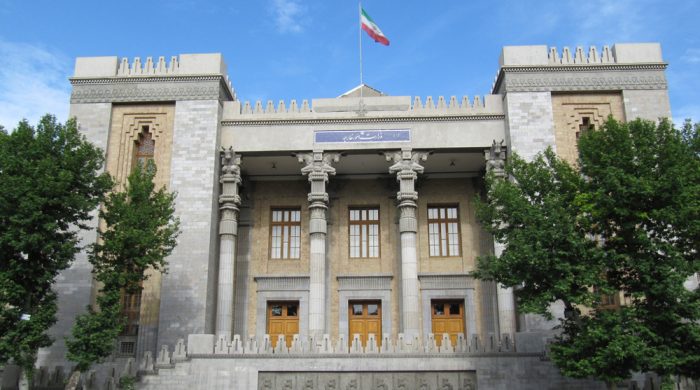
File photo of the building hosting Iran’s Foreign Ministry in the capital Tehran
Press TV – June 15, 2025
Iran’s foreign ministry has strongly condemned the Israeli military aggression on one of its buildings in the capital, Tehran, which left many people injured, including ministry staff.
Deputy Foreign Minister Saeed Khatibzadeh, in a statement on Sunday, denounced the assault as a “deliberate and ruthless” act perpetrated by the “criminal Israeli regime.”
“The casualties include a number of my colleagues, who were transferred to a hospital for treatment,” said Khatibzadeh, who also heads the ministry’s foreign policy think tank, Institute for Political and International Studies (IPIS).
Khatibzadeh described the incident as “yet another blatant war crime” and part of the Israeli regime’s “ongoing and systematic aggression” against the Islamic Republic.
His remarks come amid continued Israeli aggression on the Islamic Republic that began on Friday morning, targeting multiple locations across the country, including Tehran.
The brutal terrorist acts have resulted in the assassination of many senior military commanders, nuclear scientists, and civilians, including children and women.
In response, Iran launched Operation True Promise III, a continuation of its previous retaliatory campaigns against the Zionist entity.
The latest operation has involved large-scale missile and drone strikes by the Islamic Revolution Guards Corps (IRGC) targeting sites across the occupied Palestinian territories.
So far, Operation True Promise III has seen the IRGC carry out a series of coordinated missile and drone strikes against high-value strategic targets across the occupied territories, including deep strikes into Tel Aviv and the occupied port city of Haifa.
These precision strikes have targeted critical infrastructure, including airbases used by the regime to launch attacks against the Islamic Republic, command and intelligence centers, industrial complexes, and fighter jet production facilities.
A flood of videos circulating on social media shows Iranian ballistic missiles piercing through multiple layers of the regime’s air defense systems with remarkable effectiveness.
On Sunday, the IRGC vowed to sustain the strikes until the entity’s “complete destruction,” issuing a strongly worded statement directed at Tel Aviv’s steadfast Western allies.
Earlier on Sunday, foreign minister Abbas Araghchi said the US must accept its responsibility for Israel’s deadly aggression against the country, as evidence shows American forces helped the regime wage its terrorist assault on Iran.
“We have solid evidence indicating that American forces and bases in the region have supported the attacks by the Israeli regime’s military forces,” Araghchi told foreign envoys in Tehran on Sunday.
He emphasized that Iran’s response to Israeli aggression was based on the principle of self-defense in international relations and that every country has the legitimate right to defend itself against aggression.
Australian writer deported by US over pro-Palestine blog posts

Al Mayadeen | June 15, 2025
The Guardian reported on Sunday that an Australian writer was detained and deported by US authorities upon arrival at Los Angeles International Airport, allegedly due to his public commentary on pro-Palestine campus protests.
Alistair Kitchen, a 33-year-old from Melbourne, had traveled to the US last Thursday intending to visit friends in New York. However, during a layover in Los Angeles, he was held by US Customs and Border Protection (CBP) for 12 hours, questioned extensively, and eventually placed on a flight back to Australia. He landed in Melbourne on Saturday.
Kitchen believes his treatment was politically motivated. “The CBP explicitly said to me, the reason you have been detained is because of your writing on the Columbia student protests,” he told The Guardian. He added that the interrogation included detailed inquiries into his opinions on the Palestinian conflict, including his “thoughts on Hamas”.
“It was quite an in-depth probing of my views on the war,” he said. “They asked me what I thought about the conflict in a very broad sense, about student protesters, what Israel should have done differently, and how I would resolve the conflict.”
Deported Dissent
Kitchen previously lived in New York for six years and was a master’s student at Columbia University. During that time, he wrote about the Gaza solidarity encampment and published articles on his blog, Kitchen Counter. One piece focused on Mahmoud Khalil, a lead negotiator of the Columbia encampment who had been detained by US authorities. In that article, Kitchen described Khalil’s arrest as one made “on utterly specious grounds by a neo-fascist state” aimed at “the deportation of dissent”.
He pointed to a Trump-era executive order issued on January 30 that promised to cancel the student visas of pro-Palestine activists and enforce “law and order” against campus protesters.
Kitchen said he had attempted to reduce the risk of being flagged by deleting some “sensitive political posts” and content from his blog and social media prior to his trip. But he believes US authorities had already connected his ESTA application to his writings using digital surveillance tools.
“Clearly, they had technology in their system which linked those posts to my Esta … a long time before I took them down,” he said. “Because they knew all about the posts, and then interrogated me about the posts once I was there.”
Border Reprisal
According to Kitchen, he was called by name shortly after deplaning and taken for secondary processing. During questioning, he said he gave officers access to his phone, something he now regrets. “I had at that time, the wrong and false hope that once they realised I was, you know, just an Australian writer and not a threat to the US, that they would let me in,” he said. “But then they took my phone away and began downloading it and searching it.”
Kitchen said he felt “terrified of retribution and reprisal from the US government” for sharing his experience publicly, but believed it important to raise awareness. He encouraged other Australians facing similar treatment to avoid giving border agents access to their devices and to accept deportation immediately instead.
He has since restored the previously removed blog posts.
During his deportation, Kitchen said his phone and passport were handed over to a Qantas flight attendant, and he was unable to access them until arriving back in Melbourne. Qantas confirmed to The Guardian that its crew received a sealed envelope from US customs containing the passenger’s belongings, which were returned upon arrival. The airline declined further comment.
Iran preparing to ‘shut down Israel’s war machine’
RT | June 15, 2025
Tehran is gearing up to decisively counter Israel’s military operations, and intends to “shut down the regime’s war machine,” a senior Iranian security official told RT exclusively on Sunday.
Israel and Iran have been engaged in a fierce exchange of fire for three consecutive days. According to Israel’s emergency service Magen David Adom, Iranian strikes have killed at least ten people, bringing the total death toll to 13. In Iran, Israeli strikes have caused at least 406 deaths and 654 injuries, according to the group Human Rights Activists. The Iranian government has not released official casualty figures yet.
”Iran has been preparing for a long war,” the official told RT, emphasizing the country’s resolve to confront Israel. According to the source, millions of Iranians rallied in the streets on Saturday, defying West Jerusalem’s attacks, and demanding retribution. “This is an important support for Iran to continue its actions with force,” the official added.
The official outlined Iran’s extensive list of potential targets within “occupied territories,” which include covert residences of Israeli government leaders, energy facilities, factories supplying military aircraft, and critical command-and-control infrastructure.
Iran’s paramilitary Revolutionary Guard said that the country’s missiles had targeted fuel production facilities for Israeli fighter jets, a claim not acknowledged by Israel.
World leaders urgently called for de-escalation in order to prevent an all-out war. Russian President Vladimir Putin had condemned Israel’s strikes on Iran and expressed concern over further escalation. In a phone call with US President Donald Trump on Saturday, Putin reiterated Moscow’s willingness to facilitate negotiations.
Oman-mediated nuclear talks between Tehran and Washington were scheduled for Sunday; however, they were canceled following Israel’s strikes. Trump did not rule out the possibility of continuing the negotiations, saying, “They’d like to make a deal. They’re talking.”
Trump ‘open’ to Putin as Iran-Israel mediator
RT | June 15, 2025
US President Donald Trump said on Sunday he is open to Russian President Vladimir Putin serving as a mediator in the Israel-Iran conflict. In an hour-long phone call the previous day, the two leaders focused on the Middle East crisis.
“Yeah, I would be open to it. He is ready. He called me about it,” Trump responded to ABC News’ Rachel Scott, when asked about Putin’s potential role in brokering peace.
“We had a long talk about it. We talked about this more than his situation. This is something I believe is going to get resolved,” Trump added.
After the phone call the Kremlin later said that Putin had condemned Israel’s strikes on Iran and expressed concern over further escalation, while reiterating Russia’s willingness to facilitate negotiations.
Putin recalled that Moscow had previously proposed concrete measures to facilitate “mutually acceptable agreements” in US-Iran nuclear negotiations before the current escalation, presidential aide Yuri Ushakov revealed.
“Russia’s principled position and commitment to resolving this issue remain unchanged,” Ushakov stated. “As President Putin emphasized, we will continue to act accordingly.”
Despite the cancellation of Oman-mediated nuclear negotiations between Tehran and Washington following Israel’s strikes, Trump maintained that discussions continued. “They’d like to make a deal. They’re talking,” he said, suggesting the escalation might actually accelerate diplomacy.
When asked about possible American engagement in the conflict, Trump stated: “We’re not involved in it. It’s possible we could get involved. But we are not at this moment involved.”
The conflict in the Middle East escalated on June 12 when Israel struck Iranian nuclear sites, killing senior military officials and prompting retaliatory missile barrages from Tehran. Both sides have exchanged fire for a third straight day.
Israeli strike on Natanz nuclear facility ‘crime against international law, NPT’: Iran FM
Press TV – June 15, 2025
Iranian Foreign Minister Abbas Araghchi says the Israeli strikes on the Islamic Republic’s Natanz nuclear facility were a major crime under international law and the Non-Proliferation Treaty (NPT).
In a phone conversation with Spain’s Foreign Minister José Manuel Albares Bueno on Sunday, Araghchi once again asserted the peaceful nature of Iran’s nuclear program.
“The attack on the peaceful nuclear facilities of a country is absolutely prohibited, especially considering that Iran’s nuclear program is subject to the most stringent supervision (of the UN nuclear agency) and has been verified as per Resolution 2231 of the Security Council,” he said.
Iran expects that all countries and the International Atomic Energy Agency (IAEA) would condemn the Israeli aggression in the strongest terms, he added.
The Israeli regime, backed by the United States, carried out a large-scale military aggression on multiple locations inside Iran early on Friday, targeting nuclear facilities, military infrastructure, and residential buildings in Tehran and other cities.
The Natanz nuclear facility near Isfahan city was also hit, although only surface damage was caused because the centrifuges are buried deep underground. There were no radiation or casualties.
The Iranian foreign minister said the Israeli regime flagrantly violated the principles of the United Nations Charter and international law by conducting its acts of aggression in the midst of indirect nuclear talks between Iran and the United States.
Araghchi added that the Tel Aviv regime violated Iran’s sovereignty and territorial integrity by attacking nuclear facilities and residential areas inside the country just two days before the sixth round of Tehran-Washington talks in the Omani capital of Muscat.
“It is clear that the main objective of this act of aggression was to have a destructive impact on the diplomatic processes and to drag others into an unjust war,” the top Iranian diplomat emphasized.
Pointing to Israel’s record of attacks on residential areas and its killing of a large number of innocent women and children, he said, “Defense is the response to the aggression.”
Araghchi emphasized that the Iranian Armed Forces would strongly proceed with their “completely calculated defensive operation” to protect national sovereignty, territorial integrity, and civilians.
The Spanish foreign minister, for his part, expressed concern over the escalation of tensions in the region and voiced his country’s readiness to help ease the tensions.
Featured Video

Israel furious at Trump over Turkey, Syria to invade Lebanon
or go to
Aletho News Archives – Video-Images
From the Archives
Bum Rap for the Rapa Nui
By Thomas Riggins | Dissident Voice | February 5, 2014
A new report in Science News Magazine (1-25-2014) by Bruce Bower details a reevaluation of the view that the Rapa Nuians, the native inhabitants of Easter Island (Rapa Nui), were responsible for the collapse of their population and society due to over exploitation of natural resources and the destruction of the rain forest on their island, a view recently popularized by Jared Diamond in his book Collapse (2005).
As Bower reports, the anthropologist Maria Mulrooney has published the results of her studies of the Rapa Nui culture (Journal of Archeological Science, December 2013) based on new radiocarbon dates from archeological sites on the island. She has concluded that after the clear cutting of the forest in the 1500s, to make room for agricultural production, the population of Rapa Nui remained sufficiently vibrant to carry on food production and continue their cultural development.
Exactly when the Rapa Nui arrived on Easter Island is unknown but it was on or before 1200 A.D. or so. Mulrooney maintains they had a thriving culture which was still going strong even after their “discovery” by the Dutch explorer Jacob Roggeveen on Easter Sunday 1722. This would indicate that they had not suffered “collapse” as a result of forest clearance. … continue
Blog Roll
 Aletho News
- Abelardo De la Espriella’s Victory Renews Pressure on Venezuela
- Israel furious at Trump over Turkey, Syria to invade Lebanon – w/ Col. Macgregor
- IRGC says it struck US military positions, warns of broader response
- Russia stops record number of Ukrainian drones overnight – MOD
- Denmark admits ‘no evidence’ for Russian drone hysteria
- Washington agreement ‘will not pass’: MP Fadlallah
- Iran mocks US for ‘solving’ domestic hunger problem, lecturing others on issue
- Germany, Israel hold joint naval drill off Haifa amid Gaza genocide
- Trump’s war on Iran becomes ‘most unpopular conflict’ in US history
- The Middle East is wringing its hands of Washington. Finally
- If Americans Knew
- Four Reasons the Netanyahu-Backed Plan to ‘End’ U.S. Military Aid to Israel Is a Scam
- Archbishop of Canterbury vows to help Palestinians achieve ‘freedom you deserve,’ calls for end to Israeli occupation
- The scars left behind by Israel’s white phosphorus in Lebanon
- Drones and decomposing babies: What’s in UN report on Israel’s genocide of Palestinian children
- Crimson Thread: The new Israeli separation wall that cuts through the ‘breadbasket of Palestine’
- Gaza ceasefire talks back to square one as Israel changes the rules – Daily Update
- The NDAA Proposed Merger of the U.S. and Israeli Military is Strategically Unwise and Inherently Unconstitutional
- Victories by Pro-Palestinian Democrats Show the Party’s Shift on Israel
- Massie moves to strike $3.3B in Israel military aid from the budget
- How Jeffrey Epstein’s Israeli Network Shaped Congo’s Deadly Mineral Trade
- No Tricks Zone
- Lousy Station Siting: Swirling Controversy Surrorunds Germany’s Latest “New Alltime Record High” Temperature
- 2025 Study: Cloud Effects Reduce Downwelling Longwave Radiation, Overriding The CO2 Impact
- 3 New Studies Find Increasing Trends In Solar Radiation Since The 1980s – Easily Explaining Warming
- THE TRANSCEIVER PARADOX: Why Organoid Intelligence (OI) Could Become Our Ultimate Alien Predator
- German Wind Turbines Face Regulatory Shutdown Due To Excessive Noise
- New Study: Chile’s Relative Sea Level Was 3.2 Meters Higher Than Today During The Mid-Holocene
- Beyond The Pitch: Why FIFA’s World Cup Is One Of Humanity’s Best Investments
- Climate Alarmists Now Using Natural Phenomena To Support Their Claims
- New Study: Significant CO2 Fluxes From Non-Volcanic Sources Are Largely Neglected In Carbon Budgets
- Women Climate Scientists Being Harassed, Insulted By Skeptics, Claims Berkeley Earth Researcher
 Aletho News