In The Name of ‘Helping Iran’, The U.S. And Israel Slaughter Over 100 Iranian Schoolgirls

The Dissident | February 28, 2026
During his announcement of the current U.S./Israeli regime change war on Iran , Trump framed the war under the pretext of helping Iranians, saying:
to the great, proud people of Iran, I say tonight that the hour of your freedom is at hand. Stay sheltered. Don’t leave your home. It’s very dangerous outside. Bombs will be dropping everywhere. When we are finished, take over your government. It will be yours to take. This will be, probably, your only chance for generations.
For many years, you have asked for America’s help, but you never got it. No president was willing to do what I am willing to do tonight. Now you have a president who is giving you what you want, so let’s see how you respond. America is backing you with overwhelming strength and devastating force. Now is the time to seize control of your destiny and to unleash the prosperous and glorious future that is close within your reach. This is the moment for action. Do not let it pass.
But after one day of war, the U.S. and Israel have already carried out a massacre of over 100 children.
The Financial Times reports that, “A primary school in southern Iran was struck during Saturday’s joint US-Israeli military operation, killing at least 108 people who were mostly schoolgirls, according to Iranian authorities.”
According to the governor of Hormozgan Province, Mohammad Ashouri, “In addition to the deaths, 92 people were injured and an unspecified number trapped under rubble”.
The Guardian reported that , “In one video circulating on social media, purportedly showing the immediate aftermath of the strike, smoke rises from the burnt-out walls, and debris lies spread across the road. Hundreds of onlookers gathered at the site, some in obvious distress. Screams can be heard in the background,” adding, “Persian factchecking service Factnameh was able to cross-reference the video with other photographs of the school site, and concluded that the video was authentic. Reuters said it had also verified the footage as being from the school.”
Other footage also shows the bodies of the student girls who were killed in the massacre.
This massacre has also been confirmed by multiple witnesses who have spoken to the media.
Middle East Eye interviewed a staff member at the school who said, “She used to watch these young girls playing at school every day. But after today’s strikes, she saw their bodies lying on classroom benches and in different corners of the school.”
Middle East Eye added:
She said she had stepped out of the school to take care of something when she suddenly heard a horrifying sound. Within seconds, a missile – or something like it – hit the school building.
After hearing the blast, she ran back toward the school and was faced with a scene she says she will never forget for the rest of her life.
“I felt like I had gone mute. I couldn’t speak,” the staff member told MEE. “You could hear the sound of children crying and screaming.”
Drop Site News spoke to Mohammed Shariatmadar, the father of a six-year-old girl named Sara killed in the massacre, who said, “I cannot understand how a place where innocent children learn can be bombed like this, We are talking about small children who knew nothing of politics or wars. And yet they are the ones paying the highest price,” adding, “My heart is broken, For Sara and for all the children we lost today. I want the world to know that the children are the real victims. Every day that passes without a solution increases the pain and the suffering for the families and for the children alike”.
Another witness told Drop Site News, “Everyone rushed to the school the moment they heard the blasts. Chaos took over completely. Security forces were trying to push families back, fearing the area would be targeted again.”
Seyyed Ibrahim Mirkhayali, a father who lost his nine-year-old daughter in the massacre said, “I was at work when my wife called and told me that the girls’ primary school in Minab had been bombed. I could not process what I was hearing at first. Then I left immediately and drove to the school. The atmosphere was terrifying and catastrophic. The parents were in a deadly silence, filled with fear and dread for their daughters. We did not know who had gotten out and who was still under the rubble”.
Along with this media reports that “In Fars Province, also in southern Iran, ‘Israel’ killed 20 volleyball players in a strike on a sports hall in the city of Lamerd, according to a provincial official.”
While pretending to care about Iranians, the U.S. and Israel are clearly happy to massacre children and civilians in Iran in order to carry out the real goal of destroying Iran as a nation.
Why are Americans killing and dying for Israel, again?
By Tarik Cyril Amar | RT | February 28, 2026
Israel and its US auxiliaries have attacked Iran. In terms of international law and elementary justice, things are clear beyond the slightest doubt: the attack is a war of aggression – but to be fair, in Israel’s case that hardly makes a difference anymore.
With ‘highlights’ including apartheid, ethnic cleansing, unlawful detention, torture, sexual violence, and genocide, Israel has such an extensive and constantly growing record of, literally, every crime under international law, including human-rights and humanitarian law (or the law of armed conflict), that one more or less hardly seems to matter anymore. This state is a monster, and monsters will monster as long as they can.
The US, of course, is no spring chicken either when it comes to treating international law – really, any law – as a doormat and brutally, gleefully violating the most basic ethics, the kind of simple rules normal people intuitively recognize, such as “don’t murder, lie, or steal.”
Indeed, while Israel can easily claim to be the single most criminal, indeed evil country in the world, the US wins the most-powerful-rogue-state prize hands down. There is – empirically, quantifiably – no other country that combines such ingrained and increasingly explicit scorn for law and morality with such brute power and perpetual violence. Before the current assault on Iran, the kidnapping of Venezuelan President Nicolas Maduro was just the last proof of that fact, so glaringly obvious that it woke up even some Western commentators.
If some things are too obvious to merit further discussion, others are more intriguing. Let’s start with the greatest mystery: Why is the US joining – really, obeying – Israel and its powerful American lobby once again in going to war in the Middle East? Was Iraq 2003 not enough of a disaster? Are the American elites really congenitally unable to learn?
In terms of actual US interests, war against Iran makes no sense at all. Iran is not close to a nuclear bomb and, as a matter of fact, has a religiously and ethically based (hard to grasp in Washington, I know) explicit policy against acquiring one. And even if Iran were building such weapons or seeking a state of being “latently” able to do so as urgently needed insurance against permanent Israeli and US aggression, Washington would gain nothing and risk very much by going to war.
On the other hand, it was precisely the JCPOA agreement with Iran, destroyed by the US during the first Trump presidency, that proved empirically that the issue of Iranian nuclear energy use can be resolved well by compromise. As to recent, hysterical US claims about other types of WMDs and “intercontinental missiles,” it is time to no longer give such crude, dumb lies the time of day. Enough with the propaganda already.
Regime change? So, please could someone explain why installing a washed-out Pahlavi princeling – if it ever were to work, that is – in Tehran is good for Americans? Spoiler, no one can. At least not honestly. Do I hear someone say geopolitics? Oh, that would mean the “genius” geopolitics of risking a long war with great damage to the US and its regional allies? Then, perhaps it’s all about plunder? Yes, true, the US simply loves plundering. Historically speaking, the whole country is built on it, just like Israel. But even plunder on its own despicable terms only makes sense if you turn a profit. Good luck with that while sinking more gazillions into war-for-Israel.
And that brings us to the only explanation that does make sense, even if in a very grim way: The US, as in almost all Americans, has zero interest in war with Iran. As little as in a proxy war with Russia and a Cold War with China, both strategies, by the way, doomed to fail. In all three cases, the vast majority of Americans would only stand to benefit from peaceful and cooperative relationships.
But Washington chooses permanent conflict and war against Iran anyhow. The reason is that US policy in the Middle East – and not only – has been captured by Israel and its lobby. As John Mearsheimer, both doyen of explaining international relations by national interests (the theory of Realism) and co-author of the standard work on the Israel Lobby, has long acknowledged, Israel’s influence on the US is real, contradicts American interests, and forms an exception to the theory of realism in that Washington is constantly hurting its own country.
For reasonable observers, this case is closed. When devastating the Middle East, the US is acting not in its own genuine national interest but the perverse conception that Israel has of its national interest: subjugating and, if needed, destroying all sovereign states in its neighborhood so as to create and preserve Israeli domination and even ‘Greater Israel’, a nightmare of ‘Lebensraum’ for Zionist settlers from, at least, Egypt to Iraq.
But, again, why? This is where the Epstein scandal makes a difference – or should do so – to unbiased minds. We must acknowledge that Jeffrey Epstein was not “merely” a very rich and perverse criminal with far too many friends in high places but an agent of Israel, whether with a direct affiliation to its dreaded Mossad service of spying, murder, and subversion or not. His core operation served to gather extremely compromising blackmail material on large swathes of the elites of the US and the West more generally. FBI agents, we now know, assessed that Trump himself is among those trapped in this manner. If anything, frantic – and also, again, criminal, efforts – by Trump’s Department of Justice and his head of the FBI to purge the files of references to the current president and his friends only provide further corroborating evidence that Trump is under Israel’s control.
Remember ‘Russiagate’ (really, of course, Russia Rage)? The irony! Russia was never remotely close to (or even trying) to having a US president under its thumb. That was all BS. Yet, in the end, ‘Russiagate’ did do two things: it gave Trump a (fundamentally realistic if exaggerated) sense of having been a victim of a smear campaign and, among voters, it helped Trump make his furious comeback, without which he would not now be in power. The delusion and mass hysteria of ‘Russiagate’ – which was that famous American thing, a nothing-burger – paved the way for the power that really controls Trump and really does enormous damage to America: Israel and its lobby.
Will Americans ever free themselves from the one state and network that have really run history’s most successful subversion and state-capture operation on them? Who knows? We know that it would take more than putting an end to Epstein-like blackmail. If anything, Trump’s bitter enemies, Joe Biden and Kamala Harris, have only recently shown us that the American “elite” is enthralled to Israel and its crimes also for reasons ranging from being bribed to sharing the vile insanity of Zionism. If the US ever wants its independence back from Israel, all of that will have to go.
Tarik Cyril Amar is a historian from Germany working at Koç University, Istanbul, on Russia, Ukraine, and Eastern Europe, the history of World War II, the cultural Cold War, and the politics of memory.
Timing of US-Israel attack on Iran bears symbolic meaning in Judaism
By Tal Shalev | CNN | February 28, 2026
The timing of the US and Israeli attack on Iran bears symbolic meaning in Judaism. Ahead of the upcoming Jewish holiday of Purim, worshippers read the specific portion from the Old Testament, known as Zachor.
The passage from the book of Deuteronomy commands the ancient Israelites to remember an unprovoked attack by the nation of Amalek and to eradicate the memory of Amalek once the Israelites are settled in their land.
The passage is read publicly before Purim to fulfil the mitzvah of remembering Amalek as Israel’s achetypical enemy.
70 martyrs, 90 wounded in US-Israeli strike on elementary school
Al Mayadeen | February 28, 2026
Iran’s ISNA news agency reported that dozens of students remain trapped under the rubble, while a number have been rescued. A hospital in the same area also suffered partial damage, according to ISNA.
Iran’s Mehr news agency further reported that two students were martyred in the Narmak area of Tehran.
Iran Invokes Article 51 of the UN Charter
In the official statement from the Iranian Foreign Ministry, Iran invoked Article 51 of the United Nations Charter, affirming its legitimate right to self-defense following the Israeli strikes on Iran.
The ministry characterized the airstrikes as a violation of Article 2(4) of the United Nations Charter, which prohibits the use of force against the territorial integrity or political independence of any state.
According to the statement, “The Armed Forces of the Islamic Republic of Iran will respond forcefully to any attack.” The ministry reiterated that Iran would use all its capabilities to deter aggression and confront its enemies.
Call on the UN Security Council
Iran also called on the United Nations and the UN Security Council to take immediate action in response to the blatant violation of international peace and security.
The statement urged the UN Secretary-General, as well as the President and members of the Security Council, to fulfill their responsibilities without delay.
It also appealed to all UN member states, particularly countries in the region, members of the Islamic world, and states belonging to the Non-Aligned Movement, to condemn the act of aggression and to adopt urgent and collective measures to halt it.
The ministry warned that the escalation represents an unprecedented threat to regional and global peace and security.
Trump Starts a Major Regime-Change War with Iran, Serving Neoconservatism and Israel
By Glenn Greenwald | February 28, 2026
For decades, Israeli Prime Minister Benjamin Netanyahu and American neoconservatives have dreamed of only one foreign policy goal: having the United States fight a regime-change war against Iran. With the Oval Office occupied by Donald Trump — who campaigned for a full decade on a vow to end regime-change wars and vanquish neoconservatism — their goal has finally been realized.
Early Saturday morning, the United States and Israel began a massive bombing campaign of Tehran and other Iranian cities. President Trump posted an eight-minute speech to social media purporting to justify his new war, dubbed “Operation Epic Fury.” Trump’ war cry was filled with the same slogans and clichés about Iran that Americans have heard from the carousel of bipartisan neocons dominating U.S. foreign policy for decades: Iran is a state sponsor of “terror”; it is pursuing nuclear weapons; it took American hostages forty-seven years ago (in 1979); it repressed and kills its dissidents, etc.
As if to underscore how fully he was embracing the very foreign policy dogma he vowed to reject, Trump invoked the Marvel-like “Axis of Evil” formulation that White House speechwriter David Frum wrote for George W. Bush at the start of the War on Terror. Iran’s government, President Trump proclaimed, is one determined to “practice evil.” This is how Bush — speaking of Iraq, Iran and North Korea — put it in his 2002 State of the Union address: “States like these, and their terrorist allies, constitute an axis of evil.”
Trump left no doubt about the scope and ambition of his new war. This will not be a quick or targeted bombing run against a few nuclear sites, as Trump ordered last June as part of Israel’s 12-day war with Iran. There is nothing remotely constrained or targeted about any of this. Instead, this new war is what Trump called a “massive and ongoing” mission of destruction and regime-change, launched in the heart of the Middle East, against a country of 93 million people: almost four times the size of Iraq’s population when the U.S. launched that regime change war back in 2003.
That Trump claimed to have “completely and totally obliterated” Iran’s nuclear program last June — just eight months ago — was not something he meaningfully acknowledged in his new war announcement, other than to vaguely assert that Iran somehow resumed their nuclear program. In fact, Trump seemed to delight in repeating the same triumphalist rhetoric that he used last year when he assured Americans that Iran’s nuclear program could no longer pose a threat as a result of Trump’s triumphant Operation Midnight Hammer.
In lieu of outlining any clear mission statement for this new war, let alone a cogent exit strategy, Trump offered a laundry list of flamboyantly violent vows. The U.S. will “totally obliterate” Iran’s ballistic missile program (which Iran could not use to reach the American homeland but which Trump admitted last June caused Israel “to get hit very hard” in retaliation). Trump also promised that the U.S. would “annihilate” Iran’s navy. And he told Iranians: “the hour of your freedom is at hand….bombs will be dropping everywhere.”
Trump also attempted to prepare the nation for caskets and body bags of American soldiers returning to the U.S. “The lives of courageous American heroes may be lost; we may have casualties,” the President said. But, said the man who did everything to avoid military service including during the Vietnam War, mass death of American soldiers “often happens in war.”
In sum, Trump just launched the exact war that most of his MAGA movement professed to oppose. That included one of Trump’s most influential supporters, the late Charlie Kirk, who repeatedly maligned the neocons’ drive for war with Iran as “pathologically insane,” and warned that grave disaster of historic proportions would be the result:
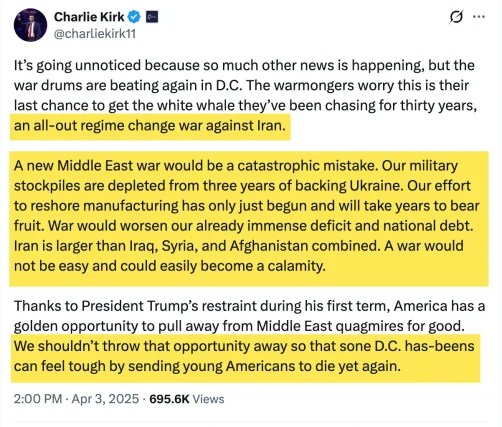
Charlie Kirk, X, April 3, 2025, warning against a regime-change war in Iran
The false claims behind this new war with Iran are ones we have extensively documented. In Trump’s war announcement this morning, he claimed — as he did at Tuesday’s State of the Union address — that Iran refuses to promise that it will not obtain nuclear weapons. The exact opposite is true: Iran has stated this clearly, unequivocally and repeatedly, and did so as recently as this week. “Iran will under no circumstances ever develop a nuclear weapon,” proclaimed Iran’s foreign minister Seyed Abbas Araghchi.
The consequences of this new Trump/Netanyahu war of choice cannot be predicted with any degree of certainty. Already, Iran has launched numerous retaliatory ballistic missiles at Israel, as expected, and has also attacked U.S. military bases in the United Arab Emirates, Qatar, Bahrain and Kuwait.
But the lack of predictable outcomes is, of course, precisely the point. If the U.S. and Israel succeed in their stated goals of widespread “annihilation” and regime change, then they will create, at the very least, a huge power vacuum in the middle of the world’s most volatile region that will require U.S. resources and a sizable military presence for years if not decades to come. One of the world leaders most responsible for the Iraq War, former British Prime Minister Tony Blair, admitted that it was the invasion of Iraq that gave rise to ISIS.
It is hard to overstate what a massive fraud Donald Trump, his campaign and his political movement are. For more than a decade, Trump has ranted and raved against the evils of regime-change wars and neoconservative dogma, only to launch a new war that most perfectly encapsulates and aggressively advances both. He spent years falsely warning that former President Obama would start a war with Iran because of how weak and inept Obama supposedly was at negotiation and diplomacy, only to now do that himself (rather than start a new war with Iran, as Trump predicted, Obama entered a diplomatic agreement with them which major nuclear bodies attested was effective in monitoring Iran’s nuclear activities: a deal which Trump, at Israel’s insistence, tore up in 2018).
Throughout the 2016 campaign, Trump mercilessly mocked Marco Rubio for receiving millions in donations from Sheldon and Miriam Adelson, money that Trump said would “mold [Rubio] into [their] perfect little puppet,” only for himself to become not only the largest beneficiary of Adelson funding in history, but to become the ultimate puppet of the Adelsons’ agenda, one which Trump has clearly acknowledged — when speaking in Israel last year — is an agenda that puts the interests of Israel atop everything, including Americans’ interests:
“I get her in trouble with this, but I actually asked [Miriam] once… ‘What do you love more? The United States or Israel?’ She refused to answer. That might mean Israel,” Trump says, smiling, while looking at the dual Israeli-American national.
And it is not an exaggeration to say — in fact, basic honestly requires one to say — that the 2024 Trump/Vance campaign is one of the most fraudulent political campaigns in American history:

Just one week before the 2024 election, Tulsi Gabbard proclaimed that “a vote for Kamala Harris is a vote for Dick Cheney and a vote for war, war and more war.” Conversely, Gabbard said, “a vote for Donald Trump is a vote to end wars, not start them.” Other than immigration, this “no-new-wars” theme was the most central to Trump’s political appeal and his political promises since he emerged on the political scene a decade ago.
One can rehash the decades of now-trite arguments about Iran as much as one wants. But such endless debate cannot alter the facts here that are indisputable and fundamental.
Iran has not attacked and could not have attacked the United States at home. No such attack was even arguably imminent. The new war that Trump just started with Israel is thus the definitive war of choice.
In contrast to the lie-driven 18-month public campaign of Bush and Cheney to convince the American public to support an invasion of Iraq, there has been virtually no attempt made, as I documented this week, to even explain to the American public why a new war with Iran is necessary or desirable. There has been no Congressional approval sought let alone obtained, notwithstanding the U.S. Constitution’s exclusive assignment of war-making powers to the Congress.
In his novel 1984, George Orwell highlighted the dangerous insanity of war propaganda with this leading example: “WAR IR PEACE.” Yet that is precisely the rationale invoked by various Trump supporters to somehow depict this new war as aligned with Trump’s vows of peace (starting massive new wars is merely “peace through strength”).
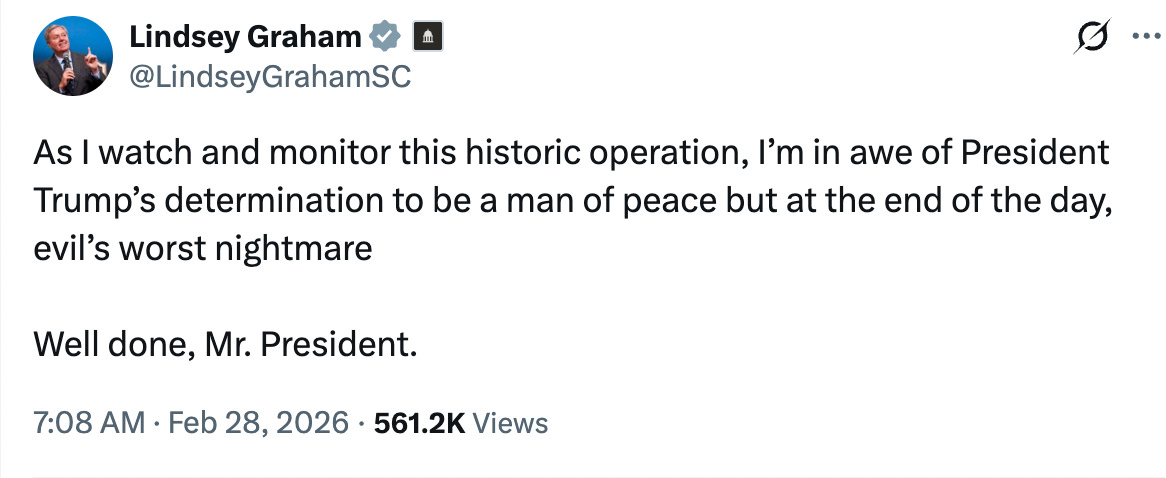
This is, obviously, the war that Israel and Trump’s largest Israel-loyal donors most wanted and have long been pressuring him to start. Pro-Israel billionaires like Bill Ackman, long-time pro-Israel warmongers like Lindsey Graham, and Israel First activists like Mark Levin are of course already boisterously celebrating this new war against Israel’s primary adversary.
But this is ultimately an American war, one that Trump unilaterally started and for which Trump is responsible. Notably, of course, it is not Trump or his family, but instead everyone else in the world, who will bear the costs and burdens of the war. This was the point Trump famously emphasized shortly before the 2024 election — on November 1 — when explaining why Washington is full of sociopathic warmongers such as Dick and Liz Cheney who constantly start wars in which other people’s families, but never their own, must go fight and die.
As Trump’s senior White House advisor Stephen Miller said about those comments, “warmongering neocons love sending your kids to die for wars they would never fight themselves.” Indeed they do, Stephen Miller.
Do not expect meaningful opposition from the Democratic Party. Some of them, perhaps most, will make loud noises in protest. But the party’s senior leader, Sen. Chuck Schumer (D-NY), this week urged Trump to make the case to the public about why this war was necessary, whereas Schumer last June mocked Trump for attempting to obtain a peace deal with Iran and accusing him of “chickening out” of the war with Iran that he prosed. Some Democrats, such as Sen. John Fetterman (D-PA), are effusively praising Trump and his new war.
This new war against Iran is as pure a continuation of the bipartisan DC posture of endless war that has, more than any single cause, destroyed American prosperity, standing, and future over the last six decades at least. The only question how is how many people will die, for how long the damage will endure, and what new unforeseen evils will be created in its wake.
The KAL Flight 007 Tragedy
Tales of the American Empire | February 26, 2026
The United States government has admitted that over 200 American military personnel were shot down aboard aircraft while spying over the Soviet Union during the Cold War. American Generals had sent aircraft probing into Soviet airspace to test reactions and collect intelligence. They loved to play cat and mouse games to taunt the Soviets. This was considered good training that provided valuable intelligence. These games resulted in 269 civilian deaths in 1983 when a Korean airliner (KAL Flight 007) was shot down as it flew over the Soviet Union.
_________________________________
“Secret Casualties of the Cold War”; Air & Space Magazine; Paul Glenshaw; December 2017; https://www.smithsonianmag.com/air-sp…
“A Shot in the Dark: The Untold Story of Korean Air Lines flight 007”: Kyra Dempsey (aka Admiral Cloudberg); Medium; May 20, 2024; / a-shot-in-the-dark-the-untold-story-of-kor…
“DISGUISED RC-135W RIVET JOINT OF U.S AIR FORCE CARRY OUT SURVEILLANCE OF CHINESE MILITARY BASES!”; Defense Updates; September 17, 2020;  • DISGUISED RC-135W RIVET JOINT OF U.S AIR F…
Related Tale: “A U-2 and World Peace were Sabotaged in 1960”; • A U-2 and World Peace were Sabotaged in 1960
Why Trump’s war on Iran will fail
By Tamer Ajrami | MEMO | February 27, 2026
The United States has turned the talks with Iran upside down. What is happening now does not look like serious negotiations. It looks more like a way to buy time and prepare for a more dangerous phase. That is why two questions matter: Why Trump’s war on Iran will not succeed, and why would it be a dangerous choice for Washington? The answer is simple. The demands Washington is putting on the table are designed to be rejected, and because any military action, if it occurs, will reveal the limits of force, the logic of exhaustion, and the absence of a clear or achievable goal.
All the talk about a deal, gaps, and loopholes continues to go around in circles. On the ground, the US is moving in a completely different direction: it is raising the bar in a way that ruins the talks from the inside and pushes things toward escalation.
Washington now says it has clear conditions. In reality, these conditions make any settlement almost impossible. The first demand is that Iran hand over all its enriched uranium directly to the United States. Not to a third country, not through an international mechanism, not through gradual reductions. Just hand it over to Washington. This is not meant to produce a balanced agreement. It is meant to humiliate a state and force it to give up a highly sensitive part of its sovereignty.
The second demand is even clearer: dismantle Iran’s nuclear facilities and destroy them completely, including major sites like Isfahan, Natanz, and Fordow, along with underground facilities hidden in mountains. The irony is that Washington and its allies do not have full certainty about what earlier strikes (12-day war, June 2025) actually achieved inside these deep facilities. So, the demand for dismantling and destruction looks like a political cover for the simple reality of what lies underground is not easy to reach.
On sanctions, the US offers no clear path. The talk is about lifting a limited set of sanctions imposed recently, while keeping the main sanctions in place under a long “test.” Has Iran truly surrendered, or is it only offering symbolic concessions? Then comes the most dangerous condition of all: the deal must be permanent, Iran must stop enrichment completely, and this must last forever. These are not terms for a fair agreement. They are terms of surrender.
That is why this round looks more like the round before war. The US military buildup in the region is still expanding, and the flow of aircraft, defence systems, and naval assets continues. Everyone is watching everyone through satellites. Almost nothing can be hidden. The real message is not in press statements. It is in the movements that create a new reality and make escalation feel closer than a settlement.
But if a strike happens, it will be full of risks. Even in the American media, one question keeps coming back: what exactly are Trump’s goals? Does he want a limited strike to force Iran into quick concessions? Does he want a wider campaign to bring down the regime? Or does he simply want to declare that he “destroyed” the nuclear program without being able to prove it? The problem is that these goals clash with each other, and each one requires different tools, different costs, and different timelines.
Time is part of the problem too. Some estimates suggest that the ability to keep up intense operations with the current level of forces may be limited. This connects with warnings about running down air defences and burning through advanced / expensive ammunition in a campaign that does not guarantee results. In other words, if war starts, it may quickly turn into a war of exhaustion. It is exactly the kind of fight Washington does not want.
If Iran can launch large waves of ballistic missiles, it can drain defensive stocks on US ships and at US bases in the region fast. Then comes the embarrassing question: how does the US keep fighting? And how does it stop without looking like it pulled back under fire? If Iran keeps firing while the US withdraws, the image inside America would be politically costly.
That is why the administration, based on what is being discussed in Washington, may look for a way to sell the war at home. One idea is for Israel to launch the first strike, and then for the US to step in later under the banner of “defending Israel”. That makes it easier to justify the intervention in Washington, because critics will face a ready-made slogan: we are defending an ally.
But on the ground, it is hard to separate who starts and who joins. US and Israeli forces operate in the same environment and in overlapping ways. The real difference is not in the sky. It is in the story Washington wants to tell its public.
Even if a strike happens, the main question remains: can airstrikes alone achieve big goals? Many analysts say hitting facilities becomes like a game of chasing a moving target. You destroy one site, it gets rebuilt. You hit a surface facility that was emptied beforehand. Equipment and materials are moved elsewhere. As for facilities buried deep in mountains, they remain a major problem. Access is not guaranteed, and photos alone cannot prove total destruction.
More importantly, a nuclear programme is not just concrete and steel. It is knowledge, technology, experience, and an industrial base. Even if part of it is damaged, Iran can repair it over time. Claims of “total destruction” therefore sound more like political messaging than a verifiable reality.
The missile program is an even bigger challenge. Iran produces missiles in large numbers and has the industrial and scientific base to rebuild its stock after any confrontation. Even if the US hits some production lines, wiping the program out completely would require long-term control on the ground and not just airstrikes.
Here is the truth that official speeches avoid: if Trump’s real goals are regime change, removing Iran’s missile power for good, or forcing “zero enrichment” forever, then airstrikes will not deliver that. Those goals require a major ground war and a long occupation. This then may bring huge losses, heavy costs, and years of deep involvement.
This would not serve the US at a time when competition with China is rising. Burning through advanced and expensive American capabilities in the Middle East without clear gains could give China a strategic advantage and push it to move faster on bigger priorities like Taiwan, while Washington remains stuck in a war with no clear ending.
There is also a constant operational risk in any large air campaign: an aircraft could be shot down, a pilot could be captured, or a major incident could happen in a sensitive strait. One such event can turn a limited strike into a wider war, and shift the focus from negotiating nuclear issues to negotiating prisoners and political humiliation.
So, Washington faces two costly paths: a full-scale war it does not have the political tools to sustain, or airstrikes that will not achieve the announced goals but could open the door to further escalation. In both cases, negotiations become a temporary cover while the region moves toward a dangerous test of power and its limits.
The bottom line is this: raising demands to the level of humiliation does not lead to an agreement. It pushes the other side toward rejection and then toward preparation for confrontation. When talks become terms designed to fail, they do not prevent war. They delay it to a moment chosen by Washington; after the battlefield is prepared and the political story is already written.
In the end, the problem is not that Washington has less power. The problem is that it is pursuing goals that are bigger than its tools. Airstrikes do not topple regimes, erase nuclear know-how, and do not end a missile program that can be rebuilt. The higher the US raises its demands, the more it closes the door to diplomacy and the closer the drift toward confrontation.
If war begins, it may quickly become a costly fight with no clear ending: defenses get drained, rare munitions get burned, markets shake, and bases come under attack. Then an unsolved question will rise inside the US: how do we end this without political defeat? Failure becomes likely because the goals cannot be achieved by bombing alone. And the danger is huge, because escalation may spiral beyond control. In a war like this, Washington might win a round in the air, but lose the bigger game on the ground.
Ukraine Given $43Bln in Proceeds From Russian Assets Frozen by G7 Since 2024 – Estimates
Sputnik – 27.02.2026
The G7 nations have issued $3.8 billion in loans to Ukraine in 2026 using proceeds generated by frozen Russian state assets, bringing the total amount of loans given to Kiev since 2024 to almost $43 billion, according to calculations by Sputnik based on data from the Ukrainian Finance Ministry and national agencies.
In 2024, the G7 countries approved a $50-billion loan to Ukraine, funded by revenues from frozen Russian assets. By late February 2026, the countries had allocated $42.7 billion to Ukraine under this scheme.
The first billion was transferred to Ukraine by the United States in late 2024. Since then, Washington has not provided any new funding to Kiev from Russian asset proceeds. The other members of the G7 gave Ukraine $37.9 billion in 2025 and $3.8 billion in 2026.
Overall, the European Union has contributed $32 billion in funding to Ukraine as part of the loan secured by Russian assets. Canada has contributed $3.6 billion, while Japan and the United Kingdom have each contributed approximately $3 billion.
The military is babying F-35s to hide their true cost to taxpayers
By Mike Fredenburg | Responsible Statecraft | January 23, 2026
Are the military services babying the F-35 to obscure its true costs while continuing to get enormous sums of taxpayer funding for a plane that has consistently failed to live up to performance expectations?
From the very beginning, the F-35 program has been plagued by hundreds of billions of dollars in cost overruns and repeated schedule delays.
Moreover, even as promised capabilities have been delayed by well over a decade, billions poured into fixes haven’t resolved ongoing reliability issues, crippling its operational effectiveness, and rocketing the program cost to over $2 trillion dollars — 400% more in inflation-adjusted dollars than its 2007 Government Accountability Office estimate.
The plane’s extreme unreliability has resulted in full mission capable rates (FMC) of only 36.4% , 14.9%, and 19.2% for the F-35A, F-35B, and F-35C, respectively. For F-35Bs and F-35Cs, only the newest planes have full mission availability rates above 10%.
Unsurprisingly, the services and Lockheed Martin don’t really like to talk about FMC; instead, they like to focus on mission-capable (MC) rates of roughly 50%. While much lower than the 90 percent promised by Lockheed Martin and its service partners, it certainly sounds much better than the dismal FMC rates. But MC is a very deceptive measure, and the services know it, as “mission capable” aircraft need only be capable of flying non-combat missions, such as training, ferrying, or public relations, etc.
But the MC deception is only part of the equation when it comes to just how little bang-for-the-buck taxpayers are getting for their dollar.
Strong circumstantial evidence, coupled with emerging data and the services’ long history of stonewalling when it comes to problems associated with major programs, suggest that the U.S. military services , as well as prime contractor Lockheed Martin, have been babying the F-35s to obscure just how unreliable and expensive they would be if not being nursed along.
This coddling of the F-35 lowers some costs and pushes other costs into the future, keeping current year expenses as low as possible. This makes the program look like it is more efficient and effective than it really is, improving the chances of selling and delivering more F-35s while decreasing the chances the program will be curtailed or even canceled.
Major maintenance cost factors
There are three major drivers of wear and tear on an aircraft like the F-35: how many missions (sorties) it carries out, how many flight hours it accumulates, and how it’s flown during a mission.
Missions/Sorties are the best predictors of maintenance-related costs. While accumulated flight hours are often discussed when it comes to aircraft age and maintenance, studies have shown that the number of sorties, on average, is a better predictor of the wear and tear on an aircraft. This is because each sortie involves the stresses of taking off and landing, as well as subjecting the engine to thermal cycles, the primary culprit when it comes to engine wear.
Once the plane is flying, its wear is minimal unless subjected to aggressive maneuvering and engine use. Hence, when it comes to minimizing wear, for the same number of flight hours, fewer sorties of longer duration will produce less wear than more sorties of shorter duration, 100 two-hour sorties vs. 200 one-hour sorties.
Flight hours and operating costs. While in most cases, the number of sorties will be a better predictor of when maintenance will be required, more flight hours still equal more maintenance. So, if you can keep the hours down, the absolute cost of maintaining the plane will be less. For context, modern fighters like the F-16 routinely flew 250–350 hours per year in their prime, but F-35s average only about 195 hours annually — well below their original targets of 250–316.
To note: the June 2025 Congressional Budget Office found that F-35 availability and hours being flown are “lower, in some cases much lower, than those of other fighter aircraft of the same age.” Interestingly, even at 17-years of age, legacy aircraft such as F-16s and F-15s blow away the mission readiness of brand-new F-35s, even though they are flying more hours annually.
Indeed, we know the hours flown each year by the F-35A and F-35B declined markedly over the first seven years of their lifetimes. This means aircraft just a few years old are being flown less than brand new planes and consequently being subject to less daily wear and tear, conveniently pushing the cost of replacing engines and other expensive depot-level work down the road, even as the services continue to buy new F-35s under what some, including myself, would call false cost metrics.
But beyond cost shifting, overall fewer hours being flown means less in-the-air training “stick time.” And while flight simulators are helpful, there is no substitute for training in a real plane, being subject to real flight forces. Sadly, due to unreliability and cost per flying hour, F-35 pilots are not getting the stick time they need to truly excel.
How the planes are flown during sorties matters. While the services do not typically report how the planes are actually being operated during a sortie, babying vs. pushing it to the limits of its airframe and engine will dramatically impact how much maintenance is required. Due to operational security concerns, exactly what non-combat operational limits are placed on the pilot and his plane is not available. But we do know now that there are very tight limits on how often and how long the F-35B and F-35C are permitted to go supersonic due to the damage done to their stealth coating and perhaps even structure during supersonic flight.
F-35 retrofits and upgrades kick costly engine overhauls down the road. By building and fielding aircraft even before final designs were complete, the F-35 program took concurrency to a level never seen before. This multibillion-dollar concurrency experiment resulted in an unprecedented number of retrofits and hardware modifications for early batches of F-35s — work that can take more than a year to complete for each affected plane. But while the plane is offline, it isn’t being used, so again, any necessary engine overhaul and associated maintenance costs will be kicked like a can into the future.
Putting it All Together
Consider a brand-new F-35A delivered to an Air Force squadron. In its first few years, it is assigned to training units where it generates many short-duration sorties of 1.5 hours or less, while generating over 200 or more flight hours per year. From there, it gets assigned to an operational squadron, flying fewer sorties of longer duration, but still racking up enough hours not to have a big negative impact on the fleet-wide average. Reduced sorties mean less monthly maintenance costs and less wear on the engine.
Then in year five and six, it undergoes refits and rework that take it out of service for a total of 12 months. While out of service it is not contributing hours and sorties, but it also is not putting wear on its engine, pushing a multi-million dollar engine overhaul out by another year. This cost shifting makes the program look better than it is. By year eight it is flying just over 150 hours per year, while the Air Force is counting on newer planes to keep the averages up.
While this kind of micromanagement can reduce maintenance costs due to fewer sorties and hours, it also shifts major costs into the future and depends on new planes to maintain average flight hours and sorties at a high rate. Once new planes stop entering the fleet, the number of hours and sorties pilots will be able to fly will have to be reduced to keep costs from going through the roof.
We don’t have the smoking gun, but…
Ultimately, due to legitimate operational security (OPSEC) concerns, the services won’t reveal full details on how the F-35 sorties and hours are being micromanaged or limitations and restrictions on how F-35 pilots are allowed to operate the aircraft. But we do know that the 2024 CBO report adjusted overall estimated sustainment costs for the F-35 program from $1.1 trillion to $1.58 trillion, while stating F-35s will be flying 21% less hours going forward due to reliability issues.
This is exactly what one would expect from the kind of cost shifting pattern we have described. What’s more, we can be sure sophisticated opponents like China and Russia have seen this report and have doubtlessly conducted in-depth analysis exposing the F-35’s inability to conduct high-tempo operations over a sustained period against a peer competitor, who, unlike opponents such as Venezuela and Iran, will regularly create situations in which we aren’t controlling the timing and tempo of our responses.
This lack of robustness also ensures that our pilots are shortchanged in skills development relative to what they could count on from a more reliable fighter.
By micromanaging F-35s, the true depth of their shortcomings can be concealed/minimized, helping to sustain support for a program diverting enormous resources from potentially more effective alternatives. It’s time to stop wallowing in sunk cost emotionalism and put a stop to buying planes whose reliability and costs make them a national security liability.
Daniel Davis: China & Russia Will Defend Iran
Glenn Diesen | February 26, 2026
Lt. Col. Daniel Davis is a 4x combat veteran, the recipient of the Ridenhour Prize for Truth-Telling, and is the host of the Daniel Davis Deep Dive YouTube channel. Lt. Col. Davis discusses why diplomacy in Iran has failed, how there is no off-ramp, and why this war will likely be a disaster.
Daniel Davis Deep Dive: https://www.youtube.com/@DanielDavisDeepDive/videos
Follow Prof. Glenn Diesen:
- Substack: https://glenndiesen.substack.com/
- X/Twitter: https://x.com/Glenn_Diesen
- Patreon: https://www.patreon.com/glenndiesen
Support the research by Prof. Glenn Diesen:
- PayPal: https://www.paypal.com/paypalme/glenndiesen
- Buy me a Coffee: buymeacoffee.com/gdieseng
- Go Fund Me: https://gofund.me/09ea012f
The US’ self-directed ‘China nuclear threat’ will only be a waste of effort: Global Times editorial
Global Times | February 27, 2026
On Wednesday, US Secretary of State Marco Rubio again touched upon China in terms of nuclear weapons negotiations, claiming that any nuclear arms treaty must include China. In the same few days, CNN published an “exclusive report,” citing so-called intelligence sources, to hype up the so-called “Chinese nuclear test.” These coordinated efforts are just a carefully orchestrated show by Washington. Earlier this month, Christopher Yeaw, assistant secretary for the Bureau of Arms Control and Nonproliferation at the US Department of State, disclosed a so-called “breaking news,” claiming that China conducted nuclear testing in 2020, causing a stir in international public opinion. Since then, the “China nuclear threat” rhetoric, directed by Washington, has been launched.
With high-ranking officials making statements, the so-called “insiders” disclosing information to the media, and a number of mainstream media outlets echoing the sentiment, Washington’s elaborate efforts are clearly driven by self-interest. The intention is obvious: Simultaneously with Yeaw’s alleged “Chinese nuclear test” revelations, he also conveniently stated that the US will return to testing on an “equal basis.” This timing coincides with the expiration of the New START Treaty between the US and Russia, a time when the US faces immense international pressure. Clearly, hyping up the “Chinese nuclear threat” is a two-pronged approach: It allows the US to deflect responsibility for deliberately delaying or even abandoning US-Russia nuclear negotiations, while simultaneously providing a fig leaf for its shady ambition to resume nuclear testing.
Washington’s close monitoring of China’s nuclear development is no secret. Take last year as an example. The Arms Control Treaty Compliance Report published in April focused solely on Russia’s suspected supercritical tests, while the Report to Congress on Military and Security Developments Involving the People’s Republic of China released in December detailed the so-called ‘China’s nuclear arsenal expansion and missile deployments,’ making no mention of so-called nuclear tests. It’s worth noting that these reports, in order to prove the so-called “China threat,” gathered various rumors from different sources. If there were truly “concrete information,” would Washington have kept it hidden from 2020 until now? Why didn’t it disclose it in official reports, but instead waited until the expiration of the New START Treaty between the US and Russia to release it? Moreover, global seismic networks, including the US Geological Survey under the Department of the Interior, did not record any abnormal seismic events at that time.
But this blame-shifting spectacle isn’t merely friction between China and the US. The US possesses more than 5,000 nuclear warheads, a considerable number of which are deployed in a ready-to-launch posture. It also stations tactical nuclear weapons in six NATO countries capable of conducting nuclear strikes. Under such circumstances, how could China engage in so-called “equal negotiations”? As the country with a vast nuclear arsenal and the greatest impact on global strategic balance, the US should shoulder special and primary responsibility for nuclear disarmament and demonstrate genuine sincerity. The reality, however, is that Washington not only shows no intention of reducing its arsenal, but is accelerating nuclear expansion. Should Washington fail to restrain its nuclear ambitions, the consequences for the world would be disastrous.
Facts indicate that the US itself has become the greatest hidden danger to global nuclear security. It has withdrawn from multiple international arms control agreements, while continuing to modernize its nuclear arsenal, develop new nuclear weapons, expand the scope of nuclear strike capabilities, and even lower the threshold for nuclear use. By introducing nuclear deterrence into regional conflicts, it has seriously undermined the stability of the global nuclear security architecture. More ironically, while frequently accusing other countries of “developing nuclear capabilities,” the US simultaneously engages in nuclear deterrence cooperation with its allies, transfers nuclear technology, and deploys nuclear equipment abroad. The double standard is evident.
It is the strong expectation of the international community that the US assumes its due responsibility as a major power in safeguarding global nuclear security. What Washington should do first is stop shifting blame. It should immediately resume strategic stability dialogue with Russia and discuss follow-up arrangements to the New Strategic Arms Reduction Treaty. In addition, AUKUS, which has raised concerns about nuclear proliferation, should be halted, and Washington should exercise restraint over its “close ally” Tokyo’s increasingly swelling nuclear ambitions. The waste contamination left behind by dozens of US nuclear tests in the South Pacific also urgently requires remediation. In the nuclear issue, Washington has many pressing responsibilities to fulfill, rather than “finding faults” with China.
Nuclear arms control is a shared security issue for all humanity. Safeguarding it requires major powers to take proactive responsibility. During the Conference on Disarmament in Geneva, China said it is willing to maintain communication with all parties and exchange views on the work of the Conference and on the Review Conference of the Parties to the Treaty on the Non-Proliferation of Nuclear Weapons. China has long participated in and supported a range of arms control, disarmament, and non-proliferation mechanisms – actions and contributions that are visible to the international community. Washington’s elaborate scheme, full of hidden motives, lacks both persuasiveness and credibility, and will ultimately be a waste of effort. Hopefully, it could do something genuinely meaningful that contributes to world peace and security.
US university cancels Palestine conference citing sanctions concerns
Al Mayadeen | February 26, 2026
The University of Southern Maine has withdrawn permission to use a campus venue for a conference centered on Palestine, just days before it was scheduled to begin, triggering a dispute over sanctions law and First Amendment protections.
The event, titled “Consequence of Palestine,” had drawn more than 300 registrants and was organized by the Maine Coalition for Palestine, Maine Voices for Palestinian Rights, and the university’s department of criminology and sociology. It was expected to feature virtual remarks by Francesca Albanese, the United Nations special rapporteur for the occupied Palestinian territories, who has been under US sanctions since last year.
University officials said the decision was based on federal sanctions law. Samantha Warren, chief external and governmental affairs officer for the University of Maine system, told The Guardian in an email that “hosting a conference that is being actively promoted as including a speaker sanctioned by the US government would put our public university in violation of federal law”. She said organizers should have obtained authorization from the Treasury Department before proceeding.
Sanctions regulations prohibit US entities from providing “any goods or services” to individuals designated under sanctions regimes. Violations can carry severe penalties, including heavy fines and potential prison time. However, legal scholars argue that the scope of what constitutes a “service” remains ambiguous.
Campus rights clash
In December, the Treasury Department’s Office of Foreign Assets Control (OFAC) clarified in correspondence with the Middle East Studies Association that “no authorization” was required to include Albanese in an academic event, provided that she did not receive payment, reimbursement, or “training or assistance”. That clarification emerged after concerns were raised about the impact of sanctions on academic exchange.
Xiangnong Wang, a staff attorney at the Knight First Amendment Institute who had sought clarification from OFAC, said the cancellation reflects broader concerns about the chilling impact of sanctions on constitutionally protected speech. “It’s very concerning that sanctions continue to have such a broad deterrent effect on speech that is undoubtedly protected by the First Amendment,” he said.
Organizers said they were caught off guard by the abrupt cancellation. Abigail Fuller, a sociology professor involved in planning the conference, stressed the constitutional implications of the decision. “We’re a public university; the university system is subject to First Amendment laws,” she said. “We feel we have a very, very strong case that they are suppressing our free speech.”
According to organizers, they attempted to clarify that federal guidance did not require special permission to include Albanese. They even proposed removing her from the program in an effort to preserve the event. They were subsequently told there was insufficient time for administrators to evaluate the conference’s “risk”.
Speech under pressure
The dispute comes amid reports that Republican lawmakers had written to the system’s chancellor requesting “information on steps the university is taking to ensure the safety and well-being of its Jewish students”. Organizers believe such political pressure contributed to the reversal and said administrators had also expressed concern about possible federal funding consequences.
Albanese was sanctioned last July, with US authorities accusing her of “unabashed antisemitism, expressed support for terrorism, and open contempt for the United States, Israel, and the West”. She has previously rejected those allegations and criticized the move as politically motivated, describing the United States as “a country of contradictions, full of ideals and principles and still, plotting against democratic values”.
The Treasury Department did not immediately respond to requests for comment on the university’s interpretation of sanctions law.
Despite losing access to their campus venue, conference organizers say they are seeking an alternative location and are exploring possible legal action. Fateh Azzam, a member of the Maine Coalition for Palestine, said canceling the conference outright was not an option.
“That would mean that they have effectively silenced an open and public debate on the issues,” he said. “This controversy will probably bring in more people.”
Featured Video

Alon Mizrahi: ‘Israel Must Be Dismantled’
or go to
Aletho News Archives – Video-Images
From the Archives
Allies Don’t Need Lobbies
By Jay Knott | Dissident Voice | September 24, 2013
In a recent article on Counterpunch, Rob Urie defended the traditional Marxist analysis of US policy in the Middle East. He argues that support for Israel is driven primarily by economic interest, not the Jewish lobby.
He starts by paying tribute to the idea that Western societies are uniquely racist. He says that the “Western narrative” claims there is an “Arab character”, and that this is “antique racist blather”. He gives no definition of these terms. Further, he establishes his credentials as part of the dominant current in the American left by claiming that “over a million people in Iraq died so ‘we’ in the West can drive SUVs.”1
When he tries to criticize bourgeois economics, he makes it clear he doesn’t understand the developments it has made since Marx’s day, using the mathematical discipline known as “game theory”. He dismisses the basic abstraction of economic theory, the idea of the rational individual, on the grounds that it is “devoid of history, culture and political context”. But abstractions are always devoid of something.
He defends a more concrete economic theory, mostly Marxist, with some input from another theorist of capitalist crisis, Hyman Minsky. This concrete theory leads him to the view that US activity in the Middle East is primarily driven by rational capitalist motives, the need to secure a supply of oil.
“Taking the totality of circumstance — former oil company executives launching war on an oil rich nation on a pretext they publicly proclaimed they didn’t believe shortly before taking office — and that upon launching their war proved to be non-existent, requires a willingness to overlook the obvious — that the war on Iraq was for oil, that is difficult to support.”1
Perhaps I’ve misunderstood him, but based on what he says in the rest of the article, this convoluted sentence seems to argue that, because president Bush and vice-president Cheney attacked Iraq on false premises, and they also said it was all about oil, and they are former oil executives, and Iraq has a lot of oil, it’s difficult to deny US attacks on Iraq are all about oil.
In fact, it’s not hard at all. As Urie points out, at times Bush and co. said that attacking Iraq was “protecting the world’s supply of oil.”1 But, as he also points out, they are congenital liars. Why should we believe them when they say they are trying to “protect” the oil supply? Protect it against what? When politicians “admit” attacks on Middle Eastern countries are wars for oil, they are parroting the neo-con party line, feeding the public, both left and right, with a plausible-sounding pretext. For right-wingers, “it’s a war for oil” is a reason to support war, and for leftists, it’s a way to feel better by complaining impotently about corporate greed. Both approaches help the war drive. … continue
Blog Roll
 Aletho News
- US vs Iran: Kharg Island Talk — Bluff or Escalation? Ex-Military Officer Weighs In
- Zelensky unnecessarily involves Ukraine in the Middle East crisis
- Turkish tanker blacklisted by Ukraine hit in drone attack – media
- Canada, the U.S., and NATO: the inescapable trap
- Villains of Judea: Leonid Radvinsky
- Alon Mizrahi: ‘Israel Must Be Dismantled’
- Former Head Of MI6 Admits That The U.S. And Israel Are Losing The Iran War
- Scattered Thoughts on War and Peace
- Iran Threatens to Close Red Sea to Shipping in Response to Invasion
- Iran in excellent position to prevail in war with US, Israel: John Mearsheimer
- If Americans Knew
- Israel may be committing war crimes in Lebanon – Not a ceasefire Day 167
- In the West Bank, life is a constant battle – 3 articles
- Jacob Reses, one of the most powerful pro-Israel operatives in Trump’s Washington
- Israeli-US assaults kill or injure 87 children a day – Not a ceasefire Day 166
- ‘Forever live by the sword’: Understanding Israelis’ massive support for Iran war
- UN’s special rapporteur on human rights says Israel is systematically torturing Palestinians
- Trump White House plagiarized Iran war manifesto from Israel-aligned think tank
- Gaza says 6–10 patients die daily waiting for treatment abroad as Israel blocks medical evacuations
- ‘Substantial evidence’ of double-tap strike in killing of Gaza’s Hind Rajab
- ‘Do Not Want To Die For Israel’: Doubts About Trump’s Iran Strategy Spread Among Troops
- No Tricks Zone
- Devastating Assessment Of Comirnaty Vaccine By Former Senior Pfizer Europe Toxicologist
- New Study: CO2 Is ‘Effectively Negligible’ As An Explanatory Climate Change Factor Since 2000
- Former Pfizer Toxicologist Dr. Helmut Sterz Tells Bundestag Hearing Pfizer Vaccine Should Have Never Been Approved
- Energy Expert: Germany’s Nuclear Phaseout Was A “500 Billion Euro Mistake”
- New Research: South Australia’s Mid-Holocene Sea Surface Temperatures Were 4°C Warmer Than Today
- Storing Green Energy To Last Germany 10 Days Would Require A 60-Million Tonne Battery
- New Studies: UK Sea Levels Were 4 Meters Higher Than Today During The Mid-Holocene
- Destructive Green New Deal: German Energy And Metal Group Warns Of Drastic Crisis
- New Study Documents A 20-Year Pause In Arctic Sea Ice Decline – Driven By Internal Variability
- Wake-up Call: Survey Shows Majority Of Germans Now Favor Postponing Climate Targets!
 Aletho News