Iran War Just Got Much Bigger / Matt Bracken & Lt Col Daniel Davis
Daniel Davis / Deep Dive – September 8, 2026
Qatar Warns of ‘Industrial Catastrophe’ If Strait of Hormuz Remains Closed
By Kyle Anzalone | The Libertarian Institute | September 8, 2026
Qatar is warning that there will be significant global consequences if the Strait of Hormuz is not reopened soon. Iran closed the Strait in response to the war started by the US and Israel. President Donald Trump also imposed a blockade of Iranian ports.
On Monday, Qatar’s Foreign Ministry spokesperson, Mohammed Al-Ansari, said reopening the Strait of Hormuz remains a priority, warning that the prolonged disruption could lead to an “industrial catastrophe.”
The Strait of Hormuz has become a major issue for Trump. Before the war, the Strait was treated as an international waterway. However, after the US and Israel attacked Iran, Tehran seized control of the Strait.
Since then, Tehran has limited traffic to nations that are not participating in the war against Iran. Additionally, Iran is requiring vessels to use preapproved shipping lanes and pay a “service fee.”
Tehran says any agreement to end the conflict must recognize Iran’s sovereignty over the Strait. Iran is in negotiations with Oman to establish new protocols for ships transiting the waterway. Washington is demanding that Tehran return the Strait to its pre-war status.
The US has attempted to force open the Strait of Hormuz. The US is currently escorting tankers through the waterway in hopes of defending the vessels from Iranian missiles and drones. Over the past week, US warships and tankers were targeted by Iranian missiles and drones.
While US officials have claimed that the amount of oil exiting the Strait is close to prewar levels, monitoring agencies say only a small fraction is getting out of the Persian Gulf.
Trump has attempted to pressure US allies into joining a coalition to reopen the Strait without success. The President has recently turned his focus toward South Korea. He recently scaled back war games with Seoul, in part, because South Korea refused to aid the war against Iran.
On Tuesday, Seoul said it still had not determined if it would provide assistance to the war. “We are closely consulting with the international community, including the US, on ways to make a substantive contribution toward the swift restoration of freedom of navigation in the Strait of Hormuz and peace and stability in the Middle East,” Defense Ministry spokesperson Chung Bin-na said. “No specific measures have been decided at this point.”
Iran warned South Korea that any involvement in the US war would have “consequences.”
IRGC Navy seizes cutting-edge US unmanned submersible in Strait of Hormuz

Photo released by the IRGC Navy shows an advanced US underwater vehicle captured by the IRGC forces near the Strait of Hormuz on September 8, 2026
Press TV – September 8, 2026
The Islamic Revolution Guards Corps (IRGC) Navy announced that it has successfully intercepted and captured a highly advanced, unmanned American underwater vehicle at the entrance of the strategic Strait of Hormuz.
In a statement released on Tuesday, the IRGC Navy stated that the seizure was carried out in the early hours of the day following a “complex intelligence and operational action.”
The unmanned submersible incorporates some of the world’s most advanced underwater technology and was delivered to the US terrorist military in 2025, the statement said.
The IRGC announced that photographic evidence and detailed footage of the captured US asset would be released in the coming hours.
Iranian news agency Tasnim identified the captured system as a Dive-LD, an autonomous unmanned underwater vehicle developed by US defense technology company Anduril Industries and first delivered to the US Navy’s Unmanned Undersea Vehicle Group 1 in 2025.
The vehicle is approximately 5.8 meters long, has a diameter of about 1.2 meters and weighs roughly 2.7 tonnes.
Its published specifications include an endurance of up to 10 days underwater and a maximum operating depth of around 6,000 meters.
Designed as a modular autonomous platform, the Dive-LD can be configured for missions including intelligence, surveillance and reconnaissance, seabed mapping, infrastructure inspection and mine-countermeasure operations.
The capture comes amid a sharp escalation between Iran and the United States over the Strait of Hormuz, one of the world’s most strategically important maritime chokepoints.
The waterway has increasingly become a key arena in the US war on Iran, prompting Tehran to assert greater control over maritime activity in and around the strait.
Recent military exchanges have included US strikes on Iranian oil tankers and Iranian missile attacks targeting US naval forces.
On September 6, Iran said it had struck a US unmanned vessel attempting to enter a restricted area near Hormuz.
The capture of the unmanned underwater vehicle (UUV) marks the latest in a long history of Iran intercepting and seizing advanced Western military technology.
Over the past decade, Iranian forces have successfully downed or captured numerous high-value US assets, including the RQ-170 Sentinel stealth drone, MQ-9 Reaper drones, and various underwater gliders and surface vessels in the Persian Gulf.
Reverse-engineering these captured technologies has historically played a significant role in accelerating Iran’s domestic drone and unmanned naval programs.
Massie And Burlison Introduce Bill To Defund Flock Surveillance Cameras
By Ken Macon | Reclaim The Net | September 8, 2026
Two Republican members of Congress have introduced a bill that seeks to stop the federal government from funding surveillance cameras that are used to build mass vehicle and biometric location tracking systems.
Representative Thomas Massie of Kentucky and Eric Burlison of Missouri introduced the Flock-Off Act, H.R. 10221, on September 2.
Massie and Burlison want to cut off the flow of federal money to local and state law enforcement that is used to purchase, maintain, and operate the controversial Flock Safety cameras, but also other similar systems, and any data they produce.
And the proposal seeks to stop federal funding of any cloud services that store data collected by Flock Safety and similar companies, as well as any data-sharing agreements involving these systems.
Massie and Burlison are joined by five other representatives as original cosponsors of the bill: Lauren Boebert of Colorado, Paul Gosar of Arizona, Ro Khanna of California, Chip Roy of Texas, and Victoria Spartz of Indiana.
If it becomes law, the Flock-Off Act would represent a significant limitation on the ability of the federal government to help build and maintain surveillance systems that can track people’s movements and identify them through biometric data.
The bill covers automated license-plate readers, cameras that can identify or extract vehicle characteristics, and biometric surveillance cameras. Biometric data is defined as including facial recognition, voiceprints, iris or retinal scans, fingerprints, and gait recognition.
The bill would require federal agencies to decommission federally funded covered systems within 180 days, while state and local recipients would have to stop operating federally supported systems to continue receiving money under the relevant federal program. If they violate the spending prohibition, relevant program funds would be withheld until the improperly spent amount is repaid to the US Treasury.
There are some exceptions: the border, and toll roads. Federal funds could continue to be used for cameras located within one mile of the northern or southern US border, if they are used to detect or interdict “unlawful entry, human trafficking, or drug smuggling.” In addition, automated license-plate readers used solely to collect, administer, or enforce tolls would also be exempt.
Massie said the purpose of the bill is to stop the federal government from helping local police and cities that have “gone beyond the pale” by deploying mass surveillance systems that are reminiscent of those described in George Orwell’s dystopian novel 1984.
“The federal government shouldn’t provide ‘security’ grants to cities and police departments that have gone beyond the pale and turned their communities into a version of 1984,” Massie said. “The Flock-Off Act withholds federal money from municipalities and police departments that deploy Flock cameras to surveil law-abiding citizens. Federal taxpayers should not be forced to fund the surveillance state.”
“Technology may change, but our constitutional rights do not,” Burlison said. “The Fourth Amendment protects Americans from unreasonable searches, and advances in surveillance technology should not come at the expense of our privacy and liberty.”
H.R. 10221 was referred to the House Committee on Oversight and Government Reform.
US Warns UK Against Forcing Platforms to Promote Preferred News
By Cindy Harper | Reclaim The Net | September 8, 2026
The US government has urged its British counterpart to give up on plans to make social media and video sharing platforms give more prominence to news from mainstream media outlets.
The US government’s objection is that this would amount to “mandating that platforms algorithmically amplify government-preferred media.”
The UK proposal was contained in a green paper published in June, titled “Watch This Space: A New Strategic Direction for UK Media.” The document said that the government will “explore legislative options to require social media to make news content from PSM providers, and potentially also national and local news publishers, prominent and easily discoverable.”
The US response to the UK Department for Culture, Media and Sport’s consultation, which closed on August 31, argues that the idea of official judgments about which media outlets are trustworthy is dangerous because it can be used to suppress others and thus harm free expression and competition.
Unlike direct censorship, this would work by promoting government-preferred media, but the effect would be to make it even harder for others to be heard. This is because of the way recommendation algorithms work, and the limited space on a user’s feed – promoting some content means suppressing other content, and thus, speech.
The US government also warned that this policy would have “significant effects beyond UK borders” because of the global nature of the platforms that would be forced to implement it. This could lead to “extraterritorial censorship of protected speech by Americans online.”
The US Embassy and Consulates in the UK published the US government’s response. The British government’s preference is to have voluntary industry agreements. However, if these prove insufficient, the government says it is prepared to legislate.
The UK Department for Culture, Media and Sport reacted to the US criticism by saying that it “strongly believes” in free expression and fair competition, and that any future action will ensure those are protected.
This is not the first time the UK proposal has been criticized. Among those who previously spoke against it were House Judiciary Committee Chairman Jim Jordan, YouTube, and Reform UK leader Nigel Farage.
The UK green paper cites countering “misinformation” during “crisis” or “unrest” as the reason to make sure that news from public service media providers is easily accessible and prominent. It does not set out a final test for deciding which national or local publishers might also qualify, but that is the crux of the US criticism, and the question remains unanswered.
Mark Levin Trashes the Constitution to Protect Violent West Bank Settlers
By Kurt Nimmo | Another Day in the Empire | September 8, 2026
Mark Levin is at it again. He is livid over a decision by the UK government to ban trade with violent illegal settlers in the West Bank. Foreign Secretary Ed Miliband said this week the UK will ban imports of all goods from settlements in the occupied West Bank, in addition to services including financing, construction, infrastructure, real estate, and advertising for settlements.
For Levin and the Zionists in Israel and the United States, a boycott of Kahanist settlers is antisemitism, the same as public criticism of Israel over its slaughter of Palestinians, most of whom are women and children, is hatred of Jews.
Levin considers himself a constitutional lawyer. However, his interpretation of the US Constitution is highly selective. As an ardent and outspoken Zionist and defender of apartheid and genocide, he believes a boycott of Israel is not protected by the First Amendment. The right to boycott was reaffirmed in 1982 with a Supreme Court ruling on NAACP v. Claiborne Hardware Co. It held that nonviolent political boycotts are a form of protected speech. However, this is irrelevant when it comes to Israel.
The case centered around a civil-rights boycott of white-owned businesses in Mississippi. The Court upheld the right to peaceful advocacy, association, and political expression that were integral to the campaign.
In 2022, the US Court of Appeals for the Eighth Circuit affirmed Arkansas’ anti-boycott contracting legislation. The majority determined that the law governed commercial purchasing choices rather than safeguarding speech. In February 2023, the Supreme Court decided not to review an appeal.
However, court rulings in Texas, Arizona, and Arkansas have upheld the right to boycott as as a protected form of political expression under the First Amendment, challenging the legality of anti-BDS laws across the United States.
“Close to 40 states across the U.S. have laws that require ending contracts with and/or divesting from companies that engage in antisemitic boycotts, divestment, and sanctions (BDS) against Israel,” Levin posted to social media on September 7.
These states whose combined GDP is significant should publicly make clear to countries such as the UK that companies that engage in BDS because of their decisions will face consequences under state anti-BDS laws. By the way, Florida and Texas combined have a much larger GDP than the UK.
The Boycott, Divestment, and Sanction (BDS) movement is now illegal in 38 states. Congress has also considered anti-boycott legislation. In 2019, the Senate passed S.1, which contains anti-boycott provisions. In 2023, Republicans, including Marco Rubio, reintroduced the Combating BDS Act.
Most Americans oppose anti-BDS laws by a wide margin. 72% oppose laws penalizing people who boycott Israel while 22% supported such laws, according to the University of Maryland’s Critical Issues Poll.
Levin is not opposed to BDS if it focuses on the correct target. In 2021, for instance, he demanded a BDS-style boycott of big tech and major television networks in response to criticism of Israel. “He argues that the way to fight against distortions and false claims, and to counter the media censors, is take a page from the anti-Israel activists’ playbook,” reported the Jerusalem News Syndicate in 2021.
Does Levin disagree with the colonial protests against British goods in the 1760s and 1770s that led to the Boston Tea Party? Does he believe the Montgomery bus boycott in the mid-1950s was illegitimate? How about the United Farm Workers boycotts in the 1960s, or the NAACP Mississippi boycott of white-owned businesses, also in the 60s?
No, probably not. The only legitimate opposition to BDS concerns Israel. The Zionist state gets a pass and the Constitution is null and void when confronted with spurious accusations of antisemitism.
US ambassador threatens Britain with economic retaliation over Israeli settlement trade ban
The Cradle | September 8, 2026
US Ambassador to Israel Mike Huckabee has said Washington will certainly hit back if Britain proceeds with trade sanctions targeting illegal Israeli settlements in the occupied West Bank, telling BBC that a response could come from the federal government and from individual US states.
Huckabee said acting in this way against “a partner, Israel” risked a “huge economic impact on British businesses,” which he warned could find themselves “banned” from operating “in a number of states.”
He told BBC the planned ban on illegal Israeli settlement goods would be “discrimination against the Jewish people,” singling out Florida as a state that could move against British trade.
The ambassador had already accused the British government of “Jew hate” over the weekend, responding to criticism of Israel’s actions in Gaza by British Foreign Secretary Ed Miliband, who is himself Jewish.
Florida Republican Congressman Randy Fine issued a parallel threat, saying legislation he pushed through as a state lawmaker “would ban any British company forced to comply from doing business with any state or local government in Florida.”
Firms joining the boycott would also be shut out of the state if they needed permits or tax dealings with authorities to function, he said.
Israeli President Isaac Herzog, in a filmed statement, said Britain would land on “the wrong side of history,” calling the step “a grave miscalculation” and “a gross interference in the democratic elections of a sovereign nation.”
This comes after UK Prime Minister Andy Burnham moved to impose a full ban on trade with illegal Israeli settlements in the occupied West Bank, along with possible sanctions on Israeli ministers and individual settlers.
Israeli Foreign Minister Gideon Saar has publicly attacked British Foreign Secretary Miliband, calling his statement on the E1 settlement project patronizing.
The illegal E1 settlement bloc would cut the occupied West Bank in half, isolate it from occupied East Jerusalem, and bury any prospect of a Palestinian state, an outcome Israeli officials have stated as the goal.
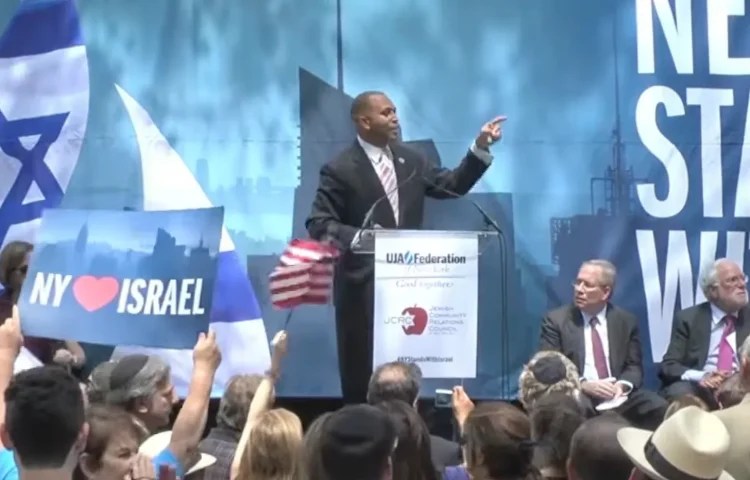
Buck-Dancing for Zion: Hakeem Jeffries
How Brooklyn’s point man in Congress was groomed to serve Jewish interests over his own constituents
José Niño Unfiltered | September 7, 2026
Jared Kushner and Hakeem Jeffries met privately in New York City in recent weeks, and neither man wanted to discuss it afterward.
The New York Times reported the encounter on August 23, citing five people with knowledge of a session held in a New York City space a mutual friend provided. The two men discussed housing, immigration, and the cost of living. Kushner urged Jeffries to sit down with White House chief of staff Susie Wiles as a follow-up. NBC News confirmed the account the same day. Jeffries’s initial statement never acknowledged the meeting at all, insisting only that “the affordability crisis is not a hoax and nothing short of transformational policy change is acceptable.” He later posted a video on X acknowledging that “Kushner asked for a meeting.”
The timing carried its own message. Democrats lead in nearly every midterm poll, and Jeffries becomes speaker if they capture the House in November. Kushner has told associates that Jeffries ranks as “the most serious” Democratic leader. House Speaker Mike Johnson shrugged at the news on Fox News, saying “I don’t know what that’s about.” Crooked Media co-founder Tommy Vietor was less charitable, posting on X: “Jared Kushner has no actual government job; he just uses his family connections to get money from gulf autocrats and fund corrupt deals. The only way Jeffries should work with him is with demands for documents and subpoenas.”
That reaction captures a long-standing problem with Jeffries. Namely, the qualities that make Jeffries someone Trump’s inner circle can work with are the same qualities that have made him a target inside his own party and nowhere is more apparent than on the issue of Israel.
Jeffries reached that position by a steady ascent through the House. He won New York’s 8th Congressional District in 2012, succeeding Ed Towns, and quickly built a legislative profile around criminal justice reform. He introduced legislation to criminalize chokeholds after Eric Garner’s death and served as the lead Democratic sponsor of the bipartisan First Step Act of 2018, a jailbreak bill that became one of Donald Trump’s most significant legislative accomplishments of his first term.
House Democrats unanimously elected Jeffries to succeed Nancy Pelosi as House minority leader on November 30, 2022, making him the first Black American to lead either party in either chamber of Congress. He was re-elected to the post in 2024. In July 2025 he set the record for the longest House floor speech in modern history, speaking for eight hours and 44 minutes against the One Big Beautiful Bill Act and breaking the mark Rep. Kevin McCarthy (R-CA) set in 2021. Heading into the 2026 midterms, Jeffries is widely positioned to become speaker if Democrats retake the House.
With Jeffries potentially becoming House Speaker, American Jewry could breathe a sigh of relief knowing that they have a safe pair of hands wielding the speaker’s gavel. Jeffries represents Brooklyn’s 8th District, which Jewish Currents has described as the 15th most Jewish congressional district in the country, and he was raised in Crown Heights, home to the global headquarters of the Chabad-Lubavitch movement. He has extolled that constituency, telling reporters and audiences that “in New York City we consider Jerusalem to be the sixth borough.”
His public language and, more importantly, his legislative record on Israel have been reliably pro-Zionist throughout his congressional career. Jeffries backed the $1 billion Iron Dome replenishment in September 2021, which passed 420 to 9 over objections from eight progressive Democrats. He voted in favor of the $26.4 billion Israel Security Supplemental, H.R. 8034, in April 2024, which split House Democrats 173 to 37. He voted no on a GOP standalone Israel aid bill, H.R. 6126, in February 2024 that Democrats viewed as a partisan maneuver, and he supported the 2019 anti-BDS resolution H.Res.246 as well as the Antisemitism Awareness Act in May 2024. By 2022 alone, Jewish Currents documented Jeffries raising $440,000 from Israel-advocacy groups—the sixth-highest total among House members that cycle, per OpenSecrets—and he has traveled to Israel five times on AIPAC-sponsored trips since entering Congress in 2013. Jeffrie’s pro-Israel funding surged to over $1 million by the 2024 election cycle.
In July 2026, Jeffries continued his pro-Israel antics. Rep. Thomas Massie (R-KY) offered an amendment stripping $3.3 billion in Foreign Military Financing for Israel from the fiscal 2027 State Department bill. It failed 104 to 314. Among Democrats, 103 voted yes, 98 voted no, and 10 voted present, with Massie the lone Republican supporter. Jeffries voted no. In a Dear Colleague letter, he called the measure “overly broad,” arguing it would hinder humanitarian aid efforts, refugee resettlement, and efforts to undermine resistance groups like Hamas. Notably, he declined to whip the vote, telling members there would be “good faith reasons that will result in members voting in a variety of different ways.”
They would proceed to do so, with his own deputy, Minority Whip Katherine Clark (D-MA), announcing she would vote yes because “the status quo is not tenable.” Former Speaker Nancy Pelosi voted yes as well, saying “the Netanyahu government cannot maintain its current course.” Caucus Chair Pete Aguilar (D-CA) stayed with Jeffries. The party’s top two leaders had split publicly on the defining foreign policy question of the cycle, and Jeffries found himself on the shrinking side.
The money surrounding that vote drew immediate scrutiny. Sludge reported that on May 20, AIPAC’s PAC routed two earmarked payments totaling $149,300 to the Jeffries Battleground Protection Fund, the largest earmarked disbursement in the PAC’s history, listed in Federal Election Commission records as an earmark of Jewish billionaire investor Daniel Och.
The AIPAC money flowing into Jeffries’ coffers has raised concerns among progressives. When Jeffries told WNYC’s Brian Lehrer Show in November 2025 that AIPAC’s PAC could give only “$5,000 or $10,000 per cycle, that’s it,” Sludge called the characterization misleading, noting the group’s conduit system has funneled more than a million dollars in earmarked donations to his campaigns.
That financial relationship has fueled further backlash. When AIPAC’s United Democracy Project super PAC spent $14.5 million in June 2024 to defeat Rep. Jamaal Bowman (D-NY), Jeffries offered only a muted response, telling Punchbowl News that “pro-Israel groups are going to support pro-Israel members of Congress.” Radio host Charlamagne tha God has mockingly nicknamed Jeffries “AIPAC Shakur” for his close alignment with pro-Israel donors.
Other leftist outlets have taken Jeffries to task for his devotion to Israeli interests. His 2026 partnership with liberal Zionist organization J Street to oppose the Massie-sponsored arms amendment drew a pointed critique from CounterPunch, which accused him of coupling rhetoric about restraint with continued support for weapons transfers amid allegations of Israeli conduct in Gaza.
Jeffries’s financial entanglements do not end with AIPAC. Sam Bankman-Fried, the FTX founder later convicted of fraud, donated to Jeffries’s campaign, and Jeffries pledged to donate the funds after FTX’s collapse, according to Bloomberg. Separately, 2026 reporting found that committees tied to Jeffries and other Democratic leaders donated to candidates who had pledged to reject corporate PAC money, even as those same committees accepted funds from corporations including Barclays, CVS and UnitedHealthcare, raising accusations of an indirect funding workaround.
The financial ties only reinforce a rhetorical record that consistently delegitimized Palestinian resistance to Israeli transgressions. In February 2022, he called claims that Israel is an apartheid state “demonstrably false, dangerous and designed to isolate Israel in one of the toughest neighborhoods in the world,” responding directly to Amnesty International’s report on Israeli apartheid. After October 7, 2023, he declared in a press release that “America stands firmly and unequivocally with Israel” and that Congress “must stand with Israel until the invasion by Hamas has been crushed.” He also criticized the phrase “from the river to the sea” in a November 2023 statement as a call for “the complete destruction of Israel,” and stressed in February 2025 that “our commitment to Israel’s right to exist as a Jewish and Democratic state and eternal homeland for the Jewish people is ironclad.”
The most recent flashpoint in Jeffries’s career came in August 2026 with a private meeting with Jared Kushner, President Trump’s son-in-law and top outside adviser, to discuss “potential areas of common ground” on housing, immigration, and the cost of living. The New York Times noted the meeting’s timing “underscored that those around Mr. Trump were well aware of the likelihood of a Democratic-led House,” and that Kushner suggested Jeffries also meet with White House Chief of Staff Susie Wiles. Kushner reportedly told associates that if anything bipartisan gets done with Congress, Jeffries is “the most serious person among Democratic leaders.”
Despite the criticism he received from progressives, Jeffries defended the meeting on CNN and in a video posted to X, insisting “no one from the Trump cartel is getting a pass” and that he agreed to the sit-down only to “discuss the affordability crisis that exists, that is not a hoax.” This was not the first time Jeffries and Kushner had found common ground. He and Kushner have a prior working relationship dating to their collaboration on the 2018 First Step Act.
Taken together, Hakeem Jeffries is a reliable servant of Israel and the broader Jewish community. Both Trump terms have been Judeo-accelerationist to the core, with Israel getting nearly everything it wants. Naturally, the American public has grown tired of these escapades that only advance Jewish interests and are now prepared to vote the bums out in the upcoming midterms.
Though it should be stressed that in the Jewish-dominated plutocracy we live in there is no meaningful opposition to the Pan-Judah. At best, voters will have to pull the lever for another competing faction of Jewish proxies.
Enter Hakeem Jeffries and his minions.
Regardless of how the political pendulum swings later this year, the Jewish donor networks and political action committees backing Israel face no real downside, secure in the knowledge that a Democratic flip merely elevates Jeffries, an empty suit who is a certified coon for the Cohens in word and in deed.
US, South Korea and Japan Begin Joint War Games
By Kyle Anzalone | The Libertarian Institute | September 7, 2026
The US, South Korea, and Japan kicked off five-day Freedom Edge war games in and around the Korean Peninsula.
“The exercise will also incorporate multi-national maritime and aviation capabilities, and introduce enhanced air defense scenarios, medical evacuation training, and maritime interdiction operations,” a statement from Pacific Command (PACCOM) said. “Building on the foundation of Freedom Edge 25, as well as regular trilateral ballistic missile defense and defensive counter-air exercises throughout the year, Freedom Edge 26 stands as our most advanced trilateral cooperation to date.”
The US, South Korea and Japan began holding Freedom Edge in 2024. For the second year in a row, the drills will occur without an American aircraft carrier. The US carrier fleet has been strained by the wars in the Middle East, and the Japan-based USS George Washington was recently deployed to the region.
The military drill often provokes a hostile response from North Korea. During last year’s iteration of Freedom Edge, Pak Jong Chon, vice-chairman of the Central Military Commission of the Workers’ Party of Korea, said the drills “pose a grave challenge to the security interests of our state and a major danger of undermining regional stability and escalating military tension.”
On Monday, North Korean Minister Kim Song-gi said Freedom Edge was pushing the situation to the brink. “US-led military demonstrations are being held one after another, without any break in time or space, as military cooperation between the United States, Japan and the Republic of Korea evolves into a dangerous offensive alliance with nuclear elements.” He continued, “This reality poses a serious security threat, pushing instability on the Korean Peninsula and beyond to the brink.”
Last month, President Donald Trump said that the US and South Korean bilateral Ulchi Freedom Shield (UFS) war games were unnecessarily hostile toward North Korea. “These exercises are not only costly, with much of these costs paid for by the United States of America (as usual!), but send a signal that is totally inappropriate and hostile, to a Country that, as long as Donald J. Trump has been President, has been unthreatening and respectful,” he posted on Truth Social.
While Trump cut the UFS drills in half, the Freedom Edge war games have gone forward as planned. South Korean Rear Adm. Kim Ji-hoon called the Freedom Edge drills the “most effective” exercises. “The trilateral Freedom Edge exercise is being executed to counter North Korean nuclear and missile threats and that’s the main purpose of the exercise,” he added.
Trump’s decision to scale back the UFS drills appeared to be part of a push to secure a meeting with North Korean Supreme Leader Kim Jong Un. Kim’s sister, Kim Yo Jong, rebuked the overture, saying that merely scaling back the war games did not change the hostile US policy towards North Korea.
Supreme Leader Kim said Pyongyang remains focused on establishing a nuclear deterrent to prevent Washington and South Korea from starting a war. On Monday, North Korea put its second 5,000 ton destroyer into service.
“The enemies’ concerns will surely be deepened,” Kim said at the commissioning ceremony. “We must establish more clearly a powerful and reliable nuclear war deterrent, to put into practice the diverse and effective operation of our nuclear combat systems and further strengthen our military activities for maritime defense and war deterrence.”
US Placing Missiles in Europe to Cancel Strategic Stability Talks Prerequisites – Russian MFA
Sputnik – 07.09.2026
MOSCOW – The deployment of US ground‑based US intermediate-range and shorter-range missile systems in Europe, in particular in Norway, will nullify the prerequisites for a constructive dialogue with the United States on strategic stability, Russian Foreign Ministry spokeswoman Maria Zakharova said on Monday.
“Steps such as the deployment of US ground‑based US intermediate-range and shorter-range missile systems in Europe, which threaten Russia, will, to put it mildly, nullify the prerequisites for a constructive conversation with the United States on strategic issues,” Zakharova said in a statement.
Russia views the deployment of systems in Norway capable of launching medium- and short-range missiles as yet another step in a series of highly destabilizing actions by NATO, the statement read.
“As part of Russia’s response measures, the locations where US systems are deployed and controlled, as well as the infrastructure supporting them, are becoming the focus of special attention from Russia’s strategic deterrence forces, which includes planning the combat use of the relevant strike assets in the event of an armed conflict,” Zakharova said.
The ministry added that favorable conditions for a substantive and productive dialogue with the United States on strategic stability had not been established now.
Analysts warn of ‘colonization’ as US ‘saturates’ Australia with 110 bases
Press TV – September 7, 2026
The United States reportedly wields control over, or has access to, 110 military facilities belonging to Australia — a presence so extensive that analysts now describe it as a “saturation” and even a “colonization” of the Australian continent.
The Guardian, citing information gathered from the database of the Nautilus Institute, reported that the US military or US defense corporations have access to more than half of Australia’s military facilities.
According to the database, the United States controls 17 military facilities on mainland Australia, has access to 75 more Australian-run military installations elsewhere, while US defense corporations have access to an additional 18 facilities.
“This is not a matter of penetration, it’s a matter of saturation,” said Prof Richard Tanter, the database’s author.
“Over half of the defense facilities that we have looked at have some level of American access: that means American personnel, it means American corporations, some of the biggest armaments companies in the world.”
The US military in Australia engages in gathering intelligence, accessing satellite data for targeting information, and communications intercepts.
Other military activities include training for some 2,500 marines on dry-season rotation in the Northern Territory, as well as the pre-positioning of warfighting assets, weapons, munitions, and fuel, stored in case of a regional war in the Pacific.
The US now practically owns Australia’s human, soil, and mineral resources through its control of the nation’s military, according to critics.
The US military presence will continue to expand. From next year up to 1,200 uniformed military personnel will operate from the HMAS Stirling submarine base just off Fremantle.
The government insists that technically this will not be a US base — rather a “rotation” — but there is little contestation of its actual implication.
The AUKUS nuclear submarine agreement, described by former defense minister Christopher Pyne as “a lot more than the submarine procurement,” effectively establishes a new United States submarine base in the Indian Ocean.
“For the Americans, being able to have a submarine base in the Indian Ocean is a massive strategic advantage,” Pyne told a public inquiry.
Dr Vince Scappatura, author of The US Lobby and Australian Defense Policy, described US base access across Australia as a kind of “second wave of colonization.”
“Today we are shaping up to be the ‘tip of the spear’ for US power projection into the region — that’s what the sprawling US base access represents,” he said.
“Each one of those dots on the map represents a point of leverage Washington has over Canberra when it comes to matters of defense and foreign policy.”
Scappatura noted that the phrase “empire by invitation” was originally coined to describe US hegemony over western Europe “but it is applicable equally here. I sometimes describe it as ‘voluntary subordination’.”
The United States has been escalating militarization in the Pacific by resetting ties with regional countries in an attempt to form a coalition against China.
Beyond Australia, US bases and military access points are expanding across Japan, South Korea, the Philippines, and other regional nations, effectively drawing them into Washington’s orbit.
Critics say this is a desperate bid by Washington to arrest the rise of China, with Australia and other regional countries being used as forward operating bases in what could become a larger confrontation.
Tanter says that the acceptance of the US military presence has become so ingrained within the government and defense that unwinding Australia’s enmeshment within the world’s most powerful military is increasingly difficult.
“This is a massive institutional failure in Australia, a kind of learned incapacity at a political, parliamentary and bureaucratic level,” he said. “We’ve learned how not to ask those questions.”
Dr Emma Shortis, director of international and security affairs at the Australia Institute, says Australia’s increasing integration with the US military has resulted in “an accelerating erosion of Australia’s independent, sovereign, decision-making power.”
“Instead of having the option of saying ‘no’ to involvement in United States wars, involvement becomes the default position,” she said.
She cited the March attack by a US nuclear-powered submarine on an Iranian frigate, sinking it and killing more than 100 people. Three Australian naval personnel were onboard, part of the submarine’s crew: the US did not forewarn Australia of the attack.
“Australia might maintain the pretense of sovereign decision-making power, but that’s not the reality,” Shortis said.
Dr Albert Palazzo, an adjunct professor at the University of New South Wales Canberra and formerly the director of war studies for the Australian army, told the Guardian the US military’s accelerating buildup carries danger for Australian security.
“The Australian government seems to be waltzing its way into a war between the United States and China, by allowing this country to become an outpost or bastion of the US military, and as a platform from which they will launch military force against China,” he said.
Australians’ faith in the US is fragile and fracturing. A Lowy Institute poll showed Australians’ “trust in the United States to act responsibly in the world” has fallen to 31%, the lowest level in its polling history.
Just 21% of Australians have confidence in Donald Trump to do the right thing in world affairs, the lowest level of confidence in a US president yet.
More than twice as many Australians (59%) now believe Australia’s interests are best served by a more independent foreign policy rather than a closer alliance with the US (23%). Just 13% of Australians believe the US is a “very reliable” security ally.
This represents, Shortis says, a “seismic shift” in Australia’s perception of its once-great and powerful friend.
“After following the US into nearly every war since World War II, Australians have had enough. They see tangible risks in being so close to President Trump’s bleak and violent version of America.”
Inside America’s deadly war on suspected drug boats | Fault Lines Documentary
Since September 2025, the US military has carried out more than 60 strikes on suspected drug-trafficking boats in the Caribbean and Eastern Pacific, killing more than 220 people.
In a military campaign called Operation Southern Spear, President Donald Trump’s administration has claimed to wage war against “narcoterrorism”. Yet the government has released little information about who was killed, the evidence against them or how targets were selected.
In Killing at Sea, Fault Lines investigates the administration’s claims about Operation Southern Spear by uncovering the stories of those targeted and the evidence used to justify lethal military force.
Through the stories of families left searching for answers, alongside witness accounts, physical evidence and interviews with legal experts, Fault Lines asks whether the strikes are lawful, whether they have disrupted the drug trade and what accountability exists for those killed.
From fishing communities in the Caribbean to Washington, DC, Killing at Sea examines a military campaign conducted largely beyond public view—and asks who is being killed in the US’s new war at sea, and why.
Featured Video

Trita Parsi: Israel Set a Trap for Total War in the Region
or go to
Aletho News Archives – Video-Images
From the Archive
Zionism’s Violent Legacy
By Donald Neff | Washington Report On Middle East Affairs | January 1996
On January 4, 1948, Jewish terrorists drove a truck loaded with explosives into the center of the all Arab city of Jaffa and detonated it, killing 26 and wounding around 100 Palestinian men, women and children.[1] The attack was the work of the Irgun Zvai Leumi – the “National Military Organization,” also known by the Hebrew letters Etzel – the largest Jewish terrorist group in Palestine. The Irgun was headed by Revisionist Zionist Menachem Begin and had been killing and maiming Arabs, Britons and even Jews for the previous ten years in its efforts to establish a Jewish state.
This terror campaign meant that at the core of Revisionist Zionism there existed a philosophical embrace of violence. … continue
Blog Roll
 Aletho News
- Trita Parsi: Israel Set a Trap for Total War in the Region
- Trump’s Iran war is on an Israeli leash
- Saudi oil boss issues global supply warning
- Riyadh Says Its Oil System Is Intact. The Numbers Say Otherwise.
- Trump and Netanyahu Want to “Finish the Job” on Iran
- US ‘one-sided dictation’ not Iran’s beliefs makes rational talks impossible: Baghaei
- Iran’s Next Strike May Not Explode. It Could Shut You Down /Col Doug Macgregor
- Iran: US political targets legitimate if assassinations return
- Iraq shuts key border crossing with Iran under US pressure: Report
- Undersea Internet cables could be targeted in retaliation for attacks on Iran: IRGC deputy chief
- If Americans Knew
- The Israel Lobby’s Changing Fortunes
- AIPAC has become such a political liability that it’s shifting to a more “nimble” approach to buying politicians
- At least 160 Israeli settler attacks in 2 weeks
- Will Gaza’s Ancient Christian Community Disappear Forever?
- Israel’s vision of regional security rests on keeping Arab states weak
- Heidi Levine recounts how Palestinian youths helped save her in settler attack
- DAILY UPDATE: Latest essential news on Palestine, Israel, & region
- Trump’s Intensifying Sabotage of the ICC, for Israel’s Sake
- Israeli military detain US and UK volunteers in West Bank including Democratic NY politician Brad Lander
- Americans at National Conservatism Conference held in Israel this year criticize Israel
- No Tricks Zone
- E-Cars Reduce CO2 Emissions By Only 41% Compared To Internal Combustion Engine Vehicles
- Predictions Made By Renowned Climate Professor Over Past Decades Have Been Proven To Be Poor
- New Study Suggests Large Regions Of The Pacific Ocean Have Been Cooling For The Last 80 Years
- Germany’s Green Energy Debacle: High Energy Costs Force Kahla Porzellan to Close After 182 Years!
- New Study: 50 Years Of The Most Aggressive ‘Net Zero’ Policies Can Only Affect The Global Climate By 0.03°C
- US September “Heat” Was No Record…Many Records Set Decades Ago
- Latest European Green Energy Debacle; Portugal’s Largest Flagship Solar Park Insolvent!
- Green Energy Debacle: German Expert Professor Fritz Vahrenholt Warns Of Severe Economic And Social Consequences
- Two More Paleo Reconstructions Affirm Meters-Higher Sea Levels Across Ireland, Brazil 7000-6000 Years Ago
- New Study: Earth And Venus Surface Warmth Largely Explained By Convection And Lapse Rate, Not CO2 Or Radiation

