Where were you, Senators? While They Dripped Poison Into Our Children’s Bodies?
By Paul Connett, Ph.D. | The Defender | September 5, 2025
Paul Connett, Ph.D., co-author of “The Case Against Fluoride: How Hazardous Waste Ended Up in Our Drinking Water and the Bad Science and Powerful Politics That Keep It There,” responds to Thursday’s U.S. Senate hearing during which members of the Finance Committee accused U.S. Health Secretary Robert F. Kennedy Jr. of “politicizing” science.
Yesterday, the world watched as you bayed and sneered at Robert F. Kennedy Jr. for disagreeing with your beliefs on vaccines.
Were you following a script forwarded to you by the PR hate machinery of the pharmaceutical industry?
Ironically, a similar complex of industry, CDC and pseudo-professional bodies has kept you silent on another public health practice for decades.
You have remained silent while they have dripped poison into our children’s bodies for 80 years.
Where were you between 2017 and 2020, when U.S. Government-funded mother-offspring and infant fluoride IQ studies were published?
Where were you in 2022, when the Centers for Disease Control and Prevention witnessed this science but failed to warn pregnant mums to avoid fluoridated water?
Where were you in 2024 when the National Toxicology Program reviewed these and many other IQ studies and concurred that fluoride was a neurotoxin?
Where were you on Sept. 24, 2024, when a federal judge concluded, after a seven-year Toxic Substances Control Act (TSCA) trial, that “U.S. Government-approved” fluoridated water posed an “unreasonable risk” to America’s children?
Did you read this science that you supposedly treasure? Did you put it above self-serving propaganda sources?
Are you following the science? Or following the money? On both issues?
Where was RFK Jr. during all this? He was reading the science.
And he watched the TSCA trial online. He knows that fluoridation must end.
Is he wrong on this? Are you?
Perhaps it’s time you stopped your baying and sneering and started actually reading the science?
Is it good to expose a baby’s brain to fluoride from day 1 of pregnancy?
Is it good to inject organic mercury into a baby’s bloodstream?
Is it good to inject aluminum into a baby’s bloodstream?
Should we be messing with messenger RNA?
Do we know what we are doing?
Paul Connett, Ph.D., is co-author of “The Case Against Fluoride: How Hazardous Waste Ended Up in Our Drinking Water and the Bad Science and Powerful Politics That Keep It There.”
Pharma’s Coup Attempt: How Cartel Insiders Are Plotting to Oust Robert F. Kennedy, Jr.
By Paul Anthony Taylor | Dr. Rath Health Foundation | September 5, 2025
A leaked memo from one of the pharma cartel’s most powerful trade groups has revealed a desperate plan to push Robert F. Kennedy, Jr. out of his role as United States Secretary of Health and Human Services (HHS). The document, apparently originating from a closed-door meeting of the Biotechnology Innovation Organization (BIO), shows that industry leaders are prepared to spend millions of dollars lobbying Congress and manipulating public opinion to force Kennedy from his job. At stake is not just U.S. government vaccine policy, but the deeper question of who actually runs public health in America – democratically elected officials, or the corporations that profit from disease.
The plan unveiled
The memo appears to come from BIO’s Vaccine Policy Steering Committee, a powerful body representing companies such as Pfizer, Merck, Novavax, and Vaxcyte. According to whistleblowers, the group met on April 3, 2025, to discuss the “threat” posed by Kennedy’s healthcare reform agenda. The summary leaves no doubt about its intentions. One line is especially blunt: “It is time to go to The Hill and lobby that it is time for RFK Jr. to go.”
The threat to the cartel is clear. Kennedy has insisted on long-term safety data for vaccines, full publication of trial results, and the restoration of manufacturer liability for injuries. These proposals would dramatically slow down the fast-track approvals and legal protections that have allowed vaccine makers to rake in billions while avoiding accountability. In the eyes of BIO, this is not just policy reform – it is a direct attack on its business model.
Fear of accountability
BIO’s real fear is not scientific debate but financial disruption. The memo quotes one executive from Vaxcyte warning that “investors have stated they are leaving until the next data read out,” citing uncertainty caused by Kennedy’s push for tighter regulation. Capital, in other words, is fleeing the vaccine sector. Instead of reassuring the public with stronger safety standards, BIO is working to reassure Wall Street by removing the man calling for reform.
This exposes the heart of the problem: the pharmaceutical industry has become so dependent on weak oversight and political protection that it views accountability itself as a threat. Rather than adapt to higher safety expectations, BIO would rather manipulate politics to preserve the old system.
Buying influence
The most revealing part of the plan is financial. BIO has committed $2 million to a new communications campaign titled ‘Why We Vaccinate.’ But this is no ordinary public health initiative. According to the memo, its goal is not education but “inspire and frighten” messaging designed to sway the “movable middle” of public opinion. Essentially, by tying vaccination to national security, economic productivity, and workforce resilience, the campaign seeks to use fear as a political weapon.
This is not science. It is psychology. Instead of engaging Kennedy’s arguments on their merits, BIO plans to drown out discussion with a flood of fear-based advertising and carefully managed surrogates. Among those mentioned as possible allies are Dr. Mehmet Oz and Senator Bill Cassidy. These figures are expected to provide a veneer of bipartisan legitimacy while avoiding any real debate about the substance of Kennedy’s proposals.
Controlling the narrative
Equally troubling is BIO’s strategy of redefining language itself. The leaked document reveals plans to replace words like “protect” and “defend” with softer-sounding terms such as “streamline,” “optimize,” and “enhance.” But behind the rebranding lies a cynical truth. As Robert W. Malone MD has pointed out, when BIO says “efficiency,” it means fewer safety checks. When it says “transparency,” it means PR-polished talking points, not the release of raw scientific data. When it says “resilience,” it means consumer obedience, not real safeguards.
This is not reform – it is narrative disingenuity that would not be out of place in George Orwell’s dystopian novel Nineteen Eighty-Four. BIO is attempting to control the vocabulary while ensuring that nothing actually changes. It is a form of deception that goes beyond lobbying, seeking to manipulate the very terms of debate so the public never realizes reform has been hollowed out.
The plot is already underway
The memo points to this month (September 2025) as a critical deadline. Congress is back in full session, budget negotiations are getting underway, and the media cycle is returning to full speed after the summer lull. BIO’s campaign is timed to seize this moment, flooding the airwaves with its ‘Why We Vaccinate’ messaging before Kennedy’s reform agenda gains traction.
September also marks the reopening of schools, a time when vaccine debates are most prominent in the public eye. By striking early, BIO hopes to dominate the narrative and silence Kennedy before he can rally broader public support. For the pharma industry, this is not about science but survival.
Significantly, therefore, in the past couple of days, we have already seen nine former leaders of the Centers for Disease Control and Prevention (CDC) speaking out against Kennedy, publishing an open letter in The New York Times that criticizes his policies.
Separately, and simultaneously, more than 1,000 current and former HHS employees are said to be calling for Kennedy to either resign or be fired. Their letter – which does not name the signatories but mentions vaccines eight times – accuses him of endangering the nation’s health. It is difficult not to see the hand of BIO behind these moves.
A threat to democracy
The implications of this plot go far beyond health policy. If corporations can secretly conspire to spend millions lobbying for the removal of a sitting government official, then democracy itself is in danger. Whether one agrees with Kennedy’s policies or not, it should not be the pharmaceutical lobby that decides who serves in public office. That decision belongs to the people and their elected representatives, not to an industry that stands to profit from the outcome.
This is why the BIO leak matters so much. It shines a light on the machinery of influence that usually operates in the shadows – closed-door meetings, carefully managed talking points, and money flowing into Washington to buy outcomes that serve shareholders instead of citizens.
Who decides about global health?
The BIO plot also has international implications, as it aligns with broader efforts to centralize health policy through global treaties and the algorithmic censorship of dissenting medical views. If left unchecked, this could lead to a future where drug companies, aided by international bodies, dictate not only U.S. policy but all global health decisions as well. The Kennedy reforms represent a direct challenge to that vision.
Ultimately, therefore, this story is not just about Robert F. Kennedy, Jr. It is about whether public health will be guided by the principles of science, safety, and consent – or by the profit motives of an industry that sees accountability as a threat. Seen in this light, BIO’s efforts to remove Kennedy are not a sign of power. They are an admittance of weakness.
Kennedy’s reforms may be inconvenient for Wall Street, but they reflect the public’s increasing demands for safety, consent, and honesty in medicine. The real question now is whether corporations will continue to dictate the rules – or whether the American people can successfully reclaim health policy for the public good.
Paul Anthony Taylor
Executive Director of the Dr. Rath Health Foundation and one of the coauthors of our explosive book, “The Nazi Roots of the ‘Brussels EU’”, Paul is also our expert on the Codex Alimentarius Commission and has had eye-witness experience, as an official observer delegate, at its meetings.
Sparks Fly as RFK Jr. Tells Senators CDC Failed Americans During COVID
By Brenda Baletti, Ph.D. | The Defender | September 4, 2025
In a contentious Senate hearing today, U.S. Health Secretary Robert F. Kennedy Jr. engaged in fiery exchanges with senators on both sides of the aisle who questioned his record in office, the administration’s vaccine policies, and the ouster of top officials and advisers at the Centers for Disease Control and Prevention (CDC).
During the hearing held by the Senate Finance Committee, which has oversight over the U.S. Department of Health and Human Services (HHS), many senators used their allotted five minutes to make impassioned speeches and air their grievances, often leaving Kennedy little or no time to respond.
The New York Times described Kennedy, who was visibly annoyed at times, as “remarkably salty and dismissive with senators at times today.”
“You don’t want to talk,” Kennedy told Sen. Elizabeth Smith (D-Minn.). “You want to harangue and have partisan politics. I want to solve these problems.”
Sens. Elizabeth Warren (D-Mass.) and Raphael Warnock (D-Ga.) called for Kennedy to resign or be fired by President Donald Trump during the hearing. This morning, Democratic senators on the committee issued a statement calling for his resignation.
Kennedy clashed with senators over the administration’s recent firing of CDC Director Susan Monarez, the U.S. Food and Drug Administration’s (FDA) narrowing of the COVID-19 vaccine approvals, the recent cancellation of $500 million in research funding for mRNA vaccines, Kennedy’s restructuring of the CDC’s Advisory Committee on Immunization Practices) and the upcoming agenda for that committee, which will address the universal hepatitis B vaccine recommendations.
Several senators also pressed Kennedy on whether Operation Warp Speed was a great accomplishment, and raised concerns about cuts to Medicaid and funding for rural hospitals.
Kennedy shot back at his critics, promising to fix the “malpractice” within the public health agencies, and touting his agency’s many accomplishments since he took the helm.
He blasted the CDC, which he said, “is the most corrupt agency in HHS,” for its history of failing to protect Americans’ health, particularly during the COVID-19 crisis, during which the U.S. “did worse than any country in the world.”
“The people at CDC who oversaw that process, who put masks on our children, who closed our schools, are the people who will be leaving,” he said, adding, “That’s why we need bold, competent and creative new leadership at CDC. People who are able and willing to chart a new course.”
Wyden called Kennedy a liar, Kennedy accused Wyden of doing nothing to prevent chronic disease
After Committee Chair Mike Crapo (R-Idaho) kicked off what he predicted would be a “spirited debate,” ranking member Ron Wyden (D-Ore.) attacked Kennedy for the “costs, chaos and corruption” he allegedly brought to the agency.
That was also the title of a report Wyden co-authored with Sen. Angela Alsobrooks (D-Md.) and submitted to the record, summarizing their take on Kennedy’s tenure at HHS.
Wyden called Kennedy a liar and made what he called an “unprecedented” request that Kennedy be formally sworn in, presumably so the committee could later prove he lied under oath. Crapo refused the request, which isn’t customary in Senate hearings.
Wyden then launched a long attack on Kennedy’s “agenda,” which he said is “fundamentally cruel and defies common sense.”
Kennedy shot back:
“Senator, you’ve sat in that chair for how long? 20, 25 years? While the chronic disease in our children went up to 76%, and you said nothing. You never asked the question, why it’s happening. ‘Why is this happening?’ Today, for the first time in 20 years, we learned that infant mortality has increased in our country. It’s not because I came in here. It’s because of what happened during the Biden administration that we’re going to end.”
Kennedy says Monarez lied in WSJ Op-Ed
Several senators referred to an op-ed written by Monarez and published this morning in The Wall Street Journal. Monarez, who was fired last week by Trump, claimed Kennedy pressured her “to compromise science itself.”
“I was told to preapprove the recommendations of a vaccine advisory panel newly filled with people who have publicly expressed antivaccine rhetoric,” Monarez wrote.
When asked, Kennedy disputed Monarez’s account of her firing. “I told her that she had to resign because I asked her, ‘Are you a trustworthy person?’ And she said ‘no,’” he said.
Wyden quoted Monarez to Kennedy and asked whether he had pressured her to preapprove recommendations. “No, I did not say that to her,” Kennedy responded.
So she’s lying today to the American people in the Wall Street Journal ?” Wyden asked.
“Yes, sir,” Kennedy responded.
Kennedy said the opposite was true. Monarez indicated she would refuse to endorse any CDC vaccine panel recommendations even before the committee met to make them, he said. He said he asked her to walk back that stance so she would hear the recommendations and their rationale before making any decision, but Monarez refused.
Taking away vaccines?
Several senators, including Smith and Warren, accused Kennedy of going back on his commitment and “taking away vaccines” from the American people.
Warren cited the FDA’s decision to end emergency use authorization of COVID-19 vaccines and limit approvals of the vaccines to people at high risk. However, HHS also confirmed the vaccines would be available for anyone who decided they wanted them anyway.
Defending the move, Kennedy told Warren, “We’re not going to recommend a product for which there’s no clinical data for that indication, is that what I should be doing?”
“I know you’ve taken $855,000 from pharmaceutical companies, Senator,” he later told Warren.
Operation Warp Speed — worthy of a Nobel Prize
Senators accused Kennedy of holding a contradictory position on Operation Warp Speed, which Sen. Bill Cassidy (R-La.) said deserved a Nobel Prize, but few gave him time to respond to the accusations.
Several senators also lambasted Kennedy for not acknowledging that the COVID-19 vaccines saved millions of lives.
Sen. Roger Marshall (R-Kan.), a physician who supported Kennedy and spent much of his five minutes questioning why the hepatitis B vaccine is given to all babies, asked Kennedy to respond.
Kennedy said that when the COVID-19 vaccines were first rolled out, they were necessary because the virus was dangerous, but that the vaccines were significantly less necessary now.
“The virus has mutated, it’s much less dangerous, where there’s a lot of natural immunity and herd immunity, and so the calculus is different, and it’s complicated.”
Kennedy added:
“They think I’m being evasive because I won’t make a kind of a statement that’s almost religious in nature, ‘it saved a million lives.’ Well, there is no data to support that. There’s no study. There’s modeling studies. There’s faulty data.”
Sen. Ron Johnson (R-Wis.), who thanked Kennedy for “putting up with this abuse,” backed Kennedy’s statements on the dangers of the COVID-19 vaccines and said federal health agencies hid the early signals for myo and pericarditis.
At the end of the hearing, Crapo offered Kennedy the floor to make a statement if there were things he wanted to clarify.
“I think I’ll have mercy on everybody here,” Kennedy said. “Let’s adjourn.”
Watch the full hearing on CHD.TV
This article was originally published by The Defender — Children’s Health Defense’s News & Views Website under Creative Commons license CC BY-NC-ND 4.0. Please consider subscribing to The Defender or donating to Children’s Health Defense.
Quit Lying, Associated Press, Climate Change Isn’t Making U.S. Corn Farming ‘Dicier’

By Anthony Watts | Climate Realism | September 2, 2025
A recent Associated Press (AP) story carried by WCVB-TV and many other news outlets, warned that “climate change is making it “dicier” to grow corn in the United States. This is false. Data clearly shows that amid modest climate change corn yields and production have increased steadily, regularly setting new records.
The AP writes:
Across major corn-growing states, climate change is fueling conditions that make watching the corn grow a nail-biter for farmers. Factors like consistently high summer overnight temperatures, droughts and heavier-than-usual rains at the wrong time can all disrupt the plants’ pollination — making each full ear of corn less of a guarantee and more of a gamble.
Overall, corn growers got lucky this year with late-season weather that contributed to what is now predicted to be a record bumper crop. But experts say bouts of extreme weather are intensifying the waiting game during a critical time of year between planting and harvest.
Human-caused climate change has worsened multiple U.S. extreme heat events this year and has steadily increased the likelihood of hotter overnight temperatures since 1970, according to Climate Central, an independent group of scientists who communicate climate science and data to the public.
The AP’s narrative is a pure lie, debunked within its own paragraphs. Corn growers didn’t get lucky this year with a bumper crop, rather bumper crops have been a trend during the recent period of modest warming, even with the normal annual ups and downs inherent to crop production. The USDA meteorologist, Brad Rippey, who the AP quoted described 2025’s production as a “monster U.S. corn crop.” But it’s not the first monster crop in the past few decades for U.S. corn farmers.
The numbers tell a clear and compelling story of rising corn production. The U.S. Department of Agriculture confirmed record national yields of 179.3 bushels per acre in 2024, breaking the previous record set only a year earlier in 2023. Long-term records from the U.N. Food and Agriculture Organization show U.S. corn yields have more than tripled since 1961, rising from around 3.5 tons per hectare to more than 11 tons today as seen in the figure below:
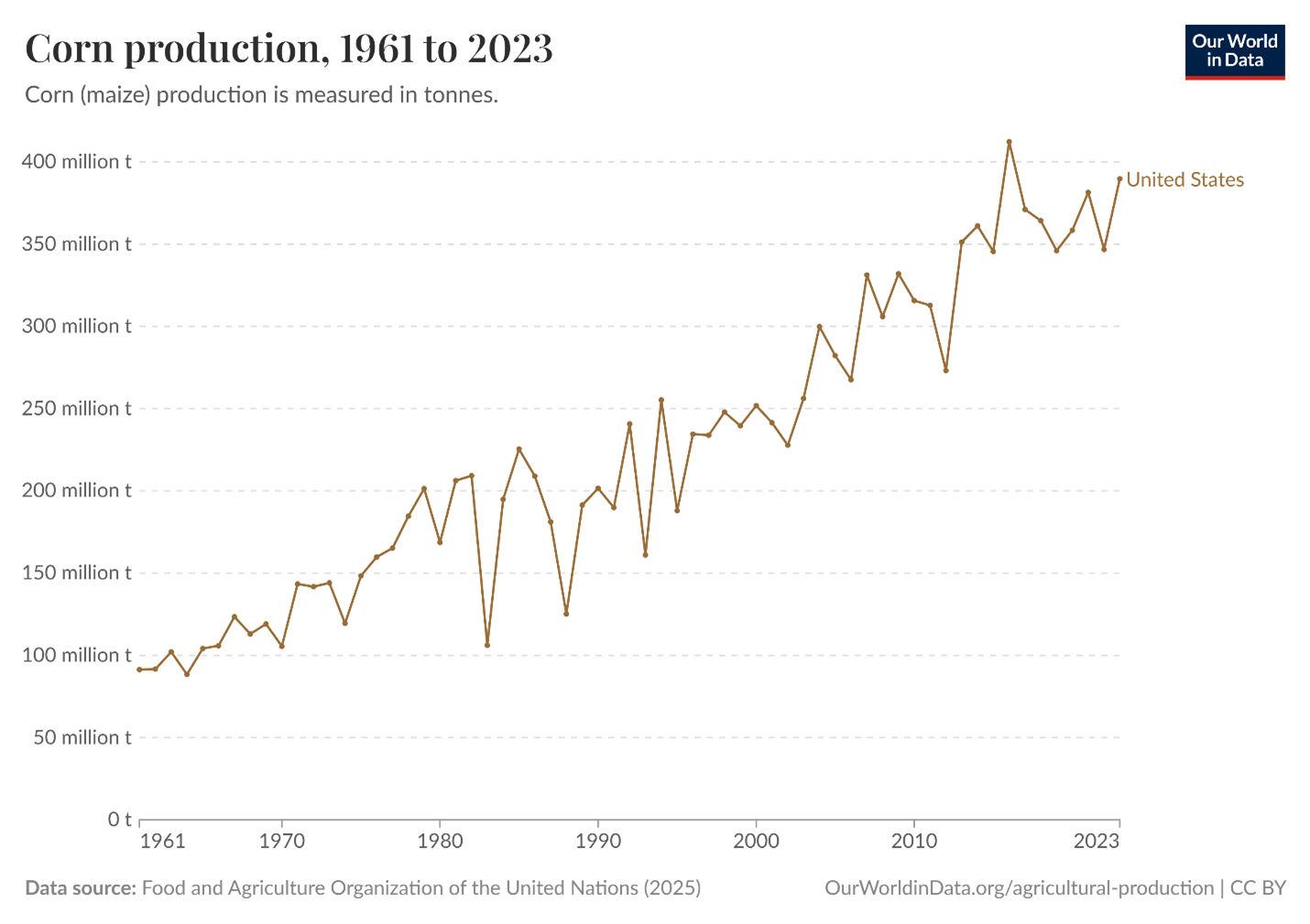
Economists at the University of Illinois calculate that yields have increased by nearly two bushels per acre every year since 1950. These are not the marks of a crop in decline — they are the hallmarks of long-term improvement from better farming practices, yield improved varieties, selective breeding practices to improve resiliency to weather factors, and boosted production due to carbon dioxide fertilization.
The significant gains in yields have also produced records for production with U.S. Department of Agriculture data showing each of the past ten years of production having been higher than any previous years or decades in history, with new records for production being set three times since 2016.
To tie corn growers concerns to climate change, the AP article relied on a small number of anecdotes about heat, corn tassel timing, and the fragility of pollination. Yes, these can matter for pollination in a particular field, but they have always been part of farming. Weather extremes are nothing new, and across hundreds of posts, Climate Realism has cited data across a range of stories showing extreme weather hasn’t become more frequent, severe, or inconsistent in recent years. What matters is the nationwide harvest, and it keeps breaking records. If the climate were truly making corn “dicier,” record-breaking yields would not keep piling up.
The real problem corn producers face at the moment is not crop decline, but instead just the opposite, crop abundance and farming success. Bumper crops have produced an oversupply to the market that is resulting in lower prices, even as ever more corn is being diverted from grocery shelves to gas tanks as ethanol requirements creep up.
Farmers are not watching their livelihoods wither under climate change. Instead, they are wrestling with the economic consequences of overproduction, as a variety of news outlets have reported recently. On the same day the AP was incorrectly bemoaning corn declines, a story titled, “Huge Crops in Corn Belt Hit Cash-Strapped Farmers With More Unease,” was published in the Wall Street Journal. Just a few days earlier, in a story, subtitled, “so much corn, so little profit, NewsNation reported that with the USDA projecting 16.7 billion bushels of corn in 2025, the largest in American history, the glut is pushing prices to multi-year lows, with Iowa producers estimating losses of $80 to $100 per acre at current bids. That is not a climate crisis, it is an economic one caused by success.
So contrary to the AP’s claims, the real problem facing corn farmers is not extreme, unpredictable weather and crop diseases hampering production, but rather oversupply of the market due to record setting production, the latter a regular occurrence across the first quarter of the 21st century as global temperatures have continued to rise modestly.
Climate Realism has repeatedly documented this pattern of media misrepresentation about crop yields and climate change, with over 100 articles on the subject. We note that when crop yields rise, the media ignores or downplays it. When a short-term weather challenge arises, it is cast as evidence of climate change driving it. The broader reality — backed by decades of USDA and FAO data — is that American agriculture continues to thrive even in a modestly warmer world. Corn is not alone, wheat and soybeans, for example, are also enjoying long-term gains in productivity, and 2025 will be remembered for surplus, not scarcity.
Oversupply is forcing farmers to store corn with little hope of profitable sales, while trade policy uncertainties in corn exports weigh on demand. These are the real stressors in agriculture today, none of which have anything to do with climate change. By fixating on climate change while admitting record abundance in the same breath, The AP obscures the actual challenges farmers face with regards to commodity markets, prices, and trade.
The conclusion is unavoidable: the claim that climate change is making corn yields more precarious is demonstrably false. Yields are rising, production is at record highs, and as a result, prices are low, driving down farm income. The Associated Press misled its affiliates and readers by suggesting a climate crisis where there is none, undermining trust in its reporting. Farmers and the public deserve better.
29 million deaths linked to EU and US sanctions – study
The unilateral measures were associated with more than 560,000 excess deaths annually from 1971 to 2021, a recent study suggests
RT | September 7, 2025
Western sanctions contributed to nearly 29 million excess deaths worldwide over five decades – a toll comparable to that of wars, according to a recent study.
The research, published last month in Lancet Global Health, has gained attention around the world.
Examining age-specific mortality in 152 countries from 1971 to 2021, using statistics from the Global Sanctions Database, researchers compared mortality rates before and after sanctions, tracking long-term trends to estimate their toll in excess deaths. They focused on three sanctioning authorities: The UN, the US, and the EU (and its predecessor).
“We estimate that unilateral sanctions over this period caused 564,258 deaths per year, similar to the global mortality burden associated with armed conflict,” the authors noted, with a total of 28.8 million deaths across the 51-year span.
We found the strongest effects for unilateral, economic, and US sanctions, whereas we found no statistical evidence of an effect for UN sanctions.
Most excess deaths occurred among the most vulnerable – the very young and the elderly.
“Our findings reveal that unilateral and economic sanctions, particularly those imposed by the USA, lead to substantial increases in mortality, disproportionately affecting children younger than 5 years,” the study said, noting that the age group accounted for 51% of the total death toll.
The report found that the sanctions undermine economic and food security, often causing hunger and health problems among the poorest. Additionally, the dominance of the dollar and euro in global transactions allowed the US and EU to amplify the impact of their sanctions.
At last year’s BRICS summit, member nations called for “unlawful unilateral coercive measures” to be eliminated, warning of their disproportionate impact on the most vulnerable. Members have increasingly avoided the dollar “to shield themselves from US arbitrariness,” Moscow has said.
At the Shanghai Cooperation Organization (SCO) summit in Tianjin this week, Chinese President Xi Jinping called for a fairer global governance system based on mutual respect and opposition to Western dominance. Russian President Vladimir Putin welcomed the proposal as especially relevant when “some countries still do not abandon their desire for dictatorship in international affairs.”
AP Jerusalem chief participated in secretive Israeli govt anti-BDS event, leaked files reveal
By Max Blumenthal | The Grayzone | September 6, 2025

AP’s Israel-Palestine news director, Josef Federman, has spun data to minimize the Gaza death count. Leaked documents show he appeared on a panel aimed at assisting “Israel’s ability to effectively portray its narrative” during a gov’t-sponsored propaganda conference chaired by an ex-IDF official who legitimized killing journalists.
The Israeli massacre of five journalists in broad daylight on August 24, 2025 at Nasser Hospital in Gaza’s Khan Younis city prompted a sternly worded statement to the Israeli government from the Associated Press and Reuters, which each employed a reporter murdered by the IDF. The AP subsequently published a detailed investigation demonstrating that the Israeli military knowingly attacked a civilian target, then carried out a double tap strike after a rescue team and journalists arrived on the scene.
While the AP’s statement of outrage about the killing of its photographer in Gaza, Miriam Dagga, has brought the leading wire agency’s tension with the Israeli government to its height, the relationship with Tel Aviv was not always so adversarial.
The Grayzone has reviewed leaked documents revealing that the AP’s news director for Israel-Palestine, Josef Federman, participated in a private 2018 panel discussion aimed at assisting “Israel’s ability to effectively portray its narrative.” His host was a secretive Israeli government outfit dedicated to combatting the global BDS campaign to boycott, divest from, and sanction Israel. Called the Global Coalition For Israel (GC4I), the event was convened in Jerusalem on June 18, 2018 by Israel’s Ministry of Strategic Affairs and Diplomacy – the de facto propaganda arm of the Israeli government.
The moderator of the panel in which Federman participated was Avital Leibovich, the former spokeswoman for the IDF who has ardently defended the Israeli policy of defining Palestinian journalists as terrorists in order to assassinate them.
Federman has presided over the AP’s coverage of Israel-Palestine since 2014. Throughout Israel’s genocidal assault on Gaza began in October 2023, Federman has helped shape a narrative that has subtly but effectively advanced Tel Aviv’s objectives, regurgitating the baseless and comprehensively debunked claim that “Israelis were raped or sexually assaulted” on October 7; legitimizing Israel’s violent invasion and theft of Syrian land as a historical “shift,” and relying on bogus data from an Israel lobby-affiliated researcher to minimize the civilian death count in Gaza – a grim toll which now includes one of his colleagues at AP.
Federman’s penchant for uncritically quoting notoriously mendacious Israeli military officials has helped secure his reputation for biased coverage.
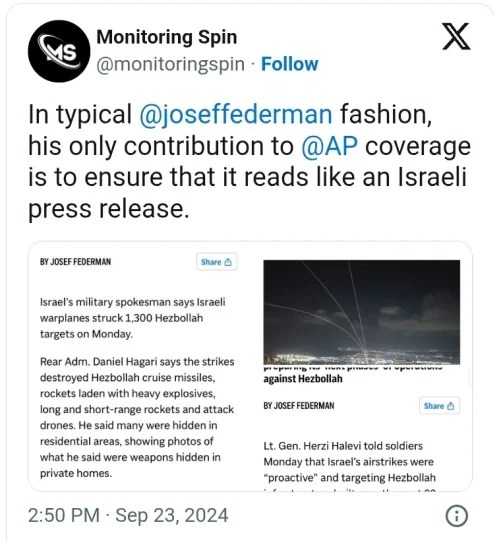
Federman’s participation in the 2018 Israeli government anti-BDS event appears to contradict clearly stated AP guidelines on conflicts of interest. According to the AP’s website, “We avoid addressing, or accepting fees or expenses from, governmental bodies; trade, lobbying or special interest groups; businesses, or labor groups; or any group that would pose a conflict of interest.”
In response to a detailed query from The Grayzone about Federman’s participation in the semi-covert conference, AP Vice President of Corporate Communications Lauren Easton stated, “Josef Federman is a professional journalist and a former chairman of Israel’s Foreign Press Association. It is not uncommon for journalists to speak about their work at conferences and other events. It remains AP policy to refrain from accepting honoraria, and that policy was followed here.”
The details of the GC41’s gathering were gleaned from a massive tranche of documents extracted by hackers from Israel’s Ministry of Justice in 2024. A full schedule and list of GC4I conference participants has never been seen before by the public.
View GC4I’s 2018 schedule here.

AP, other agencies join semi-secret Israeli gov’t event chaired by ex-IDF official who justified killing journalists
When GC4I gathered in 2018, it met at the Mamilla Hotel Conference Hall in Jerusalem for two days of discussions and briefings on the fight to crush the growing Palestine solidarity movement and its BDS campaign. The conference opened with an address by Sima Vaknin-Gil, then the Director-General of Israel’s Ministry of Strategic Affairs. A former Israeli intelligence official, Vakhnin-Gil had emerged as one of the most influential coordinators of the country’s propaganda efforts abroad, especially in the US, where she helps the Israeli government evade the Foreign Agent Registration Act law.
Her speech was followed by a discussion moderated by celebrity Republican pollster Frank Luntz on the feasibility of defining the BDS movement as a “hate group.” Further panels focused on “developing relations in the corridors of power” and “how… legislation in Europe and the United States can be used to reduce funding for organizations delegitimizing Israel.”
On the second day of the GC41 conference, Federman joined a panel aimed at “discuss[ing] the difficulties of reporting fairly and accurately on Israel, while dealing with issues such as BDS, delegitimization, and the Israel-Palestinian conflict.”
The panel was explicitly aimed at helping the Zionist operatives gathered at the GC4I “understand the shortcomings in Israel’s ability to effectively portray its narrative, what reporters are looking for when writing an article and why the anti-Israel camp’s narrative resonates in the Western world.”
Avital Leibovich, a former IDF spokeswoman who moved on to the American Jewish Committee, chaired the panel. During her stint at the IDF, Leibovich played a leading role in justifying Israel’s deliberate killing of journalists in the Gaza Strip. In 2012, for example, she fired off a letter to the New York Times which smeared Palestinian journalists slain at the hands of the Israeli military: “Such terrorists who hold cameras and notebooks in their hands, are no different from their colleagues who fire rockets aimed at Israeli cities and cannot enjoy the rights and protection afforded to legitimate journalists,” she wrote.
In 2016, Leibovich appeared at Washington DC’s Newseum amid protests – including by this reporter– and condemnation from the Palestinian Journalists’ Syndicate, which urged the institution in a May 31 letter “not to provide a platform to someone who has justified, on record and to a world audience, Israel’s grave violations of international law and war crimes, and in particular attacks against journalists and press freedoms.”
Chaired by Leibovich, the 2018 GC4I panel featured featured the Jerusalem Bureau Chief of RT, Paula Slier, and Laurent Lozano, who held the same position at Agence France Press, alongside the AP’s Federman. Slier has since left RT, while Lozano is currently AFP’s bureau chief in Dakar, Senegal.
Reached by The Grayzone, Slier described the gathering as “a very pleasant experience.”
She said she considered her participation in a semi-covert Israeli government conference as a normal part of her duties as a correspondent in Jerusalem. “It was a chance for them to hear how foreign channels worked in Israel,” Slier commented. “I used to participate and attend all conferences – whether they were pro-Israel or pro-Palestinian – I thought it important to engage with everyone, and it was also an opportunity to talk about RT.”
GC4I launched at “secret conference” with “closed sessions” on criminalizing BDS
GC4I’s first gathering took place in 2010, at a time of heightened Zionist anxiety about the rising global grassroots movement to boycott Israel. A who’s who of Israeli lobbyists from the US, UK and Australia were on hand, alongside Israeli officials from the office of Prime Minister Benjamin Netanyahu and the newly created Ministry of Strategic Affairs.
“The aim was to end the perceived lack of co-ordination within the pro-Israel movement, a concern frequently voiced by Israel-advocates,” wrote researcher Hil Aked.
Marcus Dysch of the Jewish Chronicle gained access to a 2014 GC4I meeting in London, England. He described it as a “secret conference… held in closed sessions amid heavy security.”
“We have the resources. We have the intelligence. Most important, we have unbounded determination,” Ronald Lauder, the billionaire Zionist financier and Netanyahu confidant, told the crowd of Jewish communal leaders and Israeli officials in London.
Lauder pledged to leverage his fortune to criminalize the BDS movement: “We will draft and lobby for legislation that will withhold government funding from academic institutions that boycott Israel.”
Reporting back to Jewish Federation at home, minimizing deaths in Gaza
Well before he emerged in the Middle East as a reporter, Josef Federman enrolled as a graduate student at Israel’s Hebrew University.
He grew up in Westborough, Massachusetts, where his parents helped found the B’nai Shalom Congregation, a Reform Jewish synagogue. Federman has returned on two occasions to deliver lectures at the synagogue, once in 2021 to discuss the Abraham Accords alongside an Israeli academic, and again in March 2024, during the height of Israel’s genocidal campaign in Gaza, for an event titled, “Reporting from Israel.” That speech was co-sponsored by the Jewish Federations of Central Massachusetts, a top sponsor of pro-Israel lobbying inside the US.
Two months later, the Israeli government seized camera equipment from the AP to prevent it from live-streaming video from the Israeli side of the northern Gaza frontier. While Israel announced that it would return the equipment and allow the broadcasts to continue, the event eerily foreshadowed the Israeli military’s double tap strike on the Reuters live position at the Nasser Hospital in Khan Younis this August 24.
The following month, Federman published a piece of “AP data analysis” that relied on dubious statistics to advance one of Israel’s most important propaganda objectives in Gaza. According to the headline of Federman’s piece, “Women and children are killed less frequently as war’s toll rises.” The article therefore implied that all men in Gaza between the ages of 18 and 59 were possible militants. Throughout the piece, Federman referred to Gaza’s Health Ministry as “Hamas-run,” casting doubt on its casualty counts.
To legitimize his conclusions, Federman turned to Gabriel Epstein, a researcher at the Washington Institute for Near East Policy, or WINEP, the most prolific think tank of the Israel lobby in Washington DC. WINEP director Robert Satloff, a veteran Israel lobbyist, praised the AP’s Federman for “tak[ing] a big step toward setting the record straight.”
Another researcher cited in the article, Michael Spagat, defended the quality of death counts by Gaza’s Health Ministry. Months later, in September 2024, Spagat revised his view of the death toll, declaring, “I now believe that the true death toll almost certainly exceeds the official total.”
This August, a review of an internal Israeli intelligence database further discredited Federman’s analysis, revealing that 83% of those killed by the Israeli military in Gaza were civilians.
Today, Federman’s “data analysis” on the Gaza death has been discredited by virtually every expert outside the Israel lobby, and by the gruesome reality on the ground. However, a revealing post remains on his personal LinkedIn page which shows him liking a rant by Idit Shamir, consul general of Israel in Toronto, mocking the official death count in Gaza:
“Isn’t it curious?” wrote the Israeli official. “Hamas is clueless about Israeli hostages’ status but has a crystal-clear count of Palestinian casualties before Israeli strikes even occur!”

Now that a fellow AP reporter, Miriam Dagga, has joined the tens of thousands of civilians murdered by Israel in Gaza over the past two years, Federman’s agency has been forced to release a rare expression of outrage at Tel Aviv. The indignation offers a stark contrast from the comity Federman displayed when he bantered at an Israeli government conference with the former IDF official who legitimized the policy that would claim Dagga’s life.
What you need to know about PCHR, Al-Haq and Al-Mezan sanctioned by US
By Ivan Kesic | Press TV | September 6, 2025
In yet another glaring example of shielding the Israeli regime from accountability, the United States has imposed sanctions on three Palestinian human rights organizations, including Al-Haq, the Palestinian Center for Human Rights, and the Al Mezan Center for Human Rights.
Enacted on September 4, 2025, under the pretext of Executive Order 14203, these measures explicitly target the human rights groups for their legitimate engagement with the International Criminal Court (ICC) to investigate Israeli war crimes amid the ongoing genocide in Gaza.
This move, watchdogs argue, represents a direct attack on the core principles of international law and human rights defense, strategically designed to criminalize truth-telling and protect Israeli impunity.
They say it forms a sinister pattern of obstruction, following earlier sanctions against the Palestinian prisoner rights group Addameer, UN Special Rapporteur Francesca Albanese, and the ICC itself.
It comes amid the ongoing genocide in Gaza that has claimed nearly 65,000 Palestinian lives, most of them children and women, since October 2023.
Al-Haq
Established in 1979 in Ramallah, the occupied West Bank, Al-Haq stands as one of the oldest and most respected Palestinian human rights organizations, dedicated to protecting human rights in the Occupied Palestinian Territory under the strict frameworks of international law.
The organization has consultative status at the UN Economic and Social Council and is a member of international federations like FIDH for its meticulous documentation of Israeli crimes, including extrajudicial killings, torture, and the institutionalized practices of apartheid and settler colonialism.
Al-Haq’s advocacy work has been instrumental in providing critical evidence to the ICC, directly supporting the court’s 2024 arrest warrants for Israeli prime minister Benjamin Netanyahu and former military affairs minister Yoav Gallant for horrendous war crimes.
The organization’s reaction to the US sanctions was one of defiant condemnation, issuing a statement that labeled the measures an “internationally wrongful act” aimed at shielding the Israeli “Zionist settler-colonial apartheid regime.”
Al-Haq’s director, Shawan Jabarin, emphasized that the sanctions, which freeze assets and criminalize essential transactions, pose a direct threat to operational capacity and staff safety, but the official vowed unwavering resilience, stating: “We will not be silenced.”
This reprisal mirrors a previous Israeli designation of Al-Haq as a “terrorist organization” in 2021, which was widely condemned by major human rights watchdogs at the time.
The Palestinian Center for Human Rights
Founded in 1995 in Gaza City by prominent lawyers and activists, including Raji Sourani, the Palestinian Center for Human Rights (PCHR) has built a formidable reputation for its grassroots advocacy and legal action against human rights violations in the besieged Gaza Strip.
PCHR holds consultative status with the UN and has been a vital source of documentation throughout the devastating Gaza genocidal war, reporting on Israeli airstrikes, extrajudicial killings, and the crippling blockade that violates international humanitarian law.
Its advocacy work has relentlessly focused on providing legal aid to victims and submitting detailed evidence of war crimes to the ICC, making it a key partner in the international pursuit of justice.
PCHR reacted to the sanctions by directly naming US complicity, stating on its X account, “Yesterday, the US government, Israel’s partner in the ongoing genocide, shamefully sanctioned Palestinian human rights organisations.”
The organization highlighted the chilling effect these sanctions will have, threatening its ability to operate amid a dire humanitarian crisis where its work documenting atrocities and offering legal services is most critically needed.
PCHR framed the US action as a deliberate attempt to criminalize their truth-telling mission and protect Israeli impunity, vowing to continue its advocacy despite the immense risks and calling for global solidarity to counter this blatant intimidation.
The Al-Mezan Center for Human Rights
The Al-Mezan Center for Human Rights, established in 1999 in Gaza, has dedicated its mission to monitoring and documenting human rights violations with a specific focus on the devastating impact of Israeli gencoidal war and siege on the civilian population.
As a member of international networks like FIDH and the OMCT, Al-Mezan has built a reputation for credible reporting on the ground, detailing the destruction of infrastructure, civilian deaths, and the famine-like conditions exacerbated by the ongoing conflict.
Its advocacy work has been pivotal in supporting the ICC’s investigation, providing crucial evidence that contributed to the case against Israeli leaders for atrocity crimes.
Al-Mezan connected the sanctions to the ongoing genocide, stating, “As the genocide in Gaza continues, the US has sanctioned us, @alhaq_org, and @pchrgaza, citing our support & involvement with the ICC’s efforts.”
The organization warned that the US measures constitute a direct attack on their ability to document atrocities and provide essential legal and psychological support to victims, thereby further endangering staff safety and isolating them from international partners.
Al-Mezan urgently called on the European Union and other international actors to invoke blocking statutes to neutralize the sanctions’ impact, framing the US move as an extension of its complicity in the Israeli campaign to eradicate Palestinian resistance and silence any witness to its crimes.
International outrage
The sanctions against these three organizations have been met with universal condemnation from the international human rights community, with leading global NGOs labeling the measures a “blatant attack on human rights” and a “cruel and vindictive effort to punish those advocating for victims.”
UN High Commissioner Volker Türk deemed the measures “completely unacceptable,” arguing they serve only to deepen impunity and silence victims.
This concerted effort to dismantle Palestinian civil society exposes a US foreign policy that has wholly abandoned any pretense of supporting a rules-based international order, choosing instead to act as the legal shield for a Zionist project of dispossession and genocide.
By weaponizing its financial power to sanction human rights defenders, the United States is not merely observing but actively participating in the suppression of the Palestinian people, revealing a profound moral bankruptcy that history will judge with severity.
Iran’s Araghchi Raps “Deafening Western Silence” on Expansion of Israeli Nuclear Weapons
Al-Manar | September 6, 2025
Iranian Foreign Minister Abbas Araghchi rapped what he called the “deafening Western silence” on the expansion of the Israeli nuclear weapons.
“Iran has long warned that the Western hysteria over nuclear proliferation in our region is all fluff. The issue, in their view, is not the existence—or expansion—of atomic weapon arsenals. It is about who gets to advance scientifically, even with peaceful nuclear programs,” Araqchi wrote in a post on his X account on Friday.
“It is therefore not a surprise that there is deafening Western silence over the apparent expansion of the only nuclear weapons arsenal in our region—the nukes in the hands of their genocidal ally. The E3 and the US may be in denial, but their silence is eliminating any credibility to utter anything about non-proliferation,” the Iranian foreign minister said.
The remarks by the top Iranian diplomat came as new revelations point to intensified construction at the Dimona nuclear site, long suspected of housing the Israeli regime’s undeclared nuclear arsenal.
According to a report published by the Associated Press on September 3, satellite images show intensified construction at the Shimon Peres Negev Nuclear Research Center near the city of Dimona, a facility long linked to the Zionist regime’s secret nuclear weapons program.
Experts who analyzed the images suggested the work could either be a new heavy water reactor —capable of producing plutonium for atomic bombs— or a facility for assembling nuclear weapons. They highlighted that the Zionist entity’s current heavy water reactor, which dates back to the 1960s, may soon require replacement.
The Defunct Weaponization of the U.S. Dollar. The SCO Summit and the Decline of the West’s Financial Hegemony.
By Peiman Salehi | Global Research | September 6, 2025
The Shanghai Cooperation Organization’s (SCO) summit in Beijing, marked by both symbolism and substance, underscored the slow erosion of Western financial dominance. While mainstream coverage focused on China’s military parade, the real significance lies in the economic agenda advanced by SCO members. Discussions of a potential SCO Development Bank, expanded use of local currencies, and closer coordination with BRICS initiatives point to a growing determination across Eurasia and the Global South to challenge the monopoly long exercised by the United States and its allies through the IMF, the World Bank, and the dollar system.
For decades, these Western-controlled institutions have functioned as instruments of geopolitical leverage. Structural adjustment programs dismantled social protections, imposed privatization, and locked countries into cycles of debt dependency.
The dollar, presented as a neutral global currency, has been repeatedly weaponized through sanctions, financial exclusion, and manipulation of international payment systems. In this context, the SCO’s economic discussions must be seen for what they are: not technical proposals, but acts of resistance. By seeking alternatives to dollar-based finance and conditional lending, SCO members are asserting that the age of Western financial coercion is no longer uncontested.
China and Russia, the central actors in this process, have both experienced the coercive use of Western financial power.
Sanctions on Russia and tariffs on China have reinforced the urgency of building parallel institutions. For smaller states, particularly in the Global South, the stakes are even higher. Access to credit that is not tied to Washington’s geopolitical priorities could mean the difference between austerity and investment, between dependency and sovereignty. The SCO’s proposals are embryonic, but they point toward a broader trend: the emergence of multipolar finance as a shield against unilateral domination.
Critics in the West have rushed to dismiss these efforts, portraying them as impractical or politically motivated. But such dismissals miss the point. The very fact that alternatives are being openly discussed and partially implemented signals the weakening of Western monopoly. The creation of the BRICS New Development Bank, the use of local currencies in trade between Russia, China, and India, and now the SCO’s initiatives all mark a shift from rhetoric to practice. Each new mechanism reduces the ability of the United States to dictate terms unilaterally.
This does not mean China or Russia will replace Washington as the new hegemons. Rather, it means that unipolarity is ending. The world is moving toward a multipolar order in which no single state can control the flows of finance, trade, and development. For Global South nations, this creates both opportunities and risks. It offers the possibility of diversifying partnerships and rejecting conditionality, but it also requires vigilance to avoid reproducing dependency under new patrons. Multipolarity is not a guarantee of justice, but it is a necessary precondition for breaking the cycle of Western domination.
The SCO summit should therefore be understood as part of a larger civilizational struggle over the architecture of world order. Western hegemony has rested not only on military alliances and cultural influence, but on financial coercion. By weaponizing the dollar, Washington has sought to enforce compliance far beyond its borders. The SCO’s economic agenda represents an attempt to reclaim sovereignty in the face of this coercion, to create breathing space for states that refuse to align with U.S. geopolitical priorities.
What emerges from Beijing is not a fully formed alternative, but a direction of travel. Multipolar institutions are being built step by step, challenging the illusion that Western institutions are eternal or indispensable. For countries in Africa, Asia, and Latin America, this is a call to action. It is an invitation to participate in the shaping of a world where development is not dictated from Washington or Brussels, but negotiated among equals.
The mainstream media will continue to focus on parades and symbols, but the real revolution is occurring in the realm of finance. The SCO summit was a reminder that the West’s monopoly on money and credit is cracking, and that the future of global order will be defined not by a single hegemon but by the collective efforts of states refusing to submit. For those seeking peace, justice, and sovereignty, this is a development to be welcomed, nurtured, and defended.
Peiman Salehi is a Political Analyst & Writer from Tehran, Iran.
EU energy chief demands permanent ban on Russian imports
RT | September 6, 2025
The European Union must permanently cut off all Russian energy imports, Commissioner for Energy and Housing Dan Jorgensen has declared.
Most EU countries have halted direct imports of Russian crude and gas under sanctions over the Ukraine conflict. However, Brussels continues to push for a full phase-out of Russian energy by the end of 2027 under its RePowerEU Roadmap. The plan calls for ending spot gas contracts, suspending new deals, limiting uranium imports, and targeting the so-called Russian “shadow fleet” of oil tankers allegedly used to bypass sanctions.
Jorgensen, who has championed the plan for months, said the bloc must urgently agree on its framework and stick to it even after the Ukraine conflict ends.
“For us the objective is very, very clear. We want to stop the import as fast as possible,” he told reporters in Copenhagen on Friday. “And in the future, even when there is peace, we should still not import Russian energy… In my opinion, we will never again import as much as one molecule of Russian energy once this agreement is made.”
Jorgensen noted that the US has backed Brussels’ plans. President Donald Trump, frustrated with slow Ukraine peace talks, urged European allies on Thursday to halt Russian energy imports. The July trade deal between Washington and Brussels also included a pledge that the EU would replace Russian oil and gas with American LNG and nuclear fuel.
Hungary and Slovakia, both heavily dependent on Russian supplies, have been the strongest opponents of the phase-out, arguing it would undermine the bloc’s security and raise prices. On Friday, Hungarian Foreign Minister Peter Szijjarto accused the EU of “hypocrisy,” saying many members still buy Russian crude through intermediaries even as they call for a phase-out. Jorgensen said he was in talks with Budapest and Bratislava but noted the plan can be approved without them, as it requires only a qualified majority.
Moscow considers any restrictions targeting its energy trade illegal and has warned that abandoning its energy will drive up prices and weaken the EU’s economy by forcing it to rely on costlier alternatives or indirect Russian imports.
Is the West still capable of keeping its maritime trade routes functioning?

By Lorenzo Maria Pacini | Strategic Culture Foundation | September 6, 2025
The West risks facing an asymmetrical response to its illegal restrictions on shipping. Unlike Russia, most developed countries depend on the stable and secure functioning of maritime trade routes. The application of the measures used by the West against itself could trigger a crisis in maritime supply chains due to disruptions in the delivery of strategically important goods and raw materials.
A difficult dependency to manage
Unlike Russia, the West bases its economy and strategic security on a widely interconnected and stable global maritime trade system, established as a founding principle of the maritime power of sea-faring civilizations (Seapower, in the classical geopolitics of Mackinder and Mahan). Most developed Western countries are heavily dependent on the smooth and secure functioning of maritime trade routes to ensure the continuous supply of strategic goods, raw materials, and energy products. Maritime trade is an irreplaceable and essential pillar of Western supply chains, with the increasing complexity and vulnerability of these systems due to geopolitical and environmental dynamics.
This dependence means that illegally imposed restrictions on navigation, or pressure on key maritime routes such as the Suez Canal or the Red Sea passage, can have significant not only economic but also geopolitical impacts. The West as a whole, unlike Russia, which has developed an autonomous strategy to diversify its trade routes, does not have established and functional alternatives for many of its maritime supply lines. And this is a problem that is not easily solved.
In military science, the term ‘asymmetry’ refers to the use of strategies, tactics, and tools that do not mirror those of the enemy, but aim to exploit differences in capabilities, organization, and objectives to strike at the enemy’s weak points. Applied to the maritime domain, asymmetry describes how an actor, often weaker in conventional terms, can challenge a superior naval power by avoiding a head-on confrontation and instead seeking to destabilize its freedom of maneuver, logistics, and route security.
In the current geostrategic context, in fact, a crucial aspect concerns the risk that the West will face asymmetric responses to its illegal restrictions on navigation. This concept of asymmetry is central to the theory of contemporary maritime threats: Western powers, by unilaterally imposing restrictions on the routes or maritime activities of other states (e.g., through sanctions, blockades, or “no sail zones”), could generate unconventional reactions that are difficult to manage structurally, especially now that dominance of the seas is no longer the exclusive preserve of the old Atlantic empires.
The case of Russia is emblematic: despite being heavily affected by sanctions and restrictions on global maritime traffic, it has developed a maritime strategy aimed at building autonomous infrastructure and new routes—such as the development of the Northern Sea Route—to bypass Western restrictions and ensure internal and external economic continuity. The West, on the other hand, despite having provided important regulatory and military tools to ensure freedom of navigation, finds itself exposed to more damaging forms of retaliation precisely because it is unable to easily circumvent the key routes on which it depends.
The application of the same restrictive measures used by the West against itself would, in perspective, result in a potentially acute crisis in maritime supply chains. Disruptions in access to and passage through key trade routes would cause delays in the delivery of strategic raw materials and essential goods, with knock-on effects on industry, agriculture, energy, and final consumption.
The consequences of blockages or restrictions on strategic passages such as the Suez or Panama Canals include not only higher costs due to longer and more expensive alternative routes (with additional costs for fuel, insurance, and sailing time) but also port congestion, increased emissions, and misalignments between supply and demand in global chains. Furthermore, insecurity in maritime routes can raise insurance premiums, contributing to increased international transport costs and fueling market volatility.
Structural differences between the West and Russia and growing instability
Western vulnerability must be viewed in light of the structural differences in maritime management and strategy between the West and Russia.
Russia is gearing up to become a major maritime power, investing in infrastructure, shipbuilding, and new logistics hubs on its territory, aiming for more direct control of its export routes for resources (natural gas, coal, agricultural products) to non-Western markets such as Asia, which are becoming geopolitical and economic priorities.
For example, the Navy’s key role in Arctic routes is already a global excellence, for which the collective West lags far behind. The West, on the contrary, relies on an international maritime trade network that is increasingly subject to high interdependence and multilateral cooperation, and has not yet developed an equivalent system of autonomous routes and infrastructure capable of circumventing unilateral restrictions. This creates an imbalance that can result in asymmetric risk: while Russia can tolerate or circumvent certain restrictions due to its alternative shipping options, the West cannot do the same without serious disruption in terms of trade flows and costs.
Current geopolitical trends increase the likelihood that illegal restrictions on navigation, applied for political reasons, will translate into significant crises in Western supply chains. The effects manifest themselves in:
- Increased delays and misalignments in the delivery of raw materials and finished products (e.g., critical materials, energy, agricultural products);
- Higher costs for maritime transport and insurance, reflected in higher prices and potential pass-through to end consumers;
- Risk of port congestion and logistical disruptions that can trigger temporary regional or global economic crises;
- Increased geopolitical tensions in key regions, with exposure to maritime conflicts or asymmetric actions by state and non-state actors.
The application of restrictive Western measures on oneself is not only a technical challenge, but also a factor that could trigger chain reactions that are difficult to control, as other maritime powers and regional actors could adopt asymmetric strategies, including the militarization of routes, piracy, and targeted sabotage.
A war of maps
But how did the West construct these restrictions? This corresponds to a ‘war of maps’: whoever controls cartography and security warnings dominates the very perception of freedom of navigation.
Three types of restrictive measures have been applied: economic sanctions, maritime exclusion zones (mainly in areas of open or potential conflict) and the updating of maritime charts. And when sailing, maps are essential.
The map war is a cognitive and regulatory domain, in which the representation of space becomes a weapon, more or less directly. Those who control the maps, i.e., decide what to show, what to obscure, and which routes are safe or prohibited to follow, effectively exercise strategic dominance that influences many actors.
The map war at sea is played out on several levels:
Cartographic: updates to official charts (e.g., NOAA for the US, UKHO for Great Britain) can delimit restricted areas, minefields, and training areas. This forces civilian and military ships to change their routes, even if the sea remains physically free.
Digital: ECDIS and AIS systems, which are mandatory in commercial navigation, receive updates from Western sources (Navtex, Inmarsat, IMO). By adding or removing “digital layers,” the West can channel traffic.
Narrative-legal: maps are never neutral; they reflect a vision of the law of the sea. A NATO map will show as “international waters” areas that Russia or China consider “territorial waters.” It is a form of “cartographic lawfare.”
Operational: navies reinforce on the ground what the map represents. If an area is marked as “restricted” and is patrolled by frigates or naval drones, the cartographic representation becomes reality.
Cognitively controlling space means dominating representation, i.e., conditioning the movements of commercial and military fleets, driving up insurance and logistics costs, legitimizing a certain view of maritime law and, most importantly, transforming the sea into a sort of “mosaic” made up of mandatory corridors and prohibited areas. In other words, it is no longer just the strength of ships that determines control, but also the use of the power of representation, which constrains reality geopolitically speaking.
The problem is that the West, with its maritime powers of glorious memory, cannot be denied, is still convinced that it has immeasurable and unchallenged power. However, this perception does not correspond to the truth. Western leaders have promoted sanctions and restrictive policies, driven by the desire to maintain control that has long since ceased to belong to them, and have ended up compromising their own economies and damaging their interests. The schizophrenia seems never-ending.
Even sanctions have not worked
Economic sanctions and export controls are now the main weapons of US national security. With a simple administrative act, Washington can exclude its adversaries from the dollar-dominated international financial system and limit their access to advanced technology supply chains. These tools, designed to reinforce foreign policy and defense objectives, are often used as an intermediate response: more effective than diplomacy alone, but less risky than direct military intervention. Their apparent low cost and ease of use have encouraged their frequent use, with the risk of gradually reducing their effectiveness and raising doubts about the stability of the dollar as a global reserve currency.
Over the past two decades, these tools have been applied against a growing range of adversaries. The campaign against Iran saw intensive use of financial leverage, in particular through pressure on European banks to sever ties with Tehran, a model that inspired the approach towards Russia after the annexation of Crimea in 2014: targeted sectoral sanctions were introduced, calibrated to affect future growth prospects without causing immediate shocks to energy markets. Subsequently, attention shifted to China, with technological restrictions directed at giants such as Huawei and ZTE in an attempt to slow down the development of advanced capabilities in areas such as artificial intelligence and defense.
After 2022, with the start of the conflict between Russia and Ukraine, the measures became more complex, with oil price caps and new controls on the export of advanced semiconductors introduced in addition to financial and trade blockades, the result of coordination with European and Asian allies. This combination of instruments showed how economic measures can be integrated into a single strategy, even if they fail to produce positive effects. Arrogant rhetoric clashed with harsh reality: sanctions are no longer as effective a deterrent as they once were, and their effect is much less controllable and predictable.
Behind every sanctions package lie intricate decision-making processes, in which coordination with allies and calculation of the effects on global markets play a decisive role, and, above all, a discreet sense of masochism. Countless hours of work, commissions, discussions, and proclamations in the media have produced only an unprecedented accumulation of disadvantages.
Because, to be honest, the sanctions system simply does not work. On the one hand, sanctions have evolved in response to increasingly sophisticated threats, combining financial, commercial, and technological levers, but entirely in a self-congratulatory sense, as they are not pragmatically effective. on the other hand, they have rarely produced significant political change in the affected states on their own, instead generating side effects on the global economy and tensions with the private sector or with Western partners themselves, creating a disastrous boomerang effect.
If the West does not decide to stop, it will be forced to pay the price for all its misdeeds, a price that is much higher and more painful than it can imagine. And then it will be too late to turn back.
Featured Video

When Israel Is Mighty
or go to
Aletho News Archives – Video-Images
From the Archives
US murdering 1 million Iraqis is democracy, Iran giving yogurt to Iraq is “domination”
By Ali Salaam | American Herald Tribune | July 31, 2017
The New York Times, owned by the Zionist Jewish supremacist Ochs-Sulzberger family, has no problem with Iraqi suffering as long as Iran is not the one behind it.
The Iraq War was a genocide of the Iraqi people by Zionist supremacists in the Bush administration. Over 1 million innocent people were killed based on a lie. American soldiers died in an Israeli war and now an average of 22 soldiers commit suicide every day because their consciences cannot cope with the fact they committed crimes in an illegal war that served no purpose other than to benefit Israel, not America.
Benjamin Netanyahu, Prime Minister of the Zionist regime, once said “We are benefiting from one thing, and that is the attack on the Twin Towers and Pentagon, and the American struggle in Iraq.”
Paul Wolfowitz had his sights on Iraq since his time in the first Bush administration. Former Israeli official and Bush administration official Richard Perle had his eyes on Iraq since at least his authorship of the Clean Break white paper. The Zionist regime had their eyes on Iraq since the 1980s when strategist Oded Yinon wrote his white paper in support of dividing the Arab-Muslim world along ethnic and sectarian lines. The global Zionist lobby has had their eyes on Iraq since Theodor Herzl stated that Eretz Israel’s true borders go from the Nile River in Egypt to the Euphrates River in Iraq. … continue
Blog Roll
 Aletho News
- MEP blasts ‘Euro-Gestapo’ for lecturing Russia on democracy
- Syria May Send Troops to Saudi Arabia Amid War with Ansar Allah
- UK whines about losing billions to ‘Putin tax’
- Baghaei to Rubio: Distorted narratives cannot erase US record of broken commitments
- Houthis Don’t Have to Conquer Saudi Arabia to Make It Pay
- MOE: Nearly 22,000 Students and Education Workers Killed
- Guterres in Islamabad: Genocide, cowardice, and the cage of Imran Khan
- Johnson, Marandi say Yemen holds upper hand over Saudi Arabia
- False flags won’t save aggressors, Iran FM spokesman says
- The Makkah Pact Enters Into Force: The End of American Dominance or Its New Form?
- If Americans Knew
- Report claimed Mark Levin used by Israeli government to influence Trump
- Over 2,000 Gazans have died awaiting medical evacuation amid Israel’s continued siege
- How a U.S. Diplomat Suppressed and Altered Reports Critical of Israel
- 5 Palestinians Die from Israeli Strikes in Gaza as Relentless Attacks Continue
- Report: Ceasefire Slows Killing but Leaves Devastation Intact
- Country Music Singer Zach Bryan Breaks Attendance Record at Robert Kraft’s Gillette Stadium While Wearing ‘Free Palestine’ Shirt for Second Night in a Row
- Three years of death and devastation: Israel’s war on Gaza in pictures
- Why Hamas believed the status quo was more dangerous than its 7 October gamble
- Debunking Israel’s latest list of ‘terrorist’ journalists in Gaza
- In Gaza, focus is on survival, “every step is a struggle” – Daily Update
- No Tricks Zone
- New Study: 50 Years Of The Most Aggressive ‘Net Zero’ Policies Can Only Affect The Global Climate By 0.03°C
- US September “Heat” Was No Record…Many Records Set Decades Ago
- Latest European Green Energy Debacle; Portugal’s Largest Flagship Solar Park Insolvent!
- Green Energy Debacle: German Expert Professor Fritz Vahrenholt Warns Of Severe Economic And Social Consequences
- Two More Paleo Reconstructions Affirm Meters-Higher Sea Levels Across Ireland, Brazil 7000-6000 Years Ago
- New Study: Earth And Venus Surface Warmth Largely Explained By Convection And Lapse Rate, Not CO2 Or Radiation
- 2025 Nature Paper Claiming Worsening Global Drought Gets RETRACTED …Heavily Flawed
- New Study: ‘Global Drought Shows No Detectable Recent Acceleration Under Climate Warming’
- Economic Masterminds: German Socialists Suggest Taxing Productivity Gains Stemming From Using AI
- The South China Sea Has Not Been Cooperating With The Climate Change Narrative

