How close was Jeffrey Epstein to Israel’s Mossad?
The Grayzone | July 18, 2025
The Grayzone’s Anya Parampil and Max Blumenthal discuss allegations that late financier and trafficker Jeffrey Epstein was an Israeli intelligence asset.
Al-Tanf and the Yinon Plan for Syria: Israel’s Fortress of Fragmentation
21st Century Wire | July 21, 2025
Oded Yinon, author of the 1982 paper “A Strategy for Israel in the 1980s,” is often cited regarding Israel’s aim to divide neighboring Arab and Muslim areas into ethnic mini-states. Yinon was a former advisor to Ariel Sharon, a former senior official with the Israeli Foreign Ministry, and a journalist for The Jerusalem Post. Although Yinon downplays the paper’s direct relevance to current geopolitics, its ideas have arguably become foundational to Zionist policy; balkanization was crucial for Israel’s establishment and continues to be a strategy for its military dominance in the Middle East, especially in Syria. His paper is commonly known as the “Yinon Plan.” Within it, you can read:
“The dissolution of Syria and Iraq later on into ethnically or religiously unqiue areas such as in Lebanon, is Israel’s primary target on the Eastern front in the long run, while the dissolution of the military power of those states serves as the primary short term target. Syria will fall apart, in accordance with its ethnic and religious structure, into several states such as in present day Lebanon, so that there will be a Shi’ite Alawi state along its coast, a Sunni state in the Aleppo area, another Sunni state in Damascus hostile to its northern neighbor, and the Druzes who will set up a state, maybe even in our Golan, and certainly in the Hauran and in northern Jordan. This state of affairs will be the guarantee for peace and security in the area in the long run, and that aim is already within our reach today.”
The fragmentation of Syria was always an integral part of the Yinon plan, with its operational headquarters not in Tel Aviv but at the US Al-Tanf base, located at the tri-border area between Syria, Jordan, and Iraq, and along one of the main highways between Baghdad and Damascus.
Syrian journalist and TV presenter, Haidar Mustafa, wrote for The Cradle on December 2, 2024, about the importance of the Al-Tanf base, one of the most strategic military garrisons for the US occupation in Syria, which acted as a launching platform for countless Israeli overt and covert operations:
“The US coalition’s mission against the Islamic State quickly evolved into a broader strategy of occupying parts of Syria, with the Al-Tanf base crucial to securing its influence and supporting Israeli interests amid growing local resistance.”
In a recent post on X, Lebanese analyst Ibrahim Majed articulated several points about the Al-Tanf base and the immense role the American base has played in advancing Israel’s Yinon Plan, describing it as a “Strategic Outpost for Greater Israel and Israel’s Fortress of Fragmentation.” His post inspired the title of our post today.
Recently, we covered the “David’s Corridor”, a land route in Israel that extends from the occupied Golan Heights through southern Syria to the Euphrates. This route represents Israel’s most crucial foothold in the centre of West Asia, which ultimately benefits from the protection provided by the Al-Tanf base. Should Israel manage to gain control over the southern provinces of Syria, it will be considerably closer to connecting with the territories held by the U.S.-backed Syrian Democratic Forces (SDF) in the east, through the American Al-Tanf base located near the Iraqi border, achieving several goals including the non-negligible control of the corridor, the fragementation of Syria and in time the replacement of the “Shiite Crescent” by an “Israeli Crescent”. Israel aims to establish a secure route that begins in the Golan Heights, traverses through the Suwayda province, continues across the eastern Syrian desert where the US base at Al-Tanf is situated, and extends to the Kurdish-controlled area of Hasakah, ultimately reaching Iraqi Kurdistan along the Iranian border. This explains the continued US military presence in north-east Syria and why last week, on two occasions, a large CIA delegation found itself at the Qasrak base in Al-Hasakah. This is how Israel intends to permanently cut off the Tehran-Beirut road.
Regarding the Druze community in Syria, Israel uses them primarily as a geographic instrument, a human “Maginot Line” of some sort, where the demographic acts as a human shield that, on one hand, hinders Sunnis’ expansion, while simultaneously stopping the Shiites from consolidating on the other. Local groups like Druze, Kurds and Bedouin tribes are all supported directly or indirectly with Western and Israeli logistics and intelligence, and it will remain so, as long as their presence helps Israel fill the vacuum.
The situation in Syria is no longer up for debate—it is laid bare, with each chapter shedding light on the Greater Israel Plan, or the so-called Yinon Plan. This plan provides neither peace nor solutions, nor does it reflect any sense of humanity; instead, it ensures chaos for geopolitical and financial profit, leading to the downfall of a nation we once recognised as Syria. Lebanon is undoubtedly next on Israel’s fragmentation map, and it is with great concern that one must anticipate Israel’s next move…
Darrin Waller writes Fountainbridge Substack…
Understanding the Yinon Plan: Syria is Gone — Is Lebanon Next?
The fall of Syria marks the beginning of a new era of Levantine chaos.
As I wrote when Assad fell, Syria ceased to exist. Fourteen years of sectarian carnage — unleashed by a Salafist proxy terrorist militia, trained by the US, UK, Israel, and Turkey in camps across Jordan and Turkey, and funded by Persian Gulf petrodollar monarchies to the tune of three trillion dollars — extinguished the last secular Levantine nation in December 2024.
As Hassan Nasrallah warned:
“If Syria were to fall into the hands of these groups, its present and future would spiral into chaos… a scene of endless infighting among factions devoid of reason or culture, drowning in extremism, bloodshed, sectarian rivalries…”
It is done. Sold to us as a revolution. A popular uprising.
Another regime change operation — brutally executed over 14 years — culminated in the installation of a mercenary leader: the Saudi-born takfiri Jolani, now styling himself as President Ahmed al-Sharaa.
What we are seeing is the prosecution of the Yinon Plan — a 1982 geopolitical blueprint calling for Israeli regional dominance through the fragmentation of Iraq, Syria, Lebanon, and Egypt along ethnic, sectarian, and tribal lines.
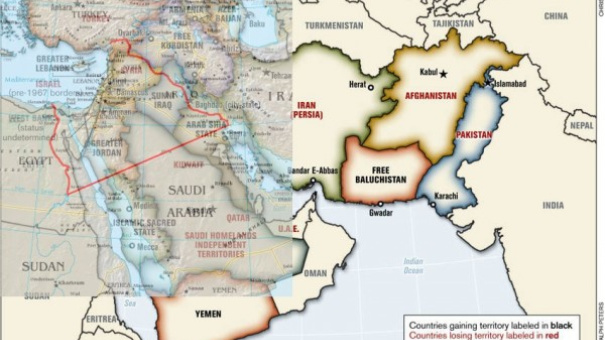
IMAGE: Project Balkanisation: Oded Yinon and an Enduring Plank of Israeli Foreign Policy (Source: Katehon)
It argues that Israel’s long-term survival hinges on one core premise: “The dissolution of all existing Arab states into small units.”
On the surface, the geopolitical win by the US-UK-Israel military-intelligence trifecta — backed by Turkey and the Persian Gulf monarchies — appears seismic. A Shīʿī-led country now falls under Sunni Salafism, severing the contiguous Shīʿī-controlled corridor linking Tehran to Hezbollah in Lebanon.
Another barrier to China’s Silk Road ambitions into the Mediterranean has been firmly set in place. Any revival of the ancient Via Maris — a trade corridor that once ran the Levantine coast, linking Asia to Europe and North Africa — remains a pipe dream.
Severed by the establishment of Israel and now buried beneath the rubble of Syria’s destruction, it ensures that any vision of unity from the Maghreb to the Arabian Peninsula remains just that — a vision.
But perhaps of greater immediate import — Israel’s ethno-supremacists and their vision of a ‘Greater Israel’ have just taken a giant leap forward. Southern Syria — and crucially, Mount Hermon, which overlooks Damascus and the Bekaa Valley in Lebanon, granting strategic military dominance over both — is now firmly under Israeli control. As is the tri-border area between Syria, Jordan, and Iraq — Al Tanf.
Yet there’s more. Israel now moves to establish its self-styled ‘David’s Corridor’ — a contiguous land route stretching from the occupied Golan Heights through southern Syria to the Euphrates. It cuts through the governorates of Deraa, Suwayda, Al-Tanf, and Deir Ezzor, reaching the Iraqi-Syrian border at Albu Kamal — granting Israel a strategic foothold deep in the heart of West Asia.
The corridor was already partially activated during the 12-day war with Iran, enabling standoff air strikes deep into Iranian territory.
With a direct land route to Iraq now viable, expect covert destabilisation efforts within the Shīʿī heartlands of Karbalāʾ and Najaf, alongside renewed backing for Kurdish separatists in both Iraq and Syria. Further vicious sectarian conflict across the region is now being baked in.
Whilst Israel’s bombing of the Defence Ministry and the Presidential Palace in Damascus was supposedly to protect the Druze community from Jolani’s Salafist mercenaries, no such protection was afforded to the Alawites, Armenians, Assyrians, or any of Syria’s other religious or ethnic minorities, who were left to be slaughtered.
The strikes on the Defence Ministry and Presidential Palace were telegraphed well in advance — and were thus performative. A warning to Jolani — Southern Syria is now firmly under Israel’s purview. No Syrian military forces will be allowed.
Meaning: Jolani and his hired guns are expendable, especially now that they’ve completed their task — extinguishing Syria’s sovereignty. As Hadi Nasrallah ruefully put it:
“You mean to tell me the very ones armed by Israel, treated in Israeli hospitals, coordinating with the IOF, shaking Netanyahu’s hand and thanking him for bombing Lebanon — are now being bombed by Israel after serving their purpose? Who would’ve thought?”
And yet, it remains far from clear if Jolani has outlived his usefulness, or if he still has his uses, at least from a US perspective.
Only days ago, whilst Jolani was in Baku, Syrian and Israeli officials were reportedly in talks. Rumours even swirled of a deal wherein Syria would launch attacks against Lebanon’s Shiʿī communities — either independently or in coordination with Israel.
Little wonder, then, that US envoy Tom Barrack warned Lebanon to ‘disarm Hezbollah or risk Syrian occupation’ — signalling that Lebanon, too, is likely slated for division and balkanisation.
The port of Tripoli and the Bekaʿa Valley, Lebanon’s agricultural heartland and a Shīʿī stronghold, are now in play. The only question is whether Ankara or West Jerusalem will seize them first, come to blows over Lebanon’s spoils, or quietly divide them, with Turkey taking the port and Israel the Bekaʿa.
But full control may yet require the chaos of full-on civil war. Syria and Lebanon edge closer — division and balkanisation becoming ever easier to enforce, until little remains but manageable fragments. The Yinon Plan made manifest.
“The attack on Lebanon is going to happen without a doubt… the question is when, and the other question is how. Is Israel going to do a ground invasion at the same time or just attack from the air?” (Ibrahim Majed)
Doubtless, the architects of today’s chaos are already patting themselves on the back, expecting handsome dividends to roll in. More division. More balkanisation. A weaker, fractured Arab world — and a stronger, more dominant Israel.
This is what Netanyahu means when he talks about “redrawing the Middle East”.
Yet the US and Israel are unravelling at an accelerating pace. Their seeming victory over the Levant is no triumph of providence — it courts the abyss and beckons the judgment to come.
US envoy says Hezbollah weapons ‘an internal matter’ during Beirut visit
The Cradle | July 21, 2025
US envoy Tom Barrack said while visiting Lebanon on 21 July that the issue of disarming Hezbollah is an “internal matter,” after months of pressure by Washington on the Lebanese state to secure a surrender of the resistance’s weapons.
“Disarming Hezbollah is an internal matter,” he said, adding that “ideas and assistance” are being offered to the Lebanese state.
“We are not forcing anyone to do anything … we are trying to help,” he added.
He stressed that Hezbollah “is a terrorist organization” in the eyes of the US, and that Washington does not engage in dialogue with it. “We have no skin in the game,” Barrack said.
He claimed Lebanon faces no “consequences” or “threat” if Hezbollah does not disarm, but that it will be “disappointing.”
When asked by a reporter about guarantees that Israel will withdraw its forces from Lebanon and end its attacks on the country, Barrack said, “We cannot compel Israel to do anything, can we?”
Barrack is in Lebanon to discuss with officials Beirut’s response to a US proposal for disarming Hezbollah.
Sources cited by Reuters in early July said that Barrack warned that Hezbollah must be disarmed by November or the end of this year at the latest – in exchange for a withdrawal of Israeli troops from the five points they occupied in south Lebanon after the ceasefire, in violation of the deal. Earlier this month, the US envoy warned that Lebanon risked being occupied by Syria’s extremist-dominated military if Beirut did not move quickly to disarm Hezbollah.
Barrack said during his last trip to Lebanon that he was “satisfied” with Lebanon’s response to the US roadmap, which is expected to be finalized and handed over soon.
Beirut has reportedly demanded that no timeframe for disarmament be set until Israel withdraws and ends attacks.
The resistance group has repeatedly rejected surrendering its weapons. As the government vows to achieve a monopoly over all weapons across Lebanon, Hezbollah says it is ready for internal discussions on the formation of a Lebanese defensive strategy, through which the group’s arms would be incorporated into the state for use in deterring Israel.
The Lebanese resistance group has refused any discussion on the matter until Israeli troops withdraw from Lebanon and end their attacks.
Israeli attacks on Lebanon have continued unabated. Tel Aviv has violated the ceasefire over 3,000 times. More than 200 people have been killed since the deal was signed in November 2024.
Twelve people were killed in an Israeli airstrike in the eastern Bekaa region of Lebanon last week.
Israel has threatened to continue escalating against Lebanon if Hezbollah is not disarmed.
Hezbollah MP Hussein Jachi said on Monday that Hezbollah “will not abandon its weapons for empty US promises.”
“We will not abandon our faith or our strength. We are ready for confrontation. There will be no surrender or submission to Israel, and Israel will not receive our weapons,” Hezbollah chief Naim Qassem said on Friday.
“We know that confrontation is very costly, but surrender leaves us with nothing,” he added, noting that if the “threat is removed, we are ready to discuss the defense strategy and the national security strategy.”
Pentagon Quietly Returns Nuclear Bombs to UK for First Time Since 2008
Sputnik – 21.07.2025
WASHINGTON – The United States has reportedly returned its nuclear weapons, including an unspecified number of B61-12 thermonuclear gravity bombs, to the British Lakenheath air force base in Suffolk, the UK Defense Journal reported, citing multiple sources.
For the first time since at least 2008, the United States has transported weapons from the US Air Force Nuclear Weapons Center at Kirtland Air Force Base in New Mexico to a newly established secure storage facility in Suffolk, UK, the journal reported on Sunday.
The Lakenheath base stored US nuclear weapons during the Cold War, with their removal occurring in 2008 as part of disarmament initiatives. The potential reintroduction of nuclear bombs to Europe coincides with worsening relations between NATO and Russia, particularly due to the ongoing conflict in Ukraine and the military alliance’s efforts to enhance its readiness.
The B61-12 bomb is an enhanced version of the B61 nuclear bomb, featuring advanced guidance systems and variable yield capabilities. As a key element of the United States’ strategic nuclear arsenal, it is designed for deployment through various delivery systems, including F-35A Lightning II aircraft and other platforms.
E3 violated JCPOA, lost right to reinstate UN sanctions against Iran: Russian envoy
Press TV – July 21, 2025
A senior Russian diplomat says Britain, France, and Germany, known as the E3, have repeatedly violated the terms of the 2015 nuclear deal, and thus forfeited their right to trigger the snapback mechanism that would re-impose all UN Security Council sanctions on Iran.
Russia’s Permanent Representative to International Organizations in Vienna, Mikhail Ulyanov, made the remarks in an interview with Izvestia newspaper on Monday, days after the E3, in coordination with the US, threatened to initiate the 30-day snapback process if there is no progress on Iran’s nuclear talks by the end of August.
“As for the threats of Westerners to initiate a mechanism for restoring sanctions, it is quite rightly noted that this idea is illegitimate,” Ulyanov said.
“The Americans themselves withdrew from the JCPOA, renouncing the rights and obligations of a participant in the nuclear deal, and the United Kingdom, Germany and France are violators of both the JCPOA and UN Security Council resolution 2231. This means that they have also deprived themselves of the right to initiate a ‘snapback.’”
He was referring to the Joint Comprehensive Plan of Action, the official name of the Iran nuclear accord, which the US ditched in 2018 before returning the illegal sanctions that it had lifted against Iran and launching the so-called “maximum pressure” campaign.
Following the US withdrawal, the European signatories to the JCPOA failed to uphold their commitments and made no efforts to save the agreement.
Also in his remarks, the Russian envoy criticized the Europeans and Americans for using “the tactics of forceful pressure” against Tehran, saying such an approach has no chance of success.
“The habit of Europeans and Americans to set certain deadlines all the time is quite counterproductive,” he said, citing the negotiations aimed at restoring the JCPOA in 2021-2022 as an example.
In an X post on Sunday, Ulyanov emphasized that the E3 “has no legal or moral right” to activate the snapback procedure.
Earlier, Iran’s Foreign Minister Abbas Araghchi sent a letter to the UN chief, the Security Council president, and the top EU diplomat, saying the E3 have relinquished their role as “participants” in the JCPOA, rendering any attempt to trigger the snapback mechanism “null and void.”
Why Israel seeks a temporary Gaza truce to keep its genocide going
Behind the talk of calm, Tel Aviv is redrawing Gaza’s borders, displacing its population, and laying groundwork for permanent control, one truce at a time.
By Qassem Qassem | The Cradle | July 20, 2025
Twenty-one months into its brutal campaign against the Gaza Strip, Israel is again mulling a temporary ceasefire with the Palestinian resistance. Two brief truces have already collapsed into renewed bloodshed.
But is the genocidal war really coming to a close? This question looms over the proposed truce, raising doubts about whether Israel seeks an end, or simply a pause before its next assault.
This time, mediations led by Qatar and the US, with Egypt playing a minor role, are pushing for a 60-day cessation of hostilities. The deal hinges on a pledge from US President Donald Trump to extend the truce if talks progress.
Tel Aviv’s day-after plans for Gaza
These negotiations reflect a deeper shift in the occupation state’s security doctrine. Israeli Prime Minister Benjamin Netanyahu has repeatedly declared his intention to reshape Gaza’s future beyond a temporary lull in fighting.
He insists on disarming the resistance, dismantling Hamas’s authority and control, and eliminating any future threat from the besieged enclave. In Tel Aviv’s vision for the “day after,” there is not even a role for the collaborative Palestinian Authority (PA) in the Strip.
At most, Israel may tolerate an occupation state-backed militia resembling the Yasser Abu Shabab group or deploy Arab security forces to support local merchants or clans in governing Gaza – until the PA is “reformed” to Washington’s satisfaction, with Israel maintaining overarching security and military control.
This plan dovetails with the long-standing aspiration of Israel’s far-right government to re-establish illegal settlements in northern Gaza. Netanyahu is lobbying his army to construct a “tent city” in Rafah to forcibly relocate 600,000 Palestinians, a blatant demographic engineering scheme.
The 60-day truce proposal includes a phased Israeli withdrawal from west to east, a halt to air raids, permission for food and humanitarian aid entry, and a prisoner exchange. Unlike previous ceasefires, Trump’s involvement is being marketed as a guarantee that the occupation forces will not resume attacks once the deadline expires – as they did immediately after the March truce.
Yet despite signs of possible relief for Gaza’s starving and besieged population, Israel still believes it has not achieved its core objective: dismantling Hamas. One unnamed Israeli official was recently quoted as saying: “The flexibility we’ve shown paves the way for an agreement, but Netanyahu clearly doesn’t intend to end the war.”
Any upcoming truce is thus likely a pause to prepare the battlefield for the next round. Still, renewed war could prove challenging given the limits of the occupation army and the deepening cracks in its society.
Reconstruction as leverage and the Morag corridor ploy
As part of ongoing pressure, anti-resistance forces are using Gaza’s reconstruction as leverage. Israel has floated a deceptive offer to allow Qatari and international funds into Gaza during the truce, which is an attempt to lure Hamas into believing the war is truly ending. This is, in reality, a calculated deception by Israel to manufacture the illusion of an approaching end to war and draw Hamas into a false sense of security.
According to a report on 10 July by Israeli newspaper Yedioth Ahronoth, Israel has “tentatively agreed” to Qatari participation in rebuilding the Strip, provided it does not monopolize the process. Other states are expected to co-fund reconstruction to prevent funds from reaching Hamas, although Saudi Arabia and the UAE have made their commitment to Gaza’s reconstruction conditional on the war’s conclusion.
A major sticking point is Israel’s new “Morag Corridor,” carved between Khan Yunis and Rafah to replicate the Philadelphia Corridor separating Gaza from Egypt. Much like the Netzarim axis that once bisected the Strip, the Morag route is presented by Israel as vital for its security. Tel Aviv plans to use the corridor to isolate the Rafah tent city from northern Gaza—effectively creating a walled-off holding zone for displaced Palestinians.
Palestinian resistance factions have flatly rejected this scheme. Not only does it violate Palestinian sovereignty, but it would turn Gaza into a cluster of disconnected, besieged cantons, with Israel occupying nearly 40 percent of the territory.
On 14 July, Netanyahu’s government submitted a third withdrawal map to mediators. Leaks reveal that Israeli forces plan to remain in a 900-meter belt near Beit Hanoun and a 3.5-kilometer strip east of Rafah. In a post on X, Kan political correspondent Gili Cohen, citing sources familiar with the negotiations, said that Israel is now showing “flexibility” on broader withdrawals from Rafah and the Morag axis.
But Rafah remains the core obstacle to any deal. Israel insists on cramming 600,000 Palestinians into the southern city, either to push them into Egypt, where alarm over Israeli designs is mounting, or force them toward the sea. Tel Aviv and Washington are actively probing third countries to receive Gaza’s expelled population.
A tactical pause, not a peace plan
Netanyahu’s real goal is to secure strategic gains for the post-war phase. During his visit to Washington earlier this month, he sought a written US assurance that would allow Israel to resume its war, even under a formal ceasefire.
He plans to wield this assurance as political cover at home, particularly to placate extremist coalition partners like Itamar Ben Gvir (Jewish Power) and Bezalel Smotrich (Religious Zionism), who demand total war and Hamas’ annihilation.
Netanyahu’s envoy and strategic affairs minister Ron Dermer put it bluntly in a 14 July podcast interview with US columnist and political advisor Dan Senor:
“Right now, what we’re trying to do is get to a ceasefire … the minimum requirement is that the force responsible for the Oct. 7 attack is no more. They have lost control of Gaza due to their decision to act.”
According to Walla News, Netanyahu convinced Trump to delay the agreement by an additional week—bringing the timeline closer to the end of the Knesset’s summer session (late July). The paper noted that Trump is “tired of the war,” but Netanyahu managed to buy time, though what he offered in return remains unclear.
The proposed truce cannot be viewed in isolation from Israel’s broader strategy. Far from signaling the war’s end, it is a calculated intermission. Tel Aviv seeks to redraw Gaza’s demographic and security map, while Hamas focuses on regrouping and fortifying its battlefield presence.
Netanyahu’s recent moves prove that this is no pursuit of peace. What Israel wants is a lull long enough to dismantle Hamas’ political infrastructure, impose buffer zones, and reengineer the population through its “tent city” blueprint.
Palestinian affairs analyst Michael Milstein mocked Tel Aviv’s “day after” vision in a 13 July column in Yedioth Ahronoth, arguing that Gaza has become a constant testing ground for flimsy Israeli schemes that collapse shortly after being proposed. He described Israel’s latest military campaign as a “ferocious effort devoid of dramatic gains,” noting that its aggression in northern Gaza ahead of the last ceasefire produced no lasting achievements. These include past attempts to build isolated ‘bubbles’ of alternate governance in Gaza, and the so-called ‘Generals’ Plan,’ which failed to yield results even amid heavy attacks in the north. He pointed to the long record of failed experiments, from the village leagues in the West Bank, to the occupation’s backing of the Kataeb militias in Lebanon, to the eventual collapse of the South Lebanon Army. These models, he wrote, reflect a deeply flawed understanding of reality, rooted in the belief that brute military force can compel Hamas to disarm, surrender, or abandon Gaza entirely.
He noted two competing camps inside Israel: one that seeks phased withdrawal while postponing Hamas’ fate, and another pushing for full reoccupation based on the racist logic that “Arabs are only deterred by losing land” and that “settlements prevent terrorism.”
Rather than a moment of transition, this seems to be a continuation of Israel’s campaign by other means. So long as Tel Aviv avoids a political reckoning for its war on Gaza, every ceasefire will be a battlefield in disguise. Between a fleeting truce and a deepening occupation, Gaza stands today at a decisive crossroads — one where the illusion of peace masks a relentless colonial project.
Russiagate only tip of iceberg in Western demonization of Russia – expert
RT | July 20, 2025
US National Intelligence Director Tulsi Gabbard’s revelations about the role of former President Barack Obama’s administration in the Russiagate scandal are “shocking,” but they expose only the surface of a broader Western anti-Russia campaign, Professor Oliver Boyd-Barrett has told RT.
On Friday, Gabbard released newly declassified documents describing a coordinated effort by senior Obama-era officials – led by Obama himself – to falsely accuse Donald Trump of colluding with Russia during the 2016 election. The documents indicate that Obama ordered officials to discard intelligence assessments that found no Russian involvement in Trump’s campaign and replace them with claims blaming Moscow based on fabricated data. The scandal led to the years-long Trump-Russia probe known as ‘Russiagate.’
“This is an extraordinary moment, that the head of intelligence in the US has made such a bold, in some ways shocking, statement of the truth,” Boyd-Barrett, a professor at Bowling Green State University and author of an in-depth study of Russiagate, said on Saturday. He noted the moment was especially striking as Gabbard called for prosecution of those involved in what she described as a “coup” attempt.
Boyd-Barrett, however, emphasized that to “fully comprehend” Russiagate, it must be viewed as only a small part of a broader Western campaign to demonize Russia, “that goes decades back.”
“It’s part of a much deeper agenda – we’re talking Russia narrative… the broader context of an anti-Russian campaign that was stoked artificially around the time of the late 90s when the West had so clearly decided that NATO was going to move eastwards regardless of whatever anyone in Russia or anyone in the US had to say,” he said. He also warned against reducing Russiagate to a personal political ploy, noting that blaming it solely on Obama or Hillary Clinton’s election anxiety is “too simple an explanation.”
Moscow has repeatedly denied interfering in the US electoral process.
Trump administration ordered to restore funding to US propaganda outlet
RT | July 20, 2025
A federal judge has ordered the administration of US President Donald Trump to restore funding for state-run Radio Free Europe/Radio Liberty (RFE/RL), ruling that the decision to stop the support was “unprecedented” and lacked any basis.
RFE/RL was a key tool for spreading Western propaganda in the Soviet bloc during the Cold War and was funded by the CIA. The outlet currently receives nearly all of its funding from Congress.
The Trump administration has sought to cut funding for RFE/RL and several other state-linked outlets. It has denounced the United States Agency for Global Media (USAGM), the body that oversees state-funded media, saying it is “not salvageable,” while indulging in “obscene overspending.” The administration also claimed it is crawling with “spies and terrorist sympathizers.”
Consequently, the USAGM essentially froze funding for RFE/RL and refused to enter into a new contract with the outlet after the previous agreement expired in March. This led to staff furloughs and programming cuts, though the EU stepped in to fill the budgetary gap.
On Friday, Judge Royce C. Lamberth of the US District Court for the District of Columbia ruled that the Trump administration lacks the legal authority to refuse Congress-approved funding of more than $70 million, arguing that they provided no clear basis for the move.
”It is unprecedented for an agency to demand that entirely new terms govern its decades-old working relationship with a grantee entity,” he wrote. He went on to rebuke the USAGM for a lack of responses to RFE/RL to negotiate a new agreement, describing it as “stonewalling” and adding that the agency went dark for days or even weeks.
The “USAGM’s flagrant disregard for its funding responsibilities” caused RFE/RL to suffer “mass furloughs, cancelation of programming, and inevitable damage to the global influence that RFE/RL has built over decades,” the ruling said.
RFE/RL President and CEO Stephen Capus welcomed the court’s decision. “This victory provides our journalists with the momentum necessary to continue reaching the nearly 47 million people each week… With this ruling, RFE/RL can continue to advance US national security interests.”
Just Six US House Members Vote Against Sending Israel Another Half Billion Dollars in Military Aid
By Adam Dick | Ron Paul Institute | July 18, 2025
Special interests are continually finagling to gain more support from the United States government that oversees a vast trove of money and power. A vote just after midnight Friday morning in the US House of Representatives suggests that the government of Israel is at the top of the heap of special interests when it comes to being able to extract benefits from the US with very widespread support from American legislators.
The vote was on an amendment Rep. Marjorie Taylor Greene (R-GA) offered to the Department of Defense Appropriations Act (HR 4016) that was being considered on the House floor. Greene’s amendment would have removed the bill’s providing of 500 million dollars in military aid to the Israel government.
As Greene explained in her House floor speech introducing the amendment, this money would be doled out by the 37 trillion dollars in debt US government to the government of “nuclear armed Israel” that provides universal health care and college education subsides to Israelis while receiving US handouts. Further explained Greene, the half billion dollars in the bill is not a one-off payment. Rather, Greene explained that “the US already provides Israel with 3.8 billion annually in foreign aid” and provided an additional 8.7 billion dollars via just one other bill last year. Further, noted Greene, the US has spent enormous sums recently on taking military actions of its own in support of Israel. She provided as an example the US having spent over 800 million dollars shooting off “15 to 20 percent of our Terminal High Altitude Area Defense missiles stockpiles” in aid of Israel in the “twelve-day war” against Iran earlier this year.
Gather a random group of 435 Americans — the same number as there are voting members in the House — to vote on this matter, and Greene’s amendment would be sure not to lose in a landslide. But, the US House of Representatives, despite on occasion being referred to as the people’s house, has a membership whose views in regard to the US giving more and more to the Israel government are far askew from public opinion.
Just 1.4 percent of House members voted for Greene’s amendment. Here is the list of the six House members who voted in opposition to providing another half billion dollars in military aid to what is looking like the most successful special interest in America:
Rep. Marjorie Taylor Greene (R-GA)
Rep. Al Green (D-TX)
Rep. Summer Lee (D -PA)
Rep. Thomas Massie (R-KY)
Rep. Ilhan Omar (D-MN)
Rep. Rashida Tlaib (D-MI)
Trump’s ultimatum to Russia is bluster and bluff to hide proxy war defeat
Strategic Culture Foundation | July 18, 2025
What’s behind Trump’s angry ultimatum to Russia this week? The short answer: failure and frustration. Donald Trump promised American voters that he would end the Ukraine war in 24 hours upon his election in November 2024. Six months into his presidency, Trump has failed to deliver on his boastful promises.
This week, Trump flipped his pacemaker image by pledging billions of dollars worth of new American weaponry to Ukraine. He also issued a warning to Russia to call a ceasefire within 50 days or else face severe secondary tariffs on its oil and gas exports. The tariffs, quoted at 100 percent, will be applied to nations purchasing Russian exports, primarily Brazil, China, and India. The latter move indicates that the U.S.-led proxy war in Ukraine against Russia is really part of a bigger geopolitical confrontation to maintain American global hegemony.
In any case, Moscow dismissed Trump’s ultimatum. Deputy Foreign Minister Sergei Ryabkov said that Moscow would not comply with pressure and that Russia would not back down from its strategic goals in Ukraine to counter NATO’s historic aggression.
It is clear that Trump and his administration have failed to understand Russia’s strategic position and the root causes of the conflict.
Trump’s supposed diplomacy is seen to operate on a superficial basis more akin to showbiz, with no substance. He wants a peace deal with Russia to show off his vaunted skills as a business negotiator and to grab the limelight, headlines, and adulation.
Resolving a conflict like Ukraine requires deep historical understanding and genuine commitment to due diligence. Moscow has repeatedly stated the need to address the root causes of the conflict: the expansion of NATO on its borders, the CIA-sponsored coup in Kiev in 2014, and the nature of the NATO-weaponized Neo-Nazi regime over the past decade.
Trump and his administration have failed to appreciate Russia’s viewpoint. Thus, expecting a peace deal based on nothing but rhetoric and vacuous claims about “ending the killing” is futile. It won’t happen.
This failure, based on unrealistic expectations, has led Trump to adopt an increasingly bitter attitude towards Russian President Vladimir Putin in recent weeks. Ironically, Trump has accused Putin of duplicity and procrastination when, in reality, it is Trump who has shown no serious commitment to resolving the conflict.
Now, with chagrin and bruised ego, Trump has reacted with frustration over what are his own failings by issuing ultimatums to Russia. Trump’s 50-day deadline for a Russian response to his demands has a similarity to the 60-day deadline he threatened Iran with, after which he carried out a massive bombing attack on that country. Trump’s aggression towards Iran has turned out to be a fiasco and failure. Threatening Russia is even more useless.
This proclivity for threatening other nations has the hallmark of a Mafiosa megalomaniac. It is also causing Trump to lose support among his voter base, who believed he was going to end “endless wars.” It’s shambolic. Biden’s war is becoming Trump’s war because, at the end of the day, it is the U.S. imperial deep state that rules.
Trump’s mercurial switch from professing peace in Ukraine to ramping up the promise of weapons shows that his previous aspirations were always hollow and contingent on other interests.
It seems that the 47th American president did not want peace after all. What was driving his apparent desire to end the conflict in Ukraine – what he deprecated as “Biden’s war” – was simply to cut American financial costs.
What has appealed to Trump is that the proposed new supplies of American weapons to Ukraine will be paid for by Europe. Money and profit are all that matter to him. It is significant that when Trump announced the new arms racket scheme, he was sitting beside NATO chief Mark Rutte in the Oval Office. Rutte has a knack for wheedling, previously referring to Trump as “daddy” and this week absurdly praising the U.S. as the world’s policeman for securing peace. It seems that the NATO and transatlantic ruling establishment have found a way to manipulate Trump. Tell him that the Europeans will henceforth directly subsidize the U.S. military-industrial complex.
The trouble for Trump and the NATO establishment is that it is all an unworkable bluff. For a start, the U.S. arsenal of Patriot missiles and other munitions has been depleted and destroyed by Russia over the past three years in Ukraine. There are no “wonder weapons” that can alter the battlefield dominance of Russia.
Secondly, the European economies are broke and can hardly sustain the proposed purchase of U.S. weapons for Ukraine, even if such supplies were feasible, which they are not. At least four European states, including France, the Czech Republic, Italy, and Hungary, have said they will not engage in any scheme of buying American weapons for Ukraine.
Thirdly, Trump’s threat of secondary sanctions against Brazil, China, India, and others for doing business with Russia is a blatant assault on the BRICS and Global South that will only garner international contempt. Trump’s bullying is neither viable nor credible. His earlier trade war against China has already failed and shown that the United States is an impotent giant whose power is a thing of the past. Trump had to climb down from his hobby horse towards China.
So, threatening to hit China and others with 100 percent tariffs for doing business with Russia is like a former prizefighter shaking a feeble fist while sitting in a wheelchair. He is liable to incur more self-harm.
Lastly, Russia is decisively winning the NATO-led proxy war in Ukraine. The Kiev regime’s air defenses are non-existent at this stage. Therefore, Russia can and will press its strategic terms to end the conflict because it is the military victor.
Trump’s ultimatum to Russia is nothing but bluster and bluff. He once mocked Ukraine’s puppet president Zelensky, that he had no cards to play. Trump, for all his bravado, has only a couple of deuces himself.
In 50 days, Trump will have a serious amount of egg on his face when Russia’s defeat of the NATO proxy war becomes more evident.
Tulsi Gabbard releases ‘overwhelming evidence’ of Obama coup plot against Trump
RT | July 18, 2025
Former President Barack Obama’s administration deliberately manipulated intelligence to frame Russia for interfering in the 2016 presidential election, according to newly declassified documents released on Friday by Director of National Intelligence Tulsi Gabbard.
Gabbard unveiled more than 100 pages of emails, memos, and internal communications, which she described as “overwhelming evidence” of a coordinated effort by senior Obama-era officials to politicize intelligence and launch the multi-year Trump–Russia collusion investigation. She dubbed it “a treasonous conspiracy to subvert the will of the American people.”
The scandal severely damaged relations between Moscow and Washington, leading to sanctions, asset seizures, and a breakdown in normal diplomacy.
”This intelligence was weaponized,” Gabbard said. “It was used as a justification for endless smears, for sanctions from Congress, and for covert investigations.” She added: “When key internal assessments found that Russia ‘did not impact recent U.S. election results,’ those findings were suppressed.”
“For months before the 2016 election, the Intelligence Community maintained that Russia lacked both the intent and capability to hack U.S. elections,” Gabbard noted. “But once President Trump won, everything changed.”
One document — a draft President’s Daily Brief dated December 8, 2016 — stated Russia “did not impact recent U.S. election results” through cyberattacks. The report, prepared by the CIA, NSA, FBI, DHS, and other agencies, found no evidence of voting interference.
Yet Fox News reported on Friday that the document was pulled — “based on new guidance,” according to internal emails. Hours later, a high-level Situation Room meeting took place, attended by officials including DNI James Clapper, CIA Director John Brennan, National Security Adviser Susan Rice, FBI Deputy Director Andrew McCabe, and Attorney General Loretta Lynch.
According to declassified notes, attendees agreed to produce a new intelligence assessment at President Obama’s request. That report, released on January 6, 2017, claimed Russia had intervened in the election to help Donald Trump — directly contradicting earlier assessments.
Gabbard claims the revised assessment leaned on the discredited Steele Dossier — compiled by a former British spy — while sidelining dissenting views within the intelligence apparatus. “This was not intelligence gathering,” Gabbard stated. “It was narrative building.”
Confirmed as DNI earlier this year — after a contentious process — Gabbard says she has forwarded the documents to the Department of Justice. She has urged investigations into former CIA Director John Brennan and former FBI Director James Comey, who are reportedly facing criminal inquiries. “No matter how powerful, every person involved must be brought to justice,” she stressed. “Our nation’s integrity depends on accountability.”
“The integrity of our democratic republic depends on full accountability,” Gabbard concluded. “Nothing less will restore the public’s trust — and ensure nothing like this ever happens again.”
Want To Wipe Out Patriot Systems? Ask The Russians How
Sputnik – 18.07.2025
US-made Patriot air defenses aren’t a magic fix for Ukraine — and Russia’s arsenal has already exposed their weaknesses.
“Patriot is ineffective against hypersonic missiles,” retired Russian Colonel Viktor Litovkin tells Sputnik.
- The Kh-47M2 Kinzhal, a Russian hypersonic missile that reaches speeds up to Mach 10 and ranges of 3,000 km, easily destroys Patriots.
- Iskander-M’s single-stage solid-fuel guided missile 9M723 boasts a quasi-ballistic trajectory. With a striking range up to 500km it is another effective tools against Patriot systems.
- Both the Iskander-M and Kinzhal systems demonstrate high precision.
- Not by hypersonic alone: Geran dones + Kalibr missiles is a killer combo. A swarm of Geran drones forces Patriots to waste missiles. Then, while it’s reloading, a cruise missile, like a Kalibr, is fired.
Patriot’s Achilles’ heels
- “Dead Zones”: The Patriot has dead zones, like up to 100m altitude where it can’t detect targets, per Litovkin.
- So drones flying low can evade it. This is exactly how Houthi drones overcome air defenses in the Middle East, and Patriots couldn’t stop them.
- Easy to detect: The Patriot system has a radar station that emits radio waves. By detecting these waves, you can determine where they come from and pinpoint the coordinates of the source. So, in this case, reconnaissance is technically quite simple.
Ukraine’s Layered Defense Dream
The Kiev regime aims to build a layered system, says Yuriy Knutov, a military expert and air defense historian, which would include:
- long-range Patriots
- mid-range SAMP/T
- short-range NASAMS or IRIS-T
- plus Gepard guns
Who gets protection:
- Knutov believes that new Patriot systems will protect Western military plants in Ukraine.
- They’ll also be deployed around Kiev, Kharkov, Odessa, and Lichevsk — key hubs for weapons.
- Ukrainian troops at the front lines? Just cannon fodder.
The Patriot is the core — so it must be precisely targeted, he says.
Featured Video

Death Spikes & Rising Cancer In Our Youth Explained
or go to
Aletho News Archives – Video-Images
From the Archives
Politicians lie
By Mazin Qumsiyeh | Popular Resistance | August 18, 2013
There is no way to say this truth nicely: Politicians lie. That includes Japanese, American, Egyptian, Israeli, and Palestinian politicians! Is there something more common sense than that? Yet, so many citizens around the world believe their own politicians or wistfully acknowledge lies but think it is part of the job needed to run things. They believe even when politicians contradict themselves blatantly. This phenomenon is rather remarkable. It is a dissonance and disconnect from reality that many seem oblivious to. It is very dangerous because it can lead to accepting rationales for going to war. These can be deadly wars that lead to millions of lives lost as happened in what was called World War 1 and WW2. Even when incredible and declassified evidence abound, politicians continue to lie and old mythologies refuse to die. Here are just a few of the countless lies told to us over the past few decades… continue
Blog Roll
 Aletho News
- From Unipolar Universalism to Multipolar Civilizational Distinctiveness
- RSF military group defects, joins Sudanese army: State media
- Ireland goalkeeper refuses to play ‘Israel’ as squad weighs boycott
- China pushes back against US on Cuba, Iran
- Ukrainian Soldiers, Potential Mercenaries: Have Gun, Will Travel!
- Burnham’s UN debut… A masterclass in British disinformation
- Iran flights continue despite US aviation sanctions
- Global Tipping Points Lead the World Into a State of Entropy
- The day-after at the White House: USA and Xi Jinping
- The Geopolitical Balance in the Red Sea: The UAE Being Displaced by New Players
- If Americans Knew
- Deconstructing Netanyahu’s pants-on-fire UN rant – Daily Update
- Trump betrayed voters with his campaign lies and prioritized a foreign country once he took office
- Netanyahu calls Israel’s war in Gaza ‘opposite of genocide’ in UN speech to near-empty hall
- Settler Kidnappings: Torture, Sexual Abuse and Terrorisation of Palestinian Abductees as Israel Deepens Annexation of West Bank
- Gaza winter nears as 162,000 tents become unusable, raising fears of humanitarian crisis
- Netanyahu says, “It’s the opposite of genocide”; UN says Gaza economy is world’s ‘most severe crisis on record’ – Daily Update
- Israel’s US-Backed Assault on Gaza Has Created the ‘World’s Most Severe Economic Crisis on Record’: UN
- ‘Protecting U.S. Citizens’… From Israel
- ‘This is where I live now, the back of a truck’: a day in the life of a grandmother in Gaza
- In UN Speech, Iran’s President Displays Pictures of Children Killed by US, Brings Attention to Israel’s Nuclear Arsenal
- No Tricks Zone
- New Study: Earth And Venus Surface Warmth Largely Explained By Convection And Lapse Rate, Not CO2 Or Radiation
- 2025 Nature Paper Claiming Worsening Global Drought Gets RETRACTED …Heavily Flawed
- New Study: ‘Global Drought Shows No Detectable Recent Acceleration Under Climate Warming’
- Economic Masterminds: German Socialists Suggest Taxing Productivity Gains Stemming From Using AI
- The South China Sea Has Not Been Cooperating With The Climate Change Narrative
- Energy Crisis: Germany Enters Heating Season With Historically Low Gas Reserve Fill Levels
- New Study: The Antarctic Ice Sheet Gained Mass From 2020-2024 Due To Staggering Snow And Ice Accumulation
- Study: Ocean Heating Rates From Thousands Of Years Ago ‘Dwarf’ Modern Ocean Heating Rates
- Climate Extremists Target, Attack Large-Scale Power Grid Infrastructure In Germany!
- New Study: Antarctic Ice Melt Has Contributed Less Than 1 Centimeter To Sea Level Rise In The Last 30 Years

