Huckabee aide goes to ‘unusual lengths’ to portray ‘Israel’ positively
Al Mayadeen | October 9, 2026
David Milstein, a senior advisor to US Ambassador to “Israel” Mike Huckabee, suppressed an embassy memo critical of the Israeli government’s decision to approve additional settlements in the Israeli-occupied West Bank, The New York Times reported, citing three US officials who work with Milstein.
The officials told the Times that Milstein blocked the memo from being released before it could be shared with lawmakers in Washington. He also insisted on approving communications from the embassy section responsible for Palestinian affairs, according to multiple officials with direct knowledge of the matter.
The officials said they spoke to the newspaper because they were concerned that Milstein’s actions were undermining the normal work of the diplomatic mission, while those who interacted with him told the Times that he went to “unusual lengths” to portray “Israel” positively.
Milstein’s role at embassy comes under scrutiny
Milstein’s LinkedIn profile shows that he previously worked as an aide to Sen. Ted Cruz, R-Texas, and as an advisor to Florida Gov. Ron DeSantis’ gubernatorial campaign, where he handled “Jewish and pro-Israel outreach.” He later served as a special assistant to former US Ambassador to “Israel” David Friedman during President Donald Trump’s first term.
Milstein also drew attention in September after sending wedding invitations requesting “monetary wedding gift[s]” in “U.S. dollars or Israeli shekels” alongside a QR code, according to screenshots reviewed by Politico’s Playbook.
Huckabee defended Milstein following the report, writing on social media, “If there is anyone I’ve worked with presently or over the past 50 years of my adult life which I’ve had absolute confidence in as one with impeccable integrity, it’s David Milstein.”
A source in the intelligence community told Politico, “[Milstein’s] a giant walking counterintelligence red flag … the fact that he is blatantly soliciting donations is absolutely jaw dropping.”
The Trump administration previously dropped sanctions imposed by the Biden administration on extremist Israeli settlers. Huckabee has also condemned settler violence in the West Bank, calling it an “act of terror.”
Huckabee has separately addressed growing dissatisfaction toward “Israel” in the United States, telling NewsNation that social media disinformation and foreign propaganda were responsible for much of the negative perception.
Trump Announces Diesel Supply Deal With Putin Following Phone Call
Sputnik – 09.10.2026
US President Donald Trump says he reached an agreement with Russian President Vladimir Putin during a phone call for Russia to supply diesel fuel to American and global markets.
Russia will deliver more than 300,000 tons immediately, followed by 500,000 tons in November and another 1 million tons shortly afterward, he wrote on Truth Social.
Trump also announced plans for an additional 3 million tons of Russian diesel, depending on the condition of Russia’s refineries, claiming the agreement would help bring down fuel prices in the US and worldwide.
Following the announcement, the US Treasury’s Office of Foreign Assets Control (OFAC) announced a temporary general license allowing Russian diesel supplies to global markets, effective immediately at Trump’s direction.
Trump believes the deliveries would help bring down diesel prices in the US and worldwide amid rising fuel costs and disruptions to global energy markets.
Baghaei to Rubio: Distorted narratives cannot erase US record of broken commitments
Press TV – October 7, 2026
Iranian Foreign Ministry spokesman Esmaeil Baghaei has dismissed claims by US Secretary of State Marco Rubio that Tehran has repeatedly squandered chances for an agreement, saying the inversion of historical facts cannot erase Washington’s pattern of treaty-breaking from public memory.
Baghaei, responding to an IRNA question on Rubio’s assertion that “Iran has missed opportunities for an agreement multiple times,” stated on Wednesday, “The inversion of historical truths cannot remove the reality of America’s repeated breaches of commitment from the mind of public opinion.”
He pointed to Washington’s successive acts of bad faith, including its unilateral withdrawal from the nuclear deal on May 8, 2018, the sabotage of diplomatic tracks, military aggression against Iran while negotiations were underway, and the subsequent violation of the Islamabad Memorandum of Understanding Iran reached on June 18.
Baghaei held the United States responsible for the insecurity prevailing in the region and for the economic consequences felt in America and worldwide.
“Blame-shifting and contradictory statements cannot overshadow the demand of American and global public opinion that those responsible for the illegal war and the crimes committed be held to account,” he said.
On the latest developments in contacts with the United States, the spokesman said the Islamic Republic’s considerations and conditions for ending the imposed war on all fronts and restoring security to the Persian Gulf and the Strait of Hormuz have been set out explicitly and decisively.
The necessary response to the other side’s proposals will be conveyed through intermediaries. “The exchange of messages between Iran and the US is being conducted through intermediaries,” he added.
On diplomatic efforts related to regional peace and security, including commercial shipping in the Strait of Hormuz, Baghaei stressed that the security of navigation in the waterway matters more to the Islamic Republic of Iran than to any other party. Iran, in consultation with Oman as the other littoral state, has spared no effort to restore security to the Strait.
“The consultation process between Iran and Oman has proceeded successfully. In addition to agreeing on the geographical coordinates of safe two-way routes in the Strait of Hormuz, the two sides have reached an understanding on how the matter will be presented to the relevant international body, a step that will, God willing, be taken soon,” he said.
Asked about the possibility of a joint meeting involving Iran, Oman, and other Persian Gulf states, Baghaei said Iran will continue its efforts to strengthen trust and engagement among the region’s countries.
“Defenders of the homeland, in both the diplomatic arena and the field, stand shoulder to shoulder, resolute and steadfast in defending Iran’s sovereignty and securing the nation’s interests and security,” he concluded.
Houthis Don’t Have to Conquer Saudi Arabia to Make It Pay
Daniel Davis / Deep Dive – October 7, 2026
Johnson, Marandi say Yemen holds upper hand over Saudi Arabia
Al Mayadeen | October 7, 2026
Former CIA analyst Larry Johnson and Professor Mohammad Marandi said that Yemen holds the upper hand in its war with Saudi Arabia, and that neither Turkey nor Pakistan is likely to change that by sending forces to the kingdom’s aid.
Speaking on Al Mayadeen’s The Grand Standoff: Iran and the World on Tuesday, both guests also noted that Tehran is working on the assumption that the US will restart its war on Iran, while Johnson argued that Washington has less capacity to carry one out than its rhetoric suggests.
Yemen advances as Saudi-backed forces falter
Marandi said that the past weeks have shown a one-sided war. He stated that the Saudi camp’s claims that it could retake significant territory proved to be empty talk, as Yemeni forces, led by Ansar Allah and the Yemeni government, kept moving forward. “The liberation of Taiz is near,” he said.
Johnson stressed that Yemen “has every advantage in this war.” He put Saudi Arabia’s dependable fighting strength at about 75,000 soldiers, the Presidential Leadership Council (PLC) at another 100,000, and the Yemeni Armed Forces’ at 350,000. He described the Saudi army as “basically a group of mercenaries,” while Yemeni fighters have the motivation of defending their own land.
Johnson highlighted that the PLC’s latest offensive showed a lack of military competence. “Successful military attacks are usually not announced in advance, they usually prefer not to give the opposing side a heads up about what you’re going to do,” he said, noting that this one was announced beforehand. He added that the PLC launched it “even without what’s called close air support.”
Saudi aircraft carried out a number of bombing runs along the front lines, Johnson said, “but they were not coordinated.” He explained that “normally you want somebody on the front lines who can actually be in communication with the pilots or with the air controllers, the combat air controllers, to identify specifically along the front lines where bombs need to be dropped.”
“What we’ve seen is that [the Yemeni Armed Forces] operate at a more sophisticated level,” he said. He rejected the Western line that this is Iran’s doing. “Contrary to Western propaganda that this is all just the work of Iran, this is not the work of Iran,” he said. “Anybody that’s had any dealings at all with the Houthis knows that they are quite independent.” He said the movement sees Iran as a friend, but “they don’t let Iran dictate its choices or what it does.”
Johnson added that he believes Saudi Arabia attacked Sanaa after the funeral of Sayyed Ali Khamenei because the US encouraged it. He explained that Washington wrongly saw Yemen as a paper tiger, and described its approach to West Asia as “a combination of ignorance and arrogance.”
Turkey, Pakistan face a logistical nightmare
Both guests dismissed the idea of a Turkish or Pakistani deployment. Johnson said the announcement that Turkey and Pakistan would effectively declare war on Yemen “was laughable.”
He clarified that air power would not solve the problem either. “Dropping bombs without effective ground controllers is just, it’s a waste of bombs,” Johnson said. “It’s just punching holes in landscape without accomplishing anything.” He called the announcement “more Western hype” that “speaks to the desperation of the Saudis,” adding, “I don’t see Turkey or Pakistan intervening in any significant way.”
Marandi said he does not know whether Riyadh, Ankara and Islamabad have even decided to send forces. “It’s possible,” he said. “But as Larry said, this would be a logistical nightmare, and the cost would be extraordinary. And even troop movements inside Saudi Arabia would not be easy.”
He stated that neither country has the capacity. “Pakistan, of course, its military is on the border with India, and they have very bad relations with the Taliban in Afghanistan,” Marandi said, adding that Turkey has difficult relations with almost all of its neighbors. “The armed forces of Pakistan and Turkey are not designed for such mass movements of troops.”
Marandi asserted that Turkey and Pakistan are also harming themselves by letting the narrative spread that they stand with Saudi Arabia. “Turkey and Pakistan are not doing themselves any favors by pushing or allowing this narrative to be pushed that they are on the side of Saudi Arabia,” he said. He pointed to their stance on Gaza, which he said made them popular across the region. “They’ve become heroes across the region,” he said, and “it’s clear that their sympathies lie with [Ansar Allah].”
Saudi Arabia exposed on oil, infrastructure
“The Saudis are in real trouble,” Johnson said. He said the East-West oil pipeline is down and that reports of oil getting through, including through the Strait of Hormuz, are false. “They have lots of infrastructure that can be targeted and is being targeted by Ansar Allah,” he noted, while “Ansar Allah doesn’t sit there with an abundance of infrastructure that can be targeted by the Saudis or the Western helpers.” His conclusion was that “Yemen holds the upper hand.”
Marandi pointed to the weight of the kingdom’s finances. “The Saudis have nothing but their oil exports and their oil industry to sustain themselves, and it is a country that has very high costs,” he stressed. “The government spends a lot of money, so the economy is doing very poorly.” He warned that “the longer this war lasts, the more Saudi infrastructure will be destroyed.”
Marandi argued that the way out is obvious. “The smart thing to do would be for Saudi Arabia to end this war, to do a deal with the people of Yemen, and to lift the siege, and to recognize the government, and stop interfering in Yemen’s internal affairs,” he said. “But Mohammed bin Salman is not the wisest of leaders, to say the least.” He compared the crown prince to Trump. “I think both are very arrogant, neither are wise, and the people around them are yes-men,” he asserted. “Otherwise the Saudis would have ended this by now.”
Johnson put the responsibility on Riyadh. “This is a fight that the Saudis chose to initiate,” he insisted, adding that Ansar Allah “was content to live side by side with the Saudis” and “abiding by the ceasefire” until the Saudis broke it. For Johnson, the kingdom now has a single option. “The choice is settle, make peace with Yemen, or risk the absolute destruction of the government and the country of Saudi Arabia.”
Tehran plans for a renewed US war on Iran
Marandi told the program that Tehran is planning around the assumption that Trump will restart the war. “I’m not saying that war is inevitable, but the working assumption is definitely that we’re going to have war,” he stated. Iran “has been preparing itself for a major confrontation, a very heavy war that would take perhaps weeks,” he noted, and it has warned US-aligned countries that helped Washington that “this time around the Iranian response will be much more devastating for them as well.”
He detailed upgrades to Iran’s missile and drone capabilities, improved air defenses, expanded underground bases and strengthened command and control meant to protect its leaders from targeted strikes. The remaining question, he argued, is timing. “Will there be conflict before Netanyahu’s election, or between the two elections, or after the US midterm elections? That is basically the real question.”
Marandi also pointed to deepening energy shortages. “Trump can pretend that the Strait of Hormuz is open and that more oil is getting through than ever before,” he said. “But the reality is that that’s not the case. The shortages are accumulating.”
Flows reached 11 to 12 million barrels a day for a couple of weeks, when Iran avoided escalation around President Masoud Pezeshkian’s planned US trip, but even then they fell short of demand. Shortages of diesel, gasoline, helium, sulfur and LNG are growing faster than the oil shortage, he explained.
He questioned why Trump keeps threatening to wipe out Iran if, as Trump has claimed for over seven months, the country is already defeated. “I don’t think anyone in Iran takes him seriously anymore,” Marandi added.
Johnson points to limits on US firepower
Johnson argued that Washington’s capacity is thinner than its threats suggest. “I wouldn’t characterize it as a wider escalation, because the United States is limited in what it can do to escalate,” he stated. He noted that the US lacks a robust supply of Tomahawk and JASSM cruise missiles and that its air defense stocks are depleted. “They’ve exhausted their air defense systems. Patriot missiles and THAAD missiles are, I mean, they’re out.”
He cited the evacuation of 12 B-1 bombers from RAF Fairford as evidence. Washington blamed a possible Iranian drone threat, but Johnson countered that “if they still had an adequate number of Patriot missiles, they wouldn’t have evacuated 12 B-1 bombers from the Fairford RAF airfield.” Even against drones, he added, the US does not have enough PAC-3 missiles.
Johnson dismissed press reports of 10,000 US troops being surged to the region, pointing out that 50 to 60 percent of them are the crews of aircraft carriers, escort destroyers and a Marine Expeditionary Unit. The USS Theodore Roosevelt is replacing the USS George H.W. Bush, which is docked in Phuket, Thailand, and due to depart on October 9. “So it doesn’t look like there’s a buildup on that front,” he observed, adding that it is unclear whether the Bush will return to waters off Iran.
Johnson believes the bomber withdrawal followed a secret meeting last Friday at Camp David involving J.D. Vance, Pete Hegseth and John Ratcliffe. In his view, they recognized that “the United States really is in a limited position to carry out any kind of effective or sustained strikes against Iran that are risk-free.” He expects Iran to act preemptively if it judges strikes are imminent, for example against aircraft deployed to al-Udeid.
For Washington, he concluded, “the United States stands to lose much, much more than they’ve already lost if they decide to renew conflict and war with Iran.”
False flags won’t save aggressors, Iran FM spokesman says
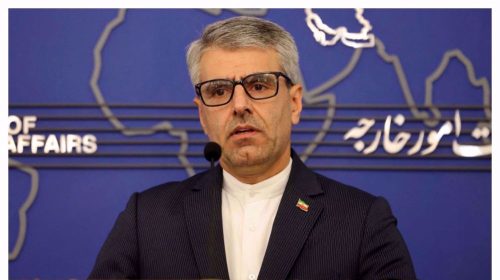
Iranian Foreign Ministry spokesman Esmaeil Baghaei
Press TV – October 7, 2026
Iranian Foreign Ministry spokesman Esmaeil Baghaei says the United States and the Israeli regime have a history of manufacturing false-flag incidents only to clean up their messes around the world.
In a Wednesday post on his X account, the Iranian official said such scenarios would not save them from the quagmire of the aggression against Iran.
Baghaei said telling lies about Iran and accusing it of having a role in security incidents would fail to justify the US-Israeli aggression against the Islamic Republic.
“In a world where the American and international public is weary of an unlawful war of aggression against Iran, and where the aggressors have no honest way to justify a war of choice, even a raft made of lies can look like salvation to those who are drowning,” he said in the post.
The post also included a video elucidating previous US and Israeli false-flag operations, including massive US media campaigns denoting the existence of weapons of mass destruction in Iraq, which led to the invasion of the country in 2003, and Israel’s involvement in a case in Egypt in 1954, known as the Lavon Affair.
“False flags are an old craft: manufacture the incident, assign the blame, and harvest the consequences,” said Baghaei.
The post came after officials in the US and allied countries suggested that Iran may have had a role in recent security incidents, including on a Flydubai flight from the United Arab Emirates to the Israeli-occupied territories and in a suspected plot against an American base in Britain.
Iran has roundly rejected the accusations, calling them a pretext for launching renewed aggression against the country, months after the US and the Israeli regime were forced to end a previous offensive under a ceasefire reached in mid-April.
The Makkah Pact Enters Into Force: The End of American Dominance or Its New Form?
By Salman Rafi Sheikh – New Eastern Outlook – October 7, 2026
On October 5, Saudi Arabia, Türkiye and Pakistan activated the Makkah Pact, taking their new alliance to war for the first time, and potentially revealing the future of American power in the Middle East: Washington provides the security umbrella while regional partners increasingly do the fighting.
From treaty to military alliance
Only two months after Saudi Arabia, Pakistan and Türkiye signed the Makkah Joint Defence Agreement, the new alliance has been activated. As representatives of the three countries met in Riyadh and Houthi missiles and drones targeted Saudi territory, Saudi-backed Yemeni forces launched a major counteroffensive around the strategically important Bab al-Mandeb Strait. Despite hundreds of strikes, the Saudi offensive has not been enough to push the Houthis back to their original position. In this context, the alliance’s Strategic-Political and Defense Committee agreed to move “immediately” toward implementing its collective-defence commitments and to provide agreed military forces and capabilities for rapid deployment in Saudi Arabia. The meeting also appointed retired Pakistani Lieutenant General Nauman Mahmood as the alliance’s first secretary-general.
The significance goes beyond additional military assistance for Riyadh. The Yemen war is transforming – and that, too, very rapidly – a remarkably young agreement into an operational military alliance. Signed on August 7, the Makkah Pact contains a collective-defence commitment under which an armed attack against one member is regarded as an attack against all three. Pakistan describes the agreement as defensive and grounded in the right to collective self-defense under Article 51 of the UN Charter.
That inevitably invites comparisons with NATO. The analogy should not be exaggerated. NATO possesses 32 members, an integrated command structure and more than seven decades of institutional development. The Makkah Pact possesses none of that depth.
But its institutional development has been unusually rapid. On August 31, the three governments established mechanisms for political and military coordination, agreed to create a permanent secretariat in Saudi Arabia and committed themselves to joint activities, defence-industrial cooperation and joint technology development and production. Now comes the most important stage in the evolution of any military alliance: responding to an actual threat.
Pakistan and Türkiye were already assisting Saudi Arabia before formal activation. Reports show that Pakistan had supplied air-defence systems, drones, anti-drone equipment and light artillery, while Pakistani advisers were working with Saudi counterparts supporting Yemeni forces. Türkiye had supplied drones. The October 5 decision potentially integrates such capabilities into something larger: collective military action undertaken because one alliance member has come under attack.
The distinction between defensive and offensive action consequently becomes blurred. Defending Saudi airspace against Houthi missiles is clearly defensive. Destroying the launchers firing those missiles from Yemen would involve offensive operations undertaken for a defensive purpose. Pakistani Defence Minister Khawaja Asif has deliberately avoided ruling out that possibility, saying Pakistan would make “whatever means are available” at its disposal available to defend Saudi Arabia.
America stays, but its role changes
It would be tempting to interpret this development as evidence that Saudi Arabia is preparing for a post-American Middle East. That conclusion would be premature. The more interesting possibility is almost the opposite: the Makkah Pact may fit remarkably well into the kind of Middle Eastern security order the Trump administration itself wants to create. Trump welcomed the agreement shortly after it was signed. He called it’s a “big, bold and important first step” and argued that it demonstrated how regional countries could “defend themselves in a more meaningful way.” That language closely matches the administration’s formal defence strategy.
The 2026 National Defense Strategy says Washington wants regional allies and partners to assume “primary responsibility” for deterring and defending against Iran and its proxies, while the United States supports them and deepens cooperation with Gulf partners. The administration’s arms-transfer strategy similarly argues that allies should assume more responsibility for regional security while Washington equips them with advanced American military capabilities. Yemen now offers an unusually clear illustration of what this division of labour can look like.
Saudi Crown Prince Mohammed bin Salman sought direct American military intervention against the Houthis in September. Trump declined to order US strikes. But Washington did not withdraw from the conflict. Instead, it offered intelligence and targeting assistance, while CENTCOM commander Admiral Brad Cooper travelled to Saudi Arabia for consultations. As the Saudi-backed offensive subsequently began, the same pattern continued. Saudi aircraft provided extensive air support to Yemeni government forces, while the United States supplied intelligence and targeting support. America therefore remains deeply involved. What has declined, at least for now, is direct participation in the fighting. This distinction matters.
The choice facing Washington is not simply between dominating Middle Eastern security and abandoning it. There is a third possibility: remaining the indispensable strategic enabler while shifting more of the immediate military burden onto regional states. That is precisely where the Makkah Pact becomes useful.
Saudi Arabia brings financial resources, geography and enormous investments in advanced weaponry. Türkiye contributes a large, NATO-trained military and a rapidly expanding defence industry. Pakistan brings substantial conventional forces, longstanding military relations with Saudi Arabia and extensive operational experience. Together, they can potentially perform missions that previously might have generated demands for more direct American intervention. The United States can remain above this architecture rather than outside it: supplying intelligence, weapons, logistical assistance, strategic deterrence and diplomatic backing while allies provide more of the personnel and firepower required to confront regional threats. Seen this way, the pact is not necessarily a rebellion against American primacy. It could become one mechanism through which that primacy is made less militarily expensive for the US.
A different kind of American order
This model also helps explain why describing the emerging Middle East as “post-American” can be misleading. American power has traditionally been measured partly through deployments, bases and direct military intervention. But primacy does not require Washington to fight every regional war itself. The Makkah Pact could push this transformation considerably further.
Its future significance will depend less on what its three members call the alliance than on what they build after Yemen, and whether their first experiment in collective defence proves sufficiently successful to encourage deeper cooperation. Regular military planning, interoperable forces, integrated air and missile defence, intelligence-sharing arrangements and joint weapons production would gradually give the agreement institutional substance.
Yet therein lies a paradox for Washington. The same burden-sharing that reduces America’s military responsibilities could eventually reduce its leverage. More capable allies are not necessarily more dependent allies. As regional powers acquire the institutions, experience and capabilities to conduct military operations with diminishing direct American involvement, they may also acquire greater freedom to pursue threats and strategic objectives that do not fully correspond with Washington’s preferences. An arrangement that initially reinforces the US security architecture could therefore gradually produce greater regional strategic autonomy.
The consequences could extend to military technology. Saudi Arabia’s armed forces remain heavily equipped with American weapons, but neither Pakistan nor Türkiye operates exclusively within a US defence ecosystem. Pakistan, for example, operates the JF-17 fighter aircraft jointly developed with China. In fact, Islamabad has deployed this jet in Saudi Arabia as part of the pact. While Türkiye has built an increasingly indigenous defence industry. A more deeply integrated Makkah alliance could therefore eventually combine American, Turkish, Pakistani and Chinese-origin military technologies rather than reproduce an exclusively US-centred weapons architecture.
That may prove more consequential for American primacy than the pact itself. If the Makkah alliance fades once the immediate Houthi threat recedes, it will remain another temporary regional alignment. But if Yemen produces permanent military integration, Washington could confront an unexpected consequence of its own burden-sharing strategy: the more successfully regional allies learn to defend the American-led order themselves, the less dependent that order may eventually become on America.
Salman Rafi Sheikh, research analyst of international relations and Pakistan’s foreign and domestic affairs
Follow new articles on our Telegram channel
US Senator Murphy says Pentagon denied him entry to US base in Qatar
Al Mayadeen | October 6, 2026
Democratic US Senator Chris Murphy said Tuesday that the Pentagon had denied him access to a US military base in Qatar and refused to arrange a briefing on the US-Israeli war on Iran during his regional tour.
Speaking to journalists in Riyadh, Murphy accused the department of deliberately obstructing congressional scrutiny of the war and concealing its consequences from the American public.
“This trip confirmed for me that there is an active, unprecedented, unconstitutional effort underway to hide the costs of this war and the implications of this war from Congress and the American people,” he said, as quoted by Reuters.
Murphy urges Republicans to challenge Pentagon secrecy
Murphy called on Republican senators to confront the deliberate obstruction by the Department of War.
“I’ve never encountered anything like this in my time in the Senate and it’s part of a deliberate campaign of obfuscation that my Republican colleagues in Congress should demand an end to,” he said.
The senator said the Pentagon had denied him access to Al Udeid Air Base in Qatar, the largest US military base in the region. The installation has come under repeated Iranian retaliatory strikes since the US-Israeli aggression against Iran began in February.
He also said the department had declined to organize a briefing on the war while he was visiting the region.
Diplomatic meetings proceed despite military restrictions
Murphy contrasted the Pentagon’s conduct with that of US Secretary of State Marco Rubio, whom he credited with helping organize the trip and facilitating meetings with diplomats.
His regional discussions included talks with Qatari Emir Sheikh Tamim bin Hamad Al Thani and Saudi Crown Prince Mohammad bin Salman, alongside other senior Gulf officials.
Riyadh was the second stop on the senator’s tour, following his visit to Qatar.
The fallacy of US delusions about Iran’s economic collapse
Iran’s economic adaptation over decades, marked by domestic production, regional trade and Asian partnerships, is on course to thwart Washington’s economic terrorism.
Press TV – October 6, 2026
US Treasury Secretary Scott Bessent’s prediction that Iran’s economy would soon collapse underscores the depth of delusion within the current American leadership.
“Iran is absolutely not sanctionable,” Deputy Economy Minister Mortaza Zamanian said this week as Tehran worked to keep trade flowing despite Washington’s latest sanctions campaign.
Zamanian cited Iran’s extensive borders, established commercial routes and longstanding trading relationships, saying that they make it impossible for external pressure simply to switch off the country’s economy.
His remarks came as Washington intensified its economic terrorism against Iranian oil, shipping, aviation, finance, technology and foreign companies supporting those sectors.
The new American campaign has been accompanied by extraordinary predictions from senior American officials, including Treasury Secretary Scott Bessent’s claim that Iran could have “nothing left to trade” within two weeks.
Speaking on September 27, Bessent claimed that Iran would probably make its final oil deliveries to China within two weeks, after which, he asserted, “they will have nothing.”
That prediction deserves comparison with history, because American administrations have imposed increasingly severe sanctions on Iran since 1979 while repeatedly expecting economic pressure eventually to produce collapse.
Yet the economy did not disappear, and Iran instead developed domestic industries, expanded regional commerce, strengthened trade with Asian powers and accumulated extensive experience operating outside Western financial channels.
The proposition that an economy which has absorbed American sanctions for almost half a century will suddenly disintegrate within two weeks therefore indicates the depth of delusion among the current US leadership.
Iran enters this confrontation possessing a large domestic market, extensive productive capacity, enormous energy resources and deeply established commercial relationships across Eurasia.
These are not temporary sanctions evasions assembled during the present crisis, but economic capabilities developed over decades through investment, industrial learning, regional integration and repeated adaptation to external restrictions.
The most important fact about Iran’s economic structure is its size, because a country with more than ninety million people possesses a domestic market capable of supporting extensive production independently of Western consumers.
The World Bank describes Iran as relatively diversified for an oil-exporting economy, with a substantial domestic market, a large workforce and significant activity across manufacturing, agriculture and services.
That domestic market sustains production across food, pharmaceuticals, construction materials, steel, petrochemicals, machinery, transportation, consumer goods and numerous intermediate industrial sectors serving Iranian households and companies.
Iran is therefore not an economy that must export continuously merely to keep its factories operating, because a substantial portion of its production already serves domestic consumption, investment and infrastructure.
That distinction becomes particularly important when external restrictions are designed around the assumption that cutting foreign trade will automatically paralyze domestic economic activity.
A country whose productive system is centered on domestic demand possesses an economic engine that continues operating even when international transactions become more complicated.
Iran has also spent decades building industrial capabilities specifically suited to its own resource base, population, infrastructure requirements and energy-intensive economy.
Steel production, petrochemicals, cement, refining, power generation, construction, food processing and pharmaceuticals represent substantial industrial ecosystems involving domestic engineering, manufacturing, logistics and skilled employment.
These capabilities have repeatedly expanded during periods when access to Western investment and technology was severely restricted, demonstrating that Iranian industrial development does not depend upon continuous Western participation.
Iran’s long exposure to sanctions has produced another asset that cannot be imposed or removed through a Treasury designation, namely a large body of accumulated technical and commercial experience.
When foreign manufacturers withdraw, Iranian companies have learned to redesign equipment, substitute components, develop domestic suppliers and work with companies from countries willing to maintain commercial relationships.
Academic research has documented this process in Iranian industries, including evidence that sanctions simultaneously restricted access to foreign technology while encouraging the development of domestic technological capabilities.
The resulting industrial knowledge extends beyond individual companies, because engineers, technicians, procurement specialists and managers have accumulated practical experience with restricted supply chains over successive decades.
A manufacturer that has operated under sanctions for years does not design its procurement system around the assumption that every international supplier will remain available indefinitely.
It develops alternatives as part of ordinary business planning, creating a commercial culture in which substitution, regional sourcing and domestic production are integrated into industrial decision-making.
This is one of the strongest reasons the prediction of sudden economic emptiness looks disconnected from Iran’s actual economic structure.
There is no single foreign supplier whose disappearance can remove Iran’s entire industrial capacity, because Iranian production is distributed across thousands of domestic enterprises and numerous regional supply relationships.
The system has been shaped by scarcity for so long that adaptation has become embedded within the operating methods of Iranian companies themselves.
Iran’s geographical position provides another form of economic strength that cannot be erased by financial sanctions, because the country physically connects several of the world’s most important commercial regions.
Iran borders Turkey, Iraq, Armenia, Azerbaijan, Turkmenistan, Afghanistan and Pakistan, while its southern coastline provides direct access to the Persian Gulf and Gulf of Oman.
Those borders connect Iranian commerce with the Caucasus, Central Asia, South Asia, the Persian Gulf, Turkey and Iraq, creating commercial possibilities extending in several directions simultaneously.
This geography gives Iran direct access to neighboring markets while also placing the country along important transportation corridors linking Russia, Central Asia and the Indian Ocean.
The significance of Zamanian’s argument is therefore practical rather than rhetorical, because no financial authority can relocate Iran away from its geographic position.
Goods can move through different borders, suppliers can be found in different countries and exporters can redirect shipments towards different markets when commercial conditions change.
Iran has consequently developed a regional trading system that does not depend upon one border, one port, one customer or one foreign economic relationship.
Its trade with Iraq, Turkey, the United Arab Emirates, Afghanistan, Pakistan, the Caucasus, Central Asia and China represents an extensive commercial geography developed through years of interaction.
The World Bank has documented precisely this shift, noting that Iranian trade has increasingly pivoted towards neighboring countries and China as sanctions have restricted conventional international economic relationships.
That transformation is now an established feature of Iran’s economy rather than an emergency measure invented after the latest American escalation.
China gives Iran’s economic system another dimension because it combines enormous industrial capacity with sustained demand for Iranian energy and other commodities.
In other words, Iran possesses access to a major global market even while facing comprehensive American restrictions on its oil industry.
China also supplies Iranian companies with machinery, manufactured products, electronics, industrial equipment and intermediate goods required across the domestic production system.
The relationship therefore operates in both directions, with Iran supplying commodities and China supplying industrial goods, creating a commercial relationship considerably broader than the simple sale of sanctioned oil.
Iran consequently does not need unrestricted access to every Western market when it possesses substantial trade relationships with China and numerous neighboring economies.
Iran’s energy resources provide perhaps the clearest demonstration of the country’s underlying economic strength.
It ranks second globally in proven natural-gas reserves and fourth in proven crude-oil reserves, giving the country extraordinary resource depth beneath its existing industrial economy.
These resources provide not merely potential export earnings but also abundant domestic energy and petrochemical feedstocks supporting Iran’s manufacturing, electricity generation, transportation and industrial production.
Iran has consequently developed an extensive downstream economy that converts hydrocarbons into refined products, petrochemicals and industrial inputs rather than relying exclusively upon crude-oil exports.
The World Bank has specifically noted that sanctions encouraged additional processing of crude oil and hydrocarbons into petrochemicals, illustrating how restrictions have contributed to changes within Iran’s economic structure.
The country’s resource base also gives it a durable position in Asian energy markets, where large industrial economies require reliable supplies of oil and petrochemical products.
That is why American attempts to eliminate Iranian oil revenue confront persistent commercial demand rather than an absence of buyers interested in Iranian resources.
The financial system represents another area where Iran has developed substantial independent capacity after decades of exclusion from conventional Western banking.
Iran’s economic ties span a broad network of foreign entities, reflecting its commercial reach across banking, shipping, logistics, commodities, and manufacturing.
Against this background, Bessent’s latest prediction appears less to be an independent economic forecast than an expectation based on what the American campaign is intended to achieve.
His claim that Iran will have nothing left to trade within two weeks assumes that removing one major source of oil revenue effectively removes the economic foundations supporting the entire Iranian system.
Iran’s actual economic structure is considerably broader, because oil exports represent one component of national economic activity alongside manufacturing, agriculture, services, domestic consumption and regional commerce.
The World Bank estimates that Iran’s economy contracted during the Iranian year ending March 2026, while simultaneously describing an economy that has adapted to sanctions through changing trade patterns and alternative payment mechanisms.
Those facts should not be confused with economic collapse, because contraction in a particular period is fundamentally different from the disappearance of productive capacity, markets and commercial institutions.
The historical record is even more significant, because American sanctions have been imposed repeatedly since 1979 and have been intensified dramatically during successive administrations.
The sanctions regime has targeted Iranian banking, oil exports, investment, technology, shipping and foreign companies, with especially severe measures introduced during the 2010s and after Washington abandoned the nuclear agreement.
Iran nevertheless retained its industrial base, rebuilt oil exports after earlier restrictions, expanded non-oil exports and redirected a growing share of trade towards neighboring countries and China.
The American expectation that economic pressure would eventually produce decisive Iranian economic capitulation has therefore been tested repeatedly against an economy that continued adapting.
Predicting that a strategy that failed to trigger economic collapse over half a century will suddenly achieve it within fourteen days merits no serious consideration, because it reveals the naivety of its proponents.
Washington now possesses powerful financial tools, but financial power does not eliminate Iran’s factories, oilfields, farms, engineers, consumers, borders, ports, regional markets or established commercial relationships.
Iran enters the current phase with an economic architecture extending from domestic manufacturing plants to Chinese refineries, from Persian Gulf shipping networks to northern Eurasian trade corridors.
Its domestic market provides magnitude and size, its industrial base provides production, its energy reserves provide commodities and its geography provides access to several major commercial regions.
In other words, Iran already possesses the domestic capabilities and international relationships required to keep its economy operating beyond the reach of any single American economic sabotage.
What changes with Lula or Flávio?
By Lucas Leiroz | Strategic Culture Foundation | October 6, 2026
Brazil’s presidential elections are approaching. And with them come controversies, debates, and different perspectives on what this event means for Brazil, for the BRICS, and for the future of the multipolar world.
In a recent article, respected Brazilian political analyst Valdir Bezerra argued that the 2026 elections represent a turning point in Brazilian history, potentially determining Brazil’s role in the world. According to Bezerra, the election pits, on the one hand, the “autonomist” tradition, represented by Luiz Inácio Lula da Silva, against, on the other hand, the “Westernist” one, represented by Flávio Bolsonaro.
With all due respect to Bezerra’s work, as one of the most highly regarded analysts in the Russian-Brazilian political debate, I would like to present a critical view of his position here. My intention is not to “refute” Bezerra’s argument, but merely to explain why I do not consider this opposition between autonomism and Westernism a valid premise for analyzing the current electoral dispute. Furthermore, I would also like to explain why I do not consider the 2026 election a decisive moment in determining Brazil’s international role.
Flávio is a Westernist, but Lula is not an autonomist
The umbrella terms used to define these two “traditions” of Brazilian foreign policy do not seem remotely applicable to the current reality. The terms through which many Brazilian thinkers once defined the opposition between those who support national sovereignty and development and those who advocate a subordinate position toward the Atlantic axis have long since become obsolete in the upper levels of Brazilian politics – where there is currently no figure worthy of the title of “autonomist.”
There is no need to comment here on the Westernist nature of Flávio Bolsonaro, who, like his father before him, advocates a foreign policy of total alignment with the United States and Israel, as well as an agenda hostile to the BRICS and multipolarist platforms. The central question, however, is to understand where Lula stands between Westernists and autonomists.
Brazil’s current president has governed the country on three occasions and played a leading role in some of the most significant events in international politics in the twenty-first century. He was a co-founder of the BRICS, built alliances with sovereigntist governments in the Americas – Venezuela, Bolivia, and Cuba – in the 2000s, maintained friendly ties with Iran, and, more recently, strengthened partnerships with Russia amid the Western-imposed sanctions regime, in addition to openly condemning the genocide in Gaza.
All of this is extremely admirable, but a fair analysis of Lula requires presenting the other side of his political profile: Lula has never been a “multipolarist,” but rather a skillful operator within the multilateralism of the Obama era in the 2000s. This is compounded by the fact that Lula was openly supported by the Democratic establishment in the 2022 elections. Indeed, Lula’s third government has been marked by controversies worthy of a classic “Westernist” leader: Lula did not recognize the Venezuelan elections, initiated tensions with Nicaragua, vetoed Venezuela’s accession to the BRICS, sidelined negotiations for a Mercosur-China agreement in order to prioritize a free-trade pact with Europe that is extremely detrimental to South American countries – an agreement that could even be described as neocolonial, turning Mercosur countries into commodity exporters and technology importers. This is without even mentioning the close, almost fully aligned relationship with the Macron regime in France.
Lula has certainly made several correct decisions, but if we go back a little in time, former President Jair Bolsonaro did as well: he refused to sanction Russia and to condemn the Special Military Operation – unlike Lula, who repeatedly condemned it -, strengthened partnerships with China, preserved the BRICS structure, and abandoned alignment with post-Trump U.S. foreign policy, becoming a target of Joe Biden.
In the end, weighing successes against successes and mistakes against mistakes, both sides appear very far from any “autonomist” ideal.
So, how should we define Lula and Flávio?
We can summarize this point in a single sentence: both Lula and Bolsonaro are, each in his own way, Westernists.
On several other occasions, I have commented in my column on how I view Brazil’s Sixth Republic – the current constitutional regime founded in 1988 – as a kind of “permanent color revolution.” On one side, an openly pro-U.S. and pro-Israel liberal right; on the other, an institutionalist liberal left, ideologically and financially connected to a major international lobby stretching from the U.S. Democrats to the European Union.
The current partial tensions between Lula and Trump are nothing new. Bolsonaro became an extremely troublesome figure in Brazil-U.S. relations as soon as Biden came to power. What many analysts fail to perceive is that Brazil-U.S. relations are defined by the dialectic between the left and right in Brazil and the Democrats and Republicans in the United States. Lula was Biden’s friend, just as Bolsonaro was Trump’s friend. If Lula wins the 2026 election, he will face many problems – at least until a possible Democratic return to power in the United States. If Flávio wins, Brazil and the United States will be in total alignment – but only as long as Trump remains in the White House.
It is this dynamic that allows the United States to keep Brazilian politics under stable control. Washington does not need to stage a Maidan in Brazil. Indeed, the formula of “coup + dictatorship” does not tend to work in large and diverse continental countries such as Brazil – and the greatest proof of this is Brazil’s own experience during its military regime, which was initially backed by the United States but later became an autonomous, non-aligned regime following an internal self-coup among the military. It is no coincidence that the United States endorsed Brazil’s democratization, helping to create precisely the political regime that exists today.
On one side, a right supported by the Republicans, Israel, and the transnational neoconservative lobby; on the other, a left that obeys the Democrats and the Europeans. Lula was a major multilateralist at a time when Washington, under Obama, encouraged precisely this kind of veneer over U.S. unipolarity; Bolsonaro was an open U.S. puppet at a time when Washington, under Trump, demanded precisely that. The difference is very small – or nonexistent.
And what does the 2026 election really represent?
At the international level, nothing or very little.
If he wins, Lula will come under pressure while Trump remains in power. And over the past four years, Lula has already shown that he compensates for American hostility by becoming even more closely aligned with the Europeans. On the other hand, if Flávio wins, we will have at least a period of total alignment with the United States, which could change following a possible Democratic victory in the next presidential elections. It is a very clear choice between Republicans-Israel and Democrats-EU. “Autonomism” is not part of the equation.
At the domestic level, however, many factors are at stake.
It is on the domestic front that the debate over the election should be concentrated. After all, no Brazilian will vote for one candidate or the other because of Palestine or the BRICS – which, although legitimate causes, are distant realities for the average citizen. Domestically, we have a Lula who is becoming increasingly weakened by the side effects of years of alliance with the Judiciary Branch – which is now being scrutinized and exposed in the context of the Banco Master corruption scandal. On the other side, Flávio is recovering ground that was once considered lost, and the two now appear statistically tied in the polls.
The Judiciary accumulated extraordinary powers under Lula, to the point of imprisoning peaceful protesters and elderly people on charges of “terrorism” simply because they participated in pro-Bolsonaro demonstrations. The hostility between the Judiciary and Bolsonarism cannot be reversed except through a victory by Flávio that culminates in the appointment of Bolsonarist judges to the Supreme Court – thereby reshaping the course of the Republic itself.
We can summarize the situation by saying that Lula would give the Sixth Republic a new lease on life, while Flávio would accelerate its collapse. As long as the Sixth Republic exists, no genuinely “autonomist” alternative will emerge in Brazil because the Brazilian constitutional system itself prevents such an alternative. But this does not mean that the imminent collapse of this system would result in a “multipolar dawn” in Brazil, since there is no political movement in the country – apart from the extremely “Westernist” Bolsonarist movement itself – with sufficient strength to establish a new state project.
The conclusion may be frustrating for the more optimistic and hopeful, but what appears to be about to happen in Brazil in 2026 is absolute nullity. With Lula or Flávio, little is likely to change. Brazil will remain a declining middle power, politically subordinate to the United States, but with a certain degree of freedom to engage multilaterally with the Eurasian powers – while domestically, the institutions of the Sixth Republic continue to destroy themselves.
Britain leads Western media’s demise through ‘fear porn’ narrative
By Martin Jay | Strategic Culture Foundation | October 6, 2026
Ian Proud’s arrest by secret police at a London airport marks a new low in how far the deep state can go to control a false narrative. But it also shows a new level of fear.
As mad as it sounds, it does appear that Western European nations at least are preparing themselves to go to war with Russia at some point in the not-too-distant future. What is particularly worrying is there seems to be a distinct vacuum in all areas of what we could broadly call ‘media’ in questioning this narrative. Thirty years ago it was considered normal for journalists to be the source of vexing questions towards state actors and to generally be a pain in the arse as they questioned every decision made and every idea presented. It was our job to be anti-establishment and to take a very cynical view of “policy”. There was nothing remarkable about this. It was what we did. Being despised by the greater powers was part of the job; working anti-social hours and having few friends also came with it.
Today there are no journalists in what we call ‘mainstream’ media doing this. They have been replaced by younger, more social-media-savvy ‘content creators’ who believe that journalism is more or less a grammatical role, where the raw material is handed to you with all the information therein, and the role of the journalist is simply to refine it to the style of the day for mass consumption.
The danger of this transition is that nearly all of what we are being presented with as news is actually fake, or at best heavily redacted to keep the masses where the elite want them to be: restrained, prepped and misinformed.
The Ukraine war is an excellent example. The main reason why people in the U.S. and UK are so fabulously biased against Russia and are so sympathetic towards the corrupt elite in Kiev is that for years they have been brainwashed with ‘news’ about Russia which has been negative and which cunningly feeds a racist bias – a prejudice which has been cultivated over at least a decade, if not more. The result is that now a number of lies have become established in newsrooms where journalists, even those who know, simply navigate around nuance and present a fairy-tale story, designed to be understood by the masses who have no other sources of information to even question it.
Just recently, Western news outlets reported a “plague” in Russia, with stories about a “lockdown”, following a case of a worker in a laboratory dying of pneumonia in circumstances which are still not certain. Western media, as part of their role to keep Russia-phobia at its peak, are so locked and loaded that their ‘hair-trigger’ reactions to bad news stories from Russia are understandable. They are also hungry for clickbait, and such stories feed a starved audience which has already had its first fix of such COVID hysteria stories and wants more. The truth is entirely immaterial. Hysteria and lies are what’s being fed at a feverish rate by ‘content creators’ red in tooth and claw, foaming at the mouth with their desire to serve the deep state and the elites who have invested so much in an agenda.
The contrast between Russia and the West is interesting, though, when we look at media. In Russia just recently, the BBC correspondent based in Moscow made the internet buzz on social media with his short interview with Russia’s foreign minister, who was kind enough to answer his loaded question about Russia’s war ideology with Ukraine. What absolutely no one noted was how Russia is happy to accommodate foreign journalists who have such a distinct agenda to feed the Russia-phobia back home, while Russian journalists have been banned in those EU capitals for years. Old Europe, which once held such values as a free press so dearly, has adopted the Soviet model, while Russia is actually more advanced when it comes to such tenets of what we expect in a democracy. Russia has no fear of the awkward questions, unlike the West.
We should be asking ourselves who really benefits from a war with Russia.
Is it too sceptical and ‘conspiracy theorising’ to assume that the industrial military complex has been successfully lobbying for such a war for AT LEAST a decade, and critically, it succeeded in convincing the intelligence and military establishment in the UK to use its leverage with media to provide journalists with the raw material which enhances a prejudice against Russia?
Normally such an idea could be dismissed as pure nonsense. But just consider how far the UK, for example, has gone to eradicate all media coverage which could be deemed as at least leaning towards Russia – or even simply just holding the UK government to account by asking the questions that British journalists have stopped asking. If the elite in the UK who control the loss-making newspapers (think about that) are so sure of their rationale that Russia is the enemy whom we must go to war with, why are they so terrified of journalists – or anyone, for that matter – simply holding a view which questions the narrative?
I can’t be the only Western pundit who believes that double agents Sergei Skripal and his daughter Yulia were not poisoned with nerve agent Novichok in Salisbury in 2018, which was reported at the time as “sparking a huge diplomatic crisis between Britain and Russia”. Isn’t the real story that British security chiefs decided, upon discovering that Sergei Skripal was actually a triple agent who was feeding information back to Moscow, that he was dispensable? And what better way to supposedly teach the Russians a lesson, while blaming Moscow for his death, than to murder him and his daughter using a nerve agent which either was Novichok – which a British lab just down the road from where the Skripals lived had conveniently sitting in a fridge – or a similar poison? What’s important to note about Novichok is that the victims usually die instantly upon contact with it. What is likely is that the Skripals were not poisoned by the Russian drug but a British version of another nerve agent. It is a shocking example of how poor British journalism is that hacks in the UK simply report the Skripal incident of Novichok poisoning without a single shred of evidence to back it up. They don’t even add a note of scepticism in their reporting about the drug and who is “claiming” that it is Novichok.
We see the same shocking level of atrocious, biased reporting about the Ukraine war, which the British public were simply told through the media narrative was an “invasion” by Putin’s army. No background, no nuance, no glimpse of Russia’s perspective, as no one can cope, it would seem, with the story being clouded by facts.
And it’s the same with the Russia “plague” story, as it was with the RAF base “attack” story recently, which was probably just local thieves buying contraband gasoline from corrupt U.S./UK soldiers looking to make a quick buck at the UK base. Notice how quickly Trump used the story as a basis to move all U.S. bombers off the base and back to U.S. soil, where they are completely useless in his so-called Middle East war. For Trump it was an opportunity for another media stunt which keeps him on the front pages and everyone guessing. He was probably grateful to the British for being offered the raw material. Another problem of this new generation of journalists is how compliant they are to report “news” which isn’t news at all, but just material used as a distraction, one day at a time. Trump is a master at manipulating media with this game, usually saying something so stupid and so controversial, which draws journalists away from doing real journalism. If you can occupy journalists with writing up stories about the latest idiotic comment or statement by Trump, then you control them as you control their time.
Just look at how the Epstein story is not being reported and investigated. How Trump got off scot-free, as since February 28th journalists’ attention was diverted to the war with Iran – which is one of the reasons why Trump keeps this story alive with constant troop movements and talk of a massive attack after midterms. People have not made the link with the Epstein material being leaked and the war with Iran kicking off practically on the same day.
For the British, the “Russians are coming” story has no cynical write-up by journalists who are 100 percent compliant with its erroneous narrative. The fear of elites in London is palpable, though, that it will always be questioned by fringe actors taking up bandwidth on social media. In the past this was the RT correspondent in London, who was able to ask difficult questions and generally be a thorn in the side of the Westminster village which controlled journalists like rats held in a basket. The main reason why RT was kicked out of the UK was that it offered a style of reporting on UK politics which had since left us thirty years ago – such is the murky world of the deep state and how it saw how in Brussels journalists could be manipulated until they become stenographers for it.
Yet even with this new Stalinist style of media control in the UK, the state is wobbly. Even with the impressive set-up it has now of total media dominance, where journalists pump out total garbage about the Ukraine war or what they are told to write about the Middle East, still the fear is there.
The example of video blogger Ian Proud, a former UK diplomat once based in Moscow, is worrying but poignant. Simply going to Moscow to attend a conference where Putin was speaking was enough to have him get the full Stasi treatment at Heathrow airport – detained and all digital content seized.
Proud’s YouTube interviews, with his dowdy style of presenting, are proving to be popular as he simply offers a more sober view of both Russia and the UK Foreign Office, his former employer. These interviews are getting the attention of UK spooks, who are so nervous about the truth getting out about Russia and the shameful lies which are being packaged now for the British public, that they had to give Proud the American prison ‘shake down’ routine. Britain, a country which once was a beacon for the world with its view of liberty and in particular its passion for free speech, has fallen to a level which we can only compare to a West African country which has just had a new dictator installed, complete with black aviators and epaulettes. What the Proud Heathrow airport case shows is that this new regime in power will stop at nothing to control a narrative, and that the last bastion of free speech – YouTube podcasts – is the next target. The more successful Proud’s channel becomes, the more inevitable it is that he will be forced to leave the UK and settle in Russia to continue practising free speech. The shoulder tassels of Britain’s deep state will not sleep well until the country has a media narrative which would make Joe Stalin blush – and British journalists are helping them with this goal.
Georgia’s Largest Healthcare System Will Fire Employees Who Refuse Flu Vaccine
By Brenda Baletti, Ph.D. | The Defender | October 5, 2026
Employees of Georgia’s largest healthcare system have until Nov. 1 to get the flu vaccine or an approved exemption, or they will be suspended without pay. If suspended employees don’t submit proof of vaccination by 4 p.m. Nov. 15, they will be fired.
According to the Emory Healthcare website, the vaccine mandate applies to all employees, including contractors and remote workers.
Employees suspended for missing the first deadline, Nov. 1, 11:59 p.m., will not be allowed to use their paid time off.
COVID-19 shots are not mandated, but employees are “encouraged to engage in shared decision-making with their provider” on whether or not to get the vaccine.
A spokesperson for the healthcare system said the requirement is intended to protect patients and staff and to encourage everyone to get vaccinated.
Dr. Sherika Newman of Doctor in the Family, a physician-led patient advocacy and health consulting service in Atlanta, told CBS News that flu vaccine requirements are common in healthcare.
“Asking health care providers or people who interact with patients to take the flu vaccine early every year is what we always mandate so that we are protecting ourselves from spreading viruses to vulnerable populations,” Newman said.
She said everyone should get vaccinated, not just healthcare workers, although only healthcare workers will lose their jobs if they don’t get the vaccine.
Cleveland Clinic: 2024-2025 flu shot increased risk of getting the flu
Flu vaccine effectiveness can vary, according to the Centers for Disease Control and Prevention (CDC), which cites studies since 2009-10 showing effectiveness between 19% and 60%. The major factors influencing vaccine effectiveness are a person’s age and health and how well the vaccines match the circulating virus strains.
According to a Cleveland Clinic study published last year, people who received a flu vaccine formulated for the 2024-25 flu season had a 27% higher risk of getting the flu than those who didn’t get the vaccine.
It wasn’t the first study to find that flu vaccines could actually increase the risk of becoming ill.
A 2023 study co-authored by Dr. Anthony Fauci acknowledged that “viruses replicating in the respiratory mucosal environment continue to present a particular challenge for developing effective vaccines with strong protection.”
“The flu shot has never really prevented transmission of the flu and in some years (i.e., last year) the efficacy of preventing the flu is actually negative,” said Brian Hooker, Ph.D., chief scientific officer at Children’s Health Defense. “Flu would blow through a vaccinated population with nearly the same ease as it would an unvaccinated population.”
A 2012 peer-reviewed study published in Clinical Infectious Diseases showed that children who received the flu vaccine were at significantly increased risk of contracting non-flu respiratory virus infections.
Moderna’s mRNA flu shot added to the mix this year
According to the CDC’s FluView vaccination chart, as of Sept. 26, flu cases were at “minimal” levels across almost all 50 U.S. states, including Georgia.
Flu season typically begins in October and ends in May, with highest transmission rates in December and February.
The CDC recommends flu shots for people age 6 months and older, assuming they have no medical conditions that make vaccination risky.
Flu shot formulations differ each year based on information about which strains may circulate that year. The formulations aren’t tested for safety or efficacy before they’re distributed to the public.
In March, vaccine advisers to the U.S. Food and Drug Administration (FDA) recommended trivalent vaccines to protect against two influenza A and one influenza B viruses.
In the past, most flu vaccines were made from a flu virus grown in eggs, and then inactivated and made into a vaccine. Or, they were made from recombinant protein vaccines, which have pieces of the flu pathogen that the immune system learns to recognize and fight.
This year, Moderna’s controversial mRNA flu shot, mFLUSIVA, approved in June, is also available for people age 50 and over.
Number of healthcare workers getting flu, COVID vaccines declining
Manufacturers say they will produce up to 135 million doses of flu vaccine for the U.S. market this flu season.
In recent years, many healthcare workers have been resisting flu shot mandates and declining the shot.
For example, record numbers of frontline health workers in the U.K. refused the flu vaccine in 2024-25.
Rates of U.S. healthcare workers who take the COVID-19 and flu shots have also been declining in recent years.
Numbers are lowest among health professionals who work in nursing homes. In the 2024-25 flu season, only about 42% of those workers got the shot, compared with about 81% of workers in acute care hospitals.
This article was originally published by The Defender — Children’s Health Defense’s News & Views Website under Creative Commons license CC BY-NC-ND 4.0. Please consider subscribing to The Defender or donating to Children’s Health Defense.
Featured Video

Saudi Led Destruction of Yemen’s heritage
or go to
Aletho News Archives – Video-Images
From the Archives
Israel: Strategic Ally or Liability?
By Stephen Sniegoski | My Catbird Seat | June 12, 2010
The claim that Israel serves as a valuable ally for the United States is made by both pro-Zionists and much of the anti-war and anti-Zionist Left that is influenced by Noam Chomsky. As a result of the Gaza flotilla massacre, which has caused a world-wide uproar against Israel, the value of Israel to the United States is being publicly questioned in more mainstream foreign policy forums. … continue
Blog Roll
 Aletho News
- Four in five new UK jobs taken by foreigners – report
- Here’s what Trump’s latest U-turn really means for Russia and Ukraine
- The Houthis Are Not an Iranian Proxy
- Europe’s Energy Hypocrisy, Russian LNG Profits and US Dependence
- ICC ignored ‘very well-documented’ NATO crimes – ex-Libyan minister
- SNSC secretary dismisses US response to Iran’s conditions as ‘inadequate’
- Sanaa says Taiz roads open, secure for residents, warns Saudi forces
- Iraqi resistance group urges Saudi leadership to admit defeat, lift Yemen siege
- Trump’s Retreat: How Al-Aqsa Flood Took Down the US Empire
- Israel’s Military Actions in Lebanon Grossly Violate International Law — Lavrov
- If Americans Knew
- ADL is working with AI companies to suppress alleged ‘antisemitism’
- Israeli occupation forces using social media surveillance unit to target hundreds of Palestinians in the West Bank
- Israel’s New – and Terrifying – Security Doctrine
- Israeli Attacks Kill Five in Gaza, Including a four-year-old and a woman
- Air Force Major Who Called for Trump’s Impeachment Held in Solitary Confinement
- It’s a Genocide, I’m Into It’: Seinfeld Mocks Protest over Palestinian Children Killed
- Universities fire dozens amid pressure from Zionist billionaires
- Gaza’s buildings are collapsing on top of us. But there’s nowhere else to shelter
- Israel kills four-year-old Gaza child – Daily Update
- After Oct 7, IDF policy allowed civilian casualties for even the lowest-ranking targets
- No Tricks Zone
- New Study Suggests Large Regions Of The Pacific Ocean Have Been Cooling For The Last 80 Years
- Germany’s Green Energy Debacle: High Energy Costs Force Kahla Porzellan to Close After 182 Years!
- New Study: 50 Years Of The Most Aggressive ‘Net Zero’ Policies Can Only Affect The Global Climate By 0.03°C
- US September “Heat” Was No Record…Many Records Set Decades Ago
- Latest European Green Energy Debacle; Portugal’s Largest Flagship Solar Park Insolvent!
- Green Energy Debacle: German Expert Professor Fritz Vahrenholt Warns Of Severe Economic And Social Consequences
- Two More Paleo Reconstructions Affirm Meters-Higher Sea Levels Across Ireland, Brazil 7000-6000 Years Ago
- New Study: Earth And Venus Surface Warmth Largely Explained By Convection And Lapse Rate, Not CO2 Or Radiation
- 2025 Nature Paper Claiming Worsening Global Drought Gets RETRACTED …Heavily Flawed
- New Study: ‘Global Drought Shows No Detectable Recent Acceleration Under Climate Warming’

