Trump hits back at Medvedev
RT | June 23, 2025
US President Donald Trump has cautioned the deputy chairman of Russia’s Security Council Dmitry Medvedev against “casually” talking about nuclear weapons. The comment came after the former Russian president suggested that several unnamed countries were prepared to provide Iran with weapons of mass destruction.
On June 22, the US bombed Iran’s nuclear facilities in Fordow, Natanz, and Isfahan and claimed that its warplanes had severely degraded the Islamic Republic’s nuclear program. The attack was preceded by massive air raids against Iran by Israel.
In a post on his Truth Social platform on Monday, Trump wrote: “Did I hear Former President Medvedev, from Russia, casually throwing around the ‘N word’ (Nuclear!), and saying that he and other Countries would supply Nuclear Warheads to Iran?”
The US head of state asked for immediate confirmation or rebuttal, insisting that “the ‘N word’ should not be treated so casually.”
Trump went on to boast about America’s superior military capabilities, both air- and sea-borne, citing the weekend bombardment of Iran as proof.
In a series of X posts on Sunday, Medvedev claimed that a “number of countries are ready to directly supply Iran with their own nuclear warheads.” The Russian official stopped short of naming those nations but suggested the American bombardment had done nothing to stop the “enrichment of nuclear material – and… the future production of nuclear weapons” by Tehran. Medvedev asserted that Iran’s leadership will emerge “even stronger” in light of Washington’s actions.
With the “vast majority of countries around the world [opposing] the actions of Israel and the United States,” President Trump “can forget about the Nobel Peace Prize,” as he “has now pushed the US into another war,” he concluded.
On Monday, Medvedev responded to Trump, stressing that “Russia has no intention of supplying nuclear weapons to Iran because, unlike Israel, we are parties to the Nuclear Non-Proliferation Treaty.”
However, the ex-Russian president added that “other countries might – and that’s what was said.”
He urged Washington to refrain from “arguing over who has more nukes,” emphasizing that the New START arms-control treaty, which was signed by Moscow and Washington on Medvedev’s watch, is still in force.
“The question is: what comes next?” he concluded.
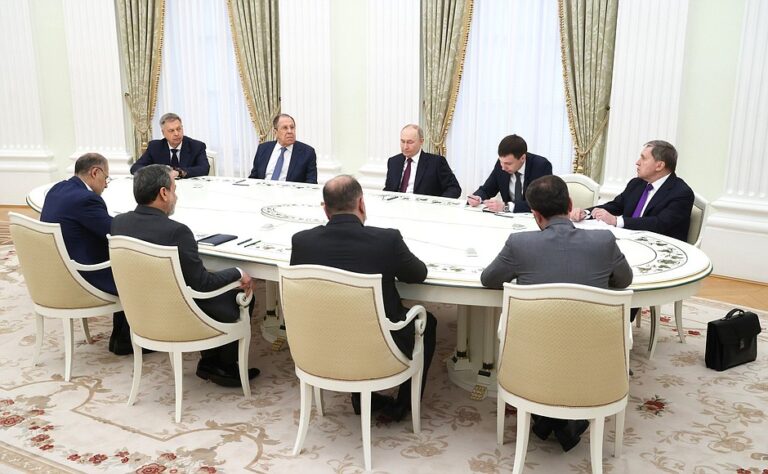
Speaking during a meeting in Moscow on Monday with Iranian Foreign Minister Abbas Araghchi, Russian President Vladimir Putin characterized the US attack on Iran as an “unprovoked aggression” in breach of international law, for which “there can be no justification.”
Middle East in Crisis – 5
By M. K. BHADRAKUMAR | Indian Punchline | June 23, 2025
The former President and Deputy Chairman of Russia’s Security Council Dmitry Medvedev who is one of the most authoritative voices at the Kremlin, wrote on the Telegram channel on June 23 a critique on the Middle East crisis following the US attack on Iran’s three key nuclear sites of Fordow, Natanz and Isfahan.
Medvedev listed ten points, which, taken together, messaged that Russia’s stance on the developing situation around Iran has markedly shifted to one of proactive mode marked by profound scepticism and deep concern about President Donald Trump’s intentions.
As recently as on June 4, Trump had sought Putin’s help to advance the US-Iran negotiations on the nuclear issue and Putin, in good faith, agreed to help. Indeed, the Iranian government spokesperson had disclosed on June 12 that preparations were under way for a visit by Putin to Tehran.
But on June 22, Trump ordered air strikes on Iran’s three nuclear sites without taking Putin into confidence. Such surreptitious behaviour may be nothing new to Washington in inter-state relations but it caused embarrassment to the Kremlin. Medvedev’s comments show it when he ridicules Trump’s triumphalism about the air strike.
The ten points Medvedev listed under the heading What did the Americans achieve with their night strike on three points in Iran? underscore that Russia’s stance on the developing situation around Iran has shifted to one of unequivocally distancing itself from the US approach going forward. The 10 points are:
- The critical infrastructure of the nuclear cycle, apparently, was not damaged or was damaged only slightly.
- The enrichment of nuclear materials, and now we can say directly – and future production of nuclear weapons — will continue.
- A number of countries are ready to directly supply Iran with their nuclear weapons.
- Israel is under attack, explosions are thundering, people are in a panic.
- The United States is drawn into a new conflict with the prospect of a ground operation.
- The political regime of Iran is preserved, and with a high degree of probability it has become stronger.
- The people are consolidating around the spiritual leadership, and even those who did not sympathize with him.
- Trump, who came as a peacemaker president, started a new war for the United States.
- The absolute majority of countries in the world are against the actions of Israel and the United States.
- With such success, Trump will never see the Nobel Peace Prize, even despite all the venality of this nomination. A good start, congratulations, Mr. President!
On the whole, Medvedev’s assessment is in sync with the swathe of opinion among neutral observers, including Western analysts, about the state of play. However, Points 2 and 3 stand out as particularly noteworthy in their prognosis that inexorably, Iran has now been pushed into a path of making a nuclear bomb and, more importantly, Tehran can expect help in this direction from “a number of countries (who) are ready to directly supply Iran with their nuclear weapons.”
This is the first time that Russia has explicitly spoken about Iran’s likely ‘nuclearisation’. That in itself is a paradigm shift. Medvedev has approvingly presented it in a marked departure from Russia’s stated affirmations in the past that Iran’s nuclear programme is for peaceful purposes. Russia has been historically a cornerstone of the nuclear non-proliferation regime.
Three things have changed. First, the US itself has become a proliferator. In Europe, the US’s allies freely fly its planes fitted with nuclear bombs during exercises. German pilots have familiarised themselves with such planes. In Asia-Pacific, AUKUS actually involves transfer of nuclear weapon technology to Australia which is technically an NPT member.
Second, when it comes to Iran, a key ally of Russia, the US aggression has crossed Iran’s “big red line” — to borrow the words of foreign minister Abbas Araghchi — which leaves Tehran with no alternative but to act in self-defence. Besides, in the ‘rules-based order’ imposed by the US on Iran, its ally Israel, a non-NPT member country, has a fully-developed clandestine nuclear weapon programme and is estimated to have a stockpile of some 200 nuclear missiles but all of that Trump blithely ignores.
Third, things have come to such a pass today that smaller countries must nuclearise in the quickest way possible, which is their only iron-clad guarantee to preserve their sovereignty and territorial integrity from the US in the chaotic international situation today. North Korea’s success in pushing back US pressure is due to its nuclear deterrent capability. What is absolutely galling is that Trump has not even cared to seek a mandate from the UN Security Council and has gone to war with Iran without getting the Congress’ approval.
Evidently, Medvedev’s commentary pooh-poohs the pious hopes in Washington and Tel Aviv about forcing a ‘regime change’ in Iran. Medvedev assertively proclaims that not only has Iran’s political system become stronger but “people are consolidating around the spiritual leadership” including elements that “did not sympathise with him” previously.
Russia shares the prevailing opinion in the world community that by embracing a military confrontation with Iran, Trump has added to the US’ growing isolation in the world community.
An intriguing point here is that in Medvedev’s prognosis, the US is being drawn into a new conflict abroad “with the prospect of a ground operation.” He didn’t explain how this may happen. Iran, which is almost the size of Europe, is a big country and has approximately 610,000 active duty personnel plus 350,000 reserve and trained personnel that can be mobilised when needed. Then, there is the Islamic Revolutionary Guard Corps (IRGC) which has approximately 125,000 personnel and a voluntary militia, Basj, under it with a further a further approximately 90,000 active personnel.
Even a limited US commando operation is fraught with high risk. The ballad of Operation Eagle Crew — undertaken in April 1980 in an attempt to rescue the US hostages — ended tragically. Of eight helicopters sent into Iran, two became disabled and a third was blown into a C-130 cargo plane by a fierce desert sandstorm, killing eight American servicemen whose bodies, left behind, were later paraded before Iranian television cameras. The Carter administration, humiliated by the failed mission and loss of life, expended great energy to have the bodies returned to the US. Trump is unlikely to risk such escapades.
In geopolitical terms, the seismic shift in the Kremlin thinking can be a game changer for Iran which must be regretting that it declined a Russian offer to include a provision for mutual security assistance in times of war in the two countries’ recently concluded treaty of strategic partnership, similar to what Russia has with DPRK. Also, Putin disclosed last week that Russia had offered to jointly develop an integrated air defence system jointly with Iran (that could access Russian satellite data) but Iran showed no interest. Curiously, he revealed that Tehran was yet to ask for any help, either!
That was on June 19. But on June 22 Trump struck and a terrible beauty was born. It appears that Khamenei ordered Araghchi who was busy parleying with Europeans to go East and meet Putin.
Anyway, at a meeting with Aragchi in the Kremlin today, Putin used exceptionally strong words to condemn the US attack on Iran which he called a “completely unprovoked act of aggression against Iran … without foundation or justification.”
Putin added, “Russia has long-standing, strong, and trustworthy relations with Iran, and we are committed to supporting the Iranian people through our continued efforts… Your visit provides us with an important opportunity to discuss these sensitive issues in depth and to explore ways we might work together to navigate the current situation.” (The Kremlin readout is here.)
Will Russia’s entry deter Trump on his warpath? That is the million dollar question in the coming days. If Trump persists with such belligerence in cahoots with Israel’s Benjamin Netanyahu, a protracted war of attrition will ensue that will most certainly bring in China at some point with which Iran has a strong mil-to-mil relationship.
21st of June, a day that will live in infamy
By Douglas Macgregor | June 23, 2025
On the 21st of June, a day that will live in infamy, President Trump led the American People to War with Iran. Trump’s message to Americans? Striking Iran’s three nuclear facilities is all that U.S. Forces will do. Unless, of course, the Iranians have the temerity to strike back. In that case Trump promises to destroy Iran. Ridiculous.
Washington has launched its own Pearl Harbor operation. U.S. Air and Naval Power executed rehearsed strikes against a few “critical” Iranian targets. Then, American Forces pulled back, ostensibly waiting for Tehran to capitulate much like the Japanese in December 1941. Trump’s mindset echoes Israel’s thinking when it attacked Iran last week, but Iran did not collapse after Israel’s surprise attack.
And Tehran won’t capitulate to Washington’s opening moves. Initial assessments of the strikes’ effectiveness suggest nothing of consequence was destroyed. The facilities? Devoid of people. Empty of centrifuges and enriched uranium. But the lack of damage? That’s not yet relevant. It’s a question no one in Washington cares to answer.
The world now waits for Iran’s response. Tehran’s leaders aren’t reckless or impetuous. Their counter-strike will be deliberate and likely decisive. And make no mistake, Iran will strike back. It will do so in ways Washington doesn’t expect.
Why? Tehran controls the political and moral high ground. Israel violated international law. A program of mass murder in Gaza. Backing the murderous ISIS-led regime in Syria. Killing Christians. Killing other minorities. Israel’s unprovoked attack on Iran. These are incontrovertible facts.
Escalation is inevitable, but Iran, not Washington, will control it. Remember the Houthis from Yemen and their war with Saudi Arabia? They struck Saudi oil fields. Repeatedly. Now, Iran has far greater reach. Far more ballistic missiles. Desalination plants. Across the Arabian Gulf are within striking distance of the Houthis. They are also within striking range of Iranian missiles. Millions depend on them for water.
Iran’s parliament just voted to close the Strait of Hormuz. Markets won’t react until Monday morning. But they will panic. Inevitably, oil prices will soar. The financial consequences for Americans? Eventually, devastating. Everyday, one out of every five barrels of oil flows through the Straits of Hormuz.
Washington spent six months bombing the Houthis. Then, Washington threw in the towel. Walking away from war with Iran won’t be so easy.
Russian Prime Minister Medvedev warned that many countries are now willing to transfer nuclear technology to Iran. Simple rule. Countries with nuclear weapons don’t get bombed. Look at North Korea. Countries without them? They get bombed. Iraq. Libya and, now, Iran prove it. This is the universal lesson for the world beyond America’s borders.
Iran’s parliament voted to close the Straits of Hormuz, but Tehran doesn’t need to formally close the Strait of Hormuz. Shipping companies will do it. If the risk of losing tankers is too great, the insurance companies will insist. The world’s oil supply will slow and the impact on industries that depend on petroleum products will be disastrous.
This is the real “battle damage assessment.” The consequences will be felt for decades. Trump just invited war to America. Now, Americans must prepare for it. Tens of millions of foreigners crossed our borders illegally between 2020 and 2025. Washington is foolish to ignore the high probability that Islamist terror sleeper cells are here. No doubt, the Drug Cartels will be happy to cooperate with them against American Law Enforcement.
Dietrich Bonhoeffer, a German Pastor who resisted Hitler’s regime and was eventually executed by the Nazis, said evil carries the germ of its own subversion. But against stupidity, Bonhoeffer warned the well-intentioned are always defenseless.
Bonhoeffer explained why: “Against stupidity we are defenseless. Neither protests nor the use of force accomplishes anything here; reasons fall on deaf ears; facts that contradict one’s prejudgment simply need not be believed – in such moments the stupid person even becomes critical – and when facts are irrefutable, they are just pushed aside as inconsequential, as incidental. In all this the stupid person, in contrast to the malicious one, is utterly self-satisfied and, being easily irritated, becomes dangerous by going on the attack.”
Washington’s ruling political class, not just President Trump, decided to unconditionally support Israel in its war against Iran. Going to war when and where Israel dictates and for reasons Israel decrees is stupid. It’s worse than stupid. It’s stupidity on stilts. Israel’s war for Jewish Supremacy in the Middle East will fail and Washington will now fail with it. The war against Iran will fail because the war is unjust and the world will ensure that it fails.
No justification for attack on Iran – Putin
RT | June 23, 2025
Israeli and US hostilities against Iran are groundless and unjustifiable, Russian President Vladimir Putin has told Iranian Foreign Minister Abbas Araghchi.
The top Iranian diplomat, who landed in Moscow and met with the Russian president on Monday, said earlier that the visit was needed for “closer, more precise, and more serious consultations” with Russia, in the wake of the US strikes on Iranian nuclear facilities.
During the meeting at the Kremlin, Putin described the attacks on Iran as “an unprovoked aggression,” for which “there can be no justification.”
The actions of Israel and the US are “illegitimate” and violate international norms, he added.
The Russian leader noted that he was glad to see Araghchi in Moscow, saying that his visit would allow Russia and Iran “to discuss these pressing issues and jointly think about a way out of the current situation.”
Araghchi agreed with Putin’s assessment, saying that “Russia today stands on the right side of history and international law.”
By striking targets in Israel, Iran is defending its sovereignty in a legitimate way, the diplomat stressed.
Israel and the US explained their attacks on Iran by claiming that Tehran was on the brink of obtaining a nuclear weapon. The Iranian authorities have repeatedly insisted that that they are not working on a bomb, while defending their right to pursue a peaceful nuclear program.
Seyed M. Marandi: America Attacks Iran – Retaliation is Coming
Glenn Diesen | June 22, 2025
Seyed Mohammad Marandi is a professor at Tehran University and a former advisor to Iran’s Nuclear Negotiation Team. Prof. Marandi discusses the US attack on Iran and why retaliation is unavoidable.
US Would Not Intervene If Israel Had Not Been on Brink of Defeat – Iranian Ex-Ambassador
Sputnik – 23.06.2025
The United States would not have intervened in the Middle East conflict if Israel had not been on the brink of defeat, former Iranian Ambassador to Germany Seyed Hossein Mousavian told RIA Novosti.
“Israel not only failed in its ten-day military operation against Iran but was on the verge of defeat. Had Israel not been in a crisis, the U.S. would not have intervened,” Mousavian said.
He pointed out that while Iran has suffered irreparable damage, the negative consequences of the US attack against it will also harm the United States and jeopardize regional peace and security.
“US President Donald Trump’s national security team either failed to properly assess the consequences of a U.S. military attack on Iran, or they were unable to dissuade the President—or perhaps the majority of them actually supported the decision. In any case, this event has further revealed the extent of Israeli Prime Minister Benjamin Netanyahu’s influence over the White House,” he added.
The United States struck three Iranian nuclear sites in Natanz, Fordow and Isfahan on Sunday night. US President Donald Trump said that the strike aimed at crippling Iran’s nuclear capabilities. He said Tehran must agree to “end this war” or face far more serious consequences.
Iran denies the military component of its nuclear project. As IAEA Director General Rafael Grossi said on June 18, the agency’s inspectors have not seen concrete evidence that Iran was pursuing a nuclear weapons program. The US intelligence community, contrary to statements by President Donald Trump and Israel, believed that Iran was not seeking to create nuclear weapons, as reported by CNN. Former British Ambassador to Uzbekistan Craig Murray told RIA Novosti that Iran had shown incredible patience and peacefulness over the past few years, despite Israel’s actions.
Moscow blasts US redo of ‘Iraqi weapons of mass destruction’ stunt
RT | June 22, 2025
Russia has sharply condemned the United States for its airstrikes on Iranian nuclear facilities, calling the attacks “irresponsible, provocative and dangerous,” and warning they risk pushing the Middle East toward a large-scale war with potentially catastrophic nuclear consequences.
Speaking at an emergency session of the UN Security Council on Sunday, Russian Ambassador Vassily Nebenzia accused Washington of violating the UN Charter, international law and the Nuclear Non-Proliferation Treaty (NPT).
“The United States has opened a Pandora’s box, and no one knows what consequences may follow,” Nebenzia said, noting that by targeting IAEA-supervised nuclear sites, Washington has “once again demonstrated total disregard for the position of the international community.”
Nebenzia drew a pointed comparison to the lead-up to the 2003 Iraq War, when then-US Secretary of State Colin Powell presented false evidence to “justify the invasion of another sovereign state, only to plunge its people into chaos for decades and not find any weapons of mass destruction.”
“Many today feel a strong sense of déjà vu,” he said. “The current situation is essentially no different: we are once again being urged to believe in fairy tales in order to once again bring suffering to millions of people living in the Middle East.”
Russia argued that Tehran has not been proven to be pursuing a nuclear weapon, echoing earlier assessments by US intelligence that were dismissed by President Donald Trump as “wrong.” Nebenzia accused Washington of fabricating a narrative to justify the use of force and of undermining the decades-long diplomatic framework built around Iran’s peaceful nuclear program.
The Russian envoy also criticized what he described as the hypocrisy of Western nations that had for days called for “restraint” in the same Security Council chamber, yet failed to condemn Washington for joining Israeli strikes – and even blamed Iran for the escalation.
“We are witnessing an astonishing example of double standards,” he said. “Iran has been and remains one of the most thoroughly inspected states under the NPT, but instead of encouraging such an attitude, it receives bombardments of its territory and civilians by a state that refuses, in principle, to sign the NPT.”
Nebenzia warned that the US strikes undermine the authority of the IAEA and the global non-proliferation regime, and that continued escalation could return the world to an era of uncontrolled nuclear risk.
“This is an outrageous and cynical situation, and it is very strange that the Director General of the IAEA did not say a word about it. Neither has he ever called on Israel to join the NPT,” Nebenzia added.
Calling for urgent action, Russia – joined by China and Pakistan – submitted a draft Security Council resolution demanding an immediate and unconditional ceasefire and a return to diplomatic talks on Iran’s nuclear program.
Col. Jacques Baud: America Bombs Iran’s Nuclear Facilities
Glenn Diesen | June 22, 2025
Colonel Jacques Baud is a former military intelligence analyst in the Swiss Army and the author of many books. Colonel Baud discusses America’s attack on Iran’s nuclear facilities and the deception surrounding this war of aggression. International law, treaties and institutions are all undermined in the effort to destroy Iran and restore American hegemony.
After Years of Silence, New CDC Vaccine Panel to Vote on Mercury in Flu Shots
By Suzanne Burdick, Ph.D. | The Defender | June 18, 2025
The CDC’s vaccine advisory committee will vote next week on the mercury-based flu vaccine, according to an Advisory Committee on Immunization Practices (ACIP) meeting agenda draft posted today on the ACIP website
The committee will also vote on RSV vaccines for pregnant mothers, babies and young children.
This will be the first meeting since U.S. Health and Human Services (HHS) Secretary Robert F. Kennedy Jr. tapped eight new ACIP members — just days after removing all 17 former members in what he called a “clean sweep … needed to re-establish public confidence in vaccine science.”
Before they vote, ACIP members will hear presentations on respiratory syncytial virus, or RSV vaccines, including Merck’s new RSV shot for newborns. Last week, the U.S. Food and Drug Administration (FDA) approved the new shot, even though clinical trials showed an 11.71% rate of serious adverse events, including death.
Discussions, but no votes, are slated for other vaccines, including COVID-19, Chikungunya, Anthrax and MMRV (Measles, Mumps, Rubella, Varicella).
ACIP decides which vaccines should be recommended to the public, who should take them and how often — recommendations the Centers for Disease Control and Prevention (CDC) typically rubber stamps and publishes on its immunization schedules.
The committee will meet June 25-26 in Atlanta, Georgia.
ACIP to discuss thimerosal after years of silence
Thimerosal is a mercury-based preservative used in multi-dose vials of the flu vaccine, according to the CDC. Most single-dose vials and pre-filled syringes of the flu shot don’t contain the preservative, as they’re intended for single use.
Over 25 years ago, vaccine industry leaders and public health officials concealed evidence from the CDC’s own database that linked thimerosal to neurodevelopmental disorders in children, including autism, according to transcripts from a meeting in Norcross, Georgia.
The U.S. government has long said thimerosal poses no harm to children. However, in 2001, out of what the agency said was an abundance of caution, the CDC said the ingredient would no longer be used in childhood vaccines.
A recent investigation by journalist Sharyl Attkisson proved both statements untrue.
Thimerosal’s potential to harm kids has been on Kennedy’s radar for over a decade. In 2014, he edited a book on the topic: “Thimerosal: Let the Science Speak: The Evidence Supporting the Immediate Removal of Mercury — a Known Neurotoxin — from Vaccines.”
The CDC webpage for flu shot safety considerations during pregnancy makes no mention of thimerosal, nor does it encourage pregnant women to be sure they get a flu shot from a single-dose vial or prefilled syringe to avoid mercury exposure.
Next week, ACIP members will hear a presentation on thimerosal in vaccines and a presentation on proposed recommendations for flu vaccines that contain thimerosal. The names of the presenters were not listed on the agenda at press time.
The committee will also vote on flu vaccines that don’t contain thimerosal.
Dr. Meryl Nass, who has attended many past ACIP meetings, said, “There is no need for thimerosal, a known neurotoxin, as it is not used in single-dose vials. Its use should be ended.”
Critics weigh in on ACIP agenda
Reactions to the ACIP meeting agenda were mixed. Some said it signaled that the CDC is veering off course, while others called for even more change.
Brian Hooker, Ph.D., Children’s Health Defense’s (CHD) chief scientific officer, said that although he was encouraged by Kennedy’s selections for the new ACIP members, he was disappointed in the slate of meeting presenters and moderators.
“It is the same old cast of CDC characters (from the National Center for Infectious and Respiratory Diseases) who present a very biased viewpoint,” Hooker said. “CDC’s culture is vaccinology as a religion, straight up. ACIP committee members desperately need an alternative view that is based on the very stark reality of vaccine ineffectiveness and the extremely high prevalence of vaccine adverse events.”
Dr. Jeremy Faust, editor of Medpage, said in a Substack post critiquing the ACIP meeting agenda that the planned vote on thimerosal “revives and elevates a longstanding anti-vaccine conspiracy theory.”
“Removing the compound will do nothing to improve vaccine safety,” Faust wrote, “but it certainly will undermine confidence in other existing vaccines.”
Faust also criticized the CDC for failing to put a COVID-19 vaccine vote on the meeting agenda, writing that the move will leave “fall policies unclear.”
HHS officials last month removed the COVID-19 shot from the CDC’s recommended list of immunizations for healthy children and pregnant women after the FDA limited its COVID-19 vaccine approvals to high-risk groups and the elderly.
‘This could mark a turning point’
James Lyons-Weiler, Ph.D. is president and CEO of the Institute for Pure and Applied Knowledge, an advocacy group that pushes for accuracy and integrity in science and for biomedical researchers to put people’s health before profits. He said the ACIP meeting agenda suggested that the CDC was making progress in “structure, balance, and transparency.”
“If public comment is taken seriously and if safety data are rigorously and honestly evaluated — then this could mark a turning point,” Lyons-Weiler said.
Lyons-Weiler said it’s also important that the CDC be “fully open” about its Evidence to Recommendations framework.
When ACIP makes a vaccine recommendation, it’s accompanied by what’s called an Evidence to Recommendations framework that describes the information the committee used in making its decision.
In the past, the CDC took shortcuts in showing this evidence, Lyons-Weiler said. He said he hopes the next ACIP meeting shows that the CDC is moving forward “with the full light of science, skepticism, and civic trust.”
ACIP guidelines don’t address full scope of possible vaccine injuries
Historically, states use ACIP recommendations to help shape vaccine policy and doctors use them in making decisions.
Some states consider the ACIP’s “General Best Practice Guidelines for Immunization,” which lists examples of contraindications and precautions for each vaccine, as the only acceptable authority when deciding whether to grant a child’s medical exemption request to a school-required vaccine.
However, ACIP’s list of contraindications isn’t exhaustive, according to attorney Sujata Gibson, who said:
“Right now, states like New York and California are overruling treating physicians and rejecting medical exemptions when they don’t see the condition listed in the ACIP best practices guideline as a contraindication or a precaution.
“But the guideline doesn’t provide an exhaustive list of all the reasons a child may be at risk of serious harm… The way that New York, California and other states are treating these guidelines is reckless and dangerous, and children are being severely harmed as a result.”
In other words, it doesn’t matter how many doctors confirm that a particular child will likely be harmed by a certain vaccine, states like New York and California give medical exemptions only for conditions specified in ACIP’s guidelines.
The Defender reached out to the CDC to ask if the new ACIP committee will clarify that its guidance is not a substitute for clinical decision-making and should not be used as a standard for clinicians or schools in deciding whether to grant medical exemptions. The CDC did not respond by the deadline.
This article was originally published by The Defender — Children’s Health Defense’s News & Views Website under Creative Commons license CC BY-NC-ND 4.0. Please consider subscribing to The Defender or donating to Children’s Health Defense.
Trump aides pushed war on Iran with Mossad-fed intel, ignoring dissent
Al Mayadeen | June 22, 2025
The CIA and US Central Command are being used as tools by “Israel’s” Mossad to push the United States toward a full-scale war with Iran, a senior official in US President Donald Trump’s administration told The Grayzone.
According to the official, CIA Director John Ratcliffe and CENTCOM Commander Gen. Michael Kurilla regurgitated Israeli briefings, without disclosing their origin, to influence Trump directly.
The official described Ratcliffe as “Mossad’s stenographer”, arguing that Israeli intelligence shaped White House perceptions through intermediaries who bypass standard US intelligence vetting.
This manipulation completely sidelined dissenting voices, including Director of National Intelligence Tulsi Gabbard and her deputy, Joe Kent, who have raised concerns about the consequences of escalation.
This April, The Grayzone published audio of AIPAC CEO Elliott Brandt boasting about his long-standing influence over Ratcliffe, calling him a “lifeline” inside the Trump administration. The recording detailed how AIPAC cultivated not only Ratcliffe but also Marco Rubio and Mike Waltz, both later appointed to key national security posts.
Waltz, according to The Grayzone, was forced out of his NSC role in May after being exposed for secretly coordinating an Iran strike plan with Israeli occupation Prime Minister Benjamin Netanyahu.
The Grayzone also revealed that Rubio, now serving as acting National Security Director, holds more influence over cabinet-level operations than any official since Henry Kissinger.
Push for regime change, assassination
The Trump official also emphasized that Mossad and Israeli military briefers are singularly focused on regime change, not nuclear diplomacy. During meetings, they reportedly lobbied for the assassination of Iran’s leader, Sayyed Ali Khamenei.
The official added that Israeli briefings often emphasized apocalyptic scenarios, including unverified claims that Iran could hand off a nuclear weapon to Ansar Allah in under a week.
While Trump’s Iran envoy, Steve Witkoff, reportedly urged the president to maintain diplomatic channels, Israeli escalation strategies appeared calculated to collapse the negotiation process entirely, said The Grayzone.
Gabbard and Kent, both critical of unilateral military action, have reportedly been frozen out of meetings by Chief of Staff Suzie Wiles. Ratcliffe and Kurilla now dominate the president’s briefings. The CIA director has been accused of parroting Israeli memos, while Kurilla, dubbed “Israel’s” “favorite general”, has relentlessly made the case for direct US engagement in Iran.
As of June 13, Tel Aviv launched unilateral strikes on Iran, reportedly rushing to act before Kurilla’s retirement in July. Some former Pentagon officials suggested Kurilla’s presence was a deciding factor for Israeli timing.
Hiroshima-like horrors if US joins war
As reported by The Grayzone, at a June 8 Camp David meeting, Ratcliffe reportedly used a clumsy football metaphor to argue Iran was just “one yard away” from developing a nuclear bomb. Two days later, Gabbard released a video warning of Hiroshima-like horrors if warmongers pushed the US into conflict with an allegedly nuclear-capable state. Trump was said to be enraged.
By June 20, Gabbard publicly reaffirmed loyalty to Trump, though her assessment of Iran’s nuclear capability remained unchanged, claiming that while Iran could assemble a bomb in weeks or months, it had not yet done so.
Vice President JD Vance has reportedly held parallel Iran briefings, but Trump’s exposure remains largely confined to Fox News and advisors aligned with Israeli policy, according to The Grayzone.
According to former Trump advisor Steve Bannon, Fox has effectively become “a 24/7 commercial for war on Iran,” prompting him to call for a Foreign Agent Registration Act investigation.
As Trump returns to Washington, the former official told The Grayzone, “The party is on,” suggesting the president had already decided to act on Tel Aviv’s behalf, which, in fact, materialized early June 22, with the US conducting airstrikes on Iran’s nuclear facilities.
Iran warns of NPT withdrawal, Strait of Hormuz closure after US attack
Al Mayadeen | June 22, 2025
Following the United States’ airstrikes on Iranian nuclear facilities, senior Iranian lawmakers have raised the possibility of withdrawing from the Nuclear Non-Proliferation Treaty (NPT) and closing the strategic Strait of Hormuz in retaliation.
The warnings come after US President Donald Trump announced, in a post in Truth Social, on Sunday at dawn, that the United States carried out what he described as a “very successful attack” on three Iranian nuclear facilities: Fordow, Natanz, and Isfahan.
Esmail Kowsari, a prominent member of Iran’s National Security and Foreign Policy Committee in Parliament, affirmed that the country had already implemented protective measures to safeguard its nuclear infrastructure. He dismissed allegations of severe damage to Iran’s nuclear program, calling them “baseless claims,” and insisted that “Tehran has accurate intelligence disproving such assertions.”
Kowsari revealed that authorities are actively weighing a possible exit from the NPT. “We are reviewing the option of withdrawing from the Nuclear Non-Proliferation Treaty,” he said, noting that the parliamentary committee would soon hold an emergency session to assess the American attack and formulate Iran’s official response.
Reiterating Iran’s commitment to Resistance, Kowsari warned that “our armed forces will certainly continue striking the Zionist entity,” adding, “US military bases across the region will not remain secure. Hitting them will be far easier than targeting the Israeli regime.”
He further cautioned that Iran is prepared to escalate militarily if necessary, stating, “The closure of the Strait of Hormuz is on the table. We will definitely implement it if the situation requires.”
‘Iran will respond decisively’
In a related comment, Sara Fallahi, another member of the parliamentary committee, told Tasnim News that a forceful response is inevitable. “Iran will respond decisively,” she said, adding that retaliation could involve “a full withdrawal from the NPT and closure of the Strait of Hormuz.”
Parliament’s Foreign Policy Committee head, Abbas Golroo, reinforced that position in a statement posted on X, asserting that “Iran has the legal right to withdraw from the nuclear Non-Proliferation Treaty (NPT) based on its Article 10, following US strikes on three Iranian nuclear facilities.”
Article 10 of the NPT provides that any member state has “the right to withdraw from the Treaty if it decides that extraordinary events have jeopardized the supreme interests of its country.”
IAEA announces emergency meeting following US strikes
In response to the escalating crisis, International Atomic Energy Agency (IAEA) Director General Rafael Grossi announced an emergency session of the agency’s Board of Governors scheduled for Monday in Vienna.
“In light of the urgent situation in Iran, I am convening an emergency meeting of the @IAEAorg Board of Governors for tomorrow,” Grossi posted on X on Sunday.
Separately, the head of Iran’s Atomic Energy Organization sent a formal letter to the IAEA, demanding an independent investigation into the US aggression. Iranian officials have insisted that the targeted facilities were operating under full IAEA supervision and posed no nuclear threat.
US Strikes on Iran Reckless Breach of Sovereignty – Russian Foreign Ministry
Sputnik – 22.06.2025
MOSCOW – The Russian Foreign Ministry condemned the US bombing of Iranian nuclear sites as a reckless move that violates the Islamic Republic’s sovereignty, international law and the UN Charter.
“The reckless decision to bomb the territory of a sovereign state, whatever the arguments, runs counter to international law, the UN Charter, the UN Security Council Resolution,” the ministry said.
It is of particular concern that the attack was carried out by a permanent member of the UN Security Council, the ministry said, adding that the UN’s core body had to interfere.
“The UN Security Council should naturally take action. Confrontational behavior of the US and Israel has to be rejected collectively,” the statement read.
“We call for an end of aggression and urge efforts that will create conditions for a return to a political and diplomatic path,” the statement said.
The ministry also called on Rafael Grossi, the head of the International Atomic Energy Agency, to report impartially on the Iran attacks at the UN atomic agency’s board of governors’ meeting on Monday.
Featured Video

Houthis Don’t Have to Conquer Saudi Arabia to Make It Pay
or go to
Aletho News Archives – Video-Images
From the Archives
Newly Released FBI Docs Shed Light on Apparent Mossad Foreknowledge of 9/11 Attacks
By Whitney Webb | MintPress News | May 17, 2019
NEW YORK — For nearly two decades, one of the most overlooked and little known arrests made in the aftermath of the September 11 attacks was that of the so-called “High Fivers,” or the “Dancing Israelis.” However, new information released by the FBI on May 7 has brought fresh scrutiny to the possibility that the “Dancing Israelis,” at least two of whom were known Mossad operatives, had prior knowledge of the attacks on the World Trade Center. … continue
Blog Roll
 Aletho News
- UK whines about losing billions to ‘Putin tax’
- Baghaei to Rubio: Distorted narratives cannot erase US record of broken commitments
- Houthis Don’t Have to Conquer Saudi Arabia to Make It Pay
- MOE: Nearly 22,000 Students and Education Workers Killed
- Guterres in Islamabad: Genocide, cowardice, and the cage of Imran Khan
- Johnson, Marandi say Yemen holds upper hand over Saudi Arabia
- False flags won’t save aggressors, Iran FM spokesman says
- The Makkah Pact Enters Into Force: The End of American Dominance or Its New Form?
- NATO’s top generals gather in Kiev
- EU’s continuing expansion – greater threat to Russia
- If Americans Knew
- In Gaza, focus is on survival, “every step is a struggle” – Daily Update
- Three Years of Genocide: How America’s Israel-First Media Filtered Out the Truth
- Israeli war chief briefs ministers on potential war against Palestinian Authority
- New Report: Israel Killed nearly 21,000 Palestinian Students and Education Workers in Past Three Years
- Israel’s flailing chatbot army
- Five Palestinians Killed, Others Injured by Israeli Fire in Gaza
- Israel is rewriting the Palestinian curriculum in East Jerusalem to erase Palestinian identity
- Three years of genocide: Israel turned prisons into killing grounds and torture sites
- Three years of genocide. Words fail. Daily Update
- ‘I’d rather die than go back’: A Palestinian teen’s 10-month nightmare in Israeli jail
- No Tricks Zone
- New Study: 50 Years Of The Most Aggressive ‘Net Zero’ Policies Can Only Affect The Global Climate By 0.03°C
- US September “Heat” Was No Record…Many Records Set Decades Ago
- Latest European Green Energy Debacle; Portugal’s Largest Flagship Solar Park Insolvent!
- Green Energy Debacle: German Expert Professor Fritz Vahrenholt Warns Of Severe Economic And Social Consequences
- Two More Paleo Reconstructions Affirm Meters-Higher Sea Levels Across Ireland, Brazil 7000-6000 Years Ago
- New Study: Earth And Venus Surface Warmth Largely Explained By Convection And Lapse Rate, Not CO2 Or Radiation
- 2025 Nature Paper Claiming Worsening Global Drought Gets RETRACTED …Heavily Flawed
- New Study: ‘Global Drought Shows No Detectable Recent Acceleration Under Climate Warming’
- Economic Masterminds: German Socialists Suggest Taxing Productivity Gains Stemming From Using AI
- The South China Sea Has Not Been Cooperating With The Climate Change Narrative

