Trump bracing for a longer Ukraine war
By M. K. BHADRAKUMAR | Indian Punchline | May 30, 2025
One of the mysteries of the Ukraine endgame is that President Donald Trump did not issue an executive order on January 20 withdrawing all support for Ukraine. That would have been the easiest way to end the war.
The conditions were propitious — Candidate Trump didn’t mince words that it was a hopeless war that cost the US dearly in treasure; he thought poorly of President Volodymyr Zelensky as a shameless free rider; he saw the war as impeding his foreign-policy priority of the US’ transition to a multipolar world order; and, he felt no compulsion to inherit ‘Biden’s war’.
But instead, Trump plunged himself with gusto into the Ukraine question, although Washington lacked the means to leverage Russia to compromise on its core interests in what Russian people regarded as an existential war.
Quite possibly, some of Trump’s advisors prevailed upon him to undertake the theatrical diplomatic effort on the basis of a flawed reading of the state of play in the war. Trump believed that western sanctions lethally weakened the Russian economy; that Russia’s casualty figures ran into hundreds of thousands and such a high level of attrition was unsustainable; that Zelensky would sign up on the dotted line; that an improvement in Russian-American relationship would be a ‘win-win’ with massive economic benefits accruing to both sides and so on.
But all these premises turned out to be wrong notions. Putin has steered the economy to a state of permanent western sanctions (which was the Soviet experience, too). Russian entrepreneurs have successfully replaced the fleeing western businesses in the wake of sanctions and will now resist any re-entry by the latter.
Russia’s casualty figures are much lower than the self-serving western estimates put it, as the high level of recruitment to the army suggests. Zelensky is bent on prolonging the war with support from European powers per Biden’s script to ‘Trump-proof’ the war. Europeans not only have a Plan B but have collaborators within the US some of whom may even be in Trump’s team.
Suffice to say, Trump has been on a learning curve, as he began sensing that the Kremlin is determined to realise the objectives it had set for itself (as outlined in Putin’s historic speech last June at the foreign ministry). According to a Reuters report two days ago, “Putin wants a ‘written’ pledge by major Western powers not to enlarge the US-led NATO alliance eastwards — shorthand for formally ruling out membership to not only Ukraine and Georgia and Moldova and other former Soviet republics as well.”
“Russia also wants Ukraine to be neutral, some Western sanctions lifted, a resolution of the issue of frozen Russian sovereign assets in the West, and protection for Russian speakers in Ukraine” — per Reuters.
Europeans will scoff at such demands. Therefore, as things stand, a breakthrough at the Russia-Ukraine peace talks in Istanbul on June 2 seems unlikely. Unsurprisingly, Russia is pressing ahead with an offensive campaign in all directions, throwing in all its forces with a culmination planned for summer or early autumn.
The least bad option
Trump has three options under the circumstances. One is to simply refuse to own responsibility for the war and walk away for good. But then, can Trump deny his own part in it in his first term? While the Trump administration identified its approach to foreign policy as ‘principled realism’, late Joseph Nye’s characterisation of Trump as an “idiosyncratic realist” was perhaps closer to the truth.
The official administration policy on Ukraine during Trump’s first term was a continuation of the policy pursued by the Obama administration. It recognised Crimea as part of Ukraine, condemned Russia’s occupation and eventual annexation annexation of the peninsula; it underscored Russia’s primary responsibility for the instigation, continuation and conduct of the conflict in eastern Ukraine; it even identified the Russian interference in Ukraine as part of a wider pattern of aggression towards other states and as proof of Moscow’s challenge to the fundamental principles of international order.
For these reasons, the Trump administration maintained that the US should help Ukraine to defend itself and should penalise Russia both through sanctions and diplomatic isolation (eg., membership of the G7). Curiously, shades of this thought process resurface even today occasionally in Trump’s Truth Social outbursts. Trump seems unaware he’s carrying a can of worms as his Ukraine legacy.
So, the second option today is to convey Trump’s dissatisfaction over Russia’s perceived intransigence in dictating terms for settlement and its alleged lack of interest in peace talks. Trump even hinted at Russia’s hidden agenda to conquer Ukraine. Trump is hinting at punishing Russia both through sanctions and supplying weapons to Ukraine. German chancellor Friedrich Merz’s provocative announcement of giving long-range weapons to Zelensky was probably green lighted by some people in Trump’s team. After all, Merz is no stranger to Wall Street.
However, this is a recipe for an extremely dangerous NATO – Russia confrontation. If long range German missiles hit Russia, Russia will retaliate in a way that could potentially cripple NATO’s operational readiness in a hypothetical war. Belarus State Secretary of Security Council Alexander Volfovich has said that the Oreshnik missile system is “planned to be stationed in Belarus by the end of the year. The locations for its deployment have already been determined. Work is under way.” The spectre of World War III may seem a bit of a stretch, but Trump will have to consider the dangers of climbing the escalation ladder, which could destroy his MAGA presidency.
Washington has no means to intimidate the Kremlin. The bottom line is, Trump is actually left with only a third option, the least bad option — viz., walking away from the Ukraine conflict at this point and return when the war has been lost and won, possibly by the end of the year. This will not damage Trump’s reputation.
Trump may already be displaying his credentials as ‘peacemaker president’ if the US-Iran talks, which seem to be making progress, results in a nuclear deal. Besides, US-Russia normalisation needs more time to gain traction. Senator Lindsey Graham’s hard-hitting sanctions bill against Russia with 81 co-sponsors in the senate signals that Russia is a very toxic subject in the US domestic politics.
Also, Russia-Ukraine talks is only one track. The Russians have sensitised Trump’s team that while Moscow engages with Kiev, the root cause of the war — absence of a European security architecture — still remains to be addressed, which is something that only Russia and the US can work out jointly. The US shouldn’t shirk its responsibility, being both the original instigator of NATO expansion and sponsor of the Ukraine war.
The reaction by the US special envoy for Ukraine Keith Kellogg has been positive when he told ABC News in an interview that the US understands that it is a matter of national security for Russia that NATO may stop accepting new Eastern European countries into its ranks — ie., not only Ukraine but Moldova and Georgia as well.
Kellogg said he considered the Russian side’s concerns to be justified. He did not rule out the possibility of reaching an agreement during negotiations between the US and Russia. This is a big step forward.
Elite Western universities are a corrupt, parasitic empire
Instead of high-quality education, these institutions are fostering a global neo-feudal system reminiscent of the British Raj
By Dr. Mathew Maavak | RT | May 30, 2025
In a move that has ignited a global uproar, US President Donald Trump banned international students from Harvard University, citing “national security” and ideological infiltration. The decision, which has been widely condemned by academics and foreign governments alike, apparently threatens to undermine America’s “intellectual leadership and soft power.” At stake is not just Harvard’s global appeal, but the very premise of open academic exchange that has long defined elite higher education in the US.
But exactly how ‘open’ is Harvard’s admissions process? Every year, highly qualified students – many with top-tier SAT or GMAT test scores – are rejected, often with little explanation. Critics argue that behind the prestigious Ivy League brand lies an opaque system shaped by legacy preferences, DEI imperatives, geopolitical interests, and outright bribes. George Soros, for instance, once pledged $1 billion to open up elite university admissions to drones who would read from his Open Society script.
China’s swift condemnation of Trump’s policy added a layer of geopolitical irony to the debate. Why would Beijing feign concern for “America’s international standing” amid a bitter trade war? The international standing of US universities has long been tarnished by a woke psychosis which spread like cancer to all branches of the government.
So, what was behind China’s latest gripe? The answer may lie in the unspoken rules of soft power: Ivy League campuses are battlegrounds for influence. The US deep state has long recruited foreign students to promote its interests abroad – subsidized by American taxpayers no less. China is apparently playing the same game, leveraging elite US universities to co-opt future leaders on its side of the geostrategic fence.
For the time being, a judge has granted Harvard’s request for a temporary restraining order against Trump’s proposed ban. Come what may, there is one commonsense solution that all parties to this saga would like to avoid: Forcing Ivy League institutions to open their admissions process to public scrutiny. The same institutions that champion open borders, open societies, and open everything will, however, not tolerate any suggestion of greater openness to its admissions process. That would open up a Pandora’s Box of global corruption that is systemically ruining nations today.
Speaking of corruption – how is this for irony? A star Harvard professor who built her career researching decision-making and dishonesty was just fired and stripped of tenure for fabricating her own data!
Concentration of wealth and alumni networks
The Ivy League has a vested interest in perpetuating rising wealth and educational inequalities. It is the only way they can remain atop the global rankings list at the expense of less-endowed peers.
Elite universities like Harvard, Stanford, and MIT dominate lists of institutions with the most ultra-wealthy alumni (net worth over $30mn). For example, Harvard alone has 18,000 ultra-high-net-worth (UHNW) alumni, representing 4% of the global UHNW population.
These alumni networks provide major donations, corporate partnerships, and exclusive opportunities, reinforcing institutional wealth. If the alma mater’s admissions process was rigged in their favor, they have no choice but to cough it up, at least for the sake of their offspring who will perpetuate this exclusivist cycle.
The total endowment of Princeton University – $34.1 billion in 2024 – translated to $3.71 million per student, enabling generous financial aid and state-of-the-art facilities. Less prestigious institutions just cannot compete on this scale.
Rankings, graft, and ominous trends
Global university rankings (QS, THE, etc.) heavily favor institutions with large endowments, high spending per student, and wealthy student bodies. For example, 70% of the top 50 US News & World Report Best Colleges overlap with universities boasting the largest endowments and the highest percentage of students from the top 1% of wealthy families.
According to the Social Mobility Index (SMI), climbing rankings requires tens of millions in annual spending, driving tuition hikes and exacerbating inequality. Lower-ranked schools which prioritize affordability and access are often overshadowed in traditional rankings, which reward wealth over social impact. Besides, social mobility these days is predetermined at birth, as the global wealth divide becomes unbridgeable.
Worse, the global ranking system itself thrives on graft, with institutions gaming audits, inflating data, and even bribing reviewers. Take the case of a Southeast Asian diploma mill where some of its initial batch of female students had been arrested for prostitution. Despite its flagrant lack of academic integrity, it grew rapidly to secure an unusually high QS global ranking – ahead of venerable institutions like the University of Pavia, where Leonardo da Vinci studied, and which boasts three Nobel Laureates among its ranks.
Does this grotesque inversion of merit make any sense?
Government policies increasingly favor elite institutions. Recent White House tax cuts and deregulation may further widen gaps by benefiting corporate-aligned universities while reducing public funding for others. This move was generally welcomed by the Ivy League until Trump took on Harvard.
With such ominous trends on the horizon, brace yourselves for an implosion of the global education sector by 2030 – a reckoning mirroring the 2008 financial crisis, but with far graver consequences. And touching on the 2008 crisis, didn’t someone remark that “behind every financial disaster, there’s a Harvard economist?”
Nobody seems to be learning from previous contretemps. In fact, I dare say that ‘learning’ is merely a coincidental output of the Ivy League brand
The credentialism trap
When Lehman Brothers and its lesser peers collapsed in 2008, many Singapore-based corporations eagerly scooped up their laid-off executives. The logic? Fail upward.
If these whizz kids were truly talented, why did they miss the glaring warning signs during the lead up to the greatest economic meltdown since the Great Depression? The answer lies in the cult of credentialism and an entrenched patronage system. Ivy League MBAs and Rolodexes of central banker contacts are all that matters. The consequences are simply disastrous: A runaway global talent shortage will hit $8.452 trillion in unrealized annual revenues by 2030, more than the projected GDP of India for the same year.
Ivy League MBAs often justify their relevance by overcomplicating simple objectives into tedious bureaucratic grinds – all in the name of efficiency, smart systems, and ever-evolving ‘best practices’. The result? Doctors now spend more time on paperwork than treating patients, while teachers are buried under layers of administrative work.
Ultimately, Ivy League technocrats often function as a vast bureaucratic parasite, siphoning public and private wealth into elite hands. What kind of universal socioeconomic model are these institutions bequeathing to the world? I can only think of one historical analogue as a future cue: Colonial India, aka the British Raj. This may be a stretch, but bear with me.
Lessons from the Raj
As Norman Davies pointed out, the Austro-Hungarians had more bureaucrats managing Prague than the British needed to run all of colonial India – a subcontinent that included modern-day Pakistan and Bangladesh. In fact, it took only 1,500-odd white Indian Civil Service (ICS) officials to govern colonial India until WWI.
That is quite staggering to comprehend, unless one grasps how the British and Indian societies are organized along rigid class (and caste) lines. When two corrupt feudal systems mate, their offspring becomes a blueprint for dystopia.
India never recovered from this neo-feudal arrangement. If the reader thinks I am exaggerating, let’s compare the conditions in the British Raj and China from 1850 to 1976 (when the Cultural Revolution officially ended). During this period, China endured numerous societal setbacks – including rebellions, famines, epidemics, lawlessness, and a world war – which collectively resulted in the deaths of nearly 150 million Chinese. The Taiping Rebellion alone – the most destructive civil war in history – resulted in 20 to 30 million dead, representing 5-10% of China’s population at the time.
A broad comparison with India during the same period reveals a death toll of 50-70 million, mainly from epidemics and famines. Furthermore, unlike colonial India, many parts of China also lacked central governance.
Indian nationalists are quick to blame a variety of bogeymen for their society’s lingering failings. Nevertheless, they should ask themselves why US Big Tech-owned news platforms, led by upper-caste Hindu CEOs, no less, showed a decidedly pro-Islamabad bias during the recent Indo-Pakistani military standoff. Maybe, these CEOs are supine apparatchiks, much like their predecessors during the British Raj? Have they been good stewards of the public domain (i.e. internet)? Have they promoted meritocracy in foreign lands? (You can read some stark examples here, here and here).
These Indian Big Tech bros, however, showed a lot of vigor and initiative during the Covid-19 pandemic, forcing their employees to take the vaccine or face the pink slip. They led the charge behind the Global Task Force on Pandemic Response, which included an “unprecedented corporate sector initiative to help India successfully fight COVID-19.” Just check out the credentials of the ‘experts’ involved here. Shouldn’t this task be left to accomplished Indian virologists and medical experts?
A tiny few, in the service of a hegemon, can control the fate of billions. India’s income inequality is now worse than it was under British rule.
A way out?
As global university inequalities widen further, it is perhaps time to rethink novel approaches to level the education field as many brick and mortar institutions may simply fold during the volatile 2025-30 period.
I am optimistic that the use of AI in education will be a great equalizer, but I also fear that Big Tech will force governments into using its proprietary EdTech solutions that are already showing signs of runaway AI hallucinations – simply because the bold new world is all about control and power, not empowerment. Much like the British Raj, I would say.
Dr. Mathew Maavak researches systems science, global risks, geopolitics, strategic foresight, governance and Artificial Intelligence.
U.S. Cancels Contracts Worth $766 Million for Moderna Bird Flu Vaccine After ‘Rigorous Review’
By Michael Nevradakis, Ph.D. | The Defender | May 29, 2025
The Trump administration cancelled two contracts totaling $766 million with Moderna for the development of its mRNA-1018 vaccine for the H5N1 strain of bird flu, citing safety and efficacy concerns identified during its clinical trials, the U.S. Department of Health and Human Services (HHS) has confirmed.
“After a rigorous review, we concluded that continued investment in Moderna’s H5N1 mRNA vaccine was not scientifically or ethically justifiable,” HHS Communications Director Andrew Nixon told The Defender.
“This is not simply about efficacy — it’s about safety, integrity and trust. The reality is that mRNA technology remains under-tested, and we are not going to spend taxpayer dollars repeating the mistakes of the last administration, which concealed legitimate safety concerns from the public,” Nixon said.
Moderna first revealed the cancellation of the two awards in a statement published Wednesday. Moderna also announced “positive interim data” from its Phase 1 and 2 clinical trials for mRNA-1018.
“While the termination of funding from HHS adds uncertainty, we are pleased by the robust immune response and safety profile observed in this interim analysis,” Moderna said in its statement.
Last year, HHS awarded Moderna $176 million for the late-stage development of the mRNA-1018 vaccine. In the final days of the Biden administration in January, HHS granted Moderna $590 million to accelerate the development of its bird flu vaccine and expand clinical studies for vaccines targeting five other flu virus subtypes.
‘A major policy shift away from dangerous mRNA injection programs’
Some scientists criticized the cancellation of the awards. Dr. Ashish Jha, dean of the Brown University School of Public Health and the Biden administration’s COVID-19 response coordinator, told CNN, “The attack on mRNA vaccines is beyond absurd” and that “we will come to regret this” if bird flu starts spreading between humans.
However, epidemiologist Nicolas Hulscher called the news “a very positive development” that “marks a major policy shift away from dangerous mRNA injection programs.”
Vermont-based lawyer and farmer John Klar called it a “sensible decision,” noting the seasonal nature of the virus and its waning virulence.
Dr. Clayton Baker, an internal medicine physician, called the contract cancellation “absolutely the right decision.”
“The mRNA gene therapy platform, as demonstrated by the multiple toxicities of the COVID-19 shots, is fundamentally unsafe and should be removed from use altogether,” Baker said.
Baker suggested that the timing of the January 2025 grant, just days before the start of President Donald Trump’s second term, was likely intended to “promote the bird flu panic that was perpetrated by the outgoing administration, in order to derail the new administration.”
HHS told Reuters earlier this year that it would review agreements the Biden administration made for vaccine production. In March, HHS denied rumors that it was considering cancelling funding for mRNA vaccine research.
In February, the U.S. Department of Agriculture announced a $1 billion plan to combat the spread of bird flu among chickens. The plan included a strategy to develop vaccines for chickens, but not for humans.
According to Reuters, Moderna “has been banking on revenue from newer mRNA shots, including its bird flu vaccine and experimental COVID-flu combination vaccine, to make up for waning post-pandemic demand for its COVID vaccine.” The company “plans to explore alternatives for late-stage development and manufacturing” of its bird flu vaccine.
News of the canceled contracts came just days after Moderna withdrew its application for U.S. Food and Drug Administration (FDA) approval of its mRNA-1083 combination flu and COVID-19 vaccine.
Last week, Reuters reported that Moderna’s decision to withdraw its application came amid “increased regulatory scrutiny of the vaccine approval process since Robert F. Kennedy Jr. took the top U.S. health job earlier this year.”
Markets did not immediately react to news of the grants’ cancellation. Moderna shares remained flat during after-hours trading Wednesday, but were up by over 2.6% by press time Thursday.
No human bird flu cases reported in three months
According to Reuters, bird flu has infected 70 people in the past year, mostly farm workers, but “has spread aggressively among cattle herds and poultry flocks.”
In January, a Louisiana man who was hospitalized with the first severe case of bird flu in the U.S. died — the first bird flu-related death in the U.S. and all of North America. However, the man, who was older than 65, had underlying medical conditions, and it remains unclear whether bird flu directly caused his death.
There have been no new human bird flu cases in three months, The Associated Press (AP) reported May 19.
Dr. Meryl Nass, an expert on biological warfare and founder of Door to Freedom, said, “H5N1 was a dangerous virus if you caught it from a chicken years ago.” But it has never spread person-to-person, and has “mutated to cause extremely mild disease in almost all humans that have caught it over the past five to 10 years.”
Nass said this makes a new bird flu vaccine for humans unnecessary. “There is absolutely no reason why the United States needs another bird flu vaccine, and there is even less reason to develop an mRNA vaccine because the platform itself is dangerous.”
Bird flu scare a ‘propaganda campaign’
Mainstream media outlets and many scientists continue to suggest that bird flu poses an imminent threat to humans, in what Dr. Richard Bartlett, an emergency room director, former Texas Department of Health and Human Services advisory council member, and expert on bird flu, called a “propaganda campaign.”
“The messaging has been that bird flu spread from penguins to sea lions, to a western Minnesota goat, to Texas dairy cattle and finally to a dairy farmer with red eyes. It’s been a two-year marketing campaign,” Bartlett said.
Bartlett said the messaging is intended to “manufacture the perception of a need for new mRNA products — despite the absence of long-term safety data.”
Last year, former FDA Commissioner Robert Califf warned that a potential bird flu pandemic could have a 25% mortality rate. Jeremy Farrar, Ph.D., then the World Health Organization’s chief scientist, warned that bird flu has an “extremely high” mortality rate for humans and could mutate to pass between humans.
In December 2024, Dr. Leana Wen, the former commissioner of the Baltimore City Health Department and a professor of public health at George Washington University, said the outgoing Biden administration had not done enough to address bird flu and criticized the lack of availability of a bird flu vaccine.
After the start of Trump’s second term and the implementation of funding cuts to government health agencies, mainstream media reports suggested the cuts were placing the public at risk of a worsening bird flu outbreak.
In February, Reuters reported the cuts “disrupted the U.S. response to bird flu as the outbreak worsens,” resulting in “anxiety among federal health staff that critical information about bird flu will not be disseminated in a timely manner or at all.”
In April, USA Today reported that cuts affecting the FDA’s Center for Veterinary Medicine “will hamper the FDA’s ability to respond to animal disease outbreaks, including bird flu, and protect public health.”
Also that month, virologists from 40 countries published a report in The Lancet urging the Trump administration to prepare for a bird flu pandemic, according to Gavi, the Vaccine Alliance.
The report was funded by the Bill & Melinda Gates Foundation, which in 1999 established Gavi. The Gates Foundation holds one of the four permanent seats on Gavi’s board and continues to heavily fund the organization.
According to the AP, “experts are puzzling over why reports of new human cases have stopped” in the last three months. The report suggests that infections potentially aren’t being detected, that immigrant farm workers may be afraid to be tested, and that efforts to find bird flu cases were “weakened by government cuts.”
Baker said such scenarios are unlikely to account for the lack of recent bird flu cases. “What does this say about the severity of the illness in humans? It says that the illness is either mild or entirely asymptomatic and that there’s no need for a vaccine for an asymptomatic condition.”
U.S. ‘poured a king’s ransom’ into bird flu vaccine development
Nass said that the FDA has already licensed three vaccines for H5N1 and that “there have been dozens of experimental bird flu vaccines that were never taken to licensure. The U.S. government “has already poured a king’s ransom” into funding these vaccines, even though bird flu has never spread between humans.
Baker said that instead of funding new bird flu vaccines, the U.S. government should “stop the gain-of-function style manipulation of bird flu into a bioweapon, which takes place at the Kawaoka lab at the University of Wisconsin and the Southeast Poultry Research Laboratory in Athens, Georgia, as well as at other labs.”
Gain-of-function research increases the transmissibility or virulence of viruses and is often used in vaccine development. Earlier this month, Trump issued an executive order pausing gain-of-function research in the U.S. for 120 days while a new regulatory framework is developed. The order also ended U.S. funding for such research in some countries.
“Gain-of-function research produces human pathogens, the process is driven by fear in the media, and then proprietary vaccines are presented as the solution,” Baker said. “It needs to end.”
Recently, there have been growing calls among scientists for a moratorium or ban on mRNA vaccines, including a petition pending before the FDA.
This article was originally published by The Defender — Children’s Health Defense’s News & Views Website under Creative Commons license CC BY-NC-ND 4.0. Please consider subscribing to The Defender or donating to Children’s Health Defense.
Report: Biden May Not Have Even Known About Detrimental Climate Policies of his Own Administration

Power The Future | May 28, 2025
While the Biden administration was quick to tout and implement its aggressive climate agenda, a closer look raises a more troubling question: did President Joe Biden ever even know about some of the sweeping actions taken in his name?
We reviewed eight major executive actions that fundamentally reshaped American energy policy, from banning offshore drilling to invoking emergency powers to boost solar manufacturing, and found no evidence that President Biden ever personally spoke about any of them. Not in a press conference. Not in a speech. Not even a video statement.
These aren’t minor procedural documents, memos, or messaging documents. They include:
- Clean AI Data Centers EO (Jan. 14, 2025): Gave the Departments of Defense and Energy the green light to lease public land for AI data centers, provided they’re powered by “clean energy,” of course.
- Offshore Drilling Ban (Jan. 6 2025): Pulled over 625 million acres of the Outer Continental Shelf out of future oil and gas leasing. Biden never mentioned it on camera.
- EO 14143 (Jan. 16 2025): A last-days-of-the-administration decree making AmeriCorps alumni eligible for preferential federal hiring, potentially reshaping the makeup of the federal workforce without public debate and allowing eco-left to insert themselves in the administration.
- Arctic Drilling Ban (March 13, 2023): Prohibited oil and gas leasing in sensitive areas of the Arctic. Notably timed just after approval of the Willow Project, this was a political fig leaf, not a presidential priority.
- Defense Production Act Invocation (June 6, 2022): Used Cold War-era emergency powers to push solar panels and heat pumps without a peep from Biden himself.
- EO 14027 (May 7, 2021): Created a “Climate Change Support Office” buried in bureaucracy, giving climate staffers yet another taxpayer-funded silo of influence.
- EO 14030 (May 20, 2021): Ordered all federal agencies to assess “climate-related financial risk,” laying the groundwork for ESG-style investing mandates across the government.
- EO 14057 (Dec. 8, 2021): Committed the entire federal government to net-zero emissions by 2050 and required 100% carbon-free electricity by 2030—one of the most expansive decarbonization orders in history.
After uncovering this slew of major executive actions reshaping America’s energy landscape that were never publicly addressed by President Biden, Power The Future Executive Director stated: “Americans deserve to know which unelected staffers or radical unnamed activists implemented sweeping change through an autopen. The Biden energy agenda destroyed livelihoods of energy workers and fueled the record-high inflation that broke the budgets of millions of Americans. The question is simple, and deserves an immediate answer: what did Joe Biden know, and when did he know it?”
Despite their massive consequences for American energy producers, workers, and consumers, President Biden made no public comment, on camera or to press, about any of these actions.
This lack of public acknowledgment begs the question of whether these orders were auto-penned by eco-left policy by ghostwriters?
Americans deserve to know whether their president is making energy policy or whether it’s being run by anonymous staffers in federal agencies and activist NGOs behind closed doors.
When executive power is used to shut down energy production, rewire the economy, and restructure the federal workforce, the American people should at least expect their elected leader to own it.
Instead, we’re left with a pile of signed orders and zero accountability. Power The Future will continue investigating the true origins of these impactful policies.
A short guide on how to starve a population to death
By Jonathan Cook | May 28, 2025
A short guide on how to engineer a genocide by starvation and ethnic cleansing:
1. Choose your moment. Ok, you’ve been ethnically cleansing, occupying, oppressing and killing your neighbours for decades. The international courts have ruled your actions illegal. But none of that will matter the moment your neighbours retaliate by attacking you. Don’t worry. The western media can be relied on to help out here. They will be only too ready to pretend that history began on the day you were attacked.
2. Declare, in response, your intention to starve your neighbours, treating them as “human animals”, by blocking all food, water and power. You will be surprised by how many western politicians are ready to support this as your “right to defend yourself”. The media will echo them. Important not to just talk about blocking aid. You must actually do it. There will be no serious pushback for many, many months.
3. Start relatively slowly. Time is on your side. Let a little bit of aid in. But make sure to relentlessly smear the well functioning, decades-old aid distribution system run by the international community – one that is transparent, accountable and widely integrated into the community it serves. Say it is infiltrated by “terrorists”.
4. Use that claim – evidence isn’t really necessary, the western media never ask for it – as the pretext to bomb the aid system’s warehouses, distribution centres and community kitchens. Oh, and don’t forget to bomb all the private bakeries, destroy all the farmland, shoot all the animals and kill anyone who tries to use a fishing boat, so that there are no other sources of food. You are now in control of the trickle of aid reaching what is rapidly becoming a severely malnourished population.
5. Time to move into higher gear. Stop the international community’s aid getting in all together. You will need a humanitarian cover story for this bit. The danger, particularly in an age of social media, is that images of starving babies will make you look very bad. Hold firm. You can get through this. Claim – again evidence isn’t really necessary, the western media won’t ask for it – that the “terrorists” are stealing the aid. You will be surprised how willing the media is to talk about babies going “hungry”, ignoring the fact that you are starving them to death, or speak of a “famine”, as though from drought and crop failure, not from your carefully laid plans.
6. Don’t lose sight of the bigger story. You are blocking aid to “eradicate the terrorists”. After all, what is the worth of a baby, of a child – all 1 million of them – in the fight to eliminate a rag-tag army of lightly armed “terrorists” who have never waged their struggle outside of their historic homeland.
7. Now that the population are entirely at your disposal, you can roll out a “humanitarian” alternative to the existing system you have been vilifying and wrecking. Probably best to have been working on this part of the plan behind the scenes from early on, and to have regularly consulted with the Americans on how to develop it. You may even find they are willing to fund it. They usually are. You can obscure their role by using the term “private contractors”.
8. It’s time for implementation. Obviously, the point is not to really distribute aid. It is all about providing a cover story so that the starvation and ethnic cleansing can continue. Make sure you provide only a tiny amount of aid and make it available only at a few distribution points you have set up with these “private contractors”. This has two advantages.
9. It forces the population to come to the areas you want them in. Like luring mice into a trap. Get them to the very edge of the territory, because from there you will be best positioned at some point to drive them over the border and get rid of them for good.
10. Your system will lead to chaos, as desperate, starving people fight for food. That’s great for you. It makes them look like a swarming mass of those “human animals” you were talking about from the start. Don’t they deserve their fate? And it means that young, fit men – especially those from large, often armed, criminal families – will end up with most of the food. The stuff they can’t grab at the distribution points, they will ambush later as people try to return home laden with their heavy aid packages. That may seem counter-productive, given that you’re claiming to want to eliminate the “terrorists”. Won’t these fit, young men, as conditions degenerate further, provide a future source of recruits to the “terrorists”. But remember, the real goal here is to starve the population as quickly as possible. The young, the elderly, the sick and the vulnerable are the ones who will die first. The more of them who start dying, the faster the pressure builds on everyone else to flee the territory to save themselves.
You are nearly there. True, faced with the emaciated bodies of your victims, western politicians will start making harsh pronouncements. But they have already given you a massive head start of 20 months. Be grateful for that. You don’t need much longer. While they dither, you can get on with the job of extermination. Leave it to the history books to judge what really happened.
Sanctions as Self-Harm: The West’s Strategic Blind Spot in Confronting Russia
By Ricardo Martins – New Eastern Outlook – May 28, 2025
This article critically analyzes the latest EU sanctions on Russia, arguing they are strategically flawed and economically self-destructive. Drawing from past failures, it shows how the West’s punitive measures are backfiring, hurting Europe and the U.S. more than isolating Russia.
What is the New Sanctions Package About?
The EU has unveiled a new sanction package targeting Russia, predominantly focusing on the energy sector, specifically oil and diesel exports. This builds upon earlier restrictions intended to cripple Russia’s economic capacity to sustain its military operations in Ukraine. The new sanctions include tighter enforcement mechanisms on the oil price cap, restrictions on ship-to-ship transfers in international waters, and efforts to curtail Russia’s access to Western insurance and logistics networks. But like the previous measures, they raise a fundamental question: Will they work?
The Status of Past Sanctions: Buying While Punishing
Historically, sanctions against Russia have been inconsistent and riddled with loopholes. Despite strong rhetoric, Europe has continued purchasing Russian commodities under various exemptions. The EU still imports significant quantities of Russian diesel, liquefied natural gas (LNG), coal, uranium, and even agricultural products like grain and fertilizer. The result is a paradox: while aiming to isolate Russia, the West remains economically entangled with it. This undermines the moral and strategic coherence of sanctions and allows Russia to adapt and thrive despite Western pressure.
Sanctions Hit Europe More Than Russia
While sanctions are theoretically aimed at weakening Russia’s economy, the practical consequences have disproportionately hit European industries and households. Russian exports are fungible: oil, coal, and fertilizers find alternate markets in Asia, Africa, and Latin America. Meanwhile, Europe has struggled with soaring energy prices, industrial shutdowns, and declining competitiveness. Diesel shortages, energy rationing, and inflation have become the new norm, particularly in Germany, which once depended heavily on Russian inputs for its industrial base.
Russia, by contrast, has localized production, developed new markets, and implemented mercantilist strategies to reduce dependence on Western technology and finance. As one Russian analyst put it, sanctions have become “psychological warfare,” increasingly irrelevant to daily life in Russia.
Oil and Diesel: The Inflation Time Bomb
The crux of the new sanctions is oil and diesel. But can the U.S. and EU afford to forgo Russian, Venezuelan, and Iranian crude without catastrophic inflation? The answer appears to be no.
Russia exports about 7.5 million barrels of oil per day, or nearly 10% of global supply. Taking that offline—especially in conjunction with sanctioned Venezuelan and Iranian oil—would create a massive global shortfall. Western refineries, particularly in the U.S. Gulf Coast, are calibrated to process heavy sour crude like Russia’s Urals blend. Without it, refineries operate suboptimally, and gasoline prices spike.
In the U.S., diesel drives nearly all logistics trucks, trains, and ships. Removing a major global supplier like Russia tightens global supply, causing diesel prices to surge and supply chains to buckle. Already, diesel refills for trucks cost over $2,000, with potential spikes threatening food prices and consumer goods. Inflation will soar again, just as it had started to cool.
Baltic Sea Escalation: Tankers and Arrests
The geopolitical tension is intensifying. Russian oil tankers, often flagged under third countries, are now escorted by Russian naval vessels in the Baltic Sea. An incident involving an Estonian ship attempting to halt a tanker, which ended up detained in Russian waters, demonstrates the volatility of the situation. This marks a dangerous escalation, with the potential for military clashes over enforcement of maritime sanctions—an area traditionally governed by international law, not unilateral action.
Western Industrial Decline: No Shipyards, No Leverage
Sanctions enforcement is further complicated by Western logistical decline. The U.S., Britain, and France have largely lost their shipbuilding industries. Insurance and shipping markets have globalized, and London no longer dominates maritime underwriting. Russian entities are increasingly self-insuring their fleet, rendering sanctions on Western insurers irrelevant.
Furthermore, without a domestic merchant marine, the U.S. relies on foreign ships even for military logistics—a vulnerability in any prolonged conflict. Meanwhile, China and Russia continue expanding their shipping capabilities and influence over global supply routes.
The Legal Quandary: Sanctions and Sovereignty
From a legal standpoint, unilateral sanctions that attempt to compel third-party countries to comply (so-called secondary sanctions) strain the legitimacy of the “rules-based international order.” It is lawful for the West to impose its own sanctions, but not to mandate their enforcement by sovereign nations like India or Brazil. Such overreach risks global backlash and accelerates moves toward de-dollarization and alternative trade systems, such as the BRICS currency initiative.
Is the EU Addicted to Sanctions?
The EU appears increasingly reliant on sanctions as a primary foreign policy tool. Yet, their efficacy is questionable. Past sanctions have not altered Russian behavior, destabilized its economy, or improved Western leverage. Instead, they’ve fostered economic nationalism in Russia, weakened EU industries, and exposed the strategic shallowness of Brussels and Washington’s policies.
Sanctions are not a strategy; they are a tactic. And overuse risks turning them from a deterrent into a diplomatic crutch—one that Europe may not survive intact if economic pain continues to mount.
Conclusion: A Strategy of Self-Harm
Sanctions as Self-Harm: The West’s Strategic Blind Spot in Confronting Russia
In sum, the latest sanctions package is more of the same: punitive in intent, performative in practice, and counterproductive in outcome. The West, particularly Europe, will likely bear the brunt of energy shortages, inflation, and industrial decline. Meanwhile, Russia’s diversified exports, strategic alliances with China and India, and robust internal adaptation mechanisms render sanctions increasingly futile.
History has shown that attempts to isolate Russia through economic pressure are not only ineffective—they risk reinforcing the very state structures they aim to dismantle. Unless sanctions are part of a broader diplomatic and economic strategy, they will continue to hurt the sanctioning powers more than their target.
Ricardo Martins ‒PhD in Sociology, specializing in policies, European and world politics and geopolitics
Greenland eyes Chinese investment amid ‘new world order’
RT | May 27, 2025
Greenland is weighing the possibility of inviting Chinese investment to develop its mining sector in light of tensions with the US and limited engagement with the EU, the island’s business and mineral resources minister, Naaja Nathanielsen, told the Financial Times on Tuesday.
An autonomous territory of Denmark, Greenland holds vast but hard-to-exploit reserves of minerals such as gold and copper. Foreign capital is essential for developing the resources, yet recent geopolitical tensions have made it difficult to secure reliable partnerships.
“We are trying to figure out what the new world order looks like,” Nathanielsen said, adding that Greenland was “having a difficult time finding [its] footing” in evolving relationships with its Western allies.
The Arctic island signed a memorandum of understanding with the US on mineral development during President Donald Trump’s first term. However, according to Nathanielsen, it’s coming to an end. The government in Nuuk had tried, unsuccessfully, to renew it during the administration of former US President Joe Biden.
Following Trump’s return to office in January, Greenland hoped to revive discussions of renewing the memorandum. Instead, the US president talked about purchasing the island and refused to rule out using military force to assert US sovereignty over it.
Nathanielsen called such statements “disrespectful and distasteful,” adding that Greenland “has no wish to be American.”
China has shown interest in the Arctic’s mineral wealth, including oil, gas, and minerals. It has invested in Russian energy projects and has expressed interest in Greenland’s mining sector. No Chinese companies, however, are currently operating active mines in Greenland, although one firm holds a minority stake in an inactive project.
According to Nathanielsen, Chinese investors might be holding back because they don’t want “to provoke anything.”
“In those terms, Chinese investment is of course problematic, but so, to some extent, is American,” she said.
Greenland would prefer closer cooperation with the EU, which aligns more closely with its environmental priorities, the minister said. However, the bloc’s engagement has been slow, with only one project, led by a Danish-French consortium, currently in development. The mine is expected to begin operations within five years.
At present, Greenland has two functioning mines: one for gold, operated by the Icelandic-Canadian firm Amaroq Minerals, and another for anorthosite, a light-colored industrial rock, managed by a subsidiary of Canada’s Hudson Resources.
ADL Regional Director Calls for Government-Regulated Online Censorship
By Cindy Harper | Reclaim The Net | May 27, 2025
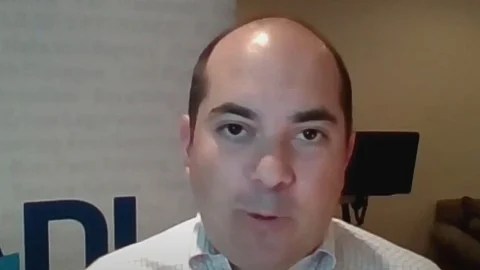
The Anti-Defamation League’s David Goldenberg is demanding a broad overhaul of how speech is governed on the internet, calling for both government intervention and intensified corporate censorship. In a recent appearance, Goldenberg, who heads the ADL’s Midwest operations, expressed frustration over what he sees as declining efforts by tech firms to suppress online content he deems hateful.
Citing Meta’s rollback of its fact-checking team in the United States, he argued that platforms must be forced to take action. “You have a platform like Meta that just gutted its entire fact-checking department… And so what we need to do is we need to apply pressure in a real significant way on tech platforms that they have a responsibility, that they have an absolute responsibility to check and remove hateful speech that is insightful.(sic)”
Goldenberg advocated not just for voluntary moderation, but for legislative and regulatory measures, both at the federal and state level, that would compel platforms to act as speech enforcers. He pointed to efforts in states like California as examples of where local governments are already testing such models.
His concern centers around what he perceives as an ecosystem of radicalization made easily accessible by today’s digital infrastructure. He warned that extremist ideologies no longer require obscure forums or dark web communities to spread. “It used to be you had to fight going into the deep dark web… Now… it’s easier and easier to be exposed in the mainstream,” he said.
Framing the online environment as a catalyst for violence, Goldenberg argued that free access to controversial viewpoints must be curtailed. He called for social media companies to take a stronger stance by excluding users whose views fall outside accepted boundaries, adding that regulation should enforce this responsibility.
He zeroed in on Section 230 of the Communications Decency Act, a critical piece of legislation that shields platforms from legal liability over user-posted content. “Congress needs to amend Section 230, which provides immunity to tech platforms right now for what happens,” Goldenberg said. He dismissed comparisons between modern platforms and telecommunications companies, referencing past remarks by Facebook’s Mark Zuckerberg about how phone providers were not liable for threats made over calls. Goldenberg’s view was blunt: “These tech platforms are not guaranteed under the Constitution. They’re just not.”
From his perspective, private companies should be free to “kick people off, to de-platform,” and if they fail to do so voluntarily, they must be pressured or regulated into compliance. He described accountability as a mechanism for shaping behavior, stating, “Accountability is a tool that can be incredibly effective in changing behavior.”
The position advanced by Goldenberg reflects a broader effort to blur the line between public authority and private platform control. By demanding that companies mirror the goals of activists and lawmakers, his approach seeks to institutionalize censorship and convert digital platforms into engines of ideological enforcement.
But such a vision comes with consequences. By urging the dismantling of legal protections and empowering both governments and corporations to decide which views should be silenced, this framework sets the stage for widespread suppression. What’s framed as protection from harm becomes a template for restricting dissent, and narrowing the range of permissible thought in public discourse.
US aid site collapses in Gaza amid mismanagement, Israeli gunfire
Al Mayadeen | May 27, 2025
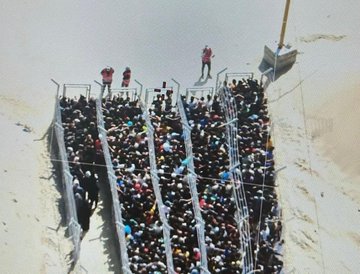
The latest attempt to distribute aid in Rafah as part of the ethnic cleansing plan descended into chaos on Tuesday, as the American-managed distribution mechanism built to push people south of the strip, by the Gaza Humanitarian Foundation, failed catastrophically, an Al Mayadeen correspondent on the ground reported.
The site reportedly collapsed due to overcrowding, disorganization, and a lack of control by the overseeing company, resulting in the destruction of a large portion of the facility.
The scenes showed a harrowing sight of people being driven inside overcrowded narrow paths made of metal fences and barbed wire, reminiscent of WW2 nazi concentration camps.
The breakdown was further compounded by live fire from Israeli occupation helicopters, which targeted the vicinity of the distribution center, escalating panic among the gathered civilians. Israeli media outlets, including Yedioth Ahronoth, confirmed that Israeli occupation forces opened heavy fire at Palestinians from Gaza who had stormed the aid complex.
The same outlet also claimed that armed personnel contracted by the American company overseeing the site fled the scene amid the surge in crowds. In response, Israeli commentators criticized the incident as yet another security failure similar to previous breakdowns in the so-called Netzarim axis, pointing to the “privatization of security tasks inside hostile territory by foreign contractors.”
Aid system reflects ‘systematic starvation policy’
In a strongly worded statement, the Government Media Office in Gaza condemned the collapse of the Rafah aid distribution plan, accusing the Israeli occupation of deliberate sabotage. “The occupation has utterly failed in its project to distribute aid in the zones of racial segregation,” the statement read.
It further asserted that the occupation’s interference at the aid distribution center “exposes the collapse of the so-called humanitarian process it claims to lead,” calling the scene “irrefutable evidence of the occupation’s failure to manage the crisis it has intentionally created.”
The office denounced the establishment of isolated zones, referred to as “ghettos”, for distributing limited aid as a deliberate policy aimed at perpetuating starvation and dismantling the social fabric of Gaza.
Accusing the Israeli regime of weaponizing humanitarian aid as a tool of war and political extortion, the office held the occupation fully responsible for the deepening food crisis and humanitarian collapse.
Calls for UN to open border crossings
The Gaza Media Office reiterated its complete rejection of any project involving buffer zones or so-called humanitarian corridors managed by the Israeli occupation. It demanded immediate and unrestricted access to humanitarian aid, urging the United Nations to act swiftly to open the crossings and empower humanitarian agencies to operate freely and independently.
The statement also called for international investigation committees to document what it described as the war crime of starvation and to hold the occupation’s leadership legally accountable.
Additionally, the office appealed to Arab and Islamic nations to intervene and activate independent humanitarian channels to break the blockade imposed on the Gaza Strip.
The events in Rafah offer yet another bleak chapter in Gaza’s ongoing humanitarian disaster, highlighting the severe consequences of militarized aid delivery and foreign-managed logistics within a war-torn and besieged population.
Group CEO resigns from post
Jake Wood, the executive director of the US-backed Gaza Humanitarian Foundation (GHF), announced his resignation on Sunday, stating the group’s aid delivery model could not be implemented without violating core humanitarian principles.
The departure throws fresh uncertainty over the future of the initiative backed by the Israeli occupation and the United States to deliver food aid into the besieged enclave, bypassing traditional aid structures.
Last week, the Gaza Government Media Office announced in a statement that “Israel’s” brutal blockade on humanitarian aid has killed hundreds of Gazans, and led to a sharp rise in miscarriages.
“The Israeli occupation’s starvation policy in Gaza has led to the deaths of 326 people due to malnutrition and lack of food and medicine, along with over 300 miscarriages among pregnant women in just 80 days,” the office stated.
In a public statement, Wood said he was proud of the plan he had developed, which aimed to distribute 300 million meals within 90 days while addressing diversion concerns and complementing existing NGOs.
“Senators from Israel” Sabotaging Trump’s Iran Deal
By Kevin Barrett | American Free Press | May 27, 2025
Last month I warned in these pages that Donald Trump faces a stark choice regarding Iran: “Nuclear Deal II or World War III.” I pointed out that Iran is open to a deal, but that it won’t be much different from the JCPOA that Trump unilaterally canceled during his first term.
Failure to reach a nuclear agreement would make a catastrophic US war on Iran almost inevitable—not because Iran would quickly build nuclear weapons or threaten anyone, but because failed negotiations would embolden Israel to attack Iran, knowing that it would almost certainly be able to draw the US into the war. And if that happened, Iran could climb the escalation ladder by killing thousands of US soldiers, sinking US ships, and most importantly, destroying enough of the region’s oil production to completely collapse the global economy.
Iran doesn’t want nuclear weapons, which are banned by a decades-old religious edict renewed by the current Supreme Leader. But a growing minority of Iranians want to rethink that edict. They believe that Iran’s lack of nuclear weapons has allowed nuclear-armed Israel to repeatedly attack it, murder its scientists, perhaps even (deniably) assassinate its president, and commit genocide and other crimes with impunity. So even though nukes are ungodly, the minority claims, there is a “necessity doctrine” that allows people to do things that are ordinarily forbidden if survival requires it.
Israel, for its part, wants to completely dominate the region. Zionist extremists, who now represent about half the Israeli public, are committed to building “Greater Israel.” That would require genocide at industrial scale to eliminate regional populations so Yahweh’s supposedly chosen people can steal all the land and resources between the Nile and Euphrates rivers.
An ever-expanding Israel that continues invading and occupying its neighbors, stealing their land and resources, and murdering and expelling their populations cannot dream of doing such things unless it is the only nuclear weapons state in the region. So the possibility that one day Iran might “go nuclear” worries Israeli hardliners. If Iran continues developing its civilian nuclear program, Israelis believe, someday its leaders might change their minds and decide to build nuclear weapons. The Israelis apparently don’t understand that it is their own reckless criminality that is driving more and more Iranians toward considering the necessity of developing nukes for self-defense.
A Trump nuclear agreement would, like its predecessor, keep Iran in a position of needing about a year of “breakout time” to build nuclear weapons—as opposed to months or even weeks without a deal. But that’s not good enough for Netanyahu and other Israeli hardliners. They want to lay waste to Iran, even if it requires blowing up the global economy and with it Trump’s presidency.
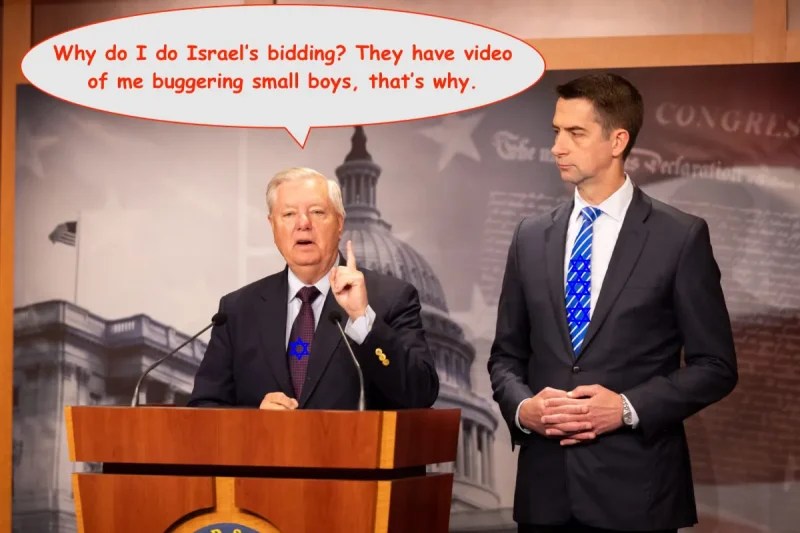
A group of “Senators from Israel” led by Tom Cotton (R-IS) and Lindsey Graham (R-IS) is trying to torpedo Trump’s nuclear negotiations with Iran. The treasonous Israeli-owned senators are pushing a resolution demanding that Iran completely dismantle its civilian nuclear program. That’s a non-starter. International law, beginning with the Nuclear Non-Proliferation Treaty (NPT) specifically allows Iran (like other non-nuclear-weapons states including Japan, Brazil, and the Netherlands) to enrich up to 5%. Under the 2015 JCPOA Iran agreed to limit enrichment to 3.67%, a significant concession representing roughly the minimum enrichment required for nuclear power and research.

The “Senators from Israel” also want Iran to abandon its ballistic missiles—the core of its defense strategy—and stop cooperating with regional allies in Iraq, Lebanon, Yemen, and above all, Palestine. Those demands, too, are non-starters. Their only purpose is to destroy the possibility of any agreement, thereby opening the door for Israel to drag the US into a disastrous war on Iran.
Will the Trump Administration break free from the malign influence of the Israel lobby and its extremist leader, Benzion Mileikowsky, that Polish-born internationally-wanted criminal who operates under the alias “Benjamin Netanyahu”? Will Trump take the advice I offered last month and “terminate Bibi’s command…with extreme prejudice if necessary?”
There are encouraging signs that Trump may jettison Netanyahu in order to avoid the war-on-Iran-for-Israel trap that Bibi has set for him. By striking a separate peace with Yemen’s Houthis that allows them to continue targeting Israel, then triumphally visiting the region’s Arab capitals (including Hamas-funding Qatar) Trump has done everything but order Israel to stop its genocide in Gaza.
Trump needs to give that order ASAP—not only for humanitarian reasons, but also to create a fait accompli that will help bring down Netanyahu and forestall the Israeli hardliners’ efforts to trick the US into yet another disastrous war for Israel. If the Trump Administration does not act decisively, Netanyahu’s bought-and-paid-for “US” senators will keep pushing Bibi’s war plans, with potentially catastrophic results.
The Right Approach to the US-Iran Nuclear Negotiations
By Glenn Diesen | May 27, 2025
I recently attended a media festival in Tehran and also had the opportunity to explore Iran’s weapon systems and one of its nuclear facilities. Iran’s nuclear program is cited as the main reason for Israel and the US to threaten war with Iran. Such a war would likely escalate into a disastrous regional conflict, and perhaps even pull in the other great powers in a world war. Israel obviously needs to bring America on board to attack Iran, so the discussions between the US and Iran are of great importance. What do the Americans and Iranians want, and is there common ground that can be reached?
If the only demand by the US was for Iran to abstain from developing nuclear weapons, then an agreement could be reached, as Iran claims it does not intend to develop nuclear weapons and has accepted that inspectors are there to ensure compliance. Indeed, Iran agreed to the Joint Comprehensive Plan of Action (JCPOA) and honoured its obligations before the US unilaterally withdrew from the agreement. The US now demands a renegotiation and demands the complete dismantlement of Iran’s civilian nuclear energy program, which it is entitled to have as a signatory to the Non-Proliferation Treaty.
Furthermore, the US has linked its hegemonic policies in the region to the nuclear issue. The US demands that Iran limit the range of its ballistic missile program and also suspend its support for allies in the region – primarily Yemen, Lebanon and Hamas. From Tehran’s perspective, this represents a complete capitulation that would make its security dependent on the benign intentions of Israel and the US. This neglects that the US has had Iran in its crosshairs for the past 45 years, and Iran does have legitimate security concerns.
What can be considered a legitimate security concern by the US is that Iran has become a nuclear threshold state, with the knowledge and material to develop a nuclear weapon. Restricting the extent to which uranium is enriched and imposing strict inspections could possibly be negotiated.
However, threatening to bomb Iran would not eliminate its know-how or all of its material, and such an attack would only incentivise Iran to develop a nuclear deterrent. Even US threats to attack Iran unless it complies with US demands must be making the political leadership in Iran consider acquiring a nuclear weapon. So far, Iran is not developing nuclear weapons, because doing so would encourage other states, such as Saudi Arabia, to also pursue nuclear weapons. Recognising the security competition, the result would not be greater security for Iran.
In my opinion, another approach to negotiations would be to do what is rarely done anymore in Western diplomacy: to recognise and mitigate the security concerns of the other side for the purpose of reducing the security competition. Threatening and bullying Iran into making unilateral concessions has become the new normal in the unipolar era. The US offer to remove sanctions on Iran is merely an offer to stop punishing Iran. The point of departure in any diplomatic approach should be to address mutual security concerns and explore where an agreement that enhances security for both sides can be found. Threatening Iran with capitulation and linking nuclear issues to unrelated matters will only ensure the failure to reach an agreement.
Russia could restrict return of Western brands – Izvestia
RT | May 27, 2025
The Russian parliament is set to pass a law that would regulate the right of foreign companies to reclaim assets sold during their exit from the country, Izvestia reported on Tuesday. The draft has reportedly been approved by the Finance Ministry and will be considered by the State Duma in its second and third readings simultaneously.
Numerous US, European, and Asian companies pulled out of Russia due to supply problems caused by unprecedented sanctions imposed on Moscow by the West after the escalation of the Ukraine conflict in 2022. Other firms left due to the risk of facing secondary sanctions or public relations pressure.
The bill, reviewed by Izvestia, allows Russian authorities or current owners to reject asset buybacks under certain conditions. Grounds for refusal include the foreign seller being from a country that has imposed sanctions on Russia, the repurchase price being below market value, or if more than two years have elapsed since the original deal with the Russian owner fulfilling obligations to employees and creditors.
The Russian authorities may also block asset buybacks if a company operates in sectors deemed vital to the country’s socio-economic stability, including defense or finance, the outlet said. In such cases, asset repurchase would require presidential approval.
According to Izvestia, the new measures will be voted on in June and could affect at least 18 foreign companies with buyback options, including Renault and McDonald’s. The draft law also reportedly stipulates that foreign businesses denied repurchase could be eligible for compensation, the amount of which would be determined by the government. However, if former owners failed to fulfill obligations before their exit, compensation could be reduced by court decision.
In March, Russian President Vladimir Putin ordered the government to draft regulations for Western firms seeking to return to the country’s market, which would prioritize the adequate protection of local businesses.
Following the exodus of foreign firms, the Russian market has largely adapted by promoting domestic and Chinese brands, making re-entry more challenging for Western companies. In sectors such as automotive and fashion, local alternatives have filled the void left by departing Western firms.
Putin said on Monday that foreign tech firms that continue operating in Russia while acting against the country should be “squeezed out.”
“They are trying to squeeze us, so we must respond in kind,” Putin said in response to a question about possible measures against companies such as Zoom and Microsoft. The president added that Russia had not expelled any companies and had instead created favorable conditions for their operations.
Featured Video

Houthis Don’t Have to Conquer Saudi Arabia to Make It Pay
or go to
Aletho News Archives – Video-Images
From the Archives
A Lesser “Grade” of Human
By Michael Hoffman | Revelation of the Method | January 3, 2024
Will the more than 100 Iranians killed by terrorist bombs today be mourned in the West as victims of terrorism? Certainly not. Allied doctrine has it that the killing of Israeli or American civilians is a crime of cosmic proportions, while shedding the blood of “enemy” women and children is perfectly acceptable; indeed commendable.
The West does not memorialize the hundreds of thousands of civilians bombed by the U.S. in Serbia, Iraq, Afghanistan and every major German city 1943-1945. America’s fire-bombing of the city of Tokyo by General Curtis LeMay in March 1945 was followed by Harry Truman’s atomic incineration of Hiroshima and Nagasaki in August of that year. Truman never had a moment of doubt or regret over the murder of more than a 100,000 Asian children, mothers and non-combatant boys and men. It was business as usual for the “noble” Allies during the “Good War.”
In the West human rights signifies passionate concern only for civilians designated as truly human: Israelis first, then Americans and British, followed by their satraps.
This inhumanity is the legacy of Talmudic ideology, beginning with tractate Sanhedrin 57a from 400 A.D., concerning liability for capital punishment: “If a Jew murders a gentile, he is exempt.”
This teaching of contempt was reiterated in the dogma of Chabad Lubavitch founder Rabbi Shneur Zalman in the 18th century. … continue
Blog Roll
 Aletho News
- Houthis Don’t Have to Conquer Saudi Arabia to Make It Pay
- MOE: Nearly 22,000 Students and Education Workers Killed
- Guterres in Islamabad: Genocide, cowardice, and the cage of Imran Khan
- Johnson, Marandi say Yemen holds upper hand over Saudi Arabia
- False flags won’t save aggressors, Iran FM spokesman says
- The Makkah Pact Enters Into Force: The End of American Dominance or Its New Form?
- NATO’s top generals gather in Kiev
- EU’s continuing expansion – greater threat to Russia
- US Senator Murphy says Pentagon denied him entry to US base in Qatar
- Israel expands “incitement” charge to target Palestinian education and memory
- If Americans Knew
- Three Years of Genocide: How America’s Israel-First Media Filtered Out the Truth
- Israeli war chief briefs ministers on potential war against Palestinian Authority
- New Report: Israel Killed nearly 21,000 Palestinian Students and Education Workers in Past Three Years
- Israel’s flailing chatbot army
- Five Palestinians Killed, Others Injured by Israeli Fire in Gaza
- Israel is rewriting the Palestinian curriculum in East Jerusalem to erase Palestinian identity
- Three years of genocide: Israel turned prisons into killing grounds and torture sites
- Three years of genocide. Words fail. Daily Update
- ‘I’d rather die than go back’: A Palestinian teen’s 10-month nightmare in Israeli jail
- How Jared Kushner’s firm’s investment in an Israeli company could be a major conflict of interest
- No Tricks Zone
- New Study: 50 Years Of The Most Aggressive ‘Net Zero’ Policies Can Only Affect The Global Climate By 0.03°C
- US September “Heat” Was No Record…Many Records Set Decades Ago
- Latest European Green Energy Debacle; Portugal’s Largest Flagship Solar Park Insolvent!
- Green Energy Debacle: German Expert Professor Fritz Vahrenholt Warns Of Severe Economic And Social Consequences
- Two More Paleo Reconstructions Affirm Meters-Higher Sea Levels Across Ireland, Brazil 7000-6000 Years Ago
- New Study: Earth And Venus Surface Warmth Largely Explained By Convection And Lapse Rate, Not CO2 Or Radiation
- 2025 Nature Paper Claiming Worsening Global Drought Gets RETRACTED …Heavily Flawed
- New Study: ‘Global Drought Shows No Detectable Recent Acceleration Under Climate Warming’
- Economic Masterminds: German Socialists Suggest Taxing Productivity Gains Stemming From Using AI
- The South China Sea Has Not Been Cooperating With The Climate Change Narrative

