China urges US to stop space threat rhetoric
Al Mayadeen | May 22, 2025
China’s Foreign Ministry has strongly condemned recent accusations by the United States that Beijing and Moscow pose a growing threat to American space operations.
In a press briefing on Wednesday, Foreign Ministry Spokesperson Mao Ning urged Washington to “stop irresponsible rhetoric” and abandon its pursuit of military dominance in space.
“China has always insisted on the peaceful use of outer space, and opposed the weaponization of and arms race in space,” Mao said, responding to US claims that Russian and Chinese technology now poses the ‘greatest threat’ to the United States in space defense.
The renewed US accusations were made by General Chance Saltzman, Chief of Space Operations at the US Space Force, who alleged that both China and Russia possess anti-satellite capabilities that endanger US interests.
Rejecting these allegations, Mao stated that Beijing has no interest in entering a space race, nor in pursuing “space supremacy.”
Instead, she emphasized that it is the US that has designated outer space as a military battlefield, a move that threatens global security.
“The US continues to build up its space forces, form a military alliance in outer space, and contribute to its weaponization, posing a serious threat to universal development and security interests,” she warned.
Mao urged the US to halt its space militarization agenda and work toward “lasting peace and security” in orbit, reiterating China’s long-held position that space should remain a zone of peaceful exploration and cooperation.
Washington accused of militarizing orbital space
Beijing’s remarks come amid rising global concern over the militarization of space, with the US leading efforts to formalize space as a new warfighting domain.
The creation of the US Space Force, coupled with expanded joint military drills and new orbital systems, has drawn criticism from both Russia and China. Both countries have long supported a legally binding treaty to prevent the deployment of weapons in outer space, an initiative that Washington has consistently blocked.
China’s response shows repeated warnings that the US approach to space risks triggering a destabilizing arms race. “We urge the US to stop expanding its military presence in outer space under the guise of national security,” Mao concluded.
Republican Senators Want War, Republican Voters Don’t
By Jack Hunter | The Libertarian Institute | May 22, 2025
Last week over two-hundred Republicans, including every GOP senator except Rand Paul (R-KY), signed a letter urging President Donald Trump to insist that Iran give up all enrichment capabilities in any nuclear deal with that country.
In other words, they don’t want a new Iran deal.
But most Republicans do want a deal. As Responsible Statecraft’s Stavroula Pabst reported on May 12, “As U.S.-Iran talks continue, new polling finds that nearly two-thirds of Republicans support a negotiated deal on Iran’s nuclear program over military action intended to destroy it.”
Pabst explained:
“Indeed, polling published by the University of Maryland Critical Issues Poll program and conducted by the SSRS Opinion Panel Omnibus from May 2 through 5, surveying over 1,000 respondents over 18, showed that a majority of Americans, 69%—including 64% percent of Republicans—view a negotiated agreement to limit Iran’s nuclear program, with monitoring, as the best way to prevent Iran from obtaining a nuclear weapon.”
It seems that on Iran, the Republican members of Congress are out of sync with the voters who put them there.
Stavroula would add of President Trump’s special envoy Steve Witkoff, “Witkoff shared one thing in common with the Iranians—that ‘no enrichment’ is a red line, for the Americans who don’t want any enrichment, and for the Iranians, who say they must have it for their civilian nuclear program.”
The Republicans who signed that letter know this. Again, they don’t want a deal.
So many of them want a U.S. war with Iran and have said so many times. President Trump seeking diplomacy over military action wrecks their war plans.
So they play games, like issuing this phony, dishonest letter.
The gap between the majority of Republican voters who want a deal and the nearly two-hundred Republicans in Congress who don’t appears to reflect a difference in the culture of the GOP’s voting base vs. the Washington establishment.
However imperfectly, Donald Trump has imposed an ‘America First’ ethos on Republican identity, something so many of his supporters eagerly embraced. A major part of that identity is no more wars and overseas nation-building. Neoconservative Republicans like Liz Cheney and Adam Kinzinger were eventually pushed out of their own party, feigning over alleged MAGA threats to democracy, but in reality with an understanding that their zeal for war and empire ran counter to what Trump represented.
So they bailed. Republican voters didn’t want them anymore. Still, the remaining congressional Republicans of their mindset continue to have to operate in a party that Trump has reshaped, but that doesn’t mean so many have changed from being the reflexively war-happy, Bush-Cheney neocons they’ve been for most of their careers.
The primary difference between neocon Lindsey Graham and neocon Liz Cheney is that Graham has accepted doing what it takes to remain withing Trump’s movement and good graces. On foreign policy, Graham and Cheney don’t differ one bit.
Neocons are what they are. The Republican base is what it is, in 2025.
Regardless, Trump shouldn’t listen to Washington Republicans. He has no reason to.
Responsible Statecraft’s Ben Armbruster laid out why on Monday:
“Neocons and their allies in Washington, Israel, and beyond are making unrealistic demands about the outcome of U.S. talks with Iran on limiting its nuclear program. But President Trump has absolutely no reason to listen to them and should not take them seriously.”
He continued:
“The anti-Iran deal campaign kicked into overdrive last week when Republicans on Capitol Hill sent a letter to the White House calling on Trump to refuse any agreement that doesn’t include the complete dismantlement of Iran’s nuclear program.”
The neocons are very worried that successful diplomacy could prevent war.
“Every Republican senator except Rand Paul signed a letter to President Trump urging the administration to push for an end to Iran’s enrichment capacity,” Andrew Day, senior editor of The American Conservative, told RS. “They know that this demand is unacceptable to the Iranian regime and are clearly hoping to sabotage Trump’s diplomatic efforts.”
Exactly.
Neocons are going to neocon and will eagerly work for the next war, especially with Iran, for the rest of their lives. It’s how they’re built. “Warmonger” is a pejorative, but it’s also an accurate description of so many of these Beltway creatures.
If MAGA Republicans believe that what makes America great is the actual Americans who inhabit it, neocons measure national greatness by the willingness and ability of the United States to spread its empire to every inch of the globe, with any potential wars being a bonus, not a deterrent.
Neocons and MAGA are oil and water. When Trump said that George W. Bush “lied” the American people into war with Iraq on a Republican primary debate stage in South Carolina in 2016, some said his campaign was DOA for the unpardonable crime of questioning the war in “Bush country.”
We all the know what actually happened: the exact opposite. Trump’s MAGA movement now is the GOP. Bush-Cheney neoconservatism is mostly a faded memory for the base.
Now it the time to kick the neocons when they’re down.
So, to hell with them. Ignore their stupid letters. Deny and denounce their reaching rationales for committing the U.S. to yet another nonsensical tragedy abroad.
Call them on their bullshit.
Instead, make the peace and pursue the diplomacy that most Republican voters currently want and more importantly, would actually put America first, for the first time in a long time.
Republican senators might want war, but the people—Trump’s people—don’t. It’s time for populism on steroids. A robust antiwar conservatism for the twenty-first century. Give the great Smedley Butler his due.
If there was ever a time to give the people what they want, it’s now.
‘Golden Dome’ – US’s Unbreakable Shield or $175B Fantasy?
Sputnik – 22.05.2025
Trump’s $175 billion plan to build a comprehensive ground- and space-based missile shield, while ambitious, may not yield the results the POTUS seems to be hoping for.
The system’s name, ‘Golden Dome,’ was likely inspired by Israel’s Iron Dome air defense system.
The problem is, the Iron Dome is only effective against lone targets or small groups of targets and cannot handle a massed attack, military expert and air defense forces’ historian Yuri Knutov told Sputnik.
The Iron Dome is also meant to intercept jury-rigged rockets fired by Palestinian resistance whereas Trump’s Golden Dome is supposed to tackle intercontinental ballistic missiles, points out Igor Korotchenko, military analyst and editor in chief of National Defense magazine.
Technology- and composition-wise, Trump’s plan appears similar to Reagan’s failed Strategic Defense Initiative (SDI) that proposed using lasers, particle beams and even space-based missiles to intercept ballistic threats.
Yet even 40+ years after the SDI was pitched, the US lacks the technology to build such a system, to “reincarnate Reagan’s idea,” as Korotchenko put it.
The development of the Golden Dome is further hampered by the fact that while its ground component essentially means upgrading the existing US anti-ballistic weapons such as THAAD, Aegis and Patriot, the missile shield’s space component would have to be built from scratch, Knutov points out.
All in all, the Golden Dome is not going to be capable of repelling a mass ICBM launch.
The Israel Embassy Shooter Manifesto
By Ken Klippenstein | May 22, 2025
I’ve obtained the alleged manifesto written by Elias Rodriguez, suspect in the killing of two Israeli Embassy staffers in Washington, DC on Wednesday.
I believe the document to be authentic for several reasons, including the fact that it is signed by Rodriguez and timestamped well before he was named by law enforcement or any media. I am publishing it here not to glorify the violence — which I find abhorrent and condemn — but so the public can better understand the truth of what happened.
Refusing to confront the content of these texts often creates an information vacuum that is quickly filled by hoax documents, conspiracy theories, or selective leaks from authorities that can distort the facts. I believe that sunlight is the best disinfectant, especially when politics is involved, as the document makes clear is the case here.
Metropolitan Police Chief Pamela A. Smith identified Rodriguez as a 30-year-old man from Chicago who she said shouted “Free Palestine!” at the scene. The manifesto echoes this message, citing the war in Gaza as its central grievance and framing the killings as an act of political protest.
Below is the document in full.
Explication
May 20, 2025
Halintar is a word that means something like thunder or lightning. In the wake of an act people look for a text to fix its meaning, so here’s an attempt. The atrocities committed by Israelis against Palestine defy description and defy quantification. Instead of reading descriptions mostly we watch them unfold on video, sometimes live. After a few months of rapidly mounting death tolls Israel had obliterated the capacity to even continue counting the dead, which has served its genocide well. At time of writing the Gaza health ministry records 53,000 killed by traumatic force, at least ten thousand lie under rubble, and who knows how many thousands more dead of preventable disease, hunger, with tens of thousands now at risk of imminent famine due to Israeli blockade, all enabled by Western and Arab government complicity. The Gaza information office includes the ten thousand under the rubble with the dead in their own count. In news reports there have been those “ten thousand” under the rubble for months now, despite the continual making of more rubble and repeated bombing of rubble again and again and the bombing of tents amid the rubble. Like the Yemen death toll which had been frozen at some few thousand for years under Saudi-UK-US bombardment before being belatedly revealed to stand at 500k dead, all of these figures are almost surely a criminal undercount. I have no trouble believing the estimates that put the toll at 100,000 or more. More have been murdered since March of this year than in “Protective Edge” and “Cast Lead” put together. What more at this point can one say about the proportion of mangled and burned and exploded human beings whom were children. We who let this happen will never deserve the Palestinians’ forgiveness. They’ve let us know as much.
An armed action is not necessarily a military action. It usually is not. Usually it is theater and spectacle, a quality it shares with many unarmed actions. Nonviolent protest in the opening weeks of the genocide seemed to signal some sort of turning point. Never before had so many tens of thousands joined the Palestinians in the streets across the West. Never before had so many American politicians been forced to concede that, rhetorically at least, the Palestinians were human beings, too. But thus far the rhetoric has not amounted to much. The Israelis themselves boast about their own shock at the free hand the Americans have given them to exterminate the Palestinians. Public opinion has shifted against the genocidal apartheid state, and the American government has simply shrugged, they’ll do without public opinion then, criminalize it where they can, suffocate it with bland reassurances that they’re doing all they can to restrain Israel where it cannot criminalize protest outright. Aaron Bushnell and others sacrificed themselves in the hopes of stopping the massacre and the state works to make us feel their sacrifice was made in vain, that there is no hope in escalating for Gaza and no point in bringing the war home. We can’t let them succeed. Their sacrifices were not made in vain.
The impunity that representatives of our government feel at abetting this slaughter should be revealed as an illusion, then. The impunity we see is the worst for those of us in immediate proximity to the genocidaires. A surgeon who treated victims of the Mayan genocide by the Guatemalan state recounts an instance in which he was operating on a patient who’d been critically injured during a massacre when, suddenly, armed gunmen entered the room and shot the patient to death on his operating table, laughing as they killed him. The physician said the worst part was seeing the killers, well known to him, openly swagger down local streets in the years after.
Elsewhere a man of conscience once attempted to throw Robert McNamara off a Martha’s Vineyard-bound ferry into the sea, incensed at the same impunity and arrogance he saw in that butcher of Vietnam as he sat in the ferry’s lounge laughing with friends. The man took issue with McNamara’s “very posture, telling you, ‘My history is fine, and I can be slumped over a bar like this with my good friend Ralph here and you’ll have to lump it.'” The man did not succeed in heaving McNamara off a catwalk into the water, the former secretary of state managed to cling to the railing and clamber back to his feet, but the assailant explicated the value of the attempt by saying “Well, I got him outside, just the two of us, and suddenly his history wasn’t so fine, was it?”
A word about the morality of armed demonstration. Those of us against the genocide take satisfaction in arguing that the perpetrators and abettors have forfeited their humanity. I sympathize with this viewpoint and understand its value in soothing the psyche which cannot bear to accept the atrocities it witnesses, even mediated through the screen. But inhumanity has long since shown itself to be shockingly common, mundane, prosaically human. A perpetrator may then be a loving parent, a filial child, a generous and charitable friend, an amiable stranger, capable of moral strength at times when it suits him and sometimes even when it does not, and yet be a monster all the same. Humanity doesn’t exempt one from accountability. The action would have been morally justified taken 11 years ago during Protective Edge, around the time I personally became acutely aware of our brutal conduct in Palestine. But I think to most Americans such an action would have been illegible, would seem insane. I am glad that today at least there are many Americans for which the action will be highly legible and, in some funny way, the only sane thing to do.
I love you Mom, Dad, baby sis, the rest of my familia, including you, O*****
Free Palestine
– Elias Rodriguez
Europe must bear consequences of forcing return of UN sanctions against Iran: FM
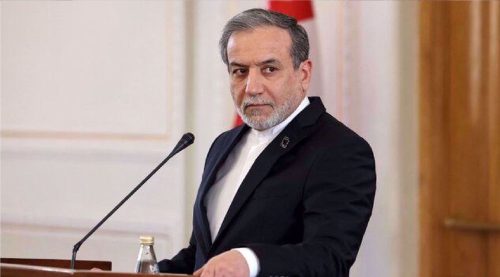
Iran’s Foreign Minister Abbas Araghchi
Press TV – May 21, 2025
Foreign Minister Abbas Araghchi has cautioned the US’s European allies in a 2015 nuclear agreement with Iran against invoking the so-called “snapback mechanism” to re-impose the United Nations sanctions against the Islamic Republic.
Speaking to Saudi Arabia’s Asharq News network on Wednesday, the top diplomat emphasized that such a move would end participation by the European parties — the UK, France, and Germany — in the deal that is officially known as the Joint Comprehensive Plan of Action (JCPOA).
He added that the trio’s potential recourse to the mechanism would lead to significant consequences and potential irreversible escalation of tensions, referring to the likelihood of strong retaliatory steps that the Islamic Republic could take in response.
Araghchi reiterated Iran’s readiness to engage in diplomacy, expressing hope that the European parties too would demonstrate determination to resolve the current impasse.
The deadlock occurred when the United States ditched the JCPOA in 2018, and returned the illegal and unilateral sanctions that the agreement had lifted.
This was followed by the European trio’s failure to return the US to the accord, as they had said would do, as well as their walking in Washington’s footsteps by returning their own sanctions.
In response to the betrayal, Iran began a number of legitimate and gradually escalating nuclear countermeasures.
“The situation we’re in is by no means Iran’s fault. It is the fault of the United States, which withdrew from the JCPOA, and the fault of the European countries that failed to compensate for the US’s withdrawal,” Araghchi added.
‘Uranium enrichment absolutely non-negotiable’
Addressing the topic of Iran’s peaceful uranium enrichment activities, the foreign minister said the activities were a principled and fundamental issue for Iran.
He emphasized that the enrichment program was a major scientific achievement developed by domestic scientists and held immense value for the Iranian people.
The official, meanwhile, paid tribute to the seven-strong Iranian nuclear scientists, who were assassinated amid their invaluable contribution to the Islamic Republic’s peaceful nuclear energy program.
According to Araghchi, the victims’ sacrifices towards advancement of the program had made the nuclear issue “absolutely non-negotiable.”
Fifth round of Iran-US talks to be held on May 23: Oman
Press TV – May 21, 2025
The fifth round of indirect negotiations between Iran and the United States will take place on May 23, according to Oman’s foreign minister.
Badr al-Busaidi made the announcement on Wednesday, adding that the talks will be held in the Italian capital, Rome.
Three of the previous rounds took place in the Omani capital, Muscat, and the second round in Rome.
Iranian and US officials have not commented on the announcement so far.
The talks focus on producing a replacement for the 2015 nuclear deal, which was derailed by American withdrawal in 2018.
Iran had previously declared it would decide whether to take part in the next round of the talks after US officials claimed any deal would not allow Tehran to enrich uranium.
Iran says it will not forgo its right to uranium enrichment, which is guaranteed under the Non-Proliferation Treaty.
Netanyahu’s endgame: Isolation and the shattered illusion of power
By Ramzy Baroud | MEMO | May 20, 2025
There was a time when Benjamin Netanyahu appeared to have all the cards. The Palestinian Authority was largely passive, the occupied West Bank was relatively calm, Israel’s diplomatic reach was expanding, and the United States seemed ready to bend international law to accommodate Israel’s desire for complete control over Palestine.
The Israeli prime minister had also, at least in his own estimation, succeeded in subduing Gaza, the persistently defiant enclave that had for years struggled unsuccessfully to break the suffocating Israeli blockade.
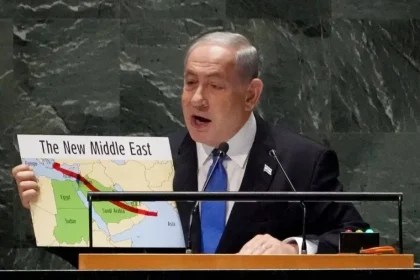
Within Israel, Netanyahu had been celebrated as the nation’s longest-serving prime minister, a figure who promised not only longevity but also unprecedented prosperity. To mark this milestone, Netanyahu employed a visual prop: a map of the Middle East, or, in his own words, “the New Middle East.”
This envisioned new Middle East, according to Netanyahu, was a unified green bloc, representing a future of ‘great blessings’ under Israeli leadership.
Conspicuously absent from this map was Palestine in its entirety—both historic Palestine, now Israel, and the occupied Palestinian territories.
Netanyahu’s latest unveiling occurred at the United Nations General Assembly on 22 September, 2023. His supposedly triumphant address was sparsely attended, and among those present, enthusiasm was notably absent. This, however, seemed of little consequence to Netanyahu, his coalition of extremists, or the broader Israeli public.
Historically, Israel has placed its reliance on the support of a select few nations considered, in their own calculus, to be of primary importance: Washington and a handful of European capitals.
Then came the October 7 assault. Initially, Israel leveraged the Palestinian attack to garner Western and international support, both validating its existing policies and justifying its intended response. However, this sympathy rapidly dissipated as it became apparent that Israel’s response entailed a campaign of genocide, the extermination of the Palestinian people in Gaza, and the ethnic cleansing of Gaza’s population and West Bank communities.
As images and footage of the devastating carnage in Gaza surfaced, anti-Israeli sentiment surged. Even Israel’s allies struggled to justify the deliberate killing of tens of thousands of innocent civilians, predominantly women and children.
Nations like Britain imposed partial arms embargoes on Israel, while France attempted a balancing act, calling for a ceasefire while suppressing domestic activists advocating for the same. The pro-Israel Western narrative has become increasingly incoherent, yet remains deeply problematic.
Washington, under President Biden, initially maintained unwavering support, implicitly endorsing Israel’s objective – genocide and ethnic cleansing.
However, as Israel failed to achieve its perceived objectives, Biden’s public stance began to shift. He called for a ceasefire, though without demonstrating any tangible willingness to pressure Israel. Biden’s staunch support for Israel has been cited by many as a contributing factor to the Democratic Party’s losses in the 2024 elections.
Then, Trump arrived. Netanyahu and his supporters, both in Israel and Washington, anticipated that Israel’s actions in Palestine and the wider region — Lebanon, Syria, etc — would align with a broader strategic plan.
They believed Trump’s administration would be willing to escalate further. This escalation, they envisioned, would include military action against Iran, the displacement of Palestinians from Gaza, the fragmentation of Syria, the weakening of Yemen’s Ansarallah, and more, without significant concessions.
Initially, Trump signalled a willingness to pursue this agenda: deploying heavier bombs, issuing direct threats against Iran, intensifying operations against Ansarallah, and expressing interest in controlling Gaza and displacing its population.
However, Netanyahu’s expectations yielded only unfulfilled promises. This raises the question: was Trump deliberately misleading Netanyahu, or did evolving circumstances necessitate a reassessment of his initial plans?
The latter explanation appears more plausible. Efforts to intimidate Iran proved ineffective, leading to a series of diplomatic engagements between Tehran and Washington, first in Oman, then in Rome.
Ansarallah demonstrated resilience, prompting the US on 6 May to curtail its military campaigns in Yemen, specifically the Operation ‘Rough Rider’. On 16 May, a US official announced that the USS Harry S. Truman would withdraw from the region.
Notably, on 12 May, Hamas and Washington announced a separate agreement, independent of Israel, for the release of US-Israeli captive Edan Alexander.
The culmination occurred on 14 May, when Trump delivered a speech at a US-Saudi investment forum in Riyadh, advocating for regional peace and prosperity, lifting sanctions on Syria, and emphasising a diplomatic resolution with Iran.
Conspicuously absent from these regional shifts was Benjamin Netanyahu and his strategic ‘vision’.
Netanyahu responded to these developments by intensifying military operations against Palestinian hospitals in Gaza, targeting patients within the Nasser and European Hospitals. This action, targeting the most vulnerable, was interpreted as a message to Washington and Arab states that his objectives remained unchanged, regardless of the consequences.
The intensified Israeli military operations in Gaza are an attempt by Netanyahu to project strength amidst perceived political vulnerability. This escalation has resulted in a sharp increase in Palestinian casualties and exacerbated food shortages, if not outright famine, for over two million people.
It remains uncertain how long Netanyahu will remain in power, but his political standing has significantly deteriorated. He faces widespread domestic opposition and international condemnation. Even his primary ally, the United States, has signalled a shift in its approach. This period may mark the beginning of the end for Benjamin Netanyahu’s political career and, potentially, for the policies associated with his horrifically violent government.
Exposing Hypocrisy: Palestine, the ICJ, and the Collapse of Liberal Legitimacy
By Taut Bataut – New Eastern Outlook – May 20, 2025
ICJ has recently postponed the hearing of South Africa’s case against Israeli war crimes to January 12, 2026, providing it more time to annihilate Gaza. This marks the collapse and failure of the international system.
The Ongoing Humanitarian Crisis in Gaza
Since October 7, 2023, the Palestinians have been facing one of the worst genocidal operations in the world. More than 50000 Palestinian civilians, mostly women and children, have been intentionally killed by the Israeli Defense Forces (IDF) under the pretense of eliminating Hamas. However, this war has exposed the self-proclaimed champions of human rights and liberalism. The United States and the European Union have constantly been providing military, diplomatic, and financial aid to Israel.
The latter has emerged as the largest recipient of the US aid since its illegitimate inception. Moreover, the US government has vetoed multiple United Nations resolutions seeking to establish humanitarian peace in the region. U.S. President Donald Trump also reiterated his country’s support for Israel after his re-election. He also proposed a plan to relocate the native people of Gaza to the neighboring countries and occupy the region for the long term.
The Zionist state has intentionally targeted aid workers, mosques, churches, hospitals, schools, and other civilian infrastructure in violation of international law. In an unprecedented move, the Netanyahu administration is using starvation and hunger as a weapon of war against the innocent civilians of the Gaza Strip. Several heart-wrenching images of starved children from Gaza have emerged on social media during all this time. Amnesty International and the different international humanitarian agencies have condemned these Israeli policies and declared them a war crime.
Global Legal Responses and the Case at the ICJ
While most of the Muslim nations hesitated even to utter a single sentence against the ongoing Israeli war crimes and genocide in Israel, South Africa filed a case against the Zionist state in the International Court of Justice (ICJ) in December 2023 under the 1948 Genocide Convention. This Convention, established to halt the recurrence of Holocaust like events, defines genocide as “acts committed with intent to destroy, in whole or in part, a national, ethnical, racial or religious group.” More than 10 countries, including Turkey, Ireland, Egypt, the Maldives, Chile, Belgium, and Mexico, have joined the case against Israel.
The petition demanded urgent actions to prevent further Israeli war crimes in Gaza. However, despite the presence of numerous evidence and reports by international human rights organizations, the ICJ failed to halt the genocide of innocent civilians of the Gaza Strip. The court was also commissioned to determine whether the Israeli Defense Forces were committing genocide in Gaza. Since 2023, the court has made no considerable decision against the Israeli war crimes.
Exposing Hypocrisy and Seeking Alternatives to Western Hegemony
The world, especially the Gazans, is waiting for the international community to stand against the atrocities and the war crimes of the IDF and the Netanyahu government. However, the Western world and its puppet Arab nations are constantly ignoring the plight of the innocent Palestinians. This has exposed the international organizations, the OIC, and the Western liberal values. The ICJ’s recent decision to postpone the hearing till January 2026 demonstrates its apathy towards the citizens of Gaza in particular and towards the citizens of Third World countries in particular.
Israeli war crimes and apartheid in Palestine date back to the former’s inception in 1948. Since then, the Zionist groups in Palestine have been occupying the properties of the native peoples. Israel’s history is replete with rapes, torture, and killing of innocent children and women in Palestinian territory. The Zionist leaders have always supported sexual assault by the Israeli Defense Forces.
However, the international community remains indifferent to the plight of the Palestinians. The ICJ’s postponement of the hearing till next year demonstrates its commitment to justice and peace in the world. This move has once again revealed that the US-backed unipolar liberal world order has failed. It has also exposed the reality of the so-called champions of human rights. The United States and other Western nations have always echoed their concerns about the Ukrainian people. However, their nonchalance to the plight of the Palestinians exposes their hypocrisy.
Although the Palestinians and their supporters around the world were hopeful about the ICJ, this is the time to realize that all the international institutions were made merely to prolong the US hegemony and serve the Western interests. It is improbable that the ICJ would declare Israeli operations as genocide. However, even if it does so, it would be too late, as hundreds more Palestinians would have been killed by then. Nonetheless, South Africa’s case against the ICJ has further exposed the Western world order and its institutions. It is the right time for third-world countries to look for an inclusive and egalitarian world order. BRICS provides the best alternative to the developing countries pursuing their ambition of following independent foreign policies and mutual development.
MAGA influencers want an Iran deal and for hawks to shut up
Trump is unlikely to pay any political price if he disregards the old guard’s unrealistic demands
By Ben Armbruster | Responsible Statecraft | May 19, 2025
Neocons and their allies in Washington, Israel, and beyond are making unrealistic demands about the outcome of U.S. talks with Iran on limiting its nuclear program. But President Trump has absolutely no reason to listen to them and should not take them seriously.
The anti-Iran deal campaign kicked into overdrive last week when Republicans on Capitol Hill sent a letter to the White House calling on Trump to refuse any agreement that doesn’t include the complete dismantlement of Iran’s nuclear program.
“Every Republican senator except Rand Paul signed a letter to President Trump urging the administration to push for an end to Iran’s enrichment capacity,” Andrew Day, senior editor of the American Conservative, told RS. “They know that this demand is unacceptable to the Iranian regime and are clearly hoping to sabotage Trump’s diplomatic efforts.”
Center for International Policy senior non-resident fellow Sina Toossi called the letter’s demand “a poison pill.”
“Demanding zero enrichment, permanent restrictions, and total dismantlement of Iran’s nuclear infrastructure — after the U.S. already broke the 2015 deal — is not a negotiating position,” he told RS.
Meanwhile, other deal opponents say that Iran can be allowed to keep its program for civilian energy production purposes with the caveat that it cannot enrich its own uranium.
The good news for Trump though — and those who see an opportunity to box in Iran’s nuclear program and avoid war — is that this anti-Iran deal coalition has no constituency outside Washington and Israel, and Trump will pay very little to no political price if he just ignores them.
Take for instance a recent poll conducted by the SSRS Opinion Panel Omnibus in conjunction with the University of Maryland Critical Issues Poll program. That survey found that a large majority of Americans — 69% — favor “a negotiated agreement limiting Iran’s nuclear program to peaceful ends, with stringent monitoring” as opposed to military action. But perhaps more importantly for Trump’s political fortunes, 64% of Republicans surveyed — i.e. his base — agreed.
Opponents of diplomacy with Iran try to obfuscate this reality and muddy the waters. For example, Foundation for the Defense of Democracies CEO Mark Dubowitz — who’s been pushing for regime change in Iran for nearly two decades — promoted a poll last week finding that “76% of Americans say Iran’s nuclear-weapons facilities should be destroyed.”
Of course there is one problem: Iran doesn’t have nuclear weapons or a nuclear weapons program, and thus no nuclear weapons facilities, a fact that the U.S. intelligence community routinely concludes.
But it’s not just the American people or the GOP base that support Trump making a deal with Iran. Some of the more high profile figures in the MAGA-America First world back him too.
“It’s called sanity,” Steve Bannon said last week, referring to the SSRS/UMaryland poll. Bannon, of course, served as a senior adviser to Trump during his first term and remains influential within his orbit and among his supporters.
Rep. Marjorie Taylor Greene (R-Ga.), who also has clout with Trump’s base, has been very vocal recently against going to war with Iran. “There is no wedge between the base and President Trump,” she said earlier this month. “The wedge is between Congress and the establishment Republicans that are undermining the president’s agenda.”
And conservative media star Tucker Carlson, who like Bannon, has close ties to Trump world and is influential with the president’s base, has been similarly calling out neocons and others who are trying to kill Trump’s diplomacy with Iran and push for war.
“Thousands of Americans would die. We’d lose the war that follows. Nothing would be more destructive to our country,” he said last month. “Anyone advocating for conflict with Iran is not an ally of the United States, but an enemy.”
Popular right-wing podcaster Charlie Kirk has piled on as well. “[T]here are people in Washington inside the Pentagon and inside the administration who want to launch military strikes on Iran. Often, they say it’d be easy. Just one strike in and out,” he said recently. “Now pause. How often have they actually been correct about the one in and out thing? Has that ever actually been the case?”
“President Trump has consolidated his power over the Republican Party to a remarkable degree and could certainly sign a good deal with Iran without suffering politically,” Day said. “The base still loves him, and lawmakers and conservative media are afraid of him. The elites would fall in line for fear of MAGA turning on them.”
Ryan Costello, policy director at NIAC, agrees. “Trump wouldn’t have been elected president twice if his foreign policy echoed the discredited views of the Bush-Cheney wing of the Republican party,” he said. “Trump can have a deal with Iran or he can be pushed into war by adopting rigid and inflexible demands — the vast majority of Americans want him to lead with diplomacy.”
Meanwhile, it appears increasingly unlikely that Democrats — most of whom supported President Obama’s Iran nuclear deal back in 2015 — will try to make much political hay with any agreement Trump makes with Tehran.
“This is not a time for politics on Iran,” Rep. Ro Khanna (D-Calif.), a leading Democratic foreign policy voice in the House, said last week. “I support [Trump] trying to get a deal with Iran. I supported the Obama nuclear deal. How about we put the interest of our nation and peace above scoring political points at every moment?”
And what’s perhaps overlooked but maybe equally important: major regional powers like Saudi Arabia, who campaigned hard against Obama’s Iran deal, have changed their tune with Trump.
“Gulf leaders have been broadly supportive of the talks between the Trump administration and Iran because they don’t want to be caught in the crossfire of a regional escalation if they fail,” Ali Vaez of the International Crisis Group told Middle East Eye last week. “That support doesn’t necessarily translate into success at the negotiating table but it’s a shift from the 2015 talks.”
Perhaps most importantly, Trump can get a deal with Iran that places strict limits on its nuclear program with incredibly intrusive verification mechanisms that will satisfy his stated goal of preventing Iran from building a nuclear weapon, all without zero enrichment provisions or requiring Iran to dismantle its entire program.
“Not only will adopting a hardline ‘no enrichment’ position push Iran from the negotiating table entirely, it is not necessary for an effective agreement and would not fully address Iran’s proliferation risk,” the Arms Control Association’s Kelsey Davenport wrote recently, adding that “dismantling the infrastructure does not erase the knowledge Iran has gained about uranium enrichment.”
In short, she concluded, the U.S. “can find the right combination of limits and monitoring to block Iran’s pathways to nuclear weapons while allowing Iran to retain a less risky level of uranium enrichment.”
Ben Armbruster is the Managing Editor of Responsible Statecraft. He has more than a decade of experience working at the intersection of politics, foreign policy, and media. Ben previously held senior editorial and management positions at Media Matters, ThinkProgress, ReThink Media, and Win Without War.
Iran Nuclear Negotiations Bring New, Suprising Developments
By Ted Snider | The Libertarian Institute | May 20, 2025
In the past several days, there have been surprising developments in the negotiations between Washington and Tehran over Iran’s civilian nuclear program.
U.S. President Donald Trump has frequently, but not always, defined the goal of the negotiations as being limited to preventing Iran from getting a nuclear weapon. He repeated that definition as recently as May 25, saying Iran must “permanently and verifiably cease pursuit of nuclear weapons…They cannot have a nuclear weapon.”
But the message from his team has been contradictory. Then-National Security Advisor Mike Waltz said that the United States is demanding “full dismantlement,” and Trump’s special envoy Steve Witkoff said that “a Trump deal” means “Iran must stop and eliminate its nuclear enrichment and weaponization program.” Rubio said that Iran can have a civilian nuclear program, but by importing uranium enriched up to 3.67%, and no longer by enriching their own. On May 9, Witkoff told Breitbart News that “An enrichment program can never exist in the state of Iran ever again. That’s our red line. No enrichment.”
But Iran has drawn the mirror image red line. Iran’s Supreme Leader, Ayatollah Ali Khamenei, has placed a firm limit that Iran will not negotiate “the full dismantling of Iran’s nuclear infrastructure.” Iranian President Masoud Pezeshkian repeated that red line ahead of the talks, insisting that “Iran has never sought, is not seeking, and will never seek nuclear weapons” but that “Iran will not give up its peaceful nuclear rights.”
American insistence on ending Iran’s civilian enrichment program could put a quick end to the talks. Widening the negotiations to Iran’s missile program or to Iran’s relationship with its regional proxy groups could also jeopardize the talks.
But Trump raised that possibility on May 14 when he suggested that breaking off relations with proxy groups in the region must be part of any deal. Iran “must stop sponsoring terror,” he said, and “halt its bloody proxy wars.”
The contradictory statements emanating from the Trump administration appear to have been “because of a lack of decision on key strategic points,” Trita Parsi, Executive Vice President of Quincy Institute for Responsible Statecraft and an expert on Iran, told me. And, indeed, on May 7, Trump said, “We haven’t made that decision yet.”
“As a result,” Parsi said, “the debate on these points is now, rather unhelpfully, taking place out in public.”
That the talks have progressed to a fourth meeting suggests, at this point, that the public crossing of these Iranian red lines may not be being repeated in the private meetings. Iran’s Foreign Minister hinted at that possibility when he identified one of the difficulties in the negotiations as being “contradictions both inside and outside the negotiating room.” Supporting this possibility, when Trump introduced Iran’s support of regional proxies into the discussion, Araghchi called the remark, not unproductive or unhelpful, but “deceitful.”
And Araghchi may know. Barak Ravid of Axios has now reported that, during the fourth round of talks, the United States presented Iran with a written proposal. The report says that, during the third round, Araghchi gave Trump’s special envoy Steve Witkoff a document with Iran’s proposals for a deal. The U.S. studied it and returned it to Iran with “questions and requests for clarifications.” Iran replied, the U.S. prepared a new proposal, and then presented it to Araghchi who has now brought it back to Tehran for consultations with Supreme Leader Ali Khamenei and President Masoud Pezeshkian.
How far down the path to a settlement the proposal is is unknown. Araghchi said future negotiations now become more difficult. But he said that “despite the difficulty and frankness of the talks, very useful discussions were held.” He then said, “We can now say that both sides have a better understanding of each other’s positions.”
This major breakthrough may have been facilitated by another recent development: a subtle change in tone by Trump. Following a flurry of American threats, the fourth round of talks was postponed. Iranian officials said that [d]epending on the U.S. approach, the date of the next round of talks will be announced.”
Recently, that approach subtly changed. Previously, Donald Trump had formulated Iran’s choice as “If they don’t make a deal, there will be bombing. It will be bombing the likes of which they have never seen before.” But in his most recent remarks, which went largely unnoticed, Trump softened the consequence, saying only “If Iran’s leadership rejects this olive branch…we will have no choice but to inflict massive maximum pressure, drive Iranian oil exports to zero.” Notably, bombing was replaced with sanctions.
On May 15, Trump again seemed to reject the risk of war:
“Because things like that get started and they get out of control. I’ve seen it over and over again. They go to war and things get out of control, and we’re not going to let that happen.”
In another surprise development, Iran may have facilitated negotiations with a creative and unexpected proposal.
There are now reports that Iran has suggested for consideration that they could join with Saudi Arabia and the United Arab Emirates in a nuclear enrichment consortium. Iran would continue to enrich uranium but accept a cap at the 3.67% enrichment required by a nuclear energy program. Saudi Arabia and UAE, who would gain access to Iran’s nuclear technology, would be shareholders and funders.
If true, the proposal would be based on a consortium idea first proposed by Princeton physicist Frank von Hippel and former Iranian nuclear negotiator Seyed Hossein Mousavian.
Von Hippel told me that the idea was inspired by the URENCO enrichment consortium of Germany, the Netherlands and Britain and by the ABAAAC consortium of Brazil and Argentina.
The consortiums, he said, allow nuclear experts from each country to “visit each other’s facilities to assure themselves that the activities are peaceful.” He added that “decisions that might have proliferation implications are made by the [partner] governments.” Saudi Arabia’s, the Emirates’ and Iran’s watchful eyes would all help the International Atomic Energy Agency ensure that the program is peaceful.
Aside from the implications for the nuclear negotiations, this level of trust between Iran, Saudi Arabia, and the UAE was unthinkable only a very short time ago and testifies to the changes going on in the region and in the evolving Iran-Saudi Arabia relationship. That Iran would trust Saudi Arabia with access to its nuclear technology indicates that a region changing shift in the relationship is underway.
As Annelle Sheline, research fellow in the Middle East program at the Quincy Institute, told me:
“The Iranians’ willingness to join a consortium with Saudi Arabia and the UAE to develop civilian nuclear energy demonstrates significantly improved relations between these countries. This sends a strong signal that Tehran as well as Riyadh and Abu Dhabi would prefer to prioritize cooperation over conflict.”
She said that all three countries have growing motivation for peace in the region. Crown Prince Mohammed bin Salman needs to avoid violent conflict to encourage the foreign investment and tourism needed to fuel his planned economic diversification. Mohammed bin Zayed needs economic security in the face of competition from Saudi Arabia to be a regional hub. Iran needs to encourage peace in the region because of the recent weakening of its own strategic position in the region. Saudi Arabia and Iran have recently been moving towards enhanced friendship both bilaterally and through multinational organizations.
Sheline expressed the hope to me that “Trump should take advantage of these circumstances to sign a nuclear deal with Iran and avoid unnecessary war.”
All of these developments, from the contradictory American messaging, to the until now unreported existence of a written proposal, to the subtle and little noticed change in Trump’s tone to the Iranian idea of a nuclear consortium with Saudi Arabia and UAE are shocking and new. They may present an opportunity to return to a nuclear agreement with Iran and to usher in a new hope for peace and friendly relations both between the U.S. and Iran and in the region. Hopefully, the two sides will seize this opportunity.
Montana Becomes First State to Ban Warrantless Data Purchases by Law Enforcement
By Ken Macon | Reclaim The Net | May 18, 2025
Montana has taken a decisive leap where others have faltered, becoming the first state in the US to officially outlaw a widespread government surveillance tactic: buying up private data without a warrant.
With the passage of Senate Bill 282 (SB 282), lawmakers have directly confronted what has become a backdoor into people’s lives, commercial data brokers selling sensitive digital information to law enforcement agencies, sidestepping the need for judicial authorization.
This so-called “data broker loophole” has allowed government agencies across the country to acquire personal details they’d otherwise need a warrant to access.
Instead of presenting probable cause to a judge, agencies could simply purchase location histories and other metadata from third-party brokers who gather it from mobile apps.
These apps often track users’ movements down to the minute, creating comprehensive logs of their daily routines. Until now, that information was effectively up for grabs, and no warrant has been required.
Montana’s new law puts a clear end to that practice. Under SB 282, state and local government entities are now barred from purchasing several categories of digital data, including but not limited to: electronic communications and their contents, geolocation data, financial transaction records, pseudonymous identifiers, and other forms of sensitive personal information such as religious beliefs, health status, and biometric details.
Importantly, the legislation doesn’t eliminate access altogether, it restricts how that access is obtained.
Law enforcement in Montana must now secure a judge’s approval via a search warrant or meet other legal standards such as investigative subpoenas. Consent from the device’s owner is also still a permissible route.
What SB 282 achieves is a ban on the government using cash instead of cause to gather what should be protected digital traces.
This isn’t Montana’s first move to prioritize digital civil liberties.
The state has already passed a range of privacy-forward policies in recent years, including strong limitations on facial recognition, protections for genetic information, and a state constitutional amendment that explicitly shields digital data from unreasonable searches and seizures. SB 282 continues that trend, bolstering Montana’s reputation as a leader in privacy rights.
The structure of the new law aligns with the spirit of a federal bill, the Fourth Amendment is Not for Sale Act, introduced by Senator Ron Wyden.
In the vacuum left by federal inaction, states have begun crafting their own responses. Montana, despite its modest population, is now at the forefront of that movement.
Montana becomes first state to close the “data broker loophole” that allows law enforcement to purchase data without a warrant by enacting SB 282 which prohibits the government from using money to access certain types of sensitive digital information
Featured Video

Houthis Don’t Have to Conquer Saudi Arabia to Make It Pay
or go to
Aletho News Archives – Video-Images
From the Archives
A Lesser “Grade” of Human
By Michael Hoffman | Revelation of the Method | January 3, 2024
Will the more than 100 Iranians killed by terrorist bombs today be mourned in the West as victims of terrorism? Certainly not. Allied doctrine has it that the killing of Israeli or American civilians is a crime of cosmic proportions, while shedding the blood of “enemy” women and children is perfectly acceptable; indeed commendable.
The West does not memorialize the hundreds of thousands of civilians bombed by the U.S. in Serbia, Iraq, Afghanistan and every major German city 1943-1945. America’s fire-bombing of the city of Tokyo by General Curtis LeMay in March 1945 was followed by Harry Truman’s atomic incineration of Hiroshima and Nagasaki in August of that year. Truman never had a moment of doubt or regret over the murder of more than a 100,000 Asian children, mothers and non-combatant boys and men. It was business as usual for the “noble” Allies during the “Good War.”
In the West human rights signifies passionate concern only for civilians designated as truly human: Israelis first, then Americans and British, followed by their satraps.
This inhumanity is the legacy of Talmudic ideology, beginning with tractate Sanhedrin 57a from 400 A.D., concerning liability for capital punishment: “If a Jew murders a gentile, he is exempt.”
This teaching of contempt was reiterated in the dogma of Chabad Lubavitch founder Rabbi Shneur Zalman in the 18th century. … continue
Blog Roll
 Aletho News
- Houthis Don’t Have to Conquer Saudi Arabia to Make It Pay
- MOE: Nearly 22,000 Students and Education Workers Killed
- Guterres in Islamabad: Genocide, cowardice, and the cage of Imran Khan
- Johnson, Marandi say Yemen holds upper hand over Saudi Arabia
- False flags won’t save aggressors, Iran FM spokesman says
- The Makkah Pact Enters Into Force: The End of American Dominance or Its New Form?
- NATO’s top generals gather in Kiev
- EU’s continuing expansion – greater threat to Russia
- US Senator Murphy says Pentagon denied him entry to US base in Qatar
- Israel expands “incitement” charge to target Palestinian education and memory
- If Americans Knew
- Three Years of Genocide: How America’s Israel-First Media Filtered Out the Truth
- Israeli war chief briefs ministers on potential war against Palestinian Authority
- New Report: Israel Killed nearly 21,000 Palestinian Students and Education Workers in Past Three Years
- Israel’s flailing chatbot army
- Five Palestinians Killed, Others Injured by Israeli Fire in Gaza
- Israel is rewriting the Palestinian curriculum in East Jerusalem to erase Palestinian identity
- Three years of genocide: Israel turned prisons into killing grounds and torture sites
- Three years of genocide. Words fail. Daily Update
- ‘I’d rather die than go back’: A Palestinian teen’s 10-month nightmare in Israeli jail
- How Jared Kushner’s firm’s investment in an Israeli company could be a major conflict of interest
- No Tricks Zone
- New Study: 50 Years Of The Most Aggressive ‘Net Zero’ Policies Can Only Affect The Global Climate By 0.03°C
- US September “Heat” Was No Record…Many Records Set Decades Ago
- Latest European Green Energy Debacle; Portugal’s Largest Flagship Solar Park Insolvent!
- Green Energy Debacle: German Expert Professor Fritz Vahrenholt Warns Of Severe Economic And Social Consequences
- Two More Paleo Reconstructions Affirm Meters-Higher Sea Levels Across Ireland, Brazil 7000-6000 Years Ago
- New Study: Earth And Venus Surface Warmth Largely Explained By Convection And Lapse Rate, Not CO2 Or Radiation
- 2025 Nature Paper Claiming Worsening Global Drought Gets RETRACTED …Heavily Flawed
- New Study: ‘Global Drought Shows No Detectable Recent Acceleration Under Climate Warming’
- Economic Masterminds: German Socialists Suggest Taxing Productivity Gains Stemming From Using AI
- The South China Sea Has Not Been Cooperating With The Climate Change Narrative

