MIT divests from Israeli arms firm funded program
Al Mayadeen | September 15, 2024
The MISTI-“Israel” Lockheed Martin fund has been shut down after continuous pressure from the Massachusetts Institute of Technology’s (MIT) staff and faculty, the MIT Coalition for Palestine announced on Friday, marking a major divestment win for the university’s Scientists Against Genocide (SAGE) movement.
“Under pressure from students and scientists of conscience at this Institute, the MIT administration has discontinued MISTI-Israel’s Lockheed Martin Seed Fund and will not renew its contract,” the organization said in a statement.
“This was a major target of our divestment action. The program ends after months of protest against it last fall, including letter deliveries, sit-ins, and public information campaigns,” it highlighted.
The Lockheed Martin Seed Fund was a program established in 2019, managed by the MIT International Science and Technology Initiative Israel (MISTI-“Israel”) to connect students and researchers to Israeli offices at Lockheed Martin, a weapons manufacturer firm.
The divestment marks the first American-Israeli arms manufacturer partnership to end at an American university since the genocide began on October 7. Additionally, the fund was removed from the MISTI-“Israel” website between December 2023 and February 2024.
The arms company has supplied the occupation with several billion dollars of weapons to be used during its ongoing genocide in Gaza, including Hellfire missiles, attack aircraft, and heavy artillery. These munitions have been used within the past 11 months to target schools, universities, hospitals, religious sites, and crucial infrastructure, as “Israel” killed over 41,000 Palestinians.
The MIT Coalition for Palestine emphasized that Lockheed also enabled its alumnus, Benjamin Netanyahu, to extend the occupation’s genocidal acts to the West Bank and al-Quds, as well as Israeli concentration camps.
The MIT Coalition for Palestine referred to the UK’s recent suspension of 30 weapons licenses, asserting there are many steps to implement to order a full arms embargo on the regime. The organization also shed light on how boycotts, divestments, and sanctions resulted in the end of South Africa’s apartheid regime in the 1990s.
“A similar campaign is now required of us if we want to see an end to the Israeli apartheid regime in our lifetime and the formation of a free, democratic Palestine from the Jordan River to the Mediterranean Sea,” the statement read.
“Today we are gathered once again as a united MIT community, speaking in its majority voice, as we have in referendum after referendum, from the sit-ins in Lobby 7 to the Scientists Against Genocide Encampment this spring, to say that we are FED UP and DONE with aiding and abetting the apartheid state.”
The movement added that despite this major step in divestment, the institution’s laboratories continue to conduct direct research funding links to the Israeli Occupation Forces (IOF), while the administration maintains its partnerships with Elbit Systems and Maersk.
They denounced these ties and criticized MIT for violating its “own ethical funding criteria, research ethics, and health and safety policies.”
“They are shameful and criminal and signal in clear and offensive terms that the Institute does not care about the human life and dignity of our Palestinian colleagues here at MIT and abroad. We say no. No science for apartheid and free Palestine,” the statement concluded.
Pro-Palestine protests prompt closure of Israeli arms firm’s US office
Last month, a US branch of “Israel’s” largest arms manufacturer, Elbit Systems, announced the termination of its office lease in Cambridge, Massachusetts following months of demonstrations led by Boycott, Divestment, and Sanctions (BDS) Boston.
A subsidiary of the Israeli-based company, KMC Systems, had moved into a building at 130 Bishop Allen Drive in December 2021, where the lease was expected to end next year.
The BDS organization described the end of Elbit’s lease as “a testament to our collective power,” attributing “varied community efforts” for the disruption of Elbit and its landlord, Intercontinental Management Corp.’s operations and “forcing the early termination of the lease.”
The movement has pledged to keep fighting to “prevent Elbit from moving to another nearby location,” as well as attempt to “sever Elbit’s ties with the Massachusetts Institute of Technology (MIT) and other actors in the Boston area.”
“We will not consider ourselves victorious until Elbit Systems is dismantled and until Palestine is liberated,” BDS Boston asserted.
An Act of War! Putin’s Final Warning as NATO Prepares to Attack Russia
By Glenn Diesen | September 14, 2024
President Putin has warned that the long-range precision missiles considered to be used against Russian territory will make NATO directly involved in the war. These missiles supplied by the US and UK can only be operated with the involvement of American and British soldiers, and the missiles will be guided by the satellites of NATO countries. The dishonest discussion in the West about NATO’s decision to escalate in such a reckless manner is deeply troubling given that nuclear war is at stake.
Incrementalism: From Proxy War to Direct War
These long-range missiles represent the end of the proxy war and the beginning of a direct NATO-Russia war. Since the Western-backed coup in 2014, NATO and Russia have been fighting a proxy war in Ukraine. On the first day after the coup, the new government in Kiev installed by Washington created a partnership with the CIA and MI6 for covert war against Russia.[1] By definition, a proxy war is when two or more powers do not fight directly in battle but fight through a third-party country. From 2014, the proxy war was defined as NATO supporting Kiev and Russia supporting the Donbas rebels who opposed the legitimacy of the post-coup government installed by Washington.[2] In the words of Ukraine’s General Prosecutor, who was eventually fired by Joe Biden, Washington was treating Ukraine as a colony and demanding the right to approve all new government appointments.[3]
When Russia became a direct participant in the conflict by invading Ukraine in February 2022, the proxy war became even more dangerous as NATO involved itself in the war planning and supplying the weapons, ammunition, training, mercenaries, intelligence and target selection for Ukraine to fight Russia. Yet, NATO was fighting Russia indirectly through a proxy. Over the next 2,5 years, the lines between proxy war and direct war became increasing blurred. This line will now be eliminated as NATO’s war against Russia becomes a direct war as the long-range missiles supplied by the US and UK are also operated by the US and UK.
How did we end up with the US and UK attacking Russian territory without any serious debate in the West? Incrementalism or salami tactics involve cutting off thin slices gradually. With small incremental steps, no one action appears to be so outrageous that it justifies a major response, yet over time the aggressor has pushed through all red lines with minimal opposition. The US used such tactics to mitigate Russian opposition and to alleviate concerns among European allies for NATO expansion, the missile defence system, and the proxy war in Ukraine. NATO incrementally sends more powerful weapons and become increasingly involved in the war. Any negative reactions from their own public or Russia are sought to be mitigated by imposing restrictions on the use of these weapons, but these restrictions are then incrementally removed.
In the beginning of the war, the US was apprehensive about sending tanks and Biden warned that sending F16s could trigger World War 3.[4] Where has the incrementalism taken us today? American illegal cluster ammunition is used to bomb civilian targets in the Russian city of Belgorod, and NATO has provided the intelligence and weapons for the invasion of the Russian region of Kursk where civilians are kidnapped and executed. German tanks manned by soldiers with fascist insignia on their uniforms are yet again fighting in Kursk, and the main objective was most likely to seize the Kursk Nuclear Power Plant. NATO does not criticize Ukraine when it attacks Russia’s early nuclear warning system or nuclear power plants, and instead praises the invasion of Kursk for having humiliated Putin.
NATO’s self-delusion: Ukraine’s “right to defend itself”
The argument that Ukraine has the right to defend itself is a very deceptive counterargument as nobody has disputed that Ukraine has this right. The question is how deeply NATO can be involved before the thin line between proxy war and direct war is crossed. The US is illegally occupying Syria, and nobody would disagree that Syria has the right to defend itself. But does Russia have the right to bomb American and British cities under the guise of helping Syria defend itself? What would the US have done if the situation was reversed, and Russia was attacking American cities through Mexico as a proxy?
British Prime Minister Keir Starmer argued: “We don’t seek any conflict with Russia. That’s not our intention in the slightest”.[5] This is probably true, Britain merely wants the right to strike Russia with missiles without Russia responding. When the US and UK sabotaged the Istanbul peace agreement in 2022, the Israeli and Turkish mediators explained that the Americans and British saw an opportunity to fight and bleed Russia as a strategic rival by fighting with Ukrainians. As American political and military leaders keep reminding us, this is a great war as NATO can weaken Russia without using its own troops. The question is how deeply involved NATO can become before we ask the very uncomfortable question: does Russia also has a right to defend itself?
Putin’s argument is reasonable and deserves to be discussed seriously, yet we no longer have reasonable discussions in the West as any empathy or understanding for the Russian position is castigated as treason. Every discussion is simplified and dumbed-down to either supporting “us” or “them”, and support for “us” entails repeating a ridiculous script that ignores reality and ends up with self-harm. If we want to avoid nuclear war, we should begin to take the security concerns of our adversary more seriously instead of shaming any effort to do so.
How will Russia Retaliate Against a NATO Attack?
Russia can pursue either horizontal or vertical escalation. Horizontal escalation is more restrained by retaliating in other areas by for example supplying air defences to Iran, making arms deals with North Korea, sending Russian warships to the Caribbean, sending advanced weaponry to NATO adversaries, or even providing intelligence for strikes on for example US occupation troops in Syria and Iraq.
However, a direct attack by NATO on Russia will likely pressure the Russians to respond directly with vertical escalation irrespective of the risk of a nuclear exchange. F16s and other weaponry that will be used against Russia have been placed in Poland and Romania as these are considered “safe spaces” as long as NATO is not directly involved in the war. NATO drones operating over the Black Sea and providing targeting data to Ukraine seem like an obvious target. NATO satellites that are used to guide missile attacks on Russia can also be destroyed. Attacks with tactical nuclear weapons in Western Ukraine would also be a powerful retaliation that send a strong message without attacking NATO directly.
It appears that NATO has deluded itself with incrementalism as it now plans to attack Russia without expecting any significant retaliation. Whenever Russia responds it is portrayed as occuring in a vacuum, thus Russia is presented as both weak for not responding to red lines and aggressive for acting unprovoked. Russia responded to the coup and covert war in 2014 by taking back Crimea; Russia responded to NATO’s sabotage of the Minsk peace agreement and the refusal to give security guarantees by invading in 2022; and Russia responded to the sabotage of the Istanbul agreement in favour of sending weapons by annexing Lugansk, Donetsk, Zaporizhya and Kherson.
What was previously recognised as possibly triggering World War 3 is now dismissed as Russian propaganda as NATO is merely helping Ukraine defend itself. The Western political-media elites continue to argue that Russia has threatened retaliations in the past that did not materialise. Russia’s restraint is thus interpreted as weakness, and NATO continues to escalate until Russia responds sufficiently.
The problem is that Russia has been restrained because any response could result in a rapid and uncontrolled race up the escalation ladder that results in a nuclear exchange. As NATO takes the world to the brink of world war, should we not at least have a sensible discussion about what is being done instead of hiding behind meaningless slogans such as “Ukraine has the right to defend itself”?
Banks Urged to Stop Financing Livestock Production
By Jesse Allen | American AG Network | September 13, 2024
Over 100 climate groups are pressuring JPMorgan Chase, Citigroup, and other private banks to stop financing global meat and dairy companies.
Agriculture Dive Dot Com says the institutions’ lending activities undermine their environmental commitments. An open letter from groups led by Friends of the Earth to some of the world’s biggest banks calls for a halt on any new financing that expands industrial livestock production and to add requirements that meat, dairy, and feed clients disclose their climate action plans. The letter calls out the banks by name for supporting the world’s biggest meat, dairy, and animal feed producers like JBS, Tyson Foods, and others.
While food companies are a small part of the banks’ overall lending portfolios, the groups say they have a much bigger impact on the institutions’ environmental footprints. The letter says increased lending has let the world’s biggest emitters grow their operations and emissions.
Moscow to Respond if West Lifts Restrictions on Deep Strikes Inside Russia – Nebenzia
Sputnik – 13.09.2024
UNITED NATIONS – The NATO countries will be in direct war with Russia is they lift the restrictions on the use of long-range weapons to strike deep inside Russia and Moscow will take “relevant decisions”, Russian Ambassador to the UN Vassily Nebenzia said on Friday.
“If the decision to lift the restrictions is really taken, that will mean that from that moment on NATO countries are conducting direct war with Russia. In this case, we will have to take, as you understand, relevant decisions with all the consequences for this that the Western aggressors would incur,” Nebenzia said during a meeting of the UN Security Council.
The Russian ambassador also said that the US is responsible for pinning all the blame elsewhere but it will not be able to succeed because “there is intelligence from US and EU satellites.”
The UN Security Council meeting was requested by Russia and focuses on the issue of Western supplies of weapons to the Kiev regime.
Blinken alleges RT engaged in ‘covert info ops., military procurement’
Al Mayadeen | September 13, 2024
US Secretary of State Antony Blinken accused on Friday state media organization RT of possessing cyber capabilities and engaging in covert information, influence operations, and military procurement.
Blinken told reporters that the United States is imposing sanctions on three entities and two individuals over Russia’s alleged “covert influence operations in the media domain, including interference in Moldova’s democracy, and its upcoming elections.”
In response, Russian Foreign Ministry spokeswoman Maria Zakharova mockingly told Sputnik she suggests “treating Blinken’s actions as a blockchain.”
‘There will be a response’
The news website’s Deputy Director of English-Language Information Broadcasting Andrey Kiyashko, Digital Media Projects Manager Konstantin Kalashnikov, and numerous other employees were also added to the sanctions list.
Zakharova said on Tuesday that Russia will respond to US sanctions targeting Russian media and all its other adversarial actions.
“They (US) will have to understand that no action against our country will remain unanswered,” Zakharova said on the Solovyev LIVE show.
US authorities charged Kalashnikov and her fellow colleague Elena Afanasyeva with money laundering conspiracy and Foreign Agents Registration Act (FARA) violations.
The US State Department also implemented stricter regulations for Rossiya Segodnya (RT) and its subsidiaries, deeming them “foreign missions.” With this measure, the organization is obligated under the Foreign Missions Act to notify the department of all employees working in the US and disclose all their owned properties.
US authorities also announced restrictions on issuing visas to individuals believed to be “acting on behalf of Kremlin-supported media organizations.” However, the Department of State did not reveal the names of the individuals subject to the new restrictions.
Free Speech Group Slams Pennsylvania Gov. Shapiro’s Gag Order on Public Employees
By Didi Rankovic | Reclaim The Net | September 13, 2024
The Foundation for Individual Rights (FIRE) has condemned a new executive order issued in Pennsylvania as unconstitutional, where that pertains to the First Amendment speech protections.
Governor Josh Shapiro’s move, described by the group as a “sweeping gag order” targeting public employees, is believed to be so egregious that FIRE is at the same time urging those affected across the state to join forces and challenge it in court.
The executive order prohibits anyone in the public sector – teachers, librarians, those working for utility companies among them – from making statements that can be interpreted as “scandalous” or “disgraceful.”
These changes to the code of conduct were added in May, in an “under-the-radar” fashion, but with rather significant impact: the code of conduct was now being extended to cover speech as well.
And these amended rules apply both to employees while at work, and off duty, FIRE remarks, bringing up a key question: who will decide what’s scandalous and disgraceful to the point that it must be punished?
“Impossibly vague” is how FIRE treats the wording of the order, which it believes merits a class action suit to overturn what is condemned as unconstitutional government overreach.
“No elected official can slap a gag order like this on state workers,” said FIRE’s director of public advocacy, Aaron Terr, adding that the group regards it as an abuse of power and hopes to team up with those affected for a legal battle.
In August, FIRE tried to communicate to the Pennsylvania governor that the rules were violating the First Amendment, in the hope of avoiding a lawsuit.
The August letter was ignored by Shapiro’s office. Back in May, those behind the contested changes made it obvious what prompted them: a war in the Middle East.
We obtained a copy of the second letter for you here.
In order to bring “moral clarity” into the way people are allowed to speak about that, concepts like “antisemitism, Islamophobia, and other forms of hate speech” are mentioned as being on the rise in Pennsylvania, the US, and the whole world.
But Tarr is unimpressed. “The state is strategically putting all the chess pieces in place to punish everyday Americans for nothing more than saying something the government doesn’t like,” is his take on the true nature of all this.
And, Tarr added, “Our job is to smack those pieces off the board before someone gets fired for speaking their mind.”
Four Americans convicted for ‘conspiring’ with Russia
RT | September 13, 2024
Four US black rights activists have been convicted of conspiring to act as unregistered Russian agents, the Justice Department has announced. They have been acquitted, however, of a more serious charge of acting as agents of a foreign government.
A Florida jury found four defendants – Omali Yeshitela, Penny Hess, Jesse Nevel, and Augustus C. Romain Jr. – guilty “of conspiracy to act as agents of a foreign government,” the Justice Department said on Thursday.
“Each defendant faces a maximum penalty of five years in prison. A sentencing date has not yet been set,” it added.
The trial was part of longer-running US legal proceedings against Russian human rights activist Aleksandr Ionov, who heads the Russian Anti-Globalization Movement. According to prosecutors, the four defendants carried out actions in the US between 2015 and 2022 on behalf of the Russian government and received money and support from Ionov, who was allegedly in contact with Russian intelligence.
Yeshitela, Hess, and Nevel had also been charged with the more serious crime of acting as agents of a foreign government, although jurors cleared them of those charges.
The Justice Department claimed that the Americans all knew Ionov, who has also been indicted in the US in connection with the case but is not under arrest, worked for the Russian government.
All four of those convicted are or were affiliated with the African People’s Socialist Party and Uhuru Movement, which defends the rights of African people. They include the movement’s 82-year-old leader, Yeshitela, as well as members Hess, 78 and Nevel, 34. Former member Romain, 38, founded the Atlanta-based Black Hammer Party in 2018.
The defense, meanwhile, claimed that the government had prosecuted the accused simply for their pro-Russian views.
“This case has always been about free speech,” Hess’ attorney, Leonard Goodman, told the AFP news agency.
In an interview with RT last week, Ionov said that in the absence of any evidence, the US government had leveraged its foreign agents laws.
“Over two years, our counterparts have been unable to find any evidence” and used “the entire list of restrictions and limitations that could be imposed,” he claimed.
Yeshitela, speaking to a crowd outside the courthouse after the trial, said it was important that “they were unable to convict us of working for anybody except black people.” He stressed that he was “willing to be charged and found guilty of working for black people.”
The defense noted that none of the 12 jurors was black. After the dismissal of a black woman from the original line-up in week two of the trial, the judge refused the defense’s request to replace her with an alternate black juror.
Russian ‘Force Majeure’ on Resource Exports Could Clobber Western Economies: Here’s Why
By Ilya Tsukanov – Sputnik – 12.09.2024
President Putin has asked the government to consider restrictions on the export of strategic materials like nickel, titanium and uranium in response to unfriendly countries’ actions. Sputnik asked investment experts specializing in resource markets how these restrictions would impact the world economy. In short: it wouldn’t be pretty for the West.
Investors and market experts are buzzing over the Russian president’s instructions to Prime Minister Mishustin to whip up a report on measures Russia could take to limit the export of certain strategic minerals in response to Western sanctions policy, with uranium stocks enjoying an immediate price surge, and observers warning of shortages and hefty price increases for strategic metals if were to Moscow move forward with restrictions.
Along with nickel, titanium and uranium, Putin hinted that “other” resources may be affected, while emphasizing that restrictions should be considered so long as “this does not harm us.”
A resource superpower, Russia is endowed with substantial reserves of virtually all the primary commodities required to keep a modern economy functioning.
- The country possesses up to 12% of the world’s oil reserves, 32% of its natural gas, 8% of all untapped uranium, and 11% of the planet’s coal.
- Russia accounts for 25% of global iron reserves, 33% of nickel, 15% of zinc and titanium, 11% of tin, 10% of lead and rhodium, 8% of chromium, 7% of copper, 3% of cobalt, 2% of bauxite and about 1% of gallium, plus substantial amounts of beryllium, bismuth, and mercury. Russia also has about 12% of global potash (used in an array of areas, from agriculture and industrial chemicals to pharmaceuticals).
- Up to 23% of the world’s gold, 12% of silver, up to a fifth of platinum group metals, and as much as 55% of diamonds are buried under Russia’s soil.
- Russia is also a potential world leader in the production of rare earth minerals (which are used in an array of modern high-tech devices, communications systems and advanced weaponry). While it only accounts for about 2% of rare earths production today, Russia has the second-largest reserves, constituting up to 28.7 million metric tons, and has committed to major investments in production and processing. Known rare earths possessed by Russia include samarium, europium, gadolinium, lanthanum, neodymium, promethium, and cerium.
World’s Dependence on Russian Resources
Russia’s detractors have often played up its resource exports as a sign of the country’s lagging development or low place in the global hierarchy of ‘developed vs. underdeveloped’ nations. However, the partial breakdown in ties with Western countries after 2022 showed that while Russia can definitely survive without Western technological and consumer goods, the same cannot be said of the West when it comes to Russian oil, gas, uranium, fertilizers and other materials.
The US, for instance, continues to rely on Russian uranium to fuel its nuclear power plants, vowing to wean itself off its dependency only by 2028. Europe, having largely cut itself off from Russia’s cheap and dependable pipeline-delivered natural gas, is currently buying record volumes of Russian LNG amid shortages of US and Gulf-sourced supplies. Furthermore, major Western agricultural producers including the US, Germany, France and Poland have carved out special exceptions for themselves to allow the continued purchase of Russia’s world-class nitrogen fertilizers, which are energy-intensive to produce.
“The pain” of a Russian freeze on strategic resource exports “would be felt by both the US and the EU, and all countries listed as ‘unfriendly’ to Russia, as they would have to source the required elements from third country suppliers, and that would entail an appreciable price increase for the commodity, and the extended supply chain costs that entails,” Paul Goncharoff, general director of consulting firm Goncharoff LCC, told Sputnik, commenting on Putin’s proposal.
“In this case, most if not all alternative suppliers would be countries listed as ‘friendly’ to Russia. This is a value-added benefit for those countries,” Goncharoff added.
“In every instance the end user pays this mandatory unlegislated tax bill in the form of even higher inflation,” Goncharoff said, hinting that the higher commodity prices would add to the pain already being experienced by producers and consumers in many Western countries as a consequence of the two-and-a-half-year-old hybrid war against Russia.
The US and Europe should expect a 15-20% bump in the costs of its strategic resource imports if Moscow moves ahead with the restrictions, especially since Russia is in a unique position globally in the production of high-quality nickel, aviation-grade titanium, and enriched uranium, says Maxim Khudalov, chief strategist at Vector X, a Moscow-based investment and brokerage firm.
For instance, while Russia today accounts for ‘only’ about 8% of total global nickel output, it accounts for about 20% of the production of “high-grade nickel used to produce high-quality stainless steel and nickel-containing alloys, which are needed for space, aviation and defense technologies,” Khudalov explained.
The same goes for high quality titanium, Khudalov said, pointing out Russia’s titanium giant VSMPO-AVISMA in Sverdlovsk region is “unique in the world” as far as its ability to produce vast amounts of aviation-grade titanium is concerned.
Finding a replacement supplier would take time, including running a gauntlet of quality and safety testing and recertification which could take years, and in the case of aviation-grade titanium be required to meet strict temperature, bending, pressure load and other requirements, the expert noted.
“In an airplane, you can’t just say ‘well, I don’t like this supplier of an element used for the wing, I’ll take it from somewhere else.’ Nothing of the kind. If you replace the element used in the wing, you change the airplane, and have to retest it, because it’s no longer safe for civilian use,” Khudalov explained. “The conclusion here is that it is very difficult to replace Russian supplies in the aviation industry, requiring significant recertification efforts.”
If Europe loses access to Russian aviation-grade titanium, that would add to Airbus’s production costs, affecting the aviation giant considerably in its high-stakes rivalry with Boeing.
Meanwhile, higher nickel costs would mean higher prices for virtually all of Europe’s high-tech products, from electronics to specialized mechanical engineering products, Khudalov said, emphasizing that “all of this will become more expensive in Europe and again allow their American ‘friends’ to grab the remainder of their markets.”
“In this sense, Europe is more vulnerable than the US, because the US, with all its capabilities, can afford to increase production costs, at least because their energy is cheap. Europe cannot afford any increase in production costs and will objectively lose,” Khudalov said.
In the case of enriched uranium, the situation is even more complex, according to Khudalov, because it is a restricted resource typically exported to a specific customer for a specific use, and planning for the replacement of suppliers is a long and painstaking process, since nuclear power plants can’t simply be turned on and off at will.
“The French are the second player after Russia in uranium enrichment, but Russian enrichment technology is head and shoulders above anyone else in the world, and our enrichment costs are 35-40% cheaper than anywhere in the world. So if a country is forced to switch to French-sourced material, it will have to pay a very hefty premium,” Khudalov emphasized.
In that sense, France could meet increased US demand over time, but not overnight, since it would have to ramp up its own enrichment capacity.
“The US themselves were planning on disconnecting from our uranium starting in 2028. Well, we could ‘help them’, so to speak, to implement their decision by making deliveries more regulated,” Khudalov suggested.
Short-Term Losses, Long-Term Win
Russia, over the short term, could lose a bit of its export revenues if resource exports to the West were suddenly curtailed, Khudalov noted.
“But on the other hand, what do we need export revenues for? Generally speaking, the whole point of international trade for us is to sell raw materials in exchange for technology. Western countries have refused to supply us with technology basically going back to 2014. Then the question is: why do we continue to supply them with strategic raw materials? To get some green pieces of paper which they then seize from us? This is a rather strange position. Therefore, here it is turning out that since they limit our access to technology, we are starting to limit their access to raw materials,” Khudalov said.
“It can’t be said that all these possible restrictions on the Americans and the Europeans are critical and would kill their industry. It won’t. But it will add very serious difficulties, first and foremost of an organizational nature, because they would have to look for a supplier of comparable quality, and of course, pay a price they’re not accustomed to paying. Because when a force majeure occurs on the market, and for them this would constitute a force majeure, any normal businessman will be obliged to take advantage of their status as an alternative supplier. Most of the alternative suppliers are located in China, with whom the Americans are in the process of kicking off a global trade war,” the observer stressed.
“The cherry on the cake is that the president’s proposal sounded like a proposal to limit the supply of strategic metals to unfriendly countries, but probably implies no restrictions for friendly countries. In that case, we would deliver a nice pass to China, whose entire industry is aimed at producing high-tech equipment, and would effectively get a 15-20% advantage on the cost of strategic materials over Western competitors,” benefiting Beijing in its push to put “pressure on Europe and the US in all markets” globally, Khudalov said.
Russia, meanwhile, will be able to reorient its strategic metals exports to other major alternative markets as well, including India, according to the expert.
‘Israel’s’ Bloody Negotiations Strategy in Gaza
By Jamal Kanj | Al Mayadeen | September 12, 2024
Fifty-two years ago, almost to the day, on September 8, 1972, I survived the first of many air and sea raids on my refugee camp in northern Lebanon. I was less than two hundred yards from the area across the river where a group of us young kids met every day, between 4 and 5 p.m., to play in the large field, swim in the river, or the Mediterranean Sea.
At first, I heard what sounded like a humming plane. Before I could even turn my head to look up at the sky, I was startled by the booming sound of low-flying fighter jets passing overhead, dropping massive rockets onto the open field. The first bomb exploded in the northwest area of the field, creating a massive fireball—a black column of smoke intertwined with a glowing red blaze. The shockwave threw me off my bike. Soot filled the air and fragments rained down like strafing bullets all around me.
In less than 15 minutes, the once grassy green play area of approximately 20 acres was transformed into a lunar landscape, pocked with craters. One pit was so large and deep that groundwater filled the hole.
If the Israeli air raid had occurred just five or ten minutes later, I would have been in the middle of the field, playing with other 14-year-old kids. My friend Barakat, who was already there and likely had been eagerly anticipating my arrival, was killed. The raid left many unexploded devices and time-delayed bombs, making it difficult to recover his body until the next day. Our neighbor Mahdi was also killed, buried under the plowed soil. Years later, his skeleton was discovered when the area was being graded.
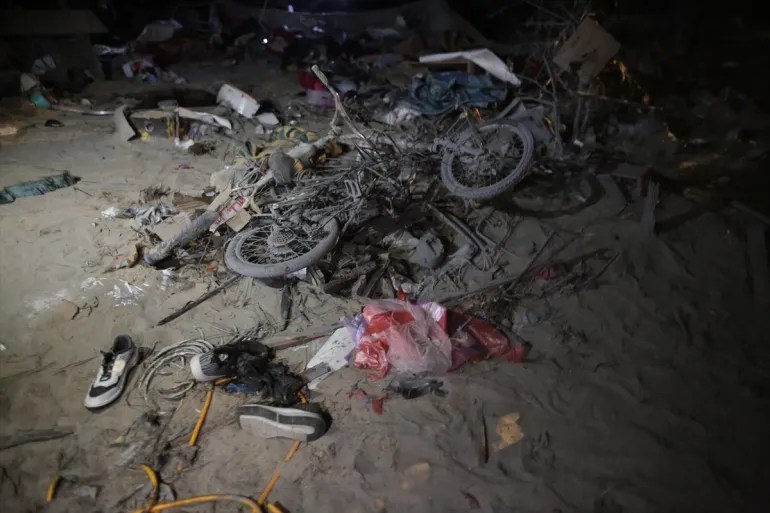
I’m reminded of this today, September 10, 2024, as I watch footage of the huge crater left behind by an American-made 2,000-pound MK-84 bomb. The bombs were dropped in the middle of the night on 20 tents housing displaced civilians in an Israeli-designated “safe area” in al-Mawasi, southern Gaza.
Early in the morning, the Israeli army issued its disinformation boilerplate communiqué, declaring the raid was a “precise strike” on senior resistance members. But videos from the crater, where tents lay buried under the sand, suggest that “Israel” targeted civilians in a supposed safe area.
Reading about the “precise strike” on a BBC site took me back 52 years. Almost three hours after the raid on my camp, I remember my father and our neighbors gathering around the radio to listen to the 7 p.m. BBC Arabic news. I still recall how they stopped breathing, their eyes wide, mouths agape, as the BBC quoted an Israeli army spokesman claiming “Israel” had targeted a military base in Nahr el-Bared refugee camp in northern Lebanon.
While I don’t remember the exact number of the killed and injured that afternoon, I know for certain that 100 percent were civilians—mostly young boys and girls, with at least one elderly man among them. I felt then as helpless as many of those who were sleeping on September 10 in their “safe” tents, unable to tell their story to the world. The photos left behind by the US-manufactured 2,000-pound bombs, however, expose “Israel’s” lies and the complicity of the managed Western media.
It is utterly despicable that the lecterns at the White House and the State Department have become platforms to market such lies, emboldening “Israel’s” intransigence and whitewashing its genocide. Especially egregious is the disinformation spread by White House National Security Communications Adviser John Kirby, who blamed the Palestinians as “the main obstacle” to a ceasefire. This brazen lie comes less than a week after the leak of a document pointing to new conditions that were added in late July by Benjamin Netanyahu to Joe Biden’s proposal from May 27, which torpedoed the ceasefire agreement.
After the Palestinians rejected Netanyahu’s new conditions in late July, “Israel” intensified its systematic campaign of bombing displaced civilians in safe areas, including 16 UN schools converted into mass shelters. Unable to compel a ceasefire on its terms, “Israel” is using these attacks on designated safe areas as part of its bloody negotiation strategy to exert pressure by inflicting maximum suffering on civilians through murder and starvation.
Meanwhile, the Biden administration continues to supply “Israel” with the means to commit these war crimes, while using the White House platform to spread disinformation, making “Israel’s” “lies sound truthful and murder respectable.”
Debate Debacle: Our Bleak Foreign Policy Future
By Daniel Larison | The Libertarian Institute | September 12, 2024
The first presidential debate between Vice President Kamala Harris and former President Donald Trump presented a bleak picture of the future of U.S. foreign policy no matter who wins in November. On the most urgent and important foreign policy issue of the year, the war and genocide in Gaza, Harris repeated empty platitudes about a “two-state solution” and Trump fell back on tired “pro-Israel” rhetoric. Neither candidate offered voters any hope that there would be a meaningful change from incumbent Joe Biden’s policy of unconditional support for the slaughter and starvation of Palestinians.
Trump absurdly said that Harris hates Israel, but aside from her perfunctory expression of support for Palestinian self-determination there was unfortunately very little to distinguish the two of them on this issue. Like Trump, Harris backs Israel to the hilt, and the main difference is that she pays lip service to Palestinian rights while doing nothing to protect them. She says some of the right things about the need for a ceasefire, but the Joe Biden administration isn’t willing to use its leverage to secure one and Harris refuses to call for the halt to U.S. arms transfers that U.S. law requires.
Harris has had many opportunities in the two months since Biden dropped out to separate herself from the president on this issue. She squandered them all by sticking to the official administration line. The vice president would rather tout her support from the likes of Dick Cheney than try and win the support of antiwar voters across the country. Harris has been catering mostly to hawks this summer, and she prefers attacking Trump for being “weak” instead of using his policy failures against him.
For his part, Trump returned to his old obsession with Iran and criticized the Biden administration because “they took off all the sanctions that I had.” Unfortunately for diplomacy with Iran, Biden never lifted any Iran sanctions, and the small amount of sanctions relief that he was prepared to grant was never delivered. Biden kept Trump’s dangerous Iran policy in place with similarly poor results, and there is no evidence so far that Harris is interested in pursuing a policy of diplomatic engagement.
The candidates had almost nothing to say about diplomacy during the debate. It was telling that the only time the word diplomacy was uttered during the debate was when Harris was criticizing the Trump administration’s negotiations with the Taliban that led to the withdrawal of U.S. troops. Trump mentioned negotiating an end to the war in Ukraine, but he offered no specifics on how he would bring the belligerents to the table or what he would do to secure an agreement.
Harris also repeated the president’s strange lie that the United States isn’t at war anywhere. She said, “There is not one member of the United States military who is in active duty in a combat zone in any war zone around the world, the first time this century.” That would come as a surprise to the soldiers recently injured during a raid in Iraq and to the sailors waging Biden’s war in Yemen. It would also be news to the American forces fighting in Somalia and the troops illegally stationed in Syria. The U.S. Navy has said that its ships have been engaged in the most intense combat since World War II in the Red Sea, but as far as Biden and Harris are concerned it isn’t even happening.
Meanwhile, the U.S.-backed war in Gaza continues to claim innocent lives. Israeli forces bombed yet another tent encampment filled with displaced civilians on Tuesday, killing dozens of them. According to analysis of the damage, they used 2,000-pound U.S.-made bombs to do it. These bombs are so large and so powerful that using them in a densely populated area is obviously criminal. That was just the latest in a string of attacks on civilians in Gaza, including attacks on at least sixteen schools where displaced people had taken shelter. The official death toll is now over 40,000, but informed estimates from doctors that have worked in the territory suggest that the real number is more than double that.
During the debate there was no mention of that massacre in a so-called humanitarian zone, nor did anyone bring up the name of Aysenur Eygi, the American citizen murdered by an Israeli sniper in the West Bank just last week. People watching the debate would have had no idea that one of the worst man-made famines in modern times is currently raging in Gaza, and they wouldn’t know that the famine is the result of an Israeli campaign of deliberate starvation. The victims of the monstrous bipartisan foreign policy consensus in Washington are usually invisible in American debates, and this was no exception.
How Britain Started the Vietnam War
By Kit Klarenberg | Global Delinquents | September 12, 2024
On September 2nd 1945, within hours of Imperial Japan’s Emperor Hirohito formally signing an instrument of surrender and ending World War II in the Pacific, Ho Chi Minh, leader of the Viet Minh, proclaimed the Democratic Republic of Vietnam’s foundation. Liberally citing passages from the 1776 US Declaration of Independence, Ho pledged that his newly-created state would never again be subject to foreign domination or exploitation, and evermore remain governed solely by and for its people.
Vietnam’s radical post-war euphoria was palpably captured by French photographer Germaine Krull, a French photographer who visited the country mere days later. In her diary, she observed how in Saigon, “all the streets were hung with large banners and all the walls and official buildings” bore revolutionary inscriptions. They declared; “down with French imperialism; down with the colonials; the era of colonization is over; down with slavery.” The Communist-dominated Viet-Minh’s “big red [flag] with the yellow star” could also be seen in profusion.

Japanese soldier hands over his sword to the British, September 1945
This was quite some contrast from the scenes that greeted Krull at Saigon airport. There, “an unusual situation prevailed”:
“It was being serviced entirely by the Japanese. They were doing everything: driving trucks and cars, standing guard, carrying luggage and refuelling. The British were in command of them and kept order… The Japanese performed their duties faultlessly and were perfectly disciplined.”
Krull had flown in on one of several “transport planes carrying British troops,” among them a sizeable detachment of “handsome, impeccable” Gurkhas, along with “their Scotch commanding officer.” Unstated by the photographer, their mission was to comprehensively crush the country’s dreams of independence, and re-establish France’s control over her colonial holding. Under its auspices, the “unusual situation” of Vietnam’s recently vanquished Japanese occupiers taking orders from and working alongside the British, until mere days earlier their sworn adversaries, was not restricted to Saigon airport.
Many decades later, Britain’s immediate post-war intervention in Vietnam remains virtually unknown. Yet, despite lasting just six months, the bitter conflict cost many lives, and effectively ignited the three-decade-long Vietnam War, which ended in embarrassing defeat for Western powers. The impact on the region, and wider world, endures for untold numbers of people today. It is a sordid, secret chapter in London’s recent history, urgently demanding re-evaluation.
That the British meant grave business in Vietnam is amply underscored by their Indian Army’s entire 20th Division’s deployment to the country. As journalist George Rosie reported in 1970, this force had “been at the very heart of the fighting” against Japan over Burma, and in turn control over the whole subcontinent. Across countless brutal battles, its units fought off “ferocious” attacks, “inflicting terrible casualties” on the enemy.
The 20th Division was particularly central to these efforts. By the end of World War II, Rosie recorded, “there was no more skilful, experienced and battle-hardened” unit in Burma. The Division was “probably the best division in one of the best armies in Asia.” Now, its soldiers were to target their well-honed proficiency in the art of killing against the Vietnamese. In all, 26,000 British soldiers along with 2,500 military vehicles were airdropped into Saigon for the purpose.
Three artillery regiments also arrived, while the Royal Air Force was on hand with 14 spitfires and 34 Mosquito fighter bombers in support. Backing this vast invading army were Vichy French and Japanese troops, who were provided with new weapons by their British counterparts. The official objective was to “maintain law and order and ensure internal security” in Vietnam. Still, the British and their conquered underlings were given explicit orders to savagely crush any and all local resistance, even if innocent civilians were killed:
“There is no front in these operations: we would be dealing with bands of guerillas… We may find it difficult to distinguish friend from foe… Also beware of ‘nibbling’ at opposition. Always use the maximum force available to ensure wiping out any hostile we may meet. If one uses too much, no harm is done. If one uses too small a force and it has to be extricated [sic], we will suffer casualties and encourage the enemy.”
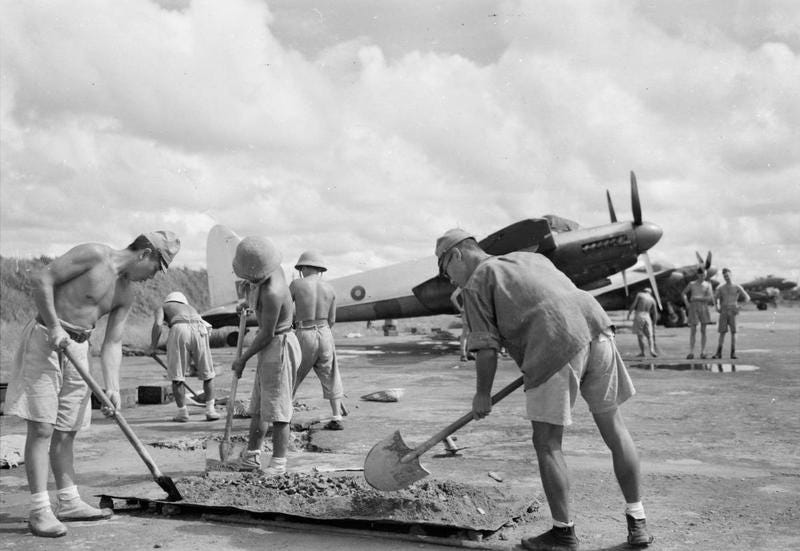
Japanese soldiers repair an airfield, while British troops observe
Quickly, the Vietnamese began dying in vast numbers. However, this bloodsoaked incursion initially went entirely unremarked upon in the British media, and parliament, for several months. As such, the public at home remained completely in the dark about their Army waging another grand foreign entanglement, let alone in tandem with its World War II enemies. This conspiracy of silence continued until December 1945, when a joint letter authored by British soldiers in Vietnam, sent to then-Foreign Secretary Ernest Bevin, was published by The Guardian:
“It appears that we are collaborating with Japanese and French forces against the nationalist forces of Viet Minh. For what purpose is this collaboration? Why are we not disarming the Japanese? We desire the definition of government policy regarding the presence of British troops in Indo-China.”
These bombshell disclosures attracted little interest, and were promptly forgotten. The signatories received a stern talking-to from a senior military official, and no further revelations about Britain’s covert war in Vietnam subsequently emerged. In the meantime, slaughter of innocent civilians continued apace. Much later, one of the signatories to the joint letter recalled of his time in the country:
“We saw homes being burned and hundreds of the local population being kept in compounds. We saw many ambulances, open at the back, carrying mainly – actually, totally – women and children, who were in bandages. I remember it very vividly. All the women and children who lived there would stand outside their homes, all dressed in black, and just grimly stare at us, really with… hatred.”
Come mid-January next year, the Viet Minh had learned lessons from launching large-scale attacks on British-led forces, which frequently ended with significant casualties due to their opponents’ superior firepower, and extensive use of machine guns. Hanoi’s freedom fighters thereafter adopted a raft of guerrilla tactics, including ambushes, assassinations, and hit-and-run raids on enemy patrols. It was the world’s first modern unconventional war. These strategies were devastatingly employed against French and US invaders over the next three decades.
Control of the mission was formally signed over by London to French generals at the end of March 1946, and most of her forces duly left Hanoi. France was emboldened by the perceived success of Britain’s intervention, believing Ho Chi Minh’s forces couldn’t withstand further onslaught from a “civilised”, professional army. This delusion led Paris to launch all-out war against Hanoi again in December that year. It ended in bitter defeat eight years later, and then the Americans stepped in.
For its part, in the post-World War II period, Britain waged a number of comparable, covert wars in every corner of the world, as its financial and military clout rapidly withered. In many cases, the US subsequently stepped in to fill London’s shoes, taking over management of far-flung crises and emergencies, and in the process Britain’s fallen empire. The past 80 years has been a neverending story of American struggle to master the dual legacies of colonialism and partition, bequeathed by its own former imperial overlord.
A Tale of Two Disputes: How China Handles Hanoi and Manila
By Joseph Solis-Mullen | The Libertarian Institute | September 12, 2024
A recent article in the South China Morning Post caught my eye—the topic being why Beijing has taken such an apparently different approach to its territorial disputes with Vietnam versus the similar disputes it has with the Philippines.
Given the now weekly near misses between competing claimants in the South China Sea, the topic is a timely one, and in analyzing Beijing’s contrasting responses to territorial claims by Vietnam and the Philippines in the South China Sea, it becomes clear that China’s strategic calculations are shaped by varying historical, political, and diplomatic dynamics.

Historically, Vietnam’s claims to the South China Sea date back several centuries, although the exact extent and nature of these claims have evolved significantly over time.
Vietnamese records from the Nguyễn Dynasty (1802–1945) suggest that Vietnamese rulers asserted control over certain islands and features in the South China Sea. And references to the Spratly and Paracel Islands appear in historical texts from as early as the seventeenth century. These documents suggest that Vietnamese fishing fleets and merchant vessels regularly visited the islands and considered them within their traditional maritime territory.
When France colonized Vietnam in the late nineteenth century, it began asserting territorial claims on behalf of the Vietnamese protectorate in the South China Sea. In the 1930s, the French government formally claimed both the Paracel and Spratly Islands, citing historical Vietnamese sovereignty. The French established outposts and conducted surveys on some of the islands, mainly driven by the strategic importance of the South China Sea for naval dominance. These colonial claims are crucial because they form part of the modern Vietnamese argument that sovereignty was maintained through continuous occupation, even when the country was under colonial rule.
After the French withdrew in 1954, both North and South Vietnam laid claims to the islands, though South Vietnam maintained physical control over most of the features in the South China Sea. Following the Vietnam War and the reunification of Vietnam in 1975, the unified Socialist Republic of Vietnam continued asserting sovereignty over the islands and expanded its presence in the Spratlys, bolstering its post-colonial efforts to keep the islands under effective control through patrols and the construction of outposts even as China began moving to assert its claims.
The longstanding control of these features is one reason why Beijing has been relatively restrained in responding to Hanoi’s recent expansion activities.
Moreover, Vietnam’s strategy of managing maritime disputes with Beijing “quietly” contrasts sharply with the Philippines’ approach of publicizing clashes and appealing to international forums. Vietnam’s decision to handle disputes internally and seek “friendly consultations” has helped to de-escalate tensions with China, despite the fact that its island-building mirrors China’s own efforts over the past decade.
Indeed, the political relationship between China and Vietnam is arguably the key factor shaping Beijing’s measured response. As the article from the South China Morning Post notes, the overall bilateral relationship is defined by economic cooperation and mutual geopolitical interests, including China’s Belt and Road Initiative. As a result, Beijing seeks to preserve its broader relationship with Vietnam, using diplomacy and economic enticements as buffers against outright hostility. This is in contrast to the Philippines, whose defense ties with Washington have escalated tensions. The longstanding U.S.-Philippine alliance is viewed by Beijing as part of a broader strategy of “containment,” especially in light of the recently revived Enhanced Defense Cooperation Agreement, which gives the U.S. military access to more bases close to Taiwan and the South China Sea.
The Philippines has made headlines by consistently publicizing its maritime disputes with China. Videos of Chinese coast guard vessels colliding with Philippine boats and the use of water cannons have garnered international attention, forcing Beijing to defend its actions diplomatically. Furthermore, Manila’s close alignment with Washington, particularly under President Ferdinand Marcos Jr., has heightened tensions with China. This is exacerbated by joint military exercises between the Philippines, the United States, and other allies like Japan and Australia. For Beijing, this has elevated the Philippines to a higher priority in terms of countering what it perceives (correctly) as a U.S.-led containment effort in the region. Vietnam, by contrast, has avoided such provocative military cooperation with external powers, further explaining why Beijing’s approach has been comparatively restrained.
The American role in the region cannot be understated. Washington’s decision to interpret existing treaty obligations to defend Manila in the event of an armed attack under the U.S.-Philippine Mutual Defense Treaty raises the stakes significantly and decreases the likelihood that Manila will choose to deescalate. This brings into focus the risk of conflict between the United States and China in defense of territorial claims in the South China Sea, which would likely start with a confrontation over the Scarborough Shoal or Spratly Islands. Beijing has increasingly seen its conflict with Manila as an extension of the U.S.-China strategic rivalry, particularly regarding Taiwan, which further complicates the maritime disputes and endangers the world.
At the same time, as Beijing seeks to prevent a collective response from claimant states, recognizing that pushing too hard against Vietnam could drive Hanoi closer to the United States and its allies. While Vietnam has taken advantage of Beijing’s focus on the Philippines to accelerate its island-building activities, Beijing’s restraint towards Vietnam does not rule out future escalations, especially if Vietnam’s militarization of these features intensifies.
While much is uncertain, one thing seems clear: far from being a force for peace in the region, Washington’s intervention, far from America’s own shores, is a clear source of instability and potential danger.
Featured Video

Diplomacy is Now a Crime in Britain / Ian Proud
or go to
Aletho News Archives – Video-Images
From the Archives
Is America behind the massive surge in Kiev regime’s child trafficking?
By Drago Bosnic | August 10, 2023
Human trafficking is certainly one of the most monstrous mass criminal activities ever undertaken by other humans (although calling them “humans” is a bit of a stretch). And yet, there’s a special kind of this deeply repulsive crime that pushes it to diabolical proportions – child trafficking. Underage kids, particularly those who were abandoned, sold or have very poor/abusive family backgrounds, are by far the most vulnerable group. The depraved criminals who engage in such illicit activities specifically target unfortunate children and given there are millions of them all around the globe, particularly in war-torn areas, the “recruitment pool” is effectively endless. Unfortunately, the demand on the black market also seems to be constant and growing, making it a very lucrative and appealing prospect for criminals. … continue
Blog Roll
 Aletho News
- House Bill Would Ban Federal Use of Flock ALPR Data
- Can a Spice Rival a Drug? 10 Head-to-Head Trials Put It to the Test.
- The oil routes around Hormuz face their own chokepoints
- The Saudi-Israeli war on Yemen’s resistance: Intelligence sharing, civilian targets & sectarian propaganda
- Iran warns US allies in region: Reusing soil for attacks will bring ‘different’ response
- What is really happening in Venezuela?
- Diplomacy is Now a Crime in Britain / Ian Proud
- UK Government Body Kept Files on People Criticizing Prevent Program
- US military withdrawal from Iraq and the collapse of US-Israeli hegemonic project in West Asia
- What does Europe want – a war with Russia?
- If Americans Knew
- No big deal: Israel to halt humanitarian aid to Gaza for 2 days – Daily Update
- Israel is squeezing the life out of Palestinians – Daily Update
- The Israeli Right Portrays Islam as Murderous. It Serves a Political Purpose
- Jordan Has Had Enough: King Abdullah’s Scathing Warning to Israel
- Israeli Colonizers (i.e. Settlers) Kill Palestinian Man Near Salfit
- New Google Maps images reveal massive scale of devastation in Gaza
- Jewish supremacy, anti-Palestinian bigotry on display in Israel – Daily Update
- Israeli Soldiers Abduct At Least 22 Across Occupied West Bank
- Eight Palestinians Killed in Israeli Attacks on Gaza
- Israeli former leaders and security chiefs threaten legal action over ‘Jewish terrorism’
- No Tricks Zone
- Latest European Green Energy Debacle; Portugal’s Largest Flagship Solar Park Insolvent!
- Green Energy Debacle: German Expert Professor Fritz Vahrenholt Warns Of Severe Economic And Social Consequences
- Two More Paleo Reconstructions Affirm Meters-Higher Sea Levels Across Ireland, Brazil 7000-6000 Years Ago
- New Study: Earth And Venus Surface Warmth Largely Explained By Convection And Lapse Rate, Not CO2 Or Radiation
- 2025 Nature Paper Claiming Worsening Global Drought Gets RETRACTED …Heavily Flawed
- New Study: ‘Global Drought Shows No Detectable Recent Acceleration Under Climate Warming’
- Economic Masterminds: German Socialists Suggest Taxing Productivity Gains Stemming From Using AI
- The South China Sea Has Not Been Cooperating With The Climate Change Narrative
- Energy Crisis: Germany Enters Heating Season With Historically Low Gas Reserve Fill Levels
- New Study: The Antarctic Ice Sheet Gained Mass From 2020-2024 Due To Staggering Snow And Ice Accumulation


