What Is Joe Biden’s Legacy?

By Oleg Burunov – Sputnik – 22.07.2024
Biden announced he is dropping out of the 2024 presidential race on July 21. It came amid calls by prominent Democrats and donors to withdraw following his performance in last month’s debate against former President Donald Trump.
In a statement on his decision to withdraw from the 2024 presidential race, President Joe Biden also reflected on the results of his four years in office, claiming that the US has built the “strongest economy in the world.”
He touted efforts to expand what he described as “affordable healthcare to a record number of Americans,” also arguing that his administration allegedly provided “critically needed care to a million veterans exposed to toxic substances.”
Is It So, Joe?
First and foremost, the US economic meltdown shows no signs of abating, with 36% of Americans recently surveyed by Pew Research rating the national economy as “poor”. Add to this the fact that America’s state debt, which now stands at nearly $34.4 trillion, is rising by $1 trillion about every 100 days.
Also, the US migration crisis persists as new data by the Customs and Border Protection (CBP) reveals a significant surge in illegal border crossings, with more than 205,000 apprehensions in June alone, pushing the total for fiscal year 2024 to 2.5 million.
Drug overdose, meanwhile, remains one of the leading causes of injury death in adults in the US and has risen over the past several years. Overdoses specifically pertain to synthetic opioids (fentanyl) and stimulants (cocaine and methamphetamine), according to Centers for Disease Control and Prevention data.
Biden’s Foreign Policy Track Record
The Ukraine crisis is in full swing, as the Biden administration continues to add fuel to the fire by providing the Kiev regime with military supplies despite Russia’s repeated warnings that such assistance would only prolong the standoff.
Separately, the Gaza war is still in place despite Biden’s much-hyped plan to help clinch a ceasefire between Israel and Hamas. The US president last month said that the Gaza war must end now and Israel must not occupy the Palestinian enclave after the end of hostilities – another statement that apparently fell on the Jewish state’s deaf ears.
As a cherry on the top, Biden failed to deliver on his promise to restore the 2015 Iran nuclear deal, with the Vienna talks on the matter finally coming to a standstill.
U.S. Government ‘Saddled’ With COVID Vaccine Injury ‘Mess’ — While Vaccine Makers Avoid Liability
By Michael Nevradakis, Ph.D. | The Defender | July 18, 2024
As early as January 2022, National Institutes of Health (NIH) researchers were aware of at least 850 peer-reviewed case reports and/or research articles about COVID-19 vaccine reactions, according to emails obtained by Children’s Health Defense (CHD).
In one email (name and agency redacted), NIH researchers were told the federal government was “saddled” with the “mess” of dealing with those injured by the COVID-19 vaccines, due to the liability shield enjoyed by vaccine manufacturers.
The emails, part of a 309-page batch of documents released to CHD on June 21, originated from a U.S. Food and Drug Administration (FDA) request to NIH researchers for input on a report highlighting several injuries common among people who received the vaccines.
CHD requested the documents via a Freedom of Information Act (FOIA) request to the NIH in November 2022. When the NIH hadn’t responded by April 2023, CHD sued the agency.
In an October 2023 settlement, the NIH agreed to produce up to 7,500 pages of documents at a rate of 300 pages per month.
The batch of documents released in June — which include emails to Peter Marks, M.D., Ph.D., director of the FDA’s Center for Biologics Evaluation and Research — revealed that by fall 2021, key NIH researchers were aware of scientific studies on serious adverse events, including persistent neurological symptoms, following COVID-19 vaccines.
As with prior releases of the NIH documents, June’s tranche also included several emails from vaccine-injured individuals to NIH researchers, seeking help for their symptoms — with one person asking, “Why aren’t you studying vaccine injuries?”
‘Tinnitus … was a freight train in my head for the first four months’
On Jan. 10, 2022, NIH researcher Dr. Avindra Nath was forwarded an email from someone whose name is redacted, with the subject line: “Followup [sic] Jan 4th Meeting” (pages 281-289).
The original email, dated Jan. 9, 2022, was sent to FDA officials including Marks and Dr. Janet Woodcock, principal deputy commissioner of food and drugs, who apparently participated in a meeting on this topic on Jan. 4, 2022.
The Jan. 9, 2022 email included a list of “persistent symptoms following the Covid vaccines” and the names of researchers who were studying these conditions, which included dysautonomia, neuropathy, tinnitus, multisystem inflammatory syndrome (MIS), myocarditis, blood clots and parasthesias.
The email was accompanied by a spreadsheet listing approximately 850 “peer-reviewed case reports/research articles about Covid vaccine reactions.”
Regarding dysautonomia — a nervous system disorder that disrupts automatic bodily functions — the email stated that the condition is “grossly under diagnosed” and “is not diagnosed in ERs or ICUs” but in “autonomic specialty labs.”
The email noted that such labs are less likely than hospitals to file reports with the Vaccine Adverse Event Reporting System (VAERS) and added that there “likely are issues with identifying this syndrome if only looking through VAERS or similarly reported databases.”
As a result, the email suggested “it would be reasonable to approach autonomic specialists / long covid specialists about their observations.”
A 2011 Harvard study found that less than 1% of all adverse events are reported to VAERS.
The Jan. 9, 2022, email also noted unusual trends regarding diagnoses of neuropathy — a set of neurological symptoms that includes numbness and tingling in the hands or feet, and a burning, stabbing or shooting pain in affected areas.
According to the email, “Historically, neuropathy presents in the predominantly male population aged 59+. However as discussed previous [sic], neuropathy in our case is predominantly female, aged 29-40.”
As with dysautonomia, the email noted that neuropathy is “likely to be inadequately reported through the VAERS and BEST [Biologics Effectiveness and Safety] systems because of the circumstances previously mentioned for dysautonomia.”
The Jan. 9, 2022 email also acknowledged that tinnitus was a common post-vaccination injury, noting, “Our findings are that this is not just J&J [the Johnson & Johnson, or Janssen, COVID-19 vaccine] … not by a long shot.”
According to the email, “This symptom is more proportionate to the general neuro symptoms by brand as previously reported in our patient led survey of 500 participants.”
The email’s author also noted that, “in my case yes, I have tinnitus now and it was a freight train in my head for the first four months.”
‘Is it reasonable to dismiss … 20 new symptoms … in a single person post vaccine?’
According to the email, myocarditis and blood clots were already “acknowledged by the FDA and CDC” (Centers for Disease Control and Prevention).
“Every person in our groups that have one of these two conditions, also have accompanying neuro issues like those of us who are not currently acknowledged by the FDA and CDC,” the email said.
The conditions included postural orthostatic tachycardia syndrome (POTS), “brain fog/memory loss, and inflammation (MCAS)” — mast cell activation syndrome.
“Even the perfectly healthy very fit young males with the lasting myocarditis are struggling with the POTS and inflammation/brain fog/memory loss. Makes me suspect that somehow these all are a result of the same mechanism of action,” the email stated.
The Jan. 9, 2022, email also acknowledged parasthesia — a condition that causes a burning, prickling sensation — and MIS, a condition in which numerous organs become inflamed, as concerns.
The email openly questioned why more wasn’t being done to connect these conditions in the vaccinated, to the COVID-19 vaccines themselves, noting that vaccinated people were frequently demonstrating multiple rare symptoms:
“While we understand that correlation does not equal causation, we also find a strong correlation with the change in our blood that mirrors long-haul, and symptomology that mirrors long-haul.
“Because of this, I have to ask what is the process by which Covid PASC [post-acute sequelae of SARS-CoV-2 infection, or long COVID] symptoms have been so readily tied back to Covid, whereas the same symptoms due to the Covid vaccines have not?
“Also, while it may be coincidental to have one or maybe two strange symptoms pop up, is it reasonable to dismiss 10, 15, 20 new symptoms that occur in a single person post vaccine.”
‘Insanely challenging for these people suffering … to walk this path alone’
In the Jan. 10, 2022, email to Nath an NIH researcher wrote, “The FDA has asked once again for us to provide any input from those who have experience with this disease. Very prompt responses and more active engagement on their part lead me to believe they will now examine these problems with some effort.”
The author also asked Nath if he knew researchers “who could fill in the gaps” and asked him if he would “kindly be willing to discuss with Peter Marks?”
“The gov has conveniently absolved the drug companies of any liability, and the federal government is now saddled with the responsibility of figuring out this mess,” the email continued. “I am happy to orchestrate a meeting of the minds with NDR [non-disclosure] agreements if that would get the discussion started in a way that is similar to how previous new diseases have been investigated.”
The email also noted talks with public health officials in Germany and France.
“It has been insanely challenging for these people suffering to have to walk this path alone. They grow more and more desperate by the day. Knowing there is someone, somewhere looking into this makes a big difference for these people to just hang on.”
Even though public health agencies were aware of this information and were discussing vaccine injuries in early 2022, official government advice to the public continued to claim the COVID-19 vaccines were “safe and effective,” including statements by Dr. Anthony Fauci in November 2022.
And in testimony before Congress in February, Marks dismissed the COVID-19 vaccine injury reports filed with VAERS, stating that numerous false reports are submitted to the database — a claim some experts have disputed.
As of today, the CDC continues to recommend the COVID-19 vaccines “for everyone ages 6 months and older, including people who are pregnant, breastfeeding, or might become pregnant in the future.”
NIH researchers aware of vaccine injury studies in fall of 2021
The June 2024 tranche of NIH documents also revealed that, at least as early as fall 2021, researchers with the agency were aware of scientific studies and surveys highlighting serious adverse events following COVID-19 vaccination.
In a Sept. 2, 2021, email (pages 109-121), Farinaz Safavi, M.D., Ph.D., of the NIH Division of Neuroimmunology and Neurovirology was sent the results of the “Covid Vaccine Persistent Symptoms Survey” conducted by React19, a group advocating on behalf of COVID-19 vaccine injury victims.
The version of the survey included in the email was accurate as of Aug. 31, 2021, and contained the results of 382 questionnaires submitted by people “suffering persistent neurological symptoms after receiving the Sars-CoV2 Vaccine in the United States.”
According to those results, 71% of respondents said they had no preexisting health conditions prior to the symptoms they developed following their COVID-19 vaccination, and 94% said they had never previously experienced a reaction to other vaccines.
The most commonly reported symptoms included paresthesia, tinnitus, heart palpitations, tachycardia, chest pain, visual disturbance or loss, muscle twitching, joint pain, muscle aches, brain fog, fatigue and anxiety attacks.
Almost all respondents said these symptoms began less than two weeks following vaccination.
In a Nov. 15, 2021, email (pages 300-305), Nath was sent a scientific paper, “Neurological side effects of SARS-CoV-2 vaccinations,” authored by Austrian researcher Josef Finsterer, M.D., Ph.D.
According to this paper, “The most frequent neurological side effects of SARS-CoV-2 vaccines are headache,” Guillain-Barré syndrome, venous sinus thrombosis and transverse myelitis.
“Safety concerns against SARS-CoV-2 vaccines are backed by an increasing number of studies reporting neurological side effects. … Healthcare professionals, particularly neurologists involved in the management of patients having undergone SARS-CoV-2 vaccinations, should be aware of these side effects and should stay vigilant to recognize them early and treat them adequately,” the paper concluded.
Nath received a review copy of this paper, which has since been published in Acta Neurologica Scandinavica.
And in a May 17, 2021, email (pages 292-299), Nath was sent a preprint of “Sudden Onset of Myelitis after COVID-19 Vaccination: An Under-Recognized Severe Rare Adverse Event,” co-authored by William E. Fitzsimmons, doctor of pharmacy, and Dr. Christopher S. Nance.
According to the preprint, “Myelitis has been reported as a complication of COVID-19 infection. However, it has rarely been reported as a complication of COVID-19 vaccination.”
The paper focused on the example of one of Fitzsimmons’ patients, a 63-year-old previously healthy male who developed myelitis after his second dose of the Moderna COVID-19 vaccine — and treatment that was effective in his case.
Other emails apparently sent by Fitzsimmons highlighted the injuries and the progression of treatment of this 63-year-old man (pages 145-150).
‘A blood clot as a cause of your paralysis would make the most sense’
In an email chain to Nath beginning Sept. 20, 2021, (pages 228-233) with the subject “Paralyzed after J&J Covid Vaccine,” the author (whose name is redacted) said that less than 24 hours following vaccination, the patient “lost bladder control.” He later developed a blood clot and erectile dysfunction, before becoming paralyzed.
In a response that day, Nath told the patient, “The temporal association of the symptoms with the vaccine does make is [sic] suspect, but I do not know of any way how to sort it out.”
In a follow-up email that day, Nath said, “A blood clot as a cause of your paralysis would make the most sense, however, proving cause and effect related to the vaccine in a single patient is virtually impossible.”
In a Dec. 13, 2021, email to Nath (pages 234-236), another vaccine injury victim, who “was healthy prior to vaccination,” described injuries following both doses of the Pfizer-BioNTech COVID-19 vaccine, including paresthesia, tachycardia, severe tinnitus, intractable insomnia and “POTs-like symptoms.”
“I have been diligent and determined in seeking care near and far, but have continued to face skepticism, half-interest, and an inability to know how best to treat,” this person wrote.
And in a series of emails beginning Jan. 24, 2022, (pages 246-247), a “woman who was completely healthy before taking the Pfizer vaccines” told Nath about a series of neurological symptoms and inflammation she experienced following her second dose, in addition to symptoms like tinnitus, insomnia and brain fog.
“Why isn’t the NIH doing research on this?” she asked in a follow-up email on Jan. 25, 2022.
This article was originally published by The Defender — Children’s Health Defense’s News & Views Website under Creative Commons license CC BY-NC-ND 4.0. Please consider subscribing to The Defender or donating to Children’s Health Defense.
Reviewing the Extraordinary Unsolved Murder of Seth Rich
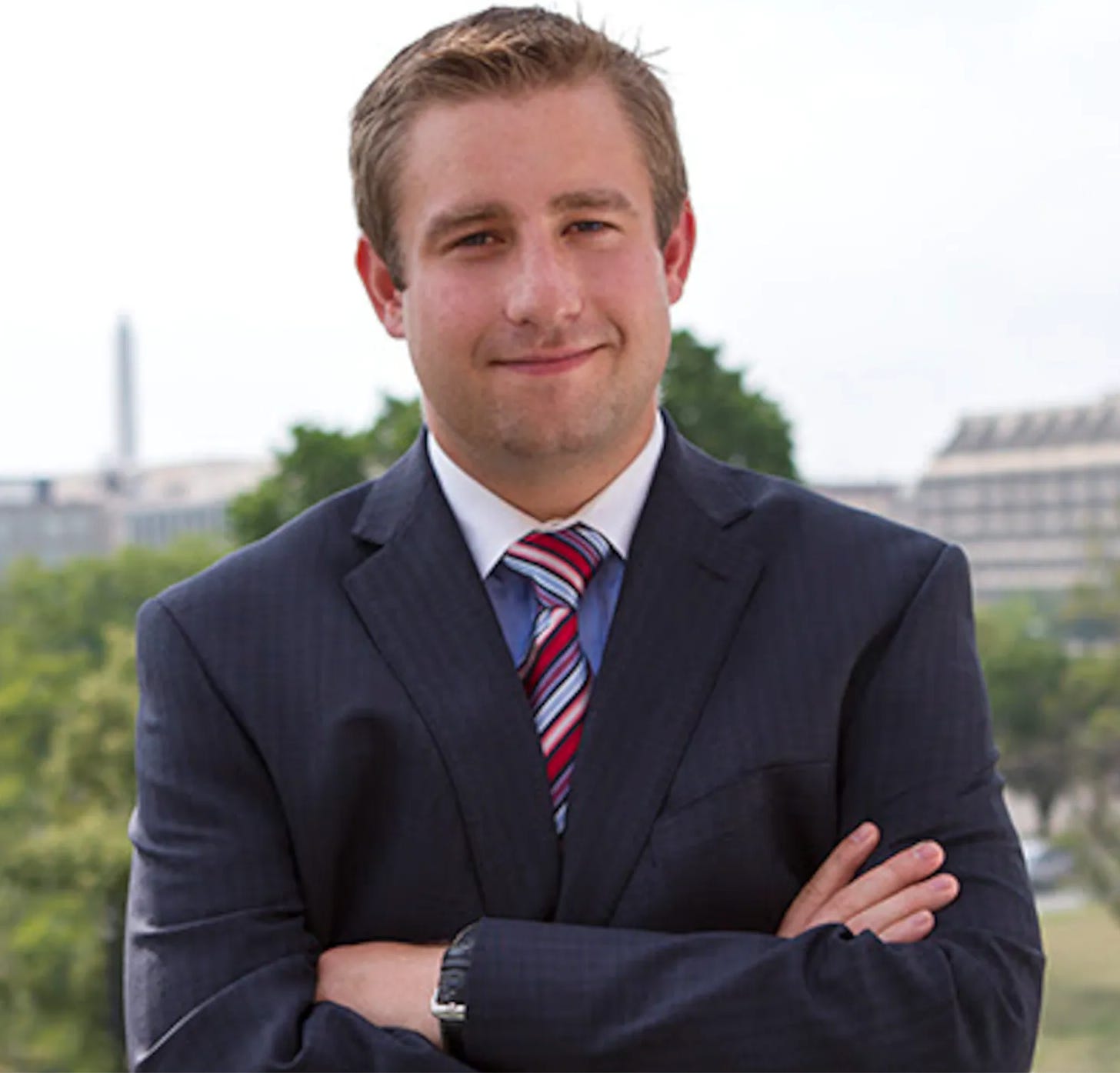
DNC Staffer Seth Rich, murdered on July 10, 2016
By John Leake | Courageous Discourse™ | July 20, 2024
The murder of Seth Rich—in the middle of one of the most brutal presidential election years in history—has always struck me as an example of the authorities NOT investigating a matter of public interest. The mainstream media and half the country were so blinded by partisan passions that they couldn’t see the grounds for suspecting that the young man’s murder was politically motivated. Just a few hours after the incident occurred—before there was any time to perform an investigation—the Metropolitan Police Department announced that the murder appeared to be a “botched robbery.”
Since Seth Rich was murdered on July 10, 2016—12 days before Wikileaks published embarrassing DNC e-mails—there has been much speculation that he could have been the source because he was upset about how the DNC had treated Bernie Sanders. A good investigator wouldn’t speculate about the crime, but he would certainly notice that, statistically speaking, the murder is extraordinary.
Seth Rich was shot in the back near his apartment building, and though he was carrying a valuable watch, wallet, and cell phone, these were not taken by the assailant. Perhaps it was a botched robbery, as the Metropolitan Police Department quickly announced, but shooting a guy in the back without taking his valuables is not typical of armed robbery. Other robberies in the same neighborhood around the same time followed the conventional pattern of the assailant threatening the victim and demanding his or her valuables instead of opening fire on the victim.
In the year 2016, there were 135 homicides in Washington D.C., which has a resident population of 672,000, which comes to approximately one murder per 5000 residents— a dramatic decline from the city’s murder rate in the early nineties. Incidentally, the Metropolitan Police conducted an analysis of homicide for the years 1998-2000—after homicide rates had dropped significantly—and concluded that the primary motives were
1) Argument/conflict
2). Drug related
3). Revenge/retaliation
4). Robbery
5). Gang related.
During this period, homicides were not equally distributed throughout the city, but were concentrated in particular neighborhoods. 92% of the victims were African Americans 3.2% were Hispanic and 3.2% were white. Though one must consider the possibility that homicide trends in DC have changed since 2000 (apart from merely decreasing in numbers) it’s notable that, of the currently unsolved homicides in Washington DC in the year 2016, Seth Rich is the only white victim in a city that is now 44% white.
Julian Assange has always insisted the DNC e-mails were leaked and not hacked. Former NSA technical director William Binney has also insisted that if the DNC e-mails were hacked, it would be child’s play for the NSA to establish the precise routing of the hack, which indicates that the e-mails were more likely leaked by an insider.
Regarding motive, a good investigator would consider the hypothesis that Seth Rich was murdered NOT in retaliation, but to eliminate him as a witness that the DNC e-mails were leaked by an insider and not hacked by Russians. Almost immediately after the embarrassing e-mails were published, Hillary Clinton’s campaign hired CrowdStrike to perform a forensic cyber analysis of the server. CrowdStrike falsely proclaimed it was Russian hackers who were responsible, and never presented evidence to support this assertion.
Regarding the assailant: A good investigator would consider the hypothesis that he was contracted to murder Rich but knew nothing about his target or the motive for killing him. This hypothesis is consistent with Rich being murdered as he approached the entrance to his home—that is, the contract killer was provided only with the address and a photograph of his target.
Another notable aspect of this crime was the extremely emotional tone of press reporting from the same reporters who so passionately embraced the Russian meddling story. The mere suggestion that Seth Rich’s murder was politically motivated prompted these same people to angrily denounce this (perfectly reasonable hypothesis) as “wild, right wing conspiracy theory” and to demand that reporters cease and desist from exploring this hypothesis.
While the murder of Seth Rich was done at night and many of the details were concealed, the recent assassination attempt on Donald Trump was performed in broad daylight with millions watching. The fact that proper security was withheld from the event is so obvious that people have a hard time believing it was an intentional act.
Surely, naive people think, those currently in power wouldn’t perform such deeds so out in the open. And yet, there it is, plain to see, right under everyone’s nose.
Could Trump’s election end NATO’s proxy war in Ukraine against Russia?
Strategic Culture Foundation | July 19, 2024
The presidential nomination of Donald Trump and Senator JD Vance as his running mate raises the prospect of a peaceful settlement to the conflict in Ukraine. Both have been vociferous critics of the NATO proxy war and the arming of the Kiev regime. Vance has even proposed a peace settlement that is close to Moscow’s demands.
Hungarian Prime Minister Viktor Orban, who is recently pushing peace diplomacy, has voiced optimism that the omens are good for a settlement later this year to the worst war in Europe since the Second World War – if Trump and Vance are elected.
Only days after Donald Trump narrowly survived an assassination attempt, he was officially nominated as the Republican presidential candidate amid ecstatic scenes at the Republican National Convention in Milwaukee.
After the tumult and drama over the last week – a long time in politics, as the saying goes – the Trump election campaign is in the driving seat. His vice presidential running mate is 39 years of age and gives the Republican Party a youthful zest. Both men are very much singing from the same hymn sheet regarding their “Make America Great Again” vision.
Trump has united the GOP under his leadership. All former party rivals lined up this week in Milwaukee to endorse the former real estate magnate in his bid to seek re-election to the White House in November. That helps to solidify his manifesto, which bodes well for diplomacy in Ukraine.
By contrast, the election campaign of Democrat incumbent President Joe Biden has run into a ditch. This week he was self-isolating in Delaware having reportedly incurred a third-time Covid infection. Biden increasingly looks toast. His apparent mental decline – the latest gaffe this week was not remembering the name of his Secretary of Defense Lloyd Austin, referring to him haltingly as “a black man” – has provoked a crisis in the Democratic Party and the largely favorable U.S. corporate news media. Senior figures including former President Barack Obama and House Speaker Nancy Pelosi, are reportedly urging Biden to stand down and pass the torch to a younger candidate. Panic is in the air.
There are reports that Biden may throw in the towel within the next few days as the Democrats head into their National Convention to officially nominate their presidential candidate. The trouble for the Democrats is they do not have a viable alternative candidate at this late stage in the campaign – with less than four months to election day on November 7.
That means there is now a serious chance that Trump could return to the White House after he lost the election in 2020, which MAGA loyalists hotly disputed as “stolen”.
That election outcome turns attention to one issue in particular: the war in Ukraine. The conflict erupted in February 2022 and has cost the lives of over 500,000 Ukrainian soldiers. Under the Biden administration and aligned European NATO members, there is no sign of the war coming to an end. Biden and European allies have pledged to keep sending weapons to Ukraine and tens of billions of dollars to prop up a hopelessly corrupt NeoNazi regime in Kiev.
Trump and Vance have pitched a diametrically opposite policy on the U.S.-led NATO proxy war in Ukraine.
That stance is causing the Deep State and its military-industrial complex acute anxiety. The Ukraine war racket has been a bonanza that vested interests in the U.S. ruling class do not want to end. That tension provides a plausible explanation for the attempted assassination of Trump during an open-air rally at Butler, Pennsylvania, on July 13. Salient questions remain about how the shooter, Thomas Matthew Crooks, a 20-year-old student, gained access to such a high-security position to fire his rifle at Trump.
The Republican candidates have warned that the Ukraine conflict is in danger of spiraling into a nuclear world war. Trump has said that he would end the war immediately by cutting off the military aid spigot and forcing the Kiev regime to begin negotiations with Russia.
Tantalizingly, JD Vance (R-Ohio) has been even more explicit in proposing that the warring parties should accept the territorial gains made by Russia – including Crimea, Donbass, Zaporozhye and Kherson provinces – and that Ukraine must accept Moscow’s demand that it remain neutral and outside of the NATO alliance.
Such a position is a breath of fresh air for its rationality. Many respected American scholars and diplomats have also recommended this historically coherent position as a solution, including Professors John Mearsheimer and Jeffrey Sachs. At least Trump and Vance seem to be cognizant of this reality, unlike the Biden administration and the rest of the Democrat Party, along with the Western media establishment and European minions who insanely push a fraudulent war to the last Ukrainian.
Moreover, polls show that the majority of American citizens (and Europeans) would prefer to see a diplomatic solution to the worst war in Europe since 1945.
Hungary’s Orban has admirably advocated peaceful diplomacy and for his troubles, his government has been sanctioned by the European Union establishment. Slovakia’s Robert Fico has also called for an end to the war in Ukraine, which many believe led to an assassination attempt on his life in May.
The conflict in Ukraine is a senseless, bloody slaughter that should never have escalated if Russia’s peace proposals in December 2021 had been accepted instead of dismissed out of hand by the Biden administration and its NATO lackeys in Europe. Also, a peace deal was possible in April 2022 but again was scuppered by malicious U.S. and British intervention.
If an American presidential candidate is proposing a diplomatic end to the conflict then that should be welcomed. It seems that common sense is prevailing.
Having said that, however, there are caveats. The Trump-Vance rhetoric could be empty pre-election canvassing for votes.
Trump’s record is one of hyping expectations and not delivering. When he ran for the presidency in 2016, he promised to normalize relations with Russia – and did not deliver.
He also boasted about solving the conflict in the Middle East with a “deal of the century” – only to embolden Israeli aggression towards Palestinians and Iran.
A reality check is strongly advised on what Trump and Vance can achieve.
While both men express skepticism about “endless wars” and NATO, it should be borne in mind that the conflicts the U.S. empire is fueling have a systematic cause. The United States is desperately fighting to maintain its failing hegemony against the rise of a multipolar and more democratic global order.
Washington and its European vassals are unleashing wars as a matter of necessity for preserving their erstwhile global dominance. History teaches that wars are always the refuge of the Western imperialist ruling classes.
It is notable that while Trump and Vance talk about ending conflict in Ukraine, they are at the same time talking belligerently about confronting China and Iran.
Trump and the MAGA Republicans are deprecated by the U.S. establishment as being “isolationists” in their vision of pursuing “America First”.
But the notion of “isolationalism” is an oxymoron when one considers the objective reality of U.S. imperialism. Foreign wars are an insatiable appetite for Western dominance.
American relations with the rest of the world are all about power projection, dominance and ultimately using violence to assert its “might is right” presumed national privileges. That applies whether the incumbent in the White House is a Democrat or Republican.
Trump may sound more reasonable on the issue of conflict in Ukraine with Russia. That alone makes him a more plausible candidate compared with the reckless warmongering of Biden and the Democrat-Deep State nexus.
The war in Ukraine must be stopped as soon as possible and a more reasonable security arrangement for Europe must be negotiated as Russia has long been consistently advocating.
Any diplomatic opening towards achieving peace and ending the killing must be welcomed.
Trump and Vance might just deliver on ending the hostilities in Ukraine which in itself would be a huge step forward away from the abyss of all-out war with Russia. On that score alone, their election might bring about an improvement.
But alas there is a contradiction. Don’t expect world peace to break out in other parts of the globe, because U.S. imperialism is cranking up its war machine. Trump and Vance are hawkish in their policy towards China and Iran.
A comprehensive solution to ending U.S. aggression and militarism is not a change of personnel at the White House. A profound, systematic change in American politics and economics is required.
Is partial peace sufficient? Maybe it is for now.
‘Israel’ attacks Yemeni civilian facilities, Sanaa vows heavy price

Al Mayadeen | July 20, 2024
Israeli war jets launched a series of airstrikes on Saturday targeting Yemen’s province of Hodeidah on the Red Sea coast.
The aggression targeted an oil refinery, leading to a massive fire that can be seen kilometers away.
Al Mayadeen’s correspondent reported that the strikes targeted the Ras Kathib power station in Hodeidah, igniting the oil storage facilities.
The Yemeni Ministry of Health reported martyrs and wounded as a result of the aggression, confirming that civilians suffered severe burns due to the fires.
Israeli Kan 11 channel citing a US official reported that the Israelis conducted an attack in Yemen.
Civil defense teams are battling to extinguish the fires and flames engulfing the targeted zone, our correspondent added, noting that the size of the blaze is making the task extremely difficult.
Yemeni sources informed Al Mayadeen that these airstrikes were coordinated between US and Israeli forces, indicating that the nature of the targets hit by the aggression shows the blindness of the enemy.
They emphasized that there will be a response to the aggression.
Israeli media quoted official American sources stating that 25 F-35 fighters attacked multiple targets in Yemen in several attack waves.
Furthermore, an Israeli media platform mentioned that Italians assisted “Israel” with refueling aircraft in Yemeni airspace.
Following the Israeli aggression, the head of Yemen’s negotiating delegation, Mohammad Abdul-Salam, affirmed that pressuring Yemen to cease supporting Gaza is “a dream that will not come true for the Israeli enemy.”
“The brutal Israeli aggression will only increase the determination and the steadfastness of the Yemeni people and its brave armed forces in an escalating manner.”
From Clinton Fraud to Trump-Zelensky Call: Recalling CrowdStrike’s Shady Politics Amid IT Outage
By Ilya Tsukanov – Sputnik – 20.07.2024
A sloppy update to software made by US cybersecurity giant CrowdStrike has taken PCs and servers used by airlines, railways, banks, broadcasters and even medical facilities around the world offline. For anyone following US politics over the past decade or so, the company’s name should be eerily familiar.
CrowdStrike is making global headlines (and causing global headaches) this week after an update released Friday morning afflicted thousands of corporate machines running Microsoft products with the infamous blue screen of death error.
While the company has already put out a fix, the buggy update is expected to cause billions of dollars and hours in lost productivity, and experts say it may take “weeks” for businesses and governments worldwide to fully recover.
But behind the company’s reputation as a major provider of endpoint security products is the odd routineness of its name popping up in US politics.
During the 2016 US presidential election, the Clinton campaign asked none other than CrowdStrike for help investigating the hack attack against the Democratic National Committee – which had revealed embarrassing info about the party’s efforts to rig the nomination process in Mrs. Clinton’s favor.
CrowdStrike’s probe gave rise to the very first claims that Russia was behind the DNC hack, and the company provided its “forensic evidence and analysis” to the FBI, starting the ball rolling on the Russiagate conspiracy theory that Donald Trump was colluding with Russia to “steal” the election.
CrowdStrike executive Shawn Henry admitted under oath in congressional testimony in 2017 that the company had no “concrete evidence” to back up its “Russian hackers” story, but by that point it was too late, and Trump would spend virtually the entirety of his term in office dogged by the “collusion” claims.
CrowdStrike’s name also came up in the infamous 2019 phone call between Trump and Volodymyr Zelensky, with the then-US president asking Zelensky to “do us a favor” and “find out what happened” with CrowdStrike’s server, which Trump said was in Ukraine. The Trump team was convinced that CrowdStrike planted evidence on the DNC server to frame Russia while covering up Ukraine’s own efforts to “weaken the Trump bandwagon” during the 2016 race. Democratic politicians and anti-Trump media dismissed the president’s suspicions as groundless.
The Trump-Zelensky phone call, in which he also asked Kiev to look into then former vice president Joe Biden’s role in firing of a prosecutor probing his son Hunter Biden’s alleged corrupt activities while working for Ukrainian energy company Burisma, wound up sparking the first Trump impeachment in 2019.
CrowdStrike was also one a handful of firms tapped by the US Cybersecurity and Infrastructure Security Agency in 2021 to work out a ‘whole-of-nation’ cyber defense plan. The initiative has been criticized as an attempt to strengthen the US intelligence and Big Tech’s surveillance powers using cybersecurity as a cover.
The same year, CrowdStrike CEO George Kurtz blamed Russian hackers for the 2020 SolarWinds hack attack on the US Federal Government, but curiously admitted the company had no information of its own “to corroborate that finding.”
‘PR Nightmare’
“The PR aspect is of course a nightmare for CrowdStrike,” veteran independent cybersecurity expert Lars Hilse told Sputnik, commenting on Friday’s outage and the impact it’s had on the company’s image and stock price.
CrowdStrike’s market cap plunged by $12.5 billion, and its CEO George Kurtz saw over $320 million shaved from his personal fortune. The company stock’s price fell from about $343 to $302 per share, signaling that about 12 percent of the company’s market value has been wiped out.
Interestingly, not everyone in the company came out of the outage in the red, with Chief Security Officer Shawn Henry selling off 4,000 shares of CrowdStrike Holdings’ common stock on July 15 for $371.32 per share, or $1.49 million total, according to Security and Exchange Commission data.
Hilse says the main “lesson” from the CrowdStrike mess will be the demand that cybersecurity companies improve testing before rolling out critical updates – something especially important if they’re done as “a single update being pushed to a plethora of customers running cloud-based solutions, including those responsible for the flawless operation of critical infrastructure like airports, banks, etc.”
“With increasing reliance on technology comes exponentially increasing impact on society if these technologies fail, whether through a deliberate/targeted attack, or a faulty piece of software, like in this case,” Hilse emphasized.
Russian cybersecurity specialist Alexei Lukatskiy told Sputnik Russia has been able to dodge the CrowdStrike bullet thanks to strong homegrown cybersecurity companies. Friday’s outages thus serve as another important “lesson” for Russia, which has been “gradually switching away from products by foreign vendors to Russian ones,” that it’s on the right track, he said.
Another important takeaway, according to Lukatskiy, is the modern world’s increasingly critical level of dependence on computers. “IT has penetrated into a wide array of different areas, and the owners of companies working in critical industries must understand all the consequences and evaluate the unacceptable events that may occur due to the seeming failure of an ordinary computer…,” he said.
Recall that CrowdStrike Lied About DNC Server “Hack” in 2016
By John Leake | Courageous Discourse™ | July 20, 2024
second I saw the news yesterday that computers all over the world had been taken down—causing widespread disruptions to travel, medical care and an array of businesses—I couldn’t help wondering if it was an implicit reminder of how dependent we are on global computer systems, and therefore how vulnerable we are.
Then I saw the outage was purportedly traced to CrowdStrike—the same Austin-based cybersecurity hired by the DNC in 2016 to investigate the alleged “hack” of its server. The security breach resulted in the leak of incredibly embarrassing e-mails revealing John Podesta, Hillary Clinton, and DNC leadership performing all manner of Machiavellian machinations.
Back then, when I read the Wikileaks e-mails, I immediately wondered, “How are these villains going to change the subject from the content of their e-mails to something else? What misdirection trick are they going to pull?”
Enter CrowdStrike, which the DNC hired to do a forensic cybersecurity analysis of the DNC server. Shortly thereafter, CrowdStrike claimed that Russian agents had hacked it.
It didn’t matter that there was no evidence of this, as CrowdStrike President Shawn Henry admitted under oath in a declassified December 2017 interview before the House Intelligence Committee. The lying mainstream media still ran with the story that became Russian Collusion HOAX—the biggest fraud of the decade.
Even though former NSA Technical Director, William Binney, tried to tell anyone who would listen that the leak must have resulted from a DNC insider who downloaded the e-mails onto a storage device, no major mainstream media outlet would listen to him.
I wondered about Binney’s concept on a DNC insider when I researched the mysterious death of DNC insider Seth Rich (An Extraordinary Unsolved Murder in Washington D.C.) shortly before the accusation of Russian hacking was made.
Did Rich—who was apparently disaffected with the DNC because of its shabby treatment of Bernie Sanders—reveal to someone that he knew that the leak was not the result of an external hack, thereby prompting the perception that he could easily debunk the Russian-Collusion Hoax if he weren’t silenced forever?
Now, less than one week after whoever is running this country allowed a would-be assassin to climb onto a roof and take a shot at Donald Trump on a stage 400 feet away, we are told that CrowdStrike’s defective update to its security software knocked out global IT systems.
It seems to me that CrowdStrike should be viewed with grave suspicion and that businesses should be asking if it is prudent to have CrowdStrike software running on their computer systems.
Retro Israel panel defies ‘America First’ foreign policy
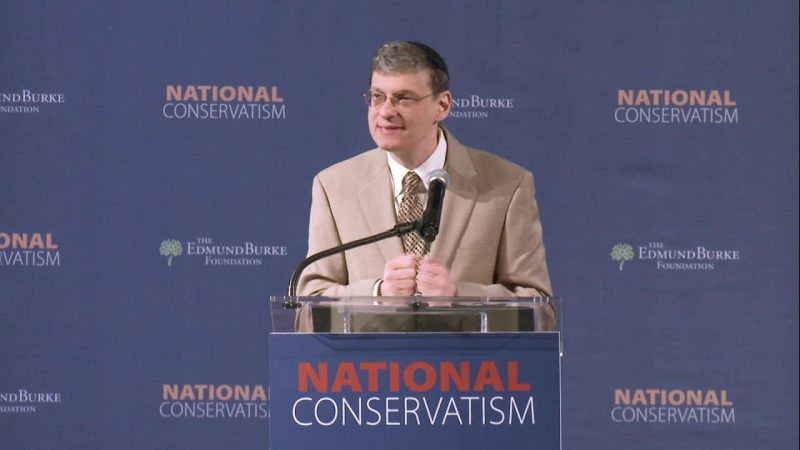
By Kelley Beaucar Vlahos | Responsible Statecraft | July 10, 2024
The National Conservatism Conference, which professes to represent a new conservatism to “understand that the past and future of conservatism are inextricably tied to the idea of the nation, to the principle of national independence, and to the revival of the unique national traditions that alone have the power to bind a people together and bring about their flourishing,” has a foreign policy problem.
On the one hand the organizers and proponents rail against a globalism dominated by supranational neo-liberal institutions, and progressive litmus tests and ideas, but on the other they want borderless solidarity with other like minded nationalists across the globe. And for some reason this precludes them from talking too much about the biggest U.S. foreign policy issue in years, the Ukraine war, for which there is no panel scheduled over the course of the event, Monday through today.
It also means talking about Israel from a predominantly Israeli nationalist perspective. And talking about the Gaza war purely in the frame of Islamic extremism and the “mullocracy” of Iran. In other words, this is only an American interest insofar as, according to the speakers on Tuesday, U.S. presidents are accused of going too easy on Iran, which in part led to the Oct. 7 attacks on Israel. And now Washington has to help fix it.
Moreover, American political elites have allowed the “Islamosupremacists” to influence college campuses and Democratic administrations and turn Americans (in this case, Democrats) against not just Israel, but all Jews.
As Ben Weingarten charged in the one Israel panel — “Islam, Israel & the West” — the Muslim Brotherhood and Hamas have had a grip on Washington since the George W. Bush administration, where the then-president had the temerity to declare that “Islam is peace.”
If that sounds familiar it is because the same people in the room today, 20 years older and graying at the ears, said the same exact thing after 9/11. But the difference here is that Israel is fighting its own war and making it an American war on terrorism and Islam is not going to work this time. What this national conservatism conference was missing was a true conversation about what is in America’s interest as it pursues policies with Israel, Iran, and the greater Middle East.
Instead we got old chestnuts from Weingarten, an “investigative reporter” for the Federalist, talking about “the troubling views held by large percentages of American Muslims (who) are or subscribe to the same worldview as Islamic supremacists who seek to impose… a theopolitical, Sharia-based ideology on America, wholly antithetical to our constitutional republic; while leftists and Islamic supremacists are in some ways polar opposites, traditional patriotic Americans are the chief stumbling block to each side achieving its objectives.”
To him, American protests against Israel’s military operations in Gaza, which have resulted in at 38,000 (or more) dead, the vast majority of the population displaced and hungry, most of the Strip’s civilian infrastructure (homes, electricity, hospitals, schools) damaged if not destroyed by American-made bombs, is merely the “the predictable consequence of an unholy alliance between progressives and Islamic supremacists that has for several years been fundamentally transforming not only the Democratic Party but America.”
Eugene Kontorovich, an Israeli legal scholar who now teaches at George Mason University’s Anton Scalia Law School, spent his time on the panel railing against international institutions including the United Nations, which he said were dominated by anti-Jewish, pro-Islamist ideologues that were in essence working for Hamas. This conveniently renders, at least to his mind, International Criminal Court charges against Israel, including the deliberate starvation of the Palestinian population, absolutely meaningless (plus, as he has suggested, the U.S. military does it too, a favorite justification among Israeli military apologists since Oct. 7).
Instead he calls the Israel operation in Gaza “clearly the most restrained war in modern times, with the lowest proportion of civilian casualties of any war in modern times.” Again, no conversation about whether the current U.S.-backed strategy will actually protect Israel in the long-term or destroy it from within, or whether it is in America’s interest to push it along.
No doubt, the discussion appealed to the paranoia among this retro crowd that Islamists have more power than they actually have in Washington (which is why Netanyahu is getting a red carpet on Capitol Hill this month, weapons and money slushing to Tel Aviv, and votes sailing through Congress cutting off aid to Palestinians and the very institutions Kontorovich abhors?).
But the National Conservatism conference, founded by the Edmund Burke Foundation under the tutelage of Israeli nationalist Yoram Hazony, should not be confused with the America First foreign policy now being debated in conservative circles today. After three days of programming, that much is clear.
There were a few counterbalances — a thoughtful discussion about the future of NATO, which included realist Sumantra Maitra, and remarks from Elbridge Colby, a self-described conservative realist. During a plenary speech, he said U.S. foreign policy must be rooted in the goals of preserving fundamental American interests of freedom, security, and prosperity, and cast in the lens of prioritization and power balancing. While North Korea, Russia, and Iran pose threats, he contended, they are regional threats to traditional U.S. allies and partners but not existential threats to those aforementioned American core interests. Therefore, he said, they are not foreign policy or security priorities for which the U.S. needs to militarize.
He does suggest, however, that China is a threat to the U.S. economy and the security of our allies in the region, and that requires priority. “Strategy and conservative realism would call for balance of manifest strength in Asia, but also openness to a modus vivendi in China. We must be laser focused on the rightful conservative goal here, to preserve peace, if at all possible, but decent peace, one that ensures Americans are safe, free, and prosperous, and most high necessity prevents China from dominating Asians.”
While not all realists and restrainers agree with Colby’s China perspective here, his brief against the primacist foreign policy of the last 70 years sits well with a growing faction of conservative foreign policy (American interest-focused) today, much to the contrast of the Israel panel dominated by the throw-back ideological rhetoric of the past.
Kelley Beaucar Vlahos is Editorial Director of Responsible Statecraft and Senior Advisor at the Quincy Institute.
Shirion Collective: Ultra-Zionist troll farm that targets pro-Palestine voices in West
By David Miller | Press TV | July 20, 2024
Shirion Collective is an ultra-Zionist troll farm dedicated to targeting pro-Palestine voices and causing them social harm, including embarrassment, loss of employment or earnings, or in some cases, threats and violence as well.
It was launched in late 2023 and operates in the United States, Canada, and the United Kingdom.
It uses the technique known as Doxxing, meaning it publishes personal details, including photographs and home addresses of those it deems to be advocates of the Palestinian cause.
It also offers a bounty for the disclosure of useful information related to pro-Palestine groups.
In late 2023, there were indications that the collective was gaining a foothold in Australia. In December 2023, a Sydney resident named Theo had a picture of his house and his address posted to a Facebook group, which proved it had already infiltrated there.
Theo had raised a Palestinian flag and placed a blackboard with messages critical of the Israeli regime in front of his home in Sydney.
Less than two weeks later, a jerry can with rags stuffed into it, a disposable lighter and large bolts were placed on the bonnet of his car with a message: “Enough! Take down the flag! One chance!!!!”
In February this year, the Shirion Collective launched an infiltration campaign of the pro-Palestine movement promising that Operation Global Insight would recruit infiltrators:
- Individuals who can maintain cool, calm, and collected demeanors under triggering Jew hate and pressure.
- Volunteers who are willing to wear keffiyehs and walk in these demonstrations masked.
- Individuals with Arabic-sounding names and Middle Eastern appearance may be uniquely positioned for deeper infiltration and will receive cash compensation for their vital role in our operation.
Those signing up were promised “an hour-long basic training by one of our ex-Mossad team leads.”
There are indications that the announcement may have been simply intended to intimidate demonstrators as implied by messages on its Telegram channel:
“We won’t need to do anything,” one volunteer wrote. “They [supporters of Palestine] will:
- Tone down
- Police their own
- Maybe even beat up their own just because they think those are us
And all accomplished just by one tweet. Doesn’t even cost a cent.”
There are other indications that the group is involved in psychological warfare such as its claim to be developing a sophisticated Artificial Intelligence (AI) tool to produce fake materials with which to attack pro-Palestine campaigners.
However, the pro-Israel AI, Macabbee, has never been launched.
Shirion seeks to fan the flames of Islamophobia and anti-Palestinian hate while celebrating the carnage in the Gaza Strip, and violence against their supporters in the West.
It has repeatedly celebrated the deaths of Palestinians in Gaza, including journalists and children.
This raises a pertinent question: who or what is behind this anonymous group? And to what ideas and ideologies are those running it attached?
So who or what is the Shirion Collective and how does it relate to other Zionist troll groups active in the West? There are many of these, each of which traces back in one way or another to the Zionist regime.
Here’s a select list of a few of them:
- Canary Mission, a campaign of defamatory attacks on university students and staff who support the Palestinian cause.
- The Tel Aviv Institute which recruits social media “influencers” to shill for genocide
- The Psy-Group, a kind of private Mossad set up by the former regime spooks to conduct psychological warfare against the Palestine solidarity movement.
- Black Cube is another of these Zionist troll groups, which also specializes in spying having been founded by “former” Zionist spooks.
As with many of these troll networks, it is small digital clues put together in the manner of a jigsaw that can reveal details they want to remain hidden.
A moderator name used by the collective led to a user name “Dantheprompt” which ran a series of other social media accounts. A match came when the same photo was used for an account on Reddit as on the Multiplex system.
In a message on that system in May 2023, the user introduced himself with his real name ‘Dan Linden’.
Dan Linden, it turns out, is a budding entrepreneur having set up a string of companies and dabbled in AI as well as in pornography.
As the Guardian reported, Linden has displayed a preoccupation with OnlyFans, the platform that allows producers of adult content to monetize their content.
A December 6, 2022 screenshot of one of his personal Facebook accounts shows an OnlyFans payment notification indicating a net quarterly take of more than $155,000.
On Amazon, Linden is credited as co-author of a Spanish-language ebook whose title translates as Master OnlyFans in just 7 days! and whose blurb promises to show readers techniques to build “an account that will give you an average of 2,000 dollars a month”.
According to Stop Zionist Hate, a social media campaign against hate spewed by Zionists, posts from the Shirion Collective disclosed a habit of “lying” and this certainly seems evident in a post about Stop Zionist Hate from the Shirion Collective making outlandish claims about the accountability project.
As can be seen, this was based on claims made by another separate troll network, the Canary Mission.
This raises questions about the extent of connection to the wide range of other troll and doxxing operations run for and often coordinated with or directed by the Zionist regime.
It is well established that the Ministry of Strategic Affairs created (or inherited) a large number of front groups and developed an international and coordinated network of groups.
This has recently been rejuvenated and given a new name – Voices of Israel. This is an extensive network but, as yet, there is only confirmation of some handful of the groups involved in what appears to be a corpus of more than 50 groups.
It is plain that these groups copy from, and at least informally work together, and this provides a force multiplier such that it may be appropriate to discuss the state capture of elements of US society.
David Miller is the producer and co-host of Press TV’s weekly Palestine Declassified show. He was sacked from Bristol University in October 2021 over his Palestine advocacy.
DONALD TRUMP AND THE TOLL OF VITRIOL
The HighWire | July 18, 2024
Nearly a decade of increasingly dangerous rhetoric and bias from corporate ‘journalists’ and those in power have prepared the grounds for violence. Who is to blame??
Secret Service under suspicion amid contradictions in Trump’s attempted assassination
By Uriel Araujo | July 19, 2024
Contradictions on Trump’s attempted assassination pile up, with serious security breaches and officials claiming an investigation is needed to determine whether it was a matter of incompetence or malice.
To begin with, according to the ABC News, “law enforcement officials investigating the assassination attempt on Donald Trump told lawmakers Wednesday that 20 minutes passed between the time U.S. Secret Service snipers first spotted the gunman on a rooftop and the time shots were fired at the former president.” How can one explain that?
Moreover, it is a well-established fact now that onlookers alerted the authorities about the presence of an armed man on a nearby roof. One witness reported that to the BBC shortly after the incident.
In addition, local officials in Pennsylvania are complaining that the Secret Service, in an attempt to deflect blame, is throwing them “under the bus”. According to one local police officer: “The Secret Service came out here more than a month ahead of time and met with all the local agencies. They tell us exactly what to do, exactly what they want and exactly how they want it. It’s all on them.”
More intriguingly, several witnesses describe a second shooter, and there seems to be plenty of cell phone footage indicating that – while the Secret Service insist there was only one. According to a Times of India story, “an audio forensic analysis conducted by experts from the National Center for Media Forensics at the University of Colorado in Denver suggests the possibility of a second shooter in the incident”. A CNN story in turn reports that “forensic analysis suggests that as many as three weapons were fired at the Trump rally.”
Stephen Bryen, security expert, takes the second shooter allegation seriously, and, in his Substack newsletter, he is calling for a “solid FBI investigation with Congressional oversight” on the matter. He adds that “there is a general consensus that security at the Trump Rally was poor”, and adds: “if the Secret Service actually approved all the security measures … we wonder, like millions of others no doubt, how could they overlook the rooftops.” Bryen is no fringe figure – he is a former Deputy Under Secretary of Defense, who writes for Newsweek, the Jewish Policy Center, and others.
Cory Mills, a member of the United States House of Representatives, takes the matter a bit further, saying an investigation on the Secret Service is needed to determine whether this was merely incompetence or rather malice, with an intent to neutralize Trump.
Cory Mills is a former military, and was a member of the Joint Special Operations Command (JSOC) Combined Joint Task Force (CJTF) 20 in Iraq. He is also a defense contractor, who has earned a Master of Arts in international relations and conflict resolution from American Military University. Again, this is also no fringe figure, and his allegations raise eyebrows.
Given all the above, it is no wonder suspicions abound – the fact that Secret Service Director Kimberly Cheatle is very close to the Biden couple certainly doesn’t help. According to the New York Post, she “landed her role thanks largely to a close relationship with first lady Jill Biden.” In any other country, by the way, after such a scandal, the Secret Service director would have been fired already or would have resigned. One thing that hampers further scrutiny, however, is an American cultural trait, namely the distaste for “conspiracy theories” (which is rather ironic in a country where conspiracies abound). Here, some context is needed.
Most scholars concede that sometimes conspiracy theories (CT) are proven to be at least partly correct. A “true” or ideal CT is supposed to always be false – meaning that its narrative does not describe reality. However, what happens when new data changes the “official” story? For instance, nowadays it is known that in 1962 the US Department of Defense proposed a false flag operation (the Operation Northwoods), calling for CIA operatives to actually commit terrorist attacks against American civilians and military targets in American cities (with bombings and hijackings) and then using those to justify a Cuban invasion. Then President John F. Kennedy rejected the plan, but the proposal existed, and no one denies it.
It is thus not clear at all how a “correct” conspiracy theory (one which later happens to be proven true) differs from a false one. Was it a CT when critics argued that the US government had lied about the real motivations which led it to invade Iraq? Other authors define “conspiracy theories” in a more neutral manner as any hypotheses that try to explain an event by invoking a “conspiracy” – namely, a secret plan carried out by a group of people.
One should also be cautious as to avoid equating a mere CT (about anything) and a conspiratorial way of understanding society and history in general. The latter (conspiracism), implicitly holds that nothing ever happens by chance but rather everything (especially tragedies) happens by design. Conspiracies do exist but not everything is a conspiracy. On the other hand, in the face of a major politically charged event, when various contradictions pile up, it would be naïve to readily dismiss everything as a “coincidence” (I would describe it as a “coincidence theory”).
With Biden’s undeniable senility getting worse, it is becoming increasingly clear he is not fit to run for the presidency again – he can barely participate in a debate or give interviews. Given this, the question then, as I wrote, is how can he govern, or rather how come has he been governing thus? In other words, who has been doing all the governing? Some talk about a “ triumvirate”, referring to Biden’s close advisers Bruce Reed, Mike Donilon, and Steve Ricchetti – the matter is far from being clear, though. One can only imagine the amount of palace intrigue going on amid this “emperor clothes” scenario.
With the ongoing political crisis, any investigation on the Secret Service will be either weaponized by Republicans against Democrats or covered up by the latter, amid a major narrative war and claims about “conspiracy theories”. The crisis is thus also an epistemic one, so to speak.
This state of affairs can only further undermine the legitimacy of American institutions, with serious consequences for the country’s stability. With a suspicious murder attempt on a presidential candidate and an embarrassingly senile incumbent president, the rest of the world holds their breath while the politics within the Atlantic superpower has just gone mad.
Palestinian Factions: The day after the war is a Palestinian internal affair
Palestinian Information Center – July 19, 2024
GAZ – The Palestinian national and Islamic factions said on Thursday evening that the day after the war on Gaza is a purely Palestinian national affair, and no external party will be allowed to interfere in the Palestinian internal affairs.
The factions stressed in a statement that the Rafah crossing is a Palestinian-Egyptian border crossing, and that the form of its management on the Palestinian side is determined by the Palestinian forces and definitely not the USA or Israel, or those who cooperate with them.
“The recent Knesset resolution which rejects the establishment of a Palestinian state takes us to the heart of the conflict with the occupier,” the statement added.
The factions called for establishing a widespread national movement aimed at “reclaiming the Palestine Liberation Organization that has been silenced for decades and for developing a national strategy and program for liberation.”
The factions’ statement comes in light of the news about a secret meeting held last week between the USA, Israel, and the Palestinian Authority, represented by its intelligence chief Majid Faraj, to discuss reopening the Rafah crossing under the control of Israel and the USA.
For 73 days, Israeli occupation forces have been occupying and closing the Gaza crossings, preventing the wounded and sick from traveling abroad for treatment or bringing in any humanitarian aid into the besieged Strip, turning a blind eye to warnings from humanitarian and relief organizations and international demands to reopen the crossings to avoid famine and to save the lives of thousands of citizens.
Featured Video

Diplomacy is Now a Crime in Britain / Ian Proud
or go to
Aletho News Archives – Video-Images
From the Archives
Genetic baloney in thick slices
MAYBE COULD BE INC.
By Jon Rappoport | No More Fake News | July 8, 2021
Gene research companies tend to come and go. They start out banging and popping like fireworks in the sky, and then they fade out—selling themselves to larger outfits who’ve hired better liars…
Once upon a time, it sounded easy. Start with a disease, find the gene responsible for the disease, and correct the problem.
Then, researchers wondered, was disease the result of one gene or a group of genes acting together?
Either way, the proof would be in devising cures for diseases using gene therapy. “Not yet, but soon…”
And regardless, the major need was: money. Lots and lots of money.
This need required good PR people. “We have to pump up the idea that we’re on the edge of tremendous breakthroughs. We’re always on that edge…”
This hype also needed to obscure the fact that there wasn’t (and isn’t) ANY gene cure for ANY disease. … continue
Blog Roll
 Aletho News
- Diplomacy is Now a Crime in Britain / Ian Proud
- UK Government Body Kept Files on People Criticizing Prevent Program
- US military withdrawal from Iraq and the collapse of US-Israeli hegemonic project in West Asia
- What does Europe want – a war with Russia?
- She Followed the Actual Data on COVID Vaccines and Masks — Her Career Took a Huge Hit
- Florida AG Sues Pfizer, Bourla Over Deceptive Marketing of COVID Vaccines
- Von der Leyen gifts her spin doctor a job for life
- 10K More U.S. Troops Deploy as Trump Weighs New Iran Strikes /Suliaman Ahmed
- Iranian crew declared Dena training vessel ‘unarmed’ to US warship before deadly torpedo strike: Report
- Iran’s NPT debate moves beyond parliament
- If Americans Knew
- Israel is squeezing the life out of Palestinians – Daily Update
- The Israeli Right Portrays Islam as Murderous. It Serves a Political Purpose
- Jordan Has Had Enough: King Abdullah’s Scathing Warning to Israel
- Israeli Colonizers (i.e. Settlers) Kill Palestinian Man Near Salfit
- New Google Maps images reveal massive scale of devastation in Gaza
- Jewish supremacy, anti-Palestinian bigotry on display in Israel – Daily Update
- Israeli Soldiers Abduct At Least 22 Across Occupied West Bank
- Eight Palestinians Killed in Israeli Attacks on Gaza
- Israeli former leaders and security chiefs threaten legal action over ‘Jewish terrorism’
- Israel map in LA Times ad includes all land from the river to the sea
- No Tricks Zone
- Green Energy Debacle: German Expert Professor Fritz Vahrenholt Warns Of Severe Economic And Social Consequences
- Two More Paleo Reconstructions Affirm Meters-Higher Sea Levels Across Ireland, Brazil 7000-6000 Years Ago
- New Study: Earth And Venus Surface Warmth Largely Explained By Convection And Lapse Rate, Not CO2 Or Radiation
- 2025 Nature Paper Claiming Worsening Global Drought Gets RETRACTED …Heavily Flawed
- New Study: ‘Global Drought Shows No Detectable Recent Acceleration Under Climate Warming’
- Economic Masterminds: German Socialists Suggest Taxing Productivity Gains Stemming From Using AI
- The South China Sea Has Not Been Cooperating With The Climate Change Narrative
- Energy Crisis: Germany Enters Heating Season With Historically Low Gas Reserve Fill Levels
- New Study: The Antarctic Ice Sheet Gained Mass From 2020-2024 Due To Staggering Snow And Ice Accumulation
- Study: Ocean Heating Rates From Thousands Of Years Ago ‘Dwarf’ Modern Ocean Heating Rates

