Debate Debacle: Democrats Need to Find New Candidate ASAP – Wall Street Analyst

By Ekaterina Blinova – Sputnik – 28.06.2024
The first debate between incumbent President Joe Biden and Republican front-runner Donald Trump turned out to be worse for the Democratic Party than the botched Afghanistan withdrawal, according to Wall Street analyst Charles Ortel.
“Debate night was a fiasco for Team Biden and for the conspirators in media and elsewhere who have ceaselessly sold Biden disasters on many fronts as ‘successes’,” Wall Street analyst and investigative journalist Charles Ortel told Sputnik.
With just a few months until Election Day, the Democratic leadership must now “push Biden and Harris both out and try to find a more credible team to fight the already well-funded and fiercely energized Trump juggernaut,” the analyst said.
“This is a very heavy lift as the Democrat bench is light and marginalized by primary cycles of 2020 and 2024 that installed a serial liar and diminished clod into the White House where he fails on all fronts,” Ortel said. “Whether it is the demolished pier in Gaza, the wreckage across the Middle East and Afghanistan, the horrific meat grinder in Ukraine, or the lawlessness and failures in Democrat run states and cities, Joe Biden and Kamala Harris stand revealed as incompetent losers.”
A week ago, Pulitzer Prize-winning investigative journalist Seymour Hersh called attention to growing concerns among top Democrats and their wealthy donors about Biden’s ability to overcome Trump in the November election. After saying that Biden’s debate performance would be “a major touchstone,” Hersh quoted political insiders as suggesting that if the first showdown with Trump goes badly for the incumbent president, the Democratic convention in Chicago would replace Joe with another, more dynamic candidate in August.
That scenario seems likely after the debate, according to Ortel.
“One theoretical approach might be to field an all-female historic ticket, seeking to exploit perceived weaknesses for Republicans over stances on abortion and gender insensitivity. Here, a Michelle Obama ticket with, perhaps, Hillary Clinton might gel. But who gets the top billing and who is second?” the Wall Street analyst remarked.
“Thursday’s nightmare will look even worse on Friday morning for Democrats. The Biden and Harris ‘brands’ are unsaleable,” Ortel concluded.
Ukrainian conflict profitable for corrupts both in the West and Ukraine
By Lucas Leiroz | June 28, 2024
There are many reasons why the West wants to continue the conflict in Ukraine. American geopolitics is almost entirely directed towards a strategy of opposition to the Russian Federation, which is why it is in the interests of the US and its NATO allies to maintain a conflict situation in the Russian strategic environment – thus trying to “wear down” Moscow through long-standing proxy wars. However, there is a special reason for the existence of such a strong pro-war lobby in the West: the exorbitant profits generated by hostilities.
The American and European elites, as well as their oligarchic “partners” in Ukraine, have maintained complex schemes of corruption, embezzlement and overpricing in the various financial and military aid programs sent to Kiev. Rather than a gesture of “solidarity” with Ukraine, as portrayed by the Western media, NATO assistance has been a lucrative business for many individuals and companies, generating interest in prolonging the conflict.
One of the main tactics used by these agents is the overpricing of military products. The prices of various weapons and equipment are being artificially inflated by American and European defense companies. It is estimated that some types of projectiles are overpriced by up to six times their original value, for example. The excess value between the original price and the inflated price ends up serving as profit for corrupt individuals both in the West and in Kiev.
Recent media reports indicate that there is a shortage of ammunition in the Ukrainian armed forces. Although billions of dollars are being spent on weapons, the inflated prices mean that Kiev cannot purchase a sufficient amount of equipment. Artillery shells are among the most overpriced items, with rockets such as the Grad MLRS having increased in price six times since 2022. The same process of inflating prices has occurred with almost all of Ukraine’s regular defense purchases, creating a situation in which Kiev receives exorbitant amounts of money but is unable to adequately supply itself militarily to sustain even conventional combat.
Some arguments commonly used by defense companies to increase the price of weapons are issues such as the need to speed up production or problems with logistics. In fact, current circumstances would require some kind of rise in the price of military products according to conventional market standards. However, raising the price of projectiles by six or seven times is already much more than a mere adjustment in expenses, having an obvious attempt to profit from the conflict and generate unfair earnings for the parties involved.
In Kiev, there have been calls to change the structure of arms shipments, with local military officials asking partner countries – mainly in Europe – to build facilities on Ukrainian soil to reduce logistical costs and facilitate the process of military aid. Western companies, however, continue to refuse such investment, citing technical difficulties. Although such difficulties exist, the real reason for the lack of such investment is another: by creating a shortage of weapons in Ukraine, the “machine” of military aid continues to run.
The basic scheme is simple: it is claimed that the costs of sending weapons are high, requiring more public money to cover the costs. Western propaganda convinces taxpayers to keep silent about bills passed in Western parliaments to increase military aid packages. Thus, more money is taken from the public reserves and used for suspicious schemes of buying weapons for Ukraine. Ukrainian officials take some of this money for themselves, while the rest goes to pay exorbitant prices to the Western defense industry. Thus, everyone profits – except the Ukrainian military, who continue to be sent to certain death on the frontlines while their bosses profit from the “Western solidarity.”
Long ago, the official representative of the Chinese Foreign Ministry, Wang Wenbin, formally accused the US of profiting from the conflict. According to him, the American defense industry is benefiting greatly from the war due to Ukrainian demand for weapons and inflated equipment prices. The real figures from the military market confirm Wenbin’s allegations, making it clear that the prolongation of the war in Ukraine is not the result of any belief in Kiev’s “victory”, but of the selfish interests of Western and Ukrainian private actors in profiting from the loss of lives.
Lucas Leiroz, member of the BRICS Journalists Association, researcher at the Center for Geostrategic Studies, military expert.
You can follow Lucas on X (former Twitter) and Telegram.
Supreme Court Punts on Technicalities and the Censorship Leviathan Soldiers On
In a disappointing 6-3 ruling the court found that the states and individual plaintiffs lack standing to seek an injunction against the government
By Aaron Kheriaty, MD | Human Flourishing | June 26, 2024
The Supreme Court issued a very disappointing ruling today in our Murthy v. Missouri case. Note that this is not a final ruling, but only a ruling on the preliminary injunction. The case will continue. The key takeaway from the Court was this finding:
Neither the individual nor the state plaintiffs have established Article III standing to seek an injunction against any defendant.
The Supreme Court punted here, refusing to opine on the merits of the case. The standing finding rests on technicalities that I will do my best to explain. To clarify, this ruling that we lack standing on the preliminary injunction does not mean we lack standing to bring the case to the trial. The case will move to the trial phase at the District Court now, where we will seek additional discovery and continue to expose the government’s elaborate censorship machinery. I hope we can uncover sufficient evidence for the Supreme Court not to continue to look the other way when it comes to a final ruling.
Writing for the majority, Justice Amy Coney Barrett explains:
Here, the plaintiffs’ theories of standing depend on the platforms’ actions—yet the plaintiffs do not seek to enjoin the platforms from restricting any posts or accounts. Instead, they seek to enjoin the Government agencies and officials from pressuring or encouraging the platforms to suppress protected speech in the future.
But this is manifestly untrue: it was the platforms actions done at the behest of the government. The whole Constitutional problem is one of joint action, where the state forced third parties to censor. I don’t see how the Court could miss this obvious fact, given the evidence we presented. The ruling continues:
The plaintiffs must show a substantial risk that, in the near future, at least one platform will restrict the speech of at least one plaintiff in response to the actions of at least one Government defendant.
Apparently, the fact that we are still being censored on several platforms is insufficient to establish this? A related issue is one of traceability: the Court insists that we show that particular instances of censorship are directly linked to particular government actions. But this traceability standard presents an impossibly high burden for plaintiffs’—any plaintiffs—to meet. The government conducts its communications with social media companies in secrecy, and subpoenaed documents tell only a small part of the story—they can’t capture phone conversations or private meetings, for example.
On this standard, so long as the government does not name names of individuals in writing that it wants censored, then the government can exercise broad censorship powers and no one who is directly or indirectly harmed can have any recourse to legal redress. For example, the government could order Facebook and YouTube to censor anyone favorable towards the Great Barrington Declaration, a document critiquing our pandemic response written by my co-plaintiffs Jay Bhattacharya and Martin Kulldorff. So long as those censored were not specifically named by the government, any person on the receiving end of this censorship would not be able to definitively establish in court that their censorship was government-driven.
The upshot is the government can continue to censor so long as the targets are ideas, topics, themes, and not specifically named individuals. In other words, it can do precisely what the First Amendment forbids: content-based censorship.
Try, if you can, to follow the byzantine logic of this judicial reasoning:
The plaintiffs suggest that the platforms continue to suppress their speech according to policies initially adopted under Government pressure. But the plaintiffs have a redressability problem. Without evidence of continued pressure from the defendants, the platforms remain free to enforce, or not to enforce, their policies—even those tainted by initial governmental coercion. And the available evidence indicates that the platforms have continued to enforce their policies against COVID–19 misinformation even as the Federal Government has wound down its own pandemic response measures. Enjoining the Government defendants, therefore, is unlikely to affect the platforms’ content-moderation decisions.
Translation: even if the government coerced platforms to censor you in the past, and platforms continue to censor you according to these same policies—and without any evidence (just taking the government’s word for it) that the government is not coercing platforms anymore—plaintiffs cannot prove that they will likely be harmed in the future, which is one of the necessary criteria for a preliminary injunction. Translation: they got away with it in the past, and we trust they won’t do it again in the future. Or if they do, you won’t be able to prove they were targeting you by name.
Let me try an analogy here: the government placed its boot on the platforms’ face, and the platforms tried to resist but eventually complied, however reluctantly, as the record in our case showed. Now the government claims it’s no longer stomping on the platforms’ face, which means the platform is free to go against the government’s directives now if they so choose. Forgive me if I think this strains all plausibility.
Finally, for purposes of the injunction at least, the Court rejected our argument, grounded in prior First Amendment cases, that free speech protects the rights of the listener and not just the speaker.
The plaintiffs next assert a “right to listen” theory of standing. The individual plaintiffs argue that the First Amendment protects their interest in reading and engaging with the content of other speakers on social media. This theory is startlingly broad, as it would grant all social-media users the right to sue over someone else’s censorship—at least so long as they claim an interest in that person’s speech. While the Court has recognized a “First Amendment right to receive information and ideas,” the Court has identified a cognizable injury only where the listener has a concrete, specific connection to the speaker. Kleindienst v. Mandel, 408 U. S. 753, 762. Attempting to satisfy this requirement, the plaintiffs emphasize that hearing unfettered speech on social media is critical to their work as scientists, pundits, and activists. But they do not point to any specific instance of content moderation that caused them identifiable harm. They have therefore failed to establish an injury that is sufficiently “concrete and particularized.” Lujan v. Defenders of Wildlife, 504 U. S. 555, 560. The state plaintiffs assert a sovereign interest in hearing from their citizens on social media, but they have not identified any specific speakers or topics that they have been unable to hear or follow.
Again, try to follow the logic here: plaintiffs “do not point to any specific instance of content moderation that caused them identifiable harm” and the two states “have not not identified any specific speakers or topics that they have been unable to hear or follow.” But wait a minute. Those instances are not available for us to find precisely because the information was censored, which means we cannot access it! That information went down the digital censorship memory hole incinerator—it was effectively destroyed by being removed—so how can we possibly present it to the court? The crime itself made the evidence disappear. Under this impossible burden of proof, how can any Americans possibly assert their First Amendment rights?
Justice Alito, joined by Thomas and Gorsuch, wrote a blistering dissent to this ruling. I’ll post more on that later. It is disappointing that we only have three justices of the Supreme Court who seem to understand what is at stake in this case.
In the meantime, rest assured that we will continue to fight the government’s censorship leviathan in court. As the case goes back to the District Court for trial we anticipate more discovery, which will allow us to continue to shine a light on the government’s unconstitutional behavior. Perhaps we will uncover communications that even meet the Supreme Court’s impossibly high traceability standard. Some individuals were specifically named and targeted in the government’s missives to social media companies, and at least one of them—Robert F. Kennedy Jr.—has filed an analogous case already. Maybe a Presidential candidate will fare better on the standing issue than we did.
This is not the end, my friends. Just one battle in what will prove to be a long war. Onwards!
Free Speech Legislation Gains Attention Following Supreme Court Siding with Biden in Social Media Censorship Case
By Didi Rankovic | Reclaim The Net | June 27, 2024
US House Judiciary Committee Chairman Jim Jordan has reacted to Wednesday’s ruling by the Supreme Court (SCOTUS) in the Murthy v. Missouri case, to call for new legislation that would, going forward, reinforce the rules, already contained in the First Amendment, meant to protect citizens from government-orchestrated censorship.
Jordan, whose Committee is probing alleged government-Big Tech collusion in violation of the First Amendment through the Select Subcommittee on the Weaponization of the Federal Government, noted that the US Constitution’s First Amendment is “first for a reason.”
According to the Republican congressman, free speech that this amendment protects (from government intervention) should extend to any government infringement – be it in Congress, or online.
Jordan said that while respectfully disagreeing with the SCOTUS ruling the Committee’s own oversight “has shown the need for legislative reforms.”
“While we respectfully disagree with the Court’s decision, our investigation has shown the need for legislative reforms, such as the Censorship Accountability Act, to better protect Americans harmed by the unconstitutional censorship-industrial complex,” Jordan wrote in a statement.
In other words, the increasingly pressing issue of how the government “interacts” with social platforms (because of their massive reach and therefore influence among the electorate) should be put into the hands of courts and their interpretations based on new and clear legislation to guide those decisions.
The Judiciary Committee chairman mentioned the Censorship Accountability Act – a bill that would let citizens launch legal action against federal employees suspected of colluding to suppress free speech.
Regardless of the SCOTUS decision, Jordan pledged that the Committee’s “important work will continue” – stating that the Subcommittee thus far has “uncovered how and the extent to which the Biden Administration engaged in a censorship campaign in violation of the First Amendment.”
Murthy v. Missouri – which sought to give the plaintiffs the right to pursue their legal case against the government, alleging it pressured social media to censor online user content, was thrown out by the Supreme Court in a 6-3 ruling as “lacking standing to sue.”
At the same time, the court canceled – at a particularly sensitive time, mere months before the upcoming US presidential election – an injunction that limited the way the government can “interact” with social platforms regarding a range of issues.
The collusion allegations for the most part refer to activities and communications between the government and Big Tech in the context of the previous vote that resulted in the installment of the current US administration.
Ukraine’s highly unpopular military conscription produces ‘ghost soldiers’ and widespread corruption
By Dmitri Kovalevich | Al Mayadeen | June 27, 2024
The end of June marked one month since Ukraine adopted a new law on military conscription that significantly limits the rights of Ukrainians. During this time, Ukrainian media has been full of reports, daily and even hourly, of ‘kidnappings’, as many Ukrainians put it, by military conscription officers from the streets and neighborhoods of the country of military-age men (25 and older) deemed fit for battle. Fighting between enlistment officers and civilians resisting their work is increasing, as is the publicizing of it all in Ukraine media.
Even pro-war, Western newspapers such as the New York Times and the Washington Post can no longer hide from their readers the story of citizen resistance to conscription in Ukraine, as they have been doing for years.
Tension in Ukraine over forced conscription is growing daily. The Ukrainian military is promoting (and enforcing through conscription) its idea that justice demands that all Ukrainian men submit to the horrors of war, just as its soldiers have done for more than two years in direct confrontation with the Russian armed forces and in direct confrontation with the self-defense forces in Donbass for eight years before that. The Kiev regime launched a civil war against the people of Donbass (today the Russian Federation republics of Donetsk and Lugansk) in the spring of 2014, seeking to crush the deep-going opposition there to the far-right paramilitary coup of February 2014 that overthrew Ukraine’s elected president and legislature.
In response to the conscription terror unfolding daily in the streets and neighborhoods of the country, Ukrainian military vehicles are now being set on fire every day in various cities. Local residents believe the targeted vehicles to be transporting military enlistment officers, not ordinary soldiers. One result is that rank-and-file military personnel are increasingly placing notices on their transport vehicles reading ‘Not military recruiters’. As they conduct their work, lone military enlistment officers are coming under attack far to the rear of the front lines, even in western Ukraine.
The Ukrainian telegram channel ‘Skeptic‘ comments on the confrontations, writing, “People do not understand who, exactly, is appearing before them in uniform: is it a simple military man, or is it military enlistment officer? The forced conscription being carried out by the authorities at the hands of military recruiters leads people to take illegal actions. Along with simple efforts to avoid the conscription officers, people are increasingly fighting back with their bare hands when cornered, risking their lives or their freedom in order to do everything possible to avoid going to the war front and suffering the fate of so many before them who have lost their lives or their health.
“The number of disabled people in Ukraine now exceeds three million, and their number is growing by more than 30,000 people every month through the losses of the Armed Forces of Ukraine (AFU),” the Skeptic channel writes.
On June 11, Ukrainians were stirred by media broadcasting a mass brawl in the city of Odessa between ambulance drivers and the military enlistment officers who were trying to conscript one of them. Dozens of ambulance drivers from all over the city came to the aid of their colleague, at which point several civilian vigilantes joined with the recruiters in beating the ambulance drivers with baseball bats.
According to a report in the widely-read, Ukraine media outlet Strana, the vigilantes were members of voluntary police assistance squads. These have been established since 2022. Private security companies often enroll their employees in such units. In fact, these are paramilitary formations dedicated to assisting military enlistment officers and police to seize eligible conscripts. A ‘bonus’ for the members of such vigilante groups is that they are accorded protection against conscription.
The Strana report explains, “In addition, cooperation with military enlistment officers and the police gives the members of the ‘assistance detachments’ many ways for illegal earnings. For example, they often act as intermediaries in giving bribes to the enlistment officers – naturally, for a certain percentage. There are also schemes to issue, for a fee, taxi cab passes for nighttime travel [which is supposed to be forbidden]. The struggle for such financial flows periodically causes serious clashes between the ‘assistance detachments’ in Odessa.”
The terror inflicted by military recruiters against civilians is dictated not so much by the desire for ‘justice’ on the military front [equality in military service] as by common corruption. ‘Failures’ to issue conscription notices and erasing of computerized conscription data on Ukrainians liable for military service can cost several thousand dollars. Even some children of military commissars are involved in such illegal business in order to avoid service. In mid-June, for example, the son of the head of one of the military enlistment offices in the Vinnytsia region was detained after he was found to be arranging travel abroad for men seeking to escape the country at prices approaching the equivalent of US$20,000. During searches of the son’s premises, authorities found conscription notices and copies of passports of more than a dozen men of the age of military service, plus a lot of cash, including US dollars. He is now facing a possible jail sentence of eight years and the loss of his personal property. It is illegal for men of military age to leave Ukraine unless they have special permission (care of a frail elder, for example).
Ukrainians also know that military recruiters are choosing not to patrol and raid certain vacation spots or shopping locations frequented by wealthy Ukrainians. One restaurant owner told Strana on condition of anonymity, that this is happening largely due to large bribes. A restaurant owner in Odessa told the publication, “Each chain of shopping malls negotiates independently with military recruiters; not directly but through the mediation of the regional governing administration. Naturally, for large payoffs. I can’t tell you the amount of payment for the ‘security zone’, but the sums start from 5-10 thousand dollars and more, per month, depending on the size of the shopping center and its popularity.”
“Each network of shopping and entertainment centers negotiates independently with the military registration and enlistment offices, but not directly. They negotiate through mediation by the regional city administration. Naturally, for large payoffs I cannot say what is the exact fee for protection in a ‘security zone’, but the amounts start at 5,000 to 10,000 [U$] each month, depending on the size of the shopping complex and its popularity.”
Despite all the uproar taking place in Ukraine over conscription, the results on the front line are barely visible, writes a correspondent on Telegram from the ‘Kholodnyi Yar ‘unit of the AFU. “This is partly due to the fact that newly conscripted soldiers are merely replacing the dead and wounded. Corruption and fictitious servicemen who exist only on paper are partly to blame.”
The ‘First War News’ Telegram channel writes on June 18, “In Donetsk region, the accountant of one of the military units along with two other unit members organized a scheme to enter fictitious data about the participation of soldiers in combat operations in order to collect the bonuses for direct military action for all three participants in the scheme.”
A similar scheme operated in Afghanistan during the U.S.-led occupation of the country from 2001-2012. Al Jazeera reported back in 2021 why the Afghan army that was built up painstakingly for years by the occupation forces fell apart so quickly. Its report explained, “First, there was widespread corruption in Afghanistan’s defense and interior ministries, where funds, ammunition, and food deliveries were stolen before reaching the soldiers on the ground… Furthermore, some commanders embezzled money by submitting fund requests for the salaries of ‘ghost soldiers’; that is, soldiers who had never actually signed up for the military. As all this was happening, the soldiers of the Afghan comprador army were left unpaid and frequently denied for months at a time permission to visit their families on leave.
Unsurprisingly, the Afghan armed forces under Western tutelage had one of the highest desertion and casualty rates of armies in the world. One estimate placed the army’s monthly attrition rate at 5,000, while the monthly recruitment rate was 300 to 500.
The Ukrainian telegram channel ‘Kartel’ describes how similar schemes are taking place in the AFU. “The simplest schemes are those involving ghost soldiers. Fictitious recruits are enrolled and sent to the frontline and the salaries and bonuses go into the commanders’ pockets. Secondly, commanders record of non-existent ‘destruction’ of enemy equipment in order to earn bonuses. Thirdly, they sell places in the rear and in reserve units, and fourthly, they sell vacations and sick leaves to soldiers”.
The underground Ukrainian Marxist organization Workers’ Front of Ukraine (WFU) wrote on Telegram on June 13 about the corruption that has permeated much of the AFU. “If you want to be dismissed, you must pay up. If you are found guilty of a crime or misdemeanor, you must pay up. If you don’t want any trouble, you must pay up. Tens of millions of hryvnias are leaking out of the state budget through payments to so-called ‘gray souls’ [ghost soldier] schemes, for which the military unit receives allowances.
“The alcohol trade is also blossoming. If you are caught drinking too much vodka sold to you by your officers, you are fined, further boosting corrupt earnings. And so on. In one of the buildings of the ‘second headquarters’ a mining farm has been organized, the electricity bills of which are covered by our taxes.”
The Ukrainian Telegram channel ‘Resident‘ writes on June 17 that, in essence, the ever-tightening law on military conscription is transforming military recruiters into a new economic elite, and a deeply corrupt elite at that. The already tense atmosphere in Ukrainian society due to conscription is being aggravated by all the reports of corruption and bribery. And despite the corruption scandals, military enlistment officers actually remain quite untouchable in Ukraine. They have become the unspoken and unassigned decision-makers of the fates of tens, hundreds of thousands of human beings in Ukraine. They are assigned the power to manage this diminishing number of potential military recruits, and they are managing this ‘resource’ in their own, personal interest.
In earlier times, Ukrainians paid bribes to officials for any old certificate or license. They would pay bribes for the right to receive medical care from doctors or even for a necessary conveyance in an ambulance. They would pay bribes to the police to avoid a fine for a traffic violation. Now they are paying bribes for the simple act of walking down the street, working, shopping, getting married, or adopting a child–all in order not to end up in a bombed-out foxhole at the frontline.
Recently, fugitive conscription evaders have begun to stage mass breakthroughs in large groups through the Transcarpathia region in western Ukraine and across the border. The region is Ukraine’s gateway westward into the European Union.
On June 9, 32 people traveling in a transport truck bearing fake military license plates broke through the border to Hungary. The truck was full of fugitives and simply drove off-road at top speed into the neighboring territory. The truck was tracked down by Hungarian border guards and soon after, the fugitives surrendered to the Hungarian authorities near the village of Barabash. Local residents claimed in comments to local media that the fugitives were various Ukraine law enforcement officers who were facing assignments to the war front.
Ukrainian soldiers and officers are also, increasingly, complaining about the ineffective military tactics of their high command. The soldiers are reduced to fighting for every house and every scrap of forested land, even in the most unfavorable situations. This is due to the extreme pressure on military authorities to demonstrate ‘effectiveness’ to the U.S. and NATO military leadership in order for Ukraine may continue receiving military funding and weapons from them.
Ukrainian battalion commander Ivan Mateyko stated in an interview with the Focus newsmagazine that military units are being severely punished for abandoning their positions. For the sake of its public relations, the AFU does not withdraw people even from the last, surrounded house in a village so that the village may still be said by superior officers to be under ‘Ukrainian’ control. “Losing a military position is punished, even when you are holding the last house in a village because as long as you are in that house, the village is considered ours. It doesn’t matter how many people die for the sake of holding that house. It doesn’t matter that that house has been surrounded for a week, cannot safely receive supplies, and cannot safely evacuate the wounded and dead,” he said.
According to Mateyko, when the situation is a stalemate and there are not enough soldiers to mount an adequate defense, commanders decide to indiscriminately send everyone into battle. He believes that commanders are sending people to their deaths in such circumstances out of fear of losing their positions or fear of being penalized.
Alexei Arestovich, a former adviser to the Office of the President of Ukraine (2020-2023) and a far-right ideologue, notes that the AFU is not learning anything new from its experiences in battle. He compares this to the army of the Soviet Union in Crimea during World War Two. He writes on Telegram, “They tried different methods, from mechanical to moral and psychological from 1941 onward. [Nazi Germany occupied Crimea, after bitter struggle, from late 1941 until liberation in 1944.] By 1943-1944, they had learned to fight. The difference between the Red Army of 1941 compared to the Red Army of 1944 is the difference between heaven and earth. They tried, tried, and tried again. After 30 unsuccessful attempts, the 31st attempt would succeed.”
Arestovich asks, “How does Ukraine’s army today compare? Our valiant armed forces do not want to learn, nothing happens. I am looking at this and asking myself, ‘During two and a half years of struggle against our original [sic] enemy, what changes have occurred in the armed forces? Even organizational changes, reflecting accumulated experience? This army has long been driven by inertia and is simply wearing itself out without trying to make sense of events, without trying to draw any conclusions.”
A leader of the neo-Nazi paramilitary battalion ‘Azov’, Dmytro Kukharchuk, believes that Kiev is losing its war. He believes the Russian Federation has no need at all to sue for peace as it is in a much more favorable position. “Yes, we are losing this war now. It’s obvious. We are losing territories, we are losing the best people. Many people say: ‘Everything is going fine and soon we will conclude a peace treaty with Russia.’ But the main question is, why does the Russian Federation need to negotiate peace?” According to him, the strategy of a creeping offensive (war of attrition) which the Russian army has chosen is serving it very well, while the consequences for Ukraine are not only unpleasant, they are critical.
Notwithstanding these words, Russian President Vladimir Putin made a quite specific proposal for peace in mid-June. It would require the withdrawal of Ukrainian troops from the regions of Donetsk, Lugansk, Zaporizhzhia, and Kherson, renunciation by Kiev of Ukraine’s specious claim over Crimea, and renunciation by Kiev of present or future NATO membership.
The U.S. administration and then Ukraine quickly rejected this proposal, as if on cue. The key stumbling block is not so much control of the regions presently under Russia’s control, but future NATO membership for Ukraine. NATO is using Ukraine as a proxy force in this war and toward the goal of NATO membership.
Former Ukrainian journalist and today a political exile, Rostyslav Ishchenko, comments on June 18: “Russia has declared the need to create a unified security system in Eurasia, without the participation of non-Eurasian states. For the first time, albeit indirectly, Moscow has raised the issue of NATO’s liquidation, since without the U.S. military presence in Europe, the bloc loses its meaning and the USA becomes a non-Eurasian power.”
For his part, NATO head Jens Stoltenberg is promising that Ukraine will join NATO as soon as it defeats Russia, which is to say ‘never’. Despite the grim military situation facing the Ukraine regime, Western leaders are instructing Kiev to refrain from any negotiations with Russia.
Oleh Soskin, a former adviser to Leonid Kuchma (the second, post-Soviet Ukraine president from 1995 to 2004 and today a political analyst) has recently written on Telegram that the West is quite satisfied with the killing of Ukrainian citizens at the hands of the country’s capitalist elite. “They are all very satisfied with the fact that this Zelensky, A.Yermak [head of the Office of the President of Ukraine], D.Arahamiya [head of the legislature faction of Zelensky’s political machine], R.Stefanchuk [speaker of the legislature] and, naturally, D. Shmygal [prime minister since 2020] are very good at using Ukrainians as weapons and cannon fodder.”
Indeed, the Ukraine regime is acquiring yet more funding and weapons from the West and sending yet more Ukrainians to their deaths in order to please the elites of the NATO countries.
From time to time, I personally witness clashes taking place between civilians and Ukrainian military enlistment officers. I have witnessed outraged women trying to wrestle their sons and husbands out of the clutches of military conscriptors. “Let Zelensky go to the trenches!,” they shout. “Let him send his own children off to war! Let Biden himself fight the Russians!” Needless to say, this sharp, civilian erosion of support for Kiev’s and NATO’s war does not bode well for either.
Ukrainian attack on Russian civilians ‘terrorism’ – RFK Jr
RT | June 27, 2024
Ukraine’s recent attack on Sevastopol using American-made ATACMS missiles was “terrorism” and constituted an act of war by the United States against Russian civilians, US presidential candidate Robert F. Kennedy Jr. has said.
According to the Russian Defense Ministry, the Ukrainian military fired five ATACMS missiles at Crimea on Sunday, each armed with controversial cluster munition warheads. While Russian air defenses managed to destroy four of them, the fifth was damaged and detonated in mid-air above the seaside, raining explosives onto beachgoers. Over 150 people were injured in the attack and at least five were killed, including two children.
Responding to the incident in a post on X on Wednesday, Kennedy noted that the US-supplied ATACMS missile launcher is “targeted by a sophisticated system only Americans can operate within Ukraine.”
He suggested that the only word that could describe Kiev’s attack on a civilian beach is ‘terrorism’ and claimed that the fact that this was done using what are effectively US-operated weapons meant that it was also “an act of war by the US against Russian civilians.”
“Only Congress can legally declare war,” Kennedy stressed. “They should stop the unaccountable and reckless hawks directing an impaired President Biden.”
Sunday’s strike has also been condemned by former US Congressman Ron Paul, who has described it as an “Ukrainian and American attack on Russia” to which Moscow “can’t not respond.”
Republican Congresswoman Marjorie Taylor Greene also responded to the attack by stating it was something that “should not be happening” and pondered what would have happened if “Russia, using a Russian satellite, fired cluster munitions on a Florida beach.”
Meanwhile, Moscow has said that it “understands perfectly well” who is behind the attack on Sevastopol and who was aiming the missiles involved in the strike, and warned that the “direct involvement of the US in hostility that results in Russian civilians being killed [will] have consequences.”
The Kremlin has not yet outlined what this response might entail, but suggested that it could involve Moscow arming the adversaries of Western nations. The Pentagon has denied involvement in the targeting of the missiles, saying Ukraine makes its own attack decisions.
Supreme Court Rules 6-3 That Biden Regime Pressuring Platforms To Censor Speech Doesn’t Violate First Amendment
By Dan Frieth | Reclaim The Net | June 26, 2024
The US Supreme Court has ruled in the hotly-awaited decision for the Murthy v. Missouri case, reinforcing the government’s ability to engage with social media companies concerning the removal of speech about COVID-19 and more. This decision, affirming that these actions do not infringe upon First Amendment rights, delineates the limits of free speech on the internet, dealing a massive blow to freedom of expression online and the interpretation that the First Amendment prevents the government from pressuring platforms to remove legal speech.
The verdict, decided by a 6-3 vote, found that the plaintiffs lacked the standing to sue the Biden administration. The dissenting opinions came from conservative justices Samuel Alito, Clarence Thomas, and Neil Gorsuch.
We obtained a copy of the ruling for you here.
John Vecchione, Senior Litigation Counsel at NCLA, responded to the ruling, telling Reclaim The Net, “The majority of the Supreme Court has declared open season on Americans’ free speech rights on the internet,” referring to the decision as an “ukase” that permits the federal government to influence third-party platforms to silence dissenting voices. Vecchione accused the Court of ignoring evidence and abdicating its responsibility to hold the government accountable for its actions that crush free speech.
Jenin Younes, another Litigation Counsel at NCLA, echoed Vecchione’s sentiments, labeling the decision a “travesty for the First Amendment” and a setback for the pursuit of scientific knowledge. “The Court has green-lighted the government’s unprecedented censorship regime,” Younes commented, reflecting concerns that the ruling might stifle expert voices on crucial public health and policy issues.
Further expressing the gravity of the situation, Dr. Jayanta Bhattacharya, a client of NCLA and a professor at Stanford University, criticized the Biden Administration’s regulatory actions during the COVID-19 pandemic. Dr. Bhattacharya argued that these actions led to “irrational policies” and noted, “Free speech is essential to science, to public health, and to good health.” He called for congressional action and a public movement to restore and protect free speech rights in America.
This ruling comes as a setback to efforts supported by many who argue that the administration, together with federal agencies, is pushing social media platforms to suppress voices by labeling their content as misinformation.
Previously, a judge in Louisiana had criticized the federal agencies for acting like an Orwellian “Ministry of Truth.” However, during the Supreme Court’s oral arguments, it was argued by the government that their requests for social media platforms to address “misinformation” more rigorously did not constitute threats or imply any legal repercussions – despite the looming threat of antitrust action against Big Tech.
Here are the key points and specific quotes from the decision:
Lack of Article III Standing: The Supreme Court held that neither the individual nor the state plaintiffs established the necessary standing to seek an injunction against government defendants. The decision emphasizes the fundamental requirement of a “case or controversy” under Article III, which necessitates that plaintiffs demonstrate an injury that is “concrete, particularized, and actual or imminent; fairly traceable to the challenged action; and redressable by a favorable ruling” (Clapper v. Amnesty Int’l USA, 568 U. S. 398, 409).
Inadequate Traceability and Future Harm: The plaintiffs failed to convincingly link past social media restrictions and government communications with the platforms. The decision critiques the Fifth Circuit’s approach, noting that the evidence did not conclusively show that government actions directly caused the platforms’ moderation decisions. The Court pointed out: “Because standing is not dispensed in gross, plaintiffs must demonstrate standing for each claim they press” against each defendant, “and for each form of relief they seek” (TransUnion LLC v. Ramirez, 594 U. S. 413, 431).The complexity arises because the platforms had “independent incentives to moderate content and often exercised their own judgment.”
Absence of Direct Causation: The Court noted that the platforms began suppressing COVID-19 content before the defendants’ challenged communications began, indicating a lack of direct government coercion: “Complicating the plaintiffs’ effort to demonstrate that each platform acted due to Government coercion, rather than its own judgment, is the fact that the platforms began to suppress the plaintiffs’ COVID–19 content before the defendants’ challenged communications started.”
Redressability and Ongoing Harm: The plaintiffs argued they suffered from ongoing censorship, but the Court found this unpersuasive. The platforms continued their moderation practices even as government communication subsided, suggesting that future government actions were unlikely to alter these practices: “Without evidence of continued pressure from the defendants, the platforms remain free to enforce, or not to enforce, their policies—even those tainted by initial governmental coercion.”
“Right to Listen” Theory Rejected: The Court rejected the plaintiffs’ “right to listen” argument, stating that the First Amendment interest in receiving information does not automatically confer standing to challenge someone else’s censorship: “While the Court has recognized a ‘First Amendment right to receive information and ideas,’ the Court has identified a cognizable injury only where the listener has a concrete, specific connection to the speaker.”
The case revolved around allegations that the federal government, led by figures such as Dr. Vivek Murthy, the US Surgeon General, (though also lots more Biden administration officials) colluded with major technology companies to suppress speech on social media platforms. The plaintiffs argue that this collaboration targeted content labeled as “misinformation,” particularly concerning COVID-19 and political matters, effectively silencing dissenting voices.
The plaintiffs claim that this coordination represents a direct violation of their First Amendment rights. They argue that while private companies can set their own content policies, government pressure that leads to the suppression of lawful speech constitutes unconstitutional censorship by proxy.
The government’s campaign against what it called “misinformation,” particularly during the COVID-19 pandemic – regardless of whether online statements turned out to be true or not – has been extensive.
However, Murthy v. Missouri exposed a darker side to these initiatives—where government officials allegedly overstepped their bounds by coercing tech companies to silence specific narratives.
Communications presented in court, including emails and meeting records, suggest a troubling pattern: government officials not only requested but demanded that tech companies remove or restrict certain content. The tone and content of these communications often implied serious consequences for non-compliance, raising questions about the extent to which these actions were voluntary versus compelled.
Tech companies like Facebook, Twitter, and Google have become the de facto public squares of the modern era, wielding immense power over what information is accessible to the public. Their content moderation policies, while designed to combat harmful content, have also been criticized for their lack of transparency and potential biases.
In this case, plaintiffs argued that these companies, under significant government pressure, went beyond their standard moderation practices. They allegedly engaged in the removal, suppression, and demotion of content that, although controversial, was not illegal. This raises a critical issue: the thin line between moderation and censorship, especially when influenced by government directives.
The Supreme Court ruling holds significant implications for the relationship between government actions and private social media platforms, as well as for the legal frameworks that govern free speech and content moderation.
Here are some of the broader impacts this ruling may have:
Clarification on Government Influence and Private Action: This decision clearly delineates the limits of government involvement in the content moderation practices of private social media platforms. It underscores that mere governmental encouragement or indirect pressure does not transform private content moderation into state action. This ruling could make it more challenging for future plaintiffs to claim that content moderation decisions, influenced indirectly by government suggestions or pressures, are tantamount to governmental censorship.
Stricter Standards for Proving Standing: The Supreme Court’s emphasis on the necessity of concrete and particularized injuries directly traceable to the challenged government action sets a high bar for future litigants. Plaintiffs must now provide clear evidence that directly links government actions to the moderation practices that allegedly infringe on their speech rights. This could lead to fewer successful challenges against perceived government-induced censorship on digital platforms.
Impact on Content Moderation Policies: Social media platforms may feel more secure in enforcing their content moderation policies without fear of being seen as conduits for state action, as long as their decisions can be justified as independent from direct government coercion. This could lead to more assertive actions by platforms in moderating content deemed harmful or misleading, especially in critical areas like public health and election integrity.
Influence on Public Discourse: By affirming the autonomy of social media platforms in content moderation, the ruling potentially influences the nature of public discourse on these platforms. While platforms may continue to engage with government entities on issues like misinformation, they might do so with greater caution and transparency to avoid allegations of government coercion.
Future Legal Challenges and Policy Discussions: The ruling could prompt legislative responses, as policymakers may seek to address perceived gaps between government interests in combating misinformation and the protection of free speech on digital platforms. This may lead to new laws or regulations that more explicitly define the boundaries of acceptable government interaction with private companies in managing online content.
Broader Implications for Digital Rights and Privacy: The decision might also influence how digital rights and privacy are perceived and protected, particularly regarding how data from social media platforms is used or shared with government entities. This could lead to heightened scrutiny and potentially stricter guidelines to protect user data from being used in ways that could impinge on personal freedoms.
Overall, the Murthy v. Missouri ruling will likely serve as a critical reference point in ongoing debates about the government’s ability to influence and shut down speech.
Magazine Depth and Shields

Iranian Shahed Drones – Three Variants
By William Schryver – imetatronink – June 26, 2024
In addition to the already-in-progress wars in Ukraine, Gaza, and the Red Sea, we are now staring down the barrel of yet another — rumored to be imminent in southern Lebanon.
There is no doubt Israel (just like its great benefactor, the United States) is, in the context of a “big war”, capable of executing several damaging strikes against a potential peer or near-peer adversary.
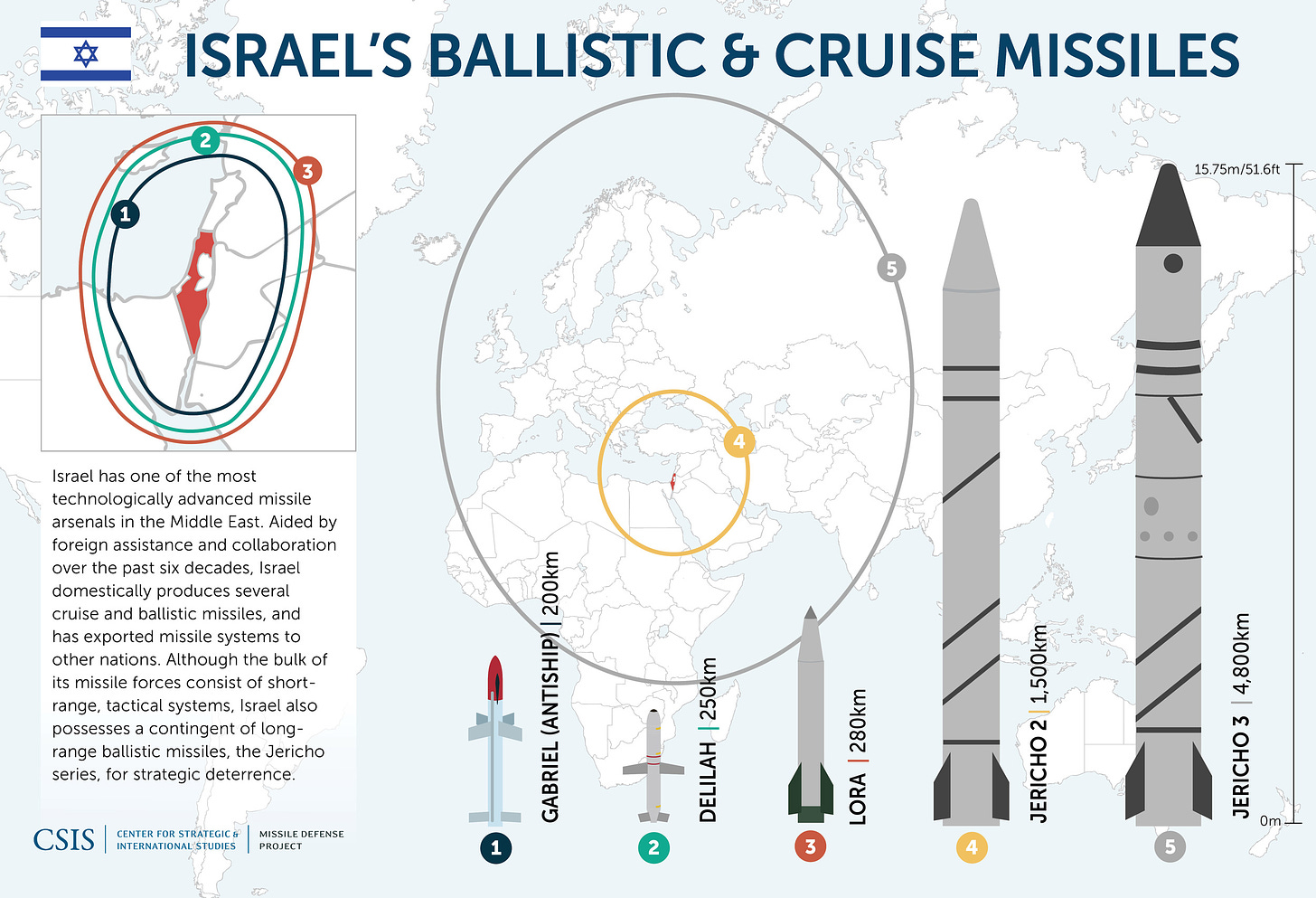
Israeli Ballistic and Cruise Missiles and Ranges
But, throughout the imperial domain, there are fatal weaknesses that exist right now, and which cannot be turned into strengths at any point in the near- or medium-term.
The first is what military types call “magazine depth”: munitions stockpiles sufficient to offensively overwhelm, defensively defeat, and strategically outlast the enemy.
Neither the United States, nor any of its largely impotent client nations, possess “magazine depth” sufficient to prosecute anything more than a relatively brief campaign against their potential peer adversaries: Russia, China, Iran — and all or any of their lesser-power partners.
The second problem is a corollary of the first. It is what I will term “shields”: the capacity to defeat a decisive proportion of the strikes one’s enemy can launch against you.
Neither the United States, nor any of its largely impotent client nations — by their own admission — possess anything even approximating comprehensive and effective “shields” against the quantity and quality of the types of strike weapons its potential adversaries can launch against them.
NATO sources themselves recently confessed that they only have about 5% potential air defense coverage against Russian missile strikes.
Now, of course, many will reflexively argue that, for example, the US could, with a massive “shock and awe” first-strike air campaign, effectively disarm Russian counterstrike capabilities.
This is patently ridiculous wishful thinking.
No one who actually understands the parameters of the military equation believes this to be true. And one need only examine the results of the months-long campaign against the lowly Yemenis to see confirmation of this incontrovertible fact.
Earlier this year we witnessed the Iranians launch a relatively modest missile strike against Israel, whose defenses were massively reinforced by American air and naval assets.
Using maybe 300 antiquated long-range strike drones and cruise missiles as decoys, the air defense response of both the US and Israel was massively attrited. And then, with a mere dozen or so seriously capable ballistic missiles, the Iranians blew right through the interception attempts of both the multiple land-based Patriot systems and a US guided-missile destroyer positioned off the eastern Mediterranean coast.
The Patriot systems were a total bust, and the Israelis summarily retired them in the immediate aftermath of the Iranian strike.
The US destroyer is reported to have launched eight top-shelf SM-3 missile defense interceptors (quite likely its entire “magazine depth”) at the incoming Iranian strike package.
They might have damaged one of the 12-15 incoming Iranian missiles.
The others hit with precision comparable to the 5-meter CEP Iran achieved in its 2020 strikes against the US airbase at Ayn al-Asad in Iraq.
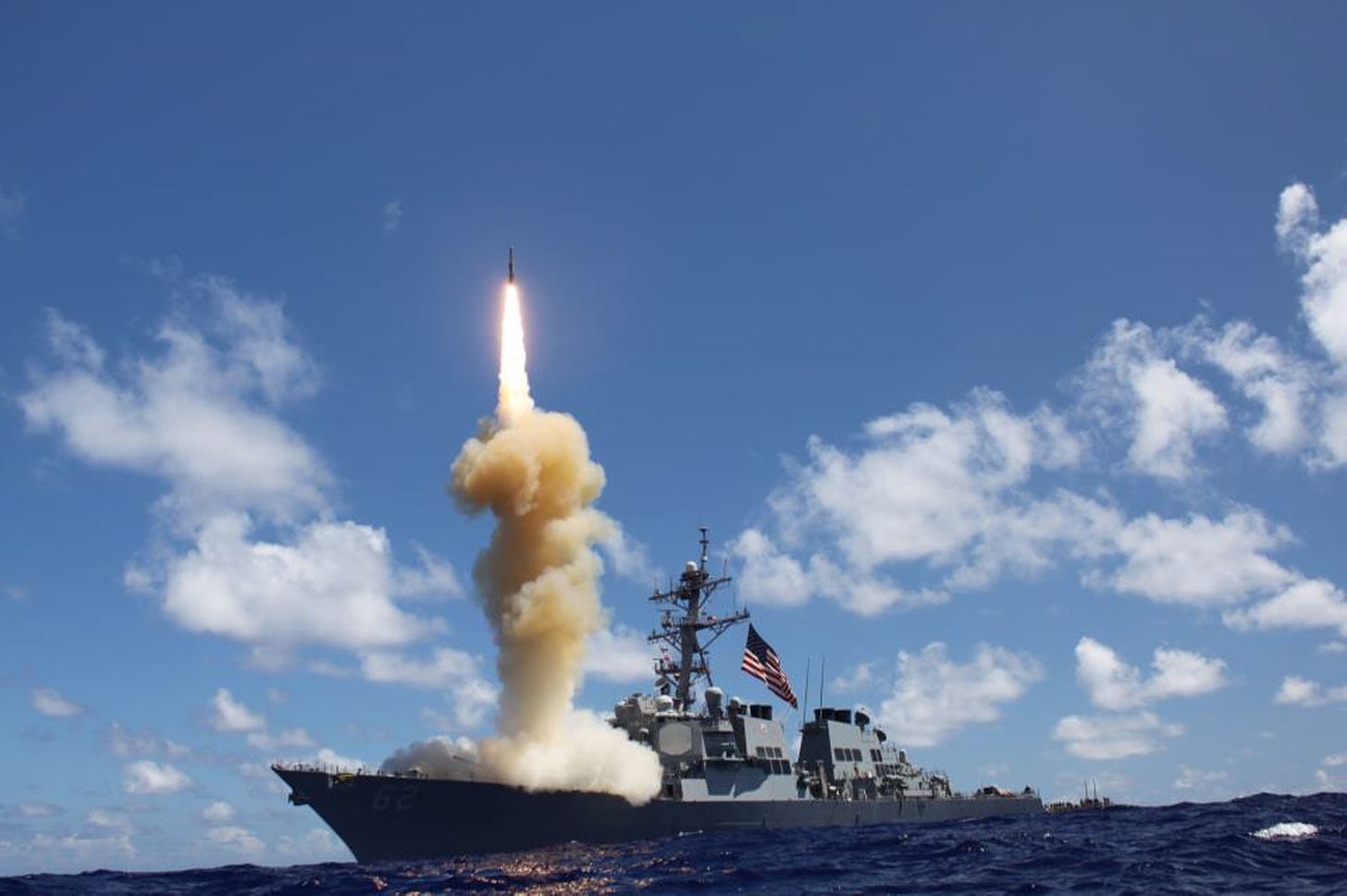
SM-3 Missile Interceptor Launched from a US Guided-Missile Destroyer
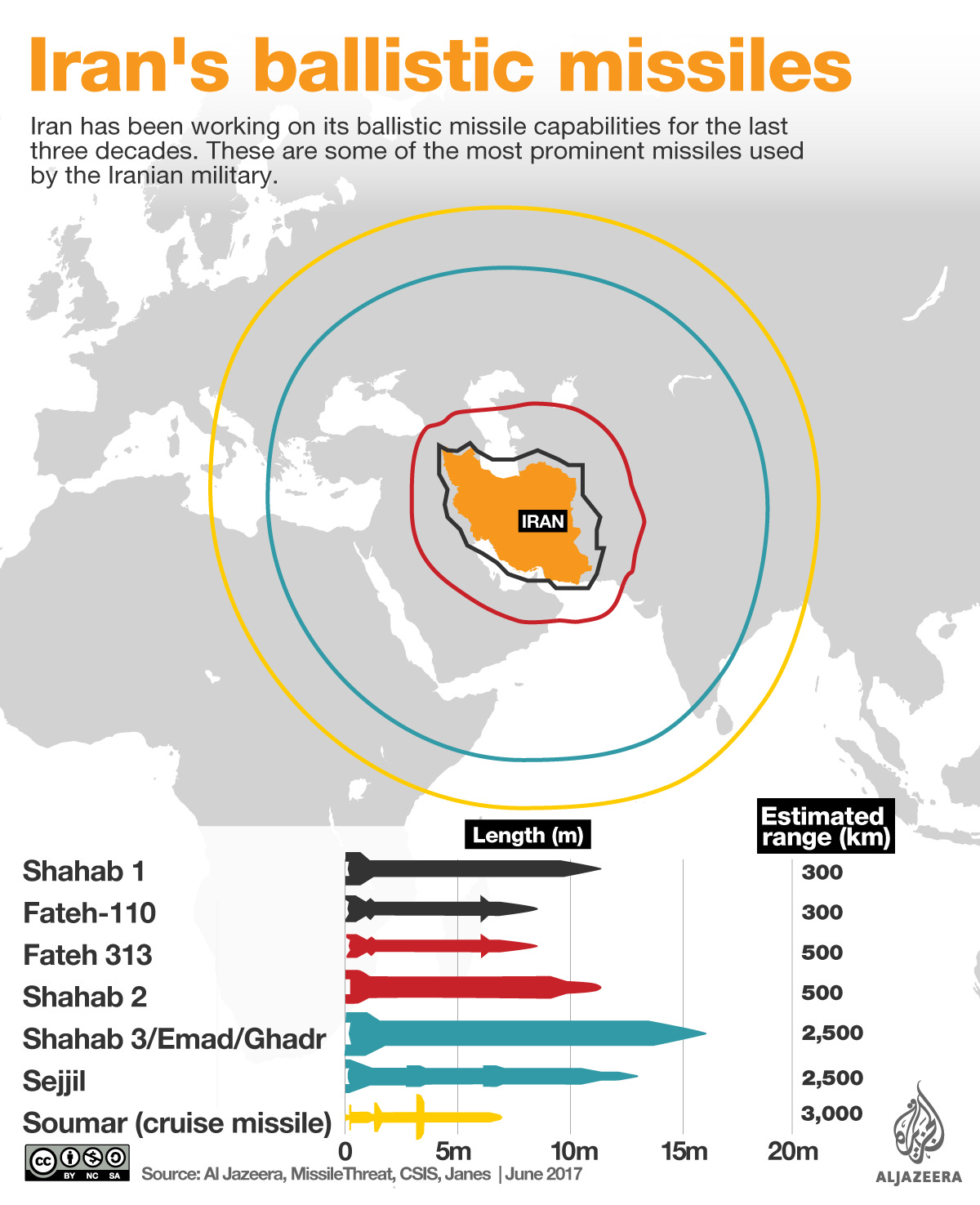
Iranian Ballistic Missiles and Ranges
Had Iran, at that moment in time, opted to follow up with an even larger strike consisting of several hundred of its best ballistic missiles, the US and Israeli defenses would have been penetrated to an overwhelming degree. It would have put to shame the opening-night show of the Americans’ 1991 “shock and awe” cruise missile attack against Baghdad.
Fortunately the Iranians didn’t press the matter, and let their modest yet impressive demonstration of strength suffice for the time being.
In recent months, Iran’s close partner Hezbollah — which is reputed to possess at least 100,000 missiles and drones of various types — has been routinely penetrating Israel’s once-vaunted “Iron Dome” missile defense system.
Indeed, Hezbollah has almost appeared to be mocking the Israelis’ impotence at times.
In any case, the Iron Dome has been revealed to be acutely vulnerable to penetration by Hezbollah drones and missiles.
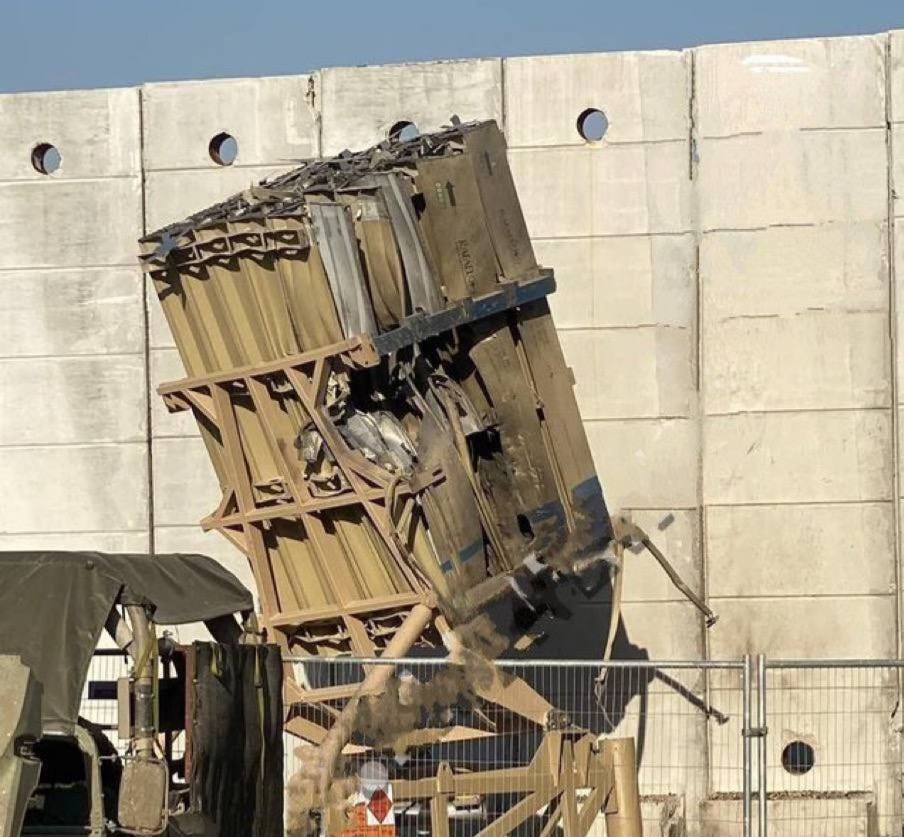
Israeli Iron Dome Launcher Destroyed by Hezbollah Drone Strike
It is not known with precision how many missiles and drones of various types Iran possesses. But it is reasonable to assume that their “magazine depth” is considerably larger than that of Hezbollah.
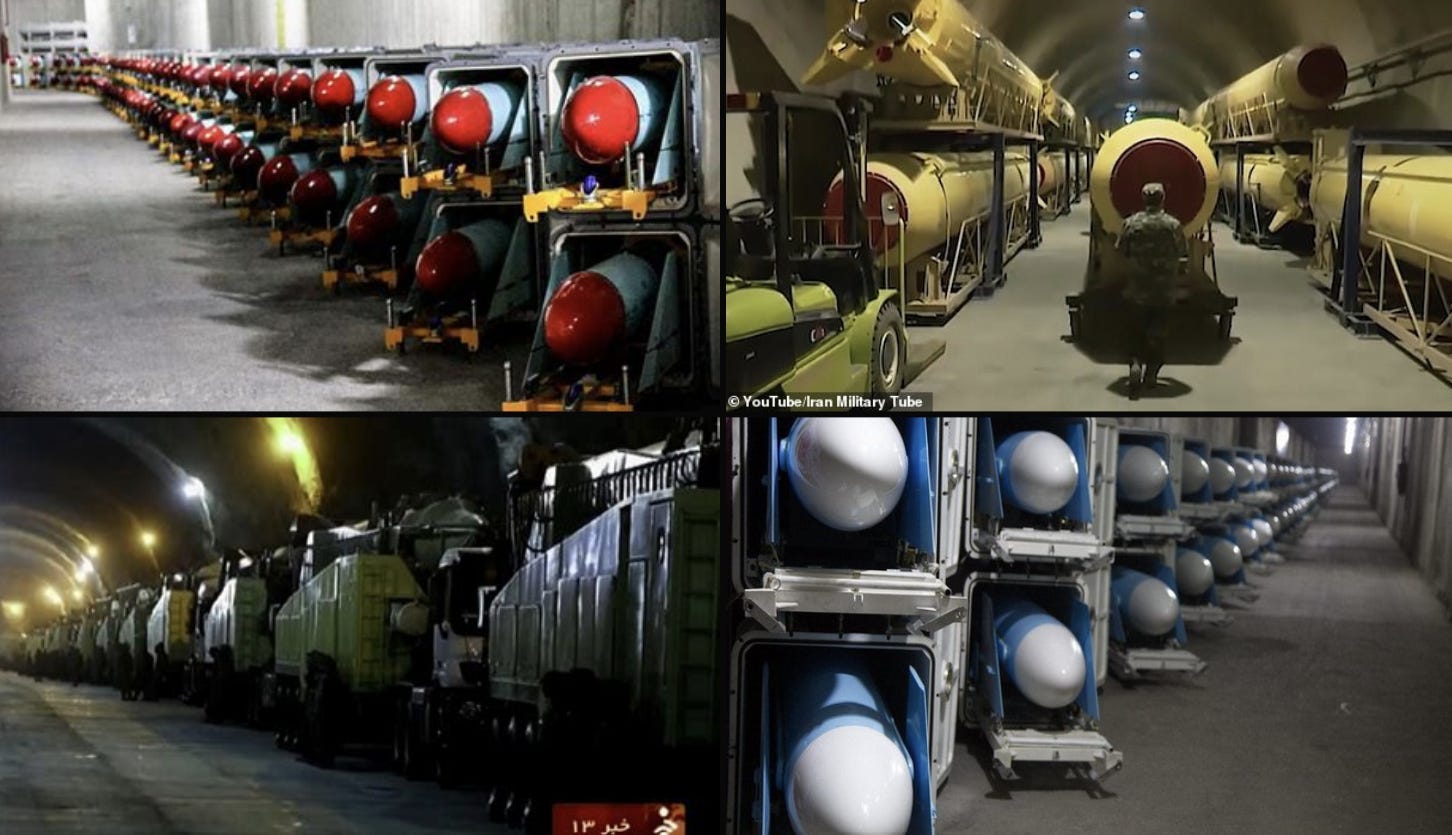
Iranian Missiles
It is also not known with precision how many missiles and drones of various types Russia possesses. But it is reasonable to assume that their “magazine depth” is considerably larger — and exceedingly more potent — than that of Hezbollah and Iran combined.
Even more importantly, the Russians have, over the course of the war in Ukraine, demonstrated an unprecedented capability to routinely shoot down the best strike missiles the US and its NATO vassals have been able to launch against them.
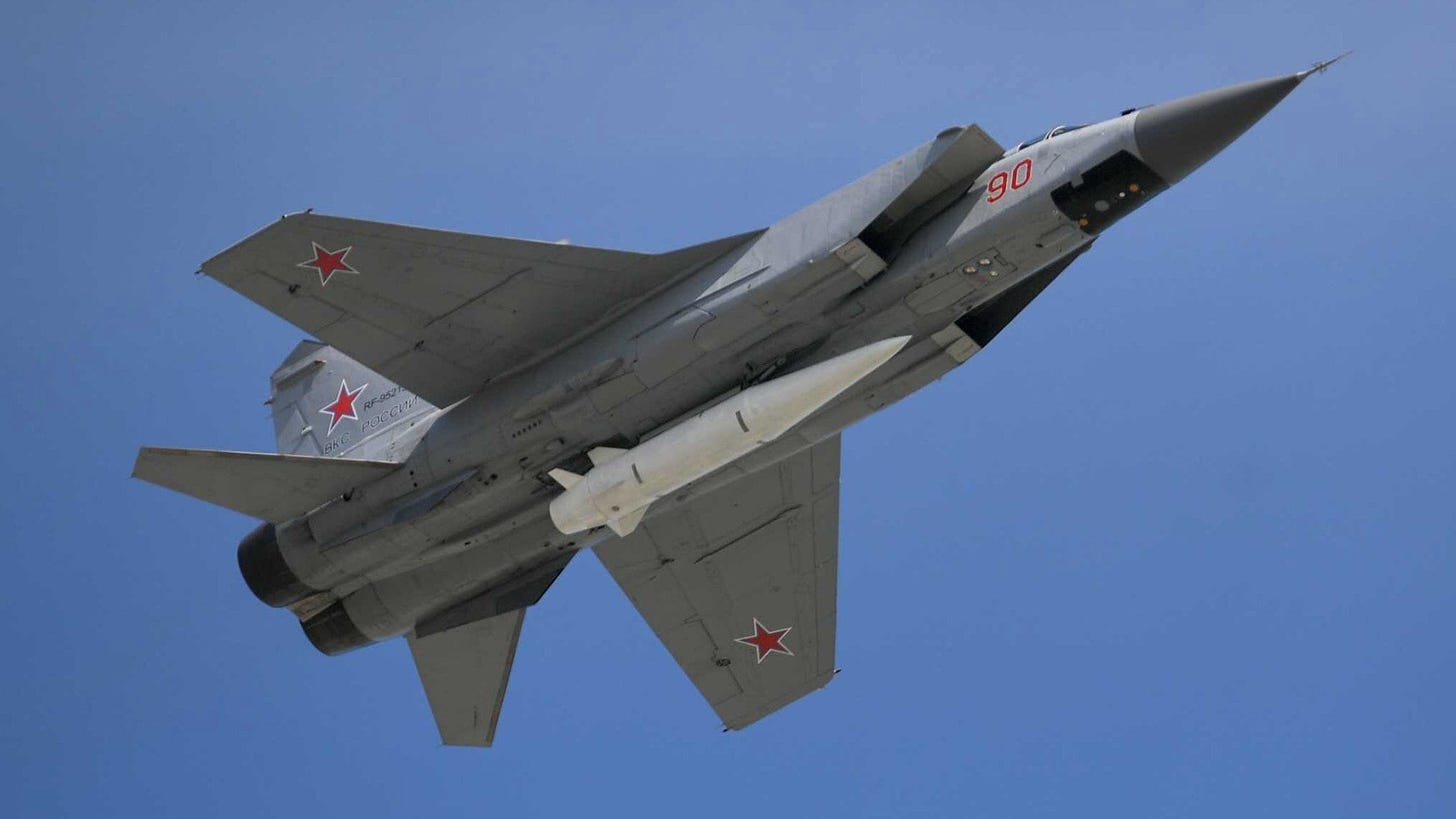
Russian MiG-31 Carrying a Hypersonic Kinzhal Missile

Russian Avangard Hypersonic Missile
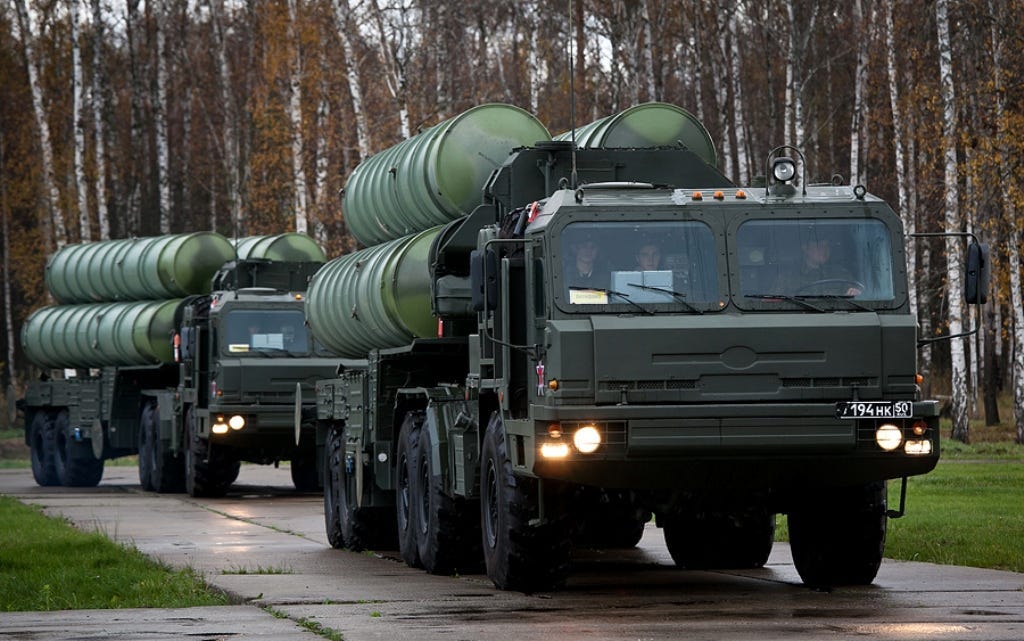
Russian S-400 Air Defense System
Lastly, it is not known with precision how many missiles and drones of various types China possesses. But it is reasonable to assume that their “magazine depth” is at least an order of magnitude larger than Hezbollah, Iran, and Russia combined.
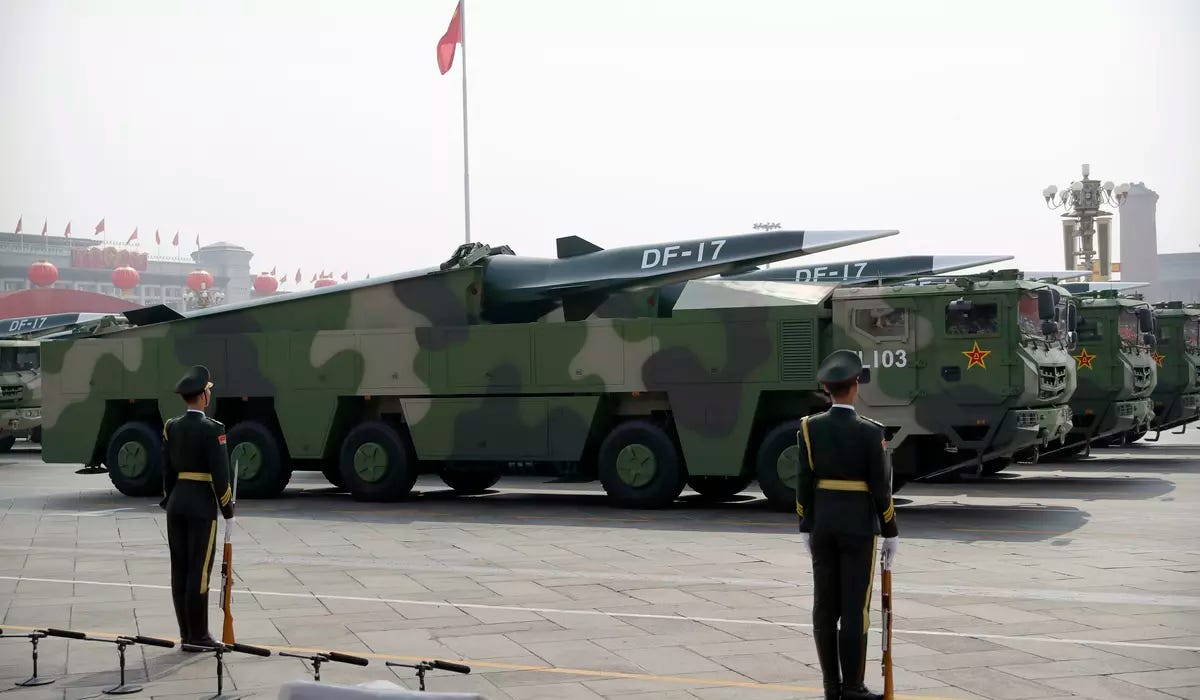
Chinese DF-17 Hypersonic Missiles
Of course, I’ve not yet made any mention of North Korea, who has now been formally received into the Russia, China, Iran mutual-defense partnership. People love to mock Kim Jong-Un and his people, but the empire underestimates them at their peril.
The Israelis can talk tough about making war against Hezbollah and its friends, but if they actually attempt it, it will end very, very badly for them.
The Americans and their almost laughably impotent allies can talk tough about making war against Russia or China, but if they actually attempt it, it will end catastrophically for them.
Then we’ll really have a dangerous situation on our hands.
Israel targets US public with massive propaganda campaign: Report
The Cradle | June 24, 2024
Israel is covertly funding a massive propaganda campaign to target the US public, including through the passage of legislation to restrict US citizens’ right to free speech when criticizing Israel and its ongoing war on Gaza, The Guardian reported on 24 June.
The UK newspaper reported that there are 80 programs already underway as part of the massive propaganda campaign known as the “Voices of Israel.”
The program is funded and run by the Israeli Ministry of Diaspora Affairs, led by MK Amichai Chikli.
The program was designed to carry out what Israel calls “mass consciousness activities” targeting the US and European public.
Voices of Israel is part of the “latest incarnation” of a “sometimes covert operation” by the Israeli ministry to censor students, human rights organizations, and other critics of Israel.
Known previously as “Concert” and before that, “Kela Shlomo,” the campaign previously spearheaded efforts to pass so-called “anti-BDS” state laws that penalize Americans for engaging in boycotts or other non-violent protests of Israel.
Voices of Israel works through non-profits and other entities that often do not disclose donor information. From October through May, the campaign spent about $8.6 million to target US citizens with pro-Israel propaganda.
The Institute for the Study of Global Antisemitism and Policy (ISGAP) is one such organization receiving funding through the Israeli program.
The ISGP cited its success during congressional hearings in which Claudine Gay, the president of Harvard University, was grilled for allowing pro-Palestinian protests on campus.
Congresswoman Elise Stefanik confronted Gay during the hearing, accusing her of fostering antisemitism at Harvard. The confrontation was widely viewed on social media.
Gay, the prestigious university’s first African-American president, soon resigned amid the resulting negative media coverage. She was replaced as interim president by Jewish-American professor and Harvard provost Alan Garber.
The Guardian reported further that the ISGAP touted its “congressional public relations coup” at a 7 April Palm Beach Country Club event.
“All these hearings were the result of our report that all these universities, beginning from Harvard, are taking a lot of money from Qatar,” bragged Natan Sharansky, the ISGAP chair. Sharansky, a former minister of Diaspora Affairs, told the assembled supporters that 1 billion people had viewed Congresswoman Stefanik’s aggressive questioning of Harvard president Gay.
The ISGAP has also been deeply involved in the campaign to limit US citizens’ Second Amendment right to free speech by passing laws at the state and local levels that redefine antisemitism to include certain criticisms of Israel, The Guardian added.
The ISGAP lobbies governments to adopt the International Holocaust Remembrance Alliance (IHRA) definition of antisemitism, which equates criticism of Israel as a ‘racist endeavor’ and anti-Zionism with antisemitism.
“We shifted the focus to work at the local level,” said Brig Gen Sima Vaknin-Gill, a former intelligence officer now managing director of the ISGAP.
“We’ve found that mayors and states – it’s much easier to work with them and actually make the definition into something real.”
Another US group tied to Voices of Israel and the Ministry of Diaspora Affairs campaign is CyberWell, a pro-Israel “anti-disinformation” group led by former Israeli military intelligence and Voices officials. CyberWell established itself as an official “trusted partner” to TikTok and Meta, allowing it to help screen and edit content.
A recent CyberWell report called for Meta to suppress the popular slogan “From the river to the sea, Palestine will be free.”
The Guardian notes, “One struggles to find a parallel in terms of a foreign country’s influence over American political debate.”
US-based organizations producing propaganda or lobbying to influence US citizens are required by law to register as foreign agents.
However, none of the groups identified in The Guardian’s report have registered under the Foreign Agents Registration Act (FARA).
“There’s a built-in assumption that there’s nothing at all weird about viewing the US as sort of an open field for Israel to operate in, that there are no limitations,” said Lara Friedman, president of the Foundation for Middle East Peace.
GMO: Famine is worsening in Gaza
Palestinian Information Center – June 25, 2024
GAZA – The Government Media Office (GMO) in Gaza warned that famine is seriously worsening in the Gaza Strip, especially in Gaza City and North Gaza governorates.
The GMO Director-General, Ismail Thawabta, said in a press conference in Gaza on Monday that the humanitarian conditions have seriously deteriorated across the Gaza Strip, especially following the inhumane US and Israel’s decision to “prevent the entry of food and medicine.”
He pointed out that this comes within the framework of the genocidal war against civilians in the Gaza Strip, stressing that famine directly threatens the lives of citizens, which portends a rise in the death toll due to hunger.
About 3,500 children are currently facing the dire threat of death in Gaza due to malnutrition and the lack of essential nutritional supplements, he highlighted.
“The specter of famine looms larger each day, with a grim forecast of increased fatalities resulting from hunger,” Thawabta said.
He pointed out that “for 49 days, the Israeli occupation army has been preventing 25,000 sick and wounded people from traveling to receive treatment abroad, after it took over the Rafah border crossing with Egypt,” stressing that Israel’s control over the Rafah crossing has significantly impacted the wounded people’s access to essential medical care.
He underlined that 700,000 people endure daily famine conditions due to Israel’s obstruction of aid entry, leaving approximately 15,000 trucks stranded at border crossings, exacerbating the crisis.
Thawabta stressed that this heartbreaking reality underscores the urgent need for action to prevent further suffering and loss of life.
He charged the US administration and the Israeli occupation authorities for this catastrophic situation in Gaza, saying, “The people of the Gaza Strip are facing death as a result of famine and the starvation policy pursued by Israel and the US administration.”
The floating pier built by the United States did not do anything to stop the famine in the northern Gaza Strip, he added.
The GMO director launched a distress call to the international community, international organizations, all countries of the free world, and the Arab and Muslim countries, to intervene in order to protect the Palestinian people, who are being subjected to genocide.
Featured Video

Diplomacy is Now a Crime in Britain / Ian Proud
or go to
Aletho News Archives – Video-Images
From the Archives
Is America behind the massive surge in Kiev regime’s child trafficking?
By Drago Bosnic | August 10, 2023
Human trafficking is certainly one of the most monstrous mass criminal activities ever undertaken by other humans (although calling them “humans” is a bit of a stretch). And yet, there’s a special kind of this deeply repulsive crime that pushes it to diabolical proportions – child trafficking. Underage kids, particularly those who were abandoned, sold or have very poor/abusive family backgrounds, are by far the most vulnerable group. The depraved criminals who engage in such illicit activities specifically target unfortunate children and given there are millions of them all around the globe, particularly in war-torn areas, the “recruitment pool” is effectively endless. Unfortunately, the demand on the black market also seems to be constant and growing, making it a very lucrative and appealing prospect for criminals. … continue
Blog Roll
 Aletho News
- Diplomacy is Now a Crime in Britain / Ian Proud
- UK Government Body Kept Files on People Criticizing Prevent Program
- US military withdrawal from Iraq and the collapse of US-Israeli hegemonic project in West Asia
- What does Europe want – a war with Russia?
- She Followed the Actual Data on COVID Vaccines and Masks — Her Career Took a Huge Hit
- Florida AG Sues Pfizer, Bourla Over Deceptive Marketing of COVID Vaccines
- Von der Leyen gifts her spin doctor a job for life
- 10K More U.S. Troops Deploy as Trump Weighs New Iran Strikes /Suliaman Ahmed
- Iranian crew declared Dena training vessel ‘unarmed’ to US warship before deadly torpedo strike: Report
- Iran’s NPT debate moves beyond parliament
- If Americans Knew
- Israel is squeezing the life out of Palestinians – Daily Update
- The Israeli Right Portrays Islam as Murderous. It Serves a Political Purpose
- Jordan Has Had Enough: King Abdullah’s Scathing Warning to Israel
- Israeli Colonizers (i.e. Settlers) Kill Palestinian Man Near Salfit
- New Google Maps images reveal massive scale of devastation in Gaza
- Jewish supremacy, anti-Palestinian bigotry on display in Israel – Daily Update
- Israeli Soldiers Abduct At Least 22 Across Occupied West Bank
- Eight Palestinians Killed in Israeli Attacks on Gaza
- Israeli former leaders and security chiefs threaten legal action over ‘Jewish terrorism’
- Israel map in LA Times ad includes all land from the river to the sea
- No Tricks Zone
- Green Energy Debacle: German Expert Professor Fritz Vahrenholt Warns Of Severe Economic And Social Consequences
- Two More Paleo Reconstructions Affirm Meters-Higher Sea Levels Across Ireland, Brazil 7000-6000 Years Ago
- New Study: Earth And Venus Surface Warmth Largely Explained By Convection And Lapse Rate, Not CO2 Or Radiation
- 2025 Nature Paper Claiming Worsening Global Drought Gets RETRACTED …Heavily Flawed
- New Study: ‘Global Drought Shows No Detectable Recent Acceleration Under Climate Warming’
- Economic Masterminds: German Socialists Suggest Taxing Productivity Gains Stemming From Using AI
- The South China Sea Has Not Been Cooperating With The Climate Change Narrative
- Energy Crisis: Germany Enters Heating Season With Historically Low Gas Reserve Fill Levels
- New Study: The Antarctic Ice Sheet Gained Mass From 2020-2024 Due To Staggering Snow And Ice Accumulation
- Study: Ocean Heating Rates From Thousands Of Years Ago ‘Dwarf’ Modern Ocean Heating Rates

