GMO: Famine is worsening in Gaza
Palestinian Information Center – June 25, 2024
GAZA – The Government Media Office (GMO) in Gaza warned that famine is seriously worsening in the Gaza Strip, especially in Gaza City and North Gaza governorates.
The GMO Director-General, Ismail Thawabta, said in a press conference in Gaza on Monday that the humanitarian conditions have seriously deteriorated across the Gaza Strip, especially following the inhumane US and Israel’s decision to “prevent the entry of food and medicine.”
He pointed out that this comes within the framework of the genocidal war against civilians in the Gaza Strip, stressing that famine directly threatens the lives of citizens, which portends a rise in the death toll due to hunger.
About 3,500 children are currently facing the dire threat of death in Gaza due to malnutrition and the lack of essential nutritional supplements, he highlighted.
“The specter of famine looms larger each day, with a grim forecast of increased fatalities resulting from hunger,” Thawabta said.
He pointed out that “for 49 days, the Israeli occupation army has been preventing 25,000 sick and wounded people from traveling to receive treatment abroad, after it took over the Rafah border crossing with Egypt,” stressing that Israel’s control over the Rafah crossing has significantly impacted the wounded people’s access to essential medical care.
He underlined that 700,000 people endure daily famine conditions due to Israel’s obstruction of aid entry, leaving approximately 15,000 trucks stranded at border crossings, exacerbating the crisis.
Thawabta stressed that this heartbreaking reality underscores the urgent need for action to prevent further suffering and loss of life.
He charged the US administration and the Israeli occupation authorities for this catastrophic situation in Gaza, saying, “The people of the Gaza Strip are facing death as a result of famine and the starvation policy pursued by Israel and the US administration.”
The floating pier built by the United States did not do anything to stop the famine in the northern Gaza Strip, he added.
The GMO director launched a distress call to the international community, international organizations, all countries of the free world, and the Arab and Muslim countries, to intervene in order to protect the Palestinian people, who are being subjected to genocide.
Hamas slams Biden regime for political, military support of Israel’s Gaza genocide
Press TV – June 25, 2024
Hamas says US President Joe Biden’s administration is responsible for the genocidal campaign in the Gaza Strip.
The Palestinian resistance movement said Washington continues to lend political and military support to Israel to carry out further destruction and carnage in the besieged territory.
In a statement released on Tuesday, the Gaza-based resistance movement also lamented the death of family members of Ismail Haniyeh, the head of the Hamas political bureau, including his sister, in an Israeli airstrike on their home in western Gaza City.
“We in the Hamas movement hold the Biden administration accountable for the unrelenting genocide war against our Palestinian brethren and sisters in the Gaza Strip, as it continues to offer the Zionist regime and its criminal army unconditional political and military support to press ahead with its destruction and genocide in the Strip,” the statement read.
“In light of the continuation and escalation of these horrific massacres, we call on Arab and Muslim nations as well as freedom-loving people of the world to step up their actions, and push for an end to the aggression.”
Hamas urged the international community and the United Nations to assume responsibility for the crimes of Israel in Gaza, protect innocent civilians, and hold the leaders of the terrorist Zionist regime accountable for their crimes.
One of the sisters of Haniyeh was killed in Gaza City’s Shati refugee camp on Tuesday morning.
Palestinian sources say an airstrike on a building belonging to Haniyeh’s extended family claimed the lives of 13 people.
Earlier in April, Israel had targeted and killed three of Haniyeh’s sons, along with four grandchildren — three girls and a boy.
Israel launched the atrocious onslaught on Gaza, targeting hospitals, residences, and houses of worship after Palestinian resistance movements conducted surprise Operation al-Aqsa Storm against the usurping regime on October 7, 2023.
Israel has killed more than 37,650 Palestinians, most of them women and children, and injured nearly 86,240 in Gaza since that October day.
More than 1.7 million people have also been internally displaced.
Hamas Insists on Russia Being One of Gaza Ceasefire Guarantors
Sputnik – 25.06.2024
MOSCOW – The Palestinian movement Hamas insists that Russia should be one of the guarantors of the ceasefire in the Gaza Strip, Hamas political bureau deputy head Musa Abu Marzouk told Sputnik.
“We still insist that Russia be the guarantor of such a ceasefire agreement, because obviously the United States is on the side of Israel … Russia’s position is fairer, more acceptable to all sides, and it is ready to act in this direction. We want to put an end to the hegemony of the United States and its one-sided influence on the Palestinian issue,” Marzouk said.
There is no progress in negotiations on a ceasefire agreement in the Gaza Strip, and Palestinian movement Hamas has not received a response to its amendments to the text of the document, Marzouk said.
“The efforts of our friends in Qatar are continuing, they are trying to break the freeze on the process, but there is no progress … We have made several changes that Israel has not agreed to. Therefore, they remained unanswered,” Marzouk said.
Hamas does not ask Russia for military assistance, Hamas political bureau deputy head Musa Abu Marzouk added.
“No, we did not ask for military assistance. The war is going on in Gaza, Gaza is producing its own weapons for close combat, and, so far, we believe that we can manage on our own for this kind of fighting,” Marzouk said.
Marzouk has arrived in Russia for meetings at the Russian Ministry of Foreign Affairs.
Malaysia Defies Western Sanctions on Iran
Malaysia only recognizes sanctions imposed by the United Nations and not by any individual country, Home Minister Datuk Seri Saifuddin Nasution says.
By Nguyen Kien Van – New Eastern Outlook – 25.06.2024
On May 16, a US delegation led by Brian Nelson, the Under Secretary of the Treasury for Terrorism and Financial Intelligence, visited Kuala Lumpur to discuss sanctions against Iran. The US accuses Iran of using Malaysian companies to finance militants in the Middle East.
What do we know about US accusations against Iran?
The US claims that trade between Malaysia and Iran has skyrocketed since the outbreak of the armed conflict between Israel and Hamas. Western nations allege that Iran financially supports Hamas and Hezbollah, opponents of Israel. The US highlighted the death of over 3,000 Israelis since October 7, 2023, in the ongoing conflict. 30,000 Palestinians killed in the Gaza Strip, however, do not seem to bother the US at all. Instead, the focus remains on Iran and its proxies, including Hamas, allegedly receiving funds through the Malaysian financial system.
The US is concerned that Iran can continue selling oil by transferring it from ship-to-ship in international waters to disguise its origin. Countries that do not adhere to US sanctions, or choose to ignore them, facilitate this process. Brian Nelson identified Malaysia as one such country, allegedly involved in transporting Iranian oil and raising funds for groups the US deems terrorist organizations.
What do Malaysian officials think in this regard?
Following the meeting with the US delegation, Malaysian officials reiterated that they would not comply with sanctions imposed by any country other than those from the UN Security Council. Home Minister Datuk Seri Saifuddin Nasution Ismail emphasized Malaysia’s commitment to combating terrorism financing. He acknowledged the US concerns about “illegal supplies” of Iranian oil through Malaysia, but reiterated Malaysia’s stance on adhering only to UN-imposed sanctions. The US delegation respectfully accepted Malaysia’s position.
Solidarity Among Muslim Countries
Malaysia, a Muslim-majority country, has consistently supported a two-state solution to the Israel-Palestine conflict and condemned Israel’s actions, which have resulted in numerous Palestinian casualties. Malaysia backed Iran’s use of drones and missiles against Israel on April 13, with Prime Minister Anwar Ibrahim calling it a legitimate response to Israel’s “barbaric attack” on the Iranian consulate in Damascus.
Back to Kuala Lumpur Airport
By the end of the meeting, the US delegation appeared to recognize their failure to sway Malaysia. Saifuddin Nasution Ismail reaffirmed Malaysia’s commitment to counter-terrorism financing at both ASEAN and global levels, stressing Malaysia’s adherence to the rule of law and expressing hope that the US would acknowledge this.
Once again, US efforts to intimidate Malaysia with sanctions over its economic relations with Iran have faltered, highlighting Washington’s persistent hegemonic ambitions. If other Southeast Asian nations were to similarly defy US pressure, ASEAN could emerge as a robust and independent force in the region.
US condemned for attempting to sow discord between China and Russia, North Korea
Global Times | June 24, 2024
Experts have rebuked the US for trying to sow discord between China and Russia, and North Korea, noting that the closer relationship between the two Chinese neighbors is based on current realities, as their mutual support can break through Western blockades.
The remarks came after US Air Force General C.Q. Brown, chairman of the Joint Chiefs of Staff, told reporters during an overseas trip on Sunday that the newly-signed strategic partnership agreement between Russia and North Korea could create friction with China, according to Reuters.
Reuters, citing anonymous analysts, claimed the pact, signed on Wednesday, “could undercut Beijing’s leverage over its two neighbors and any heightened instability could be negative for China’s global economic and strategic ambitions.”
Chinese experts refuted the claims.
“In fact, China is pleased to see strengthening friendly cooperation between these two neighboring countries,” said Lü Chao, an expert on the Korean Peninsula issue at the Liaoning Academy of Social Sciences. He believes the mutually supportive ties between Russia and North Korea are expected to contribute to regional security and the peace and stability of Northeast Asia.
China’s relations with both Russia and North Korea share a common goal of maintaining peace and stability in Northeast Asia, and their comprehensive cooperation is reasonable, Lü said.
The top leaders of the Democratic People’s Republic of Korea (DPRK) and Russia signed the Treaty on Comprehensive Strategic Partnership following their summit in Pyongyang on Wednesday, the Xinhua News Agency reported Thursday.
Russia and North Korea have agreed on mutual support in the event of external aggression, Russian media reported on Wednesday, citing Russian President Vladimir Putin. Russia does not rule out military-technical cooperation with North Korea in accordance with a newly signed comprehensive strategic partnership agreement, RIA Novosti reported, citing Putin at a press briefing following talks with North Korea’s top leader Kim Jong Un in Pyongyang.
In response to the development, Lin Jian, a spokesperson for the Chinese Foreign Ministry, said at a Thursday press conference that “the agreement between the DPRK and Russia is related to their bilateral cooperation. I have no comment on it.”
The closer relationship between North Korea and Russia is based on current realities, Chinese experts pointed out.
Currently, both Russia and North Korea face severe pressure from the US-led Western clique, including economic sanctions. In this situation, it is natural for the two countries to come together, especially since they have mutually beneficial aspects, such as Russia’s assistance in energy and food supplies to North Korea, according to Lü.
At the same time, some US and other Western politicians and media outlets are hyping “some kind of military alignment or military bloc” in Northeast Asia.
Such rumors also were debunked by Chinese experts.
The US is determined to implement its so-called Indo-Pacific Strategy in the region, creating a camp confrontation mentality, they said.
“China opposes any trend towards regional camps. But the US is fabricating this division,” Lü remarked.
He warned that the Western portrayal of a camp formation could further exacerbate tensions on the Korean Peninsula.
The expert explained that China has always advocated a fair and just stance on the Korean Peninsula issue, maintaining a fair and just position towards both North and South Korea, which has been widely recognized.
Lin said that on the Korean Peninsula issue, China’s position is consistent. “We always believe that upholding peace and stability on the Peninsula and advancing the political settlement of the Peninsula issue serve the common interests of all parties and hope various parties will make constructive efforts to this end,” Lin said.
Plan to establish US Marine regiment in Guam ‘to escalate camp confrontation, stir up regional tensions’
Global Times | June 23, 2024
The US Marines plan to deploy to Guam a littoral regiment capable of a flexible and rapid response in a “few years,” media revealed on Saturday, which Chinese observers said is aimed at preparing for great power competition, blatantly exposing the US’s combat intentions against China.
On Saturday, Japanese media outlet Kyodo News reported that General Eric Smith, commandant of the US Marine Corps, told a press conference in Washington that the Marine Littoral Regiment is “designed as a counter to PRC aggression,” to protect Japan, South Korea and the Philippines.
Smith said the regiment, due to be based on Guam, “will have responsibility to rapidly deploy inside the first island chain into the Philippines in order to spread the battlespace out and to protect those strategic lines of communication that emanate from Japan, back to the Philippines, back to Hawaii.”
The island chain refers to an area that includes Japan as well as the island of Taiwan and the northwest Philippines.
In the event of potential conflicts with China, such as China advancing its cause of national reunification, or conflicts erupting between China and the Philippines or Japan over territorial disputes, the US may use these deployments to strike against China, Chinese observers noted.
“This demonstrates the US’ relentless preparation to compete with China, with a clear Cold War mentality,” Zhang Junshe, a Chinese military expert, told the Global Times on Sunday.
The plan to establish a littoral regiment in Guam again demonstrated that the US is engaging in camp confrontation, seeking to rally countries like Japan and the Philippines, as well as to strengthen its control over these allies through military deployments and cooperation, enticing them to join the US’ chariot and making these countries work for its anti-China strategy, Zhang said.
This will undoubtedly add fuel to the fire and stir up regional tensions, Zhang warned, noting that the US wants to benefit from the chaos, such as selling more military equipment.
Kyodo reported that the new regiment in Guam will be the third of its kind that is capable of long-range detection and engagement using mobile missile batteries, as well as deploying small groups of marines to remote islands. The first unit was activated in March 2022 on Marine Corps Base Hawaii and the second was set up in Okinawa in November last year.
This exposed the US attempt to adopt a strategy of dispersion of its military forces, as the commandant of the US Marine Corps confirmed that the relocation of US Marines from Okinawa to Guam will begin in December.
Some observers believe that the US military forces’ shift from Okinawa to Guam is a strategic retreat, indicating a lack of security in Okinawa.
But Zhang sees it differently.
“Strategically, the US military is not retreating from Okinawa; it may withdraw its forces, but some weapons and firepower will remain in place. On the one hand, the US is instigating conflicts, while on the other hand, it does not want its forces to suffer losses. Therefore, it is pushing countries like the Philippines and Japan to be firmly tied to its warship as cannon fodder,” Zhang remarked.
Zhang also revealed the ongoing competition between the US Army and the Marine Corps for roles, funds and functions. He noted that the deployment of these assets is not actually the Marine Corps’ expertise, but should instead be a focus of the US Army.
The US Marine Corps primarily focuses on amphibious operations, but now there is a need for the corps to undergo a tactical transformation toward littoral operations, emphasizing land-sea integration. This in itself will bring about significant changes to the Marine Corps’ functions, which presents a considerable challenge, said another Chinese military expert, who requested anonymity.
If the Marine Corps insists on transformation, these disputes with the US Army will intensify, making the regiment’s implementation more challenging, some military experts warned. They believe that in reality, it is impractical for the regiment to target China.
Pentagon has ‘nothing to say’ about strike on Crimean beach with US-supplied weapons
RT | June 24, 2024
The Pentagon has refused to comment on the deadly Ukrainian cluster munition attack on a crowded beach in Sevastopol, Russia on Sunday, RIA Novosti has reported. The Ukrainian attack carried out with US-supplied ATACMS missiles killed at least four people, among them two children, and injured 151, according to local officials.
Four missiles were intercepted by air defenses, while a fifth deviated from its trajectory and detonated its cluster warhead over the busy Black Sea beach, the Russian Defense Ministry said in a statement on Sunday.
When RIA asked the Pentagon about the use of US supplied weapons in the strike on Sunday, an official replied, “we have seen the reports and have nothing to say.”
Moscow has placed the blame primarily with Washington, accusing it of enabling the “premeditated terrorist missile attack.” The targets for these US-provided missiles are assigned to Ukrainian troops by American specialists, based on their own intelligence data, the Defense Ministry stated.
According to data from the flight tracker Flightradar, a US RQ-4B Global Hawk reconnaissance drone was patrolling in the Black Sea south of Crimea during the Ukrainian missile strike.
The number of people injured in the strike stood at 151 as of Sunday night, according to Sevastopol’s governor, Mikhail Razvozhaev. A joint team of specialists from the Health Ministry’s Federal Center for Disaster Medicine arrived in the city to work with the victims, he wrote early Monday.
Kiev deliberately chooses mass gatherings of people as targets, both out of hatred and to sow panic, Russian Foreign Ministry spokeswoman Maria Zakharova said following the attack. The day of the Holy Trinity holiday was picked deliberately, she claimed.
Ukraine has previously targeted the Crimean Peninsula with US-provided ATACMS missiles. In May, ten ATACMS were shot down on a trajectory aimed at the strategic Crimean Bridge, Russian Defense Minister Andrey Belousov said at the time.
Max Blumenthal: ‘TARGETED FOR EXPOSING ISRAEL’S LIES’- The Washington Post Attacks The Grayzone
Afshin Rattansi’s Going Underground | June 21, 2024
Catching Up To Germany, The “Climate Leader”
By Francis Menton | Manhattan Contrarian | June 15, 2024
Here in New York, our leaders fancy us to be the “climate leader.” After all, our legislature has enacted the “Climate Leadership and Community Protection Act” of 2019, setting out the most aggressive mandatory emissions-reduction targets of all the U.S. states. Allegedly, 70% of our electricity will come from “renewables” by 2030. Nobody can top us!
But can we really catch up to Germany? Germany was in the “climate leadership” game before almost anybody else had even heard of it. It was all the way back in 1990 that Germany adopted its first emissions-reduction target — 25 to 30 percent fewer CO₂ emissions by 2005, compared to 1987 levels. In 2000, while New York was still in its climate diapers, Germany passed its Renewable Energy Act, granting large subsidies for the development of wind farms. In 2010 Germany adopted its “Energiewende” legislation with mandatory emissions-reductions targets of 80-95% by 2050. All along, the country has been on a crash program to build wind turbines and solar panels for well over 30 years.
So sorry, New York. Germany is the true “climate leader.” Perhaps we should check in on how it is going over there.
In a piece on January 3, Reuters provided the statistics from Germany for the most recent full year, 2023. The headline is “Renewable energy’s share on German power grids reaches 55% in 2023.”
The share of renewables on Germany’s power grids rose by 6.6 percentage points to 55% of the total last year, the sector’s regulator said on Wednesday, as Europe’s largest economy moves closer to its 2030 target. . . [of] 80% of its [electricity generation].
The achievement elicited some self-congratulatory happy talk from Environment Minister (and Green Party member) Robert Habeck:
“We have broken the 50% mark for renewables for the first time,” Economy Minister Robert Habeck said in a statement. “Our measures to simplify planning and approvals are starting to take effect.”
Read a little farther, though, and you find out that only 43.2% of the 55% came from wind and solar generators. Most of the rest (8.4%) came from “biomass,” otherwise known as wood chips imported from the U.S. — probably not what you were thinking of as the supposedly emissions-free “renewables.” (The remaining 3+% consists of hydro and some unspecified “other renewables.”).
Perhaps you are wondering, despite Habeck’s happy talk, how can it be that after 30+ years of a crash program, with enormous subsidies, to build wind and solar generators to provide electricity, Germany is only up to getting 43% of its electricity from those sources? Is there maybe some problem? If you are wondering about those things, you will not find the answer here.
And then there’s the question of whether a huge build-out of wind and solar electricity generation might have any collateral consequences for a modern industrial economy. For example, might wind and solar generation be more expensive than electricity generation by fossil fuels? Here are the latest consumer electricity price data from Eurostat, covering the second half of 2023. Key quote:
For household consumers in the EU (defined for the purpose of this article as medium-sized consumers with an annual consumption between 2 500 Kilowatt hours (KWh) and 5 000 KWh), electricity prices in the second half of 2023 were highest in Germany (€0.4020 per KWh), Ireland (€0.3794 per KWh), Belgium (€0.3778 per KWh) and Denmark (€0.3554 per KWh).
Somehow, great “climate leader” Germany has the very highest consumer electricity prices in all the EU. The 40.2 euro cents per kWh is equivalent to 43 U.S. cents at the recent exchange rate of 1.07. The latest data from the U.S. EIA gives the average U.S. consumer electricity price as 16.68 cents per kWh for March 2024. That makes the German electricity price more than two and a half times the U.S. price.
Aren’t wind and solar generation supposed to be cheaper than fossil fuels? Somehow that doesn’t seem to be working out. Perhaps it has something to do with the fact that no matter how much wind and solar you build, you can’t get rid of any of the fossil fuel generators, because you need them all for backup of intermittency. So you end up paying for two redundant systems.
Then there is the effect of high energy prices on economic growth. How’s that going in Germany? Here’s a February 23 report from Euronews, with the statistics from Germany for the 2023 year:
Year-on-year GDP growth was -0.2% in Q4 2023, a notch better than Q3 2023’s -0.3% and also in line with market expectations. For the full year 2023, Germany’s GDP shrank 0.3%.
U.S. GDP growth for 2023 was reported as 2.5% by the Bureau of Economic Analysis.
A guy named Theodor Weimer, head of the Deutsche Börse, gave a speech in April to a group of Bavarian business leaders. The speech became public when it was released on YouTube last week, and it was then covered by the Telegraph. Key quote:
The coalition government led by Chancellor Olaf Scholz was, [Weimer] argued, a “catastrophe,” Germany was “economically on the way to becoming a developing country” and “one thing is clear: our reputation in the world has never been so bad.”
And finally, in the European elections just held last week, the German Green Party has been reported one of the biggest losers, going from 21 seats to just 12, a loss of 9, or almost half of the prior total.
Well, maybe being the “climate leader” is not so great after all. At least, maybe, the people are starting to catch on. Here in New York, it will take a while longer.
Hey, Jim Jordan: Ask Fauci Who His Bosses Were!
To get to the bottom of Covid censorship, we must understand who was in charge of the global pandemic response.

llustration by Anthony Freda
By Debbie Lerman | June 13, 2024
As recently reported by Reclaim the Net, Anthony Fauci is being called to testify by House Judiciary Committee Chairman Jim Jordan for his “alleged role in the Biden White House’s censorship initiatives.”
Right away a glaring issue emerges: The censorship of dissenting COVID narratives started all the way back in late January-early February 2020, with Fauci implicated in the censorship as early as February 2, 2020. The Committee tacitly acknowledges this by requesting documents dating back to 2019, even as it frames the inquiry politically as a “Biden Administration censorship” problem.
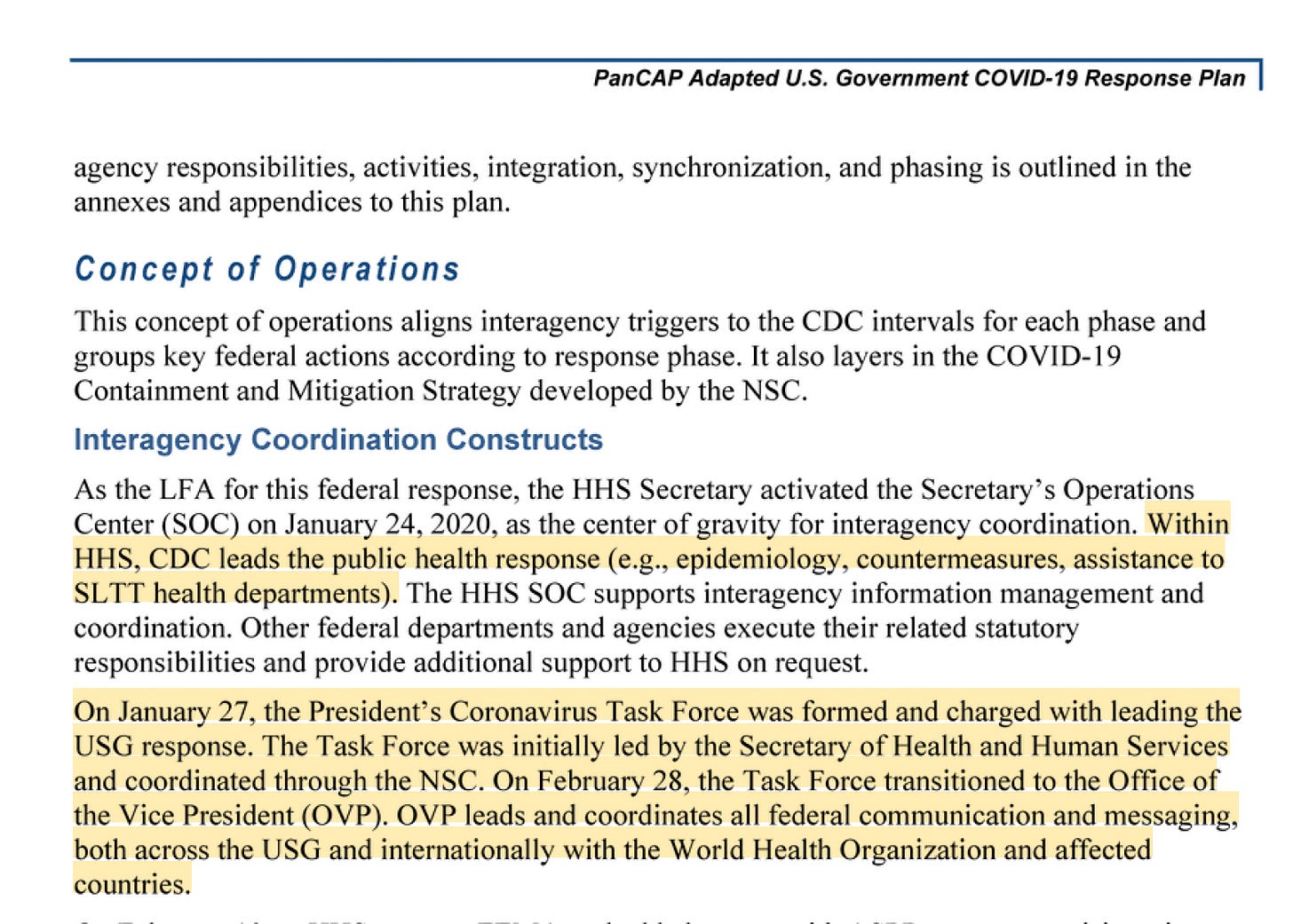
In fact, the entire disastrous, unscientific lockdown-until-vaccine pandemic response was initiated and insidiously perpetrated by the Task Force, which was housed in the Trump White House, in the Office of the Vice President (OVP).
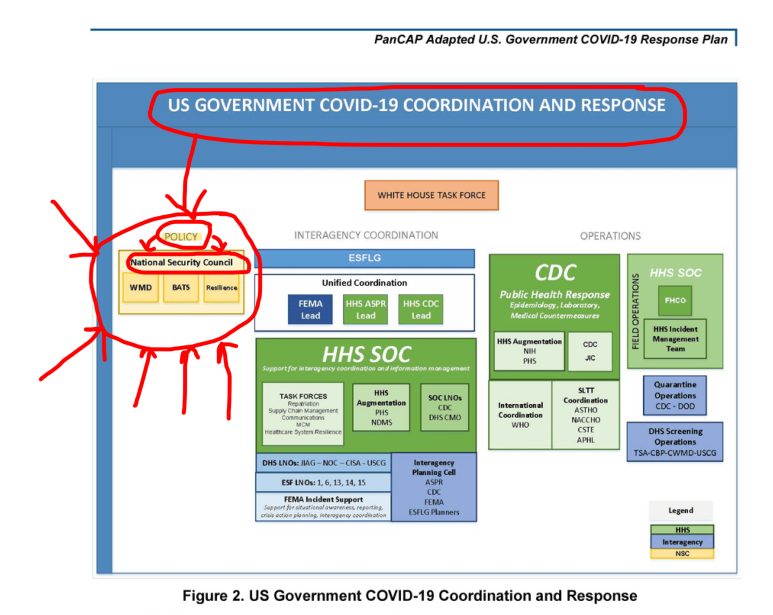
The group responsible for pandemic policy within the Task Force was not HHS or NIAID, where Fauci worked, or any other public health agency. It was the National Security Council (NSC).
All communications about Covid had to go through OVP/NSC.
We know from the Twitter files and subsequent investigations that the Intelligence Community (FBI, CIA, DHS, CISA) was heavily involved in censoring Americans on many issues, starting at least as far back as 2016. Foreign military/intelligence agencies of allied countries collaborated on censoring the U.S. population.
So if anyone is truly interested in who initiated and enforced censorship of dissenting Covid voices, they should ask the following questions of Fauci under oath:
We know from official government documents that Covid pandemic policy was set by the National Security Council (NSC), NOT the public health agencies. But who exactly on the NSC was in charge? Who wrote the policy?
- Dr. Fauci: Did you participate in crafting the pandemic response policy with the National Security Council, including censorship of dissenting views?
Why were Covid meetings classified?
On March 11, 2020 Reuters reported that “The White House has ordered federal health officials to treat top-level coronavirus meetings as classified.” Reuters sources said “the National Security Council (NSC), which advises the president on security issues, ordered the classification.”
Furthermore, government officials said “dozens of classified discussions about such topics as the scope of infections, quarantines and travel restrictions have been held since mid-January.”
- Dr. Fauci: Why were the Covid response meetings classified? Were you present in those meetings? Were censorship plans discussed in those meetings?
According to the US Government’s COVID-19 Response Plan, starting on February 28, 2020 “all federal communication and messaging” about the pandemic had to go through the Office of the Vice President, which housed the Task Force, which was led by the National Security Council.
- Dr. Fauci: In your role on the Task force, were you in charge of crafting the communications about the pandemic? If not, who on the Task Force was in charge of messaging?
- Were you in charge of efforts to censor messaging that questioned or contradicted Task Force/NSC policy?
- If not, who was in charge of designing and enforcing the censorship efforts on behalf of the Task Force/NSC?
Why was the CDC forbidden from communicating about the pandemic?
Although it was supposed to play a leadership role in pandemic communications, starting on February 28, 2020 the CDC was actually “not permitted to conduct public briefings,” according to a Senate report.

It sounds like the agency that was supposed to be in charge of communicating with the public about the pandemic was itself being CENSORED by the Task Force/NSC.
- Dr. Fauci, who forbade the CDC from conducting public briefings about the pandemic?
- Why were CDC communications with the public completely shut down?
- Was this part of the overall efforts by the Task Force/NSC to censor any messaging that contradicted their policy?
Why was the intelligence community so heavily involved in Covid censorship?
Many deeply and carefully investigated reports show extensive involvement of military/intelligence agencies and personnel in Covid censorship efforts.
Here are just a few examples:
How Twitter Rigged the Covid Debate, by David Zweig
Pentagon Was Involved in Domestic Censorship Scheme, by Alex Gutentag
The Virality Project Was a Government Front to Coordinate Censorship, by Andrew Lowenthal and Alex Gutentag
- Dr. Fauci, were you coordinating with the FBI, CIA, DHS, CISA or any other intelligence entity to censor messaging that questioned or contradicted Task Force/NSC policy?
- Why were intelligence agencies involved in censoring Covid messaging?
Were international NGOs and the WHO involved in censorship of American citizens?
Here’s one of the earliest known instances of Covid censorship from all the way back in February 2020, in which the following international cast participated:
- Anthony Fauci of the U.S. NIAID and Francis Collins of the U.S. NIH
- Jeremy Farrar, then head of the British Wellcome Trust (the wealthiest nonprofit in the UK that prospered during Covid and gave money to EcoHealth Alliance, among other Covid-related orgs) now Chief Scientist at the WHO
- Tedros Ghebreyesus, head of the World Health Organization (WHO) and Bernhard Schwartlander, the WHO representative in China (about whom little info is available online – and who requires more investigation).
As reported by US Right To Know :
on Sunday, February 2, 2020 at 11:28am
Farrar flagged a ZeroHedge article [now archived] in an email to Fauci and Collins, raising the possibility of virus=bioweapon. In the email, he mentioned that the WHO leaders were in the process of making an important decision. He said they might “prevaricate” which means “avoid telling the truth.”
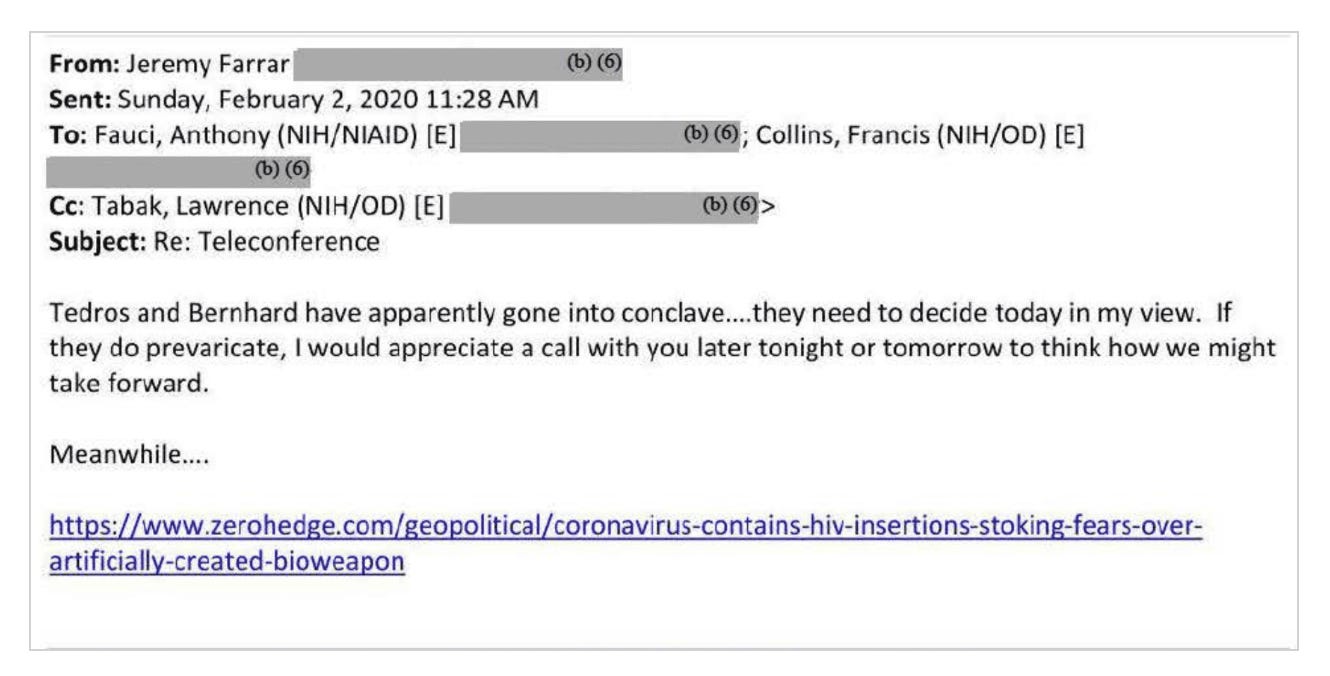
Regardless of whether they prevaricated or not, just two and a half hours later, at approximately 1:57pm ZeroHedge was suspended on Twitter.
- Dr. Fauci, was your correspondence with Farrar, involving the leaders of the World Health Organization, in any way related to the suspension of ZeroHedge on Twitter?
- If so, which of you was responsible for conveying the message to Twitter about the suspension?
- Were international organizations like the WHO, and NGOs including the Wellcome Trust, involved in Covid censorship activities in coordination with U.S. officials/agencies?
- Were you involved in any international Covid censorship activities?
Ex-DoD Analyst Derides Bid to Upgrade Outdated B-52s With Nukes
By Svetlana Ekimenko – Sputnik – 23.06.2024
The defense policy bills for fiscal year 2025 in both the US Senate and House include funding to enhance the nuclear weapon capabilities of approximately 30 B-52H Stratofortress bombers. However, the Pentagon is not enthusiastic about the proposal and instead favors a more expensive option of investing in a next-generation nuclear-capable bomber.
Congress’ bid to restore the B-52 bombers’ nuclear capabilities comes in the wake of repeated disappointments in developing US hypersonic standoff weapons, retired US Air Force Lt. Col. Karen Kwiatkowski told Sputnik.
“Putting nukes back on the upgraded B-52 is a band aid that covers that,” said the former analyst for the US Department of Defense.
“It is important to note that Congress and the Pentagon have already approved and funded engine, avionics and radar upgrades for the nearly 60-year-old B-52 airframe. The B-52H models will be designated B-52J’s, upon upgrade. This was justified several years ago with the B-52Js as a delivery mechanism for planned AGR-183 hypersonic missiles – a missile tested by the Air Force, but one that is no longer being funded in the FY2025 defense budget,” she underscored.
Dozens of the Pentagon’s hypersonic missile projects for the Army, Air Force, Navy, and DARPA have suffered setbacks, despite a desperate race to catch up with Russia and China in this field.
The hypersonic weapon that was in development by the Pentagon, the Air-Launched Rapid Response Weapon (ARRW), had been mired in delays and test failures. The weapon was to be fired from beneath the wing of a B-52 Stratofortress bomber and also contain a glide vehicle. The ARRW program, launched in April 2018, was to achieve operational deployment in 2022. However, in November 2023, after conducting two test flights in August and October 2023, the Fiscal Year 2025 budget provided no funding for procurement or further research and development of the AGM-183, effectively ending the project.
“The initiative will be costly and profitable for the defense industry, and in practical terms it keeps the B-52 in the game for tax-payer dollars. It is somewhat practical, as nuclear re-arming of the new B-52J model, as it completes other B-52 upgrades, fits well in the Boeing and Northrup Grumman industrial base,” noted Kwiatkowski.
It’s really all about the Congressional lobbyists, the ex-DoD analyst pointed out, clarifying that in the House, “Congressman Mike Rogers is the second-highest recipient of defense lobby money; In the Senate, Deb Fischer’s top donor is Northrup-Grumman a major missile developer, and Boeing, the maker of the B-52, is her fourth-largest donor.”
The conventional B-52H Stratofortress bombers had been part of the US nuclear triad close to a decade ago. However, under the New START treaty with Russia, the planes were stripped of these capabilities. With the treaty set to expire in February 2026, there is a drive to “beef up the US nuclear arsenal”. Congress has been advocating making the old bombers nuclear capable again, but the idea does not appear to be viewed favorably in the Pentagon.
“The treaty expires in 2026, and… We need to be prepared to face a nuclear environment without any treaty limitations,” said House Armed Services Chairman Mike Rogers, R-Ala., as he introduced the amendment to the passed FY25 defense policy legislation. In line with that bill, the Air Force would start upgrading the bombers within a month after the accord expires. Accordingly, it is hoped that the restoration of the B-52’s nuclear capabilities might be completed by 2029.
Democrat Congressman Adam Smith of the Armed Services Committee had voiced opposition, and was cited as saying:
“The Department of Defense is not interested in doing this… What they’re interested in doing is investing in the B-21, which is the next generation nuclear-capable bomber. This would cost a great deal of money. Also, they’re currently trying to extend the life of a number of B-52s out to 2050, which they think they can do. This would be another added expense to that.”
The Senate Armed Services Committee also voted to advance its version of the bill on restoration of nuclear capabilities of the fleet of bombers dating back to the 1960s.
Kwiatkowski dissected the features of the B-52 bomber that originally made it a suitable aircraft for nuclear warheads’ deployment during the Cold War, singling out such aspects as “manned crews, ability to fly long distances, with refueling carried out in safe airspace.”
These aspects, as well as the “relatively long lead time from launch of aircraft to actual release of nuclear weapons allowed time for recall, and the application of better intelligence and diplomacy,” she said, adding:
“Today, the push is for unmanned or smaller crews to fly the upgraded B-52 (reducing the need for human decision-making and debate once launched), and today, no airframe that flies as slow and ‘unstealthy’ as the B-52 would be safe after take-off and in flight, given intelligence and defensive capabilities of the target countries and their allies.”
The New Strategic Arms Reduction Treaty entered into force in 2011. Ten years later, Russia and the US negotiated an extension until February 2026. Amid NATO’s proxy war in Ukraine, Moscow suspended its participation in the accord on February 21, 2023.
At the time, President Vladimir Putin during his February 2023 speech to the Federal Assembly referenced everything from Washington’s unilateral withdrawals from milestone strategic weapons treaties, to NATO’s enlargement towards Russia’s borders in violation of previous verbal agreements.
Moscow added that it would continue to comply with quantitative restrictions on strategic offensive arms and exchange notifications with Washington about ballistic missile launches. In June, the US announced its “countermeasures” in response to Russia’s suspension of the treaty. Both sides say they continue to abide by New START’s numerical limits.
Karen Kwiatkowski stated that it is clear why the Department of Defense is against the proposition of upgrading the outdated bomber aircraft fleet. She indicated that the DoD recognizes the vulnerabilities and the high cost associated with such a project.
“Upgrading the B-52 is largely a political statement rather than a serious “pillar” in the old concept of US nuclear triad. Nuclear armed B-52s, instead of serving as a signal to an enemy that nuclear war can be prevented even after launch as it was throughout the Cold War, today would simply be a late-to-the-party nuclear suicide drill,” remarked the retired US Air Force officer.
She lamented the fact that there are currently “no statesmen in the West interested in preventing nuclear war, as we had during the Cold War.” No matter how much the range of the B-52 is upgraded, these outdated planes will never be able to “fully capitalize on the current advances in technology and stealth,” remarked the expert.
“Pentagon thinking has one foot in the past (a triad that includes bombers because we have always done it that way) and one foot in the future – irreversible attacks and hostage-holding strategies via high-speed, radar-evading missiles and other weapons launched from land, sea and space. This straddling of past and future delivers the B-21 [Raider aircraft] – a platform that is profitable for manufacturers but unlikely to truly function as planned in coming decades. But that is where US defense path dependency has brought us,” Kwiatkowski pointed out.
On a personal note, the former DoD analyst suggested it would be both “cheaper and wiser” to upgrade the B-52 with its human pilots than the B-21 Raider, which is “little more than another unmanned stealth missile.” After all, she summed up, such a platform would not provide any “additional ability, stability or political motivation for political leaders to approach an actual nuclear war cautiously and wisely” in the multipolar world.
“If war is politics by other means, a manned nuclear weapon that can be aborted mid-flight is better than an AI-driven nuclear event that politicians will later claim “wasn’t their fault” or was “hacked,” said Kwiatkowski.
Featured Video

Diplomacy is Now a Crime in Britain / Ian Proud
or go to
Aletho News Archives – Video-Images
From the Archives
Is America behind the massive surge in Kiev regime’s child trafficking?
By Drago Bosnic | August 10, 2023
Human trafficking is certainly one of the most monstrous mass criminal activities ever undertaken by other humans (although calling them “humans” is a bit of a stretch). And yet, there’s a special kind of this deeply repulsive crime that pushes it to diabolical proportions – child trafficking. Underage kids, particularly those who were abandoned, sold or have very poor/abusive family backgrounds, are by far the most vulnerable group. The depraved criminals who engage in such illicit activities specifically target unfortunate children and given there are millions of them all around the globe, particularly in war-torn areas, the “recruitment pool” is effectively endless. Unfortunately, the demand on the black market also seems to be constant and growing, making it a very lucrative and appealing prospect for criminals. … continue
Blog Roll
 Aletho News
- Iran warns US allies in region: Reusing soil for attacks will bring ‘different’ response
- What is really happening in Venezuela?
- Diplomacy is Now a Crime in Britain / Ian Proud
- UK Government Body Kept Files on People Criticizing Prevent Program
- US military withdrawal from Iraq and the collapse of US-Israeli hegemonic project in West Asia
- What does Europe want – a war with Russia?
- She Followed the Actual Data on COVID Vaccines and Masks — Her Career Took a Huge Hit
- Florida AG Sues Pfizer, Bourla Over Deceptive Marketing of COVID Vaccines
- Von der Leyen gifts her spin doctor a job for life
- 10K More U.S. Troops Deploy as Trump Weighs New Iran Strikes /Suliaman Ahmed
- If Americans Knew
- Israel is squeezing the life out of Palestinians – Daily Update
- The Israeli Right Portrays Islam as Murderous. It Serves a Political Purpose
- Jordan Has Had Enough: King Abdullah’s Scathing Warning to Israel
- Israeli Colonizers (i.e. Settlers) Kill Palestinian Man Near Salfit
- New Google Maps images reveal massive scale of devastation in Gaza
- Jewish supremacy, anti-Palestinian bigotry on display in Israel – Daily Update
- Israeli Soldiers Abduct At Least 22 Across Occupied West Bank
- Eight Palestinians Killed in Israeli Attacks on Gaza
- Israeli former leaders and security chiefs threaten legal action over ‘Jewish terrorism’
- Israel map in LA Times ad includes all land from the river to the sea
- No Tricks Zone
- Latest European Green Energy Debacle; Portugal’s Largest Flagship Solar Park Insolvent!
- Green Energy Debacle: German Expert Professor Fritz Vahrenholt Warns Of Severe Economic And Social Consequences
- Two More Paleo Reconstructions Affirm Meters-Higher Sea Levels Across Ireland, Brazil 7000-6000 Years Ago
- New Study: Earth And Venus Surface Warmth Largely Explained By Convection And Lapse Rate, Not CO2 Or Radiation
- 2025 Nature Paper Claiming Worsening Global Drought Gets RETRACTED …Heavily Flawed
- New Study: ‘Global Drought Shows No Detectable Recent Acceleration Under Climate Warming’
- Economic Masterminds: German Socialists Suggest Taxing Productivity Gains Stemming From Using AI
- The South China Sea Has Not Been Cooperating With The Climate Change Narrative
- Energy Crisis: Germany Enters Heating Season With Historically Low Gas Reserve Fill Levels
- New Study: The Antarctic Ice Sheet Gained Mass From 2020-2024 Due To Staggering Snow And Ice Accumulation

