‘Kind of Terrifying’: Critics Slam Claim That First Amendment Shouldn’t Constrain Government’s Ability to Censor
By John-Michael Dumais | The Defender | March 21, 2024
Journalist Matt Taibbi denounced statements made by liberal Justice Ketanji Brown Jackson during a U.S. Supreme Court hearing suggesting the First Amendment should not constrain the government’s ability to combat misinformation during a crisis.
“That was kind of terrifying because the entire purpose of the First Amendment is to restrain the government — it’s not to restrain the public from getting in the way of government action,” Taibbi said Tuesday during an interview on The Hill’s “Rising.”
Taibbi, who has reported extensively on the government’s censorship efforts, also said the plaintiffs in the case — including Drs. Jay Bhattacharya, Martin Kulldorff and Aaron Kheriaty — had their speech suppressed because they contradicted a false government opinion.
“The entire purpose of the First Amendment is to prevent the government from creating a hegemonic opinion that cannot be challenged,” Taibbi said.
The Supreme Court heard arguments on Monday pertaining to an injunction, granted in September 2023 by a federal appeals court, in Murthy v. Missouri. The case centers on whether the federal government violated the First Amendment by pressuring social media companies to censor content that ran counter to official government narratives on such topics as COVID-19 origins, vaccines, elections and other controversial topics.
Responding to Solicitor General of Louisiana J. Benjamin Aguiñaga during oral arguments, Justice Jackson said:
“So my biggest concern is that your view has the First Amendment hamstringing the government in significant ways in the most important time periods. I mean, what would you have the government do? I’ve heard you say a couple of times that the government can post its own speech, but in my hypothetical, you know, ‘Kids, this is not safe, don’t do it,’ is not going to get it done.
“And so I guess some might say that the government has a duty to take steps to protect the citizens of this country. And you seem to be suggesting that that duty cannot manifest itself in the government encouraging or even pressuring platforms to take down harmful information.”
Government set up ‘private highway’ to social media execs
“Rising” host Briahna Joy Gray asked Taibbi which was the primary issue: the government’s actions or the companies’ choices to succumb to pressure?
Taibbi compared the situation to the government hypothetically threatening to pull a mainstream media outlet’s Federal Communications Commission license unless it held a story, which he argued would be highly inappropriate.
“They didn’t just do that in this case,” Taibbi explained. “They went straight to the heads of the company” using an “industrial-scale operation … a sort of private highway to all of these companies where they were funneling mass requests.”
Taibbi noted that Renée DiResta, research director of the Election Integrity Partnership that was sponsored by both the U.S. Department of State and the U.S. Department of Homeland Security, “talked about using Section 230 to bring these companies to heel.”
“This was an overt threat,” Taibbi said.
Taibbi suggested it would be appropriate for the government to use its bully pulpit to say, “I don’t like what’s on Facebook. They made a mistake here, here and here. Here’s what I think the truth is, and we see these posts that say something else.”
“The president has an enormous megaphone to counter” what it considers misinformation, Tabbi said. “What’s not appropriate is doing it in private and coupling it with a threat.”
Justices missed the point on First Amendment
On his Racket News Substack Tuesday, Taibbi provided further context on the government’s pressure on social media companies.
During oral arguments, Principal Deputy Solicitor General Brian Fletcher — referring to instances where government officials publicly criticized social media platforms and called for changes to Section 230 protections — said, “I think it’s really troubling, the idea that those sorts of classic bully pulpit exhortations, public statements urging actors to behave in different ways, might be deemed to violate the First Amendment.”
Taibbi lamented the lack of a strong response from the other eight justices.
“That a line about ‘the First Amendment hamstringing the government’ was uttered by one Supreme Court Justice is astonishing enough,” he wrote. “[But] listening as none of the other eight pointed out that the entire purpose of the First Amendment is to ‘hamstring’ government from interfering in speech was like watching someone drive a tank back and forth over Old Yeller.”
As evidence of the justices’ confusion over First Amendment rights, Taibbi pointed to Justice Elena Kagan’s statement that the government intervening in news organizations’ activities “happened all the time” decades ago, especially when issues of national security were at stake.
As to her question, “Was that coercion?” Taibbi wrote:
“The situations aren’t remotely analogous. What’s happening now is a wide-scale partnership agreement between intelligence/enforcement agencies and media distributors, not media outlets themselves.”
Rep. Jordan: ‘That is scary where we’re headed’
Some Congress members were quick to criticize Justice Jackson’s statements from the Murthy v. Missouri hearing.
Rep. Jim Jordan (R-Ohio), in an interview with Fox News Monday, said, “The big takeaway today was Katanji Brown Jackson, when she said to the Solicitor General from Louisiana, ‘You’ve got the First Amendment hamstringing the government’ — well, that’s what it’s supposed to do, for goodness sake!”
“That is frightening because she really believes that,” Jordan added. “That is scary where we’re headed.”
Rep. Dan Bishop (R-N.C.) suggested that if the Supreme Court does not intervene, it could allow the FBI to “embed itself with social media companies” and “take down” issues like “the Hunter Biden laptop in election after election after election.”
Bishop argued that the government should not be able to suppress legal, protected speech on public platforms. “I just don’t think the government ever has a valid interest in doing that,” he said.
“[The government] can … come out publicly and say, ‘We don’t agree that there could have been a lab leak, that we think that’s a ridiculous theory,’” said Bishop. But he argued it was a “bad idea” to allow the government to pressure social media because “We see from what has happened afterward … they were wrong.”
Jordan also alleged that the Biden administration abused its power by censoring political opponents, citing its pressure to remove a tweet by Robert F. Kennedy Jr., Children’s Health Defense chairman on leave, despite the tweet containing true statements about Hank Aaron’s vaccination and passing.
“Oh, by the way, who was that individual [requesting the censorship]?” Jordan asked, before answering, “The guy running against him in the [Democratic] primary [at the time]. That is as scary as it gets, but that’s what this White House was doing.”
Will ‘traceability’ derail free speech case?
One of the central questions before the Supreme Court in Murthy v. Missouri is whether the government’s actions, including vague threats and pressure on social media companies, constitute illegal coercion.
Taibbi pointed out in the “Rising” interview that the “Twitter Files” showed “both overt and less obvious evidence” of correspondence among Twitter’s executives describing how they understood proposed regulatory changes as a threat they must answer to get the government off their back.
“That’s not missing from the case — that’s a feature of the case,” Taibbi said, adding that he thought the government publicly airing those threats “was sending a very strong message so that not only the companies would hear it, but the public would hear it.”
Taibbi acknowledged the difficulty of establishing “traceability” — a direct causal relationship between government pressure and the censorship of individual plaintiffs’ posts — saying their evidence “didn’t show a soup-to-nuts progression.”
However, he noted that shortly after the government told social media companies, ‘We don’t want anybody who is creating content that would promote vaccine hesitancy,’” people like Dr. Bhattacharya and Dr. Kulldorff were “deamplified or removed from platforms.”
Taibbi highlighted the lower court rulings that established or upheld injunctions against the government’s use of coercive tactics with social media companies.
“Two judges compared it to a mob movie,” he said. Characterizing the government in this metaphor, the judges said, ‘Hey, it’s a nice tech company you’ve got there. Be a shame if something happened to it,” Taibbi said.
“Rising” host Robby Soave asked Taibbi whether a legislative remedy could prevent government censorship. Taibbi said that while he felt there was ample evidence that what the government engaged in was already against the law, he thought it would be “difficult” to get a new law passed “absent a judicial ruling that this kind of behavior is illegal.”
But even if such a law were passed, “The problem is the enforcement mechanism is absent here,” he said.
In his Racket News article, Taibbi said the Supreme Court hearing “felt like a gut punch.” He expressed concern that if the court rules against the plaintiffs based on “traceability” issues, it could be interpreted as an endorsement of the government’s “plainly abusive” surveillance and censorship programs.
He wrote:
“Murthy [v. Missouri] already represents a major public relations victory for the Executive Branch.
“After roughly two years in which momentum for shutting down government censorship programs seemed to be gaining, and episodes like Bhattacharya’s punctured the myth that such bureaucracies only targeted ‘misinformation,’ yesterday’s hearing will help restore the basic narrative that the activities revealed earlier in this suit and in the Twitter Files was little more than good-faith efforts by a concerned government trying to stop ‘harm’ in a unique historical emergency.
“As Brown Jackson put it, ‘What would you have the government do?’”
John-Michael Dumais is a news editor for The Defender. He has been a writer and community organizer on a variety of issues, including the death penalty, war, health freedom and all things related to the COVID-19 pandemic.
This article was originally published by The Defender — Children’s Health Defense’s News & Views Website under Creative Commons license CC BY-NC-ND 4.0. Please consider subscribing to The Defender or donating to Children’s Health Defense.
Leave TikTok Alone
By Sheldon Richman | The Libertarian Institute | March 22, 2024
This is America, last I checked. Surely, the government would not force the sale of a social-media company or ban its app from the Google and Apple stores. Would it?
Well, yes, it would, could (perhaps), and might. A bill in Congress, backed by the government’s nominal chief executive, could become law. The House of Representatives passed it last week by an overwhelming bipartisan majority — despite valiant efforts by Rep. Thomas Massie, R-KY, plus a few others — and it is now before the Senate.
That bill would establish fuzzy criteria defining a “foreign adversary’s” alleged influence through a social media platform. It is aimed, for now, at requiring TikTok, used by 170 million mostly younger Americans, to be sold to a government-approved American buyer within a specified period. If not sold, Americans would be forbidden to get the app. I guess the app would have to be disabled for those who have it already.
In other words, TikTok would be banned from America — you know, just as China’s communist government bans or interferes with social media over there. Knowing how the government works, we must presume that the bill’s criteria will be applied to other cases later. It certainly would exist as a standing threat to the uncooperative.
The complaint against TikTok is that it’s a subsidiary of ByteDance, a widely owned company subject to Chinese government influence or control, although this is disputed by TikTok’s CEO, Shou Zi Chew, a Singaporean businessman with substantial roots in — the United States. But let’s assume the worst and see where that leads. After all, the Chinese government is no respecter of individual rights. If the U.S. government is eager to interfere with social media, why not the Chinese government?
TikTok worriers say that China could harvest data on Americans while feeding them self-serving democracy-subverting messages. It has reportedly been caught suppressing unflattering information. Not good, but of course, the U.S. government has done the same thing; a lawsuit about this, Murthy v. Missouri, is now before the Supreme Court. As many critics of the bill have pointed out, the Chinese don’t need TikTok to acquire information that users readily give up to other platforms. It’s already on the market. Moreover, nobody should expect the news from any one online source to be complete; as one grows, one should learn to consult a variety of sources for a fuller picture.
Matthew Petti of Reason is right: “Competition is the strongest force keeping the internet free. Whenever users find a topic banned on TikTok, they can escape to Twitter or Instagram to discuss the censored content. And when Twitter or Instagram enforce politically motivated censorship on a different topic, users can continue that discussion on TikTok.”
Changing ownership or banishing TikTok would create a false sense of security. The problem of myopia would remain.
Moreover, as Matt Taibbi alerts us, the bill would give the executive branch “sweeping powers.” He writes: “As written, any ‘website, desktop application, mobile application, or augmented or immersive technology application’ that is ‘determined by the President to present a significant threat to the National Security of the United States’ is covered.’”
Taibbi continues: “A ‘foreign adversary controlled application,’ in other words, can be any company founded or run by someone living at the wrong foreign address, or containing a small minority ownership stake. Or it can be any company run by someone ‘subject to the direction’ of either of those entities. Or, it’s anything the president says it is. Vague enough?”
By this time, shouldn’t we expect the worst from letting legislators write the rules?
But those are not the only reasons for concern. According to Glenn Greenwald, the bill had been floating around for a few years but had not garnered enough support to get through Congress. That changed recently, according to Greenwald, citing articles in the Wall Street Journal, Economist, and Bari Weiss’s Free Press. Why? As Greenwald documents, anxiety about TikTok took a quantum leap beginning on Oct. 7, 2023, the day Hamas killed and kidnapped hundreds of Israeli civilians and Israel began retaliating against the people of the Gaza Strip.
What has this got to do with TikTok? you ask. Good question. Israel’s defenders in the United States, such as Jonathan Greenblatt of the Anti-Defamation League, are upset that TikTok’s young users are being exposed to what he calls anti-Zionist and anti-Semitic disinformation. “It’s Al Jazeera on steroids,” Greenblatt said on MSNBC. During a leaked phone call, he complained, “We have a TikTok problem,” by which he means a generational problem. Younger people — including younger Jewish people — are appalled at what Israel’s military is doing in Gaza. (To complicate things, it looks like TikTok and Instagram have suppressed pro-Palestinian information.)
Would an American-owned TikTok be easier to control? Experience says yes. Have a look at the Twitter Files, which document how American officials, Chinese-style, pressured social media to censor or suppress dissenting views on important matters such as the COVID-19 response and the 2020 election. A federal judge likened the government’s efforts to the Ministry of Truth in Orwell’s Nineteen Eighty-Four.
Do we want to become more like China?
A final word. Defenders of free speech should not argue that ill-intentioned disinformation and well-intentioned misinformation from any source can cause no harm, broadly defined. Of course, it can. The proper answer to this legitimate concern is that government-produced “safetyism,” placing safety above every other value including freedom, will do more harm than good.
The World Sees Gaza as ‘US Genocide’ Not Just Israel’s
By Ian DeMartino – Sputnik – 22.03.2024
On Tuesday, four critical care doctors who recently returned from Gaza spoke to the UN. “I saw the most appalling atrocities, and I saw things I never would have expected to have seen in any healthcare setting,” Dr. Nick Maynard said, adding that he saw “mass indiscriminate bombing” and targeting of healthcare workers.
Americans do not understand how badly the United States’ reputation has been damaged across the world, which sees Gaza as “a US genocide” and “not just an Israeli genocide,” Mohammad Marandi, a professor of English literature and Orientalism at the University of Tehran told Sputnik’s The Critical Hour on Thursday.
“It’s revealing the reality of [the US] empire in a way that not even [author of ‘A People’s History of the United States, Howard Zinn] could do because it’s being done in front of our eyes, it’s being done in front of a global audience. We’ve never seen such a thing before,” Marandi said, adding that he suspects that is why the US is attempting to ban TikTok.
“The United States has lost credibility across the world. I don’t think many Americans understand how bad this has become for the United States. People across the world see this as a US genocide, it’s not just an Israeli genocide.”
Co-host Wilmer Leon asked about a recent freeze on Canadian arms shipments to Israel, which Marandi said showed that “public opinion is shifting” but that ultimately “stopping Canadian exports of weapons is nothing.” Marandi said Canada needs to take a much tougher approach.
“They sanctioned Syria… they’ve imposed sanctions on Cuba, on Venezuela, on Iran, on Yemen. Why don’t they impose sanctions on Israel? They’re carrying out a holocaust. Why don’t they hit the economy?” Marandi asked, noting that Israel will, unlike Russia, be allowed to participate in the Olympics. “No one takes this seriously. And, of course, the bulk of the weapons come from the United States anyway.”
“In any case, there is no reason to believe that the Canadian government cares about Palestinians, that they oppose the genocide, because they’ve done absolutely nothing to stop it,” Marandi added.
Ultimately, Marandi believes that Israel has laid the path for its destruction through its actions in Gaza. “I believe that the Israelis have made a fatal mistake and that what they’ve done in Gaza will be the beginning of the end of the Zionist project,” he asserted. “The real catastrophe for the Israeli regime is the fact that it’s been carrying out the genocide for almost six months in front of the world and it has demolished the facade that the regime had created for itself… about it being a democracy… All that is gone now and across the board the regime is despised and the image of the United States has been destroyed.”
Marandi noted that he has been to China twice and public opinion there has shifted as well. He noted that he does not think China will ever invest in Israel again.
“They see on their own social media networks what you and I are seeing,” he noted.
Why Slovak Wildcard Robert Fico Could Bring EU House of Cards Crashing Down
By Ilya Tsukanov – Sputnik – 21.03.2024
Slovak Prime Minister Robert Fico has found himself in the crosshairs of Eurocrats worried that he may become the next Viktor Orban -a thorn in Brussels’ backside rejecting EU directives on everything from Ukraine to criminal justice reform. Sputnik asked Slovak politician Peter Marcek what it is about Fico that’s so unnerving to the establishment.
Slovaks will go to the polls Saturday for the first round of a highly anticipated presidential election, six months after a snap parliamentary vote in September saw veteran Direction – Social Democracy leader Robert Fico’s return to the prime minister’s chair.
While Slovakia’s presidency carries a largely symbolic function, the president does have the power to appoint key figures, including the prosecutor general, and can help the government in times of crisis, making the post an important one.
The latest polling shows Peter Pellegrini, a Fico ally from the offshoot Voice – Social Democracy party, and independent former ambassador to the United States Ivan Korcok running neck and neck with between 34 and 38 percent support each, guaranteeing a runoff between them in the second round of voting April 6.
Thelooming vote has spawned a spate of articles in European legacy media bashing Fico and his party, attacking him as a left wing populist analogue of Hungarian right wing populist Viktor Orban and the Fidesz party, and fearmongering about Slovak “democracy’s future,” Pellegrini’s supposed “Russia tilt,” and Bratislava’s alleged “democratic backsliding.”
All these reports have one thing in common: dread at the prospect that Fico and his allies will pursue an independent foreign and domestic policy which threatens the interests of Brussels and the United States.
Headache for Brussels
From Ukraine arms aid (which Fico halted last October) to Kiev’s NATO membership bid (which he has promised to block), to Bratislava’s defense pact with Washington (whose terms Fico has expressed dissatisfaction with) to the launch of an independent inquiry into the EU’s authoritarian pandemic policy, to criminal code reforms slammed by Brussels, Fico has already proven a major “headache” for the West. And that’s just for openers.
“Robert Fico has been in office for only four months, but he has begun to implement the right policies. He has begun to pursue policies for his people, for his country,” Peter Marcek, a former Slovak lawmaker, businessman and the chairman of the Slavic Unity party, told Sputnik.
“He refused to support Ukraine, stopped the supply of weapons to Ukraine, agreeing only to humanitarian assistance and saying that Slovakia would only provide such aid. Fico also doesn’t agree with many of the economic laws adopted by the European Union – which are adopted to benefit the EU itself, rather than its members,” the politician said.
Fico has already managed to get into trouble with the bloc in the course of his short time in office, Marcek said, pointing to Brussels’ threats to cancel the transfer of €1 billion in funds to Bratislava over the prime minister’s legal reform agenda. “They must give this money to Slovakia because it belongs to us. If they don’t… they will make people even more against the European Union. Fico has said that if they behave like this, the result can be only one thing – that Slovakia will exit the European Union, because economically our standard of living is getting worse and worse.”
“When sanctions were introduced against Russia, it did not kill the Russian economy, maybe only creating problems at the very start, but Russia was able to find other markets. We bought oil and gas from Russia at reasonable prices, now we pay the Americans four times more. Our standard of living has dropped significantly,” Marcek explained.
“If the European Union continues its current policy, we will soon leave it. Things simply cannot continue like this, and I think everyone sees it. For example, we have to pay €22,000 for each migrant that we did not accept into our country. What if they tell us that our quota for migrants is 300,000 people? Do the math: that’s 300,000 x €22,000. Instead of allocating this money to pensioners, children, families, will we give it to migrants? Why should we accept immigrants from Africa when we were never colonizers?” the politician asked.
Brussels’ self-serving policies have people from across the EU up in arms, Marcek said, pointing to the rising popularity of both right and left populist, Eurosceptic forces across Europe, and the “major farmer protests” in Austria, France, Germany and even Spain.
Amid the chaos, the EU will have to change its policy, “or the EU will collapse.” It’s as simple as that, the observer believes.
Marcek expects elections to the European Parliament in June to bring a new crop of leaders who seek greater national autonomy against EU institutions which don’t benefit their countries.
As for Slovakia’s upcoming presidential vote, Marceck says Pellegrini will be likely to defeat “pro-American Korcok,” and replace the current president, Zuzana Caputova, who “has created many problems for the government” and prevented its normal functioning. “She is a president that was installed by the US embassy,” the politician summed up.
Ukraine Talks Haven’t Started Because of US Threats to Zelensky, Seymour Hersh Says
Sputnik – 22.03.2024
Negotiations on resolving the conflict in Ukraine could have started months ago, but US authorities threatened Vladimir Zelensky with withdrawal of non-military funding, US journalist and Pulitzer Prize winner Seymour Hersh said in an article on Substack.
“We were on the verge of a reasonable negotiation several months ago before Putin’s re-election and Zelensky’s military degradation. The US leaders got wind of the possibility and gave Zelensky the ultimatum-‘No negotiations or settlement or we won’t support your government with the $45 billion in non-military funds [that Ukraine is now receiving annually],'” the source told the journalist.
According to Hersh’s information, US intelligence community recognises that “Ukraine has little chance of winning…”
Hersh’s interlocutor also added that US President Joe Biden has staked on confronting the “Russian threat to NATO” and will not change his course under any circumstances, while the end is inevitable.
“There is no road to victory for Ukraine, and it will end with Putin as an historical icon in Russia…,” the source concluded.
In autumn 2022, Zelensky signed a decree according to which his country will not negotiate with Russia as long as it is led by Vladimir Putin. Russia, for its part, has repeatedly noted its readiness to discuss the settlement of the conflict through diplomatic means.
As Kremlin spokesman Dmitry Peskov emphasised, the Russia does not see any prerequisites for a peaceful transition of the situation, and sovereignty over the new Russian regions and Crimea is not up for discussion.
US opposes Iran-Pakistan gas pipeline project, trying to halt its construction: Official
Press TV – March 21, 2024
The US assistant secretary of State for South and Central Asia says the United States opposes the Iran-Pakistan (IP) gas pipeline project.
Speaking to congressmen during a congressional hearing in Washington on Wednesday, Donald Lu said the US is exerting maximum efforts to prevent the construction of the IP project.
He added that the US is concerned about the strain in Pakistan’s relations with neighboring Iran, particularly on the IP gas pipeline project.
The US official noted that Washington was in contact with Islamabad on the matter.
Emphasizing the importance of monitoring the funding for the mega energy project, Lu said the US is keeping a close watch on it.
“Washington has not received any request from Islamabad regarding sanctions relief, so our efforts to stop Pakistan from Iran’s gas project will continue,” the diplomat added.
Lu claimed that the project was not in the interest of Pakistan as international companies would not invest in it.
Back in February, Pakistan gave the green light for advancing much-delayed work on the joint gas pipelines project with Iran within its territory in a significant step towards enhancing energy cooperation between the two countries.
Pakistan’s Cabinet Committee on Energy (CCoE) granted its approval to start construction on the 80-kilometer pipeline from the Pak-Iran border to Gwadar.
The project, launched in 2013, had initially required Pakistan to finish the construction of the pipeline on its territory by the end of 2014.
However, the project faced prolonged delays due to the potential challenges it posed for Pakistan amid international sanctions targeting Iran.
Pakistan is likely to face an $18-billion fine if it terminates the gas pipeline agreement.
Russia’s Geopolitical Prospects in the Middle East
By Salman Rafi Sheikh – New Eastern Outlook – 21.03.2024
With Russia able to withstand – and virtually defeat – the combined military strength of NATO in Ukraine, its foreign policy and its diplomatic outreach to the rest of the world is bound to gain not only confidence but also become a lot more assertive than it was during the first year of this conflict when Washington launched its so-called “isolate Russia” project. Translating its military gains in Ukraine, Moscow, for instance, recently hosted Palestinian factions to unify them not only for a durable solution to the longest-lasting conflict in the Middle East but also for developing a strong position vis-à-vis Israel. This approach towards Palestine – which also exhibits a visible anti-Israel position – is directly motivated by Moscow’s broad Middle East outreach at a time when the political opinion in the region has turned against Israel and Washington, leaving Israel virtually isolated despite having established ties with several Muslim states in the recent past.
At the same time, this opinion has also become more favourable towards Russia. A recent survey by the Washington Institute showed that a majority of respondents in the UAE (66%), Saudi Arabia (67%), Kuwait (62%), Egypt (57%), Bahrain (68%), Qatar (63%), and Lebanon (72%) agree that the US is no longer a reliable partner and that the Middle Eastern countries “must look more to other nations like Russia and China as partners”.
On top of that is the strong credentials Moscow carries as a security guarantor. Since at least the end of the Cold War, Washington has dominated the region as its key security guarantor, both through its direct military presence and its supply, i.e., sale, of weapons worth billions of dollars to the region. But Moscow dismissed Washington’s dominance via the key role it played in Syria to defeat the US-backed “regime change” operation. Subsequently, it has been successful in helping Syria’s relations with several Arab states, including Saudi and the UAE, to become normal. Moscow, in other words, was successful in translating its military gains into diplomatic victories by becoming a peacemaker in the Middle East. Washington, on the other hand, has not been able to bring peace to the Middle East and/or prevent Israel from committing genocide.
Russia’s Middle Eastern forays are, therefore, in part motivated by Washington’s failures. At the same time, Russia also sees itself as a great military power and a great power needs to have a strong foothold – which does not have to be a military presence – in the region.
If the ultimate objective of any superpower policy is to advance its core interests, non-military means can be very useful too. In the recent past, Russia’s engagement with several Middle Eastern states via the OPEC+ framework has served its key interests well. Via OPEC+, Russia has been able to not only withstand a US-led assault on its economy but also inflict a lot of economic damage on the Western economy. Washington’s inability to break OPEC+ has led to a high inflation rate throughout Europe and North America.
While a lot of Russian ability to accomplish this depended upon the cooperation of other OPEC countries, the latter, including Saudi Arabia, also see Russia as an alternative to Washington. Plus, the partnership with Russia is also paying off. Despite a global growth rate of less than 3 percent in 2023, Saudi’s Aramco earned US$121 billion in 2023, thanks to the careful management of oil supply and prices.
Turkey is another major player in the Middle East that continues to have strong ties with Russia, primarily because of the ways that these ties serve mutual interests. The trade turnover between them increased by more than 80 percent in 2022 to reach US$62 billion. Russia is already Turkey’s biggest source of imports. But this relationship is not costly. On the contrary, Turkey saved US$2 billion on oil imports from Russia by purchasing discounted oil. Ankara was able to do this because it refused to join the US-led regime of sanctions on Russia. As a result, Russia became Turkey’s biggest supplier of energy in 2023. In 2023, Turkey imported 49.93% of its oil from Russia. A year earlier, the share of Russian oil in the Turkish market was 40.74%. Due to this, the US has been trying for the past few months to impose fresh sanctions on Russia to make Turkey-Russia [trade] difficult. But whether it will have any real impact is not hard to guess due to the increasing availability of alternative channels, i.e., using Central Asian States, to conduct trade and transfer payments.
Still, US efforts to put restrictions on entities from Russia and the Middle East to prevent them from doing trade with Russia itself shows the success Russia has achieved in the Middle East. The US fears that if Russia, like China, continues to expand its relationship with this energy-rich region, it could accelerate US exit from the region, leaving Washington’s efforts to revamp its ties, including via offering strategic defence partnerships to countries like Saudi Arabia, meaningless vis-à-vis Russia.
If even, speaking of a hypothetical scenario, the political opinion in the Middle East were to see a dramatic change to become pro-US, it does not mean an ‘end’ of Russia’s presence in, and relationship with, the Middle East. A core reason for this is the Middle Eastern states’ own desire to reposition themselves in the emerging global order as autonomous players capable of influencing global politics – something that these states can accomplish by, first and foremost, diversifying their foreign policy and reducing, if not fully eliminating, their historical dependence on the US. In this sense, Russia’s engagement with the Middle East is not simply a short-term phenomenon that would just die out the moment Washington offers a deal to the Gulf states that they cannot refuse. It is here to stay, with its prospects of growing brighter than ever.
Salman Rafi Sheikh is a research-analyst of International Relations and Pakistan’s foreign and domestic affairs.
CIA Further Discredits ‘Uyghur Genocide’ by Admitting Covert Influence Campaign
By Patrick Macfarlane | The Libertarian Institute | March 21, 2024
On March 14, Reuters released a bombshell report: in 2019 the Donald Trump White House began a clandestine CIA influence campaign to smear China’s international reputation.
According to three former U.S. officials with direct knowledge, “the CIA created a small team of operatives who used bogus internet identities to spread negative narratives about Xi Jinping’s government while leaking disparaging intelligence to overseas news outlets.” The information releases “targeted public opinion” both internationally and in China itself. Along with influencing public opinion, the campaign sought to “foment paranoia among top leaders [in China]” as they tried to trace the leaked information.
The report specifically stated that CIA operatives “promoted [corruption] allegations” against Chinese government officials and “slammed as corrupt and wasteful China’s Belt and Road Initiative.” Although these specific efforts were identified, the former U.S. officials declined to name additional narratives that were advanced.
Reuters did not confirm that the campaign has continued into the Joe Biden presidency however two “unnamed intelligence historians” told Reuters that such “presidential findings” often remain in place across administrations.
The existence of this CIA influence campaign is probable given the broader historical context.
The Trump Administration marked the extreme acceleration of the United States’ new cold war against China. This began when the Pentagon issued its 2018 National Defense Strategy, which declared a refocus from Middle East “counter-terrorism” to “Great Power Competition” with Russia and China.
Subsequently, 2019 was a banner year for Western escalation against Beijing. In October 2019, the Department of Defense created a new office focused solely on confronting China, called the “deputy assistant secretary of defense for China.” In December 2019, NATO named China as an emerging “challenge.” In 2019 and 2020, the Trump administration doubled U.S. naval transits of the Taiwan Strait over previous years and conducted approximately 1,000 reconnaissance flights over the South China Sea. Of course, when the COVID-19 pandemic arrived in 2020, it was immediately blamed on China.
The above efforts notwithstanding, the main thrust of America’s new cold war against China was informational. America sought to isolate China on the world stage by shredding its international reputation, justifying sanctions, and inhibiting trade. This was clear even before the CIA’s new revelation.
Aside from blaming that nation for COVID-19, the “Uyghur Genocide” narrative was the most prominant vehicle for achieving that goal. But just what focus, if any, does the CIA’s revelation provide to the facts of that narrative as we already know them?
Well, the CIA was there every step of the way.
2019 is the same year that an NGO called the “China Tribunal” began petitioning the UN Human Rights Council, accusing the Chinese Communist Party of conducting an industrial organ harvesting operation that preyed upon Chinese dissidents and Uyghur muslims.
In January 2021, the Trump administration weaponized this claim when Secretary of State Mike Pompeo, fresh off his post as CIA director, formally accused China of committing genocide against Uyghur muslims in its Westernmost provice, Xinjiang. To back this claim, Pompeo referred to the findings of a 2020 report written by a German sociologist named Adrian Zenz. The report was titled “Setilizations, IUDs, and Mandatory Birth Control: The CCP’s Campaign to Suppress Uyghur Birthrates in Xinjiang.” In March 2021, Zenz published an additional report, “The Uyghur Genocide: An Examination of China’s Breaches of the 1948 Convention.”
News outlets the world over declared that these reports were being made by “independent third parties.” Nothing could have been further from the truth.
The China Tribunal has direct connections to the fringe religious group Falun Gong, a Chinese spiritualist cult that runs The Epoch Times and New Tang Dynasty. Furthermore, Zenz’s reports were published by neoconservative think tanks, including the Jamestown Foundation, the Newlines Institute, and the Wallenberg Centre for Human Rights. The Jamestown Foundation itself was founded by the late CIA Director William Casey. The Newlines Institute is led, inter alia, by former employees of the “shadow CIA” private spying firm Stratfor.
Myself and others, including Max Blumenthal, Gareth Porter, and Ajit Singh have demonstrated significant statistical errors, credibility issues, mistranslations of source material, and propagandistic misrepresentations present in each report. These analyses are available elsewhere.
Each of Zenz’s reports rely in part on “leaked PRC government document[s]” to support its findings. These documents are cited by Zenz as the “Karakax List,” the “Aksu List,” and the “China Cables.”
The Karakax lists allegedly shows the reasons why 311 Uyghur individuals were interned in “reeducation camps” in Xinjiang.
The China Cables purportedly consist of “an operations manual for running mass detention camps,” four “secret intelligence briefings” from a mass Chinese Uyghur data collection system, and a regional court sentencing document where a Uyghur man was ordered 10 years’ imprisonment for telling coworkers to practice “Halal.”
According to Zenz, the Karakax List was leaked by the same source that leaked the China Cables. The International Consortium of Investigative Journalists, the organization that published the China Cables, says it received the leaks “via a chain of exiled Uyghurs,” but confirmed the document’s authenticity with several leading experts, including James Mulvenon, vice-president of Defense Group Inc, Zenz, and several intelligence sources who cannot be identified.
In 2019, the leaker identified herself as Ms. Asiye Abdulaheb, an exiled Uyghur living in the Netherlands. Ms. Abdulaheb told Dutch newspapers that she moved from China in 2009, though the documents she leaked were dated from 2017. She did not reveal how she obtained the documents.
As for the Aksu List, Human Rights watch admits it was leaked to them by Radio Free Asia, a Cold War era CIA cutout created to disseminate American propaganda across the continent.
In July 2022, Zenz jointly published a leak with the Victims of Communism Memorial Foundation, an anti-communist cold war project co-founded by President Jimmy Carter’s National Security Advisor Zbiegniew Brzezinski. Zenz gave it the ominous title “the Xinjiang Police Files.”
Zenz claims the documents are “unprecedented evidence” that “proves [the] prison-like nature of re-education camps [and] shows top Chinese leaders’ direct involvement in the mass internment campaign.” The release consists of what is claimed to be “2,800+ Images of Detainees, 300,000+ Personal records, 23,000+ Detainee Records, and 10+ Camp Police Instructions.” According to Zenz, the documents were obtained through hacking by “a third party” who broke into the computer systems of local Chinese government officials.
When the documents were made available for public scrutiny, some anomalies were detected.
For instance, some of the documents’ metadata indicated they had been edited by Zenz and a national security contractor named Ilshat Kokbore. As it turns out, Kokbore was also the president of the American Uyghur Association and was the Director for China Affairs for the World Uyghur Congress—an NGO based in Washington that receives funding from the National Endowment for Democracy. The NED was referred to as the “second CIA” by one of its founders, Allen Weinstein, because it openly performs the work that the CIA used to do covertly.
Others questioned visual anomalies in the detainee images, which suggested they may have been computer generated.
Together, Zenz used the leaks as the centerpiece of his reports accusing China on the international stage. They were cited by every major news outlet, the U.S. State department, and even by the UN High Commissioner for Human Rights.
Zenz’s reports were sold internationally as being “unbiased” and “independent,” but the Reuters revelations place CIA operatives in China “leaking intelligence” for the admitted purpose of destroying China’s international reputation. This operation ran during the primary years of the Uyghur Genocide allegations.
The full weight of this revelation cannot be overstated.
“It’s Not About Trump”: American CJ Hopkins, Charged Again in Germany, Describes Global Censorship Effort
Acquitted on German hate speech charges in January, American playwright CJ Hopkins is being charged again for the same offense.
By Matt Taibbi | Racket News | March 20, 2024
The German people are famous for putting everything in print, even things they shouldn’t, and in this instance at least, American playwright and author CJ Hopkins is glad. “The irony,” he says, laughing. “The Germans, always documenting everything.”
In a letter from the Berlin Prosecutor’s file on Hopkins, the Bundeskriminalamt (BKA, analogous to our FBI) acknowledges receipt of a document from a government office describing an effort to have tweets deleted. “The Hessen Gegen Hetze reporting office,” the highlighted portion reads, “has already initiated measures to delete the relevant post on the social network”:

Hopkins reached out to me after listening in disgust to the Murthy v. Missouri Supreme Court hearing Monday. Standing was a big issue: our government said plaintiffs like Drs. Jay Bhattacharya and Aaron Kheriaty lacked definite proof that the government was responsible for suppressing their speech. No such issue exists in CJ’s case, as you can see.
Hopkins also wanted Americans who might be up in arms about the specter of legalized censorship in their own country to see that the phenomenon has also spread to virtually every Western democracy, often in more extreme forms than we’ve seen so far in the United States.
CJ’s unique insight involves his ludicrous German case, which as you’ll read in the Q&A below has taken bizarre turns since we last checked and will now go to trial yet again. As an expat following the American situation from afar, he’s seen how the authoritarian tide is rising in similar or worse ways all around the globe.
Hopkins is facing the business end of the German version, among the worst. As detailed last June, he was charged with “disseminating propaganda, the contents of which are intended to further the aims of a former National Socialist organization.” The crime? Using a barely detectible Swastika in the cover image of his book, The Rise of the New Normal Reich. Far from “furthering the aims” of Nazism, he was criticizing them by comparing Nazi methods and laws to those of modern health authorities. The offending image:
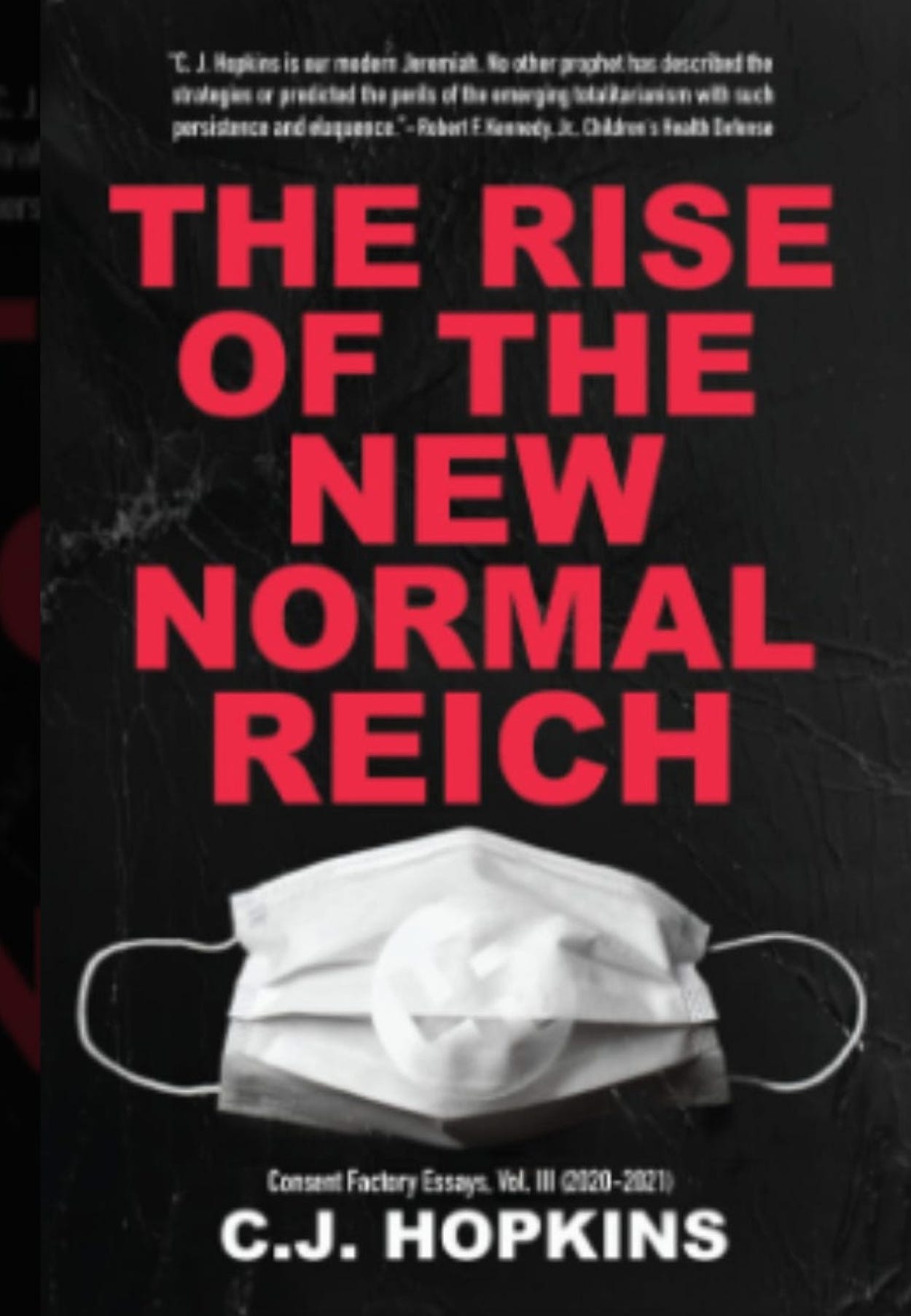
Hopkins went to trial in January and delivered an impassioned plea to the court. “Every journalist that has covered my case, everyone in this courtroom, understands what this prosecution is actually about,” he said. “It has nothing to do with punishing people who actually disseminate pro-Nazi propaganda. It is about punishing dissent, and making an example of dissidents in order to intimidate others into silence.”
Though the judge was clearly not a fan of Hopkins — a courtroom account by Aya Velázquez, which I recommend reading, described how the judge said CJ’s statements were “ideological drivel,” just “not punishable by law” — he won on the law.
After acquittal, he was made aware that technically the case wasn’t over, because thanks to a quirk of German jurisprudence, the prosecutor had a week to file an appeal. Hopkins was unconcerned. “I doubt he will [re-file]. He made a total fool of himself in front of a large audience yesterday,” he wrote. “I can’t imagine that he will want to do that again.”
Bzzt! Wrong. The prosecutor re-filed charges. The prosecutorial theory in the Hopkins case was based on a bizarre interpretation of hate crime, essentially asserting that if you have to think about an image to realize it’s satire, it can’t be allowed. If that idea spreads, it would make comedy or even sharp commentary impossible. This is why his indictment, and the similar investigation of Roger Waters, are really serious moments. Not to be heavy-handed, but eliminating the loophole for satire or mockery is exactly what Waters meant by “Another Brick in the Wall.” Before you know it, it’ll be too high to see over:
MT: You got charged again?
CJ Hopkins: No… I got acquitted. I went to trial on the 23rd of January, and I wrote this up and I’ll send it to you so you can just look at the whole account. But at the trial I made a big aggressive statement that people republished all over the place. The judge acquitted me, and then called me all kinds of names and then put on her covid mask and stalked out of the courtroom. She called me a Schwurbler, which in German is kind of an idiot, I guess a babbler or someone.
Anyway, I read that statement, which pissed them all off, but she said, “Okay, you’re an idiot, but that’s not against the law, so you’re acquitted.” So I thought, “Great. This is over. I’m acquitted.” The prosecutor had no case whatsoever, and it was really embarrassing, and I figured it was all done, but my attorney reminded me: oh no, the prosecutor can appeal. Which he did. So now I’m facing another trial in appeals court. It’s not new charges, it’s the same charge, but the prosecutor’s appeal of my acquittal.
MT: The double jeopardy thing isn’t big in Germany, I take it?
CJ Hopkins: No.
MT: Are they going to make a different argument?
CJ Hopkins: I have no idea what they’re going to do. They have no argument… I mean, they put my tweets up on an overhead projector, like we were back in high school, and interrogated me about whether the Swastika was on top of the mask or behind the mask, that sort of thing. The prosecutor’s argument was basically, “We don’t believe that Mr. Hopkins is a Nazi, or pro-Nazi, we don’t believe he was trying to spread Nazi propaganda, but he nonetheless spread Nazi propaganda. because his tweet” – and this is a great part of their argument – “because if people saw his tweets, they would have to stop and think for a minute to figure out what they meant.”
MT: Essentially you can’t have satire, because that requires a person to have at least one thought.
CJ Hopkins: You can’t make people think. You’ve got to have beat-you-over-the-head messaging. I think the whole point of this… I’m sure it’s like the plea-bargain thing in the States. They figure if they hit you with a 3,600 Euro fine, you’re going to pay three times that much to fight it in court, so you’re just going to pay the fine and go away. I don’t think they ever expected to end up in court, and I have no idea what the prosecutor is doing with this appeal. The judge a few weeks later submitted a written verdict, which is strongly in my favor. She pretty much reiterated my attorney’s arguments and made it absolutely clear that what I did falls under the exceptions to the statute, and there’s nothing here to prosecute. Nonetheless, the prosecution’s going ahead.
MT: Did you have much Western news coverage?
CJ Hopkins: Right before the trial I had you, then Neue Zürcher Zeitung, which is the big paper of record in Switzerland, and James Kirchick at The Atlantic, who was a big help. I think it put a lot of pressure on the judge. My lawyer made her aware that Germany was being portrayed as a laughingstock in the international press. Aside from The Atlantic, it was all independent alternative media.
MT: In the Murthy Supreme Court case in the States Monday, there was an issue with what they call “traceability.” I see you don’t have a traceability issue, with this document from your case file?
CJ Hopkins: Exactly. That’s why I sent it to you. Unquestionably, this is a government office, directly involved with removing the tweets. The other thing that I was going to say, is that I’m looking at things like the Supreme Court case from a non-U.S. perspective. I’m outside of it. I’m watching the legislation that’s getting rolled out in Ireland and the UK and what’s happening to me here and what’s going on in the States, and it’s so obviously much broader than just a red-blue political story in the US. This is happening throughout the Western democratic countries.
I’m just desperate to get that across to people. I think it’s so easy for people to get locked into what’s going on in their own country and not see the bigger picture.
MT: What’s an example?
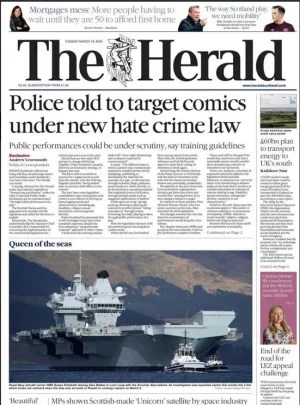
CJ Hopkins: There was just a piece in The Herald, in Scotland. The police were being trained there on how to crack down on abusive hate speech. According to this new legislation that’s rolling out and in the training manual, they were saying this could take place in comic performances or stage plays. People are being arrested in the UK for protest signs.


If I can just put one little bug in your head, Matt, to whatever degree you can tweak people and let them know: “Hey, it’s not just Trump and the Democrats and the liberals and the woke people and all that.” This is happening all over the West, in all these different countries. I think that’s one thing that my case does, it provides folks with an opportunity to remind them that this is happening all over. The old rules don’t apply.
MT: Good luck with your case.
CJ Hopkins: Take care.
Western media ‘coverage’ of Russia is incredibly dangerous, and it’s getting worse
By Glenn Diesen | RT | March 20, 2024
Western media coverage of every Russian election is bad. But this time it was even worse than usual.
Instead of lashing out at the incompetence on display, it’s more constructive to explore why rational discussions about the country continue to appear impossible.
Not to mention the dire consequences of the ongoing self-delusion.
Reason versus conformity to the group
One of the first things we learn in sociology is that humans are in a constant battle between instincts and reason. Over tens of thousands of years, we have developed the instinct to organise in groups as a source of security. This is the result of evolutionary biology as survival demands that we organise into “us” versus “them”. In-group loyalty is augmented by assigning contrasting identities of the virtuous “us” versus the evil “other”, which helps stop an individual from straying too far from the pack.
Yet, human beings are also equipped with reason and thus the ability to assess objective reality independent of their immediate circle. In international relations, it’s imperative to place yourself in the shoes of the opponent. The rationality required to see the world through the perspective of the “other” is vital for reaching mutual understanding, reducing tensions, and pursuing a workable peace.
Every successful peace process and reconciliation in history – from Northern Ireland to negotiations to end apartheid in South Africa – has been based on this.
We expect journalists to be objective in their reporting of reality, which is especially important during war. But this seems to be almost impossible, especially during conflicts. When human beings experience external threats, their herd instincts are triggered as society demands group loyalty and we punish those who deviate. The political obedience demanded during war time usually results in the weakening of freedom of speech, the role of journalism, and democracy.
Why did Russians vote for Putin?
So, how can we understand the reasons for President Vladimir Putin’s immense popularity in Russia and his landslide victory?
If we use our reason and resist our tribal instincts, it should not be difficult to understand the popularity of Putin. While the 1990s was a golden period for the West, it was a nightmare for Russians. The economy collapsed and society disintegrated with truly horrific consequences.
The country’s security also collapsed, as NATO expansion meant there was no chance to agree an inclusive European security architecture. This had been outlined in the Charter of Paris for a New Europe in 1990 and the OSCE founding documents.
A weakened Russia meant that its interests could be ignored, and NATO was able to invade Moscow’s ally Yugoslavia, in violation of international law.
When Putin took over the presidency on 31 December 1999, it was commonplace in the West to predict that Russia would share the fate of the Soviet Union. That is eventual collapse.
However, Russia has instead become the largest economy in Europe (by PPP), its society has healed from the disastrous 1990s, its military might has been restored, and new international partners have been found in the East and Global South, as evidenced by the growing role of BRICS.
Furthermore, most Russians believe it’s not a good idea to have major disruptions to leadership in the middle of a NATO-Russia proxy war in Ukraine that is deemed an existential threat. Don’t change horses in midstream as the American proverb, often attributed to Abraham Lincoln, advises.
Speaking of the US, the late Mikhail Gorbachev – who was immensely popular there – did not shy away from criticising Putin, when he was still with us. However, he nevertheless argued that Putin “saved Russia from the beginning of a collapse”.
Today, any Western journalist repeating this would be immediately branded as a “Putinist” – implying a betrayal of the “us”. Western journalists cannot acknowledge the immense achievements of Russia since 1999 as it could be interpreted as lending legitimacy and signalling support for the “bad” side.
The price of self-delusion
Arguments are not judged by the extent they reflect an objective reality, rather they are assessed by how they are seen to express support or condemnation of Russia. Conformity to a narrative signals in-group loyalty, and the desire to deprive opponents of legitimacy limits what is allowed to be discussed.
Acknowledging Putin’s achievements over the past 25 years is treated as expressing support for him, which is tantamount to treason.
Meanwhile, journalists hardly ever discuss Moscow’s security concerns and the extent to which our competing interests can be harmonised. Instead, Russian policies are conveyed by referring to derogatory descriptions of Putin’s character.
As in our other wars, conflicts are explained by the presence of a bad man and if we could just make him go away, then the natural order of peace would be restored. Putin, the narrative contends, is our most recent reincarnation of Hitler and we constantly live in the 1940s where an adversary must be defeated and not appeased.
How can journalists then explain to their audience Putin’s popularity and the reasons for his huge personal vote when it is not allowed to say anything positive about the Russian president? Unable to live in reality and unable to place ourselves in the shoes of the opponent – how are we supposed to have sensible analysis and policies? As I always warned my students of international relations: Do not hate your rivals, it produces poor and dangerous analysis!
Making self-delusion virtuous comes at a high price. How can the West pursue diplomacy and work with Putin when he is presented as the embodiment of evil and an illegitimate leader? Even explaining Russian policies is condemned as legitimising Russian policies, which is deemed to be propaganda that must not be given a platform. People conform to the good versus evil mantra as it feels virtuous and patriotic to signal that they support the in-group and loathe the out-group. But how can we pursue our interests when we have committed ourselves to self-delusion and have banned reality from our analysis?
I have attempted to explain for two years why the anti-Russian sanctions were doomed to fail and why Russia will win the war, only to be told that it is Russian propaganda to undermine support for sanctions and to challenge the narrative of a pending Ukrainian victory. Reality be damned! Ignoring reality results in a distorted picture of Russia which predictably leads to miscalculations. How could Russia as a “gas station masquerading as a country” defeat the most draconian Western sanctions and see its economy not only survive, but by some measures even thrive? Why would Russians unite under an existential threat when we cannot acknowledge the role played by NATO in that regard?
Sigmund Freud explored the extent to which instinctive group psychology could diminish the rationality of the individual. Freud’s ideas were further developed by his nephew, Edward Bernays, who became the father of modern political propaganda. Over a century ago, Walter Lippman cautioned group psychology, managed with propaganda, as it came with a heavy price. Yielding to the instinct of viewing conflict as a struggle between the virtuous “us” versus the evil “other” implies that peace requires defeating the adversary, while a workable solution becomes tantamount to appeasement.
What better explains the current failure of rational analysis and the resulting collapse of diplomacy?
Glenn Diesen is a Professor at the University of South-Eastern Norway and an editor at the Russia in Global Affairs journal.
Featured Video

Netanyahu Ordered the 2003 Invasion of Iraq
or go to
Aletho News Archives – Video-Images
From the Archives
A Lesser “Grade” of Human
By Michael Hoffman | Revelation of the Method | January 3, 2024
Will the more than 100 Iranians killed by terrorist bombs today be mourned in the West as victims of terrorism? Certainly not. Allied doctrine has it that the killing of Israeli or American civilians is a crime of cosmic proportions, while shedding the blood of “enemy” women and children is perfectly acceptable; indeed commendable.
The West does not memorialize the hundreds of thousands of civilians bombed by the U.S. in Serbia, Iraq, Afghanistan and every major German city 1943-1945. America’s fire-bombing of the city of Tokyo by General Curtis LeMay in March 1945 was followed by Harry Truman’s atomic incineration of Hiroshima and Nagasaki in August of that year. Truman never had a moment of doubt or regret over the murder of more than a 100,000 Asian children, mothers and non-combatant boys and men. It was business as usual for the “noble” Allies during the “Good War.”
In the West human rights signifies passionate concern only for civilians designated as truly human: Israelis first, then Americans and British, followed by their satraps.
This inhumanity is the legacy of Talmudic ideology, beginning with tractate Sanhedrin 57a from 400 A.D., concerning liability for capital punishment: “If a Jew murders a gentile, he is exempt.”
This teaching of contempt was reiterated in the dogma of Chabad Lubavitch founder Rabbi Shneur Zalman in the 18th century. … continue
Blog Roll
 Aletho News
- US Senator Murphy says Pentagon denied him entry to US base in Qatar
- Israel expands “incitement” charge to target Palestinian education and memory
- How Israel seeks to reshape Arab classrooms
- Paris bans pro-Palestinian demonstration planned for Oct. 7 over ‘risks of public disorder’
- In August Hanning Treason Case – All Signs Point To Tel Aviv.
- France cleared dozens of military sales to Israel between May and September: Report
- France projects nuclear power as Macron pushes arsenal expansion
- The fallacy of US delusions about Iran’s economic collapse
- What changes with Lula or Flávio?
- Britain leads Western media’s demise through ‘fear porn’ narrative
- If Americans Knew
- Soldier testimony sheds light on how Israel wages information war
- CIA Report Warns Israel Could Head Toward Civil War, Total Collapse
- Banker Who Exposed Howard Lutnick’s Ties to Epstein Warned of ‘Retaliation’ and ‘Personal Consequences’ in Last Post Before Suicide
- Israeli Attacks Kill Two Palestinians in Gaza
- Gaza genocide at 3: Israeli-U.S. cruelty and the smart, deep resistance to it are changing the world
- As genocide is about to enter 3rd year, little of Gaza remains– Daily Update
- “We See Our Homes Now From A Satellite, Like Strangers”
- Watch “Gaza: Doctors Under Attack”, originally censored by BBC
- NAZA: Israeli embassies in UK and US promote rival documentary to challenge Gaza genocide allegations
- David Ellison appoints Israeli to lead merged Paramount-Warner studios
- No Tricks Zone
- US September “Heat” Was No Record…Many Records Set Decades Ago
- Latest European Green Energy Debacle; Portugal’s Largest Flagship Solar Park Insolvent!
- Green Energy Debacle: German Expert Professor Fritz Vahrenholt Warns Of Severe Economic And Social Consequences
- Two More Paleo Reconstructions Affirm Meters-Higher Sea Levels Across Ireland, Brazil 7000-6000 Years Ago
- New Study: Earth And Venus Surface Warmth Largely Explained By Convection And Lapse Rate, Not CO2 Or Radiation
- 2025 Nature Paper Claiming Worsening Global Drought Gets RETRACTED …Heavily Flawed
- New Study: ‘Global Drought Shows No Detectable Recent Acceleration Under Climate Warming’
- Economic Masterminds: German Socialists Suggest Taxing Productivity Gains Stemming From Using AI
- The South China Sea Has Not Been Cooperating With The Climate Change Narrative
- Energy Crisis: Germany Enters Heating Season With Historically Low Gas Reserve Fill Levels

