Israel’s Gaza withdrawal, a prelude to full-out war
By Hasan Illaik | The Cradle | January 4, 2024
At the start of the new year, Israel’s occupation army began implementing the withdrawal of a large portion of its forces from the northern Gaza Strip.
This withdrawal did not mean the end of the war on Gaza, and it certainly did not suggest calm on the Lebanese-Israeli front. On the contrary, reducing the pace of the war in the Gaza Strip increases the possibilities of an Israeli war on Lebanon.
The battles taking place between the occupation army and Hezbollah along the southern Lebanese border since 8 October, in support of the resistance in Gaza, have been increasing in intensity day after day.
Washington and Tel Aviv have sought to maximize pressure on Hezbollah by warning of the possibility of a large-scale war between Israeli forces and the Lebanese resistance. These tactics were in effect long before the assassination of Hamas’ Deputy Head of the Political Bureau Saleh Al-Arouri on 2 January by an Israeli air strike in Dahiyeh, the southern suburb of Beirut. The killing of Al-Arouri now increases the chance of the war expanding.
The third stage is coming
The first stage of Tel Aviv’s war was the mass destruction and occupation of northern Gaza; the second stage is the occupation of key points in the south of the Gaza Strip, where Palestinian civilians have flocked for safety. The current troop withdrawal from the territory’s north means that the Israelis are cementing their southern plans and preparing to move on to phase three: the long, low-intensity war.
As it enters the third stage, the occupation army intends to maintain a geographical buffer surrounding the northern Gaza Strip. It also plans to continue occupying the Gaza Valley area (central Gaza), while completing its operations in Khan Yunis in the south.
The fate of the Philadelphia axis – or Salah ad-Din Axis – a strip of land on the border between Gaza and Egypt which Israel wants to control, will be left to deliberations between Tel Aviv and Cairo. This is to ensure that incidents do not occur that lead to tension between the two parties, as well as to guarantee that refugees do not flow from the south of the Gaza Strip towards Sinai.
Israel’s ground withdrawal from northern Gaza is taking place primarily because the occupation army’s target bank has been depleted. All targets prior to the start of the war have been destroyed, and all new operational targets have been bombed.
Despite this, the Palestinian resistance continues to carry out operations against Israeli forces. These organizations remain relatively unscathed in the entire area of the northern Gaza Strip, which will increase the ability of the resistance to inflict losses on occupation ranks, now and in the future.
This clear Israeli loss – in terms of Tel Aviv’s stated war objectives – has been made evident by two basic factors: First, that the occupation army cannot ‘cleanse’ the northern Gaza Strip house by house or tunnel by tunnel, because this process will take years, expose more of its soldiers to danger, and cannot be implemented without further displacing the entire population of northern Gaza or massacring them. It should be noted, despite Israeli attempts to portray matters otherwise, that hundreds of thousands of civilians are still present in the north.
Second, the Israeli government needs to gradually re-inject reserve soldiers into the country’s economy to jump-start it, and to ensure that the productive sectors are not exposed to damage from which recovery will take a long time. This, despite the fact that the US and much of Europe appear ready to assist Israel’s economy, if necessary.
These measures are being taken because Israel has patently failed to achieve the two main goals of its war, namely, eliminating the Hamas-led resistance in Gaza, and liberating the Israeli prisoners captured by the resistance on 7 October.
There remains a basic motive that must be noted: The Israeli army is currently putting all its efforts into implementing a US decision to push the war from its first and second phases into the third phase before the end of January 2024. This requires the war to be managed at a slower boil, drawing less attention to Israeli carnage and the mass suffering of Palestinians.
After three months of brutalities, Washington has assessed the Israeli army as unable to eliminate the resistance or the possibilities of regional escalation, and has noted the significant harm caused to the US administration of Joe Biden as he enters the presidential primary season.
An escalation with Lebanon
As the Israeli occupation army moves to focus its operations on the southern Gaza Strip, the intensity of military operations along the Lebanese border between Hezbollah and the Israeli army has also been ratcheted up.
Hezbollah increased its targeting of occupation soldiers, both in their visible locations and inside the settlements of northern Palestine.
The information capabilities of Hezbollah have developed in both sophistication and accuracy during the past months. The Lebanese resistance fighters have employed missile types not previously utilized, which have a greater range and better destructive capacity than previous generations.
On the other hand, Tel Aviv has doubled the firepower it used in southern Lebanon. The Israelis continue to limit their operations to the area south of the Litani River, and are not expanding their scope except to target resistance groups that carry out strikes across the border. In recent weeks, the occupation army’s destructive power has risen dramatically since the early days of the battle.
By increasing its strikes, Israel’s leadership seeks to inflict the greatest possible number of losses among the ranks of the resistance fighters, as well as to spread panic among southern Lebanese residents – displacing more of them, and destroying the largest possible number of homes. This places a burden on both Hezbollah and the Lebanese state in the reconstruction process after the end of hostilities.
But there is a longer-term goal to this Israeli military performance. The government in Tel Aviv, according to its official statements, wants Hezbollah to withdraw from the south of the Litani, to ensure the security of Israeli settlers in northern Palestine who abandoned their homes, either voluntarily or under evacuation orders from their army. By some estimates, the number of Israelis fleeing their settlements in occupied north Palestine has reached more than 230,000 people.
In parallel with the public statements, messages began arriving in Beirut, from the US and from European capitals, demanding what they call ‘the implementation of UN Security Council Resolution 1701,’ meaning Hezbollah’s withdrawal from the south of the Litani River.
According to emerging information, Tel Aviv is betting that Hezbollah will be deterred, as the 2019 economic collapse from which Lebanon has not yet recovered and the country’s long-running internal tensions are factors that will ultimately prevent Hezbollah from waging war.
Israel is therefore hoping that Hezbollah will yield to pressure and meet its demands regarding the withdrawal of its fighters from the border area with occupied Palestine.
The Israeli assessment of Lebanese affairs preceded its assassination of Al-Arouri in Beirut on 2 January. But in the same way that Israel military commanders and politicians have under-estimated and dismissed armed Palestinian resistance initiatives within occupied lands prior to 7 October, they continue to cling to a dated Israeli calculus that Hezbollah will never fully retaliate, or that it will only do so in a way that stops short of war.
Granted, Hezbollah does genuinely seek to limit the scope of the military confrontation, and has often pushed for a Gaza ceasefire to end hostilities throughout the region. Hezbollah is equally concerned about not disrupting the lives and livelihood of southern residents.
But while Hezbollah takes into account the complex political and economic Lebanese reality, it is not prepared to make concessions. Sources in the resistance axis say that Israel, as Hezbollah sees it, is not in a position to go to war with Lebanon when it cannot even compensate or digest the massive strategic losses it has incurred from Operation Al-Aqsa Flood.
Despite its desire to not expand the war, Hezbollah has already begun to prepare for it. Hezbollah’s party statement, issued after the assassination of Al-Arouri, indicates this, and field measures and developments will begin to appear in time.
What Israel was unable to achieve in Gaza (restoring deterrence) while facing the tight ranks of the region’s Axis of Resistance, it will most certainly not be allowed to gain in Lebanon.
The first signs of this will appear in the plans that Hezbollah is expected to carry out in response to Israel’s 2 January raid on Dahiyeh to assassinate Al-Arouri – the first of its kind since August 2006 – and to which its Secretary-General Hassan Nasrallah had previously threatened he would respond.
The bottom line is that Tel Aviv’s assessment of a war with Lebanon is based on its reading that Hezbollah wishes to prevent a major confrontation at any cost. Not only is this calculus wrong, but it has also muddled Israeli minds to the point where this may itself lead to the outbreak of a destructive war between the two sides.
A Lesser “Grade” of Human
Will the more than 100 Iranians killed by terrorist bombs today be mourned in the West as victims of terrorism? Certainly not.
By Michael Hoffman | Revelation of the Method | January 3, 2024
Will the more than 100 Iranians killed by terrorist bombs today be mourned in the West as victims of terrorism? Certainly not. Allied doctrine has it that the killing of Israeli or American civilians is a crime of cosmic proportions, while shedding the blood of “enemy” women and children is perfectly acceptable; indeed commendable.
The West does not memorialize the hundreds of thousands of civilians bombed by the U.S. in Serbia, Iraq, Afghanistan and every major German city 1943-1945. America’s fire-bombing of the city of Tokyo by General Curtis LeMay in March 1945 was followed by Harry Truman’s atomic incineration of Hiroshima and Nagasaki in August of that year. Truman never had a moment of doubt or regret over the murder of more than a 100,000 Asian children, mothers and non-combatant boys and men. It was business as usual for the “noble” Allies during the “Good War.”
In the West human rights signifies passionate concern only for civilians designated as truly human: Israelis first, then Americans and British, followed by their satraps.
This inhumanity is the legacy of Talmudic ideology, beginning with tractate Sanhedrin 57a from 400 A.D., concerning liability for capital punishment: “If a Jew murders a gentile, he is exempt.”
This teaching of contempt was reiterated in the dogma of Chabad Lubavitch founder Rabbi Shneur Zalman in the 18th century:
“In the Tanya of Zalman we encounter the doctrine that the souls of the gentiles contain no good whatsoever: Tanya Likutei Amarim I: ‘This law is taught: in the case of Israel, this soul of the kelipah is derived from kelipat nogah, which also contains good, as it originates in the esoteric ‘Tree of Knowledge of Good and Evil.’ The souls of the nations of the world (gentiles) however, emanate from the other, unclean kelipot which contain no good whatever.”
The unbroken chain of this dogmatic hate speech was continued by the Chief Rabbi of Jerusalem, Rabbi Abraham Isaac Kook in the 1920s. Kook weaponized the Talmud by uniting it with war-Zionism. He took the racism of the Talmud and “married” it to the Herzl/Ben Gurion ideology. Kook reiterated the Talmud’s ancient hostility to gentiles. He declared:
“The difference between the Israelite soul… and the souls of all the nations (gentiles), in their various grades, is greater and deeper than the difference between the soul…of man and the soul of animals. For between the latter there is only a quantitative difference, while between the former there exists a qualitative, essential difference.”
[Source: David Dishon,“The Beauty of Yefet in the Tents of Shem-Gentiles and Jews in the Thought of Rav Kook,” in Havruta: A Journal of Jewish Conversation. Shalom Hartman Institute. 1 (2): 80–89.]

Talmudic Zionist delegation to New York, 1924. Jerusalem Chief Rabbi Kook is on the right. Mayor John Hylan is at center.
The Cryptocracy clandestinely reverences the Talmud and the Kabbalah as the holiest books of Western civilization. This esteem has emerged in public in “Conservative” circles in the US and Britain, where Talmudism is hailed as an integral pillar of western civilization, an assertion which is unsustainable from the point of view of historiography, but a fervent article of faith on the Right, in that the Right wing believes that its agenda can’t prevail against the winds of woke without swearing fealty to this myth.
Influential Conservative Pastor Douglas Wilson advances his pro-nationalist views on the coattails of Talmudist philosopher Yoram Hazony of the Jerusalem Herzl Institute. I’m probably on safe ground in supposing that Rev. Wilson would never do the same partnered with an exponent of the Quran. Wilson, in spite of being acutely aware of the hate speech and blasphemous contents of the Talmud, offers a qualified “two cheers” for it in his new book, American Milk and Honey.
The august Acton Society, which bills itself as a paladin in the revival and restoration of our civilization, last month virtually canonized Lord Jonathan Sacks, the late Chief Rabbi of the United Hebrew Congregations of the British Commonwealth. Their gushing paean, brimming with rapture for Sacks’ life work, cited his mentor, the late Zionist Grand Rabbi Menachem Mendel Schneerson of Chabad-Lubavitch, disciple of the aforementioned racist Shneur Zalman.
“It was the Lubavitcher Rebbe, as Schneerson is known, who inspired Sacks to pursue his rabbinic ordination and dedicate himself to the Jewish people. These encounters would influence Sacks’ intellectual sensibility and approach to Jewish institutional leadership for the rest of his career.
“… Sacks delivered the Erasmus Lecture, hosted by First Things magazine in New York… under the auspices of Pope Francis, Sacks delivered the keynote address at the Vatican’s International Colloquium on ‘The Complementarity of Man and Woman.”
The Talmudic content of Rabbi Sacks’ teaching is not mentioned by the Acton institute. In a review of Jonathan Rosen’s book, The Talmud and the Internet, Chief Rabbi Sacks wrote:
“Rosen loves, as I do, the extraordinary moment in the Talmud in which God is outvoted on a point of Jewish law and celebrates the fact that his children have defeated him. In the world of the rabbis not only do men study the Word of God, God studies the word of men.”
Rabbi Lord Sacks was referring to tractate BT Bava Metzia 59b in which Rabbi Yehoshua contradicts God by declaring that the law is rightfully decided on earth by the rabbis, not in heaven. The Talmud has God admit he was wrong. It puts these words into God’s mouth: “My sons have defeated me! “My sons have defeated me!”
This is what Sacks “loves.” What does Mr. Sacks’ rabbinic megalomania have to do with the gospel of Jesus, or the literature of Augustine, Aquinas or Shakespeare? Nothing. In fact, it is profoundly inimical to it: the Talmudic mentality boasts of contradicting God. The Talmud of Mystery Babyon is an occult dictatorship emanating from the Torah sheBeal peh (the counterfeit “Torah” founded upon “the traditions of men” — cf. Mark 7 and Matthew 15).
The grandaddy of the farcical campaign to associate Talmudism with Christian law and society was Supreme Court Justice Antonin Scalia, an ardent promoter of the “Straus Center for Torah and Western Thought at Yeshiva University.” Scalia worked to apply Talmudic halacha to the American judicial system. (Cf. “A Supremely Talmudic Supreme Court Justice,” in The Occult Renaissance Church of Rome [2017], pp. 352-353 and 588-593).
The bipolar contradictions evident in the promotion of the demonstrably false legend of the West’s civilizational debt to Orthodox rabbinic theology carry the seeds of the downfall of the Conservative movement.
Meanwhile, Muslims in Iran today, and Arab civilians both Muslim and Christian in Gaza, die under the bombs of Western-enabled terrorists. This bloodshed is privately applauded in the salons and think tanks of America and Britain, given that the victims have been judged “qualitatively” and “essentially” to be a lesser “grade” of human.
Michael Hoffman manages the podcast, Revisionist History®. He is the author of the banned 2008 textbook Judaism Discovered (1,102 pages), and nine other volumes of history and literature, as well as 122 issues of the periodical, Revisionist History®. He is a former reporter for the New York bureau of the Associated Press and a former consultant to the news department of the New York Times. His books have been published in translation in Japan and France. He resides with his family in Coeur d’Alene, Idaho.
Revisionist History® is a registered trademark of Independent History and Research, Box 849, Coeur d’Alene, Idaho 83816. All Rights Reserved.
Copyright©2023 by Independent History and Research
A New Year’s Resolution Worth Keeping
By Ron Paul | January 2, 2024
In the closing days of 2023, the Biden Administration once again announced a large military aid package for Ukraine, this time a “mere” quarter of a billion dollars. Without a new authorization of funds from Congress, it is said to be the last bit of money left over from the more than $100 billion already authorized by Congress for the proxy war with Russia through Ukraine.
President Biden’s request for an additional $100 billion to spread around Ukraine, Israel, and Taiwan was rejected by a Congress eager for its winter break, and with each passing day it looks like it’s going to be harder to push it through. Poll after poll show that Americans are increasingly opposed to more of their money being spent on the neocon’s lost-cause war to overthrow Putin in Russia.
For example, a recent Fox News poll revealed that more than 60 percent of Republican voters do not want any more money sent to Ukraine. As we enter an election year, it’s probably safe to predict that Republican candidates will be wary of crossing the wishes of the clear majority of voters.
That is why the Biden Administration has been desperately trying to re-frame its request for more Ukraine war money as anything but a request for more Ukraine war money. For example, they even brought back the old discredited “domino theory” used to justify US actions in the Vietnam war. If we don’t stop Putin in Ukraine, Biden said in December, then he will keep going into western Europe where we will be forced to fight him there.
On the one hand, supporters of the Ukraine war warn that Russia is about to reconstitute the Soviet empire in Europe, while at the same time the same people tell us Russia is out of missiles and on its last leg. One more infusion of US money will end the “Russian threat” once and for all. Both of these things cannot be true at once. In fact, neither of them is true.
But still the Administration, much of Congress, and an insatiable military-industrial complex keep selling the lies.
Last month Secretary of State Antony Blinken inadvertently revealed what exactly all the spending for war is about when he stated that as much as 90 percent of the aid for Ukraine is actually spent in the United States. The money is used “to the benefit of American business, local communities, and strengthening the US defense industrial base,” he said in an interview. In other words, the money “for Ukraine” is actually a massive welfare program for well-connected military contractors back home.
As we begin the year 2024, we need to home in on the real threat to the United States. It is not Russia or China or Iran. The true threat is closer to home: it is a corrupt system that bleeds the country dry to fight imaginary enemies while enriching the military-industrial complex.
For the New Year, Congress should resolve to end the stranglehold of the military-industrial complex by reining in out-of-control military spending. Members should simply vote “no” on military spending bills until they are drafted to benefit the American people rather than the Beltway elite. I don’t hold out much hope of this happening in the short run, but it only takes a few dedicated Members to make a real difference.
US and South Korea Conduct Training Simulating Assassination of Kim Jong Un
By Kyle Anzalone | The Libertarian Institute | January 3, 2024
A top South Korean defense official said Washington and Seoul have considered assassinating the North Korean leader. The simulations have gone as far as joint special operations training missions.
South Korean Defense Minister Shin Won-sik explained to reporters last month that the deployment of US nuclear weapons or the assassination of North Korean Supreme Leader Kim Jong Un were options being discussed between Washington and Seoul.
“While it is difficult to openly discuss decapitation, the ROK-US special operation forces are… conducting training,” Won-sik said. “This training is for aerial maneuvers, raids on key facilities, and indoor mop-up.”
The Daily Beast first reported the US and South Korea would conduct the decapitation war games in August 2022.
Since President Joe Biden took office, tensions have risen sharply on the Korean Peninsula. The current administration has abandoned the Donald Trump-era diplomacy with Pyongyang. Biden has deployed some of America’s most advanced weapons to the region and ramped up military engagements with South Korea.
Pyongyang has responded to Washington’s provocations by stepping up its military capabilities. North Korea has conducted several missile tests, including with intercontinental ballistic missiles. Pyongyang successfully placed a military satellite into orbit in 2023 and plans three more this year.
Kim and other top North Korean officials warned several times last year that the US and South Korean military activities have put the Peninsula on the brink of a nuclear war. During a major address, Kim explained Pyongyang would further its nuclear weapons program during the coming year.
Why are so Many Californians Dying?
By Thomas Buckley | Brownstone Institute | January 3, 2024
Covid has claimed about 105,000* lives in the state since 2020.
In that same time period, 82,000 more Californians died from everything else than is typical.
Adjusted for the decline in population, that non-Covid “excess death” figure becomes even more concerning as the state has seen its population drop to about the same it was in 2015.
In 2015 – obviously there was no Covid – 260,000 of the then 39 million Californians died. In 2023, not including November and December, 240,000 people died not from Covid (6,000 additional people died of Covid.).
Extrapolating the year-to-date figures for 2023 creates a final year-end figure of 280,000 – 20,000 more people than died in 2015. That’s a non-Covid, population-neutral jump of 8%.
In other words, despite the protestations of certain officials, the state’s death rate has NOT returned to “pre-Covid” levels – in 2019 the year before the pandemic, 270,000 people died with a population at least 400,000 greater than today.
Why?
Dr. Bob Wachter, medical chair at UC-SF and ardent supporter of tight pandemic restrictions, did not respond to an email from the Globe (away for work the auto-response said) but he did recently tell the San Jose Mercury News that in “(T)he last three years, not only were there a lot of deaths from Covid, there were a lot of additional deaths from non-Covid causes, which are probably attributable to people not receiving the medical care that they normally would have received’ when ERs were overflowing with Covid patients (note – the truth of that ER assertion has not been verified), Wachter noted.”
In other words, the pandemicist Wachter admitted the pandemic response itself at least contributed to a significant number of excess deaths, a fact that was aggressively and roundly denied and – if mentioned – led to censoring and societal ostracization (and in many cases job losses) by the powers that be during the pandemic.
A second admission along these lines was recently made by former National Institutes of Health Director Dr. Francis Collins – Tony Fauci’s boss.
In this video clip, Collins – who once called for a “devastating takedown” (see above) of those who questioned the hard pandemic response – said his DC and public health blinders, well, blinded him to the problems his pandemic response caused and is still causing:
If you’re a public health person, and you’re trying to make a decision, you have this very narrow view of what the right decision is, and that is something that will save a life. Doesn’t matter what else happens, so you attach infinite value to stopping the disease and saving a life. You attach zero value to whether this actually totally disrupts people’s lives, ruins the economy, and has many kids kept out of school in a way that they never might quite recover from. Collateral damage. This is a public health mindset. And I think a lot of us involved in trying to make those recommendations had that mindset — and that was really unfortunate, it’s another mistake we made.
(You can see Collins for yourself here.)
Needless to say there is not even a half-hearted apology involved. And Collins is/was wrong in the approach to public health he apparently subscribes to, as throughout modern history it has involved a cost/benefit analysis and a weighing of the impact on society.
Public health, practiced properly, does not – and never before has – attached “zero value to whether this actually totally disrupts people’s lives, ruins the economy, and has many kids kept out of school in a way that they never might quite recover from.”
“We had the exact wrong people in charge at the exact wrong time,” said Stanford professor of medicine (and one of the people Collins tried to “take down”) Dr. Jay Bhattacharya. “Their decisions were myopically deadly.”
To remind Collins of the ramifications of his decision beyond the excess deaths:
Massive educational degradation. Economic devastation, by both the lockdowns and now the continuing fiscal nightmare plaguing the nation caused by continuing federal overreaction. The critical damage to the development of children’s social skills through hyper-masking and fear-mongering. The obliteration of the public’s trust in institutions due to their incompetence and deceitfulness during the pandemic. The massive erosion of civil liberties. The direct hardships caused by vaccination mandates, etc. under the false claim of helping one’s neighbor. The explosion of the growth of Wall Street built on the destruction of Main Street.
The clear separation of society into two camps – those who could easily prosper during the pandemic and those whose lives were completely upended. The demonization of anyone daring to ask even basic questions about the efficacy of the response, be it the vaccines themselves, the closure of public schools, the origin of the virus, or the absurdity of the useless public theater that made up much of the program. The fissures created throughout society and the harm caused by guillotined relationships amongst family and friends.
The slanders and career chaos endured by prominent actual experts (see the Great Barrington Declaration, co-authored by Bhattacharya) and just plain reasonable people like Jennifer Sey for daring to offer different approaches; approaches – such as focusing on the most vulnerable – that had been tested and succeeded before.
Nationally, pandemic “all-cause” deaths spiked, for obvious reasons, but they remain stubbornly higher than normal to this day.
There could be mitigating factors to California’s numbers, specifically the issue of drug overdoses. Since 2018, the overdose death rate has doubled. The last overall figures available are from 2021 which showed 10,901 people dying of an overdose. While not specifically broken out for which drug, the vast majority are from opioid overdoses and the vast majority of those involve fentanyl. In 2022, there were 7,385 opioid-related deaths with 6,473 of those involving fentanyl.
But the overdose death increase would account for only about 25% of the total increase in “excess deaths,” meaning it has an impact but cannot explain the whole story.
There is also the issue of homeless deaths. Homeless people die at a far higher rate than the rest of the population and California has had a burgeoning homeless population for the last few years, despite the money being spent on the issue. However, at least a portion of that increase can – as with overdoses – be attributed to fentanyl and is therefore difficult to separate out as discrete numbers.
Those two increases, however, may explain the fact that the “all-cause” excess death rate for those in the 25-to-44 year age bracket (it has comparatively higher overdose death and homelessness figures) have remained – except for two very recent weeks – above the typical historical range.
The increase in overdose (and alcohol-related deaths) has been directly tied to the pandemic response previously. In California, there were about 3,500 more alcohol-related deaths during the pandemic response than before: 5,600 in 2019 (pre-pandemic,) 6,100 in 2020, 7,100 in 2021, 6,600 in 2022, and 2023 is on pace to see about 6,000.
That still leaves roughly half of the excess deaths unaccounted for, raising questions about the safety of the Covid shot (a shot, not a vaccine) itself. The CDC lists 640 deaths in California directly from the shot and an increase in “adverse effects” from the shot compared to many other actual vaccines. The Covid shot “ adverse” rate was one in a thousand, while, for comparison, it’s about one in a million for the polio vaccine.
That means a person was more than 9 times as likely to die from the Covid shot as any other vaccine and 6.5 times to be injured by it in some fashion.
Still that is – according to state figures – not enough to explain the increase.
There are three other issues to note: first, many of the counting questions around dying “from” Covid versus “with” Covid remain, meaning the Covid death numbers could be elevated if the “withs” are lumped in with the “froms.”
Second, there is the simmering matter of “iatrogenic” deaths – i.e. deaths caused by the treatment. Early on in the pandemic response, a push was made to “ventilate” patients mechanically. From the above article (no caps in the original):
here’s an unsettling comparison: in NYC area, mortality rate for all COV ICU patients was 78%. in stockholm, the SURVIVAL rate was over 80%. this is a staggering variance. the key difference: ventilators. NYC used them on 85% of patients, sweden used them sparingly
Combined with the placing of Covid patients in nursing homes, the number of actual “only” or “natural” (for lack of a better term) Covid deaths, again, may be elevated.
The state Department of Public Health declined to comment on the matter.
Which brings us back to the Wachter and Collins oblique, nearly accidental admissions that the response itself may have caused significant and ongoing damage across numerous personal and public sectors.
Comparing California to other states also shows a concerning trend, specifically when considering the aftermath of the pandemic response. While increasing in population, for example, Florida’s excess death rate increase was/is lower than California’s as was its Covid death rate, a fact Gov. Gavin Newsom has been lying about for years.
During the pandemic itself, the nation saw an “all-cause” – including Covid – death rate increase of about 16% above normal. Using that metric, as it is clear the response itself had knock-on effects – California’s was 19.4% and Florida’s was 16.7%, despite the wildly different pandemic responses.
Imagine, if you will, you own a baseball team and you have two shortstops, one that earns $10 million a year and one that earns $1 million. And it turns out that both are equally talented – errors, batting stats, etc. – and that maybe the cheaper one is actually even a bit more talented it turns out. Which shortstop was the better deal for the team? The less expensive one, of course.
That is an apt analogy for states choosing how to respond to the pandemic – Florida cut the $10 million player while California kept him. In other words, the two states got the same-ish performance but at wildly different societal costs.
This pattern seems to be borne out by many of the figures. Obviously, various states that ended up lower than the national average took very different approaches: North Dakota and New Jersey saw roughly the same all-cause mortality numbers, as did Washington (state) and South Dakota.
This is true on the “high side” as well: California and Montana, Oregon and Arkansas are two pairs that had similar numbers with different approaches.
All of this raises a deeper question in that there appears to be little if any direct causative resultant difference between a draconian pandemic response and a softer touch.
And that should not at all be the case: the lockdowns, the masks, the shots, the social distancing, the closing of schools and stores and churches and parks, and everything else should have produced a clear and distinct difference – if the pandemicists were right.
If they were right, the difference in results should be stark and obvious to the naked eye. Miami should look like Genoa after the plague ships arrived while Los Angeles should seem like a New Eden. If the much-maligned Swedish “soft” model was as dangerous as the pandemicists said, Stockholm should be a ghost town.
But that’s not at all true and that’s why the pandemicists are/were so evidently wrong: the harshest methods had little impact on the end results.
While there were differences between states, they cannot necessarily be directly tied to a specific policy construct (save Hawaii, which can be discounted considering their isolated geography). Hard or soft pandemic response, in the long run it didn’t seem to matter much in the Covid death tolls.
Where it did – and still does – matter is the immediate and long-lasting damage the more tyrannical responses had on society as a whole.
And – if California’s excess death numbers are an indicator – the pandemic response itself is still killing people.
And that, too, definitely shouldn’t be happening – if the pandemicists were right.
It is even more problematic – and even more ethically abhorrent – if the Covid death figures are inflated; the number of Covid deaths of 105,000 is only about 20% higher than the other non-Covid excess death figure of 82,000.
In other words, the net “from Covid” deaths may not be terribly different from the “from the Covid response” death count.
And that possibility is the most terrifying of all.
* All numbers used are rounded for simplicity and come from state and federal sources.
Thomas Buckley is the former mayor of Lake Elsinore, Cal. and a former newspaper reporter. He is currently the operator of a small communications and planning consultancy.
Florida Surgeon General Calls for a Complete Halt on Pfizer and Moderna mRNA Vaccines
FDA, CDC Unable to Handle Dr. Ladapo’s Concerns.
By Peter A. McCullough, MD, MPH | Courageous Discourse | January 3, 2024
Dr. Joseph A. Ladapo is a Harvard-trained MD, PhD, and arguably one of the top experts on COVID-19 in the world. Prior to the Florida Surgeon General appointment, Dr. Ladapo was in academic practice at UCLA and published with myself, Dr. John McKinnon, and Dr. Harvey Risch on the efficacy of early hydroxychloroquine in acute COVID-19.
On December 6th 2023, State Surgeon General Dr. Joseph A. Ladapo sent a letter to the US Food and Drug Administration (FDA) Commissioner Dr. Robert M. Califf and Centre for Disease Control and Prevention (CDC) Director Dr. Mandy Cohen regarding questions pertaining to the discovery of DNA process-related impurities found in the the Pfizer and Moderna COVID-19 mRNA vaccines.
Ladapo’s concerns center around lipid nanoparticles laced with Simian Virus 40 (SV40) promoter/enhancer/origin of insertion DNA sequences widely distributed through the body. SV40 is a known promoter of proto-oncogenes.
The 2007, the FDA ‘Guidance for Industry: Considerations for Plasmid DNA Vaccines for Infectious Disease Indications (Guidance for Industry) outlines important considerations for vaccines that use novel methods of delivery regarding DNA integration, specifically:
- DNA integration could theoretically impact a human’s oncogenes – the genes which can transform a healthy cell into a cancerous cell.
- DNA integration may result in chromosomal instability.
- The Guidance for Industry discusses biodistribution of DNA vaccines and how such integration could affect unintended parts of the body including blood, heart, brain, liver, kidney, bone marrow, ovaries/testes, lung, draining lymph nodes, spleen, the site of administration and subcutis at injection site.
The FDA provided a written response on December 14, 2023, indicating the sponsors have NOT addressed risks outlined by the FDA itself in 2007. Because the FDA failed to handle these concerns, Dr. Ladapo has released the following statement:
The FDA’s response does not provide data or evidence that the DNA integration assessments it recommended itself have been performed. Instead, it pointed to genotoxicity studies – which are inadequate assessments for DNA integration risk. In addition, it obfuscated the difference between the SV40 promoter/enhancer and SV40 proteins, two elements that are distinct.
DNA integration poses a unique and elevated risk to human health and to the integrity of the human genome, including the risk that DNA integrated into sperm or egg gametes could be passed onto offspring of mRNA COVID-19 vaccine recipients. If the risks of DNA integration have not been assessed for mRNA COVID-19 vaccines, these vaccines are not appropriate for use in human beings.
Providers concerned about patient health risks associated with COVID-19 should prioritize patient access to non-mRNA COVID-19 vaccines and treatment. It is my hope that, in regard to COVID-19, the FDA will one day seriously consider its regulatory responsibility to protect human health, including the integrity of the human genome.

Ladapo called for a halt in Pfizer and Moderna mRNA COVID-19 vaccination. However, he did not recall the non-genetic, Spike-protein antigen Novavax vaccine. The Bio-Pharmaceutical complex does not promote Novavax largely because Weber Shandwick has a PR contract with the CDC vaccine office to promote only Pfizer and Moderna. Senator Rand Paul has called out this conflict of interest and obvious paid favoritism for mRNA over the safer but equally ineffective Novavax product.
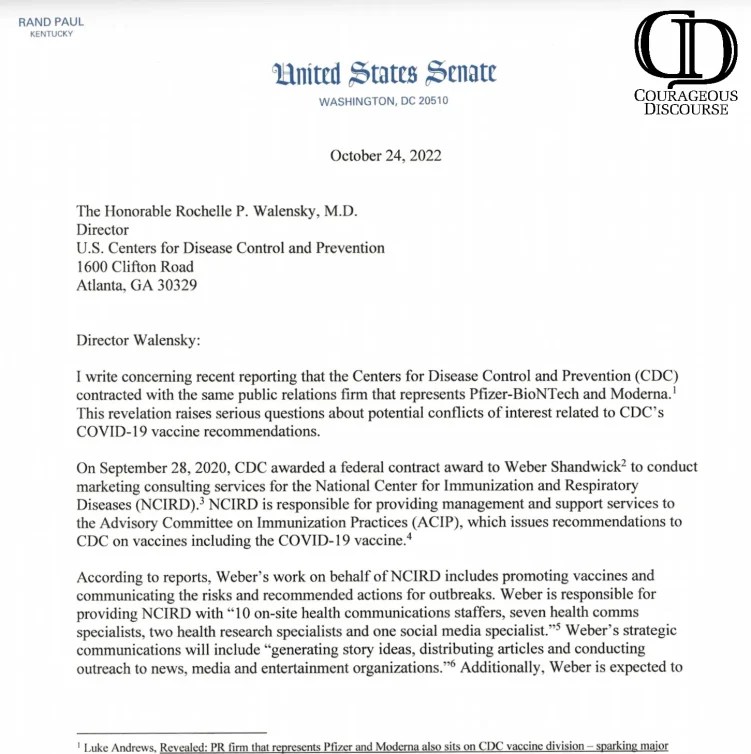
I wonder if Pfizer and Moderna were halted, would our government switch to promotion of Novavax or would they continue to let the smaller company languish?
The Florida State Surgeon General’s announcement today is a milestone as more government officials join a chorus calling for recall of COVID-19 vaccines including myself (US Senate, multiple State Senates, EU Parliament, UK Parliament), 17,000 physicians representing the Global COVID-19 Summit, Australian scientists, the World Council for Health, and the Association of American Physicians and Surgeons.
Russia thwarts Ukrainian attack on border area
RT | January 3, 2024
Russia’s Belgorod Region, which borders Ukraine, has come under fresh attack after Kiev’s forces launched a barrage of a dozen missiles, the Russian Defense Ministry has announced, adding that its air defenses had shot down all incoming projectiles.
The ministry wrote on its Telegram channel on Wednesday that “another attempt to carry out a terrorist attack by the Kiev regime on facilities on the territory of the Russian Federation, using multiple launch rocket system ‘Olkha’ missiles and ‘Tochka-U’ tactical ballistic missiles, was thwarted this morning.”
According to the statement, the shelling involved six rockets of each type.
Local residents reported seeing explosions in the skies early on Wednesday morning.
The Ukrainian military also shelled the region on Tuesday evening, using the same type of rockets, the defense ministry said, adding that all incoming missiles had been intercepted.
Earlier in the day, Kiev’s forces launched 17 ‘Olkha’ missiles toward Belgorod Region in three separate attacks. Governor Vyacheslav Gladkov wrote on his Telegram channel that one civilian had died and two were injured as a result of falling debris as the missiles were shot down.
The Russian Defense Ministry estimated that its air defenses brought down a total of 32 Ukrainian drones over Bryansk, Oryol, Kursk and Moscow regions on Monday night and Tuesday morning.
On Saturday, the city of Belgorod came under attack, with a massive Ukrainian barrage killing 25 people and wounding more than 100 others.
Kiev described the strike as retaliation for a previous Russian attack on major Ukrainian cities, including Kiev.
According to an anonymous Russian security source, Saturday’s shelling was personally ordered by Ukrainian President Vladimir Zelensky. Moscow has also claimed that the UK and the US also bear responsibility for the death of Russian civilians in Belgorod.
Ukraine and Russia have since engaged in daily tit-for-tat bombardments.
The Russian Defense Ministry reported on Tuesday that its missile strikes had obliterated a number of military industry facilities, repair shops, and ammunition warehouses in the neighboring country. Ukrainian authorities claimed that most of the projectiles ended up hitting civilian infrastructure and apartment blocks, killing multiple civilians.
The enabler of our two concurrent world wars: Washington
By Gilbert Doctorow | January 2, 2024
It is only the second day of the New Year, but you turn on the morning news with a feeling of trepidation. Here in Western Europe, the lead stories are death and destruction reported from the front lines of the two conflagrations that some commentators have identified as ‘world wars,’ given the way countries across the globe have aligned themselves with or against the protagonists in each conflict. The outstanding commonality between these two world wars is the position of the United States as their enabler in terms of delivery of essential military and financial support to one side, as well as real-time military intelligence, tactical and strategic counseling by high level officers positioned on the ground and in nearby seas. From the perspective of Washington, these are proxy wars which put at risk very few of its own men at arms, though some do come home in body bags without word to the press, while preparations proceed apace for the launch of a third proxy war in the South China Sea. The Philippines are the latest recruits to the prospective encirclement and assault on China.
On their talk shows, the Russians speculate on when a mutual defense pact with Iran, China and North Korea will be announced. This will not be a bloc, like NATO, but will enshrine the key principle of ‘one for all and all for one’ in case of attack by outside forces. To its backers in Moscow, this formulation would ensure that NATO generals understand they are up against an enemy of over two billion if we include a few other fellow travelers, not just the 145 million Russians whom they see across the border.
But that is what they say on talk shows. It is not the official voice of the Kremlin, which we find on Vesti television. Vesti maintains a near blackout of news on the Israel-Hamas war in broadcasts to its home audience. Why? Because Russia does not want to get embroiled in that war when it needs all its human and materiel resources to defeat the Ukrainians and their NATO backers. Moreover, Russia can be satisfied that the Iranians and their Houthi proxies have the situation in the Middle East under control, restraining the United States from region-wide escalation by engaging directly on Israeli’s side.
For that matter, Iran is doing just fine in shoring up Russia’s southern borders in the Caucasus. For more than a year, Armenia’s prime minister Nikol Pashinyan has been sitting on two stools: holding consultations with the French and intermittently attending gatherings of the Former Soviet Union republics called by Moscow. A week ago, Iranian leaders issued a direct warning to Armenia not to even think about pursuing the military and political rapprochement that France’s president Macron has been proposing. Said President Raisi: ‘No powers from outside the region are welcome in the Caucasus.’ This warning serves Russian security very well, though it is surely motivated by self-interest in Teheran, because any future French military presence in Armenia could also threaten them.
In Russian news, all attention is on the one conflict in which the Russians are themselves deeply engaged, and there news from the line of contact, news from the home front which a day ago experienced a murderous attack on the border town of Belgorod that killed 25 civilians and gravely injured another fifty or so, news from the United Nations Security Council deliberations of the same, more than fill the time allotted to 14.00 o’clock and 20.00 o’clock wrap-ups.
Anyone following developments of the Ukrainian war these past few days will note the tit for tat nature of the strikes dealt out by the warring parties day after day. The chain of events began early on the morning of Wednesday, 26 December, when the Ukrainians deployed air-launched Storm Shadow cruise missiles to destroy the Novocherkassk, a large landing ship of Russia’s Black Sea Fleet parked in the harbor of Feodosia, on the eastern shores of the Crimea. The ship was said to be loaded with drones and the missile strike set off a fire and explosions that may have killed as many as 74, both on the ship and in the port.
However, the outstanding feature of the attack was not the numbers of the dead or the loss of the ship itself: it was the demonstration that Kiev had now been given a Storm Shadow variant with much greater flight range than the initial shipments from the U.K. and France.
From the perspective of the Russian high command, this new ability of the Ukrainians to strike far deeper into Russian territory represented a serious escalation of the conflict which required mirror-image escalation from Russia. The Russian response was not long in coming: on the 27th, Russia launched the largest missile attack on Ukraine since the start of the Special Military Operation, more than 150 ballistic missiles, cruise missiles and armed drones, directed at cities across the Ukraine, including Kiev. Some of these were shot down by Ukrainian air defense, but the Zelensky regime admitted that all 20 Russian ballistic missiles evaded their fire and hit their targets.
From the partial information released by the Russian military, it would appear that their main interest was to destroy caches of the Storm Shadow and also the most advanced Western ground to air missiles. They claim to have destroyed a Patriot complex in the Lvov region, killing a substantial number of French military who were in charge of the installation. This is the sort of information which flits by in a second and is not repeated, so I can say no more.
The Ukrainian response the next day was a concentrated attack on the Russian border city of Belgorod, capital of an oblast of the same name. Belgorod is not more than 20 km from Ukraine’s second largest city, Kharkiv, and it first made international news about six months ago when a Ukrainian team of saboteurs claiming to be anti-Putin Russians crossed into the oblast and attacked residential neighborhoods. This time missiles were sent into apartment blocks and other civilian structures, killing some 25 Russians and gravely wounding perhaps 50 more, some of whom were evacuated to Moscow by plane on life support.
Yesterday and today the Russians avenged this serious loss by renewed missile attacks, now concentrated on Kharkiv, whence the attack on Belgorod had come. They demolished the headquarters of military intelligence in the city, claiming to have killed many foreign advisers, probably British and Americans, who were guiding the attacks. They also struck air fields across Ukraine which could be used to service planes carrying the Storm Shadow.
I end this overview with the remark that American-British escalation of the weaponry deployed against Russia was at the start of what we have witnessed these past six days. And that can be no accident. It follows from the news of the war in the immediately preceding period, which unequivocally demonstrated that on the ground, along the line of contact, the Russian forces were moving steadily to overrun Ukrainian positions and force a retreat. The storming of Mariinka was emblematic in this sense. The overall impression was depressing for the Ukrainian cause at the very time that Congress was in recess after rejecting efforts by the Administration to pass legislation ensuring continued financial and military aid to Kiev. Now these Ukrainian missile attacks on the Black Sea fleet in the Feodosia harbor and the attack on civilians in what is properly speaking Russian Federation territory of Belgorod oblast would give luster to the Ukrainian cause while prodding the Russians to escalate and perform what Washington would showcase as war crimes.
Escalation is the game Washington is playing. In Ukraine. In the Red Sea. In the Eastern Mediterranean off the coast of Lebanon. Washington seems oblivious to the possibility that the proxy wars it is fanning may yet invite a Russian, or Iranian, or North Korean strike directly on U.S. assets, whether overseas or on the Continental United States.
Ukraine to decide how to use US missiles – ambassador
RT | January 2, 2024
The decision on how to use the American-supplied missiles for HIMARS launchers will be up to the Ukrainian military command, US Ambassador to Kiev Bridget Brink said on Tuesday, according to the Ukrainian outlet Strana.
The US has sent Ukraine around 30 high-mobility artillery rocket systems since mid-2022. The projectiles Washington officially supplied to Kiev have a range of up to 160 kilometers (100 miles). Ukraine has repeatedly demanded longer-range missiles.
The Ukrainian Armed Forces command will “independently decide on the range of strikes delivered” using the HIMARS projectiles the US plans to deliver “in the near future,” Strana reported Brink as saying on Tuesday afternoon.
Brink made the identical announcement in June 2022. It was reiterated by the Pentagon in February 2023, when the US announced it would send Ukraine Ground Launched Small Diameter Bombs (GLSDB) munitions.
According to a Washington Post article at the time, Ukraine carries out HIMARS launches using “specific coordinates provided by US military personnel,” but chooses the targets itself. The US provides coordinates and targeting information “solely in an advisory role,” an anonymous American official insisted.
Russia has said that this is a distinction without a difference, and repeatedly warned that US and British officials involved in Ukrainian attacks on civilians will be brought to justice.
In October, Kiev boasted about using longer-ranged ATACMS missiles “secretly” supplied by the US. As it turned out, the White House sent over a small number of the rockets armed with the controversial cluster munitions.
On Saturday, Ukrainian long-range rocket artillery struck the main town square of Belgorod city with cluster bombs, killing 25 civilians – including children – and injuring 100 more. Czech-supplied weapons were reportedly used in the attack. Russia has retaliated by targeting Ukrainian command posts, weapons warehouses and military factories in a wave of missile and drone strikes.
Ukraine and Palestine: A double threat to US hegemony
The outcome of US-led conflicts in Ukraine and West Asia will have a profound impact on the developing world order
By MK Bhadrakumar | The Cradle | January 2, 2024
Geopolitical analysts broadly agree that the war in Ukraine and the West Asian crisis will dictate the trajectory of world politics in 2024. But a reductionist thesis appears alongside that views the Israel-Palestine conflict narrowly in terms of what it entails for the resilience of the US proxy war in Ukraine – the assumption being that the locus of world politics lies in Eurasia.
The reality is more complex. Each of these two conflicts has a raison d’être and dynamics of its own, while at the same time also being intertwined.
Washington’s neck-deep involvement in the current phase of the West Asian crisis can turn into a quagmire, since it is also tangled up with domestic politics in a way that the Ukraine war never has been. But then, the outcome of the Ukraine war is already a foregone conclusion, and the US and its allies have realized that Russia cannot be defeated militarily; the endgame narrows down to an agreement to end the conflict on Russia’s terms.
To be sure, the outcome of the Ukraine war and the denouement of the Israel-Palestine conflict, which is at the root of the West Asian crisis, will have a profound impact on the new world order, and the two processes reinforce each other.
Russia realizes this fully. President Vladimir Putin’s stunning ‘year-enders’ in the run-up to the New Year speak for themselves: daylong visits to Abu Dhabi and Riyadh (watched by a shell-shocked US President Joe Biden), followed by talks with Iran’s president and rounded off with a telephone conversation with the Egyptian president.
In the space of 48 hours or so, Putin touched base with his Emirati, Saudi, Iranian, and Egyptian colleagues who officially entered the portals of the BRICS on 1 January.
The evolving US intervention in the West Asian crisis can be understood from a geopolitical perspective only by factoring in Biden’s visceral hostility toward Russia. BRICS is in Washington’s crosshairs. The US understands perfectly well that the extra large presence of West Asian and Arab nations in BRICS — four out of ten member states — is central to Putin’s grand project to re-structure the world order and bury US exceptionalism and hegemony.
Saudi Arabia, the UAE, and Iran are major oil producing countries. Russia has been rather explicit that during its 2024 chairmanship of BRICS, it will push for the creation of a currency to challenge the petrodollar. Without doubt, the BRICS currency will be at the center stage of the grouping’s summit due to be hosted by Putin in Kazan, Russia in October.
In a special address on 1 January, marking the start of Russia’s BRICS Chairmanship, Putin stated his commitment to “enhancing the role of BRICS in the international monetary system, expanding both interbank cooperation and the use of national currencies in mutual trade.”
If a BRICS currency is used instead of the dollar, there could be significant impact on several financial sectors of the US economy, such as energy and commodity markets, international trade and investment, capital markets, technology and fintech, consumer goods and retail, travel and tourism, and so on.
The banking sector could take the first hit that might eventually spill over to the markets. And if Washington fails to fund its mammoth deficit, prices of all commodities could skyrocket or even reach hyperinflation triggering a crash of the US economy.
Meanwhile, the eruption of the Israel-Palestine conflict has given the US an alibi — ‘Israel’s self-defense’ — to claw its way back on the greasy pole of West Asian politics. Washington has multiple concerns, but at its core are the twin objectives of resuscitating the Abraham Accords (anchored on Saudi-Israeli proximity) and the concurrent sabotage of the Beijing-mediated Saudi-Iranian rapprochement.
The Biden administration was counting on the fact that an Israeli-Saudi deal would provide legitimacy to Tel Aviv and proclaim to the Islamic world that there was no religious justification for hostility towards Israel. But Washington senses that post-7 October it would not be able to secure a Saudi-Israel deal during this Biden term, and all that could be coaxed out of Riyadh is a door left ajar for future discussion on the topic. No doubt, it is a major blow to the US strategy to liquidate the Palestinian question.
In a medium term perspective, if the Russian-Saudi mechanism known as OPEC+ liberates the world oil market from US control, BRICS drives a dagger into the heart of US hegemony which is anchored on the dollar being the ‘world currency.’
Saudi Arabia recently signed a currency swap deal worth $7 billion with China in an attempt to shift more of their trade away from the dollar. The People’s Bank of China said in a statement that the swap arrangement will “help strengthen financial cooperation” and “facilitate more convenient trade and investment” between the countries.
Going forward, sensitive Saudi-Chinese transactions in strategic areas such as defense, nuclear technology, among others, will henceforth take place below the US radar. From a Chinese perspective, if its strategic trade is sufficiently insulated from any US-led program of anti-China sanctions, Beijing can position itself confidently to confront US power in the Indo-Pacific. This is a telling example of how the US strategy for the Indo-Pacific will lose traction as a result of its waning influence in West Asia.
The conventional wisdom is that preoccupation in volatile West Asia distracts Washington from paying attention to the Indo-Pacific and China. In reality, though, the waning influence in West Asia is complicating the capacity of the US to counter China both in the region as well as in the Indo-Pacific. The developments are moving in a direction where the credentials of the US as a great power are at an inflection point in West Asia – and that realization has leaked into other geographic regions around the world.
Way back in 2007, the distinguished political scientists John Mearsheimer of the University of Chicago and Stephen Walt of the John F. Kennedy School of Government at Harvard, wrote with great prescience in their famous 34,000-word essay entitled The Israel Lobby and US Foreign Policy that Israel has become a ‘strategic liability’ for the United States, but retains its strong support because of a wealthy, well-organized, and bewitching lobby that has a ‘stranglehold’ on Congress and US elites.
The authors warned that Israel and its lobby bear outsized their responsibility for persuading the Bush Administration to invade Iraq and, perhaps one day soon, to attack the nuclear facilities of Iran.
Interestingly, on New Year’s Eve, in a special report based on extensive briefing by top US officials, the New York Times highlighted that “No other episode [as the war in Gaza] in the past half-century has tested the ties between the United States and Israel in such an intense and consequential way.”
Clearly, even as Israel’s barbaric actions in Gaza and its colonial project in the occupied West Bank are exposed and laid bare, and the Israeli state’s campaign to force Palestinian population migration are in full view, two of the US strategic objectives in the region are unravelling: first, the restoration of Israel’s military superiority in the balance of forces regionally and vis-a-vis the Axis of Resistance, in particular; and second, the resuscitation of the Abraham Accords where the crown jewels would have been a Saudi-Israeli treaty.
Viewed from another angle, the directions in which West Asia’s crisis unfolds are being keenly watched by the world community, especially those in the Asia-Pacific region. Most notable here is that Russia and China have given the US a free hand to navigate its military moves – unchallenged, so far, in the Red Sea. This means that any conflagration in the region will be synonymous with a catastrophic breakdown of US strategy.
Soon after the US defeat in Afghanistan in Central Asia, and coinciding with an ignominious ending of the US-led proxy war by NATO against Russia in Eurasia, a violent, grotesque setback in West Asia will send a resounding message across all of Asia that the US-led bandwagon has run out of steam. Among the end users of this startling message, the countries of ASEAN stand at the forefront. The bottom line is that the overlapping tumultuous events in Eurasia and West Asia are poised to coalesce into a climactic moment for world politics.
Featured Video

When Israel Is Mighty
or go to
Aletho News Archives – Video-Images
From the Archives
US murdering 1 million Iraqis is democracy, Iran giving yogurt to Iraq is “domination”
By Ali Salaam | American Herald Tribune | July 31, 2017
The New York Times, owned by the Zionist Jewish supremacist Ochs-Sulzberger family, has no problem with Iraqi suffering as long as Iran is not the one behind it.
The Iraq War was a genocide of the Iraqi people by Zionist supremacists in the Bush administration. Over 1 million innocent people were killed based on a lie. American soldiers died in an Israeli war and now an average of 22 soldiers commit suicide every day because their consciences cannot cope with the fact they committed crimes in an illegal war that served no purpose other than to benefit Israel, not America.
Benjamin Netanyahu, Prime Minister of the Zionist regime, once said “We are benefiting from one thing, and that is the attack on the Twin Towers and Pentagon, and the American struggle in Iraq.”
Paul Wolfowitz had his sights on Iraq since his time in the first Bush administration. Former Israeli official and Bush administration official Richard Perle had his eyes on Iraq since at least his authorship of the Clean Break white paper. The Zionist regime had their eyes on Iraq since the 1980s when strategist Oded Yinon wrote his white paper in support of dividing the Arab-Muslim world along ethnic and sectarian lines. The global Zionist lobby has had their eyes on Iraq since Theodor Herzl stated that Eretz Israel’s true borders go from the Nile River in Egypt to the Euphrates River in Iraq. … continue
Blog Roll
 Aletho News
- MEP blasts ‘Euro-Gestapo’ for lecturing Russia on democracy
- Syria May Send Troops to Saudi Arabia Amid War with Ansar Allah
- UK whines about losing billions to ‘Putin tax’
- Baghaei to Rubio: Distorted narratives cannot erase US record of broken commitments
- Houthis Don’t Have to Conquer Saudi Arabia to Make It Pay
- MOE: Nearly 22,000 Students and Education Workers Killed
- Guterres in Islamabad: Genocide, cowardice, and the cage of Imran Khan
- Johnson, Marandi say Yemen holds upper hand over Saudi Arabia
- False flags won’t save aggressors, Iran FM spokesman says
- The Makkah Pact Enters Into Force: The End of American Dominance or Its New Form?
- If Americans Knew
- Gaza ceasefire exists in name only, say more than 100 organizations
- Nearly 2 Million in Gaza Need Urgent Shelter Assistance as Winter Looms: IOM Chief Warns
- Suppressing Palestinian resistance: US charity under fire for AI monitoring of Gaza classrooms
- Thousands Are Held in Israeli Torture Camps. This Is What Happens Inside
- Israel puts Gaza’s sick, injured, newborn in peril – Daily Update
- Report claimed Mark Levin used by Israeli government to influence Trump
- Over 2,000 Gazans have died awaiting medical evacuation amid Israel’s continued siege
- How a U.S. Diplomat Suppressed and Altered Reports Critical of Israel
- 5 Palestinians Die from Israeli Strikes in Gaza as Relentless Attacks Continue
- Report: Ceasefire Slows Killing but Leaves Devastation Intact
- No Tricks Zone
- New Study: 50 Years Of The Most Aggressive ‘Net Zero’ Policies Can Only Affect The Global Climate By 0.03°C
- US September “Heat” Was No Record…Many Records Set Decades Ago
- Latest European Green Energy Debacle; Portugal’s Largest Flagship Solar Park Insolvent!
- Green Energy Debacle: German Expert Professor Fritz Vahrenholt Warns Of Severe Economic And Social Consequences
- Two More Paleo Reconstructions Affirm Meters-Higher Sea Levels Across Ireland, Brazil 7000-6000 Years Ago
- New Study: Earth And Venus Surface Warmth Largely Explained By Convection And Lapse Rate, Not CO2 Or Radiation
- 2025 Nature Paper Claiming Worsening Global Drought Gets RETRACTED …Heavily Flawed
- New Study: ‘Global Drought Shows No Detectable Recent Acceleration Under Climate Warming’
- Economic Masterminds: German Socialists Suggest Taxing Productivity Gains Stemming From Using AI
- The South China Sea Has Not Been Cooperating With The Climate Change Narrative

