Why China’s ‘repressed’ Muslims suddenly got dragged back into the light
By Timur Fomenko | RT | November 24, 2023
At the beginning of this week, foreign ministers from a group of Muslim-majority countries, including Saudi Arabia, Jordan, Egypt, the Palestinian National Authority, and Indonesia travelled to China in order to seek support for a ceasefire in the ongoing Gaza war.
The unconditional backing of Israel by the United States and its allies has tanked their credibility across the Islamic world, and Beijing has positioned itself as an advocate of peace when others are not willing to take up that role.
It is curious that within the following few days, a report was released by Human Rights Watch, accusing China of expanding its alleged campaign of closing down and repurposing mosques into regions other than Xinjiang – which had so far been the focus of accusations that Beijing is cracking down on the predominantly Muslim Uyghur minority. Even those allegations had been somewhat on the backburner in the establishment media lately, but the HRW report was quickly picked up and amplified.
Although relations between the US and China have somewhat calmed down, it is obvious that Washington does not want to see Beijing increase its influence in the Muslim world, as that would inevitably come at the expense of American clout. The attempt to draw attention back to China’s alleged repression of its Muslim population, while underreporting Israel’s devastating attack on the (also Muslim) population of Gaza, is an exercise in deflection and part of the ongoing narrative war between China and the US. Be it about Muslims or not, the Xinjiang issue has long been a key component of that struggle for influence.
The Uyghur minority has, since 2018, been a tool of “atrocity propaganda” used to wage public relations offensives against China. It is a means to an end, which often disappears and resurfaces in the media, coinciding with the ebb and flow of anti-Beijing rhetoric coming from the US administration or the State Department. This includes using it to turn public opinion against Beijing in selected countries, including allies, or to manufacture consent for policies aimed at supply chain shifts or “decoupling,” through the accusation of forced labor, especially in the fields of key agricultural goods, polysilicon and solar panels, or to attempt to embarrass China diplomatically at the UN, or to push for boycotting events such as the Winter Olympics.
This is an incredibly opportunistic attitude to something Beijing’s detractors claim is a “genocide.” Since late 2021, the Biden administration has largely ignored the issue and it has fallen off the international agenda, precisely because Washington had gotten the sanctions they wanted from it at the time. However, the Israel-Gaza conflict introduces a new dynamic whereby the US and its allies are dramatically losing face and credibility among Muslim nations because they are backing Israel unconditionally in the wholesale slaughter of Palestinians. From a geopolitical point of view, such a policy pathway is actually strategically disastrous because it alienates the entire Global South, serves as a beacon in projecting US hypocrisy and worse still, directly empowers China as a competitor.
So when you are faced with a situation whereby Beijing is gaining diplomatic capital over your own failures, what do you do? You desperately aim to deflect by trying to draw attention to another issue in the attempt to smear Beijing: Xinjiang and the Uyghurs. Now as it happens, Muslim countries mostly ignore US-led propaganda over the Xinjiang issue, because they see it for what it is and also share a common norm of respect for national sovereignty with Beijing, which is politically beneficial for them. The only Muslim nation who has ever made public comment about it is Türkiye, because Uyghurs are a Turkic ethnic group and the issues is viewed through the lens of Ankara’s Pan-Turk ideology. However, Turkish President Recep Tayyip Erdogan is still likely to ignore the issue, or only involve himself in it based on what he can gain.
On the other hand, the Gulf States, the key US allies in the Middle East, such as Saudi Arabia and the United Arab Emirates, support China’s position, and the Gaza issue is putting them under pressure regarding their relations with the US and the decision to normalize relations with Israel. So suddenly we are seeing a resurgence of Xinjiang material because the US, even if it cannot sway their governments, wants to kindle the anger of Muslim populations about another issue instead and diminish China’s credibility. Although this is less likely in Arab States, it could cause public opinion ruptures in key Asian Islamic countries such as Indonesia and Malaysia, where significant resources were placed by organizations such as the BBC in relaying Xinjiang-related content in their respective languages.
But the question is, will this campaign succeed? It might be worth remembering that Xinjiang is an artificially imposed issue pushed “top-down” by governments and the media, whereas Palestine is a grassroots issue pushing from the bottom up, aspects of which media and politicians endeavor to selectively ignore. China’s heavy-handed management of Uyghurs in Xinjiang is not really a genocide, and it will never rank on the same level of severity as the outright bombardment and mass killing of Palestinians, no matter how hard you try.
Democrats Ignore The First Amendment With Censorship Demand Letter To X
By Christina Maas | Reclaim The Net | November 23, 2023
A group of over 25 Democratic members of Congress have raised allegations against X, once again ignoring the First Amendment and calling for online censorship.
They assert that the company is both allowing and profiting from the dissemination of false and violent content, particularly regarding the conflict between Israel and Hamas.
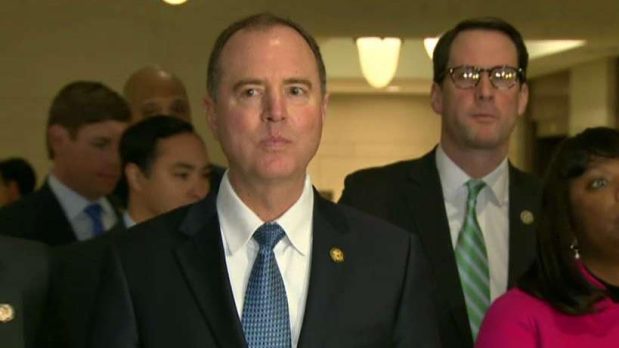
On Tuesday, these lawmakers, including notable figures such as Reps. Dan Goldman, Jamie Raskin, Jerry Nadler, Bennie Thompson, Katie Porter, and Adam Schiff, addressed a letter to Linda Yaccarino, CEO of X, and Elon Musk, its owner.
We obtained a copy of the pressure letter for you here.
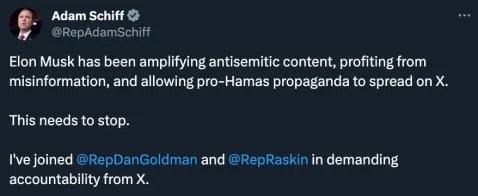
They expressed concern over X’s alleged negligence in enforcing its policies against the spread of misleading information and content promoting violence, hate, and terrorism.
The letter specifically points out the drastic reduction in X’s content moderation staff over the past year, suggesting that the company has deliberately allowed and even benefited from the illegal circulation of terrorist propaganda. This conduct, according to the legislators, is completely inappropriate for a platform as globally influential as X.
Further, the letter highlights reports from the Tech Transparency Project and the Institute for Strategic Dialogue.
“We are demanding that you uphold your public commitments and enforce your policies. Accordingly, no later than December 1, 2023, we request that you provide all forms of written communications, including email, text messages, other messaging services, or X direct messages, relating to content moderation for any posts or accounts associated with, related to, or connected to Hamas,” the letter states.
The lawmakers underscore that X Premium, a subscription service offering features like prioritized ranking in conversations and searches, might be indirectly facilitating the profit from the spread of such content. They note that X gains financially from subscription fees and ad revenue generated from these accounts.
Elon Musk recently declared that all X revenue from ads and subscriptions on content regarding the conflict will be donated to charities in the impacted region.

Additionally, the letter accuses X of profiting from subscribers who spread false and misleading narratives about the Israel-Hamas war.
Further, this month, Representatives Josh Gottheimer, a Democrat from New Jersey, and Don Bacon, a Republican from Nebraska, introduced a bill aimed at countering the uptick of alleged false information disseminated on TikTok and other online platforms amid the recent Israel-Hamas conflict.
Gottheimer clarified during a media briefing, “This legislation will require social media companies to release detailed reports of violations to their terms and services and how they’re addressing these violations, which includes using their platforms for terrorist purposes… It also requires the intelligence community to provide a threat assessment about what’s happening on social media.”
The proposed law, titled the Stopping Terrorists Online Presence and Holding Accountable Tech Entities Act or the Stop Hate Act, incorporates a $5 million daily penalty for any social media enterprise non-compliant with the proposed bill’s conditions. The act is vocally supported by the ADL.
New York Governor Kathy Hochul signed similar legislation in 2022, only to have a judge denounce it as a violation of the First Amendment.
Israel lobby offers US politician $20mn to unseat Rashida Tlaib

Actor and US Senate candidate Hill Harper – October 20, 2023 [Jemal Countess/Getty Images for NOBCO]
The Cradle | November 23, 2023
A prominent US actor turned politician was offered $20mn by the Israel lobby to run in upcoming elections against Democratic Congresswoman Rashida Tlaib, as she faces fierce criticism for her stance against what she says is Israel’s ongoing genocide against Palestinians in Gaza.
Tlaib, the only Palestinian-American lawmaker in the US Congress, has stood alone in opposing the Biden White House’s staunch support for an Israeli military campaign that has killed over 13,000 Palestinians, the majority women and children, in six weeks.
The $20mn was offered to Hill Harper on 16 October by Michigan businessman Linden Nelson, who is connected to the American Israel Public Affairs Committee (AIPAC), the most powerful Israeli lobby group in Washington.
Frank Eugene “Hill” Harper, 57, a Hollywood actor who most recently portrayed Dr. Marcus Andrews in The Good Doctor on CBS, is running to succeed retiring Democratic Senator Debbie Stabenow in Michigan.
But Nelson offered the money to Harper in exchange for dropping out of the Senate race and running for Congress against Tlaib instead.
Harper confirmed the report on Wednesday, tweeting: “I didn’t intend for a private phone call to turn public. But now that it has, here’s the truth. One of AIPAC’s biggest donors offered $20m if I dropped out of the US Senate race to run against Rashida Tlaib. I said no. I won’t be bossed, bullied, or bought.”
He also tweeted: “Yes, telling the truth here will put a target on my back. But if we ALL come together, we can win.”
“I’m not going to run against the only Palestinian-American in Congress just because some special interests don’t like her,” he added.
Harper revealed that he had been approached to primary Tlaib after Politico reported that Michigan businessman Nelson offered him $10mn in direct contributions to his potential campaign and another $10mn in independent expenditures if he ran against her.
Regarding his transition to politics, Harper explained, “I’ve had a successful acting career, and I’m not someone who grew up thinking I wanted to be a politician,” he said.
“I’m running because I want to break the stranglehold wealthy special interests have on our politics, whether it’s the Israel lobby, the NRA or Big Pharma,” he added.
Nelson’s decision comes despite his history of ties to AIPAC, which has contributed to previous failed campaigns to oust Tlaib from Congress.
In a social media post, Tlaib accused President Joe Biden, the leader of her Democratic Party, of supporting the “genocide of the Palestinian people” by providing unconditional military support to Israel.
Earlier this month, many of her fellow Democratic members of Congress joined Republicans to censure Tlaib for her comments over the war, which critics slammed as antisemitic.
“It is important to separate people and government,” Tlaib said. “The idea that criticizing the government of Israel is antisemitic sets a very dangerous precedent. And it’s been used to silence diverse voices speaking up for human rights across our nation.”
Harvard Law Review bans article on Israeli genocide in Gaza
MEMO | November 23, 2023
The prestigious Harvard Law Review (HLR) has made the extraordinary decision to ban publication of an article examining the legal framework surrounding Israel’s ongoing Nakba against Palestinians, particularly in Gaza.
Authored by Palestinian human rights lawyer Rabea Eghbariah, who is currently completing his doctoral studies at Harvard Law School, the piece had cleared editorial review and was nearing publication when HLR’s president intervened.
In an email quoted by the Intercept’s recent investigation, Editor Tascha Shahriari-Parsa revealed the president blocked publication over concerns that “editors who might oppose or be offended by the piece” may face harassment by pro-Israel groups.
On Saturday, following several days of debate and a nearly six-hour meeting, the HLS’ full editorial body came together to vote on whether to publish the article, reported the Nation. A subsequent vote rejected the article, with 63 per cent of HLR editors voting against its right to be heard. While no reason was given, the facts speak for themselves – honest discourse about Palestinian suffering remains taboo.
In a joint statement, 25 HLR editors expressed alarm that fear of public intimidation now governs editorial decisions at the university that promises to pursue truth and protect academic freedom.
“At a time when the Law Review was facing a public intimidation and harassment campaign, the journal’s leadership intervened to stop publication,” they wrote. “The body of editors—none of whom are Palestinian—voted to sustain that decision. We are unaware of any other solicited piece that has been revoked by the Law Review in this way.”
The Nation has published the article Harvard Law Review refused to run in full. The article argues that the horrific violence and humanitarian crisis unfolding in Gaza should be recognised as genocide. It states that there is credible evidence that Israel intends to destroy the Palestinian people in whole or in part, meeting the UN definition of genocide.
The author cites numerous statements by Israeli officials, as well as the material conditions imposed on Palestinians, to demonstrate genocidal intent and outcome. He asserts that the blockade of Gaza and mass killing of civilians could plausibly constitute genocide under international law.
Additionally, the article condemns the refusal of Western institutions, including prominent legal scholars and journals, to acknowledge the reality of genocide due to selective application of international law. It states that Palestinian lives are devalued and their innocence denied within a colonial structure.
The author argues the Nakba, referring to the ethnic cleansing of Palestinians in 1948 as well as the ongoing system of oppression, serves to erase Palestinians politically and physically. The article concludes that just as concepts like genocide and apartheid were codified in international law post-WWII, the Palestinian experience of genocide equally deserves recognition in order to end the crimes against them.
How the Democratic Party Faked an American Insurrection
By Robert Bridge | Strategic Culture Foundation | November 23, 2023
Last week, more than 40,000 hours of Jan. 6 Capitol Police security footage was released in the public domain that once and for all blew a hole in the pro-Trump ‘violent insurrection’ narrative so dear to the Democrats.
The one question on countless Americans’ minds following the release of the damning videos was: will all those men and women recently locked away as political prisoners for dozens of decades get another day in court? Indeed, January 6 may have been a lot of things to many people, but another Boston Tea Party it most definitely was not.
Social media was alight over the weekend showing one benign scene after another of the ‘insurrectionists’ casually strolling through the Capitol Building premises, exchanging pleasantries with the on-duty police officers, even giving each other fist-bumps.
The revelations of the true nature of the event came to light as newly appointed House Speaker Mike Johnson released the security footage, which came as a political manna from heaven for former president Donald Trump and other members of the Republican Party.
“Truth and transparency are critical,” Johnson said in a prepared statement. “This decision will provide millions of Americans, criminal defendants, public interest organizations, and the media an ability to see for themselves what happened that day, rather than having to rely upon the interpretation of a small group of government officials.”
Democrats, however, who have milked the ‘insurrectionist’ narrative for everything it is worth, predictably chafed at the release, calling it a ‘risk to national security.’
“It is unconscionable that one of Speaker Johnson’s first official acts as steward of the institution is to endanger his colleagues, staff, visitors, and our country by allowing virtually unfettered access to sensitive Capitol security footage,” said New York Democrat Rep. Joseph Morelle, who sits on the Committee on House Administration. “That he is doing so over the strenuous objections of the security professionals within the Capitol Police is outrageous. This is not transparency; this is dangerous and irresponsible.”
For almost two years, Democrats, who managed to cherry-pick the most suggestive scenes of the footage, portrayed January 6th as everything from another September 11 to a second Pear Harbor.
Last year, Alexandria Ocasio-Cortez (AOC), the photogenic member of the Democrat’s radical progressive wing, was shown visibly upset after having to “relive” the events of the Capitol riot.
“I am so angry. Having to relive that footage,” she sobbed, rubbing her forehead. “I know it’s not just me. This is everyone.”
“These attacks killed people, traumatized people and for any of you right-winger Trump loyalists, he sent his own people to jail, and promised his own people that he would pardon them.”
The inconvenient truth, however, is that only one person was killed on the day of the Capitol riot – unarmed Air Force veteran and avid Trump supporter, Ashli Babbitt, who was shot by a police officer.
Now, Republicans are demanding justice be served and that the incarcerated protesters be immediately set free.
“And just like that the J6 Committee’s violent insurrection narrative has crumbled,” said conservative commentator Charlie Kirk over X (formerly Twitter). “The Capitol Police facilitated the protesters passage through the building…the vast majority of J6ers should be immediately released.”
However, with the Democrats still in control of Washington, D.C., together with the FBI, the Justice Department and other administrative offices, the Republicans will have to wait until November 4th – and possibly longer if they lose their White House bid – before any real justice is meted out.
Meanwhile, federal officials have said there is no evidence that law enforcement officials helped coordinate the attacks.
“If you are asking whether the violence at the Capitol on January 6 was part of some operation orchestrated by FBI sources or agents the answer is emphatically no,” FBI Director Christopher Wray told Rep. Clay Higgins (R-La.) during a House Committee hearing. Higgins was questioning Wray about two Greyhound buses he said dropped off FBI agents dressed as Trump supporters at the Capitol on January 6, referring to the vehicles as “ghost buses.”
Whatever the case may be, the fresh revelations were a silver lining in a shitstorm that has been following Donald Trump, who hopes to win back the White House next November despite multiple legal woes.
“Congratulations to Speaker of the House Mike Johnson for having the Courage and Fortitude to release all of the J6 Tapes, which will explicitly reveal what really happened on January 6th!” Trump wrote on Truth Social Friday.
North Korea Scraps 2018 Military Pact with South After Seoul Walks Backs Commitments
By Kyle Anzalone | The Libertarian Institute | November 23, 2023
Amid escalating tensions in the region, North Korea has withdrawn from a 2018 agreement with South Korea that reduced military tensions on the Korean Peninsula. Pyongyang took the step after Seoul announced it would resume surveillance operations along the DMZ.
The relationship between Pyongyang and Seoul has been in a downward spiral since President Joe Biden took office. Tensions between North and South Korea spiked last week when Pyongyang successfully placed a military satellite into orbit.
North Korean state media reported the satellite allowed Kim Jong Un to view images of a US military facility in Guam.
Seoul and its backers in Tokyo and Washington condemned the satellite launch, claiming it violated UN resolutions. Pyongyang insists that it is within North Korea’s rights as a sovereign country to have spaced-based surveillance technology.
In response to North Korea’s successful launch, South Korea walked back its commitments to a 2018 inter-Korean Comprehensive Military Agreement (CMA). The CMA reduced tensions on the Peninsula by limiting military activities.
South Korea announced it was breaking the CMA on Wednesday by resuming surveillance flights along the North Korean border. Seoul’s Defense Minister Shin Won-sik explained, “North Korea’s satellite launch is a clear violation of UN Security Council resolutions and a serious provocation against [South Korea] and the international community.” South Korean Ministry of National Defense Spokesman Heo Tae-keun stated, “North Korea’s behavior shows again that it has no will to comply with the agreement.”
The North Korean Defense Ministry said Pyongyang would completely vacate the agreement. “We will immediately restore all military measures that have been halted according to the North-South military agreement,” Pyongyang’s state media outlet, KCNA, reported.
“We will withdraw the military steps taken to prevent military tension and conflict in all spheres including ground, sea, and air, and deploy more powerful armed forces and new-type military hardware in the region along the Military Demarcation Line.”
The ministry’s statement continued that South Korea must “pay dearly for their irresponsible and grave political and military provocations that have pushed the present situation to an uncontrollable phase.”
After Biden took office, the US and South Korea resumed large-scale live-fire war games on the Korean Peninsula. Pyongyang views the operations as preparations for regime change in North Korea. The White House has further escalated tension by deploying multiple strategic weapons systems to South Korea and forming a trilateral military pact with Seoul and Tokyo that Pyongyang views as an Asian NATO.
Texas Sues Pfizer for ‘Endangering Children’ by Selling Ineffective ADHD Drug
By Suzanne Burdick, Ph.D. | The Defender | November 22, 2023
Acting on behalf of the state of Texas, Attorney General Ken Paxton on Monday unsealed a lawsuit against Pfizer and its drug manufacturer, Tris Pharma, alleging the companies sold medication to children even though they knew the drug was ineffective and potentially unsafe.
The suit, filed in the Harrison County District Court, alleges Pfizer knowingly distributed a drug used for treating attention-deficit/hyperactivity disorder (ADHD) to children on Medicaid — despite the drug’s pattern of failing quality control tests.
The drug, Quillivant XR, is a stimulant that affects brain and nerve chemicals involved in hyperactivity and impulse control.
From 2012-2018, “Pfizer and Tris continually manipulated Quillivant testing to hide poor manufacturing practices and defraud the Texas Medicaid program,” according to a press release.
During those years, many families complained that the medication failed to work. According to the complaint:
“At no point did Defendants warn Texas Medicaid providers or decision-makers that Quillivant had known manufacturing issues affecting its efficacy, thereby depriving the Medicaid program of the crucial information it relies on. … As a result, thousands of Texas children received an adulterated Schedule II Controlled Dangerous Substance.”
In a tweet, Paxton said:
Commenting on the lawsuit, Kim Mack Rosenberg, acting general counsel for Children’s Health Defense, said, “Pfizer once again is in the spotlight for alleged unethical and fraudulent activity.”
Rosenberg told The Defender :
“I applaud the Texas AG for taking action here to protect some of Texas’s most vulnerable children, those who rely on Medicaid for healthcare. To knowingly supply adulterated medication to vulnerable children is inexplicable and unconscionable.”
“Unfortunately,” Rosenberg added, “this is not the first time questions have been raised about Pfizer’s conduct, including wrongdoing allegedly resulting in children dying in clinical trials in Nigeria in the 1990s and serious questions about Pfizer’s COVID-19 injections and its treatment medication Paxlovid.”
Defendants in the suit include Pfizer, Tris and Tris CEO Ketan Mehta.
The lawsuit stemmed from a whistleblower complaint made by Tarik Ahmed, who served as Tris’ technology chief from 2013-2017.
The lawyers are suing for more than $1 million, including civil penalty fees, and are asking the court to force Pfizer and Tris to pay back to the state of Texas all profits received from selling Quillivant in the Texas Medicaid program “as a result of Defendants’ unlawful acts” and, additionally, to pay back double that amount.
Lawyers with Paxton’s office requested a trial by jury.
In 2017, Quillivant grossed roughly $193.3 million in U.S. sales. The drug was developed by NextWave Pharmaceuticals, which Pfizer bought in 2012 for $680 million.
The lawyers charged the defendants with defrauding the Texas Medicaid program “by providing adulterated pharmaceutical drugs to Texas children in violation of the Texas Medicaid Fraud Prevention Act, now known as the Texas Health Care Program Fraud Prevention Act (‘THFPA’).”
The press release said, “For years, Tris altered the drug’s testing method in violation of federal and state laws to ensure Quillivant passed regulatory hurdles and could continue to be sold.”
According to Reuters, Pfizer said in a statement that it had examined the suit’s allegations on “multiple occasions” and “did not find any impact on the safety of the product.”
Pfizer said the case has no merit and will move to dismiss it.
A Tris spokesperson told Reuters in an email, “We categorically deny and intend to rigorously defend these allegations in the court of law.”
Drug failed quality control tests for years
Almost immediately after getting U.S. Food and Drug Administration (FDA) approval, Quillivant began failing routine quality tests. According to the complaint:
“Beginning at least as early as October 2012, Tris quality control personnel observed that sample of Quillivant tested under FDA-required dissolution specifications were not generating passing results.
“Dissolution testing is an important quality control tool used to measure whether a drug was properly manufactured, by comparing a simulated release of the drug to a standard set upon the drug’s initial approval.
“This in turn helps to predict whether the drug (as manufactured) will be released as expected in a patient’s body — which is critical for ensuring proper and consistent patient dosing.”
The Quillivant samples formed lumps during the reconstitution phase of the test.
Instead of investigating why there were lumps, Tris “retrained” its analysts to shake the water/drug mixture longer and to conduct the test only when “foaming is absent from the suspension,” the filing said.
Even with these changes, Quillivant continued to fail dissolution tests. Tris then stopped using that testing method and switched to a new method.
“Alarmingly,” the filing said, “the new test method was not representative of real-world usage by patients, and worse, went against the pharmacy reconstitution instructions contained in the FDA-approved label for Quillivant.”
When quality control issues continued to arise, the companies told the FDA a “misleading” and “convenient narrative to explain away the problem.”
Pfizer wanted to ‘fully exploit the economic potential of Texas Medicaid’
Meanwhile, Pfizer was petitioning Texas Medicaid to get Quillivant added to the program’s preferred drug list — but said nothing about the drug’s ongoing and unresolved quality control issues.
The FDA on March 26, 2018, sent a warning letter to Pfizer, informing the company that Quillivant was “adulterated starting in 2012 and continuing into 2018.”
Yet “even after receiving this clear and unequivocal assessment, neither Tris nor Pfizer alerted Texas Medicaid decision-makers to the FDA’s serious findings,” the filing said.
The suit alleges that the companies avoided telling Texas Medicaid about the issues because “Quillivant’s status with Texas Medicaid became a selling point.” The filing said:
“Tris and Pfizer both recognized that Texas Medicaid business would be crucial for Quillivant’s success.
“To fully exploit the economic potential of Texas Medicaid, Defendants needed Medicaid decision-makers to add Quillivant to the VDP [Vendor Drug Program] Formulary and the Preferred Drug List.
“These steps would effectively allow Medicaid providers to prescribe Quillivant to their Medicaid patients and would streamline the prescribing process by eliminating the need for the treating doctor to go through the burdensome process of obtaining prior authorization.”
Pfizer projected that Quillivant sales in Texas would significantly increase if the drug were added to the Texas Medicaid Preferred Drug List, as Texas was a “populous state with a disproportionately high percentage of children covered by Medicaid,” according to the complaint.
The Civil Medicaid Fraud Division of Paxton’s office undertook the investigation.
Suzanne Burdick, Ph.D., is a reporter and researcher for The Defender based in Fairfield, Iowa.
This article was originally published by The Defender — Children’s Health Defense’s News & Views Website under Creative Commons license CC BY-NC-ND 4.0. Please consider subscribing to The Defender or donating to Children’s Health Defense.
Gaza ‘truce’ won’t halt the regional war
The regional war is here. The Axis of Resistance assesses that the US and Israel intend to prolong the Gaza war indefinitely, and determines that a regional escalation is now unavoidable.
By Hasan Illaik | The Cradle | November 21, 2023
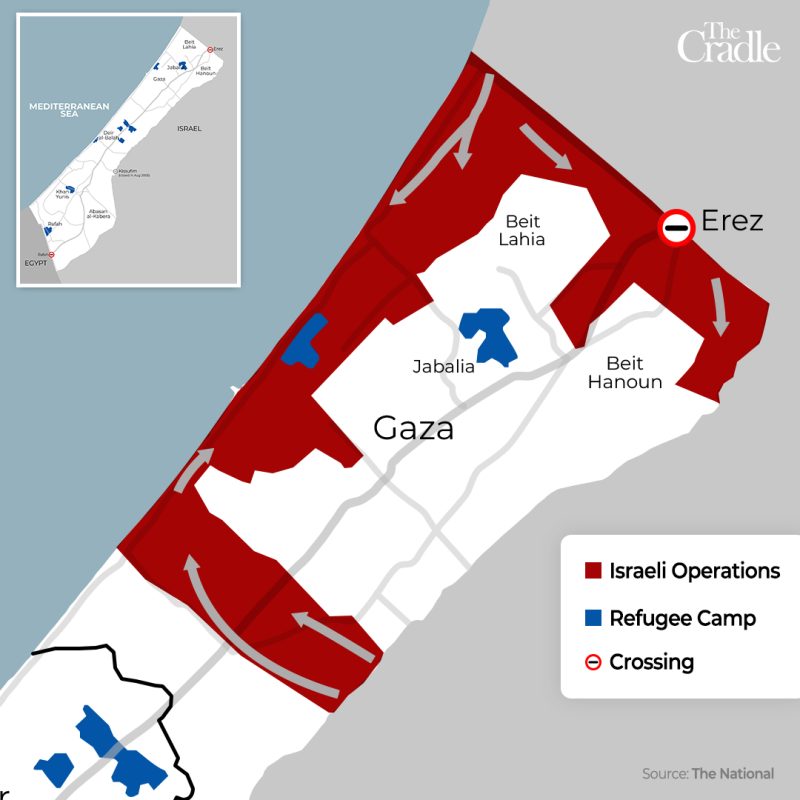
The Israeli military has announced the expansion of its ground operations in the northern Gaza Strip. After seizing territories on Gaza’s coastline, in the western part of the northern strip, Tel Aviv’s actual ground operation is now beginning.
For more than three weeks of its ground offensive, the occupation army has been operating in areas close to the shoreline, in places where tunnels cannot be dug, and, therefore, areas where the Palestinian resistance does not have significant defensive capabilities.
But now, the occupation army is moving eastward from the Gaza coast, allowing the armed resistance to maneuver far more easily and inflict greater losses on the invading soldiers and their armored vehicles – as has become quite evident in recent days.
In short, the ground battle in northern Gaza has only just begun, and is gearing up to get even hotter in the weeks ahead.
The region escalates
In support of the resistance in Gaza, the Yemeni army and Ansarallah fighters seized an Israeli-owned vessel in the Red Sea on 19 November after threatening to target all Israeli ships crossing the Bab al-Mandab Strait.
Over the past week, on Lebanon’s border with Israel, the Lebanese resistance Hezbollah has increased the frequency of its military operations. On 20 November, the occupation army monitored more than 40 attackzjs on its positions, one of which was carried out with four rockets, each with an explosive warhead weighing around 500 kilograms. The salvo destroyed the Israeli ‘Branit’ military barracks near the border with Lebanon. In just the past three days, Hezbollah has carried out an average of 12 military operations against Israeli targets each day.
Simultaneously, Iraqi resistance attacks are continuing against US military bases in Iraq and Syria – over sixty operations to date.
The increased pace of clashes across West Asia is, however, being widely ignored by many of Tel Aviv’s western allies, whose attention has been diverted by ongoing prisoner exchange talks between Israel and the Palestinian resistance, mediated by Qatar and the US. These weeks-long negotiations are being treated as evidence that the next phase will necessarily be a de-escalation in Palestine.
Those expectations have been fanned by a leak that Israel’s cabinet has discussed the imminent demobilization of a number of army reservists. While the Israeli military may indeed demobilize part of the reserve forces it called up after 7 October, this decision is not based on de-escalatory considerations. The more than 300,000 Israeli reservists initially mobilized was far too great for the capacity of the occupation army, which was unable to absorb these personnel into its fronts in Gaza, Lebanon, and the West Bank.
Despite this, many still optimistically cling to the de-escalation narrative. They are further encouraged by official US statements criticizing – albeit in a watered-down manner – Israel’s targeting of Palestinian civilians, and point to the occasional US-Israel divergences over what they call the “post-Hamas phase” in Gaza as further proof that Tel Aviv will have to scale down its war.
But at the current stage of the conflict, these discrepancies and observations are considered totally irrelevant by officials in the region’s Axis of Resistance. They note instead that Washington continues to maintain its pace of arms support for Israel, as it has done since the war’s onset, while sticking to its refusal to entertain any permanent ceasefire.
In addition, the US has reduced neither its level of involvement in the management of military operations in the Gaza Strip, nor its reinforcement of missile defense systems to counter any Yemeni or Iraqi rocket attacks on Israeli positions.
Axis officials believe that conciliatory-sounding US statements, which sometimes suggest that a de-escalation phase is imminent, are nothing but an American “public relations party” to repair a public image heavily damaged by unstinting US support for Israel’s continuing massacre of Palestinians in Gaza.
In slightly shifting its tone, Washington also seeks to mislead the Resistance Axis, hoping that this can forestall an increase in regional tensions and clashes.
From ‘truce’ to regional war
The current prisoner exchange negotiations between Israel and the Palestinian resistance include a five-day “humanitarian” truce. This is not a ceasefire by any means nor an opportunity to draw out a further lull in violence. Those familiar with the reality on the ground in the Gaza Strip confirm that any truce will merely be an opportunity for both sides to reorganize their ranks in preparation for intensified battles in the coming weeks.
They based their observations on the fact that Israel continues to adhere to its initial military goals, modified from the plan to occupy the entire Gaza Strip. Tel Aviv’s objectives today are, first, to occupy the entire north of Gaza; second, to displace all of its inhabitants, more than 800,000 of whom are still living under siege and bombardment.
And third, to continue the besiegement of southern Gaza – exerting military pressure through intensive airstrikes and special operations to force Hamas and other Palestinian resistance factions to surrender.
This plan is fully supported by the US and its western allies, as well as by Arab states that have normalized relations with Israel, notably those farthest from Palestine’s borders.
In light of these realities, the Axis of Resistance is pursuing its own West Asian escalation to pressure its adversaries to deescalate. That bar jumped considerably this week when Yemen’s Ansarallah captured an Israeli-linked ship in regional waterways.
This is a disaster for Tel Aviv, which depends primarily on maritime transportation for its imports and exports. If this becomes a pattern, Israeli-linked ships will be uninsurable, and hiring crews will become impossible. It is also a nightmare scenario for Washington, which wants the Gaza war to continue while its regional position enjoys complete calm.
Indeed, the US is desperate to maintain a regional peace, most of all in Iraq. While the multi-factional Iraqi resistance target US occupation bases inside their country and in Syria, both, the current American response has been tame. US military forces have limited their retaliatory strikes to Syrian territory – and only after informing their Russian counterparts in advance.
Washington has so far avoided striking back in Iraqi territory to avoid drawing a target on its considerable Iraqi interests – commercial, military, political – and also fears triggering the Iraqi resistance to expand operations against US bases in other West Asian states.
No ceasefire ahead
The Resistance Axis’ current assessment of the Gaza war is that both the US and Israel seek a protracted conflict – possibly even an endless war that transforms the Gaza Strip into a permanent battlefield to ensure that Israel no longer faces Palestinian deterrence capabilities.
On the other hand, the Axis continues to pursue all avenues to advance and accelerate a ceasefire in Gaza, including military options. The current “truce” announcement didn’t emerge in a vacuum – it follows painful blows against occupation forces in the Gaza Strip, a sharp escalation of clashes in the occupied West Bank, and a gradual increase in the pace and severity of attacks in the region.
The prisoner exchange truce may be announced at any moment. It will not, however, end the war. The truce is merely a break for the belligerents to prepare for more violent battles ahead, and these will not be limited to Gaza and the Lebanese-Palestinian border.
As 2023 comes to a close, all of West Asia is destined for more tension, battle, and multiple surprises. This scenario can only be eased by the announcement of a Gaza ceasefire and the provision of supplies and staples to its wounded population. It is only Washington that stands in the way, firmly opposing and blocking a ceasefire at every opportunity.
Mysterious military flights between Israel, Lebanon continue
The Cradle | November 21, 2023
Mysterious foreign military cargo flights, potentially carrying equipment for use against Hezbollah, continue to land at the Beirut and Hamat airports, Al-Akhbar reported on 21 November.
Between the 14 and 20 November, nine planes from various NATO countries were recorded landing at Beirut and Hamat airports, including several flying from Tel Aviv, according to Intelsky, a website monitoring aircraft movement in the region.
Sources speaking with Al-Akhbar said the cargo included devices used for jamming, which raises questions about the reason for their transport to Lebanon and whether they will be used to disrupt the communications network of Hezbollah in the event of an escalation of the fighting with Israel in Lebanon’s south.
Since the 7 October Hamas attack on settlements surrounding Gaza, in which 1,200 Israelis were killed and 240 more taken captive, Israel and Hezbollah have engaged in deadly tit-for-tat clashes on the Lebanese-Israel border area.
Hezbollah’s communication network played a key role during the July 2006 war against Israel, which later led to US pressure on the government of then-Lebanese Prime Minister Fouad Siniora to call for dismantling the resistance group’s communications network in 2008.
The same sources speaking with Al-Akhbar confirmed that the security authorities at Beirut and Hamat airports do not seriously inspect the cargo of the planes that land, with Hamat Air Base lacking even a scanning device. The final destination of the cargo in Lebanon is also unknown.
Intelsky reported that the movement of foreign military aircraft is proceeding at a level that Lebanon had not witnessed in years. Between 8 October and 10 November, 32 planes landed, nine of which belonged to the US, Dutch, and British Air Forces and landed at the Hamat base, and 23 planes belonging to the US, French, Dutch, Spanish, Canadian, Italian, and Saudi armies landed at the base designated for military and diplomatic aircraft on the west side of Beirut Airport.
Although Lebanese law prohibits direct flights between Lebanon and Israel, Intelsky monitored three planes landing at Beirut Airport originating in Tel Aviv.
A British Royal Air Force Airbus A400M Atlas landed in Beirut on 14 November, coming from Tel Aviv. The plane carried out a “touch and go” operation (touching the runway and taking off directly without stopping) at a British military base in Cyprus to technically comply with Lebanese law banning direct flights from Israel.
After taking off from Beirut, the plane returned to Tel Aviv after carrying out another touch-and-go operation at the British base in Akrotiri, Cyprus.
On 16 November, a US Air Force Boeing C-17A Globemaster III also flew from Tel Aviv to Beirut. The Intelsky website recorded that the plane allegedly landed in Cyprus as well but disappeared from radars before landing and reappeared after the supposed take-off. The plane was absent from radars over Larnaca for 4 minutes at an altitude of 1,264 meters, suggesting it did not land in Cyprus.
On 21 November, a British Royal Air Force (Airbus A400M Atlas landed in Beirut after making only a camouflaged landing in Akrotiri, at an altitude of only 375 meters above the base, which means that the flight violated Lebanese law and was in effect a direct flight from Tel Aviv to Beirut.
It should be noted that daily flights between the Akrotiri base and Tel Aviv have been recorded since the outbreak of the “Al-Aqsa Flood” operation on 7 October.
Al-Akhbar notes these flights raise suspicions about whether these trips are part of a broader strategy related to the conflict with Israel and may be intended to enhance the military capabilities of some parties in the region working on behalf of Israel and NATO, or to provide them with logistical support that includes transporting necessary equipment and supplies.
The Israeli army has not commented on the flight, except for a statement issued on 10 November confirming that “part of the air traffic at the airport is a routine movement to transfer military aid to the Lebanese army.”
Featured Video

Houthis Don’t Have to Conquer Saudi Arabia to Make It Pay
or go to
Aletho News Archives – Video-Images
From the Archives
A Lesser “Grade” of Human
By Michael Hoffman | Revelation of the Method | January 3, 2024
Will the more than 100 Iranians killed by terrorist bombs today be mourned in the West as victims of terrorism? Certainly not. Allied doctrine has it that the killing of Israeli or American civilians is a crime of cosmic proportions, while shedding the blood of “enemy” women and children is perfectly acceptable; indeed commendable.
The West does not memorialize the hundreds of thousands of civilians bombed by the U.S. in Serbia, Iraq, Afghanistan and every major German city 1943-1945. America’s fire-bombing of the city of Tokyo by General Curtis LeMay in March 1945 was followed by Harry Truman’s atomic incineration of Hiroshima and Nagasaki in August of that year. Truman never had a moment of doubt or regret over the murder of more than a 100,000 Asian children, mothers and non-combatant boys and men. It was business as usual for the “noble” Allies during the “Good War.”
In the West human rights signifies passionate concern only for civilians designated as truly human: Israelis first, then Americans and British, followed by their satraps.
This inhumanity is the legacy of Talmudic ideology, beginning with tractate Sanhedrin 57a from 400 A.D., concerning liability for capital punishment: “If a Jew murders a gentile, he is exempt.”
This teaching of contempt was reiterated in the dogma of Chabad Lubavitch founder Rabbi Shneur Zalman in the 18th century. … continue
Blog Roll
 Aletho News
- Houthis Don’t Have to Conquer Saudi Arabia to Make It Pay
- MOE: Nearly 22,000 Students and Education Workers Killed
- Guterres in Islamabad: Genocide, cowardice, and the cage of Imran Khan
- Johnson, Marandi say Yemen holds upper hand over Saudi Arabia
- False flags won’t save aggressors, Iran FM spokesman says
- The Makkah Pact Enters Into Force: The End of American Dominance or Its New Form?
- NATO’s top generals gather in Kiev
- EU’s continuing expansion – greater threat to Russia
- US Senator Murphy says Pentagon denied him entry to US base in Qatar
- Israel expands “incitement” charge to target Palestinian education and memory
- If Americans Knew
- Three Years of Genocide: How America’s Israel-First Media Filtered Out the Truth
- Israeli war chief briefs ministers on potential war against Palestinian Authority
- New Report: Israel Killed nearly 21,000 Palestinian Students and Education Workers in Past Three Years
- Israel’s flailing chatbot army
- Five Palestinians Killed, Others Injured by Israeli Fire in Gaza
- Israel is rewriting the Palestinian curriculum in East Jerusalem to erase Palestinian identity
- Three years of genocide: Israel turned prisons into killing grounds and torture sites
- Three years of genocide. Words fail. Daily Update
- ‘I’d rather die than go back’: A Palestinian teen’s 10-month nightmare in Israeli jail
- How Jared Kushner’s firm’s investment in an Israeli company could be a major conflict of interest
- No Tricks Zone
- New Study: 50 Years Of The Most Aggressive ‘Net Zero’ Policies Can Only Affect The Global Climate By 0.03°C
- US September “Heat” Was No Record…Many Records Set Decades Ago
- Latest European Green Energy Debacle; Portugal’s Largest Flagship Solar Park Insolvent!
- Green Energy Debacle: German Expert Professor Fritz Vahrenholt Warns Of Severe Economic And Social Consequences
- Two More Paleo Reconstructions Affirm Meters-Higher Sea Levels Across Ireland, Brazil 7000-6000 Years Ago
- New Study: Earth And Venus Surface Warmth Largely Explained By Convection And Lapse Rate, Not CO2 Or Radiation
- 2025 Nature Paper Claiming Worsening Global Drought Gets RETRACTED …Heavily Flawed
- New Study: ‘Global Drought Shows No Detectable Recent Acceleration Under Climate Warming’
- Economic Masterminds: German Socialists Suggest Taxing Productivity Gains Stemming From Using AI
- The South China Sea Has Not Been Cooperating With The Climate Change Narrative

