“Fake News” from NBC on US-Russian talks about an ‘off ramp’ to the Ukraine war in April 2023 that never took place
By Gilbert Doctorow – July 6, 2023
News portals in Ukraine and elsewhere in Europe were quick to pick up a feature item today on NBCNews.com entitled “Former U.S. officials have held secret Ukraine talks with prominent Russians.” The subtitle goes on: “The aim of the discussions is to lay the groundwork for potential negotiations to end the war, people briefed on the talks tell NBC News.”
The very notion that such talks could have taken place elicited disparaging comments from the usual suspects who would not miss a chance to be in the public eye: former U.S. ambassador to Russia, Michael McFaul, and Matt Dimmick, a former Russia and Eastern Europe director at the National Security Council. Said comments form part of the NBC report.
This news item also surfaced on Russian state television in the early evening edition of Sixty Minutes under the heading “Fake News.” Their panel discussion opened with an announcement from the RF Ministry of Foreign Affairs, responding to what is said in the second paragraph in the NBC article, which reads:
“In a high-level example of the back-channel diplomacy taking place behind the scenes, Russian Foreign Minister Sergey Lavrov met with members of the group for several hours in April in New York, four former officials and two current officials told NBC News.”
Per Lavrov, no such meeting ever took place and there are no back channels.
And then the Sixty Minutes panel was off to the races, as we say.
They listed the former U.S. officials who were said to have taken part in the meeting – Charles Kupchan, Richard Haass, and Thomas Graham, all members of the Foreign Relations Council and, as they stressed with truculent humor, all are decidedly very former. Their heyday was decades ago and today none of them holds a rank that would justify Lavrov’s spending any time with them, let alone discussing the basic principles for some negotiated settlement of the Russia-Ukraine war. They are just a bunch of old academics who get together to reminisce about the arms control negotiations of the distant past and similar issues long ago laid to rest.
After breaking its fake news story, NBC spent the greater part of its article talking about how back channel communications, dubbed Track Two talks, function and what utility they have in general.
To be sure, backchannels have served a constructive purpose in U.S. – Russian relations in the not too distant past, though I doubt that journalist Josh Lederman has a clue about this. Thomas Graham’s former mentor and associate, Henry Kissinger, had been an important initiator of such an outreach back in the summer-early autumn of 2008 when he, too was a former, not active political actor. But then Kissinger was and is Kissinger, not some flunky. That was in the time just after the Russia-Georgia war, when relations between the two countries were very tense, almost as seriously as today. And, most importantly, at the time Kissinger’s was not the only backchannel operating. In parallel there was another channel headed by a couple of members of the U.S. Senate. The end result was a paper on steps to improve bilateral relations that became known as the ‘re-set’ in the early days of the first Obama administration. Whether that initiative was creative enough to go beyond atmospherics and set the groundwork for a real change in the relationship is a different matter. The answer to that, of course, is ‘no.’
The likes of Kupchan, Haass and Graham cannot be compared to the operators of the 2008 backchannel and it was no wonder that the Sixty Minutes panel thumbed its noses at them. I, for one, have in the past taken the measure of two of these three as thinkers and found that Haass and Kupchan are muddle headed and their writings are mired in contradictions. Supposedly what they write and publish in the house organ Foreign Affairs magazine is peer vetted, but it helps not a whit. When everyone is aligned and no one disagrees, when there are no debates, only back slappers, then the quality of thinking sinks.
See my critique of Kupchan’s article ‘Nato’s final frontier: Why Russia should join the Atlantic Alliance” in Stepping out of Line (2012) pp. 199 -208 and my piece “Richard Haass: the Absent Voice at Valdai-Sochi” in Does Russia Have a Future (2015) pp 259-262
©Gilbert Doctorow, 2023
Keep Ukraine out of NATO, US experts argue
RT | July 7, 2023
Welcoming Ukraine into NATO would force the US to choose between nuclear war with Russia or abandoning its security commitments to Kiev, two American analysts claimed on Friday.
“The security benefits to the United States of Ukrainian accession pale in comparison with the risks of bringing it into the alliance,” Justin Logan and Joshua Shifrinson of the libertarian Cato Institute wrote in Foreign Affairs magazine.
If Ukraine were to join the alliance amid the ongoing hostilities, Logan and Shifrinson argued, the US and all of NATO’s European members would immediately be pulled into open war with Russia, with the potential for a nuclear exchange. However, even if the conflict were to be resolved, Ukraine and Russia will still have competing territorial claims, and a membership offer would risk reigniting the conflict, this time with NATO as a direct participant, they added.
“Under these circumstances, an American commitment to fight for Ukraine would be open to question,” they continued. If Ukraine were a NATO member and US policymakers chose not to intervene on its behalf, the bloc’s entire collective defense principle would be undermined, resulting in “a true credibility crisis for NATO.”
Furthermore, with the US protected by its nuclear arsenal and the vast Atlantic Ocean, the two analysts argued that America faces no direct threat from Russia, while Ukraine – due to its geography – forms “a bulwark” between Western Europe and Russia “irrespective of NATO membership.”
“American time, attention, and resources are needed elsewhere,” Logan and Shifrinson wrote, concluding that “the United States should accept that it is high time to close NATO’s door to Ukraine.”
Since the 2008 Bucharest Declaration, NATO’s official policy is that Ukraine will become a member of the bloc at an unspecified future date. Kiev, however, is unhappy with this non-commitment, with Ukrainian President Vladimir Zelensky reportedly threatening not to attend NATO’s upcoming summit in Lithuania unless the US-led bloc offers “concrete” security guarantees or a roadmap to full membership.
Lithuanian President Gitanas Nauseda has already ruled out a membership offer at the Vilnius summit. French President Emmanuel Macron, however, has called on the alliance’s leaders to offer Kiev bilateral or multilateral security guarantees, as well as a “path” to full-fledged membership. British Defense Minister Ben Wallace and a number of Eastern European leaders have called for Ukraine to be fast-tracked into the bloc without the usual “membership action plan” that prospective members must complete.
The White House, meanwhile, maintains that Ukraine “would have to make reforms to meet the same standards as any NATO country before they join.”
US military short of recruits with most youth disqualified

By Uriel Araujo | July 7, 2023
Already in September 2022 the Pentagon was voicing concerns about ammunition and arsenal shortages while US President Joe Biden was announcing an extra $3 billion military aid to Ukraine. Things are not so good with its transatlantic allies: in March 2023, Europe’s military was described as being in an “appalling state” by a Foreign Affairs article – a situation which is hard to escape amid today’s deindustrialization.
Last month, the US was announcing it would spend yet another $325 million to replace tanks destroyed by Russia during Ukraine’s costly and failed counteroffensive. The hard economic costs and depletion or arsenals, however, should not be Washington’s only concern: since 2020, merely 23% of young Americans (aged 17-24) are “eligible for military service without a waiver” and most ineligible youth are disqualified “for multiple reasons”, such as overweight, poor medical health, and drug abuse.
In their Atlantic piece, Former US Army Officer Jason Dempsey (an adjunct senior fellow at the Center for a New American Security) and former US Marine officer Gil Barndollar (a senior fellow at Defense Priorities) paint a very worrisome picture, from an American point of view. The 50-year old “all-volunteer force” (AVF), as the US military has come to be known after its last draftee in 1973, they write, has become “unsustainable”, facing threats in “three fronts” – namely cost, capacity, and, more importantly, “continued ability to find enough Americans willing and able to serve.”
Military pay and benefits have skyrocketed since 911, actually rising by more than 50 percent. Its high cost is one of the factors that make the US military small. When faced with medium-sized campaigns in Afghanistan and Iraq, it already found it challenging to provide just enough troops. Thus, Dempsey and Barndollar argue it could be broken by any “major conflict”. For example, they write, just over the past year of confrontation, Russia and Ukraine both have had casualties that are equal to at least half the active-duty U.S. Army, and current US military doctrine says that a force is destroyed after taking 30 percent casualties. In other words, the US itself could not endure what its ally Ukraine does.
In any case, merely 9 percent of young US citizens would seriously consider military service, a figure which is near the all-time low since the so-called All-Volunteer Force began. To broaden the recruiting pool, service branches loosened their restrictions on things such as neck tattoos and other standards. In June last year, the US Army went so far as to briefly drop its requirement for a high school diploma. Even so, the US military simply can’t seem to find recruits and keeps falling short of its enlistment quotas.
The AVF crisis is part of a larger societal crisis, even civilizational. Consider this fact: US citizens are currently enduring its worst drug crisis ever, fueled by epidemic opioid abuse. According to Council on Foreign Relations deputy editor Claire Klobucista and expert Alejandra Martinez, this state of affairs endangers the US “public health, economic output, and national security.” Opioid drugs (both legally manufactured medications and illicit narcotics) already are by far the leading cause of fatal overdoses in the country.
Or consider this: right now, the US Subcommittee on Health Care and Financial Services says that the Food and Drug Administration agency (FDA) is still dodging oversight and failing to provide answers regarding an ongoing baby formula shortage crisis. There is more: even though it is supposedly the world’s richest nation, the US healthcare system is collapsing, with hospitals closing down, overcrowded and understaffed facilities, and lack of items such as ICU beds. The country is also facing a mental health crisis, with 40% of parents reporting their children struggle with anxiety or depression, among other issues.
Given all these domestic and systemic issues, it is no wonder that most youth either do not qualify or do not want to be part of the military. Considering that many young people, due to so many factors, simply do not qualify for service, bringing back the draft (with all the political costs) would simply not solve the issue. This is one of the reasons why the US increasingly needs to fight proxy wars.
In November 2022, while addressing the Naval Submarine League’s annual gathering in Arlington, Virginia, US Navy Admiral Charles Richard, then head of US Strategic Command had this to say about the Ukraine crisis: “this is just the warmup. The big one is coming.” He added: “It isn’t going to be very long before we’re going to get tested in ways that we haven’t been tested a long time.” At the time he urged policy makers and Pentagon chiefs to return to the 1950s and 1960s dynamism in order to face such challenges.
Those are bold and ambitious calls for a declining, overburdened and overextended superpower which is actively pursuing a dual containment policy targeting both Russia and China simultaneously. In addition, it aims to maintain its naval hegemony as a sea power while also engaging in land wars as part of a Mackinder-like struggle for the Heartland. Like the meme-famous pelican, it seems to want it all. However, appetite and capacity are not to be confused. It remains to be seen whether or not American society will continue to have what it takes for all that and just for how long. Right now, the prospect is not looking good.
Now that government COVID malfeasance is exposed, what will the GOP do about it?
By Daniel Horowitz – conservative review – July 6, 2023
We are now 2+ years into consuming reams of information showing the vaccines were devastating to humanity. What will Republicans do about it other than whine about censorship? Refusing to focus on vaccine injury and the perfidy of the government-vaccine complex is an act of self-censorship.
There is a bizarre dynamic unfolding as it relates to GOP sentiment toward the vaccine. All Republicans recognize and decry the growing evidence of the government’s collaboration with big tech to censor all information about vaccine injury. Yet they seem to be more upset about the censorship of the information than about the information itself. Why is there no push from Republicans to defund the vaccines and fix the regulatory and legal structures that allowed Operation Warp Speed to occur and that continue to gaslight the next iteration of rushed, dangerous vaccines?
In an extraordinary ruling on Independence Day itself, Louisiana federal Judge Terry Doughty issued a broad injunction against all government agencies on working with social media companies to censor politically unfavored speech. Citing “substantial evidence” of government’s “dystopian” violations of the First Amendment, Judge Doughty prohibited the federal government from “encouraging, pressuring, or inducing in any manner the removal, deletion, suppression, or reduction of content containing protected free speech.” The injunction not only includes the HHS agencies censoring COVID information, but also the FBI, the Cybersecurity and Infrastructure Security Agency, the State Department, the DOJ, and the White House censoring all forms of protected speech.
This ruling comes a week after the House Judiciary committee produced a preliminary report showing DHS’ CISA was behind the censorship enterprise. It turns out that CISA funded a nonprofit group to work with social media on a process, known as “switchboarding,” which would “trigger content moderation” to “ensure priority treatment of misinformation reports.”
Republicans seem united in combating this censorship and plan to include provisions in the relevant appropriations bills for fiscal year 2024 to block funding for these surveillance and censorship programs. However, where is the same degree of outrage about the dangers of the vaccines themselves?
We now have over two years of information showing ubiquitous injury stemming from damage to all parts of the body, particularly cardiac and neurological. Whether it’s VAERS, European data, countless independent studies, epidemiological data, excess deaths and “died suddenly” mysteries correlating with the take-up of the vaccines, health insurance data, life insurance data, or disability data – we have enough evidence to convict this shot for murder if it were a human standing for trial. Yet not only have these vaccines not been defunded, the same framework that rushed their approval has already been used for countless other new vaccines.
The government’s new shell game is to concede the existence of these problems, but play semantics with the term “rare” when describing their risk. Science Insider published a piece acknowledging the “rare link between coronavirus vaccines and Long Covid–like illness,” including blood clotting, heart inflammation, and neurological disorders. Even Peter Marks, the man at the center of Operation Warp Speed, admitted, “We can’t rule out rare cases.”
“If a provider has somebody in front of them, they may want to take seriously the concept [of] a vaccine side effect,” admits the director of the FDA’s Center for Biologics Evaluation and Research, two years after emails show he ignored concerns of rushing the vaccine amidst a pileup of adverse event reporting.
However, what is rare? The CDC’s own pharmacovigilance program showed a 7.7% rate of clinical-level injury. Coupled with the underreporting rate in VAERS, there were likely millions of severe and long-term injuries, including several hundred thousand deaths in the U.S. So yes, we can suggest that 92% of people didn’t experience clinical levels of injury and 98%-99% didn’t experience long-term and deadly injuries. In that sense, I guess you can say it’s rare. But how many people are we talking about when 5.5 billion people were given at least one dose? Potentially, millions of deaths and hundreds of millions of injuries! Just consider the fact that 25% of injuries reported to VAERS and about a third reported by the European Medicines Agency are considered serious, well beyond the standard of 15%.
House Republicans can no longer ignore the problem with the vaccines. They must also stop ignoring the endless approvals of monkeypox and RSV shots based on dubious data and the same rushed framework. To that end, Speaker McCarthy should take the following actions.
- Defund all COVID shots in the HHS, DOD, and FDA funding bills.
- Create a commission of members of Congress to examine the rationale, safety, and efficacy data of all vaccines, beginning with the new ones recently approved and in the pipeline.
- Refuse to sign off on the Senate version of the Pandemic and All-Hazards Preparedness Act unless major reforms are enacted curtailing pandemic authorities.
- Bar any involvement in a WHO pandemic treaty or expansion of the International Health Regulations.
- Repeal immunity for vaccine manufacturers, including the provision in the 21st Century Cures Act of 2016 that extends the immunity to vaccines offered to pregnant women.
To this day, we still can’t get Republicans to shake their support for the V-word even in red states. Last week, Ohio Gov. Mike DeWine, the consummate COVID fascist governor, used his line-item veto to strike a provision from the budget ending vaccine mandates in colleges. “University and college dormitories and student housing are congregate settings where such policy may be of great importance to ensure resident safety,” said DeWine of vaccine mandates in his veto message. It takes a new level of cognitive dissonance to support mandates on those who don’t want the shot out of fear of harming those who did supposedly get the protection that evidently fails to protect unless the other person gets it!
Republicans all agree that our government engaged in an unprecedented operation to cover up the truth about vaccines. How come their curiosity stops at the degree of exposing the cover-up with no interest in delving into what exactly they are trying to cover up? After all, this is the only product that automatically goes into every arm of every baby multiple times after birth with a set schedule mandated by schools. Certainly the COVID shots are proven to be poison, but is there no interest in uncovering the broader truth?
© 2023 Blaze Media LLC. All rights reserved.
Majority of US Voters Believe Biden Involved in Son Hunter’s Foreign Business Deals – Poll
Sputnik – 06.07.2023
WASHINGTON – A majority of likely voters in the United States believe that US President Joe Biden was involved in his son Hunter Biden’s foreign business dealings, which are under investigation by US House lawmakers, a Rasmussen Reports poll revealed on Thursday.
More than half of respondents, 58%, said that it was likely that Biden was involved in his son’s foreign business deals, with 44% believing it “very likely,” the poll said.
One-third of respondents said it was unlikely Biden was involved in the foreign business deals, and 10% are unsure.
The poll comes amid an investigation by the US House Oversight Committee into alleged criminal acts committed by the Biden family, including corruption and influence peddling. Earlier this month, panel chairman James Comer characterized the alleged actions as “organized crime.”
The committee’s probe is partially based on accusations from a confidential FBI informant, who alleges that Joe and Hunter Biden received millions of dollars from a Ukrainian energy company. Lawmakers are also investigating deals tied to China.
However, Biden has denied ever speaking to his son about his business deals, contradicting testimony from an IRS whistleblower involved in matters related to Hunter Biden.
The survey polled 1,054 likely US voters on June 28-29 and July 2. The poll maintains a margin of error of plus or minus three percentage points with a 95% confidence level.
Palestine urges US to retract from building embassy in Jerusalem
MEMO | July 6, 2023
The Palestinian Presidency urged the US, on Thursday, to retract plans to build its embassy in Jerusalem because it will be built on Palestinian “private property”, Anadolu Agency reports.
The statement was in response to Israeli approval plans submitted by the US to build the embassy on lands the statement said were confiscated from Palestinian owners by Israel in 1948.
It described the move as “illegal” and “a violation of international law” because it will be built “on private property confiscated in 1948 from Palestinian owners, some of whom are holders of US citizenship”.
The Presidency said moving ahead with building the embassy “gives legitimacy to racist Israeli laws such as the absentee property law designed to legitimise the theft of Palestinian property”.
It added that the move is a “joint American-Israeli blow to any remaining hopes for a two-state solution.”
Former President, Donald Trump announced the US recognition of Jerusalem as Israel’s capital in December 2017. The US moved its embassy in Israel from Tel Aviv to Jerusalem in May the following year.
Jerusalem remains at the heart of the decades-long Mideast conflict, with Palestinians insisting that East Jerusalem — illegally occupied by Israel since 1967 — should serve as the capital of a Palestinian state.
Europe Says No to China Decoupling
By Salman Rafi Sheikh – New Eastern Outlook – 06.07.2023
Following active US diplomacy over the past few years, Europe seems to have now decided to say no to the US geopolitics of “decoupling” from China. This is nothing short of a major diplomatic blow for the US, although this blow has not received as much attention in the mainstream Western media due to its overt focus on events related to the Russia-Ukraine conflict. The recent visit of Chinese Premier Li Qiang to Europe, where Li not only met the German Chancellor but also addressed a conference on development financing organised by French President Macron. More than that, the fact that two of the European Union’s most powerful states received and interacted with China’s number two became possible, first and foremost, because of the available space for continuing trade partnership with China. That is one key reason why the EU now favours the politics of “de-risking” rather than “de-coupling”.
While the idea of “de-risking” would literally mean reducing dependence on China – which some might see as a good sign – “de-risking” mainly means better management of trade and economic ties with China. After all, the EU sees China as an economic competitor. Therefore, devising new strategies to manage this competition makes perfect sense not only for the EU but also for China. As a leading US media outlet said in one of its reports, the EU has basically decided not to “piss China off.”
The real question is: Why is the EU, despite China’s overall pro-Russia position on Ukraine, devising a strategy that does not involve the kind of “decoupling” that the EU has effected vis-à-vis Russia in terms of energy supplies? There are several crucial reasons for the ongoing strategic rethinking in the EU vis-à-vis China.
First of all, the EU leaders tend to believe that China itself is eager to maintain stable economic ties with the EU. As opposed to Beijing’s estranged ties with the US, China intends to maintain a healthy, although competitive, environment with the EU. Doing this is very much possible since the EU is not as deeply entangled with China in geopolitical flashpoints, such as Taiwan and the South China Sea, as the US is. For the EU, therefore, continuing trade ties with China present an opportunity that should be exploited to the best possible extent, even if this continuation does not fit very well with the nature of the US-China ties.
Secondly, the EU is a 27-member bloc, which can be – in fact, it is – internally very diverse, with many EU countries following or favouring alternative policy positions. This internal divergence makes it extremely difficult for any given actor within the EU to impose its position on the bloc. This internal divergence also means that finding consensus on minimum common ground is equally difficult.
We have seen that German and French leaders have visited China in the recent past, but we have also repeatedly seen President of the European Commission Ursula von der Leyen taking a tougher position on China, showing how the three key EU leaders are not necessarily unanimous, making it extremely difficult for a) the US to make the bloc follow a single set of policies of “decoupling”, and b) the EU to devise its best China policy that stresses “de-coupling” over “de-risking”.
Even though some countries advocate a tougher position, the declaration of the latest EU summit in Brussels said that “Despite their different political and economic systems, the European Union and China have a shared interest in pursuing constructive and stable relations, anchored in respect for the rules-based international order, balanced engagement and reciprocity,” adding that Europe “does not intend to decouple or to turn inwards” or adopt policies “to harm China, nor to thwart China’s economic progress and development.”
Thirdly, the EU does not see the kind of interest that “decoupling” would yield for the bloc, as a potential “decoupling” would supposedly serve the US and harm the EU. Unlike the US, the EU, as it stands, is not trying to preserve its own hegemony by engaging China in a conflict.
Therefore, the EU’s stance – and the language it has been expressed in – is markedly different from the language the US officials normally used to report on their interaction with China. For instance, after Blinken met Chinese officials in June, he said he “warned” China about its foreign policies. Earlier in February, Blinken had sent yet another warning to China about its support for Russia.
But the EU, as is evident from the latest declaration, has a position that stresses cooperation over warnings and conflict. Although the EU disagrees with various policies of China, including its Ukraine stance, there is no desire within the bloc, on the whole, to pick a conflict with Beijing and deliver yet another economic blow to the continent, which is still not fully recovered from the effects of “decoupling” from Russia. “Decoupling” from China, therefore, will “kill”, to quote Hungary’s foreign minister, “Europe’s economy.” Various assessments prove this scenario.
For instance, the Seeheimer Circle, an official think tank inside the party of the German Chancellor, released a paper last April on Germany’s relationship with China calling for a “multi-dimensional” – that is, open – policy towards the Asian giant. An “abrupt end to trade relations with China” would be “an economic disaster,” the paper argued, rejecting an “anti-China strategy.”
Therefore, while a potential “decoupling” from China might help the US regain its position of economic and financial dominance at the global level, the EU sees no glory. The EU leadership is cognizant of this fact, which is why key EU leaders are not in line with the US. Instead, various EU pronouncements show an ongoing struggle within the bloc with regard to developing a strictly European strategic vision vis-à-vis China.
Is China’s export control a precise counterattack against US, Japan and the Netherlands?
Global Times | July 6, 2023
The measures taken by China in recent years to safeguard national security and interests have often been subjected to excessive interpretation and reaction from the US and Western countries. The recent decision by China to implement export controls on gallium and germanium-related items is no exception. Although Chinese authorities have said this is a common international practice and not targeted at any specific country, certain countries have felt “targeted,” leading to a series of doubts, questions, and even accusations.
There are mainly two points that these people are criticizing about. First, they believe that China is indeed targeting specific countries by precisely counterattacking the semiconductor equipment export controls imposed by the US, Japan and the Netherlands. Does this contradict China’s consistent opposition to the abuse of export controls? Second, they claim China’s actions may violate regulations of the World Trade Organization (WTO) and are detrimental to the stability of the semiconductor supply chain. Both of these points are baseless.
Whether it is a precise counterattack against the discriminatory policies of the US, Japan, and the Netherlands toward China can be left for them to ponder. It is nothing wrong to make those who have done bad things to China feel uneasy and unsettled. Gallium and germanium are key raw materials used in the production of semiconductors, missile systems, solar cells, and other high-tech products. If China exports them to these countries, but they prohibit the export of high-tech products made from these materials to China, this is clearly unfair in terms of trade. If the US uses them to produce high-end military equipment, it may even pose a threat to China’s national security. China’s export control is justifiable in terms of reason and law. It needs to be emphasized that this is entirely different from the US’ abuse of export controls.
China’s export control measures have always adhered to the principles of fairness, reasonableness, and non-discrimination, and are committed to maintaining the security and stability of the global production and supply chains. As for whether these measures violate WTO regulations this time, it is more of a technical issue. China is recognized as an exemplary member of the WTO, in sharp contrast with the US, who has trampled on WTO rules and principles. Despite having larger reserves of germanium than China, the US has protected germanium as a defense reserve resource since 1984 and has hardly conducted any mining activities. In a sense, China’s implementation of export controls on gallium and germanium may have come a bit late. China has no reason to excessively deplete its strategic resources to meet the demands of unfriendly countries.
Currently, there is an abnormal phenomenon in the international community. The US has engaged in too many acts of undermining international rules and seems to be unconcerned about the accumulating “debts.” It is a bit taken for granted. On the other hand, China’s legitimate actions are often magnified and exaggerated by external forces. What’s even more despicable is that the US often takes the lead in pointing fingers at China, without any sense of guilt or shame. The US, which seriously lacks a moral bottom line in the international arena, enjoys morally blackmailing China, which is truly absurd. Dealing with such a US, China also needs to adapt.
To contain and suppress China, the US has imposed various export restrictions on China to an unprecedented extent, and these restrictions are escalating and expanding. There are currently no signs of any easing or cessation. It is reported that the Biden administration is considering a new round of high-tech investment bans on China. When the US treats China in this way, it should not expect China to remain silent and not fight back; that is impossible. However, China will not be as unscrupulous and rule-breaking as the US. Nevertheless, we do have a considerable toolbox to retaliate and make countries that harm China’s interests pay a price.
The US Secretary of the Treasury Janet Yellen is about to visit China. Is China announcing the export control measures at this time to give Yellen a warning? This is overthinking. China doesn’t need to do this, but it will not postpone or cancel planned measures just because a senior US official is coming to create a favorable atmosphere. That’s how things stand. The people who are most dramatic about China’s every move are often the ones with the strongest malicious intent toward China. Their interpretations are bound to be distorted, so it is necessary to make them feel uncomfortable.
Leading US think tank admits Russia unlikely to ever run out of missiles
By Drago Bosnic | July 6, 2023
For approximately a year and a half, we have been listening to tall tales about Russia running out of munitions of various kinds due to its supposed “inability” to produce advanced weapons, particularly long-range missiles and other sorts of PGMs (precision-guided munitions). According to mainstream propaganda, Moscow is allegedly “so desperate” that it had to “arm” its soldiers with shovels and resort to the expropriation of washing machines, smartphones, laptops and other devices that contain microchips in order to maintain production. Such ludicrous claims would never be accepted by anyone remotely familiar with how advanced military technologies work.
However, they are an important segment of the rabidly Russophobic infowar that aims to present the Eurasian giant as supposedly “technologically backward”. And yet, after Moscow’s long-range and tactical aviation, as well as naval and ground-based units, spent the entire special military operation (SMO) launching high-precision strikes by using advanced PGMs that quite literally nobody else has (the United States included), the mainstream propaganda machine simply had to admit something was seriously off with their assessment of Russia’s technological and industrial capacity. The latter should have been destroyed by Western sanctions close to a year and a half ago.
And yet, it’s still standing. The answer as to why this is the case was recently given by CSIS (Center for Strategic and International Studies), a Washington DC-based think tank that is among the most prominent ones in the US. According to their assessment, Moscow is extremely unlikely to run out of PGMs and other long-range high-precision weapons, either for itself or its numerous export customers. Somewhat surprisingly, with no ambiguity or sugarcoating, Ian Williams, a Fellow of the International Security Program and Deputy Director of the Missile Defense Project at CSIS, has made it perfectly clear that it would be “unrealistic to expect Russia to ever run out of missiles”.
The author further notes that Moscow will be able to continue building long-range PGMs, which will enable it to sustain constant long-range strike capability, “despite sanctions and export restrictions”. And while the CSIS report parroted the usual propaganda narratives about Russia, such as that its military supposedly “regularly attacked a range of military and civilian targets throughout Ukraine with costly, long-range missiles”, its findings should certainly not be dismissed. It admitted that numerous weapons experts found conclusive evidence of recently manufactured Russian cruise missiles and other PGMs that have been used in the SMO.
Still, once again, the US think tank obviously didn’t want to let another opportunity to fight the infowar go to waste, so it claims that this supposedly “indicates that Russia’s arsenal has become so depleted that weapons are being used in the conflict just a few months after manufacturing”. And while most US and other Western high-ranking officials insisted that “rebuilding the Russian stockpile will be a lot harder” due to sanctions, particularly when it comes to acquiring microchips, the latest CSIS report disproves such claims, with the author complaining that export restrictions didn’t have the desired effect on Russian missile production.
“There is no one-off fix for this problem. At most, sanctions and export controls can limit the quantity and quality of strike assets Russia can acquire,” the report admits while simultaneously parroting the regular propaganda narrative. The author then continues with the mental gymnastics by trying to “rationalize” the said propaganda narrative in line with the actual situation on the battlefield, claiming that “it’s likely Russia swiftly used up the portion of the long-range missiles that it had originally designated for the SMO”. However, he admits that “despite this, Russia continued to launch missiles against Ukraine, perhaps by withdrawing munitions from other theaters of operation”, without specifying which ones.
The report concedes that Russia continued to produce missiles during the SMO and that the evidence suggests that the majority (or maybe even all) of cruise missiles in its current arsenal were made after the SMO started. Still, the author once again insists that the supposed “depletion” of pre-SMO stocks “has altered the composition of modern Russian strike salvos” and that “Russian missile attacks have shifted from high-end missile systems like cruise missiles towards less effective, less expensive low-end systems like ‘Shahed-136/Geranium 2’ kamikaze drones”.
However, the author fails to accept the fact that these systems are simply much more cost-effective, which is why they’re being used in the first place. The report admits that despite export restrictions, particularly on crucial microelectronic components, Russia has continued manufacturing advanced long-range missiles and PGMs. Still, the author insists this is because Russia is supposedly “acquiring these Western-produced components via friendly third parties”. According to the report, the result is that “Russia will continue having the capacity to build missiles and drones and will continue to use them” and that “this reality will not change until the war ends”.
Drago Bosnic is an independent geopolitical and military analyst.
Biden Administration Files Notice of Appeal Against Social Media Censorship Collusion Ban
By Christina Maas | Reclaim The Net | July 5, 2023
The US Justice Department has formally filed a notice of appeal against a court ruling that prohibits federal agencies and officials from engaging in discussions with social media companies to censor speech on their platforms.
The ruling in favor of free speech, justified by First Amendment rights, has been met with consternation by the Biden Administration, which says it poses a restriction on their efforts to counter the dissemination of what it says is “misinformation.”
The appeal was submitted to the 5th US Circuit Court of Appeals in New Orleans this past Wednesday, in response to an injunction imposed by US District Judge Terry Doughty, alongside a lengthy opinion on the case.
Judge Doughty asserted in his detailed ruling that the manner in which federal officials communicated with technology giants such as Twitter and Facebook about the removal or restriction of content – specifically pertaining to Covid the 2020 election likely constituted a violation of First Amendment protections for US citizens.
Information, whether truthful or not, is not supposed to be in the purview of the government to police. Though, the Biden administration has attempted to defend its engagement with social media companies as a necessary approach to protecting public health and safety.
Conversely, the plaintiffs, who include the Republican attorneys general of Missouri and Louisiana, contend that the federal government’s communication with these companies amounted to a state-sanctioned censorship campaign.
In the initial ruling, Judge Doughty issued an injunction preventing a wide range of federal entities from engaging in communication with any social media company to urge, encourage, pressure, or induce the removal or suppression of speech.
However, the ruling does provide for certain exceptions. Notably, it permits government engagement with social media companies in instances involving criminal activity (including that which is election-related), national security concerns, or other threats to public security.
The appeal by the Justice Department marks a significant development in an ongoing legal matter that has far-reaching implications for the relationship between the government and social media platforms and the ability of the government to suppress speech.
Walensky Warns Public to Beware of ‘Misinformation’ and ‘Politicized Science’
By Brenda Baletti, Ph.D. | The Defender | July 5, 2023
As she ended her tenure last week as director of the Centers for Disease Control and Prevention (CDC), Dr. Rochelle Walensky warned the American public to be on guard against “misinformation” and the “politicization of science.”
Walensky told The Wall Street Journal she hopes Americans will make health decisions based on “their own risk assessment and their own personal risks, but not through politics,” emphasizing that public health recommendations also shouldn’t be politicized.
“Ironically, this comes after two-and-a-half years of Walensky misinforming the public and politicising the science,” investigative journalist Maryanne Demasi, Ph.D., wrote on her Substack.
Demasi and many others took to Twitter to remind people of Walensky’s false statements and politicized decision-making.
Walensky last week published a farewell op-ed in The New York Times, in which she wrote that public health is critically important in the U.S., and yet she “fear[s] the despair from the pandemic is fading too quickly from our memories.”
She complained that “the agency [CDC] has been sidelined, chastened by early missteps with Covid and battered by persistent scrutiny.”
She also told the WSJ that public health shouldn’t fall along partisan lines.
Yet stark political partisanship defined her time at the CDC. The WSJ reported that a recent KFF poll showed political affiliation was the strongest demographic predictor of COVID-19 vaccination. And about one-quarter of Americans don’t trust the CDC’s health recommendations, according to a 2022 survey published in the journal Health Affairs.
Walensky acknowledged “missteps in communicating” by the CDC, which, she said, “could have done a better job” making it clear to the public that the agency’s message could change during the pandemic.
But, she told the WSJ, the CDC has a plan to regain public trust in the future — by working directly with media organizations to discuss how to best shape public opinion prior to releasing scientific information to the public.
She said the CDC plans to use a method called “prebunking,” where they will communicate directly with media organizations before they release information to let the media know which details about public health might be “misconstrued.”
According to The Associated Press (AP) “prebunking” by public health agencies allows the agencies to define something as “misinformation” before readers have an opportunity to encounter it elsewhere as possibly true.
Then search engines such as Google prioritize “credible websites” like the U.S. Food and Drug Administration’s (FDA) or the CDC’s in its searches.
FDA Commissioner Robert Califf, the Virality Project and Google are among those who have promoted prebunking as a way to combat misinformation.
Journalist Kim Iversen proposed a different approach Walensky might take to restoring public trust in the CDC.
She said:
“Well, the way to do it is to apologize, to own up to your lies, to own up to the mistakes that you made and to discuss why you did that, why the agency followed such political partisanship when they should have been following science, why they ignored the science that was right in front of them.”
CDC broadcast a long list of ‘misinformation’ during Walensky’s tenure
Throughout her tenure at the CDC, which began when Biden took office in January 2021, Walensky made a series of public statements that have proven to be false.
Evidence has since emerged that Walensky knew many of these statements were false when she made them.
In March 2021, Walensky famously told Rachel Maddow, that “vaccinated people do not carry the virus, don’t get sick.”
The CDC was forced to walk back her statements a few days later. But that message was the basis for vaccine mandates imposed later that year by the Biden administration, businesses, universities and public venues throughout the country.
In a mid-June congressional hearing, Walensky defended her March statements, claiming they were true at the time.
But the Washington Examiner reported on June 20 that emails obtained through a Freedom of Information Act request showed Walensky and Dr. Francis Collins were aware of and discussed “breakthrough cases” of COVID-19 in January 2021 — just before the vaccines became widely available — and yet continued to tell the public the vaccines would prevent transmission.
In that same congressional testimony, Walensky also defended the mask mandates, saying that the summary of Cochrane’s review — which found wearing masks in the community “probably makes little to no difference” in preventing viral transmission — had been “retracted.”
But it was neither retracted nor had the authors of the review changed the language in the summary, Demasi reported.
In June 2021, Walensky told “Good Morning America” that the risk of myocarditis was extremely rare, and there was overwhelming data the vaccines were safe for children — even after hundreds of cases of myocarditis had been reported and the CDC had been aware of a safety signal since February.
Under Walensky, the CDC also gave false information on vaccine safety monitoring, added the COVID-19 vaccines to the childhood vaccine schedule despite known harms, withheld data on boosters from the agency’s own advisers and told pregnant women the vaccine was safe — just days after Pfizer reportedly finalized a report demonstrating it wasn’t.
In a March study by Krohnert and others, researchers compiled instances of errors in data presented by the CDC during the COVID-19 pandemic in publications, press releases, interviews and Twitter. The authors reported 25 instances where the agency under Walensky promoted demonstrably false numbers.
In most (80%) cases, the CDC exaggerated the severity of the pandemic. For example, Walensky gave a briefing on June 23, 2022, during which she claimed COVID-19 was a “top 5 cause of death” in children, which was untrue.
Most recently, the House Select Subcommittee on the Coronavirus Pandemic gave Walensky until July 12 to turn over phone records involving American Federation of Teachers (AFT) President Randi Weingarten. The House is investigating potential political interference on the part of AFT with the CDC’s school reopening recommendations during the COVID-19 pandemic, The Defender reported.
Walensky warns of ‘future threats’
Walensky warned at the end of her Times op-ed:
“I want to remind America: The question is not if there will be another public health threat, but when. The C.D.C. needs public and congressional support if it is going to be prepared to protect you from future threats.”
To take on these “future threats” the Biden administration nominated Dr. Mandy Cohen, an internal medicine physician and former state health secretary of North Carolina, to replace Walensky.
But critics warn Cohen is “a public health COVID authoritarian” who is “fully entrenched in the ‘bio-pharmaceutical complex.’”
Dr. Peter McCullough told The Defender that during the COVID-19 pandemic, Cohen failed to recognize therapeutics and natural immunity, and supported lockdowns, vaccine mandates and masking.
Cohen comes to the CDC from the private sector, where she is executive vice president of Aledade and CEO of Aledade Care Solutions, whose executive leadership and board of directors includes people with connections to the World Economic Forum and the Bill & Melinda Gates Foundation.
Walensky congratulated Cohen on her nomination, describing her as “a respected public health leader who helped North Carolina successfully navigate” COVID-19, and whose “unique experience and accomplished tenure in North Carolina … make her perfectly suited to lead CDC as it moves forward by building on the lessons learned from COVID-19 to create an organization poised to meet public health challenges of the future.”
Brenda Baletti Ph.D. is a reporter for The Defender. She wrote and taught about capitalism and politics for 10 years in the writing program at Duke University. She holds a Ph.D. in human geography from the University of North Carolina at Chapel Hill and a master’s from the University of Texas at Austin.
This article was originally published by The Defender — Children’s Health Defense’s News & Views Website under Creative Commons license CC BY-NC-ND 4.0. Please consider subscribing to The Defender or donating to Children’s Health Defense.
Dr. Paul Offit Lets Us Know ‘the Experts’ Have Officially Lost Their Minds
By Madhava Setty, M.D. | The Defender | July 5, 2023
I don’t have a big presence on Twitter. I don’t find the platform suitable for exploring and critiquing interesting ideas. You can say only so much in 280 characters. It’s great for inciting someone or dropping a witty comeback or link without much context.
At least that’s what I thought. Then I stumbled upon a tweet from Dr. Paul Offit. He’s taught me that you can convey a lot in a few short sentences.
Who is Dr. Paul Offit?
Offit is a big name in vaccines. Beyond what is listed below, he also sat on the Advisory Committee on Immunization Practices for the Centers for Disease Control and Prevention (CDC) and is presently a member of the Vaccines and Related Biological Products Advisory Committee for the U.S. Food and Drug Administration (FDA).
He’s had a say in the approval and/or authorization of many biologics, including the COVID-19 mRNA products.
Briefly, Offit is:
- Director of the Vaccine Education Center and professor of pediatrics in the Division of Infectious Diseases at Children’s Hospital of Philadelphia.
- Maurice R. Hilleman Professor of Vaccinology at the Perelman School of Medicine at the University of Pennsylvania.
- An internationally recognized expert in the fields of virology and immunology.
- A founding advisory board member of the Autism Science Foundation and the Foundation for Vaccine Research.
- A member of the Institute of Medicine and co-editor of the foremost vaccine text, “Vaccines.”
- The author or co-author of more than 150 papers in medical and scientific journals in the areas of rotavirus-specific immune responses and vaccine safety.
- The co-inventor of the rotavirus vaccine, RotaTeq®, recommended for universal use in infants by the CDC.
- A recipient of the Charles Mérieux Award from the National Foundation for Infectious Diseases.
His list of accomplishments goes on.
I don’t pretend to know more about vaccines than he does. I’m just an anesthesiologist and engineer. He must be a very smart person. Which is why this tweet is so baffling:
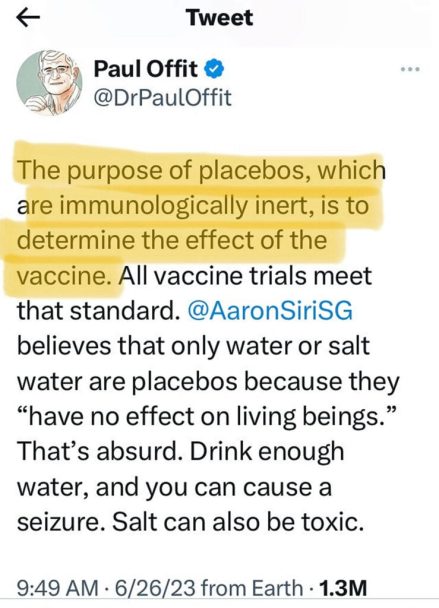
Why is Offit tweeting about placebos and saltwater right now?
It has to do with a truth bomb Robert F. Kennedy Jr. dropped at a town hall event last week.
According to Kennedy, chairman on leave from Children’s Health Defense, he and attorney Aaron Siri sued the U.S. Department of Health and Human Services (HHS) after HHS refused to meet their demand to produce at least one study comparing the safety of a vaccine on the childhood immunization schedule with a true placebo.
In a written response received more than a year later, the HHS did not cite a single such study, instead claiming:
“Inert placebo controls are not required to understand the safety profile of a new vaccine, and are thus not required.”
This stupefying claim made by Melinda Wharton, M.D., MPH, acting director of the National Vaccine Program Office, should be attacked on podcasts and publications everywhere.
How do you know that a new vaccine is safe if it isn’t tested against an inert placebo, Dr. Wharton?
If you are someone who is willing to abandon basic logic and trust every single word spewed by our public health agencies, ask yourself, why then does the FDA demand that medicines be tested against a placebo to ensure safety prior to licensure?
Twitter lit up around this pivotal topic. The tweet from one of the foremost vaccine experts in the world (Offit) was in response to Siri, who, according to Offit, asserted that virtually all vaccines on the childhood vaccination schedule, including RotaTeq (Offit’s brainchild), were not licensed by the FDA based on a placebo-controlled clinical trial.
Let’s break down Offit’s attack on Siri. Offit states: “The purpose of placebos, which are immunologically inert, is to determine the effect of the vaccine.”
Yes, Dr. Offit, one purpose of a placebo is to determine the effect of the vaccine. In order to prove that it works, it must do better than an immunologically inert substance. In other words, it must exceed the so-called placebo effect.
But that’s not the only purpose placebos serve. With regard to safety, a new vaccine has to be compared to something that has the least possible chance of causing deleterious effects.
To be clear, those who eschew a vaccine do not get in line for a shot of an “immunologically inert substance.” They stay away from the vaccine clinic altogether and take their chances.
This is why the placebo must be a true placebo. The best we can possibly do is use saline, a saltwater solution that reasonably matches the sodium concentration in our plasma. It is what is used to dilute medications and replenish blood volume. It’s what you use to store your contact lenses.
Offit then adds this:
“[Aaron Siri] believes that only water or salt water are placebos because they ‘have no effect on living beings.’ That’s absurd. Drink enough water, and you can cause a seizure. Salt can also be toxic.”
Offit is saying that by drinking a large amount of water the plasma sodium concentration in a person can abruptly decrease which, in fact, can lower the seizure threshold. He’s not wrong, it does happen in pathological conditions, especially in the critically ill.
Can salt be toxic? Yes. Ingestion of a large amount of salt will stimulate properly functioning kidneys to increase the absorption of free water, thus mitigating the effect of the salt load. This can cause volume overload and put a person at risk for heart failure and pulmonary edema.
So what — if not 0.2 ml of saline — should we use for a placebo, Dr. Offit? A tiny aliquot of adjuvants (that can include elements like aluminum)? Pro-inflammatory lipid nanoparticles? Viral or toxin deactivators like formaldehyde? Preservatives like thimerosal that contain mercury, one of the most potent neurotoxins known (yes, mercury in this form is still in some flu vaccines according to the CDC)?
All of these substances are “immunologically inert.”
But why would you consider using them as a placebo control if not to mask the potential harm of the vaccine in question?
Is that how inventors of vaccines for our children view placebos? Is that how advisory committee members on the FDA view them? What about the other advisory board members of the Autism Science Foundation? Why would anyone trust any vaccine on the childhood immunization schedule after such comments?
You don’t have to be Maurice R. Hilleman Chair of Vaccinology at the Perelman School of Medicine to see that your comments here are misleading, disingenuous and purposefully inciting.
Moreover, they don’t make any sense.
What would other recipients of your long list of awards have to say about your comments on placebos? I don’t think they would approve, sir.
Your public statements also sully the excellent reputation of the Children’s Hospital of Philadelphia and those who were lucky to train there, like me.
Dr. Setty has been a board certified anesthesiologist since 2002 and has held various leadership positions in his clinical practice.
This article was originally published by The Defender — Children’s Health Defense’s News & Views Website under Creative Commons license CC BY-NC-ND 4.0. Please consider subscribing to The Defender or donating to Children’s Health Defense.
Featured Video

Seyed M. Marandi: US-Iran War Inevitable: Kuwait and Bahrain May Fall
or go to
Aletho News Archives – Video-Images
From the Archives
Oil and the Israel Lobby
Reknowned economist M. Shahid Alam offers this excellent critique of Noam Chomsky’s defective analysis of the relative influence of Oil versus the Israel lobby over US foreign policy: … continue
Blog Roll
 Aletho News
- ICC ignored ‘very well-documented’ NATO crimes – ex-Libyan minister
- SNSC secretary dismisses US response to Iran’s conditions as ‘inadequate’
- Sanaa says Taiz roads open, secure for residents, warns Saudi forces
- Iraqi resistance group urges Saudi leadership to admit defeat, lift Yemen siege
- Trump’s Retreat: How Al-Aqsa Flood Took Down the US Empire
- Israel’s Military Actions in Lebanon Grossly Violate International Law — Lavrov
- Seyed M. Marandi: US-Iran War Inevitable: Kuwait and Bahrain May Fall
- Leaders Condemn Ansarallah Attack on Saudi Arabia While Ignoring Illegal War Against Yemen
- Leaked: Britain’s Covert Iraqi Psyops Network
- Yemeni Armed Forces Warn Airlines Against Using Saudi Airports, Exempt Mecca and Medina
- If Americans Knew
- How Israel Conquered the Latin American Right
- Agents search Rep. Omar’s Washington home in criminal probe as she vows she won’t ‘be silenced’
- “The Rule Was: ‘Shoot Everyone You See'”
- Israel goes ballistic over Nobel Laureate Navi Pillay
- U.S. May Join Yet Another Middle Eastern War — TCN
- Yellow Line moves again as Israel closes in on trapped Gazans – Daily Update
- Israeli Attacks Kill Seven Palestinians in Gaza Including Six-year-old Girl
- Gaza: Ceasefire Anniversary Marks Year of Failed Promises
- The American Conservative: Mike Huckabee Should Resign
- A C-Section in Shackles: A Palestinian Woman’s Harrowing Birth in Israeli Detention
- No Tricks Zone
- Germany’s Green Energy Debacle: High Energy Costs Force Kahla Porzellan to Close After 182 Years!
- New Study: 50 Years Of The Most Aggressive ‘Net Zero’ Policies Can Only Affect The Global Climate By 0.03°C
- US September “Heat” Was No Record…Many Records Set Decades Ago
- Latest European Green Energy Debacle; Portugal’s Largest Flagship Solar Park Insolvent!
- Green Energy Debacle: German Expert Professor Fritz Vahrenholt Warns Of Severe Economic And Social Consequences
- Two More Paleo Reconstructions Affirm Meters-Higher Sea Levels Across Ireland, Brazil 7000-6000 Years Ago
- New Study: Earth And Venus Surface Warmth Largely Explained By Convection And Lapse Rate, Not CO2 Or Radiation
- 2025 Nature Paper Claiming Worsening Global Drought Gets RETRACTED …Heavily Flawed
- New Study: ‘Global Drought Shows No Detectable Recent Acceleration Under Climate Warming’
- Economic Masterminds: German Socialists Suggest Taxing Productivity Gains Stemming From Using AI

