Former head of Disinformation Governance Board: Government flagging content has “nothing to do with censorship”
By Cindy Harper | Reclaim The Net | July 9, 2023
Last week, in a significant victory for free speech, a federal court stepped in to curb potential overreach by the Biden administration in its collaboration with social media platforms to suppress online content. The court ruling, issued by US District Judge Terry Doughty of Louisiana on Tuesday caused critics to complain that it hinders the administration’s efforts to counter online conspiracy theories and “disinformation.”
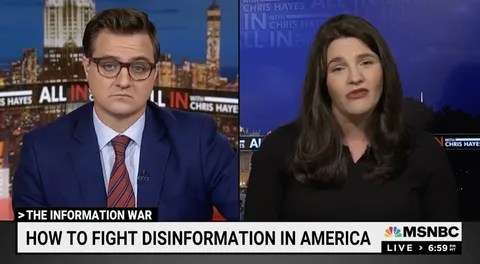
But in the usual doublespeak in an interview with MSNBC, the former head of the government’s controversial Disinformation Governance Board Nina Jankowicz claims that the government flagging content that goes against Big Tech’s policies has “nothing to do with censorship” and “is not about removing speech.”
“This is a weaponization of the court system. It is an intentional and purposeful move to disrupt the work that needs to be done ahead of the 2024 election, and it’s really chilling,” she said to the Guardian.
The ruling inhibits key federal agencies and officials from intervening in the content posted on tech platforms. It has been suggested that without such a check in place, the government’s efforts could easily spill over into manipulating public discourse and controlling information, with potentially dangerous effects on free speech and political balance.
The injunction comes as conservative leaders and groups have been vocal in their opposition, accusing the Biden administration of collusion with social media companies in an attempt to suppress conservative viewpoints.
Judge Doughty supported the arguments of Republican attorneys general from Louisiana and Missouri who filed the lawsuit. They contend that the Biden administration’s tactics infringe on First Amendment rights to free speech. He expressed the sentiment that the government seemed to be exploiting its power to stifle opposing voices, and he ominously compared the handling of social media content by the administration during the COVID pandemic to the “Orwellian Ministry of Truth.”
Nina Jankowicz, a former government appointee to lead a new Department of Homeland Security unit aimed at countering online misinformation, has defended the government’s actions, insisting that they do not amount to censorship. However, critics might question her impartiality, considering she was initially named as a defendant in the case but was later removed due to no longer holding a governmental role.
Adding to the controversy, this unit was swiftly disbanded after facing intense criticism from conservatives who claimed it was stifling conservative speech. This has led some to question whether the government’s efforts to fight misinformation are truly unbiased or, as many suspect, are a veiled attempt to suppress dissenting opinions.
The ruling, which temporarily bars several agencies and officials from pressuring social media companies to remove or delete “protected free speech,” sends a strong message that government interference in the digital public square must be carefully scrutinized. This order stands as an affirmation of the fundamental right to free speech.
Revenge of the Praetorian Guard
Brownstone Institute | July 9, 2023
There was no censorship, but it’s good that they censored misinformation.
Defenders of the Covid regime have adopted this Doublethink in response to Judge Terry Doughty’s recent injunction against the government’s collusion with Big Tech. As Orwell describes in 1984, they “hold simultaneously two opinions which cancel out, knowing them to be contradictory and believing in both of them.”
Consider the language of the Biden administration’s call for an “emergency stay” of the injunction from Missouri v. Biden that stops the government from telling social media companies what they should and should not allow their users to post. The appeal says government is not censoring but must have the power to continue “working with social media companies on initiatives to prevent grave harm to the American people and our democratic processes.”
Grave harm… from free speech!
Harvard Law Professor Larry Tribe exemplifies this authoritarian advocacy. For decades, Tribe built a reputation as a legal scholar. He authored the country’s leading constitutional law treatise, advised presidents, and appeared on television as a legal commentator.
But age has a way of eroding veneers. Tribe is a defender of a political regime, a member of a Praetorian Guard comfortable with abolishing constitutional liberties when it advances his political preferences.
In the last three years, Tribe has argued that Russian President Vladimir Putin rigged the 2016 presidential election for “Thief in Chief, Donald Trump,” led the Justice Department to argue that the CDC eviction moratorium was constitutional, and successfully lobbied President Biden to unilaterally cancel student loans.
If he were on the other side of the aisle, Mr. Tribe might be accused of spreading misinformation and unconstitutional theories that threatened our democracy. Instead, he continues to serve as a mouthpiece for the country’s most powerful forces.
On Wednesday, Tribe co-authored an article with Michigan Law Professor Leah Litman attacking Judge Doughty’s injunction against the federal government’s collusive censorship of its political opponents. Their argument is notable for its false assertions of fact and improper implications of law. They remain obtuse to the allegations in the case, the principles of the First Amendment, and the historical ploys to overturn civil liberties. All the while, they maintain a posture of moral superiority that the Biden White House has mimicked.
A “Thoroughly Debunked Conspiracy Theory”
The professors begin their article with a false premise: “The impetus behind the case is the now thoroughly debunked conspiracy theory that the government is somehow strong-arming Big Tech into censoring conservative speech and speakers in violation of the First Amendment.”
They don’t offer an explanation for this description. They fail to address the documented censorship of Alex Berenson, Jay Bhattacharya, the Great Barrington Declaration, Robert F. Kennedy, Jr., and others. There is no mention of Facebook banning users who promoted the lab-leak hypothesis after working with the CDC, the Biden Administration’s public campaign urging social media companies to censor dissent in July 2021, or the Twitter Files’ documentation of the US Security State’s influence on Big Tech.
Instead, Tribe and Litman dismiss censorship as a thoroughly debunked conspiracy theory. They didn’t need to look far for examples – the opinion documents multiple instances of the coordination between Big Tech and the Biden White House in silencing opposition.
“Are you guys fucking serious?” White House Advisor Rob Flaherty asked Facebook after the company failed to censor critics of the Covid vaccine. “I want an answer on what happened here and I want it today.”
At other times, Flaherty was more direct. “Please remove this account immediately,” he told Twitter about a Biden family parody account. The company compiled within an hour.
His boss demanded Twitter remove posts from Robert F. Kennedy, Jr., writing: “Hey Folks-Wanted to flag the below tweet and am wondering if we can get moving on the process of having it removed ASAP.”
There are too many incidents to list, but it is clear that censorship was more than a thoroughly debunked conspiracy theory. Either Tribe did not read the decision, or his ideology blinded him from reality.
“A cesspool of disinformation”
The professors’ debunked conspiracy theory premise contradicts their position later in the article.
Like many of their peers, Tribe and Litman hold an incompatible set of views: on one hand, they argue that allegations of censorship are illusory. At the same time, they argue that the government is justified in suppressing speech because of the dangers of “disinformation.”
Censorship doesn’t exist, but it’s good that it does.
They write that the ruling incorrectly defends Americans’ right of “existing in a cesspool of disinformation about election denialism and COVID.” They hold that this is an incorrect application of the First Amendment. The natural corollary to their argument would be that the government is justified in censoring “disinformation.”
But the First Amendment does not discriminate against false ideas. Labeling speech “disinformation” or smearing it with associations about “election denialism” does not take away its constitutional protections.
“Under the First Amendment there is no such thing as a false idea,” the Supreme Court held in Gertz v. Welch. “However pernicious an opinion may seem, we depend for its correction not on the conscience of judges and juries, but on the competition of other ideas.” Tribe and Litman wouldn’t defer to the conscience of judges and juries – they would leave corrections to unelected White House bureaucrats.
“Some false statements are inevitable if there is to be an open and vigorous expression of views in public and private conversation,” the Court held in United States v. Alvarez. The Framers knew the dangers of central government acting as arbiters of truth, so they banned that form of informational totalitarianism. Now, Tribe and Litman advocate to overturn that system of liberty.
It “will make us less secure as a nation and will endanger us all every day”
The professors resort to the familiar campaign of conflating dissent with danger. Justice Oliver Wendell Holmes compared handing out leaflets opposing World War I to “shouting fire in a crowded theater.” The Bush Administration eroded civil liberties in the War on Terror through the false dichotomy: “Either you are with us or you are with the terrorists.” Now, Tribe resorts to national security hysteria in defending the assault on the First Amendment. “If left standing,” he writes, the injunction “will make us less secure as a nation and will endanger us all every day.”
The professors explicitly accuse Judge Doughty of endangering Americans. So what does the judgment demand that calls for this accusation? Judge Doughty’s order prohibits government actors from communicating with social media companies to censor “content containing protected free speech.” The Biden Administration can denounce journalists, give its own press briefings, and take advantage of the friendly media environment; it just can’t encourage private companies to censor constitutionally protected speech.
“It is also axiomatic that a state may not induce, encourage or promote private persons to accomplish what it is constitutionally forbidden to accomplish,” the Court held in Norwood v. Harrison. Judge Doughty applied that axiom to the digital age, and defenders of the regime have accused him of assaulting the republic.
The Biden Administration has adopted the same view as Tribe, writing in its appeal that the injunction hinders its ability to pursue “initiatives to prevent grave harm to the American people and our democratic processes.” Again, the language mimics Orwell’s description of Doublethink: “to believe that democracy was impossible and that the Party was the guardian of democracy.”
The appeal rests on the argument that the “immediate and ongoing harms to the Government outweigh any risk of injury to Plaintiffs.” Considering what Judge Doughty’s order prohibits, the Biden Administration is saying that the inability to work with social media companies to censor “content containing protected free speech” creates “immediate and ongoing harms” that outweigh Americans’ First Amendment liberties.
The Praetorian Guard
In sum, Tribe and Litman’s arguments are divorced from the facts of the case and the protections of the First Amendment. Their work is not legal scholarship; it is a defense of the regime. They advance unconstitutional agendas to pursue their political interests. More alarmingly, the White House has adopted their point of view.
Tribe is familiar with this tactic. He has promoted clearly unconstitutional programs related to the debt ceiling, student loans, and COVID because he agrees with their progressive aims. President Biden has enjoyed and followed Tribe’s advice in each initiative.
Tribe is not unfamiliar with the ramifications of censorship. “It would be a mistake to leave judgments about the ‘proper’ distribution of speech to politicians. Arming them with a roving license to level the playing field by silencing or adjusting the volume of disfavored speakers is an invitation to self-serving behavior and, ultimately, tyranny,” he wrote eight years ago. Now it is clear that he accepts, perhaps demands, tyranny provided it advances his political beliefs.
Maybe the tyrannical impulse is benign – Tribe may think abolishing the country’s constitutional guardrails would be best for the nation. The law, however, does not have a carve out for claims of moral pursuit.
In Robert Bolt’s A Man for All Seasons, Thomas More asks his son-in-law, William Roper, if he would give the Devil the protection of the law. Roper responds that he’d “cut down every law in England” to get to the Devil.
“Oh? And when the last law was down, and the Devil turned ’round on you, where would you hide, Roper, the laws all being flat?” More asks. “This country is planted thick with laws, from coast to coast, Man’s laws, not God’s! And if you cut them down… do you really think you could stand upright in the winds that would blow then? Yes, I’d give the Devil benefit of law, for my own safety’s sake!”
Tribe and the Biden Administration may think that they have a divine mission in censoring alleged misinformation, that the Devil’s reincarnation has taken multiple forms in the bodies of Tucker Carlson, RFK Jr., Alex Berenson, and Jay Bhattacharya. Woodrow Wilson had a devout certainty in his persecution of dissidents, as did George Bush in his War on Terror. The self-professed nobility of their missions, however, does not excuse violations of Constitutional rights.
None of us ever wanted to live in a country in which the ruling regime openly expresses opposition to core constitutional rights that many generations of Americans thought were guaranteed by law. The injunction of Missouri v. Biden does nothing other than remind the government of those rights. And this is precisely why the Biden administration so strongly objects.
Russian military responds to US ‘drone harassment’ complaints
RT | July 9, 2023
The Russian Air Force is conducting joint exercises with its Syrian counterparts, so part of the country’s airspace remains off-limits to the US-led forces, the Defense Ministry reiterated after the Pentagon accused Russia of “harassing” American drones for the third time this week.
“The Russian side once again expresses concern about the systematic violations of deconfliction protocols related to the flights of unmanned aerial vehicles (UAVs) of the so-called international anti-terrorist coalition,” the deputy head of the Russian Reconciliation Center for Syria, Rear Adm. Oleg Gurinov, said in a statement on Saturday.
On Friday, the commander of US Air Forces Central, Lt. Gen. Alex Grynkewich, claimed that “three MQ-9 drones were once again harassed by Russian fighter aircraft while flying over Syria,” for the third day in a row. He shared no footage of the encounters this time, but accused Russian pilots of making “18 unprofessional close passes that caused the MQ-9s to react to avoid unsafe situations.”
On Wednesday, Moscow and Damascus kicked off a joint air defense drill, which is scheduled to last until the middle of this month. Electronic warfare units are also involved in the exercise, preparing for joint action to counter enemy airstrikes.
Asked whether the US drones could have indeed flown into a restricted area, Pentagon spokesman Patrick Ryder insisted at a press briefing on Thursday that it would be preposterous to suggest Washington was to blame.
“You – did you see the video?.. So to suggest that somehow, you know, this is our fault, it’s ridiculous. So okay?,” he told journalists .
Ryder went on to say that US forces “have very successfully deconflicted with the Russians over many years” – but refused to say whether the US was following deconfliction protocols this time.
New York state quietly shuts down Excelsior Pass program that cost $250M in tax money to build
YourDestinationNow | July 8, 2023
The state of New York has quietly shut down its Excelsior Pass program that cost taxpayers $250 million. The now-defunct pass was the Empire State’s version of a Wuhan coronavirus (COVID-19) vaccine passport.
State officials announced on June 30 that the digital vaccine passport “will no longer be available” by July 28. They cited “reduced demand for access to digital COVID-19 test and vaccine records,” alongside “the official end of the COVID-19 public health emergency” last May 11, as reasons for the discontinuation.
Given this, the Empire State said it “will no longer recommend its use, provide technical support or release future versions” of the mobile app that holds the vaccine pass. “New users will be unable to log in and register for it.”
“Your data collected for [the Excelsior Pass] continues to be private and secure. [The state of] New York has gained knowledge on digital credentialing from this effort and remains interested in the potential this type of technology could bring in the future.”
Jordan Schachtel of the Dossier recounted that New York City (NYC) made use of the Excelsior Pass in its “Key to NYC” vaccine passport program for over two years. Former NYC Mayor Bill de Blasio and his successor, current Mayor Eric Adams, utilized the pass to prohibit entry to indoor facilities to those who refused to get injected with the two-dose Pfizer and Moderna injections and the single-dose Johnson & Johnson shot.
He continued: “The Excelsior Pass program began in early 2021 with an estimated cost burden of $2.5 million. It later ballooned to a sum approaching 100 times over the original budget, with an approximate amount of $250 million being handed out to IBM, Deloitte and Boston Consulting Group (BCG).”
Excelsior Pass now the subject of a probe by state inspector general
Citing state records, Schachtel wrote that Deloitte and BCG have billed taxpayers in the Empire State approximately $200 million for the pass’ “marketing” and “buildout” costs since 2021. Meanwhile, IBM has billed around $40 million plus $200,000 monthly since 2021 for “data storage” fees.
A May 14 piece by the Times Union‘s Joshua Solomon elaborated on the state’s expenditures in relation to the Excelsior Pass. Records obtained by the newspaper found that New York state has paid Deloitte and BCG almost $28 million to work on the app. IBM had also received an additional $36 million for its work on the pass, with $2.2 million in March for “application development” being the most recent payment.
Back in October 2021, Deloitte billed the state $3.6 million in Excelsior Pass costs. Two months later in December 2021, BCG billed the state for nearly $10 million in costs related to its work in reopening New York and on the Excelsior Pass.
“The money spent on the Excelsior Pass, and its accompanying ‘wallet,’ continued to flow to the consulting groups, even as the peak of the pandemic passed and the need for the app plummeted,” the Times Union piece noted. “The work by BCG and Deloitte was just one element of $200 million that flowed from New York to those firms that are now the subject of a state inspector general’s investigation. As the nation’s COVID-19 emergency fades from the front page, the spending renews the debate about New York’s ongoing use of contracts that were amended without public oversight during the pandemic.”
“While a handful of people in New York took action to protest against the authoritarian movement pass system, the vast majority of New Yorkers were happy to accommodate the bio-medical tyranny,” Schachtel pointed out. “In NYC, virtually every business complied with the program either out of sympathy or for fear of being shut down by the government.”
He ultimately remarked: “That’s $250 million down the drain, and on to the next ‘crisis.'”
US-backed militia abducts young men in ‘recruitment’ campaign in eastern Syria
The Cradle | July 8, 2023
Militants of the US-backed Syrian Democratic Forces (SDF) launched massive arrest campaigns targeting young men in the areas under the group’s control in northeast Syria, immediately taking them to compulsory recruitment camps, Sputnik reported on 8 July.
Civic and local sources told the Russian news agency that SDF militants loyal to the US army, “are launching, for the third day in a row, campaigns of mass arrests and kidnappings of young men born between 1998 to 2005 in all the cities and towns of Hasakah and Raqqa governorates, where more than 500 young men were forcibly conscripted.”
The sources added that SDF forces set up permanent and temporary military checkpoints in the cities of Hasakah, Qamishli, and Shaddadi, and arrested large numbers of young men, including university and institute students.
The sources indicated that Hasakah residents demonstrated on 5 July in front of the local SDF recruitment headquarters demanding the immediate release of their conscripted sons. In response, the SDF called in military reinforcements, including US-made armored vehicles, to disperse the sit-in.
In Raqqa, local sources told Sputnik that SDF militants set up a checkpoint near the old bridge in the city to stop passing cars in search of young men to conscript and take to the group’s military camps.
Last month, Arab News reported that 13-year-old Kurdish girl, Peyal Aqil, went missing on her way home from a school exam, after being approached by a recruiter for the Revolutionary Youth, a group connected to the SDF and its parent group, the Kurdistan Workers Party (PKK). She followed him to one of the group’s centers in the city of Qamishli.
Her friends waited for her outside, but she never emerged.
Peyal’s mother, Hamrin Alouji, said she and her husband complained to local authorities, who refused to help.
The Revolutionary Youth group later said Peyal joined willingly, a claim her mother rejects. “We consider that at this age, she cannot give consent, even if she was convinced” by the group’s program, Alouji said.
A month after her disappearance in May, Peyal managed to run away from one of the training camps and return home.
Arab News notes that according to a UN report issued this week, 1,696 minors were recruited by armed groups in Syria in 2022, including 637 by the Kurdish-led SDF.
The report also said the UN had confirmed 611 recruitment cases by the Turkish-backed Syrian National Army (SNF), and 383 by the Al-Qaeda-linked Hayat Tahrir al-Sham. The report noted 25 cases of child recruitment by Syrian government forces and pro-government militias.
According to Bassam Alahmad, executive director of Syrians for Truth and Justice, an independent civil society organization, some children are forcibly conscripted, while others sign up out of poverty, for ideological reasons, or out of tribal loyalties.
Alahmad called on the SDF-affiliated administration in northeast Syria to “assume its responsibilities in order to stop these operations.”
An official with the PKK-linked Revolutionary Youth acknowledged to Arab News that the group recruits minors, but claimed they join willingly. “We do not kidnap anyone, and we do not force anyone to join us,” he said.
“They themselves come to us and tell us their intention to join the service of the nation,” he said. “We do not take minors if they are indecisive or unsure.”
US Congressman on Decision to Send Cluster Bombs: No One in Biden Admin Seeks Peace in Ukraine
Sputnik – 08.07.2023
WASHINGTON – Paul Gosar noted that Ukraine’s counteroffensive had gained little to nothing, as Russia had stopped the US weapon-backed Ukrainian troops.
The United States “has no business” to be involved in the Ukraine conflict, Republican Congressman Paul Gosar told Sputnik on Saturday, commenting on Washington’s decision to send cluster munitions to Kiev.
“I condemn the ongoing war and [US President Joe] Biden’s latest decision to escalate the conflict by sending cluster munitions to Ukraine. I continue to call for peace talks, as I have since March 2022, and I continue to maintain that the United States has no business in this war,” Gosar said.
No one in the Biden administration or in NATO is seeking peace to resolve the Ukraine crisis, so the conflict is still ongoing, Gosar added.
Moreover, he noted that Ukraine’s counteroffensive had gained little to nothing, as Russia had stopped the US weapon-backed Ukrainian troops.
On Friday, the United States unveiled a new military assistance package for Ukraine that includes cluster munitions. The weapons are banned by the international convention, which has been ratified by 123 countries, excluding the US and Ukraine.
Russian Ambassador to Washington Anatoly Antonov warned on Friday that the decision by the US to deliver cluster munitions to Ukraine was a “provocation” pushing humankind closer to a new world war.
Biden Admin Lying to Americans ‘About Everything to Do With Ukraine’ – RFK Jr
Sputnik – 08.07.2023
Robert F Kennedy Jr, the present 2024 presidential hopeful and nephew to assassinated former US President John F Kennedy, previously said at a town hall event that the Ukraine crisis had been turned by Washington into “a proxy war between Russia and the United States”.
The federal government under the Joe Biden administration has been blatantly lying to the Americans “about everything to do with Ukraine”, said Robert F Kennedy Jr, in an interview for Judge Andrew Napolitano on his Judging Freedom podcast.
“This was a sell job that they gave us on Ukraine,” insisted the 2024 Democratic candidate for US President.
“The Russians tried to avoid a war… wanted to sign the Minsk Accords – a reasonable document – to keep NATO out of Ukraine, with Ukraine remaining neutral… That [US] remove the Aegis missile systems from Romania, Poland, and that the murder… the wholesale killing of ethnic Russians in the Donbass by the Ukrainian government that America put in power stop. Those are all things that we should have agreed to,” stated the nephew of assassinated former US President John F Kennedy.
He added that Ukraine’s President Volodymyr Zelensky won in 2019 by promising to sign the Minsk accords. The complex series of measures negotiated by Russia, France, Germany and Ukraine in 2014-2015 in a bid to put an end to the armed conflict between the Kiev authorities and the breakaway region of Donbas. Moscow repeatedly stated that Kiev was not fulfilling the deal, for example not granting self-government to the Russian-speaking region of Donbass. In February, Ukrainian President Volodymyr Zelensky admitted he never intended to implement the Minsk agreements, with former German Chancellor Angela Merkel and Former French President Franсois Hollande, who participated in the Normandy format, admitting the same.
“It is existential for the Russians… they have a legitimate national security interest,” Robert F Kennedy Jr pointed out, referring to Moscow’s ongoing special military operation in Ukraine.
“[The US] wanted the war, for the reasons that Biden has said… The real reason for the war in Ukraine is regime change in Russia,” Kennedy emphasized in the interview on the Judging Freedom podcast.
Kennedy previously slammed decades of policy conducted by the US and NATO toward Ukraine and Russia for fueling the current conflagration.
“We have neglected many, many opportunities to settle this war peacefully,” Kennedy said in June during a live town hall event with NewsNation. He added that Washington had turned the ongoing conflagration in Ukraine into a proxy war waged by the United States against Russia.
“We were told this was a humanitarian exercise… But when President Biden was asked why we are over there, he said for regime change of [Russian President] Vladimir Putin,” the 2024 White House hopeful underscored.
Weighing in on remarks by US Defense Secretary Lloyd Austin, who said last year that Washington wanted “to see Russia weakened,” Kennedy scathingly remarked:
“That is the opposite of a humanitarian mission, that is a mission about a war of attrition.”
‘What Are They Hiding?’: RFK Jr. Unhappy Biden Delayed Release of JFK Documents
By Ian DeMartino – Sputnik – 07.07.2023
Despite a 1979 House review that concluded two or more shooters and co-conspirators were likely involved in the assassination, only Lee Harvey Oswald was accused of killing former US President John F. Kennedy. Oswald maintained his innocence until he was gunned down by Mafia-connected nightclub owner Jack Ruby before his trial.
Robert F. Kennedy Jr., the current 2024 presidential hopeful and nephew to assassinated former US President John F. Kennedy, is not happy that current President Joe Biden decided to delay the release of government documents related to the 1963 assassination.
On June 30, the Biden Administration quietly released a memo before the holiday weekend, announcing that some government documents related to the assassination would not be released as planned, a decision that angered Kennedy Jr. The White House has stated that to date, some 99% of the records have been released; however, multiple records include redactions.
“It’s not about conspiracy – it is about transparency,” the environmental and anti-vaccination figure said on Twitter on Sunday. “In a midnight Friday night announcement the White House has delivered the bad news that President Biden will be maintaining secrecy indefinitely on some JFK assassination related records.”
The 1992 John F. Kennedy Assassination Records Collection Act mandated the release of all government documents related to the killing by October 2017. However, the bill included a clause that allowed the release of documents to be delayed if it was “made necessary by an identifiable harm to the military defense, intelligence operations, law enforcement, or conduct of foreign relations.”
Biden said in his memo that the “postponement of public disclosure of that information is necessary to protect against identifiable harms to the military defense, intelligence operations, law enforcement, and the conduct of foreign relations that are of such gravity that they outweigh the public interest in disclosure.”
That explanation, which was the same justification used by former President Donald Trump when he delayed the release of the records, was not enough to satisfy Kennedy Jr., who called the postponement “unlawful.”
“The assassination was 60 years ago. What national security secrets could possibly be at risk? What are they hiding?” he questioned.
Kennedy Jr. has become more vocal about the alleged involvement of the CIA in his uncle’s assassination. He recently said ex-CIA Director Allen Dulles helped cover up the CIA’s role in the former president’s death. Dulles was fired by President Kennedy, and was a member of the Warren Commission, which was established to investigate the fatal shooting.
He also recently stated that the first instinct of his father was that the CIA was behind the murder.
Leaked Memo Shows Mayo Clinic Doubles Down On Censorship
By Didi Rankovic | Reclaim The Net | July 7, 2023
Reports this week expose Mayo Clinic as “doubling down” on speech restrictions it previously chose to impose affecting Dr. Michael Joyner.
The information comes from an internal memo sent to Mayo Clinic College of Medical Science, which is interpreted as sticking to a policy of preventing this medical organization’s members from speaking freely.
Previously, Joyner, a professor, was punished for his public statements related to his research, concerning public health, including topics such as Covid, and transgenderism and, in general, making comments that were construed as being against some government policies, that is, something that was well within his right to do.
But Mayo Clinic took the stance that what was more important, and takes precedence was for Joyner to toe the line – i.e., stick to “prescribed messaging” and rather than focus on his medical expertise, worry more ardently about the clinic’s chosen “brand” and (ideological?) standing it derives from that.
The Joyner incident came to light in early June, and after Foundation For Individual Rights and Expression (FIRE) urged the health facility to withdraw the decision. Mayo Clinic’s Chief Communication Officer Halena Gazelka a while later the same month penned the memo, recommending to those in charge to effectively ignore the criticism.
One of the key points of the controversy is that the college has made a “promise” to its teachers and students of the right to free speech – which clearly wasn’t exercised when Joyner got suspended, and had a gag-order placed on him.
In the memo, Gazelka fairly brazenly advises college leadership to keep saying that Mayo Clinic continues to be “fully committed to academic freedom and expression.”
Joyner, who is still banned from talking to reporters without the college’s permission, might be surprised to learn this.
Furthermore, in the same vein of “tweaking reality,” the memo wants the college to push the narrative that Joyner’s punishment did not come as a result of his statements about transgender athletes, but because of his criticism (“unprofessional comments”) regarding the National Institute of Health’s (NIH) regulation of convalescent plasma.
There’s also a whiff of character assassination here, as the memo recommends framing the whole thing as sour grapes on Joyner’s part:
“Dr. Joyner’s comments about the NIH did not reflect the expression of a scientific or academic opinion but instead were an expression of his personal frustration with the NIH’s regulation of a therapy he had championed,” wrote Gazelka.
Bizarre New Attack on Robert F. Kennedy, Jr: He Promotes the ‘Ugly Message that Being Autistic is Bad’
By Adam Dick | Ron Paul Institute | July 7, 2023
It seems clear that most parents of autistic children in America love the children and see great value in the children’s activities and thoughts. It also seems clear that most of these parents also would prefer that their children could live free from the effects of autism and that a way is found to prevent autism from developing in other children.
That is commonsensical.
But, when people in the media are looking for any and every basis to tar Robert F. Kennedy, Jr. and his presidential campaign, his dedication to the ordinarily perceived of as admirable goal of seeking to reduce the prevalence of autism is twisted by opponents into a vicious perspective.
MSNBC columnist Eric Garcia wrote in Sunday editorial focused on Kennedy that “the crux of his baseless claim that vaccines cause autism is the ugly message that being autistic is bad.”
Notice the language Garcia uses. He does not write that Kennedy says people with autism are bad people. Yet, it is just that misreading that would make the “ugly message” designation make any sense. What we have here is nonsense that many readers will fix in their minds into a condemnation of Kennedy for something the author did not state and offered no evidence to support.
Working to prevent autism is an activity rooted in the promotion of human happiness and health. If it is condemnable as an “ugly message,” it would seem that individuals working to prevent cancer, heart attacks, Alzheimer’s, and other serious medical problems should be similarly condemned.
Kennedy is a candidate for president, so it is right that he be criticized. But, media people, can you at least keep the criticism rational and not rooted in deception?
Copyright © 2023 by RonPaul Institute
How the Taliban crushed the CIA’s heroin bonanza in Afghanistan
The Taliban has not once, but twice eradicated Afghanistan’s poppy cultivation, the world’s largest source of heroin.
By William Van Wagenen | The Cradle | July 7, 2023
In the aftermath of the chaotic US and UK withdrawal from Afghanistan in August 2021, Pakistani journalist Hamid Mir warned in the Washington Post of the dangers of “ignoring one important consequence of the Taliban takeover: the coming boom in Afghanistan’s narcotics trade.”
Mir then boldly predicted that, “in the next few years, a flood of drugs from Afghanistan may become a bigger threat than terrorism.”
This projection of an international drug trade boom seemed plausible, considering the longstanding accusations that the Taliban funded their two-decade insurgency against the occupying forces by controlling opium production. In fact, it was believed that 95 percent of heroin used in Britain originated from Afghan opium.
It comes as a surprise then, that a June 2023 report published by Alcis, a British-based geographic information services firm, revealed that the Taliban government had all but eliminated opium cultivation in the country, wiping out the base ingredient needed to produce heroin. This outcome mirrored a similar move by the Taliban in 2000 when they were in power the first time.
Ironically, instead of praising Kabul’s new leaders for quashing the source of illicit drugs, the international community responded to this development with criticism. Even the US Institute for Peace (USIP), which is funded by the US government, argued that “The Taliban’s successful opium ban is bad for Afghans and the world.”
Such western displeasure towards the Taliban’s efforts to dismantle the global heroin trade may seem perplexing at first glance.
However, a closer examination of events in Afghanistan reveals a different perspective. Under the guise of the “War on Terror,” the 2001 US and UK invasion was driven in part by the desire to restore the heroin trade, which the Taliban had abruptly terminated just a year earlier.
The western powers sought to reestablish the lucrative flow of billions of dollars that the heroin trade provided to their financial systems. In fact, “For 20 years, America essentially ran a narco-state in Afghanistan.”
‘Dollar for Dollar’
To understand the origins of the Afghan heroin trade, a review of US involvement in the central Asian nation is necessary, beginning in 1979 when the CIA embarked on a covert program to undermine the pro-Soviet Afghan government in Kabul.
The US covertly supported an umbrella of Muslim guerrilla fighters known as mujahideen, with the hope that provoking an insurgency would entice the Soviet Army to intervene. This calculated move would force the Soviets into occupying Afghanistan and engaging in a protracted and costly counter-insurgency campaign, thereby weakening the Soviet Union over time.
To accomplish this, the CIA turned to its close allies, Saudi Arabia and Pakistan, for help. Saudi Prince Bandar bin Sultan facilitated a meeting between CIA Director William Casey and Saudi King Fahd, in which the Saudis committed to matching “America dollar for dollar supporting the mujahedeen.”
The US and Saudi Arabia, with help from Pakistani’s Inter-Services Intelligence (ISI), set up training camps for the mujahideen in Pakistan, and supplied them with advisors, weapons, and cash to fight the Soviets.
Gulbaddin Hekmatyar, the founder of the Hizb-i-Islami militia, was among the most prominent mujahideen leaders, receiving some $600 million in aid from the CIA and its allies.
Journalist Steve Coll writes in his Pulitzer Prize-winning book Ghost Wars that Hekymatyar recruited from the most radical, anti-western, transnational Islamist networks to fight with him, including Osama bin Laden and other Arab volunteers. CIA officers “embraced Hekmatyar as their most dependable and effective ally,” and “the most efficient at killing Soviets.”
Caravans of opium
Aid to Hekymatyar and other mujahideen leaders was not limited to cash and weapons. According to renowned historian Alfred McCoy:
“1979 and 1980, just as the CIA effort was beginning to ramp up, a network of heroin laboratories opened along the Afghan-Pakistan frontier. That region soon became the world’s largest heroin producer.”
The process involved smuggling raw opium gum to Pakistan, where it was processed into heroin in laboratories run by the ISI. The finished product was then discreetly transported via Pakistani airports, ports, or overland routes.
By 1984, Afghan heroin supplied a staggering 60 percent of the US market and 80 percent of the European market, while devastatingly creating 1.3 million heroin addicts in Pakistan, a country previously untouched by the highly-addictive drug.
McCoy states further that, “caravans carrying CIA arms into that region for the resistance often returned to Pakistan loaded down with opium.” Reports from 2001 cited by the New York Times confirmed that this occurred “with the assent of Pakistani or American intelligence officers who supported the resistance.”
In May 1990, the Washington Post reported that the US government had for several years received, but declined to investigate, reports of heroin trafficking by its allies, including “firsthand accounts of heroin smuggling by commanders under Gulbuddin Hekmatyar.”
Rise of the Taliban
When the Soviets did finally withdraw in 1989, the country fell into civil war as the major CIA-backed factions began fighting among themselves for control of the country. Mujahideen leaders became warlords and committed terrible atrocities against the local population while fighting amongst themselves.
It was during this anarchy that religious students from the madrassas (seminary schools), the Taliban, emerged with the help of Pakistani intelligence to take control of the country in 1996, subsequently inheriting the opium trade, which continued unhindered for several years.
In July 2000, however, Taliban leader Mullah Omar ordered a ban on all opium cultivation. Remarkably, the Taliban successfully slashed the opium harvest by 94 percent, reducing yearly production to only 185 metric tons.
Five months later, in December 2000, the US and Russia used the UN Security Council to impose harsh new sanctions on Afghanistan, citing the Taliban’s refusal to hand over Al-Qaeda leader Osama bin Laden following the bombing of the USS Cole in Yemen, in which 17 US sailors were killed. Bin Laden had taken refuge in the Islamic Emirate in 1996 after he was expelled from Sudan.
The New York Times reported that US officials sought to impose the new sanctions, despite warnings from the UN that “a million Afghans could face starvation in coming months because of a drought and continued civil war.”
Following the attacks on 11 September, 2001, Bush administration officials demanded the Taliban hand over Bin Laden once again. Mullah Omar insisted the US first provide evidence of Bin Laden’s guilt, but President Bush refused this request and ordered the US air force to begin bombing Afghanistan on 7 October.
In the wake of the bombing, Mullah Omar dropped the demand for evidence, and offered to hand over Bin Laden to US ally Pakistan for trial. Bush administration officials once again refused.
Journalist and author Scott Horton highlights in his book Fool’s Errand a peculiar aspect of the US campaign: the lack of a clear focus on capturing or eliminating Bin Laden. In fact, President Bush had already stated on 25 September that success or failure should not be defined solely by capturing Bin Laden.
Horton notes further that US planners made no initial effort to hunt down Bin Laden and the foreign Arab fighters supporting him. Instead, head of US Central Command, General Tommy Franks prioritized partnering with Afghan warlord Rashid Dostum to take control of the north of the country, and establish a “land link” to Uzbekistan.
Turning to the warlords
To also capture the capital, Kabul, and other key cities in the south, Alfred McCoy notes the CIA:
“Turned to a group of rising Pashtun warlords along the Pakistan border who had been active as drug smugglers in the south-eastern part of the country. As a result, when the Taliban collapsed, the groundwork had already been laid for the resumption of opium cultivation and the drug trade on a major scale.”
Though US forces were too late to prevent Bin Laden’s escape to Pakistan, the US bombing campaign came just in time for the beginning of poppy planting season. Poppies are planted in the autumn so that the juice from the plant, from which opium is extracted, can be harvested in spring.
McCoy clarified further that, “the Agency (CIA) and its local allies created ideal conditions for reversing the Taliban’s opium ban and reviving the drug traffic. Only weeks after the collapse of the Taliban, officials were reporting an outburst of poppy planting in the heroin-heartlands of Helmand and Nangarhar.”
In December, one of these rising Pashtun warlords, Hamid Karzai, was appointed Chairman of the Afghan Interim Administration and later president.
By the spring of 2002, large amounts of Afghan heroin were once again being transported to Britain via daily flights from Pakistani airports. The Guardian observed the case of a 13-year-old girl who was stopped after she stepped off a Pakistan International Airlines flight from Islamabad to London carrying 13kgs of heroin with a street value of £910,000.
Industrial scale
Thanks to the “land link” established by General Franks, heroin also immediately began flowing north from Mazar-e-Sharif, under CIA ally Rashid Dostum’s control, to Uzbekistan and then to to Russia and Europe.
The flow of heroin was witnessed by Craig Murray, the British Ambassador to Uzbekistan, who explained that Dostum, an ethnic Uzbek, facilitated the smuggling of heroin from Afghanistan to Uzbekistan, where it was then shipped up the railway line, in bales of cotton, to Moscow and then Riga. As Murray noted:
“Opium is converted into heroin on an industrial scale, not in kitchens but in factories. Millions of gallons of the chemicals needed for this process are shipped into Afghanistan by tanker… The four largest players in the heroin business are all senior members of the Afghan government – the government that our soldiers are fighting and dying to protect.”
‘A hands off approach’
In addition to Dostum, Afghan President Hamid Karzai’s younger brother, Ahmed Wali Karzai, quickly secured a prominent role in the Afghan heroin trade.
Credible reports emerged that Wali Karzai was deeply involved in the heroin trade, however, according to the New York Times, the incidents were never investigated, “even though allegations that he has benefited from narcotics trafficking have circulated widely in Afghanistan.”
Senior officials at the US Drug Enforcement Agency (DEA) and the office of the Director of National Intelligence (DNI) complained that the Bush “White House favored a hands-off approach toward Ahmed Wali Karzai because of the political delicacy of the matter.”
The Times later reported that according to a top former Afghan Interior Ministry official, a major source of Wali Karzai’s influence was his control over key bridges crossing the Helmand River on the route between the opium-growing regions of Helmand Province and Kandahar. This allowed Karzai to charge huge fees to drug traffickers to allow their drug-laden trucks to cross the bridges.
Like Dostum and Hekmaytar, Wali Karzai built his heroin empire while on the CIA payroll. The agency began paying Karzai in 2001 to recruit an Afghan paramilitary force that operated at the agency’s direction in and around Kandahar and to rent a large compound for use as the base of the Kandahar Strike Force. The CIA also appreciated Karzai’s help in communicating and sometimes meeting with Afghans loyal to the Taliban.
Karzai also served as the head of Kandahar’s elected provincial council. According to a senior US military officer in Kabul quoted by the Times, “Hundreds of millions of dollars in drug money are flowing through the southern region, and nothing happens in southern Afghanistan without the regional leadership knowing about it.”
The blame game
In late 2004, as reports of Karzai’s involvement in the heroin trade were emerging, Alfred McCoy writes that “the White House was suddenly confronted with troubling CIA intelligence suggesting that the escalating drug trade was fueling a revival of the Taliban.”
A proposal from Secretary of State Colin Powell to fight the heroin trade was resisted by US ambassador to Afghanistan, Zalmay Khalilzad, and then-Afghan finance minister Ashraf Ghani. As a compromise, the Bush administration used private contractors for poppy eradication, an effort that New York Times journalist Carlotta Gall later described as “something of a joke.”
Additionally, reports of a 2005 cable sent by the US embassy in Kabul to Powell’s successor, Secretary of State Condoleezza Rice, viewed Britain as being “substantially responsible” for the failure to eradicate poppy cultivation. British personnel chose where the eradication teams worked, but those areas were often not the main growing areas, and “the British had been unwilling to revise targets.”
The cable also faulted President Karzai, who “has been unwilling to assert strong leadership.” The State Department nevertheless defended him, saying, “President Karzai is a strong partner, and we have confidence in him,” despite reports of his brother’s key role in the heroin trade.
But the problem went beyond Wali Karzai. A UN report for the World Bank published in February 2006 concluded the Afghan heroin trade was operating with the assistance of many top Afghan government officials and under the protection of the Afghan Ministry of Interior.
As evidence of CIA and Afghan government involvement in the heroin trade grew, the focus of the western media shifted towards blaming the Taliban for using drug profits to fund their insurgency against foreign forces.
However, historian Peter Dale Scott challenged this narrative, citing UN estimates that the Taliban’s share of the Afghan opium economy was a fraction compared to that of supporters of the Karzai government. Scott emphasized that the largest share of the drug trade was controlled by those aligned with the Afghan government.
The surge
In early 2010, the Obama administration announced a “surge” of 33,000 US troops to help pacify the country, with a particular focus on key districts known for poppy cultivation. One such district was Marja in Helmand province, which McCoy referred to as “the world’s heroin capital.”
Despite the surge’s mission, US commanders seemed unaware of Marja’s significance as a hub for heroin production, fueled by the surrounding opium fields that accounted for 40 percent of the world’s illicit opium supply.
In September 2010, eight months after the start of the surge, “unsubstantiated” reports emerged that British soldiers were involved in trafficking heroin out of Afghanistan using military aircraft at airports in Camp Bastion and Kandahar.
Camp Bastion, jointly operated by the UK and the US, was located near Lashkar Gah, another major center of poppy cultivation. In 2012, it was alleged that poppy cultivation was taking place just outside the base’s perimeter, with British soldiers providing protection to farmers against Afghan security forces.
By late 2014, British and US forces withdrew from Camp Bastion, handing it over to Afghan forces, who renamed it Camp Shorabak. However, according to a UN report, “the opium-growing area around Britain’s main base in Afghanistan nearly quadrupled between 2011 and 2013.”
Despite the withdrawal, opium exports from Camp Shorabak apparently continued, and a small number of British military personnel returned in 2015 in what was described by the Ministry of Defense as an advisory role.
In 2016, Obaidullah Barakzai, a member of the National Assembly of Afghanistan, claimed, “It’s impossible for a few local drug smugglers to transfer opium in thousands of kilos. This is the work of the Americans and British. They transport it by air from Camp Shorabak.”
After US forces chaotically withdrew from Afghanistan in August 2021, the Taliban once again succeeded in eliminating poppy cultivation, showing it was far from a “dedicated drug cartel” after all.
Follow the money
In November 2021, an opium merchant claimed that “All the profits go to the foreign countries. Afghans are just supplying the labor.”
Peter Dale Scott noted that according to the UN, some $352 billion in drug profits had been absorbed into the western financial system, including through the US’ largest banks in 2009. As a result, Scott said the “United States involvement in the international drug traffic links the CIA, major financial interests, and criminal interests in this country and abroad.”
In 2012, the Daily Mail reported that HSBC, Britain’s biggest bank, faced up to £640million in penalties for allowing “rogue states and drugs cartels to launder billions of pounds through its branches,” and for becoming “a conduit for criminal enterprises.”
The billions in profits flowing from the Afghan heroin trade into western banks have now been eliminated by the Taliban not once, but twice in the past two decades.
Taliban leader Mullah Omar’s pronouncement in July 2000 that poppy cultivation was “un-Islamic” was, therefore, a more likely cause of the US sanctions imposed in December of the same year, and of the US invasion of Afghanistan a year later, than was any US desire to apprehend Bin Laden and dismantle Al-Qaeda.
In March 2002, just six months after the bombing and invasion of Afghanistan, a journalist asked President Bush, “Where’s Osama bin Laden?” Bush replied, ‘I don’t know. I don’t really think about him very much. I’m not that concerned.”
The Afghan drug trade serves as a stark reminder of the intricate connections between geopolitics, illicit economies, and global finance, and the need for greater transparency and accountability in addressing these complex issues.
The historical evidence also challenges the simplistic narrative that the Taliban largely controlled the Afghan drug trade, highlighting the dominant role played by the US-backed Afghan government and its allies in the CIA.
Featured Video

Seyed M. Marandi: US-Iran War Inevitable: Kuwait and Bahrain May Fall
or go to
Aletho News Archives – Video-Images
From the Archives
Oil and the Israel Lobby
Reknowned economist M. Shahid Alam offers this excellent critique of Noam Chomsky’s defective analysis of the relative influence of Oil versus the Israel lobby over US foreign policy: … continue
Blog Roll
 Aletho News
- ICC ignored ‘very well-documented’ NATO crimes – ex-Libyan minister
- SNSC secretary dismisses US response to Iran’s conditions as ‘inadequate’
- Sanaa says Taiz roads open, secure for residents, warns Saudi forces
- Iraqi resistance group urges Saudi leadership to admit defeat, lift Yemen siege
- Trump’s Retreat: How Al-Aqsa Flood Took Down the US Empire
- Israel’s Military Actions in Lebanon Grossly Violate International Law — Lavrov
- Seyed M. Marandi: US-Iran War Inevitable: Kuwait and Bahrain May Fall
- Leaders Condemn Ansarallah Attack on Saudi Arabia While Ignoring Illegal War Against Yemen
- Leaked: Britain’s Covert Iraqi Psyops Network
- Yemeni Armed Forces Warn Airlines Against Using Saudi Airports, Exempt Mecca and Medina
- If Americans Knew
- An error has occurred; the feed is probably down. Try again later.
- No Tricks Zone
- Germany’s Green Energy Debacle: High Energy Costs Force Kahla Porzellan to Close After 182 Years!
- New Study: 50 Years Of The Most Aggressive ‘Net Zero’ Policies Can Only Affect The Global Climate By 0.03°C
- US September “Heat” Was No Record…Many Records Set Decades Ago
- Latest European Green Energy Debacle; Portugal’s Largest Flagship Solar Park Insolvent!
- Green Energy Debacle: German Expert Professor Fritz Vahrenholt Warns Of Severe Economic And Social Consequences
- Two More Paleo Reconstructions Affirm Meters-Higher Sea Levels Across Ireland, Brazil 7000-6000 Years Ago
- New Study: Earth And Venus Surface Warmth Largely Explained By Convection And Lapse Rate, Not CO2 Or Radiation
- 2025 Nature Paper Claiming Worsening Global Drought Gets RETRACTED …Heavily Flawed
- New Study: ‘Global Drought Shows No Detectable Recent Acceleration Under Climate Warming’
- Economic Masterminds: German Socialists Suggest Taxing Productivity Gains Stemming From Using AI

