US Legislator Tables Motion to Withdraw America from NATO
Sputnik – 12.07.2023
Republican Congresswoman Marjorie Taylor Greene from Georgia argues that the US should “only fund our country’s defense, not another country’s war.”
US Congresswoman Marjorie Taylor Greene has proposed a series of amendments to the proposed fiscal year 2024 defense budget, including one calling on President Joe Biden to begin the country’s withdrawal from NATO and suspend supplies to Kiev until the Ukrainian conflict is over.
A US House special committee earlier held hearings on the National Defense Authorization Act (NDAA), which would provide some $886 billion in funding for US military needs. Lawmakers introduced hundreds of tabled amendments to the bill, including those initiated by scandal-plagued Congresswoman Green.
In particular, one of the proposed amendments mandates the American president to “take such steps as may be necessary” to withdraw the United States from NATO. The other imposes a ban on the allocation of US federal funds to Ukraine until Biden can confirm to Congress that the conflict in that country has been resolved through diplomatic means.
In addition, the congresswoman looked to amend the draft national defense budget to prohibit the delivery of fourth-generation F-16 fighter jets and long-range missiles to Ukraine.
“The NDAA should only fund our country’s defense, not another country’s war,” Greene tweeted about her initiatives.
The day before, Matt Gaetz, a Republican congressman from Florida, made a statement that he intended to co-sponsor an amendment to the budget that would prohibit Washington from sending cluster munitions to Ukraine or any other country. At the same time, he expressed confidence that the delivery of such munitions would not end the conflict in Ukraine.
China hits back at entire Western industries with rare-earth elements restrictions
By Drago Bosnic | July 12, 2023
It seems that China has finally had enough of foreign attempts to slow down or effectively stop its technological advances. The Asian giant is now making very concrete moves against the United States and its numerous vassals and satellite states, targeting their own high-tech industries, including their massive Military Industrial Complex (MIC). The troubled Biden administration (but also the previous one) has started an essentially suicidal economic confrontation with Beijing, particularly against its high-tech sector, by far the fastest growing in the world. This includes a US attack on Chinese semiconductor advances.
In response, last week Beijing decided to impose export restrictions on two rare-earth elements it produces in abundance (up to 95% of global production, depending on the source) – gallium and germanium. The two metals are heavily imported by the countries of the political West and its satellites, particularly for semiconductor production. It also seems that China’s timing for this was perfect, as it greatly strengthened its negotiating position, particularly as it came mere days before US Treasury Secretary Janet Yellen visited China last week. In other words, Beijing is finally capitalizing on its absolute dominance in rare-earth mining and refining.
As such capacities are sorely lacking in the political West, China believes that this move would finally open up talks and “help convince” the US that any future restrictions on microchip and semiconductor development in China will be equally (if not more) painful for the political West. On July 7, The Wall Street Journal reported that Yellen and the Chinese Premier Li Qiang discussed economic competition that “would benefit both countries” and precisely this was almost certainly one of the hotly debated topics during closed doors talks. The US has a very clear and easy choice in this regard. Unfortunately, it’s extremely likely to choose confrontation once again.
China’s pushback is already yielding results, as the global prices of the aforementioned rare-earth elements have already spiked and continue to grow. Gallium soared 27% last week, traders who spoke with Bloomberg complained, adding that the gallium market, although well-supplied for the time being, will eventually be hit by export controls starting next month, causing a flurry of panic buying as traders are scrambling to purchase the metal in greater quantities than ever. On July 7, Fastmarkets data showed Gallium prices soared $43 on the week to $326 a kilogram. As of this writing, it has soared to at least $368 and is projected to grow further in August and beyond.
Starting on August 1, exporters must apply for special licenses with the Chinese Ministry of Commerce to ship gallium and germanium abroad. This will greatly impact Washington DC, as data from the US Geological Survey shows that the belligerent thalassocracy imported an estimated 14,000 kilograms of germanium in 2022 while consuming approximately 30,000. In that same year, imports of gallium were around 12,000 kilograms, while consumption was an estimated 18,000 kilograms. It can only be expected that the US will try to stockpile these metals and try to diversify imports, while there are some indications that the troubled Biden administration might move to increase domestic mining and refining of rare-earth elements.
However, this will require time and effort that will not prevent price spikes that are already affecting entire industries across the political West. According to Bernard Dahdah, an analyst at Natixis, the move by China is far from being the “nuclear option that it could have chosen”, but it’s the first “warning shot”, emphasizing that “China does control other metals through which it can inflict more severe consequences”. And this is certainly true. China’s dominance in rare-earth elements extraction and production is well known and while Beijing never intended to “weaponize” this, it is now being forced to do so as the US and its vassals and satellite states are targeting China’s economic growth and technological innovations.
In the meantime, the Pentagon seems to be in a quiet panic. On July 7, it announced that it’s invoking the Defense Production Act to boost the domestic mining and processing capacity of the two metals. This is because gallium is one of the key elements used in the production of advanced AESA (active electronically scanned array) radars used in modern fighter jets, air defense systems, ground and sea-based ISR (intelligence, surveillance, reconnaissance) equipment, etc. These radars heavily depend on the foundational materials of gallium arsenide (GaAs) and gallium nitride (GaN), with US MIC giants such as RTX (formerly Raytheon) and Northrop Grumman on the brink of launching new systems that primarily rely on GaN.
Such systems were supposed to provide superior performance over the older GaAs-based AESA radars and this advanced technology has already started being implemented into the radars for F/A-18E/F “Super Hornet” carrier-based fighters, as well as the deeply troubled F-35 stealth fighter jets. This will affect not only Washington DC, but also its vassals and satellite states that are taking part in US aggression in the Asia-Pacific, where they aim to “contain” China and curb its growth and development. The US (and now also the EU) routinely sends its fighter jets, strategic bombers and warships to the South and East China Seas, deliberately provoking the Asian giant.
Drago Bosnic is an independent geopolitical and military analyst.
Judge Denies Biden Administration’s Attempt To Halt Injunction Against Censorship
By Dan Frieth | Reclaim The Net | July 11, 2023
On Monday, a federal judge from the Western District of Louisiana, Terry Doughty, upheld his ruling, preventing the Biden administration from engaging in specific types of communication with key social media entities.
The initial request to lift the ban on these interactions came from the administration on July 6th, but has now been met with refusal by Doughty. The judge had previously instituted this ban in response to a lawsuit by the Republican state attorneys general of Missouri and Louisiana, who are challenging the manner in which government agencies cooperate with social media behemoths to curb the propagation of inaccurate or misleading information regarding the Covid-19 pandemic and election security.
Judge Doughty reasoned that the chances of success for the plaintiffs in the lawsuit were high, and therefore upheld his order. The judge also rejected the notion that the administration would suffer any “irreparable injury” due to the communication restrictions between government agencies and social media platforms such as Facebook and Twitter.
“The First Amendment free speech rights of Plaintiffs by far outweighs the Defendants’ interests,” Doughty said in his judgment.
Doughty also dismissed the administration’s assertion that his preliminary injunction issued on July 4 was too extensive. He held that the injunction was specifically designed to block only those types of collaboration with social media companies that could infringe upon users’ “protected free speech.” He further opined, “Defendant officials can be and should be trained to recognize what speech is protected and what speech is not prior to working with social-media companies to suppress or delete postings.”
While the ruling restricts certain types of interaction, it does not ban all communication between the government and social media corporations. Doughty’s injunction allows for the continuation of meetings between the government and social media companies, specifically on subjects like cyberattacks.
US House Panel Reportedly Concludes FBI Helped Ukrainian Intel Censor US Accounts
Sputnik – 11.07.2023
WASHINGTON – The FBI helped the Security Service of Ukraine (SBU) censor social media accounts based in the United States as part of an effort to combat alleged Russian disinformation, US media reported, citing a US House Judiciary Committee report.
The FBI forwarded Meta an SBU-provided list of accounts flagged for removal, based on their alleged involvement in spreading disinformation, the Monday report detailed. However, the list included some US-based accounts, including the US State Department’s own Russian-language Instagram account.
The FBI and SBU marked authentic accounts belonging to the US government and journalists in an effort to have them censored, the report said.
The Judiciary Committee’s allegations are reportedly based on information gained through subpoenas sent to Meta and Alphabet – the parent company of Google and YouTube.
Google was inundated with censorship requests following the launch of Russia’s special military operation in Ukraine, the report said, citing a senior Google cybersecurity official. The requests primarily came from the Ukrainian government, other Eastern European governments, the EU and European Commission, the employee reportedly said.
The judiciary panel’s report was developed alongside the subcommittee on the weaponization of the US government, which is investigating governmental abuse of authority and collaboration with private companies to suppress certain viewpoints.
The FBI’s actions constitute unconstitutional misconduct and endanger national security, the lawmakers’ report said. The subject is expected to arise during a committee hearing with FBI chief Christopher Wray later this week.
The allegations mirror those made earlier this year in the so-called “Twitter Files” release, which featured an email demonstrating collaboration between the FBI and SBU to forward censorship requests to Twitter.
Biden’s Decision to Send Cluster Bombs to Ukraine Will Drag US Close to WW III – Trump
Sputnik – 11.07.2023
WASHINGTON – Former President Donald Trump said on Tuesday that President Joe Biden’s recent decision to supply Ukraine cluster munitions drags the United States closer to World War III.
“Joe Biden should not be dragging us further toward World War III by sending cluster munitions to Ukraine – he should be trying to END the war and stop the horrific death and destruction being caused by an incompetent administration,” Trump said in a press release.
Trump further said unexploded cluster munitions will be killing innocent civilians for decades to come, long after the war.
Moreover, Trump said Biden should especially be seeking to de-escalate the crisis in Ukraine after admitting the United States is running low on 155mm artillery shells it is supplying Ukraine, which is the reason it is reserving to providing cluster munitions.
The United States should certainly not be sending Ukraine its last stockpiles at a time when its own arsenals, according to Biden, are being diminished, Trump said.
Last week, Biden said the United States will provide cluster munitions to Ukraine for a temporary period while the US industrial base produces more 155mm artillery shells. He explained that he consulted with US allies and partners about his decision and that they understood the reason.
Is the United States Pursuing a Permanent Cold War with Russia?
By Ted Galen Carpenter | The Libertarian Institute | July 11, 2023
There is growing speculation about how the Russia-Ukraine war might eventually end. Three competing scenarios are strong possibilities. The most likely outcome is a definitive Russian victory after a grinding, bloody struggle lasting several more years. As time drags on, Russia’s larger population and military will confer greater and greater advantages in the fighting, despite the lumbering, inefficient nature of the Kremlin’s forces.
The second most likely outcome is a frozen conflict roughly along the current battle lines. Fighting would end with an armistice rather than a formal peace treaty and reflect exhaustion on the part of both Ukraine and Russia. Such frozen conflicts already exist in places such as Kashmir, Cyprus, and most notably, Korea.
The least likely outcome would be a definitive victory by Ukraine, given Russia’s long-term logistical advantages. Unfortunately, both Washington and NATO have embraced that unrealistic objective, pledging continued Western military support and encouraging Kiev to stay the course, regardless of the mounting costs in blood and treasure to the Ukrainian people.
No matter how the war finally ends, the Biden administration and its NATO partners appear to have given surprisingly little consideration to what the West’s postwar relationship with Moscow will—or should—look like. Robert E. Hunter, a former U.S. Ambassador to NATO, touched on one important aspect in his recent article in Responsible Statecraft. He contended that there are more important issues than Ukraine’s NATO membership aspirations that need to be discussed at the 2023 NATO summit. “More consequential for the long term is an issue that won’t arise at Vilnius: what role Russia can play in European security after the war is over.”
Hunter points out the crucial reality that “unless Russia disintegrates, at some point in the future it will have to be dealt with as a revived great power, which under any leader will pursue what Russia considers to be its legitimate interests. (Already, a weakened Russia is challenging Western interests in the Middle East and elsewhere.) Russia’s European interests include not having a rival military alliance on its doorstep.” Unfortunately, “a consensus is rapidly forming in the United States, apparently shared in the Biden administration, that a new cold war confrontation with Russia is inevitable, whatever the risks, dangers, and longevity.”
Despite occasional conciliatory rhetoric, the United States has pursued a policy to constrain and humiliate Russia since the early years of Bill Clinton’s administration. The decision to expand NATO into Eastern Europe—with the ultimate objective of incorporating Ukraine into the alliance, despite Russia’s vehement objections and warnings that the West was crossing bright red lines threatening their core security interests—was the most provocative policy. But there were others. NATO’s military intervention in the Balkans against Russia’s longstanding ally, Serbia, was another. Terminating arms control agreements important to Moscow, especially the Intermediate-Range Nuclear Forces (INF) Treaty and the Open Skies Agreement, were other gestures of hostility and contempt toward Russia.
The extent of U.S. and NATO animosity surged in 2014 after Moscow’s seizure of Crimea in retaliation for the West’s meddling in Ukraine to help oust the country’s elected, pro-Russia president. Washington and its European allies imposed an array of economic sanctions against Russia. New, far more onerous, sanctions were imposed after Russia’s larger invasion in February 2022.
A full-fledged new cold war now exists between the West and Russia, with no end in sight. Early in the Russia-Ukraine conflict, Secretary of Defense Lloyd Austin admitted that Washington’s objective was to weaken Russia permanently. Other Biden administration officials, including the president himself, have indicated that there cannot be even a limited rapprochement as long as Vladimir Putin remains in power.
However, there is little indication that either the United States or the rabidly anti-Russia governments in NATO’s East European members would relent even if new political leadership emerged in the Kremlin. Instead, as Hunter notes, a hardline, uncompromising posture toward Russia seems to be increasingly entrenched. It is difficult to find even hints, much less explicit statements, coming from NATO capitals about which sanctions would be lifted and when, if a peace accord ending the Russia-Ukraine war was signed. A frozen conflict makes a substantial, prompt lifting of sanctions even less likely.
Even if the Biden administration wanted to change course and adopt a more conciliatory strategy toward Moscow, it is doubtful that hardliners in Congress or in several NATO countries would accept such a move. Instead, they seem inclined to push Washington to adopt a course more akin to the policies U.S. leaders have pursued for decades toward such rogue states as North Korea, Cuba, and Iran.
But trying to isolate Russia in such a fashion would be even more futile and potentially disastrous. North Korea and Cuba are small, impoverished countries. Even Iran is a mid-sized power with limited clout. Russia, however, is a major global economic player and possesses the world’s largest nuclear arsenal. NATO’s attempt to enlist the rest of the world to isolate Russia and aid Ukraine has faltered badly. Seeking global unity for such a hostile approach once the Ukraine war ends would be greeted with derision throughout the “Global South.”
Robert Hunter is correct that Russia is an essential player in any stable European security system and must be re-integrated once the war ends. However, Russia’s importance is even greater than what Hunter describes. The country is a crucial factor in the global economic and security systems. Pursuing an extended cold war against Moscow is impractical and potentially disastrous. The Biden administration needs to make a major course adjustment for a post-Ukraine war era.
Five Reasons Why India Could Mediate A Russian-Ukrainian Ceasefire
BY ANDREW KORYBKO | JULY 11, 2023
There’s a growing consensus that the failure of Kiev’s NATO–backed counteroffensive and Moscow’s edge over NATO in their “race of logistics”/”war of attrition” will result in the resumption of Russian-Ukrainian talks in some form by the end of the year as was explained here. This will at the very least be aimed at reaching a ceasefire, but Zelensky is prohibited by the Rada from conducting talks with Russia, ergo the need for a mediator. Here are five reasons why India could play this role:
———-
1. The US Wants To “De-Sinify” The Peace Process
China has the diplomatic power to implement its plan for freezing the NATO-Russian proxy war, but only if the US allows Kiev to participate in talks under its aegis, which is unlikely to be approved. There’s no way that Washington would let its systemic rival go down in history as the country that helped end the most geostrategically significant conflict since World War II, with it instead preferring to “de-Sinify” the peace process by having someone else play this role in order to deprive Beijing of that diplomatic victory.
2. Russia Might Not Trust Turkiye To Mediate Again
Turkish President Erdogan’s violation of the Azovstal deal that he reached last year with his Russian counterpart might have irreparably damaged trust between them to the point where President Putin no longer feels comfortable with Turkiye mediating between it and Kiev ever again. In that case and considering the seeming inevitability of talks resuming in some form by year’s end, then it therefore follows that Russia, Ukraine, and the US would have to agree on someone else to mediate in its place.
3. India Is Much More Appealing Than South Africa
Apart from South Africa, India is the only major country that’s consistently abstained from all anti–Russian UNGA Resolutions, thus proving its neutrality towards the NATO-Russian proxy war in Ukraine. Unlike Pretoria, however, Delhi isn’t a party to the ICC and its ties with Moscow are no longer criticized by Washington. These two factors combine to make India much more appealing than South Africa as Turkiye’s possible replacement for mediating between Russia and US-controlled Ukraine.
4. Russia & The US Have Excellent Relations With India
The decades-long Russian-Indian Strategic Partnership has impressively weathered unprecedented Western pressure upon it over the last sixteen and a half months while the Indian-US Strategic Partnership was recently strengthened without doing so at the expense of Moscow’s interests. Each of those two Great Powers have natural interests in further elevating India’s rapidly rising role in global affairs, hence why they could prospectively agree on having it mediate Russian-Ukrainian ceasefire talks.
5. The Optics Of Indian Mediation Are Acceptable To All
Russia and the US are competing for hearts and minds across the Global South so each would gain from the optics of them requesting the “Voice of the Global South” to mediate. Both would also receive supplementary benefits by doing so too: Russia wouldn’t have to worry about whatever compromises it might make being spun for divide-and-rule purposes as “Chinese-dictated”, while the US can present India’s prestigious diplomatic role as proof that the “Asian Century” doesn’t mean a “Chinese Century”.
———-
State Department spokesman Matt Miller confirmed on Monday that “we welcome a role that India or any other country could play” in stopping this conflict, which signaled that it could replace Turkiye if Russia no longer regards the latter as a trusted mediator. Should Delhi be interested, then it should begin talks with both about this right away because time is of the essence as other players vie for the chance to go down in history for helping end the most geostrategically significant conflict since World War II.
Russia, NATO Confrontation Slipping Into Worst-Case Scenario – Ambassador
Sputnik – 11.07.2023
NATO leaders will gather in the Lithuanian capital Vilnius on July 11-12, 2023, to discuss a wide range of topics ranging from Sweden’s accession to the alliance to military assistance to Ukraine. It is expected that NATO leaders will also address Ukraine’s membership aspirations.
The situation in the confrontation between Russia and NATO is degrading to the most unfavorable scenario on the eve of the NATO summit in Vilnius, Russian Ambassador to Washington Anatoly Antonov said on Tuesday.
“On the eve of the NATO Summit, the atmosphere in the U.S. information landscape has heated up to the limit. Every possible effort is being made to prepare local public opinion for the acceptation of any anti-Russian decisions that will be taken in Vilnius in the coming days. The situation continues to degrade to the most unfavorable outcome of the confrontation between Russia and the NATO countries,” Antonov told reporters, as quoted by the Russian embassy in the United States.
He added that the measures taken by the Western countries created more and more insurmountable obstacles on the way out of the most acute military and political crisis, “fraught with the most serious consequences for international security.”
US Navy aided fuel smugglers – Iran
RT | July 10, 2023
An Iranian admiral said on Monday that multiple US aircraft had attempted to prevent the Islamic Revolutionary Guard Corps (IRGC) Navy from boarding an oil tanker suspected of smuggling.
“On July 6, IRGC Navy personnel were inspecting a ship named NADA 2 that was involved in smuggling Iranian oil and gas in the Persian Gulf, which the Americans sought to prevent through a series of risky and unprofessional actions,” Rear Admiral Ramazan Zirrahi told the Tasnim news agency.
Zirrahi commands the second naval district of the IRGC, headquartered in Bushehr. He told Tasnim that his men intercepted radio traffic between the ship’s captain and the “American command and control center in the region.” The 5th Fleet is based in Bahrain.
The Americans allegedly told the captain to turn off the ship’s engines and wait to be rescued. Zirrahi claimed that the 5th Fleet then sent two A-10 ground attack planes, a P-8A Poseidon spy plane, two Black Hawk helicopters, a MQ-9 drone and “patrol vessels” to the site, but ultimately failed to prevent the seizure of the ship.
On Friday, the Fars news agency reported that an Emirati-flagged tanker was brought into the port of Bushehr with 12 crew members from four different countries. Iranian authorities said they confiscated over a million liters of smuggled fuel.
The US Navy said at the time that it had “monitored” the interception of a ship in international waters but “decided not to make any further response,” according to Commander Tim Hawkins, 5th Fleet spokesman.
Hawkins had given a detailed statement about two incidents on July 5, when the 5th Fleet deployed a MQ-9 drone, a P-8 Poseidon plane, and the guided missile destroyer USS McFaul in the Gulf of Oman, in response to IRGC attempts to seize two oil tankers. In the span of about three hours, the IRGC vessels approached the Marshall Islands-flagged TRF Moss and the Bahamian-flagged Richmond Voyager, but retreated when the US destroyer came close, the US Navy said.
The US insists that Iran is “a clear threat to regional maritime security and the global economy,” and has accused Tehran of having “harassed, attacked or seized nearly 20 internationally flagged merchant vessels” since 2021.
Vaccines galore
But is more better?

By Dr Ros Jones | Health Advisory & Recovery Team | July 9, 2023
The picture above may shortly be out of date when the latest monoclonal antibody against respiratory syncytial virus (RSV) is added to the CDC list. The US approach stands in stark contrast to Europe’s.
So another dilemma for parents of young children who have already laboured long and hard over whether to give their children a covid-19 vaccine – will their children need this latest new immunisation?
An RSV vaccine developed in the 1960s got as far as human trials, but had to be hastily withdrawn when it became apparent that subsequent disease was far worse in the vaccinated than the controls. As expected, the babies made a good antibody response and there were no obvious serious side effects. Fast forward a few months to the next autumn’s RSV season and sadly for the drug company and even more sadly for the babies and their families, the vaccinated group developed much more severe disease than the controls (18/20 vaccinated infants hospitalised with 2 deaths versus 0 deaths and 1 hospitalisation in the 21 controls gives placebo efficacy of 100% against death and 95% against hospitalisation – wonderful stuff that normal saline!) Animal studies with the RSV vaccine had already highlighted such problems.
Similar difficulties were seen in candidate vaccines for SARS (SARS-CoV-1). No less than four new coronarvirus vaccines produced after the SARS outbreak in 2003 looked hopeful initially, until the animals were exposed to the SARS virus. Although the vaccinated animals cleared the virus more rapidly, they developed severe eosinophil infiltrates in their lungs, in contrast to the control animals, highly suggestive of an immune overreaction in the presence of the virus (a Th2 helper cell hypersensitisation).
Dengue vaccines have had similar problems, with Dengvaxia withdrawn after the vaccinated group experienced much more severe disease the following season. In that case, the vaccine had been rolled out widely in the Philippines without awaiting the one-year trial follow-up, in a moment of political hubris which resulted in their Minister of Health facing criminal charges, but far more seriously it also resulted in the deaths of at least 10 healthy children.
What all these disasters had in common was a condition called ADE (Antibody Dependent Enhancement). In the presence of a large immune response, inflammatory markers are activated; this led to acquired respiratory distress in the case of the SARS vaccine, severe wheezing and airway inflammation in the case of the RSV vaccine, and a severe systemic reaction with the Dengue vaccine.
So what of this latest RSV prophylactic? There are two types, firstly monoclonal antibodies which give so-called passive immunisation i.e. the infant is given injections of antibodies to protect them against RSV in the early months of life but these just disappear naturally. There is an existing drug called palivizumab which has been around since 1998, so it is not clear why they need the new one, nirsevimab. The main advantage of the new product is that it is given as a single dose, rather than the monthly injections recommended for palivizumab, which makes it more practical, hence the new version has been authorised for all infants, rather than the high risk groups only for whom the monthly palivizumab injections were recommended. Nirsevimab was approved for use in the EU and the UK last November, following trials involving 3580 treated infants. The report combines various studies – one involving only infants at high risk from RSV such as preterm babies or those with heart or lung disease, for whom there was a reduction in hospitalisation from 4.1% in the placebo group to 0.8% in the nirsevimab group. A second study then recruited healthy low risk babies and for them the reduction in hospitalisations was only from 1.6% to 0.6%. There was a reduction in overall infections, but it is not clear whether that means these infants will simply get RSV infection the following winter. Having said that, most hospitalisations for this condition are in infancy. But as so often, it seems that no longer-term outcomes are required for approval to be given.
Interestingly, the FDA have yet to approve it, although their advisory committee last month voted 21:0 to recommend it for all infants. A worrying observation in the FDA approval paperwork was an increase in all cause deaths in the nirsevimab arm of the various trials (12/3710 (0.32%) nirsevimab versus 4/1797 (0.22%) controls). I could find no mention of this on the European Medicines Agency or MHRA websites, although the same drug company results were submitted.
Meanwhile in April, the FDA approved a new RSV vaccine from GlaxoSmith Klein(GSK), Arexvy for use in over 60s, followed in May by approval of a similar Pfizer vaccine, Abrysvo. As with Covid-19 vaccines, Pfizer gave results as relative risk reductions, so an encouraging 66.7% efficacy, but much less impressive when looking at the absolute risk reduction of 0.24% (from 0.36% to 0.12%) for symptomatic lower respiratory tract infections. The number of hospitalisations was too small to look at efficacy. More worrying is that looking at the supporting information on the FDA website reveals both vaccines showing an increase in atrial fibrillation compared to the placebo and also neurological adverse events, namely Guillain-Barré syndrome and Acute Disseminated Encephalomyelitis (ADEM) in the vaccinated group, with one fatality and one woman requiring 6-months hospitalisation. In two of the studies, flu vaccine and the new RSV vaccine were given simultaneously making it impossible to know which of the vaccines to blame.
The Pfizer Abrysvo RSV vaccine is expected to be approved by the FDA in August for pregnant women, for whose infants there was a 0.8% reduction in hospital admissions for RSV infection over the following 6 months (from 1.3% to 0.5%). But the independent panel vote was not unanimous, and concerns were raised about an increase in preterm births. Indeed, the GSK RSV vaccine trial for use in pregnancy was already stopped for this reason. Because this is proposed for use in the mothers, it will need a large number to vaccinate to prevent one infant hospitalisation, given most babies don’t go anywhere near hospital for this condition. It is not at all clear whether those infants whose mothers have already been vaccinated, will also be offered the monoclonal antibody in a ‘belt-and-brace’ approach or whether the two different types of preventative are simply to provide a choice. GSK have specifically said that they do not anticipate their vaccine being used in infants: ‘evidence from an animal model strongly suggests that AREXVY would be unsafe in individuals younger than 2 years of age because of an increased risk of enhanced respiratory disease’ (remember the 1967 vaccine, whereas the Pfizer document only says of Abrysvo, ‘Pediatric studies should be delayed until additional safety or effectiveness data have been collected’.
It is noteworthy that approval for the vaccines has progressed via the FDA’s Priority Review mechanism – the excuse for Covid-19 vaccines was of course that there was an emergency due to a novel and deadly virus sweeping across the world, with a saviour vaccine the only way out of endless lockdowns. But what is the possible excuse for a priority vaccine for RSV? This virus was first isolated in 1956 and was presumably around long before that. But of course, if we’d been listening, we would have heard Sir Patrick Vallance in 2014 saying “In the future, medicines will come to market quicker with less data, with more research being conducted in the post-license phase”. It seems that the future has arrived.
The plethora of new vaccines in the pipeline, in particular mRNA vaccines which will be developed at the new UK government-funded Moderna facility in Oxford, must be subject to the proper scrutiny which has sadly been totally lacking in recent years.
This begs the question: what of the multitude of existing vaccines shown so graphically in the picture at the top of this article? It struck me that as a retired paediatrician in my seventies, now being labelled by the government as a conspiratorial ‘antivaxxer’, I had of course only had 2 vaccines in my infancy, smallpox and diphtheria. At age 7, I received the new polio vaccine and as a 13-year-old BCG against tuberculosis (and that only after a negative skin test showed I wasn’t already naturally immune). And that was it, until I reached medical school where I got the new tetanus vaccine. Yellow fever and Typhoid vaccines followed for a student elective in South Africa and then nothing until Hepatitis B vaccine 20 years later.
The generation below mine had only diphtheria, tetanus and polio in infancy with measles at 13 months. This UK timeline makes interesting reading. But my grandchildren’s generation are apparently offered 15 in their preschool years (many of course are combinations so an 8-week infant is now vaccinated against 8 different diseases simultaneously). But this is still well below the number offered (and indeed mandated for many schools) to American children. Perhaps the JCVI are full of ‘anti vaxxers’, let alone the Danish authorities where infants are only vaccinated against 6 diseases and with a much more spaced out programme at 3, 5 and 12 months.
Can anyone point me to the randomised trials showing that this huge sum total of vaccines is beneficial in terms of overall outcomes? Because I have failed to find it. Instead I have found interesting articles such as that from the Bandim project in Guinea Bissau, where the delayed introduction of childhood vaccinations in the 1970s gave a natural control group. In collaboration with the Statens Institute in Denmark, they found that killed vaccines were associated with an increase in childhood mortality. Or this one comparing the infant mortality of the healthiest 30 countries by number of vaccines given, which certainly showed no support for the idea that more is better.
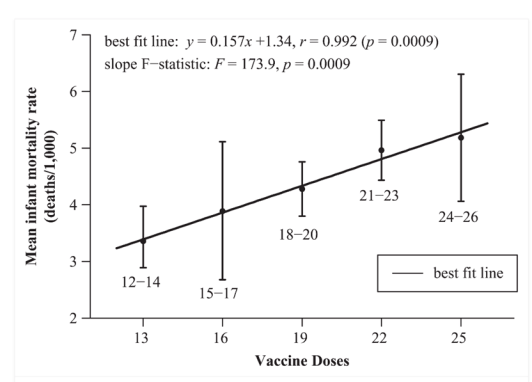
Figure 1: Mean infant mortality rates and mean number of vaccine doses 2009
Statements from WHO, Gates Foundation etc that vaccination has been the biggest life-saving breakthrough does beg the question: if the same amount of money and effort had been put into ensuring every child had access to clean drinking water and adequate food (the most basic physiological need in Maslow’s hierarchy of needs), then how many more lives would have been saved?
Would ‘Big Plumbers’ now be dominating public health policy?
Dr Ros Jones is a HART member and retired Consultant Paediatrician.
White House opposes independent oversight of Ukraine aid
RT | July 11, 2023
President Joe Biden’s administration has objected to plans by US lawmakers to establish an independent inspector general who would scrutinize Washington’s massive military and economic aid packages for Ukraine.
At issue is a provision added to the $874 billion US defense budget for the government’s next fiscal year, calling for an additional oversight layer on Ukraine aid modeled after the inspector general established for reconstruction in Afghanistan. Conservative lawmakers, including Representative Matt Gaetz, a Republican from Florida, have argued that the White House lacks adequate controls to prevent fraud and other misuse of the $113 billion in aid approved by Congress to support Ukraine in its conflict with Russia.
However, the administration argued on Monday that the Pentagon inspector general and the Government Accountability Office (GAO) are already working with relevant congressional committees to “ensure accountability” for Ukraine aid. The Pentagon inspector general and the GAO are currently conducting investigations of “every aspect of this assistance,” the White House Office of Management and Budget (OMB) said in a statement.
The White House also opposes an amendment to the defense bill that would expand the authority of the Afghanistan reconstruction inspector general. “This expansion is both unnecessary and unprecedented” because inspectors from both the US State Department and the US Agency for International Development already oversee the aid, the OMB said.
John Sopko, the independent inspector general for Afghanistan reconstruction, warned in February that strong safeguards were needed to prevent corruption from undermining Washington’s aid packages for Ukraine. Failure to learn from the US mistakes in Afghanistan, where much aid was “diverted or stolen,” could lead to a repeat in Ukraine.
“You’re bound to get corrupt elements of not only the Ukrainian or host government, but also of US government contractors or other third-party contractors to steal the money,” Sopko told Fox News.
Last year, Congress blocked an initiative spearheaded by Representative Marjorie Taylor Greene, a Republican from Georgia, to audit the aid to Kiev.
Ukraine consistently ranks as one of the most corrupt countries in Europe. Ukrainian President Vladimir Zelensky fired a number of top officials earlier this year for profiteering. An August 2022 report by CBS News indicated that only about 30% of the Western weaponry sent to Kiev was actually making it to the front lines because of waste and corruption.
Hunter Biden Reportedly Has Extensive Ties With a Dozen Senior US Officials

Sputnik – 10.07.2023
WASHINGTON – US President Joe Biden’s son, Hunter Biden, has reportedly maintained “extensive ties” with almost a dozen of current and former senior government officials since the time when his father served as vice president under the Obama administration.
A digital analysis carried out by Fox News detailed a list of officials with whom Hunter Biden was or continues to be in close contact, and includes US Secretary of State Antony Blinken, national security adviser Jake Sullivan, senior Biden adviser Michael Donilon, and a close aide to Defense Secretary Lloyd Austin, among several other people.
Hunter Biden and Sullivan were cooperating with each other during their joint work on the board of the Truman National Security Project, a liberal foreign policy think tank. Sullivan worked there in 2017-2019, while Hunter was also serving on the board of Ukrainian energy company Burisma Holdings and the Chinese private equity fund BHR Partners. The US is currently investigating those and his other foreign business activities.
The outlet noted that former White House official Mike McCormick accused Sullivan of being a “conspirator” in the Biden family’s “kickback scheme” in Ukraine at the time.
The report also cites an extensive email exchange between Hunter Biden, at the time when he was with Burisma, and then-Deputy Secretary of State Antony Blinken. That correspondence shows the two men scheduled at least one meeting with each other.
Moreover, their communications go back at least a decade. For instance, Hunter contacted Blinken’s wife, Evan Ryan, in June 2010 asking for Blinken’s non-government email address, the report said. “Can I get Toni’s non-govt email? I wanted to send him something,” the message read.
Ryan is currently serving as White House cabinet secretary.
The report also mentioned email exchanges between Hunter Biden and several other cabinet members.
US House Oversight Committee launched an investigation into alleged criminal acts committed by the Biden family, including corruption and influence peddling. Earlier this month, panel chairman Rep. James Comer (R-KY) characterized the alleged actions as “organized crime.”
The committee’s probe is partially based on accusations from a confidential FBI informant, who alleges Joe and Hunter Biden received millions of dollars from a Ukrainian energy company. Lawmakers are also investigating deals tied to China.
In June, Hunter Biden’s attorneys and the US Justice Department announced an agreement under which he will plead guilty to misdemeanor tax charges and enter a pretrial diversionary agreement on a felony firearms offense in an effort to resolve the criminal probe against him and avoid prison time.
Featured Video

Seyed M. Marandi: US-Iran War Inevitable: Kuwait and Bahrain May Fall
or go to
Aletho News Archives – Video-Images
From the Archives
Oil and the Israel Lobby
Reknowned economist M. Shahid Alam offers this excellent critique of Noam Chomsky’s defective analysis of the relative influence of Oil versus the Israel lobby over US foreign policy: … continue
Blog Roll
 Aletho News
- ICC ignored ‘very well-documented’ NATO crimes – ex-Libyan minister
- SNSC secretary dismisses US response to Iran’s conditions as ‘inadequate’
- Sanaa says Taiz roads open, secure for residents, warns Saudi forces
- Iraqi resistance group urges Saudi leadership to admit defeat, lift Yemen siege
- Trump’s Retreat: How Al-Aqsa Flood Took Down the US Empire
- Israel’s Military Actions in Lebanon Grossly Violate International Law — Lavrov
- Seyed M. Marandi: US-Iran War Inevitable: Kuwait and Bahrain May Fall
- Leaders Condemn Ansarallah Attack on Saudi Arabia While Ignoring Illegal War Against Yemen
- Leaked: Britain’s Covert Iraqi Psyops Network
- Yemeni Armed Forces Warn Airlines Against Using Saudi Airports, Exempt Mecca and Medina
- If Americans Knew
- An error has occurred; the feed is probably down. Try again later.
- No Tricks Zone
- Germany’s Green Energy Debacle: High Energy Costs Force Kahla Porzellan to Close After 182 Years!
- New Study: 50 Years Of The Most Aggressive ‘Net Zero’ Policies Can Only Affect The Global Climate By 0.03°C
- US September “Heat” Was No Record…Many Records Set Decades Ago
- Latest European Green Energy Debacle; Portugal’s Largest Flagship Solar Park Insolvent!
- Green Energy Debacle: German Expert Professor Fritz Vahrenholt Warns Of Severe Economic And Social Consequences
- Two More Paleo Reconstructions Affirm Meters-Higher Sea Levels Across Ireland, Brazil 7000-6000 Years Ago
- New Study: Earth And Venus Surface Warmth Largely Explained By Convection And Lapse Rate, Not CO2 Or Radiation
- 2025 Nature Paper Claiming Worsening Global Drought Gets RETRACTED …Heavily Flawed
- New Study: ‘Global Drought Shows No Detectable Recent Acceleration Under Climate Warming’
- Economic Masterminds: German Socialists Suggest Taxing Productivity Gains Stemming From Using AI

