Why More US Bradley Armored Vehicles Won’t Boost Ukraine’s Counteroffensive

By Oleg Burunov – Sputnik – 28.06.2023
What Washington has delivered to Ukraine is a non-upgraded version of the Bradly armed vehicles with restricted combat capabilities, retired US Air Force Lt. Col. Karen Kwiatkowski, a former analyst for the US Department of Defense, told Sputnik.
The Biden administration has announced another $500 million military package to Kiev, which includes, among other weaponry, 30 US-made Bradley infantry fighting vehicles.
At least 17 such vehicles were earlier damaged or destroyed by Russian troops amid the Ukrainian army’s unsuccessful counteroffensive attempt. Will an additional batch of the Bradley vehicles be of use to the Ukrainian military? Former Pentagon analyst Karen Kwiatkowski has her doubts.
“Well, if you have ever watched the 1998 movie “The Pentagon Wars” you might wonder how we ever developed them in the first place! And of course, they are from 1980s technology and design, because of the lag time in the US military acquisition system of that era, and today as well,” she told Sputnik.
THE PENTAGON WARS – 1998 HBO MILITARY COMEDY FILM BASED ON A TRUE STORY OF THE BRADLEY TANK
The ex-Pentagon analyst said that with the mothballed Bradleys delivered to Ukraine, the US is now in the process of upgrading these infantry fighting vehicles.
“Its replacement program was actually initiated in 2010, and the production by the winning company (or a combination) won’t begin until 2027. In a comprehensive land-sea-air battlespace, the Bradley adds mobility and protection to other parts of the combined arms array, but without the ‘rest of the system’ its capabilities are limited, as we see in Ukraine today,” Kwiatkowski noted.
She made it clear that the Bradley supplies to Ukraine are something that American Rheinmetall and General Dynamics will benefit from, as “they refine and propose their best design” of the Bradleys.
When asked whether the development of a new vehicle could entail a US military budget increase, Kwiatkowski said that “part of the strategy of NATO expansion and relevance, that has been the story of Ukraine for over a decade, is how to upgrade older weapons systems with European support and cash along with maintaining the massive US military industrial complex into the foreseeable future.”
“The US defense budget has grown every year in my lifetime, and not a single war has been ‘won’. The upcoming Pentagon budget is $842 billion, and this does not count the entire intelligence budget, so we are well over a trillion dollars annually in 2024. Because of the influence and pervasiveness of the defense industry in every state, this budget will continue to grow until the United States is bankrupted,” she concluded.
Both Kiev and Washington have acknowledged that the Ukrainian counteroffensive is progressing slower than expected, with one Pentagon official citing an American military representative who conceded that the counteroffensive is “not meeting expectations on any front.”
Russian President Vladimir Putin, for his part, stressed that Kiev had failed to reach any strategic objectives at the beginning of its counteroffensive, losing more than 180 tanks and over 400 armored vehicles.
Merck Knew Its Popular Asthma Drug Could Lead Kids to Commit Suicide, Lawsuits Allege
By Michael Nevradakis, Ph.D. | The Defender | June 27, 2023
Dozens of patients, including many children, died by suicide or suffered from neuropsychiatric problems after taking Singulair, Merck’s allergy and asthma medication, according to lawsuits that are finally proceeding, after decades of delays and legal challenges, Reuters reported.
Merck is accused of downplaying early evidence of Singulair’s impact on the brain. These claims “later faced intense scrutiny,” leading to “a raft of lawsuits alleging [Merck] knew … that the drug could impact the brain and that it minimized the potential for psychiatric problems in statements to regulators.”
Singulair, also known as montelukast, is available to adults and children as a medication for severe allergies and asthma. The drug “blocks chemicals, called leukotrienes, in the body,” according to Dr. Michelle Perro, a pediatrician. Leukotrienes “can be involved in the precipitation of asthma and can cause respiratory symptoms, as well as inflammation of the airways,” Perro told The Defender.
Numerous public comments about Singulair’s side effects were submitted in 2019, prior to the Sept. 27, 2019, joint meeting of the U.S. Food and Drug Administration’s (FDA) Pediatric and Drug Safety and Risk Management Advisory Committees charged with reviewing the drug’s safety.
Many of the comments were submitted by “vocal parents” of children adversely affected by Singulair.
Rolf Hazlehurst, senior staff attorney with Children’s Health Defense (CHD), told The Defender he “worked closely” with several of these parents.
The public comments, along with thousands of reports submitted over several years to the FDA Adverse Event Reporting System (FAERS) plus a 2015 research study finding that a “substantial amount” of Singulair entered the brain, forced the FDA to take action.
On March 4, 2020, the FDA required Singulair to carry a “black box” label — the FDA’s most serious warning, for “serious mental health side effects,” according to Drugwatch.
Black box warnings list “important side effect information surrounded by a thick black border and bold lettering to warn of permanent, serious or fatal side effects.”
In the case of Singulair, the label links the drug to “suicide, depression, aggression, agitation, suicidal thoughts and sleep disturbances.”
The black box label was at least two decades in coming, according to Hazlehurst, who said it “took over a decade’s worth of work by persistent parents, armed with overwhelming evidence of the serious neuropsychiatric side effects, urging the FDA to take action.”
According to Drugwatch, lawsuits now pending against Merck claim the drugmaker “knew or should have known before it started selling Singulair in 1998 that the drug could cause neuropsychiatric injuries during treatment and even after stopping.”
Dr. Liz Mumper, a pediatrician, said she has been “aware of the potential neuropsychiatric side effects of montelukast for many years,” adding that her patients “are instructed to stop the medicine if they notice a change in their mental health.”
“Over the years, parents have reported personality changes in their children, rapid changes in mood and irritability,” Mumper told The Defender. “Typically, these symptoms resolve once off montelukast.”
Since March 2020, when the FDA applied the black box warning to Singulair, numerous lawsuits have been filed against Merck. The lawsuits allege Merck designed “a defective drug,” in addition to claiming “negligence and failure to warn about the risk of mental problems,” according to Drugwatch.
A Reuters investigative report revealed the lawsuits also allege “that the company’s own early research indicated the drug could impact the brain but that Merck downplayed any risks in statements to regulators.”
The Reuters investigation states that plaintiffs faced a legal hurdle commonly used by Big Pharma — known as a “preemption defense” — based on a legal argument that federal law and federal regulations supersede state laws, including state product liability laws that traditionally served as the basis for lawsuits like those against Merck.
As a result, “companies increasingly argue that federally regulated products or services should be immune from lawsuits alleging state-law violations,” and plaintiffs “must often demonstrate that a company failed to disclose safety information to federal regulators — and that the information could have spurred new government restrictions or warnings before the alleged harm occurred.”
This has made it particularly difficult to sue manufacturers of generic versions of Singulair and other drugs, because generic drugmakers simply follow the primary manufacturer’s FDA-approved labeling, while the primary drugmaker can’t be sued by claimants if they or their family members took the generic version.
Perro told The Defender that a combination of an abrogation on the part of federal regulators, a lack of integrity on the part of drugmakers and complex legal maneuvering makes it difficult for doctors to prescribe safe treatments to their patients.
She said:
“A medical practitioner now needs to understand their patient, the illness, any prescribed medications, what Pharma reports about their drug, the real science behind the drug, and unfortunately, the legal doctrine of preemption, which is the principle based on federal law trumping state law.
“It is a dark time in medicine when the physician must question the integrity of what is written on the prescription pad.”
The FDA claims it has “diligently monitored reports of side effects possibly associated with montelukast, as well as communicated findings and taken regulatory action, when appropriate,” and that it “continues to monitor and investigate this important issue.”
Merck’s patent on Singulair expired in 2012, allowing generic drugmakers to begin producing and marketing the drug. Still, according to Reuters, Singulair “has provided Merck with about $50 billion in revenue.”
However, once Merck’s patent expired, “The number of patients prescribed the medicine climbed from about 7 million annually to more than 9 million” — with up to half of recipients age 16 or younger.
At least 82 suicides connected to Singular before FDA added black box warning
The Reuters investigation noted that “in the case of Singulair’s potentially deadly side effects, the FDA waited years, despite thousands of reported psychiatric problems, to require its most serious warning on the drug’s label.”
During this time, dozens of individuals taking Singulair committed suicide or faced other neuropsychiatric problems.
For instance, in 2017, 22-year-old Nicholas England, a Virginia resident, shot himself in the head less than two weeks after starting a generic version of the medication. He had no history of mental health problems — and his family had no legal recourse against Merck due to the preemption defense.
In 2007, a 15-year-old boy in New York committed suicide, 17 days after first taking Singulair. According to Reuters, this incident led Merck to propose — and the FDA to accept — an amendment to the drug’s label to add suicidal thinking and behavior to the product’s listed adverse events.
However, this adverse event “appeared in the middle of a list of more than three dozen side effects,” the Reuters investigation found. “Parent advocates argue the new label was grossly inadequate to warn of such a grave risk.”
“Neuropsychiatric side effects are listed in the documentation of potential side effects, but not always prominently,” Mumper told The Defender. And despite the new label, she said, parents searching for its package insert online will find older versions “without a prominent black box warning.”
According to Drugwatch, the change to Singulair’s label was made in August 2009, when the label was updated to also include other neuropsychiatric events including “postmarket cases of agitation, aggression, anxiousness, dream abnormalities and hallucinations, depression, insomnia, irritability, restlessness … and tremor.”
In 2008, the FDA said it was investigating “a possible association between the use of Singulair and behavior/mood changes, suicidality … and suicide,” Drugwatch reported.
In another example, the 3-year-old son of Jan Gilpin was prescribed Singulair for asthma in 2003. He “soon seemed withdrawn and sullen” and “started talking about death,” according to Reuters.
Gilpin initially did not suspect Singulair — until she discovered online posts by parents stating that their children were exhibiting similar behavior while on this medication. She pulled her son off Singular and soon “noticed he began to skip and laugh,” while his “obsessive thoughts about death disappeared after he quit the medicine.”
Indeed, “reports of related neuropsychiatric episodes piled up on internet forums and in the FDA’s early-warning detection system” starting in 1998, Reuters reported. Yet, by the time of England’s suicide in 2017, the FDA was still “reviewing” this data.
According to Reuters, in 2011, the FDA “rejected a petition from Gilpin and other parents seeking a black box warning, citing what it called insufficient evidence that the drug caused suicidal behavior.”
“Parents who argue Singulair endangered their children view the FDA’s 2020 decision to add a black box warning as vindication, but many still want to sue Merck for not acting sooner,” Reuters also reported.
In 2014, an FDA panel acknowledged that neuropsychiatric side effects among Singulair users were a “known safety issue,” but cited this reason and “feasibility concerns” in its decision not to order new studies, according to Reuters.
Yet, as reports of suicides continued to be filed — with 82 suicides linked to Singulair and its generic versions, including at least 31 involving people age 19 and younger, a new FDA advisory panel was convened in 2019.
According to Reuters, “agency staffers again said there was not enough evidence” to merit this. However, with Merck’s patent having expired, an FDA official told the advisory committee that the company may opt to pull Singulair from the market rather than fund expensive new studies to investigate the product’s safety.
This resulted in the March 2020 decision to add the black box label to Singulair.
‘Substantial amount’ of Singulair enters human brain
In its 2020 decision, the FDA cited independent research conducted in 2015 by cell biologist Julia Marschallinger and other researchers at Austria’s Institute of Molecular Regenerative Medicine.
They found that Singulair’s distribution into the brain was more significant than what was stated on the product label, which described its brain distribution as “minimal.”
Merck had claimed, in documents it submitted to FDA for the drug’s approval in 1998, that “only a trace amount” of the drug could be found in the brain and that its presence “declined over time.” Merck’s public marketing of the product later described side effects as “generally mild” and “similar to a sugar pill.”
However, Marschallinger’s team found that while Singulair’s presence decreased almost everywhere in the body within 24 hours after administration, the opposite was true in the brain, where “a substantial amount” of the drug was identified.
In its 1996 patent application for Singulair, Merck also claimed the drug could be used as a treatment for “cerebral spasms” — indicating “knowledge of the drug’s potential brain impacts.” Lawyers for plaintiffs filing Singulair lawsuits against Merck have cited this argument, as well as Marschallinger’s study.
The FDA has confirmed the study’s findings, acknowledging that claims regarding the declining presence of Singulair in all tissues “did not fully reflect the data.”
However, according to Reuters, the FDA also characterized findings of “a substantial amount” of the drug in the brain “a subjective characterization that is not necessarily incompatible with the ‘minimal’ descriptor in other contexts.”
“The FDA could have asked Merck to repeat the experiment or do it for an even longer period of time,” Marschallinger told Reuters. “It’s not hard to do.”
Perro said, “For those children who have been harmed by this drug,” due to the FDA’s 22-year delay in adding a black box warning, “there will not be any compensation because of pharmaceutical protection by our own government and liability shields.”
The FDA’s inaction has resulted in many deaths, Sue Peters, Ph.D., a CHD science fellow, told The Defender :
“The FDA has placed pharmaceutical profits over the safety and mental health of our children. It’s a never-ending cycle, with increased rates of chronic illness, like asthma, leading to pharmaceutical treatments which have not been properly safety-tested.
“These drugs put young people, with critical brain myelination continuing past 25 years of age, at risk of developing mental health disorders, leading to polypharmacy with psychiatric medications, and contributing to iatrogenic deaths as a leading cause of death in the U.S.”
Perro called for an overhaul of the FDA, telling The Defender :
“It is clear who our government — including the judicial system — is protecting. A solution to the lack of action by regulatory agencies? Overhaul.
“In the meantime, there are safer pharmaceutical alternatives for asthma in children. Not to mention, this is yet another reason to examine the root causes as to why so many children now have asthma, and address the real culprits, such as air pollution.”
For Mumper, a new approach to treating ailments such as asthma is needed. “Although montelukast is a valuable medication in my toolbox for treating allergies, the prescription should come after other measures, including working on gut health,” she said.
Similarly, Peters called for a “careful analysis” of the role of drugs in the treatment of common disorders and their role in precipitating mental health disorders and even deaths. She told The Defender :
“The tragic increase in the rate of mental health disorders in children in the United States, requires careful analysis of the role of iatrogenic death.
“Failing to consider the role of pharmaceutical drugs and medical treatments in the development of mental health disorders in children, has led to the loss of valuable research time, wasted research dollars, and ultimately the loss of life. Clearly, our current system is broken.”
Preemption defense lets Big Pharma avoid directly addressing safety claims
According to the Reuters investigative report, most of the Singulair lawsuits pending against Merck are still in their early stages.
Drugwatch reported that, as of May 16, “there have been no scheduled trials or court-approved global settlement in Singulair litigation.” Many of the suits against Merck were filed in New Jersey, where in January 2022, they were consolidated into multicounty litigation in the Superior Court of New Jersey Law Division: Atlantic County.
And in April, U.S. District Judge Timothy S. Hillman in Massachusetts denied Merck’s motion to dismiss a Singulair lawsuit “for lack of personal jurisdiction,” Drugwatch reported. Judge Hillman argued Merck manufactured, marketed and sold the drug in the state and allowed the case to continue.
Two U.S. Supreme Court rulings in 2011 and 2013 strengthened the preemption defense.
In Pliva, Inc. v. Mensing (2011), the Supreme Court held that state law requiring “generic drug manufacturers to provide adequate warning labels was preempted where federal law required manufacturers to use the same labels as their brand-name counterparts.”
And in Mutual Pharmaceutical Co. v. Bartlett (2013), the Supreme Court held that design-defect claims questioning the adequacy of a drug’s warnings under state law are preempted by the Federal Food, Drug, and Cosmetic Act and the Pliva v. Mensing ruling.
According to Reuters, the preemption doctrine rests on the U.S. Constitution’s Supremacy Clause, which states that the Constitution and federal law take precedence over state laws and state constitutions.
As a result, “Preemption defenses often deliver companies a swift procedural win, allowing them to avoid addressing the substance of plaintiffs’ allegations.”
While the defense has been used across multiple industries, it “has had a particularly profound impact in the pharmaceutical industry,” particularly as FDA data cited by Reuters indicates that generic drugs account for 91% of U.S. prescriptions.
Reuters, in its review of 257 U.S. Supreme Court and federal appeals court rulings since 2001, found that “judges ruled two-thirds of the time to weaken or kill lawsuits alleging deaths or injuries caused by corporate negligence or defective products.”
Moreover, “The number of potential lawsuits that were never filed” serves as “Another industry benefit” that “can’t be quantified,” according to Reuters.
Preemption defenses became a centerpiece of the George W. Bush administration — and FDA policy under his presidency, Reuters reports. This was part of the Bush campaign’s promise to address what it described as “frivolous” lawsuits.
Daniel Troy, the FDA’s chief counsel under the Bush administration, “interpreted preemption to mean that courts can’t undermine federal regulators based on alleged state-law violations,” Reuters reported, adding that he “aimed to make that argument in high-profile lawsuits” and briefed drug industry lawyers on the strategy in 2003.
Troy — who is now a pharmaceutical industry lawyer — told Reuters, “If you believe in a strong FDA, we can’t have state courts, especially juries, second-guessing and undercutting the FDA’s judgments.”
Hazlehurst told The Defender Troy’s argument is the same one used by Wyeth (Pfizer) before the Supreme Court in Bruesewitz v. Wyeth (2011). The Supreme Court’s decision in this case prohibited design defect lawsuits against vaccine manufacturers.
The U.S. Department of Health and Human Services, the parent agency of the FDA and the Centers for Disease Control and Prevention, supported Wyeth’s 2011 argument.
Similarly, Mumper told The Defender that pharmaceutical companies “have a history of avoiding liability through various legislative protection,” including the preemption defense and the National Childhood Vaccine Injury Act of 1986.
And in 2006, “The FDA formally changed its view of preemption in a 2006 regulation, stating the agency now believed that FDA labeling approval ‘preempts conflicting or contrary State law,’” Reuters reported.
Hazlehurst told The Defender, “CHD is proud to have played a role in advocating and assisting these parents on the journey to hold Merck accountable,” but “one thing rings loud and clear: the FDA is a captured agency, and this is a fundamental problem.”
Some parents have questioned whether the black box warning for Singulair was enough to save lives, citing the damage already done, continued legal obstacles, and Merck’s strong marketing campaign for the drug.
“Due to tremendous financial conflicts of interest, the pharmaceutical industry has tremendous influence over the FDA,” Hazlehurst said. “As a result, the FDA protects the pharmaceutical industry first and people second — this story is just one example.”
He added: “One must wonder, how many lives could have been spared if the FDA had timely done its job of properly investigating and regulating the pharmaceutical industry?”
Michael Nevradakis, Ph.D., based in Athens, Greece, is a senior reporter for The Defender and part of the rotation of hosts for CHD.TV’s “Good Morning CHD.”
This article was originally published by The Defender — Children’s Health Defense’s News & Views Website under Creative Commons license CC BY-NC-ND 4.0. Please consider subscribing to The Defender or donating to Children’s Health Defense.
I try to use logic in my articles
This has led to some very disturbing conclusions
BY BILL RICE, JR. | JUNE 28, 2023
In my last article, I tried to use deductive reasoning or “logic” to explain how I knew the spike in all-cause deaths would NOT be exposed.
As I understand it, logic is simply an intellectual exercise where someone says “If A or B is true – or if one thinks these are true – then C, D or E must also be true.”
In layman’s terms, someone can make confident predictions based on some “known knowable(s).”
I use such deductive reasoning/syllogisms all the time in my writing (or try to). This is what probably makes me a “contrarian” and has allowed me to pen some fairly-original articles.
There’s another example that allows me to make another bold prediction with a pretty high degree of confidence.
Recently, a flurry of stories in the alternative press has shown conclusively that the government pressured social media companies to be much more aggressive in their censorship of users’ comments that do not align with the “authorized” Covid narratives.
(See my article on Missouri et al vs. Biden).
In reading legal documents from the Missouri v Biden lawsuit, I found a few comments from people who pointed out that the big social media companies like Meta (Facebook and Instagram), Google and YouTube are still censoring un-authorized comments at the same rate they have for the past 40 months.
I know this is true because Facebook keeps suspending my account and/or censoring or shadow-banning or restricting the reach of my Facebook posts.
Anyway, it would qualify as a “known knowable” to me that companies like these have NOT curtailed their censorship programs even after serious plaintiffs filed this lawsuit.
From this simple observation, several “logical” inferences occur to me. These include:
* These companies are NOT afraid of any terrible consequences happening to their companies if they don’t stop this censorship.
* Said differently, they seem to be very confident such a result will NOT happen.
* These companies must have concluded that nothing damaging to their companies is going to happen as a result of this lawsuit and investigation.
- In other words, executives at these companies have concluded they are “safe” to continue to censor like Big Brother.
- In fact, they probably realize they’ll be rewarded for “playing ball” with the legions of censors, “fact checkers” and “disinformation warriors” who are now omnipresent in myriad organizations.
Again, from these “logical” conclusions, I’ve deduced that, somehow, these executives must know that nothing significant or damaging to their companies is going to result from this lawsuit.
This conclusion/observation prompts this question: How do they know this?
Here, I circle back to the point I tried to make in my last column: These executives probably know this because they are all members of the same “club” …. and these club members happen to be the most powerful people and organizations on the planet.
Apparently, one iron-clad rule of said club is that members protect each other. They all benefit from sticking together.
Conversely, they all probably recognize they could be exposed and disgraced and lose their wealth, influence, benefits and power if they do NOT stick together and act together.
To use one example, my guess is that Mark Zuckerberg of Meta somehow knows nothing bad is going to happen to his company even if his army of “content moderators” and the platform’s algorithms continue to suppress my free speech (which the company continues to do).
Here, one has to state that if Missouri v Biden was successfully litigated, the conclusion would surely qualify as an epic scandal.
It would tell the world that many agents of our own government have conspired with companies like Meta to censor free speech.
Basically, the First Amendment to the U.S.Constitution would now be null and void.
Put it this way: If the U.S. government can compel partners in the media world to censor speech the government doesn’t like, we all now live in a dystopian, Orwellian world.
Well, that’s the “bet” that Zuckerberg, Google et al have apparently made. This is our “New Normal” world and these social media and Big Tech companies have no problem with this whatsoever. (Nor does the legacy press.)
It’s also possible these companies have made a more prosaic observation. For example, they have no doubt taken note of what’s happening at their competitor, Twitter, since Elon Musk bought this social media company.
According to comments Musk made in his recent conversation with Robert Kennedy, Jr., there seems to be a conspiracy of corporate advertisers to boycott Twitter now that it’s allowing far more free speech.
One doesn’t know if any memo went out to all these companies (and their ad agencies) to punish Twitter by withholding advertising spends on this platform. Here, one guesses these executives aren’t stupid enough to put any message like this in writing.
Still, we can observe what’s actually happened – “a known knowable” … as Musk, who would know, has told us.
One strongly suspects that corporate executives work in “pack” fashion just like corporate journalists do. In “journalism,” all the editors and reporters intuitively know what stories they can write and, perhaps more importantly, what stories they can’t write. Or what investigations they can’t pursue.
The same approach seems to apply to which companies are allowed to receive advertising dollars and which media companies should never receive advertising dollars.
We saw the same dynamic with the “case study” of one Tucker Carlson, formerly the star talking head at Fox News.
Yes, Tucker had the No. 1-rated TV news talk show in the world. However, his time slot at Fox News probably ranked last in “advertising revenue” from Coca-Cola, GM, IBM, Pfizer, Procter & Gamble, Johnson & Johnson, J.P. Morgan Chase and any company with scores of branded products or services.
Here’s the lesson even a caveman would get: If you want to air “dissident” commentary or journalism, you are not going to get any advertising dollars from our club members.
As you might have heard, Tucker Carlson was finally fired from Fox News. Today, I imagine the “memo” has gone out – It’s okay to once again advertise on Fox News between 8 and 9 p.m. EST.
I think this is called the “carrot-and-stick” approach to compelling compliance. (This approach seems to work in media as well as when it comes to promoting official propaganda such as “the vaccines are safe and effective.”)
Anyway, Meta and Google must have taken note of this “real-world” reality as well.
Regarding my “logical” belief that most social media companies are now completely captured (and are “all in” with Big Brother), I can make even more logical inferences.
As noted, censoring social media and Big Tech companies must not be too worried about the plaintiffs winning Missouri vs. Biden, which suggest to me that they know the U.S. Court system is also captured and will not allow any verdict that would disgrace their companies.
Here, I would opine that some lower court might rule in favor of the plaintiffs, but when this case finally gets to the Supreme Court, the Bad Guys perhaps know they have the vote of John Roberts in the bag?
They must also know that the leaders of Congress aren’t going to hold any Watergate-type hearings and expose their complicity and convince the citizens of our nation that, say, Facebook is evil and despises the First Amendment (which would mean the company despises and rejects everything the Founders of this nation stood for).
I’ll go even further. I think “club members” must know that “Joe Biden” is going to be re-elected president (or, if “Joe Biden” has to be replaced, another political clone who also hates and rejects the Constitution).
Think about it for a second. If these companies thought that Missouri v Biden might prevail – and the public might rise up against their companies – these companies would probably be throttling back on their censorship programs right now.
In fact, they’ve shrugged off these legal proceedings and are doubling, tripling and quadrupling down on the censorship of “misinformation” and “disinformation” of all varieties (not just dissident Covid speech).
This makes me think our “rulers behind the curtain” must know that they’ve also captured and control elections … and that “their” candidates will always win (even if their candidate is obviously suffering from worsening dementia, which is perhaps one reason they love this particular politician so much).
In other words, I think club members somehow know that Donald Trump, Robert Kennedy, Jr. or Ron DeSantis are not going to become the next president of the United States.
Any of these candidates, if elected, might push for hearings and prosecutions that could expose these companies for what they really are.
It seems pretty clear to me that this possibility doesn’t concern these people. Perhaps because they know this is NOT going to happen?
In my last article, I tried to explain why the “club members” aren’t worried about any of the Covid truths being exposed to the citizens of the world.
 They know they hold all the key cards and that their not-so-little fraternity isn’t going allow this to happen.
This is probably the same reason Facebook and Google aren’t worried about being humiliated and possibly facing financial ruin from their roles in attacking the Bill of Rights.
Somehow they know this is not going to happen.
Again, the most important known-knowable seems to be the knowledge that club members control all the levers of power … And so they act accordingly.
I know the above might sounds like wild conspiracy stuff to many people, but Mr. Spock would probably reach the same “logical” and deeply-disturbing conclusions I’ve reached.
I’m thinking about putting aside this “logic tool” in future articles. It’s starting to interfere with my sleep.
YouTube Escalates Its Attack on Robert F Kennedy Jr., Censors Another Interview
By Christina Maas | Reclaim The Net | June 27, 2023
YouTube has taken down another interview featuring Democratic Presidential candidate Robert F Kennedy Jr., raising eyebrows and fueling debate over the role of tech giants in controlling information. The interview, a spirited chat with Al Guart, a former New York Post reporter, was removed for allegedly breaching the platform’s “community standards.”
This has further ignited concerns over censorship and its potential ramifications on democratic dialogue.
The episode marked the launch of a podcast in which Kennedy, an environmental attorney and presidential aspirant for the 2024 election, discusses an array of subjects. From his meditation routine to his ambition of overhauling federal health agencies and the Democratic Party, the conversation traversed numerous topics. Other issues covered included handling environmental concerns and the middle class.
Al Guart expressed dismay over the removal in a statement, remarking, “YouTube just banned my interview with RFK Jr. for allegedly violating ‘community standards.’ RFK Jr. and I covered many topics of public interest and there was no threat or harm contained in the hour-long discussion.” Guart also highlighted that the podcast was gaining traction and popularity on other platforms.
During the interview, Kennedy made noteworthy remarks concerning censorship, a topic he himself has encountered on platforms such as Instagram and YouTube. He opined that, if elected President, he would engage with tech giants to explore ways to put an end to what he perceives as the unAmerican practice of censorship. He further asserted that if a satisfactory resolution could not be reached, he would consider transforming these companies into common carriers.
Kennedy, who has previously faced the ax on YouTube for violating its policy on vaccine “misinformation,” voiced his concerns over the platform’s removal of the video. He drew a parallel with concerns over foreign intervention in elections through information manipulation, stating, “People made a big deal about Russia supposedly manipulating internet information to influence a Presidential election. Shouldn’t we be worried when giant tech corporations do the same?”
In an earlier instance, YouTube removed a video featuring Kennedy in conversation with podcast host Jordan Peterson, citing a violation of its policy against “vaccine misinformation.” A YouTube spokesperson explained that content alleging vaccines cause chronic side effects, beyond the “rare” side effects acknowledged by health authorities, is not permitted on the platform.
15 Signs That You Might Be In An Abusive Relationship…
… With Your Government
The Naked Emperor | June 28, 2023
The Workplace Mental Health Institute delivers mental health training and consultancy to medium and large-sized organizations across the world. On their website they have various resources that you can download and put in your office, to help boost productivity, by addressing mental health issues.
One of their infographic downloads provides 15 signs that your might be in an abusive relationship. You may be in an abusive relationship if they [your partner]:
- Stop you seeing friends and family;
- Won’t let you go out without permission;
- Tell you what to wear;
- Monitor your phone or emails;
- Control the finances, or won’t let you work;
- Control what you read, watch and say;
- Monitor everything you do;
- Punish you for breaking the rules, but the rules keep changing!
- Tell you it is for your own good, and that they know better;
- Don’t allow you to question it;
- Tell you you’re crazy and no one agrees with you;
- Call you names or shame you for being stupid or selfish;
- Gaslight you, challenge your memory of events, make you doubt yourself;
- Dismiss your opinions;
- Play the victim. If things go wrong, it’s all your fault.

Now go back through that list and see which ones your government has subjected you to over the past three years. For most western countries it is every single one.
Your government has been mentally abusing you for years, in an almost identical fashion as an abusive partner would.
House Committee Passes Rule Banning Pentagon From Funding Pro-Censorship Organizations
By Dan Frieth | Reclaim The Net | June 27, 2023
In a move to limit the influence of organizations involved in rating or indirectly causing online censorship, the House Armed Services Committee has greenlighted a regulation that forbids the Pentagon from allocating funds to such entities. This development took place during the early hours of Thursday when the committee approved the 2024 National Defense Authorization Act.
The amendment was introduced by Republican Representative Rich McCormick of Georgia. The amendment specifically names the Global Disinformation Index (GDI), Graphika, NewsGuard, and their kin as prohibited from accessing Pentagon funds. These organizations, with the stated goal of flagging and assessing online content for “disinformation,” have been on the receiving end of criticism that argues that their rating systems are tainted by bias.
Rep. McCormick made his position clear when he expressed satisfaction with the passage of his amendment, stating, “Proud to pass my amendment that prohibits the Department of Defense from contracting with any one of a number of ‘misinformation’ or ‘disinformation’ monitors that rate news and information sources. While these media monitors claim to be nonpartisan, the reality is they are not.”
In practical terms, the amendment prohibits the Department of Defense from engaging with or financing any entity that actively partakes in advising censorship or blacklisting of news sources on grounds that may be subjective or politically biased. Furthermore, advertising and marketing agencies, which the Department of Defense relies upon for recruitment campaigns, must affirm that they do not avail the services of these types of organizations.
The Darkness Ahead: Where The Ukraine War Is Headed
BY JOHN J. MEARSHEIMER | JUNE 23, 2023
This paper examines the likely trajectory of the Ukraine war moving forward.
I will address two main questions.
First, is a meaningful peace agreement possible? My answer is no. We are now in a war where both sides – Ukraine and the West on one side and Russia on the other – see each other as an existential threat that must be defeated. Given maximalist objectives all around, it is almost impossible to reach a workable peace treaty. Moreover, the two sides have irreconcilable differences regarding territory and Ukraine’s relationship with the West. The best possible outcome is a frozen conflict that could easily turn back into a hot war. The worst possible outcome is a nuclear war, which is unlikely but cannot be ruled out.
Second, which side is likely to win the war? Russia will ultimately win the war, although it will not decisively defeat Ukraine. In other words, it is not going to conquer all of Ukraine, which is necessary to achieve three of Moscow’s goals: overthrowing the regime, demilitarizing the country, and severing Kyiv’s security ties with the West. But it will end up annexing a large swath of Ukrainian territory, while turning Ukraine into a dysfunctional rump state. In other words, Russia will win an ugly victory.
Before I directly address these issues, three preliminary points are in order. For starters, I am attempting to predict the future, which is not easy to do, given that we live in an uncertain world. Thus, I am not arguing that I have the truth; in fact, some of my claims may be proved wrong. Furthermore, I am not saying what I would like to see happen. I am not rooting for one side or the other. I am simply telling you what I think will happen as the war moves forward. Finally, I am not justifying Russian behavior or the actions of any of the states involved in the conflict. I am just explaining their actions.
Now, let me turn to substance.
To understand where the Ukraine war is headed, it is necessary to first assess the present situation. It is important to know how the three main actors – Russia, Ukraine, and the West – think about their threat environment and conceive their goals. When we talk about the West, however, we are talking mainly about the United States, since its European allies take their marching orders from Washington when it comes to Ukraine. It is also essential to understand the present situation on the battlefield. Let me start with Russia’s threat environment and its goals.
It has been clear since April 2008 that Russian leaders across the board view the West’s efforts to bring Ukraine into NATO and make it a Western bulwark on Russia’s borders as an existential threat. Indeed, President Putin and his lieutenants repeatedly made this point in the months before the Russian invasion, when it was becoming clear to them that Ukraine was almost a de facto member of NATO.
Since the war began on 24 February 2022, the West has added another layer to that existential threat by adopting a new set of goals that Russian leaders cannot help but view as extremely threatening. I will say more about Western goals below but suffice it to say here that the West is determined to defeat Russia and knock it out of the ranks of the great powers, if not cause regime change or even trigger Russia to break apart like the Soviet Union did in 1991.
In a major address Putin delivered this past February (2023), he stressed that the West is a mortal threat to Russia. “During the years that followed the breakup of the Soviet Union,” he said, “the West never stopped trying to set the post-Soviet states on fire and, most importantly, finish off Russia as the largest surviving portion of the historical reaches of our state. They encouraged international terrorists to assault us, provoked regional conflicts along the perimeter of our borders, ignored our interests and tried to contain and suppress our economy.” He further emphasized that, “The Western elite make no secret of their goal, which is, I quote, ‘Russia’s strategic defeat.’ What does this mean to us? This means they plan to finish us once and for all.” Putin went on to say: “this represents an existential threat to our country.”
Russian leaders also see the regime in Kyiv as a threat to Russia, not just because it is closely allied with the West, but also because they see it as the offspring of the fascist Ukrainian forces that fought alongside Nazi Germany against the Soviet Union in World War II.
Russia must win this war, given that it believes that it is facing a threat to its survival. But what does victory look like? The ideal outcome before the war began in February 2022 was to turn Ukraine into a neutral state and settle the civil war in the Donbass that pitted the Ukrainian government against ethnic Russians and Russian speakers who wanted greater autonomy if not independence for their region. It appears that those goals were still realistic during the first month of the war and were in fact the basis of the negotiations in Istanbul between Kyiv and Moscow in March 2022.
If the Russians had achieved those goals back then, the present war would either have been prevented or ended quickly.
But a deal that satisfies Russia’s goals is no longer in the cards. Ukraine and NATO are joined at the hip for the foreseeable future, and neither is willing to accept Ukrainian neutrality. Furthermore, the regime in Kyiv is anathema to Russian leaders, who want it gone. They not only talk about “de-Nazifying” Ukraine, but also “demilitarizing” it, two goals that would presumably call for conquering all of Ukraine, compelling its military forces to surrender, and installing a friendly regime in Kyiv.
A decisive victory of that sort is not likely to happen for a variety of reasons. The Russian army is not large enough for such a task, which would probably require at least two million men.
Indeed, the existing Russian army is having difficulty conquering all the Donbass. Moreover, the West would go to enormous lengths to prevent Russia from overrunning all of Ukraine. Finally, the Russians would end up occupying huge amounts of territory that is heavily populated with ethnic Ukrainians who loathe the Russians and would fiercely resist the occupation. Trying to conquer all of Ukraine and bend it to Moscow’s will, would surely end in disaster.
Rhetoric about de-Nazifying and demilitarizing Ukraine aside, Russia’s concrete goals involve conquering and annexing a large portion of Ukrainian territory, while simultaneously turning Ukraine into a dysfunctional rump state. As such, Ukraine’s ability to wage war against Russia would be greatly reduced and it would be unlikely to qualify for membership in either the EU or NATO. Moreover, a broken Ukraine, would be especially vulnerable to Russian interference in its domestic politics. In short, Ukraine would not be a Western bastion on Russia’s border.
What would that dysfunctional rump state look like? Moscow has officially annexed Crimea and four other Ukrainian oblasts – Donetsk, Kherson, Luhansk, and Zaporozhe – which together represent about 23 percent of Ukraine’s total territory before the crisis broke out in February 2014. Russian leaders have emphasized that they have no intention of surrendering that territory, some of which Russia does not yet control. In fact, there is reason to think Russia will annex additional Ukrainian territory if it has the military capability to do so at a reasonable cost. It is difficult, however, to say how much additional Ukrainian territory Moscow will seek to annex, as Putin himself makes clear.
Russian thinking is likely to be influenced by three calculations. Moscow has a powerful incentive to conquer and permanently annex Ukrainian territory that is heavily populated with ethnic Russians and Russian speakers. It will want to protect them from the Ukrainian government – which has become hostile to all things Russian – and make sure there is no civil war anywhere in Ukraine like the one that took place in the Donbass between February 2014 and February 2022. At the same time, Russia will want to avoid controlling territory largely populated by hostile ethnic Ukrainians, which places significant limits on further Russian expansion. Finally, turning Ukraine into a dysfunctional rump state will require Moscow to take substantial amounts of Ukrainian territory so it is well-positioned to do significant damage to its economy. Controlling all of Ukraine’s coastline along the Black Sea, for example, would give Moscow significant economic leverage over Kyiv.
Those three calculations suggest that Russia is likely to attempt to annex the four oblasts – Dnipropetrovsk, Kharkiv, Mykolaiv, and Odessa – that are immediately to the west of the four oblasts it has already annexed – Donetsk, Kherson, Luhansk, and Zaporozhe. If that were to happen, Russia would control approximately 43 percent of Ukraine’s pre-2014 territory.
Dmitri Trenin, a leading Russian strategist estimates that Russian leaders would seek to take even more Ukrainian territory – pushing westward in northern Ukraine to the Dnieper River and taking the part of Kyiv that sits on the east bank of that river. He writes that “A logical next step” after taking all of Ukraine from Kharkiv to Odessa “would be to expand Russian control to all of Ukraine east of the Dnieper River, including the part of Kyiv that lies on the that river’s eastern bank. If that were to happen, the Ukrainian state would shrink to include only the central and western regions of the country.”
It might seem hard to believe now, but before the Ukraine crisis broke out in February 2014, Western leaders did not view Russia as a security threat. NATO leaders, for example, were talking with Russia’s president about “a new stage of cooperation towards a true strategic partnership” at the alliance’s 2010 Summit in Lisbon.
Unsurprisingly, NATO expansion before 2014 was not justified in terms of containing a dangerous Russia. In fact, it was Russian weakness that allowed the West to shove the first two tranches of NATO expansion in 1999 and 2004 down Moscow’s throat and then allowed the George W. Bush administration to think in 2008 that Russia could be forced to accept Georgia and Ukraine joining the alliance. But that assumption proved wrong and when the Ukraine crisis broke out in 2014, the West suddenly began portraying Russia as a dangerous foe that had to be contained if not weakened.
Since the war started in February 2022, the West’s perception of Russia has steadily escalated to the point where Moscow now appears to be seen as an existential threat. The United States and its NATO allies are deeply involved in Ukraine’s war against Russia. Indeed, they are doing everything but pulling the triggers and pushing the buttons.
Moreover, they have made clear their unequivocal commitment to winning the war and maintaining Ukraine’s sovereignty. Thus, losing the war would have hugely negative consequences for Washington and for NATO. America’s reputation for competence and reliability would be badly damaged, which would affect how its allies as well as its adversaries – especially China – deal with the United States. Furthermore, virtually every European country in NATO believes that the alliance is an irreplaceable security umbrella. Thus, the possibility that NATO might be badly damaged – maybe even wrecked – if Russia wins in Ukraine is cause for profound concern among its members.
In addition, Western leaders frequently portray the Ukraine war as an integral part of a larger global struggle between autocracy and democracy that is Manichean at its core. On top of that, the future of the sacrosanct rules-based international order is said to depend on prevailing against Russia. As King Charles said this past March (2023), “The security of Europe as well as our democratic values are under threat.”
Similarly, a resolution introduced in the U.S. Congress in April declares: “United States interests, European security, and the cause of international peace depend on … Ukrainian victory.”
A recent article in The Washington Post, captures how the West treats Russia as an existential threat: “Leaders of the more than 50 other countries backing Ukraine have couched their support as part of an apocalyptic battle for the future of democracy and the international rule of law against autocracy and aggression that the West cannot afford to lose.”
As should be clear, the West is staunchly committed to defeating Russia. President Biden has repeatedly said that the United States is in this war to win. “Ukraine will never be a victory for Russia.” It must end in “strategic failure.” Washington, he emphasizes, will stay in the fight “for as long as it takes.”
Specifically, the aim is to defeat Russia’s army in Ukraine – erasing its territorial gains – and cripple its economy with lethal sanctions. If successful, Russia would be knocked out of the ranks of the great powers, weakening it to the point where it could not threaten to invade Ukraine again.
Western leaders have additional goals, which include regime change in Moscow, putting Putin on trial as a war criminal, and possibly breaking up Russia into smaller states.
At the same time, the West remains committed to bringing Ukraine into NATO, although there is disagreement within the alliance about when and how that will happen.
Jens Stoltenberg, the alliance’s secretary general told a news conference in Kyiv in April (2023) that “NATO’s position remains unchanged and that Ukraine will become a member of the alliance.” At the same time, he emphasized that “The first step toward any membership of Ukraine to NATO is to ensure that Ukraine prevails, and that is why the U.S. and its partners have provided unprecedented support for Ukraine.”
Given these goals, it is clear why Russia views the West as an existential threat.
There is no doubt that Ukraine faces an existential threat, given that Russia is bent on dismembering it and making sure that the surviving rump state is not only economically weak, but is neither a de facto nor a de jure member of NATO. There is also no question that Kyiv shares the West’s goal of defeating and seriously weakening Russia, so that it can regain its lost territory and keep it under Ukrainian control forever. As President Zelensky recently told President Xi Jinping, “There can be no peace that is based on territorial compromises.”
Ukrainian leaders naturally remain steadfastly committed to joining the EU and NATO and making Ukraine an integral part of the West.
In sum, the three key actors in the Ukraine war all believe they face an existential threat, which means each of them thinks it must win the war or else suffer terrible consequences.
Turning to events on the battlefield, the war has evolved into a war of attrition where each side is principally concerned with bleeding the other side white, causing it to surrender. Of course, both sides are also concerned with capturing territory, but that goal is of secondary importance to wearing down the other side.
The Ukrainian military had the upper hand in the latter half of 2022, which allowed it to take back territory from Russia in the Kharkiv and Kherson regions. But Russia responded to those defeats by mobilizing 300,000 additional troops, reorganizing its army, shortening its front lines, and learning from its mistakes.
The locus of the fighting in 2023 has been in eastern Ukraine, mainly in the Donetsk and Zaporozhe regions. The Russians have had the upper hand this year, mainly because they have a substantial advantage in artillery, which is the most important weapon in attrition warfare.
Moscow’s advantage was evident in the battle for Bakhmut, which ended when the Russians captured that city in late May (2023). Although it took Russian forces ten months to take control of Bakhmut they inflicted huge casualties on Ukrainian forces with their artillery.
Shortly thereafter on 4 June, Ukraine launched its long-awaited counter-offensive at different locations in the Donetsk and Zaporozhe regions. The aim is to penetrate Russia’s front lines of defense, deliver a staggering blow to Russian forces, and take back a substantial amount of Ukrainian territory that is now under Russian control. In essence, the aim is to duplicate Ukraine’s successes in Kharkiv and Kherson in 2022.
Ukraine’s army has made little progress so far in achieving those goals and instead is bogged down in deadly attrition battles with Russian forces. In 2022, Ukraine was successful in the Kharkiv and Kherson campaigns because its army was fighting against outnumbered and overextended Russian forces. That is not the case today: Ukraine is attacking into the face of well-prepared lines of Russian defense. But even if Ukrainian forces break through those defensive lines, Russian troops will quickly stabilize the front and the attrition battles will continue.
The Ukrainians are at a disadvantage in these encounters because the Russians have a significant firepower advantage.
Let me switch gears and move away from the present and talk about the future, starting with how events on the battlefield are likely to play out moving forward. As noted, I believe Russia will win the war, which means it will end up conquering and annexing substantial Ukrainian territory, leaving Ukraine as a dysfunctional rump state. If I am correct, this will be a grievous defeat for Ukraine and the West.
There is a silver lining in this outcome, however: a Russian victory markedly reduces the threat of nuclear war, as nuclear escalation is most likely to occur if Ukrainian forces are winning victories on the battlefield and threatening to take back all or most of the territories Kyiv has lost to Moscow. Russian leaders would surely think seriously about using nuclear weapons to rescue the situation. Of course, if I am wrong about where the war is headed and the Ukrainian military gains the upper hand and begins pushing Russian forces eastward, the likelihood of nuclear use would increase significantly, which is not to say it would be a certainty.
What is the basis of my claim that the Russians are likely to win the war?
The Ukraine war, as emphasized, is a war of attrition in which capturing and holding territory is of secondary importance. The aim in attrition warfare is to wear down the other side’s forces to the point where it either quits the fight or is so weakened that it can no longer defend contested territory.
Who wins an attrition war is largely a function of three factors: the balance of resolve between the two sides; the population balance between them; and the casualty-exchange ratio. The Russians have a decisive advantage in population size and a marked advantage in the casualty-exchange ratio; the two sides are evenly matched in terms of resolve.
Consider the balance of resolve. As noted, both Russia and Ukraine believe they are facing an existential threat, and naturally, both sides are fully committed to winning the war. Thus, it is hard to see any meaningful difference in their resolve. Regarding population size, Russia had approximately a 3.5:1 advantage before the war began in February 2022. Since then, the ratio has shifted noticeably in Russia’s favor. About eight million Ukrainians have fled the country, subtracting from Ukraine’s population. Roughly three million of those emigrants have gone to Russia, adding to its population. In addition, there are probably about four million other Ukrainian citizens living in the territories that Russia now controls, further shifting the population imbalance in Russia’s favor. Putting those numbers together gives Russia approximately a 5:1 advantage in population size.
Finally, there is the casualty-exchange ratio, which has been a controversial issue since the war started in February 2022. The conventional wisdom in Ukraine and the West is that the casualty levels on both sides are either roughly equal or that the Russians have suffered greater casualties than the Ukrainians. The head of Ukraine’s National Security and Defense Council, Oleksiy Danilov, goes so far as to argue that the Russian lost 7.5 soldiers for every one Ukrainian soldier in the battle for Bakhmut.
These claims are wrong. Ukrainian forces have surely suffered much greater casualties than their Russian opponents for one reason: Russia has much more artillery than Ukraine.
In attrition warfare, artillery is the most important weapon on the battlefield. In the U.S. Army, artillery is widely known as the “king of battle,” because it is principally responsible for killing and wounding the soldiers doing the fighting.
Thus, the balance of artillery matters enormously in a war of attrition. By almost every account, the Russians have somewhere between a 5:1 and a 10:1 advantage in artillery, which puts the Ukrainian army at a significant disadvantage on the battlefield.
Ceteris paribus, one would expect the casualty-exchange ratio to approximate the balance of artillery. Ergo, a casualty-exchange ratio on the order of 2:1 in Russia’s favor is a conservative estimate.
One possible challenge to my analysis is to argue that Russia is the aggressor in this war, and the offender invariably suffers much higher casualty levels than the defender, especially if the attacking forces are engaged in broad frontal assaults, which is often said to be the Russian military’s modus operandi.
After all, the offender is out in the open and on the move, while the defender is mainly fighting from fixed positions that provide substantial cover. This logic underpins the famous 3:1 rule of thumb, which says that an attacking force needs at least three times as many soldiers as the defender to win a battle.
But there are problems with this line of argument when it is applied to the Ukraine war.
First, it is not just the Russians who have initiated offensive campaigns over the course of the war.
Indeed, the Ukrainians launched two major offensives last year that led to widely heralded victories: the Kharkiv offensive in September 2022 and the Kherson offensive between August and November 2022. Although the Ukrainians made substantial territorial gains in both campaigns, Russian artillery inflicted heavy casualties on the attacking forces. The Ukrainians just began another major offensive on 4 June against Russian forces that are more numerous and far better prepared than those the Ukrainians fought against in Kharkiv and Kherson.
Second, the distinction between offenders and defenders in a major battle is usually not black and white. When one army attacks another army, the defender invariably launches counterattacks. In other words, the defender transitions to the offense and the offender transitions to the defense. Over the course of a protracted battle, each side is likely to end up doing much attacking and counterattacking as well as defending fixed positions. This back and forth explains why the casualty-exchange ratios in US Civil War battles and WWI battles are often roughly equal, not favorable to the army that started out on the defensive. In fact, the army that strikes the first blow occasionally suffers less casualties than the target army.
In short, defense usually involves a lot of offense.
It is clear from Ukrainian and Western news accounts that Ukrainian forces frequently launch counterattacks against Russian forces. Consider this account in The Washington Post of the fighting earlier this year in Bakhmut: “‘There is this fluid motion going on.’ said a Ukrainian first lieutenant … Russian attacks along the front allow their forces to advance a few hundred meters before being pushed back hours later. ‘It’s hard to distinguish exactly where the front line is because it moves like Jell-O,’ he said.”
Given Russia’s massive artillery advantage, it seems reasonable to assume that the casualty-exchange ratio in these Ukrainian counterattacks favors the Russians – probably in a lopsided way.
Third, the Russians are not employing – at least not often – large-scale frontal assaults that aim to rapidly move forward and capture territory, but which would expose the attacking forces to withering fire from Ukrainian defenders. As General Sergey Surovikin explained in October 2022, when he was commanding the Russian forces in Ukraine, “We have a different strategy… We spare each soldier and are persistently grinding down the advancing enemy.”
In effect, Russian troops have adopted clever tactics that reduce their casualty levels.
Their favored tactic is to launch probing attacks against fixed Ukrainian positions with small infantry units, which causes Ukrainian forces to attack them with mortars and artillery.
That response allows the Russians to determine where the Ukrainian defenders and their artillery are located. The Russians then use their great advantage in artillery to pound their adversaries. Afterwards, packets of Russian infantry move forward again; and when they meet serious Ukrainian resistance, they repeat the process. These tactics help explain why Russia is making slow progress in capturing Ukrainian held territory.
One might think the West can go a long way toward evening out the casualty-exchange ratio by supplying Ukraine with many more artillery tubes and shells, thus eliminating Russia’s significant advantage with this critically important weapon. That is not going to happen anytime soon, however, simply because neither the United States nor its allies have the industrial capacity necessary to mass produce artillery tubes and shells for Ukraine. Nor can they rapidly build that capacity.
The best the West can do – at least for the next year or so – is maintain the existing imbalance of artillery between Russia and Ukraine, but even that will be a difficult task.
Ukraine can do little to help remedy the problem, because its ability to manufacture weapons is limited. It is almost completely dependent on the West, not only for artillery, but for every type of major weapons system. Russia, on the other hand, had a formidable capability to manufacture weaponry going into the war, which has been ramped up since the fighting started. Putin recently said: “Our defense industry is gaining momentum every day. We have increased military production by 2.7 times during the last year. Our production of the most critical weapons has gone up ten times and keeps increasing. Plants are working in two or three shifts, and some are busy around the clock.”
In short, given the sad state of Ukraine’s industrial base, it is in no position to wage a war of attrition by itself. It can only do so with Western backing. But even then, it is doomed to lose.
There has been a recent development that further increases Russia’s firepower advantage over Ukraine. For the first year of the war, Russian airpower had little influence on what happened in the ground war, mainly because Ukraine’s air defenses were effective enough to keep Russian aircraft far away from most battlefields. But the Russians have seriously weakened Ukraine’s air defenses, which now allows the Russian air force to strike Ukrainian ground forces on or directly behind the front lines.
In addition, Russia has developed the capability to equip its huge arsenal of 500 kg iron bombs with guidance kits that make them especially lethal.
In sum, the casualty-exchange ratio will continue to favor the Russians for the foreseeable future, which matters enormously in a war of attrition. In addition, Russia is much better positioned to wage attrition warfare because its population is far larger than Ukraine’s. Kyiv’s only hope for winning the war is for Moscow’s resolve to collapse, but that is unlikely given that Russian leaders view the West as an existential danger.
There is a growing chorus of voices around the world calling for all sides in the Ukrainian war to embrace diplomacy and negotiate a lasting peace agreement. This is not going to happen, however. There are too many formidable obstacles to ending the war anytime soon, much less fashioning a deal that produces a durable peace. The best possible outcome is a frozen conflict, where both sides continue looking for opportunities to weaken the other side and where there is an ever-present danger of renewed fighting.
At the most general level, peace is not possible because each side views the other as a mortal threat that must be defeated on the battlefield. There is hardly any room for compromise with the other side in these circumstances. There are also two specific points of dispute between the warring parties that are unsolvable. One involves territory while the other concerns Ukrainian neutrality.
Almost all Ukrainians are deeply committed to getting back all their lost territory – including Crimea.
Who can blame them? But Russia has officially annexed Crimea, Donetsk, Kherson, Luhansk, and Zaporozhe, and is firmly committed to keeping that territory. In fact, there is reason to think Moscow will annex more Ukrainian territory if it can.
The other Gordian knot concerns Ukraine’s relationship with the West. For understandable reasons, Ukraine wants a security guarantee once the war ends, which only the West can provide. That means either de facto or de jure membership in NATO, since no other countries can protect Ukraine. Virtually all Russian leaders, however, demand a neutral Ukraine, which means no military ties with the West and thus no security umbrella for Kyiv. There is no way to square this circle.
There are two other obstacles to peace: nationalism, which has now morphed into hypernationalism, and the complete lack of trust on the Russian side.
Nationalism has been a powerful force in Ukraine for well over a century, and antagonism toward Russia has long been one of its core elements. The outbreak of the present conflict on 22 February 2014 fueled that hostility, prompting the Ukrainian parliament to pass a bill the following day that restricted the use of Russian and other minority languages, a move that helped precipitate the civil war in the Donbass.
Russia’s annexation of Crimea shortly thereafter made a bad situation worse. Contrary to the conventional wisdom in the West, Putin understood that Ukraine was a separate nation from Russia and that the conflict between the ethnic Russians and Russian-speakers living in the Donbass and the Ukrainian government was all about “the national question.”
The Russian invasion of Ukraine, which directly pits the two countries against each other in a protracted and bloody war has turned that nationalism into hypernationalism on both sides. Contempt and hatred of “the other” suffuses Russian and Ukrainian society, which creates powerful incentives to eliminate that threat – with violence if necessary. Examples abound. A prominent Kyiv weekly maintains that famous Russian authors like Mikhail Lermontov, Fyodor Dostoyevsky, Leo Tolstoy, and Boris Pasternak are “killers, looters, ignoramuses.”
Russian culture, says a prominent Ukrainian writer, represents “barbarism, murder, and destruction …. Such is the fate of the culture of the enemy.”
Predictably, the Ukrainian government is engaged in “de-Russification” or “decolonization,” which involves purging libraries of books by Russian authors, renaming streets that have names with links to Russia, pulling down statues of figures like Catherine the Great, banning Russian music produced after 1991, breaking ties between the Ukrainian Orthodox Church and the Russian Orthodox Church, and minimizing use of the Russian language. Perhaps Ukraine’s attitude toward Russia is best summed up by Zelensky’s terse comment: “We will not forgive. We will not forget.”
Turning to the Russian side of the hill, Anatol Lieven reports that “every day on Russian TV you can see hate-filled ethnic insults directed at Ukrainians.”
Unsurprisingly, the Russians are working to Russify and erase Ukrainian culture in the areas that Moscow has annexed. These measures include issuing Russian passports, changing the curricula in schools, replacing the Ukrainian hryvnia with the Russian ruble, targeting libraries and museums, and renaming towns and cities.
Bakhmut, for example, is now Artemovsk and the Ukrainian language is no longer taught in schools in the Donetsk region.
Apparently, the Russians too will neither forgive nor forget.
The rise of hypernationalism is predictable in wartime, not only because governments rely heavily on nationalism to motivate their people to back their country to the hilt, but also because the death and destruction that come with war – especially protracted wars – pushes each side to dehumanize and hate the other. In the Ukraine case, the bitter conflict over national identity adds fuel to the fire.
Hypernationalism naturally makes it harder for each side to cooperate with the other and gives Russia reason to seize territory that is filled with ethnic Russians and Russian speakers. Presumably, many of them would prefer living under Russian control, given the animosity of the Ukrainian government toward all things Russian. In the process of annexing these lands, the Russians are likely to expel large numbers of ethnic Ukrainians, mainly because of fear that they will rebel against Russian rule if they remain. These developments will further fuel hatred between Russians and Ukrainians, making compromise over territory practically impossible.
There is a final reason why a lasting peace agreement is not doable. Russian leaders do not trust either Ukraine or the West to negotiate in good faith, which is not to imply that Ukrainian and Western leaders trust their Russian counterparts. Lack of trust is evident on all sides, but it is especially acute on Moscow’s part because of a recent set of revelations.
The source of the problem is what happened in the negotiations over the 2015 Minsk II Agreement, which was a framework for shutting down the conflict in the Donbass. French President Francois Hollande and German Chancellor Angela Merkel played the central role is designing that framework, although they consulted extensively with both Putin and Ukrainian President Petro Poroshenko. Those four individuals were also the key players in the subsequent negotiations. There is little doubt that Putin was committed to making Minsk work. But Hollande, Merkel, and Poroshenko – as well as Zelensky – have all made it clear that they were not interested in implementing Minsk, but instead saw it as an opportunity to buy time for Ukraine to build up its military so that it could deal with the insurrection in the Donbass. As Merkel told Die Zeit, it was “an attempt to give Ukraine time … to become stronger.”
Similarly, Poroshenko said, “Our goal was to, first, stop the threat, or at least to delay the war — to secure eight years to restore economic growth and create powerful armed forces.”
Shortly after Merkel’s Die Zeit interview in December 2022, Putin told a press conference: “I thought the other participants of this agreement were at least honest, but no, it turns out they were also lying to us and only wanted to pump Ukraine with weapons and get it prepared for a military conflict.” He went on to say that getting bamboozled by the West had caused him to pass up an opportunity to solve the Ukraine problem in more favorable circumstances for Russia: “Apparently, we got our bearings too late, to be honest. Maybe we should have started all this [the military operation] earlier, but we just hoped that we would be able to solve it within the framework of the Minsk agreements.” He then made it clear that the West’s duplicity would complicate future negotiations: “Trust is already almost at zero, but after such statements, how can we possibly negotiate? About what? Can we make any agreements with anybody and where are the guarantees?”
In sum, there is hardly any chance the Ukraine war will end with a meaningful peace settlement. The war is instead likely to drag on for at least another year and eventually turn into a frozen conflict that might turn back into a shooting war.
The absence of a viable peace agreement will have a variety of terrible consequences. Relations between Russia and the West, for example, are likely to remain profoundly hostile and dangerous for the foreseeable future. Each side will continue demonizing the other while working hard to maximize the amount of pain and trouble it causes its rival. This situation will certainly prevail if the fighting continues; but even if the war turns into a frozen conflict, the level of hostility between the two sides is unlikely to change much.
Moscow will seek to exploit existing fissures between European countries, while also working to weaken the trans-Atlantic relationship as well as key European institutions like the EU and NATO. Given the damage the war has done to Europe’s economy and continues to do, given the growing disenchantment in Europe with the prospect of a never-ending war in Ukraine, and given the differences between Europe and the United States regarding trade with China, Russian leaders should find fertile ground for causing trouble in the West.
This meddling will naturally reinforce Russophobia in Europe and the United States, making a bad situation worse.
The West, for its part, will maintain sanctions on Moscow and keep economic intercourse between the two sides to a minimum, all for the purpose of harming Russia’s economy. Moreover, it will surely work with Ukraine to help generate insurgencies in the territories Russia took from Ukraine. At the same time, the United States and its allies will continue pursuing a hard-nosed containment policy toward Russia, which many believe will be enhanced by Finland and Sweden joining NATO and the deployment of significant NATO forces in eastern Europe.
Of course, the West will remain committed to bringing Georgia and Ukraine into NATO, even if that is unlikely to happen. Finally, U.S. and European elites are sure to retain their enthusiasm for fostering regime change in Moscow and putting Putin on trial for Russia’s actions in Ukraine.
Not only will relations between Russia and the West remain poisonous moving forward, but they will also be dangerous, as there will be the ever-present possibility of nuclear escalation or a great-power war between Russia and the United States.
Ukraine was in severe economic and demographic trouble before the war began last year.
The devastation inflicted on Ukraine since the Russian invasion is horrific. Surveying events during the war’s first year, the World Bank declares that the invasion “has dealt an unimaginable toll on the people of Ukraine and the country’s economy, with activity contracting by a staggering 29.2 percent in 2022.” Unsurprisingly, Kyiv needs massive injections of foreign aid just to keep the government running, not to mention fighting the war. Furthermore, the World Bank estimates that damages exceed $135 billion and that roughly $411 billion will be needed to rebuild Ukraine. Poverty, it reports, “increased from 5.5 percent in 2021 to 24.1 percent in 2022, pushing 7.1 million more people into poverty and retracting 15 years of progress.”
Cities have been destroyed, roughly 8 million Ukrainians have fled the country, and about 7 million are internally displaced. The United Nations has confirmed 8,490 civilian deaths, although it believes that the actual number is “considerably higher.”
And surely Ukraine has suffered well over 100,000 battlefield casualties.
Ukraine’s future looks bleak in the extreme. The war shows no signs of ending anytime soon, which means more destruction of infrastructure and housing, more destruction of towns and cities, more civilian and military deaths, and more damage to the economy. And not only is Ukraine likely to lose even more territory to Russia, but according to the European Commission, “the war has set Ukraine on a path of irreversible demographic decline.”
To make matters worse, the Russians will work overtime to keep rump Ukraine economically weak and politically unstable. The ongoing conflict is also likely to fuel corruption, which has long been an acute problem, and further strengthen extremist groups in Ukraine. It is hard to imagine Kyiv ever meeting the criteria necessary for joining either the EU or NATO.
The Ukraine war is hindering the U.S. effort to contain China, which is of paramount importance for American security since China is a peer competitor while Russia is not.
Indeed, balance-of-power logic says that the United States should be allied with Russia against China and pivoting full force to East Asia. Instead, the war in Ukraine has pushed Beijing and Moscow close together, while providing China with a powerful incentive to make sure that Russia is not defeated and the United States remains tied down in Europe, impeding its efforts to pivot to East Asia.
It should be apparent by now that the Ukraine war is an enormous disaster that is unlikely to end anytime soon and when it does, the result will not be a lasting peace. A few words are in order about how the West ended up in this dreadful situation.
The conventional wisdom about the war’s origins is that Putin launched an unprovoked attack on 24 February 2022, which was motivated by his grand plan to create a greater Russia. Ukraine, it is said, was the first country he intended to conquer and annex, but not the last. As I have said on numerous occasions, there is no evidence to support this line of argument, and indeed there is considerable evidence that directly contradicts it.
While there is no question Russia invaded Ukraine, the ultimate cause of the war was the West’s decision – and here we are talking mainly about the United States – to make Ukraine a Western bulwark on Russia’s border. The key element in that strategy was bringing Ukraine into NATO, a move that not only Putin, but the entire Russian foreign policy establishment, saw as an existential threat that had to be eliminated.
It is often forgotten that numerous American and European policymakers and strategists opposed NATO expansion from the start because they understood that the Russians would see it as a threat, and that the policy would eventually lead to disaster. The list of opponents includes George Kennan, both President Clinton’s Secretary of Defense, William Perry, and his Chairman of the Joint Chiefs of Staff, General John Shalikashvili, Paul Nitze, Robert Gates, Robert McNamara, Richard Pipes, and Jack Matlock, just to name a few.
At the NATO summit in Bucharest In April 2008, both French President Nicolas Sarkozy and German Chancellor Angela Merkel opposed President George W. Bush’s plan to bring Ukraine into the alliance. Merkel later said that her opposition was based on her belief that Putin would interpret it as a “declaration of war.”
Of course, the opponents of NATO expansion were correct, but they lost the fight and NATO marched eastward, which eventually provoked the Russians to launch a preventive war. Had the United States and its allies not moved to bring Ukraine into NATO in April 2008, or had they been willing to accommodate Moscow’s security concerns after the Ukraine crisis broke out in February 2014, there probably would be no war in Ukraine today and its borders would look like they did when it gained its independence in 1991. The West made a colossal blunder, which it and many others are not done paying for.
Lethal Drones at the U.S.-Mexico Border?
By Laurie Calhoun | The Libertarian Institute | June 27, 2023
Fentanyl has caused many overdose deaths in recent years, and much of it has entered the United States through Mexico. A number of politicians have thrown their support behind a proposal to officially label narcotics traffickers based in Mexico as “terrorists.” Not all of the Republican lawmakers who support this idea have openly embraced the use of lethal drones to eliminate such persons, but that would be the inevitable policy implication of such labeling, given the wording of anti-terrorist legislation. At least one presidential candidate, Vivek Ramaswamy, has said the quiet part out loud: lethal drones should be deployed at the U.S.-Mexico border. There can be little doubt that the many other politicians declaring “war” on the cartels are well aware that lethal force will be used once the fentanyl producers have been designated terrorists, and the current tool of choice among self-styled smart warriors is the unmanned combat aerial vehicle (UCAV) or lethal drone.
The superficially plausible assumption behind this proposal is that if the flow of fentanyl is stanched, then the overdose deaths will subside. But the prospect of deploying lethal drones at the U.S.-Mexico border is a simplistic plan for addressing a very complicated problem. There are dozens of reasons for opposing this approach, on moral, legal, cultural, and geopolitical grounds. Most of those arguments, however, will fall on deaf ears and certainly not deter politicians from plundering ahead, expanding the domain of the killing machine once again, having been, in at least some cases, sincerely persuaded that they are acting not to enrich death industry profiteers but to defend the people of the United States from foreign enemies. The only way to prevent the deployment of lethal drones at the border from happening will be persuasively to demonstrate that the plan could never succeed, on purely tactical grounds. Two fatal flaws virtually guarantee that, if implemented, the plan would not have the desired effect, as can be seen through a consideration of the origins of the opioid crisis and the cross-border use of lethal drones in the Middle East.
The tragic drug overdoses of hundreds of thousands of people in the United States in recent years have had many causal factors, but the prime mover, which initiated the whole ugly mess, was the promiscuous overprescription of narcotics by doctors. Led by Purdue Pharma, drug industry giants aggressively marketed their opioid products as safe to use by anyone for anything, all blessed by the FDA (Food and Drug Administration), which permitted a package insert to be included in boxes of Oxycontin indicating that the time-release format made the product safe to use without concerns about addiction or abuse. This was a classic case of the commandeering by profiteers of a government agency established in order to protect citizens but used instead to promote the interests of those who come to enrich themselves through decisively shaping government policies. (An even more obvious case has been the capture of the Department of Defense by individuals beholden to companies in military industry, such as former Raytheon board member and current secretary of defense, Lloyd Austin.) Because most members of the populace believe that the FDA is their protector (again, just as they believe in the basic goodness of the Pentagon), many of them were taken in by this pharmaceutical industry scheme.
Doctors, too, were remarkably persuaded to believe that they could and should prescribe narcotics liberally, and patients consequently came to believe that they could and should empty their large amber vials. Preposterous though it may seem in retrospect, the pharmaceutical industry undertook aggressive public media campaigns to persuade politicians and their constituents that the nation was in the throes of a “pain epidemic,” for which narcotics were the solution. When clinicians expressed concern that their patients might be turning into addicts, they were tutored by “experts” tethered to the industry that the observed condition was in fact “pseudo-addiction,” the remedy for which would be even higher doses of narcotic drugs.
Prescription narcotics were oversupplied to perfectly ordinary patients suffering from even minor bouts of acute pain, who eventually discovered that they had become dependent on and were unable to function without the drugs. The opiates to which they found themselves hopelessly addicted were prescribed legally to them by physicians whom they had trusted as having their best interests in mind. In this way, people from all walks of life, including injured high school athletes who had never even been recreational drug users, were transformed into junkies.
Some of the working people who were prescribed narcotics for their various, often minor, ailments lost their jobs and, with them, their health insurance. During the early years of what would become the opioid overdose epidemic, addicts and others supported themselves by selling pills they acquired through “doctor shopping”. As a direct consequence of the pharmaceutical industry-created demand for more and more narcotics, mercenary but board-certified doctors teamed up with unscrupulous business persons to open “pain clinics,” which swiftly became places where addicts convened and collected drugs to be diverted for illegal sales. Massive quantities of narcotics were distributed by the now notorious pain clinics. Many of those drugs were sold on the streets for recreational use, thereby creating even more addicts. (For a concise and compelling summary of the government’s indisputable role in this tragic story, see director Alex Gibney’s two-part HBO series, The Crime of the Century [2021].)
Once the pain clinics were shut down, more and more addicts turned to the streets for supplies of their needed fix of whatever was available: diverted prescription pills, heroin, morphine, and most notoriously of all, fentanyl. Because it is so potent (about fifty times more than comparable drugs) and also cheap to produce, fentanyl was mixed or even used to replace other narcotics by unscrupulous dealers. The increased demand by addicts for opioids and the use by dealers of fentanyl to cut or replace heroin and other less dangerous surrogates has resulted in the deaths of many drug users who simply did not know what they were ingesting. At least some of the fentanyl deaths reported have been of non-addicts whose supplies of other drugs, too, were tainted with the highly concentrated and toxic substance.
Can eliminating supplies of fentanyl coming over the border to the United States from Mexico solve this problem? Will summarily executing suspected producers and distributors of fentanyl help to stem the tide of overdose deaths? Even setting aside concerns about procedural justice, the proposal to assassinate suspected drug dealers fails to take into account the etiology of the opioid crisis and, most importantly of all, the nature of drug dependency and the desperation of junkies to acquire the substances to which they are not only psychologically but physically addicted.
The opioid addiction crisis was not caused but seized upon opportunistically by Mexican drug cartels. The very fact that the fentanyl business has become so lucrative for illicit drug purveyors itself illustrates that there is a strong market demand for narcotics, whether natural or synthetic. If addicts cannot acquire cheap black tar heroin and/or fentanyl from Mexican producers and their network of distributors throughout the United States, then they will seek out and locate other sources of the drugs which their bodies crave. No one denies that the opioid addiction crisis is grave. But whacking drug dealers at the U.S.-Mexico border will simply produce more drug dealers, in different places.
We’ve seen a version of this story before, mutatis mutandis. What, after all, happened when war resisters transformed into jihadists on the ground in Iraq and Afghanistan were targeted by missiles? First, there was the hydra problem: targeting suspected militants often resulted in the deaths of innocent civilians, thus fueling the very anger requisite to the recruitment by Al Qaeda and other groups of new converts to violent retaliation. Other factors, beyond the illegal invasions themselves, contributed to the increased number of radical Islamist fighters as well, including the use of torture by the occupiers, along with a variety of other incompetent policies, which led to a general degradation in the quality of life for the inhabitants of occupied territories.
Second, and directly relevant to the proposed plan to execute suspects at the U.S.-Mexico border, as the ranks of the factional fighters increased, some of them fled to other parts of the Middle East to regroup and avoid being killed by occupying forces. The comportment of the dissidents who fled war zones was entirely rational. They believed that they were right, and they naturally wanted to succeed in their missions to eject the invaders from their lands, so they relocated and strategized about how to defeat what they had come to believe was “the evil enemy.” The lethal drones then followed the factional fighters to Pakistan, Syria, Somalia, Mali, Yemen, and beyond. As a result of this lethal creep, civilians in several different countries are now under constant threat of death by missiles launched by drones.
The Mexican drug cartels are not at this point engaged in a war with the U.S. military, but recalling how and why the “Global War on Terror” spread throughout the Middle East, we must soberly consider what is likely to ensue, should lethal drones be unleashed at the border as a way of curtailing the flow of fentanyl. It is quite plausible, given what happened in the Global War on Terror, that the more missiles which are fired on the U.S.-Mexico border, the fewer people there will be who choose to continue to live there. This should be a matter of common sense even to people ignorant of the details of the disastrous Global War on Terror, and yet the politicians pushing for a new “War on Drugs” somehow have not thought through the likely consequences of their plan, preferring instead to follow their usual “act tough” approach to garner political support for superficially appealing policies. No matter that Plan Colombia, intended to reduce the flow of cocaine to the United States, had the opposite effect and led to the militarization of drug traffickers throughout region, not the renunciation of their business activities. Just as the Global War on Terror has been all but forgotten by politicians keen to “move on” rather than acknowledge their role in creating humanitarian catastrophe throughout the Middle East, Plan Colombia has been memory-holed for the very same reason. Both were abject policy failures. Mistakes were made. Stuff happens. Nothing to see here; time to move on—to Ukraine!
Following the same logic used by both the radical jihadists in Afghanistan, and the cocaine cartels in Colombia, targeted groups at the U.S.-Mexico border who wish to continue to ply their trade, producing and distributing fentanyl and other drugs to the people of the United States, may well set up shop somewhere else, in places where they will be safe from the specter of lethal drones hovering above their heads. If fentanyl is easy to produce in Mexico, it is no less easy to produce wherever the same raw materials can be found. We can expect, then, that if lethal drones are used at the border, fentanyl production and distribution will migrate as a result. Some of the producers will move south, some may relocate to Canada, but it seems far more likely that many of them will opt to use the distribution apparatus they already have in place in the United States to begin or increase synthetic drug production in the very country where fentanyl is being sold.
The illicit drug purveyors may well reason that they will be safer moving their businesses to the United States, rather than further south in Mexico or other parts of Latin America, or up north to Canada. They may find it difficult to believe that the U.S. government would deploy lethal drones in the homeland, thereby directly endangering U.S. citizens. That assumption, however, is false. We already have precedents for such deployments abroad, and even the use of robotic means of homicide within the homeland against U.S. citizens.
The case of Anwar al-Awlaki, a U.S. citizen who was summarily executed by the U.S. government in Yemen without ever having been indicted for a crime, on the basis of evidence never made public to his fellow citizens that he was a “terrorist,” illustrates that the drone killers are ready and willing to inflict capital punishment upon citizens at the executive’s decree. Abdulrahman al-Awlaki, the sixteen-year-old son of Anwar al-Awlaki, was also destroyed, along with a group of his teenage friends, by a missile launched from a drone in Yemen, about two weeks after his father was eliminated, and shortly after the boy had turned sixteen, making him a “military-age male”. To this day, we do not know whether the son was killed because military analysts worried that he would be radicalized by his father’s assassination, for the U.S. government has never explained what happened on October 14, 2011.
It is possible, albeit implausible (given the government’s silence on the matter), that the drone strike which ended Abdulrahman’s life was a mistake, an incredible coincidence that the younger al-Awlaki happened to find himself at the receiving end of a missile intended for somebody else. But the case of U.S. citizen Warren Weinstein, who had been taken prisoner (along with an Italian, Giovanni Lo Porto) by a group of suspected Al Qaeda members, and was also destroyed by a lethal drone, illustrates that, in pursuing their targets, the technokillers are ready and willing to risk harming U.S. citizens not even suspected of criminal activity.
Lest anyone suppose that the U.S. government would draw the line with citizen suspects located abroad, it is important to recognize that the presumption against the use of intentional homicide against citizens has been significantly weakened in the homeland as well, arguably as a result of the U.S. military’s “shoot first, suppress questions later” conduct abroad everywhere on display throughout the Global War on Terror. That homicide should be used to resolve conflict has been normalized in the minds of not only military and political elites but also every random mass shooter who emerges out of nowhere to annihilate a group of people as a way of expressing his discontent. When Micah Xavier Johnson, the Dallas cop killer, was blown up on July 8, 2016, using a robotic device at the behest of David O’Neal Brown, the chief of the Dallas police, nearly no one questioned the wisdom of the decision, though it would have been a simple matter to load the robot with incapacitating sedatives instead. Both of these African American men had been indoctrinated to believe that the way to resolve conflict is to obliterate human beings. Johnson, a military veteran apparently suffering from PTSD, claimed that he felt the need to kill Dallas cops as a way of protesting their killing of innocent black men.
Given these precedents, it seems likely that once lethal drones are deployed in the latest doomed-to-fail War on Drugs, the “War on Fentanyl,” they will be used not only in Mexico, but also in the United States as fentanyl production migrates to the homeland along with those fleeing the missiles being fired near the border. In the face of the overdose epidemic, politicians, goaded by both angry and mourning constituents, feel the need to act, and they will likely be supported by many in the populace in their quest to send out lethal drones—until, that is, innocent family members and neighbors begin to be incinerated in the homeland. At that point, perhaps the nation will finally have its long overdue debate about the policy of summarily executing suspects and the labeling as “collateral damage” of any innocent person unlucky enough to be located within the radius of a missile’s effects. But revisiting the immorality and illegality of killing thousands of unarmed brown-skinned young men in the prime of their lives abroad, on the basis of sketchy evidence which would never hold up in a court of law, while perhaps salubrious for future foreign policy, will have no effect whatsoever on the overdose epidemic.
The only truly effective solution to the opioid crisis, given the manifest failure of both the War on Drugs and the Prohibition, will be to legalize all drugs, making it possible for addicts and recreational drug users alike to buy what they need or want, and to know what they are actually getting. Anyone who wishes to liberate himself from the chains of addiction and return to a semblance of normal life should be assisted in that endeavor. Every addict has a story, and rather than criminalizing all of them, we would do well to take seriously the genesis of the opioid crisis in the United States. Many well-meaning patients, leading perfectly ordinary, noncriminal lives, ended up as junkies because they trusted their doctors who, in turn, trusted the pharma-coopted FDA. To those who worry that legalizing drugs will create even more junkies, there is a ready-made, highly visible anti-narcotics abuse campaign currently underway in every major city in the United States. No rational person would freely choose to wind up in the sorry state of the zombies currently haunting our streets. Rather than pinning up posters of fried eggs captioned “Your brain on drugs,” parents need only to take their children to such scenes to dissuade them from making the mistakes which led to the creation of what appear now to be mere vestiges of human beings.
Unfortunately, instead of viewing the opioid crisis as the humanitarian disaster that it is, some of the very politicians who culpably condoned industry malfeasance for years by refusing to acknowledge its root cause—pharmaceutical industry greed and our captured federal agencies—have decided that the suppliers of fentanyl from Mexico are the latest “bad guys” who must be eradicated from the face of the earth. Stigmatizing drug purveyors as “terrorists” not only will not effectively address the overdose epidemic, but it will further undermine our already crumbling republic. If the use of lethal force against suspected drug dealers is undertaken at the border, it will only be a matter of time before the presumption of innocence in the homeland is inverted into a presumption of guilt, just as occurred in the thousands of drone strikes targeting suspects on the basis of hearsay and circumstantial evidence throughout the Global War on Terror abroad.
Laurie Calhoun is the Senior Fellow for The Libertarian Institute. She is the author of We Kill Because We Can: From Soldiering to Assassination in the Drone Age, War and Delusion: A Critical Examination, Theodicy: A Metaphilosophical Investigation, You Can Leave, Laminated Souls, and Philosophy Unmasked: A Skeptic’s Critique, in addition to many essays and book chapters. Questioning the COVID Company Line: Critical Thinking in Hysterical Times will be published by the Libertarian Institute in 2023.
Fact Check: Have British Storm Shadows Proved Effective on Ukraine Battlefield?
By Ekaterina Blinova – Sputnik – 27.06.2023
UK Defense Secretary Ben Wallace asserted to British lawmakers that Storm Shadow missiles given to Kiev have had “a significant impact” on the battlefield in Ukraine. Is Wallace’s optimism justified?
“I think that the British minister of defense is somewhat embellishing the situation,” Dmitry Kornev, military expert, founder of the Military Russia portal, told Sputnik, suggesting that Wallace’s announcement resembled a PR stunt.
“Within the framework of a special military operation, missiles and the capabilities of Storm Shadow, which are used by the Armed Forces of Ukraine, so far have not played any role at all (…) Yes, they strike at some point objects. Yes, sometimes they hit them; sometimes these missiles are shot down,” he said.
What Are Storm Shadows Capable of?
In May, the British government announced that it had delivered multiple Storm Shadow long-range cruise missiles to Ukraine ahead of the Kiev regime’s counteroffensive.
The Storm Shadow is a weapon typically launched from the air, boasting a striking range in excess of 250 kilometers (155 miles). The missile’s weight is about 1,300 kilograms which includes a conventional warhead of 450 kilograms. Its diameter amounts to 48 centimeters; the rocket’s wingspan is three meters. The wonder weapon price tag is approximately $3.19 million per unit.
The weapon was used in the 2003 War in Iraq, where the Royal Air Force’s 617 Squadron extensively tested them on the battlefield. These missiles were also used during NATO’s invasion of Libya in 2011. All in all, the UK government has a stockpile of an estimated 700-1,000 Storm Shadows.
How Are Storm Shadows Carried
It was earlier reported that the British missiles would be carried by the Ukrainian Air Force Su-24 Fencer. Pictures released by the Ukrainian media showed a Su-24 with a Storm Shadow placed under the fixed-wing “glove” pylon.
In the past, The Drive suggested that Storm Shadows would be carried by Ukraine’s Su-24 with the Su-27 Flanker jet also being a likely candidate as Storm Shadow shooter. At the same time, the media outlet wondered as to how many Su-24s have been left in Ukraine. It quoted intelligence indicating that Ukraine has lost at least 17 Su-24s. It was later reported that Ukraine’s Su-24 combat version and Su-24MR reconnaissance plane have been modified to fire the British stealthy long-range missile.
Defensive or Offensive?
In May, Wallace announced that the weapon would become Ukraine’s “best chance to defend themselves.”
However, earlier this month Russian Defense Minister Sergei Shoigu pointed out that Kiev would not use these missiles for “defensive” purposes:
“According to our information, the leadership of the armed forces of Ukraine plans to strike at the territory of Russia, including Crimea, with HIMARS and Storm Shadow missiles,” the minister said at a meeting of the collegium of the Ministry of Defense.”
Shoigu warned that the use of Storm Shadow and HIMARS outside the zone of the special military operation would mean the full involvement of the United States and the United Kingdom in the conflict.
On June 22, the Ukrainian Armed Forces carried out a strike on bridges on the administrative border between the Kherson region and Crimea. As the result of the missile attack the roadway on the Chongar Bridge was damaged, but no casualties were reported by local authorities. Judging from markings on the wreckage of the missile, the strike was presumably carried out British-donated Storm Shadows.
“Apparently, several missiles were used there, and some of them probably hit [the bridge],” said Kornev. “That is, yes, a very successful illustration of the capabilities of these missiles. But how much could this hurt logistics in general? Probably, it is this case that the British Minister of Defense uses (…) But firstly, this is only one of several arteries that connect Crimea with the continental part. Secondly, the damage that was done there, but they didn’t destroy the bridge. Thirdly, besides this logistical artery, there are still many routes along the continental part, where, to be honest, Storm Shadow did not play any role at all.”
Is Storm Shadow a Game Changer for Counteroffensive?
The Russian military expert has drawn attention to the fact that Storm Shadows are now shot down “quite regularly.” Furthermore, following the Ukrainian military strike on the bridge, the Russian armed forces destroyed a depot with Storm Shadow cruise missiles in Ukraine’s Khmelnytskyi region, as per the Russian Ministry of Defense.
Still, the most vivid indicator that Storm Shadow cruise missiles have not become a game change is that they failed to facilitate Ukraine’s much-discussed counteroffensive, according to Kornev.
“The Armed Forces of Ukraine announced the start of a counteroffensive,” said the military analyst. “As part of this counteroffensive, there was some preliminary bombardment, including with Storm Shadow missiles. And there are no results. Accordingly, we can say that either the missiles are not as effective as expected, or the organization of their use is not sufficiently developed, or in general, everything related to the counteroffensive operation of the Armed Forces of Ukraine is still stalling and does not give any serious results.”
Audio of Classified War Plans Show Trump Refused Decades-Long Push to Attack Iran
By Fantine Gardinier – Sputnik – 27.06.2023
A veteran of the US state apparatus told Sputnik that the most significant part of the story about former US President Donald Trump holding onto still-classified plans for war with Iran after he left office is that Trump refused to give in to pressure to launch such a conflict, which Washington has sought for decades.
US media has obtained the audio of an alleged conversation between Trump and his aides in which prosecutors said he described showing them files he knew were still classified.
The conversation, which allegedly occurred in the summer of 2021, was previously reported based on a partial transcript cited in a criminal complaint against Trump that was filed in a federal court earlier this month.
In the two-minute-long audio clip, Trump can seemingly be heard referencing top secret plans regarding an attack against Iran that he says were prepared by Gen. Mark A. Milley, the chairman of the Joint Chiefs of Staff, who has become a sharp critic of Trump after the former president’s term ended.
“These are the papers,” Trump is heard saying. “This was done by the military and given to me.”
“See as president I could have declassified it,” Trump continues as others in the room laugh, adding: “Now I can’t, you know, but this is still a secret.”
Trump faces 37 charges related to the classified files, which the FBI seized in a raid last August at his Mar-a-Lago estate in Florida. Many of the charges each carry a potential 20-year prison sentence, if Trump were to be convicted.
Larry Johnson, a retired CIA intelligence officer and US State Department official, told Sputnik that Trump’s administration was by no means the first to consider a war against Iran, and that the focus on the war plans conceals a greater truth: that Trump didn’t want to launch such an attack.
“The war plans against Iran have existed since 1980, since the mullahs took power. And those plans exist and have been revised and updated over time. So I wouldn’t read too much into his discussing one plan.”
“I think the key point is that Trump did not act on these plans,” Johnson asserted. “He resisted the pressure from advisors who wanted to start a war with Iran, but he refused. He refused to go along with them. And that’s I think that’s really part of the anger directed at him as well.”
However, Johnson said there was actually a greater chance of war with Iran under Trump’s predecessor, Barack Obama.
“During the presidency of Barack Obama, the United States was more actively engaged in supporting intelligence operations that were leading to the assassination of Iranian scientists. They were backing this terrorist group, the MEK, the Mujahedin-e-Khalq. So, Trump is really sort of a problem for the defense establishment in Washington, DC, who were eager for that conflict. Trump tried to avoid conflict. He was always looking to cut a deal as opposed to go to war.”
Johnson predicted that if Trump manages to dodge the charges against him and win the 2024 US election, for which he has already declared his candidacy, that Trump would “cut a deal” with Tehran.
“He would find a way to de-escalate the tensions. But unfortunately, you’ve got a war party. There’s not just one political party. It’s bipartisan. We’ve got Republicans and Democrats alike who are promoting conflict, insisting on conflict. [US President Joe] Biden is not keen upon actually getting a real agreement with these guys. Trump was. I think Trump genuinely believed in and tried to promote those kinds of agreements,” the former CIA officer said.
Featured Video
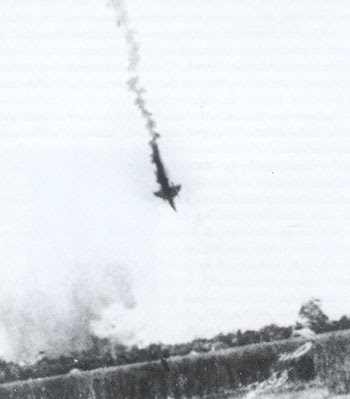
The Failed Air War Over Vietnam
or go to
Aletho News Archives – Video-Images
From the Archives
USS Liberty Massacre: A Pivotal Moment in the Hostile Takeover of America
By Kevin Barrett | Crescent | Dhu al-Qa’dah 24, 1445
In corporate America, hostile takeovers are commonplace. They occur when an aggressor—a larger corporation or rich individuals—seizes control of a smaller corporation without asking permission.
What few recognize is that the United States itself has been subjected to a hostile takeover. Since the aggressor, the illegitimate settler colony known as “Israel,” is much smaller than the US, the takeover has necessarily been surreptitious.
As of June, 2024, Israel’s gradual takeover of the US has become obvious and undeniable—a proverbial “elephant in the living room.” … continue
Blog Roll
 Aletho News
- Yemeni Armed Forces Warn Airlines Against Using Saudi Airports, Exempt Mecca and Medina
- Iran security chief says powers greater than US tried to conquer Iran but ended in ‘dustbin of history’
- Europe’s mounting social chaos… chickens coming home to roost for proxy war against Russia
- US-Russia Diesel Deal Becomes Massive Defeat for Ukraine
- Hormuz and the Looming Economic Catastrophe
- Dhubab offensive, media blitz and the rapid unraveling of Saudi-backed coalition’s new gambit
- Putin Conveys to Trump Iran’s Vision on Possible Conflict Resolution – Kremlin
- The Search for Truth: Charlie Kirk’s Assassination One Year Later
- ‘Harsh reality’: Iran says France seeks monopoly on power and intimidation, not peace for all
- When Will This White House Madness End?
- If Americans Knew
- For three years, Israel has killed a child in Gaza every 71 minutes – Daily Update
- Israeli forces kill another child in Gaza – Daily Update
- Gaza ceasefire exists in name only, say more than 100 organizations
- Nearly 2 Million in Gaza Need Urgent Shelter Assistance as Winter Looms: IOM Chief Warns
- Suppressing Palestinian resistance: US charity under fire for AI monitoring of Gaza classrooms
- Thousands Are Held in Israeli Torture Camps. This Is What Happens Inside
- Israel puts Gaza’s sick, injured, newborn in peril – Daily Update
- Report claimed Mark Levin used by Israeli government to influence Trump
- Over 2,000 Gazans have died awaiting medical evacuation amid Israel’s continued siege
- How a U.S. Diplomat Suppressed and Altered Reports Critical of Israel
- No Tricks Zone
- Germany’s Green Energy Debacle: High Energy Costs Force Kahla Porzellan to Close After 182 Years!
- New Study: 50 Years Of The Most Aggressive ‘Net Zero’ Policies Can Only Affect The Global Climate By 0.03°C
- US September “Heat” Was No Record…Many Records Set Decades Ago
- Latest European Green Energy Debacle; Portugal’s Largest Flagship Solar Park Insolvent!
- Green Energy Debacle: German Expert Professor Fritz Vahrenholt Warns Of Severe Economic And Social Consequences
- Two More Paleo Reconstructions Affirm Meters-Higher Sea Levels Across Ireland, Brazil 7000-6000 Years Ago
- New Study: Earth And Venus Surface Warmth Largely Explained By Convection And Lapse Rate, Not CO2 Or Radiation
- 2025 Nature Paper Claiming Worsening Global Drought Gets RETRACTED …Heavily Flawed
- New Study: ‘Global Drought Shows No Detectable Recent Acceleration Under Climate Warming’
- Economic Masterminds: German Socialists Suggest Taxing Productivity Gains Stemming From Using AI

