Farewell Questions for Rochelle Walensky An open letter to Congress
BY EL GATO MALO | BAD CATTITUDE | MAY 15, 2023
The history of the CDC during covid has been, at best, a checkered one.
Given what we now know about the complete failure of covid vaccines to provide sterilizing immunity, stop infection, or stop spread as well as the fact that such issues were not even tested for in the drug trials that approved them, certain questions would seem overdue in the asking:
Just what was this “Data from the CDC today” that suggested that “Vaccinated people do not carry the virus?”
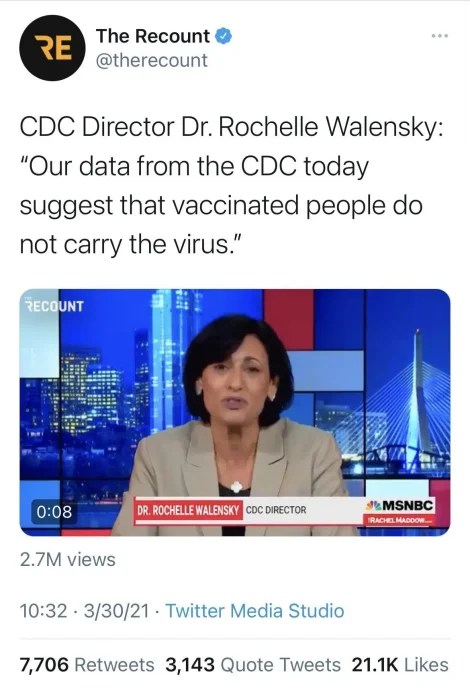
Was there, in fact, any data at all?
Or was this a completely fabricated claim used to underpin the mass rollout of a product that failed so spectacularly right out of the gates and:
- Where the sorts of safety and inefficacy signals that would have pulled any other vaccine in history off the market were ignored.
- Where the data collection was rigged to make known adverse events difficult to find, report, and aggregate in the V-safe system by removing them from searchable database fields and placing them in free text response.
- And where the mandated safety assessments were not being performed until long after problems were evident, allowing the CDC to miss the most blatant safety signal in history.
There seems to be an awfully large body of claims made by CDC that appear to have lacked foundation in fact or data. Both Dr Walensky and her predecessor Robert Redfield would seem to have a great deal to answer for here.
“The covid vaccine will make the vaccinated a dead end for the virus.”
This talking point was simply everywhere all at once.
Pfizer CEO Albert Bourla certainly pushed this narrative. Presumably, the fact that he was allowed to do so (itself quite an exceptional situation) implies the acquiescence of FDA, CDC, and other regulators.
Upon what was this seemingly widespread consensus based?
The matter appears to have never even been studied at the time the claims were made.
Why were the usually strict and fastidious US regulators so sanguine about such unusually aggressive and certain statements?
This is a most unusual situation and such an extraordinary outcome would seem to demand an extraordinary explanation.
Yet none seems forthcoming.
“The mRNA and the spike protein do not last long in the body” constitutes another key early safety claim similarly rooted in opaque or absent evidence or perhaps simply assumed or invented. (before being quietly retracted later).
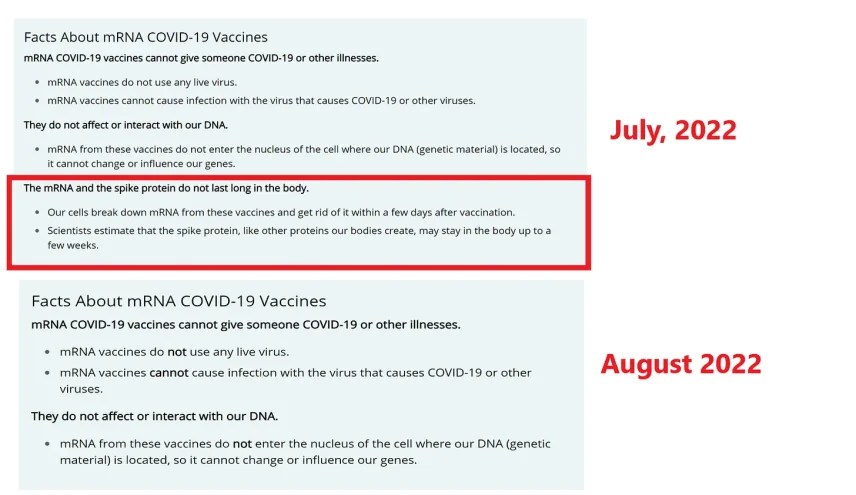
This claim also proved extravagantly incorrect.
Wherever one looks, it seems one finds that these grand claims of safety and efficacy were underpinned by a paucity or utter absence of supporting evidence.
Even the definitions themselves such as “Any positive for trace covid from a PCR test at a 40 Cycle Threshold is covid” or “No disease outcomes from vaccines are to be counted until 2 weeks after the second (or third) dose” which left a large window (4-6 weeks) during a period of known immune suppression from the jabs uncounted or even, in many cases, attributed to the unvaccinated in a manner that can make placebo look like high efficacy preventative are so unusual and inconsistent with past practice or sound science as to demand the most pointed of questions as to how such practices came to be and who the decision makers who put them in place were.
This series of unfounded claims and distortionary definitions seems both a poor and a deeply dangerous practice for Public Health.
If we are to have any hope of restoring faith in this field, we must ask and answer the pointed questions of “How did this happen?” and “At whose behest?”
Someone made these choices for some reason. Who and why would seem to be the bare minimum of post mortem here.
It is oft opined that a bad map is worse than no map at all and in this, I must wholeheartedly agree. The public health agencies in America have become the most calamitous of cartographers.
If we would seek to have the agents of public health act as something other than a marketing arm and apologist for the revolving door of Pharma with whom they seem to so regularly swap staff and sinecure then it must once more be turned to serve the public. It may do so only if it regains the public trust and such trust, once lost, may only be restored by asking the hard questions and diligently following the answers wherever so they may lead until we may understand what went wrong, hold the malefactors to account, and effect the means to prevent this from happening again.
Please make no mistake, if nothing is done and this is swept beneath some august Congressional rug or societal memory hole, it will happen again. And soon. This is not a choice I would have for America and one I do not believe you should countenance.
Public health runs on public trust.
I ask you to restore it.
Biden Misses Deadline To Hand Over Censorship Collusion Documents
By Dan Frieth | Reclaim The Net | May 15, 2023
The Biden Administration’s State Department has failed to meet the deadline to provide documents related to the “misinformation” and censorship efforts by its controversial Global Engagement Center (GEC). The House Foreign Affairs Committee demanded the documents in a letter sent on May 1.
The GEC has come under fire from Republicans after it was revealed that it funds the Global Disinformation Index, an organization that provides blacklists of media outlets to advertisers.
“State’s failure to meet the deadline continues a troubling Biden administration practice of noncompliance with congressional oversight and a lax attitude about its obligation to respond,” Rep. Michael McCaul (R-TX), the committee’s chair, told the Washington Examiner. “The Foreign Affairs Committee will keep this in mind as it considers any and all State Department-requested legislative proposals.”
In the letter, which was addressed to Secretary of State Anthony Blinken, McCaul accused the GEC of straying from its mission to “direct, lead, synchronize, integrate, and coordinate” the government’s efforts to combat “foreign state and non-state propaganda and disinformation” by funding organizations like the Global Disinformation Index, the Atlantic Council’s Digital Forensics Research Lab, the Institute for Strategic Dialogue, and Moonshot CVE.
The House Foreign Affairs Committee, now led by Republicans, delayed reauthorizations of the GEC, which was founded in the Obama era. The GEC’s legal authority will end in December 2024 unless Congress reauthorizes it.
“Neither the State Department, nor the GEC, have come close to detailing for Congress the extent of their censorship activities or provided any confidence that the problem isn’t even worse than is known right now,” said Rep. Dareell Issa (R-CA), one of the signatories to the letter sent to the State Department on May 1. “This is the time to come clean.”
Assassinating Vladimir Putin?
By RON UNZ • UNZ REVIEW • MAY 15, 2023
Early on the morning of May 3rd the Kremlin was attacked by two explosive drones, and although these were destroyed by the defenses, the Russian government claimed that the incident had probably been an assassination attempt against President Vladimir Putin.
I was skeptical at the time, but when Ray McGovern was interviewed a few days later he seemed to take the accusation seriously. Given his 27 years as a CIA Analyst, including serving as head of the Soviet Policy Group, I tend to trust his judgment on such matters:
Although pro-Ukrainian forces had likely been responsible for the drone attack, our government provides all their funding, intelligence, and control, and such a momentous act must have been fully authorized by top American officials. Under Secretary of State Victoria Nuland is the Neocon responsible for Ukraine issues and McGovern believed she would have been the one who signed off on the strike against the Kremlin.
Russia’s nuclear arsenal is the most formidable in the world, somewhat larger than our own, while its revolutionary hypersonic delivery systems are entirely unstoppable. This currently gives Moscow a measure of strategic superiority and if Putin or his successor gave the order, the bulk of our population could be annihilated within hours. Although he came into office at the end of 1999 and has spent more than twenty years in power, Putin’s current approval rating is over 80%, more than twice that of President Joseph Biden, so his death or serious injury might have world-shattering consequences.
Given the ongoing Russia-NATO military confrontation in the Ukraine war, an American sponsored drone strike against the Kremlin and Putin is an extraordinarily reckless and foolish action. What would we think if the Soviets had attacked the White House at the height of the 1962 Cuban Missile Crisis? But extraordinarily reckless and foolish actions have become an American specialty in recent years, notably including our destruction of the Nord Stream pipelines, perhaps Europe’s most important civilian energy infrastructure.
Indeed, soon after the outbreak of the Ukraine war in early 2022, our bipartisan political and media elites began vilifying Putin as “another Hitler,” with leading media figures and top U.S. Senators loudly calling for the assassination of the Russian president.
- American Pravda: Putin as Hitler?
Ron Unz • The Unz Review • March 7, 2022 • 7,900 Words
Such statements are particularly provocative given that just two years earlier we had publicly assassinated a top Iranian leader in a drone attack. At the time I had warned of the extremely dangerous implications for our future relations with Russia:
The January 2nd American assassination of Gen. Qassem Soleimani of Iran was an event of enormous moment.
Gen. Soleimani had been the highest-ranking military figure in his nation of 80 million, and with a storied career of 30 years, one of the most universally popular and highly regarded. Most analysts ranked him second in influence only to Ayatollah Ali Khamenei, Iran’s elderly Supreme Leader, and there were widespread reports that he was being urged to run for the presidency in the 2021 elections.
The circumstances of his peacetime death were also quite remarkable. His vehicle was incinerated by the missile of an American Reaper drone near Iraq’s Baghdad international airport just after he had arrived there on a regular commercial flight for peace negotiations originally suggested by the American government.
Our major media hardly ignored the gravity of this sudden, unexpected killing of so high-ranking a political and military figure, and gave it enormous attention. A day or so later, the front page of my morning New York Times was almost entirely filled with coverage of the event and its implications, along with several inside pages devoted to the same topic. Later that same week, America’s national newspaper of record allocated more than one-third of all the pages of its front section to the same shocking story.
But even such copious coverage by teams of veteran journalists failed to provide the incident with its proper context and implications. Last year, the Trump Administration had declared the Iranian Revolutionary Guard “a terrorist organization,” drawing widespread criticism and even ridicule from national security experts appalled at the notion of classifying a major branch of Iran’s armed forces as “terrorists.” Gen. Soleimani was a top commander in that body, and this apparently provided the legal fig-leaf for his assassination in broad daylight while on a diplomatic peace mission.
But note that Congress has been considering legislation declaring Russia an official state sponsor of terrorism, and Stephen Cohen, the eminent Russia scholar, has argued that no foreign leader since the end of World War II has been so massively demonized by the American media as Russian President Vladimir Putin. For years, numerous agitated pundits have denounced Putin as “the new Hitler,” and some prominent figures have even called for his overthrow or death. So we are now only a step or two removed from undertaking a public campaign to assassinate the leader of a country whose nuclear arsenal could quickly annihilate the bulk of the American population. Cohen has repeatedly warned that the current danger of global nuclear war may exceed that which we faced during the days of the 1962 Cuban Missile Crisis, and can we entirely dismiss his concerns?
I went on to note that this American policy represented a radical change from the practice of past centuries, with the major Western countries having abandoned the use of assassination in the 17th century after the end of the bloody Wars of Religion.
The 1914 terrorist assassination of Archduke Franz Ferdinand, heir to the throne of Austria-Hungary, was certainly organized by fanatical elements of Serbian Intelligence, but the Serbian government fiercely denied its own complicity, and no major European power was ever directly implicated in the plot. The aftermath of the killing soon led to the outbreak of World War I, and although many millions died in the trenches over the next few years, it would have been completely unthinkable for one of the major belligerents to consider assassinating the leadership of another.
A century earlier, the Napoleonic Wars had raged across the entire continent of Europe for most of a generation, but I don’t recall reading of any governmental assassination plots during that era, let alone in the quite gentlemanly wars of the preceding 18th century when Frederick the Great and Maria Theresa disputed ownership of the wealthy province of Silesia by military means. I am hardly a specialist in modern European history, but after the 1648 Peace of Westphalia ended the Thirty Years War and regularized the rules of warfare, no assassination as high-profile as that of Gen. Soleimani comes to mind.
During our Revolutionary War, George Washington, Thomas Jefferson, and our other Founding Fathers fully recognized that if their effort failed, they would all be hanged as rebels by the British. However, I have never heard that they feared falling to an assassin’s blade, nor that King George III ever considered using such an underhanded means of attack. During the first century and more of our nation’s history, nearly all our presidents and other top political leaders traced their ancestry back to the British Isles, and political assassinations were exceptionally rare, with Abraham Lincoln’s death being one of the very few that comes to mind.
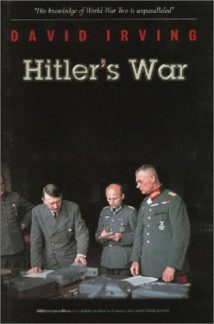
Unfortunately, the use of such lethal measures was eventually revived amid the bitter ideological struggle of World War II, at least in some quarters. According to renowned historian David Irving, when Hitler’s secret service suggested that an attempt be made to assassinate the Soviet military leadership, the German Fuehrer immediately forbade any such practices as contrary to the laws of warfare.
But his Western opponents had fewer such scruples. In 1941 Czech agents with Allied assistance successfully assassinated Reinhard Heydrich in Prague and in 1943 the US military intercepted and shot down the plane of Japanese admiral Isoroku Yamamoto. However, some of the highest profile targets the Allied leadership selected for elimination seem to have been within their own ranks.
Curtis B. Dall was a New York stockbroker who had been FDR’s son-in-law during the early 1930s and he later spent decades as a leading figure in various anti-Semitic Far Right political organizations. In 1967 a fringe Christian group published his memoirs in a cheap paperback edition, and I happened to read that book three or four years ago.
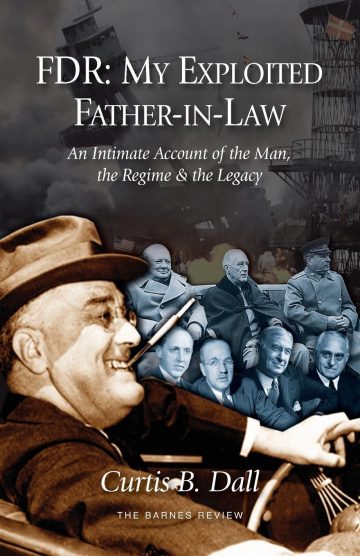
Most of the incidents and stories Dall recounted seemed reasonably plausible, but I was very surprised when he claimed that late in the war the American government, possibly under Communist influence, had decided to assassinate Chinese President Chiang Kai-shek, leader of the largest Allied nation. Although the effort fell through and the project was later abandoned, I’d never previously seen a hint of that story anywhere else and I was very skeptical of such an astonishing claim from a rather doubtful source. However, when I read Prof. Sean McMeekin’s outstanding 2021 history Stalin’s War a year or two later, he provided the same account, drawing upon the memoirs of a high-ranking American military commander based in the Chinese theater.
The plan had been to eliminate Chiang by means of a plane crash, and according to Irving the American and British governments also intended the same fate in 1943 for Charles de Gaulle, who was proving very uncooperative in his subordinate role as Free French leader in exile. However, de Gaulle survived the near-fatal accident caused by the sabotage of his plane and thereafter became much more cautious in his air travel.
Other Allied leaders were less fortunate. Like de Gaulle, Gen. Władysław Sikorski was based in London as leader of the Polish government in exile, and at first his relationship with the Allied leaders was good, with many thousands of Polish troops and airmen serving side-by-side with the British forces. However, in 1943 the Germans discovered and publicized the 1940 Katyn Forest massacre, revealing that Stalin had executed some 20,000 Polish officers whom he held as POWs. Sikorski was outraged at that enormous wartime atrocity and demanded a full Red Cross investigation while refusing to be fobbed off by Soviet denials or the implausible claim that the Germans themselves had been responsible. This led Stalin to break relations with the Polish exile government, and Irving makes a strong case that the top Allied leaders eventually decided that preserving the vital Soviet wartime alliance required Sikorski’s elimination, leading to the latter’s death in a suspicious airplane crash on Gibraltar a couple of months after de Gaulle’s had narrowly avoided the same fate.

Irving also explains that the previous year Gen. Dwight Eisenhower had made a deal with Admiral François Darlan, commander of all Vichy French forces, recognizing his authority in return for his joining the Allied cause; but the Allied leadership then nullified that controversial agreement by apparently arranging Darlan’s assassination a few weeks later.
During World War II America’s government had also put very substantial resources into the development of biological weapons and this continued after the end of the conflict although all these facts were kept completely secret at the time. There was considerable overlap of technology and personnel with the poisons and other assassination methods developed by the recently-established CIA during that period, as was discussed in a 2019 book by respected journalist Stephen Kinser, who also mentioned some of the prominent world leaders that our government attempted to assassinate during that era.
However, this climate of media avoidance has recently begun changing. Another strong endorsement of Baker’s book came from Stephen Kinzer, who just a year earlier had published Poisoner in Chief, primarily focused upon the notorious MK-ULTRA mind-control projects of Dr. Sidney Gottlieb, the CIA researcher described in the title. Kinzer’s book attracted glowing accolades from Pulitzer Prize winners Seymour Hersh and Kai Bird, both writers with great experience on intelligence matters, and received quite favorable reviews in the elite mainstream media.
At first glance, mind-control and biological warfare might seem entirely dissimilar topics, but they actually share considerable areas of overlap. Both required the creation and use of dangerous biological or biochemical agents, which for maximal effectiveness must then be tested upon unwilling human subjects, often in dangerous or lethal ways. Since in this regard they obviously operate outside the boundaries of normal legality, especially in peacetime, their use must be kept entirely secret, naturally matching them with the proclivities of an intelligence agency such as the CIA. Throughout his book Kinzer emphasized the considerable overlapping personnel and resources between these two domains. Indeed, as the CIA’s “chief poisoner,” Gottlieb developed a wide range of deadly biological compounds which he deployed in a number of mostly unsuccessful attempts to assassinate foreign leaders such as Prime Ministers Zhou Enlai of China and Patrice Lumumba of the Congo, as well as Cuba’s Fidel Castro.
However, unlike today’s climate of bold public declarations, all those previous American assassination plots of the 1950s and 1960s were kept secret from the American people. And as I explained in an an article, their eventual disclosure during the post-Watergate era produced a huge public backlash:
At the height of the Cold War, our CIA did involve itself in various secret assassination plots against Cuba’s Communist dictator Fidel Castro and other foreign leaders considered hostile to US interests. But when these facts later came out in the 1970s, they evoked such enormous outrage from the public and the media, that three consecutive American presidents—Gerald R. Ford, Jimmy Carter, and Ronald Reagan—all issued successive Executive Orders absolutely prohibiting assassinations by the CIA or any other agent of the US government.
Although some cynics might claim that these public declarations represented mere window-dressing, a March 2018 book review in the New York Times strongly suggests otherwise. Kenneth M. Pollack spent years as a CIA analyst and National Security Council staffer, then went on to publish a number of influential books on foreign policy and military strategy over the last two decades. He had originally joined the CIA in 1988, and opens his review by declaring:
One of the very first things I was taught when I joined the CIA was that we do not conduct assassinations. It was drilled into new recruits over and over again.
Yet Pollack notes with dismay that over the last quarter-century, these once solid prohibitions have been steadily eaten away, with the process rapidly accelerating after the 9/11 attacks of 2001. The laws on our books may not have changed, but
Today, it seems that all that is left of this policy is a euphemism.
We don’t call them assassinations anymore. Now, they are “targeted killings,” most often performed by drone strike, and they have become America’s go-to weapon in the war on terror.
The Bush Administration had conducted 47 of these assassinations-by-another-name, while his successor Barack Obama, a constitutional scholar and Nobel Peace Prize winner, had raised his own total to 542. Not without justification, Pollack wonders whether assassination has become “a very effective drug, but [one that] treats only the symptom and so offers no cure.”
Thus over the last couple of decades American policy has followed a disturbing trajectory in its use of assassination as a tool of foreign policy, first restricting its application only to the most extreme circumstances, next targeting small numbers of high-profile “terrorists” hiding in rough terrain, then escalating those same killings to the many hundreds. And now under President Trump, the fateful step has been taken of America claiming the right to assassinate any world leader not to our liking whom we unilaterally declare worthy of death.
Pollack had made his career as a Clinton Democrat, and is best known for his 2002 book The Threatening Storm that strongly endorsed President Bush’s proposed invasion of Iraq and was enormously influential in producing bipartisan support for that ill-fated policy. I have no doubt that he is a committed supporter of Israel, and he probably falls into a category that I would loosely describe as “Left Neocon.”
But while reviewing a history of Israel’s own long use of assassination as a mainstay of its national security policy, he seems deeply disturbed that America might now be following along that same terrible path. Less than two years later, our sudden assassination of a top Iranian leader demonstrates that his fears may have been greatly understated.
So in recent years assassination has become a standard tool of American policy, often publicly declared. This has naturally lowered the threshold for its use, perhaps leading our government to now target the political leader controlling the world’s largest nuclear arsenal, a possibility that would have been utterly unimaginable during the original Cold War.
There may be another contributing factor to this disturbing trend of American behavior. As I’ve recently discussed, over the last three decades the Neocons have gained a bipartisan stranglehold over our national security policy, and whether or not the particular individuals are Jewish, they have all been closely aligned with support for Israel and the Zionist ideological cause.
- The Neocons and Their Rise to Power
Ron Unz • The Unz Review • May 1, 2023 • 6,800 Words
One particularly problematical aspect of this powerful Israeli ideological influence has been the long Zionist history of the use of assassination, both before and after the creation of the State of Israel. In early 2020 our Solemaini killing prompted me to publish a very lengthy presentation of this important yet long concealed history, from which this paragraph and many of the preceding extracts were drawn:
Indeed, the inclination of the more right-wing Zionist factions toward assassination, terrorism, and other forms of essentially criminal behavior was really quite remarkable. For example, in 1943 Shamir had arranged the assassination of his factional rival, a year after the two men had escaped together from imprisonment for a bank robbery in which bystanders had been killed, and he claimed he had acted to avert the planned assassination of David Ben-Gurion, the top Zionist leader and Israel’s future founding-premier. Shamir and his faction certainly continued this sort of behavior into the 1940s, successfully assassinating Lord Moyne, the British Minister for the Middle East, and Count Folke Bernadotte, the UN Peace Negotiator, though they failed in their other attempts to kill American President Harry Truman and British Foreign Minister Ernest Bevin, and their plans to assassinate Winston Churchill apparently never moved past the discussion stage. His group also pioneered the use of terrorist car-bombs and other explosive attacks against innocent civilian targets, all long before any Arabs or Muslims had ever thought of using similar tactics; and Begin’s larger and more “moderate” Zionist faction did much the same.
- American Pravda: Mossad Assassinations
Ron Unz • The Unz Review • January 27, 2020 • 27,300 Words
We should also recognize the reality that during the last seventy years America has maintained the world’s largest and best-funded biological warfare program, with our government spending many tens of billions of dollars on biowarfare/biodefense across those decades. And as I’ve discussed in a long article, there is even considerable evidence that we actually used those illegal weapons during the very difficult first year of the Korean War.
- American Pravda: Waging Biological Warfare
Ron Unz • The Unz Review • August 9, 2021 • 7,500 Words
Soon after their invasion, the Russians publicly claimed that the U.S. had established a series of biolabs in Ukraine, which were preparing biological warfare attacks against their country. Last year one of their top generals declared that the global Covid epidemic was probably the result of a deliberate American biowarfare attack against China and Iran, echoing the accusations previously made by those countries.
Russian security concerns over our advanced biowarfare capabilities and the extreme recklessness with which we might employ them may explain the rather strange behavior of President Putin when he met in Moscow for talks with French President Emmanuel Macron and German Chancellor Olaf Scholz shortly before the outbreak of the Ukraine war.

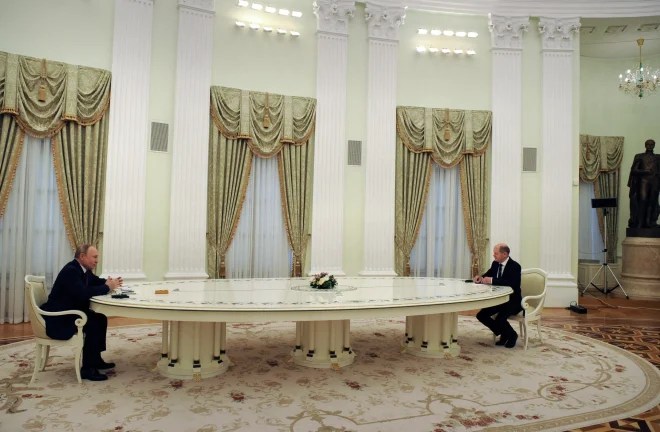
At the time many observers were puzzled why in each case the two national leaders were seated at opposite ends of a very long table, with Putin blandly suggesting that the placement was meant to symbolize the vast distance separating Russia and NATO’s Western leaders. Perhaps that innocuous explanation was correct. But I think it far more likely that the Russians were actually concerned that the Western leaders meeting him might be the immunized carriers of a dangerous biological agent intended to infect their president.
Considering the total madness that America’s ruling elites have exhibited in recent years, we can hardly blame the Russians for taking such unusual precautions to ensure Putin’s safety. This is especially true because in today’s Russia nominal and actual political power are conjoined, a very different situation than is often found in America or much of the West, as I’d noted in 2015.
Today when we consider the major countries of the world we see that in many cases the official leaders are also the leaders in actuality: Vladimir Putin calls the shots in Russia, Xi Jinping and his top Politburo colleagues do the same in China, and so forth. However, in America and in some other Western countries, this seems to be less and less the case, with top national figures merely being attractive front-men selected for their popular appeal and their political malleability, a development that may eventually have dire consequences for the nations they lead. As an extreme example, a drunken Boris Yeltsin freely allowed the looting of Russia’s entire national wealth by the handful of oligarchs who pulled his strings, and the result was the total impoverishment of the Russian people and a demographic collapse almost unprecedented in modern peacetime history.
Given this situation, I think it is very fortunate for the world—and our own country—that both Russia and China are currently led by extremely cautious and pragmatic individuals willing to forego any cycle of retaliatory escalation. But the ruling political elites of DC should recognize that their own persons are hardly likely to remain permanently sacrosanct from the terrible forces they seem all too eager to set into motion.
Related Reading:
On Korea, Joe Biden Is Choosing Every Bad Option
By Ted Galen Carpenter | The Libertarian Institute | May 15, 2023
Joe Biden has managed to embrace nearly all of the worst, most dangerous options with respect to U.S. policy on the Korean Peninsula. Washington’s policy toward North Korea is utterly sterile and ineffective. The glimpses of hope during Donald Trump’s administration that the United States might adopt a fresh approach instead of clinging to its longstanding, unattainable demand that North Korea abandon its nuclear weapons program have vanished. Biden abandoned even Trump’s modest policy deviations. Instead, his administration has resumed the insistence on Pyongyang’s complete denuclearization, along with placing strict limits on the country’s ballistic missile capabilities. North Korea continues to test missiles with ever longer ranges as U.S. leaders fume impotently.
At the same time, the Biden administration shows no inclination to re-examine the risk-reward calculation with respect to Washington’s alliance with South Korea, even as Pyongyang is now acquiring the capability to strike the American homeland. Indeed, administration officials are moving in the opposite direction, emphasizing the U.S. defense commitment to its longstanding dependent and discouraging any hints that Seoul may wish to take greater responsibility for its own defense—especially if such an initiative includes the acquisition of an independent nuclear deterrent. Instead, U.S. leaders are working to enlist South Korea as a pawn in a geostrategic chess match directed against China in exchange for a more robust U.S. commitment to defend Seoul against its North Korean adversary.
The continuing, if not intensifying, patron-client relationship between the United States and South Korea was underscored in the joint declaration that Biden and South Korean President Yoon Suk-yeol issued following their April 26, 2023, summit meeting; “The ROK has full confidence in U.S. extended deterrence commitments and recognizes the importance, necessity, and benefit of its enduring reliance on the U.S. nuclear deterrent.” If that wasn’t enough to emphasize South Korea’s continuing security dependence on the United States, the declaration added, “President Yoon reaffirmed the ROK’s longstanding commitment to its obligations under the Nuclear Nonproliferation Treaty as the cornerstone of the global nonproliferation regime.”
Perpetuating America’s risk exposure in that fashion was bad enough, but Biden went out of his way to rattle sabers at North Korea:
“President Biden reaffirmed that the United States’ commitment to the ROK and the Korean people is enduring and ironclad, and that any nuclear attack by the DPRK against the ROK will be met with a swift, overwhelming and decisive response. President Biden highlighted the U.S. commitment to extend deterrence to the ROK is backed by the full range of U.S. capabilities, including nuclear.”
Such statements were decidedly unhelpful, given the already tense environment on the Korean Peninsula. But Biden managed to inflame the situation further. “Going forward, the United States will further enhance the regular visibility of strategic assets to the Korean Peninsula, as evidenced by the upcoming visit of a U.S. nuclear ballistic missile submarine to the ROK.” North Korea’s regime is notoriously prickly and prone to engage in saber rattling of its own. However, even a more sedate government likely would feel threatened by such a provocative U.S. deployment in its immediate neighborhood.
Washington needs to adopt the opposite course to the one it is pursuing toward both North and South Korea. The Biden administration’s ossified policy toward Pyongyang is especially frustrating and dangerous. The president’s commitment to the futile zombie policy of trying to isolate North Korea was confirmed when Washington imposed new sanctions following a new round of tests in January 2022. If the administration does not change course, it is likely just a matter of time until Pyongyang resumes testing not only ICBMs, but nuclear weapons. In early February 2022, China’s ambassador to the United Nations correctly emphasized that the United States needs to come up with “more attractive and more practical” policies and actions to reduce tensions with North Korea and avoid a return to a “vicious circle” of confrontation, condemnation and sanctions over its nuclear and ballistic missile program.
U.S. leaders should seek ways to establish a normal bilateral relationship with North Korea. That means easing and eventually eliminating the vast array of economic sanctions that have been imposed over the decades. It also means negotiating a treaty formally ending the Korean War and establishing full diplomatic relations between the two countries. If such actions are not taken, the United States faces the imminent prospect of having no meaningful relations with a country that has an expanding nuclear arsenal combined with delivery systems capable of striking the American homeland. One would be hard pressed to identify a more dangerous situation.
The drastically changed nuclear weapons environment also underscores why the United States needs to remove itself from the front lines of the tense situation between North and South Korea. U.S. leaders should encourage South Korea’s greater strategic autonomy, not try to stifle independent initiatives. Even the decision about acquiring nuclear weapons should be made in Seoul, not Washington. There is no question that South Korea can provide for its own defense. It has an economy 40 to 50 times greater than North Korea’s, and it is a technological juggernaut. Keeping a weak, vulnerable Seoul as a U.S. strategic dependent was a highly questionable policy even during the early decades of the Cold War. Keeping a strong, fully capable South Korea as such a dependent, despite rapidly escalating risks to the United States, is monumentally foolish.
President Biden’s Korea policy risks the worst possible scenario. Continuing to treat North Korea as a pariah increases the likelihood of rash, desperate behavior on Pyongyang’s part, which could rekindle the dormant Korean War. Continuing to treat Seoul as a U.S. protectorate makes it certain that if an armed conflict between the two Koreas does break out, the United States would be hopelessly entangled. It would be a challenge to identify a more dangerous, bankrupt policy than the one the Biden administration is pursuing.
Ted Galen Carpenter is a senior fellow at the Libertarian Institute and a senior fellow at the Randolph Bourne Institute. Dr. Carpenter also served in various policy positions during a 37-year career at the Cato Institute. He is the author of thirteen books and more than 1,200 articles on international affairs and the threat that the U.S. national security state poses to peace and civil liberties at home and around the world. Dr. Carpenter’s latest book is “Unreliable Watchdog: The News Media and U.S. Foreign Policy” (2022)
US Pushes Indonesia to Ramp Up Military Cooperation, Jakarta Pledges Neutrality
Sputnik – 15.05.2023
The US Army’s top general was deployed to Indonesia in an effort to solidify the country’s position in the American orbit this week amid Washington’s ongoing efforts to encircle China militarily and constrain its growth.
On Friday, the Army’s Chief of Staff, James McConville, described his meeting with Indonesian Defense Minister Prabowo Subianto as a relatively benign effort to bring peace to the Indo-Pacific region.
“We have many friends in the region, and we work closely together,” McConville said. “We all share the same interests for the region: peace, security, stability.”
“That’s why we work together on maintaining a free and open Indo-Pacific for everyone,” he insisted.
For his part, Subianto described peace and stability in the region as a “common concern,” but insisted Indonesia would maintain its neutrality, pledging to continue pursuing relationships with all world’s nations – “especially all the major powers.”
McConville touched down in Jakarta on Thursday on the heels of a visit to the Philippines. That trip came shortly after last month’s massive US-Philippine war drills provoked anger among authorities in Beijing, who simulated an encirclement of their own against the renegade island of Taiwan in response.
But it’s unclear that Jakarta’s leaders are as willing to sign up for a battle with Beijing as their counterparts in Manila. Last November, Subianto promised to restore joint military exercises with China following a meeting with the nation’s defense minister.
In 2017, the US embassy in Jakarta released around 30,000 documents showing “the US actively supported the Indonesian military’s killing of as many as 1 million suspected communist sympathizers in the mid-1960s despite concerns about the reasons behind the massacre,” the Financial Times reported.
But the US maintains close relations with Indonesia’s leaders despite its questionable legacy there.
Japan to open NATO liaison office in new provocation against China and Russia
By Ahmed Adel | May 15, 2023
Japanese Foreign Minister Yoshimasa Hayashi announced that his country is considering opening a NATO liaison office, demonstrating that Tokyo is deepening its ties with the US and becoming more hostile to China and Russia. Tokyo’s rapprochement with NATO would strengthen the anti-China/Russia alliance and advance the US plans to create a NATO-styled organisation in the Far East.
“We are already in discussions, but no details (have been) finalised yet,” Hayashi said on May 10.
He specifically referenced Russia’s special military operation in Ukraine as something with repercussions far beyond Europe’s borders that made Japan rethink regional security.
“The reason why we are discussing about this is that since the aggression by Russia to Ukraine, the world (has) become more unstable,” he claimed. “Something happening in East Europe is not only confined to the issue in East Europe, and that affects directly the situation here in the Pacific. That’s why a cooperation between us in East Asia and NATO (is) becoming … increasingly important.”
However, the foreign minister failed to explain how events in Ukraine affect those in East Asia. Rather, Hayashi is using this as a weak justification for why Japan is militarising, which directly relates to Tokyo’s claims against sovereign seas and territories belonging to China and Russia.
The opening of a NATO office in Japan does not mean that the country will join the Alliance, but it does open a path for Japan to become a member of an expanded AUKUS (Australia-United Kingdom-United States). This, in turn, will require Tokyo to strengthen its contacts with NATO.
It is recalled that NATO Secretary General, Jens Stoltenberg, went to Japan and South Korea in January 2023 to lay the groundwork for strengthened ties. This is one of the reasons why Tokyo is already involved in conflicts that are not directly related to the region, despite some of the mental gymnastics it procures to create a justification.
The Japanese government is also providing $5.5 billion in aid to Ukraine, which can be seen as a step forward for the country to join AUKUS and confirms Tokyo’s intentions to strengthen its relationship with NATO. However, NATO will not officially expand to include Japan because members of the Alliance, such as Hungary, do not always align their position for the sake of serving US interests.
At the same time, France, at least in rhetoric, is seeking a degree of autonomy from the US. French President Emmanuel Macron said on April 9 that Europe needs to limit its dependence on the US.
In this way, the expansion of NATO to Asia is not likely since this initiative could lead to a further weakening of unity within the military alliance. The Americans are aware of this, and for this reason, they are working on a separate Eastern bloc to strengthen relations between NATO and Japan, most likely through the AUKUS format.
Suppose the AUKUS bloc includes Japan and intends to become the equivalent of NATO in Asia, with which the Western military alliance will cooperate closely; it would be a significant step in pressuring China and Russia since Japan’s technological and military potential exceeds that of many European countries.
It must be borne in mind that Tokyo’s rapprochement with NATO would reinforce the anti-Chinese/Russian ideology prevailing in the West. However, Tokyo’s actions come at a time when many countries in Asia and even some in Europe do not fully agree with this course of action.
The opening of the NATO office in Japan clearly indicates that the US plans to create a so-called “NATO of the Far East” and is making concrete steps towards this goal.
It cannot be overlooked that Japan’s reestablishment of overly friendly relations with South Korea attests to these plans, mainly as they have unexpectedly gone to a new qualitative level in a single leap. The President of South Korea has already visited Japan, and there are plans for Japanese Prime Minister Fumio Kishida to visit South Korea soon, as well as their impending G7 summit meeting in Hiroshima. This has occurred in recent times despite Tokyo and Seoul being embroiled for many years in mutual accusations on various historical occasions.
The leaders of both East Asian countries now hold a distinctly pro-American stance. If the opening of a NATO liaison office in Tokyo is successful, it can be expected that one will open in Seoul too, especially since the country’s leadership has taken on a provocative position against Beijing and Moscow, including the drawing of red lines concerning the war in Ukraine.
Ahmed Adel is a Cairo-based geopolitics and political economy researcher.
Yes, you can yell “fire” in a crowded theater
By Didi Rankovic | Reclaim The Net | September 24, 2020
The manner in which free speech has been coming under attack over the past several years makes it easy to forget that this is not the only era of the internet and social media when this has been happening.
Different approaches and debates about how to handle what is, or is seen as “misinformation” and “disinformation” (used by most censorship champions interchangeably these days) have existed in the past as well, as have attempts to justify limiting freedom of speech protections provided by the US Constitution’s First Amendment.
And in the US, the go-to “crutch phrase” used by those favoring the stifling of speech over promoting freedom of expression has been to explain it as the need to sanction those who are, proverbially, “shouting fire in a crowded theater.”
The expression is derived from a 1919 US Supreme Court case, US v. Schenck, during which Justice Oliver Wendell Holmes remarked that, “The most stringent protection of free speech would not protect a man in falsely shouting fire in a theater and causing a panic.”
The phrase would in the meantime all but inevitably appear whenever an argument is being made that censorship is acceptable and needed in order to prevent some type of harm. But the use of “shouting fire in a crowded theater” in this way is itself a form of disinformation.
Charles Schenck got himself in trouble, and in jail 100 years ago not by literally starting any fires, but by opposing the WW1 draft policy of his government, and putting together a pamphlet to this effect. Schenck v. The United States held that the defendant’s speech opposing the draft during World War I was not protected free speech under the First Amendment.
Some of the slogans he used are fairly universal, though, and can be applied to a variety of issues, including the present-day curtailing of online speech: messages like, “Do not submit to intimidation,” and, “Assert your Rights.”
Schenck was put on trial and found guilty under the Espionage Act, but in 1969, the US Supreme Court ruled on the issue of inflammatory speech in the Brandenburg v. Ohio case to annul the validity of that decision, when it established that the First Amendment does in fact protect free speech, all the way to the right of Ku Klux Klan members to advocate violence – unless there as a direct threat of “imminent lawless action.”
Although the expression about fires in crowded theaters never carried actual legal weight, the 1969 decision should have also made it less and less appealing to censorship proponents. However, it is still going strong.
There are several cases when the phrase was used in the last decade by officials and commentators, such as a Twitter user accused of spreading disinformation during Hurricane Sandy, WikiLeaks and its activities, and a pastor calling for the burning of Qurans.
In internet years, 2012 is today a distant past, however, the same issues concerning free speech and transparency around attempts to suppress it online were taking place at the time as well. What’s changed in the last eight years is the intensity of the argument that the only way to deal with misinformation or disinformation is to obliterate such suspected content in acts of, by and large, unaccountable censorship, particularly that taking place on social media.
In the US, this has become an often fear mongering campaign that promotes the notion that other approaches would directly and dangerously undermine democracy. In reality, though, it’s the rampant censorship that is more likely to achieve this; even Justice Holmes eventually came round to the idea that “free trade in ideas” was preferable to their suppression, when he later dissented in a case similar to Schenck’s.
The best, and likely the only truly legal and legitimate way to deal with false information on social media is to identify and expose it, rather than censor it, or prosecute its authors.
As for the “crowded theater” phrase, these days it is almost exclusively used in the media to heap criticism on US President Donald Trump, such as this recent Vanity Fair article that calls him “The Human Embodiment of Yelling ‘Fire’ in a Crowded Theater.”
This was said in the context of the coronavirus epidemic, and, of course, a particularly heated election campaign that is fertile ground not only for censorship but also for using strong and suggestive language like this – whether or not it has any legal, or ethical relevance.
FDA Grants ‘Investigational’ Approval for Pork Products Made From Gene-Edited Pigs
‘Just Like Regular Pork’
By Michael Nevradakis, Ph.D. | The Defender | May 10, 2023
Describing it as the “future of how we need to feed people,” a group of scientists and researchers from Washington State University (WSU) enjoyed some “smoky, and mildly salty” pork sausage earlier this month — derived from gene-edited pigs.
The WSU research team recently received approval from the U.S. Food and Drug Administration (FDA) to allow pork meat from gene-edited pigs into the human food supply — resulting in the celebratory barbecue featuring sausage with “a good snap to the casings … just like regular pork.”
The FDA approval, which does not appear on the agency’s website, is investigational and limited to the specific pigs raised by the research team for this purpose. It is touted as evidence that “gene-editing livestock to quickly produce desirable traits for improved food production is a viable strategy for helping feed the planet’s growing population.”
However, some scientists and food safety advocates question the safety of the gene-editing technology — CRISPR (clustered regularly interspaced short palindromic repeats) — used by the WSU researchers and backed by investors like Bill Gates, and wonder if the products produced by the technology are really safe for human consumption.
‘Gene-edited meats could be mass produced for human consumption in 10 years’
CRISPR acts as a “precise pair of molecular scissors that can cut a target DNA sequence, directed by a customizable guide.”
Put differently, this technology allows scientists to edit sections of DNA by “snipping” specific portions of it and replacing them with new segments. Gene editing is not a new concept, but CRISPR technology is viewed as being cheaper and more accurate than other gene-editing technologies.
The WSU research team, led by Jon Oatley, Ph.D., associate dean for research for the College of Veterinary Medicine and tenured professor in the School of Molecular Biosciences, used CRISPR “to improve genetic traits in livestock.”
According to Nextgov, Oatley sought “to demonstrate that food made from the [gene-edited] animals is safe to eat and that it is possible for an academic institution to achieve this type of FDA authorization.”
“Gene-editing can make changes in an organism’s DNA that could occur in nature or through selective breeding but would take much longer without a tool like CRISPR,” Nextgov writes.
Oregon Public Broadcasting reported that WSU “is also studying CRISPR gene editing on cattle and sheep,” and wrapped up a goat study last year. “If all goes as planned … gene-edited meats could be mass produced for human consumption in 10 years.”
FDA’s investigational authorization is limited to five pigs. A WSU announcement described the work by Oatley and his team as “essentially a high-tech form of selective breeding,” adding that the pigs were originally gene-edited in a way that “would enable researchers to use them to sire offspring with traits from another male pig.”
According to WSU:
“Known as surrogate sires, this technology first gene-edits male animals to be sterile by knocking out a gene called NANOS2 that is specific to male fertility. These animals can then be implanted with another male’s stem cells that create sperm with that male’s desired traits to be passed on to the next generation.”
The research “has the potential to not just improve meat quality but the health and resilience of livestock in the face of changing environmental conditions, a critical goal for increasing protein sources in developing nations,” WSU said.
According to the university’s announcement, Oatley said:
“It’s important for a university to set the precedent by working with federal regulators to get these animals introduced into the food supply. … If we don’t go through that process, all of the research we’re doing is for naught because it will never make it out into the public.”
“The original intent in making these animals was to try to improve the way that we feed people,” Oatley said. “And we can’t do that unless we can work with the FDA system to get these animals actually into the food chain.”
WSU’s announcement did not mention Oatley’s membership on the Gene Editing in Agriculture Task Force, a collaboration of the American Association of Veterinary Medical Colleges and the Association of Public and Land-grant Universities created in June 2020.
According to the June 2021 report by the task force:
“The next frontier in devising strategies to effectively feed a growing global human population will be defined by genetic enhancement; gene editing technologies are a key component in this endeavor.”
The task force also suggested the same June 2021 report be distributed “to interested organizations,” including the Food and Agricultural Organization of the United Nations and the Bill & Melinda Gates Foundation.
According to WSU, “The surrogate sires’ progeny, which are themselves not gene-edited, have not yet been reviewed by the FDA for possible inclusion in the food chain.” However, the original pigs “were processed at the WSU Meat Lab, and the U.S. Department of Agriculture inspected the meat as it does with all meat products.”
The meat “will be used in catering services that raise travel funds for the student members of the WSU Meat Judging team,” WSU said.
CRISPR: ‘It’s not precise and it’s not breeding’
The public often holds “many misconceptions about gene-editing,” Oatley said, adding:
“There’s a trust that comes with university-based research. … At WSU, we’re all about the science. We just want to make sure the research is valid, and the animals we produce are healthy.”
However, other experts have previously raised questions about the potential safety risks of inserting gene-edited and lab-grown meat into the human food supply and using tools such as CRISPR for this purpose.
In October 2022 interviews with The Defender, Michael Antoniou, Ph.D., head of the Gene Expression and Therapy Group at King’s College London, and Claire Robinson, managing editor of GMWatch, explained why they believe the risks of developing gene-edited meats and using CRISPR in this process outweighs the benefits.
Though CRISPR is often described as a “precision” gene-editing technology, Antoniou told The Defender, “It is not precise and it’s not breeding.”
Robinson told The Defender :
“These were also risks with the old-style GMOs [genetically modified organisms], and they are still risks with these gene-edited GM plants and animals.
“The risks, if you’re gene editing them … are that there will be knock-on effects on the animals, welfare or health that we can’t anticipate, such as deformities or changes in the function of certain genes in the animal.”
Antoniou warned that there may be unintended or unforeseen effects arising from this process. He said:
“Innately, gene editing also can bring about unintended DNA damage … even at the site of your intended edit or elsewhere in the DNA of your target cells, with unknown downstream consequences.
“None of these products … have been tested properly.”
A report published in the Journal of Genetics and Genomics in 2020 found that CRISPR gene-editing in rice resulted in numerous unintended and undesirable on-target and off-target mutations.
However, major investors like Gates see significant potential in foods created via gene editing and CRISPR.
According toBusiness Insider, Gates has said, “Researchers are studying ways to modify the genes of livestock animals … to make them produce milk more like dairy cows” and “make dairy cattle more resilient in hot weather.”
Gates and other proponents of CRISPR also claim that such tools — and the development and production of gene-edited meats — can serve as a solution to increased food demand due to a growing global population.
Robinson, in her October 2022 remarks, disputed such claims. She said:
“There’s no shortage of food in the world. Even in those countries where there are terrible hunger problems, they are producing food and it is available for those to buy if you have money.
“But the problem with hunger is, of course, poverty. The failure of infrastructure, the fact that you cannot get food to the hungry people. But mostly it’s inequality, things like wars and conflicts that are going on in some countries that mean that supply chains are disrupted. So really, there is no shortage of food and there isn’t ever likely to be.”
Instead, Robinson said that major corporate interests lie behind the use of CRISPR for the development of gene-edited food products.
“What we want to avoid,” said Robinson, “is a situation where the food supply ends up entirely patented, owned by big corporations … The patents on CRISPR are mostly owned by Corteva. Another patent owner used to be Monsanto, now owned by Bayer.”
Robinson added:
“The technology is patented; the products are patented. Therefore, it is all about increasing corporate control of the food supply.”
Corteva Agriscience, a conglomerate formed via the merger of Dow AgroSciences and DuPont/Pioneer, owns many CRISPR patents.
More FDA approvals of gene-edited meats likely coming soon
The FDA has approved only one other organization’s gene-edited animal for entering the food supply, according to WSU. The company, Acceligen, produces “slick-haired cattle,” which are gene-edited to grow coats that increase their resilience to higher temperatures.
The FDA’s March 7, 2022, announcement about the approval stated that “the intentional genomic alteration (IGA) does not raise any safety concerns” and that this was the agency’s “first low-risk determination for enforcement discretion for an IGA in an animal for food use.”
“We expect that our decision will encourage other developers to bring animal biotechnology products forward for the FDA’s risk determination in this rapidly developing field, paving the way for animals containing low-risk IGAs to more efficiently reach the marketplace,” said Dr. Steven M. Solomon, director of the FDA’s Center for Veterinary Medicine.
In recent years, the FDA also approved — or is close to granting full approval to — other gene-edited meat products for human consumption.
On Dec. 14, 2020, the FDA approved “a first-of-its-kind intentional genomic alteration (IGA) in a line of domestic pigs, referred to as GalSafe pigs, which may be used for food or human therapeutics. This is the first IGA in an animal that the FDA approved for both human food consumption and as a source for potential therapeutic uses.”
According to the FDA, the IGA in GalSafe pigs is intended to eliminate alpha-gal sugar on the surface of the pigs’ cells. “People with Alpha-gal syndrome (AGS) may have mild to severe allergic reactions to alpha-gal sugar found in red meat,” the FDA said, adding that the potential environmental impact “is no greater than from conventional pigs.”
The FDA also said it noted “no animal safety concerns” for GalSafe pigs “beyond those that would be expected in well-managed, commercial swine operations,” and “the microbial food safety risk is low and is mitigated by the low number of GalSafe pigs entering the food supply and the ongoing surveillance for antimicrobial resistance, among other factors.”
And in November 2022, the FDA declared lab-grown chicken meat developed by Upside Foods, a California-based firm, safe for human consumption, as part of its completion of a pre-market consultation that will likely lead to full FDA approval.
The FDA’s Nov. 16, 2022, announcement described this development as “a food revolution” that enables “food developers to use animal cells obtained from livestock, poultry, and seafood in the production of food, with these products expected to be ready for the U.S. market in the near future.”
The lab-grown chicken appears to have been developed using a process involving CRISPR. In 2019, it was reported that Memphis Meats — the former name of Upside Foods prior to a 2021 rebrand — was employing CRISPR as part of its process for curating lab-grown meat, and even received a patent for this purpose.
Michael Nevradakis, Ph.D., based in Athens, Greece, is a senior reporter for The Defender and part of the rotation of hosts for CHD.TV’s “Good Morning CHD.”
This article was originally published by The Defender — Children’s Health Defense’s News & Views Website under Creative Commons license CC BY-NC-ND 4.0. Please consider subscribing to The Defender or donating to Children’s Health Defense.
Why I’m ALMOST Ready to Vote for Trump
By Kevin Barrett | May 14, 2023
Donald Trump is, in many ways, an odious figure. A narcissistic semi-literate scoundrel who doesn’t even pretend otherwise, his primary redeeming qualities are a talent for channeling populist outrage and a certain reluctance to engage in bloody, pointless wars.
Normally I only vote for people I like (i.e. Cynthia McKinney and RFK Jr.) which is why I’ve never voted for a major-party candidate in a general election. I doubt very much that my first-ever vote for a mainstream candidate will be for the loathsome Trump. But the fake-left oligarchs and their lapdog media are working overtime to convince me to at least entertain the possibility.
The thing is, the media, legal, and political landscape has grown so grotesquely one-sided that Trump’s claims that the system is rigged against him, which once seemed whiny and petulant, are increasingly being validated. Big media’s Deep-State-assisted suppression of the Hunter Biden laptop story was, for many of us, the proverbial straw that broke the camel’s back. Since that election-deciding outrage, it has been obvious and undeniable that just because Trump is paranoid doesn’t mean they aren’t out to get him.
And the outrages just keep coming. As J-Mike Springmann and I remarked on False Flag Weekly News, the week’s two big Trump events—his civil conviction for libel and sexual assault, and his CNN Town Hall battle with Kaitlan Collins—almost seemed to have been orchestrated to spotlight Trump’s unfair treatment at the hands of the Establishment.
Jimmy Dore makes a good case that Trump’s civil trial for sexual assault and defamation was “A Pure Democratic Hit Job.” Dore points out that New York’s bizarre one-year repeal of the statute of limitations was specifically designed to grease the skids for Carroll-v-Trump. Since when did governments start temporarily repealing statutes of limitations so they can go after political figures they don’t like? The move seems especially egregious because it involved an almost three-decade-old case in which the alleged victim can’t even remember which year the alleged assault happened, and has no evidence whatsoever other than her word against his. If you’re going to do something as extreme as suspending the statute of limitations so you can prosecute a specific case, shouldn’t you at least have some evidence?
My advice to the Democrats is that they might as well go all the way and prosecute Trump for murder. Why murder? For one thing, there is no statute of limitations on murder, so they won’t have to bother suspending it. And just as Trump once said a stupid thing about grabbing women’s genitals that made him sound like “the kind of person who might do something like that,” he also once said “I could stand in the middle of Fifth Avenue and shoot somebody and I wouldn’t lose voters.” So why not bring an evidence-free prosecution against him for shooting someone in the middle of Fifth Avenue? Just find someone willing to claim they saw Trump shoot someone to death in the middle of Fifth Avenue in 1995, or was it 1996? It will be their word against his. And we all know Trump is a liar. Why? Because the media never stop telling us so. No New York jury could possibly fail to convict. And no New York judge could resist sentencing Donald J. Trump to death. (Yes, I know New York suspended the death penalty in 2004, but they could temporarily change that, just like they temporarily removed the statute of limitations, in order to dispose of Trump.)
Once Trump has been convicted and sentenced to death, we’ll all be able to breathe freely and get on with our lives, right? Not so fast! Trump’s lawyers will undoubtedly find a way to string out the appeals process, allowing him to become the first-ever candidate to run for president from death row. But what happens when he wins the election and his scheduled rendezvous with the electric chair happens to coincide with inauguration day? Will Trump be helicoptered to Washington, DC in handcuffs on January 20th, 2025, frog-marched into the Capitol, administered the oath of office, and then strapped into a special portable electric chair designed just for him and zapped like a bug? Will his hair turn an even brighter shade of orange as it bursts into flame? The Democrats would no doubt view it as inadequate payback for the horrors Trump unleashed there on January 6, 2021. But still…think of the ratings!
Featured Video

Seyed M. Marandi: US-Iran War Inevitable: Kuwait and Bahrain May Fall
or go to
Aletho News Archives – Video-Images
From the Archives
USS Liberty Massacre: A Pivotal Moment in the Hostile Takeover of America
By Kevin Barrett | Crescent | Dhu al-Qa’dah 24, 1445
In corporate America, hostile takeovers are commonplace. They occur when an aggressor—a larger corporation or rich individuals—seizes control of a smaller corporation without asking permission.
What few recognize is that the United States itself has been subjected to a hostile takeover. Since the aggressor, the illegitimate settler colony known as “Israel,” is much smaller than the US, the takeover has necessarily been surreptitious.
As of June, 2024, Israel’s gradual takeover of the US has become obvious and undeniable—a proverbial “elephant in the living room.” … continue
Blog Roll
 Aletho News
- Seyed M. Marandi: US-Iran War Inevitable: Kuwait and Bahrain May Fall
- Leaders Condemn Ansarallah Attack on Saudi Arabia While Ignoring Illegal War Against Yemen
- Leaked: Britain’s Covert Iraqi Psyops Network
- Yemeni Armed Forces Warn Airlines Against Using Saudi Airports, Exempt Mecca and Medina
- Iran security chief says powers greater than US tried to conquer Iran but ended in ‘dustbin of history’
- Europe’s mounting social chaos… chickens coming home to roost for proxy war against Russia
- US-Russia Diesel Deal Becomes Massive Defeat for Ukraine
- Hormuz and the Looming Economic Catastrophe
- Dhubab offensive, media blitz and the rapid unraveling of Saudi-backed coalition’s new gambit
- Putin Conveys to Trump Iran’s Vision on Possible Conflict Resolution – Kremlin
- If Americans Knew
- Gaza: Ceasefire Anniversary Marks Year of Failed Promises
- The American Conservative: Mike Huckabee Should Resign
- A C-Section in Shackles: A Palestinian Woman’s Harrowing Birth in Israeli Detention
- ‘He’s Desperate’: AIPAC Begins Spending Against Abdul El-Sayed to Boost Mike Rogers:
- Trump, Hormuz, and the Looming Economic Catastrophe
- For three years, Israel has killed a child in Gaza every 71 minutes – Daily Update
- Israeli forces kill another child in Gaza – Daily Update
- Gaza ceasefire exists in name only, say more than 100 organizations
- Nearly 2 Million in Gaza Need Urgent Shelter Assistance as Winter Looms: IOM Chief Warns
- Suppressing Palestinian resistance: US charity under fire for AI monitoring of Gaza classrooms
- No Tricks Zone
- Germany’s Green Energy Debacle: High Energy Costs Force Kahla Porzellan to Close After 182 Years!
- New Study: 50 Years Of The Most Aggressive ‘Net Zero’ Policies Can Only Affect The Global Climate By 0.03°C
- US September “Heat” Was No Record…Many Records Set Decades Ago
- Latest European Green Energy Debacle; Portugal’s Largest Flagship Solar Park Insolvent!
- Green Energy Debacle: German Expert Professor Fritz Vahrenholt Warns Of Severe Economic And Social Consequences
- Two More Paleo Reconstructions Affirm Meters-Higher Sea Levels Across Ireland, Brazil 7000-6000 Years Ago
- New Study: Earth And Venus Surface Warmth Largely Explained By Convection And Lapse Rate, Not CO2 Or Radiation
- 2025 Nature Paper Claiming Worsening Global Drought Gets RETRACTED …Heavily Flawed
- New Study: ‘Global Drought Shows No Detectable Recent Acceleration Under Climate Warming’
- Economic Masterminds: German Socialists Suggest Taxing Productivity Gains Stemming From Using AI

