Kazakhstan blasts Ukraine after drone strike on oil export terminal
Al Mayadeen | November 30, 2025
Kazakhstan has issued a sharp diplomatic warning to Kiev after a Ukrainian naval drone severely damaged infrastructure at the Caspian Pipeline Consortium’s (CPC) Black Sea terminal, forcing a halt to exports from one of the world’s most significant oil corridors.
The strike hit a Single-Point Mooring used to load tankers at the Novorossiysk facility, prompting CPC to suspend operations and remove vessels from the surrounding waters. The consortium, whose shareholders include Russian, Kazakh and US firms such as Chevron, Lukoil and ExxonMobil, said the November 29 attack left SPM-2 so badly damaged that “further operation of Single Point Mooring 2 is not possible.”
CPC transports roughly 1% of global crude supply and is responsible for almost 80% of Kazakhstan’s total oil exports, carrying millions of tonnes each year from the Tengiz, Karachaganak and Kashagan fields to the Black Sea. Any extended disruption threatens the economic backbone of the OPEC+ producer, whose oil overwhelmingly moves through this 1,500-kilometre pipeline to the Yuzhnaya Ozereevka terminal.
Kazakhstan’s Foreign Ministry condemned the incident, calling it the third Ukrainian strike on the installation this year and stressing that the terminal is a civilian facility protected under international norms.
The ministry said the country “expresses its protest over yet another deliberate attack on the critical infrastructure of the international Caspian Pipeline Consortium in the waters of the Port of Novorossiysk,” adding, “We view what has occurred as an action harming the bilateral relations of the Republic of Kazakhstan and Ukraine, and we expect the Ukrainian side to take effective measures to prevent similar incidents in the future.”
Ukraine has not commented on the latest strike. Kiev has repeatedly targeted Russia’s energy network, including refineries and export terminals, arguing that such facilities sustain the Kremlin’s war effort. Russian officials, meanwhile, accuse Ukraine of terrorism, executed with the support of Western intelligence services that help Ukraine identify targets deep inside Russian territory.
CPC warned that the consequences extend beyond Russia alone. “We believe that the attack on the CPC is an attack on the interests of the CPC member countries,” the consortium said.
The halt comes amid escalating maritime drone warfare in the Black Sea, where Ukraine has expanded operations in an effort to erode Moscow’s revenue sources.
4 Shocking Ties Between Rubio, Lobbyists, and Hernández Narcotics Indictment

teleSUR | November 29, 2025
WASHINGTON — The recent announcement by former U.S. President Donald Trump that he will grant a “full and complete pardon” to Juan Orlando Hernández, the former Honduran president currently serving a U.S. federal sentence for drug trafficking, has reignited scrutiny over a long-documented web of political and financial connections linking Hernández, Republican lobbying powerhouse BGR Group, and U.S. Secretary of State Marco Rubio.
Far from an isolated act of clemency, Trump’s pledge appears deeply entangled with a system of influence-peddling that has shaped U.S. policy toward Central America for years. At the center stands Rubio—a figure who, as a Florida senator, once publicly praised Hernández for “taking on drug traffickers,” even as evidence mounted that the Honduran leader was personally profiting from the very cartels he claimed to fight.
Now, with Rubio overseeing U.S. diplomacy from the State Department, critics warn that the Rubio Hernández lobbying scandal reveals how foreign actors can exploit the U.S. lobbying system to buy legitimacy, evade justice, and ultimately secure political favors—including presidential pardons.
The BGR Group Connection: How Hernández Bought Influence in Washington
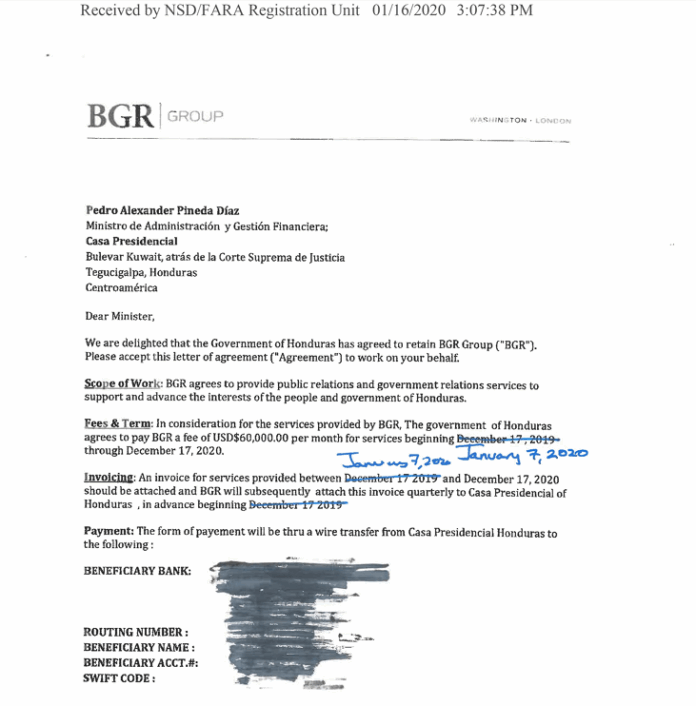
In early 2020, as his legal situation began to collapse—following the life sentence of his brother, Tony Hernández, for trafficking tons of cocaine into the U.S.—Juan Orlando Hernández signed a $660,000 contract with BGR Group, a Washington-based lobbying firm founded by former Republican Governor Haley Barbour.
The goal was clear: rehabilitate Hernández’s image in the U.S. capital as a “trusted ally” and “anti-narcotics partner,” despite mounting evidence that he had accepted millions in bribes from cartels to fund his presidential campaigns.
According to a detailed investigation by VICE News, BGR Group went to work immediately:
- It contacted 11 congressional staffers, three of whom had previously worked directly for Marco Rubio.
- It distributed press releases portraying Hernández as a bulwark against organized crime.
- It arranged meetings with U.S. officials to reinforce the narrative of Honduras as a cooperative security partner.
All this occurred while U.S. prosecutors were building their case against Hernández himself—culminating in his 2024 conviction for conspiring to import over 500 tons of cocaine into the United States.
Critically, BGR Group was not just any firm—it was a major Republican donor network with deep ties to Rubio’s political career. Records show the firm hosted fundraising events for Rubio’s 2010 and 2016 Senate campaigns, as well as his short-lived 2016 presidential bid.
This means that the same lobbying apparatus paid by a convicted narco-president helped finance the rise of the man now shaping U.S. policy toward Latin America.
Explore FEC records on BGR’s political contributions to Rubio (Federal Election Commission)
Trump’s Pardon as Political Payback—Not Justice
Trump’s announcement—made via Truth Social on Friday—comes amid his open support for Nasry “Tito” Asfura, Hernández’s political protégé and the National Party’s 2025 presidential candidate in Honduras. Trump has explicitly tied future U.S. aid to Asfura’s victory, signaling that Washington’s backing is conditional on political alignment.
In this context, the pardon of Hernández appears less like mercy and more like a strategic signal: loyalty to U.S. Republican interests—even when demonstrated through illicit means—will be rewarded.
Hernández, after all, was once Washington’s favorite Central American strongman. He allowed the U.S. to maintain military bases in Honduras, cracked down on migrant caravans, and supported U.S. regional agendas—all while allegedly running a state-sponsored drug enterprise.
Now, with Rubio at the State Department and Trump eyeing a 2028 comeback, the Rubio Hernández lobbying scandal underscores a troubling reality: foreign leaders can launder their reputations through U.S. lobbying firms, gain access to top policymakers, and ultimately escape accountability—even after federal conviction.
As one Latin American diplomat put it: “This isn’t diplomacy. It’s transactional impunity.”
Geopolitical Context: Undermining Rule of Law in the Americas
The fallout from the Rubio Hernández lobbying scandal extends far beyond bilateral relations. It strikes at the credibility of the entire U.S. “war on drugs” and its claims of promoting democracy and rule of law in Latin America.
If a president convicted of trafficking cocaine can secure a presidential pardon through backroom lobbying and partisan loyalty, what message does that send to reformers in Guatemala, El Salvador, or Colombia?
Moreover, it deepens regional distrust of U.S. intentions. For years, progressive governments in the region have argued that Washington prioritizes compliance over justice—backing authoritarian but cooperative leaders while condemning leftist governments for lesser offenses. The Hernández case validates that critique.
Cuba, Nicaragua, and Venezuela have long denounced this “selective morality” in U.S. foreign policy. Now, even centrist allies are questioning whether the U.S. system can be gamed by those with enough money and the right lobbyists.
In a hemisphere increasingly seeking multipolar partnerships, such scandals fuel the narrative that U.S. democracy is for sale—and that sovereignty is secondary to political convenience.
Gaza ‘stabilization force’ fails to launch as nations unwilling to commit troops: Report
The Cradle | November 29, 2025
The White House is having difficulty launching its so-called Gaza International Stabilization Force (ISF), as countries that previously expressed willingness to deploy troops to the project now seek to distance themselves from it, according to a 29 November report in the Washington Post.
The ISF “is struggling to get off the ground as countries considered likely to contribute soldiers have grown wary” over concerns their soldiers may be required to use force against Palestinians.
Indonesia had stated it would send 20,000 peacekeeping troops. However, officials in Jakarta speaking with the US news outlet said they now plan to provide a much smaller contingent of about 1,200.
Azerbaijan has also reneged on a previous commitment to provide troops. Baku will only send troops if there is a complete halt to fighting, Reuters reported earlier this month.
US President Donald Trump’s plan for Gaza envisioned meaningful troop contributions from Arab states, including the UAE, Bahrain, and Qatar. But after expressing early interest, none have committed to participating.
“A month ago, things were in a better place,” one regional official with knowledge of the issue stated.
Trump’s plan for post-war Gaza rests on the ability of an international force to occupy the strip and was endorsed by a UN Security Council resolution on 17 November.
However, because the resolution gave the force the mandate to “demilitarize” the Gaza Strip, many countries are resisting participation.
They say their troops could be required to disarm Hamas on Israel’s behalf. This would require killing Palestinians and possibly cast their forces as co-perpetrators in Israel’s genocide in front of the world.
Some officers are “really hesitant” to participate, one Indonesian official said.
“They want the international stabilizing force to come into Gaza and restore, quote unquote, law and order and disarm any resistance,” a senior official in Indonesia’s Ministry of Foreign Affairs said. “So that’s the problem. Nobody wants to do that.”
Participation would also put their soldiers in harm’s way, whether from Hamas or the ongoing Israeli airstrikes, which regularly kill Palestinians despite the alleged ceasefire that took effect in October.
Sources familiar with the plan told the Washington Post that the White House plans to man the force with between 15,000 and 20,000 foreign troops, divided into three brigades to be deployed in early 2026.
However, details have not been finalized, which has led to additional hesitancy among potential participating nations.
“Commitments are being considered. No one is going to send troops from their country without understanding the specifics of the mission,” the official said.
Efforts to establish the so-called “Board of Peace,” a committee of Palestinian technocrats taking orders directly from the White House to deal with the day-to-day administration of the enclave, have also stalled.
“We thought, with the Security Council resolution, within 48 to 72 hours, the Board of Peace would be announced,” another person familiar with the plan told The Post. “But nothing, not even informally.”
No other members of the Board of Peace have yet been named.
Israeli Prime Minister Benjamin Netanyahu has stated that the Israeli army will disarm Hamas if foreign countries are unwilling to do so for them.
“All indicators show that indeed no countries are willing to take on this responsibility, and that understanding is sinking in both in Israel and in the US,” said Ofer Guterman, a senior researcher at the Institute for National Security Studies (INSS) in Tel Aviv.
“Bottom line: It’s unlikely that the ISF, if it’s established at all, will lead to Gaza’s demilitarization,” he added.
Tamara Kharroub, Deputy Executive Director and Senior Fellow of the Arab Center in Washington, DC, described the Trump plan as “Permanent Palestinian subjugation and neocolonial rule dressed up as peace.”
“There are no guarantees or binding mechanisms or clarity around what constitutes reform or demilitarization and around who determines what they are. The plan ultimately gives Israel a blank check to prolong its presence in Gaza, fully reoccupy it, or resume its genocidal war,” Kharroub wrote.
Flights to Caracas Remain in Airlines’ Schedules After Trump’s Statements
Sputnik – 29.11.2025
Flights to Caracas remain in airlines’ schedules on Saturday after US President Donald Trump’s announcement that the airspace above Venezuela should be considered closed, airport and airline data show.
Thus, several Turkish Airlines planes from Havana, Copa Airlines planes from Panama and Wingo planes from Bogota are scheduled to depart to Caracas soon.
Earlier in the day, Trump called on all air carriers to consider the airspace above and around Venezuela closed without providing any reasons.
Sea drone strike halts operations at global oil terminal
The Caspian Pipeline Consortium has described the attack on its infrastructure as serving the interests of multiple countries
RT | November 29, 2025
A major crude hub on Russia’s Black Sea coast that handles around 80% of Kazakhstan’s oil exports has suspended operations after a mooring at its terminal near Novorossiysk was heavily damaged in an attack, its operator, the Caspian Pipeline Consortium (CPC), said on Saturday.
“As a result of a targeted terrorist attack using unmanned boats at 4:06 a.m. Moscow time, Single Mooring Point 2 (SMP-2) sustained significant damage,” the CPC said in a statement on its website. “At the time of the explosion, the facility’s emergency protection systems successfully shut off the relevant pipelines. Preliminary reports indicate no oil has leaked into the Black Sea, and there are no injuries among staff.”
“Further operation of Mooring Point 2 is not possible,” it added.
There was no immediate confirmation of who carried out the strike, which follows a series of Ukrainian attacks on internationally-owned energy infrastructure in Russia. In September, Ukrainian drones hit the port of Novorossiysk, damaging the CPC’s office. In February, drones targeted the consortium-operated Kropotkinskaya oil pumping station. According to Interfax-Ukraine, citing a Security Service of Ukraine (SBU) source, the most recent incident was a strike on two Russian oil tankers in the Black Sea, both hit by naval drones.
The consortium, whose shareholders include major energy companies from Russia, the United States, Kazakhstan and several Western European countries, described the incident as an attack on infrastructure serving the interests of multiple states. “No sanctions or restrictions have ever been imposed on the CPC, reflecting the company’s recognized role in safeguarding the interests of its Western shareholders,” the statement said.
Kazakhstan has activated an emergency plan to reroute crude through alternative pipelines following the disruption.
CPC said that the strike was the third act of aggression against a civilian facility protected under international law. Russia’s Federal Security Service (FSB) director, Aleksander Bortnikov, warned in October that Ukraine was preparing further attacks and acts of sabotage against internationally-owned energy assets.
The consortium was established in 1992 to build and operate the 1,500km Caspian Pipeline, which links oil fields in western Kazakhstan to a marine terminal in Novorossiysk and is a key route for exporting Kazakh crude. Last year, the system transported around 63 million tonnes of oil, roughly 74% of it on behalf of foreign shippers.
EU sabotaged Trump’s Ukraine peace plan – Guardian
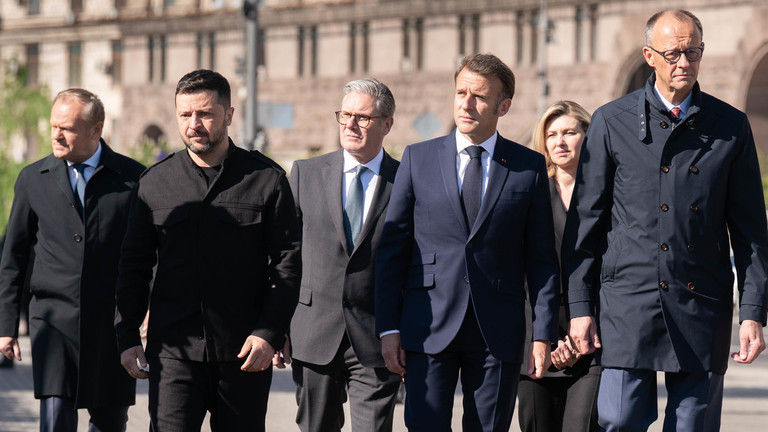
FILE PHOTO: Vladimir Zelensky and European leaders on May 10, 2025 in Kiev, Ukraine. © Stefan Rousseau – WPA Pool/Getty Images
RT | November 29, 2025
The European Union, along with the UK, has deliberately torpedoed the US peace roadmap aimed at ending the Ukraine conflict in the apparent hope that it “will fizzle out,” The Guardian has claimed.
Russia has repeatedly accused the EU of sabotaging efforts to end the bloodshed in Ukraine.
Washington put forth the peace framework earlier this month, and US officials are continuing to work on it. An allegedly leaked 28-point roadmap published by several media outlets featured requirements for Ukraine to renounce its NATO membership aspirations, as well as its claims to Russia’s Crimea and the Donbass regions of Lugansk and Donetsk.
Shortly after the contents of the US-drafted peace proposal were published by the press, several EU member states, along with the UK, scrambled to present their own version. Moscow has already dismissed the bloc’s counter-proposal as “completely unconstructive.”
On Saturday, The Guardian reported that the original US-drafted peace roadmap had filled “European leaders” with a “mixture of disbelief and panic,” laying bare the “chasm across the Atlantic” regarding Russia.
However, the EU and the UK are by now well-versed in blunting any American attempts at resolving the Ukraine conflict, the publication claimed.
Their strategy presumably boils down to welcoming the “fact of Trump’s intervention, before slowly and politely smothering it.”
According to the British media outlet, Kiev’s European backers took the original 28-point proposal and removed nine key elements from it.
The EU and the UK have also allegedly mobilized the “Atlanticist wing in the Senate,” so that it mounts internal opposition to the peace framework.
Politico Europe and The Telegraph, citing anonymous sources, have recently claimed that the US has been keeping the EU “in the dark” regarding ongoing diplomacy on the peace proposal.
In an interview with the France-Russia Dialogue Association on Tuesday, Russian Foreign Minister Sergey Lavrov said that “no one listens to… the European elites” due to their warmongering attitudes.
Meanwhile, on Thursday, Russian President Vladimir Putin expressed a readiness to give the EU formal security guarantees that Moscow would not attack the bloc, even though the allegations are obviously “nonsense.”
US faces outrage over killing of survivors in Caribbean strike
Al Mayadeen | November 29, 2025
The US is facing renewed scrutiny after reports emerged that US forces carried out a second strike on a disabled boat in the Caribbean, extrajudicially killing people who survived an initial missile attack.
Accounts published by the Washington Post, CNN, and earlier by The Intercept indicate that the September 2 attack unfolded under a direct instruction from War Secretary Pete Hegseth to ensure no one on the vessel remained alive.
Citing individuals familiar with the mission, the Washington Post reported that personnel were told “the order was to kill everybody.” The strike formed part of a wider campaign targeting boats in the Caribbean and eastern Pacific that Washington claims were transporting narcotics through international waters. Publicly released figures compiled by AFP suggest that at least 83 people have been killed since these operations began, though the administration has not provided evidence substantiating its allegations against the vessels.
Illegal orders
According to the Washington Post, US forces saw two people clinging to the burning wreckage after the first strike and then hit the vessel again. Following this episode, internal rules were revised to require rescuing any survivors. CNN noted that it remains unclear whether Hegseth had been informed about survivors before the follow-up attack.
Hegseth, addressing criticism on social media on Friday, insisted that “current operations in the Caribbean are lawful under both US and international law” and dismissed reports on the incident as “fake news,” though he did not mention the September strike specifically.
The Justice Department has meanwhile maintained that the campaign complies with the laws governing armed conflict. The Pentagon has told lawmakers that the United States is engaged in an “armed conflict” with Latin American drug cartels and has categorized suspected smugglers as “unlawful combatants.”
War crimes
The allegations have triggered political backlash in Washington. Democratic congressman Seth Moulton wrote on X that the “killing of survivors is blatantly illegal” and warned, “Mark my words: It may take some time, but Americans will be prosecuted for this, either as a war crime or outright murder.”
The revelations surface amid controversy over a video released this month by Democratic lawmakers reminding military personnel that they may refuse illegal orders, a message that prompted Donald Trump to brand them “traitors.”
International pressure is also mounting. UN Human Rights chief Volker Turk urged the United States to examine the legality of the strikes, stating that there is “strong evidence” they amount to “extrajudicial” killings.
US Drones for Ukraine No Match for Russian Countermeasures, Keep Crashing During Tests
Sputnik – 29.11.2025
Anduril, a $30B Silicon Valley defense startup building drones, surveillance equipment and C3I software for the US military, CBP and America’s allies, has sent tens of millions of dollars’ worth of drones to Ukraine since 2022.
But there’s a problem: Its products keep crashing before they can even be deployed.
Air Force testing this month involving two Anduril Altius multipurpose spy, communications, cyberwar and strike drones saw them ascend and slam into the ground. Summer testing of Anduril’s new Fury unmanned fighter damaged its engine before it could even take off, while an August test of the Anduril Anvil antidrone system caused a 22-acre fire in Oregon.
The US Navy has reported similar problems, with 30 drone boats operated by Anduril’s Lattice software shutting down during a deployment off California in May. Sailors said in a report that Anduril’s products suffered from “continuous operational security [and] safety violations, and contracting performer misguidances,” posing an “extreme risk” to US military personnel.
US Army drilling in Germany in January saw a Ghost spinning out and crashing near troops, with an Army spokesman confirming the drone’s issues with power management in cold temperatures.
And there’s another problem.
Although Ukraine’s military remains tightlipped about the performance of its Anduril equipment, an informed source told Reuters that the dozens of Ghost drones the company deployed in 2022 proved no match for Russian electronic warfare countermeasures, which jammed their satnav systems.
Meanwhile, sources told the Wall Street Journal that Anduril Altius drones were so problematic for Ukraine’s military that it stopped using them altogether in 2024.
The UK signed a $40M deal with Anduril in March for more Altius drones for Ukraine.
Stealth Bombers and Bunker Busters
A retrospective analysis of the so-called 12-Day War, and the triumphantly celebrated Operation Midnight Thunder

B-2 “Stealth Bomber” Dropping a GBU-57 “Bunker Buster” Bomb
By William Schryver | imetatronink | November 28, 2025
The GBU-57 is a big fat gravity bomb with fins. To achieve effective precision, a B-2 bomber must drop it on its intended target from no further than about five nautical miles — essentially right on top of the target.
Its penetration depth is claimed to be 200 feet. But that capability has NEVER been tested against a seriously hardened deep-underground target encased in layers of high-performance concrete, and topped with a few dozen meters of solid rock. In that sort of real-world scenario, the GBU-57 would be lucky to drill down 50 feet, if that.
It was always ridiculous silly talk to suggest the GBU-57 was the wonder weapon it was made out to be. There is a good reason the US only produced a couple dozen of them and then stopped: they understood its acute limitations in a non-permissive combat environment.
And, notwithstanding the hyperbolic Israeli propaganda, there was never any credible evidence that Iranian medium- and long-range air defenses against fixed-wing aircraft were attrited to any significant degree. And Iranian short-range air defenses were increasingly effective against long-range Israeli drones with each passing day.
As for the B-2: it is a big fat subsonic aircraft. It flies at airliner speeds. A strike on Fordow would entail flying at least 500 miles in and out of Iran.
It is nonsense that the B-2 is effectively invisible. It can be tracked from long distances, and targeted sufficiently well that missiles with effective terminal guidance (thermal / optical) can kill it.
The Iranians established during the October 26, 2024 Israeli counterstrike that they could paint F-35s with their radars. That is why the Israelis launched nothing but long-range stand-off munitions: aero-ballistic and cruise missiles – of which they have a very limited stockpile.
The same conditions prevailed during the 12-Day War.
And just as the Israelis were unwilling to risk getting fighters shot down over Iran, neither was the USAF willing to risk getting a B-2 shot down over Iran.
Maybe a few B-2s launched some JASSMs from over Iraq or the Caspian Sea. Maybe nothing but sub-launched Tomahawks hit Iranian targets. But it certainly wasn’t GBU-57 “Bunker Buster” bombs dropped by a half-dozen B-2s casually flying in Iranian airspace for an hour.
And whatever was dropped inflicted no meaningful damage. Fordow was scratched at best. A bunch of surface structures at Natanz were blown up.
Trump’s claim that Iran’s nuclear program was destroyed is absurd nonsense. No one with even a modest understanding of these things believes that.
The Israelis certainly don’t believe it, and they have admitted as much.
It is true that, in retaliation, the Iranians precisely targeted and convincingly destroyed a significant communications complex at the American Al Udeid airbase in Qatar.
The fictionalized B-2 “Bunker Buster” strike on Fordow, and the token Iranian ballistic missile strike on Al Udeid were orchestrated events designed to grease the tracks of a ceasefire that was proposed by the Americans and agreed to by the Iranians.
The Americans and Israelis had expended almost their entire inventories of ballistic missile interceptors over the course of a week and a half, and Iranian missiles were raining down with effective impunity the last few days.
The Iranians knew damn well they had already achieved a strategic victory, despite their shaky start.
I’m also convinced the Russians and Chinese encouraged Iran to accept the ceasefire proposal.
It allowed both sides to claim a PR victory, lick their wounds, and prepare for the next round.
Meanwhile, the Iranians have more production capability than do their US/Israeli counterparts. And it also appears the Iranians are much more amenable to Russian and Chinese assistance now than they may have been previously.
When this war resumes, the Iranians will be comparatively stronger than they were before. And the risks for the US/Israel will be significantly heightened.
Will Saudi Arabia fund Israel’s grip over Lebanon?
By Mohamad Hasan Sweidan | The Cradle | Novmber 27, 2025
In the wake of Israel’s November 2024 apparent ceasefire with Lebanon, Tel Aviv has moved to reshape the post-war order in its favor. Treating Lebanon as a weakened and fragmented state, Israel seeks to impose a long-term, unilateral security and economic regime in the south, bolstered by US backing.
Simultaneously, Saudi Arabia has thrust itself into the reconstruction process as the main Arab financier. But the kingdom risks becoming a junior partner in an Israeli-American project that sidelines it from real decision-making. The question facing Riyadh is clear: Will it bankroll its own marginalization?
Tel Aviv’s vision: Disarmament, deterrence, domination
Israel’s strategy for Lebanon extends far beyond the oft-repeated demand to disarm Hezbollah. It envisions a sweeping transformation of Lebanon into a demilitarized satellite state governed under a US-Israeli security framework. Nowhere is this clearer than in Tel Aviv’s insistence on remaining inside Lebanese territory until Hezbollah is stripped of its deterrent capabilities, not just south of the Litani River, but across the country.
Israeli Defense Minister Israel Katz and former Northern Command chief Uri Gordin have both publicly outlined this goal. Gordin even suggested establishing a permanent buffer zone inside Lebanon to serve as a “bargaining chip” for future negotiations, while Katz confirmed that Israeli forces would remain indefinitely in the south. Tel Aviv no longer seeks temporary deterrence, favoring permanent subordination.
Katz, for his part, has stated “Hezbollah is playing with fire,” and called on Beirut to “fulfill its obligations to disarm the party and remove it from southern Lebanon.”
Most recently, while addressing the Knesset, he warned that “We will not allow any threats against the inhabitants of the north, and maximum enforcement will continue and even intensify.”
“If Hezbollah does not give up its weapons by the year’s end, we will work forcefully again in Lebanon,” Katz reiterated. “We will disarm them.”
According to this blueprint, Lebanon is not considered a sovereign neighbor, but a security appendage to Israel’s northern frontier. State institutions are expected to serve as administrative fronts for a de facto Israeli-American command center. International aid, including funding from Arab states of the Persian Gulf, is being weaponized to enforce this new security-economic order.
From the perspective of Israel, the goals in Lebanon are not limited to the disarmament of Hezbollah. They go beyond that toward a deeper project of transforming Lebanon – especially the south – into a kind of security-economic colony.
This includes consolidating a long-term military presence, imposing new border arrangements, and paving the way for settlement projects or institutionalized buffer zones, as evidenced by current maps showing the presence of Israeli forces at several points inside Lebanese territory.
Saudi Arabia’s options: Pressure or partnership
Enter Riyadh. The Saudi Foreign Ministry has repeatedly called for Lebanese arms to be confined to the state and endorsed the implementation of the 1989 Taif Agreement.
In September, Saudi Foreign Minister Faisal bin Farhan, in a speech to the UN General Assembly, stressed that:
“Saudi Arabia stands with Lebanon, supports everything that strengthens its security and stability, and welcomes the efforts of the Lebanese state to implement the Taif Agreement (1989), affirm its sovereignty, and place weapons in the hands of the state and its legitimate institutions.”
The Saudi envoy to Lebanon, Yazid bin Farhan, reiterated Riyadh’s position: the exclusive right to possess arms must lie with the Lebanese state. In private information, during a meeting between Bin Farhan and Sunni leaders in Lebanon, the diplomat stressed that pressure must be put on disarming the party, even if that requires reaching a civil war.
On the surface, Saudi and Israeli objectives appear aligned. Tel Aviv applies military pressure. Riyadh applies economic and political pressure. Both demand the end of Hezbollah’s armed presence. But while Israel’s aim is absolute control over Lebanon’s security order, Saudi Arabia still seeks a political system that reflects its influence. In this, Tel Aviv’s ambitions collide with Riyadh’s.
However, Israel has no intention of sharing influence with any Arab state – nor even Turkiye. Its model is exclusionary. It views Riyadh not as a partner, but as a bankrolling mechanism to finance the dismantling of Lebanon’s axis of resistance under Israeli terms. As former deputy director of the National Security Council, Eran Lerman put it, Saudi Arabia is merely a pressure tool to bring Lebanon to heel.
Thus, the crux of the matter is this: Riyadh may envision itself as a key stakeholder in post-war Lebanon, but Israel sees it as a disposable auxiliary.
The 17 May redux: Recolonizing south Lebanon
To grasp the depth of Israel’s project, one need only look to its precedents. In 1983, Israel, alongside the US and under Syrian oversight, tried to enshrine a similar model via the 17 May Agreement. That deal called for an end to hostilities, gradual Israeli withdrawal, a “security zone” in the south, and joint military arrangements. In practice, it turned Lebanon into a protectorate tasked with safeguarding Israeli security interests.
Today, after the 2024 war, Tel Aviv is resurrecting that same formula. Israeli forces have remained stationed at multiple points inside Lebanon despite the ceasefire terms mandating full withdrawal. Airspace violations and near-daily raids persist under the pretext of preventing Hezbollah from “repositioning.” Think tanks in Tel Aviv, alongside joint French-US proposals, are now pushing phased disarmament: first the south, then the Bekaa, then the Syrian border, ultimately ending all resistance capabilities.
International support is being dangled as a carrot. Aid from the US, France, Saudi Arabia, Qatar, and others is contingent on Lebanon executing a disarmament plan under International Monetary Fund (IMF) oversight and within a strict timeline. This is the economic arm of the Israeli security project.
More dangerously, Israeli studies suggest that reconstruction of southern villages should be explicitly tied to the removal of resistance forces, while preserving “full freedom of action” for the Israeli army in Lebanese air and land space.
Can Riyadh afford Tel Aviv’s trap?
In parallel with this vision, western analyses close to decision-making circles in Washington and Riyadh show that Saudi Arabia itself sees Lebanon as a pivotal arena in its conflict with Iran. Any serious return to the Lebanese file is linked to the weakening of Hezbollah’s influence.
But the key divergence between the Saudi and Israeli approaches lies in a critical question: Who ultimately holds the keys to decision-making in Lebanon?
Riyadh aims to use its financial and political capital to recalibrate the Lebanese political order in its favor, minimizing Iranian sway while reinforcing its own influence. But Israel’s plan is more radical: to redefine Lebanese sovereignty altogether, placing it under perpetual Israeli security oversight.
In this model, Saudi Arabia – and any other Arab state – is reduced to the role of financier, tasked with implementing terms written in Tel Aviv and Washington rather than contributing an independent Arab vision for the region.
From this angle, Tel Aviv’s persistent invocation of the “military option” in Lebanon works against Gulf interests. It positions Riyadh and its allies as the paymasters for reconstruction, forced to foot the bill for a post-war settlement they had no role in shaping.
If Saudi Arabia concedes to this logic – and fails to leverage its influence in Washington, in Arab diplomatic circles, and in donor mechanisms – it risks forfeiting Lebanon to a joint Israeli-American order.
That order would mirror the defunct 17 May Agreement, only more deeply entrenched. Lebanon would not only be demilitarized. It would become a living model of “security-economic conjugation,” designed to recalibrate regional influence away from the Arab world and toward an Israeli-dominated Levant.
Trump’s ‘drug boat’ attacks mirror controversial Obama-era tactic – NYT
RT | November 28, 2025
US airstrikes on suspected drug smugglers in the Caribbean ordered by President Donald Trump bear similarities to the controversial ‘signature strikes’ on purported terrorists under former President Barack Obama, the New York Times has argued.
The Obama-era operations conducted primarily in Pakistan and Yemen relied on detecting patterns of behavior that US intelligence agencies claimed indicated terrorist activity, rather than identifying wrongdoing by specific individuals. Critics condemned the approach for its vague criteria – sometimes as broad as ‘military-age male’ in an area prone to militancy – and for resulting in civilian casualties.
Pentagon officials have acknowledged in closed-door briefings that they often do not know the identities of the people killed in what the White House calls a campaign against “narcoterrorism” in the Caribbean, the NYT reported on Thursday. Despite this, US officials insist that the comparison does not apply, arguing that the strikes are aimed at narcotics rather than individuals.
“They told us it is not a signature strike, because it’s not just about pattern of life, but it’s also not like they know every individual person on the boats,” Representative Sara Jacobs, a member of the House Armed Services Committee, told the outlet.
The Obama administration’s killings of low-level militants and people merely assumed to be militants was criticized as counterproductive and fueling further radicalization. Trump officials reportedly argued that attacking boats at sea reduces the risk of collateral damage.
Some US allies, including the UK, have reportedly declined to assist with the ‘drug boat’ strikes, warning that they could violate international law. The campaign has already resulted in more than 80 deaths.
Analysts increasingly suspect that the operations could be laying the groundwork for a regime-change effort in Venezuela, whose president, Nicolas Maduro, the US accuses of leading a criminal cartel.
After 75 years: Could Israel actually lose its UN membership this time?
By Dr Mohammad Yousef | MEMO | November 27, 2025
On 24 November 2025, civil-society actors in Chile launched a campaign calling for the expulsion of Israel from United Nations, invoking UN Charter Article 6. They base their call on what they describe as “continuous and systematic violations” of international humanitarian law and repeated breaches of UN resolutions, particularly in light of ongoing Genocide in Gaza and the humanitarian crisis there.
Article 6 of the UN charter states: “A Member of the United Nations which has persistently violated the principles contained in the present Charter may be expelled from the Organization by the General Assembly upon the recommendation of the Security Council.”
This is not the first such call. In September 2025, following Israeli airstrikes on Qatar targeting Hamas officials, Pakistan demanded Israel’s suspension or expulsion from the UN for violating international law and threatening international peace and security. Pakistan’s UN ambassador warned that Israel’s actions risked regional stability and global lawlessness.
Similarly, Francesca Albanese, UN Special Rapporteur on the situation of human rights in the Occupied Palestinian Territories (OPT), has repeatedly urged Israel’s suspension from the UN, Citing the crime of genocide that Israel committed against Palestinians. Targeting UN premises, violating the UN charter and labeling the UN as a terrorist organization.
The UN Charter provides mechanisms for suspension or expulsion of member states under Articles 5 and 6, while Article 6 deals with the expulsion, Article 5 deals with the suspension.
Historically and since its inception after World War II, the UN has never expelled or suspended any state member from the organization under Articles 5 and 6 of the Charter. However, the attempt to block South Africa from attending UNGA meetings was successful, following the U.N. General Assembly approval of the Credentials Committee’s recommendation to cancel the credentials of South Africa, citing the country’s Apartheid-era racial policies.
Multiple attempts were made in order to expel Israel from the UN in the past, but all of them remained unsuccessful due to either political pressure or threats to use the Veto power. The first attempt was in 1975 when Algeria and Syria led a joint campaign aiming for the suspension of Israel from the UNGA, this step requires the recommendation of the UNSC, and due to the U.S veto threat the process was halted. However, alternative ways were explored in order to isolate Israel leading to the UNGA Resolution 3379 adopted in November 1975, which declared Zionism to be “a form of racism and racial discrimination”.
Another attempt was organized by 34 Muslim states and the Soviet Union (USSR). These states sent a letter to the UN General Assembly Credentials Committee requesting Israel’s expulsion from the UNGA. The letter stated:
… “Israel’s continued defiance and its flagrant and persistent violation of the Charter of the United Nations and the principles of international law. Furthermore, we wish to reiterate Israel’s contempt and its defiant challenge to the resolutions of the United Nations as they relate to the question of Palestine and the situation in the Middle East.”
The states further emphasized Israel’s non-adherence to the UN Charter and its violations of obligations, arguing that this makes Israel a non–peace-loving state, which is a requirement for UN membership. This attempt was obstructed by Israel’s allies in the US and western countries. As a result, it failed to gain the required two-thirds majority and remained unsuccessful.
IN 2018, the Kenest passed the Nation-State bill, which in its Article 1(a) states that: “The Land of Israel is the historical homeland of the Jewish People, in which the State of Israel was established. “The president of the Palestinian Authority (PA), Mahmoud Abbas, called the Nations-State Law, “Illegitimate, Racist and apartheid”. Following this, and in response to this Law, the PA lunched an initiative calling for Israel’s expulsion form the UN. However, this initiative failed and did not progress due to the U.S threat to cut UN funding.
Given the above precedent, the campaign to expel Israel from the UN is legally grounded — but faces dıfrrent types of political pressure and institutional barriers. Any real proposal would require: (a) adoption by the Security Council; (b) absence of vetoes by any of the five permanent members (P5). Given current geopolitical alignments, particularly the support for Israel by some P5 states, such a proposal is unlikely to pass.
Nevertheless, the fact that the legal mechanism exists, coupled with mounting global outrage over Israel’s violations and Genocide in Gaza — equip the call with significant symbolic and political weight. Even if immediate expulsion is unrealistic, pressing for such a step can be part of a broader strategy of international isolation, reputational pressure, and incremental delegitimization.
Because expulsion or suspension of a state member from the UN under Article 5 and 6 is difficult, as it must go through the UNSC and most likely face U.S Veto power. As of September 2025, the U.S has used its veto 51 times to shield Israel. Acting within the framework of the UN General Assembly has a greater chance of success, particularly given the recent overwhelming support for Palestine and the noticeable shift in many states’ positions in favour of Palestine.
In May 2024, by an overwhelming majority vote, the UN General Assembly adopted a resolution supporting the Palestinians’ right to admission to the UN and to obtain full membership in the organization. The resolution passed with 143 votes in favor, 9 against, and 25 abstentions. Similarly, in September 2024, the UNGA adopted a resolution calling on Israel to bring an end without delay its unlawful presence, the resolution passed with 124 votes in favour,14 against, and 43 abstentions. On 12 September 2025, the “New York Declaration” supporting a two-state solution was endorsed by 142 UN member states, with just 10 votes against and 12 abstentions.
As with the South Africa case, the credentials of Israel’s delegation can be blocked following a letter to the UNGA Credentials Committee and a two-thirds majority vote by UNGA member states. This scenario is likely to succeed, given the growing global support for the rights of the Palestinian people within the UN.
There is another alternative: appealing to the UN General Assembly resolution “Uniting for Peace.” Adopted on 3 November 1950 (during the Korean War), it was designed to empower the GA when the Security Council is deadlocked by vetoes. Under this mechanism, the GA can convene special emergency sessions and recommend collective measures—including economic, political, or even armed action—against states threatening peace when the UNSC fails to act.
Since proclaiming itself a state on historic Palestine, Israel has repeatedly been accused of war crimes, genocide, and violations of the UN Charter, posing serious threats to international peace. After October 7th, 2023 until today, over 100,000 Palestinians have been killed by Israel, more than 1.9 million Gazans and tens of thousands of West Bankers have been forcibly displaced by Israel, Gaza’s healthcare and educational systems massively destroyed by Israel. Within a year or less, Israel has attacked seven countries, violating their sovereignty and territorial integrity, including, Lebanon, Syria, Yemen, Qatar, Iran, Tunisia, and the occupied Palestinian territories. Israel continues to expand its occupation and settlements into the West Bank and Syria, planning de jure annexations and maintaining indefinite military presence.
Given that Israel faces no serious international pressure and collective sanctions, the UN and international community—including states and NGOs—must apply maximum pressure through all possible means. The call to expel Israel from the UN or the suspension of its membership are not a rhetorical measure only — they rest on the clear text of Articles 5 and 6 of the UN Charter. Yet, Political pressure, institutional realities — especially the veto power of the Security Council’s permanent members can halt any efforts in this regard.
In this very critical moment in the prolonged legitimate struggle of the Palestinian people against the apartheid regime in Israel, calling for Israel’s expulsion or suspension from the UN, or blocking its credentials in the UNGA, is not only justified but necessary to stop the ongoing genocide and grave violations. States and the international community, through the UN, are obligated to translate diplomatic commitments into tangible actions—isolating Israel politically, legally, economically, and diplomatically—and holding it accountable for its crimes and violations of the UN Charter and international law.
Featured Video
Laith Marouf: Hezbollah’s position on US-Iran ceasefire
or go to
Aletho News Archives – Video-Images
From the Archives
Is Israel to blame for the Iraq War?
American Goy | March 10, 2008
I am so tired of this old canard that “Israel had nothing to do with USA’s war with Iraq – in fact, it officially advised America against it”.
Bullshit. … continue
Blog Roll
 Aletho News
- Laith Marouf: Hezbollah’s position on US-Iran ceasefire: What you’re not being told
- Israel’s priority lies in destroying chances of peace between Iran, US: Ex-UN nuclear chief
- Ceasefire for all or for none: Iran shuts Hormuz over Lebanon attacks
- Strait of Hormuz is Iran’s ‘nuclear weapon’ that forced US retreat: Medvedev
- Energy crisis will last for months – Kremlin envoy
- Europe’s quiet role in the war on Iran
- Forty days that shook the Empire: How Iran turned the tables on US and prevailed
- Netanyahu unilaterally declares Lebanon outside of ceasefire deal
- Israeli leaders: ‘Not a single goal’ achieved in war with Iran
- What on earth just happened? Trump, Iran, and the unlikely ceasefire
- If Americans Knew
- Gazans face a triple crisis: severe shortages of water and bread, healthcare in tatters
- NY Times reports how Netanyahu took the US into Iran War
- A sigh of relief over Iran, but Gaza and Lebanon in dire straits – Daily Update
- Thousands dead and neighborhoods razed to the ground: Aid agencies fear southern Lebanon is becoming the new Gaza
- The war the US is fighting for Israel could cost trillions
- ‘Cigarette Burns, Nail Wounds’: Toddler Tortured in Gaza to Coerce Father
- Trump Says US Sent ‘a Lot of Guns’ to Protesters in Iran
- Israeli forces destroy 17 UN peacekeeper cameras in south Lebanon
- US-Israeli strikes ‘completely destroy’ synagogue in Tehran
- Archbishop for US Military Says Iran War Is Unjust Under Catholic Teaching
- No Tricks Zone
- An Inconvenient Tree: Uncovered In Alps… Europe Much Warmer Than Today 6000 Years Ago
- New Study Reports A 60% Slowdown In Greenland’s Ice Loss Rate In The Last Decade
- Low Intensity Tornado Wrecks Major Solar Farm, Creating A Potential Toxic Dump
- New Study Finds Warming Saves Lives…Cold Temperatures 12 Times More Deadly Than Excess Heat
- German Science Blog Accuses PIK Climate Institute Of Hallucinating Climate Tipping Points
- Devastating Assessment Of Comirnaty Vaccine By Former Senior Pfizer Europe Toxicologist
- New Study: CO2 Is ‘Effectively Negligible’ As An Explanatory Climate Change Factor Since 2000
- Former Pfizer Toxicologist Dr. Helmut Sterz Tells Bundestag Hearing Pfizer Vaccine Should Have Never Been Approved
- Energy Expert: Germany’s Nuclear Phaseout Was A “500 Billion Euro Mistake”
- New Research: South Australia’s Mid-Holocene Sea Surface Temperatures Were 4°C Warmer Than Today
 Aletho News