Iran uranium transfer reports ‘US psychological warfare’: Tasnim
Al Mayadeen | May 25, 2026
Iran’s Tasnim News Agency has dismissed Western media reports claiming that Tehran has agreed to transfer its enriched uranium stockpile out of the country as part of a proposed nuclear deal, describing the allegations as part of American “psychological warfare” against Iran.
Tasnim reported that what has been circulated in the media regarding Iran’s readiness to remove enriched uranium from the country is “untrue,” and falls within the framework of “American psychological warfare against Iran.” The agency added that the text of the memorandum of understanding does not contain any statement indicating Iran’s readiness to transfer nuclear materials out of the country, and that the memorandum “did not include any commitment regarding any nuclear action.”
Earlier, The New York Times had quoted US officials claiming that “Iran agreed to give up its stockpile of highly enriched uranium” as part of the proposed agreement announced by President Donald Trump. Tasnim also denied reports that “US officials said Iran will not receive any facilities for the release of frozen funds unless it begins transferring its enriched uranium reserves.”
Iran refuses to link frozen assets to nuclear file
Tasnim affirmed that “Iran is not prepared to link the release of its frozen assets to the nuclear file,” adding that there is a “possibility that no agreement will be reached.”
The agency stressed that Tehran has not made any commitment at this stage regarding the details of the nuclear file, and therefore the release of funds in the first step will have no connection to the nuclear file. The initial understanding, Tasnim emphasised, must be based on “ending the war.”
The denial comes as the US-Israeli war on Iran continues, with Washington maintaining an illegal naval blockade on Iranian ports while demanding nuclear concessions from Tehran. Iran has consistently maintained that its nuclear programme is for peaceful purposes and that it will not negotiate under pressure. Iranian officials have repeatedly stated that the priority is ending the war, not addressing the nuclear file at this stage.
Background: Iran has consistently denied nuclear concessions in ongoing talks
The denial from Tasnim is consistent with Iran’s stated negotiating position throughout the US-Israeli war on Iran. As reported yesterday, Tasnim had already rejected a previous Al Arabiya report claiming that Iran proposed suspending uranium enrichment above 3.6 percent for 10 years.
At that time, a source informed about the negotiation process told Tasnim that all issues touched upon in recent messages exchanged between Iran and the United States have been limited to points on the cessation of hostilities, while the nuclear issue has not been mentioned at all.
Iranian Foreign Ministry spokesperson Esmaeil Baghaei confirmed that negotiations at this stage do not address the nuclear file or the details of sanctions relief. He also reiterated that the United States has no role in the Strait of Hormuz, describing it as a matter exclusively between Iran and the waterway’s coastal states.
Three fundamental sticking points remain unresolved
Beyond the nuclear file, an informed source close to Iran’s negotiating team told Fars News Agency that three fundamental points of contention remain unresolved, warning that talks will not proceed unless they are addressed. These concern the nuclear file, the release of Iranian frozen assets abroad as a non‑negotiable prerequisite for entering negotiations, and Iranian management of shipping traffic through the Strait of Hormuz.
The source noted that while US negotiators have retreated from their initial positions and accepted many of Iran’s stances, significant gaps persist. Iran has “prepared itself for all options,” the source stressed, with the Iranian armed forces remaining on high alert.
The repeated denial of media reports about nuclear concessions suggests that Washington may be attempting to shape public perception of the negotiations, while Tehran insists that no agreement on the nuclear file has been reached or even discussed in detail.
Delcy’s ‘gatekeeper’: sources say ex-Trump official Claver-Carone holds keys to Caracas
By Max Blumenthal | The Grayzone | May 25, 2026
Speaking with reporters on May 21, US Secretary of State Marco Rubio announced that Venezuelan President Delcy Rodriguez was on her way to New Delhi to discuss energy issues, and that he would be in India as well.
“This is an important trip, I’m glad we’re able to do it,” Rubio chirped after explaining the trio of nations would discuss how to increase Venezuelan oil sales to India.
His statement — and his announcement of Rodriguez’s trip before she had — perfectly illustrated Washington’s newfound dynamic with the Venezuelan government. Following over twenty years of hostile relations with Venezuela’s socialist-oriented leadership, the US Secretary of State was apparently so intimately involved with day to day affairs in Caracas that he was claiming responsibility for Rodriguez’s international itinerary.
In fact, according to an insider who enjoys close contacts within both the Venezuelan and US governments, Rubio’s influence over Rodriguez is said to be traced to one “gatekeeper”: former Trump Latin America envoy Mauricio Claver-Carone. “Mauricio [Claver-Carone] is picking who can operate and Delcy [Rodriguez] is taking instructions,” the source told The Grayzone.
A former senior US official with access to leadership in both Caracas and Washington offered the same assessment, remarking to The Grayzone, “Mauricio’s calling the shots on private sector economic positions, and if anyone wants in, they have to go to him.”
Hand-selected by former National Security Advisor John Bolton to serve as his Latin America charge during Trump’s first term, Claver-Carone no longer occupies an official governmental role. Instead, he has leveraged his legacy in the public sector to establish a Miami-based investment firm called the Lara Fund which could become a key player in the MAGA financial feeding frenzy in Caracas.
Described by the New York Times as the “architect of Trump’s tough Latin America policies,” Claver-Carone is a Cuban-American regime change zealot who once engaged in fisticuffs with Cuban diplomats as a young man. During Trump’s first term, he unleashed a financial “flamethrower” on Cuba, issuing scores of new sanctions that unraveled the Obama-era normalization policy and plunged the island back into economic misery.
Claver-Carone has similarly masterminded many of the policies that define Trump’s relationship with Venezuela, from its recognition of the previously unknown Juan Guaido as the country’s “interim president” to the deportation of hundreds of Venezuelan migrants from the US to El Salvador’s maximum security CECOT prison. Many of those migrants had been prompted to journey to the US by the economically crushing sanctions unleashed at Claver-Carone’s direction.
The Grayzone’s sources described the Trump veteran as the architect of the military invasion that saw Maduro spirited away to a federal penitentiary and installed Rodriguez as president following a stand-down by Venezuelan security forces.
“If he was in charge of implementing the kinetic side, maybe [Rodriguez] thinks she has to listen to him on finance,” the Venezuela insider said of Claver-Carone.
A report this January by investigative journalist Aram Roston described Claver-Carone as a “key backer” of Rodriguez following Maduro’s abduction, and cited sources who claimed he exercised decisive influence over Venezuela policy despite having left the administration.
Claver-Carone is now said to be at the heart of the most sensitive and consequential task Venezuela faces: the restructuring of its $170 billion in defaulted sovereign debt. Forced from several previous positions by corruption scandals and rancorous clashes, an operative with no official governmental position appears to be shaping the economic contours of Project Venezuela.
“He’s got a lock on everything”
This May, the US Treasury Department authorized Caracas to hire a financial advisor to assist with the herculean task of restructuring its debt. The Venezuelan government selected Centerview Partners, a top-drawer investment and financial advisory firm based in New York City.
According to the former US senior official, Claver-Carone’s romantic partner and business colleague, Jessica Bedoya, boarded a private jet to Caracas soon after the big announcement, arriving with a top advisor from Centerview. It was her second trip to the Venezuelan capital, they said, after visiting in February to discuss financial matters.
Claver-Carone did not respond to calls to his personal phone from The Grayzone, or to detailed questions sent by text and email.
His partner, Bedoya, is the founder of the Lara Fund investment firm where he serves as managing partner. Her bio notes that she has also worked in the CIA and National Security Council.
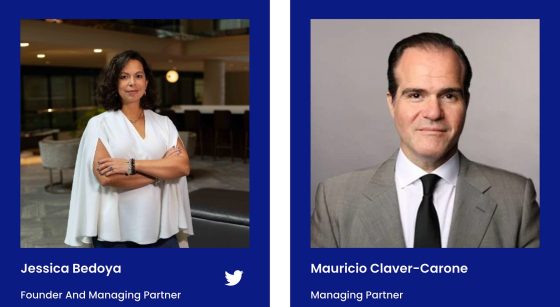
Jessica Bedoya and Mauricio Claver-Carone’s headshots, as featured on Lara Fund’s webpage
Some insiders worry that her reported presence in the Venezuelan capital, together with Claver-Carone’s outsized influence, could represent a conflict of interest, allowing them to steer debt restructuring agreements to their own personal benefit.
“Now he’s got a lock on everything,” the Venezuela insider said of Claver-Carone. “He could say to anyone who wants to work in Venezuela, I’m the guy. I have the keys. If you want to play ball, invest with me.”
The former US official said Claver-Carone was raising capital for his Lara Fund while he served as a special government employee at the State Department. While Bedoya was running the firm, they said Claver-Carone was leveraging his position inside the Trump administration to pitch potential investors.
“Arbitrary and authoritarian actions that showed him to be a real thug”
When Trump appointed Claver-Carone to serve as the first American president of the Inter-American Development Bank (IDB) in 2020, he hired Bedoya as his chief-of-staff. The couple’s secret romance at the bank triggered an embarrassing ethics investigation after a hand-written contract was discovered showing they had agreed to pursue “absolute happiness,” and included a clause with punishments including “candle wax and a naughty box” if either party breached the deal.
An independent probe ordered by the IDB discovered that Claver-Carone had increased his paramour’s salary by 40% – a $133,000 reward in less than a year. Investigators also found that the couple had racked up expenses on an IDB credit card during romantic getaways.
Claver-Carone refused to participate in the investigation while accusing its authors of “fabrications.” In the end, IDB governors voted unanimously in favor of his firing. The US government endorsed their decision.
“President Claver-Carone’s refusal to fully cooperate with the investigation, and his creation of a climate of fear of retaliation among staff and borrowing countries, has forfeited the confidence of the bank’s staff and shareholders and necessitates a change in leadership,” they wrote.
The Argentine governor of IDB, Guillermo Francos, delivered a similarly harsh assessment of Claver-Carone’s tenure. “Claver was a disaster for several reasons,” Francos remarked in 2022. “For having an inappropriate relationship, for having disproportionately increased the salary of this inappropriate relationship, for having lied, and for these arbitrary and authoritarian actions that showed him to be a real thug.”
When Claver-Carone returned to the second Trump administration, it was not long before his proclivity for conflict jeopardized his position.
Throughout 2025, Claver-Carone’s spiteful attitude reportedly complicated Trump administration attempts to prop up a key right-wing ally in South America, Argentine President Javier Milei. Milei’s chief of staff happened to be Guillermo Francos – the former IDB governor whom Claver-Carone held personally responsible for outing his secret relationship with Bedoya. According to the Argentine paper Clarin, Claver-Carone attempted to retaliate by unsuccessfully pressuring Milei to fire Francos. He then attempted to undermine a major IMF loan package to Argentina by demanding the country first sever its credit line from China. This was met with an apparent rebuke from Treasury Secretary Scott Bessent, who visited Buenos Aires to express confidence in the IMF loan just weeks after Argentina’s central bank extended its credit line from Beijing.
The following month, in May 2025, Claver-Carone announced he was leaving the State Department to return to his Lara Fund. His departure gave the appearance that he had been forced out of his job, however, he maintained his clout through his direct line to Rubio.
The former US official told The Grayzone that Claver-Carone is now angling to become a Cuban American version of Jared Kushner, the Trump son-in-law who has leveraged his proximity to the president and role as Middle East negotiator to rake in billions from Israel and several Gulf monarchies despite having no official government title. To do so, he has allegedly inserted himself into the byzantine process of restructuring Venezuela’s debt.
When the Trump administration announced that Venezuela could hire a financial advisor to assist with its sovereign debt, Rodriguez initially planned a public bidding process for the coveted position. But then, according to the ex-US official, Claver-Carone issued support for Centerview, leading to the firm’s selection. (Opposition bloggers have speculated that Centerview was chosen because one of its partners, Matthieu Pigasse, is a self-described “pro-market socialist” who previously worked on deals with Maduro and Venezuela’s state owned PDVSA oil company.)
In recent weeks, according to sources, Claver-Carone has attempted to undermine financial advisors who had been working with the Venezuelan government to restructure its debt since 2014.
They said that when Claver-Carone’s partner, Bedoya, arrived in Caracas this month, allegedly on a private jet with Pigasse, she began pushing to remove the advisory mandate from David Syed, a seasoned French lawyer who had advised Caracas on debt-related issues for over a decade, and is considered incorruptible.
“The effort to push [Syed] out created a lot of tension,” remarked the Venezuela insider. “You can’t understand debt restructuring by parachuting in without his knowledge.”
Syed did not respond to The Grayzone’s request for comment. Hamouda Chekir, another Centerview partner who works on Venezuela’s debt, did not respond to calls and text messages sent to his personal phone.
Scandal-stained firms as vehicles for extracting profit from Venezuela
Just before leaving the State Department in May 2025, Claver-Carone convinced Rubio not to renew a sanctions waiver that allowed Chevron to sell Venezuelan oil in the US market. In doing so, he eliminated a mechanism which was explicitly designed to promote transparency and prevent local officials from skimming cash.
This January, after abducting Maduro, the Trump administration granted confidential licenses to a pair of notoriously corrupt trading houses, Vitol and Trafigura, to export Venezuelan oil. The deal came months after Trump’s re-election campaign received a whopping $6 million donation from a senior trader at Vitol.
Robert Bachmann, an analyst at the Swiss watchdog Public Eye, told the Washington Post at the time, “Trump is taking advantage of firms that know how to circumvent regulation.”
Both companies had been caught engaging in a series of elaborate bribery schemes across Latin America and Africa. In 2020, the Department of Justice (DOJ) forced Vitol to pay a $135 million penalty for bribing officials for licenses in Mexico, Ecuador and Brazil. Trafigura paid a similarly staggering fine in 2024 for a lucrative bribery scheme in Brazil. In the US, Vitol was rung up by the California Attorney General for manipulating spot market prices of oil.
But almost as soon as the Trump administration entered office, it neutered the DOJ corrupt foreign practices division charged with enforcing the judgments against Trafigura and Vitol on the grounds that it was “impeding America’s national security objectives.”
Now, the profits these scandal-stained firms generate through oil sales abroad – including to Israel – are channeled back into a US-run account with little public oversight. A percentage of sales is then delivered back to the Venezuelan government. Where the rest goes is anybody’s guess.
“The Venezuelans are the owners of the oil, and we know nothing. There is no transparency,” said José Guerra, an economist aligned with the Venezuelan opposition, complained to the Washington Post about the Trafigura and Vitol licensing agreements.
Trump, for his part, has essentially admitted Venezuelan oil profits are channeled into a slush fund for his international rampage. “We’ve taken out so much oil in Venezuela, we’ve paid for the cost of the war [with Iran] about 25 times over,” the president boasted during a May 23 campaign rally. While the president’s claim was absurd, as Venezuela is currently exporting only about one million barrels of oil a month – hardly enough to cover a full day of warfare – it revealed his avaricious attitude toward the entire operation.
Among certain Venezuelan opposition activists, Claver-Carone has become a figure of contempt who is partially blamed for Trump’s declaration that their de facto leader, the coup plotter and Nobel Peace Prize winner Maria Corina Machado, “doesn’t have the support within, or the respect within, the country.”
The Trump administration’s embrace of Delcy Rodriguez, and the Venezuelan president’s faithful compliance with Washington’s financial schemes, have prompted some top Democrats to adopt Machado as a partisan cudgel. This January, Chris Murphy, a ranking Democrat on the Senate Foreign Relations Committee, praised the opposition leader as “impressive” following a meeting on Capitol Hill, while taking a nasty swipe at Rodriguez. Machado “reminded us that Trump replaced Maduro with Maduro’s head of torture,” Murphy proclaimed.
If the Democrats take Congress after this year’s midterm elections, the Trump administration’s dealings in Venezuela will face intense scrutiny from the House Oversight Committee. Bipartisan pressure will then build for fresh elections to usher in a new government. “Delcy Rodríguez is a terrible person,” the regime change-obsessed Florida Republican Sen. Rick Scott told the Wall Street Journal this month. “We’ve got to have an election soon.”
In the meantime, a flock of MAGA-aligned financial vultures has swooped into Caracas to feast on the petro-state’s post-Maduro carcass. Donald Trump Jr. is said to be hunting for opportunities in the capital for his 1789 Capital fund, while a startup backed by pro-Trump tech oligarchs Peter Thiel and Palmer Luckey, Erebor Bank, just struck a lucrative deal to reconnect Venezuela’s central bank to the global economy. In the midst of this frenzy, a figure with no government title, Claver-Carone, appears to be establishing the new pecking order.
Trump demands Arab states normalize with Israel in exchange for Iran ceasefire: Report
Press TV – May 25, 2026
US President Donald Trump has told several Arab and Muslim leaders that he expects them to establish formal relations with Israel in exchange for a ceasefire deal with Iran to end the war, according to American officials.
Axios, citing the officials, said that Trump made the demand during a phone conversation on Saturday with leaders from Saudi Arabia, the United Arab Emirates, Qatar, Pakistan, Turkey, Egypt, Jordan, and Bahrain.
According to the same sources, all eight leaders expressed support for the potential agreement with Tehran during the call.
“We are with you on this deal,” one official was quoted as telling Trump, according to the report.
Another official familiar with the conversation said the US president indicated that he would next speak with Israeli Prime Minister Benjamin Netanyahu and hoped to bring him into a joint call with the same group of Arab and Muslim leaders in the future.
Trump also pushed those countries that have not yet joined the so-called Abraham Accords – a series of 2020 US-brokered normalization deals with Israel signed under the Trump administration – to do so and establish formal ties with the Tel Aviv regime, the officials added.
Saudi Arabia, Qatar, and Pakistan currently maintain no official diplomatic relations with Israel.
One of the officials told Axios that there was “silence on the line” after Trump’s demand, prompting the president to joke and ask “if they are still there.”
The development comes as indirect talks between Tehran and Washington, mediated by Pakistan and facilitated by Qatar, continue based on the Islamic Republic’s 14-point proposal to reach a memorandum aimed at putting an end to the US-Israeli war on Iran.
Speaking in a televised interview on Saturday, Iranian Foreign Ministry spokesman Esmaeil Baghaei said Iran and the United States have edged closer to finalizing the 14-point memorandum to end the imposed war, halt American maritime aggression, and secure the release of Iran’s blocked assets.
He emphasized that Iran’s focus at this stage remains exclusively on ending the US-Israel war based on its proposal, which has been shuttled back and forth several times.
The criminal US-Israeli aggression against Iran began on February 28 with airstrikes that assassinated senior Iranian officials and commanders, including Leader of the Islamic Revolution Ayatollah Seyyed Ali Khamenei.
Iranian Armed Forces responded by launching daily missile and drone operations targeting locations in the Israeli-occupied territories as well as US military bases and assets across the region.
Furthermore, Iran retaliated against the strikes by closing the Strait of Hormuz, which resulted in a significant increase in oil prices and its by-products.
On April 8, forty days into the war, a Pakistan-brokered temporary ceasefire between Iran and the US took effect.
Negotiations ensued in the Pakistani capital, Islamabad, but stopped short of an agreement amid Washington’s maximalist demands and insistence on unreasonable positions.
The Ivanka Trump Assassination Plot Distraction
Last ditch effort to derail peace deal between the US and Iran
By Kurt Nimmo | Another Day in the Empire | May 24, 2026
On May 22, Rupert Murdoch’s New York Post floated a story claiming Iran attempted to murder Ivanka Trump, the president’s daughter. In the first paragraph of the Post story, the Islamic Revolutionary Guard Corps (IRGC) is blamed for the aborted attack. The sensationalist newspaper sources the claim to the Justice Department.
“Mohammad Baqer Al-Saadi had ‘pledged’ to target Ivanka Trump in retaliation for the assassination of his mentor Qasem Soleimani,” the Post reported.
Al-Saadi is said to be a high-ranking figure in Iraq-Iran terror circles, arrested in Turkey on May 15 and extradited to the US where he is charged with 18 attacks and attempted attacks throughout Europe and the United States, per the Department of Justice.
Al-Saadi is apparently a very ambitious and active terrorist. He is accused of attacking US and Jewish targets, including the firebombing of the Bank of New York Mellon in Amsterdam, the stabbing of two Jews in London, taking potshots at the US consulate building in Toronto, the firebombing of a synagogue in Liège, Belgium, the arson of a temple in Rotterdam, and “various other foiled counter-attacks in the US in response to the current conflict in the Middle East,” according to the Justice Department.
Sources cited in the reports alleged that Al-Saadi possessed a blueprint of Ivanka Trump’s Florida residence and had shared threatening messages online referencing surveillance of the property. Former Iraqi military official Entifadh Qanbar claimed that Al-Saadi openly spoke about avenging [IRGC officer Qasem] Soleimani’s death by targeting Trump’s family. [Qasem Soleimani was assassinated on 3 January, 2020 in Baghdad by a drone strike ordered by President Trump.]
Prosecutors say Al-Saadi is a commander for the Iraqi Shia militia Kata’ib Hezbollah, a US designated terrorist group allegedly linked to a little known group, Harakat Ashab al-Yamin al-Islamiya (the Islamic Movement of the Companions of the Right, a Qur’anic phrase), described as a “pop up” network that surfaced in March.
Details on the group came from Israel’s Ministry for Diaspora Affairs and Combating Antisemitism, an organization that specializes in targeting and defaming supposed anti-Semites, including popular podcasters such as Tucker Carlson, Candace Owens, Ian Carroll, the Swedish activist Greta Thunberg, and anti-Zionist political candidate Dan Bilzerian.
The Ministry cannot be trusted. It stands accused of launching a months-long campaign to covertly influence American lawmakers through AI-generated social media posts by fake users, according to The New York Times.
Critics argue Ministry programs like Voices of Israel, formerly known as Kela Shlomo and Concert, use bots and AI-generated content to attack opponents, influence public opinion, lobby for favorable legislation in the US and UK, and organize protests.
A central tactic involves deliberately amplifying anti-Muslim narratives, such as claims of “Islamic invasion,” “Sharia law,” and terrorism, in order to incite hostility between Christians and Muslims. This strategy aims to keep everyday Americans and Europeans divided and distracted with hate, encouraging them to view Muslims as the primary enemy rather than scrutinizing Israeli policies or lobbying efforts.
Therefore, it is not a stretch to assume Israel’s Ministry for Diaspora Affairs and Combating Antisemitism would either invent or exaggerate the claim Al-Saadi and Harakat Ashab al-Yamin al-Islamiya (HAY) are behind antisemitic attacks, especially at a critical juncture in the US-Israel war against Iran. The alleged targeting of Ivanka provides Trump with an excuse to restart the war and fulfill Benjamin Netanyahu’s desire to destroy Iran.
Netanyahu is afraid Trump will agree to a deal with Iran. Although Trump has stated on more than one occasion that he is not concerned about the financial burden his war has placed on the American people, he is, however, worried about the global economy as a depression would undoubtedly destroy the stock market and reduce valuations across the board. Israel, of course, is not concerned about this. It has a single objective—destroy Iran at all costs, even if billions of people suffer. Any deal Trump makes, any action short of bombing Iran, will short-circuit this objective.
A few hours after the story broke, Benjamin Netanyahu was reportedly “highly concerned and ‘worried’ President Trump will make a deal with Iran” and the Israeli PM “urged US to launch another round of strikes,” according to Axios.
By the afternoon of May 23, Trump posted to Truth Social: “Agreement has been largely negotiated, subject to finalization between the United States of America, the Islamic Republic of Iran.” It was the first time the president called Iran the “Islamic Republic of Iran.” Netanyahu reacted predictably, convening an urgent meeting with coalition leaders and Israeli security chiefs over what Channel 12 described as a “very bad” interim Iran deal.
“Final aspects and details of the Deal are currently being discussed, and will be announced shortly. In addition to many other elements of the Agreement, the Strait of Hormuz will be opened,” Trump posted.
RT reported the deal includes: an end to the war on all fronts, including Lebanon; several billion dollars of frozen Iranian assets unlocked; when the US blockade is lifted, the Strait of Hormuz will open; US bases and forces in the vicinity of Iran withdrawn; and a 30 day period to seal the nuclear deal.
Iran said Trump’s claim about the Strait of Hormuz “returning to normal” was false. It insisted on full control of the strait, including routes, timing, permits, and passage rules. Iran emphasized that no nuclear commitments were discussed during the meeting. They also claimed that US officials informed them that Trump’s posts are primarily intended for domestic media and political purposes, according to the Fars News Agency. A source told Fars that Trump “has realized that Iran is not one to give concessions” and sends word through intermediaries that his statements “should not be paid attention to.”
In what has become a pattern, the United States and Israel are reportedly collaborating behind the scenes to destroy any peace deal by assassinating supreme leader Mojtaba Khamenei, while weighing “whether his survival provides manageable stability or whether his removal could weaken Iran’s ruling structure further, per Israel Hayom.” Iranian MP and member of the negotiation delegation Mahmoud Nabavian “states that if Iranian leaders are assassinated in any attack, all of the complicit despots in the Persian Gulf will be killed and their palaces destroyed,” according to Seyed Mohammad Marandi.
On May 24, Benny Gantz, the Zionist Minister of Defense, posted to X that he believes it is “absolutely forbidden under any circumstances to accept the ceasefire in Lebanon as part of a deal with Iran,” thus signaling that Israel will continue murdering people and stealing land in southern Lebanon regardless of any deal between the United States and Iran.
Meanwhile, the conveniently timed and supposedly foiled assassination of Ivanka Trump is fading into noise, having done little more than prompt MAGA to ventilate on social media and elicit calls to “finish the job” of slaughtering Iranians. Ivanka Trump was never in danger and the plot has all the earmarks of previous concocted plots for which Trevor Aaronson covered more than a decade ago in his book, The Terror Factory: Inside the FBI’s Manufactured War on Terrorism.
Iran shoots down Israeli spy drone over Hormozgan province
Press TV – May 24, 2026
Iranian air defense forces have shot down an Israeli “Orbiter” reconnaissance drone over the southern province of Hormozgan, according to military sources from the country’s southeastern air defense command.
The drone, described as being used for espionage and surveillance, was intercepted and destroyed after entering the operational airspace under the protection of Iran’s southern air defense network on Sunday.
Officials said the UAV was targeted by a specialized defense system whose technical specifications have not yet been disclosed.
Military authorities based in Bandar Abbas stated that the system used in the operation is capable of detecting and engaging radar-evading drones and that no stealth UAV would be able to penetrate the airspace stretching from the Persian Gulf and its islands to southern and southeastern Iran.
The wreckage of the destroyed drone was later recovered with the assistance of maritime border police units operating in Hormozgan Province.
The interception comes at a time of increasing scrutiny over the vulnerability of advanced Western and American unmanned aerial systems in regional conflicts.
A recent Bloomberg report detailing the loss of multiple advanced US drones during the war against Iran has drawn attention to the growing challenges facing technology-driven aerial warfare.
Among the systems highlighted was the MQ-9 Reaper, long regarded as one of the symbols of American military and technological superiority due to its surveillance, tracking, and precision-strike capabilities in conflicts ranging from Afghanistan and Iraq to Syria.
Analysts say the significance of such incidents extends beyond financial losses. The downing of advanced drones increasingly carries political and strategic implications, raising broader questions about the effectiveness of modern airpower and the sustainability of prolonged military engagements.
In the United States, criticism has gradually intensified over the objectives and outcomes of US aggression against Iran.
Analysts say that if Washington, despite possessing some of the world’s most advanced military technologies, is unable to achieve its strategic goals, the justification for continuing this war becomes increasingly difficult to defend.
Col Doug Macgregor: US-Iran Deal, Israel’s Nightmare
Daniel Davis / Deep Dive – May 24, 2026
Fars debunks NYT claims ‘Israel’ was exempted from US-Iran agreement
Al Mayadeen | May 24, 2026
Claims that President Donald Trump exempted “Israel” from commitments under a potential agreement with Iran appear to be baseless, Fars News Agency revealed, based on a review of the final draft text.
Fars reported that The New York Times had alleged “Israel” was granted an exemption from the obligations outlined in the emerging draft MoU with Tehran.
However, an examination of the explicit wording of the prospective agreement shows the opposite. According to the draft text, should the agreement be finalized, the United States and its allies would be bound not to launch any form of aggression against Iran or its allies.
In return, Iran has committed that neither it nor its allies would carry out preemptive military strikes against the United States and its allies.
Consequently, the media outlet’s claim that “Israel’s” regime is exempt from any commitments toward Iran directly contradicts the explicit provisions of the final agreement, rendering the assertion false and unfounded.
US and Iran reportedly near agreement
This closely follows a report by Axios citing a US official familiar with the talks, stating that the United States and Iran are nearing a draft agreement that would reopen the Strait of Hormuz, ease pressure on global oil markets, and launch a new round of talks over Tehran’s nuclear program.
The proposed deal, which mediators and President Donald Trump have suggested could be announced as early as Sunday, would establish a 60-day ceasefire framework that could later be extended by mutual consent. However, officials cautioned that talks remain ongoing and the agreement could still collapse before being finalized.
According to the US official, both sides would sign a memorandum of understanding under which Iran would reopen the Strait of Hormuz, remove naval mines deployed in the waterway, and allow unrestricted maritime traffic to resume. In return, Washington would lift its blockade on Iranian ports and issue sanctions waivers enabling Tehran to freely export oil.
The official acknowledged that the arrangement would provide a major boost to Iran’s economy, but argued that it would also stabilize global energy markets by restoring oil flows through one of the world’s most strategically important shipping lanes.
Taking Iran’s lead, a global resistance front is needed against US-backed Israeli war machine
By Dina Y. Sulaeman | Press TV | May 24, 2026
The Israeli navy does not ask for your passport before opening fire. They don’t care whether your country’s government has diplomatic relations with Tel Aviv or not. They also don’t care if your country is secretly starting to soften its attitude toward Israel for the sake of a more comfortable relationship.
They capture, detain, injure, even kill – then wait for the world to look away.
The “Global Sumud Flotilla,” a global humanitarian activist movement to send food to Gaza by sea, has proven one thing indisputably: any country that sends its citizens on humanitarian missions to Gaza must accept insults from Israel.
South Korea, Greece, France, Brazil, Canada, Australia, the United Kingdom, and Sweden all have good relations with Israel. But their citizens are still detained by Israel in international waters.
Similar missions have been carried out for over a decade, and they always end the same way: activists are arrested or even killed. In the 2010 Mavi Marmara tragedy, for instance, ten Turkish activists were killed by regime forces, yet no meaningful accountability ever followed.
The pattern is very clear. Israel operates on the assumption that the world will condemn and then forget. And so far, that assumption has proven to be true, at least until recently.
No “right diplomatic tone”
Indonesia’s experience is both interesting and painful. In recent years, Jakarta has shown signs of change in its approach to the Palestinian issue. In fact, the President of Indonesia once issued a statement, “peace can only come if everyone recognizes, respects, and guarantees the security of Israel.”
Indonesia even joined the Board of Peace formed by Trump, of which there is Israel as a member, while the official representative of the Palestinian Authority was not accepted.
The tone of Indonesia’s diplomacy has changed, from a principled confrontation to a more cautious and accommodating approach.
And what does Indonesia get in return? Four Indonesian soldiers who were members of UNIFIL were killed by Israeli forces in Lebanon. Most recently, five Indonesian citizens who joined the Global Sumud Flotilla were held hostage by Israel in international waters.
Israel has sent its message that accommodation does not produce security. Israel reads diplomatic leniency not as goodwill, but as weakness and as a green light to go further.
The economics of genocide: Who finances aggression?
To understand why Israel acts with impunity as it does now, we must look at the support architecture that allows impunity to take place, and that architecture is primarily economic.
The United States provides about $3.8 billion in annual military aid to Israel, plus an emergency aid package that made total fund transfers increase much larger during the Gaza genocide. But military aid is only the most visible layer.
Israel is supported by an arms supply chain by American arms manufacturers such as Boeing, Lockheed Martin, Elbit Systems, and L3 Technologies that provide bombs, drones, and surveillance technology used in Gaza. There is financial exposure from BlackRock, Vanguard, and major Western banks that have significant stakes in Israeli arms companies and bonds that finance their genocidal aggressions from Gaza to Beirut to Tehran.
There is technological support from Amazon Web Services and Google that provides cloud infrastructure for the Israeli military and intelligence through “Project Nimbus”, despite major protests from their own employees.
Some companies are proven to operate in illegal Israeli settlements or support Israeli military recruitment, but remain free to operate in the Global South market.
There are notorious militias that carry out genocide in Sudan, with arms supplies from Israel through the hands of the United Arab Emirates, in order to control the gold mines. And more.
They all form a system of financial immunity to a colonial project and that system works through the daily consumption choices of billions of people around the world.
The Israeli-American axis is not just a bilateral alliance. It is a system that was designed to maintain a certain global order, in which some lives are deemed worthy of protection while others are deemed to be sacrificeable.
Urgent need to form a global resistance front
Here, we need to review the global situation more comprehensively. Iran’s resistance and that of the axis of resistance against the US and Israel have led to a marked decline in US power.
The bullying carried out by the US and Israel has had a global impact. It’s time we talk about a global resistance front. The world needs to come together to harness all the legitimate instruments at the disposal of sovereign states and civil society to make Israel’s impunity costly.
The instrument is actually available. What has been lacking so far is the political will to use it simultaneously and on a large scale. For example, every member state of the Rome Statute is obliged to execute an ICC arrest warrant and Netanyahu’s arrest warrant already exists.
The genocide lawsuit brought by South Africa at the International Court of Justice (ICJ) is a historic intervention that needs more supporters. More countries should join, file amicus briefs, or at least express official support. In this way, legal isolation works.
On the economic front, countries should stop procurement contracts with companies that supply dual-use weapons or technology to Israel, remove Israeli military bonds from sovereign wealth fund portfolios, and implement BDS principles as state policy, not just the aspirations of civil society.
Currently, more than 140 countries have recognized Palestine. Supposedly, this should not stop as empty symbolism. Any recognition should be used as a basis for a real change in the position of Palestinian international law. If Palestine is officially admitted as a member state of the United Nations, it has the right to build up a military and receive military assistance from countries when it is attacked by Israel (Article 51 of the UN Charter).
Boycotts of Israel from sporting events, music competitions, and others also need to be done. Because Israel is so dependent on international legitimacy, that’s where its vulnerability lies.
What Gaza needs is no longer just an expression of sympathy or verbal condemnation. What is needed is a front of countries and world societies that together decide that the cost of silence is much more expensive than the cost of resistance.
Iran has carried out its duties in the military arena against the US and Israel. Other countries need to show real progress on various fronts because Israel can only be stopped if it is really pressured from multiple directions, simultaneously, with real consequences.
Dina Y. Sulaeman is an Assistant Professor of International Relations at Universitas Padjadjaran, Indonesia
Warmongers in meltdown as Trump heralds Iran deal
In essence, this agreement brings the situation to where it was supposed to be following the announcement of the original ceasefire
By Trita Parsi | May 23, 2026
I wrote yesterday that the United States and Iran were on the verge of an agreement. Trump appeared to confirm as much a few hours ago with an unusually disciplined Truth Social post — grammatically coherent, diplomatically measured, and notably devoid of his customary theatrics or ritual humiliation of the opposing side.
That restraint matters. Unlike his earlier proclamations of imaginary breakthroughs, this statement carried the tone of a serious diplomatic signal rather than political indiscipline. Its timing, moreover, appeared disconnected from market considerations or domestic spectacle. My own sources in Tehran likewise confirm that a major breakthrough has been reached, though it remains contingent on final approval — precisely as Trump indicated.
So what does all of this mean? What do we actually know about the contours of the agreement? How significant was the role played by regional actors in securing the breakthrough, and what explains Europe’s near-total irrelevance in the process? If this arrangement is merely a Memorandum of Understanding, where do the principal vulnerabilities lie as negotiations enter a second phase?
Moreover, can Trump successfully sell the deal at home? What steps can — and likely will — Israel take to sabotage the agreement? And if a final deal is secured, how profound would Israel’s strategic defeat be?
Let me try to address these questions one by one.
First of all, the full details remain unclear. But according to reporting by Amwaj.media —much of which I have independently corroborated — the agreement entails a comprehensive cessation of hostilities, including in Lebanon; the gradual release of Iran’s frozen assets; and an end to America’s “blockade of the blockade” in the Strait of Hormuz.
Maritime traffic through the Strait would resume under joint Iranian and Omani oversight. Once these measures take effect, the parties would have an additional 30 days to negotiate a final agreement. That second-stage accord is expected to address both the nuclear issue and the long-term status of the Strait.
Significant progress, however, already appears to have been made on the nuclear file, and, as I understand it, broad principles for its resolution have largely been agreed upon.
In essence, this agreement restores the situation to where it was always supposed to be following the announcement of the original ceasefire. From the outset, the ceasefire was intended to be regional in scope and to include Lebanon. There was never supposed to be a “blockade of the blockade” — an absurd scheme concocted by the Foundation for Defense of Democracies that only served to undermine America’s strategic position.
Nor was commercial traffic through the Strait meant to remain disrupted. The genuinely new elements are limited sanctions relief for Tehran and a formal commitment to resolve the nuclear issue within the next 30 days.
Yet while reaching this point is undeniably significant, there is still no real deal until a final agreement is secured. And the 30-day window, though short, nevertheless offers ample opportunity for spoilers on all sides to sabotage the process.
The regional buy-in — and the fact that Trump announced the agreement only after speaking with a wide array of key regional leaders, including those of Saudi Arabia, the UAE, Qatar, Pakistan, Turkey, Egypt, Jordan, and Bahrain, in addition to a separate call with Israel’s Benjamin Netanyahu — is highly significant. This regional anchoring affords Trump a degree of political insulation in Washington. Faced with inevitable accusations from hawks that the agreement amounts to defeat or that it betrays Israel, he can point to broad regional support as evidence that America’s principal partners in the Middle East prefer diplomacy to escalation.
Indeed, compared to President Obama’s 2015 nuclear agreement, the regional engagement surrounding Trump’s deal is objectively deeper, broader, and more politically consequential. Obama’s agreement was negotiated despite resistance from Israel, Saudi Arabia, and the UAE; Trump’s appears to be taking shape with active regional backing. Europe’s near-total absence from the process is nevertheless striking — though hardly problematic. By this point, Europe’s diplomatic irrelevance in major Middle Eastern diplomacy has become so normalized that its exclusion barely registers.
Judging by the public panic now emanating from Washington’s war hawks and pro-Israel circles, however, the next 30 days are likely to be politically brutal for Trump. FDD is already openly attacking him. AIPAC is amplifying lawmakers denouncing the agreement. An adviser to the former Crown Prince of Iran has accused Trump of “total surrender.” Many of the same allies who enthusiastically applauded Trump’s decision to initiate the war are now turning on him for choosing diplomacy over permanent escalation.
Senior Israeli politicians, however, may choose a more cautious approach. Rather than confronting Trump directly, they are likely to let their proxies in Washington wage the public battle on their behalf.
Israeli elections are approaching, and Trump remains deeply popular among Israeli voters, while Netanyahu has thus far failed to convert the popularity of the Iran war into a decisive electoral advantage. A direct public clash with Trump over the agreement could therefore prove politically dangerous for Netanyahu. Trump, if provoked, could inflict substantial damage simply by signaling support for one of Netanyahu’s challengers.
Trump may have hinted at this dynamic a few days ago when he — seemingly out of nowhere — told reporters that he enjoys a “99% approval rating” in Israel and could run for prime minister there himself. On the surface, it sounded like another episode of characteristic Trumpian bravado. But in context, it may well have been a pointed warning to Netanyahu and Israel’s political establishment that Trump can damage them far more than they can damage him.
There should be little doubt, however, that if a final agreement is reached — and any lasting agreement will almost certainly require substantial, if not total, sanctions relief for Iran — it would constitute a devastating strategic defeat for Tel Aviv.
Israel’s two wars have, paradoxically, strengthened Iran’s deterrence posture, exposed Israel’s inability to confront Iran without overwhelming American military backing, and inflicted incalculable damage on America’s global standing and aura of military supremacy.
Indeed, the cumulative effect may be so severe that the pursuit of uncontested American global primacy is no longer a realistic option. At the same time, support for Israel within the United States has eroded dramatically across nearly every demographic group except older Republican voters.
Most importantly, sanctions relief would liberate Iran’s economy from decades of constriction and gradually shift the regional balance of power away from Israel and its vision of a “Greater Israel.” For precisely that reason, Israel will almost certainly do everything within its power — behind the scenes — to sabotage the agreement before it becomes irreversible.
But Israel is not the only threat to the deal. Both Washington and Tehran will have to exercise extraordinary discipline to ensure that their competing narratives of victory do not strengthen the hardline opposition camp in the other country. Throughout the negotiations, Trump has shown remarkably little sensitivity to how his inflammatory social media posts complicate Tehran’s ability to compromise. Iran must now avoid making the same mistake. Public triumphalism in Tehran could easily undermine Trump’s political capacity to deliver the agreement domestically.
The Iranian Foreign Ministry spokesperson’s recent tweet comparing the outcome of Trump’s war to the failed Roman attempts to subjugate the Sassanidian Persian Empire is a case in point. Whatever its domestic appeal in Iran, such rhetoric risks hardening opposition in Washington at precisely the moment when restraint and strategic ambiguity are most needed.
At the end of the day, for the Phase II negotiations to succeed — and for any agreement to prove durable — both sides must be able to claim victory.
Trita Parsi is the co-founder and Executive Vice president of the Quincy Institute for Responsible Statecraft.
Iran to US: Three unresolved issues must be settled before talks begin
Al Mayadeen | May 23, 2026
An informed source close to Iran’s negotiating team has identified three fundamental unresolved issues with the United States, stating that unless these matters are settled, negotiations will not proceed, while also revealing that US officials have privately urged Tehran to disregard Trump’s public statements as domestic posturing.
Speaking to Iran’s Fars news agency, the source said that while American negotiators have effectively retreated from their initial approach based on threats and inducements, having recognised that Iran will not submit to the logic of force, three core disagreements remain. The source noted that Washington has come to understand that Tehran cannot be pressured into submission, yet significant gaps persist.
“If these issues are not resolved, negotiations will not take place,” the source warned.
First sticking point: No nuclear talks until trust measures implemented
The source explained that Iran has declared it will not engage in nuclear discussions during this round of talks. Tehran has made clear that its priority is ending the war, not addressing the nuclear file at this stage.
Only after the other side implements confidence‑building measures will nuclear matters be addressed in a subsequent round. This position reflects Iran’s insistence that Washington must first demonstrate good faith before any discussion of its peaceful nuclear programme.
Second sticking point: Release of frozen funds as precondition
The second fundamental condition for Iran’s entry into negotiations is the transfer and release of Iranian assets frozen abroad. These funds, which have been blocked by US sanctions for years, represent a critical economic issue for Tehran.
“Without this happening, we will not enter negotiations at all,” the source emphasised, indicating that Iran views the release of its assets as a non‑negotiable prerequisite for any diplomatic progress.
Third sticking point: Control over Hormuz shipping traffic
The third disagreement centres on the mechanism for vessel transit through the Strait of Hormuz. Washington insists on a complete return of the strait to its previous status quo, before the US-Israeli war on Iran began.
However, Iran maintains that it will only restore the number of ships to previous levels, but according to its own model. Tehran would determine how many vessels are permitted to pass and grant permission only to those it approves. This means ships must transit under Iranian management and through routes determined by Iran.
The source noted that while the United States has accepted Iran’s positions in many instances, these three major obstacles remain serious.
Iran prepared for all options
The source stressed that Iran has prepared itself for all possible scenarios, indicating that Tehran is not banking solely on a diplomatic breakthrough.
The Iranian armed forces remain on high alert, and military planners continue to update target banks and operational equipment.
This posture reflects Tehran’s understanding that Washington may not be willing to meet its conditions, and that the current ceasefire could collapse at any moment.
US officials: ‘Don’t pay attention to Trump’s tweets’
Fars also reported that certain mediators, along with US officials involved in the indirect negotiations between Iran and the United States, have sent messages to the Iranian side during the text‑exchange process. The message was: “Don’t pay attention to Trump’s tweets.”
According to the sources, these officials emphasized that President Donald Trump’s statements in the media are for “public and domestic consumption,” and that his true position at the negotiating table differs from his public rhetoric. The messages suggest that even Washington’s own negotiators view the president’s social media outbursts as a hindrance to diplomacy.
An informed source also told Fars that Trump’s initial position, known as the “15 points,” represented a high ceiling of American demands that he was unable to achieve, even through the option of war. What is currently on the negotiating table is clearly different from those initial positions. Trump has come to realise that “Iran is not a party that can be subjected to extortion,” the source said.
No current nuclear discussions
Meanwhile, Tasnim news agency quoted an informed source denying reports that Iran had proposed freezing uranium enrichment above 3.6 percent for 10 years. The source confirmed that such reports are “completely baseless.”
The source added that the current focus of messages and conversations is exclusively on ending the war. No details related to the nuclear file are being discussed at this time at all, contradicting Western media reports that have suggested progress on the nuclear front.
Baqaei: US has no role in Strait of Hormuz
Earlier on Saturday, Iranian Foreign Ministry spokesperson Esmaeil Baqaei reiterated that the United States has no role in the Strait of Hormuz, describing it as a matter between Iran and the coastal states of the Gulf. He also confirmed that negotiations at this stage do not address the nuclear issue or the details of sanctions relief.
Tehran has taken a “responsible and wise” decision to make ending the war on all fronts, including Lebanon, the focus of negotiations, Baqaei said. This approach prioritises stopping the bloodshed and restoring stability to the region before tackling longer‑standing disputes.
Over 50 countries continued to arm Israel during genocide of Palestinians in Gaza: Report
The Cradle | May 23, 2026
An Al-Jazeera investigation published on 23 May revealed that military-grade products from at least 51 countries and self-governing territories kept entering Israel even after the International Court of Justice (ICJ) issued a provisional ruling over the genocide of Palestinians in Gaza.
In January 2024, the UN’s top court ordered Israel to take all measures to prevent genocidal acts in Gaza. By then, Israel’s brutal bombing of Gaza had killed more than 26,000 Palestinians, most of them women and children.
However, countries across the globe continued to provide weapons and military assistance to the Israeli military, the Al-Jazeera report found.
Using Israeli Tax Authority (ITA) import data, customs records, and freedom of information requests, the Al-Jazeera investigation found the military-related goods were shipped to Israel from countries across Europe, Asia, North America, and South America, including from many that have signed the genocide convention.
In some cases, the military supplies originated from countries that had publicly imposed arms embargoes on Israel or had at least partially suspended arms supplies to the country.
According to the ITA data, Israeli arms imports increased after the ICJ ruling, in particular munitions imports.
The five biggest military suppliers to Israel—namely the US, India, Romania, Taiwan, and the Czech Republic—all boosted their shipments of military equipment to Tel Aviv following the ruling.
ITA data showed that 2,603 consignments of military-related goods valued at $885 million were sent to Israel between October 2023 and October 2025. Of those, $805 million worth came after the January 2024 ruling.
The consignments included ammunition, explosive munitions, weapons parts, and armored vehicle components.
According to Stephen Humphreys, professor of international law at the London School of Economics, there was “ample evidence that countries arming Israel may be complicit in international crimes, including war crimes and crimes against humanity.”
“The most recent ‘ceasefire’ did not change this,” stated Gerhard Kemp, a professor of criminal law at the University of the West of England.
Since the ceasefire reached in October 2025, Israel has continued killing Palestinian civilians in Gaza and creating conditions of life that could destroy the group in whole or in part, Kemp said.
This indicates that states still have an obligation to stop supporting Israel’s war on Palestinians in Gaza, which has now killed at least 72,000 people. Tens of thousands more remain buried under the rubble of buildings Israel has bombed.
“Some states have a very narrow understanding of the duty to prevent genocide and are waiting for a judicial determination that there is a genocide in Gaza,” Kemp said. “But the ICJ will likely take several years to make such a determination. The better view is to look at domestic legal obligations … and international legal obligations and legal tools triggered by available evidence.”
Though the ICJ has not issued its final ruling, the UN Independent International Commission of Inquiry on the Occupied Palestinian Territory published a report in September 2025 concluding that Israel “committed a genocide against the Palestinians in Gaza.”
The UN report asserts that “states are obliged to take steps to ensure the prevention of conduct that may amount to an act of genocide … including the transfer of weapons that are used or likely to be used by Israel to commit genocidal acts.”
Featured Video
BRITAIN’S WARNING: PREPARE FOR WAR
or go to
Aletho News Archives – Video-Images
From the Archive
How Ukraine Tortured and Slaughtered Donbass
By Kit Klarenberg | Al Mayadeen | July 11, 2024
Almost immediately after the proxy war erupted, ISIS-tier footage of the torture and murder of Russians in Ukrainian custody emerged.
On July 6th, the New York Times published an astonishing investigation: In Ukraine, Killings of Surrendering Russians Divide an American-Led Unit. The article documents in grim detail how Chosen Company, an international volunteer battalion for Kiev, routinely executes Russian prisoners of war. It is the very first mainstream admission that this practice – a brazen breach of the Geneva Conventions, and a grave war crime – is widespread among Ukraine’s fighters, both foreign and homegrown. … continue
Blog Roll
 Aletho News
- Pentagon designates Chinese cultural centers national security threat
- Israel Demolishes Home Of Lebanese Journalist Whose Viral Film Exposed Pager Attack
- Record Oil, Empty Tanks: The UAE’s Miracle Recovery
- Burnham tackles Britain’s poverty with aggression in Yemen
- Peace in Ukraine: the easy way – or the hard way
- Trump & the Rrrrussians
- US taxpayer money laundered back through Ukraine – Musk
- Before COVID, an NIH lab chief proposed making a SARS-like bat virus more infectious
- Gates, Bourla on Trial in Netherlands Accused of ‘Great Reset’ Scheme at Vaccine Injury Hearing
- BRITAIN’S WARNING: PREPARE FOR WAR
- If Americans Knew
- DAILY UPDATE: Latest essential news on Palestine, Israel, & region
- Damning report shows the media must confront its failures on Gaza
- BBC senior broadcaster speaks out on Gaza coverage
- Netanyahu vows vast West Bank invasion in response to 20-minute skirmish that left 2 Israeli soldiers and 2 Palestinian fighters dead
- Tied up and tortured: Israel using US-made electroshock weapons on Palestinian detainees
- The outsourced risk: how newsrooms rely on Gaza’s freelancers without protecting them
- Gaza bakeries forced to shut as Israel blocks flour shipments
- Gaza’s breast cancer patients face a deadly wait for treatment amid Israel’s genocide
- DAILY UPDATE: Latest essential news on Palestine, Israel, & region
- The Israel Lobby’s Changing Fortunes
- No Tricks Zone
- Two New Studies Find Thwaites Glacier Melt Cannot Be Driven By Human Activity Or A Warming Ocean
- E-Cars Reduce CO2 Emissions By Only 41% Compared To Internal Combustion Engine Vehicles
- Predictions Made By Renowned Climate Professor Over Past Decades Have Been Proven To Be Poor
- New Study Suggests Large Regions Of The Pacific Ocean Have Been Cooling For The Last 80 Years
- Germany’s Green Energy Debacle: High Energy Costs Force Kahla Porzellan to Close After 182 Years!
- New Study: 50 Years Of The Most Aggressive ‘Net Zero’ Policies Can Only Affect The Global Climate By 0.03°C
- US September “Heat” Was No Record…Many Records Set Decades Ago
- Latest European Green Energy Debacle; Portugal’s Largest Flagship Solar Park Insolvent!
- Green Energy Debacle: German Expert Professor Fritz Vahrenholt Warns Of Severe Economic And Social Consequences
- Two More Paleo Reconstructions Affirm Meters-Higher Sea Levels Across Ireland, Brazil 7000-6000 Years Ago


