Hunter Biden Tells Candace Owens His Father Blackmailed by Israel

By Kurt Nimmo | Another Day in the Empire | May 22, 2026
Hunter Biden, the crack addict son of the former president, told Candace Owens the Zionists were out to get him and his father. Despite the fact Joe Biden proudly considers himself a Zionist, the real Zionists threatened and blackmailed him into allowing a genocide in Gaza, according to Hunter.
Left unmentioned is the fact Joe Biden provided Israel with what it needed to eliminate Palestinians in Gaza. AIM-120C-8 AMRAAM air-to-air missiles for fighter jets, 155mm artillery shells, Hellfire AGM-114 missiles for attack helicopters, 2,800 MK-82 500-lb. bombs, JDAMs, small diameter bombs, and bomb fuzes worth $8 billion. He arranged the shipment of thousands of Joint Direct Attack Munition (JDAM) kits and hundreds of small diameter bombs worth $680 million. His Pentagon authorized the “deployment of a Terminal High-Altitude Area Defense (THAAD) battery and associated crew of U.S. military personnel to Israel.”
During the Biden regime, “an analysis published by the medical journal The Lancet estimated that the actual number of Palestinian deaths in Gaza, including those decomposing beneath the rubble of bombed-out hospitals, schools, and densely packed refugee camps, is likely more than 186,000.”
Evidence of “genocide, starvation, ethnic cleansing, and forced displacement was clearly available to the Biden administration, yet it lied to the American public to hide its own criminal culpability in the war crimes, crimes against humanity, and genocide.”
By June [2024], the Biden administration had sent Israel at least 14,000 massively deadly 2,000-pound MK-84 bombs, made in Oklahoma and dropped on hospitals, apartment blocks, and crowded refugee camps. In addition, it sent 6,500 500-pound bombs, 3,000 Hellfire precision-guided air-to-ground missiles, 1,000 bunker-buster bombs, 2,600 air-dropped small-diameter bombs, and other munitions.
Democracy for the Arab World Now (DAWN) produced a 172-page document submitted to the International Criminal Court accusing President Biden, former Secretary of State Antony Blinken, and former Defense Secretary Lloyd Austin of committing war crimes. The filing “details how the US officials provided ceaseless military and diplomatic support to Israel despite being aware that its aid was being used to commit the type of alleged war crimes for which the ICC issued warrants against Israeli leaders,” Zeteo reported.
Such US support has included at least $17.9 billion of weapons transfers, intelligence sharing, and targeting assistance – and the US abstaining from, voting against, and vetoing several UN resolutions calling for a ceasefire and hostage deal or increased humanitarian aid over the course of 15 months. It’s also included repeatedly sending weapons to Israel without congressional review.
Biden not only gave Israel everything it wanted, he was also part of Prime Minister Benjamin Netanyahu’s war cabinet. “While there certainly is a time-honored tradition of a ‘special relationship’ between the U.S. and Israel, Biden has gone where no other U.S. president ever has gone during one of Israel’s wars—not only physically but also politically and strategically,” TIME Magazine reported.
“Biden’s connection to Israel is deeply engrained in his political DNA,” argues Aaron David Miller, a former Middle East negotiator. “I don’t believe you have to be a Jew to be a Zionist, and I am a Zionist,” Biden declared when he met with Netanyahu and his war cabinet during a visit to Israel.
During his long career, Biden voiced unwavering support for Israel. “America must insure Israel’s existence,” he declared in 1972 by “ensur[ing] that Israel receives whatever weapons she needs.” In 1975, he admitted that the “interest groups that I hear from are the Jewish interest groups concerned about Israel. And they’ve always been reasonable when they’ve come to me, they’ve never threatened me in any way. Maybe it’s because I tend to vote their way.”
Since his political career began as a senator in 1973, Biden has consistently supported the Jewish state. He affirmed Israel’s right to defend itself throughout the Yom Kippur War and the October 7 prison break, earning him the nickname of the most pro-Israel president in American history.
Hunter is attempting to salvage his father’s reputation, but he cannot hide the fact the elder Biden consistently supported the illegal invasion of Iraq, and that of Afghanistan. He supported the 78-day bombing of Serbia in 1999 (he called for “a Japanese-German-style occupation” of the country).
“Biden’s imperial outlooks,” writes Gerald Sussman,
drawn from Washington’s and the mainstream media’s commitments to maintaining US hegemony in the world, has placed him among the world’s leading war criminals, alongside those, Kennedy, Johnson, and Nixon, who led the genocide in Vietnam, where millions of people were bombed, gassed, maimed, and disfigured by chemical weapons.
While the former president’s disgraced son insists his father was setup by the Zionists, he cannot escape the fact his old man is a war criminal that “continuously and unconditionally provid[ed] political support and military support to Israel while being fully aware of the specific crimes committed by Netanyahu, Gallant, and their subordinates” while providing over $17.9 billion in military aid and arms transfers to the criminal government of Israel.
The logic of victory: Iran’s principled terms for end to imposed war define a new strategic reality
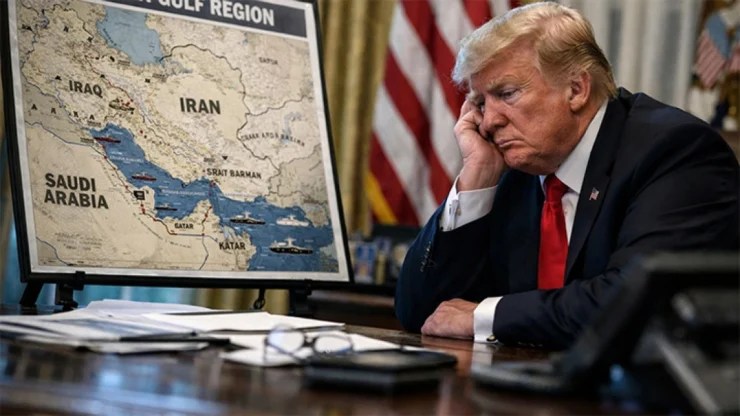
Press TV | May 22, 2026
Nearly 40 days of all-out military aggression, shadow warfare, and economic blockade have given way not to Iran’s surrender, but its emergence with a strategic upper hand.
The “Ramadan War” – an unprovoked and illegal military aggression that came amidst Oman-mediated nuclear diplomacy – ended in a way Washington and Tel Aviv never anticipated. Iran did not collapse, its alliances did not fracture and its military deterrent remained intact. And now, as the guns have fallen silent, it is Iran – not the US – that is setting the terms.
Iran’s end-of-war conditions are not maximalist bargaining ploys. Rather, they are the logical, rational, and legally grounded demands of a victor who has proven, on the battlefield and in the diplomatic arena, that aggression against a resilient nation produces only defeat.
Tehran is not asking for charity. It is demanding what is rightfully owed to a nation that has been wrongfully attacked, illegally sanctioned, economically terrorized, and yet emerging stronger, more cohesive, and more confident.
The foundational logic of ending an imposed war
The first and most critical point in Iran’s strategic calculus is remarkably simple: in any war, the side that requests a ceasefire is the side that is losing. Iran did not request a ceasefire; it was the American side. This single fact upends the conventional Western narrative that portrays Iran as an isolated, pressure-cooked “regime” desperate for a deal.
Iran’s logic is rooted in the universal, time-tested rationality of all wars. Wars do not end because both sides grow weary simultaneously. They end when one side realizes that continued fighting will produce worse outcomes than accepting the other side’s terms.
In the 40-day imposed war and its aftermath, the American-Zionist enemy – an alliance of the world’s most advanced militaries, intelligence agencies, and economic powers – failed to achieve its stated objectives. There was no “regime change.” Iran’s nuclear infrastructure remains intact. The Axis of Resistance did not collapse. And critically, Iran emerged stronger.
Had America possessed the capacity to defeat Iran militarily, it would have done so. It would not have sought a ceasefire and opened back channels for negotiation.
The very act of seeking an end to war is an admission of strategic failure. Therefore, the enemy has no right to obtain through diplomacy – through the end of war – what it could not obtain through indiscriminate force, cowardly acts of terror, and state-sponsored criminality.
This is a strategic logic and it dictates everything that follows.
The aggressor pays: Restitution, withdrawal, and end of sanctions
Because the US is the aggressor – having initiated an unprovoked war against the Iranian nation through assassinations, sabotage, cyberattacks, and direct military strikes – it must bear the full cost of the cowardly aggression.
Iran’s conditions are therefore not punitive fantasies but standard provisions in any post-war settlement where the aggressor ends up on the losing side.
Iran demands full payment of war damages and compensation for all victims of American and Israeli aggression; return of all Iranian assets and properties illegally blocked or seized; complete withdrawal of US forces from military bases surrounding Iran; termination of the illegal naval blockade that in itself constitutes an act of war; a comprehensive end to aggression on all fronts, including against Iran’s allies in the Axis of Resistance; full and verifiable lifting of all illegal sanctions against Iran, including the revocation of UN Security Council sanction resolutions and a signed end-of-war agreement enshrining these terms.
These demands are not opening bids but the minimum acceptable outcome for Iran. The enemy may negotiate over the sequencing or technical details of implementation, but the substance is non-negotiable. The aggressor pays, withdraws and lifts its illegal economic siege.
Diplomacy as a continuation of war by other means
Iran has already demonstrated its superiority in diplomacy. By forcing the American side to accept its framework for ending the illegal and unprovoked war, Tehran has demonstrated that Washington is the frustrated, failed and isolated party in this war.
The US assembled the most powerful military coalition in modern history, planned for years to overthrow the Islamic Republic or force it into fundamental concessions, and came away with nothing. None of the military objectives came to fruition and everyone acknowledges that.
Any future negotiations after the end of this imposed war will be conducted from a position of Iranian strength. Iranian negotiators will have no need to link those talks to wartime pressures. And make no mistake: Iran will enforce compliance.
Any shortcoming by the enemy in fulfilling its obligations will be met with Iranian responses below the threshold of full-scale war – a domain in which Iran operates with even greater ease and lethality. The enemy has already tested Iran in conventional war and suffered a crushing reputational, military, political, and strategic defeat. It has no appetite for a second round.
Strait of Hormuz – A prize already won by Iran
Perhaps no single issue illustrates Iran’s strategic upper hand more clearly than the Strait of Hormuz. Western analysts habitually frame the strait as a point of vulnerability for Iran, a choke point that Iran threatens to close. This is exactly backward.
Iran’s position is that the Strait of Hormuz is already an Iranian gain from the war. It is a legal, principled, and logical right that is presently in Iran’s hands. Unlike blocked assets or sanctions, which require active enemy reversal control over this strategic waterway located between the Persian Gulf and Gulf of Oman – requires no new action from Iran. It is a fait accompli.
Iran’s enhanced control over the Strait of Hormuz serves three concrete objectives.
- Security: Guaranteeing Iran’s security in the Persian Gulf against future American or Persian Gulf Arab aggression.
- Economic justice: Preventing blackmail by regional governments and securing material rights of the Iranian nation through tolls and transit fees.
- Strategic deterrence: Creating a new normal in which any future aggression against Iran must account for Tehran’s tightened grip over global energy chokepoints.
The status of the strait after the war is fundamentally different from before the war. Iran will not return to the previous order. That order – in which the US patrolled freely, imposed sanctions, and threatened Iran with impunity – is effectively dead. Iran’s permanent sovereignty over the waterway is not a demand but a reality that the enemy must accept.
Iran is not acting unilaterally or recklessly in this regard. Agreements with neighboring Oman, based on mutual interests, are necessary to consolidate Iran’s control. Iran’s diplomatic apparatus is actively pursuing these agreements.
This is not an act of belligerence but an act of responsible statecraft, embedding Iran’s strategic gain within a framework of regional cooperation.
Finally, the strait carries profound symbolic weight. Iran’s unchallenged sovereignty over the Strait of Hormuz represents the heavy penalty and fine that the aggressor must pay for having invaded Iranian territory – directly or by proxy. Every tanker that transits under terms acceptable to Tehran is a reminder that the US miscalculated catastrophically.
And if the enemy ever indulges in the fantasy of another war on Iran, it will now have to factor in Tehran’s expanded maritime and land sovereignty as a permanent, inescapable variable.
The nuclear file – Deferred but not diminished
Western media frequently portrays Iran’s nuclear program as the central point of leverage against Tehran. It is not a point of weakness, but an area of demonstrated Iranian resilience.
Throughout its long history of peaceful nuclear activities, including temporary, voluntary transparency measures, Iran has never abandoned its principles or its legal rights.
International law recognizes Iran’s right to possess the full nuclear fuel cycle. America has no authority to override international organizations and treaties and it is not the world’s nuclear policeman. The US defeat in the recent war has stripped it of any pretense to that role.
Both the US and the Zionist regime tried to force Iran’s nuclear surrender through unprovoked war and bombing campaigns, but catastrophically failed. They will also fail in any future negotiations to strip Iran of its inalienable nuclear rights. Iran’s nuclear decisions – regarding enrichment levels, research, development, and even the scope of its program – are Iran’s own business.
They are not tied to the recent war, from which Iran emerged victorious in preserving its nuclear materials, facilities, and, most critically, its scientific and engineering knowledge.
The bomb question: A clear doctrine, not an ambiguity
Donald Trump and members of his war cabinet, including war secretary Pete Hegseth, repeatedly claim that preventing Iran from obtaining a nuclear bomb is their primary objective. But here again, Iran’s position is clear and has been stated repeatedly: a nuclear bomb has no place in Iran’s defense and security doctrine.
This is not a new or ambiguous position. It is a matter of public record, reinforced by the martyred Leader of the Islamic Revolution, Ayatollah Seyyed Ali Khamenei’s fatwa (religious decree) against the development and use of nuclear weapons.
Trump cannot claim victory on an issue where no threat existed. The embattled American president does not get to factor the nuclear bomb myth as his personal achievement.
If, in the future, with changed regional circumstances and potentially a revised fatwa, Iran’s doctrine evolves, that is a matter for another time. But today, in the present, the doctrine has not changed. Iran possesses all the knowledge required to complete the nuclear cycle for peaceful development, and it will continue to exercise its inalienable rights.
The invalidity of Trump’s deadline threats
Throughout the recent war and its aftermath, Trump repeatedly resorted to a worn-out, theatrically bankrupt tactic: the artificial deadline. “Iran must agree by X date, or else.” This gimmick failed at least five times. Each time, the US president backpedaled.
This deadline threat is a psychological warfare technique designed to induce panic, haste, and unforced errors from the Iranian side. Iran has shown that it will not be rushed and it will take all the time necessary to draft a meticulous, robust end-of-war document that closes every loophole and secures national and strategic interests.
The deadline is fundamentally a threat of war. But war has already been tried. War brought the enemy nothing but humiliation, and re-entering a war cannot produce anything different.
The enemy is bluffing with a hand it has already shown and lost. Iran’s diplomatic apparatus must remain vigilant against this trick, but it need not lose sleep over it.
The Bab el-Mandeb incidents – A warning across the sea
Recent explosions and security incidents reported in the Bab el-Mandeb Strait and around Socotra Island, including a temporary shutdown of the strait for several hours, have been met with conspicuous silence from the US, the Israeli regime, and Western media outlets.
That silence is not accidental. It is the silence of an enemy that understands it has been outmaneuvered.
These incidents constitute a clear and explicit warning from the broad Axis of Resistance. If the American-Israeli enemy resumes its military adventurism against Iran, the war this time will not remain contained to the Persian Gulf. It will expand to include the Red Sea and the Gulf of Aden. Bab el-Mandeb, another global energy chokepoint, will become an active front.
Even during active negotiations to end the war, the hand of the resistance front is not tied. Iran and its allies have many available options, any of which can make conditions harder for the enemy. The message is unambiguous: military escalation will be met with geographical expansion of the war, not with Iranian retreat.
These security incidents may well be a prelude to the extra-regional translation of the war against the Islamic Republic of Iran, as previously alluded to in warnings from the Islamic Revolution Guards Corps (IRGC). In other words, the battlefield is no longer limited to Iranian soil, the Persian Gulf, or even West Asia. Iran’s enemies are being served notice that their own vulnerabilities – far from their shores – are well within reach.
American refineries – The cyber dimension
The recent chain of explosions and fire incidents in at least five American refineries and petrochemical complexes across different regions of the United States has also been underreported and underexamined by American authorities. This, too, is no accident.
These incidents demonstrate a strategic evolution that should terrify Iran’s enemies. The world has reached a stage where knowledge based on information technology has grown so advanced that it can replace physical military action in specific geographies.
Cyber capabilities, wielded by unknown actors anywhere in the world, can achieve the same results as armed assault, but without the high costs, missile range limitations, or legal and international liabilities.
Iran’s adversaries have long relied on their ability to project conventional military power globally. The refinery incidents suggest that this advantage is being nullified. An actor with sophisticated cyber capabilities can now impose severe economic costs on the American homeland without the need to fire a single missile or cross any border.
The lesson for the enemy is stark: your critical infrastructure is vulnerable. Your refineries, your grids, your financial systems – all are potential targets in a domain where traditional military superiority offers no protection. If you wage another war on Iran, you will not be safe anywhere.
Are we on the verge of a US-Iran deal?
China is emerging as the silent, indispensable diplomatic power in the region
By Trita Parsi | May 22, 2026
Nothing is confirmed and finalized yet, and the spoilers should not be underestimated, but lots of activity points in the direction of a deal.
A few things stand out:
1. The role of China in the background is essential. Without having its fingerprints on the deal, and by that, avoiding any responsibility if it fails, China is emerging as the silent, indispensable diplomatic power in the region. (While Pakistan’s Asim Munir is traveling to Tehran, the Pakistani Prime Minister will be departing for Beijing shortly)
2. The regional involvement in the mediation is astounding: Pakistan, Qatar, Egypt, Turkey, Saudi and Oman are all or have all been playing an instrumental role in moving things forward. If a deal is reached, it will have regional buy-in (save from Israel and the UAE) at levels far beyond the JCPOA.
3. Regional diplomats and intel folks have been shuttling in and out of Tehran for weeks now. Qatar’s role, in particular, is noteworthy.
4. Europe’s absence is noticeable but not felt, as its irrelevance is becoming normalized.
5. More ships have been passing through the Strait of Hormuz. Whether these were mainly tankers going to China, and whether China paid a fee, is unclear at this point. But it is noteworthy that the ships are passing through both the Iranian AND the American “blockades.”
6. Though some distance remains to reaching a deal, my own conversation with folks on both sides has left me slightly more optimistic, primarily because of the flexibility I am detecting on the Iranian side regarding the stockpile (despite the Reuters story from yesterday). Ideas that were categorically rejected two weeks ago are now being genuinely considered.
7. If a deal is secured, Trump will face a lot of criticism from the Blob and the pro-Israel crowd in DC, but he will be in a very good position to sell the deal to the American public, whose concerns are very different from those of the Blob…
Revealed: USAID, NED & Open Society Quietly Bankroll Cuba’s “Independent” Media In Push for Regime Change
By Alan MACLEOD | MintPress News | May 15, 2026
Amid escalating U.S. aggression towards the Cuban island through a maximum pressure campaign and the threat of military intervention, the United States government has been covertly funding a huge network of Cuban media outlets that claim to be independent in a push for regime change against the independent socialist government.
These outlets present themselves as unbiased investigative journalism, but are quietly being financed by Washington through USAID, the National Endowment for Democracy and the Open Society Foundation in order to sow discontent across the Caribbean nation, softening it up for a potentially “imminent” invasion by the Trump administration.
Cuba faces some of its worst energy blackouts in its history, thanks to the U.S. blockade, which is attempting to strangle the island into submission. As a Communist state defying U.S. orders, Cuba has, since 1959, been in the crosshairs of Washington, who are attempting to overthrow the government. MintPress sheds light on this shady regime change nexus.
Independent Journalism, Brought To You By The State Department
CubaNet is one of the most influential and well-established news outlets covering affairs on the Caribbean island. Founded by anti-government activists in 1994, the site has become the go-to source of information for corporate media, who regularly cite it, and present it as an objective and unbiased independent media (e.g., The Washington Post, The Wall Street Journal, Fox News, and The Los Angeles Times ). CubaNet reporters have written op-eds in major U.S. newspapers such as USA Today, calling for an immediate change in government on the island.
But CubaNet is not as independent as it seems. The outlet is bankrolled by the U.S. national security state. CubaNet has received millions of dollars in funding from USAID and the National Endowment for Democracy, as well as the Open Society Foundation.
One currently active $500,000 USAID grant, for instance, was awarded to CubaNet to “engage on-island young Cubans through objective and uncensored multimedia journalism.” While ostensibly a laudable goal, even the grant’s own one-sentence description hints that its purpose is to undermine and attack the Cuban government. It states that it will (emphasis added) “increase the free flow of information to and from Cuba in order to offset the regime’s disinformation campaigns.”
Another news organization receiving huge sums of money from Washington is ADN Cuba. Literally meaning “Cuba’s DNA,” the outlet has amassed a significant following online, boasting over 100,000 subscribers on YouTube, over 200,000 on Instagram, and over 1.3 million on Facebook. It describes itself as “an independent media outlet committed to freedom and democracy in Cuba.” Yet it is actually based in Spain. And it does not seem particularly committed to transparency about its funding.
What is clear, however, is that ADN Cuba has received millions of dollars from the U.S. national security state. In September 2024, USAID approved a $1.1 million grant to ADN Cuba – a gigantic amount of money for an organization that publishes barely one story per day on its website. This was on top of a $1.5 million allocation for the 2022-2024 period. Indeed, since 2020, ADN Cuba has received in excess of $3 million from USAID alone. This relationship is not disclosed to readers– even in stories directly covering USAID funding Cuban media– and is relegated to the footnotes of obscure U.S. government funding databases.
Diario de Cuba is another Spanish-based news outlet that publishes a wide variety of stories, all with one thing in common: a deep aversion to the Cuban government. The BBC describes it and CubaNet as key sources for impartial news, run by journalists who “report without censorship and to paint a broader picture on the country’s reality.”
And just like CubaNet, Diario de Cuba has received seven-figure funding from Washington. Between 2016 and 2020, Diario de Cuba received $1.3 million in USAID cash – almost as much as CubaNet over the same period. This generous funding has allowed it to reach a global audience, with over 600,000 followers on Facebook alone.
Regime Change Networks
The Central Intelligence Agency used to directly (and secretly) sponsor hundreds of media outlets across the world. However, after a series of scandals and more information about its nefarious activities came to public attention, Washington decided to outsource many of its most controversial foreign operations to organizations such as the National Endowment for Democracy and the U.S. Agency for International Development.
“It would be terrible for democratic groups around the world to be seen as subsidized by the CIA,” Carl Gershman, the NED’s longtime president, said, explaining the 1983 decision to create his organization. NED co-founder Allen Weinstein agreed: “A lot of what we do today was done covertly 25 years ago by the CIA,” he told The Washington Post.
Under the guise of democracy promotion and human rights, the U.S. government channels money to political and social groups across the world in order to maximize its strategic goals, including regime change.
In recent years, the U.S. has used the twin organizations of the NED and USAID to bankroll anti-government protests in Hong Kong, to attempt a color revolution in Belarus, to overthrow the government of Ukraine in 2014, and to organize riots across Iran earlier this year.
In Cuba, the NED and USAID played a critical role in organizing a (failed) uprising against the government in 2021. USAID in particular spent millions of dollars funding, organizing and promoting the San Isidro Movement – a collective of musicians, artists, and journalists– to lead a counter-revolution on the island.
San Isidro members were at the forefront of a wave of nationwide protests that July. The demonstrations were immediately signal boosted by Western corporate media, top celebrities, and U.S. politicians, including President Biden. Netizens were flooded with the astroturfed “SOS Cuba” campaign, that trended across the Internet for days.
In the end, however, the coordinated efforts of the U.S. failed to convince ordinary Cubans to take to the streets, and the movement quickly petered out.
Esteban Rodríguez, a key member of the San Isidro movement, is a producer at ADN Cuba.
When U.S. Money Is Paused, “Independent” Media Immediately Collapse
The importance of U.S. government money to the survival and operations of these outlets was underlined early last year when the Trump administration chose to freeze funding to USAID and the NED. Announcing the decision, Elon Musk, then head of the Department of Government Efficiency, described USAID in particular as a “viper’s nest of radical-left Marxists who hate America.”
The effect on Cuban media was immediate. As soon as the money stopped flowing, dozens of organizations faced immediate liquidation. CubaNet published an emergency editorial asking readers to make up the shortfall. “We are facing an unexpected challenge: the suspension of key funding that sustained part of our work.” they wrote; “If you value our work and believe in keeping the truth alive, we ask for your support.” “Without [USAID] funds, it will be extremely difficult to continue,” CubaNet director Roberto Hechavarría Pilia added.
Diario de Cuba was in similarly dire straits. Its director, Pablo Díaz Espí, noted that “aid to independent journalism from the government of the United States has been suspended, which makes our work more difficult,” asking readers to donate.
Musk’s decision accidentally revealed a sprawling network of over 6,200 reporters and nearly 1,000 outlets worldwide that were quietly being trained, supported, and bankrolled by the CIA front, all under the banner of promoting “independent” media and freedom of information.
Another supposedly independent Cuban outlet plunged into crisis was El Toque (The Touch). Founded in 2014 and receiving hundreds of thousands of dollars from the NED, El Toque publishes in Spanish and English, and attempts to manipulate the exchange rates in Cuba.
The funding cut hit them badly, with editors announcing that they would immediately have to lay off half their staff (15 people) and stop working with dozens of freelancers, while looking for alternative funding sources.
El Estornudo (The Sneeze), is also generously financed by NED. In 2021 alone, the endowment awarded the investigative journalism outlet $180,000. It also receives copious support from the Open Society Foundation, although it insists that none of this U.S. money comes with any strings attached or affects its output.
While Western media often portray the Cuban media landscape as a David-and-Goliath fight between plucky independent media facing repression, and a sprawling state-sponsored propaganda apparatus, the gigantic sums handed out to these “underdogs” make them by far and away the best funded outlets on the island. A 2023 Guardian article, for instance, profiled 24-year-old photojournalist Pedro Sosa, who worked for both El Toque and El Estornudo. It presented the pair as “offer[ing] real reporting over stodgy state media” and journalists as poor and vulnerable truth tellers standing up for “freedom,” and facing a “crackdown” from the state.
But it also let slip that working for U.S.-backed media is not as bad a career move as portrayed, and is, in fact, an extremely lucrative profession. It casually mentions that salaries at tiny El Toque are ten times that of even the most senior journalists working in Cuban state media. In reality, then, these oppressed free speech warriors are actually some of the richest individuals on the entire island, thanks to the power of the U.S. dollar, which pays them handsomely to produce a constant stream of anti-government news.
In the end, the U.S.-backed outlets need not have worried, and NED and USAID funding resumed after some restructuring.
Jobs For the Boys
All this, however, pales in comparison to the resources the U.S. has dedicated to Radio and TV Martí. Founded in 1985 by the Reagan administration, the Miami-based network boasts dozens of full-time employees and receives tens of millions of dollars from Washington annually.
Unlike the rest of the journalism industry, workers at Radio and TV Martí enjoy strong job security and six-figure wages, despite the fact that the Cuban government is able to jam and block many of their broadcasts from reaching Cuba, meaning precious few people consume its content.
Since its creation, Washington has spent at least $800 million on Radio and TV Martí.
The outlets profiled make up only a small portion of the network of anti-government media being funded by the United States. Most of the recipients of American money remain anonymous – a decision taken in part to hide their identities and preserve their credibility inside Cuba.
The National Endowment for Democracy considers Cuba a “long-standing priority,” and is currently officially funding 32 separate projects on the island.
Media related grants include one $80,000 project titled “Strengthening Access to Information,” which promises to:
“[E]nhance access to information and promote critical thinking, the organization will produce daily reporting and analysis across various formats, providing independent perspectives on issues affecting citizens’ daily lives, including freedom of expression, public safety, human rights, and other pressing social concerns.”
Another $115,000 grant, titled “Expanding Access to Uncensored Media” notes that it will:
“[P]romote independent information, the organization will provide narrative journalism on censored topics, conduct investigations, and produce in-depth articles, photo essays, and opinion pieces while strengthening the media’s operational capacity.”
Thirty-one of the thirty-two projects hide the recipient’s name and identification, meaning that those groups working with the CIA cutout organization are generally only ever identified if they advertise this relationship, or, like when U.S. money was temporarily halted in 2025, they call for help.
Anti-government media are only a small portion of the huge array of groups Washington secretly funds and supports. From musicians and academics, to civil society, educational, and religious groups, to think tanks, charities and NGOs, there exists a vast nexus of organizations receiving vast sums of money from the U.S. government.
Two of these bodies include The Observatorio Cubano de Derechos Humanos (Cuban Observatory of Human Rights, or OCDH) and lawyers’ group, Cubalex.
Both groups produce reports denouncing the Cuban government, and are regularly cited as impartial authorities on human rights on the island in Western outlets, such as The New York Times, CNN, and The Washington Post. But what readers are not told is that both organizations are bankrolled by the U.S. national security state.
Records show that USAID has given almost $1.5 million to the OCDH. NED support, meanwhile, was crucial to Cubalex’s inception in 2010, and Washington continues to pay its staff wages to this day. As the company’s executive director, Laritza Diversent said last year,
“Without the support of National Endowment for Democracy, Cubalex would not have existed; to do the work we do requires resources. For 14 years, NED has been supporting us. Last October, after trying a lot of times, we [also] achieved a state Department grant.”
Thus, there is barely a corner of the anti-government Cuban opposition that has not been reached by U.S. money, either through government organizations such as the NED or USAID, or through institutions such as the Ford Foundation and Open Societies Foundation, which have historically performed a similar role in promoting American interests abroad.
Many of these groups are headquartered in South Florida, where U.S. government money is helping to subsidize thousands of jobs for the Cuban-American community. It is therefore no exaggeration to say that a significant part of Miami economy is propped by taxpayer money funding counter-revolutionary forces. Ironic, considering that conservative Cubans often vehemently object to government welfare programs in both the U.S. and Cuba.
Digital Bombardment
In 2010, a new social media and messaging app, Zunzuneo, took Cuba by storm. From nowhere, it went viral, picking up tens of thousands of users – a very large number for the time on such an internet-sparse island.
None of its users, however, were aware that the platform had been secretly created by USAID in order to promote regime change. Their plan was to first provide an excellent service that would capture the market, then to slowly drip feed Cubans anti-government messaging, and finally to direct them to join “smart mobs”, aimed at triggering a color revolution.
In an effort to hide its ownership of the project, the U.S. government held a secret meeting with Twitter founder Jack Dorsey, aimed at getting him to invest in the project. It is unclear to what extent, if any, Dorsey helped, as he has declined to speak on the matter.
Zunzuneo was abruptly shut down in 2012, perhaps because the Office of Cuba Broadcasting (which oversees TV and Radio Marti) had already created a new program called Piramideo.
Piramideo marketed itself as an app that allowed Cubans to receive world news for free, and without censorship. Almost immediately, however, locals reported being deluged with fake news about anti-government protests that never happened. Piramideo was shut down in 2015, after reporting on U.S. government meddling in Cuba caused a scandal and diplomatic embarrassment.
Today, however, with Cubans increasingly using American social media apps, this kind of subterfuge is largely unnecessary, as it can be done out in the open. During the 2021 San Isidro protests, apps such as Instagram and Twitter were openly participating in the attempt to overthrow the government, taking no action against a massive boom of clearly fake bot accounts parroting the exact same messages (down to the typos) and using the same astroturfed hashtag. Twitter’s editorial team even placed the protests – which drew barely a few thousand people into the streets nationwide – at the top of its “What’s Happening” for over 24 hours, meaning that every user worldwide would be notified. The failed putsch has come to be known as the “Bay of Tweets.”
Unending War on Cuba
In October, for the 33rd consecutive year, the United Nations voted overwhelmingly (165-7) to call for an end to the American blockade against Cuba. This economic war was established by the Eisenhower administration, in response to the Cuban Revolution of 1959, which overthrew the U.S.-backed dictator, Fulgencio Batista.
These illegal unilateral coercive measures, which an internal U.S. government memo states are designed to “decrease monetary and real wages, to bring about hunger, desperation and overthrow of government,” cost Cuba billions every year, and severely impede its development.
The U.S. attempted to invade Cuba in 1961, and brought the world to the brink of annihilation during the subsequent Cuban missile crisis. It reportedly attempted to kill its leader Fidel Castro hundreds of times, and carried out waves of terror attacks against the country, including using biological weapons on the island.
Successive administrations continued the economic war against Cuba, which was ramped up after the fall of the Soviet Union. But the Trump State Department, run by Cuban-American Marco Rubio, has taken it to a new level, declaring the island to be one of its top priorities.
Trump himself has declared that Cuba is “next” on the list of countries being targeted for regime change. “We may stop by Cuba after we’re finished” with Iran he said last month.
In response, Cuban president Miguel Díaz-Canel said his country was ready to repel any U.S. invasion, as it did during the Bay of Pigs, stating:
“The moment is extremely challenging and calls upon us once again, as on April 16, 1961, to be ready to confront serious threats, including military aggression. We do not want it, but it is our duty to prepare to avoid it and, if it becomes inevitable, to defeat it.”
It is in this context that the U.S. government’s funding of a vast array of media outlets targeting Cuba should be seen; the media attack is just one facet of Washington’s multipronged approach to regime change.
Many of the organizations profiled here publish in English, and nearly all are used as supposedly credible sources of information on Cuba for Western corporate media, meaning that U.S. State Department narratives are laundered into the public consciousness through this network.
Many Cubans and Americans are completely unaware that their news about the island comes largely through a matrix of shady outlets quietly funded by the U.S. national security state via the NED and USAID. Their purpose is to keep up the flow of negative stories in order to soften the public up into accepting regime change on the island. After all, in war, truth is always the first casualty.
The Rape of Nanking: Massacre or Myth?

By Jonas E. Alexis • Unz Review • May 21, 2026
The Rape of Nanking: The Forgotten Holocaust of World War II by Iris Chang was unquestionably an incendiary and highly tendentious work that quickly generated considerable controversy in both the United States and Japan following its publication in 1997. The book received praise from major publications such as the Wall Street Journal, The Atlantic, the Chicago Tribune, and the Philadelphia Inquirer.
The book achieved such remarkable success that it prompted then fifty-year-old Ted Leonsis, vice chairman of AOL, to produce the documentary film Nanking, which he described as a “labor of love.”[1] According to Ted Leonsis, the film was intended to be comparable to Steven Spielberg’s Schindler’s List.[2]
Chang, who was Chinese American, was only twenty-seven years old when she began writing The Rape of Nanking. However, Chang died by suicide in 2004 near Los Gatos at the age of thirty-six.[3] Before taking her own life in her automobile, Chang left three suicide notes, one of which stated in part:
“I can never shake my belief that I was being recruited, and later persecuted, by forces more powerful than I could have imagined. Whether it was the CIA or some other organization I will never know. As long as I am alive, these forces will never stop hounding me.”[4]
Whether Iris Chang’s fears were intensified by the medications she was taking, or whether she genuinely believed that certain organizations were pursuing her, lies beyond the scope of the present analysis. Her references to groups such as the CIA raise additional questions regarding the nature and origin of those concerns.
In any event, what remains undeniable is that Iris Chang’s book helped revive widespread public discussion of the so-called Nanjing Massacre. In a 1998 review of the work, George Will of the The Washington Post declared that: “it has stimulated seminars and conferences at Harvard, Yale, Princeton and many other places, and is assisting those honorable Japanese who are combatting their country’s officially enforced amnesia regarding what the Imperial Army did in December 1937 and January 1938.”[5]
In the same article, Will agreed with Chang’s position and declared that
“Japanese soldiers killed tens of thousands of surrendered Chinese soldiers and almost certainly more than 300,000 noncombatants. (Civilian deaths at Hiroshima and Nagasaki totaled 210,000. Britain and France suffered a combined total of 169,000 civilian deaths from 1939 to 1945.) The Nanking killing continued for seven weeks in front of international witnesses, without any attempt at concealment, and with the sadism of recreational killing. Chinese were used for bayonet practice and beheading contests. People were roasted alive, hanged by their tongues from hooks, mutilated, drowned in icy ponds, buried up to their waists and then torn apart by German shepherds, buried up to their necks and run over by horses or tanks. In addition to pandemic rape by Japanese soldiers even of young children, some of them tied to beds or posts for days, fathers were forced to rape their daughters, sons their mothers.”[6]
According to these accounts, the alleged atrocities occurred within a period of less than two months. The implicit assumption, therefore, is that Japanese soldiers were killing approximately 5,000 civilians each day! An obituary published in the New York Times similarly stated that “in less than two months they [the Japanese] murdered more than 300,000 civilians and raped more than 80,000 women.”[7] Chang placed the estimated number of rape victims between 20,000 and 80,000, rather than “more than 80,000.” Chang wrote:
“Many soldiers went beyond rape to disembowel women, slice off their breasts, nail them alive to walls. Fathers were forced to rape their daughters, and sons their mothers, as other family members watched. Not only did live burials, castration, the carving of organs and the roasting of people become routine, but more diabolical tortures were practiced, such as hanging people by their tongues on iron hooks or burying people to their waists and watching them torn apart by German shepherds. So sickening was the spectacle that even Nazis in the city were horrified.”[8]
Such an extraordinary claim would appear to require equally extraordinary evidence, thereby prompting several preliminary questions. Why did Mao Zedong— who had Jews fighting for him[9] and who later presided over policies that allegedly resulted in the deaths of tens of millions of Chinese citizens[10]—not make substantial use of this alleged evidence against Japan? Why did he never publicly suggest that Japanese soldiers were raping more than 1,300 women per day during the events in question? Is it being suggested that Mao was entirely unaware of such allegations, or that he failed to recognize their potential political significance?
Why did Chiang Kai-shek—who received support from both the Soviet Union and anti-Japanese propagandists such as Morris Cohen and Harold Isaacs in the United States—fail to address these allegations in any substantial manner? Moreover, if Harold Isaacs was deeply sympathetic to revolutionary movements in Asia and maintained associations with figures connected to Leon Trotsky, why did he not emphasize these claims more prominently in his own political and journalistic work?[11] One may ask whether Chang exaggerated certain aspects of the events in question or incorporated claims that were insufficiently substantiated or even fabricated, whether deliberately or unintentionally.
At this point, it is important to note that the book cannot be taken seriously, largely because her book omits many of the issues and questions raised above. Moreover, unlike historians such as David Irving, whose works are often grounded extensively in archival research, Chang’s book relies heavily on secondary sources rather than primary archival documentation. Furthermore, unlike detailed historical studies such as Orderly and Humane: The Expulsion of the Germans after the Second World War by R. M. Douglas, Hitler’s Jewish Soldiers: The Untold Story of Nazi Racial Laws and Men of Jewish Descent in the German Military by Bryan Mark Rigg, Hitler’s War by David Irving, or After the Reich: The Brutal History of the Allied Occupation by Giles MacDonogh,[12] Chang’s ambitious work is not primarily based on extensive archival materials or a substantial body of primary-source evidence. This is not to suggest that there is anything inherently problematic about the use of secondary sources. Rather, the concern is that many of the sources upon which Chang relied contain their own uncertainties, ambiguities, or expressions of skepticism.
In all honesty, assessing Chang’s The Rape of Nanking is almost like scrutinizing Daniel Jonah Goldhagen’s Hitler’s Willing Executioners: Ordinary Germans and the Holocaust, a fraudulent book which was quickly denounced for its historical inaccuracies, methodological weaknesses, and a lack of balance. Hitler’s Willing Executioners is indeed filled with citations, but they were largely distortions of the actual facts.
In fact, Goldhagen made things up whenever possible in order to prove the preposterous thesis that ordinary Germans were responsible for what happened to Jews in Nazi Germany. When scholars exposed his clear errors and deliberate deceptions, Goldhagen did not apologize. Instead, he wanted to sue those scholars—a response that is completely contrary to genuine scholarship and historical research.[13] Of course, the Holocaust establishment had an interest in promoting Goldhagen’s threadbare hoax. Like Goldhagen’s book, the American establishment also almost certainly had an interest in promoting Iris Chang’s The Rape of Nanking. After all, didn’t Japan attack Pearl Harbor? Didn’t Japan ally itself with Germany? Wasn’t Japan considered one of the villains of the war?
What is especially striking about this controversial debate is that Chang deliberately left out important issues from her book—issues that would have seriously weakened her thesis. For example, she never mentioned the Tongzhou Incident, which took place in the same year as the alleged Nanking Massacre.. In July 29, 1937, a group of some 3,000 Chinese soldiers ambushed Japanese garrison’s barracks
“and proceeded to raid Japanese shops, inns, and private homes. Approximately 200 of the 380 Japanese residents of Tongzhou were slaughtered. The 120 who survived did so only because they fled to the barracks, seeking refuge, before they were surrounded. These acts were flagrant violations of international law relating to the conduct of war (hereafter referred to as ‘international law’). Four days after the incident, the aforementioned director officially condemned the Chinese troops for the abduction, rape, and slaughter of Japanese citizens. Defense attorneys submitted his statement to the Tokyo Trials, but it was rejected by William Webb, the presiding justice, without explanation. The Allies were unwilling to allow any mention of the Tongzhou Massacre in the courtroom.”[14]
In April of 1947,
“defense attorney Levine called Kayashima Takashi (a former lieutenant-general in the Japanese Army) to the witness stand.” Takashi testified that the Chinese were committed brutal acts of rape and murder. His soldiers were called to Tongzhou in order to rescue the Japanese settlers. His accounts obviously make one wonders why Chang completely dismissed the entire incident in her book: The scene inside the town was ghastly. Brutally murdered bodies of Japanese settlers were lying everywhere. Most of them had ropes tied around their necks. I had to force myself to look at the mutilated corpses of women and innocent children. I no longer have the report I wrote at the time. I have relied on my memories for this statement. But I assure you that what I witnessed was so horrifying that I will never be able to forget it.
“I went to a restaurant (I think it was called Asahiken) to investigate. There were seven or eight women there, ranging in age from 17 or 18 to 40. They had all been raped, and then shot to death as they lay naked on the floor. Four or five of them had been stabbed in the genitals with bayonets. … The living quarters had been ransacked, and all the furniture, bedding, and clothing stolen. The situation was virtually the same at the homes of the other Japanese victims. The scene at the Kinsuiro Inn was gruesome. Since many of the Japanese had gathered there, sensing danger, there had been mass carnage. … The owner of Kinsuiro and the maids had been tied together, raped, and decapitated.”[15]
Similar incidents also took place in places such as Tanggu and Tianjin. The Japanese made several attempts to resolve the conflict peacefully, but those efforts failed. In fact, a peace conference between the Japanese and the Chinese was scheduled in Shanghai for August 9, but it never took place because soldiers from the Chinese Peace Preservation Corps killed Navy Sublieutenant Oyama Isao and First Class Seaman Saito Yozo on that very day.[16]
Edouard Helsey, China’s correspondent for a Paris newspaper, wrote in 1938:
“An unfortunate incident occurred on August 9, in which a Japanese naval officer was murdered by Chinese sentinels from the Rainbow (Hong) Bridge Airfield. Perhaps the Japanese officer should have been more cautious, but there is no denying that this was a Chinese plot. It is clear that the Nanking government had decided to go to battle in Shanghai at least 15 days prior to this incident. Their plan was not simply to split the Japanese forces in South China, but also to entice them into the Neutral Zone, which act would certainly cause international problems. It was a malicious trick, this engineering of incident upon incident, the misinterpretation of which would sway public opinion in the West.
“Chiang Kai-shek himself concurred that that was his intention, and he seemed rather pleased with himself. When I met with him at the end of October (1937) in Nanking, I asked him the following question. ‘That was a clever ploy, since Shanghai is a thorn in Japan’s side. Until it is extracted, the Japanese will be paralyzed, will they not?’ Chiang replied, through an interpreter: ‘You are right. I believe it was successful.’ At that time, the Japanese government and military authorities were attempting to avoid a war. They viewed an attack on Shanghai as a real danger.”[17]
During the Second Sino-Japanese War, about 22,000 Japanese living around the Yangtze River evacuated to Shanghai. It was agreed that the Japanese government had the right to protect those citizens in that area. At the same time, many foreigners from the United States, Britain, France, and Italy were also living in Shanghai. Because of the Boxer Rebellion around 1900, these governments had signed agreements with China that explicitly gave them the right to protect their citizens in Shanghai. So by August 11,
“Japan dispatched a naval landing party of 4,000 to Shanghai, to protect the lives and property of Japanese citizens. But by then, the Chinese force, shielded by pillboxes and creeks, had already swelled to 150,000. Therefore, the Japanese government decided to send two more divisions from Japan to Shanghai on August 13. On the night of August 14, five days after Sublieutenant Oyama was assassinated, as hostilities and tension heightened, Chinese Air Force planes bombed Shanghai. Several aircraft flew toward Shanghai at 10:00 a.m., and dropped bombs on the Japanese Consulate, Naval Landing Force Headquarters, Japanese warships, and on the streets of Shanghai. At about 4:00 p.m., a dozen aircraft bombed the moored warship Izumo, the French Settlement, and the International Settlement. An entry in The China Year Book 1938 reads ‘Chinese planes drop bombs in International Settlement.’ Those bombs killed 1,741 persons and wounded 1,868. Most of the victims were Chinese. The Chinese Air Force had intentionally dropped bombs on its own people, setting a world record, however disgraceful.”[18]
All of these historical backgrounds were completely omitted from Chang’s The Rape of Nanking. Chang claimed that Nanking’s population was around 600,000 when the city fell, but independent estimates place the population closer to 200,000 to 250,000. “The population did not reach 600,000 until June 1940, 30 months after the Japanese occupied the city.”[19]
It gets more interesting. As historian Higashinakano Shudo convincingly puts it,
“If 300,000 were indeed massacred over a period of two months, then 5,000 people would have been killed each day, at a rate of three or four per minute, for a period of 60 days… The total area of the Safety Zone was only 3.86 square kilometers. If, in such a small space, 100,000, or 300,000, individuals were massacred, there would have been corpses everywhere.”[20]
If Chang’s claims are incorrect, then what is the historical truth behind the debate? Is it historically accurate to say that the Japanese mercilessly tortured and massacred more than 300,000 noncombatants and raped between 20,000 and 80,000 women? What would the Japanese military have gained from such actions? And is it reasonable to believe that the international community knew these events were taking place and did nothing?
Japanese historian Shudo Higashinakano wrote in his documented work The Nanking Massacre: Fact versus Fiction that Chang’s book “relies on faked photographs and hugely exaggerated accounts.”[21]
Higashinakano also sent Penguin, the publisher of The Rape of Nanking, a list of no fewer than ninety historical errors found in just the first sixty pages of the book. Penguin eventually corrected some of those errors.[22]
Higashinakano was not the only historian to point out factual errors in Chang’s book. Shortly after the book was published, Ikuhiko Hata, one of Japan’s leading historians, wrote a lengthy article highlighting what he described as serious deceptions involving at least eleven photographs used in the book. I also had the opportunity to receive Hata’s book on comfort women in South Korea through one of his university associates. As the San Francisco Chronicle put it one year after Chang’s book was published:
“One photo, which the book credits to the military Politburo of the Chinese Nationalist government, shows women and children walking across a bridge with Japanese soldiers, and carries the caption: ‘The Japanese rounded up thousands of women. Most were gang-raped or forced into military prostitution.’ “The truth is, Hata said, that, although the photo was published with a similar caption by the Chinese Nationalists in 1938, apparently as anti-Japanese propaganda, it originally appeared the previous year as one of four in a Japanese newspaper, Asahi Gurafu, showing peaceful scenes of Chinese villagers under Japanese occupation, with women and children returning home from the fields.
“In the sharper original photo, it is possible to see that two of the villagers are smiling, and there is a woman pulling a cart of freshly harvested cotton that was cropped out of the Nationalist Chinese version. The cropped photo appeared in a recent book on Nanjing by a Japanese professor as an illustration of Japanese army atrocities in China. But after its interpretation was challenged, the publisher of his book apologized and retracted it.
“Other mistakes occur in Chang’s book, which quotes as ‘compelling evidence’ a secret telegram by Japan’s foreign minister admitting that Japanese troops, ‘in a fashion reminiscent of Attila and his Huns,’ had slaughtered ‘not less than 300,000 Chinese civilians.’ This was, in fact, a quotation from the cable of a British reporter, and concerned deaths not only in Nanjing but elsewhere. The book also describes Japan as the first nation to use air power ‘as a means of terrorizing civilian populations,’ a distinction generally attributed to the Germans in World War I.”[23]
Chang’s thesis is now beginning to fall apart. Historian David M. Kennedy of Stanford noticed similar problems. Although Kennedy praised the book, especially for its many photographs—likely unaware that critics had challenged the authenticity of several of them—he still stated that the book contains “intellectually insufficient” assertions.[24] In a similar vein, historian Roger B. Jeans of Washington and Lee University declared that Chang’s book is “half-baked history.”
Chang, said Jeans, was “greatly inflating the population of Nanjing (Nanking) at that time and uncritically accepting the Tokyo War Crimes Tribunal and contemporary Chinese figures for the numbers of Chinese civilians and soldiers killed.”[25] Historian Timothy M. Kelly put the final nail in the coffin. When academics and the media were praising Chang’s book, Kelly wrote:
“In light of the discrepancies I found in Chang’s book, it makes me wonder whether any of the reviewers know enough about the subject (Chinese and Japanese history, WWII, war crimes, historiography, not to mention the pertinent scholarly literature) to venture an informed opinion about the merits of Chang’s book… The mass media and those who write for it are often incredibly irresponsible and they need to be told so.”[26]
Kelly argued that the problem with the book can be placed in four categories: “simple carelessness, sheer sloppiness, historical inaccuracies, and shameless plagiarism.”[27]
Kelly provided multiple examples to support his accusations—far too many to discuss in full here. We will mention only a few of them. On page 166 of her book, Chang writes: “The Westerners themselves were often sprayed with Lysol upon entering the city.” Kelly responded,
“It’s incredulous that Chang would use a brand name here. Does she expect her readers to believe that Japanese authorities really sprayed foreigners with the particular product called Lysol? Surely the generic word ‘disinfectant’ would have been more adequate, not to mention accurate.”[28]
On page 13, Chang says: “In the documentary In the Name of the Emperor, one Japanese historian dismisses the entire Rape of Nanking with these words: ‘Even if twenty or thirty people had been killed, it would have been a great shock to Japan.” Kelly responded: “Chang does not identify this historian here or in the Notes section. Who is this historian? Is he/she a major or minor player? What impact has this historian had?”[29]
Chang: “When Shanghai finally fell in November, the mood of the imperial troops had turned ugly, and many, it was said, lusted for revenge as they marched toward Nanking.” Kelly: “Chang does not document the source of this statement, that is, who said it. This rhetorical device only gives the appearance that Chang is reporting fact.”[30]
Chang: “In July 1853, he (Matthew Perry) sent two ships belching black smoke into Tokyo Bay — giving the people of Japan their first glimpse of metal-clad, steam-powered ships. Surrounding himself with some sixty to seventy aggressive-looking men armed with swords and pistols, Perry strode through the capital of the Shogun and demanded meetings with the highest-ranking officials in Japan.”
Kelly: “The capital Chang refers to here is Edo, the present-day Tokyo. The historical truth is that Perry never set foot in the capital. He was officially, though reluctantly received, after some delay, on the beach at Uraga, some 35 miles from Edo at the entrance to Edo Bay, which has since been renamed Tokyo Bay. At the completion of the ceremonies Perry ordered his fleet of four vessels to a new anchorage about ten miles into the Edo Bay. He later proceeded in the Mississippi further into the bay to a point where he could see the Shinagawa area of Edo.”[31]
Chang: “In March 1944, the United Nations created the Investigation of War Crimes Committee …” Kelly: “How is this possible? The United Nations was not chartered until October 24, 1945. Chang again has her facts wrong.”
Once again, that is only the tip of the iceberg. If you believe Chang’s book is accurate, Kelly’s detailed research will likely come as a major shock. Even historian Takashi Yoshida Western Michigan University, who does not support the Japanese revisionist interpretation of what happened in Nanking, admits that Chang’s book contains “numerous errors and inaccuracies.”[32]
Even if we grant Chang’s questionable thesis that The Rape of Nanking is somehow accurate, it still would not fit with what the Allies actually did to Japan after World War II. Chang never discussed the fact that the Allied forces—especially the United States—committed sexual crimes and abuses, including the rape of many Japanese civilians, after the war. She called on Japan to apologize and pay reparations, yet she said nothing about what the United States did to Japan after the bombings of Hiroshima and Nagasaki.
Moreover, Chang never discussed reports that some Chinese soldiers raped Chinese women and then blamed the crimes on Japanese soldiers. Even The New York Times—hardly a Japanese propaganda outlet—published an article in 1938 titled, “Ex-Chinese Officers Among U.S. Refugees: Colonel and His Aides Admit Blaming the Japanese for Crimes in Nanking.” It stated:
“The ex-Chinese officers in the presence of Americans and other foreigners confessed looting in Nanking and also that one night they dragged girls from the refugee camp into the darkness and the next day blamed Japanese soldiers for the attacks.”[33]
When the American professors who had protected those former Chinese officers realized that the officers themselves were involved in wrongdoing, they became “seriously embarrassed.”[34]
Chang mentioned none of these. Shudo argues:
“20 days before and immediately prior to the fall of Nanking, the city’s population was 200,000, according to Europeans and Americans who were there at the time. Eight days after the fall and on Christmas Eve, it was still 200,000. No one indicated a vast decrease in population due to mass slaughter. Confronted by these facts, how can anyone claim that 300,000 noncombatants were murdered in Nanking?
“Prior to the capture of the city, Chinese troops stripped off their uniforms and mingled with the civilian population. By doing so, they became unlawful combatants not protected by the Regulations Concerning the Laws and Customs of War on Land annexed to the Hague Convention. No Chinese military personnel inside the city walls surrendered to the Japanese. Accordingly, during the 11-year period spanning December 13, 1937, the day Nanking fell, to December 1948, when the Tokyo Trials ended, no one accused Japanese troops of having killed prisoners of war in violation of the aforementioned regulations. Confronted with these facts, how can anyone claim that the Japanese murdered prisoners of war?
“The Japanese are accused of having murdered 7,000 persons each day, i.e., 300,000 persons over a period of six weeks. But according to ‘Daily Reports of Serious Injuries to Civilians,’ the only killing witnessed by a European or American in Nanking was one ‘lawful execution.’ The contents of these reports (issued on a daily basis and submitted to the Japanese Embassy in Nanking) are corroborated by data gathered from the testimonies of European, American and Chinese residents in Nanking, and from Japanese military records (all of which data has been computerized and analyzed). How do we explain a massacre with no witnesses?”[35]
Harold Timperley, a British reporter for the Guardian, wrote the book What War Means, which helped spread the claim that Japanese forces were frequently killing civilians. However, the book itself did not provide documented evidence to support those accusations. Shudo continued:
“Rev. Miner Searle Bates and George Fitch submitted material for What War Means (both used pseudonyms). The ostensible intent of the book, edited by Timperley, was to impress upon the reader the horrors of war via accounts written by disinterested parties (European and American residents of Nanking). But Timperley was, in fact, an advisor to the Nationalist government’s Ministry of Information. Rev. Bates, a famous Christian missionary who taught at the University of Nanking, was also an advisor to the Ministry of Information. And Mrs. Fitch was a close friend of Mme. Chiang Kai-shek.
“It has also become clear that What War Means is a propaganda book compiled and published by the Counterintelligence Division of the Nationalist Ministry of Information’s International Propaganda Section. Timperley was paid by the Ministry of Information for editing the book. Thus, What War Means, perceived as proof of the ‘Nanking Massacre,’ was not written from an impartial standpoint. On the contrary, it can be viewed only as war propaganda.”[36]
As noted earlier, Chiang Kai-shek was aligned with Joseph Stalin in efforts to weaken or defeat Japan. In fact, scholar Li Yuzhen writes that Chiang made several attempts “to secure the direct participation of Soviet forces in China.” Yuzhen argues that Chiang’s cooperation with Stalin contributed significantly to Japan’s defeat during World War II.[37]
Both the Soviets and Chiang “were committed to defeat the Axis powers of Germany and Japan… War necessity compelled two men [Stalin and Chiang] who had every reason to distrust each other to overcome a long history of mutual suspicion and animosity to find common ground.”[38]
In other words, although Chiang Kai-shek and Joseph Stalin had their differences, they were united in their determination to defeat Japan and Germany. As Yuzhen puts it:
“As the threat of Japan to China increased, and that of Germany and Japan to the Soviet Union, China and the Soviet Union moved gingerly toward an accommodation. While Chiang hoped for Soviet material aid and actual Soviet military involvement in China’s war with Japan, Stalin’s strategy was to trap Japan in China so as to be able to concentrate on Europe and avoid a war with Japan on its eastern frontier. Stalin had the best cards, including a far more powerful army. He resisted China’s pressure to throw Soviet forces into China’s war with Japan until the last two weeks of the war.”[39]
It was Stalin himself who pressured the communist party in China to accept Chiang as their leader. “Soviet financial and military aid was instrumental in sustaining China’s war effort during the first five years of the war against Japan. Even though it is fair to say that the Soviets gained the most, the accommodation between Stalin and Chiang Kai-shek paid dividends for both sides.”[40]
Anyone with a minimum level of intellectual honesty would acknowledge that it would have been in Chiang’s interest to promote the so-called Nanking massacre. Yet he never mentioned it. This suggests that the Nanking issue is far more complex than what has been portrayed by publications such as The New York Times and the Chicago Daily News. In addition, numerous key documents from the period of the alleged events in Nanking do not mention the incident either. In fact,
“the International Information Department (a branch of the Ministry of Information established not long before the fall of Nanking) sponsored 300 press conferences for foreign journalists between December 1, 1937 and October 24, 1938. During that time, emergency press conferences were called whenever important news broke (even in the dead of night, according to reports), and the news was transmitted all over the world. But no press conference was ever called to announce a massacre in Nanking.”[41]
So, the so-called rape of Nanking appears to have been shaped by wartime propaganda in the United States and possibly by Chinese authorities at the time. In the next articles, we will interview several Japanese writers and historians to hear their perspectives on this important issue.
Notes
[1] Thomas Heath, “Ted Leonsis Takes a Sharp Turn,” Washington Post, July 31, 2006.
[2] Ibid.
[3] Heidi Benson, “Historian Iris Chang won many battles / The war she lost raged within,” San Francisco Chronicle, April 17, 2005; Kathleen E. McLaughlin, “Iris Chang’s suicide stunned those she tried so hard to help,” San Francisco Chronicle, November 20, 2004. The prevailing vision is that hate mail and threatening notes from Japanese ultranationalists may have contributed to her death. Implausible. First of all, the Chang family never told us who those “ultranationalists” were. The fact is that Chang’s book was widely criticized by Japanese academics for its lack of historical accuracy and intellectual honesty. Furthermore, Chang must have known that writing books like The Rape of Nanking was a huge enterprise which had the potential to create enormous controversy and historical debates. It sounds like she was not prepared to faced criticism and the complete historical inaccuracies in her book.
[4] https://en.wikipedia.org/wiki/Iris_Chang .
[5] George Will, “Wartime Sadism: Nanking Remembered,” Washington Post, February 19, 1998.
[6] Ibid.
[7] “Iris Chang, Who Chronicled Rape of Nanking, Dies at 36,” NY Times, November 12, 2004.
[8] Iris Chang, The Rape of Nanking: The Forgotten Holocaust Of World War II (New York: Basic Books, 1997), 6.
[9] Tom Segev, “The Jews Who Fought With Mao,” Haaretz, July 27, 2012.
[10] See Frank Dikötter, Mao’s Great Famine: The History of China’s Most Devastating Catastrophe, 1958-62 (London: Bloomsbury Publishing, 2010).
[11] For a meticulous study on these issues, see Joshua Blakeney, Japan Bites Back: Documents Contextualizing Pearl Harbor (Non-Aligned Media, 2015).
[12] R. M. Douglas, Orderly and Humane: The Expulsion of the Germans after the Second World War (New Haven: Yale University Press, 2012); Brian Mark Rigg, Hitler’s Jewish Soldiers: The Untold Story of Nazi Racial Laws and Men of Jewish Descent in the German Military (Lawrence: The University Press of Kansas, 2002); David Irving, Hitler’s War and the War Path (London: Focal Point Publications, 1991).
[13] See Norman G. Finkelstein and Ruth Bettina Birn, A Nation on Trial: The Goldhagen Thesis and Historical Truth (New York: Verso, 1998).
[14] Shudo Higashinakano, The Nanking Massacre: Fact versus Fiction (Minato-ku, Tokyo: Sekai Shuppan, Inc., 2005), 5.
[15] Ibid., 6.
[16] Ibid., 10.
[17] Ibid., 12.
[18] Ibid., 13.
[19] Ibid., 191
[20] Ibid., 150.
[21] Ibid., i.
[22] https://web.archive.org/web/20070705013557/http://www.jiyuu-shikan.org/nanjing/errors.html.
[23] Charles Burress, “Wars of Memory / When Iris Chang wrote ‘The Rape of Nanking,’ to memorialize one of the bloodiest massacres of civilians in modern times, she wasn’t prepared for the firestorm she started,” San Francisco Chronicle, July 26, 1998.
[24] David M. Kennedy, “The Horror: Should the Japanese atrocities in Nanking be equated with the Nazi Holocaust?,” Atlantic, April 1998 issue.
[25] Roger B. Jeans, “Victims or Victimizers? Museums, Textbooks, and the War Debate in Contemporary Japan,” Journal of Military History, January 2005: 149-195.
[26] Timothy M. Kelly, “Book Review: The Rape of Nanking by Iris Chang,” Edogawa Joshi Tanki Daigaku Kiyô no.15, March 2000: http://www1.edogawa-u.ac.jp/~tmkelly/research_review_nanking.html.
[27] Ibid.
[28] Ibid.
[29] Ibid.
[30] Ibid.
[31] Ibid.
[32] Takashi Yoshida, The Making of the “Rape of Nanking”: History and Memory in Japan, China, and the United States (New York: Oxford University Press, 2006), 146.
[33] Higashinakano, The Nanking Massacre, 179.
[34] Ibid.
[35] Ibid.
[36] Ibid., iii.
[37] Li Yuzhen, “Chiang Kai-shek and Joseph Stalin During World War II,” Hans van de Ven and Diana Lary, eds., Negotiating China’s Destiny in World War II (Stanford: Stanford University Press, 2014), chapter 8.
[38] Ibid., 142.
[39] Ibid., 141
[40] Ibid., 142.
[41] Higashinakano, The Nanking Massacre, v.
Douglas Macgregor: NATO Attacked Russia; U.S. Being Pushed Out of the Middle East
Glenn Diesen | May 21, 2026
The Rank Hypocrisy of the Trump Indictment of Raúl Castro
By Kurt Nimmo | Another Day in the Empire | May 21, 2026
Now that Trump is snared by the “escalation trap” in Iran, he has turned his attention to overthrowing the government of Cuba. In addition to a new round of crippling sanctions on trade, travel, and oil shipments, the latter responsible for shortages and blackouts, the Trump administration unsealed an indictment of former Cuban leader Raúl Castro over the 1996 shoot-down of Brothers to the Rescue aircraft. Castro, now 94, was Cuba’s defense minister at the time.
Acting Attorney General Todd Blanche announced that Castro and other former senior members of Cuban leadership and the military are facing charges of conspiracy to kill US nationals, destruction of aircraft, and four individual counts of murder.
“For nearly 30 years, the families of four murdered Americans have waited for justice,” Blanche said during a ceremony in Miami to remember those who were killed in the incident. “They were unarmed civilians and were flying humanitarian missions for the rescue and protection of people fleeing oppression across the Florida straits.”
CIA Operative José Basulto and Brothers to the Rescue
Brothers to the Rescue (Hermanos al Rescate ) is an activist group based in Miami headed by José Basulto. The organization claims to be a humanitarian group that assists and rescues raft refugees emigrating from Cuba and to “support the efforts of the Cuban people to free themselves from dictatorship through the use of active non-violence,” according to an archived Hermanos web page.
News reports generally avoid background on Hermanos and its leader, Basulto, a CIA operative and an admitted terrorist. During testimony in the trial of Gerardo Hernández, a Cuban intelligence agent (a member of the Cuban Five, or Miami Five), Basulto “shared with jurors his history as a 1960s anti-Castro CIA operative and his admitted cannon assault on a Cuban hotel nearly 40 year ago,” the Miami Herald reported in early 2001.
A native of Santiago de Cuba, Basulto testified that he was a young Boston College student when he joined the CIA-led war against Castro. Basulto trained in Panama, Guatemala and the United States and was infiltrated back into Cuba—posing as a physics student at the University of Santiago—to help prepare the ground for the Bay of Pigs invasion.
During an interview with Gonzalo Porcel in 1999, Basulto admitted he trained with the CIA in Virginia “in different things like demolitions, foreign armaments, and intelligence, propaganda, and a few other things that were pertinent to the type of work we were doing, like psychological operations and so forth.”
Brothers to the Rescue was founded in 1991 and conducted over 2,400 aerial missions, reportedly rescuing more than 4,200 individuals during the 1994 Cuban rafter crisis. However, saving Cuban rafters at sea was not the organization’s only mission.
The Brothers “started to redefine their mission as one of not helping innocent people at risks for their lives but to carry out a political agenda of harassing and threatening the Cuban government by over flights, dropping leaflets (from the air into Cuba),” said former White House advisor Richard Nuccio, the top advisor on Cuba to President Bill Clinton. “It made the Cubans angry.”
The commander of the Cuban air force and air defenses “was instructed that violations . . . should no longer be tolerated and that he was authorized, if such a situation arose again, to decide personally on military interception and shooting down, if so required.”
Cuba Warned It Would Shoot Down Aircraft Violating its Airspace
On February 24, 1996, two Brothers to the Rescue Cessna Skymasters, which were engaged in the act of dropping leaflets on Cuba, were shot down by a Cuban Air Force MiG-29UB, killing four people.
A year prior to the shoot-down, the Cuban government filed multiple protests on repeated violations of its airspace by Brothers to the Rescue aircraft overflying populated areas and dropping thousands of leaflets and other materials calling for popular insurrection against the government, according to documentation at the National Security Archive. The FAA opened a protracted investigation and warned Basulto numerous times not to continue his “taunting” provocations.
Nuccio and State Department undersecretary Peter Tarnoff, along with Secretary of Transportation Federico Peña, repeatedly voiced their concerns to the FAA. They emphasized the need for Brothers to the Rescue flights to be permanently grounded and cautioned that Cuba’s redlines, which are meant to safeguard its security, should be taken seriously.
After the shoot-down, the FAA issued a clear and unambiguous “cease and desist” order to Basulto. This order was issued in response to Basulto’s “careless or reckless” operations, which posed a significant risk to the lives and property of others, according to documents released through the Freedom of Information Act.
On the day before the shoot-down, according to the 2014 book Back Channel to Cuba: The Hidden History of Negotiations Between Washington and Havana, by American University Cuba specialist William LeoGrande and Archive senior analyst Peter Kornbluh, Nuccio
sent an email to National Security Advisor Sandy Berger alerting him that Basulto intended to fly the next day. “Previous overflights by Jose Basulto of the Brothers have been met with restraint by Cuban authorities,” he reported. “Tensions are sufficiently high within Cuba, however, that we fear this may finally tip the Cubans toward an attempt to shoot down or force down the plane,” he warned.
Nuccio contacted the FAA and instructed them to block the flights. The FAA, however, refused and only promised to warn Basulto about the overflights. While no explanation for the refusal was given, it was likely at the behest of the CIA, although there is no documentation of that.
“Cuban officials used every means of communication available: diplomatic notes, military briefings, intermediaries, and back-channel contacts to make clear their patience had run out,” notes Nicholas Greven for Jacobin.
History of Terror Attacks Against Cuba
In the 1990s, the US government, CIA, and the Cuban exile community in Miami were busy attempting to subvert the Cuban government. The following is taken from Summary of Terrorist Actions against Cuba (1990-2000):
- “Cuban Liberation Army” terrorists, led by Higinio Diaz Anne, entered Cuba at Santa Cruz del Norte to engage in sabotage.
- Counter-revolutionaries from Miami infiltrated Cuba to sabotage tourist shops.
- A group of terrorists set out from the United States in order to attack economic targets along the Havana coastline.
- Brothers to the Rescue assisted a terrorist operation sabotaging an economic target in Villa Clara province.
- In 1992, the Melia Varadero Hotel was attacked by Miami-based terrorists.
- The following year, Tony Bryant, leader of the terrorist group “Commandos L” announced plans to carry out attacks against hotels in Cuba.
- Brothers to the Rescue planned to blow up a high-tension pylon near San Nicolas de Bari in Havana province in 1993.
- Brothers to the Rescue encouraged attempts on the life of Fidel Castro, while Andres Nazario Sargen, head of terrorist group ALPHA 66, publicly announced that his organization had carried out five illegal operations against Cuba.
- Humberto Perez, spokesperson for ALPHA 66, threatened to murder tourists visiting the island. In 1994, the Guitart Cayo Coco Hotel was attacked a second time. Three years later, an explosive device was detonated in the Melia Cohiba Hotel in Havana. Additionally, bombs exploded in the Triton, Chateau Miramar, and Copacabana Hotels.
- Terrorist Luis Posada Carriles and five of his accomplices attempted a failed assassination of Castro in late 1994.
- In 1996, the FBI arrested and then released five armed terrorists intercepted at Marathon Key and headed for Cuba.
- An unidentified person was arrested when he was caught sneaking into Cuba through Punta Alegre, Ciego de Avila, on a boat carrying weapons and a large cache of military equipment.
- The Cuban government arrested Raul Cruz Leon, responsible for placing six bombs that exploded in various hotels in the Cuban capital, including one that killed Italian tourist, Fabio Di Celmo.
Double Standards
The decades-long illegal effort by the US to destabilize and terrorize the Cuban people is not part of the argument in regard to the arrest Raúl Castro and his involvement in the downing of Brothers to the Rescue aircraft. There would be little argument if the US had shot down Cuban aircraft assisting anti-American terrorists in Miami.
Finally, consider that not a single person was arrested and charged in the downing of Iran Air Flight 655, a routine commercial flight from Bandar Abbas, Iran, to Dubai. The civilian aircraft was blown out of the sky by a missile launched from the USS Vincennes in the Persian Gulf on July 3, 1988. Then Vice President George H. W. Bush represented the United States at the Security Council and defended the action as appropriate for the circumstances.
“After this unforgivable crime, the American authorities tried to justify this hostile act as a mistake,” reported the Iran Press. “However, due to the fact that the Vincennes was equipped with the most advanced radar and computer systems, as well as the specificity of the type of aircraft, it became clear that there was no possibility of mistake, and this action was completely deliberate and hostile.”
For the United States, there are two versions of justice—one for designated enemies, and another for crimes perpetuated by the US and its allies and co-conspirators, including anti-Castro terrorists plotting to murder civilians at tourist hotels in Cuba.
The poster child for this hypocrisy is Luis Posada Carriles, a Cuban terrorist responsible for the 1976 bombing of a Cuban airliner that killed 73 people. Posada was acquitted on all charges against him in 2011 and lived out the remainder of his life in Miami.
Trump’s Gaza ‘peace’ board in turmoil as funding pledges fail to materialise
MEMO | May 21, 2026
Donald Trump’s controversial “Board of Peace” for Gaza has warned that a gap between pledged funds and money actually disbursed must be closed urgently, raising fresh doubts over the US-led scheme already widely viewed as the president’s vanity project rather than a serious plan to rebuild the besieged Palestinian enclave.
A report submitted to the United Nations Security Council said: “The gap between commitment and disbursement must be closed with urgency.” It warned that funds pledged but not transferred mark “the difference between a framework that exists on paper and one that delivers on the ground for the people of Gaza.”
Trump established the Board of Peace to oversee his plan to end Israel’s genocide on Gaza and rebuild the territory, large parts of which have been reduced to rubble after more than two years of bombing. The reconstruction effort is estimated to cost around $70 billion, while $17 billion has reportedly been pledged to the board so far.
The board had previously denied that it faced funding constraints, insisting that it was an “execution-focused organisation that calls capital as needed.” However, its own report to the Security Council now urges countries that have made pledges to accelerate disbursement and calls on non-member states and international organisations to contribute without delay.
The United States, Saudi Arabia, the United Arab Emirates and Qatar are among the states said to have pledged funds, alongside Kuwait, Morocco and Uzbekistan. Yet the future of Gulf commitments now appears more uncertain following Trump’s war on Iran, which has deepened regional instability and exposed the fragility of US-led security arrangements in the Middle East. The Iran war has widened rifts between Washington and its allies, with European leaders saying they were not consulted before US-Israeli strikes on Iranian leadership and infrastructure.
The funding concerns add to longstanding criticism that the Board of Peace is less a credible reconstruction mechanism than an exercise in Trumpian self-promotion. The initiative is widely seen as “aggrandising theatre” and warned that it erases Palestinian political rights while recasting Gaza as a development site rather than an occupied territory whose people are entitled to freedom, dignity and self-determination.
The board was created after Trump’s broader Gaza plan, which placed the US president at the centre of the transitional initiative. It is chaired by Trump and tasked with supervising a still-to-be-formed Palestinian technocratic government and reconstruction under the second phase of the ceasefire deal.
Critics say the plan fails to confront the root causes of Gaza’s destruction: Israel’s occupation, siege and military assault. Analysts have pointed out that Gaza does not need a branding exercise or a donor board dominated by Washington and its allies, but a political settlement rooted in Palestinian sovereignty and international law.
The board’s report says 85 per cent of Gaza’s buildings and infrastructure have been destroyed and that around 70 million tonnes of rubble must be cleared. Despite an October ceasefire, Israel has kept troops in a large part of Gaza and continued air strikes, while the second phase of Trump’s plan — including broader Israeli withdrawal, reconstruction and the disarmament of Palestinian factions — has not been implemented.
Many states remain reluctant to channel reconstruction funds through Trump’s board because of concerns over transparency, oversight and political control. Under the board’s charter, member states reportedly hold three-year terms unless they pay $1 billion to fund its activities and secure permanent membership, raising further questions over whether Gaza’s reconstruction is being treated as a humanitarian obligation or a pay-to-play diplomatic platform.
US Provided Most of Israel’s Missile Defense During Iran War
By Kyle Anzalone | The Libertarian Institute | May 21, 2026
The US fired hundreds of its most advanced interceptors to protect Israel from Iranian missiles during the first five weeks of the war.
According to a Department of War assessment described to The Washington Post, the US used 200 Terminal High Altitude Area Defense (THAAD) interceptors and over 100 SM-3 and SM-6 missiles in defense of Israel. Israel only used 100 Arrow interceptors and 90 David’s Sling missiles.
Speaking about the imbalance, an administration official told The Post, “In total, the U.S. shot around 120 more interceptors and engaged twice as many Iranian missiles.” The official added that “The imbalance will likely be exacerbated if fighting restarts.”
The imbalance occurs because Washington and Tel Aviv developed a strategy for the defense of Israel, where the US advanced interceptors handled the bulk of the Iranian missiles. The official said that the policy resulted in a significant “drawdown” of the US interceptor stockpile.
During the conflict, the US used about half of its stockpile of advanced interceptors, including Patriots, SM-3, SM-6, and THAAD interceptors. The US intelligence community says Iran has over 70% of its pre-war launchers and missiles. Additionally, Tehran has resumed drone production, and it’s rebuilding its military production at a surprising rate.
A US official also told The Post that Israel’s offensive capabilities were slowing down. They explained that by the end of March, Israel was conducting 50% fewer strikes against Iran because its air force was exhausted by operations against Lebanon and Yemen.
In recent days, President Donald Trump has threatened to restart the war against Iran if Tehran does not comply with his demands. However, the President had made similar threats throughout the six-week-long ceasefire and has always backed down.
The Post reports that the US has positioned additional naval assets near Israel to assist with missile defense if the war restarts.
Boxed into a Corner: Iran Has Outsmarted Trump Every Step of The Way
By Robert Inlakesh | Palestine Chronicle | May 21, 2026
US President Donald Trump has boxed himself into a corner that his ego will not allow him to get out of. Instead of Tehran surrendering, it is Washington that has to accept defeat, or risk dragging this regional conflict into a much wider and bloody war. The bottom line– Iran is better at wars of attrition.
From the first moments of the US-Israeli attack in February 2024, up until the temporary cessation of hostilities came into effect, the Iranians were in the driver’s seat. Iran’s former leader, Seyyed Ali Khamenei, had remained in his publicly known office and was killed almost immediately, almost too easily, it should be noted.
Unlike at the beginning of the 12-Day War, last June, the Iranians didn’t take 15 hours to respond to the aggression against them. Instead, it took only a few hours until missiles were raining down across the Persian Gulf and on Israeli targets.
The message that has been sent to both the Israelis and the US appears to be one that they are incapable of comprehending: assassinations don’t win wars against the Iranian-led Axis of Resistance. Despite its overwhelming technical and military advantages, the US-Israeli alliance watched on as the Iranians absorbed hit after hit, maintaining the capability to continue firing every single day and inflicting significant retaliatory blows.
Around 16 US bases and hundreds of American military assets were crushed, while the military casualties numbered at least into the hundreds; that we know about. Iran, however, flipped the tables completely and decided to make what could be construed as a territorial gain– they now control the Strait of Hormuz.
The only answers the Trump administration has been able to come up with, in response to the Strait of Hormuz closure and Iran’s proven ability to continue fighting, are that he directs enormous strikes on civilian infrastructure or puts boots on the ground. Both these options will result in severe consequences, regionally and domestically, for the United States.
All of this could be solved if the US government were capable of making its own decisions, independent of Israel. However, we live in the real world, where President Trump openly says he isn’t thinking of his own citizens’ financial position, but instead about what Israel cares about (“Iran can’t have nuclear weapons”).
It is also apparent that Trump doesn’t actually care about Iran potentially building nuclear weapons, because if he did, the path to preventing this outcome is a deal that replicates the 2015 Nuclear Deal. The US’s problems with Iran have never been about nuclear weapons; they seek regime change in Tehran for two reasons: Iran is an independent nation, and Israel wants to see it fall.
Evidently, the Trump administration is in the back pocket of the US-based Israel Lobby and is incapable of saying no, which has gotten them into this current mess. A leader like Trump, whose shallow ego makes him incapable of admitting defeat, has been led into a disaster that he can’t get out of.
Instead of weakening the Islamic Republic, if the war were to end on the simple terms that Iran has set out – namely, a ceasefire on all fronts, a new system governing the Strait of Hormuz, and the lifting of sanctions, in addition to handing over frozen assets and compensation – then Tehran will be transformed into a major regional power. If it were militarily battered and had no leadership, as President Trump consistently claims, this would not even be on the table.
The Trump administration fell for the bait of attacking Iran and launching a decapitation strike; now it is being made to pay a price. The Iranians are not about to throw away their leverage for nothing; they want to use this opportunity to free their nation economically and to achieve victory across the region.
Then came the “Uno reverse card” strategy, Washington imposing a blockade on top of Iran’s blockade. If you were to believe the White House, the Iranians are already begging on their knees due to this strategy. If you instead trust your own perceptions, then the reality couldn’t be further from this fictional and egotistical depiction.
Iran can easily outlast its opponents when it comes to surviving an economic war, because it has suffered through this for 47 years. Which means that Trump is running out of time.
On the Lebanon front, Hezbollah is grinding down the Israeli ground forces who are currently attempting to impose an occupation in the south of the country. Washington’s solution has been to try to use the deeply unpopular Lebanese government in an attempt to stir civil unrest inside Lebanon, but also to drag it into a normalization agreement with Tel Aviv, one that will present the Israelis with a propaganda victory.
Hezbollah, both Washington and Tel Aviv told the world, was supposed to have been defeated in 2024. Instead, it is now using asymmetric warfare to batter the Israelis and impose a new equation that will eventually force a retreat that will represent an even more consequential retreat than occurred as a result of the 2000 liberation of South Lebanon.
So the Trump administration is running out of time, the economic pressure on his Persian Gulf Arab allies is immense and the Israelis are feeling the heat of Hezbollah’s blows. There are two ways forward: to escalate again militarily or to bow to Iranian demands. The military option is a non-option, because there is simply nothing more that can be achieved without enormous consequences. Yet, Donald J Trump, the weakest President in American history, appears incapable of saying no to Israel.
– Robert Inlakesh is a journalist, writer, and documentary filmmaker. He focuses on the Middle East, specializing in Palestine.
Iran blasts CENTCOM’s ‘shameless distortion’ on Minab school massacre
Press TV – May 20, 2026
The Iranian Foreign Ministry spokesman has rejected as totally “baseless” the US Central Command (CENTCOM)’s narrative regarding the missile strike on Minab’s Shajareh Tayyebeh school, saying the US is attempting to shun accountability for the massacre of more than 170 students and teachers.
In a post on his X account early Wednesday, Esmaeil Baghaei said that the “claim by US Central Command (CENTCOM) that the targeted #Shajareh_Tayyebeh Elementary School in #Minab was located within a ‘missile launch facility’ is a baseless fabrication and an appalling lie.”
On the very first day of the unprovoked war of aggression by a US-Israeli military coalition on February 28, US Tomahawk missiles struck Shajareh Tayyebeh Girls’ Elementary School in Minab, in southern Iran, killing at least 175 people, most of them schoolgirls.
Baghaei’s remarks came after Adm. Brad Cooper, the CENTCOM commander, claimed during a House committee hearing that the school was located near an active Islamic Revolution Guards Corps (IRGC) cruise missile base.
“This shameless distortion is a clear attempt to obscure the severe reality of the 28 February missile attacks, which resulted in the tragic slaughtering of over 170 school children and their teachers,” Baghaei stressed.
“Targetting an active educational institution during school hours constitutes a grave violation of international humanitarian law and is a clear war crime. The civilian nature of the site cannot be obscured by technical misrepresentations.
“The military commanders and United States authorities responsible for ordering and executing this catastrophic assault must be held fully accountable under international law,” the Iranian Foreign Ministry spokesman emphasized.
Multiple independent investigations, including visual analyses by CBC News and satellite imagery from Planet Labs, revealed a pattern of precision-guided munitions striking the school.
Former Pentagon targeting expert Wes Bryant concluded the attack was “absolutely deliberately targeted.” Leaked preliminary US military findings cited “outdated targeting data” as a factor.
Despite this, President Donald Trump claimed without evidence that “that was done by Iran, because they’re very inaccurate with their munitions.” Days later, when shown video of a US Tomahawk missile striking the site, Trump said “I haven’t seen it” and falsely asserted Iran possesses Tomahawks.
US war secretary Pete Hegseth told the BBC: “The only side that targets civilians is Iran.”
Five former US officials have criticized the Pentagon’s unprecedented lack of transparency, with Rep. Adam Smith calling Pentagon responses “pathetic and completely inadequate.”
Republican Senator John Kennedy broke with the administration, saying: “I think we made a mistake. It was a terrible, terrible mistake.” Former officials attribute the deflection to a “reluctance” to contradict Trump after he blamed Iran, a claim described as “really far-fetched and very clearly not true.”
The administration’s efforts to recast a school with children’s murals and a sports field as a military target continue as the investigation nears three months with no admission of responsibility.
Featured Video
BRITAIN’S WARNING: PREPARE FOR WAR
or go to
Aletho News Archives – Video-Images
From the Archive
How Ukraine Tortured and Slaughtered Donbass
By Kit Klarenberg | Al Mayadeen | July 11, 2024
Almost immediately after the proxy war erupted, ISIS-tier footage of the torture and murder of Russians in Ukrainian custody emerged.
On July 6th, the New York Times published an astonishing investigation: In Ukraine, Killings of Surrendering Russians Divide an American-Led Unit. The article documents in grim detail how Chosen Company, an international volunteer battalion for Kiev, routinely executes Russian prisoners of war. It is the very first mainstream admission that this practice – a brazen breach of the Geneva Conventions, and a grave war crime – is widespread among Ukraine’s fighters, both foreign and homegrown. … continue
Blog Roll
 Aletho News
- Pentagon designates Chinese cultural centers national security threat
- Israel Demolishes Home Of Lebanese Journalist Whose Viral Film Exposed Pager Attack
- Record Oil, Empty Tanks: The UAE’s Miracle Recovery
- Burnham tackles Britain’s poverty with aggression in Yemen
- Peace in Ukraine: the easy way – or the hard way
- Trump & the Rrrrussians
- US taxpayer money laundered back through Ukraine – Musk
- Before COVID, an NIH lab chief proposed making a SARS-like bat virus more infectious
- Gates, Bourla on Trial in Netherlands Accused of ‘Great Reset’ Scheme at Vaccine Injury Hearing
- BRITAIN’S WARNING: PREPARE FOR WAR
- If Americans Knew
- An error has occurred; the feed is probably down. Try again later.
- No Tricks Zone
- Two New Studies Find Thwaites Glacier Melt Cannot Be Driven By Human Activity Or A Warming Ocean
- E-Cars Reduce CO2 Emissions By Only 41% Compared To Internal Combustion Engine Vehicles
- Predictions Made By Renowned Climate Professor Over Past Decades Have Been Proven To Be Poor
- New Study Suggests Large Regions Of The Pacific Ocean Have Been Cooling For The Last 80 Years
- Germany’s Green Energy Debacle: High Energy Costs Force Kahla Porzellan to Close After 182 Years!
- New Study: 50 Years Of The Most Aggressive ‘Net Zero’ Policies Can Only Affect The Global Climate By 0.03°C
- US September “Heat” Was No Record…Many Records Set Decades Ago
- Latest European Green Energy Debacle; Portugal’s Largest Flagship Solar Park Insolvent!
- Green Energy Debacle: German Expert Professor Fritz Vahrenholt Warns Of Severe Economic And Social Consequences
- Two More Paleo Reconstructions Affirm Meters-Higher Sea Levels Across Ireland, Brazil 7000-6000 Years Ago

