NYPD Commissioner Jessica Tisch is Turning New York City into a Surveillance Colony
By Matt Wolfson | The Libertarian Institute | October 29, 2025
In a recent report for the Libertarian Institute, I investigated Zionists’ role in creating the crisis point at which New York City now finds itself: caught between a colonial elite which has commandeered government and a progressive-socialist backlash to that elite which proposes to expand government. In this report, I will trace how, in response to the progressive-socialist threat to their power, Zionists and their allies are expanding government in new and frightening directions. The leading player in this operation, like in all good intelligence ops, is not a colorful or charismatic character. But she has all of the subtler qualities—connections, management prowess, presentational understatement—that the city’s minders look for in those who hold actual power.
Jessica Tisch, the New York Police Department Commissioner since 2024 who will definitely stay on if either Zohran Mamdani or Andrew Cuomo wins the mayoralty according to public statements made by both men, is the third generation of the billionaire Zionist family that has had prominent roles in shaping the city since the 1980s. Her grandfather, Laurence Tisch, bought CBS in the 1980s not long before his brother Robert bought the New York Giants, establishing the family, which had started in hotels and movie theaters, as the owner of two of the city’s landmark organizations. In the 1990s, Laurence Tisch was a member of The Study Group, the informal philanthropic Zionist gathering co-founded by Leslie Wexner and Charles Bronfman, which led directly and indirectly to the foundation of Taglit Birthright, the Foundation for Defense of Democracies, and various other projects for Zionist continuity. Laurence’s son and Jessica’s father, James Tisch, is the chairman of the Board of Leows Corporation, the family’s flagship business. James’ wife and Jessica’s mother, Merryl, was the chancellor of the New York State Board of Regents, responsible for supervising all educational activities in the state; and is the chair of the State University of New York Board of Trustees, responsible for supervising the state university system.
Within this context of a family involved in media, finance, philanthropy, and part-time politics, Jessica Tisch, who is now 44, charted her own specific path: from security to administration to the cusp of politics with the backing of money. She started in the NYPD in the decade of the September 11 attacks; continued in the department in the 2010s; moved in the first half of the 2020s to the Sanitation Department, arguably New York’s most important after police and fire. She has returned in the mid-2020s to the NYPD as its commissioner, while also widely being considered a potential future mayor. Like Mamdani, Tisch is a product, this time a direct one, of the decades of Zionist influence that preceded her rise. Like Mamdani, rewinding Tisch’s career shows how she is the capstone to a project of military policing that began in the 1990s and 2000s but that has sharpened under pressure into a full-blown project of social control.
That project began when crime rose in New York in the 1980s and 1990s in response to displacement and homelessness facilitated by WASPs, Zionists, and their allies co-opting city government to the benefit of finance and real estate. In response, Eric Breindel, the neoconservative Zionist editor of the New York Post who had extensive connections to Wall Street, arranged for the Post to back the then-longshot Rudolph W. Guiliani as a tough-on-crime candidate, delivering him Staten Island and so the city.
At the same time, Michael Steinhardt, the Zionist financier who was integral in the reinvention of Wall Street in the 1980s, became the major donor for the Democratic Leadership Council (DLC), which in turn was the major backer of President Bill Clinton, who shepherded to passage in Congress as his main legislative priority the Violent Crime Control and Law Enforcement Act. This act provided newly elected Mayor Giuliani and his police commissioner William Bratton federal funds for law enforcement, with certain conditions attached that increased local spending on policing as well as the size of the NYPD. The NYPD’s budget increased from $1.7 billion to $3.1 billion between 1993 and 2000, also leading to increased city spending, since, under the terms of the Clinton crime legislation, to receive federal funds the city had to spend funds of its own.
During this period, “crime”—defined as everything from murder to unlicensed street vending—fell in response to across-the-board enforcement. After 2001, Raymond Kelly, Mayor Michael Bloomberg’s police commissioner, pushed this practice to its limit with the aggressive practice of “stop and frisk” in minority neighborhoods: a daily distillation of the broader disenfranchisement the black and Latino communities of New York had been experiencing since the 1970s.
Kelly also made sure that the NYPD would benefit from post-9/11 funding of counter-terrorism measures, measures which hinged heavily on techniques for surveillance. And it was by channeling this new priority for social control that Jessica Tisch made her career beginning in 2000s. Fresh out of Harvard, she took “an analyst position available in what was then the counterterrorism bureau” of the NYPD. According to a recent profile in The New York Times:
“Kelly…did not normally meet with applicants for such entry-level jobs, but he ended up interviewing her. ‘Probably because she was a Tisch,’ he said, adding that he had been impressed with her three Harvard degrees.”
“Probably because she was a Tisch” seems like a fair assessment of why the supervisor of 55,000 employees took the time to meet a twenty-something about an entry-level position. But Kelly and Tisch also shared the promising ground of a professional focus: Kelly was committed to surveillance-as-policing, and Tisch’s main interest was data and surveillance. At the NYPD, she began “developing the Domain Awareness System, one of the world’s largest networks of security cameras, including handling contracts to build and expand it.” According to a description of this work in a recent profile of Tisch in New York Magazine, she was Domain’s driving force and Domain her career-maker:
“… Tisch, 27, was tasked with figuring out what to do with more than $100 million in unspent grant money from the federal Department of Homeland Security, which had just built a surveillance network to prevent another terror attack downtown. What if, she asked, the Domain Awareness System went citywide? And what if, instead of trying to stop a suicide bomber, the system tried to spot all kinds of crooks? What if it included the NYPD’s trove of arrest reports and criminal histories? When Tisch sent the privacy guidelines for the system to the lawyers at the New York Civil Liberties Union, they retched…The bosses had the opposite reaction: ‘No, you’ve made it. Congratulations,’ the former colleague recalls them saying.”
Based on an initial grant of $350 million from the Department of Homeland Security and developed with Microsoft technology, the System consists today of “a surveillance network of more than 18,000 interconnected cameras—including those in the private sector—as well as law-enforcement databases.” The system, in one description, “assimilates data from several surveillance tools—license plate readers, closed-circuit television streams, facial recognition software and phone call histories—and uses it to identify people.” As these descriptions suggest, private corporations and nonprofits, for example Rockefeller University in Midtown East Manhattan, can buy in: providing their own cameras then linking them to the surveillance system run out of the NYPD. “And,” according to one report, “when Microsoft turns around and sells the technology to other cities, New York gets a cut.”
Tisch was not only one of the developers, if not the developer, of the system; she also so impressed Kelly with her tenacity dealing with the various technology sub-vendors put in play by the project that he moved her up through the ranks. (She also may have impressed Kelly with her access to funds; the nonprofit the New York Police Foundation, which her uncle chaired and where two of her family members still sit on the board, provided some of the early contributions for testing her surveillance system.) Within a decade, “she became the city’s first information technology commissioner… and within months she was in the midst of the coronavirus pandemic, struggling to create a contact tracing system and then a vaccine distribution system.” Throughout this time, Tisch was working with at least one like-minded colleague from a similar background. This was fellow Harvard graduate Rebecca Ulam Weiner, the granddaughter of the Zionist nuclear scientist Stanislav Ulam of the Manhattan Project, whose view of her grandfather’s work is instructive:
“As someone whose job it is to keep secrets, I often wonder whether such an experiment [as the Manhattan Project] would be possible today, scientifically or socially.”
Fast forward to November 2024, and an embattled Mayor Eric Adams, whose allies in the black community have increasingly moved away from him even as powerful Zionists have edged closer, appointed Tisch Commissioner. He did this despite vocal concerns from civil liberties advocates that, in the words of one, “It’s really alarming to see a commissioner who built her career on the infrastructure of mass surveillance.” Weiner is Tisch’s deputy commissioner of intelligence and counterterrorism, and has let it be known that her department “relies on a mind-boggling suite of assets that Americans might otherwise assume are controlled by the CIA, FBI, DHS, Secret Service, or other agencies.” These include:
“… a legion of intelligence analysts, counterassault and dignitary-protection teams, a flotilla of boats…surveillance aircraft, the nation’s biggest bomb squad, a counter-drone unit, a remote contingent of NYPD detectives… and a network of multilingual undercover operatives…”
Among this “remote contingent” is NYPD Detective Charlie Benaim, “[whose] office could be any squad room in Brooklyn, but for years [has been] an Israeli police station near Tel Aviv,” where “Benaim’s been feeding an endless stream of information, in real time, to his bosses back at One Police Plaza.” According to Weiner, Benaim’s function is “asking the New York question, when something is happening, what would it look like it if it were to happen in New York City, and more importantly than that, how do you prevent it?” A new model for Benaim in answering these questions, apparently, is the Hamas uprising of October 7. This suggests either that the NYPD expects a coordinated attack from foreign operators; or that New York’s security leaders see the city as potentially under siege by its own displaced and ghettoized underclass and plan to respond accordingly.
Telling in this regard is the fact that Tisch’s top priority as commissioner is “doubling down on data-driven policing and surveillance,” an aim which has “sparked fierce criticism from watchdog groups that New Yorkers are living in a surveillance state.” According to New York Magazine, Tisch’s proposed reforms fall along four lines. First, she wants to expand actual surveillance capacities by expanding the city’s camera network “to include more privately owned cameras.” Second, she wants to extend the contract of one of Domain’s less reliable components, “the ShotSpotter gunshot-detection system” which “may result in confirmed shootings only less than 15 percent of the time, according to the comptroller’s office,” a fact which Tisch dismisses, “arguing that something is better than nothing.” Third, she wants to use data collected “to surge police resources down to a single block,” allowing for the department to deploy overwhelming force to tackle individual incidents in small areas. (This means essentially treating city policing as counterinsurgency warfare, and it’s not too different than the LAPD tactics that led to the abuse of Rodney King and the fallout that followed.) Finally, “perhaps the biggest change is that she wants to use those same systems and processes to fight ‘chaos,’ not just crime,” meaning that minor noise disturbances or unusual behavior could qualify for police enforcement via surveillance and surges. (Again, this is a retread of the 1990s: “Giuliani-style crackdowns, only with better gear.”)
More instructively still, she feels this way despite at least one recent controversy suggesting that her policies have adverse effects on the very communities historically at the blunt end of militarized policing. According to The New York Times, in an August report, the NYPD used Domain Awareness System’s facial recognition software to identify and arrest for indecent exposure in April a 230 pound 6-foot-2 black man, Trevis Williams. The arrest was made even though a witness said that the offender was about 160 pounds and 5-foot-6 and even though “location data from [Williams’s] phone put him about 12 miles away at the time.” According to the Times, the fact that “a facial recognition program plucked his image from an array of mug shots and the woman identified him as the flasher was enough to land Williams in jail.” This is despite the fact that “other police departments… require investigators to gather more facts before putting a suspect identified by facial recognition into a photo lineup,” and despite advocacy from groups like the American Civil Liberties Union to “ban… the use of facial recognition by the police because of the risk of misidentification.”
“In the blink of an eye, your whole life could change,” Williams told the Times about his experience, adding that he still gets panic attacks since his April arrest and subsequent imprisonment. The Times investigation did not report asking for a comment from the NYPD or its Commissioner. Nor did it report that, as early as 2019, 11,000 cases per year were being investigated by the NYPD with the help of facial recognition software.
Despite collateral damage from her policies, positive media profiles of “Commish Tisch” and her subordinates have been plentiful since her accession. In an April 2025 report in The News section of The New York Times, the paper had the following to say about her: She has “an unlikely and remarkable career”; is “the daughter and granddaughter of two strong women, neither of whom came from money”; “learned hard work by example”; is “talkative and purposeful, but circumspect”; is a “no-nonsense technocrat” and “incredibly competent”; commands “a huge amount of respect”; is “very businesslike,” “[takes] no guff,” and should run for mayor. New York Magazine, the city’s go-to venue for fashion and culture commentary, had run an equally complimentary profile in March of 2025 that included the same political prediction.
And, the month before New York Magazine’s profile of Tisch, Vanity Fair ran a profile of Tisch’s deputy Weiner titled “NYPD Confidential.” Headed by a black-and-white photo of Weiner flanked by members of her squad that seemed ripped from a promotional poster of Captain America, the article’s text gave its subject an equally marquee treatment, describing her as “laser focused,” “unfazed,” “poised, cultivated, pin-sharp, convivial, boundlessly curious, charmingly profane,” and “a lightning-quick study” who had “a wicked sense of humor.” All three of these profiles also emphasized, as The New York Times’ editorial board regularly emphasizes, a recent rise in crime in the city without honing in on its obvious causes: financialization, gentrification, and displacement.
The Times is owned by the Sulzberger Family, whose members are ambivalent about Zionism but who have deep connections to Zionists. (Their executive editor, Joseph Kahn, is the son of a committed Zionist corporatist and runs in the billionaire Zionist milieu; their editorial page is dominated by Jewish Zionists of all political persuasions; and the former head of the Sulzberger family wealth office now heads Bill Ackman’s.) Vanity Fair is still owned by the Newhouse Family, which, as I reported in my recent investigation on the rise of Zionist power in New York, was vital to that project thanks to its ownership of Conde Nast. New York Magazine is dependent for its scoops on access to the city’s financial and philanthropic elite, many of them Zionists—its recent profile subjects include not just Jessica Tisch but Barry Diller and Diane Von Furstenberg and Bill Ackman. The message from these media venues seems clear: the Zionist financial powers of New York are squarely behind Jessica Tisch, and want their readers to know it.
It is not, in this context, a coincidence that the Times ran an article soon after Zohran Mamdani’s victory in the Democratic mayoral primary citing anonymous sources to report that Mamdani was being urged to keep Tisch on if he wins the mayoralty as a “steady pair of hands.” It is also not a coincidence that this story came during a period when Dan Loeb and Bill Ackman, younger Zionist financial-philanthropic operators, were attacking Mamdani as soft-on-crime almost daily and shifting their funding focus to Mamdani’s Independent mayoral competitor, Mayor Eric Adams, to the point of personally vetting Adams’s campaign manager before the position was filled. What this suggested at the time was a pincer movement, in which attacks by Loeb and Ackman pressured Mamdani into keeping Tisch on as a sign of faith in the establishment and détente with Zionism.
And, in late October, with Mamdani still attacked by connected Zionist players for purportedly making Jews feel unsafe despite the fact that he has attracted significant Jewish support, this is exactly what occurred. On October 22, Mamdani announced, four days after Andrew Cuomo had announced the same, that he would ask Tisch to stay on should he win the election. The reported terms on which this “ask” was made are not encouraging when it comes to Mamdani’s leverage over Tisch if he is elected mayor. Details in The New York Times painted a scenario in which Mamdani had publicly (and factually erroneously) made Tisch the poster child for safety in the city without extracting any concessions from her camp in return. According to the Times,
“… Mr. Mamdani confirmed his decision during the final televised debate before the Nov. 4 election. ‘Commissioner Tisch took on a broken status quo, started to deliver accountability, rooting out corruption and reducing crime across the five boroughs,’ Mr. Mamdani said at the debate. “I’ve said time and again that my litmus test for that position will be excellence’… Ms. Tisch’s allies have signaled for months that she would want to stay in the job regardless of the election’s outcome. [Mamdani] campaign officials declined to detail any conversations between the candidate and the commissioner, but said they were confident she would accept. Delaney Kempner, a spokeswoman for Ms. Tisch, referred a reporter back to an earlier statement from the commissioner stressing that ‘it is not appropriate for the police commissioner to be directly involved or to seem to be involved in electoral politics.’”
Tisch’s strategic mix of aggressive behind-the-scenes lobbying and Olympian public detachment sends a message: as New York Magazine put it less than twenty-four hours after Mamdani made the announcement, she is “the Heiress Who Could Make or Break the Socialist Mayor.” Not long after this article ran, Hakeem Jeffries, the New York Democratic leader of the U.S. House of Representatives, ended five months of ostentatious non-endorsement of Mamdani with a statement endorsing Mamdani—specifically praising his willingness to keep on Tisch. Already, then, thanks to a series of private maneuvers and public feints, Tisch has been placed in the driver’s seat: the establishment’s cooperation with Mamdani is clearly conditioned on Mamdani’s continued acceptance of her.
One difficulty of critiquing moves like these is that the conflation of “Jewish power” and New York is an old trope, in part because New York has been since the early twentieth century a Jewish city. So it should be emphasized, as I have emphasized in my previous report on this topic, that New York’s problem is not a problem of Jewish power. It is a problem of government-tied financialization at the hands of a small number of WASPs and then a small number of Zionists, and it has come at the expense of the people who live in the city, among them many Jews. Now, with a direct threat to Zionists’ influence in the person of Zohran Mamdani, the operation is out front. Zionist financiers have sent one of their own to occupy the most powerful security position in the city, and they are intent on keeping her there. If they fail to install their ally Andrew Cuomo in the mayoralty, which will give Tisch carte blanche, the prospect of them working to sabotage a Mamdani mayoralty in the lead-up to a Tisch For Mayor campaign in 2029 is a very real one.
They will likely do this much like they managed the securance of Jessica Tisch’s job: with media attacks meant to maximize pressure on Mamdani; followed by private assurances to Mamdani that the attacks will stop if concessions follow. These public-private feints, in turn, will push Mamdani into concessions which will make him lose face with his base, isolating him between an unfriendly establishment and a disillusioned electorate. (This trend is already occurring, albeit at the edges, after Mamdani’s public commitment to keeping Tisch, whom many Mamdani voters see as a threat to civil liberties.) Tisch’s allies will manage these plays with the help of The New York Times and other organs of influence (the Conde Nast publications, New York Magazine, the New York Post) which by their own admission are pining for technocratic government predicated on what they call “effective management.”
But there is another equally bad outcome that could accrue should Mamdani win the mayoralty and Tisch stay on as police commissioner. This is the fusion of the most dangerous potential aspect of socialism, total government direction of the economy, with the most dangerous potential aspect of Zionism: total techno-military colonial control. It doesn’t take a great deal of imagination to see how, under a de facto power-sharing agreement between Mamdani and Tisch (Mamdani in charge of domestic welfare, Tisch in charge of security) the worst impulses of both systems will merge to create a city government which is totalistically involved in every aspect of its citizens’ lives, Singapore transfused with Sweden. This outcome for a city which for a century has been read as a triumph of American individualism would be, to understate the case, a seismic shift.
Francesca Albanese names over 60 states complicit in Gaza genocide
The Cradle | October 29, 2025
The UN special rapporteur for the occupied Palestinian territories, Francesca Albanese, told the General Assembly on 28 October that 63 countries, including key western and Arab states, have fueled or were complicit in “Israel’s genocidal machinery” in Gaza.
Speaking remotely from the Desmond and Leah Tutu Legacy Foundation in Cape Town, Albanese presented her 24-page report, ‘Gaza Genocide: A Collective Crime,’ which she said documents how states armed, financed, and politically protected Tel Aviv as Gaza’s population was “bombed, starved, and erased” for over two years.
Her findings place the US at the center of Israel’s war economy, accounting for two-thirds of its weapons imports and providing diplomatic cover through seven UN Security Council vetoes.
The report cited Germany, Britain, and a number of other European powers for continuing arms transfers “even as evidence of genocide mounted,” and condemned the EU for sanctioning Russia over the war in Ukraine while remaining Israel’s top trading partner.
Albanese accused global powers of having “harmed, founded, and shielded Israel’s militarized apartheid,” allowing its settler-colonial project “to metastasize into genocide – the ultimate crime against the indigenous people of Palestine.”
She said the genocide was enabled through “diplomatic protection in international fora meant to preserve peace,” military cooperation that “fed the genocidal machinery,” and the “unchallenged weaponization of aid.”
The report also identified complicity among Arab states, including the UAE, Egypt, Bahrain, and Morocco, which normalized ties with Tel Aviv.
Egypt, she noted, maintained “significant security and economic relations with Israel, including energy cooperation and the closing of the Rafah crossing,” tightening the siege on Gaza’s last humanitarian route.
Albanese warned that the international system now stands “on a knife-edge between the collapse of the rule of law and hope for renewal,” urging states to suspend all military and trade agreements with Tel Aviv and build “a living framework of rights and dignity, not for the few, but for the many.”
Her presentation provoked an outburst from Israel’s envoy Danny Danon, who called her a “wicked witch.”
Frascnesca fired back, saying, “If the worst thing you can accuse me of is witchcraft, I’ll take it. But if I had the power to make spells, I would use it to stop your crimes once and for all and to ensure those responsible end up behind bars.”
Human rights experts described the report as the UN’s most damning indictment yet of Israel’s ongoing genocide in Gaza.
Albanese had previously been sanctioned by the US in July, after releasing a report that exposed western corporations profiting from Israel’s genocide in Gaza.
The 27-page report, ‘From Economy of Occupation to Economy of Genocide,’ named over 60 companies, including Lockheed Martin, Caterpillar, Microsoft, Palantir, and Hyundai, for aiding and profiting from Israel’s settlements and military operations, and called for their prosecution at the International Criminal Court (ICC).
US Secretary of State Marco Rubio accused Albanese of waging a “campaign of political and economic warfare against the United States and Israel,” announcing the sanctions as part of Washington’s effort to counter what he called “lawfare.”
The move drew sharp condemnation from UN officials and rights groups, who warned that it threatened global accountability mechanisms.
Israeli strikes violated Gaza ceasefire, Resistance will respond: Hamas
Al Mayadeen | October 29, 2025
Hamas affirmed that the Resistance will not allow the Israeli enemy to impose new realities under fire, warning that recent attacks represent a grave breach of the Gaza ceasefire agreement.
In an official statement on Wednesday, the movement stressed that the ongoing Israeli escalation in the Gaza Strip clearly reveals an intention to sabotage the ceasefire agreement signed in Sharm el-Sheikh under the auspices of US President Donald Trump.
Hamas held the occupation fully responsible for the dangerous escalation and its consequences, warning that continued aggression threatens to collapse the fragile ceasefire. The movement added that the Resistance factions in Gaza remain unified and fully committed to the terms of the agreement, while vowing not to allow “Israel” to shift the status quo through military force.
“The world must realize that the blood of our children and women is not cheap,” the statement read, emphasizing the resistance’s readiness to respond to violations.
Hamas denies involvement in Rafah incident
Hamas also confirmed it had no connection to the shooting incident in Rafah, southern Gaza, reiterating its commitment to the ceasefire and accusing the occupation of fabricating pretexts to justify continued aggression.
The movement described the Israeli army’s bombing of civilian areas in Gaza as a flagrant violation of the agreement, warning that the occupation’s actions could lead to an uncontrollable escalation.
Hamas strongly criticized the US administration’s ongoing support for the occupation, describing it as an active partnership in the bloodshed of the Palestinian people. The statement condemned Washington’s silence and complicity, saying it directly encourages the continuation of attacks on Gaza.
As the situation on the ground deteriorates, Hamas warned that the ceasefire agreement, brokered under President Donald Trump, is at serious risk of collapse. The Resistance movement reaffirmed that while it remains committed to the agreement, it will not remain passive in the face of continued aggression and violations.
This comes after the Israeli occupation carried out a series of attacks against the Gaza Strip, violating the ceasefire agreement and killing at least 100 Palestinians.
Sanctioned Russian oil giant to sell foreign assets
RT | October 28, 2025
Russian oil major Lukoil has announced plans to divest its foreign assets following the imposition of Western sanctions on the company and its subsidiaries.
Lukoil, along with Russia’s other major oil producer, Rosneft, was targeted by US sanctions announced last week by President Donald Trump, which followed similar UK sanctions against the two firms. The announcement triggered a spike in global oil prices.
Under a US Treasury license, the two companies are allowed to complete ongoing operations until November 21.
Lukoil is Russia’s second-largest oil producer, accounting for around 2% of global output. Founded in 1991 by Soviet decree and spearheaded by then deputy oil and gas minister Vagit Alekperov, who remains a co-owner, the company employs more than 100,000 people globally. It operates projects in the Balkans, the Middle East, Africa, Central Asia, several EU countries, and the United States. By the end of 2024, Lukoil maintained a retail network of some 2,500 fuel stations in 20 countries, exporting 730,000 barrels of crude per day and around 300,000 bpd of petroleum products. The company reported a 2024 net profit of $10 billion.
Lukoil has started considering bids from potential buyers, according to a press release issued late on Monday. The divestment process is being conducted under the wind-down license, which the company said it may seek to extend if needed “to ensure uninterrupted operations of its international assets.”
Trump cited Moscow’s alleged “lack of” commitment to the Ukraine peace process for imposing the sanctions. Moscow has maintained it is seeking a lasting solution to end the conflict. Kiev and its Western backers have repeatedly called for an immediate ceasefire, while Moscow says this would only allow Ukraine to regroup its military and receive more arms.
Russia has long said that Western sanctions are illegal and are backfiring on those who impose them. President Vladimir Putin described Washington’s move as “unfriendly,” but said it would not have a significant impact on the economy.
While visiting the US this week, Putin’s aide Kirill Dmitriev stated that “the language of pressure does not work with Russia” and that only constructive dialogue could “bear fruit.”
The Russian Regret
By Israel Shamir • Unz Review • October 29, 2025
The Russians are disappointed with Trump’s policy towards Russia. They have long given up hoping to partner with the US in building a just world order, and they are now giving up the hope that they might be treated fairly. The last person in Russia (if not in the world) still hoping to get along with Mr Trump is President Putin.
One can understand him. There is a great need for geopolitical and geo-economic cooperation between the US and Russia, both in resolving the Ukrainian crisis (taking into account Russia’s interests) and in interacting throughout the Arctic, Caribbean, Africa and all the other global ‘hot spots’. That would be international cooperation, not American Hegemony, as many US politicians prefer. The US should step away from the abyss of nuclear war, while this is still possible. Last week, the Russians carried out nuclear exercises, of a magnitude never done previously. The exercises involved Russia’s full nuclear triad—land-based, sea-based, and airborne assets, according to the statement reported by Russia’s state RIA news agency on Telegram. During the exercise, a Yars intercontinental ballistic missile (ICBM) was launched from the Plesetsk Cosmodrome and Tu-95MS strategic bombers conducted air-launched cruise missile strikes, the Kremlin said. A strategic submarine cruiser launched a ballistic missile from the Barents Sea. And then there was the launch of Burevestnik, a brand-new cruise missile with nuclear reactor onboard, that can fly anywhere for as long as it takes. The Pentagon has revealed that they are worried about these new developments, and have asked the Russians to show them how they make their new devices, the Burevestnik and Poseidon. It is good that President Putin prefers peace, not war.
However, President Putin is not a free agent. There is a strong demand in Russian politics for a nuclear response to Western provocations, not stopping at the Western border of the Ukraine, but going all the way west. For the present, Putin prevails, but it’s likely to change if the US continues its drift toward war and sanctions. And the US invasion of Venezuela is likely to be met with force. The Russian soldiers of Wagner PDC are supposedly already there.
Such sentiments were recently expressed by Sergey Karaganov (a prominent political scientist and honorary representative of The Council on Foreign and Defence Policy) on TVC television, quoted by a PolitNavigator correspondent:
“Europeans – we are dealing with insane morons, excuse me, these are unpleasant words. Well, brutalised morons. They really are morons – the current generation of degenerate European elites, who have also ceased to fear God… and have lost their fear of death.
This is an animal instinct that needs to be restored; they have nothing else left, because they have no intellectual function, no sense of homeland, no sense of gender or love. Of course, I am exaggerating; there are wonderful people there. But that’s how it is [those who are in the governing circle] — they are the scum of humanity.
There is no leader there yet, figuratively speaking, no ‘Hitler’. But, in principle, they are moving towards this. And they are driving their peoples to slaughter. We must stop this movement – in order to save ourselves and these peoples, by the way. Maybe something will come of them someday, although they are degrading very quickly.
They are now being targeted for a massive confrontation with Russia. By the way, we underestimate this, because total propaganda is turning masses of Europeans into potential cannon fodder.
So, we must save them, and at the same time save the world. This is our historical task, but we must realise this historical task. Moreover, we have no other option. Either we destroy ourselves, then destroy the world, or we win and save humanity.
The program’s host Dmitry Kulikov noted that historically, ‘we act best when we understand that we have no other option.’ This feeling permeates Russian political circles. They more and more often repeat Putin’s words from 2018: We shall go to heaven, and they will just croak.
This is indeed regretful, for Putin and Trump have in common real enemies, namely the leaders of Britain, France, Germany, the European Union and the ultra-liberal stateless intelligentsia. Can it be that a grown man, a US President, falls for flattery of the cheapest kind delivered by the likes of Keith Starmer, Macron, Friedrich Merz et al? Doesn’t he understand that they despise him? What do they want? Do Fritz (German Chancellor Friedrich Merz) and Ursula have good memories of the free Russian soup the Germans were fed by the Russian soldiers in 1945, and perhaps they dream of tasting it again? Does Starmer hope to distract his voters so that they might forget his support for Gaza Genocide and Israeli football hooligans? Does Macron think it better to send Frenchmen to die in the Ukraine so they won’t join the Yellow Vests? Does Swedish Ulf Kristersson think that it’s better to keep up the venerable tradition of hosting the Russian occupation force at least once in a century? Which of these plans fit into Trump’s vision?
We may ask – why would President Trump lift a finger to help Vladimir Zelensky, the man who supported the Democratic Party candidate during the US presidential election and played a role in launching the impeachment proceedings against Donald Trump?
In case Trump forgot, the Russian envoy Dmitriev reminded the American public (in his interview with journalist Lara Logan) that Zelensky campaigned in support of Kamala Harris, who represented the Democratic Party in the 2024 election and was Trump’s main rival. ‘Let’s not forget that,’ he added. Dmitriev then noted that Zelensky was one of the factors that influenced the initiation of the first impeachment process against the then US president.
The investigation that preceded the impeachment of US President Donald Trump began on 24 September 2019 at the initiative of US House Speaker Nancy Pelosi. The impeachment was sparked by a statement by an anonymous informant (probably Zelensky himself) who claimed that in July 2019, Trump pressured Vladimir Zelensky for personal political gain. According to the anonymous report, Trump demanded that Kiev investigate the activities of Hunter Biden, the son of former Vice President Joe Biden, in exchange for providing Ukraine with financial and military aid.
After these allegations surfaced, the White House was forced to publish a memorandum containing a transcript of the telephone conversation between Trump and Zelensky. The document showed that Trump did indeed ask the Ukrainian president to ‘look into’ the matter concerning the Biden family. At the same time, a week before the aforementioned conversation, Trump had ordered the suspension of military aid to Ukraine. Representatives of the Democratic Party viewed this decision as a possible attempt to put pressure on Kiev in order to achieve an investigation that would be beneficial to Trump. The president himself was forced to publicly deny these allegations.
On 31 October 2019, the US House of Representatives approved a resolution to formally begin impeachment proceedings. On the 18th of December, the final debates took place, during which two articles of impeachment against Trump were put to a vote: abuse of power and obstruction of a congressional investigation. Both articles were approved, resulting in the president’s impeachment, making him the third head of state in US history to be subject to such a decision by the House of Representatives.
On 15 January 2020, a vote was held to send the indictment to the Senate, where the articles of impeachment were sent the following day. After reviewing the case, on 5 February 2020, the Senate acquitted Donald Trump on both counts. And now Trump wants to help the man who saddled him with that mess?
Not only that, but Trump’s policy of arming Europe and providing military aid to Ukraine is against US interests. Forcing Europe’s NATO members to increase defence spending to two per cent and then to five per cent will, in the near future, turn the EU into a military monster comparable to the Third Reich. A militarily strong EU would immediately break its economic dependence on the United States, both in terms of oil and gas and technology. And then it would begin to impose its own agenda on other countries, including America itself. Trump’s course towards the militarisation of Europe is suicidal for the future of the United States; it is feeding the crocodile that the countries of the anti-Hitler coalition seemed to have destroyed forever in 1945.
One might understand Trump’s decisions if building up a Ukrainian statelet were a winning move for the West. But it is not. It’s like feeding money to a slot machine in one of the casinos belonging to Trump’s benefactor, Sheldon Adelson. You give it money, and it gives you jolly music, noise, colourful figures move across the screen; then – nothing. Drop more money, you surely will win the next round, says the croupier. A wise man would not throw good money after bad, but a gambler would, down to his last penny. NATO’s Ukrainian morass is like a Kyiv Casino – they tell you that you are about to win big, you just have to invest another hundred billion! Billions have gone down this drain with nothing to show for it except more Miami palaces for Mr Zelensky and his friends.
The Trump’s renovation of the east wing of the White House is not just a random project – the so-called ‘Trump Ballroom’ is just a cover story for the construction of a secret bomb shelter and presidential bunker. But how long would he be able to sit there under a rain of Oreshnik and other fabulous Russian missiles? They will reach the deepest bunker and burn it out.
No, the only salvation for America is an honest alliance with Russia and the transformation of the Ukraine from Europe’s military springboard into a ‘bridge of cooperation’ between the West and the East. Thank God it is still possible.
NATO expansion has never benefited Europe. It was always a way to keep US troops on the job throughout the Cold War. NATO was deliberately expanded to keep up pressure on Russia. It always put Europe at risk, and there was never any corresponding benefit for the average European. Now, with the US about to drastically reduce its troops in Europe, the nations of Europe are on the brink of running NATO by themselves. Does Europe really want to recreate the Cold War and become a testing ground for Russia’s new cruise missiles? Are they really ready to face such an implacable enemy on their doorstep? Does Europe really want to make an enemy of a European country sitting on most of Europe’s natural resources, including its natural gas, oil, coal, palladium, aluminium and iron ore? How could this enmity benefit the average European family?
And President Trump will be remembered for Gaza Genocide that was not stopped by his 3000 years peace (lasted just two days!), for submission to the European clowns and to Bibi Netanyahu; now for leading the US into final Armageddon.

Who Are the US Candidates Refusing AIPAC Money?
By Robert Inlakesh | Palestine Chronicle | October 28, 2025
The litmus test for whether a politician is truly interested in representing the people who elect them to power is becoming their stance on Palestine, more specifically, Gaza.
As American public opinion continues to shift against Israel, the US political landscape is also undergoing a dramatic transformation. AIPAC, once viewed as an asset to aid in election races, is now becoming a liability, giving birth to a new generation of politicians who are demonstrating their sincerity through a refusal to be bought by the Israel Lobby.
While New York Mayoral candidate Zohran Mamdani has perhaps received the most attention for his pro-Palestinian stances, he is in no way alone. In fact, he is joined by countless others who use their anti-genocide stances as a means of connecting with their voter bases.
All authoritative polling data suggests the majority of Democratic Party supporters currently hold a more favorable view of the Palestinians than Israel. According to a recent Gallup poll, 92 percent of all Democrats said they oppose the war in Gaza. Yet, the ability of candidates to reject funding from the Israel Lobby and freely speak their mind on the issue transcends a simple agreement with constituents on a single foreign policy issue.
Instead, refusing to take AIPAC money is rapidly becoming a prerequisite in order to be viewed as authentic, and it drives belief amongst the public that any given candidate will actually work to achieve key campaign promises. In other words, AIPAC equals corruption, and being pro-Palestinian equates to authenticity.
One of the most successful campaigns, coming from this new generation of politicians, is that of Graham Platner, who is a Democrat running for a seat in the US Senate for Maine. In his campaign ads, he promotes a “Mainers First” mentality, centering the working class and also explicitly opposing Washington’s support for the genocide in Gaza. He has publicly rejected funds from AIPAC, as opposed to Senator Susan Collins, who has taken at least $647,758 from the Israel Lobby.
Platner is a Marine Corps veteran who did four combat tours and also worked as an Oysterman. Despite countless attempts, from within the Democratic Party establishment and the Israel Lobby, to stir up controversies and undermine his campaign, the progressive candidate is still polling above his Democratic primary opponent and Maine Governor, Janet Mills.
Although the uptick in pro-Palestinian sentiment is more prominent amongst Democrats, there is also a notable shift amongst Republicans. Pew Research polling data shows that, while unfavorable views amongst Republicans overall stand at around 23 percent, amongst those aged 18-49, a whopping 50 percent said they viewed Israel unfavorably.
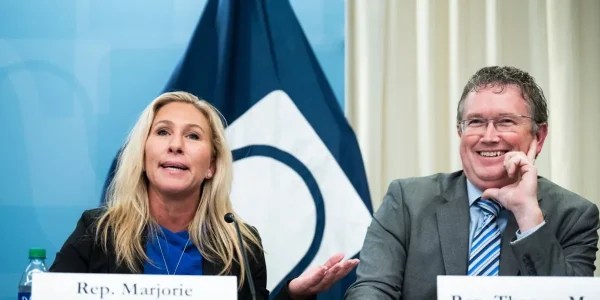
Harnessing the energy of the shift, the likes of Rep. Marjorie Taylor Greene, Rep. Thomas Massie, and Rep. Matt Gaetz have all explicitly come out in opposition to AIPAC. Their messaging around the issue is to assert that they are “America First”, as opposed to their Republican colleagues, whom they accuse of being “Israel First”. These representatives align themselves with popular conservative commentators like Candace Owens and Tucker Carlson, amongst others, who also carry the same rhetoric.
Ultimately, the idea of America First and slogans like Mainers First transcend partisan lines. The idea of prioritizing Americans above the interests of Israel has long been taboo, yet we saw this collapse during the Democratic primary campaign for the Mayor of New York.
When Zohran Mamdani was asked where he would first visit as Mayor, he answered calmly that “I would stay in New York City. My plans are to address New Yorkers across the five boroughs and focus on them.” Although he was then challenged repeatedly and asked to recognize Israel as a Jewish State, which he refused to do based upon opposition to systems of ethnic or religious hierarchy, the clip of his answer went viral, receiving broad agreement amongst both Democrats and Republicans.
Other politicians running for Congress, who are explicitly anti-AIPAC, include the following candidates:
Robb Ryerse for Arkansas’s Third District, who is seeking to unseat Steve Womack, funded to the tune of $142,030 by the Israel Lobby. In California, there is Chris Bennet running for the Sixth District, Mai Vang for the Seventh District, Saikat Chakrabarti for the Eleventh District, Chris Ahuja for the Thirty-Second District, as well as Angela Gonzales-Torres for the Thirty-Fourth District.
In Colorado, there is Melat Kiros for the First District, as well as John Padora for the Fourth District. Within Florida, there is also Bernard Taylor running for the Twenty-First District, Elijah Manley for the Twentieth District, Marialana Kinter for the Seventh District, and Oliver Larkin for the Twenty-Third District.
Running in Illinois, there is Robert Peters for the Second District, Junaid Ahmed for the Eighth District, Morgan Coghill for the Tenth District and Dylan Blaha for the Thirteenth District. Meanwhile, in Indiana, there is Jackson Franklin, who is running for Congressional District Five and, in Massachusetts, Jeromie Whalen is running for the First District.
Seeking to win Maryland’s Fourth District is Jakeya Johnson, while Donavan McKinney is running for Michigan’s Thirteenth District and Kyle Blomquist is competing for its First District. Crossing over to Missouri, there is a well-known progressive candidate, Cori Bush, for its First District and Hartzell Gray for Missouri’s Fourth District.
For New Hampshire’s First District, Heath Howard is in the running, while, in New Jersey, Katie Bansil is running for the Sixth District. Meanwhile, there is James Lally running for Nevada’s Third District, Aftyn Behn for Tennessee’s Seventh District and Zeefshan Hafeez for Texas’s Thirty-Third District.
Also contending for Washington’s Ninth District is Kshama Sawant, while Aaron Wojchiechowski is running for Wisconsin’s Fifth District and Brit Aguirre is contesting for West Virginia’s First District.
Meanwhile, Abdul El-Sayed is running for Senate in Michigan, and Karishma Manzur is a Senate Candidate in New Hampshire, both of whom reject AIPAC funding and oppose the ongoing genocide.
It is important to note that new projects, like AIPAC Tracker, are also now promoting candidates who refuse to take funding from the Israel Lobby and have set up a page whereby citizens can donate to these anti-AIPAC politicians. AIPAC Tracker has played a particularly important role in educating the public, through graphics, showing how much the Israel Lobby has given to individual politicians.
Despite the majority of the anti-AIPAC campaigns being led by progressive Democrats, it is clear that the infamy of the Israel Lobby is having a major impact on mainstream Democrats, too.
For example, earlier this month, AIPAC appeared to be experiencing an existential crisis following an announcement from prominent lawmaker, Seth Moulton, who declared he would not receive funds from the Lobby group and would even be returning their contributions.
In an official statement, Moulton claimed to be making his move due to AIPAC’s alignment with the Israeli government of Benjamin Netanyahu, in particular. For such a right-leaning Democrat, on foreign affairs, to be publicly disavowing AIPAC, it signaled the toxicity of its brand more than anything.
Back in 2024, AIPAC claimed victory after it managed to unseat progressive Democratic Party Representative, Jamaal Bowman, over his pro-Palestinian stances, in the “most expensive House primary ever” in US history. At the time, AIPAC had spent at least $14.5 million on anti-Bowman ads through its PAC, United Democracy Project, alone.
Just over a year later, it appears as if the Israel Lobby had forked out tens of millions for what can be labeled, in hindsight, as a pyrrhic victory. Although the Zionist Lobby groups have injected unprecedented funding into continuing their purchase of American elected officials, their strategy appears to be collapsing.
Over time, more and more Americans from across the aisle are beginning to correlate support for Israel with political corruption. The litmus test for whether a politician is truly interested in representing the people who elect them to power is becoming their stance on Palestine, more specifically, Gaza.
The more Israel interferes in American domestic affairs, demands free speech crackdowns, unconstitutional legislation, billions in taxpayer dollars to fund their wars of aggression, unlawful deportations of Israel critics and drags the US into more conflict overseas, the more the American opposition to the Israel Lobby grows.
Recently, Illinois-based journalist Matthew Eadie uncovered that AIPAC is now employing new tactics to get around its own toxic brand, by “driving donations without any transparency” through Unique ID campaigns.
One series of “AIPAC secret campaigns” has been in support of Minority Leader of the US House, Hakeem Jeffries, nicknamed “AIPAC Shakur” by popular radio-show host, ‘Charlamagne tha god’, whereby certain links to donate were shared and will not pop up as direct AIPAC contributions, yet are still traceable by the Israel Lobby and directed by them.
Social media activists are not letting these tactics slip and are actively pointing out what they claim to be deceptive tactics, only fuelling more anger at the Lobby, in general. Yet, such tactics appear to prove desperation on AIPAC’s behalf, especially amidst growing calls for them to register as a foreign agent.
Damning Evidence Proves Keir Starmer Lied About UK Role in Israel’s Genocide in Gaza
21st Century News Wire | October 28, 2025
British journalist Matt Kennard reveals the criminal role of the British military as an accomplice to Israel’s brutal genocide of native Palestinian population in Gaza. Kennard reveals how the Royal Air Force (RAF) has flown hundreds, if not thousands, of surveillance flights over Gaza since October 7, 2023. It is believed that the British flights supplied the Israelis with targeting intelligence used to slaughter countless Palestinians—including thousands of unarmed men, women and children. Despite the exposure, the Starmer government refused to give any details about these flights which amount to war crimes.
Watch this incredibly damning video report from Double Down News:
Building European Security Without Russia ‘Unrealistic’, Warns Hungary’s Top Diplomat
Sputnik – 28.10.2025
Building the architecture of European security without Russia is unrealistic, Foreign Minister of Hungary Peter Szijjarto said on the sidelines of the 3rd International Conference on Eurasian Security in Minsk.
Szijjarto also said he hopes for success of the talks between Hungarian Prime Minister Viktor Orban and US President Donald Trump and hopes Washington will understand the position of Budapest, whose energy security is impossible without Russia.
“Our energy security is based on our honest and reliable energy cooperation with Russia. Our historical experience shows that this cooperation has always been reliable and effective. Therefore, we hope that our energy security will not be violated. We hope that the conversation between our Prime Minister and the President of the United States in the second half of next week will also be successful from this point of view,” Szijjarto told reporters on the sidelines of the 3rd Minsk International Conference on Eurasian Security.
The Hungarian side “will talk in great detail about our energy supply situation and hopes that it will be treated with respect,” the minister said.
Hungary hopes that the Russian-US summit in Budapest will take place, the question is about timing of preparations, he added.
“We were looking forward to the phone call between [US] President [Donald] Trump and [Russian] President [Vladimir] Putin announcing the possibility of a peace summit. We are happy to host it. We understand that neither side has abandoned this plan. The question is the timing and the content. Therefore, we hope that preparations will move forward and the summit will ultimately take place,” Szijjarto told reporters on the sidelines of the third Minsk International Conference on Eurasian Security.
The Rubio Doctrine: Neocons Are Back!
By Ron Paul | October 27, 2025
According to several recent news reports, the two major Trump foreign policy shifts last week are the handiwork of Marco Rubio, the President’s Secretary of State and (acting) National Security Advisor. As with all neocon plans, they will be big on promises and small on delivery.
First up, according to Bloomberg it was Rubio who finally convinced President Trump to take “ownership” of the US proxy war on Russia, and for the first time place sanctions on Russia. Up to this point President Trump chose to portray himself as a mediator between Ukraine and Russia. But with this move against Russia’s oil sector he can no longer credibly claim that this is “Joe Biden’s war.”
The Trump move followed a confusing few weeks since the Trump/Putin Alaska summit in August. After that meeting Trump dropped the neocon position that a ceasefire in the Russia/Ukraine war must occur before any peace negotiations. It was a sign that Trump was looking more realistically at the war. He also said he did not think Ukraine would win, which is pretty obvious.
A surprise call to Putin the day before Ukrainian president Zelensky was to arrive in town just over a week ago reinforced that position and Zelensky left Washington empty-handed. He was seeking Tomahawk missiles that could strike deep into Russian territory.
Then out of the blue President Trump last week announced through his Treasury Secretary Scott Bessent that the US would be sanctioning Russia’s two largest oil companies until Russia declares a ceasefire in the war before negotiations. That won’t happen, but what it does mean is that Rubio and the neocons have successfully gotten Trump to step on the escalation escalator. That is what they always do. It will be much harder to back down now.
At the same time the US Administration was jumping deeper into the Russia/Ukraine war, a long-time neocon dream was suddenly back in play. Although in Trump’s first term a “regime change” operation was attempted against Venezuela, it failed spectacularly. But the neocons have long dreamed of overthrowing the Venezuelan government – they almost got their way back in 2002 – and suddenly after several weeks of extrajudicial murder on the high seas in the name of fighting the drug war, President Trump announced that land strikes on Venezuela would begin soon.
He did mention that he might brief Congress on his plans for war on Venezuela, not that Congress can be bothered to care much one way or the other.
The neocon old guard that still dominates Washington foreign policy is taking a victory lap. South Carolina Senator Lindsey Graham was on the Sunday shows beaming over the conversion of “no regime-change wars” President Trump to “regime change wars” President Trump.
The Saddam Hussein WMD factories of 2002 have become the Nicolas Maduro cocaine and fentanyl factories of 2025 and once again the neocon war lies are amplified by the US mainstream media and transmitted to the American people. A new disaster is in the making. The “global war on terror” has been rebranded the “hemispheric war on narco-terror” and the US military industrial complex is rubbing its hands in anticipation of a windfall.
After John Bolton’s disastrous stint in the first Trump Administration, promises were made that the second Trump Administration would be neocon-free. Instead, the neocons are back. Unless President Trump wakes up soon, the neocons will destroy his second term…and maybe the country.
Inside the Trump Administration’s Venezeula Disagreements
By Ted Snider | The Libertarian Institute | October 28, 2025
In the waters of the Caribbean, a surprisingly large U.S. fleet sits with Venezuela in its sights. It includes over 10,000 troops, Aegis guided-missile destroyers, a nuclear-powered fast attack submarine, F-35B jet fighters, MQ-9 Reaper drones, P-8 Poseidon spy planes, assault ships, and a secretive special-operations ship.
The fleet is built for war on Venezuela or its drug cartels, but it is engineered to put enough pressure on Venezuela’s President Nicolás Maduro to push him from power. The justification for the war is stopping the flow of drugs into the United States by Venezuelan drug cartels; the justification for the coup is that Maduro is the head of those cartels.
But U.S. officials—often those in the best place to know—have disagreed with all three aspects of the military action: the significance of Venezuela’s drug cartels in the flow of drugs, and especially fentanyl, into United States; the role of Maduro in those cartels; and the use of the military to fight them. For their disagreement, many of those officials have left or been forced from their jobs.
U.S. President Donald Trump has insisted that military force is necessary to stop “narco-terrorists” who are smuggling a “deadly weapon poisoning Americans.” He has claimed that “every boat” the U.S. military strikes off the coast of Venezuela is “stacked up with bags of white powder that’s mostly fentanyl” and “kills 25,000 on average—some people say more.”
But current and former U.S. officials disagree. While most of the boats the U.S. military has sunk have been in the passageway between Venezuela and Trinidad and Tobago, U.S. officials say that that passage is neither used to transport fentanyl nor is it used to transport drugs to the United States. 80% of the drugs that flow through that passage is marijuana, and most of the rest is cocaine. And those drugs are headed, not to the United States, but to West Africa and Europe. Most of the fentanyl that finds its way into the U.S. comes from Mexico.
The military strikes on Venezuelan boats cannot be justified by the war on drugs and “are unlikely…to cut overdose deaths in the United States,” according to officials. “When I saw [an internal document on the strikes],” a senior U.S. national security official said, “I immediately thought, ‘This isn’t about terrorists. This is about Venezuela and regime change.’”
According to the U.S. Drug Enforcement Administration, 90% of the cocaine that transits into the United States enters through Mexico, not Venezuela. And Venezuela is not a source of fentanyl. The dissenting American officials are in agreement with international bodies. The 2025 UNODC World Drug Report assesses that Venezuela “has consolidated its status as a territory free from the cultivation of coca leaves, cannabis and similar crops.” The report says that “[o]nly 5% of Colombian drugs transit through Venezuela.” The European Union’s European Drug Report 2025 corroborates the United Nations report: it “does not mention Venezuela even once as a corridor for the international drug trade.”
U.S. intelligence also disagrees on the Trump administration’s claim that Maduro is at the head of the Venezuelan drug cartels. The Trump administration has insisted that “Maduro is the leader of the designated narco-terrorist organization Cartel de Los Soles.”
Again, though, U.S. officials disagree. A “sense of the community” memorandum dated April 7, 2025 that puts together the findings of the eighteen agencies in the U.S. intelligence community released by the Office of the Director of National Intelligence directly contradicts the Trump administration’s claim that Maduro is the leader of Tren de Aragua (TDA) drug cartel.
The memorandum clearly states that “the Maduro regime probably does not have a policy of cooperating with TDA and is not directing TDA movement to and operations in the United States.” It states that the intelligence community “has not observed the regime directing TDA.”
Making the American case against the Maduro government even less credible, the memorandum finds that “Venezuelan intelligence, military, and police services view TDA as a security threat and operate against it in ways that make it highly unlikely the two sides would cooperate in a strategic or consistent way.” The Venezuelan National Guard has arrested TDA members and “Venezuelan security forces have periodically engaged in armed confrontations with TDA.”
The contradiction was seen as a problem. Days after the memorandum’s release, Joe Kent, then acting chief of staff for Tulsi Gabbard, the director of national intelligence, told a senior intelligence analyst to do a “rethink” of the analysis and offer a new assessment. “We need to do some rewriting so this document is not used against the DNI [Director of National Intelligence] or POTUS [President of the United States],” Kent told intelligence officers.
The rewritten memo still contradicted the Trump administration’s claims about Maduro. One week later, Michael Collins, the acting chair of the National Intelligence Council, and Maria Langan-Riekhof, his deputy, were fired by Gabbard. Gabbard claims the firings were part of a campaign to stop leaks by “deep-state criminals” who are politicizing the intelligence community.
U.S. officials have objected not just to the White House’s claims about Venezuela as a narco-state and about Maduro’s role as head of the cartels, but also to the White House’s militarized answer to the problem. And the objection has come from the highest level of the U.S. military.
On October 16, Admiral Alvin Holsey, head of the U.S. Southern Command, the group that oversees all operations in Central and South America, including the current and any future military actions taken against Venezuela, announced that he was stepping down. The New York Times has reported that there were “real policy tensions concerning Venezuela” between the admiral and Pete Hegseth, the secretary of War. Current and former U.S. officials say that Holsey “had raised concerns about the mission and the attacks on the alleged drug boats.”
But there are also reports that there were questions about whether Holsey would be fired in the days before he announced his resignation. “Hegseth did not believe Holsey was moving quickly or aggressively enough to combat drug traffickers in the Caribbean.” The Washington Post reports that “Hegseth had grown disenchanted with Holsey and wanted him to step aside.” The disenchantment, according to “people familiar with the matter,” started “around the time that the Trump administration began ordering deadly strikes on alleged drug boats off the coast of Venezuela.”
At every level, Venezuela as a significant source of drug deaths in America, Maduro’s role as leader of Venezuela’s drug cartels, and the United State’s militarized solution to the problem, U.S. officials have disagreed with the Trump administration. Some of those officials have paid for doing their jobs with their jobs.
China will act if its interests are harmed by Iran sanctions: Envoy
Press TV – October 27, 2025
China will act to respond to the sanctions imposed against Iran if they harm its interests, the country’s ambassador to Iran has said.
Cong Peiwu said on Monday during a press conference in Tehran that China will not hesitate to act if its economic interests are affected by restrictions imposed on trade with Iran.
Cong made the remarks in response to questions about China’s way of dealing with recent United Nations sanctions on Iran, which were re-imposed in late September after European parties to a 2015 nuclear deal between Iran and world powers accused Tehran of failing to observe its obligations under the agreement.
Along with Russia and Iran, China believes that the move by Britain, France, and Germany to return UN sanctions on Iran was illegal, signaling that it would not necessarily abide by the UN sanctions.
The Chinese ambassador said that Beijing seeks closer cooperation with Tehran as he reiterated that Iran and China share a common stance opposing unilateralism in the world.
China is Iran’s largest trading partner, as it buys 29% of Iran’s total non-oil exports while being responsible for 25% of imports into the country.
Estimates suggest that more than 92% of Iran’s oil exports also end up in China, despite a harsh regime of US sanctions that imposes heavy penalties on buyers of Iranian oil.
Those estimates show that China’s total trade with Iran, including its oil purchases, amount to $65-70 billion per year.
Experts believe China counts on the smooth and affordable supply of oil from Iran for maintaining growth in its industrial sector.
Figures published in late August showed that China had relied on Iran for 13.6% of its total oil imports in the first half of 2025 as shipments reached an average of 1.38 million barrels per day (bpd) over the period.
Privately-owned refiners receive the bulk of Iranian oil shipments arriving in China as they enjoy discounts of up to 8% per barrel offered by Iran to circumvent US sanctions.
Recent data by international tanker tracking services suggest Iran’s oil exports to China reached records of more than 1.8 million bpd in September.
Sen. Rand Paul Slams Strikes on Boats in Caribbean as ‘Extrajudicial Killings’
By Kyle Anzalone | The Libertarian Institute | October 27, 2025
Senator Rand Paul blasted President Donald Trump’s strikes on alleged drug traffickers as unconstitutional and illegal.
“A briefing is not enough to overcome the Constitution. The Constitution says that when you go to war, Congress has to vote on it. … The drug war, or the crime war, has typically been dealt with through law enforcement,” Paul said on Fox News Sunday. “And so far they have alleged that these people are drug dealers … and we’ve had no evidence presented. So at this point we would call them extrajudicial killings.”
So far, the Department of War has bombed ten boats it claims are smuggling narcotics into the US. Nine of the strikes have been on vessels in the Caribbean, against alleged cartels linked to Venezuela. The White House has not provided evidence that the ships were carrying drugs.
“So far, they have alleged that these people are drug dealers. No one said their name. No one said what evidence. No one said whether they’re armed. And we’ve had no evidence presented,” Paul said.
One survivor of a strike was released by Ecuador, finding he was not engaged in wrongdoing when the boat was attacked. One family member said a victim of a US strike was a fisherman, and not working for a cartel.
Trump has discussed expanding the strikes into Venezuela and has given the CIA approval to conduct lethal operations against cartels. Secretary of State Marco Rubio claims that Venezuelan President Maduro is the leader of a cartel designated as a Foreign Terrorist Organization.
If Trump elects to expand the war, he told reporters that he will brief Congress on the plans. He went on to say he did not have to discuss the matter with the Legislator and has not sought a Declaration of War.
The Constitution explicitly grants Congress the authority to Declare War. However, the principle of preventing the President from unilaterally declaring war has been eroded over time. Congress has not declared war since World War 2 II. The last Authorization for Use of Military Force was passed in 2002 for the Iraq War.
Senator Paul has teamed up with Democratic Senator Tim Kaine to push a War Powers Resolution that would stop Trump from launching a war with Venezuela.
Featured Video

Deception – Submarines against Olof Palme
or go to
Aletho News Archives – Video-Images
From the Archives
Woolsey Fire started at Santa Susana Field Lab — where “radioactive materials released were never accurately measured”
By John Laforge | CounterPunch | November 30, 2018
In my Nov. 16 column, I reported on potential radiation risks posed by California’s Woolsey wildfire having burned over parts or all of the Santa Susana Field Laboratory—south of Simi Valley, Calif., 30 miles outside Los Angeles—site of at least four partial or total nuclear reactor meltdowns.
The field laboratory operated 10 experimental reactors and conducted rocket engine tests. In his 2014 book Atomic Accidents, researcher James Mahaffey writes, “The cores in four experimental reactors on site … melted.” Reactor core melts always result in the release of large amounts of radioactive gases and particles. Clean up of the deeply contaminated site has not been conducted in spite of a 2010 agreement.
Los Angeles’s KABC-7 TV reported Nov. 13 that the Santa Susana lab site “appears to be the origin of the Woolsey Fire” which has torched over 96,000 acres. Southern Calif. Public Radio said, “According to Cal Fire, the Woolsey Fire started on the afternoon of Thursday, Nov. 8 … on the Santa Susana site.” … continue
Blog Roll
 Aletho News
- Feeling Better, Getting Worse: How Psychiatric Drugs Create the Illusion They Cure
- ‘Nobody Told Me’: Former Mental Health Patient Calls Out Dangerous Side Effects of Psychiatric Drugs
- Dr. Abu-Sitta: Beirut ‘felt like a day in Shifa Hospital’
- Iran Has Won the War, It Will Be Up to the US to Secure the Peace: Mohammad Marandi
- Iran condemns assassination threats against Iranian negotiators amid US talks
- Brussels cannot say where its own pipeline inspectors are as Hungary’s oil lifeline remains shut
- Israel’s Iran War: Myth and Reality
- Between war and industrial breakdown: The US-Israeli attrition crisis
- Pressure builds on Iran to ‘drop’ Lebanon ceasefire demand as Islamabad talks hang in balance
- In another clash report, US denies agreement to release Iran’s assets
- If Americans Knew
- Pro-Israel ‘Thinktanks’ and Individuals who Influence U.S. Foreign Policy
- Mearsheimer reveals how Israel dictates US policies on Iran, Gaza – video
- After killing 350+, Israel still has a “score to settle” with Lebanon before ceasefire – Daily Update
- Military aid to Israel emerges as the latest political litmus test for Democrats
- The only Palestinian children’s rights organization closes following years-long Israeli campaign against it
- ‘I Can’t Forget the Smell’: Lebanese Reel After Israel Kills Over 300 in Single Day
- DNC Shoots Down Resolutions Calling Out AIPAC and Limiting Arms to Israel
- TCN: Is Israel Blackmailing President Trump?
- Israel killed at least 303 Lebanese yesterday – who were they? Daily Update
- Amnesty: Urgent – Protect Lebanese civilians from brutal escalation in Israeli attacks
- No Tricks Zone
- German Expert: Heat Dome Led To Record Temps In Western USA…Warmer In 1934, 1936
- New Study: No Linear Warming Or Glacier Retreat Along Northern Antarctic Peninsula Since 1980s
- An Inconvenient Tree: Uncovered In Alps… Europe Much Warmer Than Today 6000 Years Ago
- New Study Reports A 60% Slowdown In Greenland’s Ice Loss Rate In The Last Decade
- Low Intensity Tornado Wrecks Major Solar Farm, Creating A Potential Toxic Dump
- New Study Finds Warming Saves Lives…Cold Temperatures 12 Times More Deadly Than Excess Heat
- German Science Blog Accuses PIK Climate Institute Of Hallucinating Climate Tipping Points
- Devastating Assessment Of Comirnaty Vaccine By Former Senior Pfizer Europe Toxicologist
- New Study: CO2 Is ‘Effectively Negligible’ As An Explanatory Climate Change Factor Since 2000
- Former Pfizer Toxicologist Dr. Helmut Sterz Tells Bundestag Hearing Pfizer Vaccine Should Have Never Been Approved
 Aletho News