The ‘Opposition Party’ Has Done Nothing to Stop the Iran War and Much to Goad Trump Into Continuing It
By Jeremy Loffredo | April 9, 2026
There is a version of the Democratic Party that exists only in the imagination: the peace party, the anti-war party, the party that marched against the Iraq War and howled at its neocon designers. As Donald Trump (reportedly) accepted Iran’s ceasefire terms this week, some of the most pointed attacks coming his way from Democrats are not about the thousands of civilians killed, the weeks of brutal bombardments against medical centers and universities, or the global economic damage the war has caused. They are about the war ending before the U.S. and Israel finished the job.
And this is not a fringe phenomenon. It is a pattern coming from Democratic senators, the Democratic House Foreign Affairs Committee, ranking members of the Armed Services Committee, and some of the party’s most prominent voices. The liberal opposition party wants more war.
This pattern predates the war. During the 2024 presidential campaign, Kamala Harris called Iran America’s “greatest adversary,” vowed that Iran would never obtain a nuclear weapon under her watch, and argued that Iran’s attacks on Israel would not have happened under her presidency. The Democratic nominee for president was running on a promise to be harder on Iran than Donald Trump.
“What a disaster”
On April 7, 2026, as a ceasefire between the United States and Iran was announced following weeks of devastating U.S.-Israeli bombing campaigns, Sen. Chris Murphy (D-Conn.) took to X to offer his initial reaction: not relief at the end of the killing, but outrage at the terms Trump had accepted to stop it.
“It appears Trump just agreed to give Iran control of the Strait of Hormuz, a history-changing win for Iran,” Murphy wrote. “The level of incompetence is both stunning and heartbreaking. What on earth is happening?”
And Murphy is not a Democratic Party outlier. The New York Times has called Murphy “one of the future leaders of the party.” The Guardian, the Times, and NBC News have all listed him as a possible 2028 presidential candidate. Senate Minority Leader Chuck Schumer has named him one of the party’s “best messengers.” Foreign Policy magazine has called him a “rising Democratic star.”
For Murphy, attempting to end a war against a civilian population that had been brutally bombed for over five weeks was just infuriating.
In a follow-up thread, he wrote: “They will control and toll the Strait for the first time. They keep their nuclear program. They keep their missiles. What a disaster.”
And should anyone point out that at least the killing had stopped, Murphy had an answer ready: “An anti-American regime is in power and emboldened. Iran still has their missiles and nuclear program. That’s ‘good’?”
Murphy is not arguing that the war was unjust, that it violated international law, or that it killed too many innocent women and children, all of which are true and documented. He’s arguing that the ceasefire is a bad deal because it leaves the Iranian government standing with its nuclear program and ballistic missiles intact.
Having a civilian nuclear program is a legal right under Article IV of the Nuclear Non-Proliferation Treaty, to which Iran is a signatory. But Murphy is treating Iran’s exercise of their international right as an American defeat. And as for their intolerable missiles, most countries have militaries, and every country has the right to them.
Trump, for his part, had no good options left: Iran had closed the Strait of Hormuz, oil prices had spiked globally, and American military objectives had not been achieved. The only path out was accepting terms. Stopping the bombing has already saved lives and protected a civilian population from further devastation. Murphy’s “Democratic rising star” objection is not that the war was wrong but that it ended before the Iranian state was entirely destroyed.
‘TACO’ Trump
Chuck Schumer, the Senate’s top Democrat, had established this line — attacking Trump from the right — months earlier, during nuclear deal negotiations in mid-2025. When Trump was reportedly exploring a diplomatic agreement with Tehran as an alternative to war, Schumer coined an acronym: TACO (Trump Always Chickens Out).
“When it comes to negotiating with the terrorist government of Iran, Trump’s all over the lot,” Schumer said. “One day he sounds tough, the next day he’s backing off. If TACO Trump is already folding, the American public should know about it.”
Schumer was not criticizing Trump for threatening war; he was criticizing him for not following through on those threats, demanding that Trump be tougher on Iran at a moment when most Americans, including supermajorities of his own party, supported a diplomatic nuclear deal. Foreign Policy magazine noted that Schumer’s attack was from a position to Trump’s right, using the language of Iran hawks.
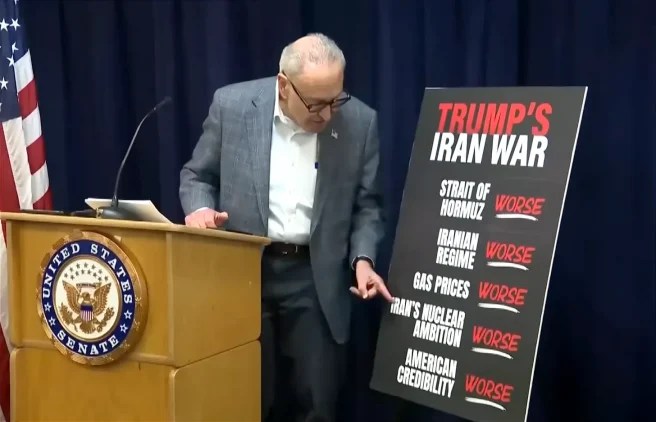
When the ceasefire was finally announced, Schumer held a press conference in New York and went through the deal point by point, explaining why the outcome represented an American failure. “The Strait of Hormuz is in worse shape today, with more Iranian domination of it than it was before the war started,” Schumer said. “Iran still has an ayatollah named Khamenei. The Iranian regime is still standing. Not just standing, but now emboldened. And the regime is likely to be even more radical and more dangerous than it was before.” He called Trump “a military moron” and said the war had made the United States worse off than before it started. The Senate’s top Democrat was not upset that the war happened. He was upset that it hadn’t achieved more.
Venezuela: Trump Didn’t Finish the Job
In January 2026, U.S. special forces captured Venezuelan President Nicolas Maduro in a nighttime raid and flew him to New York to face drug trafficking charges. Within weeks, the Trump administration settled into a working relationship with Maduro’s former vice president, Delcy Rodriguez, now Venezuela’s acting president. Trump, having removed Maduro, chose to work with the Venezuelan regime rather than dismantle it. Rodriguez, previously sanctioned by Trump’s own Treasury Department, was quietly removed from the sanctions list in April 2026.
House Foreign Affairs Committee Democrats posted a screenshot of the New York Times article reporting the sanctions removal and responded:
“Delcy was Maduro’s brutal co-conspirator to steal an election and repress Venezuelans. 3 months later she’s off the US sanctions list, with zero plans for reforms and her regime still harassing and jailing its political opponents. Trump doesn’t care about Venezuela’s democracy, just its oil.”
Democrats on the House Foreign Affairs Committee, the body in Congress responsible for overseeing U.S. foreign policy, were not satisfied. The problem, in their telling, was not that Trump had removed a foreign head of state by military force. It was that Trump had cut a deal with his successor rather than going for full regime change.
The Impeachment Spectacle
In 2019, Democrats launched an impeachment process that would run for months, producing two weeks of nationally televised public hearings, 12 witnesses, and more than 30 hours of testimony, before the full House voted to impeach in December. The central charge was that Trump had frozen $400 million in military aid to Ukraine, weapons intended to be used against Russia, a U.S. adversary. Withholding them was, in the Democratic telling, an impeachable betrayal of American interests. Fast forward to 2026: Trump waged a 40-day bombing campaign against Iran, a U.S. adversary, without congressional authorization, and Democrats introduced not impeachment articles but complaints that he failed to hit Iran hard enough.
When Trump withheld weapons from a U.S. enemy’s enemy, Democrats called it impeachable. When Trump actually bombed a U.S. enemy, Democrats called it inadequate. In both cases, they were pushing Donald Trump in exactly the same direction.
All of it, from Schumer’s TACO attacks to the Democratic Foreign Affairs Committee’s frustration with Delcy Rodriguez to Murphy calling a ceasefire “heartbreaking,” points in the same direction. Not toward restraint, not toward diplomacy, but toward a more complete and more decisive confrontation with American adversaries. Whether that reflects genuine hawkishness, reflexive opposition to anything Trump does, or some complicated mixture of both, the political effect is the same. The liberal opposition party is pushing for more war.
Jeremy Loffredo (X: @loffredojeremy) is an independent journalist and filmmaker who covers foreign policy and war.
How UK Regulator Ofcom Quietly Bypassed International Law to Police American Speech
A UK regulator bypassed every formal legal treaty and just emailed American companies into compliance, 98% of them apparently obliged
By Dan Frieth | Reclaim The Net | April 9, 2026
A Freedom of Information response has confirmed what the UK’s speech regulator would probably have preferred to keep quiet. Ofcom fired off 197 information demands to American tech companies under the Online Safety Act, and not a single one went through the US-UK Mutual Legal Assistance Treaty, the formal diplomatic process that exists for exactly this kind of cross-border legal enforcement. Every one of those 197 notices was sent directly, by email or post, to companies operating entirely on American soil.
The number comes from a FOI request filed by Daniel Lü, who asked Ofcom a series of pointed questions about how it enforces the Online Safety Act against non-UK targets.
Ofcom confirmed that as of February 26, 2026, it had issued 197 Section 100 notices to US businesses. Zero through MLAT. The treaty between the US and UK that governs how one country’s legal process gets enforced in the other’s jurisdiction was treated as optional. Ofcom decided it didn’t apply.
That admission drew an immediate response from Preston Byrne, the American lawyer who represents 4chan and other US companies targeted by Ofcom.
Byrne called the 197 notices a “breathtaking” “attack on the First Amendment” and pointed out the uncomfortable math.
Only two US companies, 4chan and Kiwi Farms, have publicly refused to comply with Ofcom’s demands. If Byrne’s assessment is right, that leaves Ofcom enjoying “a 98% compliance rate with foreign censorship orders that violate the First Amendment.”
A British regulator sent nearly 200 demands to American companies, bypassed every established legal channel, and almost all of them appear to have simply done what they were told. The chilling effect is already here.
Ofcom Uses Free Speech to Hide Its Censorship Methods
Lü did more than ask for the number of notices. He asked for policy documents about how Ofcom selects its foreign enforcement targets, what guidance it gives its teams about the legality of emailing criminal penalty warnings to US corporations, and whether Ofcom has any internal guidance on protected speech.
Ofcom admitted it holds much of that information. Then it refused to hand it over. The reason, cited directly from the FOI Act, was that disclosure “would, or would be likely to, inhibit the free and frank exchange of views for the purposes of deliberation; and/or would otherwise prejudice, or would be likely otherwise to prejudice, the effective conduct of public affairs.”
A speech regulator is claiming that transparency about its censorship operations would damage free and frank deliberation. Ofcom is borrowing the language of free expression to shield itself from accountability over how it suppresses expression. The irony is so complete it feels deliberate.
On the question of whether Ofcom holds any guidance on protected speech, the answer was even more revealing. Ofcom said it doesn’t have any. No internal documents addressing what speech is protected when it exercises its enforcement powers against foreign companies.
It pointed instead to its general obligations under the Online Safety Act, the Communications Act 2003, and the European Convention on Human Rights, along with links to already-public guidance documents. That’s the speech protection regime for companies being censored by the UK from American soil: a few hyperlinks to existing publications.
The MLAT Problem Isn’t New. It’s Getting Worse.
The treaty issue is central. MLAT exists so that when one country wants to enforce its laws against people or companies in another country, there’s a formal process involving both governments. For the US side, that means routing through the Department of Justice. A judge gets involved. There’s oversight. There are procedural protections.
Ofcom has previously argued it doesn’t need to use MLAT because its Section 100 notices are administrative, not criminal. That distinction might satisfy Ofcom’s lawyers in London, but it doesn’t satisfy anyone else. Byrne and his clients have argued in federal court that Ofcom’s demands have no legal force precisely because they skipped the treaty process. 4chan and Kiwi Farms received their enforcement demands by email, sent to addresses that in some cases weren’t even authorized to accept legal service.
The Lü FOI also asked whether Ofcom holds any correspondence with the US Department of Justice or the FBI about its enforcement activity. Ofcom’s response: it holds no information related to this question. The regulator didn’t talk to anyone in the US government before firing off 197 demands to US companies. It just hit send.
What the FOI Actually Revealed, and What Ofcom Hid
Lü’s request covered six questions. The pattern in Ofcom’s responses tells its own story. On the questions where Ofcom could respond by linking to documents that are already public, it was happy to share. On everything else, it cited exemptions, claimed it didn’t hold the information, or both.
When asked for policy documents about enforcing the OSA against non-UK providers, including any records discussing MLAT, Ofcom said it holds some information but won’t release it. It also claimed it holds no records of MLAT discussions or legal guidance about whether emailing criminal penalty warnings to American corporations is valid. Either Ofcom never considered whether its enforcement method was legal under international law, or it did consider it and doesn’t want anyone to see that analysis.
When asked how it selects non-UK enforcement targets, Ofcom cited exemptions under the Communications Act 2003 and linked to its public enforcement guidance, plus its own decisions against 4chan and other US entities. The internal criteria, the actual decision-making process for choosing which American companies to go after, stayed hidden.
When asked about its approach to “qualifying worldwide revenue,” the basis for calculating fines that can reach £18 million or 10% of global revenue, Ofcom linked to its public guidance explaining that companies are expected to self-report their revenue to Ofcom. Companies that Ofcom is threatening with fines are supposed to voluntarily tell Ofcom how much money they make, so that Ofcom can calculate a bigger fine. The compliance incentives here are about as perverse as they get.
Byrne Goes to Congress
Byrne said he forwarded Ofcom’s admission directly to the US government. He tagged US Under Secretary of State for Public Diplomacy Sarah Rogers, Senator Eric Schmitt, and House Judiciary Committee Chairman Jim Jordan, and called on Congress to act. This is consistent with Byrne’s approach throughout the Ofcom fight. He has previously said he copies the US government on Ofcom correspondence that crosses his desk.
The legal strategy from the US side has been to deny Ofcom any clean precedent. The four companies that received formal enforcement action, 4chan, Kiwi Farms, a mental health forum called SaSu, and the social network Gab, all refused to comply. 4chan responded to one of Ofcom’s fines with a picture of a hamster. The point was to make Ofcom’s orders publicly and visibly unenforceable on American soil, turning each attempted punishment into a political liability for the regulator rather than a deterrent for the rest of the American internet.
But the 197 number changes the scale of the problem. Those four companies were the public-facing enforcement targets, the ones Ofcom wanted to make examples of. Behind them, 193 other US companies apparently received quieter demands and, if Byrne’s analysis is correct, most of them complied without a fight. Without lawyers, without publicity, without anyone in Congress knowing it happened.
Byrne has pushed the GRANITE Act, a proposed law that would allow US entities to sue foreign governments for censorship attempts and void foreign censorship orders in US courts. Sarah Rogers, the US Under Secretary of State for Public Diplomacy, has appeared on GB News in London suggesting Congress is considering a federal version of the law. The Trump administration has made public statements objecting to the Online Safety Act. The US State Department sent diplomats to London in 2025 to challenge Ofcom directly.
Whether all of that translates into legislation remains an open question. Ofcom, for its part, has already moved on to bigger targets. After spending a year trying to fine platforms like 4chan and getting nowhere, the regulator recently opened new investigations into Facebook, Instagram, Snapchat, TikTok, YouTube, Roblox, and X. The small companies held the line. The question now is whether the large ones will too, or whether they’ll decide that complying with a foreign regulator’s censorship demands is easier than asserting their constitutional rights.
Israel’s priority lies in destroying chances of peace between Iran, US: Ex-UN nuclear chief
Press TV – April 8, 2026
Mohamed ElBaradei, former head of the United Nations nuclear watchdog, has strongly warned of the Israeli regime’s full intention to destroy chances of peace between the United States and Iran.
“The most important thing Israel will work on by all means is eliminating any chances for peace between Iran and America,” he wrote in a post on X on Wednesday.
The regime, he added, would try to torpedo any likelihood of rapprochement between the Persian Gulf’s littoral states and the Islamic Republic with similar zeal.
Such anti-peace efforts on the part of the regime would, meanwhile, “result in marginalizing it (Tel Aviv) in the region and spotlighting the policies of occupation, settlement, and ethnic cleansing it practices, as we see it doing now in Lebanon,” ElBaradei added.
The comments by the former head of the International Atomic Energy Agency (IAEA) came after the regime killed hundreds of people in Lebanon shortly after President Donald Trump announced agreeing to a two-week lull in the US’s attacks on Iran.
Trump said a 10-point proposal forwarded by the Islamic Republic serves as a “workable basis on which to negotiate and the main framework for these talks.”
The proposal underlines the need for cessation of aggression throughout the entire region, including in Lebanon, conditioning the Islamic Republic’s stopping its defensive strikes on a halt to aggressors’ regional atrocities.
ElBaradei said “a fundamental condition for peace in the region is for America to rein in Israel’s rampage.”
He, however, regretted that Washington had stopped utterly short of doing so in the face of the regime’s deadly attacks on the Gaza Strip and the occupied West Bank.
“And the result is clear to everyone: More killing and destruction!”
Ceasefire for all or for none: Iran shuts Hormuz over Lebanon attacks
Al Mayadeen | April 8, 2026
In response to recent Israeli attacks on Lebanon, Iranian officials are calling for decisive measures to counter the aggression in support of Lebanon and its people, warning that the Strait of Hormuz could be closed again until the attacks on Lebanon stop.
Ibrahim Rezaei, spokesperson for the Iranian Parliament’s National Security and Foreign Policy Committee, said in a post on X: “In response to the brutal Israeli aggression on Lebanon, the movement of ships in the Strait of Hormuz must be immediately stopped, and a strong, decisive strike must be launched to prevent further attacks by the Israeli entity.”
The Iranian official paid tribute to the Lebanese people, asserting that “we must not leave them alone for a second.” Rezaei emphasized the need for clarity on the terms of engagement and rejected the separation of the battlefields in Iran and Lebanon, stating, “Either there is a ceasefire on all fronts, or there is no ceasefire on any front.”
Iran’s UN envoy stresses ceasefire in Lebanon, warns of consequences
On his part, Iran’s envoy to the United Nations in Geneva, Ali Bahraini, stressed the importance of “Israel” upholding the ceasefire in Lebanon, adding that Tehran will approach peace negotiations with Washington cautiously due to a deep lack of trust.
Bahraini stated, “In light of the deep lack of trust, Tehran will deal cautiously with ‘peace’ negotiations with Washington, while at the same time remaining on military alert.”
The UN envoy also stressed the role of “Israel” in the ongoing aggressions, declaring, “We emphasize the necessity of the Israeli entity’s commitment to a ceasefire in Lebanon.”
He further warned about the consequences of continued hostilities, saying, “We warn that the continuation of attacks will lead to further complications and the resulting severe consequences.”
On the issue of talks, Bahraini said Iran will approach the talks with the US in Islamabad with far more caution than previous negotiations due to “the deep chasm of mistrust, while remaining on military alert.”
“We are not putting any trust in the other side. Our military forces are keeping their preparedness…but meanwhile, we will go for negotiations to see how serious the other side is,” the ambassador told Reuters.
Iran considering withdrawal from ceasefire if ‘Israel’ continues Lebanon assault
Iran may withdraw from the ceasefire agreement if “Israel” continues violating the truce by launching attacks on Lebanon, an informed source told Tasnim News Agency.
The source told the agency that “Iran is currently studying the possibility of withdrawing from the ceasefire agreement with the continuation of the Israeli entity’s violations and its aggression against Lebanon.”
The report noted that halting the war on all fronts, including against the “Resistance forces” in Lebanon, had been accepted by the United States as part of a two-week ceasefire plan. However, the source added, “Since this morning, in blatant violation of the ceasefire, the Israeli entity has carried out brutal attacks against Lebanon.”
In response, Iranian armed forces are identifying targets to retaliate against Israeli aggression in Lebanon, Tasnim‘s source said, further warning, “If the United States is unable to restrain its rabid dog in the region, Iran will assist it in this matter, exceptionally, through force.”
Moreover, a senior Iranian official also told Press TV that “Iran will punish Israel for its aggression against Lebanon and violations of the ceasefire.”
Cementing this stance, Fars News Agency reported that oil tanker traffic through the Strait of Hormuz was halted following the Israeli attacks, though two tankers had earlier received safe passage clearance after Tehran’s conditions were accepted and the ceasefire went into effect.
Later, a source in the Iranian Navy confirmed the Strait’s closure, saying, “We have closed the Strait of Hormuz, and currently, only Iranian ships and vessels coming from Iran are passing through”
“Only two oil tankers were able to benefit from the ceasefire and pass through the Strait of Hormuz before ‘Israel’ violated the agreement,” he added.
Iran conditions deal on ceasefire in Lebanon
Iran has tied any move toward a ceasefire in the US-Israeli war to the halt of all aggression on every front, including in Lebanon. Tehran’s leadership insists a lasting end to hostilities must go beyond a temporary truce and must stop attacks against Iran and its allies.
Tehran’s 10‑point proposal, which Washington has accepted as the basis for talks during the two-week ceasefire, calls for the cessation of all aggression in the region as a precondition for peace negotiations. The plan demands an end to wartime attacks and a guarantee that further aggression will not be launched against Iran or allied forces.
Among other conditions, the proposal includes a commitment to end all US and Israeli military operations targeting Iranian territory and groups aligned with Tehran, as well as halting aggression that “Israel” launched on Lebanon, among other countries in the region.
Iran’s negotiators emphasize that without a permanent stop to the war’s aggression on all fronts, including the war in Lebanon, any cease‑fire would be meaningless and could allow enemy forces to regroup and resume attacks.
‘Israel’ sticks to its criminal ways, violating the agreement
Meanwhile, Israeli Prime Minister Benjamin Netanyahu unilaterally decided that the ceasefire agreement does not include Lebanon, effectively violating the terms of the agreement reached between Tehran and Washington and potentially derailing the process to reach a permanent ceasefire.
In a statement posted on the Israeli Prime Minister’s Office X account, Netanyahu said the Israeli regime backs Washington’s efforts to ensure Iran “no longer poses a nuclear, missile and terror threat,” and acknowledged that the United States had communicated its commitment to achieving these goals in upcoming negotiations.
However, buried at the end of the statement was a unilateral carve-out: “The two-week ceasefire does not include Lebanon.”
Barely hours after the ceasefire was reached, the Israeli occupation forces brazenly violated the agreement, launching a wide-scale attack targeting the entirety of Lebanon from south to east with more than 100 strikes and committing harrowing massacres in Beirut, the South, and the Bekaa. ِThe Israeli aggression killed and wounded hundreds, the Lebanese Ministry of Public Health reported, while the Lebanese Red Cross reported that 100 ambulances were working on rescue operations across the country.
Strait of Hormuz is Iran’s ‘nuclear weapon’ that forced US retreat: Medvedev
Press TV – April 8, 2026
Russia’s former president, Dmitry Medvedev, says Iran’s undisputed command over the Strait of Hormuz has become its true “tested nuclear weapon” that forced the United States to retreat.
Iran and the US agreed to a two-week ceasefire on Tuesday after Donald Trump was forced to accept a 10-point proposal from Tehran. This proposal includes a permanent end to the war, the lifting of all sanctions, and the withdrawal of US combat forces from the region.
Hours after the announcement, Medvedev—currently Deputy Chairman of Russia’s Security Council—wrote on X, “It’s not clear how the truce between Washington and Tehran will play out.”
“But one thing is certain—Iran has tested its nuclear weapons. It is called the Strait of Hormuz. Its potential is inexhaustible,” Medvedev added.
Iran’s Armed Forces fought a 40-day war against two nuclear powers, the US and Israel, who have long accused Tehran of seeking an atomic weapon.
Days after the unprovoked war was launched against Iran on February 28, the Islamic Revolution Guards Corps (IRGC) imposed restrictions on transit through the Strait of Hormuz, leaving hundreds of vessels and tankers linked to the aggressors stranded in the Persian Gulf.
During the war, Iranian authorities asserted that the world’s vital energy lifeline, through which nearly one-fifth of global oil typically passes, was open to everyone except the US, Israel and their allies.
The restrictions sent global energy prices soaring, with experts warning that the impact could escalate to historic levels if the confrontation continued.
President Trump issued several deadlines for Iran to open the strait or face attacks on its vital infrastructure, including power plants. However, he extended the deadline every time after Iran threatened massive retaliation, and announced a ceasefire hours before his last deadline was approaching.
Iran’s Foreign Minister, Abbas Araghchi, announced after the ceasefire that “safe passage through the Strait of Hormuz will be possible” for a period of two weeks.
Araghchi also said that Iran would halt its defensive strikes if unprovoked attacks targeting the country were halted.
Energy crisis will last for months – Kremlin envoy
RT | April 8, 2026
Global energy markets will take months to recover from the shock caused by the US‑Israeli war on Iran, Kremlin envoy Kirill Dmitriev has warned, noting that the reopening of the Strait of Hormuz is unlikely to have an immediate effect.
His comments come after US President Donald Trump announced a “double-sided” two-week ceasefire with Iran to negotiate a long-term peace agreement based on Tehran’s 10-point plan that would see it retain control over the strait.
While oil prices have dropped in response to the news, Dmitriev, who serves as Russian President Vladimir Putin’s special envoy for investment and economic cooperation, has warned that energy markets “will take months to normalize even if the Strait of Hormuz remains open.”
Dmitriev’s prediction came in response to a Bloomberg report in which several Asian airline chiefs cautioned that jet fuel prices would still require “many, many more months” to stabilize. The director general of the International Air Transport Association (IATA), Willie Walsh, noted that if the Strait of Hormuz “were to reopen and remain open, it will still take a period of months to get back to where supply needs to be, given the disruption to the refining capacity in the Middle East.”
The conflict has inflicted lasting damage on energy infrastructure with multiple refineries destroyed, causing jet fuel prices to more than double since the war began. Thai Airways CEO Chai Eamsiri called the current shock the worst in his near‑four‑decade career.
More than 800 vessels also remain trapped in the Persian Gulf after the Strait of Hormuz was virtually closed following the US and Israeli strikes in late February. According to Bloomberg, traders and shipowners are now closely monitoring which ships will begin to transit the strait under the fragile ceasefire. An International Maritime Organization tally from late March estimated that some 20,000 seafarers are stuck aboard trapped ships, facing dwindling supplies, fatigue, and psychological stress.
A recent Newsmax report, released just before the ceasefire announcement, also warned of a looming global commodity shock, noting that the true scale of the disruptions caused by the US-Israeli war on Iran has yet to materialize. The outlet cautioned that the world could soon face sudden and severe shortages that will quickly spread from energy to fertilizers, food production, and consumer goods.
Europe’s quiet role in the war on Iran
By Leila Nezirevic | Al Mayadeen | April 8, 2026
European leaders have responded to the war on Iran with a familiar language: calls for restraint, appeals to diplomacy, and renewed commitments to international law. From Brussels to Berlin, the language has been measured, even cautious. Yet the gap between what Europe says and what it does has rarely been so stark.
While European governments publicly distance themselves from escalation, their infrastructure, alliances, and policies continue to sustain the very war effort they claim to oppose. Military bases, logistical networks, and intelligence frameworks tied to NATO remain fully operational.
Arms flows continue. Political backing, though often indirect, is unmistakable.
This contradiction is not simply a matter of hypocrisy. It reveals something deeper about Europe’s position in the global order, one defined less by autonomy than by structural dependence on the United States. The war on Iran is not creating this reality; it is exposing it.
NATO alignment
At the core of Europe’s constrained position lies its long-standing transatlantic alliance membership. NATO has, for decades, provided the framework for European security. But it has also shaped Europe’s foreign policy, narrowing the space for independent action.
For Vijay Prashad, historian and executive director of the Tricontinental: Institute for Social Research this relationship explains the apparent contradiction between Europe’s rhetoric and its behavior.
“Well, that contradiction is at the heart of the arrangement across the Atlantic, where European countries have, in a sense, surrendered their foreign policy to the United States through their attachment to NATO. In a sense, NATO shapes the foreign policy of Europe for the most part, and Europe doesn’t really have much independence to chart its own foreign policy direction.”
This is not merely a matter of political choice in any given moment. It reflects a deeper institutional reality. Europe’s security, intelligence, and military systems are deeply intertwined with those of the United States.
In moments of crisis, divergence becomes not only politically costly, but structurally difficult. “So regardless of the statements made from European capitals, when push comes to shove, the Europeans are right there alongside the United States, ” he told Al Mayadeen English.
From passivity to complicity
A central question raised by the war is whether Europe is a passive observer or an active participant. The answer, increasingly, points toward the latter.
“Europe is providing various forms of assistance—direct assistance—to the Israelis and the United States, including the use of the British base in Cyprus, which is basically a NATO base. So complicity goes to the heart of the NATO world.”
This involvement may not always take the form of direct military engagement, but it is nonetheless material. The use of European territory for operations, the maintenance of supply chains, and the continuation of arms transfers all contribute to the functioning of the war effort.
Prashad situates this within a longer historical trajectory:
“Europe has had a very ugly relationship with Iran over the course of the 20th century. It was European countries that conducted the coup in 1953 that brought in the Shah of Iran, whose very brutal reign lasted from 1953 to 1979. It was West Germany that provided chemical weapons to Iraq to use against the new Islamic Republic between 1980 and 1988. Other European countries also armed Saddam Hussein to conduct an ugly war against the Iranian people.”
This history is not incidental. It shapes how Europe is perceived in Tehran and across the region. More importantly, it underscores that Europe’s current role is part of a longer continuum of intervention, alignment, and strategic calculation.
Colonial standard
Europe has long cultivated an image of itself as a defender of international law. Its institutions and diplomatic traditions are frequently presented as pillars of a rules-based global order. The war on Iran, however, has exposed the fragility of this claim.
“If Europeans want to have a meaningful foreign policy, I would like to see it… Where is the condemnation from European capitals? Not one capital has clearly condemned this war of aggression. It is quite striking.”
The comparison with other conflicts is unavoidable.
“There was immediate outrage over the Russian entry into Ukraine, but the Israeli bombing, including the killing of civilians, including 180 schoolchildren on the very first day of the bombardment, none of that elicited complete condemnation on the grounds of international law.”
This inconsistency has consequences. It undermines Europe’s credibility not only in West Asia, but globally.
“Europe’s claim to being a defender of international law has been deeply undermined. One could say it was already severely damaged in the context of Gaza, and in this situation with Iran, that claim is further weakened.”
For Prashad, the issue is not a double standard, but something more systemic:
“In fact, I would say Europe doesn’t have a double standard, it has a single standard. And that standard is what I would call a colonial standard.”
Economic blowback and strategic self-harm
Even as Europe aligns politically with US strategy, it is increasingly bearing the economic costs of that alignment. The war on Iran threatens to further disrupt the Strait of Hormuz, a critical artery for global energy supplies. Any escalation risks driving up oil prices, intensifying inflation, and pushing already fragile European economies toward recession.
Yet, as Prashad notes, Europe’s vulnerability is not new: it is the result of a series of strategic decisions over the past two decades.
“Over at least the last 20 years, Europe has conducted what could be described as a kind of energy self-sabotage,” said Prashad, who is also an author of 40 books, including Washington Bullets.
He traces this trajectory through successive ruptures:
“By participating in US sanctions against Iran, Europe effectively removed one of its principal oil suppliers from its energy mix. Then, following the war in Libya, another major source of energy was destabilized. And later, through the deterioration of relations with Russia, Europe reduced its access to Russian oil and natural gas.”
The cumulative effect has been to push Europe toward more expensive and less stable energy sources.
“As a result, it has had to rely more heavily on liquefied natural gas and other imports, often at higher cost.”
These decisions were not taken in isolation. They were embedded in a broader geopolitical alignment, one that prioritized strategic cohesion with the United States over economic pragmatism.
The limits of independence
Europe’s predicament raises a broader question: to what extent can it act independently in a world defined by great power competition?
“Europe has the space to make its own decisions. But you don’t very often see Europe crossing the United States.”
There have been moments of divergence like Germany’s refusal to join the Iraq War in 2003, but these remain exceptions rather than the rule.
More often, alignment prevails. And this alignment is not only institutional, but ideological.
“There is an underlying cultural arrogance that runs, as I put it, like an undersea cable between the United States, Canada, and Europe.
“Despite the fact that there are different institutions… this underlying cultural alignment brings them together and effectively whips them into a common political position.”
Following a strategy it does not control
The risks of this dependence are becoming increasingly apparent. The war on Iran is unfolding along a trajectory largely shaped by the United States and Israel.
Europe, by contrast, finds itself reacting rather than shaping outcomes.
“Europe needs to reflect very seriously on the fact that the United States and Israel have basically reached very high levels on the escalation ladder, and yet it seems that Iran is not going to fold.”
If the conflict fails to achieve its objectives, or if Iran emerges politically strengthened, Europe may find itself strategically exposed.
“Iran has, in fact, secured a kind of political victory. So, what does that mean for Europe, which has followed the United States into sanctions policies that have also hurt European economies?”
Europe was once a major customer of Iranian oil and natural gas, and that relationship was cut off—not primarily by Europe’s own initiative, but through alignment with US policy.
Sovereignty in question
The effect of these dynamics is to cast doubt on the very idea of European sovereignty in foreign policy.
“If Europeans want to have a meaningful foreign policy, I would like to see it.”
Europe possesses the institutions, the economic weight, and the diplomatic capacity to act independently. But in practice, those capabilities are constrained by structural, political, and ideological factors.
The result is a form of sovereignty that exists more in theory than in practice, invoked in speeches but rarely exercised in moments of crisis.
War beyond the battlefield
The final outcome of the war on Iran will not be determined solely by military means.
“Outcomes in war are not only determined militarily, they are also political. It is possible for a country to have overwhelming military power and still not achieve its political objectives.”
For Europe, the implications are profound. By aligning itself with a war whose outcome it can neither control nor guarantee, it risks deepening both its dependence on the United States and its vulnerability.
In fact, the war on Iran is revealing Europe’s role in the world.
This is a continent that speaks the language of international law, yet applies it selectively.
A political bloc that calls for diplomacy, yet remains embedded in military escalation. An economic power that bears the costs of conflict, yet struggles to shape its course.
The contradiction is no longer subtle. It is structural. And in the war on Iran, it is fully exposed.
Leila Nezirevic is a London-based journalist and documentary filmmaker with extensive experience in reporting for major media outlets, with her work being published by leading networks worldwide.
Forty days that shook the Empire: How Iran turned the tables on US and prevailed
By Sarwar Abbas | Press TV | April 8, 2026
Forty days into the war imposed illegally on the Islamic Republic of Iran, the unthinkable has happened. The United States has retreated unceremoniously, and Iran has declared a “historic victory,” stamping its authority as a new global superpower.
And the enemy, despite unleashing overwhelming force, has been forced to accept a 10-point Iranian proposal that includes a permanent ceasefire, the removal of all primary and secondary sanctions, and the withdrawal of US combat forces from the region.
The proposal also includes Iran’s complete and firm control over the Strait of Hormuz, a strategic waterway that disrupted the global energy momentum in the past month.
After 40 days of the war that should never have happened in the first place, the aggressors have failed to achieve any of their stated objectives. Trump desperately looked for an off-ramp from the quagmire he helped create, and the world witnessed something unprecedented: the defeat of a superpower at the hands of a nation that refuses to bend.
The war of aggression was launched against Iran on February 28, amid indirect nuclear talks between Tehran and Washington. Its initial aim was audacious: “regime change” in Iran. The first wave of strikes specifically targeted the Leader of the Islamic Revolution, Ayatollah Seyyed Ali Khamenei, along with several top-ranking military commanders. The subsequent waves targeted both commanders and top officials.
Washington and Tel Aviv believed this time would be different. Unlike the 12-day war of June last year, which also came in the middle of nuclear talks, this time the proponents of “regime change” felt that the collapse of the Islamic Republic was imminent. They were catastrophically wrong, which they must have realised now.
Immediately after launching what was dubbed “Operation Epic Fury,” Trump exuded confidence that the US aggression would allow the Iranian people to overthrow their own government, hoping to plant someone subservient to Washington.
Perhaps the plan was to do what they did in Venezuela. But Trump and his aides forgot that Iran is not Venezuela. And the Iranian people are not passive bystanders.
Following devastating Iranian retaliatory strikes that obliterated nearly all US military installations across the region, President Trump made a strained declaration two weeks ago. He claimed that “regime change” had already happened in Iran, referring to the election of Ayatollah Seyyed Mojtaba Khamenei as the country’s new Leader.
He was ridiculed for making such an outlandish claim. As one observer quipped, the US-Israeli war machine could not even change Iran’s revolutionary slogans, let alone topple the system that has survived nearly five decades of plots and conspiracies.
When Ayatollah Mojtaba Khamenei addressed the nation on March 13, he struck a defiant tone – vowing revenge for martyrs, reaffirming resistance against aggression, and emphasizing the strategic value of controlling the Strait of Hormuz.
Far from indicating collapse, his election demonstrated institutional strength, which the products of the Epstein class will never understand. The Islamic Republic rests on constitutional structures that are not tied to one individual. Its strategic doctrine remains unshaken, which has been demonstrated yet again during this war.
Trump has long framed Iran’s nuclear program as an existential danger. Before the Ramadan war, he threatened military action to dismantle it, even though, as many social media users pointed out, he had, after the 12-day war, claimed the program was already “obliterated.”
Eventually, after 40 days of war and mindless rhetoric, the “regime change” fantasy also evaporated. His attempt to attack nuclear facilities in Isfahan failed spectacularly, as Americans lost a vast fleet of aircraft in the process, without achieving anything.
Trump was also fixated on the Strait of Hormuz, vowing to open it. Iran’s navy had effectively closed the waterway to American and allied vessels following the launch of the unprovoked war. Any attempt to cross the Strait without Iran’s consent was a recipe for disaster.
Trump issued several warnings: reopen the strait or face strikes on Iranian power plants. Deadlines changed from 48 hours to five days to ten days and then again 48 hours before he eventually gave up and accepted Iran’s 10-point proposal.
The shifting goals of America’s futile military campaign, from day one to day forty, revealed a stunning absence of strategy or clarity. Even US politicians and pundits condemned the war as unnecessary and unprovoked, with many of them even suggesting the 25th Amendment to have the megalomaniac president removed from office.
Beyond strategic failure, the United States suffered crippling military and economic damage from Iran’s Operation True Promise 4 retaliatory strikes – 99 of them in 40 days.
During the first week alone, Iranian retaliatory strikes cost American taxpayers over $1 billion, as per reports. Carrier and warplane deployment accounted for $630 million, while lost F-15E jets in Kuwait added nearly $300 million, as per Press TV analysis.
The war had become a costly trap for the Trump administration, widely seen as a strategic miscalculation with no gains and only losses. That’s precisely why the role of Netanyahu was the key. He couldn’t do it on his own, so he dragged Trump into the unnecessary war.
A total of 99 waves of Iranian missile and drone strikes leveled US bases across the region, as American forces were compelled to abandon fortified positions for hotels and office spaces. Americans have downplayed the casualty toll, particularly the death toll, but independent estimates have put the deaths into hundreds, if not thousands.
The Fifth Fleet in Bahrain, the bastion of US military presence in the region, particularly suffered the heaviest damage. Iranian strikes repeatedly targeted its headquarters in Manama, demonstrating a new model of asymmetric warfare, inflicting irreparable damage on infrastructure, ammunition depots, and command buildings there.
American air power was completely decimated in the region. On March 27, the IRGC destroyed a $700 million E-3 Sentry AWACS at Prince Sultan Air Base in Saudi Arabia, along with multiple electronic warfare planes and refueling aircraft. Days earlier, Iran and Iraqi resistance forces downed six KC-135 Stratotankers, the important air-refueling backbone.
Days later, Iran successfully hit an F-35 Lightning II stealth fighter for the first time ever. The multi-trillion-dollar asset of the American military was targeted in central Iran.
A number of F-15s, F-16s, F-18s, over a dozen MQ-9 Reaper drones and over 170 drones were also downed or damaged. Four AN/TPY-2 THAAD radars and a billion-dollar Qatar early-warning installation were also hit.
On April 3, dubbed the “darkest day” for the US Air Force, F-15E Strike Eagle, an A-10 Thunderbolt II, multiple MQ-9 Reaper drones, and Hermes reconnaissance platforms were also downed by the Iranian air defenses, which have vastly improved since the 12-day war.
On the other hand, due to the closure of the Strait of Hormuz for American and allied vessels, oil prices hit three-year highs, which had ripple effects across the globe.
Gasoline prices in the US climbed above $4 per gallon, and diesel also hit $6 in many states. Supply disruptions spread to LNG, fertilizer, and other commodities as well.
To make it worse, Trump’s approval rating nosedived to 36 percent, his lowest since returning to office, with 59 percent disapproval, the highest of his political career.
Now the Republicans are concerned about the midterm elections.
Now, 40 days after launching its war of aggression, the US has been forced to accept Tehran’s 10-point proposal: a permanent ceasefire, Iranian control over the Strait of Hormuz, acceptance of enrichment, full sanctions removal, termination of all UN resolutions, war compensation, US combat withdrawal from the region, and an end to fighting on all fronts, including against Lebanon’s Islamic Resistance.
This is not a stalemate. This is a defeat – historic, undeniable, and crushing.
The era of unchecked American power in West Asia has ended. Iran has emerged as a regional superpower and the world must come to terms with this undeniable fact.
Sarwar Abbas is a Pakistan-based writer and commentator.
Netanyahu unilaterally declares Lebanon outside of ceasefire deal
Al Mayadeen | April 8, 2026
Just a couple of hours after a ceasefire deal was reached, “Israel’s” Prime Minister Benjamin Netanyahu announced Wednesday that his government supports the US decision to suspend strikes on Iran for two weeks, but immediately breached the agreement by declaring it does not extend to Lebanon.
In a statement posted on the Israeli Prime Minister’s Office X account, Netanyahu said the Israeli regime backs Washington’s efforts to ensure Iran “no longer poses a nuclear, missile and terror threat,” and acknowledged that the United States had communicated its commitment to achieving these goals in upcoming negotiations.
However, buried at the end of the statement was a unilateral carve-out: “The two-week ceasefire does not include Lebanon.”
The Israeli regime has already violated the ceasefire before the ink had dried, targeting an ambulance in southern Lebanon alongside bombing several towns in the South.
Israel bombs ambulance, kills 4
All of the following attacks took place shortly after the ceasefire came into effect.
Israeli forces opened their post-ceasefire assault by targeting an ambulance in the town of al-Qleileh in the Tyre district, South Lebanon, killing four people, per Al Mayadeen’s correspondent.
In the Ras al-Ain area, our correspondent reported that an Israeli airstrike hit another vehicle, wounding a number of people. An Israeli drone also struck a motorcycle in Qana, causing injuries.
The IOF carried out airstrikes across al-Rayhan and Nabatieh al-Fawqa in the South, while Israeli artillery shelled a string of towns across the Bint Jbeil district, like Touline, Jmeijmeh, Baraachit, Majdal Selm, and Shaqra. Meanwhile, the town of Hadatha was attacked twice in the early hours of the morning.
In the Bekaa, an airstrike targeted the town of Yohmor.
Direct contradiction of Pakistani mediator
The declaration stands in direct contradiction to the announcement made by Pakistani Prime Minister Shehbaz Sharif, who brokered the agreement.
Sharif stated that “the Islamic Republic of Iran and the United States of America, along with their allies, have agreed to an immediate ceasefire everywhere, including Lebanon and elsewhere, EFFECTIVE IMMEDIATELY.”
Israeli media outlets, including Ynet and Maariv, had reported that the ceasefire encompassed Lebanon. Israeli Channel 12 further cited a security source confirming that the Iranians “insisted that the ceasefire also includes Lebanon.”
Iran’s demands throughout negotiations had explicitly included an end to aggression on all fronts, Lebanon among them.
Israeli public reacts with fury
The ceasefire announcement triggered a wave of frustration across Israeli media. Israeli broadcaster Channel 11 reported that settlers remained in shelters even as the truce was declared. Other outlets described the agreement as “the largest failure in Israel’s history since October 7.”
Maariv was particularly critical, writing that the United States and “Israel” had abandoned most of their war objectives, creating a new regional reality. The outlet said Iran had succeeded in dragging both into an agreement that amounted to surrender from both sides, and that after 41 days of fighting and 5,000 buildings destroyed, the outcome was a decisive Iranian victory, with Hezbollah expected to return stronger than before. Iran and its allies, Maariv concluded, appeared to be the only party emerging victorious from the confrontation.
Commentators questioned the logic of the deal, with one platform sarcastically asking, “Forty days and an entire nation staying home for a ceasefire?”
Trump was not spared either, with several outlets calling him “a global joke” and “a weak man unable to withstand pressure.”
Israeli leaders: ‘Not a single goal’ achieved in war with Iran
Press TV – April 8, 2026
Israeli opposition leader Yair Lapid has sharply criticized prime minister Benjamin Netanyahu for supporting a temporary ceasefire between the United States and Iran, calling it a “political disaster.”
Lapid made the remarks in a post on his X account on Wednesday, after Netanyahu’s office said Israel supports US President Donald Trump’s decision for a two-week ceasefire.
“There has never been such a political disaster in all of our history,” Lapid said, adding that Israel “wasn’t even at the table when decisions were made concerning the core of our security.”
Lapid also stressed that Netanyahu “failed politically and strategically in achieving “even a single one of the goals that he himself set.”
“It will take us years to repair the political and strategic damage that Netanyahu wrought” due to “arrogance, negligence, and a lack of strategic planning” on Netanyahu’s part, he added.
Israeli opposition figures also criticized the ceasefire with Iran, saying Netanyahu has failed to achieve the war’s objectives.
In a post on X, Yair Golan, the head of the left-wing Democratic Party, called the ceasefire a “strategic failure” by Netanyahu.
“He promised a historic victory and security for generations, and in practice, we got one of the most severe strategic failures Israel has ever known,” Golan said.
“It’s a total failure that endangers Israel’s security for years to come,” he added.
On Wednesday, the United States and Iran agreed to a two-week ceasefire after Washington received a 10-point proposal from Tehran. Netanyahu’s office said Israel supported Trump’s decision.
What on earth just happened? Trump, Iran, and the unlikely ceasefire
By Trita Parsi | April 8, 2026
Yesterday began with Donald Trump issuing genocidal threats against Iran on social media and ended—just ten hours later—with the announcement of a 14-day ceasefire, on Iran’s terms. Even by the volatile standards of Trump’s presidency, the whiplash is extraordinary. What, then, have the two sides actually agreed to—and what might it mean?
In a subsequent post, Trump asserted that Iran had agreed to keep the Strait of Hormuz open during the two-week pause in hostilities. Negotiations, he added, will proceed over that period on the basis of Iran’s 10-point plan, which he described as a “workable” foundation for talks.
Those 10 points are:
1. The US must fundamentally commit to guaranteeing non-aggression.
2. Continuation of Iran’s control over the Strait of Hormuz.
3. Acceptance that Iran can enrich uranium for its nuclear program
4. Removal of all primary sanctions on Iran.
5. Removal of all secondary sanctions against foreign entities that do business with Iranian institutions.
6. End of all United Nations Security Council resolutions targeting Iran.
7. End of all International Atomic Energy Agency resolutions on Iran’s nuclear program.
8. Compensation payment to Iran for war damage.
9. Withdrawal of US combat forces from the region.
10. Cease-fire on all fronts, including Israel’s conflict with Hezbollah in Lebanon.
The United States has not, of course, signed on to all ten points. But the mere fact that Iran’s framework will anchor the negotiations amounts to a significant diplomatic victory for Tehran. More striking still, according to the Associated Press, Iran will retain control of the Strait during the ceasefire and continue—alongside Oman—to collect transit fees from passing vessels. In effect, Washington appears to have conceded that reopening the waterway comes with tacit recognition of Iran’s authority over it.
The geopolitical consequences could be profound. As Mohammad Eslami and Zeynab Malakouti note in Responsible Statecraft, Tehran is likely to leverage this position to rebuild economic ties with Asian and European partners—countries that once traded extensively with Iran but were driven out of its market over the past 15 years by U.S. sanctions.
Iran’s calculus is not driven solely by solidarity with Palestinians and Lebanese. It is also strategic. Continued Israeli bombardment risks reigniting direct confrontation between Israel and Iran—a cycle that has already flared twice since October 7. From Tehran’s perspective, a durable halt to its conflict with Israel is inseparable from ending Israel’s wars in Gaza and Lebanon. This is not an aspirational add-on; it is a prerequisite.
The forthcoming talks in Islamabad between Washington and Tehran may yet falter. But the terrain has shifted. Trump’s failed use of force has blunted the credibility of American military threats, introducing a new dynamic into U.S.-Iran diplomacy.
Washington can still rattle its saber. But after a failed war, such threats ring hollow. The United States is no longer in a position to dictate terms; any agreement will have to rest on genuine compromise. That, in turn, demands real diplomacy—patience, discipline, and a tolerance for ambiguity—qualities not typically associated with Trump. It may also require the participation of other major powers, particularly China, to help anchor the process and reduce the risk of a relapse into conflict.
Above all, the ceasefire’s durability will hinge on whether Trump can restrain Israel from undermining the diplomatic track. On this point, there should be no illusions. Senior Israeli officials have already denounced the agreement as the greatest “political disaster” in the country’s history—a signal, if any were needed, of how fragile this moment may prove to be.
Even if the talks collapse—and even if Israel resumes its bombardment of Iran—it does not necessarily follow that the United States will return to war. There is little reason to believe a second round would produce a different outcome, or that it would not once again leave Iran in a position to hold the global economy hostage. In that sense, Tehran has, at least for now, restored a measure of deterrence.
One final point bears emphasis: this elective war was not only a strategic blunder. Rather than precipitating regime change, it has likely granted Iran’s theocracy a renewed lease on life—much as Saddam Hussein did in 1980, when his invasion enabled Ayatollah Khomeini to consolidate power at home.
The magnitude of this miscalculation may well puzzle historians for decades to come.
Iran declares ‘historic victory’ over US, says enemy forced to accept its proposal

Press TV – April 7, 2026
Iran has declared a “historic and crushing defeat” of the United States and the Israeli regime after 40 days of war, announcing that Washington has been forced to accept a 10-point Iranian proposal that includes a permanent ceasefire, the lifting of all sanctions, and the withdrawal of US combat forces from the region.
In a statement addressed to the “noble, great, and heroic nation of Iran,” the Supreme National Security Council said the enemy had suffered an undeniable defeat and now saw “no way forward but to submit to the will of the great nation of Iran and the honorable Axis of Resistance.”
The announcement comes on Day 40 of the US-Israeli war of aggression on Iran, which began with the assassination of Leader of the Islamic Revolution Ayatollah Seyyed Ali Khamenei and top-ranking commanders on February 28.
According to the statement, the United States has agreed to a 10-point proposal that fundamentally commits Washington to:
- No new aggression against Iran
- Continued Iranian control over the Strait of Hormuz
- Acceptance of enrichment
- Removal of all primary sanctions
- Removal of all secondary sanctions
- Termination of all UN Security Council resolutions
- Termination of all Board of Governors resolutions
- Payment of compensation to Iran
- Withdrawal of US combat forces from the region
- Cessation of war on all fronts, including against the heroic Islamic Resistance of Lebanon
“Iran has achieved a great victory and has forced criminal America to accept its own 10-point proposal,” the statement read.
The statement by the top security body described the past 40 days as one of the “heaviest combined battles in history,” in which Iran and its allies in Lebanon, Iraq, Yemen, and occupied Palestine inflicted blows that “the historical memory of the world will never forget.”
“Iran and the Resistance have almost completely destroyed the American military machine in the region,” it stated. “They have inflicted crushing and deep blows on the vast infrastructure and capabilities that the enemy had built and deployed around the region over many years for this war against Iran.”
The statement added that within the occupied territories, Resistance forces had dealt “devastating and crushing blows to the enemy’s forces, infrastructure, facilities, and assets.”
It further stated that the United States understood as early as 10 days into the war that it could not win.
“Not only did none of the enemy’s main objectives materialize, but the enemy realized from about 10 days after the start of the war that it would have no ability to win this war,” the statement said. “For this reason, through various channels and methods, the enemy began efforts to establish contact with Iran and request a ceasefire.”
The top security body further said the enemy had initially imagined a quick military victory, believing Iran’s missile and drone capabilities would be “quickly extinguished,” and noted that the “vile global Zionism” had convinced the “ignorant President of the United States” that the war would finish Iran.
While declaring victory, the top security body also urged continued vigilance.
“We congratulate all the people of Iran on this victory,” the statement read, “and emphasize that until the details of this victory are finalized, there remains a need for the resilience and prudence of officials and the preservation of unity and solidarity among the people of Iran.”
The Iranian announcement came hours after Trump said he had agreed to a two-week suspension of bombing and attacks on Iran, subject to Tehran reopening the Strait of Hormuz.
In a post on his Truth Social platform, Trump said he would “suspend the bombing and attack of Iran for a period of two weeks” — a decision he described as a “double-sided CEASEFIRE.”
Trump said the suspension is “subject to the Islamic Republic of Iran agreeing to the COMPLETE, IMMEDIATE, and SAFE OPENING of the Strait of Hormuz.”
Earlier on Tuesday, he had warned that “a whole civilization will die tonight” if Iran failed to meet his demands, an inflammatory war rhetoric that triggered backlash worldwide.
Many condemned the bluster as genocidal and said it amounts to a horrendous war crime.
Pope Leo XIV called the threat “truly unacceptable,” while US lawmakers decried Trump’s rhetoric as “pure evil,” with many of them calling for the invocation of the 25th Amendment to remove Trump from office.
The Strait of Hormuz, which carries approximately one-fifth of the world’s oil, has been effectively blocked by Iran since the US and Israel launched their unprovoked and illegal war of aggression against the Islamic Republic of Iran on February 28.
Iranian officials had categorically stated that the strategic waterway will not be reopened unless its demands are met, which include the permanent cessation of US-Israeli attacks.
In line with the directive of the Leader of the Islamic Revolution, Ayatollah Seyyed Mojtaba Khamenei and the approval of the Supreme National Security Council, and given Iran and the resistance’s upper hand on the battlefield, the enemy’s inability to carry out its threats despite all its claims, and the official acceptance of all the legitimate demands of the Iranian people, it has been decided that negotiations will be held in Islamabad to finalize the details.
This will take place within a maximum of 15 days, so that the details of Iran’s victory on the battlefield may also be solidified in political negotiations.
The negotiations will begin on Friday in Islamabad. Iran will allocate two weeks for these negotiations and the timeframe may be extended by mutual agreement of the two sides.
The top security body said it is essential that during this period, complete national unity is maintained and victory celebrations continue with strength.
These negotiations, it asserted, are a national negotiation and an extension of the battlefield, so all people and political groups must trust and support this process, which is under the supervision of the Leader of the Islamic Revolution.
“If the enemy’s surrender on the battlefield is transformed into a decisive political achievement in the negotiations, we will celebrate this great historic victory together. Otherwise, we will fight side by side on the battlefield until all the demands of the Iranian people are met,” the statement noted.
“Our hands are on the trigger, and the moment the slightest mistake is made by the enemy, it will be answered with full force.”
Featured Video

Seyed M. Marandi: US-Iran War Inevitable: Kuwait and Bahrain May Fall
or go to
Aletho News Archives – Video-Images
From the Archives
Oil and the Israel Lobby
Reknowned economist M. Shahid Alam offers this excellent critique of Noam Chomsky’s defective analysis of the relative influence of Oil versus the Israel lobby over US foreign policy: … continue
Blog Roll
 Aletho News
- SNSC secretary dismisses US response to Iran’s conditions as ‘inadequate’
- Sanaa says Taiz roads open, secure for residents, warns Saudi forces
- Iraqi resistance group urges Saudi leadership to admit defeat, lift Yemen siege
- Trump’s Retreat: How Al-Aqsa Flood Took Down the US Empire
- Israel’s Military Actions in Lebanon Grossly Violate International Law — Lavrov
- Seyed M. Marandi: US-Iran War Inevitable: Kuwait and Bahrain May Fall
- Leaders Condemn Ansarallah Attack on Saudi Arabia While Ignoring Illegal War Against Yemen
- Leaked: Britain’s Covert Iraqi Psyops Network
- Yemeni Armed Forces Warn Airlines Against Using Saudi Airports, Exempt Mecca and Medina
- Iran security chief says powers greater than US tried to conquer Iran but ended in ‘dustbin of history’
- If Americans Knew
- Gaza: Ceasefire Anniversary Marks Year of Failed Promises
- The American Conservative: Mike Huckabee Should Resign
- A C-Section in Shackles: A Palestinian Woman’s Harrowing Birth in Israeli Detention
- ‘He’s Desperate’: AIPAC Begins Spending Against Abdul El-Sayed to Boost Mike Rogers:
- Trump, Hormuz, and the Looming Economic Catastrophe
- For three years, Israel has killed a child in Gaza every 71 minutes – Daily Update
- Israeli forces kill another child in Gaza – Daily Update
- Gaza ceasefire exists in name only, say more than 100 organizations
- Nearly 2 Million in Gaza Need Urgent Shelter Assistance as Winter Looms: IOM Chief Warns
- Suppressing Palestinian resistance: US charity under fire for AI monitoring of Gaza classrooms
- No Tricks Zone
- Germany’s Green Energy Debacle: High Energy Costs Force Kahla Porzellan to Close After 182 Years!
- New Study: 50 Years Of The Most Aggressive ‘Net Zero’ Policies Can Only Affect The Global Climate By 0.03°C
- US September “Heat” Was No Record…Many Records Set Decades Ago
- Latest European Green Energy Debacle; Portugal’s Largest Flagship Solar Park Insolvent!
- Green Energy Debacle: German Expert Professor Fritz Vahrenholt Warns Of Severe Economic And Social Consequences
- Two More Paleo Reconstructions Affirm Meters-Higher Sea Levels Across Ireland, Brazil 7000-6000 Years Ago
- New Study: Earth And Venus Surface Warmth Largely Explained By Convection And Lapse Rate, Not CO2 Or Radiation
- 2025 Nature Paper Claiming Worsening Global Drought Gets RETRACTED …Heavily Flawed
- New Study: ‘Global Drought Shows No Detectable Recent Acceleration Under Climate Warming’
- Economic Masterminds: German Socialists Suggest Taxing Productivity Gains Stemming From Using AI

