Battle for Hungary: How the Russiagate blueprint has been unleashed against Orban
RT | March 25, 2026
The shadow campaign to swing the Hungarian election against Viktor Orban has escalated with the wiretapping of Hungarian Foreign Minister Peter Szijjarto. The case offers a rare look into how bureaucrats, journalists, and spies run a regime-change operation in real time.
Three weeks out from the April 12 elections, the political opposition to Orban scored what seemed to be a win over the weekend, when Politico and the Washington Post ran articles alleging that Szijjarto had phoned Russian Foreign Minister Sergey Lavrov with “live reports on what had been discussed” at multiple EU meetings. The reports cited anonymous “European security officials.”
Neither Orban nor Szijjarto make any secret of their desire to maintain cordial relations with Moscow, particularly on matters of energy security and the peace process in Ukraine. However, when bundled with more outlandish claims – that Russian “election fixers” are already embedded in Budapest, for example – the reports paint a picture of a government compromised by the Kremlin.
Orban’s leading opponent, Peter Magyar, has repeated these claims in his speeches. After the Szijjarto story broke, he accused the foreign minister of “betraying Hungarian and European interests,” and threatened him with “life imprisonment” for treason, should his Tisza party win the election.
All it took was one leaked audio file for the scheme to unravel.
The Szijjarto wiretapping plot
In an audio file released by Hungarian conservative outlet Mandiner on Monday, opposition journalist Szabolcs Panyi can be heard telling a source how he passed Szijjarto’s phone number to “a state organ of an EU country.” Once they had this number, he explained, agents of this country were able to extract “information about who that number spoke to, and they see who is calling that number or who that number is calling.”
In a Facebook post on Monday, Panyi confirmed that he was the person on the recording. He said that he was asking his source whether she knew of any alternate numbers used by Szijjarto or Lavrov, “so that I could compare them with information received from the national security service of a European country.”
Panyi’s confession explained how the “European security officials” were able to track Szijjarto’s phone conversations before feeding the information to Politico and the Washington Post.
Orban immediately announced an investigation into the wiretapping. “We are dealing with two serious issues,” the PM stated on Monday. “There is evidence that Hungary’s foreign minister was wiretapped, and we also have indications of who may be behind it.” Szijjarto explained that as the EU’s longest-serving foreign minister, he regularly speaks to Lavrov with messages from his colleagues in the EU. The real scandal, he said “is that a Hungarian journalist is colluding with foreign secret services in order to wiretap a member of the Hungarian government.”
“What makes this case even worse is that this Hungarian journalist is friends with the inner circles of the [opposition] Tisza party,” he added.
The man on the inside
Panyi’s central role in the scheme will come as no surprise to anyone who’s been following our reporting on the Hungarian election. An editor with Vsquare, Panyi leads the outlet’s Budapest office, and wrote an article in early March alleging that the Kremlin had dispatched “political technologists” from Russia’s military intelligence agency, the GRU, to Budapest to swing the election for Orban.
Panyi did not explain what this mysterious team of election meddlers was doing, or investigate whether they actually existed. Instead, he took the word of the anonymous “European national security sources,” who fed him the story at face value.
Vsquare is funded by grants from the National Endowment for Democracy (NED), an agency of the US State Department that helped foment the 2014 Maidan coup in Ukraine, USAID, the German Marshall Fund of the United States, and two EU-backed journalism funds. Almost all of Vsquare’s published work – which includes investigations tying Orban’s government to Russian intelligence, as well as hit pieces on populist leaders Robert Fico in Slovakia and Andrej Babis in the Czech Republic – is based on information provided by European intelligence agencies, as well as interviews with pro-EU politicians and NGOs.
Panyi’s apparent role is to launder this information for public consumption. In the case of the GRU meddling story, he took the word of the intelligence agencies and presented it as original reporting before it was picked up and disseminated by multiple Western outlets, including the Financial Times. The EU then activated its online censorship mechanism in Hungary, citing the threat of “potential Russian online disinformation campaigns.” Originating with EU spies and spread by an EU-financed news outlet, the story helped legitimize the bloc’s censorship campaign ahead of a crucial election.
In the case of the Szijjarto-Lavrov story, Panyi went even further by helping the spies obtain their information in the first place. It is unclear which agency he collaborated with, but in a Facebook post, the Vsquare editor said that he spoke to officials from seven EU countries while working on the story. Among them was Gabrielius Landsbergis, Lithuania’s former foreign minister who has referred to Russia as “the world’s cancer that must be removed.”
What’s the endgame for Panyi and the EU?
Panyi stands to personally gain if Orban is ousted in April. In the recording released by Mandiner, he tells his source that he is a “quasi-friend” of Anita Orban, a member of Magyar’s Tisza party, and Magyar’s pick to replace Szijjarto as foreign minister. Panyi suggests that he has close links to Tisza, and would be in a position to recommend “who should stay or be removed” if Magyar takes power.
More broadly, it is unclear whether Vsquare’s reporting will have any meaningful impact on Hungarian voters. However, smear campaigns and dirty tricks are part and parcel of any election, and with Orban vetoing the EU’s €90 billion loan package for Ukraine, Brussels and its allies have every incentive to try to tip the scales in their favor.
Yet even if Orban wins, the flood of Russia conspiracies from outlets like Vsquare, Politico, and the Washington Post serves another vital purpose: to delegitimize his victory and justify reprisals from Brussels.
Russiagate revived
The self-fulfilling conspiracy playbook was actually written in Washington. Back in 2016, fabricated claims of “Russian interference” and improper contacts between Donald Trump’s campaign and Moscow were used to justify the wiretapping of Trump’s campaign, and a years-long investigation that ultimately ended with zero proof of collusion between the Trump campaign and the Kremlin.
The parallels between ‘Russiagate’ and the information war playing out in Hungary are unmistakable. In the same way that Vsquare’s GRU report propped up the EU’s decision to impose its censorship regime on Hungary earlier this month, the FBI used the ‘Steele Dossier’ – a collection of unfounded rumors about Trump’s relationship with Moscow – to justify wiretapping the Trump campaign.
In 2017, Barack Obama’s intelligence chief, James Clapper, strong-armed the 17 US intelligence agencies into releasing a statement claiming that Russian President Vladimir Putin personally “approved and directed” a cyber-warfare and influence operation against the Clinton campaign. In 2026, the EU’s spy agencies are using the press to smear Orban and Szijjarto as agents of the Kremlin.
‘Russiagate’ stymied Trump’s policy agenda for the entirety of his first term in office. Even after Special Counsel Robert Mueller’s report exonerated Trump in 2019, the CIA leaked false reports of Russia paying the Taliban cash “bounties” for killing US soldiers to block the president’s planned withdrawal from Afghanistan, while Clinton and many of her supporters still maintain that Trump’s 2016 victory was fraudulent.
The EU has already blocked funds for Hungary equal to 3.5% of the country’s GDP, over Orban’s banning of LGBT propaganda and refusal to accept non-European migrants. Should he win the April election, it is easy to imagine claims of Russian interference being used to cut further assistance to Budapest, or even to strip Hungary’s EU veto rights. The latter idea has already been floated by Sweden, Lithuania, and a host of unnamed “EU diplomats” interviewed by Politico last week.
What’s the bottom line?
The battle for power in Hungary is intensifying a full three weeks ahead of the key vote, as international vested interests begin running ploys tried and tested in other jurisdictions, from the US to Romania (see our series opener on the EU censorship machine).
In Hungary, Panyi has claimed that “the connection between Szijjarto and Lavrov is just the tip of the iceberg.” Orban has vowed to “take retribution” for the wiretapping. Magyar has threatened Szijjarto with prison time. For everyone involved, the scandal has raised the stakes of the election to the point where nobody can afford to lose on April 12.
At The Munich Security Conference, AOC Gets It Wrong On Foreign Policy
The Dissident | February 13, 2026
Democratic representative Alexandria Ocasio-Cortez recently appeared at the Munich Security Conference- supposedly to showcase her foreign policy knowledge- in what many believe may be the lead up to an eventual presidential run in 2028.
Unfortunately, what AOC showcased was that, while being critical of aspects of U.S. foreign policy, she gets it dead wrong on issues ranging from NATO to USAID to Iran to Ukraine.
Calling To Fund A CIA Cutout
While AOC called out some U.S. hypocrisy around the claim of a “rules-based international order”, she still gave credence to the idea that such a thing even exists, or that the U.S. is concerned with human rights and democracy around the world.
At one panel, she said , “That does not mean that the majority of Americans are ready to walk away from a rules-based order and that we’re ready to walk away from our commitment to democracy.”
This apparently includes support for so-called U.S. “democracy promotion” initiatives such as the CIA cutout USAID, which AOC called to support at two different conferences.
When asked at the aforementioned panel, “Are there any particular institutions that a democratic administration would want to save?”, AOC replied, “ first and foremost, I think we need to revisit our commitments to international aid not just USAID but the the dozens of global compacts that the current secretary of state and President Trump have withdrawn from” adding, “They are looking to withdraw the United States from the entire world so that we can turn into an age of authoritarianisms of authoritarians that can carve out the world where Donald Trump can command the Western Hemisphere and Latin America as his personal sandbox where Putin can saber rattle around Europe and and try to bully around our own allies there.”
At another panel, AOC complained that the Trump administration was playing “hokey pokey with USAD”.
In reality, USAID and other “aid organizations” such as the National Endowment for Democracy are used to meddle in the domestic affairs of countries that do not bow down to U.S. demands, including by attempting to undermine democratically elected governments.
Foreign Policy magazine wrote in 2014 , “Foreign governments have long accused the U.S. Agency for International Development of being a front for the CIA or other groups dedicated to their collapse. In the case of Cuba, they appear to have been right.”
The magazine added, “In an eye-opening display of incompetence, the United States covertly launched a social media platform in Cuba in 2010, hoping to create a Twitter-like service that would spark a ‘Cuban Spring’ and potentially help bring about the collapse of the island’s Communist government” adding, “It was a digital Bay of Pigs, but it was funded by USAID, an arm of the government dedicated to doing good work in bad places, not by the CIA.”
The outlet noted that this was far from the only time USAID has been used as a tool of U.S. regime change, writing:
Venezuelan President Hugo Chavez frequently and famously accused the United States of covertly trying to overthrow him, but only after his death did evidence emerge to support his seemingly paranoid claims. A WikiLeaks cable released in 2013 outlined the U.S. strategy for undermining Chavez’s government by “penetrating Chavez’s political base,” “dividing Chavismo,” and “isolating Chavez internationally.” The strategy was to be carried out by USAID’s Office of Transition Initiatives, the same office responsible for developing “Cuban Twitter,” and involved funding opposition organizations in Venezuela.
USAID has also played a role in funding the 2004 coup against Haiti’s elected president Jean-Bertrand Aristide, the 2014 coup against Ukraine’s elected president Viktor Yanukovych, the 2018 coup attempt against Nicaragua’s president Daniel Ortega, and the 2024 judicial coup against Romanian presidential candidate Calin Georgescu.
Claiming NATO Stops Regime Change Wars
At one of the Munich Security panels, AOC claimed that the “Trans-Pacific Partnership”, later clarifying that she meant transatlantic partnership, i.e., alliances like NATO would somehow stop, “the installation of regional puppet governments”.
AOC claimed, “it actually is the Trans-Pacific Partnership. It is our global alliances that can be a hard stop against authoritarian consolidation of power, particularly in the installation of regional puppet governments.”
In reality, the “transatlantic partnership” through NATO, since the end of the Cold War, has done nothing but regime change wars to overthrow unfriendly governments and install puppets.
In 1999, NATO bombed Serbia and Kosovo in what was billed as a humanitarian intervention to save Albanians in Kosovo from the Serbian authorities, but in reality, it was an orchestrated regime change war against Slobodan Milosevic.
As James Bissett, the former Canadian ambassador to Yugoslavia, explained , “Media reports have revealed that as early as 1998, the central intelligence agency assisted by the British Special Armed Services were arming and training Kosovo Liberation Army members in Albania to foment armed rebellion in Kosovo. The KLA terrorists were sent back into Kosovo to assassinate Serbian mayors, ambush Serbian policemen and do everything possible to incite murder and chaos. The hope was that with Kosovo in flames NATO could intervene and in so doing, not only overthrow Slobodan Milosevic the Serbian strong man, but more importantly, provide the aging and increasingly irrelevant military organization with a reason for its continued existence.”
Following this, NATO intervened in Afghanistan and did exactly what AOC claimed it would prevent: it occupied the country and propped up a puppet government.
Journalist Seth Harp meticulously documented in his book “The Fort Bragg Cartel: Drug Trafficking and Murder in the Special Forces” that the NATO propped up government led by CIA asset Hamid Karzai was “the world’s leading narco-state, with an economy almost entirely dependent on the drug trade”.
NATO then overthrew Libyan leader Muammar Gaddafi, one of the key planks in the greater Zionist/Neo-Con clean break plan for greater Israel.
While the intervention was billed as a humanitarian intervention to stop Muammar Gaddafi from slaughtering innocent civilians and to support moderate rebels, a 2015 UK parliament report later admitted that “the proposition that Muammar Gaddafi would have ordered the massacre of civilians in Benghazi was not supported by the available evidence” and “It is now clear that militant Islamist militias played a critical role in the rebellion from February 2011 onwards”.
The CIA then used Gaddafi’s weapons stockpile to further the next regime change war on the “clean break” hit list in Syria with journalist Seymour Hersh reporting that following the fall of Gaddafi, the CIA “authorised a rat line in early 2012” which was “used to funnel weapons and ammunition from Libya via southern Turkey and across the Syrian border to the opposition” noting that, “Many of those in Syria who ultimately received the weapons were jihadists, some of them affiliated with al-Qaida”.
Repeating CIA/Mossad Talking Points About Iran
While AOC did oppose bombing Iran at the behest of Israel, she repeated CIA and Mossad talking points without giving vital context before doing so.
When asked, “Would you support direct U.S. military strikes on Nuclear facilities if direct negotiations fail with Iran?” AOC responded, “I think that that is a dramatic escalation that no one in the world wants to see. Right now what the Iranian regime is doing particularly with respect to protesters is a horrific slaughter of some estimates have tens of thousands of people.”
The claims of “tens of thousands of people” killed by the Iranian government during protests comes from biased sources openly supporting war with Iran, such as Amir Parasta a German-Iranian eye surgeon who is a lobbyist for the Israeli opposition puppet Reza Pahlavi and the outlet Iran International, which Israeli journalist Barak Ravid said , “the Mossad is using… quite regularly for its information war”.
In other words, AOC opposing war with Iran but repeating the claim of “tens of thousands dead” is akin to saying in 2002, “I oppose war with Iraq, but Saddam definitely has WMDS”.
Furthermore, AOC missed an opportunity to give some vital context on the protests in Iran.
For one, she did not mention that U.S. Treasury Secretary Scott Bessent twice boasted that the protests in Iran were caused by U.S. sanctions on the country’s economy, saying:
President Trump ordered treasury and our OFAC division, (Office of Foreign Asset Control) to put maximum pressure on Iran, and it’s worked because in December, their economy collapsed, we saw a major bank go under, the central bank has started to print money, there is a dollar shortage, they are not able to get imports and this is why the people took to the streets.
What we can do at treasury, and what we have done, is created a dollar shortage in the country, at a speech at the Economic club in New York in March I outlined the strategy, it came to a swift -and I would say grand- culmination in December when one of the largest banks in Iran went under, there was a run in the bank, the central bank had to print money, the Iranian currency went into free fall, inflation exploded and hence we have seen the Iranian people out on the street.
(Emphasis: Mine)
Furthermore, AOC missed an opportunity to list the mountains of evidence that the CIA and Mossad infiltrated the protests to turn them in a violent and pro-regime change direction.
This includes:
- A Mossad-connected X account in Persian boasting, “Let’s all come out to the streets. The time has come. We are with you. Not just from afar and verbally. We are also with you in the field.”
- Former Secretary of State, Mike Pompeo wishing a “Happy New Year to every Iranian in the streets. Also to every Mossad agent walking beside them.”
- Israel’s Channel 14 reporting that “foreign actors are arming the protesters in Iran with live firearms, which is the reason for the hundreds of regime personnel killed.”
- Former head of the Military Intelligence Directorat in Israel, Tamir Hayma, saying, “There is currently a very significant influence operation by the US” in Iran.
- The Financial Times reporting that, “Another witness in western Tehran told the FT he saw about a dozen fit men, ‘looking like commandos’, dressed in similar black clothing, running through the area and calling on people to leave their homes and join the protests. ‘They were definitely organised, but I don’t know who was behind them,’ he said.”
- Mossad connected Israeli journalist Yonah Jeremy Bob cryptically writing , “Only after the air is clear will the full story of the Mossad’s involvement likely be cleared to be told. But when it comes to the Mossad and Iran, there is always far more than meets the eye”.
- Israel’s Heritage Minister Amichai Eliyahu boasting , “When we attacked in Iran during ‘Rising Lion’ we were on its soil and knew how to lay the groundwork for a strike. I can assure you that we have some of our people operating there right now”.
Supporting The Ukraine Proxy War
When asked about the proxy war in Ukraine, AOC said, “there’s no conversation about Ukraine that can happen without Ukraine, and so they of course lead in terms of setting their terms on this, but I think that overall as a principle, we shouldn’t reward imperialism. And I don’t think that we should allow Russia to continue or any nation to continue violating a nation’s sovereignty and to continue to be rewarded”.
This was a strong signal in support of continuing the proxy war in Ukraine.
At no point did AOC mention that in 1997, veteran diplomat George F. Kennan warned that NATO expansion eastward would “be expected to inflame the nationalistic, anti-Western and militaristic tendencies in Russian opinion; to have an adverse effect on the development of Russian democracy; to restore the atmosphere of the cold war to East-West relations, and to impel Russian foreign policy in directions decidedly not to our liking” a view he said was “not only mine alone but is shared by a number of others with extensive and in most instances more recent experience in Russian matters.”
Nor did she mention that former U.S. ambassador to Russia, William Burns, warned in 2008 that, “Ukraine and Georgia’s NATO aspirations not only touch a raw nerve in Russia, they engender serious concerns about the consequences for stability in the region. Not only does Russia perceive encirclement, and efforts to undermine Russia’s influence in the region, but it also fears unpredictable and uncontrolled consequences which would seriously affect Russian security interests. Experts tell us that Russia is particularly worried that the strong divisions in Ukraine over NATO membership, with much of the ethnic-Russian community against membership, could lead to a major split, involving violence or at worst, civil war. In that eventuality, Russia would have to decide whether to intervene; a decision Russia does not want to have to face”.
AOC did not mention the Maidan coup in 2014, which, as Ukrainian political scientist Konstantin Bondarenko noted, was carried out because “The West, however, did not want a Ukrainian president who pursued a multi-vector foreign policy; the West needed Ukraine to be anti-Russia, with clear opposition between Kyiv and Moscow. Yanukovych was open to broad cooperation with the West, but he was not willing to confront Russia and China. The West could not accept this ambivalence. The West needed a Ukraine charged for confrontation and even war against Russia, a Ukraine it could use as a tool in the fight against Russia this was why Western politicians, diplomats, and civil society representatives actively supported the Euromaidan (coup against Yanukovych) as a mechanism for overthrowing Yanukovych, even going as far as providing financial support for the ‘revolutionary’ process”.
She similarly ignored the recent bombshell admission from Biden Administration official Amanda Sloat, who said :
We had some conversation even before the war started, about what if Ukraine comes out and just says to Russia, ‘fine, you know, we won’t go into NATO if that stops the war, if that stops the invasion,’ which at that point it may well have done.
I guess if you want to do an alternative version of history, one option would have just been for Ukraine to say in January of 2022, ‘fine, you know, we won’t go into NATO, we will stay neutral.’ Ukraine could have made a deal around March/April of 2022 around the Istanbul talks
There is certainly a question, almost three years on now, would that have been better to do before the war started, would that have been better to do in Istanbul talks, it certainly would have prevented the destruction and the loss of life.
Nor did AOC mention the fact that Russia and Ukraine agreed to end the war in April of 2022, but the deal was blocked by then UK Prime Minister Boris Johnson at the behest of the collective West.
Through all of her answers, AOC showed she is not serious about being anti-war and will undoubtedly give in to the foreign policy establishment on many issues.
U.S. Funds Continue to Flow to Ecuadorian Groups Despite Trump-Era Suspension
teleSUR | January 25, 2026
Ecuadorian foundations, governmental entities, media outlets, private companies, and other organizations continue to receive U.S. financial support according to Foreign Assistance, despite a temporary funding suspension for international aid programs announced by the Trump administration in January 2025.
In 2025, U.S. financial allocations to Ecuador reached USD 59.96 million, representing a 38.06% reduction compared to the USD 96.8 million delivered in 2024.
Despite the decrease, the resources remain significant and primarily come from two sources: the Department of State, with USD 9.19 million, and the United States Agency for International Development (USAID), with USD 35.52 million.
USAID has long been subject of criticism in several countries, including Ecuador, where previous governments have accused it of interference in internal affairs.
Main Beneficiaries
A Radio Pichincha report shows that the Andean Foundation for Media Observation and Study (Fundamedios, in Spanish) received USD 80,701 in 2025 for the “Fostering Accountability through Investigative Reporting (FAIR)” project. This figure is 44% lower than the USD 145,000 it obtained in 2024 from USAID for “Ecuador Verifies,” a coalition that brings together media, civil society organizations, and universities with the goal of underseeing political discourse.
The Pachamama Foundation, dedicated to the conservation of the Amazon rainforest and the “good living” concept in the Ecuadorian and Peruvian Amazon, recorded an inverse trend: it went from receiving USD 279,020 in 2024 to USD 1,570,207 in 2025.
This organization was shut down in December 2013 during the administration of President Rafael Correa, following a report by the Ministry of the Interior that determined it was carrying out “actions not included in its statutory purposes and objectives.”
According to a statement from the Ministry of the Environment that year, “with the collaboration of the Ministry of the Interior, it was determined that the NGO was engaging in actions that interfered with public policies, undermining, as stipulated by the Regulations for Social Organizations, the internal security of the state and public peace.”
Its legal status was restored in 2017 under the presidency of Lenin Moreno.
Despite the continuity of funding, several organizations remain on edge over the possibility that the U.S. may decide to suspend or modify its economic assistance in the future, which could force them to cut projects and lead to staff layoffs.
The uncertainty persists even though, between 2019 and 2025, total disbursements reached USD 824 million, with a notable increase since 2022 under the administration of Guillermo Lasso. Between 2022 and 2023 alone, aid exceeded USD 500 million, and between 2024 and 2025, during the government of Daniel Noboa, it surpassed USD 157 million.
Honduras: The Making of a Controlled Democracy

Zionist Organisation of America (ZOA) Praises Honduras’ Opening Diplomatic Mission In Jerusalem & Later Its Embassy. (Source: Zionist Organisation of America | ZOA)
21st Century Wire | December 22, 2025
Tegucigalpa — The streets of Honduras’ capital were tense as the results of the 2025 elections unfolded, a nation holding its breath amid suspicion, polarisation, and uncertainty. Beneath the visible turmoil lies a deeper story: for over a century, foreign powers have shaped Honduran politics, society, and culture, deliberately fracturing communities and weakening democratic institutions. Once a predominantly Catholic country with a cohesive social fabric, Honduras now grapples with divisions along religious, social, and racial lines, leaving its citizens vulnerable to manipulation and its democracy under strain.
Israel’s influence in Honduras extends far beyond diplomacy or military cooperation. Historical ties, dating back to the early 20th century with figures like Samuel Zemurray, established patterns of economic and political leverage to control Honduran leadership while advancing pro-Zionist objectives. In modern times, presidents, including Juan Orlando Hernández, have strengthened these ties through military cooperation, arms purchases, and symbolic gestures, such as relocating the Honduran embassy to Jerusalem in 2021. Israeli influence also penetrates civil society, promoting Zionist ideology, synagogue expansion, and religious conversion programs, including Protestant-to-Judaism conversions, that embed loyalty to Israeli interests within key segments of society. Four figures who held or effectively controlled the Honduran presidency, Juan Lindo, Ricardo Maduro, Juan Orlando Hernández, and Samuel Zemurray, have been Jewish or closely aligned with pro-Zionist interests, highlighting the deep historical roots of Israel’s influence in the country. These interventions reinforced a pro-Israel political bloc, cultivated an environment where dissent is socially penalised, and subtly shaped political allegiances, a dynamic clearly evident in the 2025 elections.
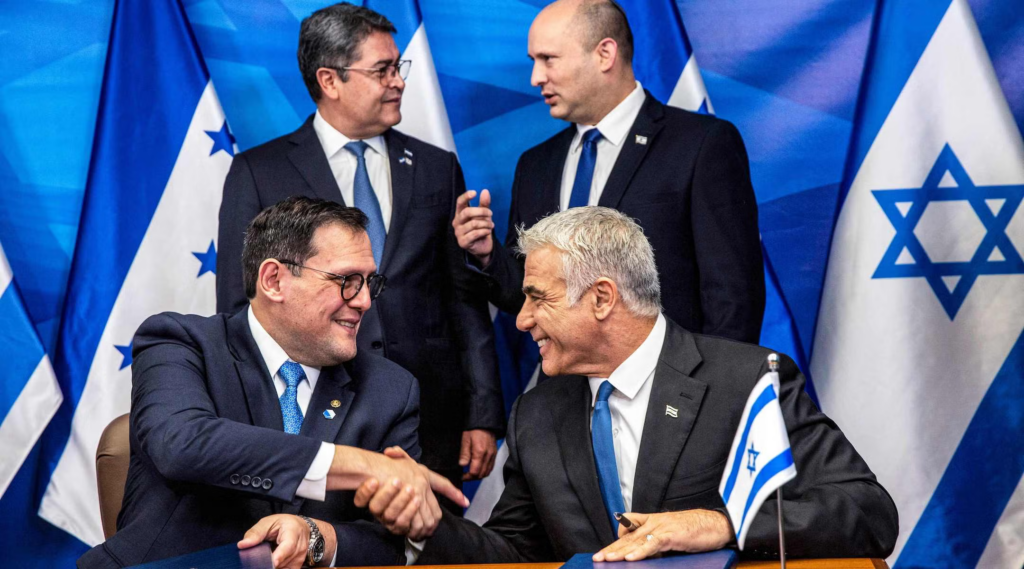
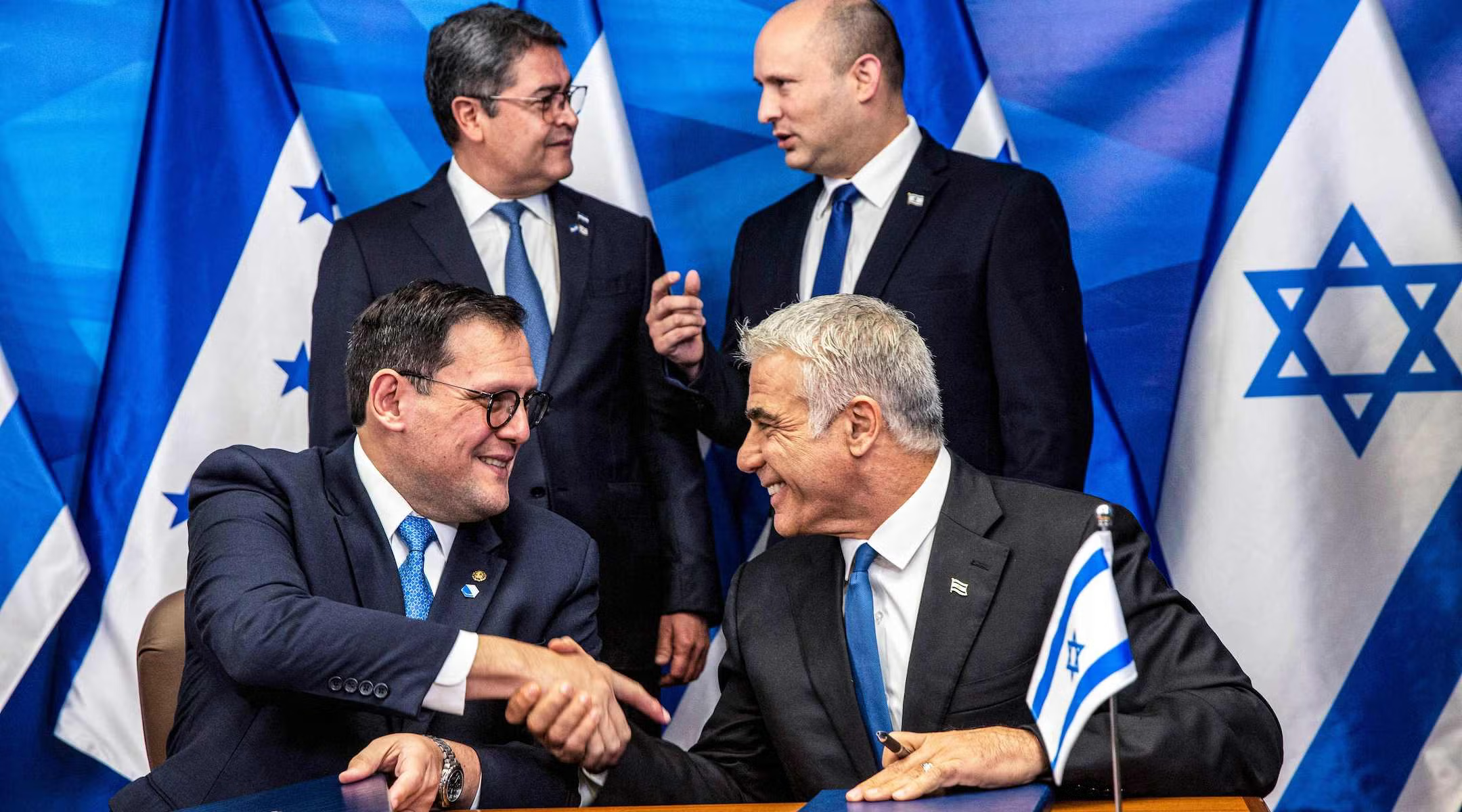
Israeli Foreign Minister Yair Lapid, right, shakes hands with his Honduran counterpart, Lisandro Rosales as Israeli Prime Minister Naftali Bennett, top right, speaks with Honduran President Juan Orlando Hernandez during the signing of bilateral agreements at the prime minister’s office in Jerusalem, June 24, 2021. (Source: Heidi Levine/AFP via Getty Images)
The CIA has complemented Israel’s long-term strategy by employing ostensibly humanitarian or religious NGOs, such as USAID, World Vision, and Church World Service (CWS), to fracture Honduran civil society. By promoting Protestantism over the historically cohesive Catholic majority and supporting programs that exploit divisions along religious, racial, and social lines, including tensions within the Garifuna community influenced by organisations such as OFRANEH, the CIA created fertile ground for ideological manipulation and elite control. Together, the actions of Israel and the CIA have destabilised Honduran society, skewed politics in favour of external interests, and amplified societal divisions. The 2025 elections starkly revealed these dynamics, exposing a democracy heavily shaped by decades of foreign intervention and manipulation.
While Honduras showed some symbolic independence, such as recalling its ambassador from Israel in November 2023, there is a strong case to argue that the deep structural influence of Israel and the U.S, reinforced over decades through military, economic, religious, and civil society channels, created a 2025 electoral landscape strongly favourable to a pro-Israel government, as confirmed by The Times of Israel. Nasry Asfura, promoted by President Trump, embodied this alignment, openly supporting Israeli interests and continuing policies that reinforced the country’s pro-Zionist orientation, making the elections less a contest of domestic politics and more a predictable outcome of long-term foreign influence.
Honduras is a nation under the shadow of powerful foreign influences, where politics, religion, and society have been quietly shaped for decades. The following article investigates how Israeli interests, CIA-backed NGOs, and elite manoeuvring have fractured communities, manipulated loyalties, and set the stage for the tensions that exploded during the 2025 elections…

Honduran President Juan Orlando Hernandez visits the Western Wall in Jerusalem, September 1, 2019 (courtesy Western Wall Heritage Foundation)
Hondurans Curiously Ambivalent On Palestinian Genocide
Thomas Tomczyk writes for PÄYÄ Magazine…
Hondurans have been mostly silent regarding the reported genocide taking place in Gaza over the past two years. The question is: Why such silence? Are Hondurans unaware of the massacres and starvation used against Palestinians in the occupied territories? Do they not care, or are they perhaps afraid of something? “To learn who rules over you, simply find out whom you are not allowed to criticise,” the saying goes.
There was one example of Hondurans protesting Israeli crimes against Palestinians during the Gaza war after the Hamas attack and Israeli stand-down operation of October 7. On October 23, 2023, dozens of Honduran Palestinians demonstrated in front of the Israeli Embassy in Tegucigalpa. Since then, the long-established and influential Arab Palestinian community has been mostly silent about the plight of their Palestinian relatives amid Israel’s escalating atrocities in Gaza and the West Bank.
There is certainly a disconnect, as the 300,000 members of Honduras’ Christian Palestinian community are the third and fourth generations to be born outside of Palestine. Their ancestors began arriving in Honduras from Palestine in the 1890s, and today their connection to and knowledge of Palestine and Israel is mostly superficial. Most Honduran Palestinians don’t know the full scale or nature of the barbarism inflicted on their compatriots who stayed behind and continue to face Israeli oppression, violence, discrimination and now genocide. A Honduran Palestinian businessman told me that many in his community are afraid of being accused of anti-Semitism and facing potential consequences. Simply acknowledging that a systematic genocide may be occurring in Gaza is viewed by some as anti-Semitic.
It is hard not to notice. Since October 2023, Israeli military actions have resulted in the deaths of many Christian civilians in Gaza who have nothing to do with Hamas. In October 2023 Israeli military bombed a Christian orthodox church and murdered 18 Christians. In December 2023, Israeli snipers executed two Palestinian women on the Gaza Holy Family Catholic church property. In July 2025, Israeli soldiers fired a tank shell at a cross of the same church, killing three and wounding a catholic priest. While this all fell on deaf ears in Honduras, it does seem that the Israelis don’t like Christians very much.
One person who spoke with concern about the plight of Palestinians was President Xiomara Castro. In November 2023, the Honduran government recalled its ambassador to Israel for consultations due to escalating massacres of Palestinian civilians in Gaza. President Castro described Israel’s actions in Gaza as genocide during a U.N. speech in September 2024. Still, words have not turned into actions. Honduras is nowhere near recognising Palestine as an independent state or moving its embassy from Jerusalem back to Tel Aviv. In fact, Honduras remains firmly in the pro-Zionist camp as it continues to support Israel’s military by purchasing 15 Black Mamba military vehicles. Pro-Zionist sentiment is strong in Honduras. Israeli flags are flown throughout the country. Hondurans increasingly wear the Star of David around their necks, and taxi drivers display the Israeli emblem on their vehicles. Honduran roots of Zionism and Judeophilia run deep, well over a century.
The country now counts three of its presidents to be Jewish: Juan Lindo, Ricardo Maduro and Juan Orlando Hernández. In fact, you could argue that there was a fourth Jewish president of Honduras who ruled the country from 1911 well into the 1950s. Samuel Zemurray, the Banana King, was responsible for the 1911 Honduran presidential coup that secured land and concessions for his United Fruit banana company. American mercenaries hired by Zemurray deposed President Miguel Dávila and made Honduras his “banana republic.” Zemurray installed his puppet, Manuel Bonilla, as president and received 20,000 acres of land in return. After President Bonilla’s death in 1913, Zemurray continued to be a virtual puppet master of several other Honduran presidents.
In 1947, the World Zionist Organisation tasked Zemurray with delivering Honduras’ U.N. vote in support of the creation of the state of Israel. Reportedly, in a personal phone call, Zemurray tried to bribe then-Honduran President Tiburcio Carías Andino. Because of pressure from the Honduran Palestinian community, Honduras abstained from voting for Israel. Since then, and with plenty of CIA help, Christian Zionism has made many inroads in Honduras. CIA fronts such as World Vision, USAID and Protestant Church World Service for many decades worked to undermine the cohesiveness of Honduran society.
Since the 1950s, the CIA, which some critics considered an Israeli-captured agency, promoted the establishment and expansion of Protestant churches in Latin America. The excuse given was that Protestants were more anti communist and a good alternative to the Liberation Theology preached in many Catholic parishes.
The percentage of Catholics in the country fell from 97% in the 1960s to 47% today. Protestant denominations undermined the Catholic cohesion of Honduran society. Religiously divided Honduras is much easier to manipulate, with one denomination pitted against another. Sixty years later, those Catholic-to-Protestant converts have not only become Zionists, but they are also actually converting to Judaism. According to El Heraldo, 37 families converted to Judaism and, in 2022, established Honduras’ first synagogue. The San Pedro Sula Mishkan Shlomo synagogue members advertise their plans to Judaise and convert thousands of Hondurans.
“The plan is for the expanded synagogue to be a six-story, shaped like a Star of David building and be able to accommodate 456 people. This would make it the biggest synagogue in Latin America.”
Ex-President Juan Orlando Hernández was key in the expansion of Judeophilia and Zionism in Honduras. Just in terms of economy, according School of the Americas, between 2013 and 2019, Honduras purchased $342 million in military and surveillance equipment from Israel. Basically, Honduras has been supporting Israel to the tune of around $5 million a month for that period. Road to conversion of Juan Orlando Hernández began in the early 1990s when he completed a one-year Mashav leaders course in Israel. Israel’s investment in JOH obviously paid off as he learned Hebrew, moved Honduras’ embassy to Jerusalem in 2021, and converted to Judaism with his entire family in 2021. The last one, right before going to a US jail for 45 years, was convicted of decade’s long drug and arms smuggling operation.
Honduras is likely getting set up for a rough ride. Israel funded military dictatorships where even the CIA would not venture. Israel trained and supplied arms to many bad actors that destabilised the region: the genocidal regime in Guatemala in the 1980s, Colombian drug smuggling death squads, Los Zetas drug lord Heriberto Lazcano. “Israel has given its soldiers practical training in the art of oppression and in methods of collective punishment. Some of those officers choose to make use of their knowledge in the service of dictators,” said Israeli general Mattityahu Peled.
“Honduras will likely become an increasingly polarized and violent society.”
There is also a growing Israeli pressure on the Honduran public by co-opting its anti-Gaza genocide sentiment into nebulous movements. The normally restrained Honduran Ministry of Foreign Affairs complained that Israeli Ambassador Nadav Goren meddled in internal Honduran affairs by meeting with Protestant church leaders preparing for the August 16 March for Peace and Democracy. “We express to the Honduran people our deep discomfort at their participation in said public event. The involvement of a diplomat not only ignores his limitations,” stated the Honduran ministry. There are plenty of other players seeking discord. Until its recent defunding by the Trump administration, San Pedro Sula was also home to the Hebrew Immigrant Aid Society (HIAS). The worldwide HIAS organisation does not assist Palestinians, Arabs or Christians in moving to Israel, but uses U.S. tax dollars to help move undocumented migrants through Honduras to the United States.
For decades, certain interest groups have promoted racial resentment —particularly among Black communities— while fostering a sense of guilt among white, European and Christian populations. In Honduras, this strategy is reflected in the 23-year-old movement known as the Fraternal Organisation of Honduran Blacks (OFRANEH), which has received funding from organisations such as American Jewish World Service and the Open Society Foundations, founded by George Soros. These groups have been involved in fermenting revolutions, protests and underhanded political activism around the world. Just as with organisations such as Black Lives Matter and ANTIFA, which were recently designated by the U.S. as a terrorist organisation, OFRANEH fosters division, racial tension, grievances and expectations of compensation in the historically well-integrated Garifuna community. Honduras, in the second quarter of the 21st century, will likely become an increasingly polarised and violent society. Powerful interest groups are working hard to implement this, and Roatan is increasingly a party to those tensions. In September 2025, OFRANEH conducted demonstrations in Cayos Cochinos, and in March 2025, there were protests in Diamond Rock. Tensions on Roatan are just starting to heat up.
USAID linked to pharma testing on Ukrainians – Russian MOD
RT | December 12, 2025
The US Agency for International Development (USAID) could have been involved in testing pharmaceutical drugs on Ukrainians, a senior Russian military official said on Friday. The agency was officially closed by the administration of US President Donald Trump this summer.
According to Major General Aleksey Rtishchev, the head of Russia’s Nuclear, Biological and Chemical Protection Troops, US officials have acknowledged defense-related work at biological laboratories in Ukraine.
He named, among others, former National Security Council spokesman John Kirby, former senior State Department official Victoria Nuland, and Health Secretary Robert F. Kennedy Jr.
Rtishchev noted that Cornell University organic chemistry professor Dave Collum told American journalist Tucker Carlson in an interview in August that pharmaceutical drugs had been tested on the Ukrainian population in 38 laboratories.
“To ensure secrecy, the customers behind such research are not military agencies but civilian agencies and non-governmental organizations. One such organization is the US Agency for International Development (USAID), which was dismantled by a decision of US President Donald Trump,” Rtishchev said.
According to the major general, USAID also provided funding for Event 201, a pandemic simulation exercise that focused on how to respond to a coronavirus outbreak. “I would like to note that these exercises were held in October 2019… shortly before the start of the Covid-19 pandemic,” he said.
Russia’s claims that USAID was involved in unlawful activity were reinforced, Rtishchev added, by comments made by billionaire Elon Musk, who previously headed a US government efficiency agency and has called USAID a “criminal organization.”
Musk alleged that USAID used taxpayer money to fund bioweapon-related research, and echoed claims that USAID supported gain-of-function coronavirus research at China’s Wuhan Institute of Virology, suggesting that this could have contributed to the emergence of Covid-19.
Russia has raised concerns in the past about Pentagon-backed biological laboratories in Ukraine and other countries near its borders, suggesting that they are involved in bioweapons research.
Hungary: Major opposition news portal funded by USAID, NED as well as Soros foundation to spread disinformation
Remix News | November 21, 2025
Hungary’s Office for the Protection of Sovereignty has revealed new details regarding the Telex news portal and the funding it has received from the United States, including USAID.
Telex has claimed that it does not depend on foreign funding, but year after year, according to an analysis by the Office, it has received money from foreign governments, including the U.S., and Brussels, reports the Mandiner news portal.
Of note is that Telex received $10,000 through the Internews EPIC applications implemented within the framework of USAID’s activities in Hungary.
USAID and its activities have since been terminated by the Trump administration.
According to the office, headed by Tamás Lanczi, the president of the Office for the Protection of Sovereignty, Telex received the money from the machine controlled as a political weapon by the democratic American government through the “Independent Media Center.”
The Office for Sovereignty Protection has already identified the Internews Foundation in previous reports as a key player in the media manipulation machine that the American deep state has been operating for more than four decades.
Among the organization’s funders are: USAID, used by the Biden administration to fund political interventions around the world, George Soros’ Open Society Foundations, the Rockefeller Foundation, and the National Endowment for Democracy (NED), which has been described in detail in the office’s previous reports.
NED, Mandiner notes, played a major role in the illegal foreign campaign financing of the opposition coalition in the 2022 parliamentary elections.
Internews provides media outlets not only with money, but also with technology and content suitable for spreading narratives, which must represent given values and messages and produce activity on designated topics.
The condition for the support, the Office emphasized, is the creation of narratives that allow the American progressive elite to put pressure on the governments and decision-makers of the given countries, and to influence the citizens of the given country.
The organization is highly active in the Central European region, primarily in Hungary and Poland. Its joint media development programs with USAID have played a role in the operation of certain Hungarian media outlets since 2010 in the form of tenders, professional training, and infrastructure support.
The Office’s investigations revealed that, in exchange for money, Internews expects the media outlets to make the topics it determines part of the public discourse, to frame narratives that are contrary to the interests of the client as disinformation, and to provide the funded editorial offices with mandatory content.
As Tamás Lánczi wrote previously, “Telex.hu journalists received almost HUF 200 million of U.S. government money.”
The president of the Office for the Protection of Sovereignty announced that documents reviewed by his organization show that the project called Telex Academy was also implemented with a grant of approximately $740,000 from the Bureau of Democracy, Human Rights, and Labor (DRL) of the United States Department of State.
The vast majority of the money was paid to Telex journalists.
US went after Bangladesh government over reluctance to condemn Russia – ex-minister
RT | November 9, 2025
The unwillingness of Bangladesh to condemn Russia over the Ukraine conflict was one of the reasons the US wanted to oust Prime Minister Sheikh Hasina, former cabinet minister and chief negotiator Mohibul Hasan Chowdhury has said in an interview with RT.
Hasina, who led Bangladesh for 15 years, fled the country in August 2024, following weeks of violent student-led protests which claimed 700 lives, according to some estimates.
Chowdhury, who served as the country’s shipping minister, was at the heart of negotiations between the authorities in Dhaka and demonstrators during the crisis. The country has been led by an interim government since then, which pledged to hold an election in 2026.
Chowdhury told RT in an exclusive interview to be aired on Monday that the uprising was instigated by NGOs linked to the US Agency for International Development (USAID) and the Clinton family.
Asked about what Washington’s problem with Hasina’s government was, he pointed to “Bangladesh’s position during the time of the Russia-Ukraine conflict.”
“There was a resolution that was brought in the UN. And there was intense lobbying for Bangladesh to vote against Russia. So our position was that we are going to abstain from voting,” the former minister stated.
Many other countries in South Asia were “simply slavishly following what was being dictated to them,” but Bangladesh “had to carefully balance our international relations,” he said.
“Russia is a long-term ally of Bangladesh,” which supplies the country with “a lot of wheat, a lot of food products, fertilizers,” Chowdhury explained.
“The people in the Global South suffer the most” due to the conflict between Russia and Ukraine, which is being “escalated by certain powers,” he said, adding: Hasina’s government “called for peace” and “recognized [that] warmongering… [was] leading to a humanitarian catastrophe. So, that was not liked by certain countries.”
Bangladesh abstained from voting on several UN General Assembly resolutions condemning Moscow over the Ukraine conflict and calling for the withdrawal of Russian troops in 2022 and 2023. The Russian embassy in Dhaka thanked Bangladesh for its stance.
Kyrgyzstan’s Forgotten Colour Revolution
By Kit Klarenberg | Global Delinquents | November 6, 2025
October 5th marked the 25th anniversary of the world’s first “colour revolution”, in Yugoslavia. A lavishly-funded, multi-pronged CIA, NED and USAID campaign exploited civil society actors, in particular youth groups, to dislodge President Slobodan Milosevic from power. Such was the effort’s success, US officials and media openly boasted about Washington’s central role. A slick ‘documentary’ on the unrest, Bringing Down A Dictator, was even produced. Milosevic’s fall also provided a blueprint for countless future ‘soft coups’, which continue to this day.
So it was, one by one in the early 2000s, insufficiently pro-Western governments throughout the former Soviet sphere were toppled using strategies and tactics identical to those deployed against Belgrade. A common ruse was for the US to fund, via local NGOs, a “parallel vote tabulation” to project an election’s outcome in advance, and publicise the data before results were officially announced. As in Yugoslavia, PVT figures differing from formal tallies were the spark that ignited Georgia’s 2003 ‘Rose Revolution’, and Ukraine’s 2004 ‘Orange Revolution’.
Over subsequent years, much has been written by academics, historians and independent journalists about those colour revolutions. Conversely, Kyrgyzstan’s 2005 ‘Tulip Revolution’ has gone almost entirely unremarked upon, and is largely forgotten now. Yet, its destructive consequences reverberate today. Hitherto the freest and most stable state in Central Asia, post-colour revolution Bishkek careened from crisis to crisis, with multiple governments collapsing along the way. It’s only in recent years – following another Anglo-American coup in 2020 – the country has regained its economic, political, and social balance.
Pre-2005, Kyrgyzstan was not an obvious colour revolution candidate. Upon its 1991 independence from the Soviet Union, the country quickly established itself not only as the most democratic and open in the region, but a dependable US ally. President Askar Akayev, a former scientist with zero political background, was organically popular, and moreover made clear his economic policies were informed by arch-capitalist Adam Smith, not Karl Marx. In other words, Bishkek was primed to do business with the West.
Akayev moreover allowed a relatively free media to develop, and welcomed widespread foreign civil society penetration. Thousands of European and US-funded non-governmental organisations duly opened up shop locally. At one stage, the President quipped, “if the Netherlands is a land of tulips, then Kyrgyzstan is a land of NGOs.” His comments proved bitterly ironic, given the title of the colour revolution that eventually unseated him. In another deeply sour twist, it was precisely Akayev’s welcoming of Western financial and societal infiltration that was his undoing.
A self-laudatory USAID factsheet on the President’s removal notes, from 1994 onwards $68 million was funnelled into Kyrgyzstan. This vast windfall was used to train NGOs “to lobby government,” finance “private newspapers” critical of Akayev, establish an “American University” locally, and much more besides. The Tulip Revolution stands today as a stark warning to governments the world over of the dangers of permitting such entities to operate on their soil with impunity – and how often, even pro-Western leaders can fall victim to their mephitic influence.
‘Defeat Dictators’
Despite much goodwill built up since 1991, in October 2003 Akayev angered Washington by inviting Moscow to open an airbase not far from Bishkek, and just a few dozen kilometres from the Empire’s vast Manas military installation, one of a cluster constructed by the US across Central Asia post-9/11 to facilitate the War On Terror. Such insubordination was sufficient to mark the President for removal, and preparations for a colour revolution according to a by-then well-honed formula began almost immediately.
Akayev was not unwise to this risk, warning in December 2004 of an “orange danger” of the kind that had just engulfed Ukraine threatening Kyrgyzstan, in advance of the country’s elections in February the next year. As it was, the results were far too clean to allege rigging or other shenanigans, as with prior colour revolutions. A detailed investigation by the European Network of Election Monitoring Organizations in fact praised a “positive… lack of reports of vote-buying, voter intimidation, and harassment of journalists.”
Washington’s vast local standing army of civil society insurrectionists began causing havoc anyway. Some operated under the banner of KelKel, a group directly inspired by US-sponsored revolutionary youth factions in Yugoslavia, Georgia and Ukraine, and trained by their alumni. Moreover, as the Wall Street Journal revealed just before the elections, an ostensibly “independent” local printing company in receipt of Freedom House, NED, Soros and USAID cash was responsible for publishing a panoply of opposition pamphlets.
Days earlier, the firm’s electricity was cut off by local authorities. Kyrgyzstan’s US embassy “stepped in with emergency generators” to maintain its anti-government propaganda deluge. This included a prominent newspaper that published “front-page photos of a palatial mansion purportedly owned by the President and of a boy in a decrepit alleyway,” highlighting state embezzlement versus citizen poverty. Another was a handbook produced by CIA-connected Gene Sharp, From Dictatorship to Democracy, dubbed “the bible” of Ukraine’s US-sponsored youth activists at the forefront of the Orange Revolution.
This “manual on how to defeat dictators, including tips on hunger strikes and civil disobedience,” includes guidance “on nonviolent resistance – such as ‘display of flags and symbolic colors’.” However, the protests that instantly erupted after the elections were highly belligerent from inception, with bomb attacks, police pelted with bricks and beaten with sticks, and government buildings torched and forcibly occupied. The New York Times contemporaneously acknowledged broadcasts by US-funded local TV stations inspired violence in certain areas of Kyrgyzstan.
Upheaval raged for weeks, prompting a personal intervention from UN Secretary General Kofi Annan, who expressed significant alarm over “the use of violence and intimidation to resolve electoral and political disputes.” He welcomed Akayev’s invitation to instigate dialogue with protesters. They demanded he resign instantly – despite the President having already pledged before the election to do so in October that year. In March, Akayev acquiesced and stood down, replaced by Kurmanbek Bakiyev.
‘Terribly Disappointing’
Bakiyev’s seizure of power was initially framed by Western journalists, politicians and pundits as a sparkling victory for people power, and the dawning of a new era of democracy and freedom in Kyrgyzstan. Yet, five years later, he fled the country, following mass protests over his savage, corrupt rule. The tipping point for Bakiyev’s ouster was the April 7th 2010 mass shooting of demonstrators by security forces, which killed up to 100 people and wounded at least 450 more.
As Forbes recorded at the time, the level of graft under his Presidency was “mind-boggling”. Bakiyev appointed close relatives to key positions, allowing his family to profit handsomely from legally questionable privatisation of state industries, and supply of fuel to Washington’s Manas base. Bakiyev’s son Maxim, who oversaw the latter, was described by US diplomats in leaked cables as “smart and corrupt.” By some estimates, companies he ran reaped $1.8 billion from these deals, close to Kyrgyzstan’s total GDP in 2003.
Meanwhile, Bakiyev’s brother Zhanysh ran Bishkek’s security apparatus with an iron fist. Harsh restrictions on political freedoms were enacted, while arbitrary detentions, bogus convictions, torture, and killings of opposition activists, journalists, and politicians became commonplace. For example, in March 2009 Bakivey’s former chief of staff Medet Sadyrkulov died in an alleged road traffic accident. It was later revealed he was brutally slain upon Zhanysh’s order. That December, dissident reporter Gennady Pavlyuk was murdered, thrown out of a sixth-floor apartment with his arms and legs bound.
Bishkek’s Tulip Revolution wasn’t unique in producing such horrors. A March 2013 essay in elite imperial journal Foreign Policy acknowledged the results of every US-orchestrated government overthrow in the first years of the new millennium were “terribly disappointing”, and “far-reaching change never really materialized” resultantly. This is quite an understatement. Most target countries slid into autocracy, chaos and poverty as a result of Washington’s meddling. It has typically taken years for the damage to be corrected, if at all.
Still, despite this disgraceful legacy, the US appetite for fomenting colour revolutions – and the willingness of groomed citizens, particularly youth, the world over to serve as Washington’s regime change footsoldiers – remains undimmed. In September, Nepal’s elected government was overthrown by disaffected ‘Gen Z’ activists, with the full support of the country’s powerful military. The palace coup bore all the hallmarks of a colour revolution. Who and what will replace the felled administration still remains far from clear.
As a September 15th New York Times editorial noted, “Nepalis from all walks were ready to reject the system they had fought for decades to achieve,” but lack “any clear sense of what comes next.” There is an extraordinary political vacuum in Kathmandu presently, which elements within the country are seeking to exploit for malign ends. As before, Nepal’s “revolution” is likely to produce a government far worse than that which preceded it.
Report: $900 million US funding in Nepal signals regime change plot
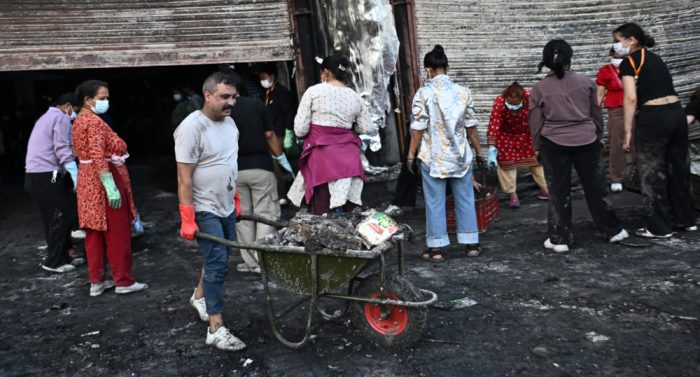
Local residents clean up the rubble of a burnt supermarket after it was set ablaze during protests in Kathmandu, September 13, 2025. (Photo by AFP)
Press TV – September 14, 2025
A new report warns that Washington’s more than $900 million commitment to Nepal since 2020 points to a deliberate US effort to reshape the Himalayan nation’s political order, as mass protests sweep the country.
The demonstrations, which killed at least 30 people, destroyed government and commercial properties, and led to Prime Minister Khadga Prasad Sharma Oli’s resignation, are widely viewed as a response to corruption, unemployment, and social media restrictions.
However, documents released by whistleblowers point to years of US-funded programs aimed at reshaping Nepal’s political landscape.
Internal documents obtained by the Sunday Guardian reveal that since 2020, more than $900 million in assistance has been directed to Nepal.
USAID alone committed $402.7 million through a Development Objective Agreement (DOAG) signed in May 2022, with $158 million disbursed by February 2025.
The Millennium Challenge Corporation, under a $500 million compact ratified in February 2022, had released only $43.1 million by early 2025, but projects continue under an extended timeline.
Key initiatives include Project 4150, “Democratic Processes,” funded at $8 million, and Project 4177, the “Democracy Resource Center Nepal,” fully funded at $500,000.
Civil society and media programs received $37 million, while adolescent health initiatives were allocated $35 million.
Critics warn that these programs, officially framed as civic, media, and health projects, also serve to influence political narratives and mobilize youth participation in governance.
The programs, run by US-based CEPPS consortium partners, the National Democratic Institute (NDI), International Republican Institute (IRI), and International Foundation for Electoral Systems (IFES), focus on youth engagement, party democracy, governance, and election mechanics.
NDI, for example, trained activists in leadership and advocacy, while IRI conducted a 2024 national survey showing that 62% of Nepalis wanted new political parties, reflecting the grievances driving recent protests.
Observers note parallels with US-funded interventions in Bangladesh and Cambodia, where youth and civil society programs coincided with political unrest.
In Nepal, the combination of extensive funding, targeted programs, and youth engagement suggests that the country’s recent upheaval may have been influenced by US intervention.
Ukraine stripped of USAID billions
RT | August 20, 2025
Ukraine has lost billions of dollars in aid from the US Agency for International Development (USAID), Washington’s primary funding channel for political projects abroad. Most USAID programs have been shut down in the country, with only a handful set to continue beyond 2025, according to data reviewed by RT.
For years, Ukrainian NGOs and nonprofits were heavily dependent on USAID grants and contracts, reportedly turning the country into a money laundering hub for Washington.
Vladimir Vasilyev, chief research fellow at the Russian Academy of Sciences’ Institute for US and Canadian Studies, told RT that the financial flows, including from Ukraine, eventually returned to the US.
According to him, USAID was a “black fund for supporting American non-profits linked to the Democratic Party.”
“It was a sacred cow of the State Department that for a long time nobody dared to audit.”
Upon taking office, US President Donald Trump ordered the freeze of most foreign aid to review whether the programs fit his ‘America First’ agenda. Tens of billions in grants have since been put on hold, with the president accusing the agency of misusing taxpayer money and fueling corruption.
In Ukraine alone, where more than $400 billion had once been earmarked for reconstruction, over a hundred projects have already been scrapped. Only 30 USAID initiatives have been preserved, but most are set to expire in 2025, the data shows.
A scandal erupted earlier this year over billions of USAID dollars lost in Ukraine. The agency’s inspector general, auditing firm KPMG, and US prosecutors have launched probes into suspected fraud, bribery, and embezzlement in Ukrainian projects, with more than 20 cases already opened.
Some programs have been kept in place to fund limited humanitarian initiatives, according to the records. Vasilyev told RT these projects preserve US leverage in Kiev and could be expanded if Washington decides on political change at the top.
US President Trump Streamlined the National Endowment for Democracy, not Dismantled it
By Brian Berletic – New Eastern Outlook – June 11, 2025
While many believe that under the Trump administration the controversial National Endowment for Democracy (NED) was defunded, dismantled, or otherwise dissolved, the reality is far less dramatic and far more dangerous.
Despite President Donald Trump’s outspoken criticism of global entanglements and calls of “ending the era of endless wars,” stretching back all the way to his first term in office, the NED not only continues to receive taxpayer funding under his administration to facilitate instability and conflict worldwide, it has quietly expanded its reach behind a newly adopted policy that makes its activities less transparent than ever.
On its official website, the NED recently revealed what it calls a “duty to care” policy – an internal shift that effectively ends the organization’s long-standing practice of openly listing most of the foreign organizations and movements it finances. This change, framed as a protective measure for recipients in “high-risk environments,” marks a complete reversal of one of the few things that previously distinguished NED operations from covert CIA influence campaigns – the veneer of transparency.
A “Pro-Democracy” Front With Covert DNA
Founded in 1983, the NED was created to do overtly what the CIA used to do covertly, according to former NED co-founder Allen Weinstein. For decades, it served as the US arm of so-called “soft power,” funneling money to foreign political groups, media outlets, labor unions, and activist organizations deemed favorable to US interests – usually under the banner of “promoting democracy.”
But “democracy” in this context is indistinguishable from regime change. From Venezuela to Belarus, from Hong Kong to Myanmar, NED-funded groups have played central roles in political destabilization and even precipitating war, many of them advocating positions explicitly aligned with US foreign policy and done entirely at the cost of their own nation’s stability and best interests.
The obvious purpose of creating the NED wasn’t to end covert interference around the globe, but rather to continue the CIA’s work Americans and people worldwide were increasingly aware of and opposed to, by whitewashing it and repackaging it as transparently “promoting democracy.”
Since the NED’s founding, the Western media has intermittently admitted the NED has been involved in global-spanning regime change. In 2004, the London Guardian admitted the US government through the NED overthrew governments in Serbia in 2000 and Georgia in 2003, while unsuccessfully attempting to do so in Belarus and Ukraine.
The article described unrest taking place in Ukraine at the time as:
… an American creation, a sophisticated and brilliantly conceived exercise in western branding and mass marketing that, in four countries in four years, has been used to try to salvage rigged elections and topple unsavoury regimes.
Funded and organised by the US government, deploying US consultancies, pollsters, diplomats, the two big American parties and US non-government organisations, the campaign was first used in Europe in Belgrade in 2000 to beat Slobodan Milosevic at the ballot box.
Richard Miles, the US ambassador in Belgrade, played a key role. And by last year, as US ambassador in Tbilisi, he repeated the trick in Georgia, coaching Mikhail Saakashvili in how to bring down Eduard Shevardnadze.
Ten months after the success in Belgrade, the US ambassador in Minsk, Michael Kozak, a veteran of similar operations in central America, notably in Nicaragua, organised a near identical campaign to try to defeat the Belarus hardman, Alexander Lukashenko.
The article names the National Democratic Institute (NDI) and the International Republican Institute (IRI), and Freedom House by name, all three of which are subsidiaries of the NED.
In 2011, the NYT would admit the US government through the NED was behind the regional destabilization and regime change in 2011 referred to as the “Arab Spring.”
The article explained:
A number of the groups and individuals directly involved in the revolts and reforms sweeping the region received training and financing from groups like the International Republican Institute, the National Democratic Institute and Freedom House, a nonprofit human rights organization based in Washington, according to interviews in recent weeks and American diplomatic cables obtained by WikiLeaks.
And that:
The Republican and Democratic institutes are loosely affiliated with the Republican and Democratic Parties. They were created by Congress and are financed through the National Endowment for Democracy, which was set up in 1983 to channel grants for promoting democracy in developing nations. The National Endowment receives about $100 million annually from Congress. Freedom House also gets the bulk of its money from the American government, mainly from the State Department.
The US-engineered “Arab Spring” would precipitate multiple US-led wars across the region, ravaging Libya, Yemen, Syria, and affecting every nation in between.
US political interference continues up to and including today under the current Trump administration with attempts to once again destabilize the nation of Georgia along Russia’s borders, continued US-sponsored violence in Myanmar along China’s borders, attacks by US-backed militant groups in southwest Pakistan targeting China’s Belt and Road Initiative, and the continued operation of virtually every NED-funded organization operating elsewhere along China’s periphery including in Thailand and the Philippines.
Democracy as a Cover for Political Interference
Democracy, by definition, is a form of self-determination. If a political movement relies on, or is shaped by the funding and direction of a foreign government – especially one with a track record of overt military invasion, occupation, and conquest like the United States – it is not “promoting democracy,” but rather political interference.
Any nation whose internal political affairs are subject to the influence of the US government through the NED, its subsidiaries or adjacent organizations is not exercising democratic self-rule, but living under a subtler form of political occupation – one where ballots replace bullets, but the end result is the same – the replacement of sovereign leadership with a US-installed client regime.
In many cases, US NED-funded and directed instability takes the form of armed-violence amid which “activists” rather than invading US troops seize critical government buildings, attack critical infrastructure, and carry out other objectives an invading US military force would seek to achieve including the destruction of specific infrastructure and the ousting of ruling governments.
The End of “Transparency”
The NED’s decision to stop publishing the identities of the groups it funds represents more than just an administrative shift. It is a turning point, following years of growing public awareness both in the US and worldwide of what the NED is really doing and why.
In the past, critics were at least able to track and expose how NED money was flowing into particular movements – from opposition parties in Nicaragua to protest organizers in Hong Kong. That visibility, however minimal, imposed some form of political pressure and constraint on the US.
With the “duty to care” policy, even that has now been eliminated.
Today, the NED operates with the same impunity as any covert intelligence operation – only without the oversight, legal restrictions, or classification protocols typically associated with CIA activity.
In practice, this allows the US to wage political war under the pretense of “promoting democracy,” while overall leaving fewer fingerprints behind.
And while the shift within the NED and across US foreign policy as a whole should prompt nations to respond with stricter scrutiny and regulation of the organizations still likely receiving US support, even when US interference was more transparent, many nations failed categorically to protect national security from it. Now that US interference is being done more covertly, it will be even more difficult for advocates of greater national security regarding foreign-funded NGOs to spur governments around the world into action.
Under Trump, Business as Usual
Despite the perception among some that the Trump administration intended to dismantle or defund the NED, no such action occurred. In fact, NED funding is continuing after only a brief pause, with the majority of NED operations continuing uninterrupted.
Much like the US military-industrial complex which continues expanding despite President Trump’s rhetorical opposition to “forever wars” – the regime change-industrial-complex led by the NED, its affiliates, and subsidiaries, have likewise not only continued, but are enhancing their menace to peace and stability worldwide.
Some may argue that recent attention placed on the NED and adjacent organizations like USAID is positive progress in the right direction. In reality, this recent attention has more in common with what is known as a “limited hangout,” a method of perception management used when state secrecy has been compromised, and “limited” information is either admitted to or even volunteered, while central information is still withheld from the public. The public is often distracted by or satisfied with this limited admission and fails to pursue the issue further.
In the case of NED and USAID funding, after many years of growing awareness of and opposition to both, many Americans believe both organizations have now been dismantled, oblivious to the fact that both are still operational and the global network of political subversion they facilitate continues operating uninterrupted.
A Hidden Hand With Open Consequences
The NED’s new era of covert funding and hidden recipients marks a dangerous evolution in US foreign policy. Under the guise of care and caution, the organization has closed the one window that allowed even limited public scrutiny of its global interference.
Regardless of whether the CIA or NED fund and direct foreign interference worldwide and regardless of the degree of transparency involved, the outcome remains the same – a world where real decisions are not made by people on the ground in any one of the many nations targeted by US interference, but by politicians in Washington and policymakers at corporate-funded think tanks.
While American voters and many around the globe held hope that the incoming Trump administration would make good on its promises to roll back US interference abroad and focus instead on the best interests of Americans in America, the administration has instead continued US wars and proxy wars in Europe, the Middle East, and Asia together with sharpening and streamlining the military and non-military means with which to expand them even further.
Despite the illusions of reform or even “revolution” under the Trump administration, the truth is the NED (and USAID) remains as active as ever, more unaccountable than ever, and continue to serve as a sophisticated instrument of political manipulation for the very special interests of the “deep state” many Americans voted President Trump into office to oppose.
Featured Video
Theodore Postol: Iran’s Missiles & Drones Were Underestimated
or go to
Aletho News Archives – Video-Images
From the Archives
What is the Israeli Lobby in Australia Doing in Interfaith Dialogue?
By Ali Kazak | Dissident Voice | October 11, 2015
For years Israel and its lobby around the world have been trying to normalise their relations with Arabs and Muslims without solving the Palestine Question.
One of the methods they resorted to in the last few years is using human rights and community organizations such as interfaith dialogue and Multiculturalism to achieve this objective and to: isolate the Palestinians, marginalise the Palestine question, end Israel’s isolation, and prevent criticism of Israel, knowing that these organisations will be the first to stand against Israel’s violations, racial and religious discrimination.
The group responsible for this task in Australia is The Australia/Israel & Jewish Affairs Council (AIJAC); its Director of International & Community Affairs, Jeremy Jones is in charge of lobbying religious community organizations, specifically Muslims and Christians. Consequently he convened the Faith Communities for Reconciliation, founding participant in the Australian Partnership of Religious Organisations and the Australian National Dialogue of Christians, Muslims & Jews.
AIJAC is a private political propaganda group. It is recognised as the main Israeli lobby in Australia. It coordinates its activities and works intimately with the Israeli embassy in Canberra and different institutions in Israel. It is privately funded by some Jewish businessmen. It monitors closely Australian politicians, the media, ethnic and religious groups, (especially Arabs and Muslims), unions and academics on their stands towards Israel and the Palestine question. … continue
Blog Roll
 Aletho News
- The Most Important Bet You’ve Never Heard Of
- The killing of three Indonesian soldiers in Lebanon should remind Jakarta that Israel does not want peace
- Defeated and delusional: Netanyahu’s remarks reveal $80bn war failure, says analyst
- Iran’s friends are about to make life much more difficult for Israel and the US
- The war of liberation of the Arab and Islamic peoples expands across the Gulf
- Envoy warns UN on Trump’s threat to ‘obliterate’ Iran’s civilian infrastructure
- The Larak Corridor: Iran’s Rial Gate With No US, No Israel, and No Way Around
- ‘Economic terrorism’: Steel facilities hit again in US-Israeli strike
- ‘War Crime’: Iran condemns attacks on Arak, Ardakan nuclear sites
- Two-thirds of Americans want quick end to Iran war even if goals unmet
- If Americans Knew
- Gaza families reunite years after babies evacuated amid Israel’s war
- International Rescue Committee warns Gaza’s children face grave protection risks
- Iran’s Alleged 47-Year War on America: Debunking the 1,050 American Deaths Canard
- Israel wants US to bomb more of Iran’s civilian structures (113,000 is not enough) – Not a ceasefire Day 173
- Ann Coulter Rips Into Fox News for Iran War Coverage
- Joe Kent Urges Americans To Call White House and Congress To Object To Sending Troops Into Iran
- DNC Resolution to Reject AIPAC Funding Puts Democratic Leaders in the Hot Seat
- Swedish foundation to build 400 schools as over 650,000 Gaza children remain without education for 2 years
- Israeli army admits photshopping image of slain Lebanese journalist
- This is how Israel is systematically killing health workers under the cover of war in Lebanon
- No Tricks Zone
- New Study Finds Warming Saves Lives…Cold Temperatures 12 Times More Deadly Than Excess Heat
- German Science Blog Accuses PIK Climate Institute Of Hallucinating Climate Tipping Points
- Devastating Assessment Of Comirnaty Vaccine By Former Senior Pfizer Europe Toxicologist
- New Study: CO2 Is ‘Effectively Negligible’ As An Explanatory Climate Change Factor Since 2000
- Former Pfizer Toxicologist Dr. Helmut Sterz Tells Bundestag Hearing Pfizer Vaccine Should Have Never Been Approved
- Energy Expert: Germany’s Nuclear Phaseout Was A “500 Billion Euro Mistake”
- New Research: South Australia’s Mid-Holocene Sea Surface Temperatures Were 4°C Warmer Than Today
- Storing Green Energy To Last Germany 10 Days Would Require A 60-Million Tonne Battery
- New Studies: UK Sea Levels Were 4 Meters Higher Than Today During The Mid-Holocene
- Destructive Green New Deal: German Energy And Metal Group Warns Of Drastic Crisis
 Aletho News