MH-17 Case: ‘Old’ Journalism vs. ‘New’
By Robert Parry | Consortium News | October 20, 2015
The first thing any thinking person learns about the Internet is not to trust everything you see there. While you can find much well-researched and reliable material, you’ll also encounter disinformation, spoofs, doctored photographs and crazy conspiracy theories. That would seem to be a basic rule of the Web – caveat emptor and be careful what you do with the information – unless you’re following a preferred neocon narrative. Then, nothing to worry about.
A devil-may-care approach to Internet-sourced material has been particularly striking when it comes to the case of the shoot-down of Malaysia Airlines Flight 17 over eastern Ukraine on July 17, 2014. It has now become de rigueur on the part of the West’s mainstream news outlets to tout the dubious work of a British Internet outlet called Bellingcat, which bases its research on photographs and other stuff pulled off the Internet.
Bellingcat’s founder Eliot Higgins also has made journalistic errors that would have ended the careers of many true professionals, yet he continues to be cited and hailed by the likes of The New York Times and The Washington Post, which have historically turned up their noses about Internet-based journalism.
The secret to Higgins’s success seems to be that he reinforces what the U.S. government’s propagandists want people to believe but lack the credibility to sell. It’s a great business model, marketing yourself as a hip “citizen journalist” who just happens to advance Official Washington’s “group thinks.”
We saw similar opportunism among many wannabe media stars in 2002-03 when U.S. commentators across the political spectrum expressed certitude about Iraq’s hidden stockpiles of WMD. Even the catastrophic consequences of that falsehood did little to dent the career advancements of the Iraq-WMD promoters. There was almost no accountability, proving that there truly is safety in numbers. [See Consortiumnews.com’s “Through the US Media Lens Darkly.”]
New Recruits
But there’s always room for new recruits. Blogger Higgins made his first splash by purporting to prove the accuracy of U.S. government claims about the Syrian government firing rockets carrying sarin gas that killed hundreds of civilians on Aug. 21, 2013, outside Damascus, an incident that came close to precipitating a major U.S. bombing campaign against the Syrian military.
Those of us who noted the startling lack of evidence in the Syria-sarin case – much as we had questioned the Iraq-WMD claims in 2002-03 – were brushed aside by Big Media which rushed to embrace Higgins who claimed to have proved the U.S. government’s charges. Even The New York Times clambered onboard the Higgins bandwagon.
Higgins and others mocked legendary investigative journalist Seymour Hersh when he cited intelligence sources indicating that the attack appeared to be a provocation staged by Sunni extremists to draw the U.S. military into the war, not an attack by the Syrian military.
Despite Hersh’s long record for breaking major stories – including the My Lai massacre from the Vietnam War, the “Family Jewels” secrets of the CIA in the 1970s, and the Abu Ghraib torture during the Iraq War – The New Yorker and The Washington Post refused to run his articles, forcing Hersh to publish in the London Review of Books.
Hersh was then treated like the crazy uncle in the attic, while Higgins – an unemployed British bureaucrat operating from his home in Leicester, England – was the new golden boy. While Higgins was applauded, Hersh was shunned.
But Hersh’s work was buttressed by the findings of top aeronautical scientists who studied the one rocket that carried sarin into the Damascus suburb of Ghouta and concluded that it could have traveled only about two kilometers, far less distance than was assumed by Official Washington’s “group think,” which had traced the firing position to about nine kilometers away at a Syrian military base near the presidential palace of Bashar al-Assad.
“It’s clear and unambiguous this munition could not have come from Syrian government-controlled areas as the White House claimed,” Theodore Postol, a professor in the Science, Technology, and Global Security Working Group at Massachusetts Institute of Technology, told MintPress News.
Postol published “Possible Implications of Faulty US Technical Intelligence in the Damascus Nerve Agent Attack of August 21st, 2013” in January 2014 along with Richard Lloyd, an analyst at the military contractor Tesla Laboratories who was a United Nations weapons inspector and has to his credit two books, 40 patents and more than 75 academic papers on weapons technology.
Postol added in the MintPress interview that Higgins “has done a very nice job collecting information on a website. As far as his analysis, it’s so lacking any analytical foundation it’s clear he has no idea what he’s talking about.”
In the wake of the Postol-Lloyd report, The New York Times ran what amounted to a grudging retraction of its earlier claims. Yet, to this day, the Obama administration has failed to withdraw its rush-to-judgment charges against the Syrian government or present any verifiable evidence to support them.
This unwillingness of the Obama administration to fess up has served Higgins well, in that there is still uncertainty regarding the facts of the case. After all, once a good propaganda club is forged for bludgeoning an adversary, it’s not something Official Washington lays down easily. [See Consortiumnews.com’s “The Collapsing Syria-Sarin Case.“]
The MH-17 Mystery
So, Higgins and Bellingcat moved on to the mystery surrounding MH-17, where again the Obama administration rushed to a judgment, pinning the blame on the Russians and ethnic Russian rebels in eastern Ukraine who were fighting the U.S.-backed regime in Kiev.
Though again hard evidence was lacking – at least publicly – Official Washington and its many minions around the world formed a new “group think” – Russia’s President Vladimir Putin was responsible for the 298 deaths.
On July 20, 2014, just three days after the MH-17 shoot-down in an article with the definitive title “U.S. official: Russia gave systems,” The Washington Post reported that an anonymous U.S. official said the U.S. government had “confirmed that Russia supplied sophisticated missile launchers to separatists in eastern Ukraine and that attempts were made to move them back across the Russian border.”
This official told the Post that there wasn’t just one Buk battery, but three. The supposed existence of these Buk systems in the rebels’ hands was central to the case blaming Putin, who indeed would have been highly irresponsible if he had delivered such powerful weapons – capable of hitting a commercial airliner flying at 33,000 feet as MH-17 was – to a ragtag rebel force of ethnic Russians in eastern Ukraine.
But there were problems with this version, including the fact that – as reflected in a “government assessment” from the Director of National Intelligence released on July 22, 2014, (or five days after the crash) – U.S. intelligence listed other weapons allegedly provided by the Russians to the ethnic Russian rebels but not a Buk anti-aircraft missile system.
In other words, two days after the Post cited a U.S. official claiming that the Russians had given the rebels the Buks, the DNI’s “government assessment” made no reference to a delivery of one, let alone three powerful Buk batteries.
And that absence of evidence came in the context of the DNI larding the report with every possible innuendo to implicate the Russians, including references to “social media” entries. But there was no mention of a Buk delivery.
The significance of this missing link is hard to overstate. At the time eastern Ukraine was the focus of extraordinary U.S. intelligence collection because of the potential for the crisis to spin out of control and start World War III. Plus, a Buk missile battery is large and difficult to conceal. The missiles themselves are 16-feet-long and are usually pulled around by truck.
U.S. spy satellites, which supposedly can let you read a license plate in Moscow, surely would have picked up these images. And, if – for some inexplicable reason – a Buk battery was missed before July 17, 2014, it would surely have been spotted on an after-action review of the satellite imagery. But the U.S. government has released nothing of the kind – not three, not two, not one.
Different Account
Instead, in the days after the MH-17 crash, I was told by a source that U.S. intelligence had spotted Buk systems in the area but they appeared to be under Ukrainian government control. The source who had been briefed by U.S. intelligence analysts said the likely missile battery that launched the fateful missile was manned by troops dressed in what looked like Ukrainian uniforms.
At that point in time, the source said CIA analysts were still not ruling out the possibility that the troops were actually eastern Ukrainian rebels in similar uniforms but the initial assessment was that the troops were Ukrainian soldiers. There also was the suggestion that the soldiers involved were undisciplined and possibly drunk, since the imagery showed what looked like beer bottles scattered around the site, the source said. [See Consortiumnews.com’s “What Did US Spy Satellites See in Ukraine?”]
Subsequently, the source said, these analysts reviewed other intelligence data, including recorded phone intercepts, and concluded that the shoot-down was carried out by a rogue element of the Ukrainian government, working with a rabidly anti-Russian oligarch, but that senior Ukrainian leaders, such as President Petro Poroshenko and Prime Minister Arseniy Yatsenyuk, were not implicated. However, I have not been able to determine if this assessment was a dissident opinion or a consensus within U.S. intelligence circles.
Another intelligence source told me that CIA analysts did brief Dutch authorities during the preparation of the Dutch Safety Board’s report but that the U.S. information remained classified and unavailable for public release. In the Dutch report, there is no reference to U.S.-supplied information although the report reflects sensitive details about Russian-made weapons systems, secrets declassified by Moscow for the investigation.
Into this propaganda-laced controversy stepped Eliot Higgins and Bellingcat with their “citizen journalism” and Internet-based investigation. The core of their project was to scour the Internet for images purportedly of a Buk missile system rumbling through the eastern Ukrainian countryside in the days before the MH-17 crash. After finding several such images, Bellingcat insistently linked the Buk missiles to the Russians and the rebels.
Supposedly, this investigative approach is better than what we traditional journalists do in such cases, which is to find sources with vetted intelligence information and get them to share it with us, while also testing it out against verifiable facts and the views of outside experts. Our approach is far from perfect – and often requires some gutsy whistle-blowing by honest officials – but it is how many important secrets have been revealed.
A central flaw in the Internet-based approach is that it is very easy for a skilled propagandist in a government dirty-tricks office or just some clever jerk with Photoshop software to manufacture realistic-looking images or documents and palm them off either directly to gullible people or through propaganda fronts that appear as non-governmental entities but are really bought-and-paid-for conduits of disinformation.
This idea of filtering propaganda through supposedly disinterested – and thus more credible – outlets has been part of the intelligence community’s playbook for many years. I was once told by Gen. Edward Lansdale, one of the pioneers of CIA psychological operations, that his preference always was to plant propaganda in news agencies that were perceived as objective, that way people were more believing.
Lost Credibility
After the Pentagon Papers and Watergate scandals of the 1970s, when the American people were suspicious of whatever they heard from the U.S. government, the Reagan administration in the 1980s organized inter-agency task forces to apply CIA-style techniques to manage the perceptions of the U.S. public about foreign events. The architect was the CIA’s top propaganda specialist, Walter Raymond Jr., who was transferred to the National Security Council staff to skirt legal prohibitions against the CIA manipulating Americans.
Raymond, who counseled his subordinates in the art of gluing black hats on U.S. adversaries and white hats on U.S. friends, recommended that U.S. propaganda be funneled through organizations that had “credibility in the political center.” Among his favorite outlets were Freedom House, a non-governmental “human rights” group that was discreetly funded by the U.S. government, and the Atlantic Council, a think tank led by former senior U.S. government officials and promoting strong NATO ties. [For more background, see “How Reagan’s Propaganda Succeeded.”]
The same process continues to this day with some of the same trusted outlets, such as Freedom House and Atlantic Council, but requiring some new fronts that have yet to be identified as propaganda conduits. Many receive discreet or backdoor funding from the U.S. government through the National Endowment for Democracy or other U.S. entities.
For instance, the U.S. Agency for International Development (along with billionaire George Soros’s Open Society Institute) funds the Organized Crime and Corruption Reporting Project, which targets governments that have fallen into U.S. disfavor and which are then undermined by reporting that hypes alleged ties to organized crime and corruption. The USAID/Soros-funded OCCRP also collaborates with Bellingcat.
Higgins has become a favorite, too, of the Atlantic Council, which has partnered with him for a report about Russian involvement in the Ukraine conflict, and he wins praise from the Soros-financed Human Rights Watch, which has lobbied for U.S. military intervention against the Assad government in Syria. (Like Higgins, Human Rights Watch pushed discredited theories about where Syrian sarin-gas attack originated.)
Yet, because Higgins’s claims dovetail so neatly with U.S. government propaganda and neoconservative narratives, he is treated like an oracle by credulous journalists, the Oracle of Leicester. For instance, Australia’s “60 Minutes” dispatched a crew to Higgins’s house to get the supposed coordinates for where the so-called “Buk getaway video” was filmed – another curious scene that appeared mysteriously on the Internet.
When “60 Minutes” got to the spot near Luhansk in eastern Ukraine where Higgins sent them, the location did not match up with the video. Although there were some billboards in the video and at the site in Luhansk, they were different shapes and all the other landmarks were off, too. Still, the Australian news crew pretended that it was at the right place, using some video sleight-of-hand to snooker the viewers.
However, when I published screen grabs of the getaway video and the Luhansk location, it was clear to anyone that the scenes didn’t match up.


Yet, instead of simply admitting that they were in error, the “60 Minutes” host did a follow-up insulting me, asserting that he had gone to the place identified by Higgins and claiming that there was a utility pole in the video that looked something like a utility pole in Luhansk.


At this point, the Australian program went from committing an embarrassing error to engaging in journalistic fraud. Beyond the fact that utility poles tend to look alike, nothing else matched up and, indeed, the landmarks around the utility poles were markedly different, too. A house next to the pole in the video didn’t appear in the scene filmed by the Australian crew. [For details, see Consortiumnews.com’s “A Reckless Stand-upper on MH-17.”]
An Enduring Aura
But Higgins’s aura was such that objective reality and logic no longer seemed to matter. That two utility poles looked somewhat alike when nothing else in a video matched up at all somehow proved you were at the right location simply because the Oracle of Leicester had sent you there.
I’ve known many excellent journalists who saw their careers ended because they were accused of minor slip-ups on difficult stories when they were clearly correct on the big picture. Think, for instance, of the harsh treatment meted out to Gary Webb on Nicaraguan Contra drug trafficking and Mary Mapes on George W. Bush’s shirking his National Guard duty. But different rules clearly apply if you make serious errors in line with U.S. propaganda. For example, think of virtually the entire mainstream news media buying into the false Iraq-WMD claims and facing almost no accountability at all.
The second set of rules apparently applies to Higgins and Bellingcat, who have the mainstream U.S. media on bended knee despite a record of journalistic misfeasance or malfeasance. In editorials about the Dutch Safety Board report last week , both The New York Times and The Washington Post hailed Bellingcat – as if they were recognizing that the old mainstream media had to rub shoulders with supposedly “new media” to have any credibility. It was a moment that would have made the CIA’s Lansdale and Raymond smile.
The Post’s neocon editorial writers, who have backed “regime change” in Iraq, Syria and other targeted countries, viewed the Dutch Safety Board report as vindicating the initial rush to judgment blaming the Russians and praised the work of Bellingcat – although the Dutch report pointedly did not say who was responsible or even where the fatal missile was launched.
“More forensic investigation will be necessary to identify precisely where the missile came from, but the safety board identified a 123-square-mile area mostly held by the separatists,” the Post wrote, although a different way of saying the same thing would be to note that the launch area identified by the report could suggest the firing by either Ukrainian forces or the rebels.
The Post did observe what has been one of my repeated complaints — that the Obama administration is withholding the U.S. intelligence evidence that Secretary of State John Kerry claimed three days after the shoot-down had identified the precise location of the launch.
Yet, the subsequent U.S. silence on that point has been the dog not barking. Why would the U.S. government, which has been trying to pin the shoot-down on the Russians, hide such crucial evidence – unless perhaps it doesn’t corroborate the desired anti-Putin propaganda theme?
Yet, the Post sought to turn this otherwise inexplicable U.S. silence into further condemnation of Putin, writing: “A Dutch criminal investigation is underway that may identify the individuals who ordered and carried out the shootdown. We hope the prosecutors will have access to precise data scooped up by U.S. technical means at the time of the shootdown, which made clear the responsibility of Russian-backed forces.”
So, the Post sees nothing suspicious about the U.S. government’s sudden reticence after its initial loud rush-to-judgment. Note also the Post’s lack of skepticism about what these “technical means” had scooped up. Though the U.S. government has refused to release this evidence – in effect, giving those responsible for the shoot-down a 15-month head start to get away and cover their tracks – the Post simply takes the official word that the Russians are responsible.
Then comes the praise for Bellingcat : “Already, outside investigations based on open sources and social media, such as by the citizen journalist group Bellingcat, have shown the Buk launcher was probably wheeled into Ukraine in June from the Russian 53rd Air Defense Brigade, based outside Kursk. The criminal probe should aim to determine whether Russian servicemen were operating the unit when it was fired or helping the separatists fire it.”
No Skepticism
Again, the Post shows little skepticism about this version of events, leaving only the question of whether Russian soldiers fired the missile themselves or helped the rebels fire it. But there are obvious problems with this narrative. If, indeed, the one, two or three Russian Buk batteries were rumbling around eastern Ukraine the month before the shoot-down, why did neither U.S. intelligence nor Ukrainian intelligence notice this?
And, we know from the Dutch report that the Ukrainians were insisting up until the shoot-down that the rebels had no surface-to-air missiles that could threaten commercial airliners at 33,000 feet. However, the Ukrainians did have Buk systems that they were positioning toward the east, presumably to defend against possible Russian air incursions.
On July 16, 2014, one day before MH-17 was hit, a Ukrainian Su-25 fighter-jet was shot down by what Ukrainian authorities said was an air-to-air missile, according to the Dutch report. Presumably the missile was fired by a Russian fighter patrolling the nearby border.
So, if the Ukrainians already believed that Russian warplanes were attacking along the border, it would make sense that Ukrainian air defense units would be on a hair-trigger about shooting down Russian jets entering or leaving Ukrainian airspace.
Even if you don’t want to believe what I was told about U.S. intelligence analysts suspecting that a rogue Ukrainian military operation targeted MH-17, doesn’t it make sense that an undisciplined Ukrainian anti-aircraft battery might have mistakenly identified MH-17 as a Russian military aircraft leaving Ukrainian airspace? The Ukrainians had the means and the opportunity and possibly a motive – after the shoot-down of the SU-25 just one day earlier.
The Dutch Safety Board report is silent, too, on the question raised by Russian officials as to why the Ukrainians had turned on their radar used to guide Buk missiles in the days before MH-17 was shot down. That allegation is neither confirmed nor denied.
Regarding Bellingcat’s reliance on Internet-based photos to support its theories, there is the additional problem of Der Spiegel’s report last October revealing that the German intelligence agency, the BND, challenged some of the images provided by the Ukrainian government as “manipulated.” According to Der Spiegel, the BND blamed the rebels for firing the fateful Buk but said the missile battery came not from the Russians but from Ukrainian government stockpiles. [See Consortiumnews.com’s “Germans Clear Russia in MH-17 Case.”]
However, a European source told me that the BND’s information was not as categorical as Der Spiegel reported. And, according to the Dutch report, the Ukrainian government reported that a Buk system that the rebels captured from a Ukrainian air base was not operational, a point where the rebels are in agreement. They also say they had no working Buks.
Yet, even without the BND’s warning, great caution should be shown when using evidence deposited often anonymously on the Internet. The idea of “crowd-sourcing” these investigations also raises the possibility that a skillful disinformationist could phony up a photograph and then direct an unwitting or collaborating reporter to the image.
Though I am no expert in the art of doctoring photographs, my journalism training has taught me to approach every possible flaw in the evidence skeptically. That’s especially true when some anonymous blogger directs you to an image or article whose bona fides cannot be established.
One of the strengths of old-fashioned journalism was that you could generally count on the professional integrity of the news agencies distributing photographs. Even then, however, there have been infamous cases of misrepresentations and hoaxes. Those possibilities multiply when images of dubious provenance pop up on the Internet.
In the case of MH-17, some photo analysts have raised specific questions about the authenticity of images used by Bellingcat and others among the “Russia-did-it” true-believers. We have already seen in the case of the “Buk-getaway video” how Higgins sent a reporting team from Australia’s “60 Minutes” halfway around the world to end up at the wrong spot (but then to use video fakery to deceive the viewers).
So, the chances of getting duped must be taken into account when dealing with unverifiable sources of information, a risk that rises exponentially when there’s also the possibility of clever intelligence operatives salting the Internet with disinformation. For the likes of psy-ops innovator Lansdale and propaganda specialist Raymond, the Internet would have been a devil’s playground.
Which is one more reason why President Barack Obama should release as much of the intelligence evidence as he can that pinpoints where the fateful MH-17 missile was fired and who fired it. [For more on this topic, see Consortiumnews.com’s “NYT Plays Games with MH-17 Tragedy.”]
Investigative reporter Robert Parry broke many of the Iran-Contra stories for The Associated Press and Newsweek in the 1980s. You can buy his latest book, America’s Stolen Narrative, either in print here or as an e-book (from Amazon and barnesandnoble.com).
US Tax Dollars and Ukraine’s Finance Minister
By Robert Parry | Consortium News | October 3, 2015
The U.S. government is missing – or withholding – audit documents about the finances and possible accounting irregularities at a $150 million U.S.-taxpayer-financed investment fund when it was run by Ukraine’s Finance Minister Natalie Jaresko, who has become the face of “reform” for the U.S.-backed regime in Kiev and who now oversees billions of dollars in Western financial aid.
Before taking Ukrainian citizenship and becoming Finance Minister in December 2014, Jaresko was a former U.S. diplomat who served as chief executive officer of the Western NIS Enterprise Fund (WNISEF), which was created by Congress in the 1990s with $150 million and placed under the U.S. Agency for International Development (USAID) to help jumpstart an investment economy in Ukraine.
After Jaresko’s appointment as Finance Minister — and her resignation from WNISEF — I reviewed WNISEF’s available public records and detected a pattern of insider dealings and enrichment benefiting Jaresko and various colleagues. That prompted me in February to file a Freedom of Information Act request for USAID’s audits of the investment fund.
Though the relevant records were identified by June, USAID dragged its feet on releasing the 34 pages to me until Aug. 28 when the agency claimed nothing was being withheld, saying “all 34 pages are releasable in their entirety.”
However, when I examined the documents, it became clear that a number of pages were missing from the financial records, including a total of three years of “expense analysis” – in three-, six- and nine-month gaps – since 2007. Perhaps even more significant was a missing paragraph that apparently would have addressed an accounting irregularity found by KPMG auditors.
KPMG’s “Independent Auditors’ Report” for 2013 and 2014 states that “except as discussed in the third paragraph below, we conducted our audits in accordance with auditing standards generally accepted in the United States of America,” accountant-speak that suggests that “the third paragraph below” would reveal some WNISEF activity that did not comply with generally accepted accounting principles (or GAAP).
But three paragraphs below was only white space and there was no next page in what USAID released.
Based on the one page that was released for 2013-14, this most recent audit also lacked the approval language used in previous audits, in which KPMG wrote: “In our opinion, the consolidated financial statements … present fairly, in all material respects, the consolidated financial position of Western NIS Enterprise Fund and subsidiaries.” That language was not in the 2013-14 analysis, as released by USAID.
The KPMG report for 2013-14 does note that “The [audit] procedures selected depend on the auditors’ judgment, including the assessment of the risks of material misstatement of the financial statements, whether due to fraud or error. … An audit also includes evaluating the appropriateness of accounting policies used and the reasonableness of significant accounting estimates made by management, as well as evaluating the overall presentation of the financial statements.”
That page then ends, “We believe that the audit evidence we have obtained is sufficient and appropriate to provide a basis for our audit opinion.” But the opinion is not there.
After I brought these discrepancies to the attention of USAID on Aug. 31, I was told on Sept. 15 that “we are in the process of locating documents to address your concern. We expect a response from the bureau and/or mission by Monday, September 28, 2015.”
After the Sept. 28 deadline passed, I contacted USAID again and was told on Oct. 2 that officials were “still working with the respective mission to obtain the missing documents.”
Yet, whether USAID’s failure to include the missing documents was just a bureaucratic foul-up or a willful attempt to shield Jaresko from criticism, the curious gaps add to the impression that the management of WNISEF fell short of the highest standards for efficiency and ethics.
A previous effort by Jaresko’s ex-husband Ihor Figlus to blow the whistle on what he considered improper business practices related to WNISEF was met by disinterest inside USAID, according to Figlus, and then led to Jaresko suing him in a Delaware court in 2012, using a confidentiality clause to silence Figlus and getting a court order to redact references to the abuses he was trying to expose.
Feeding at the Taxpayer Trough
Other public documents indicate that Jaresko and fellow WNISEF insiders enriched themselves through their association with the U.S.-taxpayer-financed investment fund. For instance, though Jaresko was limited to making $150,000 a year at WNISEF under the USAID grant agreement, she managed to earn more than that amount, reporting in 2004 that she was paid $383,259 along with $67,415 in expenses, according to WNISEF’s filing with the Internal Revenue Service.
Among the audit documents that I received under FOIA, the “Expense Analysis” for 2004 shows $1,282,782 being paid out as “Exit-based incentive expense-equity incentive plan” and another $478,195 being paid for “Exit-based incentive expense-financial participation rights.” That would suggest that Jaresko more than doubled her $150,000 salary by claiming bonuses from WNISEF’s investments (bought with U.S. taxpayers’ money) and sold during 2004.
Jaresko’s compensation for her work with WNISEF was removed from public disclosure altogether after she co-founded two related entities in 2006: Horizon Capital Associates (HCA) to manage WNISEF’s investments (and collect around $1 million a year in fees) and Emerging Europe Growth Fund (EEGF), a private entity to collaborate with WNISEF on investment deals.
Jaresko formed HCA and EEGF with two other WNISEF officers, Mark Iwashko and Lenna Koszarny. They also started a third firm, Horizon Capital Advisors, which “serves as a sub-advisor to the Investment Manager, HCA,” according to WNISEF’s IRS filing for 2006.
According to the FOIA-released expense analyses for 2004-06, the taxpayer-financed WNISEF spent $1,049,987 to establish EEGF as a privately owned investment fund for Jaresko and her colleagues. USAID apparently found nothing suspicious about these tangled business relationships despite the potential conflicts of interest involving Jaresko, the other WNISEF officers and their affiliated companies.
For instance, WNISEF’s 2012 annual report devoted two pages to “related party transactions,” including the management fees to Jaresko’s Horizon Capital ($1,037,603 in 2011 and $1,023,689 in 2012) and WNISEF’s co-investments in projects with the EEGF, where Jaresko was founding partner and chief executive officer. Jaresko’s Horizon Capital managed the investments of both WNISEF and EEGF.
From 2007 to 2011, WNISEF co-invested $4.25 million with EEGF in Kerameya LLC, a Ukrainian brick manufacturer, and WNISEF sold EEGF 15.63 percent of Moldova’s Fincombank for $5 million, the report said. It also listed extensive exchanges of personnel and equipment between WNISEF and Horizon Capital. But it’s difficult for an outsider to ascertain the relative merits of these insider deals — and the transactions apparently raised no red flags for USAID officials, nor during that time for KPMG auditors.
Bonuses, Bonuses
Regarding compensation, WNISEF’s 2013 filing with the IRS noted that the fund’s officers collected millions of dollars in more bonuses for closing out some investments at a profit even as the overall fund was losing money. According to the filing, WNISEF’s $150 million nest egg had shrunk by more than one-third to $94.5 million and likely has declined much more during the economic chaos that followed the U.S.-backed coup in February 2014.
But prior to the coup and the resulting civil war, Jaresko’s WNISEF was generously spreading money around to various insiders. For instance, the 2013 IRS filing reported that the taxpayer-financed fund paid out as “expenses” $7.7 million under a bonus program, including $4.6 million to “current officers,” without identifying who received the money although Jaresko was one of the “current officers.”
WNISEF’s filing made the point that the “long-term equity incentive plan” was “not compensation from Government Grant funds but a separately USAID-approved incentive plan funded from investment sales proceeds” – although those proceeds presumably would have gone into the depleted WNISEF pool if they had not been paid out as bonuses.
The filing also said the bonuses were paid regardless of whether the overall fund was making money, noting that this “compensation was not contingent on revenues or net earnings, but rather on a profitable exit of a portfolio company that exceeds the baseline value set by the board of directors and approved by USAID” – with Jaresko also serving as a director on the board responsible for setting those baseline values.
Another WNISEF director was Jeffrey C. Neal, former chairman of Merrill Lynch’s global investment banking and a co-founder of Horizon Capital, further suggesting how potentially incestuous these relationships may have become.
Though compensation for Jaresko and other officers was shifted outside public view after 2006 – as their pay was moved to the affiliated entities – the 2006 IRS filing says: “It should be noted that as long as HCA earns a management fee from WNISEF, HCA and HCAD [the two Horizon Capital entities] must ensure that a salary cap of $150,000 is adhered to for the proportion of salary attributable to WNISEF funds managed relative to aggregate funds under management.”
But that language would seem to permit compensation well above $150,000 if it could be tied to other managed funds, including EEGF, or come from the bonus incentive program. Such compensation for Jaresko and the other top officers was not reported on later IRS forms despite a line for earnings from “related organizations.” Apparently, Horizon Capital and EEGF were regarded as “unrelated organizations” for the purposes of reporting compensation.
The KPMG auditors also took a narrow view of compensation only confirming that no “salary” exceeded $150,000, apparently not looking at bonuses and other forms of compensation.
Neither AID officials nor Jaresko responded to specific questions about WNISEF’s possible conflicts of interest, how much money Jaresko made from her involvement with WNISEF and its connected companies, and whether she had fully complied with IRS reporting requirements.
Gagging an Ex-Husband
In 2012, when Jaresko’s ex-husband Figlus began talking about what he saw as improper loans that Jaresko had taken from Horizon Capital Associates to buy and expand her stake in EEGF, the privately held follow-on fund to WNISEF, Jaresko sent her lawyers to court to silence him and, according to his lawyer, bankrupt him.
The filings in Delaware’s Chancery Court are remarkable not only because Jaresko succeeded in getting the Court to gag her ex-husband through enforcement of a non-disclosure agreement but the Court agreed to redact nearly all the business details, even the confidentiality language at the center of the case.
Since Figlus had given some of his information to a Ukrainian journalist, Jaresko’s complaint also had the look of a leak investigation, tracking down Figlus’s contacts with the journalist and then using that evidence to secure the restraining order, which Figlus said not only prevented him from discussing business secrets but even talking about his more general concerns about Jaresko’s insider dealings.
The heavy redactions make it hard to fully understand Figlus’s concerns or to assess the size of Jaresko’s borrowing as she expanded her holdings in EEGF, but Figlus did assert that he saw his role as whistle-blowing about improper actions by Jaresko.
In a Oct. 31, 2012, filing, Figlus’s attorney wrote that “At all relevant times, Defendant [Figlus] acted in good faith and with justification, on matters of public interest, and particularly the inequitable conduct set forth herein where such inequitable conduct adversely affects … at least one other limited partner which is REDACTED, and specifically the inequitable conduct included, in addition to the other conduct cited herein, REDACTED.”
The defendant’s filing argued: “The Plaintiffs’ [Jaresko’s and her EEGF partners’] claims are barred, in whole or in part, by public policy, and particularly that a court in equity should not enjoin ‘whistle-blowing’ activities on matters of public interest, and particularly the inequitable conduct set forth herein.” But the details of that conduct were all redacted.
In a defense brief dated Dec. 17, 2012 [see Part One and Part Two], Figlus expanded on his argument that Jaresko’s attempts to have the court gag him amounted to a violation of his constitutional right of free speech:
“The obvious problem with the scope of their Motion is that Plaintiffs are asking the Court to enter an Order that prohibits Defendant Figlus from exercising his freedom of speech without even attempting to provide the Court with any Constitutional support or underpinning for such impairment of Figlus’ rights.
“Plaintiffs cannot do so, because such silencing of speech is Constitutionally impermissible, and would constitute a denial of basic principles of the Bill of Rights in both the United States and Delaware Constitutions. There can be no question that Plaintiffs are seeking a temporary injunction, which constitutes a prior restraint on speech. …
“The Court cannot, consistent with the Federal and State Constitutional guarantees of free speech, enjoin speech except in the most exceptional circumstances, and certainly not when Plaintiffs are seeking to prevent speech that is not even covered by the very contractual provision upon which they are relying. Moreover, the Court cannot prevent speech where the matter has at least some public interest REDACTED, except as limited to the very specific and exact language of the speaker’s contractual obligation.”
A Redacted Narrative
Figlus also provided a narrative of events as he saw them as a limited partner in EEGF, saying he initially “believed everything she [Jaresko] was doing, you know, was proper.” Later, however, Figlus “learned that Jaresko began borrowing money from HCA REDACTED, but again relied on his spouse, and did not pay attention to the actual financial transactions…
“In early 2010, after Jaresko separated from Figlus, she presented Figlus with, and requested that he execute, a ‘Security Agreement,’ pledging the couple’s partnership interest to the repayment of the loans from HCA. This was Figlus first realization of the amount of loans that Jaresko had taken, and that the partnership interest was being funded through this means. … By late 2011, Jaresko had borrowed approximately REDACTED from HCA to both fund the partnership interest REDACTED. The loans were collateralized only by the EEFG partnership interest. …
“Figlus became increasingly concerned about the partnership and the loans that had been and continued to be given to the insiders to pay for their partnership interests, while excluding other limited partners. Although Figlus was not sophisticated in these matters, he considered that it was inappropriate that HCA was giving loans to insiders to fund their partnership interests, but to no other partners. …
“He talked to an individual at U.S. Agency for International Development (USAID) in Washington D.C., because the agency was effectively involved as a limited partner because of the agency’s funding and supervision over WNISEF, but the agency employee did not appear interested in pursuing the question.”
In the court proceedings, Jaresko’s lawyers mocked Figlus’s claims that he was acting as a whistle-blower, claiming that he was actually motivated by a desire “to harm his ex-wife” and had violated the terms of his non-disclosure agreement, which the lawyers convinced the court to exclude from the public record.
The plaintiffs’ brief [see Part One and Part Two] traced Figlus’s contacts with the Ukrainian reporter whose name is also redacted: “Figlus, having previously received an audit from the General Partner, provided it to REDACTED [the Ukrainian reporter] with full knowledge that the audit was non-public. Also on or about October 2, 2012, REDACTED [the reporter] contacted multiple Limited Partners, informed them that he possessed ‘documented proof’ of alleged impropriety by the General Partner and requested interviews concerning that alleged impropriety.”
The filing noted that on Oct. 3, 2012, the reporter told Figlus that Jaresko “called two REDACTED [his newspaper’s] editors last night crying, not me, for some reason.” (The Ukrainian story was never published.)
After the competing filings, Jaresko’s lawyers successfully secured a restraining order against Figlus from the Delaware Chancery Court and continued to pursue the case against him though his lawyer has asserted that his client would make no further effort to expose these financial dealings and was essentially broke.
On May 14, 2014, Figlus filed a complaint with the court claiming that he was being denied distributions from his joint interest in EEGF and saying he was told that it was because the holding was pledged as security against the loans taken out by Jaresko. But, on the same day, Jaresko’s lawyer, Richard P. Rollo, contradicted that assertion, saying information about Figlus’s distributions was being withheld because EEGF and Horizon Capital “faced significant business interruptions and difficulties given the political crisis in Ukraine.”
The filing suggested that the interlocking investments between EEGF and the U.S.-taxpayer-funded WNISEF were experiencing further trouble from the political instability and civil war sweeping across Ukraine.
A Face of Reform
By December 2014, Jaresko had resigned from her WNISEF-related positions, taken Ukrainian citizenship and started her new job as Ukraine’s Finance Minister. In an article about Jaresko’s appointment, John Helmer, a longtime foreign correspondent in Russia, disclosed the outlines of the court dispute with Figlus and identified the Ukrainian reporter as Mark Rachkevych of the Kyiv Post.
“It hasn’t been rare for American spouses to go into the asset management business in the former Soviet Union, and make profits underwritten by the US Government with information supplied from their US Government positions or contacts,” Helmer wrote. “It is exceptional for them to fall out over the loot.”
When I contacted George Pazuniak, Figlus’s lawyer, about Jaresko’s aggressive enforcement of the non-disclosure agreement, he told me that “at this point, it’s very difficult for me to say very much without having a detrimental effect on my client.” Pazuniak did say, however, that all the redactions were demanded by Jaresko’s lawyers.
I also sent detailed questions to USAID and to Jaresko via several of her associates. Those questions included how much of the $150 million in U.S. taxpayers’ money remained, why Jaresko reported no compensation from “related organizations,” whether she received any of the $4.6 million to WNISEF’s officers in bonuses in 2013, how much money she made in total from her association with WNISEF, what AID officials did in response to Figlus’s whistle-blower complaint, and whether Jaresko’s legal campaign to silence her ex-husband was appropriate given her current position and Ukraine’s history of secretive financial dealings.
USAID press officer Annette Y. Aulton got back to me with a response that was unresponsive to my specific questions. Rather than answering about the performance of WNISEF and Jaresko’s compensation, the response commented on the relative success of 10 “Enterprise Funds” that AID has sponsored in Eastern Europe and added:
“There is a twenty year history of oversight of WNISEF operations. Enterprise funds must undergo an annual independent financial audit, submit annual reports to USAID and the IRS, and USAID staff conduct field visits and semi-annual reviews. At the time Horizon Capital assumed management of WNISEF, USAID received disclosures from Natalie Jaresko regarding the change in management structure and at the time USAID found no impropriety during its review.”
One Jaresko associate, Tanya Bega, Horizon Capital’s investor relations manager, said she forwarded my questions to Jaresko, but Jaresko did not respond.
Despite questions about whether Jaresko improperly enriched herself at the expense of U.S. taxpayers and then used a Delaware court to prevent disclosure of possible abuses, Jaresko has been hailed by the U.S. mainstream media as the face of reform in the U.S.-backed Ukrainian regime that seized power in February 2014 after a violent coup overthrew democratically elected President Viktor Yanukovych.
For instance, last January, New York Times columnist Thomas L. Friedman cited Jaresko as an exemplar of the new Ukrainian leaders who “share our values” and deserve unqualified American support. Friedman uncritically quoted Jaresko’s speech to international financial leaders at Davos, Switzerland, in which she castigated Russian President Vladimir Putin:
“Putin fears a Ukraine that demands to live and wants to live and insists on living on European values — with a robust civil society and freedom of speech and religion [and] with a system of values the Ukrainian people have chosen and laid down their lives for.”
However, from the opaqueness of the WNISEF records and the gagging of her ex-husband, Jaresko has shown little regard for transparency or other democratic values. Similarly, USAID seems more intent on protecting Jaresko and the image of the Kiev regime than in protecting America tax dollars and ensuring that WNISEF’s investments were dedicated to improving the lot of Ukrainian citizens.
Investigative reporter Robert Parry broke many of the Iran-Contra stories for The Associated Press and Newsweek in the 1980s. You can buy his latest book, America’s Stolen Narrative, either in print here or as an e-book (from Amazon and barnesandnoble.com).
Subversion Against Cuba Continues Uninterrupted Amidst Normalization
By Matt Peppe | Just the Facts | September 13, 2015
U.S. and Cuban delegations met in Havana Friday to “focus on setting priorities for the next steps in the normalization process,” according to the Miami Herald. They set up a “steering committee in the rapprochement process” expected to hold regular meetings. The process was laid out last month after the American flag was raised at the newly-opened U.S. embassy in Havana. Secretary of State John Kerry noted on the occasion that “the road of mutual isolation that the United States and Cuba have been travelling is not the right one, and that the time has come for us to move in a more promising direction.” The Obama administration has since announced loosening of restrictions that would permit American citizens to travel to Cuba on both commercial flights and cruise ships.
Superficially, it would seem that U.S. policy has moved away from a half-century of economic warfare, terrorism, subversion, and interference in the internal affairs of the nation American politicians have long considered a “natural appendage” of the United States, which would fall into the U.S. orbit like an apple from a tree, as John Quincy Adams once said.
If U.S. policy makers had indeed abandoned this attitude and actually moved in a more promising direction, it would mean they finally decided to engage their counterpart as Cuban Minister of Foreign Affairs Bruno Rodríguez stated his government was willing to with the United States itself: “through a dialogue based on mutual respect and sovereign equality, to a civilized coexistence, even despite the differences that exist between both governments, which makes it possible to solve bilateral problems and promote cooperation and development of mutually beneficial relations, just as both peoples desire and deserve.”
But despite extending formal diplomatic courtesies and speaking in a more conciliatory tone, the Obama administration has demonstrated behind the scenes that it does not intend to demonstrate mutual respect or recognize sovereign equality.
As the delegations met on Friday, Obama quietly renewed Cuba’s status as an “enemy” under the Trading With the Enemy Act (TWEA) of 1917. Under this Act, utilized against Cuba by every President since John F. Kennedy in 1962, the government issues the Cuban Assets Control Regulations to set the terms of the embargo (more accurately described by Cuba and the United Nations as a blockade).
By extending this enemy designation, the Obama administration is reserving the right to dictate the terms of the embargo, rather than allowing Congress to do so under the 1996 Helms-Burton Act. While Obama has shown himself more willing than Congress to relax some punitive and illegal aspects of the embargo than the current Congress, by continuing to define Cuba as an enemy he is both sending an hostile signal to Cuba and employing a transparent legal fiction.
An “enemy” in the TWEA is specified as a government with which the U.S. is at war, as declared by Congress. Congress has never declared war on Cuba. They have not declared war on any country since Japan in 1941.
While it may be true that renewing the TWEA against Cuba may be more beneficial to Cuba by granting the executive branch greater flexibility, the fraudulent nature of the continued imposition of legal sanctions against Cuba should be emphasized. Though Obama has said U.S. policy against Cuba “has been rooted in the best of intentions,” it has in reality been rooted in vindictiveness and shrouded in legal distortions that continue to this day.
At the same time, the flood of U.S. taxpayer dollars earmarked with the express purpose of regime change in Havana continues unabated. The fiscal year 2016 budget contains $30 million for this purpose.
One use of these funds is for a US propaganda agency to hire mercenaries to denigrate Cuban civil and political personalities. As Tracey Eaton notes in his blog Along the Malecón : “The U.S. government wants to hire entertainers who would produce ‘uniquely funny, ironic, satirical and entertaining’ comedy shows targeting Cuban officials, politicians and others on the island. The Office of Cuba Broadcasting, which runs Radio & TV Martí, is looking for a team that would produce 10 30-minute comedy sketch shows.”
The infamous Radio Martí has been broadcasting John Birch Society type propaganda from Miami into Cuba since the 1980s. The U.S. has continued to fund the station, despite its being declared illegal by the Cuban government. One wonders how the U.S. government itself would react if the Russian or Chinese government financed a program lambasting Obama, Kerry, and other Americans for political gain while disguising it as organically developed entertainment? It is not likely they would view a strategic attack created and financed abroad, rather than being a homegrown political expression of dissent, as protected free speech.
USAID, after being exposed for its subversive Cuban Twitter program “ZunZuneo“, which sought to sow discontent and stir unrest among the Cuban population, and its effort to co-opt Cuban hip hop artists, announced last week that it is seeking three program managers to be awarded six-figure salaries.
Eaton writes that the job description calls for “experience in the areas of democracy promotion, human rights, civil society development” and that candidates must obtain a “secret” security clearance. It is not hard to imagine that these highly compensated program managers would likely be implementing similar covert programs to destabilize Cuban society and attempt to turn its citizens away from the Revolution.
The National Endowment for Democracy (NED) – an arm of US foreign policy that overtly carries out programs that previously were undertaken covertly by the CIA – is also hiring a Program Officer to work on NED’s “Cuba grants program” and “developing the Endowment’s strategy for Cuba.” Unlike the USAID positions, which are indicated to be in Washington, this position would require “regular field visits.”
Cuban blogger and former State Security Agent Percy Francisco Alvarado Godoy writes that the position is for “someone in charge of mounting all types of subversion against the Cuban government on behalf of the NED… completely illegal, meddlesome, and violative of our sovereignty and, therefore, will not admit any of his activity in our territory.”
It is clear that the U.S. continues to act towards Cuba with utter disregard for mutual respect and sovereign equality despite the formalities uncritically accepted by mainstream media as true normalization. By looking beyond the face value of the words of American officials, one can’t help but recognize that relations are anything but normal. Until the U.S. government recognizes that normal cannot include sanctioning, illegally occupying, and spending tens of millions of dollars on subversion and interference in another country’s internal affairs, “normalization” remains nothing more than a vacuous abstraction.
Cold War II to McCarthyism II
By Robert Parry | Consortium News | June 8, 2015
Perhaps it’s no surprise that the U.S. government’s plunge into Cold War II would bring back the one-sided propaganda themes that dominated Cold War I, but it’s still unsettling to see how quickly the major U.S. news media has returned to the old ways, especially the New York Times, which has emerged as Official Washington’s propaganda vehicle of choice.
What has been most striking in the behavior of the Times and most other U.S. mainstream media outlets is their utter lack of self-awareness, for instance, accusing Russia of engaging in propaganda and alliance-building that are a pale shadow of what the U.S. government routinely does. Yet, the Times and the rest of the MSM act as if these actions are unique to Moscow.
A case in point is Monday’s front-page story in the Times entitled “Russia Wields Aid and Ideology Against West to Fight Sanctions,” which warns: “Moscow has brought to bear different kinds of weapons, according to American and European officials: money, ideology and disinformation.”
The article by Peter Baker and Steven Erlanger portrays the U.S. government as largely defenseless in the face of this unprincipled Russian onslaught: “Even as the Obama administration and its European allies try to counter Russia’s military intervention across its border, they have found themselves struggling at home against what they see as a concerted drive by Moscow to leverage its economic power, finance European political parties and movements, and spread alternative accounts of the conflict.”
Like many of the Times’ recent articles, this one relies on one-sided accusations from U.S. and European officials and is short on both hard evidence of actual Russian payments – and a response from the Russian government to the charges. At the end of the long story, the writers do include one comment from Brookings Institution scholar, Fiona Hill, a former U.S. national intelligence officer on Russia, noting the shortage of proof.
“The question is how much hard evidence does anyone have?” she asked. But that’s about all a Times’ reader will get if he or she is looking for some balanced reporting.
Missing the Obvious
Still, the more remarkable aspect of the article is how it ignores the much more substantial evidence of the U.S. government and its allies themselves financing propaganda operations and supporting “non-governmental organizations” that promote the favored U.S. policies in countries around the world.
Plus, there’s the failure to recognize that many of Official Washington’s own accounts of global problems have been riddled with propaganda and outright disinformation.
For instance, much of the State Department’s account of the Aug. 21, 2013 sarin attack in Syria turned out to be false or misleading. United Nations inspectors discovered only one rocket carrying sarin – not the barrage that U.S. officials had originally alleged – and the rocket had a much shorter range than the U.S. government (and the New York Times ) claimed. [See Consortiumnews.com’s “NYT Backs Off Its Syria-Sarin Analysis.”]
Then, after the Feb. 22, 2014 U.S.-backed coup in Ukraine, the U.S. government and the Times became veritable founts of propaganda and disinformation. Beyond refusing to acknowledge the key role played by neo-Nazi and other right-wing militias in the coup and subsequent violence, the State Department disseminated information to the Times that later was acknowledged to be false.
In April 2014, the Times published a lead story based on photographs of purported Russian soldiers in Ukraine but had to retract it two days later because it turned out that the State Department had misrepresented where a key photo was taken, destroying the premise of the article. [See Consortiumnews.com’s “NYT Retracts Ukraine Photo Scoop.”]
And sometimes the propaganda came directly from senior U.S. government officials. For instance, on April 29, 2014, Richard Stengel, under secretary of state for public diplomacy, issued a “Dipnote” that leveled accusations that the Russian network RT was painting “a dangerous and false picture of Ukraine’s legitimate government,” i.e., the post-coup regime that took power after elected President Viktor Yanukovych was driven from office. In this context, Stengel denounced RT as “a distortion machine, not a news organization.”
Though he offered no specific dates and times for the offending RT programs, Stengel did complain about “the unquestioning repetition of the ludicrous assertion … that the United States has invested $5 billion in regime change in Ukraine. These are not facts, and they are not opinions. They are false claims, and when propaganda poses as news it creates real dangers and gives a green light to violence.”
However, RT’s “ludicrous assertion” about the U.S. investing $5 billion was a clear reference to a public speech by Assistant Secretary of State for European Affairs Victoria Nuland to U.S. and Ukrainian business leaders on Dec. 13, 2013, in which she told them that “we have invested more than $5 billion” in what was needed for Ukraine to achieve its “European aspirations.” [See Consortiumnews.com’s “Who’s the Propagandist: US or RT?”]
One could go on and on about the U.S. government making false or misleading claims about these and other international crises. But it should be clear that Official Washington doesn’t have clean hands when it comes to propaganda mud-slinging, though you wouldn’t know that from the Times’ article on Monday.
Funding Cut-outs
And, beyond the U.S. government’s direct dissemination of disinformation, the U.S. government also has spread around hundreds of millions of dollars to finance “journalism” organizations, political activists and “non-governmental organizations” that promote U.S. policy goals inside targeted countries. Before the Feb. 22, 2014 coup in Ukraine, there were scores of such operations in the country financed by the National Endowment for Democracy. NED’s budget from Congress exceeds $100 million a year.
But NED, which has been run by neocon Carl Gershman since its founding in 1983, is only part of the picture. You have many other propaganda fronts operating under the umbrella of the U.S. State Department and its U.S. Agency for International Development. Last May 1, USAID issued a fact sheet summarizing its work financing friendly journalists around the world, including “journalism education, media business development, capacity building for supportive institutions, and strengthening legal-regulatory environments for free media.”
USAID estimated its budget for “media strengthening programs in over 30 countries” at $40 million annually, including aiding “independent media organizations and bloggers in over a dozen countries,” In Ukraine before the coup, USAID offered training in “mobile phone and website security.”
USAID, working with billionaire George Soros’s Open Society, also funds the Organized Crime and Corruption Reporting Project, which engages in “investigative journalism” that usually goes after governments that have fallen into disfavor with the United States and then are singled out for accusations of corruption. The USAID-funded OCCRP also collaborates with Bellingcat, an online investigative website founded by blogger Eliot Higgins.
Higgins has spread misinformation on the Internet, including discredited claims implicating the Syrian government in the sarin attack in 2013 and directing an Australian TV news crew to what appeared to be the wrong location for a video of a BUK anti-aircraft battery as it supposedly made its getaway to Russia after the shoot-down of Malaysia Airlines Flight 17 in 2014.
Despite his dubious record of accuracy, Higgins has gained mainstream acclaim, in part, because his “findings” always match up with the propaganda theme that the U.S. government and its Western allies are peddling. Though most genuinely independent bloggers are ignored by the mainstream media, Higgins has found his work touted.
In other words, whatever Russia is doing to promote its side of the story in Europe and elsewhere is more than matched by the U.S. government through its direct and indirect agents of influence. Indeed, during the original Cold War, the CIA and the old U.S. Information Agency refined the art of “information warfare,” including pioneering some of its current features like having ostensibly “independent” entities and cut-outs present the propaganda to a cynical public that rejects much of what it hears from government but may trust “citizen journalists” and “bloggers.”
To top off this modern propaganda structure, we now have the paper-of-record New York Times coming along to suggest that anyone who isn’t disseminating U.S. propaganda must be in Moscow’s pocket. The implication is that now that we have Cold War II, we can expect to have McCarthyism II as well.
~
Investigative reporter Robert Parry broke many of the Iran-Contra stories for The Associated Press and Newsweek in the 1980s. You can buy his latest book, America’s Stolen Narrative, either in print here or as an e-book (from Amazon and barnesandnoble.com).
From Reagan to Obama: Forced Disappearances in Honduras
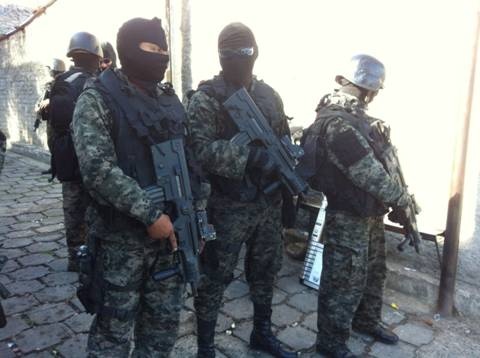
Honduran military police on patrol in Tegucigalpa, Honduras. (Photo: Karen Spring)
teleSUR | May 25, 2015
The 1980s saw widespread political violence and countless forced disappearances in many countries in Latin America, and Honduras was no exception.
Hundreds of political opponents of the 1980s U.S.-backed regime were kidnapped, tortured, and assassinated by the CIA-trained secret army unit Battalion 316, while at the same time Honduras served as a military base and training ground for U.S. counterinsurgency strategy in the region, especially in neighboring El Salvador and Nicaragua.
With the Reagan Administration turning a blind eye to the brutality of Battalion 316, intentionally downplaying or denying its violence in order to continue backing Honduras financially and using the country as a key U.S. military outpost, the details of this death squad’s operations did not become clear until years later. A historic expose published in the Baltimore Sun in 1995, which included interviews with ex-Battalion 316 torturers and details from declassified U.S. government documents, revealed the full extent of the secret unit’s atrocities and its close links to Washington.
However, torture and disappearances aren’t just a tragic reality of the past in Honduras. Human rights defenders have drawn disturbing parallels between Battalion 316 and the present day situation in Honduras, saying the current level of human rights abuses and political repression is just as bad, if not worse than the era of forced disappearances in the 1980s.
In the wake of the 2009 U.S.-backed coup ousting democratically elected President Manuel Zelaya, forced disappearance, torture, and targeted assassinations re-emerged as state terror tactics to intimidate and repress a broad-based resistance. Conspicuous and even conscious links to 1980s tactics since the 2009 coup, as well as ongoing U.S. complicity, show a continuity of state sponsored terror, with new elements for the post-coup context.
Cold War Anti-Communism, Battalion 316, and Spreading Terror with U.S. Support
As U.S. President Ronald Reagan took office in January 1980, the Sandinista revolutionary government was in power in Nicaragua and revolutionary forces were struggling for political control in El Salvador. Honduras was undergoing its so-called transition to democracy with a return to civilian rule. The U.S., already supporting the Guatemalan military’s bloody counterinsurgency efforts for over a decade, played a key role in backing the counter-revolutionary factions of the political struggles gripping the region in civil war, namely Salvadoran government forces and the Nicaraguan Contras.
While Honduras did not have a mass revolutionary guerrilla movement like its neighboring Central American countries, political opposition was criminalized to contain the threat of an armed, popular uprising. Much of this violent work was carried out through forced disappearances by the death squad Battalion 316, the special unit of the Honduran military responsible for political torture and assassinations, with the collaboration of other military branches, special forces, and police.
According to the Honduran human rights organization COFADEH, formed in the 1980s by family members of the disappeared, Battalion 316 was responsible over 180 forced disappearances between 1980 and 1988, and many more were kidnapped and tortured.
Forced disappearance refers to the practice of secretly abducting and murdering victims, making them disappear from society without a trace. Bodies of the disappeared are often carefully hidden, or rendered unrecognizable, to instil fear without the identity of the victim or the perpetrator becoming known..
Battalion 316’s terror was simultaneously covert and public, carried out by disguised agents at times in broad daylight, intended to instill fear and make an example of their victims. Suspected political dissidents were kidnapped, detained in secret jails, and tortured. Sometimes remains of victims were found in ditches. According to the Baltimore Sun expose, torture techniques included electric shock, suffocation, freezing temperatures, and psychological torture as part of interrogation, which sometimes involved CIA agents. Berta Oliva, director of the Committee of Relatives of the Disappeared in Honduras (COFADEH), has said that at least one prisoner was skinned alive in a clandestine Battalion 316 jail.
While the numbers of people disappeared in Honduras was considerably less than in many other Latin American countries during the same period, the hundreds killed and disappeared created a broader fear and terror campaign that had the intended outcome of disempowering the Honduran left.
According to Adrienne Pine, Professor of Anthropology at American University, it’s hard to overstate Battalion 316’s impact.
“The highly publicized disappearance, torture and murder of just under 200 activists, students, journalists and professors in the early 1980s created an atmosphere of terror, effectively crushing any possibility for civic or democratic engagement in Honduras,” she told teleSUR. “As such, it laid the groundwork for the implementation of U.S.-led neoliberal economic policies, of which the Honduran military itself was a primary beneficiary.”
Battalion 316, led in its most brutal years from 1982-1984 by School of the Americas and Argentine-trained head of the Honduran armed forces General Gustavo Alvarez Martinez, was a right-wing project designed to aid the Cold War fight against the alleged threat of communism in the region. Many Battalion agents were graduates of the U.S. School of the Americas (renamed in 2001 to the Western Hemisphere Institute for Security Cooperation) military training center for U.S. allies in Latin America, specializing in Cold War counterinsurgency training. The Battalion itself was trained and financed by the CIA. Meanwhile, Honduras received tens of millions of dollars in U.S. funding throughout the decade, reaching its height of US$77.4 million in 1984.
The secret military unit also received training in Chile under dictator General Augusto Pinochet, as well as from Argentine counterinsurgency forces, at the time deep in their own dirty war against leftist dissidents that claimed some 30,000 victims in Argentina by early the 1980s.
U.S. Ambassador under the Reagan Administration, John Negroponte, is documented to have met frequently with Battalion 316 leader Alvarez Martinez. However, the violence and human rights abuses perpetrated by Alvarez Martinez’s forces are conspicuously absent from the hundreds of cables of records of their correspondence. In 1983, the U.S. awarded Alvarez Martinez the Legion of Merit for “encouraging the success of democratic processes in Honduras,” exposing the true face of U.S. hypocrisy.
U.S. denial of the violent situation in Honduras enabled the ongoing use of the country as a strategic U.S. military base from which to execute counterinsurgency strategy in the region, while the supposed threat of an armed insurgency in Honduras justified the existence of Battalion 316 and its terror.
State Terror Returns: Post-Coup Fear Tactics and Forced Disappearances
After the 2009 military coup against democratically elected President Manuel Zelaya, the ousted president said in an exclusive interview with Democracy Now! that Battalion 316 was “already operating” in Honduras under a different name and using “torture to create fear.”
“There was a tremendous resurgence (after the coup) of death squad activity and assassinations of human rights defenders, trade unionists, campesinos, activists of the resistance of all sorts including journalists, lawyers,” Dana Frank, professor of History at the University of California Santa Cruz, told teleSUR. “It was very rare in the 20 years before the coup for these kinds of assassinations to happen … but it shot up dramatically after the coup.”
The post-coup links to Battalion 316 terror were palpable, both in the vast increase in human rights abuses, including torture, assassinations, and forced disappearances, as well as the direct connections of Battalion 316 personnel offering their expertise to the coup regime.
Former head of the Battalion 316, School of the Americas graduate Billy Joya, became a prominent coup regime spokesperson, advisor, and aide to de facto president Roberto Micheletti. According to COFADEH, many other retired Battalion 316 agents also became government advisors.
Pine, author of “Working Hard, Drinking Hard: On Violence and Survival in Honduras,” said that the numbers of state-sponsored disappearances, tortures, and extrajudicial killings since the coup have far exceeded those of the 1980s.
With striking similarity to the fear campaign of the 1980s, COFADEH documented in 2010, along with dozens of other death threats and assassinations, that a former Battalion 316 agent publicly threatened resistance activist Candelario Reyes with forced disappearance and death, saying that killing such a “communist dog” would make the “best example” for other resistance activists.
“You can see the continuity with some of these individuals including the references to the 80s that are conscious references,” said Frank. “It’s terror, it’s deliberately spreading terror.”
Harkening back to 1980s terror was a deliberate strategy to instil fear in perceived political threats. In 2012, COFADEH human rights defender Dina Meza received a series of threats of death and sexual violence by text message signed with the initials CAM, standing for Comando Alvarez Martinez, early 1980s head of Battalion 316 responsible for grave human rights abuses. According to Amnesty International, CAM was used as a pseudonym in numerous death threats against journalists and activists in the wake of the coup.
According to Frank, an expert on human rights and U.S. foreign policy in Honduras, the clearest and most alarming examples of post-coup strategies that follow the model of Battalion 316 are the TIGRES special units of the police force and FUSINA inter-agency task forces that bring together military, police, military police, prosecutors, and other government officials under military control.
FUSINA was initially headed by School of the Americas graduate Colonel German Alfaro, former commander of Battalion 15, the military unit in the Aguan Valley region implicated in dozens of post-coup murders of campesino activists. Trained by the FBI, DEA, and U.S. Marines, FUSINA is not only troubling for its conglomeration of agency functions under a military mandate, but also for its U.S.-enhanced intelligence capacities.
COFADEH denounced TIGRES as a “crude resurrection” of Battalion 316’s political disappearances, murder, and “criminal behaviour.”
These new constellations of state and military power, designed and deployed to create fear and contain political dissent, have again had a deep social and political impact in Honduras.
“A combination of the ‘soft power’ of USAID and NED-funded (so-called pro-democracy) programs on the one hand, and death squads within the police, the military, and now the military police have succeeded in destroying the post-coup resistance movement,” explained Pine. “This is what makes possible the neoliberal plunder of the country currently underway.”
A Different Pretext for Familiar Terror Tactics
But while there are clear continuities between the 1980s and post-coup strategies, there are also important differences.
Despite the fact that the armed left was a very small faction in Honduras, particularly in comparison to the revolutionary uprising in neighboring countries, Battalion 316’s violence was committed in the name of counterinsurgency. As Frank explains, the broad based nature of the post-coup popular resistance means that the victims of extrajudicial killings and forced disappearances have been from a more diverse cross-section of society than the 1980s campaign against suspected revolutionary leftists.
Now, with the pretext of an alleged communist armed struggle no longer relevant, post-coup repression, including use of these historical counterinsurgency tactics, and U.S.-backing of a violent regime is framed in different terms.
“The pretext now is drug trafficking,” said Frank. “The drug war has been the frame within which the United States government has legitimated support for repression by state security forces in Honduras and increased funding for them.”
And while the U.S. goal of maintaining a regional base of power amidst the threat of emerging or consolidating leftist alternatives remains much the same, the political context in the region has significantly changed.
“The larger context is the many democratically elected center and center-left governments all over Latin America that the United States is threatened by because they aren’t going to pay obeisance to United States power,” said Frank. “The United States wanted to lock down its power in Honduras so that it can maintain what has long been the most captive nation in Latin America.”
In the process, the U.S. also promotes the interests of transnational corporations that are making a killing from state-sponsored death squads that suppress resistance and pave the way for capitalist exploitation of land, labor, and indigenous and campesino resources.
“With the consolidation of neoliberal corporate capital, Honduran and U.S. politicians are more beholden to their sponsors than they were three decades ago,” explained Pine. “Hondurans today suffer not just from the terror of death squads but from the ravages of three decades of the implementation of neoliberal policy made possible by death squads, which makes them that much more vulnerable.”
COFADEH: Seeking Justice, Truth, and Respect for Human Rights
Bertha Oliva, director of COFADEH, lost her husband Tomas Nativi to forced disappearance by Battalion 316. Nativi was taken from their home by masked agents in 1981 and has never been seen again.
Over the year after Nativi’s disappearance, Oliva came to realize that she was not alone, and others had similar experiences of family members being disappeared. In 1982, 12 of these families came together to form COFADEH with the clear objective of bringing back alive family members who had been disappeared. In the majority of cases throughout the 1980s while Battalion 316 was operating, COFADEH did not succeed in their goal.
After the 1980s, COFADEH broadened its scope as an organization not only committed to seeking justice for the families of the disappeared and truth for Honduran society, but also representing and defending victims of human rights abuses, documenting cases, and providing training to raise awareness about human rights.
The creation of COFADEH was, in its own words, a “concrete action” in the face of the inactivity of the state to ensure “the right of victims to live and to have due process, among other rights that have been violated.”
COFADEH has continued to play a key role in documenting and denouncing human rights abuses and demanding justice, particularly once again in the years since the coup.
U.S. Funded Industrial Park in Afghanistan Found With Only One Business and No Electricity . . . And Missing Records
By Jonathon Turley | April 23, 2015
We have yet another example of how we are wasting billions of dollars in Afghanistan where a combination of incompetence and corruption continues to drain the U.S. treasury. This week, SIGAR released two reports showing how, an inspection of the $7.8 million Shorandam Industrial Park in Kandahar is an utter failure and how the money to create a sustainable source of power for Kandahar City has left the city literally in the dark. Once again, there is no indication of any discipline or action taken against those who approve such projects and oversee such failures.
I have previously written about the waste of billions of dollars by the government without any significant discipline of government officials. We have become accustomed to reports of unimaginable corruption and waste in Afghanistan from bags of money delivered to officials to constructing huge buildings immediately torn down to buying aircraft that cannot be used to buildings that seem to “melt away”. Much like our useless campaign against poppy production where we continued to spend billions because no one had the courage to end or change the program.
In this latest case, SIGAR found only one active Afghan business at the park, which was designed to accommodate 48 businesses. Notably, SIGAR inspectors found that they could not full assess the site because there was a lack of electricity and the contract files were mysteriously missing — leaving them also both literally and figuratively in the dark.
The missing contract files are a signature for our contractors in Afghanistan. An inspection of USAID-funded facility at Gorimar Industrial Park in Balkh province also found the files missing.
US Backtracks, Says Venezuela is Not a Threat, as Opposition Leaders Flock to Panama Summit
By Lucas Koerner | Venezuelanalysis | April 8, 2015
Caracas – On the eve of the much-anticipated Summit of the Americas, Senior White House Advisor Benjamin J.Rhodes downplayed his government’s designation of Venezuela as a threat to U.S. national security on Tuesday.
On March 9, President Obama issued an Executive Order branding Venezuela an “unusual and extraordinary threat” and imposing new sanctions, a move which has been roundly condemned by a multitude of nations and multilateral blocs, including UNASUR, the Non-Aligned Movement, CELAC, and the G77+China.
In response to the global outcry, the White House has appeared to soften its tone, with Rhodes dismissing the aggressive language of the Executive Order as “completely pro forma”.
“The United States does not believe that Venezuela poses some threat to our national security,” Rhodes stated in a press conference. The Presidential advisor did not, however, indicate that the U.S. administration had any intention of rescinding the executive decree.
The White House statement comes just days prior to the Summit of the Americas in Panama, which may mark a new chapter in U.S.-Latin American relations as the former continues to rebuild diplomatic ties with Cuba.
However, this supposed watershed moment has been vastly overshadowed by the Obama administration’s aggressive measures against Venezuela which have united the region behind Caracas and are likely to be a key point of contention at the summit.
Venezuelan President Nicolas Maduro has launched a petition campaign to gather 10 million signatures demanding the repeal of Obama’s Executive Order, of which 9 million have been collected so far. The Venezuelan head of state intends to personally deliver the signatures to the U.S. president during the summit this weekend.
Opposition Leaders Seek to Discredit Venezuela
While the U.S. attempts to downplay its aggressive posture against Venezuela, Venezuelan opposition leaders head to Panama where they plan to denounce the Bolivarian nation before the gathering of regional leaders.
The Panama summit will feature various parallel fora that will give “civil society” leaders the opportunity to present on the political and social situation in their respective countries.
Lilian Tintori, the wife of jailed far right opposition leader Leopoldo Lopez, will be given four minutes to present on Venezuela, which she claims is “on the verge of a humanitarian catastrophe“. Lopez, awaits trial for his role in leading last year’s violent opposition protests known as “the Exit” which sought the ouster of President Nicolas Maduro, taking the lives of at least 43 people.
Also attending is Rocio San Miguel of Citizen Control, who is a journalist specializing in military affairs closely linked to the U.S. embassy and various programs of USAID. She has actively worked to discredit President Nicolas Maduro’s relationship with the Venezuelan military as well as coordinates the provision of U.S. funds to anti-government groups.
Representing the Civil Consortium for Development and Justice, attendee Carlos Ponce Silen is the director of the Latin American and Caribbean Network for Democracy (RELIAL), which funnels the millions it receives in National Endowment for Democracy (NED) funding to Venezuelan opposition groups.
According to U.S. embassy cables published by Wikileaks, Ponce Silen organized a meeting between the U.S. Agency for International Development’s (USAID) acting country representative and right wing student leaders in 2008.
Participating on behalf of the Venezuelan Institute of Social and Political Studies (INVESP) is Carlos Correa, director of the NGO Public Space, which has been revealed by a Freedom of Information Act request to be one of the principal fronts for over $4 million in NED funds channelled to Venezuelan opposition journalists between 2008 and 2010.
The Venezuelan opposition has received hundreds of millions in U.S. funding over the past decade, including $14 million between 2013 and 2014 alone, provided via USAID and the NED.
Government watchdog doubts $400 million USAID program for Afghan women is working
RT | April 3, 2015
A $416 million program to empower Afghan women may leave them “without any tangible benefit” instead, a government watchdog warned, urging USAID to provide more data on the controversial project.
The Promoting Gender Equity in National Priority Programs – Promote, for short – was announced last November as part of US reconstruction efforts in Afghanistan. Its stated intent is to empower some 75,000 Afghan women between the ages of 18 and 30 to become political, business and civil service leaders, and engage girls ages 14 through 18 in “leadership development programs.”
However, the Special Inspector General for Afghanistan Reconstruction (SIGAR) warned that the US Agency for International Development (USAID) has not shown what the program would actually do, provided for adequate safeguards and controls of the contractors involved, or even accounted for half the funding Promote is supposed to receive.
“I am concerned that some very basic programmatic issues remain unresolved and that the Afghan women engaged in the program may be left without any tangible benefit upon completion,” John F. Sopko wrote in a letter to the USAID acting administrator, made public Thursday.
“I do hope that we are not going to fall again into the game of contracting and sub-contracting and the routine of workshops and training sessions generating a lot of certificates on paper and little else,” Sopko said, quoting the words of Afghanistan’s First Lady, Rula Ghani, from a November 2014 conference.
Though his staff was briefed on Promote in late February, Sopko wrote, “USAID could not provide the audit team a list of all the agency’s projects, programs, and initiatives intended to support Afghan women, or how much the agency spent on each effort.”
“USAID was also unable to provide data demonstrating a causal relationship or correlation between the agency’s efforts to support Afghan women and improvements in Afghan women’s lives,” he added.
In October 2014, USAID announced the award of five-year, “indefinite-delivery/indefinite quantity” contracts for Promote to three companies: Chemonics International, Development Alternatives and Tetra Tech. According to the agency, USAID would provide $216 million for the program, while another $200 million would come from unspecified foreign donors.
The SIGAR is questioning the basis of this estimate, since USAID failed to produce any supporting documentation, including any memorandum of the understanding between the three contractors and the Afghan government.
“Of this $416 million, how much will be spent in Afghanistan on Afghan women, and how much will be spent on security and overhead costs for the three contractors and program implementers?” the SIGAR asked. Sopko also raised the issue of USAID’s “sustainability plan,” asking whether any steps were taken to ensure the program survived past the US withdrawal from Afghanistan.
Read more: Expensive chaos: Billions of dollars meant for Afghanistan development wasted
How the US Funds Dissent against Latin American Governments
teleSUR | March 12, 2015
“A lot of what we do today was done covertly 25 years ago by the CIA.”
NED founding father, Allen Weinstein
The U.S. government and military have a long history of interfering in the affairs of numerous countries in Latin American and the Caribbean.
By the end of the 19th century, there had been at least 10 U.S. military interventions across the hemisphere including Argentina (1890), Chile (1891), Haiti (1891), Panama (1895), Cuba (1898), Puerto Rico (1898) and Nicaragua (1894, 1896, 1898 and 1899).
From this time onward, successive U.S. administrations applied different strategies and tactics for involvement in the region as a means to secure and protect its geopolitical and economic interests. However, only recently has there been wider acknowledgement about the role that U.S. funding to nongovernmental organizations, or NGOs, particularly from the National Endowment for Democracy (NED) and the United States Agency for International Development (USAID), plays in furthering U.S. foreign policy. For example, in 2012 governments of the Bolivarian Alliance for the Peoples of Our America (ALBA) collectively signed a resolution to expel USAID from each of the signing countries. Those countries included Bolivia, Cuba, Ecuador, Dominica, Nicaragua, and Venezuela.
The National Endowment for Democracy (NED)
Created by the administration of former U.S. President Ronald Reagan in 1983, the NED operates as a foundation that provides grants for “democracy promotion.” The foundation is structured as an umbrella with an almost corporatist flavor, housing four other organizations reflecting U.S. sectoral and party interest: the U.S. labor affiliated American Center for International Labor Solidarity (ACILS) and Chamber of Commerce linked Center for International Private Enterprise (CIPE), along with the National Democratic Institute for International Affairs (NDI) and the International Republican Institute (IRI), both of which reflect Democrat and Republican affiliations, respectively.
In many ways the NED resembles previous CIA efforts in the 1950s, 60s and 70s to provide mostly public money for secret operations aimed to bolster pro-U.S. governments and movements abroad. In South America for example, between 1975 and 1978 the U.S. helped with the creation and implementation of Operation Condor. The U.S. provided right-wing dictatorships in Argentina, Bolivia, Brazil, Chile, Paraguay, Uruguay, Colombia, Peru, Venezuela and Ecuador with technical and military support for the goal of hunting down and killing political opponents. Some estimate that Operation Condor killed between 60,000 and 80,000 people.
In 1986, then president of the NED Carl Gershman explained to the New York Times, “We should not have to do this kind of work covertly … It would be terrible for democratic groups around the world to be seen as subsidized by the C.I.A. We saw that in the 60s, and that’s why it has been discontinued. We have not had the capability of doing this, and that’s why the endowment was created.”
U.S. citizens unknowingly fund the NED with public money. The U.S. government allocates part the budget of the United States Agency for International Development (USAID) under the U.S. State Department to the NED – which is most of the NED’s funding source. Although it receives practically all of its funding from the U.S. government, the NED is itself an NGO headed by a Board of Directors. The current board includes:
- Political economist, author and free market universalist Francis Fukuyama,
- Elliott Abrams, former deputy assistant and deputy national security adviser on Middle East policy in the administration of President George W. Bush,
- Moises Naim, Venezuelan Minister of Trade and Industry during the turbulent early 1990s and former Executive Director of the World Bank, and
- Former Deputy Secretary of State under George W. Bush (2005 – 2006) and Vice Chairmanship at Goldman Sachs Group, Robert B. Zoellick.
The scope of activity of the NED is truly impressive. According to the NED website, it supports more than 1,000 NGO projects in more than 90 countries.
At its inception in the early 1980s, its funding allocation was set at US$18 million and reached its peak in the late 1990s and early 2000s. Allocations for 2014 and 2015 have been approved for US$103.5 million, while over US$7 million was directed primarily to opposition organizations in Ecuador, Bolivia, Venezuela and Cuba in 2013.
Within the U.S. State Department Justification of Request documents which outline the reasons for funding requests, it is clear that funding priorities in Latin America and the Caribbean reflect the NED’s modern strategy of overtly carrying out old covert objectives.
Michel Chossudovsky, a professor emeritus of economics at the University of Ottawa in Canada, sees this funding as an element in “manufacturing dissent” against governments that the U.S. government dislikes. However, these funders do not work alone. “The NED (and USAID) are entities linked with the U.S. state department, but they operate in tandem with a whole of other organizations,” said Chossudovsky.
In May 2010 the Foundation for International Relations and Foreign Dialogue released their report Assessing Democracy Assistance in Venezuela which revealed that in addition to NED and USAID funding, a broad range of private and European based foundations funded opposition-aligned NGOs in the country with between US$40-50 million annually.
According to Dan Beeton, International Communications Director at the Center for Economic and Policy Research (CEPR) in Washington, D.C., NED funds in Latin American have been directed at “a lot of what are kind of the old guard political entities that are now kind of discredited,” such as the Trade Union Confederation of Venezuela (CTV), which was instrumental in the 2002 coup in Venezuela, as well as older political parties that are now marginal forces in their country’s political landscapes in spite of their considerable outside funding.
The United States Agency for International Development
Created in 1961 as a foreign assistance program under President John F. Kennedy, USAID commands a much larger budget and broader scope than NED. While U.S. diplomats continue to stress that USAID funding does not have a political basis, USAID documents nonetheless acknowledge its role in “furthering America’s interests” while carrying out “U.S. foreign policy by promoting broad-scale human progress at the same time it expands stable, free societies, creates markets and trade partners for the United States.” But critics are skeptical of USAID’s missionary work, noting how their strategy has changed over time.
“(USAID’s) mandate is to provide development aid and historically it has provided development aid, tied into debt negotiations and so on. Subsequently with the evolution of the development aid program it has redirected its endeavours on funding NGOs,” said Chossudovsky.
While the range of activities undertaken by NGOs can be broad and some of these programs may not have political intentions, Beeton nonetheless argues that this funding “ultimately can and often does serve a political end when the U.S. wants these grantees to help it fulfill its goals in these countries.”
The extent of U.S. political ambitions recently came into the international spotlight with the revelation that USAID had secretly spent US$1.6 million to fund a social messaging network in Cuba called ZunZuneo, with the stated purpose of “renegotiat(ing) the balance of power between the state and society.” The project was headed up by Joe McSpedon of the USAID’s Office of Transition Initiatives (OTI).
Other USAID officials accused of active political meddling in the affairs of sovereign countries include regional head Mark Feierstein. According to Venezuelan investigative journalist Eva Golinger, in 2013 Feierstein met Venezuelan opposition figures including right-wing politicians Maria Corina Machado, Julio Borges and Ramon Guillermo Avelado as well as political strategist Juan Jose Rendon to devise a plan to undermine the Venezuelan government.
At the State Department budgetary hearing, Feierstein also confirmed “a long-standing program in place to support those who are advocating and fighting on behalf of democracy and human rights in Venezuela … and we are prepared to continue those under any scenario.”
State Department cables revealed by WikiLeaks also brought to light previous activities by USAID/OTI in Venezuela, including the development of a five point, anti-government strategy for U.S. embassy activities, as well as the confirmation that grantees had been active in promoting street demonstrations in 2009.
Machado, a former anti-Chavista National Assembly member, was among the signatories of the Carmona decree following the Venezuelan coup in 2002, which abolished the legislative and judiciary powers, as well as the constitution. She was also among the most prominent promoters of last year’s opposition violence that claimed the lives of 43 people.
In Bolivia, local rural workers’ groups and the government expelled the U.S.-based Chemonics International Inc. after their US$2.7 million USAID-funded “Strengthening Democracy” program was accused of financing destabilization attempts against the government. Chemonics operates in approximately 150 countries, offering various technical services and “consulting.”
The Bolivian government publicly outlined what they argued was proof of USAID-funded programs to mobilize the indigenous population against the government, in particular an indigenous march protesting the construction of a highway. USAID funded programs were active in these areas, and had funded some of the leading organizations such as the Eastern Bolivia Indigenous Peoples and Communities Confederation (CIDOB).
“USAID refused to reveal who it was funding and the Bolivian government had strong reasons to believe that it had ties and coordination with opposition groups in the country which at the time was involved in violence and destructive activities aimed at toppling the Morales government,” said Beeton. “Now we know through WikiLeaks that that’s what really was going on.”
President Evo Morales also revealed transcripts of phone calls between the anti-highway march organizers and U.S. embassy officials. The U.S. embassy confirmed the calls, but explained that they were merely trying to familiarize themselves with the country’s political and social situation.
Officials also denounced the lack of accountability to the Bolivian government or to the recipient constituencies of USAID funds.
The head of the Eastern Bolivia Indigenous Peoples and Communities Confederation (CIDOB), Lazaro Taco, confirmed that they had received “external support for our workshops,” but would not identify the source.
These and other USAID activities led Bolivian President Evo Morales to claim that the agency was conspiring against his government. The government expelled USAID from the country in May 2013, while USAID denied any wrongdoing.
In June of 2012, an Ecuadorian daily revealed that 4 NGOs based in Ecuador were recipients of over US$1.8 million for a project called Active Citizens, whose political bend was critical of the Correa government.
Shortly afterwards, the Technical Secretariat for International Cooperation (Seteci) of Ecuador announced it would also investigate the “Costas y Bosques” (Coasts and Forests) conservation project, which received US$13.3 million in funding from USAID. The project, based in the provinces of Esmeraldas, Guayas and Manabí, was also being undertaken by the Chemonics International Inc, the same organization expelled from Bolivia.
Mireya Cardenas, National Secretary of Peoples, Social Movements and Citizen Participation, said that “there is every reason to consider USAID a factor of disturbance that threatens the sovereignty and political stability (of Ecuador)”. While the U.S. Ambassador in Ecuador Adam Namm tried to reassert that USAID did not fund political parties, he did confirm that certain opposition groups such as Fundamedios was funded “indirectly.”
In November 2013 the Ecuadorean government sent a letter to the U.S. embassy in the country’s capital Quito, ordering that “USAID must not execute any new activity” in Ecuador. USAID canceled its aid shortly after.
For Beeton, “lack of transparency is probably the biggest problem (with USAID) in that it really prevents the governments in the host countries from finding something objectionable, or even coordinating better”. This was in large part the principle concern from the Ecuadorian Seteci, who questioned the extent of expenditures on certain project and the lack of coordination.
In the wake of the devastating 2010 earthquake, CEPR conducted an extensive evaluation of USAID funding to Haiti, including the history of funding, and found transparency and coordination with local government to be a significant problem, especially when the local government experienced tensions with U.S. foreign policy.
“The U.S. government has been perfectly happy to not coordinate with governments, and that has a lot to do with politics… it was under [former Haitian President] Aristide really saw a lot of assistance bypass the Haitian government and go to NGO, including violent opposition groups and so called democratic opposition groups much like what you are seeing recently in Venezuela and Bolivia,” said Beeton.
For 2013, the combined NED and USAID allocations for Cuba, Venezuela, Ecuador and Bolivia alone totaled over US$60 million, with the bulk of these funds destined to Cuba and Ecuador. For the government and progressive social movements of these countries, there is a growing concern that these funds could be used to undertake what Chossudovsky qualified as a “consistent process of destabilizing government as part of non-conventional warfare, meaning you don’t send in the troops but you destabilize the government through so called colored revolutions or infiltrations.”
Cuba Détente
By ROBERT SANDELS and NELSON P. VALDÉS | CounterPunch | January 28, 2015
“I do not expect the changes I am announcing today to bring about a transformation of Cuban society overnight.”
— Barack Obama, Dec. 17, 2014
President Obama’s Dec. 17 statement announcing changes in U.S. Cuba policy was a mixture of historical truths and catch phrases drawn from the catalog of myths about Cuba and U.S. policy goals.
The first round of rule changes, announced by Jan. 16 by the Office of Foreign Assets Control (OFAC), was significant in the areas of trade and banking. At the same time, much of the language is drawn from the old justifications for regime change. (Let us put aside the hypocrisies in Obama’s speech such as the instruction — coming from a country where labor unions have been systematically destroyed — that “Cuban workers should be free to form unions.”)
In his speech, Obama reworked Einstein’s famous definition of insanity to support his partial abandonment of the half-century attempts to destroy the Cuban revolution. “I do not believe we can keep doing the same thing for over five decades and expect a different result,” said Obama. (If he means that the policy he has supported for six years is insane, what does that say about him?)
Nowhere in the speech did Obama renounce the longstanding U.S. commitment to regime change in Cuba or even acknowledge that it ever existed. While implicitly recognizing that the use of sanctions to achieve political results had failed, he continues to pursue them in Korea, Russia and elsewhere. One day after making the Cuba speech, he signed a bill imposing sanctions on Venezuela alleging that the government of President Nicolas Maduro had violated the human rights of protestors during violent anti-government demonstrations last February. The demonstrations were led by right-wing representatives of the Venezuelan elite who have long been backed by the United States.
We should note that the phrase about doing the same thing for over five decades and expecting a different result is incorrect. True, five decades ago the Eisenhower administration broke diplomatic relations with Cuba, but since then his 10 successors, who account for 14 presidential terms, tried a variety of other “things” besides cutting diplomatic relations. There were the commando raid things launched from U.S. territory by Cuban exiles burning cane fields and sugar mills and the CIA-trained underground blowing up movie theaters and shopping centers. Then of course, there was the Bay of Pigs invasion thing by an exile expeditionary force landing in a swamp. That was a really big thing. With that failure came Bobby Kennedy’s Operation Mongoose thing, which was expected to be a let’s-get- it-right-this-time do-over of the Bay of Pigs disaster.
Since the 1962 Missile Crisis, there have been endless “democracy promotion” things financed by CIA front organizations. There have been clandestine anti-Cuban shortwave things broadcast from all manner of conveyances — yachts, balloons, zeppelins, airplanes. Leaflets, books and pamphlets of every kind were surreptitiously sent to Cuba in tourist luggage, in diplomatic pouches, hidden in hollow trees and even dropped from airplanes. Then there were the hit-and-run attacks from speedboats shooting up Russian ships, Cuban fishing boats, coastal hotels and hamlets.
Alan Gross, pretending to bring computer equipment to synagogues in Cuba that didn’t need them, is only a recent and not the last example of the often ludicrous plotting of various U.S. government agencies. Currently, the U.S. Agency for International Development (USAID) is at the forefront of the regime-change program. Obama did not mention the Gross thing but revealed that he would have proposed détente earlier had Cuba not imprisoned him.
Obama has it backwards. It’s not the “thing” that needs to be changed but the desired “result.” His new policy direction does not promise to end imperial bullying or to accept Cuban independence and sovereignty. Why else would he say the new thing he has in mind “will promote our values through engagement”?
Making the crime fit the punishment
To justify the long hostility toward Cuba, the United States has created a Cuba that never existed; a tropical gulag of indiscriminate terror where hordes of political prisoners rot while a cartoon dictator recites hours of his political poetry to a captive audience.
It is not surprising that the external and domestic opponents of the Cuban government, whether or not they are paid by the United States or its European partners, do not have their own vision of what a post-Castro society would look like. They and Obama are bound by the official blueprint drawn up by Congress in the Helms-Burton law of 1996, which essentially calls for a non-Cuban Cuba.
What would happen to employment, housing, health care and education in the new Cuba of Washington and Miami invention? Why is it that regime change is couched in fuzzy terms like “freedom” devoid of any economic, social or cultural content? And why is it that Obama criticizes the old policy because it “failed to advance our interests” without acknowledging what those interests really are?
Nothing in Obama’s speech corrects the half-century assault on truth. Many of the media commentaries on the Obama speech recite from the fantasies concocted over the years to mask the insanity of the policy. Here is just a sampling:
-Seventy-five Cubans dissidents were arrested in April 2003 in what is called the Black Spring. Ever since then they have been referred to as political prisoners or freedom fighters.
Actually, they were tried and convicted in a Cuban court for operating as paid agents of the pretend dissident movement funded by the United States. Roger Noriega, former assistant secretary of state for Western Hemisphere Affairs, conspired with James Cason, then head of the U.S. Interest Section in Havana, to openly encourage local dissidents hoping that the Cuban government would kick Cason out and give George W. Bush an excuse for closing the Cuban Interest Section in Washington and worsening bilateral relations. The scheme is what got the 75 arrested.
Among the 75 were journalists, few of whom ever practiced journalism. There also were pretend independent librarians paid by the United States to pose as part of a pretend grassroots defiance of a pretend Cuban control of what people could read.
A report to the American Library Association in 2001 described how one of the “independent” libraries in Cuba “consisted of four or five dusty shelves of books.” A woman in one of these libraries said, “No books had ever been confiscated [and] that she was not being intimidated or threatened by the government as a result of having this collection….The woman receives many of her books as well as payment for her activities from the U.S. and Mexico but would not identify individual sources. She said she was asked to operate the library because she is a dissident.”
-Cuba always blocks U.S. efforts to improve relations.
The example often cited is the shooting down in 1996 of two private exile planes near the Cuban coast. But Fidel Castro did not plot with well-known terrorist José Basulto, founder of Brothers to the Rescue, to have him organize provocative flights over the Cuban capital; Basulto did that on his own. It was the shootdown that led to enactment of the Helms-Burton law, which now prevents Obama from lifting the blockade. So, was it Fidel Castro or Helms, Burton and Basulto who torpedoed some supposed improvement in bilateral relations?
– The Cuban Five were spies.
Nearly every news outlet continues to refer to the five Cuban agents imprisoned in 1998 as “spies.” (The last three were released as part of the Obama opening.)
Actually, they were Cuban agents who infiltrated Brothers to the Rescue and other counterrevolutionary groups in Florida and then alerted the FBI to their plans for attacks against Cuba from the United States in violation of U.S. law.
– Alan Gross, who, was released from prison on “humanitarian grounds” as part of the Obama opening, was unjustly imprisoned in Cuba.
Actually, he was a sub-contractor working under a USAID grant and sent on five trips to Cuba to set up clandestine electronic networks as part of the U.S. subversion obsession and therefore correctly imprisoned. People who do that sort of thing in the United States can be tried as unregistered agents of a foreign power and sent to prison, just like Alan Gross.
Where did all those doctors come from?
The president’s positive comment on Cuba’s contribution to fighting Ebola in Africa has been noted as one of the inducements for change. Good, but Obama needs to explore what Cuba’s worldwide medical missionary program says about the island.
Imagine what it would take for the mythical Cuba the United States created, with its tiny population of the impoverished and the oppressed, to produce such quantities of surplus doctors, nurses and medical technicians who are now working in 66 countries. If Obama could admit that his mythical Cuba could never have done that, he might start setting the historical record straight and maybe ask the Cubans to advise him on Obamacare.
Today Cuba has 75,000 physicians or one per 160 inhabitants. Approximately 132,000 medical/health professionals have provided medical and dental attention to poor people abroad. At present, there are over 50,000 medical workers and no less than 25,000 doctors working outside of Cuba. In 2013, the health sector had 322,627 health professionals and technicians – that is, 28.9 per 1000 inhabitants — 76,836 physicians and 14,964 dentists as well as 88,364 nurses.
All of these accomplishments at home and abroad have taken place while the U.S. government persisted in enticing doctors, nurses and other professionals to leave Cuba. Remember, it was the people of Cuba who, we are incessantly told, make only $20 a month, who paid for their education even as Cuba confronted relentless U.S. financial and economic obstruction. Does Obama intend to reimburse the Cubans?
The United States calls the maze of economic and commercial sanctions an embargo. (The Cubans, referencing international law, call it a blockade.) Obama cannot unilaterally put an end to this kind of warfare but must wait for Congress to act. While the executive branch has the constitutional power to define foreign policy, Bill Clinton signed the Helms-Burton bill transferring control of Cuba policy to Congress. This was the second time he relinquished executive power over Cuba policy. The first was in 1992 when, running against George H.W. Bush, he announced his support for the Torricelli Act, which severely tightened trade restrictions. Obama’s Democratic predecessor made it necessary for him to go before Congress in his recent State of the Union message and ask Republicans to give back his foreign policy powers.
New rules
Clearly, the old rules lacked consistency. For example, when OFAC travel and remittance rules affecting Cuban-Americas were relaxed in the past, the justification was always to promote democracy and to separate Cubans from dependence on their government. But, when the same rules were made more severe, as under George W. Bush, the justifications were the same.
OFAC’s new regulations will materially ease the sanctions. Some of the changes sound like attempts through administrative regulations, to overturn fundamental sanctions in the Helms-Burton law. These include new rules allowing direct interbank transfers with the U.S. banking system, the use of U.S.-issued credit and debit cards and the elimination of “cash and carry,” which was a burdensome requirement for Cuba in paying for imports in convertible currencies.
Nevertheless, other changes may conflict with old practices. For example, will the U.S. Treasury Department protect credit/debit card companies from lawsuits by U.S. nationals seeking compensation from the Cuban government? The logistics of these transactions remains to be clarified.
Travel to Cuba can now be insured by U.S. companies and U.S. airlines could fly to Cuba from any city if market demand is sufficient instead of from a few government-selected cities. The major airlines could then reduce the advantage that the smaller companies enjoyed until now.
The travel ban has been relaxed even as OFAC preserves the principle of controlling travel for political purposes. The 12 categories of allowable travel remain in place although now without requiring a written specific license and organized travel and tours will be opened to more players.
Still, restrictions remain. Those who will be able to travel more freely are prohibited by a watchful government from having fun. New categories of travel are authorized under the new rules, “provided that the traveler’s schedule of activities does not include free time or recreation in excess of that consistent with a full-time schedule.”
Picking winners for a Cuban market economy
Trade sanctions have always had the effect of indirectly “managing” the Cuba economy. The new rules can determine who gets to invest in or trade with Cuba and which Cuban sectors will receive the most benefit. The majority of U.S. firms will be left out of the great Cuban market economy as envisioned in Washington.
Until now only agricultural and some medical and educational materials could be sold to Cuba. The new regulations allow for an increase in the kinds of goods that Cuba can import from the United States such as construction and agricultural tools and machinery. However, these can only be sold to non-state sectors such as co-ops and private entrepreneurs. Thus, certain sectors of the U.S. corporate world will be given preferential treatment.
OFAC is also giving Cuban entrepreneurs in the private sector an advantage over the state, but the Obama administration also wants U.S. information technology corporations to invest in Cuba’s telecommunications infrastructure, which means selling services, software and equipment to the Cuban government.
Rules applied to the banking sector raise significant questions. Financial institutions will be allowed to open accounts in Cuban banks to simplify transactions that are authorized by the United States and Cuba. But will Cuban banks be allowed to do the same in the United States?
Are these U.S. banks going to open dollar accounts in Cuban banks? Are they going to be held liable for breaking the restrictions that the United States Treasury Department imposed on dozens of banks for doing the same thing? Less than 24 months, ago the Bank of Nova Scotia, Commerzbak, Credit Suisse and many others were charged with billions of dollars in fines. Will the new rules be retroactively applied or is this a case of sorry — bad timing?
Since 1962, any ship that called on a Cuban port was prohibited from entering a U.S. port for at least six months. Now, ships transporting food, medicine, medical equipment and other materials may, in case of some emergency in Cuba, go to Cuba and then enter any U.S. port without prejudice as can any other ship owned by the same company. But Cuba is still not permitted to use U.S. currency in international transactions or purchase of technologies that might have more than 10 percent of U.S. components.
Some U.S. companies shall not suffer
Obama appears to have come around to where former Secretary of State Henry Kissinger was in 1972 when he limited the scope of economic sanctions to protect the interests of selected U.S. corporations. In April of that year, Kissinger approved export licenses for three U.S. automakers with subsidiaries in Argentina permitting them to sell cars to Cuba. The State Department issued a statement that read in part, “Our policy toward Cuba is unchanged. We did not wish to see these U.S. companies suffer as a result of U.S. policy.”
Stifling trade and financial transactions in Cuba by withholding all the utilities of capitalism was inconsistent with promoting a free market, which is mentioned 13 times in Helms-Burton.
Do the new regulations show that Obama is rejecting the old insanity and striking out toward true respect for Cuban sovereignty? While there is symbolic importance in resuming formal diplomatic relations, there is nothing in normal diplomacy that prevents Obama from carrying on regime change schemes by other means. As he said Dec. 17, “we can do more to support the Cuban people and promote our values through engagement.”
Relaxing the restrictions on travel is fine but does anyone find Obama’s reasoning for doing so a little suspicious? “Nobody represents America’s values better,” said Obama, “than the American people, and I believe this contact will ultimately do more to empower the Cuban people.”
Obama wants to transfer information technology to Cuba. Good. He could also transfer to dissidents the supplies of military-grade microchips that Alan Gross was imprisoned for doing.
The day for celebration should be postponed until we see whether the true potential of Cuba’s social and political experiment can proceed unobstructed by an enraged superpower and whether the United States is ready to work with Cuba in bringing a more constructive future to both countries. Maybe by then Cuba can show the United States how to form labor unions.
Robert Sandels lives in Mexico and writes on Cuba and Mexico.
Nelson P. Valdés is Professor Emeritus, University of New Mexico. For more information on Cuba visit: http://www.cuba-l.com
Featured Video
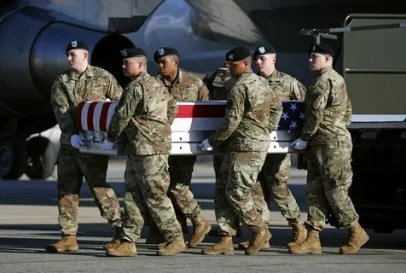
American Military Failure in Afghanistan
or go to
Aletho News Archives – Video-Images
Frlom the Archives
Iran War: United States Military Versus Israel Firsters
By James Petras | November 27, 2007
Why must Jewish organizations be and be seen as the loudest drum-beaters of all? Why can we not bring ourselves to say that military intervention is not on the table at all? Why not stash it under the table, out of sight and mount instead a diplomatic assault? – Leonard Fein, Forward
Introduction
As the White House and Congress escalate their economic sanctions and military threats against Iran, top military commanders and Pentagon officials have launched a counter-offensive, opposing a new Middle East War. While some commentators and journalists, like Chris Hedges (Truthdig, November 13, 2007), privy to this high stakes inter-elite conflict, attribute this to a White House cabal led by Vice President Cheney, a more stringent and accurate assessment puts the Zionist Power Configuration (ZPC) in the center of the Iran war debate.
There is a great deal riding in this conflict – the future of the American empire as well as the balance of power in the Middle East. Equally important is the future of the US military and our already heavily constrained democratic freedoms. The outcome of the continuous and deepening confrontation between top US military officials and the Israel Firsters over US foreign policy in the Middle East has raised fundamental questions over self-determination, colonization, civilian primacy and military political intervention, empire or republic. These and related issues are far from being of academic interest only; they concern the future of the United States. … continue
Blog Roll
 Aletho News
- Hezbollah Returns: It Didn’t Start a War, It Is Ending One
- EU states seek ‘talks’ with Iran for access to Strait of Hormuz: Report
- Trump on Hormuz: “Others must take care of it” after US falters
- Who Is closer to collapse?
- A War that Backfired: Why the US-Israeli Campaign Is Strengthening Iran
- How Zionist Control Is Hurting US Interests
- Iran warns it may target US missile launch sites in UAE cities
- American Military Failure in Afghanistan
- Friendly Skies of Georgia: Are Israeli-Linked Drones Launching False Flags from Georgian Territory?
- The Three Big Lies about Mammography Screening
- If Americans Knew
- No let-up in attacks on Gaza as Israel takes on Iran, Lebanon – Not a ceasefire Day 155
- ‘Of Course’: IDF Drops Case Against Soldiers Accused of Raping Palestinian Prisoner
- Don’t Fall for the Regime Change Talk. Israel Is ‘Mowing the Lawn’ in Iran
- Will Israel and the US wreck the Gulf States along with Iran?
- US so far burned through ‘years’ of munitions in Iran war: Report
- How the Israeli Tail Wags the American Dog
- Outdated intel likely led to deadly U.S. strike on Iranian elementary school, sources say
- Pentagon insider says high U.S official Douglas Feith reported to Netanyahu
- In fond memory of Walid Khalidi, the historian of Palestine
- 6 more Americans killed, as Israel ‘mows the lawn’ in Iran – Not a ceasefire Day 154
- No Tricks Zone
- Storing Green Energy To Last Germany 10 Days Would Require A 60-Million Tonne Battery
- New Studies: UK Sea Levels Were 4 Meters Higher Than Today During The Mid-Holocene
- Destructive Green New Deal: German Energy And Metal Group Warns Of Drastic Crisis
- New Study Documents A 20-Year Pause In Arctic Sea Ice Decline – Driven By Internal Variability
- Wake-up Call: Survey Shows Majority Of Germans Now Favor Postponing Climate Targets!
- Televised! Leading German Political Candidate Tells Schoolchildren CO2 Makes Sun Hotter!
- New Study: A Century Warming Of 1.1°C Is ‘Commonplace’ And ‘Not Unusual’ During This Interglacial
- New Study: ‘Internal Noise’ And Volcanic Forcing Can Trigger 10-15°C Warming Within Decades
- Glaciers Worldwide Are Suddendly Surging, Experts Blame Warming!
- Surprising Discovery: Sahara Is Greening…Billions Of Trees Where Once Thought To Be Barren
 Aletho News