Corruption and waste in Afghanistan: Role of US government exposed in new report
RT |September 14, 2016
A new report examining widespread corruption and waste in Afghanistan found that the practice blossomed following the US invasion in 2001. The problem was fed by its slowness to recognize the problem and exacerbated by the injection of tens of billions dollars into the economy with very little oversight.
“Corruption in Conflict: Lessons from the U.S. Experience in Afghanistan” examined how from 2001 to 2014 the US government, through the Department of Defense, State, Treasury and Justice and the US Agency for International Development (USAID) understood the risks of corruption in Afghanistan, how the US evolved its understanding, and the effectiveness of that response.
SIGAR was created by Congress to provide independent and objective oversight of Afghan reconstruction projects and activities.
The report released on Wednesday had five main findings: 1) corruption undermined the US mission in Afghanistan by fueling grievances against the Afghan government and channeling material support to the Taliban; 2) the injection of tens of billions of dollars into the Afghan economy was governed by flawed oversight and contracting practices and “partnering with malign powerbrokers”; 3) the US was slow to recognize the problem; 4) when it did recognize the depth of corruption “security and political goals” trumped anti-corruption efforts; 5) in areas where it was successful it was only “in the absence of sustained Afghan and US political commitment.”
The report defined corruption as “the abuse of entrusted authority for private gain,” and placed in the context of Afghanistan’s kinship-based society where the gains from corruption often benefited not just an individual but a family, clan, tribe or ethnic group.
Corruption is the system of governance
According to SIGAR about $113.1 billion has been appropriated for Afghanistan relief and reconstruction since 2002. The funds were used by the Afghan National Security Forces to promote good governance, conduct development assistance, and engage in counter-narcotics and anti-corruption efforts.
In a 2010 US Embassy Kabul report on a meeting with senior US officials and the Afghan National Security Adviser, Dr. Rangin Dadfar Spanta said “corruption is not just a problem for the system of governance in Afghanistan; it is the system of governance.”
The report referred to a 2015 UK research that showed there was weak separation of the private and public spheres which resulted in widespread private appropriation of public resources, vertical- and identity-based relationships had primacy over horizontal, i.e. citizen-to-citizen relationships, and politics was centered around a centralization of power and patron-client relations replicated throughout society.
Opportunities for corruption expanded after 2001 as the amount of money in the economy grew from millions to billions of dollars with the Department of Defense budget at time equivalent to the entire Afghan economy and sometimes quadruple the amount.
“Many of the funds were licit, arriving via civilian and military contracts. At their peak in fiscal year 2012, DOD contract obligations for services in Afghanistan including transportation, construction, base support, translation/interpretation, an private security total approximately $19 billion, just under the Afghanistan’s 2012 gross domestic product of $20,5 billion,” stated the report. “From 2007 to 2014 those contract obligation totaled more than 89 billion.”
Billions worth scandals
During the years of the Obama administration, Afghanistan was rocked by two corruption scandals: The Salehi arrest and the Kabul Bank losing $1 billion.
Salehi was involved in the New Ansari Money Exchange, a money transfer firm that moved money into and out of Afghanistan. The exchange was suspected of moving billions of dollars out of Afghanistan for Afghan government officials, drug traffickers and insurgents. US law enforcement and intelligence investigators estimated that as much as $2.78 billion was taken out of Afghanistan between 2007 and 2010.
“A wiretap recorded an aide to Karzai, Mohammad Zia Salehi, soliciting a bribe in exchange for obstructing the investigation into New Ansari. Reportedly, after US officials played some of the wiretaps for an adviser to Karzai, the adviser approved Salehi’s arrest,” stated the report.
Salehi was arrested in July 2010, but was released within hours on the orders of President Karzai and the case was dropped. The New York Times reported Salehi had once worked for notorious warlord Rashid Dostum and was also “being paid by the CIA.”
“If true, this would suggest a US intelligence agency was paying an individual as an intelligence asset even as US law enforcement agencies were building a major corruption case against him,” stated the report.
The other corruption scandal involved the Kabul Bank, which was used among other things to pay the salaries of the Afghan military and police, was found in 2010 to have lost nearly $1 billion of US taxpayer’s funded foreign assistance to Afghanistan. The bank’s deposits had seemingly vanished into Dubai and off-shore locations and unknown offshore bank accounts and tax havens, through Ponzi schemes, fraudulent loans, mass looting and insider loans to fake and bogus companies by less than 12 people who were apparently linked to President Karzai.
Lack of oversight and slow response
Against this the DOD and USAID vetted contractors and implemented contracting guidance to reduce opportunities for corruption and while they were somewhat successful, “they were not unified by an overarching strategy or backed by sustained, high-level US political commitment,” stated the report.
During this time, from mid-2011 to March 2012, the US also sought to explore political reconciliation with the Taliban and to do so the US had to preserve a working relationship with President Karzai to ensure an Afghan government buy-in.
“The US government showed a lack of political commitment. When it became clear the Afghan government was not willing to undertake true reform – because it involved taking action against people connected to the highest levels of political power – the US government failed to use all of its available tools to incentivize steps towards resolution,” stated the report.
Another weakness in tackling corruption was the high turnover of US civilian and military staff “meant US institutional memory was weak and efforts were not always informed by previous experience.”
“One Afghan anticorruption expert noted that US agencies often hosted workshops and training that lasted only a few days, with limited follow-up. He suggested that a more fruitful approach might have been to establish a standing institute to train auditors, attorneys, investigative police and others for year, rather than days,” stated the report.
SIGAR’s report quoted Ryan Crocker, who re-opened the US Embassy in Kabul soon after the September 11, 2001 attacks and served again as ambassador in 2011-2012 as saying that “the ultimate point of failure for our efforts wasn’t an insurgency. It was the weight of endemic corruption.”
The report comes with recommendations for addressing corruption risks to US strategic objectives for future missions. It recommended that Congress pass legislation to make clear “that anticorruption is a national security priority in a contingency operation” and required strategies, benchmarks and “annual reporting on implementation.” It also recommended that Congress consider sanctions and the DOD, State and USAID should establish a joint vetting unit to better vet contractors and subcontractors in the field.
The recommendations for the executive branch level are that interagency task force should formulate policy and lead strategy on anticorruption during an operation and the intelligence community should analyze links between host government officials, corruption, criminality, trafficking and terrorism and provide regular updates.
“In Afghanistan today, corruption remains an enormous challenge to security, political stability, and development,” SIGAR said.
Exposing US-Funded “NGOs”
From Moscow to Myanmar, US-European funded organisations undermine the essential work of genuine NGOs
The New Atlas | August 9, 2016
A nongovernmental organisation (NGO) is described as a not-for-profit organisation independent from states and international governments. They are funded by donations and facilitated by volunteers drawn from the communities they serve.
Genuine NGOs fitting this description fulfil a vital role within the nations they work regarding issues including education, healthcare, the media, the environment, technology, and economic development.

They often perform their work in parallel with government organisations and may even cooperate with their national government. At other times, they provide a necessary but constructive check and balance to deficiencies present within a state.
However, NGOs can be abused. Foreign governments and financially motivated special interests can use the structure and appeal of NGOs as vectors to project unwarranted, coercive power and influence.
Funded not by the communities they claim to serve, but by these foreign interests, they often operate under the pretext of upholding the legitimate roles and responsibilities of genuine NGOs while in reality undermining a targeted nation’s government, its people, its institutions, and national peace and stability. Ironically, such organisations also undermine the perceived legitimacy and effectiveness of real NGOs.
Foreign interests seek to do this for a number of reasons including pressuring a targeted government to make concessions regarding bilateral relations, competing with and eventually overrunning state institutions, and even replacing a nation’s entire government.
How the US State Department Took Over Myanmar’s Ministry of Information
An extreme example of this can be seen in Southeast Asia’s Myanmar, where the Ministry of Information is now firmly under the control of Pe Myint, trained in “journalism” by a US government-funded organisation posing as an NGO, called the Indochina Media Memorial Foundation.
Pe Myint is also a member of a political party supported by a large collection of US and British funded organisations (National Endowment for Democracy (NED), Open Society, USAID, etc.), which in turn was propelled into power during recent elections also influenced heavily by organisations posing as NGOs funded by these same foreign interests.
Previously an independent institution of Myanmar, the Ministry of Information is now firmly under the influence of the US State Department. This may explain uncharacteristic comments regarding “substandard democracy” published by a national newspaper it controls directed at neighbouring Thailand ahead of the August 7, 2016 Thai referendum.
Henceforth, the Ministry has been made to serve the best interests of the United States, not Myanmar, indicated by the fact that its recent comments only risk jeopardising what would otherwise be constructive and beneficial bilateral relations with Thailand.
In this example, foreign-funded organisations not only pressured the government of Myanmar to accept the conditions in which a foreign-backed opposition came to power, but these foreign-funded organisations also helped create an entirely parallel government that are now overwriting Myanmar’s sovereignty.
Recognise the Threat
These foreign-funded organisations masquerading as NGOs are more than just foreign-funded “charities,” “rights advocates,” or “media platforms.” This can be discerned simply by examining the intermediary organisations providing these groups money and examining the special interests and agendas they in turn serve.
The United State National Endowment for Democracy (NED) for example, lists among its 2013 sponsors (.pdf) petrochemical giant Chevron, Wall Street’s Goldman Sachs, US State Department-connected and privacy usurping tech-giant Google and the US Chamber of Commerce which itself represents corporations ranging from defence contractors to oil companies to banks, as well as agricultural and pharmaceutical giants. Individual donors include pro-war Republican politicians including Frank Carlucci, Paula Dobriansky, Condoleezza Rice and Robert Zoellick.
 |
| (It would be exponentially more difficult for foreign funded organisatons posing as NGOs to attract volunteers and local support if the true nature of their funding was transparently and repeatedly disclosed to the communities they allegedly serve.) |
NED’s board of directors represents a similar and troubling convergence of special interests who directly contradict the alleged purpose of both NED itself, and the many organisations it funds around the world.
Unfortunately, many people who work for foreign-funded organisations posing as NGOs are unaware of such facts. Senior leadership of these organisations often go through great lengths to conceal their foreign funding to avoid scrutiny and even in some cases, to avoid properly paying people who are led to believe no funds are available and thus are asked to “volunteer” to help. Those few who are aware of this funding, are usually unaware of who and what NED and other organisations like them truly represent.
To put it simply, any organisation or institution serves only the interests of those who support it. An NGO supported by local donations and volunteers serves its local community. A foreign-funded organisation posing as an NGO serves foreign interests.
And simpler still, an organisation funded by a foreign government cannot possibly be characterised as “nongovernmental.” Even at face value, this notion strains credibility.
Case Study: Prachatai, Thailand
After being caught concealing foreign funding, Bangkok-based media platform Prachatai disclosed several million baht in US State Department funding, Open Society grants and funds from several European governments.
Remarkably, Prachatai was (and still is) soliciting donations on their website. They also have categorically failed to update their foreign funding in English (since their first and only disclosure in 2011) and have never disclosed their foreign funding to their Thai readers.
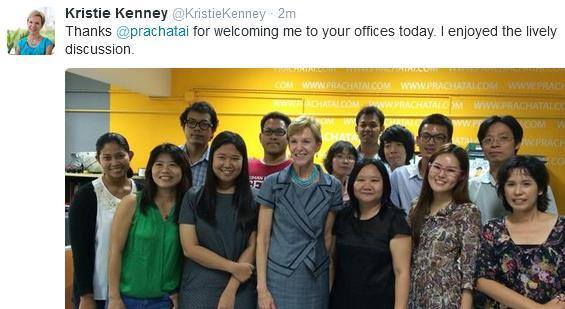 |
| (US Ambassor Kristie Kenney in US State Department-funded Prachatai’s office in Bangkok, Thailand.) |
Independent journalists attempting to ascertain the true depth of Prachatai’s connections to the US State Department were told that Prachatai had none, and that the money was provided to them unconditionally.
In reality, as revealed by Wikileaks, Prachatai’s staff remains in constant contact with the US Embassy in Bangkok, with US ambassadors and political counsellors making regular visits to their office off of Ratchada Road, and with Prachatai’s director Chiranuch Premchaiporn making regular, lengthy and detailed reports about Thailand’s internal political affairs to US Embassy staff.
In the infamous Cablegate leak, the US Embassy in Bangkok sent off as many as 7 cables regarding or referencing Prachatai and its activities within the country and in particular its defence of agitators attempting to undermine the nation’s institutions and political stability.
For the US State Department, Prachatai exists as a state-funded asset — a constant pressure point to extort concessions from the Thai government with and to coerce from them the settings in which US-backed political forces might take power.
Under the guise of defending “free speech” and “human rights,” Prachatai networks deeply with US-backed political party Pheu Thai, its street front the United Front for Democracy Against Dictatorship (UDD or “red shirts”) and a large number of other US-funded organisations posing as NGOs and academic associations — many of which share the office building Prachatai is currently based in.
Additionally, Prachatai communicates and coordinates regularly with foreign media staff based in Thailand, particularly those who gravitate around the swank Foreign Correspondents’ Club of Thailand clubhouse and bar in downtown Bangkok.
Together they stage public relations events aimed at portraying the current Thai government as overbearing, dictatorial and losing popularity and control. In reality, the events include the same handful of stand-ins and utilise intentionally deceptive methods to conflate the size and impact of each staged event.
By participating in such events, the foreign media betrays the principles it allegedly represent, creating the news rather than objectively covering it. For Prachatai, posing as an NGO but clearly functioning as an extension of US interests in Thailand, it too represents a betrayal of true, community-supported activism.
Ending the Charade
In all honesty Prachatai’s activities could easily be tolerated by the Thai government, if only for one concession — that Prachatai and other organisations like it fully and repeatedly disclosed in English and in Thai, their existence as foreign-funded government organisations rather than pose as a genuine NGO.
Since it has operated for years and failed to fulfil its own responsibilities toward transparency to the society it claims to serve, it may be time for Thailand to pass legislation to force foreign-funded organisations like Prachatai to come clean.
Other nations have adopted comprehensive legislation to help protect real NGOs from those with foreign funding merely posing as such.
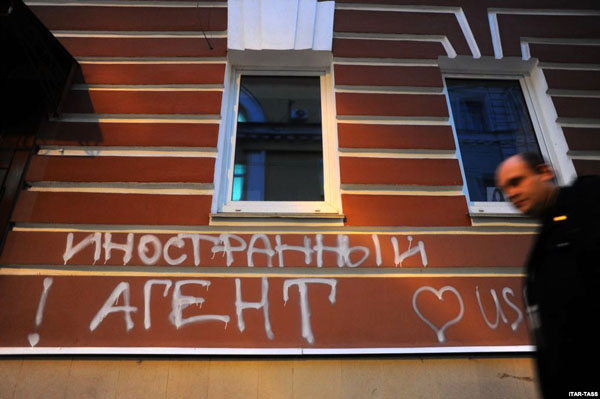
(The graffiti reads, “foreign agent,” written in Russian..)
In Russia, legislation now requires foreign-funded organisations to declare on all written material and verbally declare before all audio statements, their relationship with foreign interests. Those that fail to register as foreign-funded organisations or fail to disclose all of their funding, face liquidation.
While the US and the myriad organisations it was running in Moscow predictably decried the legislation as “oppressive,” some might appreciate the irony of “pro-democracy activists” resisting calls for greater transparency, a fundamental prerequisite for a democratic society.
Foreign-funded organisations posing as NGOs are more than a mere nuisance, or even simply a means by foreign governments and special interests to apply coercive pressure on a nation’s government and institutions. They represent a patient, concerted effort to compete with and eventually fully replace a nation’s existing sovereign institutions. This threat should not be underestimated nor should it be tolerated.
And beyond a threat to national security, these foreign-funded organisations attract and squander a nation’s human resources, while undermining the very legitimate and essential work performed by honest, locally-supported NGOs.
Magical Thinking in US Foreign Policy

By James W Carden | Consortium News | August 11, 2106
Despite America’s myriad problems domestically and internationally, its geo-strategic position remains the envy of the world. Protected in the east by the Atlantic, in the west by the Pacific, to the north by Canada and to the south by Mexico, the United States is, for all intents and purposes, impervious to a foreign invasion.
Its advanced and mobile nuclear arsenal and conventional force projection capabilities further serve as a deterrent against attacks from rival nation-states. The country’s strategic position is enhanced, too, by what Valéry Giscard d’Estaing has referred to as the “exorbitant privilege” – that of possessing the world’s reserve currency. As such, the U.S. does not face the same restraints on spending that other nations do.
Because the dollar accounts for so high a proportion of the balance sheets of other countries, the rest of the world is tacitly committed to propping up its value. Taken together, America’s isolated and protected geo-strategic position combined with the “exorbitant privilege” of the dollar means, in effect, that the U.S. has an unrivaled geo-strategic position.
Yet since the end of the Cold War, the foreign policy establishment and three successive administrations have committed the U.S. to a dangerous and ill-conceived pursuit of global military and economic hegemony which has only served to undercut the country’s economy and security. It is a pursuit that is frequently cloaked in the rhetoric of humanitarianism and “democracy promotion.”
United Nations Ambassador Samantha Power recently declared in the pages of the New York Review of Books that it is “our self-interest that requires us to get better at improving human security in the service of national security.”
Power – like nearly all members of the foreign policy establishment today – believes (or says she believes) that the way foreign governments treat their own citizens “matters because it can have a direct impact on international peace and security – and on our respective national interests.”
To bolster her argument she takes the example of the Russian government which, she claims, habitually lies to its own people about what it is really up to in Ukraine. “The elimination of critical voices inside Russia,” writes Power, “helps enable acts that are profoundly destabilizing outside of Russia.”
Power’s claims are part of the widely shared, bipartisan consensus among the post-Cold War foreign policy elites who believe that the problem is not that the United States has intervened around the world too much and too often but rather that it has intervened too little. In Power’s view, “we must never be ashamed to ask whether we have been too reticent in pressing certain governments to reform and to respond to the demands of their citizens.”
This last point is a curious claim that, I suspect, quite intentionally skirts the question of whether the U.S., by actively pushing its “pro-democracy” agenda abroad, is itself the instigator of many of those “demands” (by financing and organizing many of the groups clamoring for U.S. intervention).
Financing Destabilization
Efforts – almost too numerous to count – by USAID, the International Republican Institute and the National Endowment for Democracy, often in conjunction with various think tanks, TOR developers (software that enables anonymous communications), and George Soros-funded Open Society Institutes – have sought to materially aid a plethora of opposition groups across the globe. (They, in turn, seek more U.S. intervention to enhance their political positions within their societies.)
Contrary to what the scholar, diplomat George Kennan urged – that diplomacy, properly executed, was necessarily a government-to-government interaction – Power believes that “we need to broaden the spectrum of whom we engage with our diplomacy.”
She writes that diplomats must court “civil society organizations” and other groups such as “teachers association, workers’ unions and leaders in the business community” – never mind the very plain fact that State Department diplomats and Commerce Department officials, among others, have been doing outreach of that sort for some time.
The results of all this U.S. meddling have been little short of disastrous. Take, for instance, the failed state of Ukraine, where USAID and other U.S. institutions spent $5 billion in the quarter century since the fall of the Soviet Union, according to Assistant Secretary of State for European Affairs Victoria Nuland (and that was before the U.S.-backed overthrow of the elected government in February 2014 and the current civil war which has claimed the lives of some 10,000 Ukrainians).
This generation of American “humanitarian” crusaders, as exemplified by the career of Ambassador Power, continually seeks to sacrifice stability on the altar of “democratic” idealism (even when that involves reversing democratic results and contributing to humanitarian suffering). Further, the problem that these efforts engender for U.S. national security interests are legion: war continues to rage in eastern Ukraine, Libya is completely destabilized, likewise Syria and Iraq.
Contrary to what Power would have us believe, the “democratization” crusade undermines, rather than strengthens U.S. national security. As the Greek statesman Pericles famously observed: “I am more afraid of our own mistakes than of our enemies’ designs.”
James W Carden is editor of The American Committee for East-West Accord’s eastwestaccord.com. He previously served as an advisor on Russia to the Special Representative for Global Inter-governmental Affairs at the US State Department.
Is US-Funded Destabilization in Latin America Now Paying Off?
By Francisco Dominguez – teleSUR – April 14, 2016
Most progressive governments in Latin America find themselves under intense attack in what is evidently a well synchronized and well financed continental plan of destabilization.
Riots, street demonstrations, anti-corruption campaigns, protests about the domestic negative impact of the world economic crisis, general strikes, impeachment efforts, economic sabotage, and the like, have become the battle horses on which oligarchic forces in cahoots with Washington are riding to carry out “regime change.”
So far, conservative forces in Latin America have been successful in overthrowing President Manuel Zelaya in Honduras in 2009 and President Fernando Lugo in 2012 in Paraguay. Both presidents were ousted by oligarchic parliamentary majorities with mass support from middle class “civic associations”, in complicity with the judiciary, with the latter providing a veneer of legality.
The preconditions for “regime change” take, in some cases, years of careful preparation. This normally involves intoxicating media campaigns of demonization aimed to exacerbate political polarization to the maximum, through the instilling of fear, the staging of aggressive and sometimes violent, middle class mobilizations, the activating of many associations of civil society, and the setting up of, sometimes hundreds, of externally funded NGOs.
The aim is to question the legitimacy of the “target government” which usually involves the systematic discrediting of existing political institutions so as to foster chaos as the most conducive context for “regime change”. This strategy has been “theorized” in manuals that are mass-produced and get heavily promoted free of charge by establishment outfits.(1)
Despite the fastidiousness with which Washington and domestic perpetrators seek to enshrine their efforts at “regime change” in any one nation with the veil of legality, constitutionality, democracy promotion, regional autonomy, and virtuous legitimacy, always a powerful media apparatus is activated the world over, unleashing a barrage of negative reporting and demonization of the “target government” with one overriding message: the solution to created crisis is the ousting of the government.
The favorite demonization is to label the “target government” as a totalitarian dictatorship or in the process of becoming so, unless stopped. This is coupled with regular official condemnatory statements of the “target government” from the U.S. State Dept. and a barrage of U.S. official bodies.
In this “regime change” narrative, the ousting of the target government, being the cause of “civil society’s rebellion”, is fully justified. Thus for example the highly illustrative New York Times editorial of April13, 2002, on occasion of the brief ousting of Hugo Chavez: “Venezuelan democracy is no longer threatened by a would-be dictator.”
The NYT explained that Chavez had been ousted “after the military intervened and handed power to a respected business leader.” The key, therefore, is to portray the “ruler” of the target government as a threat to democratic civilization, thus the NYT editorial justifies the 2002 coup in Venezuela because Chavez “battled the media and alienated virtually every constituency from middle-class professionals, academics and business leaders to union members and the Roman Catholic Church.(2)
So, 21st century “regime change”, different from the more traditional 20th century U.S.-orchestrated coup d’état, involves an intense “battle for hearts and minds”, an essential component of the strategy.(3) Thus, huge financial, political and cultural resources are mobilized to bring about hegemony for “regime change” in society and in all state and civil society institutions, going as far, in some cases, as even co-opting sections of the downtrodden. Most of this is “facilitated” with generous NED and USAID grants awarded over many years.
Faced with its own steady decline and the rise of radical governments in the post-Soviet era, the U.S. seeks to destabilize and oust governments through “color revolutions” as in Georgia, 2003 and the Ukraine, 2004 and 2014. Consequently the U.S. has substantially reorganized its architecture for intervention with the CIA becoming a mere appendix but with USAID and the National Endowment for Democracy and their many associated bodies taking center stage and receiving the lion’s share of the resources. The modality may have changed but U.S. foreign policy remains pretty much what it was: to remove governments it does not like. U.S. State Dept. and USAID budget is bigger than the GPD of many states, in 2016 it was US$50.3 billion.
Among the key U.S. institutions involved in “regime change” is the U.S. State Department, the body with the biggest authority, but there is also the United States Southern Command, the Congress and Senate Foreign Affairs Committees, and the CIA. Then further down the food chain, there are USAID, NED, Office for Transition Initiatives, American Center for International Labor Solidarity and American Institute for Free Labor Development, among the most important ones.
They work closely together and in the pursuance of the same aims, with the International Republican Institute, chaired by John McCain of CHECK; the National Democratic Institute, chaired by Madeline Albright; Transparency International; and Centre for International Private Enterprise. They all channel huge sums to support civil (and when possible) military subversion to create the conditions for “regime change”. They also channel huge sums to fund “civil society” associations, political parties, media outfits, NGOs, professional bodies, trades unions, think tanks, business, student groups and so forth.(4)
These institutions are the field commanders that coordinate the national detachments in every target country around a regional perspective so as to maximize the results of every push for “regime change” in any individual Latin American nation. We are increasingly seeing former right-wing Latin American presidents acting jointly to contribute to the destabilization of Bolivarian Venezuela, for instance.
Additionally there is a raft of “private” or “independent” bodies concerned chiefly with Latin America, the most important of which are Inter-American Press Association; Fundacion para el Analisis y los Estudios Sociales – led by Jose Maria Aznar; the Instituto Prensa y Sociedad; hundreds of Think Tanks; and possibly thousands of NGOs that share the “regime change” aim but that do it from a specialist angle. To all of this architecture of U.S. intervention, the overwhelming majority of the world corporate media play a decisive role, making any U.S. led intervention, a lethal political threat to the survival of any “target government”.
Most progressive governments in Latin America have been or are subjected to systematic levels of traumatic and deliberately created social, economic and political chaos, politics and culture, which in many cases it can go on for years. In Cuba for five decades, in Nicaragua (on and off) nearly four decades and in Venezuela for 17 years thus far, with no end in sight.
Venezuela’s Bolivarian government is currently in the crosshairs of U.S. destabilization plans and “regime change” efforts through an economic war that has the Bolivarian process on the ropes. In Argentina, three years of an intense dirty war against Cristina Fernandez’s government, aspects of which had sinister overtones, paid off when at the November 2015 presidential election, the Right’s candidate, Mauricio Macri, won the election by a small margin of 1 percent. In Ecuador, a police mutiny in September 2010, obviously instigated from abroad and with huge U.S. support, nearly succeeded in ousting the government with with President Rafael Correa miraculously escaping with life.
The destabilization against Ecuador continues with the “revolt” of civil society and very violent street protests. And in Brazil, through a very intense and thoroughly intoxicating media campaign, a “regime change” push seeking to oust the democratically elected and legitimate president Dilma Rousseff is underway, as we write it is not clear whether the effort to oust Dilma will be successful or not.
By substantially reducing export revenues that fund progressive social programs, the persistent world economic crisis significantly helps the “regime change” efforts by the U.S. and its allies. It may be just coincidence but the U.S. ambassador in Paraguay when elected president Fernando Lugo was ousted by a right-wing parliamentary coup, was Liliana Ayalde. The current U.S. ambassador in Brazil, where a right-wing parliamentary coup against elected president Dilma Rousseff is in progress, is Liliana Ayalde.
Bolivar once said that the United States appears to be destined by Providence to plague America with misery in the name of liberty. Exactly, through the NED, USAID and others, the United States must stop destabilizing elected governments in the name of “democracy,” “good governance” and “national security.”
Francisco Dominguez is a senior lecturer at Middlesex University, where he is head of the Centre for Brazilian and Latin American Studies.
(1) See Gene Sharp, “From Dictatorship to Democracy,” Serpent’s Tail, 2011, first published in 2002.
(2) “Hugo Chavez Departs,” New York Times, April 13th, 2002
(3) The overthrow of Honduras President Manuel Zelaya, in June 2009, has led to the book with the very suggestive title “The Good Coup” (Mario Caceres di Iorio, CCB, Canada, 2010).
(4) See “Evolution of USAID and NED in Dominguez,” Lievesley and Ludlam, Right-Wing Politics in the New Latin America, Zed, 2011.
Is the Media an Accomplice in Drone Murders?
By Emran Feroz – teleSUR – March 11, 2016
Since 2001, the United States has been killing people with weaponized drones, most times not knowing the identities of the victims.
The victims of drone strikes are nameless and invisible, despite the fact that most of them are civilians.
The Pentagon announced this week that more than 150 al-Shabab fighters have been killed by a U.S. drone strike in Somalia. The Pentagon spokesmen repeatedly talked about “fighters” and “terrorists” which “posed an imminent threat to the U.S.” But as usual, he offered no proof of his claims.
This kind of language has become normalized when it comes to the U.S. drone war, which is not just taking place in Somalia, but also in countries like Yemen, Pakistan, Afghanistan and Iraq. What is significant regarding the regular attacks in these countries is the media coverage. In fact, it practically does not exist. The many victims of drone strikes are nameless and invisible. And if they appear in any media reports, all of them are completely dehumanized and described as “terrorists,” “suspected militants” or any other similar euphemism.
This was also the case after the latest strike in Somalia, a country the U.S. is officially not at war with. Shortly after the Pentagon’s announcement, many news outlets adopted the U.S. government’s version of the incident. The New York Times, for example, wrote about the killing of “150 fighters who were assembled for what American officials believe was a graduation ceremony.” “Militants” was also the term the Washington Post used to describe all the victims. It is necessary to point out that many other well-known media outlets from all over the world did the very same thing. As usual, there was a huge lack of any critical scrutinizing. Instead, media once again became a mouthpiece of the U.S. government by quoting its military officials and spreading their one-sided views constantly.
Since 2001, the United States has been killing people with weaponized drones, most times not knowing the identity of the victims. As of today, at least 6,000 people have been killed by these drone strikes. According to the London-based Bureau of Investigative Journalism, only 4 percent of drone victims in Pakistan were identified as a-Qaida members. But vastly more than 2,000 people have been killed there by drones during the last years.
Another country which is suffering heavily under drone strikes is Afghanistan, the most drone bombed country in the world. Between 2001 and 2013, 1,670 drone strikes took place in the country. It was in the city of Kandahar, the Taliban’s former stronghold, where the first strike by a weaponized drone took place in October 2001. The target, Taliban founder Mullah Mohammad Omar, was not killed on this day, but many other unknown people have been in the years since.
One of these people was Sadiq Rahim Jan, a 21-year-old food vendor from Paktia, eastern Afghanistan. He was murdered by a drone strike in July 2012. A few days later, media outlets in Kabul described him as a “Taliban commander.” The family members of Aisha Rashid have also been killed by a drone strike. The Afghan girl was four years old when a missile hit the pick-up of her family in Kunar, also in the east of the country. Fourteen passengers, including Aisha’s parents, were murdered. Only she survived – barely – with a ragged face. Initially, all the victims were described as “militants” by Afghan government officials and local media outlets.
Tariq Aziz, from North Waziristan shared a similar destiny. The 16-year-old anti-drone activist was killed by a drone strike in November 2011, together with his 12-year-old cousin Waheed. Unlike the case of Malala Yousafzai, the young Pashtun girl which was nearly killed by a member of the Pakistani Taliban and received a Nobel Peace Prize, Tariq’s case is widely unknown.
In all the mentioned cases, as well as many other, significant media coverage was nonexistent – or it described the victims as terrorists, extremists, militants, al-Qaida members, and so on. This is happening on a daily basis and there are also reasons why it is happening.
In the case of Sadiq, for example, his family became outraged after they noticed that local media outlets described their son and brother as a “Taliban commander.” On that day, the young Afghan was the only person who has been killed in the area. He never had any connection with any insurgent group, not to mention being a commander of them. One of the media outlets which spread these news was Radio Azadi, an Afghan branch of the US government’s external broadcast services. It should be more than obvious that the main aim of such a media platform is not spreading objective information.
Another example for this behaviour is Tolo TV, Afghanistan’s leading mainstream television channel. Last year, the channel’s news website reported that in July 2015 drone strikes in the eastern province of Nangarhar killed “nearly 250 Taliban and Daesh [Islamic State] insurgents.” The main source for this “reporting” was the National Directorate of Security (NDS), the Afghan intelligence service, which was built by the U.S. in the first days of the NATO invasion.
Tolo TV was created in 2004 by Saad Mohseni, an Afghan businessman who is being called an “Afghan Rupert Murdoch” and is considered one of the most powerful men in Afghanistan. The channel’s creation was mainly funded by the notorious United States Agency for International Development (USAID), which is widely known as one of the most important foreign policy tools of the White House.
In general, one can assume that many media outlets in Afghanistan were not created to support journalism and press freedom but to install media institutions who can be useful to represent particular interests. This is also the case in other countries which suffer from drone strikes.
Noor Behram, an investigative journalist from Northern Waziristan, is known for taking pictures of the drone murder scenes and spreading the victims’ faces. After Behram talked with journalists from Islamabad, Pakistan’s capital, he experienced that for them, a beard, long hair and a turban or a pakol, a traditional Afghan cap, is enough to describe male drone victims as “terrorists.” But nearly every man in this area looks like that. According to this logic, everyone, even myself when I am staying there, must be a terrorist.
Besides, Behram’s results fit into Washington’s practice that all military-aged males in a strike zone are considered as “militants.”
The U.S. and its allies needed propaganda organs to construct and justify their war on a medial level. Despite the question if this is moral or not, one should agree that it is also very logical because every war is based on propaganda – it was always like that and probably will never change.
But what remains is the question why so many people still believe such a biased media coverage and its constructed narrative of a good war which is only hitting the bad guys.
Emran Feroz is an Afghan-Austrian journalist, writer and activist currently based in Germany. He is the founder of Drone Memorial, a virtual memorial for civilian drone strike victims.
Another Day, Another Billion for Color Revolutions Near Russia’s Borders
Sputnik – February 13, 2016
Last week, the Obama administration proposed its final, 2017 fiscal year budget proposal to Congress. Among the proposed outlays is a State Department request for nearly a billion dollars to counter “Russian aggression” and “promote democracy” in the former Soviet Union. In other words, Washington thinks the region needs more color revolutions.
On Tuesday, the State Department and USAID held a special joint briefing, laying out a $50.1 billion spending request for 2017, including $953 million in “critical support for Ukraine and surrounding countries in Europe, Eurasia and Central Asia to counter Russian aggression through foreign assistance and public diplomacy.” The funds, officials specified, would go toward “enhancing access to independent, unbiased information; eliminating corruption and supporting rule of law; strengthening civil society; enhancing energy security, supporting financial reforms, trade, and economic diversification; and increasing some defense capabilities” in countries including “Ukraine, Georgia, and Moldova [and] in Central Asia.”
The spending would be separate from the proposed $3.4 billion (up from $789 million in 2016), provided by the so-called “European Reassurance Initiative,” which aims for “a significant reinvestment in the US military presence in Europe after decades of gradual withdrawal” to counter “the growing threat Russia poses to long-term US national security interests in Europe and beyond.”
With most of the Western media basically ignoring the plans and focusing on other aspects of the budget’s whopping $4 trillion in proposed spending, Russian security analysts, naturally, couldn’t let this ‘minor detail’ simply slip by unnoticed, given that the spending proposal is openly oriented against Russia.
Analyzing the State Department’s proposed new spending spree, Svobodnaya Pressa columnist Andrei Ivanov says that the outlays raise as many questions as they answer.
“It’s not difficult to guess what is implied by [the proposed spending for] ‘democratization,'” the journalist noted. “However, several questions arise. Firstly, this year, the State Department has already allocated $117 million ‘to support democracy’ in Ukraine, and $51 million for Moldova and Georgia. But in these countries, so-called color revolutions have already taken place, and the Americans have already almost achieved what they set out to do.””Secondly, it’s unclear what kind of ‘countering of Russian aggression’ the State Department means in relation to Central Asia. Kazakhstan and Kyrgyzstan have long been oriented toward Moscow, and even joined with Russia in the common customs area of the Eurasian Economic Union. Kazakhstan, Kyrgyzstan, and Tajikistan are also part of the Collective Security Treaty Organization’s unified security system. Russia has also signed a series of bilateral cooperation agreements with Uzbekistan.”
The proposed spending, Ivanov notes, “assumes a serious US commitment to pursuing its [geopolitical] goals, which threatens Russia with obvious negative consequences. The question thus arises about the countermeasures our country might take in response.”
“According to experts, on the eve of the coup d’état in Ukraine in 2014, over two thousand non-governmental organizations were created, from training camps for militants to various clubs of political scientists and media workers.”
Unfortunately, the journalist recalls, “Moscow relied more on the agreements reached with Ukrainian elites; the result was disastrous. Today, the question again arises about the need to work actively with the civil society of neighboring states.”
Asked to comment on the State Department’s new spending proposal, Andrei Manoilo, a professor of political science at Moscow State University, expressed a commonly held view among Russian security professionals.
Namely, the professor told the newspaper, “when Washington talks about spreading democracy, and allocates money for this purpose, it is referring to ‘color revolutions’ – the overthrow of undesirable regimes and the drive to bring puppets who mimic democracy to power.”
“Factually, these countries find themselves under American control. Ukraine is a vivid example. Until recently, Georgia too served as a good example, with each department and ministry in the country featuring an advisor and curator from the State Department. In Ukraine, supervision is carried out through the US Embassy, and through officials loyal to Washington, charged with implementing its instructions.”
As for the earmarking funds for countries which have already undergone color revolutions, Manoilo explained that the money “is allocated for the purpose of maintaining the stability of the dependent regime.” This is especially true in Ukraine’s case, he said. It is also meant “to ensure the loyalty of local elites.”
In Georgia’s case, “after Mikheil Saakashvili resigned from his post and was forced to flee the country, the American position weakened somewhat, mainly due to the perceived negativity which the color revolution had brought the country. So here, the US [spends] in order to maintain its influence. It is also possible that the US is considering ensuring the loyalty of Georgian elites by ‘nourishing’ cyclical color revolutions, thus carrying out a rotation of the elite.”
As for Central Asia, the State Department announcement seems to indicate, according to Manoilo, “that color revolutions are planned there as well. The Americans need to see regime change in the countries which, for the most part, are oriented toward Russia. In Central Asia, Moscow has several projects geared toward integration, including the Shanghai Cooperation Organization and the CSTO. Today, the countries in the region face a difficult situation, with disintegratory processes growing among them.”
In Tajikistan, the professor warned, the State Department may attempt to reignite the embers of the country’s civil war, which took place between 1992-1997, taking advantage of disagreements between the country’s north and south. “US NGOs, which operated freely in the country until recently, are taking advantage [of discontent] among both northern and southern elites. It was not until about a year ago that President Emomali Rahmon began to restrict their activities.”In Kyrgyzstan, meanwhile, “the situation has changed little since the last color revolution. The protest mood remains strong. US NGOs and foundations have been working actively with the rural population, which is not very versed in politics, but is easy to agitate to participate in demonstrations against authorities, as the ‘melon’ revolution of 2010 demonstrated.”
In all the countries of Central Asia, Manoilo noted, “there is the strong factor of Islamist radicalism. By and large, only the presence of Russian military bases holds back an Islamist offensive in the region.”
Unfortunately, he says, “practice has shown that when it comes to overthrowing undesirable governments, the State Department easily finds a common language with even the most rabid fundamentalists. It’s sufficient to recall the color revolutions of the so-called Arab Spring. It would not be out of place to presume that the US is preparing their repetition, except this time in the post-Soviet space.”
“In addition to Central Asia, there is the southern Caucasus. Last summer, Armenia saw a rehearsal of a color revolution under non-political slogans – a new technology called the ‘Electro-Maidan’. Armenia is a Russian ally in the South Caucasus, and the US has plans for regime change, using their methods of the so-called ‘democratic transition’.”
Ultimately, Manoilo warns, “by dismantling the political order in Russia’s neighboring countries, the US wants to create a vacuum around our country. Simply put, this indicates a repeat of the Ukrainian scenario. After all, until very recently it was simply impossible to imagine Ukraine as a country which is hostile to Russia.” … Full article
US Could Spend US$30M in 2016 to ‘Promote Democracy’ in Cuba
teleSUR – January 2, 2016
The United States government could potentially spend up to US$30 million on “democracy development” programs in Cuba in 2016, according to bills waiting for approval at U.S. Congress.
Two draft bills related to U.S. State Department’s budget for foreign spending were approved by the Appropriation Committees of both the House of Representatives and the Senate.
The draft bill approved by the House Committee on Appropriations states that the National Endowment for Democracy, or NED, the State Department and the Agency for International Development would share US$30 million in Cuba democracy funds.
Of the funds appropriated by this Act under the heading ‘Economic Support Fund, “$30,000,000 shall be made available to promote democracy and strengthen civil society in Cuba,” the draft bill said. It was approved by the House’s committee in June 2015.
It added that such funds could not be used “for business promotion, economic reform, entrepreneurship, or any other assistance that is not democracy-building.”
Meanwhile, the draft bill approved by the Senate Committee on Appropriations said that US$20 million should be used for Cuba democracy programs, including up to $5 million for “private Cuban entrepreneurs.” This draft was approved by the committee in July last year.
The Senate version of the bill also authorizes US$50.5 million “for programs to promote Internet freedom globally,” and says a portion of the funds would likely be used “to support Internet freedom in Cuba.”
Neither bill has been approved by any of the corresponding government bodies yet.
Over the years, programs such as the NED or the United States Agency for International Development (USAID) have received mounting criticism over meddling in other nations political spheres in order to promote U.S. interests, unlike their claim of promoting democracy and aid.
Both programs are funded by the U.S. congress.
Republican Congressman Ron Paul, who ran for the U.S. presidency twice, has argued against such programs. In 2005, he stated that NED has “very little to do with democracy. It is an organization that uses U.S. tax money to actually subvert democracy, by showering funding on favored political parties or movements overseas.”
The NED has been banned in various countries over meddling claims.
Featured Video

Trita Parsi: Israel Set a Trap for Total War in the Region
or go to
Aletho News Archives – Video-Images
Book Review
Why the War on Conspiracy Theories Is Bad Public Policy
By Kevin Barrett • Unz Review • February 1, 2019
 A Review of Conspiracy Theories and Other Dangerous Ideas by Cass Sunstein (based on an earlier paper co-authored with Adrian Vermeule); In Defense of Troublemakers: The Power of Dissent in Life and Business by Charlan Nemeth; and Conspiracy Theories and the People Who Believe Them, edited by Joseph E. Uscinski
On January 25 2018 YouTube unleashed the latest salvo in the war on conspiracy theories, saying “we’ll begin reducing recommendations of borderline content and content that could misinform users in harmful ways—such as videos promoting a phony miracle cure for a serious illness, claiming the earth is flat, or making blatantly false claims about historic events like 9/11.”
At first glance that sounds reasonable. Nobody wants YouTube or anyone else to recommend bad information. And almost everyone agrees that phony miracle cures, flat earthism, and blatantly false claims about 9/11 and other historical events are undesirable.
But if we stop and seriously consider those words, we notice a couple of problems. First, the word “recommend” is not just misleading but mendacious. YouTube obviously doesn’t really recommend anything. When it says it does, it is lying. … continue
Blog Roll
 Aletho News
- Putin’s key remarks on peace talks and Europe’s ‘schizophrenia’
- Trita Parsi: Israel Set a Trap for Total War in the Region
- Trump’s Iran war is on an Israeli leash
- Saudi oil boss issues global supply warning
- Riyadh Says Its Oil System Is Intact. The Numbers Say Otherwise.
- Trump and Netanyahu Want to “Finish the Job” on Iran
- US ‘one-sided dictation’ not Iran’s beliefs makes rational talks impossible: Baghaei
- Iran’s Next Strike May Not Explode. It Could Shut You Down /Col Doug Macgregor
- Iran: US political targets legitimate if assassinations return
- Iraq shuts key border crossing with Iran under US pressure: Report
- If Americans Knew
- DAILY UPDATE: Latest essential news on Palestine, Israel, & region
- The Israel Lobby’s Changing Fortunes
- AIPAC has become such a political liability that it’s shifting to a more “nimble” approach to buying politicians
- At least 160 Israeli settler attacks in 2 weeks
- Will Gaza’s Ancient Christian Community Disappear Forever?
- Israel’s vision of regional security rests on keeping Arab states weak
- Heidi Levine recounts how Palestinian youths helped save her in settler attack
- DAILY UPDATE: Latest essential news on Palestine, Israel, & region
- Trump’s Intensifying Sabotage of the ICC, for Israel’s Sake
- Israeli military detain US and UK volunteers in West Bank including Democratic NY politician Brad Lander
- No Tricks Zone
- E-Cars Reduce CO2 Emissions By Only 41% Compared To Internal Combustion Engine Vehicles
- Predictions Made By Renowned Climate Professor Over Past Decades Have Been Proven To Be Poor
- New Study Suggests Large Regions Of The Pacific Ocean Have Been Cooling For The Last 80 Years
- Germany’s Green Energy Debacle: High Energy Costs Force Kahla Porzellan to Close After 182 Years!
- New Study: 50 Years Of The Most Aggressive ‘Net Zero’ Policies Can Only Affect The Global Climate By 0.03°C
- US September “Heat” Was No Record…Many Records Set Decades Ago
- Latest European Green Energy Debacle; Portugal’s Largest Flagship Solar Park Insolvent!
- Green Energy Debacle: German Expert Professor Fritz Vahrenholt Warns Of Severe Economic And Social Consequences
- Two More Paleo Reconstructions Affirm Meters-Higher Sea Levels Across Ireland, Brazil 7000-6000 Years Ago
- New Study: Earth And Venus Surface Warmth Largely Explained By Convection And Lapse Rate, Not CO2 Or Radiation

