Inspector General Alleges High-Level Interference in USAID Contract Rigging Investigation
By Noel Brinkerhoff | AllGov | January 27, 2013
The second in command at the U.S. Agency for International Development (USAID) has been accused of interfering with an inspector general’s probe into alleged contract rigging by the agency’s top lawyer.
The investigation was launched after the inspector general (IG) learned that former USAID general counsel Lisa Gomer had helped former chief financial officer David Ostermeyer develop a contract for a “senior government-to-government assistance adviser” that would go to Ostermeyer after he retired. The bidding was later cancelled.
While conducting the probe, the IG’s office was told by Deputy Administrator Donald Steinberg, USAID’s No. 2 official, that the investigation was “inappropriate” and that the U.S. Department of Justice should not have been told about the case.
“When people are slapping badges down, reading rights and monitoring who is calling who as it relates to career people, it is a mistake,” an IG memo quoted Steinberg as saying to investigators.
USAID spokesman Kamyl Bazbaz told The Washington Post that none of the agency’s top officials interfered with the inspector general’s probe.
Gomer’s attorney claimed the Justice Department has dropped its own investigation into the alleged contracting rigging. But a Justice spokeswoman declined to confirm this assertion when asked by the newspaper.
Related article
- Justice Department Investigating USAID for Allegedly Rigging Contracts (voicerussia.com)
Alan Gross and his descent into hell
Along the Malecon | January 21, 2013
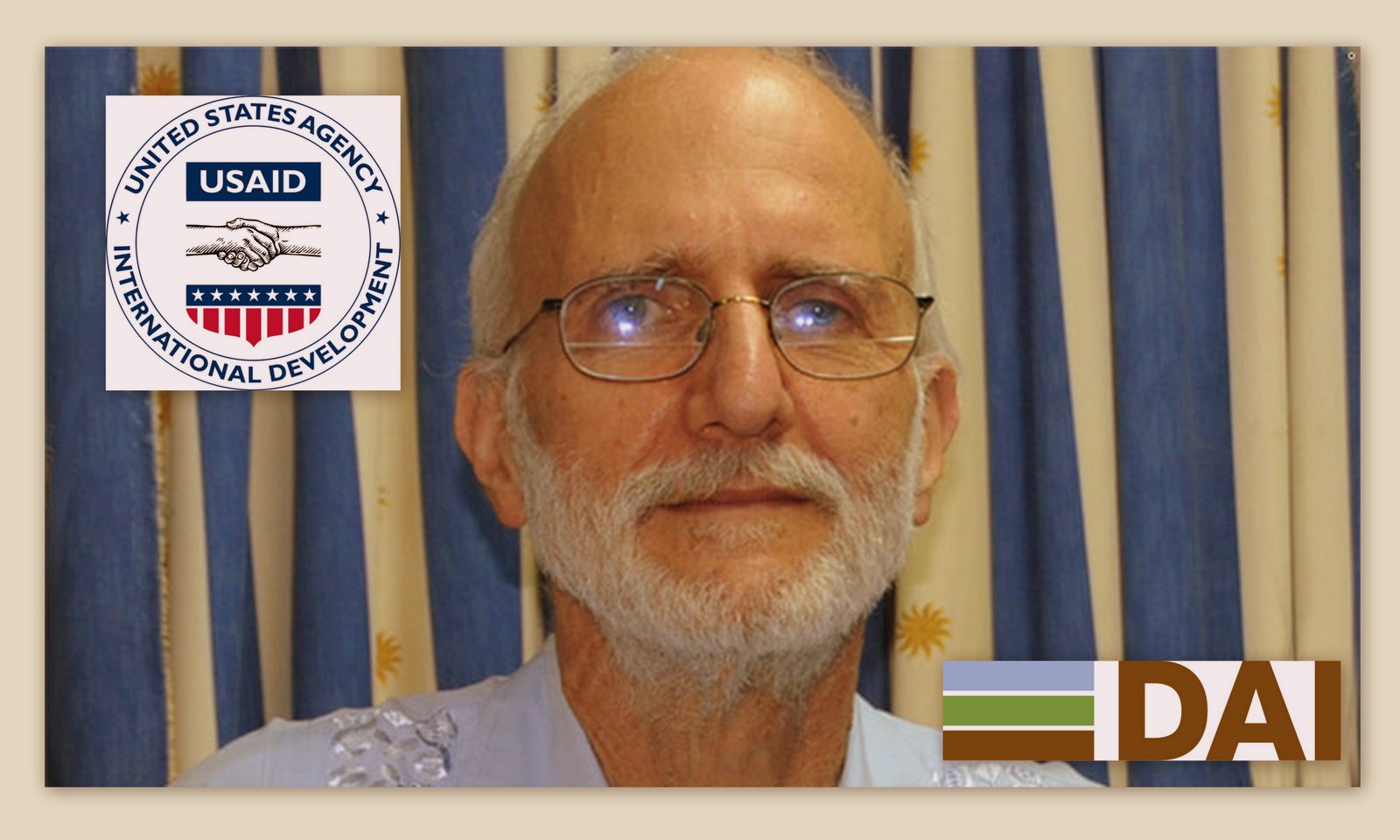
This isn’t “Everything You Wanted to Know About Alan Gross, But Were Afraid to Ask.” Unanswered questions about Gross abound more than three years after Cuban authorities nabbed him in Havana.
The Agency for International Development dispatched the American development worker to Cuba on a highly sensitive mission in 2009. Cuban authorities followed his movements at first, then arrested him and deposited him in jail. Discovering how he got there, ever so far from his home in Maryland, is a winding trail of money, bureaucracy and barely intelligible acronyms.
Below is a post aimed at answering some basic questions in the case and adding context to new details that emerged this month in court records, confidential memos and other documents (see links to source material at end of post).
Who hired Alan Gross?
A global development company, Development Alternatives Inc., or DAI, based in Bethesda, Md., and with offices in London, Islamabad and other cities. The company had revenue of nearly $300 million in 2012.
What’s DAI’s connection to USAID?
DAI is one of USAID’s top contractors. USAID has awarded more than $4 billion in contracts to DAI since 2000.
On Sept. 27, 2005, USAID signed a $25,000 contract with DAI as part of the agency’s “Instability, Crisis and Recovery Programs.”

The contract description shown in federal records is cryptic: CMM IQC.
What does that stand for?
CMM refers to the Office of Conflict Management and Mitigation in USAID’s Bureau for Democracy, Conflict, and Humanitarian Assistance. The office works with USAID and its partners, along with the State Department and the Pentagon. “These new partnerships,” USAID says, have boosted the U.S. government’s ability to fight the “Global War on Terror.”
IQC is Indefinite Quantity Contract, an agreement that delivers an unspecified quantity of products or services.
What was DAI supposed to do?
USAID hired DAI to conduct “conflict and fragility” assessments, which involved:
- A review of risk factors in specific countries or regions
- The development of work plans
- Research
- Fieldwork and reports
- Planning and implementation of meetings and other duties.
What does that have to do with Cuba?
Under the 2005 contract, DAI became one of USAID’s go-to contractors for a range of tasks. So when USAID wanted to assign a sensitive Cuba project in August 2008, it turned to DAI.
What was that project called?
The Cuba Democracy and Contingency Planning Program, or CDCPP.
How did Alan Gross get involved?
By 2008, Gross was in debt and had evidently been trying to land a Cuba-related contract for at least a year. He had been to the island before and knew key people who were handling U.S. government-financed projects in Cuba.
Key people? Any names?
Gross was in contact with Marc Wachtenheim, then director and founder of the Cuba Development Initiative at the Pan American Development Foundation, or PADF, another big USAID contractor.
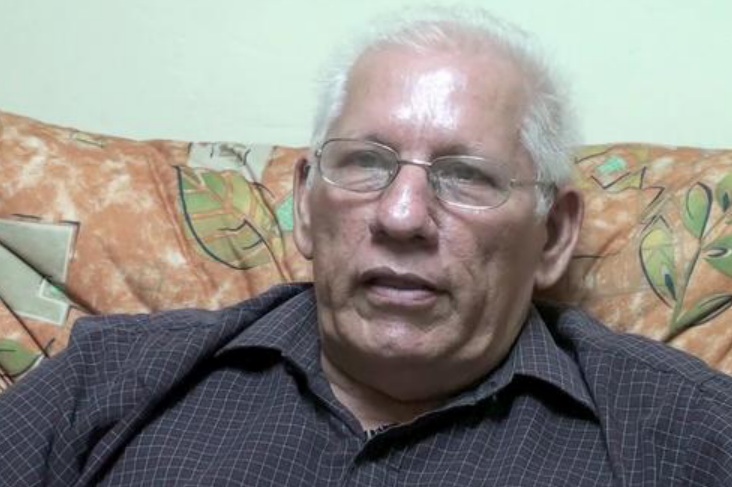
José Manuel Collera
In 2004, Wachtenheim had asked Gross to deliver a video camera and other items to José Manuel Collera, former head of the Freemasons fraternal organization in Cuba. Gross delivered the package and the PADF paid him $400.
What was Gross doing in Cuba in 2004?
At his 2011 trial, Gross testified that he went to the island as a tourist in 2004. He stayed at the four-star Hotel Raquel in Havana. It’s unclear if he traveled to Cuba again before 2009. His 2006 company tax records cited ongoing humanitarian work in Cuba.
Anything special about Collera?
Collera was an important contact for Wachtenheim, but turned out to be a spy. In 2011, Collera revealed that he was a state security agent known as “Agent Gerardo.”
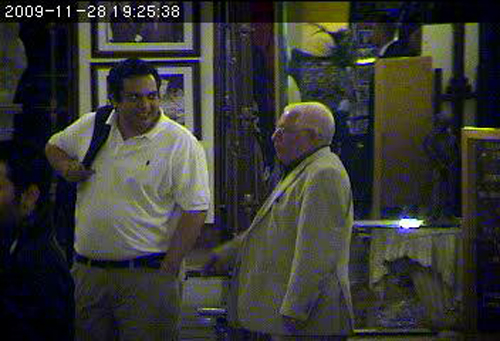
Wachtenheim, left, and Collera in surveillance video.
What became of Wachtenheim?
Cuban state security agents secretly caught Wachtenheim on surveillance video while he met with Collera and others. Presumably, agents could have detained Wachtenheim, but they did not interfere with his travels to the island.
Wachtenheim reached out to Gross again in 2007. He gave him $5,500 and asked him to buy a Hughes model 9201 satellite terminal that was to be taken to Cuba. The equipment allows users to send information over the Inmarsat Broadband Global Area Network, or BGAN, satellite network. It’s not clear who delivered it and how it was used. The equipment may have been tied to an unrelated PADF program. Raúl Capote, a Cuban professor who worked for Cuban state security, said James Benson, a U.S. official in Havana, delivered a portable BGAN terminal to him and said, “Marc Wachtenheim sends you this.”
That same year, Gross pitched a Cuba proposal to Wachtenheim. He called it “Information and Communications Technology for Cuba: A Pilot Project.”
Wachtenheim didn’t bite. Cuban authorities found out about the project because information about it was on a flash drive Gross had when he was arrested in December 2009.
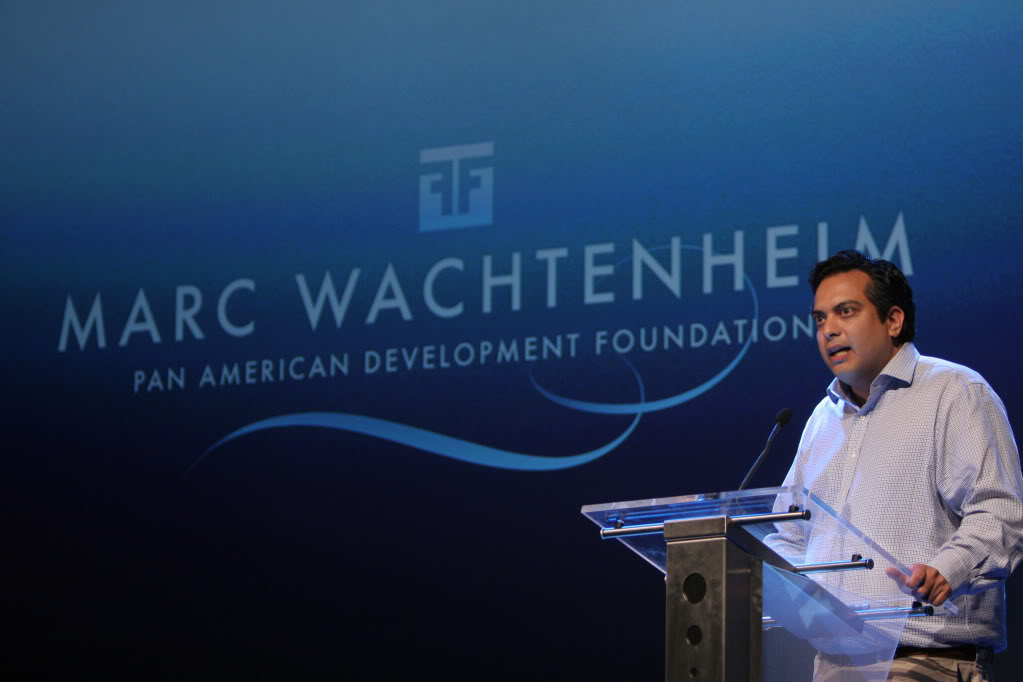
Marc Wachtenheim
How did Gross finally get the DAI subcontract?
In 2008, Gross learned that DAI had received a Cuba-related contract, described as a “Washington, DC-based project focused on promoting democratic governance in Cuba.”
One version of the story is that Gross then contacted John McCarthy, chief of party for the Cuba project at DAI, and told him he wanted in. Gross told a different story at his trial, saying DAI had asked him to submit a proposal for an upcoming project that he “knew nothing about.”
Whatever the case, Gross got the job even though he didn’t speak Spanish, was not a Cuba specialist and didn’t appear to have extensive experience on the island.
What happened to McCarthy?
He was promoted. He is now DAI’s Global Practice Leader.
So why did DAI hire Gross?
Gross’s connections certainly didn’t hurt. A DAI official who recommended him to USAID on Oct. 21, 2008, wrote:
I can comment on Alan Gross as a former colleague (we overlapped at Nathan from the late 1980s to the early 1990s) and general acquaintance (we stayed in touch over the years) with whom I have exchanged insights about economic development and new business opportunities in this arena every few months.
Alan is a very conscientious and trustworthy individual. He is particularly strong in situational and issues analysis, brokering of technologies and programmatic concepts, and the identification of business opportunities (and this last is a reference to business start-ups, pilots, and innovative ways of overcoming constraints to business growth). I cannot comment on JBDC, as I have never contracted services directly from his company.
Back up. What’s the reference to Nathan?
Gross was a senior partner at Robert R. Nathan Associates from 1987 to 1991.
What about JBDC?
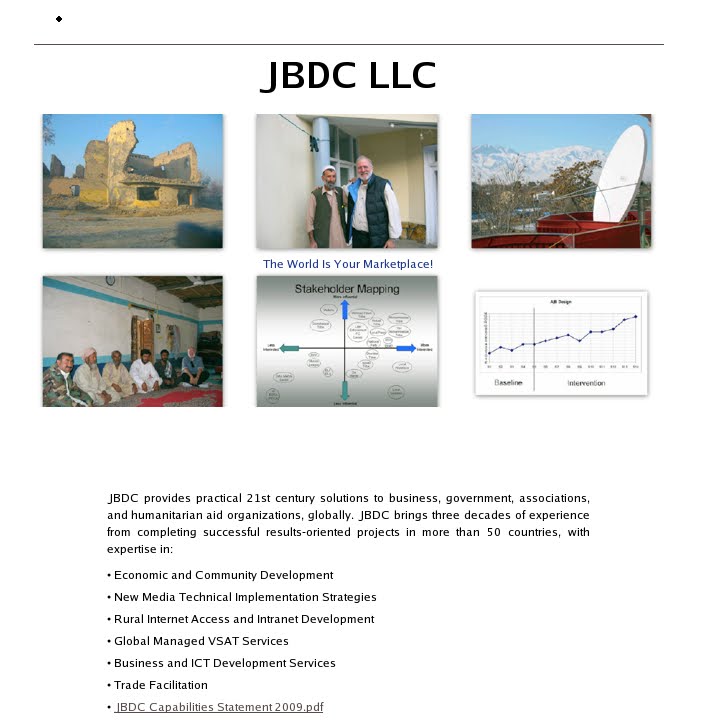
Joint Business Development Center, Inc., was a business and economic development group that Gross founded and ran.
Who designed DAI’s Cuba project?
The project was “based entirely” on Gross’s Dec. 29, 2008, proposal. Gross called it the “ICTs Para La Isla Project.”

From an Alan Gross memo
How long was the project supposed to last?
The initial phase was set for 15 weeks: Feb. 10, 2009, to June 10, 2009.
How much was Gross paid?
The original subcontract amount was $258,274. Gross asked DAI for a project extension and $332,334 in additional funds. USAID agreed and Gross signed the deal on Oct. 26, 2009, bringing the subcontract amount to $590,608.
How much did Gross actually receive?
DAI paid the original $258,274. Neither USAID nor DAI has revealed how much more he received. The contractor has said Gross was paid for the “deliverables” he completed.
Under the contract terms, Gross would have gotten $65,132.80 before departing on his last Cuba trip.
Then he would have received $21,168 after returning to the U.S. and filing a trip report with DAI, but he was arrested before he could do that. So it is quite possible he received just $65,132.80, not the full $332,334.
Did Gross have to pay his own expenses out of that budget?
Yes. His proposed $332,334 budget, for instance, included at least $167,445 in expenses. That means Gross would have taken home only $164,889 if he had completed the contract.
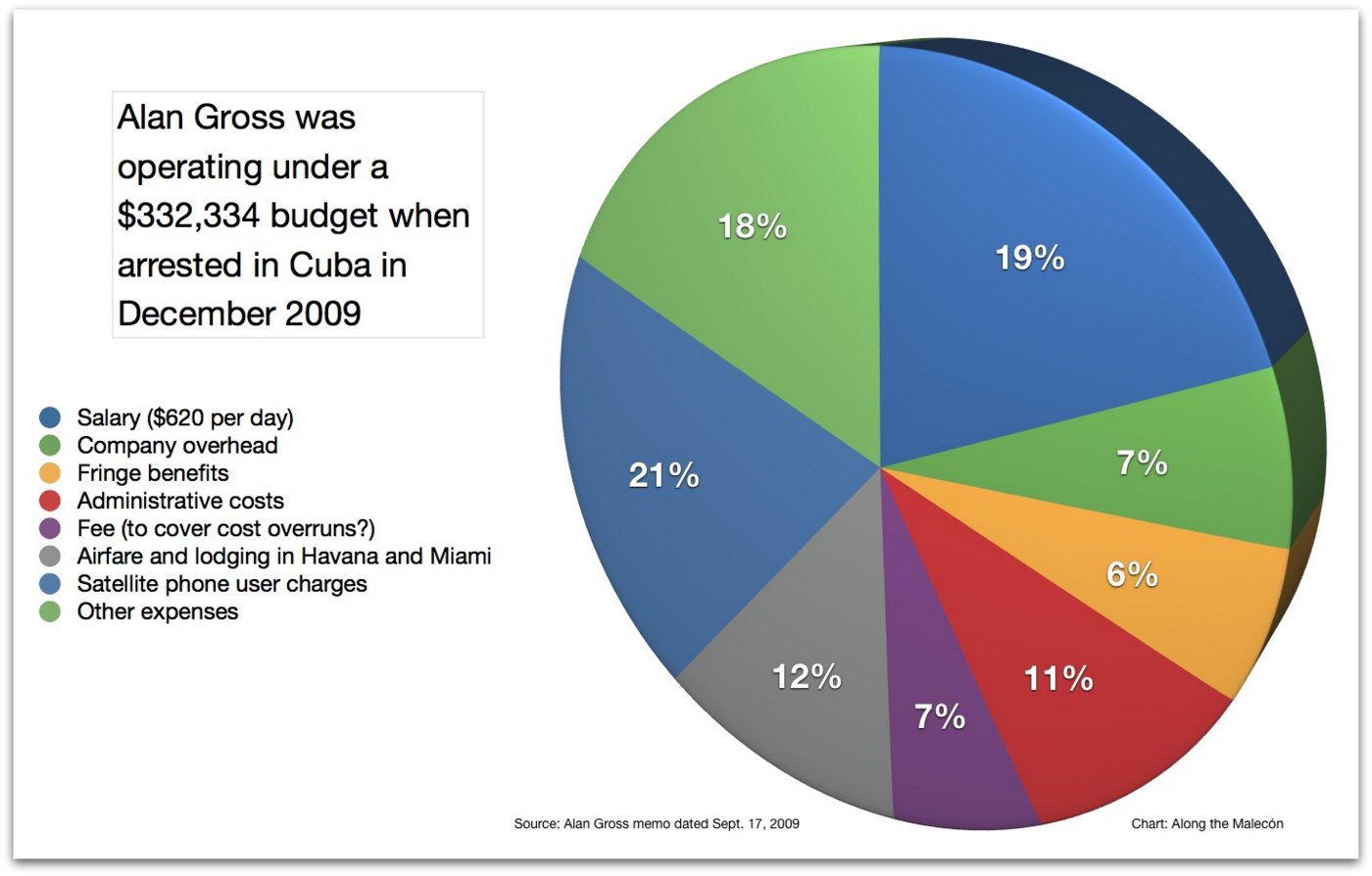
What were some of big costs that Gross expected to pay?
- Airfare and lodging in Havana and Miami, $40,112
- Satellite modem user charges for just four months, $68,640
What was his salary?
Gross charged DAI $620 per day. That came in just under USAID’s limit of $626.54, which was the agency’s maximum allowable salary without a waiver in 2009. Gross figured he’d collect that amount for 102 days under the contract extension, giving him $63,240.
So how could Gross have taken home $164,889?
Ah, therein lies the beauty of a federal contract. He threw in company overhead, $21,854; fringe benefits, $21,528; administrative costs, $35,081; and an expense that was simply described as his “fee,” a tidy $35,081, which may have been added to compensate for any cost overruns and other unexpected expenses.
What did Gross accomplish under the subcontract?
He installed three BGAN broadband Internet connections as part of a pilot project. The satellite modems were evidently placed at Jewish synagogues or offices in Havana, Camagüey and Santiago de Cuba. Gross wrote in a memo:
A wireless network where none previously existed was developed and made operational at 3 target group communities….The target group is now capable of receiving, transmitting, storing and conveying mass information through multi-modal means not previously available.
Gross said “activities initially developed” in Havana and the two other cities now “can be expanded to other identified target groups.”
He added:
Although not part of the Contractor’s initial scope of work, basic content was provided to each of the three communities. This includes three encyclopedias, pictures and video of each other’s communities (developed during three field visits), a significant array of music, and more than a terabyte of storage capacity at each site.
How many trips did Gross make to Cuba under the DAI subcontract?
Four during the initial phase, and one after the contract extension. He was arrested during the fifth trip.
How many trips did he plan under the contract extension, in addition to the five?
Seven, which would have brought the total to 12. His goals were to:
- Beef up security at the three Internet sites he had already established because he feared they’d be detected.
- Study and monitor usage at the sites.
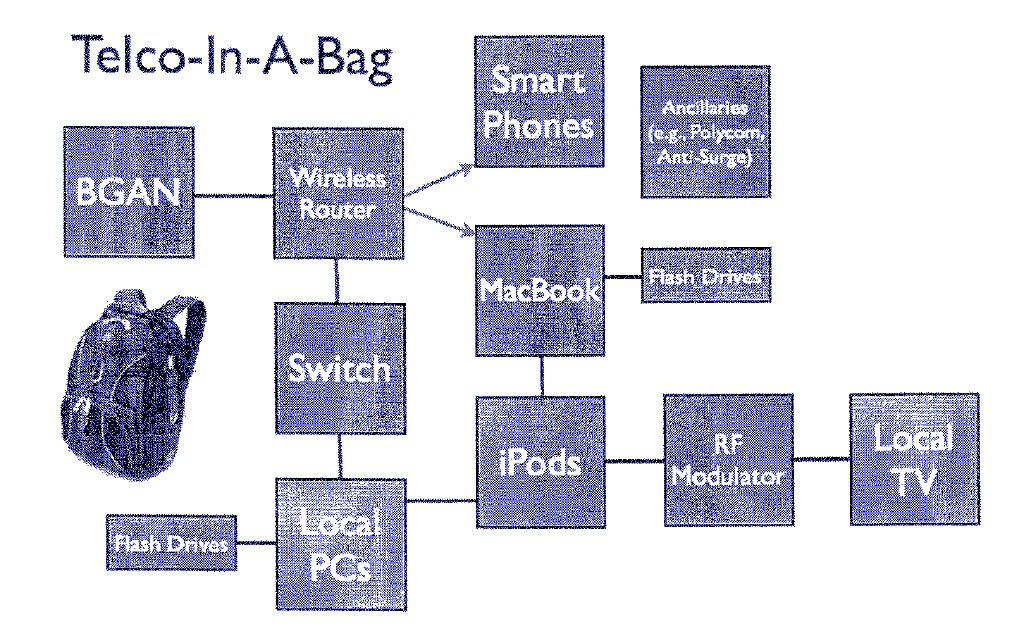
- Supply “up to three new beneficiaries” with telecommunications kits he called “Telco-in-a-Bag.” They were each to include a satellite modem, laptop and other equipment that would fit in a backpack.
When was Gross arrested?
Dec. 3, 2009.
Was anyone else jailed?
None of Gross’s Cuba contacts were reported jailed, but Wachtenheim was reportedly in Cuba around that time and was forced to leave the country in a hurry.
Capote, the professor who was also known as Agent Daniel, said Wachtenheim had traveled to Havana in December 2009 and had called him to arrange a meeting, but he didn’t show up.
Later he called to apologize. Capote recalled the conversation.
Wachtenheim: I had to urgently leave Cuba. Do you have your equipment with you? Do you have it?
Capote: I have it.
Wachtenheim: Make it disappear. Get rid of it quickly.
Cuban authorities had arrested an American who was “very awkward and naive,” Wachtenheim explained. He said Capote needed to get rid of his BGAN because having it would be “very dangerous” for Capote and for the American.
What were the charges against Gross?
In February 2011, Cuban authorities charged Gross with “actions against the independence or the territorial integrity of the state.” Prosecutors also accused him of taking part in a “subversive project aiming at bringing down the revolution.”
How did Gross explain his work?
In a statement given to the court, Gross said he saw the Cuba project as a way to help support his family and “pay off accumulated debts,” and improve Internet access for members of the Jewish community in Cuba.
Gross said:
Let me be absolutely clear and unambiguous: I have never, would never, and will never purposely or knowingly do anything personally or professionally to subvert a government or political system, or bring harm to anyone…I do deeply regret that my actions have been misinterpreted as harmful and a threat against the security and independence of Cuba. Surely, this runs counter to what I had intended.
How did the arrest impact DAI?
On Sept. 14, 2010, USAID modified its contract with DAI. The agency made changes to the scope of work, cut the funding amount from $28,310,630 to $6,857,817, and scheduled early termination of its agreement with the contractor.
Did USAID or DAI say how the contractor spent $6,857,817? Was there any accountability to taxpayers?
No and no. USAID has not made public any reports on the outcome of the Cuba Democracy and Contingency Planning Program. The agency said “due to the sensitive nature of content,” no reports on the program would be submitted to USAID’s huge online database, the Development Experience Clearinghouse.
Have auditors examined USAID’s Cuba programs?
Yes. USAID paid the DMP Group at least $1.47 million to audit the agency’s Cuba programs in 2009 and 2010.
However, USAID has refused disclose any meaningful audit results. In response to a Freedom of Information Act request, USAID in 2011 released a 10-page heavily redacted report that contained few details.
Who used the Internet connections that Gross set up?
Neither DAI nor USAID has reported usage details. Trusted Cubans who were vetted in some way evidently managed the sites, so access was limited. Gross’s subcontract required a usage analysis, but no documents on that have been make public.
Where are the BGAN modems, laptops and other equipment now?
Cuban authorities seized the gear.
How did the project advance the democratization of Cuba?
It is not clear the project had any impact in Cuba, despite its cost and the jailing of Our Man in Havana.
Sources:
- CDCCP Task Order
- DAI contract amendment
- Cuba judgment vs. Alan Gross
- DAI-CDCCP document
- DAI reply to Gross family lawsuit
- Alan Gross budget proposal
- August 2008 DAI meeting notes
- Cuba indictment vs. Alan Gross
- John McCarthy statement
- Vetting of Alan Gross
- Sept. 27 contract record
- Gross’s “Para La Isla” proposal
- DAI contract modification
- Subcontract
- Subcontract-1
- USAID salary memo
Related articles
- Cuba responds to unsubstantiated U.S. claims regarding the Alan Gross case (alethonews.wordpress.com)
- Documents Describe US “Transition Plans” for Cuba (alethonews.wordpress.com)
Documents Describe US “Transition Plans” for Cuba
Secrecy, politics at heart of Cuba project
Along the Malecon | January 17, 2013
U.S. officials stressed the importance of secrecy during a 2008 meeting with a Maryland contractor that had been chosen to carry out a new democracy project in Cuba, according to a confidential memo (download 8-page document).
The project wasn’t considered classified, however, because the U.S. Agency for International Development wanted to create the illusion of transparency.
Development Alternatives Inc., of Bethesda, Md., won the USAID contract on Aug. 14, 2008, and quickly hired Alan Gross, who was later arrested in Cuba while working on the project.
DAI – not USAID, as some websites have reported – wrote the confidential memo to summarize what was said during a private Aug. 26, 2008, meeting with top USAID officials.
During the meeting, DAI learned that the U.S. government had “five to seven different transition plans” for Cuba. DAI would “not be asked to write a new one.”
Instead, the contractor would carry out a daring plan to set up satellite Internet connections under the nose of Cuban state security agents.
USAID promised to protect the identities of contractors and their associates in and out of Cuba. “The program is not pressing (and will not press) them to disclose networks,” said the memo, which DAI filed in federal court on Jan. 15 as part of its reply to a $60 million lawsuit filed by the Gross family in November 2012 (See Spanish-language translation of this post here, h/t Letras Afiladas).
The memo stressed the unusual nature of the Cuba program:
The project was not classified because USAID wanted to send the message that this is a transparent process. Also, a classified project imposes significant security, documentation burdens and delays on all its stakeholders.
USAID wanted no delays and was eager to move ahead. The memo said:
This Administration expects immediate results from this program, definitely before mid-January.
That deadline likely had something to do with the departure of George W. Bush, a strong supporter of USAID’s programs in Cuba, and the arrival of Barack Obama, who was sworn in on Jan. 20, 2009.
The DAI memo summed up a top USAID official’s view of the political undercurrents:
- This project has received and will continue to warrant intense political scrutiny and pressure for results and fiscal integrity.
- Target populations for grants are those NGO reaching out to pro-democracy and human rights change agents and those Cubans with a different vision for their country.
- USAID is not telling Cubans how or why they need a democratic transition, but rather, the Agency wants to provide the technology and means for communicating the spark which could benefit the population.
- This project will be difficult to implement because an ‘ossified’ Cuban government prevents change, and because most government resources go to its police and control machinery.
- The Cuba program attracts significant attention and scrutiny by US Congress, where some support and others question existing activities.
- There is, of course, skepticism on this project, influential political and civic leaders have the perception that this program is paying too much for work that could be significantly less expensive through other contract or award options.
The challenge, the memo said, would be finding “creativity to implement this project in the face of opposition from the Cuban State…while protecting the security of participants and change agents.”
The project was entitled “Cuba Democracy and Contingency Planning Program,” or CDCPP. The memo gave explicit instructions on how the initiative should be described if any lawmakers should ask about it.
Explanation to the Hill regarding CDCPP: to empower pro-democracy, pro-human rights and those looking for alternative visions for the island. The program seeks to expand the reach of their ideas and activities, to build and fortify networks and their capacity to act, and to increase the flow of communication to and around the island.
That vague description gave no clues to the project’s clandestine nature, but the DAI memo was clear:
CDCPP is not an analytical project; it’s an operational activity. USAID approval is needed for everything. We cannot freelance.
The memo said USAID picked DAI in part because of its international reach.
USAID would like to tap into the global network of contacts that DAI has in terms of democracy promotion…
Planes flying in to Cuba from Europe, Central America and the Caribbean look “less conspicuous.”
Grant limits to non-U.S. NGOs “have no funding ceiling,” the memo added. But:
Cuban security apparatus is very strong so non-US NGOs should be vetted.
The DAI memo spelled out what the contractor should say in response to any inquiries from the public or the media:
Yes, we have been awarded CDCPP and we are working with USAID on discussions, but the project is not fully operational yet. Please refer other questions to (redacted) of USAID.
The memo said USAID stressed:
Nothing anywhere.
DAI said that meant:
We must not post anything on our website or issue a press release on the awarded contract.
DAI wound up picking Gross to handle “new media” – the satellite Internet connections – described as the “most sensitive component in a very sensitive project.”
And during four trips to Cuba, Gross established three Internet connections – one in Havana, two outside the capital.
DAI paid him $258,274. He requested more money to continue the project and was promised $332,334, which would have brought his subcontract total to $590,608, an October 2009 memo shows (download 6-page document).
In late November 2009, Gross returned to Cuba a fifth time. Cuban authorities arrested him on Dec. 3, 2009, and accused him of crimes against the socialist state.
DAI said it paid Gross “the full amount owed under the Subcontract for completed deliverables.”
That evidently means Gross would have been entitled to just $65,132.80. That would bring his total payments to $323,406.80, not the full $590,608 he could have collected if he were not arrested.
Gross called his effort “Para La Isla” – For The Island. According to a proposal (download 13-page document) he wrote after his first four trips to Cuba:
Efforts to date under the Para-La-Isla (PLI) Pilot have been focused on establishing and operationalizing 3 sites on the Island through which target group members now have greater access to information than they had previously.
Activities in support of these efforts included the selection, configuration, logistics and training on the use of specific information and communication technologies (ICTs). Primary objectives of the Pilot dealt with the efficacy of the technologies deployed and the contractor’s demonstration that these technologies work.
In the Sept. 17, 2009, memo, Gross proposed six eight additional trips to Cuba that his company would carry out from Nov. 1, 2009, to Oct. 31, 2010.
The memo stated:
Activities initially developed under this pilot at the first site in the capital city have been replicated and expanded to two other target group member communities in the provinces. These activities can be expanded to other identified target groups.
That likely means that Gross and DAI had envisioned taking the program beyond the Jewish community where Gross installed his first Internet connection.
Gross had supplied his Cuban collaborators with Broadband Global Area Network equipment, BGAN for short. The equipment, which fits into a backpack, can be used to establish a broadband Internet connection from anywhere in the world. Users can also make phone calls, send e-mail messages and set up a WiFi network.
During follow-up visits, Gross wanted to learn how Cubans were using the BGAN equipment, increase the number of users at each site and boost security so they wouldn’t be caught.
He considered it “highly probable” that state security agents would detect the satellite connections in the provinces. He wrote:
Radio Frequency activity in the Capitol City is more difficult to monitor than in the provinces because of an already existing level of RF congestion (e.g., from government, commercial sites, embassies, etc.). Therefore, monitoring and detection in the use of ICTs is less likely to occur in the Capitol City. Conversely and because there is little RF congestion in the provinces, monitoring and detection of ICT devices is highly probable.
Even limited use of BGANs and wireless networks will be monitored and detected because Island government technicians routinely “sniff” neighborhoods with their handheld devices in search of ham-radio and satellite dishes. While wireless computer networks (intranet) are not likely to cause any problem if detected, discovery of BGAN usage for Internet access would be catastrophic.
Gross planned to install special SIM cards in the three BGAN systems that would disable their GPS tracking feature and make them more difficult to detect. He wrote:
In order to improve and supplement security tactics and protocols already in place, the contractor will use an alternative SIM card, called “discreet” SIM card, that will increase the level of technical security with each of the 3 BGANs deployed. Discreet SIM cards impede the ability to track or detect specific aspects of non-terrestrial transmitted signals, regarding location and IP identification of transmission. This is accomplished by:
- Masking the IP address of the BGAN, in case some entity is able to “hack” into the transmission at either end, and
- Masking the signal so that its GPS location cannot be pinpointed within 400 km.
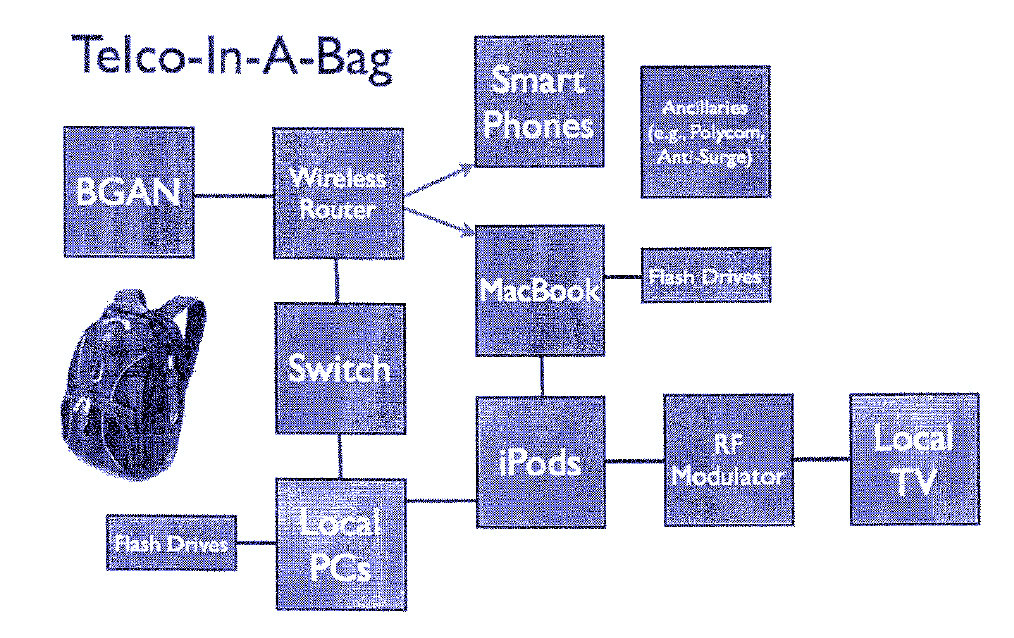
During the last three of the six trips that Gross planned, he had hoped to supply “up to an additional three prospective new target group sites” with what he described as “Telco-in-a-Bag.” He wrote:
Beneficiaries will utilize this equipment to support activities that are consistent with CDP program. A standard configuration will include:
- Hardware and software (e.g., computers, modems)
- Content sharing devices (e.g. iPods, flash drives, smartphones)
- Activation and Service (BGAN and mobile)
- Installation
- Training on the use of this equipment will be similar to the first 3 sites (excluding training on Ruckus Wireless equipment)
- Local Technical Support to be provided by local contractor staff for trouble-shooting, technical assistance, maintenance, etc.
- Accessories
- Schematic
Gross said each ‘Telco-In-A-Bag” would include:
- Unlocked SmartPhones
- Sim Card
- 2GB miniSD Expansion Memory Card
- iPod 120 GB
- Composite AV Cable for use with iPod & TV
- RF Modulator for TVs, Coaxial Cable
- BGAN satellite modem (1 T&T, 2 Nera)
- Discreet BGAN Sim card
- Wireless Router
- Switch
- MacBook
- Backpack
- Surge Protector (3-outlet) & Adapters
- Polycom Communicator for Notebook
- WD External Hard Drive, 500 GB
- USB Memory Stick (4 GB Flash Drive)”
The memo said that Gross and DAI would reach “an amicable agreement on how to resolve or settle” any differences if forces beyond their control prevented the project’s completion.
But there was no amicable agreement after Gross was arrested and Gross and his wife, Judy, sued DAI and USAID.
On Jan. 15, DAI asked a federal judge to throw out the lawsuit. Lawyers for DAI wrote (download 57-page document):
The Cuban government, reprehensibly, has sought to manipulate its detention of Mr. Gross to strengthen its hand in dealings with the United States. This has included seeking to exchange Mr. Gross’s release for the U.S. Government’s release of five Cuban spies. As Congresswoman Ileana Ros-Lehtinen observed, “[t]he Cuban dictatorship is clearly using Mr. Gross to strengthen its grip on power and gain leverage with the United States.”
Against this backdrop, Plaintiffs have filed the present tort suit seeking monetary damages from the Defendants. The fundamental premise of the Complaint is that Plaintiffs may bring tort claims against the Defendants based on the tragic harm that has befallen Mr. Gross.
This premise is wrong. Plaintiffs’ allegations are inextricably intertwined with Federal laws and policies that bar Plaintiffs’ claims, and also fail to state a claim on which the Court can grant relief. Plaintiffs’ claims must be dismissed for eight distinct reasons, any one of which would justify dismissal.
The DAI lawyers – Steven J. Weber, Sarah M. Graves and Matthew J. Gaziano – also said that the company did not have duty to protect Gross. They said he was an independent contractor who should have done more to avoid arrest.
They wrote:
…the Subcontract explicitly states “[t]he Subcontractor shall take all reasonable precautions to prevent damage, injury, or loss to all persons performing services hereunder, the Work, all materials and equipment utilized therein, and all other property at the site of the Work and adjacent thereto.” § 7.3. Thus, § 410 is inapplicable on its face, and the general rule restricting liability to independent contractor employees should prevail.
In sum, DAI had no duty to protect Mr. Gross from the type of injury he suffered, and no exception to this rule is applicable given his admitted status as an employee of an independent contractor. Whether his injury was foreseeable is a factual question that does not change this analysis.
The Cuban government – not DAI – are ultimately to blame for any harm done to Gross and his wife, the contractor’s lawyers said.
DAI deeply regrets that Mr. and Mrs. Gross have suffered harm due to the actions of the Cuban government while Mr. Gross was undertaking activities in Cuba to further the U.S.Government’s foreign policy. For the reasons stated above, however, the Complaint against DAI must be dismissed in its entirety and with prejudice.
Related articles
- Alan Gross and his descent into hell
- Cuba responds to unsubstantiated U.S. claims regarding the Alan Gross case
- Cuba and the Jewish Lobby
- Ecuador: Government Announces End of Cooperation with USAID

USAID looks for ways around Russian ban
By Veronika Krasheninnikova | RT | September 24, 2012
Russia’s Ministry of Foreign Affairs gave USAID until October 1 to shut its doors in Moscow. This is an excellent decision by the Russian Government. And Washington’s immediate and virulent reaction only confirms that Russia is right on target.
The New York Times next morning on the front page cited American officials who “quickly pledged to maneuver around the Kremlin.” Even before the public announcement, on Tuesday 18 September, US Ambassador to Moscow Michael McFaul and USAID leadership met with their Russian partners.
Grigory Melkonyants, deputy head of the Golos Association – one of the top recipients of USAID funding – confirmed after the meeting that the agency is “not going to leave Russia completely” and they are “brainstorming” about how to reorganize. In the meantime, Ambassador McFaul announced that “it will take at least a year” for USAID to exit Russia, according to Bloomberg News.
Brainstorming on how circumvent the Russian government’s decision – instead of how to pack up faster – is only one more demonstration of Washington’s utter disrespect for another country’s sovereignty. Indeed, there are a number of ways in which USAID can maneuver around its predicament.
Funding can be channeled directly from USAID headquarters in Washington to its Russian beneficiaries – no need to go through a Moscow office.
USAID funding can be redirected through a great number of other US institutions, beginning with the National Endowment for Democracy and its four mandated institutes; private funds such as MacArthur, Soros’s Open Society Institute, or Freedom House; universities’ Russia programs, etc.
To hide the American connection, USAID can channel funding through their partners in Ukraine, Poland or Georgia – for their very active operations in the Caucuses; in this case the money entering Russia will be Ukrainian, Polish or, God forbid, Saakashvili’s.
In October last year, USAID signed an agreement with Cisco Systems on joint 50/50 funding of Cisco Networking Academies for Public Service Program. Cisco and other major US corporations may continue running USAID programs.
A year ago Michael McFaul announced an initiative to create a new US$50 million fund, essentially an endowment for a private foundation established under Russian law for Russian civil society groups.
Washington may use any combination of these and other possibilities. One way to put an end to USAID activities in Russia is not only to close their Moscow office, but to insist on shutting down all USAID programs and funding for Russia. This is American taxpayers’ money – give it back to the American people, use it to help them pay mortgages instead of throwing families out of their homes.
Obviously, USAID cannot be allowed to stay in Moscow beyond the set date. This delay will only serve to build up additional infrastructure – people and organizations – to run operations remotely.
The main lament of the Western press has been about how hard USAID closure will hit the sick, disabled, mothers, newborns and other children that the agency helps. Well, let’s take a look at USAID leadership to see how well they are suited for healthcare services.
Director of USAID/Russia Charles North, according to its official biography is “a 2004 graduate of the National War College, with an MS Degree in National Security Strategy.”
Earlier North served as Senior Deputy Director of USAID’s Afghanistan and Pakistan Task Force, and helped launch a presidential initiative to support Mexico and Central America in battling organized crime and drug trafficking.
In Washington, Assistant Administrator for Europe and Eurasia until last year was Douglas Menarchik: a 26-year career US Air Force officer, Vietnam veteran with 211 combat missions, assistant for terrorism policy at the Pentagon, where he developed the Defense Department’s Strategic Plan for Combating Terrorism, military advisor to the vice-president of the United States with a portfolio including terrorism and low intensity conflict. Earlier Menarchik was instructor at the Air Force Special Operations School, teaching combating terrorism and counter insurgency.
But that’s not all. If you check Charles North’s bio on USAID site, you will see a new “updated” version that excludes his National War College stint. However, a cached copy of his true biography is still available – and this snapshot shows the page as it appeared on September 14, 2012. Someone was cleaning house a few days before the public announcement.
Enough tales about healthcare dispensed by US military and national security cadre. USAID – out. Russia must take care of its own civil society, ill and disabled by itself instead of outsourcing it to Washington. Russia’s shutting USAID operations is also an excellent example for any other country where USAID operatives still work on “winning hearts and minds” of the local population.
Related articles
- Russia shows USAID the door (alethonews.wordpress.com)
Russia shows USAID the door
RT | September 19, 2012
The United States Agency for International Development (USAID) has announced it will close its offices in Russia.
After 20 years of working in Russia, USAID officials said they were informed by the Russian government that their services were no longer required.
According to the Foreign Ministry, USAID was attempting to manipulate the election processes in the country.
“The character of the agency’s work…did not always comply with the declared aims of cooperation in bilateral humanitarian cooperation,” the Foreign Ministry said on its website. “We are talking about issuing grants in an attempt to affect the course of the political processes in the country, including elections at different levels and institutions in civil society.”
Russian civil society has become fully mature, the Foreign Ministry said, and did not need any “external direction.” Moscow is read to work with USAID in third-party countries, it said.
In an interview with Kommersant, Dmitry Peskov, President Putin’s press-secretary, suggested that the US agency was not abiding by the rules regulating their work with NGOs.
“As all foreign agencies that provide financial support for Russian NGOs, USAID should abide by Russia’s legal regulations,” Peskov said. “As long as the Americans abide by these norms, we obviously couldn’t make a decision to terminate their activities on Russian territory.”
Moscow‘s decision to halt USAID programs comes after Putin in July signed legislation that requires nongovernmental organizations that receive funds from abroad to register as “foreign agents.”
The law requires that Russian-based NGOs provide information as to how funds received from abroad are being used in Russia.
The United States has denied that USAID programs are aimed at interfering in Russia’s domestic affairs.
US State Department Spokeswoman Victoria Nuland announced the termination of USAID’s operations in Russia on Tuesday. The Kremlin notified US officials they have until October 1 to close the mission.
Washington began its USAID operations in Moscow following the unexpected collapse of the Soviet Union. At that time, Russia was a basket case, dependent on IMF loan transfusions just to keep its head above water. USAID spent more than $2.6 billion in Russia on various projects, like cleaning up the environment and fighting against infectious diseases.
Russia’s domestic situation began to turn around, however, when the presidency passed from Boris Yeltsin to Vladimir Putin. Today, Russia has not only returned its debts, but is now a lender of last resort for countries hammered by the 2008 financial crisis.
Although Russia’s reversal of fortunes is often explained by its vast natural resources, political will also played a significant role in the progress.
Since Russia no longer sees itself as a charity case, USAID activities were increasingly viewed as not only redundant, but even a little humiliating.
Aside from the growing irrelevance of such foreign-sponsored activities, there was the nagging suspicion inside Russia that these agencies served as fronts for purely political motives.
This year, for example, USAID was allotted $50 million to finance its Russia activities. Approximately 60 per cent of the budget was to be used for promoting democracy and human rights. This represents a dramatic increase compared with the former Bush administration.
Related articles
- Russia Closes USAID Office (themoscowtimes.com)
ALBA Expels USAID from Member Countries
ALBA-TCP | June 21, 2012
Resolution from the Political Council of the Bolivarian Alliance for the Peoples of Our America (ALBA) for the immediate withdrawal of USAID from member countries of the alliance.
On behalf of the Chancellors of the Bolivarian Alliance for the Peoples of Our America, gathered in Rio de Janeiro, Federal Republic of Brazil, on June 21st 2012.
Given the open interference of the United States Agency for International Development (USAID) in the internal politics of the ALBA countries, under the excuse of “planning and administering economic and humanitarian assistance for the whole world outside of the United States,” financing non-governmental organizations and actions and projects designed to destabilise the legitimate governments which do not share their common interests.
Knowing the evidence brought to light by the declassified documents of the North American State Department in which the financing of organisations and political parties in opposition to ALBA countries is made evident, in a clear and shameless interference in the internal political processes of each nation.
Given that this intervention of a foreign country in the internal politics of a country is contrary to the internal legislation of each nation.
On the understanding that in the majority of ALBA countries, USAID, through its different organisations and disguises, acts in an illegal manner with impunity, without possessing a legal framework to support this action, and illegally financing the media, political leaders and non-governmental organisations, amongst others.
On the understanding that through these financing programmes they are supporting NGOs which promote all kind of fundamentalism in order to conspire and limit the legal authority of our states, and in many cases, widely loot our natural resources on territory which they claim to control at their own free will.
Conscious of the fact that our countries do not need any kind of external financing for the maintenance of our democracies, which are consolidated through the will of the Latin American and Caribbean people, in the same way that we do not need organisations in the charge of foreign powers which, in practice, usurp and weaken the presence of state organisms and prevent them from developing the role that corresponds to them in the economic and social arena of our populations.
We resolve to:
Request that the heads of state and the government of the states who are members of the Bolivarian Alliance for the Peoples of Our America, immediately expel USAID and its delegates or representatives from their countries, due to the fact that we consider their presence and actions to constitute an interference which threatens the sovereignty and stability of our nations.
In the city of Rio de Janeiro, Federal Republic of Brazil, June 21st 2012.
Signed by:
The government of the Pluri-national state of Bolivia.
The government of the Republic of Cuba.
The government of the Republic of Ecuador.
The government of the Commonwealth of Dominica.
The government of the Republic of Nicaragua.
The government of the Bolivarian Republic of Venezuela.
Translated by Rachael Boothroyd for Venezuelanalysis
Related articles
- 4 ALBA states leave Rio Treaty (alethonews.wordpress.com)
Featured Video
More Bombs, More Talks Zelensky Rejects Trump’s Plan
or go to
Aletho News Archives – Video-Images
Book Review
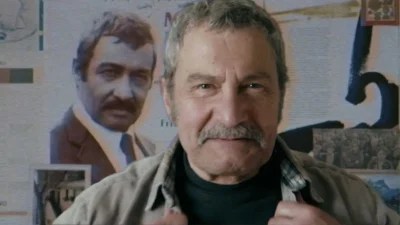
In 2007, Michael Parenti Called Out The Greater Israel Project
The Dissident | January 28, 2026
In my last article, I covered the left-wing scholar Michael Parenti- who passed away at the age of 92 this week- and his prophetic writings on the Ukraine proxy war in 2014.
Parenti’s writings on the Israel lobby and the greater Israel project were equally prophetic.
In his 2007 book “Contrary Notions” Parenti called out “Israel First” Neo-cons and Israel’s role in the Iraq war, and predicted to a tee the future Israeli/American wars in the Middle East in service of Greater Israel and the ethnic cleansing of Palestine.
In a section of the book aptly titled “Israel First”, Parenti wrote… continue
Blog Roll
Recent Comments
loongtip on Hamas never agreed to lay down… eddieb on Conspiracy Denial eddieb on WEF Calls for ‘Cultural Revolu… loongtip on Trump wanted to play peacemake… Coronistan on EU member to sue bloc over ‘su… loongtip on Vicious loongtip on EU turns to India for defense… Coronistan on Donald Trump Is No Peace … seversonebcfb985d9 on French court jails pro-Palesti… eddieb on Fourteen Incredible Facts Abou… Bill Francis on European leaders’ shift in the… seversonebcfb985d9 on Villains of Judea: Philip Esfo…


 Aletho News
- In 2007, Michael Parenti Called Out The Greater Israel Project
- Hamas never agreed to lay down arms in truce talks: Official
- Iran, China and Russia sign trilateral strategic pact
- After Years Of Denial, The IDF Admits The Gaza Health Ministry’s Numbers Are Accurate
- Riyadh and Hezbollah: A rapprochement forged in fire
- Criminal Conspiracy: How the U.S. and Israel Turned Iran into a Proving Ground for Bloody Experiments
- EU labels Iran’s Revolutionary Guard ‘terrorist organization’
- Security Guarantees Supported by Russia Agreed on in Istanbul in 2022 – Lavrov
- Russian oil major agrees sale of foreign assets to US firm
- European Union Sanctions Russian Journalists and Artists
- If Americans Knew
- Playful Post on Tel Aviv Park Omits That It Was Built on Ruins of Palestinian Neighborhood
- Palestinian developer gains massive user support for app challenging censorship claims criticising US and Israel after losing over 60 relatives in Gaza
- Gaza’s ‘Board of Peace’ – A New Phase of Palestinian Dispossession and Genocide
- Mike Huckabee is interfering with the work and witness of churches in the Holy Land with a goal of silencing Palestinian Christians
- “Hey ChatGPT, is Israel building a concentration camp?” (spoiler: yes) – Not a ceasefire Day 111
- “The Gaza ceasefire is a minefield” – Not a ceasefire Day 110
- Israel to seek new security deal from US, official says
- Leaked “Board of Peace” Resolution Outlines U.S.-Led Plan to Rule Over Gaza
- Jonathan Greenblatt Rolls Out Plan to Activate Hispanic Evangelical Golems
- Violence against hundreds of Gazan remains to find one Israeli – Not a ceasefire Day 109
- No Tricks Zone
- 130 Years Later: The CO2 Greenhouse Effect Is Still Only An Imaginary-World Thought Experiment
- New Study Affirms Rising CO2’s Greening Impact Across India – A Region With No Net Warming In 75 Years
- Germany’s Natural Gas Crisis Escalates … One Storage Site Near Empty …Government Silent
- Polar Colding…Antarctica Saw Its Coldest October In 44 Years!
- New Study: Sea Levels Rose 20 Times The Modern Rate During The Roman Warm Period
- As German Gas Storage Dips Dangerously Low…Shortage Hardly Avoidable
- New Study: Brazil’s Relative Sea Level Was 2+ Meters Higher And SSTs 3-4°C Warmer 6000 Years Ago
- Philosopher Schopenhauer: Climate Science Certainty Stems From Stupidity, Ignorance
- New Study: Species Extinction Rates Declining Since 1980 – ‘Climate Change Is Not An Important Threat’
- Denmark Places Climate Protection Above Animal Welfare, Poisoning And Culling Cows
 Aletho News