Algerian parliament unanimously votes to support Palestine militarily
The Cradle | November 3, 2023
The Algerian parliament on 2 November unanimously voted to authorize President Abdelmadjid Tebboune to enter the Gaza-Israel war and throw his support behind Palestine.
The 100/100 vote came a day after the anniversary of Algeria’s war of liberation against French colonialism.
Algeria is the second Arab nation that looks to enter the war against Israel, following Yemen’s declaration of war just two days prior.
“We launched a large number of ballistic and cruise missiles and a large number of drones at various targets of the Zionist enemy in the Palestine Occupied Territories,” the spokesperson of the Yemeni armed forces, General Yahya Saree, said earlier this week. “We emphasize that this operation is the third operation in support of our oppressed brothers in Palestine.”
Saree then added that “the position of our Yemeni people towards the cause of Palestine is fixed and principled, and the Palestinian people have the full right to defend themselves and use their full rights.” “Our forces performed their duty in supporting Gaza and fired ballistic and cruise missiles at enemy targets in the Occupied Territories.”
Arab nations have recently been following suit in their support of the Palestinian piece; Kuwait has condemned the Israeli aggression, Bahrain has cut all diplomatic ties, and Jordan has recalled their ambassador to Israel.
Nations outside of West Asia who have voiced their support for Palestine include Cuba, Chile, Venezuela, Bolivia – who’ve cut diplomatic ties with Israel completely – Nicaragua, and others.
Qassem Soleimani in Venezuela: The lesser known motive behind his assassination
By Hasan Illaik | The Cradle | January 3, 2023
On 3 January 2020, the US military assassinated Iranian Major General Qassem Soleimani, the commander of the elite Quds Force in the Islamic Revolutionary Guard Corps (IRGC), along with his companion, the deputy head of Iraq’s Popular Mobilization Units, Abu Mahdi al-Muhandis.
Three years later, the motives for this decision – and its timing -are still being debated. The reasons for the US’s shock killing, however, may not be solely related to Soleimani’s role in regional conflicts, but could also arguably stem from his growing international clout.
Why was Soleimani assassinated?
Soleimani was reportedly responsible for leading Iran’s plan to surround Israel with an arc of missiles and precision drones in the West Asian region – from Lebanon to Syria, Iraq and Gaza, all the way to Yemen – which was viewed by Israeli officials as an existential threat to the Jewish state.
The US has long accused Soleimani of being behind much of the resistance it faced after invading Iraq in 2003, as well as allegedly ordering operations against US forces in the period leading up to his assassination.
The Quds Force commander – along with Muhandis – were critical in the Iraqi effort to defeat ISIS, outside of the control and agenda of the US and its regional allies, who often used the terrorist group to secure political and geographic gains.
Furthermore, the US held Iran, and by extension Soleimani, responsible for the Yemeni attack on Saudi Arabia’s Aramco oil facilities on 14 September, 2019. The Aramco attack was so massive that it disrupted half of Saudi oil production, and was the largest of its kind since former Iraqi President Saddam Hussein’s invasion of Kuwait in 1990.
A leader in the Resistance Axis
Soleimani was the “keyholder” in the Axis of Resistance, according to an Arab politician with strong ties to decision-making circles in both Washington and Riyadh.
“Hajj Qassem,” says the politician, was uniquely capable of making decisions and then implementing them, which is considered a “rare advantage” among leaders. He was able to achieve significant strategic results – rapidly – by moving freely and negotiating directly with various statesmen, militias, and political movements.
Examples of this are rife: The Quds Force commander persuaded Russian President Vladimir Putin in 2015 to intervene militarily in Syria, and organized the complex ‘frenemy’ relationship between Turkiye and Tehran through Turkish intelligence director Hakan Fidan.
Soleimani played a pivotal role in preventing the fall of Damascus, maintained and developed important links with Lebanese resistance movement Hezbollah in Beirut, led a region wide campaign to defeat ISIS, and successfully managed the delicate balances between various political components in Iraq. In Yemen, he was able to supply the Ansarallah movement with training and arms that arguably changed the course of the Saudi-led aggression.
Together or separately, the aforementioned points made him a desired target of assassination for both the US government and the security establishment in Israel.
A visit to Venezuela
There may, however, be additional factors that contributed to the US decision to assassinate Soleimani on 3 January, 2022. While some analysts cite, for instance, the storming of the 2019 US embassy in Baghdad by demonstrators three days before the extrajudicial killing, US decision makers were unlikely to have mobilized its assassins in reaction to this relatively benign incident.
More significant for them would have been Soleimani’s unannounced trip to Venezuela in 2019, which crossed Washington’s red lines within its own geographic sphere of influence.
His visit to the South American country was publicly revealed more than two years later by Venezuelan President Nicolas Maduro, during an interview with Al-Mayadeen in December 2021.
Maduro stated that Soleimani visited Caracas between March and April 2019, during which time the US launched a cyber and sabotage attack on Venezuela, resulting in widespread power outages. He glorified the Iranian general as a military hero who “combated terrorism and the brutal terrorist criminals who attacked the peoples of the Axis of resistance. He was a brave man.”
Although Maduro did not reveal the exact date of the visit, it can be assumed that it took place on 8 April, 2019, and that Soleimani came on board the first direct flight of the Iranian airline Mahan Air between Tehran and Caracas.
At that time, the US attack on Caracas was at its peak: Washington’s recognition of Juan Guaidó as president of Venezuela, comprehensive economic sanctions, and then, at the end of April, the organization of a coup attempt that succeeded only in securing the escape of US-backed opposition leader Leopoldo Lopez to the Spanish embassy.
Expanding military ties with Caracas
During Soleimani’s Caracas visit, military cooperation between Iran and Venezuela was likely a key topic of discussion. Prior to his visit, Maduro had announced the establishment of “People’s Defense Units,” or revolutionary militias, to maintain order in the face of US-backed coup attempts.
Both Iranian and Latin American sources confirm that Tehran had a role in organizing these militias. However, the most significant military cooperation between the two countries has been in the field of military industrialization.
Since the tenure of late, former President Hugo Chavez, Venezuela has been working on a project to manufacture drones. This was announced by Chavez on 13 June, 2012, noting that “We are doing this with the help of different countries including China, Russia, Iran, and other allied countries.”
A few months earlier, the commander of the US Army’s Southern Command SOUTHCOM (its assigned area of responsibility includes Central and South America), General Douglas Fries, spoke about the same project, downplaying its importance by claiming that Iran was building drones with “limited capabilities” in Venezuela for internal security purposes.
Developing drones
In fact, Iran, represented by Soleimani’s Quds Force, was busy increasing military cooperation with Venezuela by developing new generations of drones and providing Caracas with spare parts for its existing American-made aircrafts. Interestingly, the raising of the Iranian flag has become routine in the Venezuelan Air Force’s military ceremonies.
On 20 November, 2020, President Maduro delivered a speech announcing plans to produce different types of drones. Near him, on display, was a miniature model of a drone which appeared to be that of the Iranian “Muhajer 6” aircraft that entered service in Iran in 2018.
This issue was raised by then-Israeli Minister of Defense, Benny Gantz, while receiving the heads of American Jewish organizations in February 2022.
Soleimani’s legacy in Latin America
These developments were the direct result of Qassem Soleimani’s efforts. A Venezuelan official has confirmed to The Cradle that the country’s drone project was built with full Iranian support: from training engineers to setting up research and manufacturing centers, all the way to production.
In October 2019, the commander of US Southern Command, Navy Admiral Craig S. Faller, warned that Russia, China, Iran and Cuba were operating in varying capacities in SOUTHCOM’s area of responsibility. He noted, specifically, that Iran’s influence and presence is being felt in South America.
In March 2020, the US SOUTHCOM commander repeated the same warning, placing Iran at the “top of the list of countries” that have assisted Venezuela in skirting US sanctions.
The US has long viewed Latin America as its “backyard” and has sought to prevent the influence of rival or hostile powers in the region through its adherence to the Monroe Doctrine. The influence of Soleimani in the western hemisphere may have been viewed as a threat to US interests and a crossing of this “red line.”
His role in assisting Venezuela in developing military capabilities, including the production of drones, was seen in Washington as a qualitative leap in Iran’s foreign relations and was likely a factor in the decision to assassinate Soleimani.
Venezuela National Assembly votes out US-backed opposition leader
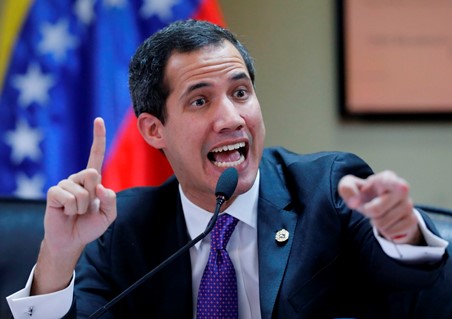
RT | December 31, 2022
Opposition lawmakers in Venezuela have voted to dissolve the ‘interim government’ formed under their one-time leader, Juan Guaido, a main rival to the country’s ruling socialist party and once a darling of the US foreign policy establishment.
Holding their vote over a Zoom call, the opposition-controlled National Assembly moved to reorganize their movement on Friday, with 72 lawmakers voting in favor of disbanding the legislature compared to just 29 opposed. Guaido’s term at the head of the assembly, as well as his ‘interim presidency’ declared in 2019 with the blessing of the US, are now set to end on January 5.
“Venezuela needs new machinery in this struggle,” lawmaker Juan Miguel Matheus of the opposition Justice First party said after the vote, adding that Guaido’s tenure as interim leader “was something that was supposed to be temporary, but it became something perpetual.”
Guaido and his supporters, meanwhile, have argued that dissolving the interim government could spell the demise of any unified opposition movement, insisting it will only bolster the power and influence of Maduro, who has been deemed an illegitimate leader by Washington and a long list of allies.
“This is not about defending Guaido. This is about not losing the important tools that we have in this struggle,” Guaido said.
The shake-up in the opposition leadership follows several years of failed efforts to oust Maduro from power, including a series of heated street protests and an outright coup attempt in 2019. While Guaido and fellow opposition leaders failed to inspire mass defections among the security forces as hoped, the ill-fated putsch enjoyed open support from US officials.
In addition to eliminating the temporary government, the assembly said it would establish a new committee to monitor the state assets it still controls, which includes a quantity of gold bullion stored at the Bank of England, as well as the American oil firm Citgo – even as it continues to be majority-owned by PDVSA, a state-controlled energy giant operated by President Maduro’s government in Caracas.
The National Assembly will also create a special panel to negotiate with Maduro, aiming to take part in another round of elections slated for 2024.
While opposition candidates were set to gain control over the legislature following elections in 2015, the results were later invalidated in the courts and the government opted to launch an entirely new body known as the National Constituent Assembly. Since then, Maduro’s opponents have effectively led a government-in-exile, with many lawmakers conducting official business from foreign countries.
US Treasury Authorizes Chevron’s Transactions With Venezuela
Samizdat – 26.11.2022
The US Treasury granted Chevron a general license allowing transactions by the California-based energy major that service oil production in Venezuela and its export to the United States.
Transactions performed by Chevron’s joint ventures with Venezuelan state oil giant PdVSA are authorized as long as they are related to “production and lifting of petroleum or petroleum products produced by the Chevron JVs.”
Sale to, exportation to, or importation into the US of petroleum produced by the Chevron JVs will be allowed as long as it is first sold to Chevron.
Joint ventures will also be allowed to buy and import petroleum production-related goods into Venezuela, including diluents, condensates, petroleum, or natural gas products.
The license does not authorize transactions if the oil is exported anywhere other than the US, payments of taxes or royalties to the Venezuelan government, or transactions involving entities linked to Russia, among other caveats.
The United States is also willing to provide targeted sanctions relief to Venezuela in order to encourage negotiations between the Venezuelan government and the opposition, a senior US administration official said on Saturday.
“We have long made clear that we believe the best solution to Venezuela is a negotiated one between Venezuelans, and Venezuelan-led, and in order to encourage that… we are willing to provide targeted sanctions relief based on concrete steps that alleviate the suffering of Venezuelan people and bring them closer to a restoration of democracy through free and fair elections,” the US official said during a conference call.
Earlier this month, sources told Sputnik that the Biden administration is looking at Venezuela as an additional source for crude oil amid global energy market volatility, but has no intention of a blanket lifting of sanctions.
The US hopes to lower gasoline prices for US consumers following production cuts made by the Saudi-led OPEC+ group to stabilize the global market, the source said.
Iran bans imports of French cars unless damage redressed
Press TV – November 21, 2022
Iran has banned the imports of French cars until France’s automobile manufacturers, namely Renault, Peugeot and Citroen, compensate the damage caused by leaving the Islamic Republic.
The withdrawal imposed a lot of costs on Iran’s automobile and parts manufacturing industry and left many investments in ruins after the US imposed new sanctions in August 2018, targeting the Islamic Republic’s car industry, trade in gold and other precious metals, and purchases of US dollars.
Although the withdrawal forced Iranian manufacturers to pool their resources and produce locally-made cars, compensation for the damage caused by the pullout is a central demand.
The ban announced by Ministry of Industry, Mining and Trade spokesman Omid Qalibaf comes as Iran is reintroducing foreign car imports in order to both improve the pool of quality automobiles and meet consumer demand.
Iran prohibited the import of Western cars in 2017 to counter the impending reimposition of US sanctions. The idea was part of Tehran’s efforts to develop a “resistance economy” that could both serve Iranians’ demands for cars, lessen dependence on foreign technology, and potentially boost export revenue.
“Those in the process of importing cars are dealing with the related issues and are concluding their contracts one by one, with the first cars expected to enter the country with the conditions that have been announced to the importers.
“However, what is certain is that French cars will not find a way to our market for now, because French companies such as Renault and Peugeot do not have a good history during the time of sanctions, when they easily left our country despite having committed to joint ventures and investments,” Qalibaf said.
Before the sanctions, French carmaker PSA Group had signed a framework deal with Iranian counterpart SAIPA to produce and sell vehicles for its Citroen brand in the country.
Under the agreement, Citroen and its Iranian partner would invest 300 million euros ($330 million) over five years in manufacturing, research and development, with the first of three planned new Citroen models due to be launched in Iran in 2018.
PSA Group, the maker of Peugeot and Citroen cars, had finalized a similar production deal with major Iranian automaker Iran Khodro under a 50-50 joint venture to invest up to 400 million euros ($451 million).
Renault had signed a new joint venture deal that included an engineering and purchasing center to support the development of local suppliers as well as a plant with an initial production capacity of 150,000 vehicles a year.
“In the middle of the road, however, they left the Iranian automakers alone and caused a lot of damage to our country’s automobile industry,” Qalibaf said.
“As long as the French car manufacturers do not compensate for these damages, they will not have any share in the large car market of our country, and the import of any car from France will be prohibited,” he added.
The ban, however, will not include South Korea, Japan and other countries, because they were not involved in any joint projects with Iranian industrialists when the new sanctions were imposed, Qalibaf stated.
The auto industry forms the second biggest sub-sector of the economy behind oil, accounting for some 10 percent of the gross domestic product and 4 percent of employment.
When the former Trump administration reimposed sanctions on Iran in August 2018, it reserved Washington’s first hammer blow for the car industry to hurt as many Iranians as possible.
However, the US pressures forced domestic manufacturers to mobilize their resources to fulfill some of the tasks which were an exclusive competence of foreign companies.
Last week, Venezuelan Minister of Transport Ramón announced the shipment of 1,000 cars built in Iran to Venezuela, stating that they were among 80,000 requests registered for the products of an Iranian car manufacturer in his country.
“We have a very high demand for Iranian car products, where we were able to register about 80,000 requests in the first stage,” he said in Tehran where he was at the head of a large delegation.
With the exports, Iran is staking out a niche in South America’s automotive marketplace which has a lot of space for growth and expansion, given the uneasy relationship of some of the countries of the region with the United States.
It followed the Iran-Venezuela 2022 Expo Fair held on Sept. 14-18 in Caracas where President Maduro announced the assembly of four Iranian models at Venirauto car manufacturing plant, a joint venture between the Venezuelan government and Iran Khodro.
Venezuela Stops Oil Shipments To Europe As Alternatives To Russian Energy Dry Up
Tyler Durden | Zero Hedge | August 19, 2022
The writing is on the wall for Europe in terms of this coming winter – It’s going to get ugly. With natural gas imports from Russia cut by 80% through Nord Stream 1 along with the majority of oil shipments, the EU is going to be scrambling for whatever fuel sources they can find to supply electricity and heating through the coming winter. Two sources that were originally suggested as alternatives were Iran and Venezuela.
Increased Iranian oil and gas exports to the west are highly dependent on the tentative nuclear deal, but as Goldman Sachs recently suggested, such a deal is unlikely anytime soon as deadlines on proposals have not been met and the Israeli government calls for negotiators to ‘walk away.’
Venezuela had restarted shipments to Europe after 2 years of US sanctions under a deal that allows them to trade oil for debt relief. However, the country’s government has now suspended those shipments, saying it is no longer interested in oil-for-debt deals and instead wants refined fuels from Italian and Spanish producers in exchange for crude.
This might seem like a backwards exchange but Venezuela’s own refineries are struggling to remain in operation because of lack of investment and lack of repairs. Refined fuels would help them to get back on their feet in terms of energy and industry. Some of Venezuela’s own heavy oil operations require imported diluents in order to continue. The EU says it currently has no plans to lift restrictions on the oil-for-debt arrangement, which means Europe has now lost yet another energy source.
Sanctions on Venezuela along with declining investments have strangled their oil industry, with overall production dropping by 38% this July compared to a year ago. Joe Biden’s initial moves to reopen talks with Maduro triggered inflated hopes that Venezuelan oil would flow once again and offset tight global markets and rising prices. Europe in particular will soon be desperate for energy alternatives, which will probably result in a scouring of markets this autumn to meet bare minimum requirements for heating.
If this occurs and no regular sources of energy can be found to fill the void left by Russian sanctions, prices will rise precipitously in the EU. Not only that, but with European countries buying up energy supplies wherever they can find them, available sources will also shrink for every other nation including the US. Get ready for oil and energy prices to spike once again as winter’s chill returns.
US asks Argentina to confiscate aircraft linked to Iran
MEMO | August 3, 2022
The US Department of Justice said on Tuesday that it has asked the government in Buenos Aires for permission to seize an Iranian plane that was sold to new owners in Venezuela but is being held in Argentina on suspicion of being linked to international terrorist groups.
The unannounced arrival of the plane in Argentina on 8 June raised concerns within the Argentinian government about its relations with Iran, Venezuela and companies that the US has imposed sanctions on. The Justice Department said that the seizure request followed the disclosure of a warrant in the District Court for the District of Columbia dated 19 July to take the aircraft for violating export control laws.
According to the department, the US-made Boeing 747-300 is under sanctions because Iran’s Mahan Air sale to Emtrasur last year violated US export laws. Both companies are subject to US sanctions over their alleged cooperation with terrorist organisations.
Assistant Attorney General Matthew Olsen of the Justice Department’s National Security Division said that, “The department will not tolerate transactions that violate our sanctions and export laws.” Mahan Air faces sanctions for its ties to Iran’s Islamic Revolutionary Guard Corps’ Quds Force, which the US has listed as a terrorist organisation.
There were 14 Venezuelans and five Iranians travelling on the aircraft when it landed in Buenos Aires. Seven of the passengers are still being held by the Argentinian authorities.
Venezuelan ruling party leader accuses US of gas pipeline ‘sabotage’
Samizdat | July 19, 2022
CARACAS – The vice president of the ruling United Socialist Party of Venezuela (PSUV), Diosdado Cabello, accused the United States of “sabotage” at state-run Venezuelan oil facilities.
On Sunday, Venezuelan Petroleum Minister Tareck El Aissami said that a Petroleos de Venezuela (PDVSA) gas pipeline in the northern state of Monagas was attacked, which triggered a fire at one of its sites. In June, the country’s authorities said that there was an attempted sabotage at the El Palito refinery in the northern state of Carabobo, which could have caused “catastrophic damage” to these facilities. Additionally, a massive fire broke out at the Cardon refinery in the northern state of Falcon in May.
“This is part of the US imperialism policy: attacking oil facilities, sending mercenaries here, some of whom were detained, while others were convicted of coup attempt and murder in our country. These are US government envoys,” Cabello said at a press conference in Caracas on Monday.
The recent “sabotage” at the PDVSA pipeline shows that the US government does not stop in its goal to destabilize the situation in Venezuela, according to Cabello.
“Such events should teach us that imperialism does not rest, they would like to see us torn apart and begging for mercy. It will not happen because our nation is not used to it, our nation does not give up,” Cabello said, adding that the security authorities will take responsibility for any act of aggression in Venezuela.
Venezuelan President Nicolas Maduro had previously implicated Colombian President Ivan Duque in attacks on oil and electricity infrastructure of Venezuela.
Petro Government in Colombia Poised to Return Key ‘Stolen’ Asset to Venezuela
By José Luis Granados Ceja | Venezuelanalysis | July 11, 2022
Troubled agrochemical company Monómeros, a subsidiary of Venezuela’s state-owned Pequiven, could return to Venezuelan control, Colombian President-elect Gustavo Petro told local radio Tuesday.
The Colombia-based agrochemical producer is considered Venezuela’s second most important foreign-held asset. It came under the control of Venezuela’s hardline opposition in May 2019 alongside a number of other foreign assets following the recognition of Juan Guaidó as “interim president” by Washington and its allies as part of efforts to oust the Nicolás Maduro government.
Since being handed over to the opposition, Monómeros has been plagued by scandals and corruption allegations, which has severely impacted its productivity and has generated serious problems for Colombia’s rural producers.
Colombian Senator Luis Fernando Velasco Chaves, a member of Petro’s transition team managing the Presidential Administrative Office file, reiterated concerns about the management of the firm following a meeting Tuesday with officials from the government of outgoing president President Ivan Duque.
“I am very concerned that Monómeros is still in the hands of Guaidó, Monómeros in the hands of Guaidó was a disaster, it disappeared,” said Velasco.
The senator also ridiculed Guaidó’s management of Monómeros, saying the incoming government could not negotiate with “ghosts that do not exist”.
The agrochemical enterprise, which has two main plants, played a major role in Colombia’s food chain, previously supplying nearly half of the fertilizers and 70 percent of the agrochemicals used by coffee, potato and palm oil production, according to local sources.
“Please look at what is happening to us, ask our peasants, ask our farmers, we are not producing and we are paying three times the [previous] cost of supplies,” said Velasco.
Mismanagement and infighting by the Venezuelan opposition eventually led Colombia’s Corporation Superintendency to assume control of Monómeros. Colombian law allows the corporate watchdog to employ such a process when an enterprise is in a critical “judicial, accounting, economic or administrative” situation.
The Maduro government called the superintendency’s takeover a “flagrant theft” of Venezuela’s assets and demanded they be returned to its rightful owner, the state-owned petrochemical company Pequiven. Maduro has said that Venezuela was engaged in “permanent diplomatic, political and legal activity” to recover the country’s foreign assets and the government has made the return of seized foreign assets a condition of a return to talks with the opposition.
The agrochemical producer did not fare much better under control by Colombian officials, with Petro claiming the company was driven into the ground, leading to a sharp increase in costs for Colombia’s agricultural sector.
“The company ended up practically closing its operations and lost the market it had in Colombia,” said the president-elect in a recent interview.
Monómeros faced yet another scandal after officials from the US Embassy to Venezuela revealed to Guaidó insider Enrique Sánchez Falcón that the company’s board had hired a lobbyist with ties to former US Ambassador to Venezuela Otto Reich without the knowledge or authorization of Guaidó’s team.
Sánchez Falcón told the outlet Efecto Cocuyo that the lobbyist was allegedly working to renew Monómeros’ sanctions waiver with the US Office of Foreign Assets Control (OFAC) but that the effort was “unnecessary” since the license was likely forthcoming anyway. Guaidó subsequently announced an investigation into the irregular hire of the lobbyist. The OFAC license was eventually renewed in late June.
The current leadership of the firm has apparently failed to even update officials from Guaidó’s team about the status of the Monómeros. Guaidó ally Yon Goicoechea said he believes the secrecy is tied to a hostile takeover effort. The US-backed “interim president” has pledged to overhaul the management of the corporation but the efforts have led to corruption accusations and further infighting amidst the opposition camp.
A press spokesperson from Guaidó’s office did not respond to a request for comment on the possible return of Monómeros to Venezuelan state management.
Outgoing Colombian President Iván Duque has steadfastly refused to return control of Monómeros to Venezuela, given that he does not recognize Maduro as president.
Duque recently said that he would also decline to extend an invitation to Maduro for Petro’s inauguration. The president-elect has said invitations are the purview of the outgoing government but said Maduro’s attendance would be “prudent”.
Petro, who has committed to reestablishing diplomatic and economic ties between Colombia and Venezuela, takes office on August 9.
Edited by Ricardo Vaz in Mérida.
Featured Video
Jeffrey Epstein’s ‘one single cause’: Israel
or go to
Aletho News Archives – Video-Images
Book Excerpt
Leslie Wexner’s Inner Demon
BY WHITNEY WEBB |
UNLIMITED HANGOUT| JUNE 10, 2022
This short excerpt from Whitney Webb’s upcoming book “One Nation Under Blackmail” examines an obscure media profile of Leslie Wexner, Jeffrey Epstein’s mentor, from the 1980s that contains disconcerting revelations about Wexner’s personality and his inner world. … continue
Blog Roll
Recent Comments
Coronistan on Why can’t western leaders acce… John Edward Kendrick on German government ‘embezzling’… loongtip on Von der Leyen to have new secu… papasha408 on First Gaza, then the world: Th… papasha408 on Is Nixing Aid to Israel a Pois… papasha408 on Japan to Sign Up For NATO’s Uk… Redracam on Iran Willing to Dilute Enriche… loongtip on When Threats Replace Evid… loongtip on Zelensky tried to kill the cha… eddieb on I might get killed for posting… Bill Francis on I might get killed for posting… loongtip on Beijing cancels Panama deals a…


 Aletho News
- Germany demands UN Rapporteur Albanese resign, joining France
- Hamas official says Netanyahu joining ‘peace council’ is a farce
- Israel Demanding that Iran Limit the Range of Missiles to 300 Kilometers
- Why can’t western leaders accept that they have failed in Ukraine?
- German government ‘embezzling’ taxpayer money to fund Ukraine – veteran politician
- Russian Soldiers Tortured in Secret Ukrainian Prisons
- Tensions between Hungary and Ukraine could lead to a new regional conflict
- Russia preparing oil lifeline to Cuba – embassy
- Jeffrey Epstein’s ‘one single cause’: Israel
- Instagram suspends Track AIPAC, watchdog tracking pro-Israel lobby spending
- If Americans Knew
- AZAPAC, the new PAC opposing Israeli domination of U.S policies
- Haim Saban: Billionaire for Israel
- Rafah e-wallet plan highlights Israel’s deepening financial occupation
- Viral post claims Netanyahu sought legal approval, igniting speculation about Israel’s organ harvesting
- AIPAC Has a New Opponent: PAL PAC
- Right-Wing Catholic Off Trump Religion Panel After Israel-Gaza Remarks at Antisemitism Event
- Jewish terrorism, apartheid rule the West Bank – Not a ceasefire Day 125
- Why Israel persecutes children like my son Shadi
- In Gaza, One Man Is Searching for the Remains of His Family With a Flour Sifter
- Horrific situation in Gaza, West Bank – Not a ceasefire Day 124
- No Tricks Zone
- German Gas Crisis…Chancellor Merz Allegedly Bans Gas Debate Ahead of Elections!
- Pollen Reconstructions Show The Last Glacial’s Warming Events Were Global, 10x Greater Than Modern
- Germany’s Natural Gas Storage Level Dwindles To Just 28%… Increasingly Critical
- New Study Rebuts The Assumption That Anthropogenic CO2 Molecules Have ‘Special’ Properties
- Climate Scientist Who Predicted End Of “Heavy Frost And Snow” Now Refuses Media Inquiries
- Polar Bear Numbers Rising And Health Improving In Areas With The Most Rapid Sea Ice Decline
- One Reason Only For Germany’s Heating Gas Crisis: Its Hardcore-Dumbass Energy Policy
- 130 Years Later: The CO2 Greenhouse Effect Is Still Only An Imaginary-World Thought Experiment
- New Study Affirms Rising CO2’s Greening Impact Across India – A Region With No Net Warming In 75 Years
- Germany’s Natural Gas Crisis Escalates … One Storage Site Near Empty …Government Silent
 Aletho News