Venezuela, Guyana to hold talks on disputed Essequibo region
RT | December 10, 2023
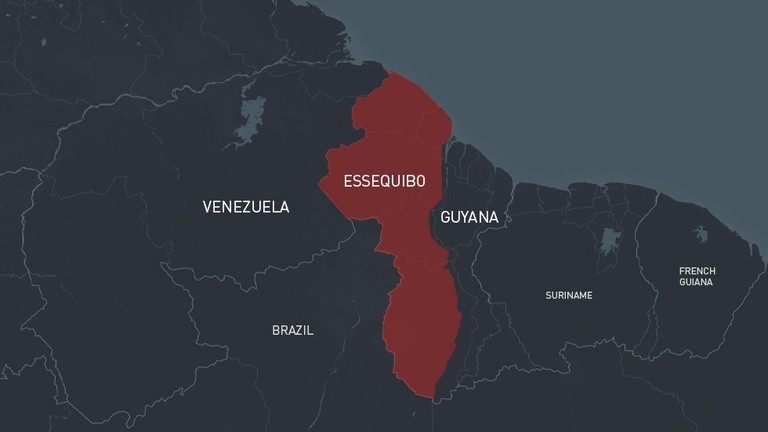
The presidents of Venezuela and Guyana – Nicolas Maduro and Mohamed Irfaan Ali, respectively – will sit down next week to discuss a long-standing territorial dispute that has recently intensified, the prime minister of Saint Vincent and the Grenadines has revealed. While Caracas has laid claim to the oil-rich Esequibo region since the late 19th century, President Maduro recently took steps toward gaining actual control over the area, which covers some 160,000 square kilometers.
Earlier this week, the Spanish daily El Pais reported that the Venezuelan government had deployed troops to the border with Guyana.
Saint Vincent and the Grenadines PM Ralph Gonsalves, who also serves as president pro tempore of the Community of Latin American and Caribbean States (CELAC), broke the news after speaking with Maduro on Saturday, saying the negotiations would take place on Thursday.
The Venezuelan government has confirmed the planned talks, saying they hoped to “preserve our aspiration to maintain Latin America and the Caribbean as a zone of peace.”
The Office of the President of Guyana, for its part, stressed that “Guyana’s land boundary is not up for discussion.”
Also on Saturday, Brazilian President Luiz Inacio Lula da Silva spoke with Maduro, calling for dialogue and warning against unilateral measures that could escalate the situation. The Brazilian head of state has also been invited to take part in Thursday’s talks as an observer.
Speaking on Tuesday, the Venezuelan president said Caracas wanted the “peaceful rescue of the Guayana Esequiba,” which “has been de facto occupied by the British Empire and its heirs and they have destroyed the area.” Maduro also unveiled a new map of Venezuela that incorporates the disputed territory, and appointed a new governor to the region.
Guyanese President Irfaan Ali, in turn, gave a televised address to the nation, accusing Venezuela of attempting to annex more than two thirds of his country.
“This is a direct threat to Guyana’s territorial integrity, sovereignty, and political independence, and a violation of fundamental principles of international law,” the leader stressed.
“The Guyana Defense Force is on high alert… Venezuela has clearly declared itself an outlaw nation,” Ali added.
The recent escalation followed Sunday’s referendum, in which 10.4 million Venezuelan voters backed Caracas’ claim to Guayana Esequiba.
The territorial dispute stems from the US’ decision in 1899 to assign the territory to what was then British Guiana – a move Venezuela never accepted as legitimate.
Guyanese military helicopter missing near Venezuelan border
The Defense Forces personnel aboard the lost chopper had been sent to inspect the area amid rising tensions with Caracas
RT | December 7, 2023
A military helicopter with five senior Guyanese officers and two soldiers onboard vanished in stormy weather on Wednesday near Guyana’s contested border with Venezuela.
Rescue operations had to be called off due to adverse weather conditions, according to Guyana Defense Forces (GDF) Chief of Staff Brigadier Oman Khan. The helicopter sent out an emergency signal shortly after refueling. The signal may have been triggered by the crew and may suggest a crash landing, he added.
The suspected crash happened as border tensions between Guyana and Venezuela are on the rise.
The territory, which Guyana refers to as Essequibo, has been disputed by the two countries since the 19th century.
In 1899, the US stepped in to arbitrate the dispute, and, invoking the Monroe Doctrine, assigned the territory to British Guyana, at the time a colony.
Venezuela never accepted the decision as legitimate, and the dispute was referred to the International Court of Justice (ICJ) in 2018.
After a referendum on Sunday about incorporating the territory as a new state in Venezuela, President Nicolas Maduro has unveiled a new map with the area, dubbed Guyana Essequiba, now shown as part of the country.
Guyanese President Irfaan Ali replied that Maduro was displaying “blatant disregard” for the ICJ, which forbade Caracas from disturbing the status quo in the region.
The dispute is further exacerbated by the recently discovered oil reserves in the waters off the coast of the Atlantic, which both countries claim.
Maduro warned that foreign companies exploiting resources in the region without permission from Caracas have three months to “comply with the law.”
Caracas has since mobilized troops and sent them to the Guyanese border in preparation for claiming the 160,000 square-km territory.
Venezuelan Authorities Coordinate Actions for Guayana Esequiba
teleSUR – December 7, 2023
On Wednesday, the Venezuelan Defense Minister Vladimir Padrino met with Alexis Rodriguez Cabello, the temporary sole authority of the state of Guayana Esequiba, to coordinate actions aimed at ensuring security in the new Venezuelan state.
“We are gathered with Major General Alexis Rodriguez Cabello, making tangible the mandate of the people for the defense of our territorial integrity. The Esequibo is ours!” Padrino said.
“Through collaborative work, the sole authority and the Bolivarian National Armed Forces will deploy all their logistical and human potential in the sector,” he added.
“We are already coordinating to promptly fulfill the mandate of the people with all the social policies towards the territory of Guayana Esequiba. There is no rest, no break, and we work for our Esequibo.”
Vice President Delcy Rodriguez, “The Venezuelan people gave an unequivocal mandate for President Nicolas Maduro to present the rescue plan for our Guayana Esequiba. The voice of the people will be heard and respected! Guyana must abide by international law instead of threaten us with the imperial hegemons. The sun of Venezuela rises in the Essequibo!”
Previously, on Tuesday, Venezuelan President Nicolas Maduro appointed Rodriguez Cabello as the temporary sole authority of the state of Guayana Esequiba.
Provisionally, his operations center and a Comprehensive Defense Zone (ZODI) will be established in Tumeremo, in the state of Bolivar, near the Guayana Esequiba.
On Wednesday, the National Assembly unanimously approved the Defense of Guayana Esequiba Bill. Presented by President Maduro, this project is aimed at advancing the creation of the state of Guayana Esequiba, which was approved in the referendum held on December 3.
Steps to Be Taken in New Phase of Defense of Guyana Essequiba
teleSUR | December 5, 2023
Venezuelan President Nicolás Maduro announced on Tuesday a set of actions to be taken by the Government to implement the result of the referendum, that is, the will of the Venezuelan people.
Following are the seven actions for the new phase in the defense of Guyana Essequiba:
1. Creation of a new High Commission for the Defense of Guyana Esequiba, coordinated by Vice President Delcy Rodriguez.
2. Immediately activate the debate in the NA for the approval of the Organic Law for the defense of the Essequiba Guyana.
3. Create the Zone of Integral Defense of the Guayana Esequiba with 3 areas and 28 sectors of integral development, to be located in Tumeremo.
4. Designate MG Alexis Rodríguez Cabello as Sole Authority of the Guayana Esequiba whose political and administrative headquarters will be located in Tumeremo.
5. To create the divisions of PDVSA Esequibo and CVG Esequibo for the exploration and exploitation of gas, oil and mining.
6. To publish and disseminate in schools, high schools and universities of the country the new Map of Venezuela that includes the Guayana Esequiba.
7. Activate an Integral Social Attention Plan for the entire population of Guayana Esequiba that includes a Census and the opening of a Saime office for the delivery of identification cards to the population based in Tumeremo.
Venezuela Rejects Statements by the President of Guyana
teleSUR | December 6, 2023
On Wednesday, the Venezuelan Ministry of Foreign Affairs responded to the statements made by Guyana’s President Irfaan Ali regarding the Essequibo region. The text of the Venezuelan response is presented below:
“The Bolivarian Republic of Venezuela condemns the recent statements made by President Irfaan Ali, who, in a reckless manner, has given the green light to the presence of the United States Southern Command in the territory of the Guayana Esequiba region, over which Guyana maintains a de facto occupation and a territorial dispute with Venezuela.
This dispute is meant to be resolved through the 1966 Geneva Agreement, the only valid legal instrument between the parties.
Venezuela denounces, before the international community, and especially before the Community of Latin American and Caribbean States (CELAC), the imprudent attitude of Guyana.
Acting under the mandate of the U.S. transnational Exxon Mobil, Guyana is opening the possibility of establishing military bases for an imperial power, thereby threatening the Zone of Peace outlined in this region.
The Cooperative Republic of Guyana recklessly violates international law, taking actions that exacerbate the territorial dispute and add to its illegal conduct of granting oil exploitation rights to Exxon Mobil over a sea area pending delimitation with Venezuela.
The Bolivarian Republic of Venezuela, true to its doctrine of Bolivarian Diplomacy for Peace, urges the Government of Guyana to abandon its erratic, threatening, and risky behavior and to resume the path of direct dialogue through the Geneva Agreement.”
Algerian parliament unanimously votes to support Palestine militarily
The Cradle | November 3, 2023
The Algerian parliament on 2 November unanimously voted to authorize President Abdelmadjid Tebboune to enter the Gaza-Israel war and throw his support behind Palestine.
The 100/100 vote came a day after the anniversary of Algeria’s war of liberation against French colonialism.
Algeria is the second Arab nation that looks to enter the war against Israel, following Yemen’s declaration of war just two days prior.
“We launched a large number of ballistic and cruise missiles and a large number of drones at various targets of the Zionist enemy in the Palestine Occupied Territories,” the spokesperson of the Yemeni armed forces, General Yahya Saree, said earlier this week. “We emphasize that this operation is the third operation in support of our oppressed brothers in Palestine.”
Saree then added that “the position of our Yemeni people towards the cause of Palestine is fixed and principled, and the Palestinian people have the full right to defend themselves and use their full rights.” “Our forces performed their duty in supporting Gaza and fired ballistic and cruise missiles at enemy targets in the Occupied Territories.”
Arab nations have recently been following suit in their support of the Palestinian piece; Kuwait has condemned the Israeli aggression, Bahrain has cut all diplomatic ties, and Jordan has recalled their ambassador to Israel.
Nations outside of West Asia who have voiced their support for Palestine include Cuba, Chile, Venezuela, Bolivia – who’ve cut diplomatic ties with Israel completely – Nicaragua, and others.
Qassem Soleimani in Venezuela: The lesser known motive behind his assassination
By Hasan Illaik | The Cradle | January 3, 2023
On 3 January 2020, the US military assassinated Iranian Major General Qassem Soleimani, the commander of the elite Quds Force in the Islamic Revolutionary Guard Corps (IRGC), along with his companion, the deputy head of Iraq’s Popular Mobilization Units, Abu Mahdi al-Muhandis.
Three years later, the motives for this decision – and its timing -are still being debated. The reasons for the US’s shock killing, however, may not be solely related to Soleimani’s role in regional conflicts, but could also arguably stem from his growing international clout.
Why was Soleimani assassinated?
Soleimani was reportedly responsible for leading Iran’s plan to surround Israel with an arc of missiles and precision drones in the West Asian region – from Lebanon to Syria, Iraq and Gaza, all the way to Yemen – which was viewed by Israeli officials as an existential threat to the Jewish state.
The US has long accused Soleimani of being behind much of the resistance it faced after invading Iraq in 2003, as well as allegedly ordering operations against US forces in the period leading up to his assassination.
The Quds Force commander – along with Muhandis – were critical in the Iraqi effort to defeat ISIS, outside of the control and agenda of the US and its regional allies, who often used the terrorist group to secure political and geographic gains.
Furthermore, the US held Iran, and by extension Soleimani, responsible for the Yemeni attack on Saudi Arabia’s Aramco oil facilities on 14 September, 2019. The Aramco attack was so massive that it disrupted half of Saudi oil production, and was the largest of its kind since former Iraqi President Saddam Hussein’s invasion of Kuwait in 1990.
A leader in the Resistance Axis
Soleimani was the “keyholder” in the Axis of Resistance, according to an Arab politician with strong ties to decision-making circles in both Washington and Riyadh.
“Hajj Qassem,” says the politician, was uniquely capable of making decisions and then implementing them, which is considered a “rare advantage” among leaders. He was able to achieve significant strategic results – rapidly – by moving freely and negotiating directly with various statesmen, militias, and political movements.
Examples of this are rife: The Quds Force commander persuaded Russian President Vladimir Putin in 2015 to intervene militarily in Syria, and organized the complex ‘frenemy’ relationship between Turkiye and Tehran through Turkish intelligence director Hakan Fidan.
Soleimani played a pivotal role in preventing the fall of Damascus, maintained and developed important links with Lebanese resistance movement Hezbollah in Beirut, led a region wide campaign to defeat ISIS, and successfully managed the delicate balances between various political components in Iraq. In Yemen, he was able to supply the Ansarallah movement with training and arms that arguably changed the course of the Saudi-led aggression.
Together or separately, the aforementioned points made him a desired target of assassination for both the US government and the security establishment in Israel.
A visit to Venezuela
There may, however, be additional factors that contributed to the US decision to assassinate Soleimani on 3 January, 2022. While some analysts cite, for instance, the storming of the 2019 US embassy in Baghdad by demonstrators three days before the extrajudicial killing, US decision makers were unlikely to have mobilized its assassins in reaction to this relatively benign incident.
More significant for them would have been Soleimani’s unannounced trip to Venezuela in 2019, which crossed Washington’s red lines within its own geographic sphere of influence.
His visit to the South American country was publicly revealed more than two years later by Venezuelan President Nicolas Maduro, during an interview with Al-Mayadeen in December 2021.
Maduro stated that Soleimani visited Caracas between March and April 2019, during which time the US launched a cyber and sabotage attack on Venezuela, resulting in widespread power outages. He glorified the Iranian general as a military hero who “combated terrorism and the brutal terrorist criminals who attacked the peoples of the Axis of resistance. He was a brave man.”
Although Maduro did not reveal the exact date of the visit, it can be assumed that it took place on 8 April, 2019, and that Soleimani came on board the first direct flight of the Iranian airline Mahan Air between Tehran and Caracas.
At that time, the US attack on Caracas was at its peak: Washington’s recognition of Juan Guaidó as president of Venezuela, comprehensive economic sanctions, and then, at the end of April, the organization of a coup attempt that succeeded only in securing the escape of US-backed opposition leader Leopoldo Lopez to the Spanish embassy.
Expanding military ties with Caracas
During Soleimani’s Caracas visit, military cooperation between Iran and Venezuela was likely a key topic of discussion. Prior to his visit, Maduro had announced the establishment of “People’s Defense Units,” or revolutionary militias, to maintain order in the face of US-backed coup attempts.
Both Iranian and Latin American sources confirm that Tehran had a role in organizing these militias. However, the most significant military cooperation between the two countries has been in the field of military industrialization.
Since the tenure of late, former President Hugo Chavez, Venezuela has been working on a project to manufacture drones. This was announced by Chavez on 13 June, 2012, noting that “We are doing this with the help of different countries including China, Russia, Iran, and other allied countries.”
A few months earlier, the commander of the US Army’s Southern Command SOUTHCOM (its assigned area of responsibility includes Central and South America), General Douglas Fries, spoke about the same project, downplaying its importance by claiming that Iran was building drones with “limited capabilities” in Venezuela for internal security purposes.
Developing drones
In fact, Iran, represented by Soleimani’s Quds Force, was busy increasing military cooperation with Venezuela by developing new generations of drones and providing Caracas with spare parts for its existing American-made aircrafts. Interestingly, the raising of the Iranian flag has become routine in the Venezuelan Air Force’s military ceremonies.
On 20 November, 2020, President Maduro delivered a speech announcing plans to produce different types of drones. Near him, on display, was a miniature model of a drone which appeared to be that of the Iranian “Muhajer 6” aircraft that entered service in Iran in 2018.
This issue was raised by then-Israeli Minister of Defense, Benny Gantz, while receiving the heads of American Jewish organizations in February 2022.
Soleimani’s legacy in Latin America
These developments were the direct result of Qassem Soleimani’s efforts. A Venezuelan official has confirmed to The Cradle that the country’s drone project was built with full Iranian support: from training engineers to setting up research and manufacturing centers, all the way to production.
In October 2019, the commander of US Southern Command, Navy Admiral Craig S. Faller, warned that Russia, China, Iran and Cuba were operating in varying capacities in SOUTHCOM’s area of responsibility. He noted, specifically, that Iran’s influence and presence is being felt in South America.
In March 2020, the US SOUTHCOM commander repeated the same warning, placing Iran at the “top of the list of countries” that have assisted Venezuela in skirting US sanctions.
The US has long viewed Latin America as its “backyard” and has sought to prevent the influence of rival or hostile powers in the region through its adherence to the Monroe Doctrine. The influence of Soleimani in the western hemisphere may have been viewed as a threat to US interests and a crossing of this “red line.”
His role in assisting Venezuela in developing military capabilities, including the production of drones, was seen in Washington as a qualitative leap in Iran’s foreign relations and was likely a factor in the decision to assassinate Soleimani.
Venezuela National Assembly votes out US-backed opposition leader
RT | December 31, 2022
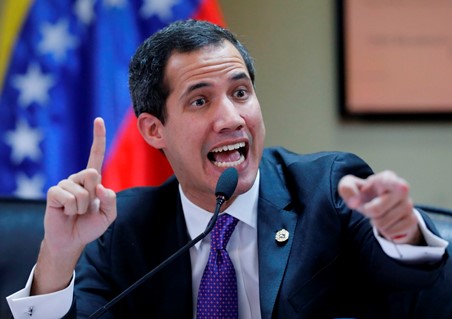
Opposition lawmakers in Venezuela have voted to dissolve the ‘interim government’ formed under their one-time leader, Juan Guaido, a main rival to the country’s ruling socialist party and once a darling of the US foreign policy establishment.
Holding their vote over a Zoom call, the opposition-controlled National Assembly moved to reorganize their movement on Friday, with 72 lawmakers voting in favor of disbanding the legislature compared to just 29 opposed. Guaido’s term at the head of the assembly, as well as his ‘interim presidency’ declared in 2019 with the blessing of the US, are now set to end on January 5.
“Venezuela needs new machinery in this struggle,” lawmaker Juan Miguel Matheus of the opposition Justice First party said after the vote, adding that Guaido’s tenure as interim leader “was something that was supposed to be temporary, but it became something perpetual.”
Guaido and his supporters, meanwhile, have argued that dissolving the interim government could spell the demise of any unified opposition movement, insisting it will only bolster the power and influence of Maduro, who has been deemed an illegitimate leader by Washington and a long list of allies.
“This is not about defending Guaido. This is about not losing the important tools that we have in this struggle,” Guaido said.
The shake-up in the opposition leadership follows several years of failed efforts to oust Maduro from power, including a series of heated street protests and an outright coup attempt in 2019. While Guaido and fellow opposition leaders failed to inspire mass defections among the security forces as hoped, the ill-fated putsch enjoyed open support from US officials.
In addition to eliminating the temporary government, the assembly said it would establish a new committee to monitor the state assets it still controls, which includes a quantity of gold bullion stored at the Bank of England, as well as the American oil firm Citgo – even as it continues to be majority-owned by PDVSA, a state-controlled energy giant operated by President Maduro’s government in Caracas.
The National Assembly will also create a special panel to negotiate with Maduro, aiming to take part in another round of elections slated for 2024.
While opposition candidates were set to gain control over the legislature following elections in 2015, the results were later invalidated in the courts and the government opted to launch an entirely new body known as the National Constituent Assembly. Since then, Maduro’s opponents have effectively led a government-in-exile, with many lawmakers conducting official business from foreign countries.
US Treasury Authorizes Chevron’s Transactions With Venezuela
Samizdat – 26.11.2022
The US Treasury granted Chevron a general license allowing transactions by the California-based energy major that service oil production in Venezuela and its export to the United States.
Transactions performed by Chevron’s joint ventures with Venezuelan state oil giant PdVSA are authorized as long as they are related to “production and lifting of petroleum or petroleum products produced by the Chevron JVs.”
Sale to, exportation to, or importation into the US of petroleum produced by the Chevron JVs will be allowed as long as it is first sold to Chevron.
Joint ventures will also be allowed to buy and import petroleum production-related goods into Venezuela, including diluents, condensates, petroleum, or natural gas products.
The license does not authorize transactions if the oil is exported anywhere other than the US, payments of taxes or royalties to the Venezuelan government, or transactions involving entities linked to Russia, among other caveats.
The United States is also willing to provide targeted sanctions relief to Venezuela in order to encourage negotiations between the Venezuelan government and the opposition, a senior US administration official said on Saturday.
“We have long made clear that we believe the best solution to Venezuela is a negotiated one between Venezuelans, and Venezuelan-led, and in order to encourage that… we are willing to provide targeted sanctions relief based on concrete steps that alleviate the suffering of Venezuelan people and bring them closer to a restoration of democracy through free and fair elections,” the US official said during a conference call.
Earlier this month, sources told Sputnik that the Biden administration is looking at Venezuela as an additional source for crude oil amid global energy market volatility, but has no intention of a blanket lifting of sanctions.
The US hopes to lower gasoline prices for US consumers following production cuts made by the Saudi-led OPEC+ group to stabilize the global market, the source said.
Featured Video
Racist Seinfeld Dances for Joy as Bibi Unveils His New Map
or go to
Aletho News Archives – Video-Images
TV Drama Review
Japanese drama projects Japan’s wartime atrocities onto Chinese characters

Global Times | October 25, 2026
By portraying Chinese characters as perpetrators of ruthless violence while casting Japanese Self-Defense Forces (SDF) intelligence operatives as defenders, the season 2 of the Japanese drama Vivant has recently drawn criticism from Chinese netizens, who argue that its depiction turns historical reality on its head while ignoring Japan’s wartime atrocities.
The TBS drama series – a spy suspense story in which an alleged unofficial intelligence unit of the SDF operates across the globe — has attracted a passionate fanbase. Its currently airing season 2 opened with a household rating of 18.8 percent, the highest for a TV drama this year, according toa commentary article by Japanese media Toyo Keizai.
What draws attention is the portrayal of the enemies in the series, the article noted. Scenes in which the Chinese organization subjects kidnapped members of the SDF unit to brutal torture are repeated with unrelenting intensity.
It is rare for Japanese TV dramas to explicitly portray a real-life country as the enemy, the article noted.
Japanese Prime Minister Sanae Takaichi also made a reference to the drama, saying that she has been recording Vivant and hopes to binge-watch it over the year-end and New Year holidays, according to Japanese media outlets.
China’s CCTV News report on Sunday revealed that the drama features scenes in which Chinese personnel cut off the fingers of and stab Japanese intelligence operatives in the abdomen. Such acts bear striking similarities to the torture inflicted on Chinese nationals by invading Japanese troops during the World War II.
The drama distorts the truth by attributing these atrocities to modern Chinese characters. Beneath the surface, it subtly glorifies Japan’s cross-border overseas operations, blurs the functional boundaries of the SDF and implicitly promotes an expansionist narrative, per CCTV News. … continue
Blog Roll
 Aletho News
- EU facing trillion-euro debt hole while seeking more cash for Kiev
- How US, Europe, Persian Gulf states exhausted missile stockpiles, splurged billions to defend Israel
- Up in arms… Koreans reject U.S. empire’s plan to make South Korea the next Ukraine
- Iran, Turkey, Pakistan, Saudi Arabia could advance region-led security framework in Tehran: FM spox
- Netizens condemn Japanese drama for projecting Japan’s wartime atrocities onto Chinese characters
- Racist Seinfeld Dances for Joy as Bibi Unveils His New Map
- A West Bank War for Netanyahu’s Election Campaign, Could It Backfire?
- Yemen denounces European Parliament’s ‘hypocritical’ push to blacklist Ansarullah
- Qalibaf: UAE’s UN bid aims to ‘clear the runway’ for ‘Greater Israel’, whitewash genocide
- Pakistan reopens Iran border after boosting security: Report
- If Americans Knew
- An error has occurred; the feed is probably down. Try again later.
- No Tricks Zone
- Sudden Stratospheric Warming, Powerful El Niño Combination May Lead To Extreme Europe Cold, Energy Crisis!
- Two New Studies Find Thwaites Glacier Melt Cannot Be Driven By Human Activity Or A Warming Ocean
- E-Cars Reduce CO2 Emissions By Only 41% Compared To Internal Combustion Engine Vehicles
- Predictions Made By Renowned Climate Professor Over Past Decades Have Been Proven To Be Poor
- New Study Suggests Large Regions Of The Pacific Ocean Have Been Cooling For The Last 80 Years
- Germany’s Green Energy Debacle: High Energy Costs Force Kahla Porzellan to Close After 182 Years!
- New Study: 50 Years Of The Most Aggressive ‘Net Zero’ Policies Can Only Affect The Global Climate By 0.03°C
- US September “Heat” Was No Record…Many Records Set Decades Ago
- Latest European Green Energy Debacle; Portugal’s Largest Flagship Solar Park Insolvent!
- Green Energy Debacle: German Expert Professor Fritz Vahrenholt Warns Of Severe Economic And Social Consequences

