‘A Complete Failure’: Venezuelan Coup Attempts Staged ‘More For The US Audience’
Sputnik – May 2, 2019
Juan Guaido’s third attempted coup against Venezuelan President Nicolas Maduro has failed just like the rest, but that hasn’t stopped the US corporate media from turning it into a heroic mass uprising for Americans to see. An activist told Sputnik the coverage is setting the stage for a war, but that both Americans and Venezuelans would resist it.
Guaido has claimed since January 23 to be Venezuela’s interim president, calling Maduro’s May 2018 reelection illegitimate. However, despite three attempts to divide the military ranks and raise a revolution in the country, Guaido’s opposition remains a small force that’s only proven capable of causing violence and chaos, not of grasping the hearts and minds of fellow Venezuelans.
Meanwhile, Washington officials continue to raise the specter of military force against Maduro’s government, which is still recognized by three-quarters of the globe’s countries as the legitimate government of Venezuela.
Radio Sputnik’s Loud and Clear discussed the situation with Gerry Condon, a Vietnam-era US veteran and peace resistor who is now the national president of Veterans for Peace and who recently returned from Venezuela; and Paul Dobson, a writer for VenezuelAnalysis.com, who reported from the Venezuelan city of Merida.
Dobson said the country Thursday seemed “relatively calm and stable” by comparison to earlier in the week.
“The events of Tuesday were to some extent, we can say, exaggerated by the international press,” Dobson noted. “There was definitely an attempted coup d’etat, but the extent to which Juan Guaido’s looking to grasp power was a lot weaker than he was perceived in the international corporate press.”
“Juan Guaido came out about five o’clock in the morning on Tuesday with a video message to his supporters saying he was taking a military base in Caracas with the support of ‘the main military units of the country.’ Both of these statements were later proven to be incorrect: he was outside the military base, not inside of the military base, and he had control of roughly 30 soldiers, of which about 25 were there, who later claimed they were tricked, according to their commanders. He later rejected their participation in this, and only 15 soldiers were left, essentially, on the side of Juan Guaido,” Dobson said.
“Thereafter, we saw significant civilian demonstrations across the country, principally in Caracas, but in other cities as well,” the writer told Sputnik. “We saw attempts by Juan Guaido’s supporters to both pressure through peaceful means but also violence the local military commanders to rebel against their chain of command, all of which was unsuccessful. By the end of the day, we saw Juan Guaido’s mentor and main political ally, Leopoldo Lopez, flee to both the Chilean and then later Spanish Embassy, where he is still holed up, and Juan Guaido went on record by calling his people onto the streets and to continue his struggle on Wednesday.”
Video recorded Tuesday and broadcast on Venezuelan television showed Venezuelan army soldiers taking back armored cars seized by the opposition.
“So yesterday, May Day, the government, who had already planned a traditional May Day march for the workers, made a new call for the people to come onto the streets and defend the national territory from this attempted coup d’etat — and the people responded,” Dobson said. “The march seen in Caracas has been described by many analysts as one of the largest Chavista marches in recent years.”
Dobson noted the opposition also “held an activity in eastern Caracas” that was “considerably smaller” and turned violent in the evening hours amid confrontations with the police and national guard, resulting in one death.
“Juan Guaido is free, still roaming the streets, but it can only be considered a complete failure for him, both in terms of achieving his political objectives, but also any sort of projection of power or domination here in the country. He is looking weaker now than he ever has been in the past,” Dobson said.
Condon told Sputnik that during his trip to Venezuela just before the most recent coup attempt, there was “no visible support for the opposition whatsoever” in the large, poor, working class districts. “I doubt, frankly, that Juan Guaido would even dare set foot in those barrios. He’s not welcome there. There’s a huge class divide; the opposition is largely white, middle class, of course led by wealthy ultra-right [wing] oligarchs, and they have even attacked people of color at those opposition marches, because if you have dark skin, you’re assumed to be a Chavista — a supporter of the government.”
Calling the most recent coup attempt a “Hail Mary pass, a hope and a prayer,” Condon said it seemed “staged more for the US audience. The real coup took place in the media… consistently [in] all of the mainstream media, there’s not a single voice you hear on the media against the US intervention, against the regime change effort. So it’s, in a sense, quite a big propaganda coup in the US media, aimed at the US people, perhaps preparing the way for a US military intervention.”
The activist said Veterans for Peace was calling on US soldiers to “resist participation in any military action” in Venezuela, noting that he expected “massive resistance” to such action, both on the ground by militias organized in the barrios, but also by the US soldiers themselves, who are “just fed up with having been deployed to one failed war based on lies after another.”
“I think that [US President Donald] Trump and his gang have kind of thrown down, they’ve kind of announced to the world that they are going to overthrow the Venezuelan government. I think they’re almost going to have to do something just to try to save face,” Condon said. “But I think their options, nonmilitary and military, are very limited, and I’m hopeful the resistance in Venezuela and around the world in solidarity with the Venezuelan people is going to triumph, and we’re going to turn a corner in the history of this hemisphere.”
Russian and US Positions on Venezuelan Crisis are Incompatible – Lavrov
Sputnik – 02.05.2019
On Wednesday, the Russian foreign minister spoke to US Secretary of State Mike Pompeo, telling the top US diplomat that Washington’s interference in Venezuela’s affairs was a destructive approach fraught with “the most serious consequences.”
Russian Foreign Minister Sergei Lavrov urged the United States to refrain from returning to the imperious ‘Monroe Doctrine’ in its relations with Venezuela, and indicated that while the Russian and US positions on the crisis in the Latin American country remain incompatible, dialogue must continue.
“We agreed to maintain contacts, including on Venezuela, but I don’t see a way to reconcile our positions — ours, on the one hand, which is based on the UN Charter and the principles and norms of international law, and that of the United States, on the other, in which Washington assigns the acting president of another country,” Lavrov said, speaking to reporters in Tashkent, Uzbekistan on Thursday.
“Our positions are incompatible, but we are ready to talk,” Lavrov stressed.
According to the foreign minister, during their conversation Wednesday, he told Pompeo that the return of the Monroe Doctrine approach to US foreign policy was a sign of disrespect to the people of Venezuela and Latin America as a whole.
Commenting on the possibility of a US military intervention of Venezuela, Lavrov said that Russia plans to create a bloc of countries to counter such plans. This group is already being formed at the UN, he indicated. “I hope that it will receive serious support from the organisation, because we’re talking about a very simple issue — one that’s hard to distort: the defence of the fundamental norms and principles of international law as they are defined in the UN Charter.”
Maduro Never Had Plans to ‘Flee’ Venezuela
Lavrov noted that earlier claims by Secretary of State Pompeo about Maduro’s supposed plans to escape the country and Russia’s efforts to dissuade him from doing so were simply not true. “If one were to review everything that officials in the US administration say about Venezuela, an endless series of questions would arise. And all of these questions, as a rule, have one and the same answer. Putting it diplomatically: this is not true,” Lavrov said.
Asked why Secretary of State Pompeo may have called him in the first place, Lavrov said that as he understood it, “he called so that he could later say publicly that he called me and urged Russia not to interfere. Well, he did so.” At the same time, Lavrov indicated that Russia does not interfere in Venezuela’s internal affairs, calling Pompeo’s allegations to that effect “rather surreal.”
“I told him that based on our principled position, we never interfere in the affairs of others, and urge others to do the same,” Lavrov said.
Lavrov and Pompeo spoke by telephone by Wednesday, a day after Venezuelan opposition leader Juan Guaido announced the beginning of the “final phase” in the opposition’s bid to seize power in the Latin American country. Before the talks, Pompeo told US media that the US could still use military force against the country “if that’s what’s required.”
Guaido proclaimed himself Venezuela’s interim president on January 23, two weeks after Maduro’s inauguration for a second term following elections in May 2018. The opposition leader was immediately recognised by the US and its Latin American and European allies, as well as Canada, while Russia, China, Cuba, Nicaragua, Bolivia and other countries around the world voiced their support for the elected government, or urged non-interference in Venezuela’s internal affairs.
Zero Percent of Elite Commentators Oppose Regime Change in Venezuela
By Teddy Ostrow | FAIR | April 30, 2019
A FAIR survey of US opinion journalism on Venezuela found no voices in elite corporate media that opposed regime change in that country. Over a three-month period (1/15/19–4/15/19), zero opinion pieces in the New York Times and Washington Post took an anti–regime change or pro-Maduro/Chavista position. Not a single commentator on the big three Sunday morning talkshows or PBS NewsHour came out against President Nicolás Maduro stepping down from the Venezuelan government.
Of the 76 total articles, opinion videos or TV commentator segments that centered on or gave more than passing attention to Venezuela, 54 (72 percent) expressed explicit support for the Maduro administration’s ouster. Eleven (14 percent) were ambiguous, but were only classified as such for lack of explicit language. Reading between the lines, most of these were clearly also pro–regime change. Another 11 (14 percent) took no position, but many similarly offered ideological ammo for those in support.
The Times published 22 pro–regime change commentaries, three ambiguous and five without a position. The Post also spared no space for the pro-Chavista camp: 22 of its articles expressed support for the end to Maduro’s administration, eight were ambiguous and four took no position. Of the 12 TV opinions surveyed, 10 were pro-regime change and two took no position.
(The Times and Post pieces were found through a Nexis search for “Venezuela” between 1/15/19–4/15/19 using each paper as a source, narrowed to opinion articles and editorials. The search was supplemented with an examination of each outlet’s opinion/blog pages. The TV commentary segments were found through Nexis searches for “Venezuela” and the name of the talkshow during the same time period, in the folders of the corresponding television network: NBC News/CBS News transcripts, ABC News transcripts, and PBS NewsHour. Non-opinion TV news segments were omitted. The full list of items included can be found here.)
Corporate news coverage of Venezuela can only be described as a full-scale marketing campaign for regime change. If you’ve been reading FAIR recently (1/25/19, 2/9/19, 3/16/19)—or, indeed, since the early 2000s (4/18/02; Extra!, 11–12/05)—the anti-Maduro unanimity espoused in the most influential US media should come as no surprise.
This comes despite the existence of millions of Venezuelans who support Maduro—who was democratically elected twice by the same electoral system that won Juan Guaidó his seat in the National Assembly—and oppose US/foreign intervention. FAIR (2/20/19) has pointed out corporate media’s willful erasure of vast improvements to Venezuelan life under Chavismo, particularly for the oppressed poor, black, indigenous and mestizo populations. FAIR has also noted the lack of discussion of US-imposed sanctions, which have killed at least 40,000 Venezuelans between 2017–18 alone, and continue to devastate the Venezuelan economy.
Many authors in the sample eagerly championed the idea of the US ousting Maduro, including coup leader Juan Guiadó himself, in the Times (1/30/19) and Post (1/15/19), and on the NewsHour (2/18/19).
The Times made its official editorial opinion on the matter crystal clear at the outset of the attempted coup (1/24/19): “The Trump administration is right to support Mr. Guaidó.” Followed by FAIR’s favorite Times columnist, Bret Stephens (1/25/19):
The Trump administration took exactly the right step in recognizing National Assembly leader Juan Guaidó as Venezuela’s constitutionally legitimate president.
It’s generally a nation’s supreme court that has the final say on who is constitutionally legitimate, but in this case they can apparently be overruled by a foreign government—or a foreign newspaper columnist.
The Post editorial board also joined Team Unelected President (1/24/19):
The [Trump] administration’s best approach would be to join with its allies in initiatives that would help Venezuelans while bolstering Mr. Guaidó.
The Times even produced an opinion video (4/1/19) with Joanna Hausmann, “a Venezuelan American writer and comedian,” as she is described in her Times bio. Between sarcastic stabs at Venezuela’s “tyrannical dictator” and cute animations of “Ruth Bader Ginsburg in workout clothes”—Hausmann’s self-described “spirit animal”—come more serious declarations about the nation’s political situation:
Juan Guiadó is not an American right-wing puppet leading an illegitimate coup, but a social democrat appointed by the National Assembly, the only remaining democratically elected institution left in Venezuela…. Let’s provide humanitarian aid and support efforts to restore democracy.
Odd that the Times didn’t find it necessary to note a blaring conflict of interest: Hausmann’s father is Ricardo Hausmann, Juan Guaidó’s appointed Inter-American Development Bank representative. Mint Press News (3/19/19) bluntly described him as the “neoliberal brain behind Juan Guaidó’s neoliberal agenda.”
It would be ludicrous to think the Times would withhold as blatant a connection to Maduro if one of his aides’ daughters made a snarky opinion video calling Juan Guaidó a would-be “brutal dictator”—even if our theoretical commentator was “an independent adult woman who has built a popular following on her own,” as Times opinion video producer Adam Ellick said in defense of the omission. Such a crucial relationship to a powerful Chavista politician would never go undisclosed—in the unlikely event that such a perspective would be tolerated in the opinion pages of an establishment paper.
These are just a few of many media pundits’ endorsements of Guaidó—someone whose name most of the Venezuelan population did not even recognize before he declared himself interim president. Put more accurately, they are endorsements of a US-backed coup attempt.
One of the more muddled regime change endorsements came from Rep. Ro Khanna’s Post op-ed (1/30/19), in which he says no! to military intervention, no! to sanctions, yet yes! to… “diplomatic efforts”:
The United States should lend its support to diplomatic efforts to find some form of power-sharing agreement between opposition parties, and only until fair elections can take place, so that there is an orderly transition of power.
“Diplomatic” is a reassuring term, until you realize that US diplomacy, as FAIR’s Janine Jackson explained on Citations Needed podcast (3/20/19), is “diplomacy where we try to get other countries to do what we want them to do”—in this case, effecting a “transition of power” in another country’s government.
Francisco Rodríguez and Jeffrey D. Sachs (New York Times, 2/2/19) envision similar efforts for a “peaceful and negotiated transition of power,” and Khanna made sure to characterize Maduro as “an authoritarian leader who has presided over unfair elections, failed economic policies, extrajudicial killings by police, food shortages and cronyism with military leaders.”
In other words, Maduro the Dictator must be overthrown—but don’t worry, the US would be diplomatic about it.
Those that didn’t take explicit positions nonetheless wrote articles blaming all or most of Venezuela’s woes on Maduro and Chávez. Economics wiz Paul Krugman (New York Times, 1/29/19) gave his spiel:
Hugo Chávez got into power because of rage against the nation’s elite, but used the power badly. He seized the oil sector, which you only do if you can run it honestly and efficiently; instead, he turned it over to corrupt cronies, who degraded its performance. Then, when oil prices fell, his successor tried to cover the income gap by printing money. Hence the crisis.
Note that Krugman failed to mention the 57 percent reduction in extreme poverty that followed Chávez’s replacement of management of the state-owned oil industry (which has been nationalized since 1976, long before Chavismo). Nor does he acknowledge the impact of US sanctions, or any other sort of US culpability for Venezuela’s economic crisis.
Caroline Kennedy and Sarah K. Smith (Washington Post, 2/5/19) did not explicitly blame Maduro and Chávez for Venezuela’s “spiral downward,” but similarly ignored evidenced US involvement in that spiral. There are only so many places where you can point fingers without naming names.
Dictatorship-talk—writers lamenting the horrific and helpless situation under an alleged “dictator”—characterized many of the ambiguous and no-position articles. In the Post (1/24/19), Megan McArdle asked:
You have to look at Venezuela today and wonder: Is this what we’re seeing, the abrupt end of Venezuela’s years-long economic nightmare? Has President Nicolás Maduro’s ever-more-autocratic and incompetent regime finally completed its long pilgrimage toward disaster?
By simply describing the declining situation of a country (Times, 2/12/19, 4/1/19) and using words like “regime” (Times, 2/14/19), “authoritarian” (Post, 1/29/19) and, of course, “dictatorship” (Post, 1/23/19; Times, 2/27/19) in reference to government officials, commentators create the pretext for regime change without explicitly endorsing it.
The Sunday talkshows and NewsHour also couldn’t find a single person to challenge the anti-Maduro narrative. They did find room, however, for three of the most passionate advocates of regime change in Venezuela: Sen. Marco Rubio (Meet the Press, 1/27/19), Donald Trump (Face the Nation, 2/3/19) and Guaidó himself (NewsHour, 2/18/19).
Other TV regime change proponents included Florida Sen. Rick Scott (Meet the Press, 2/3/19), 2020 Democratic presidential hopefuls Peter Buttigieg (This Week, 2/3/19) and Amy Klobuchar (Meet the Press, 3/17/19), Sen. Tim Kaine (Face the Nation, 3/17/19), and Guaidó-appointed, Mike Pence-approved “chargé d’affaires” Carlos Vecchio (NewsHour, 3/4/19).
But leave it to Nick Schifrin of the NewsHour (1/30/19) to bring on “two views” of the US intervention question that are both pro-regime change and pro-US intervention. View No. 1 came from Isaias Medina, a former Venezuelan diplomat who resigned from his post in protest against Maduro. Medina made the unlikely claim that 94 percent of the Venezuelan population—or 129 percent of the population over the age of 14—support US intervention to overthrow the Maduro government:
Not only I, but 30 million people, support not only the US circumstance, but also the Latin American initiative to restore the rule of law, democracy and freedom in Venezuela.
View No. 2, the ostensibly anti-regime change take, came from Benjamin Gedan, who served on the Obama administration’s National Security Council as director for Venezuela and the Southern Cone. When asked if he supported Trump’s moves to sanction Maduro and possibly use US troops to oust him, Gedan responded:
I think both of those steps are problematic. I think the sense of urgency that the United States administration has shown is absolutely correct…. The question is, how can we assist the Venezuelan people [to] promote a peaceful transition in Venezuela, without harming the people themselves, or fracturing the coalition that we have built over two administrations?
In other words, how can we overthrow the Venezuelan government without destroying the country—or “fracturing the coalition we have built”? The US has many options on the table, but none of them involve not pursuing the overthrow of Maduro.
In the “no position” camp for TV news, New York Times chief Washington correspondent David Sanger (Face the Nation, 1/27/19) noted that the problem with US support for Guaidó is one of “both history and inconsistency”:
Our history in Latin America of intervening is a pretty ugly one, and the inconsistency of not applying the same standards to places like Saudi Arabia and Egypt, where the president has embraced strong men, I think may come back to make the United States look pretty hypocritical, not for the first time.
Sanger indulged in the popular “hypocrisy takedown”: The problem, as presented, isn’t that the US disrupts democracies, destroys economies and kills people, but rather that it does so inconsistently. While vaguely acknowledging the US’s horrific track record of Latin American interventions, and Trump’s cherry-picking of governments worthy of regime change, Sanger didn’t take the logical next step of calling for the US to keep its hands off Venezuela. Instead, he called Maduro’s supporters—defined as “China, Russia and Cuba”—“not a great collection,” and failed to push back against the claim that Maduro “fixed the last” election. Without a formal declaration, Sanger did all the ideological preparation for foreign-backed regime change.
That elite media didn’t find a single person to vouch for Maduro or Chavismo, and that almost all the opinions explicitly or implicitly expressed support for the ouster of Venezuela’s elected president, demonstrates a firm editorial line, eerily obedient to the US government’s regime change policy.
This isn’t the first time that FAIR (e.g., 3/18/03, 4/18/18) has found a one-sided debate in corporate media on US intervention. When it comes to advocating the overthrow of the US government’s foreign undesirables, you can always count on opinion pages to represent all sides of why it’s a good thing. And the millions of people who beg to differ? Well, they’re just out of the question.
A Desperate Empire Crashes in Venezuela
By Maximilian Forte | Zero Anthropology | May 1, 2019
The April 30, 2019, coup attempt in Venezuela has come and gone. The coup has failed. “Failed state” theory just got a lot more complicated. No longer can the “failed state” designation apply only to those states targeted for recolonization after a prolonged period of destabilization and foreign intervention. Now “failed state” theory has to apply to a degenerate imperial state at its wit’s end, and to the failure of its proxies on the ground, as well as the failure of its invented political fictions to materialize. Even worse than any “failed state,” is the failure of aspirants to power who pretend to have power—namely, the incompetent Venezuelan opposition activist, Juán Guaidó. It’s time that even the few critical media outlets left stop dignifying Guaidó, opposition activist, with the title of self-declared “interim president,” because even that is too grandiose.
This so-called “interim president” is, by the tortured logic of Elliot Abrams, the president of an interim that has not yet begun. So that means he is not the interim president even. Or, he was the interim president, but his 30-day term (as specified by the Constitution), expired months ago. Or, he is still the interim president, but only if a defunct opposition body, that calls itself the National Assembly, believes it has the authority to unilaterally overwrite the Constitution—it does not, so he is still not even a self-declared interim president. This is what the US wants the world to recognize as “interim president”: a total fiction that cannot be sustained without reference to other fictions.
This bundle of fictions has not even been wielded by people who have the good sense to know when it’s time to shut up. No, instead the authors of these inventions spin even more, as if wanting to be spotted in all their foolishness. So we had the US government almost triumphantly declaring that it was withdrawing US diplomats from Venezuela—when Venezuela’s government was the one that ordered them out. Then we had US officials rejoice that Venezuela’s representatives had been expelled from the Organization of American States—when Venezuela already declared it was withdrawing from the OAS two years ago, and this month marked the final step in the process. Then we had the US State Department pretend that it could hand the Venezuelan Embassy in Washington, DC, over to representatives of an interim president of an interim that had not even started, or that already ended. One has to really have faith in the stupidity of audiences, and be unflinching about treating everyone as idiots, to mount such an absurd production in public. It also means that they literally have no shame.
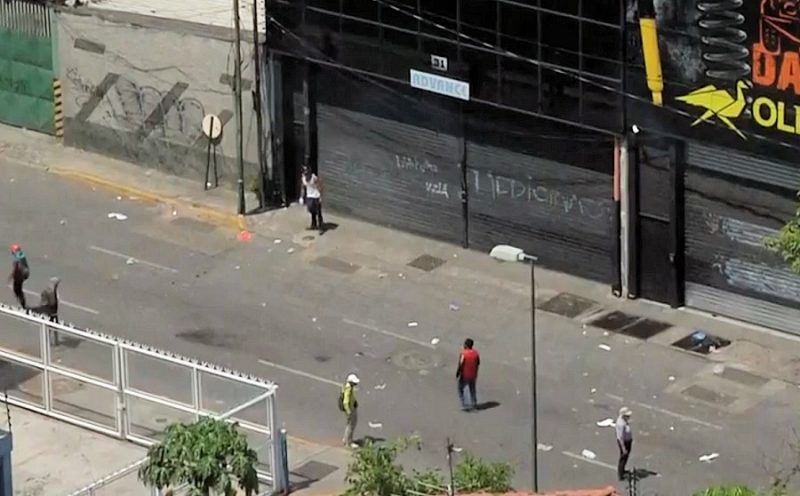
Impressive “uprising” you have there.
As a bad work of fiction, Guaidó could not mount even a lame imitation of a military-backed coup on April 30, which is just the latest in a long line of his failures this year. This character, unknown to 80% of Venezuelans a few months ago, leader of a minority party in a defunct parliament, who never campaigned for the presidency and was never elected to it—this same character posed in front of cameras and claimed military backing which he never had. So he calls on the resources of a hostile foreign power in the vain hope it make his fiction reality, clearly showing he understands nothing at all. Even worse: it shows a total lack of any care for all those who would suffer and die in war—Guaidó is ready to sacrifice them all. It’s an ill bird that fouls its own nest.
The response to Guaidó’s call? A few hundred violent protesters showed up, traded rocks with the Bolivarian National Guard, and then stood around talking to each other for hours on end. John Bolton, pushing US intervention in the name of keeping Venezuela free of external dominance (he knows no irony), even tried to nudge Venezuelans in a pitiful attempt at bribery, promising US economic relief if Guaidó took power. As far as attempted coups go, this was fortunately among the most pathetic, lame farces. There is now no resemblance between Venezuela 2019 and Libya 2011, where in the latter case opponents actually seized towns and cities and mounted protests that lasted days on end. What remains the same in the two cases is the determination of the US to implement through violent proxies a fiction of rule.
One also has to wonder how John Bolton, Mike Pompeo, and Elliot Abrams still have jobs today. Trump is not a tower of managerial business acumen after all—if one ever believed the fiction constituting his performance on The Apprentice. Bolton, who was most prominent during the April 30 coup farce, could not even keep himself from tripping over his own excremental attempt at a “narrative”. First, John Bolton called on the Venezuelan military to side with Guaidó—but then invalidated his call, turning around and asserting that, in any case, Venezuela was under (imaginary) Cuban occupation, and it was Cuban troops who were really in charge. So everything fell apart… because of Cuba, and thus Trump threatened Cuba with an embargo, which it has already been under for six decades. Cuba was the fiction used to mask another fiction—the only thing that was real here was how utterly ridiculous US empire has become.
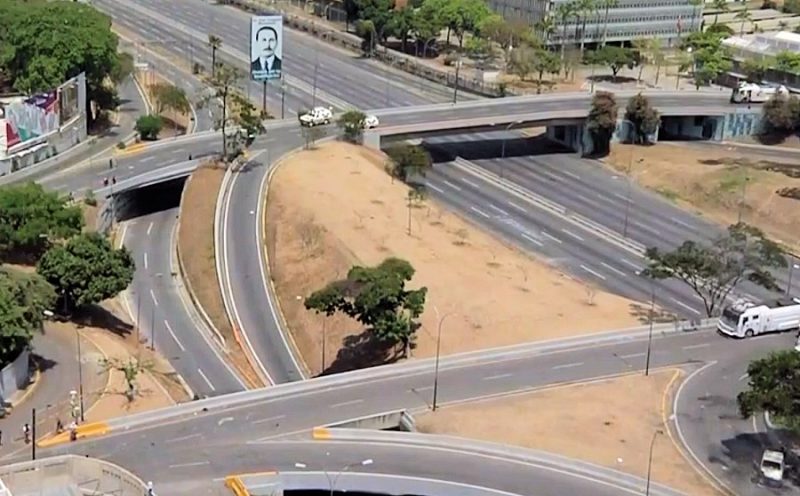
All the action, caught live on camera.
On the night of April 30, as I often do I listened to live radio from Caracas, where the assembled panellists spent a good amount of time engaged in the healthiest, most robust guffawing I have heard in ages. The subject of their laughter? Erik Prince, the war criminal who headed BlackWater and is now begging Trump for cash in return for a “plan”—a plan to send a grand total of 5,000 mercenaries to Venezuela. On RNV radio they wondered if the Americans had really become so stupid and psychotic to think that 5,000 clowns could take and hold so much as a bakery in a country which has 2,000,000 armed citizens in militias alone, not counting the hundreds of thousands in the armed forces and the paramilitary police. Apparently Prince mixed up Venezuela with Grenada—and even in Grenada it took US Marines a week to subdue armed opposition from a comparatively tiny group of diehard patriots.
Nothing is working for the US, not even what might be the most extreme sanctions ever imposed, and weeks of power outages. Certainly, none of the “humanitarian” theatre worked, whether it was the forced “aid” stunt, or the myth that Venezuelan troops set their fake aid on fire. The US was forced to imagine and fantasize about Maduro fleeing the country: witness Mike Pompeo’s bout of deranged lying about Maduro getting on a plane to Cuba, until Russia stopped him. Fictions, lies, propaganda, disinformation, fake news. To top it all off, the news came: this was not even a coup, you see. The real problem here, with such a monumental loss of face, in such a magnificent failure as April 30, is that the US will turn to even more desperate and thus more dangerous measures. However, that comes at a real cost: if the US invades, Trump has to go into an electoral contest with a new war on his back, and it’s not like such a war would come even close to a “cake walk”.
One has to wonder: will those national leaders who—without the authorization of their citizens—unilaterally “recognized” Guaidó as this so-called “interim president” thing, now take stock finally? Or will they cling to this science-fiction that there is a popular movement opposing Nicolás Maduro’s legitimate and very real government?
Clearly, very clearly as it was televised live worldwide all day on April 30 for all to see, Guaidó does not lead a popular movement. He has no authority, no legitimacy, and only a paltry amount of futile support. This so-called “uprising” was an embarrassing failure for his own image as a supposed leader. Then he takes shelter and says “tomorrow, more protests”—yes, junior, that will do the trick. Remember, sport, more always works, and besides, “there’s always tomorrow”. Keep at it, son.
This is what practice without theory looks like. This is what a “movement” without support looks like. This is what science-fiction looks like when it tries to escape the theatre and mingle with real people in the street.
Meanwhile, members of the Lima Group such as Canada, and those members of the European Union that have called for a “peaceful transition” in Venezuela, there is a lot for which they must answer. What “democracy” do they think it is where someone, not elected by the people, marshals the forces of violence in an effort to impose a government on a country? If this were to be done in their countries, would they accept it as democracy? This is the other outrageous fiction that we face: that we in North America live in democratic polities. Democracy should recognize itself in democracy—but when you instead recognize your partner in a violent clutch of putschists, then what are you?
Coup Attempt In Venezuela
Venezuelanalysis | April 30, 2019
Caracas – A military coup attempt is underway in Venezuela on Tuesday, April 30, with imprisoned right wing leader Leopoldo Lopez, and self-proclaimed “Interim President” Juan Guaido and some members of the armed forces blocking a highway in Caracas and calling on the military to rise up
According to reports, a group from Venezuela’s Sebin intelligence service freed Leopoldo Lopez from house arrest early Tuesday morning. Lopez then joined Guaido and a handful of members from different branches of the armed forces in the Altamira highway in eastern Caracas close to La Carlota airbase. Lopez and Guaido published videos on social media calling on other elements of the armed forces to join the uprising and on their supporters to take to the streets. Guaido vowed that this was the “final phase” in ousting the Maduro government.
The Venezuelan government promptly reacted, condemning the coup attempt and vowing that it would be defeated.
“We inform the Venezuelan people that right now we are facing and deactivating a small group of traitor soldiers who have positioned themselves on the Altamira overpass to attempt a coup against the state and the constitution,” Communications Minister Jorge Rodriguez tweeted.
The President of the National Constituent Assembly, Diosdado Cabello, spoke on state television, vowing that the uprising would be defeated and that those responsible would have to “assume their responsibilities.” He also called on the people and the Bolivarian militia to go out on the streets and defend Miraflores Palace.
For his part, Defense Minister Vladimir Padrino López reported that military units throughout the country reported total normalcy, and that the military remain loyal to President Maduro.
At the time of writing, Guaido’s followers are taking to the streets both in Caracas and other parts of the country, blocking roads in support of his new call for a coup. Minor confrontations with tear gas have been reported outside La Carlota air base in Caracas.
Guaido had previously called for the “largest march in Venezuela’s history” scheduled for Wednesday May 1, while a Chavista march celebrating workers’ day was also expected to take place.
Venezuela’s Defense Minister Vladimir Padrino rejected the coup attempt and said that the country’s legitimate military forces would respond to any attempt to overthrow the government of Nicolas Maduro.
“We reject this coup movement that aims to fill the country with violence. The pseudo-political leaders who have placed themselves at the forefront of this subversive movement have used troops and police with weapons of war on a public road in the city to create anxiety and terror.”
Russia Profits as US Takes Venezuelan Oil off the Market in Europe
By Irina Slav – Oilprice.com – April 12, 2019
European refiners are switching to Russian sour grades as U.S. sanctions have shrunk Venezuela’s similar-grade exports, Reuters reports, adding that the Russian sour crude is getting increasingly expensive.
Citing sources from the trading industry, Reuters says the situation has been made worse by the fact that OPEC members have cut mainly their output of heavier, more sour grades under the OPEC+ agreement aimed at stimulating a price rise.
U.S. crude is not an alternative as it is overwhelmingly light and sweet, while refineries in Europe are equipped to process heavier grades as well as light ones to make refined products.
The news is the latest reminder that the world is tipping towards a shortage of heavy, sour crude, which is the staple kind of Venezuela crude and which many refineries need to produce fuels and other products.
“Urals is anchored in a positive zone versus dated Brent and there is no indication it will fall to a discount any time soon,” one of the Reuters’ sources said. That’s a complete reversal of the traditional differential between light and heavy oil, with the latter typically trading at a discount to Brent, a light blend.
Sanctions on Iran are further complicating life for European refiners as they have restricted exports of sour grades that Iran also produces in addition to its very popular superlight crude, also called condensate.
According to Reuters, U.S. sanctions have removed 800,000 bpd of heavy crude from the global market, leaving refiners scrambling for alternatives in a limited pool that, besides Russia and Middle Eastern producers, also includes Canada and Mexico as large producers of these grades of crude. The former is having its own problems with a pipeline capacity shortage and a production cut that has boosted prices, and the latter has yet to reverse a fall in oil production.
Canadian Regime Change Fanatics Scream of Russian Interference into Canada’s Elections
By Matthew Ehret | The Duran | April 13, 2019
On April 5 Canada’s foreign minister embodied the essence of hypocrisy by complaining loudly that Canada’s upcoming October 2019 elections were under threat by a regime change operation steered by Russia which was seeking to undermine the international democratic order.
In order to respond to the threat of foreign interference, the Minister of Global Affairs Canada announced the creation of a “democratic” five person body staffed entirely with unelected senior bureaucrats from the Privy Council Office under the control of the Clerk of the PCO which will act as a new Propaganda bureau to determine what Canadians are and are not allowed to know. This body will focus on social media and will interface closely with the head of Facebook Canada CEO Kevin Chan. She also announced the creation of a Security Threats Task Force which unites all intelligence agencies of Canada (RCMP, Canadian Security Intelligence Service, Communications Security Establishment under the office of Global Affairs Canada. Lastly, the creation of a G7 Rapid Response Mechanism would be created in order to protect all of Canada’s G7 partners from similar “foreign meddling” and run out of Freeland’s Global Affairs Office.
Justin Trudeau, whose administration is collapsing under the weight of self-contradictions built into the green technocratic worldview that he was selected to advance, was quick to jump on this new narrative stating “it is very clearly that countries like Russia are behind a lot of the divisive campaigns.”
Canadian Regime Changers Exposed
Chrystia Freeland’s role as a regime change darling of the British Empire has been increasingly known since the Ukrainian Maidan. It was that British Empire that groomed her under a Rhodes scholarship at Oxford and groomed her for years as an agent controlling mass perception by her management of Reuters and Canada’s Globe and Mail before placing her in a controlling position of Justin Trudeau in 2013.
Her role in steering the vast networks of Canadian Banderites who have long grown in numbers and influence in Canada is as well-known as her friendship with leading Svoboda/Pravi Sektor leaders in Ukraine who were deployed to overthrow a legitimately elected pro-Russian government from Nov. 2013-Feb. 2014. Increasingly well known is her own family’s deeply rooted Nazi sympathies going back to her grandfather’s role in working directly with the Waffen-SS during the latter’s occupation of Ukraine.
When the Ukraine “color revolution” steered by the British-run Deep State (of which Freeland is a senior member) failed to achieve its goal of de-stabilizing Russia, attention was turned to Venezuela where both Russia and China have invested tens of billions in infrastructure and whose government has been extremely favorable to cooperation on the Belt and Road initiative.
For this job, Freeland was deployed alongside her Oxford-trained colleague Ben Rowswell who together worked diligently for several years for a color revolution. As ambassador to Venezuela from 2014-2017, Rowswell managed to coordinate anti-government forces on the ground stating “We became one of the most vocal embassies in speaking out on human rights issues and encouraging Venezuelans to speak out”. Upon leaving Venezuela he said “I don’t think they (anti-Maduro forces) have anything to worry about because Minister Freeland has Venezuela way at the top of her priority list”.
What Rowswell was referring to was Freeland’s role in garnering the semblance of international support for the overthrow by her creation of the Lima Group of 13 Latin American countries (plus Canada) who could be said to “represent the consensus view of South America” in order to give the regime change a “democratic” look. Apparently the deep state managers of Canada didn’t think there was anything weird in an Anglo Saxon monarchy leading a group of Latin American republics and assumed the world would feel the same way.
As it turns out, even though the majority of Lima Group Foreign ministers were induced to support the regime change (very likely due to the vast control of South American mining operations controlled by Canadian mining giants), the world wasn’t so quick to jump enthusiastically on the regime change bandwagon with both Russia and China firmly denying their recognition of opposition leader Guaido’s legitimacy as the country’s leader culminating in Russia’s March 23 deployment of military aircraft and personnel into Venezuela as a message to all Deep State fanatics to back off.
It is noteworthy, that even though Donald Trump paid limited lip service to the hawks in his own government and internationally by telling Russia to leave Venezuela, the fact is that the rift between Trump and those war hawks exemplified by Bolton, Pence, and Pompeo, was made very clear as the President took several opportunities from April 3-6 to call for greater cooperation with Russia and China.
The Collapse of the Deep State and Rise of the New Paradigm
Freeland, Rowswell and their British handlers are undoubtedly not sleeping well at night. Their system is collapsing and there isn’t very much that they can do about it. The empire’s control structures so long kept in the shadows are increasingly exposed to the light of day with the collapse of Russia-Gate, and the exposure of the role of Canada’s Privy Council Office and Round Table movement (aka: Chatham House groups) as guiding (British) hands behind global affairs.
With the Brexit, Italy’s joining the BRI, the failure of the EU and bankruptcy of the City of London-Wall Street banking system, the world is finally waking up to the fact that the “great game” which so perverted the 20th century is falling apart. Not only that but only one serious alternative is on the table: the Belt and Road Initiative/New Silk Road as a global force of cooperation and long term investment into the real (vs speculative/fictitious) part of the economy.
In weeks, Beijing will host the 2nd Belt and Road Conference from and Trump, speaking alongside China’s vice Premier stated a very important intention as a lead up to that conference: 1) an end to the trade war is immanent with a major deal expected in weeks and 2) that Russia, China and America should stop wasting billions on war machines and start re-directing those expenditures towards long term great projects that benefit everyone. The places to do this not only include Belt and Road projects in Eurasia, Africa and the Americas but also the important domain of space exploration and cooperation. Both Russia and China have made it clear that space is a domain for peace on earth with Russia moving ahead with a lunar colony for 2040 and China’s far side of the moon landing on January 3, 2019 being a precursor to a larger lunar mining/industrialization program to access rare earths and Helium-3 fusion fuel.
Donald Trump has joined this chorus of nations pushing for a space based economy by announcing a revival of NASA’s mission with a Moon-Mars program on March 26.
While the future looks increasingly hopeful, and the British Empire’s ugly hand is increasingly exposed for the world to see, there are still many dirty tricks which the devil can still throw at the world.
BIO: Matthew J.L. Ehret is a journalist, lecturer and founder of the Canadian Patriot Review. His works have been published in Executive Intelligence Review, Global Research, Global Times, The Duran, Nexus Magazine, Los Angeles Review of Books, Veterans Today and Sott.net. Matthew has also published the book “The Time has Come for Canada to Join the New Silk Road” and three volumes of the Untold History of Canada (available on untoldhistory.canadianpatriot.org). He can be reached at matt.ehret@tutamail.com
Is the U.S. Prepared to Accept a Defeat in Venezuela?
By Marco Teruggi – Pagina 12 – April 12, 2019
The attack should have been short since the Maduro administration was not strong enough to resist. This was the conviction of the United States as they carried out a strategy to overthrow him: they built a President 2.0 Juan Guaido; they gave him a fictionalized government, international recognition, a collective narrative among mass media companies, accelerated economic sanctions at different levels. Overlapping these variables, different results were expected to be achieved on their path of getting a forced negotiation or the toppling of the government.
Events did not take the planned course. First and most important, the breaking of the Bolivarian National Armed Force (FANB): a crucial element that should have happened but did not. A series of tactics were implemented for it, from internal conspiracy with the support of a lot of dollars, visas and guarantees, or the strategy of a latent threat of a possible U.S. intervention. A combination of bluff – an unloaded weapon pointed at your head – with built up dates to try to achieve a rupture, such as on February 23rd.
The second event that should have occurred, despite the difficulty in defining a target, was Guaido supposedly building mass support in the streets. He boasted that 90 per cent of the population supports him. Pictures of his mass mobilization capacity show that the initial momentum on January 23, when his self-proclamation was acknowledged by Donald Trump through a tweet, lost strength. A major reason for this was the crisis of expectations that resulted from the unfulfilled promise of an immediate outcome. Another is that it was an artificial, communicational, diplomatic construction which could not gather more than the right’s historical rank-and-file supporters, characterized by a specific social, geographic class, living conditions, idiosyncrasy and symbolism. The opposition looked too much like themselves.
Third was the attempt to take the poor to the streets; blackouts and the water shortages were the most favorable of the scenarios to provoke this. But the outcome was not what they expected either. The clearer and wide reaching reality was the majority trying to solve their problems, individually, collectively, together with the Venezuelan Government. Sustained protests, fostered almost completely by the right, were scarce and without capacity to spread in the country.
Each of these variables has feedback points. The crisis of expectations is the result, for instance, of the fact that the Armed Force has not broken, that Guaido speaks of a hastiness that does not occur, with the conclusion that if they don’t succeed in any of their three targets, the last resort is an international intervention headed by the United States. That same interventionist narrative moves away from those who see Guaido as an alternative to the current political and economic situation. Calling on the majorities to achieve an international operation comes across evident obstacles.
Overthrowing Maduro does not seem possible in the correlation of national forces. It has been proven that the attack will not be short and that Chavismo, which is more than a Government, has enough strength to resist. If it was just a national affair, Guaido would lose strength to the point that he wouldn’t even be part of the list of opposition leaders that carry the burden of defeat. The problem is that this new coup attempt was devised over a point of no return with the United States building of a parallel government facade, acknowledged by the European Union, the United Kingdom, Israel, Canada, and right-wing governments in Latin America. What to do with Guaido when the plan is not successful due to initial miscalculations?
The question is due to the US, its current Administration is a mixture of Donald Trump-neoconservative leaders, and the so-called deep state; that is to say, real, invisible structures of power that constitute and safeguard that country’s strategic development in the geopolitical struggle. A defeat in Venezuela would be charged to the Administration in a pre-election period and it would suffer a double blow with Maduro’s continuity, or the lack of ability make a key Latin American country fall in line, and its implications in the international arena.
The deep state has grown stronger recently through tweets and speeches of U.S. spokespeople like Special Representative for Venezuela Elliott Abrams, Secretary of State Mike Pompeo, National Security Advisor John Bolton, and Southern Command’s commanding general Craig Faller. Their different statements have shifted towards painting Venezuela as an operational base for Russia, Iran, Cuba and China, while the Maduro administration would be subordinated to each of these governments and their corresponding intelligence and military services —particularly to the first three.
The United States has announced its following steps based on that narrative. Pompeo is going to Chile, Paraguay, Peru and Colombia; Abrams to Spain and Portugal; and they convened a third meeting in the United Nations Security Council to talk about Venezuela’s situation. They have not announced the goals of the different moves yet. It is possible though to predict that there is a private and public dimension to the agreements. A possibility would be for the US to declare the Venezuelan government a transnational criminal organization and branding colectivos (Chavista grass-roots organizations) as terrorist groups that “undermine the Constitution and territorial integrity of Venezuela,” according to Bolton’s description. New possible actions would result from each of these elements.
That increase in pressure, tightening the blockade, and isolation has not led yet to the possibility of a military intervention, despite the repeated “all options are on the table.” Abrams himself sidestepped that hypothesis last Thursday. Therefore, how are they planning to achieve the outcome proposed with the combination of these actions? The United States needs to establish means, on-the-ground operational capacity, and domestic and diplomatic agreements. In this regard, the European Union stance was expressed by its high representative for foreign affairs, Federica Mogherini, who affirmed that “new free and credible presidential elections should be held as soon as possible.”
Would the U.S. be willing to accept a negotiated outcome in which Maduro remains in power? So far, that does not look possible. They don’t seem willing to accept a geopolitical defeat in Venezuela either. The U.N. Security Council met on Wednesday to deal with this aspect. At the same time, the right called for more mobilizations. The pieces are still in motion.
Translation by Resumen Latinoamericano, North America bureau
Edited by Venezuelanalysis.com
US Threatens Venezuela at UNSC as IMF Freezes Funds
Diplomatic battles rage on at international bodies such as the UNSC, the OAS and the IMF
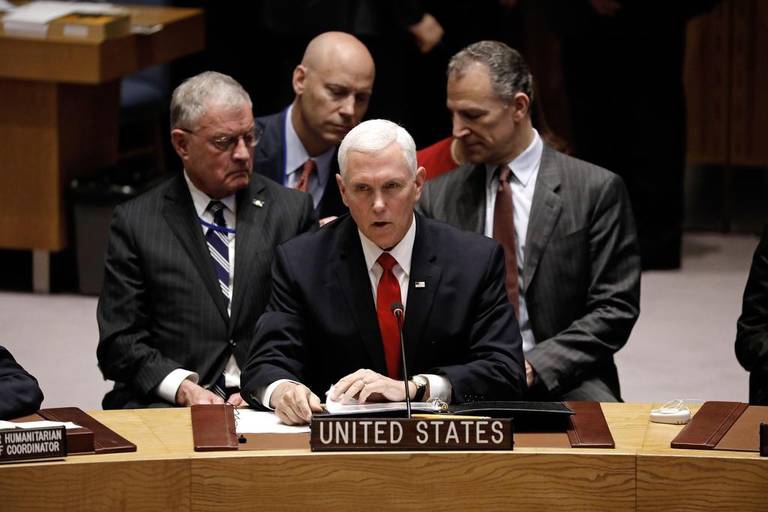
US VP Mike Pence called on the UN to recognize Guaido as Venezuela’s president. (EFE)
By Ricardo Vaz | Venezuelanalysis | April 11, 2019
Caracas – The United States pressured the United Nations to recognize self-proclaimed “Interim President” Juan Guaido during a Security Council (UNSC) meeting on Wednesday.
US Vice President Mike Pence told the UNSC that “the time has come” for the UN to recognize Guaido as Venezuela’s “legitimate president” and accept the latter’s representative to the world body. He added that the US would circulate a resolution to this effect, but offered no details on its timetable. A previous US resolution at the UNSC was vetoed by Russia and China on February 28.
Pence went on to reiterate the warning that “all options are on the table” to oust the Maduro government. “This is our neighborhood,” he told reporters afterward, calling on Russia to cease its support to the Maduro government.
Venezuela’s UN representative, Samuel Moncada, slammed what he called a “clear move to undermine” Venezuela’s rights, adding that his legitimacy depended on UN recognition and not on the declarations of the US vice president.
Russian ambassador Vassily Nebenzia accused the US of causing Venezuela “billions of dollars in losses” as a result of sanctions.
“[The US] deliberately provokes a crisis in Venezuela in order to change a legitimately elected leader for a US protege,” Nebenzia said in his speech.
Chinese representative Liu Jieyi likewise affirmed that Venezuelan affairs should be handled internally and criticized the imposition of sanctions, while his South African counterpart, Jerry Matjila, called for the UNSC to take a “constructive approach.”
Wednesday’s UNSC meeting came on the heels of a session at the Organization of American States (OAS) which approved Guaido’s appointment, Gustavo Tarre, as a representative to the body “until new elections are held.” The proposal had 18 votes in favor, 9 against, six abstentions and one absence.
Venezuelan authorities denounced the move as a violation of international law and of the OAS charter. The Foreign Ministry reiterated that Venezuela is due to leave the OAS on April 27, having started the process two years ago. Caracas denounced meddling in its internal affairs after the OAS had repeatedly tried to apply its democratic charter. However, it never managed to secure the necessary 24 votes.
Diplomatic battles surrounding Guaido’s recognition have extended to the International Monetary Fund (IMF). According to Bloomberg, the IMF cut off Caracas’ access to almost US $400 million in special drawing rights (SDR). While the IMF has shown no signs of recognizing Guaido, and lists Finance Minister Simon Zerpa as Venezuela’s representative, sources told Bloomberg that a government must be recognized by a majority of the Fund’s members to access its SDR reserves.
Venezuela remains mired in a deep economic crisis that has seen its international reserves shrink to around $9 billion. The cash crunch has been further compounded by US and allies freezing Venezuelan assets held abroad. In one such case, the Bank of England has refused to repatriate an estimated $1.2 billion worth of Venezuelan gold held in its vaults.
International tensions have also flared around the issue of humanitarian aid, with US and Venezuelan opposition ultimately failing to force an estimated $20 million worth of aid across the Venezuela-Colombia border on February 23. The operation faced strident criticism from international agencies such as the United Nations and the Red Cross, who refused to take part in the “politicization” of aid.
During Tuesday’s UNSC meeting, UN aid chief Mark Lowcock stated that Venezuela is facing a “very real humanitarian problem” and talked about the need to step up UN efforts in the Caribbean country. UN Secretary General Antonio Guterres later tweeted that the UN estimates there are 7 million people in need of aid in Venezuela, and that the UN is working to increase its assistance “in line with the principles of humanity, neutrality, impartiality and independence.”
UN agencies have increased their work in Venezuela in recent months, most recently via an agreement between Caracas and the UN’s Central Emergency Resource Fund for US $9.2 million to address the health and nutritional impacts of the country’s severe economic crisis. President Maduro has also appealed for UN assistance in countering US sanctions to bring medicines and medical equipment to Venezuela.
Likewise, the International Federation of the Red Cross (IFRC) recently announced a scaling up of its activities in Venezuela, doubling its annual country budget to $60 million as part of an agreement with the Venezuelan government.
Maduro met a Red Cross commission headed by IFRC President Peter Maurer on Tuesday to coordinate the agency’s work in Venezuela. Maurer had previously met Foreign Minister Jorge Arreaza to “strengthen cooperation agreements.”
Is Trump’s Designation of Iran Revolutionary Guard Corps as Terrorist Organization a Set-Up for War?
By Whitney Webb | MintPress News | April 8, 2019
WASHINGTON — The Trump administration designated Iran’s Islamic Revolutionary Guard Corps (IRGC), an elite group of that country’s military, as a foreign terrorist organization early Monday, confirming a report published last Friday in the Wall Street Journal that suggested that such a move was likely to occur in a matter of days. In a statement released Monday, the White House stated:
This unprecedented step, led by the Department of State, recognizes the reality that Iran is not only a State Sponsor of Terrorism, but that the IRGC actively participates in, finances, and promotes terrorism as a tool of statecraft.”
While most reports on the subject have interpreted the move as aimed at pressuring European countries and others from conducting business with Iran while also making the Iran nuclear deal much more difficult to revive, the move would further allow the Trump administration to conduct more “robust” combat operations against Iran’s military, all without congressional approval.
As was noted by the WSJ and other outlets, the Trump administration’s upcoming move to label the IRGC a foreign terrorist organization would mark the first time that any element of a foreign state is officially labeled as a terrorist group. The Bush administration had previously blacklisted the Quds Force, the IRGC unit in charge of foreign operations, in 2007 “for its support of terrorism,” and further described the group as Iran’s “primary arm for executing its policy of supporting terrorist and insurgent groups.” However, unlike the Trump administration, they stopped short of labelling the IRGC, or any of its elements, as foreign terrorist organizations themselves.
Reports from last month indicate that current Secretary of State and former CIA Director, Mike Pompeo, was one of the administration’s top officials behind the move. At the time, the New York Times noted that many officials in the Pentagon and the CIA opposed the move, given that such a designation against the IRGC could have profound repercussions for U.S. troops stationed abroad, particularly in the Middle East. Indeed, soon after the recent WSJ piece was published, IRGC’s commander, Mohammad Ali Jafari, warned that U.S. troops in the Middle East would “lose their current status of ease and serenity” and that Iran’s government would make a “reciprocal move” against the U.S. military — labeling it a terrorist group — were the Trump administration to go forward with its latest move to target the IRGC.
Where’s Trump going with this designation?
Several reports have mulled over the likely motives behind the move to label the IRGC a foreign terrorist organization, with some suggesting that the move would be used as a threat to dissuade other countries from conducting business with Iran, while others asserted that the move was aimed at curbing the ability of any future U.S. president — particularly if a Democrat takes the White House in 2020 — from resurrecting the Joint Comprehensive Plan of Action, know broadly as the Iran nuclear deal. Trump unilaterally withdrew from the Iran nuclear deal in 2018, a move which earned him strong praise from long-time Iran hawks as well Israel’s Prime Minister Benjamin Netanyahu and Trump’s most powerful political donor, billionaire Sheldon Adelson.
Yet, upon more careful consideration, an economic motive seems unlikely in light of the fact that the Trump administration has already imposed draconian sanctions on almost every sector of Iran’s economy and government, including the IRGC. In addition, making such a drastic move now to prevent a future president in 2020 or beyond from reviving the Iran deal also seems rather unrealistic given that the 2020 challenger to Trump is still unknown.
A much more likely reason for the designation is the fact that labeling any group a foreign terrorist organization allows that group to be targeted by the U.S. government by means of the Authorization for Use of Military Force (AUMF). Past reports on other groups labeled as terrorist organizations have noted that “though the CIA can gather intelligence on terror groups regardless of their status on a State Department list, official designation unlocks more robust means to combat them since it triggers the Authorization for Use of Military Force.”
Notably, the CIA opened a new “mission center” on Iran in June 2017 — when Pompeo was CIA director — aimed at “turning up the heat” on Iran and making the country a “higher priority” for American spies. Now, just under two years later, the designation of the IRGC as a terrorist group allows those clandestine operations to become “more robust” and more overt thanks to the years-long expansion of the 2001 AUMF.
Colonel W. Patrick Lang, a retired senior officer of U.S. Military Intelligence and U.S. Army Special Forces, noted on Sunday that the move amounts to a “declaration of war” against Iran’s military, writing:
The official designation as “terrorist” of the IRGC, which is a 125,000 man army with its own navy and air force, makes it legal for the U.S. Armed Forces to attack the IRGC and its people wherever they are found and under any circumstances that may occur.”
Other echoes Lang’s concerns, including Wendy Sherman, former under-secretary of state and current director of the Center for Public Leadership at the Harvard Kennedy School. Sherman told Reuters on Sunday:
One might even suggest, since it’s hard to see why this is in our interest, if the president isn’t looking for a basis for a conflict. The IRGC is already fully sanctioned and this escalation absolutely endangers our troops in the region.”
Stretching the AUMF
The Authorization for Use of Military Force (AUMF) was originally passed in 2001 in the wake of the September 11 attacks and its text authorizes the president:
[T]o use all necessary and appropriate force against those nations, organizations, or persons he determines planned, authorized, committed, or aided the terrorist attacks that occurred on September 11, 2001, or harbored such organizations or persons, in order to prevent any future acts of international terrorism against the United States by such nations, organizations or persons.”
Despite being expressly aimed at groups believed to be responsible for September 11, the AUMF has been expanded under the Bush, Obama and Trump administrations to justify military action in dozens of countries against dozens of groups, many of them with no links to al Qaeda.
Trump, since his first year in office, has been building a case to link the IRGC to al Qaeda, a case entirely devoid of evidence and one that has long seemed aimed at triggering military conflict between the United States and Iran, particularly by means of the 2001 AUMF. In remarks delivered on October 13, 2017, Trump made the following claims:
Iranian proxies provided training to operatives who were later involved in al Qaeda’s bombing of the American embassies in Kenya, Tanzania, and two years later, killing 224 people, and wounding more than 4,000 others.
The regime harbored high-level terrorists in the wake of the 9/11 attacks, including Osama bin Laden’s son. In Iraq and Afghanistan, groups supported by Iran have killed hundreds of American military personnel.”
Though Trump’s claims are demonstrably false, the fact that he is surrounded by many long-time Iran hawks does not bode well for the current state of affairs following the administration’s declaration of the IRGC as a foreign terrorist organization.
Setting up a new war?
Another point of concern is the fact that the 2002 AUMF, regarding the president’s ability to authorize the use of military forces in Iraq — which borders Iran — is still on the books. That AUMF, which gave the president authority to send U.S. military troops to Iraq in the lead-up to the Iraq War in order to defend “the national security of the United States against the continuing threat posed by Iraq,” still provides the executive branch with the ability to order military action in Iraq without approval either from the U.S. Congress or from Iraq’s government.
Dr. Jack Goldsmith, a former assistant attorney general in the Office of Legal Council during the George W. Bush administration, noted in 2014:
[The 2002 AUMF] gives the President the discretion to determine when the use of the U.S. Armed Forces is necessary and appropriate to defend U.S. national security against the continuing threat posed by Iraq (not the government of Iraq, not Saddam Hussein, but Iraq), and authorizes the President to use those forces in that circumstance.”
This AUMF is important now in light of the recent designation of the IRGC as a terrorist group and the fact that IRGC-aligned militias are present and active in Iraq, with many of them collaborating with U.S. troops stationed in Iraq in efforts to target terrorist groups like Daesh (ISIS). This declaration not only undermines that collaboration, it also would give Trump authority — per the 2002 AUMF — to send U.S. troops to Iraq without congressional approval in response to the supposed “national security threat” posed by the now-”terrorist” IRGC-aligned militias in the country. Notably, this declaration comes soon after the current Iraqi government called to expel all U.S. troops from its territory.
Not only that, but the new declaration of the IRGC as a terrorist group could also have consequences as far away as Venezuela. Indeed, the U.S. government has claimed for over a decade that the IRGC is “active” in Venezuela and accused them of involvement in Venezuelan intelligence operations, the training of left-wing Colombian paramilitary groups and security assistance to the Venezuelan government. With the IRGC now officially labeled a “terrorist organization”, the provisions of the AUMF now triggered following Trump’s declaration could have very real, troubling consequences for his administration’s regime change efforts in the oil-rich South American country.
With the IRGC now officially labeled a “foreign terrorist organization” by the U.S. government, the march to war with Iran — long a goal of top Trump administration officials — is closer than ever. With more overt and robust military and intelligence operations targeting Iran and the 2001 and 2002 AUMFs now triggered to allow the deployment of U.S. ground troops in and near Iran, the U.S. is just steps away from triggering what could turn into not just a regional war in the Middle East but a global one.
Editor’s note: This story was updated to explain the potential consequences of Trump’s decision to label the IRGC a terrorist group in relation to the Trump administration’s current campaign to topple the Venezuelan government.
Whitney Webb is a MintPress News journalist based in Chile. She has contributed to several independent media outlets including Global Research, EcoWatch, the Ron Paul Institute and 21st Century Wire, among others. She has made several radio and television appearances and is the 2019 winner of the Serena Shim Award for Uncompromised Integrity in Journalism.
VIPS Urge Trump to Avoid War in Venezuela
Consortium News | April 4, 2019
VIPS warn that Trump’s policies regarding Venezuela appear to be on a slippery slope that could take us toward war in Venezuela and military confrontation with Russia.
MEMORANDUM FOR: The President
FROM: Veteran Intelligence Professionals for Sanity (VIPS)
SUBJECT: Avoiding War with Russia over Venezuela
Mr. President:
Your Administration’s policies regarding Venezuela appear to be on a slippery slope that could take us toward war in Venezuela and military confrontation with Russia. As former intelligence officers and other national security practitioners with many decades of experience, we urge you not to let yourself be egged on into taking potentially catastrophic military action in response to civil unrest in Venezuela or Russian activities in the Western Hemisphere. With the recent arrival of two transport aircraft and enduring political support for the government of Venezuela, the Russians are far from crossing any “red line” emanating from the 1823 Monroe Doctrine.
Unfulfilled Objectives in Venezuela
Inside Venezuela, U.S. actions have failed to do more than plunge the country into deeper crisis, cause greater human suffering, and increase the prospects of violence on a national scale. President Maduro’s mishandling of the economy and authoritarian reactions to provocations are impossible to defend, but they result in part from the fact that he has been under siege since he was first elected in 2013 and has faced sanctions aimed ultimately at removing him from office. In our view, the advice you’ve received from your top advisors – Florida Senator Marco Rubio, National Security Advisor John Bolton, Special Representative Elliott Abrams, and Secretary of State Michael Pompeo – was and apparently continues to be wrong.
- Recognition of Venezuelan National Assembly President Juan Guaidó as “interim president” did not prompt the military to rise up against President Maduro. Neither did attacking the officer corps as merely corrupt opportunists and drug-traffickers enriched through loyalty to former President Chávez and Maduro, nor did repeatedly threatening them with harsher sanctions. Those actions reflected a fundamental misunderstanding about the Venezuelan military, which has never been free of corruption and political compromise but has also never been so totally isolated from the Venezuelan people that it hasn’t felt their suffering. U.S. policies incorrectly assumed that the officers – while probably fed up with Maduro’s shortcomings – would support Guaidó despite his faction’s commitment to dismantle Chavismo, which most officers believe brought historically necessary changes to the country, including enfranchisement of the poor.
Similarly, your Administration’s repeated hints at military intervention have been counterproductive to your regime-change objectives. Your policy and intelligence advisors were correct in interpreting the disparate polling data showing popular support for Guaidó as actually being support for the U.S. to extricate the country from its crisis – the National Assembly President was a political unknown until the United States and others recognized his claim to the Presidency – but your team showed a lack of understanding of Venezuelan nationalism. Venezuelans do not welcome the destruction that would be caused by U.S. military attack; they recall the death toll of Operation Just Cause, when the United States killed more than 3,000 Panamanians (by its own count) to remove one corrupt authoritarian, Manuel Noriega. Threats of invasion have pushed people to circle around Maduro, however reluctantly, not reject him.
- Your Administration’s strategy of punishing the Venezuelan people, including apparently knocking out their electricity, seems based on the false assumption that humanitarian crisis will prompt a coup to remove Maduro. In fact, the U.S. sanctions have allowed Maduro to shift blame from his own failings to U.S. malice – and it has left Guaidó, whom your advisors portray as the moral equivalent of our Founders, looking like a sell-out to Yankee imperialists at the cost of the Venezuelan people’s health and welfare and magnified civil disorder.
Lost Opportunity for Diplomacy
Senator Rubio, Mr. Bolton, Mr. Abrams, and Mr. Pompeo have also squandered a formidable moment to build on common values with allies in Latin America and Europe. Even though most Latin Americans find your aides’ public assertion that the Monroe Doctrine is alive and well to be insulting, the right-leaning Presidents of most of South and Central America rallied with you to support Guaidó’s self-proclamation. But Guaidó’s lack of leadership – he appears totally scripted by U.S. Government agencies – his inflexibility on negotiations, his open call for U.S. military intervention, and your own Administration’s dangling threat of war are rapidly alienating all but the most subservient to U.S. policy dictates. Negotiation proposals, such as those being developed by the International Contact Group, are gaining momentum.
Internationalizing the Conflict
National Security Advisor Bolton and others have sought to internationalize the Venezuela issue since before Guaidó’s proclamation. Bolton’s reference to a “Troika of Tyranny” in November – which he called “a triangle of terror stretching from Havana to Caracas to Managua” and “sordid cradle of communism in the Western Hemisphere” – was a veiled Cold War-era swipe at Russia and China. Mr. Bolton, Senator Rubio, and other advisors have made clear on numerous occasions that the overthrow of President Maduro would be just the first stage in efforts to eliminate the current governments of the “Troika” and “Communist influence” in the Western Hemisphere.
- They have repeatedly asserted that Cuban advisors have been crucial to the Maduro government’s survival without providing evidence. Indeed, the reportedly “hundreds” of Venezuelan military defectors, including many managed by U.S. agencies, have not provided even credible hearsay evidence that Cubans are doing more than providing routine assistance. In addition, the threats coming out of Washington have preempted any willingness that Cuba might have had to contribute to a regional solution to the Venezuelan crisis as it has in similar situations, such as Colombia’s recent peace process, the Angola peace process in 1989-90, and the Central American negotiations in the early 1990s.
Provocative Rhetoric about Russia
Most dangerous, however, are aggressive statements about Russia’s engagement with Venezuela. Russian oil companies, particular Rosneft, have long been in Venezuela – bailing out the Venezuelan petroleum company (PDVSA) as its mismanagement and falling oil prices have caused production and revenues to plummet. Most long-term observers believe Rosneft’s decisions, including throwing good money after bad, have been motivated by business calculations, without a particularly ideological objective.
- Your advisors’ rhetoric imposing an East-West spin on the issue presented President Putin and his advisors an opportunity to try to poke the United States in the eye – especially as Administration efforts to remove Maduro foundered and diplomatic support for Guaidó cracked. Maduro and Putin have not enjoyed particularly close personal relations in the past, and their shared strategic interests are few, but U.S. rhetoric and threats have given them common cause in tweaking us. A meeting in Rome between your special envoy, Elliot Abrams, and Russian Deputy Foreign Minister Sergei Ryabkov achieved nothing amid further U.S. sanctions against Venezuela and continued threats that “all options” were on the table.
Publicly available information is insufficient for us to know exactly what was aboard the two Russian aircraft that landed at Maiquetía last week – two months after your Administration publicly proclaimed its intention to remove Maduro – but precedent suggests Moscow had two main objectives.
- One, and probably primary, is to embarrass your Administration by defying your rhetoric, just to rub your nose in Moscow’s sovereign right to have the relations, including military liaison, with whomever it pleases. In this sense, Russian behavior resembles its intervention, at Bashar al-Assad’s request, in Syria. And it is not a far cry from Moscow’s reaction to the Western-supported coup in Kiev.
- Another objective, if press speculation about the Russian advisors and equipment aboard the aircraft is correct, would be to shore up Venezuela’s ability to warn of and respond to a U.S. military strike. Your Administration has publicly asserted that the Russians are helping repair S-300 surface-to-air missile systems, which have a purely defensive purpose. There is no evidence, not even circumstantial, that Russia has any offensive objectives in this relationship.
The U.S. reaction has suggested a much greater chance of military confrontation. Mr. Bolton “strongly caution[ed] actors external to the Western Hemisphere against deploying military assets to Venezuela, or elsewhere in the Hemisphere, with the intent of establishing or expanding military operations.” Without defining what activities he would object to, Mr. Bolton said, “We will consider such provocative actions as a direct threat to international peace and security in the region.” Your Special Representative said the “Russian presence” is “extremely pernicious.” Your Secretary of State said, “Russia’s got to leave Venezuela.” You said, “Russia has to get out” and reiterated that “all options are open” – including presumably forcing the Russians out militarily. And we note that Russia has not closed its embassy in Caracas as your Administration has.
Avoiding the Slippery Slope
As intelligence officers and security experts, we have given many years to protecting our nation from a host of threats, including from the Soviet Union. We also believe, however, that picking fights. including ousting governments, blocking negotiated settlements, and threatening other countries’ sovereign decision to pursue activities that do not threaten our national security – is rarely the wise way to go.
We repeat that we are not defending Maduro and his record, while at the same time pointing out that many of his troubles have been exacerbated by U.S. policies and efforts to oust him. We believe that due process and practical, realistic policies better protect our national interests than threats and confrontational rhetoric. It strains credulity to believe that your advisors picked this fight with President Maduro without realizing that Venezuela would seek help fixing its defensive capabilities.
Moreover and very seriously, rhetoric challenging Russia could all too easily lead to a much more consequential confrontation.
- Invoking the 1823 Monroe Doctrine is unhelpful. For Russia to provide assistance for purely defensive purposes to a country in which we seek to create regime change and threaten military attack would not be widely seen as violating the Monroe Doctrine or crossing a “red line.”
- We realize that some in the media are trying to egg you on into taking forceful action, perhaps even of a military nature, to punish Russia in any case. We urge you not to fall into this trap. This is not 19th century Latin America, and it is a far cry from the Cuba missile crisis of 1962.
- The best way to prevent dangerous miscalculation would be for you to speak directly with President Putin. Washington’s energies would be better spent clearing up differences, adjusting failed policies, and promoting a peaceful resolution in Venezuela.
For the Steering Group, Veteran Intelligence Professionals for Sanity
Fulton Armstrong, former National Intelligence Officer for Latin America & former National Security Council Director for Inter-American Affairs (ret.)
William Binney, former Technical Director, World Geopolitical & Military Analysis, NSA; co-founder, SIGINT Automation Research Center (ret.)
Marshall Carter-Tripp, Foreign Service Officer & former Division Director in the State Department Bureau of Intelligence and Research (ret.)
Bogdan Dzakovic, Former Team Leader of Federal Air Marshals and Red Team, FAA Security, (ret.) (associate VIPS)
Philip Giraldi, CIA, Operations Officer (ret.)
Mike Gravel,,former Adjutant, top secret control officer, Communications Intelligence Service; special agent of the Counter Intelligence Corps and former United States Senator
Larry Johnson, former CIA Intelligence Officer & former State Department Counter-Terrorism Official, (ret.)
John Kiriakou, former CIA Counterterrorism Officer and former Senior Investigator, Senate Foreign Relations Committee
Clement J. Laniewski, LTC, U.S. Army (ret.)
Linda Lewis, WMD preparedness policy analyst, USDA (ret.)
Edward Loomis, NSA Cryptologic Computer Scientist (ret.)
David MacMichael, former Senior Estimates Officer, National Intelligence Council (ret.)
Ray McGovern, former US Army infantry/intelligence officer & CIA presidential briefer (ret.)
Elizabeth Murray, former Deputy National Intelligence Officer for the Near East & CIA political analyst (ret.)
Todd E. Pierce, MAJ, US Army Judge Advocate (ret.)
Coleen Rowley, FBI Special Agent and former Minneapolis Division Legal Counsel (ret.)
Peter Van Buren,U.S. Department of State, Foreign Service Officer (ret.) (associate VIPS)
Sarah Wilton, Commander, U.S. Naval Reserve (ret.) and Defense Intelligence Agency (ret.)
Ann Wright, U.S. Army Reserve Colonel (ret) and former U.S. Diplomat who resigned in 2003 in opposition to the Iraq War
Veteran Intelligence Professionals for Sanity (VIPS) is made up of former intelligence officers, diplomats, military officers and congressional staffers. The organization, founded in 2002, was among the first critics of Washington’s justifications for launching a war against Iraq. VIPS advocates a US foreign and national security policy based on genuine national interests rather than contrived threats promoted for largely political reasons. An archive of VIPS memoranda is available at Consortiumnews.com.
What Monroe Doctrine?
By Philip M. GIRALDI | Strategic Culture Foundation | 04.04.2019
Because there is a presidential election coming up next year, the Donald Trump Administration appears to be looking for a country that it can attack and destroy in order to prove its toughness and willingness to go all the way in support of alleged American interests. It is a version of the old neocon doctrine attributed to Michael Ledeen, the belief that every once in a while, it is necessary to pick out some crappy little country and throw it against the wall just to demonstrate that the United States means business.
“Meaning business” is a tactic whereby the adversary surrenders immediately in fear of the possible consequences, but there are a couple of problems with that thinking. The first is that an opponent who can resist will sometimes balk and create a continuing problem for the United States, which has a demonstrated inability to start and end wars in any coherent fashion.
This tendency to get caught in a quagmire in a situation that might have been resolved through diplomacy has been exacerbated by the current White House’s negotiating style, which is to both demand and expect submission on all points even before discussions begin. That was clearly the perception with North Korea, where National Security Advisor John Bolton insisted that Pyongyang had agreed to American demands over its nuclear program even though it hadn’t and would have been foolish to do so for fear of being treated down the road like Libya, which denuclearized but then was attacked and destroyed seven years later. The Bolton mis-perception, which was apparently bought into by Trump, led to a complete unraveling of what might actually have been accomplished if the negotiations had been serious and open to reasonable compromise right from the beginning.
Trump’s written demand that Kim Jong Un immediately hand over his nuclear weapons and all bomb making material was a non-starter based on White House misunderstandings rooted in its disdain for compromise. The summit meeting with Trump, held in Hanoi at the end of February, was abruptly canceled by Kim and Pyongyang subsequently accused Bolton and Secretary of State Mike Pompeo of making “gangster-like” demands.
The second problem is that there are only a few actual casus belli situations under international law that permit a country to attack another preemptively, and they are usually limited to actual imminent threats. The current situation with Venezuela is similar to that with North Korea in that Washington is operating on the presumption that it has a right to intervene and bring about regime change, using military force if necessary, because of its presumed leadership role in global security, not because Caracas or even Pyongyang necessarily is threatening anyone. That presumption that American “exceptionalism” provides authorization to intervene in other countries using economic weapons backed up by a military option that is “on the table” is a viewpoint that is not accepted by the rest of the world.
In the case of Venezuela, where Trump has dangerously demanded that Russia withdraw the hundred or so advisors that it sent to help stabilize the country, the supposition that the United States has exclusive extra-territorial rights is largely based on nineteenth and early twentieth century unilaterally declared “doctrines.” The Monroe Doctrine of 1823 and the Roosevelt Corollary of 1904 de facto established the United States as the hegemon-presumptive for the entire Western Hemisphere, stretching from the Arctic Circle in the north to Patagonia in the south.
John Bolton has been the leader in promoting the Monroe Doctrine as justification for Washington’s interference in Venezuela’s politics, apparently only dimly aware that the Doctrine, which opposed any attempts by European powers to establish new colonies in the Western Hemisphere, was only in effect for twenty-two years when the United States itself annexed Texas and then went to war with Mexico in the following year. The Mexican war led to the annexation of territory that subsequently became the states of California, New Mexico, Nevada, Utah, Arizona and Colorado. In the same year, the United States threatened war with Britain over the Oregon Territory, eventually accepting a border settlement running along the 49th parallel.
Meanwhile the march westward across the plains continued, forcing the Indian tribes back into ever smaller spaces of open land. The US government in the nineteenth century recognized some Indian tribes as “nations” but it apparently did not believe that they enjoyed any explicit “Monroe Doctrine” rights to continue to exist outside reservations when confronted by the “manifest destiny” proponents who were hell bent on creating a United States that would run from the Atlantic to the Pacific Ocean.
The Roosevelt Corollary of 1904 amended the Monroe Doctrine, making it clear that the United States believed it had a right to interfere in any country in the western Hemisphere to maintain good order, which inevitably led to exploitation of Latin American nations by US business conglomerates that could count on a little help from US Marines if their trade agreements were threatened. In 1898, Washington became explicitly imperialist when it defeated Spain and acquired effective control over Cuba, a number of Caribbean Islands and the Philippines. This led to a series of more than thirty interventions by the US military in the Caribbean and Central America between 1898 and 1934. Other states in the region that were not directly controlled by Washington were frequently managed through arrangements with local autocrats, who were often themselves generals.
Make no mistake, citing the Monroe Doctrine is little more than a plausible excuse to get rid of the Venezuelan government, which is legitimate, like it or not. The recent electrical blackouts in the country are only the visible signs of an aggressive campaign to destroy the Venezuelan economy. The United States is engaging in economic warfare against Caracas, just as it is doing against Tehran, and it is past time that it should be challenged by the international community over its behavior. Guns may not be firing but covert cyberwarfare is total warfare nevertheless, intended to starve people and increase their suffering in order to bring about economic collapse and take down a government to change it into something more amenable to American interests.
Featured Video
Col Doug Macgregor: America’s Back to ENDLESS WARS
or go to
Aletho News Archives – Video-Images
From the Archives
Rabbi Shmuel Eliyahu: Leave No Palestinian or Arab Alive
By Jonas E. Alexis | Veterans Today | July 23, 2017
Israeli Rabbi Shmuel Eliyahu seems to have picked up where the late Rabbi Ovadiah Yosef left off. The Israeli army, Eliyahu said, must slaughter the Palestinians “and leave no one alive.” The Palestinians, the good rabbi continued, must be “destroyed and crushed in order to end violence.” Here is Eliyahu’s algorithm:
“If they don’t stop after we kill 100, then we must kill 1,000. And if they do not stop after 1,000, then we must kill 10,000. If they still don’t stop we must kill 100,000, even a million.”
There is more to this “logic” than meets the eye and ear. Eliyahu even postulated that the Israeli army ought not to get involved in arresting Palestinians because “If you leave him alive, there is a fear that he will be released and kill other people. We must eradicate this evil from within our midst.”
You may say that this is just an isolated case. No Israeli official believes that, right? … continue
Blog Roll
Recent Comments
elmerfudzie on Col Doug Macgregor: America… papasha408 on Germany demands UN Rapporteur… papasha408 on Israel Demanding that Iran Lim… Coronistan on German government ‘embezzling’… Coronistan on Why can’t western leaders acce… John Edward Kendrick on German government ‘embezzling’… loongtip on Von der Leyen to have new secu… papasha408 on First Gaza, then the world: Th… papasha408 on Is Nixing Aid to Israel a Pois… papasha408 on Japan to Sign Up For NATO’s Uk… Redracam on Iran Willing to Dilute Enriche… loongtip on When Threats Replace Evid…


 Aletho News
- Israel Wants ISIS-Linked Militias To Control Rafah Crossing — The New Order in Gaza
- ISIS never left Syria, it just changed uniforms
- Why ARE the US and Israel Obsessed With Eliminating Iran’s Ballistic Missiles?
- Kremlin comments on EU ‘myopia’ over dialogue with Russia
- Russia more adapted to contemporary military technology than NATO
- Germany puts caveat on more missiles for Ukraine
- UK High Court rules Palestine Action ban unlawful
- Populations in key NATO nations balk at sacrifices for military spending – poll
- Ukraine to ban Russian literature – culture minister
- 40 State Attorneys General Want To Tie Online Access to ID
- If Americans Knew
- In Gaza: 8,000 bodies under rubble, 3,000 missing – Not a ceasefire Day 126
- AZAPAC, the new PAC opposing Israeli domination of U.S policies
- Haim Saban: Billionaire for Israel
- Rafah e-wallet plan highlights Israel’s deepening financial occupation
- Viral post claims Netanyahu sought legal approval, igniting speculation about Israel’s organ harvesting
- AIPAC Has a New Opponent: PAL PAC
- Right-Wing Catholic Off Trump Religion Panel After Israel-Gaza Remarks at Antisemitism Event
- Jewish terrorism, apartheid rule the West Bank – Not a ceasefire Day 125
- Why Israel persecutes children like my son Shadi
- In Gaza, One Man Is Searching for the Remains of His Family With a Flour Sifter
- No Tricks Zone
- German Gas Crisis…Chancellor Merz Allegedly Bans Gas Debate Ahead of Elections!
- Pollen Reconstructions Show The Last Glacial’s Warming Events Were Global, 10x Greater Than Modern
- Germany’s Natural Gas Storage Level Dwindles To Just 28%… Increasingly Critical
- New Study Rebuts The Assumption That Anthropogenic CO2 Molecules Have ‘Special’ Properties
- Climate Scientist Who Predicted End Of “Heavy Frost And Snow” Now Refuses Media Inquiries
- Polar Bear Numbers Rising And Health Improving In Areas With The Most Rapid Sea Ice Decline
- One Reason Only For Germany’s Heating Gas Crisis: Its Hardcore-Dumbass Energy Policy
- 130 Years Later: The CO2 Greenhouse Effect Is Still Only An Imaginary-World Thought Experiment
- New Study Affirms Rising CO2’s Greening Impact Across India – A Region With No Net Warming In 75 Years
- Germany’s Natural Gas Crisis Escalates … One Storage Site Near Empty …Government Silent
 Aletho News