What Strange Corruption
The Racist Venezuelan Bourgeoisie’s Accusations Against Chavistas Are Pure Projection
By Sassy Sourstein | Cien Flamingos | February 21, 2019
Social media truly is the great democratizer. Where else can Twitter trolls and bot armies create a web of baseless rumors that make their way into the empire’s leading publications? For example:
“Maduro is a murdering criminal starving Venezuelan children while he loots the country like Chavez did. When supposed socialist Chavez died the richest Venezuelan in the world was his daughter w billions. Same w Maduro. Looting Venezuelan wealth. Giving it to himself & Cuba!” (source)
So much to unpack, but this is a template used throughout social media in various forms. Make unsourced allegations of mass murder, purposeful starvation (especially of The Children), corruption, and looting. This is a more sophisticated version (really!) in which Chávez is separated from socialism with the word “supposed,” meant to give the accuser some leverage on the left. You see, corruption is what ails Venezuela, not socialism necessarily. Much of the rest has been thoroughly debunked — there is a crime problem but no death squads, there have been a few dozen deaths in years of violent right-wing riots but no campaign of official slaughter of “protesters,” and frankly Cuba has paid for its oil many times over with solidarity and other material support to poor Venezuelans. What persists — in right-wing AND left narratives — is the corruption boogeyman. The tweet above is truly tapping into a rich vein of existing ultraleftism, in which the Bolivarian revolution isn’t socialist at all, but merely an emerging, competing bourgeoisie. I hope here to discuss and counter just some of this bullshit.
First, the claims about the Chávez family are based on the thinnest, most laughable evidence. For Hugo himself, the British tabloid Daily Mail cites a “respected analyst” from a fake “criminal justice” outfit run by a guy with 300 followers. Twitter user Bernardo Canto did the research on this lie and traced it back to a Scribd post devoid of citation or source material. Apart from that, there is absolutely zero evidence that Chávez “died rich,” as they say — which is a pretty idiotic way to do massive corruption.
As for María Gabriela Chávez, why, there must be reams of evidence against her. Well. Get a load of this.
Canto delved into these accusations uncritically published all over corporate media, including Forbes. The claim in Forbes is credited to known CIA front Diario Las Americas, based in Miami, which, “as it happens,” is now owned since 2013 by the Venezuelan backers of opposition presidential candidate Henrique Capriles, himself accused of corruption by the Maduro administration.
It all literally boils down to a receipt shown on a tabloidy TV news show whose host is a Cuban-American Republican who ran for Congress to represent Miami. That receipt? Look for yourself:
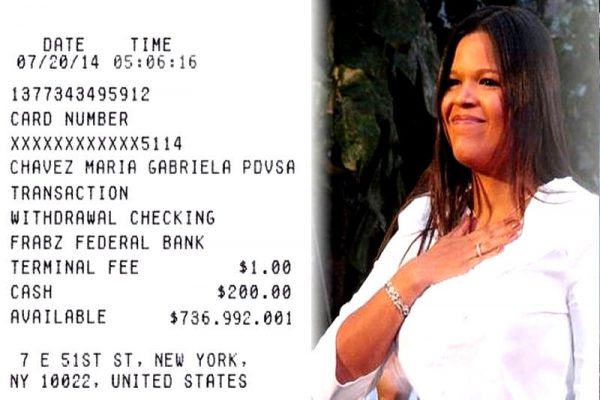
If you think that, within the United States, ATM receipts say at the bottom “United States,” well, charitably, you’ve never used an ATM here. And the address is that of the Venezuelan consulate, not any bank. Another mistake made on this truly pathetic fabrication, is that in the US we use commas, not periods, to denote whole numbers. Of course there is no way to verify if this is Amb. Chávez’s card number, and the scammer who made this knows at least that. Aporrea already debunked this — there is no “Frabz Federal Bank,” as any US resident or a quick Google search will tell you. Frabz is literally a fake ATM receipt generator. Nevertheless, Diario Las Americas claims that the reporting of supermarket-tabloid caliber blog Maduradas.com is “precise and trustworthy,” which of course makes any claim of journalistic rigor in that entire operation a preposterous notion.
Endless insinuations of impropriety against Venezuelan officials litter the internet from troll comments on up to The New York Times. The Atlantic published a particularly nasty set of libels against María Gabriela Chávez, all caged in careful transitions and caveats so as not to actually be required to provide proof. Everything from how much public money she spends (even though she’s a billionaire!) to alleged import corruption (again with no evidence provided) to comments on her musical ability. It even gives credence to a conspiracy theory that her ambassadorship was given so that Cuba would have a trojan-horse advocate at the UN. This is pure smear, a series of fevered speculations, and yet there it is in a leading light of the liberal media.
The rest of the Chávez and Maduro clans’ children are targets as well. Check out this nutty Daily Mail post published presumably to contribute wind to the sails of the ongoing coup attempt. All the María Gabriela claims are breezily restated with no attempt to corroborate, but the “accusations” against her youngest sister Rosinés are uh… well she held up “a fistful of dollar bills” — yes, ONE-dollar bills — and well, goes to school in Paris where, we are assured, she is “care free.” And then of course there’s the time Maduro stopped in Turkey to eat a steak, which is outrageous for the president of a country on his way home from trade talks in China. Diosdado Cabello, a leading PSUV member and one of Chavismo’s most efficacious orators, is mentioned for being accused by the US government of drug running but even this is admitted to be unproven. (More on narco allegations in a future post.) Cabello’s daughter Daniela is mentioned because she is pretty. Yes really. The first lady Celia Flores’s children are said to have spent $45,000 at a hotel in Paris, though the claim seems to originate with a Spanish tabloid that did some paper napkin math and has absolutely no sources whatsoever to confirm any of it — assuming the stay itself even happened.
If Maduro has a billion dollars, if Chávez had two to four — depending on whom you ask — billion fucking dollars, why would they stick around Venezuela suffering endless ridicule, threats and even attempts on their lives, and the general stresses of being responsible for the running of an entire country? Is it just megalomania against all odds? Do you think Maduro feels powerful against all that he has to deal with right now? The prospect is risible, they could buy an entire country with that amount of money and yet there they stay, ready to go down with the ship if the empire torpedoes it. What strange corruption! Something isn’t adding up, probably because it’s all lies. We should apply a high level of skepticism to any claim we see about the empire’s targets, especially if they’re at the top of the news cycle.
There’s also the matter of the so-called Bolibourgeoisie, nouveau-riche types who are said to have leveraged the revolution for personal gain. It’s no secret that — especially after the 2002 coup — the Bolivarian project created a tactical alliance with certain business interests in the country. But reports detailing the purported gluttony and profligacy rarely name anyone and make it clear that this “plugged in” wealthy set is just a consequence of 70% of the Venezuelan economy remaining in private hands. Companies that contract with the state are, of course, compensated, as they are anywhere in the world. These private companies are for profit and these profits are, of course and unfortunately, distributed to the owners and as in any capitalist society, they are free to use this wealth for any idiotic frivolous thing they please.
From personal experience living in Miami, an old-guard Venezuelan typically makes a judgement on the “legitimacy” of the wealth of say, someone exiting an expensive car based on their complexion and features. Darker and more native-featured people are assumed to be Bolibourgeois. They’ve done nothing different from a typical businessman — the white expats are just mad that black and indigenous people may have muscled their way into what should be a purely European- or Arab-descended endeavor.
There’s no evidence that these “plugged-ins” are responsible for the economic problems in Venezuela. After all, some of the most famous episodes of Latin American corruption and economic upheaval happened during the IMF-obedient regimes of the 1990s in which populist polices were rolled back, privatization ran rampant, and austerity reigned.
Real corruption is when you warehouse food to create artificial scarcities and deliberately provoke hunger. The parties who are purposely starving the Venezuelan people are the same types as in Chile who stoked privation and misery in the campaign to overthrow Allende. In Chile we know they were kept solvent by CIA money, and we can assume the same sorts of economic support exists in the case of Venezuela. In addition to smaller importers and producers being able, through whatever means, to create very telegenic scarcities of certain products, there are conglomerates whose resources are deeper, and in whose interests an overthrow is even more intensely represented, than what is available from US intel schemes.
Empresas Polar, makers of the ubiquitous harina PAN used in every single household to make arepas, has had it out for the Revolution from day one. Despite state and communal efforts to break their stranglehold on the corn flour market, their generations-deep imprint on the Venezuelan household rich and poor has persisted. If anyone “retains the ability to keep its products off the shelves just as readily as its ability to keep them on,” it’s La Polar. This is due to their still-gigantic home market share and, ironically, their being a major beneficiary of Venezuelan state subsidies for food importation. In addition, Polar’s various corporate vehicles in the US benefit from United States subsidies on corn for their many products which are sold in a growing market of quite affluent Venezuelans in the US. With all these resources at its disposal, creating artificial scarcities in a comparatively low-revenue market would be a minor line-item on Polar’s books.
There’s also the phenomenon of the “raspao,” or scrape. I don’t pretend to understand all the ways that currency can be manipulated, but merely printing too much money isn’t responsible for a one-million-percent unofficial inflation rate. For many years the Venezuelan state offered USD at an official exchange rate, for imports and travel, etc. People could buy dollars at this official rate with credit cards and then immediately convert these dollars back into bolivares in the black market — instant profit. On a trip to Mexico City last year I had a Mexican tell me with great excitement about how local Venezuelan friends of his who were involved in the scam used the profits to live well in the most exclusive neighborhoods. While the practice seems to have been curbed in recent years, the damage to the currency rate is done and the tightening sanctions compound it. I can only speculate, but with probably more certainty than a Eurotrash tabloid, that some of my Venezuelan neighbors themselves started their own nest eggs by ripping off their country. This truly is corruption, and though official currency policy is what facilitates it, it’s private criminals who take advantage, destroying their country’s economy while they live it up in exile.
The ultimate corruption is when you make millions through inheritance and other people’s labor. The accusations of the elites of Venezuela are a form of projection: they are the corrupt parasites who for generations have fed off the productive people of Venezuela, as in all nations. The same author as the Atlantic Chávez smear list — proud putchist! — has an entire post about the watches worn by some Venezuelan politicians, potentially the most news-unworthy subject of all time. The charge, of course, is “hypocrisy”: lol look at the socialists having quality timepieces! Yet when the idle scions of the Venezuelan elite themselves own safes full of jewels, several luxury cars, houses across the world, this is fine because there’s no hypocrisy involved — they never pretended to care about another soul on this planet but their own. There has never been a cynicism so toxic, so deep.
When “opposition” supporters, in between #SOS posts on Instagram, post stories of themselves on their yachts in Aruba, or their family farm in the mountains, or their beach house in Isla Margarita, or flaneuring around Barcelona and Madrid, are we meant to consider this a life of suffering? If they’re doing this, who is “earning” the money they draw to pay for these extravagances most people on earth — let alone Venezuela — can’t afford? This is corruption in every sense of the word: an indolent, lazy, entitled, racist caste of princes and princesses living off interest in foreign banks made from exploiting generations of poor workers going back into the times of chattel slavery and primitive accumulation. What is “nepotism” if not passing immense ill-gotten fortunes and estates to your children? What makes a country-club brat particularly adept at guiding such large agglomerations of the national wealth?
And even if it’s not strictly corruption, there is a certain moral emptiness to receiving a free education in Venezuela and then immediately going abroad to use your degree for personal gain, as many have done. These people are true leeches, not those demanding a fairer share of the national produce they helped create.
We also know that they consider “corruption” — or at least the even more vague “waste” — to include the building of 2.5 million homes, universities, collective farms, markets, food programs, medical facilities. To the bruised egos of the waning nobles, it’s unconscionable to give literal peasants a boost up from the dirt floor.
Listen when they talk:
“From 1999 through 2013, Venezuela collected $1.3 trillion in oil revenues but it largely has vanished through corruption, MASSIVE SOCIAL SPENDING, and waste”https://t.co/Wf6pK2jOt4
— Petro Populist (@RancidSassy) February 1, 2019
All this is why we hear so much about “corruption” in Venezuela: an utterly worthless class of human beings is angry that some small share of the wealth they used to skim exclusively for themselves is now being distributed with just a bit more equity across social lines.
Local issues of corruption, whatever they consist of, are for Venezuelans to solve. It is a completely internal matter. Imagine making the case for the bombing and invasion of a country based on the fact that it has economic problems. Now imagine those problems are mostly caused by the party who is meant to “liberate” this country. That is literally what the argument boils down to. It’s bonkers on the surface, without even so much investigation. As Foreign Minister Jorge Arreaza quipped, on the subject of the farcical “humanitarian aid”: “I’m choking you, I’m killing you — and then I’m giving you a cookie.” The US is not now and has never been in the business of securing liberty for anyone other than the financial interests of its wealthy owners. If you believe otherwise, it’s your brain that’s corrupted.
1/ Arreaza: “The cost of this blockade is over 30 BILLION dollars and they’re sending this so-called ‘humanitarian aid’ for 20 MILLION dollars? So what is this? I’m choking you, I’m killing you, and then I’m giving you a cookie?” pic.twitter.com/uUdtbGPK92
— Camila (@camilateleSUR) February 15, 2019
The End of Truth as We Know It – Or Knew It
By Jeremy Salt | American Herald Tribune | February 21, 2019
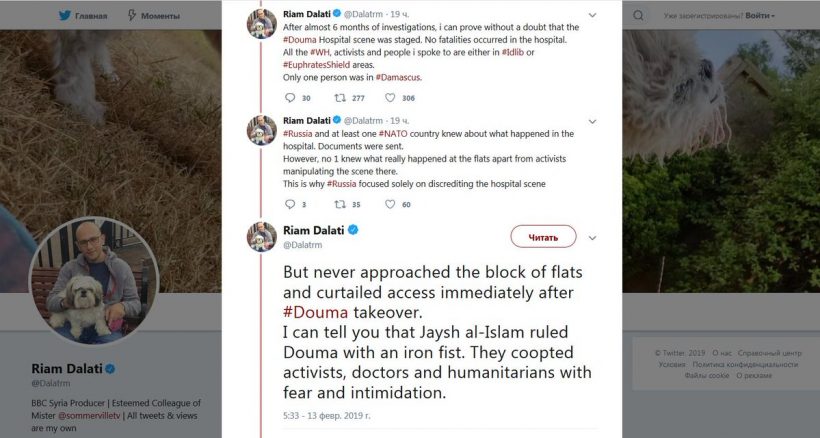
The claim (or admission) by the BBC journalist Riam Dalati that the alleged sarin attack on Douma in April 2018, was staged was received by the Russian embassy in London with glee. “Remarkable that the British MSM chose to ignore it’, whoever it was at the embassy wrote. ‘No breaking news, no articles, nothing.’
Remarkable? Not at all, given the endless track record of the media in ignoring news that does not suit its agenda. The real interest lies in the fact that an insider has owned up. His personal opinion only, according to the BBC, which along with the rest of the media, had taken the initial version of the alleged attack for granted, thus setting Syria up for the cruise missile strike by the US, Britain, and France which soon followed.
‘I can prove without a doubt that the Douma hospital scene was staged,’ Dalati wrote. Well, enough of the evidence has already been produced to prove that. As for the sarin, in July 2018, the OPCW (Organization for the Prevention of Chemical Weapons) put out an interim report indicating that whatever was used at Douma was not sarin, but most probably chlorine.
The next question is ‘used by whom?’ Again the evidence suggests that the yellow gas cylinders shown in the media propaganda blitz were not dropped from an aircraft but planted at the scene by the ‘activists’ who faked the whole episode.
The OPCW now seems to be reaching the point where it will release its full report. What it might contain opens the doors to endless speculation. It has already indicated that it found traces of chlorine and it may point an accusing finger at ‘the regime’ but without having the proof that it did it.
So expect something ultimately inconclusive, i.e. there is evidence of chlorine having been used, the Syrian regime might have used it but we really can’t say, leaving enough room for western governments to argue that they were right to bomb on the basis of the facts that were known at the time and for E. Higgins and company to argue that their version has not been disproved.
With Idlib, the last redoubt of the takfiris in Syria, now the focal point of political maneuvers and possibly military action, any credibility given by the OPCW to the accusations against the Syrian military might encourage the takfiris to try again, most likely in Idlib province, the location of the alleged chemical weapons attack in Khan Shaikhun in April, 2017. Without having the proof, the US launched a missile strike against a Syrian air base by way of retaliation.
Another faked attack would give the US and its law-breaking friends the pretext needed to disrupt or forestall any Syrian military campaign to drive the takfiris out of Idlib, which, far from having quietened down following the ‘de-escalation’ agreement reached by Turkey, Iran and Russia, is now an even hotter hothouse of takfiri activity.
The main group, Hayat Tahrir al Sham (HTS) basically still Jabhat al Nusra/Al Qaida in Syria despite the name change, and its allies have routed their ‘moderate’ enemies and taken control of between 70 to 90 per cent of the province, including Idlib city, which lives under a harsh form of sharia law.
The HTS collective has tens of thousands of armed fighters on call. So does the rival Turkish-supported National Liberation Front. The entire province is awash with arms and armed groups refusing to adhere to any agreements drawn up in Astana or Sochi and saying they will fight to the last.
Along with the fighting men are the civilians, the families of the takfiris and the normal civilian population of the province who are helpless in the face of the violence and intimidation all around them and the scheming of powerful actors far from the scene.
At present nothing is clear. The US is apparently planning to withdraw troops from northern Syria but has not withdrawn them. Erdogan and Putin have met to discuss what the US is up to, as well as the situation in Idlib and Turkey’s desire to set up a buffer zone running 460 kms and 32 kms deep along the Syrian border (on the Syrian side). Russia and Iran have so far refused to support the idea.
The buffer zone would be set up against the Kurdish People’s Protection Units (YPG), aligned with Turkey’s Kurdistan Workers’ Party (PKK) and ‘terrorists’ in the view of the Turkish government but not in the eyes of the US, which, of course, has been using the Kurds in pursuit of its own strategic interests
Turkey has recently been committing itself to the territorial and political integrity of Syria, raising an obvious question: if this is the case, why did you make such strenuous attempts to destroy both over the past eight years?
The US is on the brink of defeat in Syria. Not just defeat but defeat by Russia, which is why Trump’s plan to withdraw is facing furious criticism at home by neocons who want more war, somewhere, anywhere, and ‘liberals’ who hate Trump and will buy into almost anything that brings him down. In their views on Syria, Iran, Hizbullah, Hamas and now Venezuela the two groups are indistinguishable, even if they also affect to hate each other.
Idlib will be liberated sooner or later. If the takfiris are insisting that they will fight to the last drop of their blood that is because they have nowhere else to go. The foreigners among them can’t go back to their own countries. Turkey does not want them on its side of the border although, as the Syrian Kurds claim, it might allow them to move into Afrin, occupied by the Turkish army in March 2018. As fighters or police, they would have their uses. What happens to them when Afrin is finally returned to the hands of the Syrian state is an issue for the future.
But back to Douma. Was the district being bombed at the time a chemical weapons attack was alleged? Of course, it was. It had been taken over by one of the most murderous takfiri groups in Syria, Jaysh al Islam, and the army was shelling Douma to drive them out. What government and what army would not be constitutionally bound to do the same?
Douma was not under siege by the Syrian army, as the corporate media kept telling the world. It was being held hostage by a murderous armed group, for which the presence of civilians, deterring the army from a full-on ground military assault, was a prized asset. Civilians died in the shelling but the most likely cause of the breathing difficulties suffered by those given genuine medical treatment was smoke and dust inhalation. Jaysh al Islam and the White Helmets converted their distress into a chemical weapons attack and then ran around a clinic spraying water over everyone to prove the point.
The arguments will continue over the provenance of the yellow cylinders that gave Eliot Higgins something else to do. These were normal industrial gas cylinders that had been filled with chlorine which could only be released if someone opened the valve with a monkey wrench or if the valve had opened on impact. That a Syrian military helicopter would drop these cylinders in the hope that somehow the valve would open or break on landing is surely nonsensical.

The valves were intact so how the chlorine could have got out of the cylinders without someone manually opening them remains unexplained by those making the claim that the cylinders were dropped from a helicopter. There was no evidence of anyone in the house where the cylinders were found having been affected and as someone has observed, even the chickens running around nearby were unharmed. In short, the whole scenario screams one word: fake.
One thing not to be forgotten is that when the takfiris finally were pushed out of Douma, a makeshift chemical weapons factory, complete with how-to-make instructions and receipts for the machinery and chemical compounds received, was found underground in an elaborate network of tunnels.
Neither the factory nor the tunnels, nor the brutal nature of the takfiris holding Douma, or their previous crimes, including their previous alleged use of chemical weapons were items for show or discussion in the media.
Neither was the story one of armed fanatics taking over a district close to a national capital and holding its citizens hostage. Neither was the story one of foreign governments and the armed groups they were supporting besieging an entire country. The facts were reversed so that it was the Syrian government and army laying siege to its own people and killing them with chemical weapons.
Over the past eight years, the propaganda onslaught by these governments and the corporate media has been total. No authoritarian state or dictatorship could have done a better hatchet job on public opinion but these arch manipulators of public opinion are self-described liberals.
Therein lies their advantage. The citizens of an authoritarian state don’t believe their government or their media in the first place but western media consumers still cling to the illusion of a free press guarding their interests and are thus sucked in all the time. ‘Free for whom?’ and ‘Whose interests is the media really guarding?’ are questions that are rarely asked except by seekers after truth pushed to the margins of public debate.
The worst excesses of the takfiris – Islamic State beheadings, the throwing of people off the roofs of high buildings, the drowning of caged captives in a swimming pool and the burning of a Syrian soldier – had to be reported because they were indescribably inhuman and could not be ignored but the mundane terrorism of groups just a cut below the Islamic State in barbarity was either underplayed, ignored or blamed where possible on the Syrian military.
In the eyes of the media these groups were not terrorists but rather the ‘opposition’ or ‘rebels’ standing up to the ‘regime,’ its barrel bombs and its chemical weapons attacks, all of them, the best evidence suggests, launched by the takfiris with the intent of incriminating the Syrian government and bringing on a US-led air war.
Roughly about the same time as Riam Dalati was uttering his truth on his tweet, a Berlin-based outfit calling itself the ‘Global Public Policy Institute’ was putting out a report on chemical weapon use in Syria entitled ‘Nowhere to Hide: The Logic of Chemical Weapons Use in Syria.’
This ‘institute’ counted the number of such attacks in Syria, 336, of which number it attributed 98 percent to the ‘Assad regime’ and the rest to the Islamic State. The fact that it uses the word ‘regime’ to describe the legitimate government of Syria is the first tell-tale sign of where this report is going to lead.
The next is the sources of information, ‘our friends and partners,’ as the GPPI calls them: the Syrian Archive, the Syrian American Medical Society (SAMS) Mayday Rescue, the White Helmets, the Syrian Network of Human Rights, the VDC (Violations Documentation Centre) and Human Rights Watch, every single one of them fully engaged in propaganda attacks on the Syrian government if not actually embedded (like the White Helmets) with the takfiri groups.
The 47 pages of this report are beautifully laid out. The graphics and maps are meticulously done. As a school project, the GPPI would get 10 marks for presentation but nothing for content. On the basis of ‘evidence’ coming from such tainted sources, what makes the authors think that any reasonably well-informed person could believe their claims, and how is it that well-established German charitable foundations can hand over money for the production of such garbage?
The Syrian crisis has spawned an industry of parasites, feeding off its agony. There is no shortage of money for anyone smart enough to harvest it by giving the media what it wants and setting themselves up as a conduit for government propaganda. There is a market for lies and deceit and the laws of supply and demand being what they are, the demand is being met.
There is a truth here about the media that needs to be said. It was never truly independent, never the watchdog of the people’s interests in all seasons but it was arguably a lot better than what it has become. The explanation for this state of affairs lies partly in the death of the independent proprietor and the monopoly corporatization of the media. The proprietor’s or the board’s interest is now immeasurably greater than those of the independent owner who used to wander around the editorial floor once a week to make sure everything was ok and the staff was happy.
The corporation is global, not local, with interests that the small independent owner would hardly be able to comprehend because the leading newspaper or the television station is usually just one small part, and mostly a lesser part, of an empire that spans communications in all its branches. Conflict of interest, affecting news presentation, is inbuilt.
If the newspaper has value, it lies in its use as a weapon against or for a government depending on what the government is willing to give in return. Rupert Murdoch is the past master in using the media this way. Even if they lose money, he will keep his flagship papers going.
In the past 20 years, we have seen an abrogation of journalistic integrity for which it is hard to find a parallel in modern history. The Vietnam war was launched and maintained on the basis of lies but it did not take long for journalists to emerge who challenged the official narrative and exposed it for what it was. Compare this with Iraq and the way the media ran with the official narrative on ‘weapons of mass destruction’ from the beginning until the very one, when not one could be found.
Seymour Hersh was the leading example of journalistic integrity in Vietnam (which is not to minimize the reporting of others in the small group exposing the official lies) and, amazingly enough, is still the leading example half a century later.
For his audacity in challenging the accusation that the Syrian government was responsible for the apparent chemical weapons on the outskirts of Damascus in August 2013, and showing that it was the so-called rebels, supported by outside governments, who were most probably responsible for this atrocity, Hersh was pushed to the margins of mainstream journalism in his own country and eventually out of it altogether.
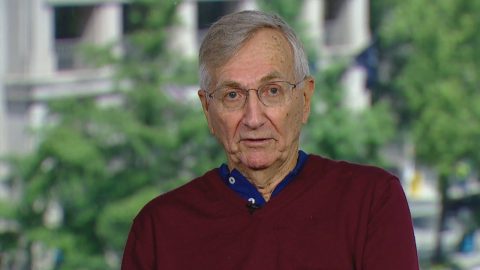
*(Seymour Hersh)
Syria is only part of a broad mosaic of ill intent, however. It was attacked in the first place because it was a strategic ally of Iran. Russia’s twin successes, in deflecting US penetration of Ukraine and making the Americans look stupid in Syria, was followed by allegations of Russian interference in the 2016 US elections. There was no proof then and there is no proof now but the same empty accusations are being repeated by the same columnists, anchors and talk show hosts all the time.
We are now facing a multi-pronged assault on truth in which governments and the corporate media are partners. On both sides of the Atlantic, they have lined up against the renewed primary enemy, Russia, wherever it is and whatever it does.
Russia lost the Democrats the US elections. Russia stole Crimea from Ukraine.
Russia saved the Syrian dictator from defeat. Russia is supporting the dictator Maduro. Russia trades with Iran. Russia does not regard Hizbullah and Hamas as terrorists as we do. Russia does not give open-ended support to Israel but rather regards it as a primary fomenter of disorder in the Middle East.
Russia poisoned the Skripals, of course. Skripal senior was a former double agent, double-crossing Russia while working for British intelligence. There is no obvious reason why Russia would want a washed-out former spy dead but of course, it had to be Russia that daubed the door handle of his house with Novichok. There was no proof, but who else could it be but Russia, and if you say ‘British intelligence,’ setting up a new round of Russia-bashing, then wash your mouth out with soap.
Mysterious Russian figures turn up in Salisbury. The British government says they are agents, stopping off at the Skripals’ house to put a few drops of Novichok on the door handle before sauntering off down the main street to look into the window of a shop selling collectibles and rare stamps.
They seemed to be enjoying themselves. They seemed in no hurry at all to get away from the scene of the crime and take the first plane back to Moscow, but isn’t that exactly the way well-trained Russian agents would behave?
Somewhere along the way they dropped what was left of their Novichok into a rubbish bin, cunningly concealed in a hi-tech perfume bottle, Nina Ricci, ‘Premier Jour.’ Enough still left to kill 4000 people, said the newspapers, but failing to kill the Skripals and killing only poor Dawn Burgess, who pulled it out of the bin and apparently sprayed or dabbed herself with some.
We don’t really know who these Russians were and what they were doing in Salisbury but we need proof, not accusations and suppositions, and the British government does not have it. We can reach conclusions on the basis of what we know or think we know but the lies told by the British government over the attack on Iraq in 2003, plus the death/murder of the UN weapons inspector David Kelly five months after the war was launched, are sufficient reasons not to believe or trust anything this government says.
This new cold war is drifting steadily towards the brink of a hot one. The US is confronting Russia through missile bases, economic sanctions and interference in the politics of states around Russia’s borders.
Trump has just announced the withdrawal of the US from the Intermediate-range Nuclear Forces (INF) treaty, accusing Russia of breaching it and saying ‘we will move forward with developing our own military response options.’
In fact, Russia had already accused the US of violating the treaty. In May, 2018, the US/NATO opened a missile base in Romania where, Russia claimed, the US had simply transferred the launchpad for the Aegis integrated naval weapons system, which utilizes Tomahawk cruise and intermediate range missile banned by the INF treaty, from sea to land.
These missiles have a range of 300-3400 miles and their apparent positioning in Romania was naturally regarded as a direct threat by Russia.
The withdrawal of the US from the INF and Trump’s threat that the US will ‘move forward’ by developing its own options raises the apprehension in Russia that the US will station other cruise and intermediate range missiles in Europe once it finds willing partners.
In his state of the union address, Putin said that such missiles could reach Russia in 10 to 12 minutes and warned of a symmetrical response, if the US deployed them in Europe, directed not just at the US but at the states hosting its missiles.
To those contemplating such measures, he said: ‘Let them count the speed and range of our missiles. That is all I ask.’
It is not just Russia that the US is threatening, however, but China. If China held naval exercises off the US or British coasts the world would quickly be facing another 1962 Cuba crisis, only much more dangerous, but the US and Britain give themselves the right to hold such exercises off the Chinese coast in the South China Sea.
As for Venezuela, the US has reverted to the crude gunboat imperialism of the late 19th century (not that gunboat imperialism ever went away). ‘Do what we want or else’ is the message sent to Maduro and the Venezuelan people. What the US wants is the resurrection of the 1823 Monroe Doctrine, and the complete domination of Latin America, including open access to its resources.
In essence, the imperialism of the 21st century is the same as the imperialism of the 20th or the 19th centuries. In the 1940s and 1950s the people of Asia, the Middle East and Africa struggled to lift the yoke of occupation, economic domination and the plundering of their natural resources off their necks. In the third millennium, they are still struggling, especially in the Middle East and Latin America.
The members of the ‘western’ collective fight among themselves but always fall into line when the alpha dog barks at them. Considerations of right and wrong, law, ethics, morality and justice are irrelevant. The alpha dog has barked and the pack must obey. Riam Dalati’s exposure of media deceit is interesting but still a mere detail on a very large and dirty canvas as the ‘west’, its governments and its media, tries to maintain control of a world fast slipping from its hands.
Jeremy Salt has taught at the University of Melbourne, Bosporus University (Istanbul) and Bilkent University (Ankara), specialising in the modern history of the Middle East. His most recent book is “The Unmaking of the Middle East. A History of Western Disorder in Arab Lands” (Berkeley: University of California Press, 2008.)
From Madero to Maduro: Lessons of the Mexican Revolution for 21st Century Venezuela

By Martin SIEFF | Strategic Culture Foundation | 21.02.2019
Just over 100 years ago, Mexico had a popular, much beloved democratically elected President determined to reduce foreign influence and obscene profits flowing out of the country and raise the standard of living for his people. The US financial interests on Wall Street orchestrated a military coup and made sure he was brutally murdered.
The president obviously was not Nicolas Maduro of Venezuela, who has been set up to receive the same treatment this year, but his name was remarkably close – Madero not Maduro. The parallels and contrasts between the two men are thought-provoking.
Unfortunately poor Francisco Madero, an idealistic reformer who ruled as President of Mexico from 1911 to 1913 did not have the tough political street smarts and plain common sense that Venezuela’s Maduro has exhibited throughout his long, controversial but undeniably successful career.
Madero naively trusted in the army commander-in-chief he had inherited from his predecessor President Porfirio Diaz, General Victoriano Huerta. Huerta had prospered throughout the long 35-year rule of Diaz from 1876 to 1911 by carrying out genocidal campaigns for him against the Yaqui Indians and the Mayans.
In 1913, Wall Street interests enthusiastically supported Huerta when he carried out a coup against the innocent Madero. Woodrow Wilson, the US president of the day was an exceptionally ugly racist who despised the Mexican people and at first went along with Huerta’s coup.
The huge financial and mining interests in New York were eager to continue plundering Mexico’s resources while more than 90 percent of its people lived virtually as slaves in appalling poverty under Diaz.
In the last decade of Diaz’s rule – securely supported by the Wall Street financial robber barons, as historian Matthew Josephson called them and by the complacent administrations of Theodore Roosevelt and William Howard Taft – at least 600,000 people were worked to death as real slaves on the estates of Diaz’s supporters. Not a whisper of disapproval was heard from Washington.
Huerta ruled with his usual mindless thuggish brutality for less than a year and a half before provoking such national revulsion that he was ousted in a brief and bloody civil war. He fled of course to the United States but then made the mistake of alienating US business and military leaders alike by openly embracing Imperial Germany to plot his militaristic comeback.
Huerta died in loose US military custody in 1916 after a night of dining out and carousing. Poisoning by the Americans was widely suspected but the cause may well just have been heavy drinking. His autopsy revealed extreme cirrhosis of the liver.
To this day Huerta is reviled as the murderous mass killer and cowardly murderer and tool of cynical foreign interests he was while the well-meaning, but tragically ineffectual Madero is genuinely loved by the people of Mexico. The days from the start of Huerta’s coup to the president’s murder – gunned down by an impromptu firing squad of assassins by night along with his own brother and vice president are remembered as La Decena Tragica, The Ten Tragic Days.
In the years that followed, Mexico endured all the horrors of a collapsed state with rival feuding bands slaughtering each other and everyone else they came across. The population of the country plummeted from 15 million in 1910 to 11.6 million a decade later. Factoring in how many deaths were masked by the high birth rate, well over four million people, or more than 25 percent of the total population died in the years of anarchic violence that Huerta’s murder of President Madero set in motion.
La Decena Tragica continues to reverberate in Mexico to this day. When current President Andres Manuel Lopez Obrador continues to withstand massive pressures from the Trump administration to recognize their preferred puppet, Juan Guaido as Washington’s preferred figurehead president of Venezuela, he is heeding his people’s reverence for martyred President Madero and remembering the bloodbaths and chaos that the hated Huerta unleashed in his place.
Madero naively trusted in the honor of his army commander, the murderous Huerta. By contrast, President Maduro in Venezuela, like his political mentor and predecessor Hugo Chavez, has taken care to always have an army high command loyal to the democratically elected national civilian leadership. Nevertheless, today, US leaders have openly called on Venezuela’s military leaders to scrap their own cherished constitution and political processes and violently topple President Maduro – All of course in the name of their usual mythical and never-defined “freedom.”
However, Bloomberg News pointedly noted in a recent report that in a Venezuelan military establishment of more than 2,000 generals and admirals, only a single officer who did not even command any troops has sworn allegiance to National Assembly Speaker Juan Guaido, the farcical boy toy whom the Trump administration is trying to set up as “president” of Venezuela in Maduro’s place.
It is just as well. The precedent of Mexico more than a century ago teaches us that if the US plot to topple President Maduro were to succeed, as the one to remove and murder President Madero did so tragically 106 years ago, then civil war, chaos and the violent death of multiple millions of innocent people would rapidly follow.
In the seven years following the murder of Francisco Madero, more than a quarter of the population of Mexico were slaughtered or starved to death. The history of states where 21st century US administrations have successfully orchestrated “regime change” makes clear that Venezuela would suffer a similar fate.
Afghanistan, Iraq, Libya, Yemen, South Sudan and Ukraine remain appalling object-lessons to the world in US criminal incompetence – at the very least – in “nation-building.” The consequences of the endless failed attempts to topple the government of Syria tell the same terrible story.
The bullets that slammed into gentle, naïve little President Madero more than a century ago continue to ricochet in our own bloodstained age.
US Threats to Venezuelan Military Violate UN Charter – Lavrov
Sputnik – 20.02.2019
Russian Foreign Minister Sergei Lavrov said on Wednesday that Washington’s threats to Venezuela’s military violated the United Nations Charter, and are representative of direct interference in the state’s internal affairs.
He also stated that Moscow grew worried about developments in Venezuela following US President Donald Trump’s recent statement urging the Venezuelan military to accept opposition leader Juan Guaido’s offer of amnesty.
“We are concerned about what is happening around Venezuela. The threats heard from the US, which are actively supported and stimulated by the Venezuelan opposition, which in fact directly invites external intervention, are certainly a violation of the UN Charter and direct interference in the internal affairs of an independent country,” Lavrov said during a press conference following talks with his Zambian counterpart Joseph Malanji.
Lavrov’s remarks come after US President Donald Trump said on Monday in a speech to Venezuelan Americans in Miami that the military of the Latin American country could either accept opposition leader Juan Guaido’s amnesty offer or “lose everything” as there would otherwise be no way out for them.
On 16 February Venezuelan opposition leader Juan Guaido, who earlier declared himself the country’s interim president, called on the Venezuelan Armed Forces, supporting President Nicolas Maduro, to change sides, giving the military seven days to do so, in the anticipation of humanitarian aid arrivals to the crisis-hit country. Prior to that, Venezuela’s Ambassador to Russia Carlos Rafael Faria Tortosa said US humanitarian aid could be a trap to be followed by military invasion.
Venezuela has long been facing political turmoil and the situation deteriorated on 23 January, when opposition leader Juan Guaido declared himself interim president, disputing President Nicolas Maduro’s re-election last year. While the United States has openly backed Guaido, the European Union did not issue a joint statement following suit because the motion was vetoed by Italy, according to a diplomatic source. Despite this, however, many European countries have individually voiced their support for the Venezuelan opposition leader.
Russia, China, Mexico, among other nations, voiced support for Maduro, who, in turn, accused Washington of orchestrating an attempted coup.
Canadian policy on Venezuela, Haiti reveals hypocrisy that media ignores
By Yves Engler · February 19, 2019
If the dominant media was serious about holding the Canadian government to account for its foreign policy decisions, there would be numerous stories pointing out the hypocrisy of Ottawa’s response to recent political developments in Haiti and Venezuela.
Instead silence, or worse, cheer-leading.
Venezuela is a deeply divided society. Maybe a quarter of Venezuelans want the president removed by (almost) any means. A similar proportion backs Nicolas Maduro. A larger share of the population oscillates between these two poles, though they generally prefer the president to opposition forces that support economic sanctions and a possible invasion.
There are many legitimate criticisms of Maduro, including questions about his electoral bonafides after a presidential recall referendum was scuttled and the Constituent Assembly usurped the power of the opposition dominated National Assembly (of course many opposition actors’ democratic credentials are far more tainted). But, the presidential election in May demonstrates that Maduro and his PSUV party maintain considerable support. Despite the opposition boycott, the turnout was over 40% and Maduro received a higher proportion of the overall vote than leaders in the US, Canada and elsewhere. Additionally, Venezuela has an efficient and transparent electoral system — “best in the world” according to Jimmy Carter in 2012 — and it was the government that requested more international electoral observers.
Unlike Venezuela, Haiti is not divided. Basically, everyone wants the current “president” to go. While the slums have made that clear for months, important segments of the establishment (Reginald Boulos, Youri Latortue, Chamber of Commerce, etc) have turned on Jovenel Moïse. Reliable polling is limited, but it’s possible 9 in 10 Haitians want President Moïse to leave immediately. Many of them are strongly committed to that view, which is why the country’s urban areas have been largely paralyzed since February 7.
In a bid to squelch the protests, government forces (and their allies) have killed dozens in recent months. If you include the terrible massacre reported here and here in the Port-au-Prince neighborhood of La Saline on November 11-13 that number rises far above 100.
Even prior to recent protests the president’s claim to legitimacy was paper-thin. Moïse assumed the job through voter suppression and electoral fraud. Voter turnout was 18%. His predecessor and sponsor, Michel Martelly, only held elections after significant protests. For his part, Martelly took office with about 16 per cent of the vote, since the election was largely boycotted. After the first round, US and Canadian representatives pressured the electoral council to replace the second-place candidate, Jude Celestin, with Martelly in the runoff.
While you won’t have read about it in the mainstream media, recent protests in Haiti are connected to Venezuela. The protesters’ main demand is accountability for the billions of dollars pilfered from Petrocaribe, a discounted oil program set up by Venezuela in 2006. In the summer demonstrators forced out Moïse’s prime minister over an effort to eliminate fuel subsidies and calls for the president to go have swelled since then. Adding to popular disgust with Moïse, his government succumbed to US/Canadian pressure to vote against Venezuela at the OAS last month.
So what has been Ottawa’s response to the popular protests in Haiti? Has Global Affairs Canada released a statement supporting the will of the people? Has Canada built a regional coalition to remove the president? Has Canada’s PM called other international leaders to lobby them to join his effort to remove Haiti’s President? Have they made a major aid announcement designed to elicit regime change? Have they asked the International Criminal Court to investigate the Haitian government? Has Justin Trudeau called the Haitian President a “brutal dictator”?
In fact, it’s the exact opposite to the situation in Venezuela. The only reason the Haitian president is hanging on is because of support from the so-called “Core Group” of “Friends of Haiti”. Comprising the ambassadors of Canada, France, Brazil, Germany and the US, as well as representatives of Spain, EU and OAS, the “Core Group” released a statement last week “acknowledging the professionalism shown by the Haitian National Police.” The statement condescendingly “reiterated the fact that in a democracy change must come through the ballot box, and not through violence.” The “Core Group’s” previous responses to the protests expressed stronger support of the unpopular government. As I detailed 10 weeks ago in a story headlined “Canada backs Haitian government, even as police force kills demonstrators”, Ottawa has provided countless forms of support to Moïse’s unpopular government. Since then Justin Trudeau had a “very productive meeting” with Haitian Prime Minister Jean Henry Ceant, International development minister Marie-Claude Bibeau declared a desire to “come to the aid” of the Haitian government and Global Affairs Canada released a statement declaring that “acts of political violence have no place in the democratic process.” Trudeau’s government has provided various forms of support to the repressive police that maintains Moïse’s rule. Since Paul Martin’s Liberals played an important role in violently ousting Jean-Bertrand Aristide’s government in 2004 Canada has financed, trained and overseen the Haitian National Police. As took place the night Aristide was forced out of the country by US Marines, Canadian troops were recently photographed patrolling the Port-au-Prince airport.
Taking their cue from Ottawa, the dominant media have downplayed the scope of the recent protests and repression in Haiti. There have been few (any?) stories about protesters putting their bodies on the line for freedom and the greater good. Instead the media has focused on the difficulties faced by a small number of Canadian tourists, missionaries and aid workers. While the long-impoverished country of 12 million people is going through a very important political moment, Canada’s racist/nationalist media is engrossed in the plight of Canucks stuck at an all-inclusive resort!
The incredible hypocrisy in Ottawa’s response to recent political developments in Haiti and Venezuela is shameful. Why has no major media dared contrast the two?
Russia’s Lukoil Halts Oil Swaps In Venezuela After U.S. Sanctions
By Tsvetana Paraskova | Oilprice.com | February 15, 2019
Litasco, the international trading arm of Russia’s second-biggest oil producer Lukoil, stopped its oil swaps deals with Venezuela immediately after the U.S. imposed sanctions on Venezuela’s oil industry and state oil firm PDVSA, Lukoil’s chief executive Vagit Alekperov said at an investment forum in Russia.
Russia, which stands by Nicolas Maduro in the ongoing Venezuelan political crisis, has vowed to defend its interests in Venezuela—including oil interests—within the international law using “all mechanisms available to us.”
Because of Moscow’s support for Maduro, the international community and market analysts are closely watching the relationship of Russian oil companies with Venezuela.
“Litasco does not work with Venezuela. Before the restrictions were imposed, Litasco had operations to deliver oil products and to sell oil. There were swap operations. Today there are none, since the sanctions were imposed,” Lukoil’s Alekperov said at the Russian Investment Forum in the Black Sea resort of Sochi.
Another Russian oil producer, Gazprom Neft, however, does not see major risks for its oil business in Venezuela, the company’s chief executive officer Alexander Dyukov said at the same event.
Gazprom Neft has not supplied and does not supply oil products to Venezuela needed to dilute the thick heavy Venezuelan oil, Dyukov said, noting that the Latin American country hadn’t approached Gazprom Neft for possible supply of oil products for diluents.
Under the new wide-ranging U.S. sanctions, Venezuela will not be able to import U.S. naphtha which it has typically used to dilute its heavy crude grades. Analysts expect that a shortage of diluents could accelerate beginning this month the already steadily declining Venezuelan oil production and exports.
Venezuela’s crude oil production plunged by another 59,000 bpd from December 2018 to stand at just 1.106 million bpd in January 2019, OPEC’s secondary sources figures showed in the cartel’s closely watched Monthly Oil Market Report (MOMR) this week.
Venezuela: The Next Move and the Final Word
By Maximilian C. Forte | Zero Anthropology | February 17, 2019
Almost a month after Donald Trump recognized Juán Guaidó as the “interim president” of Venezuela, and the imperial media started to label Nicolás Maduro as the “disputed” president of Venezuela (as if that were a universally accepted statement of fact), nothing has happened to unseat Maduro. The intended coup does not appear to be advancing. Meanwhile the US continues its sanctions, only now they are sanctioning a country they claim is led by someone who is not Maduro. If one mistook rhetoric for reality, US foreign policy would appear to have been conceived in some sort of Twilight Zone. Back in the real world, the US tacitly recognizes that Maduro is in fact the head of government and state in Venezuela, and both the threats of US military intervention and the sanctions themselves prove that point.
Far from a wave of popular condemnation of the Maduro government, Venezuela instead experiences something of a “slow coup,” mostly based on support from foreign right-wing governments. Following ZA’s sketch of the models used for this intended coup, ranging from Ukraine to Libya and Syria, others warned that we should look out for the “7 rules of regime change” that typically constitute the US’ campaigns of foreign destabilization. Libya was actually an appropriate analogy in some key regards, one of them being that the US was actively inciting chaos by trying to create a situation where more than one government claimed legitimacy. As for Ukraine, it was the Ukrainian Foreign Minister himself who drew the analogy between the Maidan protests and events in Venezuela. Also indicative of this approach is the fact that Trump hired the infamous Elliot Abrams (an ardent “Never Trumper” but an even bigger opportunist), one of the original neocons who played a role not just in the 2002 coup attempt against Hugo Chávez in Venezuela—and has now been called back for an encore—but was also tied to the covert war against Nicaragua, lying to Congress, and providing cover for the notorious death squads in El Salvador during the 1980s. In the US Congress, Democrats in charge of the House Foreign Affairs Committee put together a “team” to deal with Venezuela, including one Debbie Wasserman Schultz, who was guilty of rigging electoral processes within the DNC to the disadvantage of Bernie Sanders in 2016—worthy coup experience. (Yet, on that same committee there have been some outstanding exceptions, namely Ilhan Omar.)
Venezuela and the Problem for Trump’s White House

Nicolás Maduro, President of Venezuela
However the problem is that the “slow coup” approach seems to be increasing frustration in the ranks of both the Venezuelan opposition and the White House. How much longer can the US government tolerate its commands being ignored and “defied”? The longer this goes on, the greater the chance that Trump will lose face, at a delicate political time of upcoming US presidential elections and when he has lost so much face already. This is a person who has long boasted that his administration would always be “winning,” winning so much that his supporters would tire of all the winning. What has Trump won with Venezuela? If Trump just lets things continue, Venezuela could learn to survive sanctions the way several other states have also learned to survive them. Venezuela still has some powerful friends: China, India, and Russia chief among them. Venezuela is not under a UN-approved international sanctions regime, the kind imposed on Iraq, North Korea, and Iran. Venezuela still has room for manoeuvre, and even an IOU can carry a lot of weight if it’s based on possession of the world’s largest proven oil reserves. In addition, Venezuela’s armed forces declared their loyalty to President Maduro. The opposition made feeble, legalistic efforts to win over the military’s support (basically promising only to not “prosecute” the military for supporting the legitimate government), but this failed from the outset. Meanwhile the military held prominent exercises under the direction of Maduro’s government. The military continued to hold extensive exercises from February the 10th to the 15th, in practice for a counter-invasion. At this rate, Trump could enter the 2020 electoral campaign with Maduro still in power in Venezuela, and Trump’s opponents lampooning him as a failure: all sound and fury and nothing more than promises made of hot air.
The other option of course, the one that Trump frequently repeats is always “on the table,” is US military intervention in Venezuela. This would then be Trump’s first new war added to the list of the US’ current wars. There now appears to be a straight line of seamless continuity running from George W. Bush to Barack Obama and now Donald Trump, especially where regime change in Venezuela is concerned. Trump, who sometimes feigns awful annoyance at the “Obama legacy,” which he pretends to want to destroy, is only too keen to shore it up in Venezuela. The one “national emergency” about which no one is threatening to sue the White House, a “national emergency” decreed by Obama and still in force, is the one that classes Venezuela as an “unusual and extraordinary threat to the national security and foreign policy of the United States”. On his way out the door, Obama renewed and extended that same “national emergency”—and Trump loyally picked up the baton. Yet Venezuela has never threatened the US, and the US Congress has not authorized any military action in Venezuela. Will Trump be reticent about usurping authority by continuing to expand the executive power of the imperial presidency? If he does, another charge will then stick during the 2020 campaign: that he is authoritarian. Not just authoritarian, but one also responsible for starting a new, unpopular and costly war, an illegal war. Far from ending the US’ “foreign entanglements” and “nation building” crusades, Trump will have added to them. This would then become the final word on the Trump presidency.
Trailing a long line of failures and broken promises, Trump would be entering the 2020 presidential campaign (if his administration can survive that long), with a brand new war to place on the shoulders of Americans. Tired of all the “winning” yet?
Trump has engineered quite the situation for himself. If he does nothing more, and Maduro survives, Trump loses face. More than that, he has already lost Venezuelan oil for a whole range of US-based oil refineries and transnational shipping firms, not to mention countless billions bypassing the US financial system, and there is already talk of tapping the national oil reserve. It would be a situation where Trump ends up with less than if he had said nothing at all about the Maduro presidency—an indisputable defeat. On the other hand, if Trump chooses the military option, besides the US facing eventual defeat like it has done regularly since Vietnam, the political backlash at home would be devastating. So which is the way out for Trump?
Trump’s Next Move
There are two significant clues that suggest Trump will choose to go to war with Venezuela. One is a foreign clue, and the other is domestic. The first clue is that February 23 is likely to be the turning point. The US and its Venezuelan force multipliers are constructing a situation that could be used to provoke armed intervention by the US: an innocent humanitarian aid convoy, embraced by democracy-loving innocent civilians in Venezuela, fired upon mercilessly by the forces of the “brutal dictatorship”. Not only is the US ready to sacrifice Venezuelan lives, it is likely ready to sacrifice the lives of the US AID personnel currently in Cucuta, Colombia (poor saps, they had better get their life insurance policies in order). It has to be the kind of event that makes most Americans gasp in shock, and demand immediate justice. I don’t know if this can work, or will happen, especially because the Venezuelan government has so far excelled at playing it cool, and outsmarting the opposition.
The second clue, domestic in focus, is that Trump has recently decided to declare a war on socialism at home, with the aid of Fox News, Breitbart, and various alternative right-wing media. The only way for Trump to sell his war in Venezuela is by simultaneously linking it to a war at home. That way Trump can parade himself among diminished groups of supporters and pretend that his policy in Venezuela is what they want, and what they need: a world free of socialism.
The image of “Venezuela” is thus being instrumentalized for use against “domestic enemies,” suggestively linking the two, and the evidence for that comes directly from Trump himself. In his “State of the Union” speech of February 5, 2019, Trump stated the following about Venezuela just before turning back to the US:
“Two weeks ago, the United States officially recognized the legitimate government of Venezuela—(applause)—and its new President, Juan Guaidó. (Applause.) We stand with the Venezuelan people in their noble quest for freedom, and we condemn the brutality of the Maduro regime, whose socialist policies have turned that nation from being the wealthiest in South America into a state of abject poverty and despair. (Applause.)
Here in the United States, we are alarmed by the new calls to adopt socialism in our country….”
When one heard the speech, the flow from Venezuela to socialism in the US was both smooth and rapid—it was unmistakable that the suggestive link between the two was deliberately planned. To further applause, including from some Democrats, Trump added: “Tonight, we renew our resolve that America will never be a socialist country”. What they did not hear, and they should have if they truly listened, was Trump’s declaration of war on Venezuela.
Venezuela: The Final Word on Trump
In reviewing Trump’s foreign policy positions over the past three decades, there was one vital piece of evidence that I either overlooked or whose significance I simply did not realize (and since I have not seen the analysis that follows anywhere else, it seems everyone missed this too). While Trump may sound like he is against “endless wars,” “foreign entanglements,” “nation building” and the overthrow of foreign regimes that involves the US in affairs that do not concern it, and while he preaches respect for “sovereignty” and vows not to impose “American values” on other nations—all seemingly exceptional positions for an American president, enough to get him branded an “isolationist”—all of this is conditional on one key factor: distance/proximity.
If a potential target nation is “far away”—for example, Afghanistan and Syria—then it is wrong for the US to get involved. However, if the nation is “close” to the US—i.e., all the nations of the Western Hemisphere—then it is right for the US to intervene because in areas close to home, the US has a “special responsibility”. It’s a claim to ownership, and it’s a return to the classic neocolonial geopolitics of the Monroe Doctrine (and Trump formally cited Monroe in his 2018 address to the UN General Assembly).
The evidence for this notion of a “special responsibility” tied to proximity, comes from Trump himself. While at a golf course in August of 2017, Trump told reporters:
“We have many options for Venezuela, this is our neighbor. We’re all over the world and we have troops all over the world in places that are very, very far away. Venezuela is not very far away and the people are suffering and dying. We have many options for Venezuela including a possible military option if necessary”.
Vice President Mike Pence reiterated this explanation to Fox News, answering a question about why Trump is withdrawing troops from Syria and Afghanistan while intervening in Venezuela:
“President Trump has always had a very different view of our hemisphere… He’s long understood that the United States has a special responsibility to support and nurture democracy and freedom in this hemisphere and that’s a longstanding tradition”.
Not speaking out of turn (for a change), national security adviser John Bolton offered further confirmation: “The fact is Venezuela is in our hemisphere. I think we have a special responsibility here, and I think the president feels very strongly about it”.
Trump views Latin America as the US’ “backyard,” sovereignty thus does not apply to the Western Hemisphere’s states. But if Trump does not respect the sovereignty of Latin Americans, then why should they in turn respect the sovereign borders of the US? If sovereignty does not apply in relations between states in the Americas, then Latin Americans should dismiss US sovereignty, and freely pour across the US’ southern border. Where there is no equality and reciprocity, then invasion and counter-invasion will have to do.
If distance/proximity is one factor limiting, even reversing the scope of Trump’s putative anti-interventionism, civilization is another. On a trip to Poland in July of 2017, Trump delivered a controversial speech that many justifiably understood to be a classic defence of “White, Western, Christian civilization”:
“…. we will never forget who we are…. Americans will never forget. The nations of Europe will never forget. We are the fastest and the greatest community. There is nothing like our community of nations. The world has never known anything like our community of nations. We write symphonies. We pursue innovation. We celebrate our ancient heroes, embrace our timeless traditions and customs, and always seek to explore and discover brand-new frontiers. We reward brilliance. We strive for excellence, and cherish inspiring works of art that honor God. We treasure the rule of law and protect the right to free speech and free expression…. That is who we are. Those are the priceless ties that bind us together as nations, as allies, and as a civilization”.
Reflecting on this, I argued elsewhere that “Trump respects sovereignty only for those who are qualified to possess it : White Western Christian nations, in loose terms”. I noted that Trump evidenced the most respect for nations that are linked to the US through cultural parentage—“but where cultural affinity is lacking, Trump chooses the American materialist’s preferred substitute for culture: money, and lots of it”. Trump thus has respect for European nations plus Israel (i.e., Euro-America in the Middle East), but also China, Japan, and Saudi Arabia—that is the map of Trump’s world of sovereign states. The rest of the world is inhabited by what he freely calls “animals,” and “monsters,” shit-hole nations usually ruled by “brutal dictators”—this is the wild neocolonial frontier: it is the world beyond the pale, and beyond the pallid.
It is outside of the domain of Trump logic where we find Trump’s supposed anti-interventionist stance on Syria and Afghanistan directly collides with his actions against Venezuela and Iran, a fact noted by many others besides myself. (Except Iran does not fit within Trump’s logic as described above, which shows that it’s not much of a logic at all.) In the world of the critically rational, where people struggle to understand reality and not deny it, where contradictions need to be explained even if they cannot be reconciled, then this is how Venezuela will be the final word on Trump, especially if a war happens—read each sentence on the left, and then interject the word on the right as a corrective:
| Donald Trump’s Explicit Position (Myth) | The Final Word (Reality) |
| “We will seek friendship and goodwill with the nations of the world”… | Venezuela |
| “We do not seek to impose our way of life on anyone”… | Venezuela |
| “each nation of the world must decide for itself what kind of future it wants to build for its people”… | Venezuela |
| “America will always choose independence and cooperation over global governance, control, and domination”… | Venezuela |
| “I honor the right of every nation in this room to pursue its own customs, beliefs, and traditions. The United States will not tell you how to live or work or worship”… | Venezuela |
| “Around the world, responsible nations must defend against threats to sovereignty not just from global governance, but also from other, new forms of coercion and domination”… | Venezuela |
| “Here in the Western Hemisphere, we are committed to maintaining our independence from the encroachment of expansionist foreign powers”… | Venezuela |
| “Sovereign and independent nations are the only vehicle where freedom has ever survived, democracy has ever endured, or peace has ever prospered. And so we must protect our sovereignty and our cherished independence above all”… | Venezuela |
| “Strong, sovereign nations let diverse countries with different values, different cultures, and different dreams not just coexist, but work side by side on the basis of mutual respect”… | Venezuela |
| “…you, as the leaders of your countries will always, and should always, put your countries first”… | Venezuela |
| “The United States of America has been among…the greatest defenders of sovereignty”… | Venezuela |
| “We are going to have to stop being the policemen of the world”… | Venezuela |
| “the United States cannot continue to be the policeman of the world. We don’t want to do that”… | Venezuela |
| “it is now time to bring our troops back home. Stop the ENDLESS WARS!”… | Venezuela |
Before being elected president, Trump spoke specifically about Venezuela and Hugo Chávez in brief comments to the Miami Herald, saying: “Their leaders are not very friendly to our leaders. But, of course, our leaders don’t get along with too many people….” On Chávez he said, “He had some feelings, some very strong feelings, and he did represent a lot of people, and he represented a lot of people that had been left behind”. However, even then, Trump made comments that suggested he wanted to become involved in Venezuela’s affairs. His wish has come true, but it’s Venezuela that will have the final word.
Guaido Gives Pro-Maduro Military 7 Days to ‘Take Side of Constitution’
Sputnik – 16.02.2019
Venezuelan opposition leader Juan Guaido, who has declared himself the country’s interim president, called on the Venezuelan Armed Forces, supporting President Nicolas Maduro, to change sides, giving the military seven days to do so, in the anticipation of humanitarian aid arrivals to the crisis-hit country.
“February 23 is coming, gentlemen from the Armed Forces. It is a very important date for the Venezuelan society not only because we have an opportunity to stop this emergency, which is directly and indirectly killing people, but also to open the doors of change for Venezuela. You have this opportunity, you have eight days to take the side of the constitution,” Guaido said during a forum dedicated to national oil industry.
Guaido suggested that “usurpation” of power by Maduro and his supporters should be ended in order to leave poverty, facing the country, behind.
23 February is the day when humanitarian aid, coordinated by Guaido, is expected to reach Venezuela. Earlier in February, Guaido warned the military that blocking the aid from entering the country would be a “crime against humanity.”
The government of President Nicolas Maduro has been refusing to take in the aid saying it would justify foreign interference in the country’s internal affairs.
Christoph Harnisch, the head of the International Committee of the Red Cross (ICRC) in Columbia, has said his organization would not assist in delivering the goods to Venezuela because the ICRC does not consider the US assistance to be humanitarian aid. Earlier this month, the ICRC warned US officials against politicizing humanitarian assistance and delivering aid without the consent of local authorities.
On 23 January, Guaido, who is the speaker of the opposition-controlled National Assembly, proclaimed himself an interim president until election is held in the country, saying that an article of the Venezuelan constitution allowed him to do this. This claim was subsequently denied by supporters of Maduro.
Guaido was almost immediately recognized by the United States and its allies. Russia, China, Mexico, among other nations, voiced support for constitutionally elected Maduro, who, in turn, accused Washington of orchestrating a coup in the country.
Venezuela & The Mighty Wurlitzer
By Joyce Nelson | CounterPunch | February 15, 2019
On February 11, Bloomberg News published an astonishing piece about the unfolding Venezuelan turmoil. It was apparently the result of a major investigative effort involving three reporters and five others providing “assistance”. You’ll notice I haven’t called it a piece of news (although that’s what it looks like), but I’m not sure what to call it. It’s a piece of something, but what?
With eight people working on it, the piece is a long one, with plenty of sources. By my count, there were 19 sources. Here are 16 of them:
1-4) “four people with knowledge of the discussions”
5) “another person”
6) “a person familiar with the thinking”
7) “a person with knowledge of the conversations”
8) “another person” (different from the previously cited “another person”)
9) “a foreign military official”
10) “a French official”
11) “another person with knowledge of the deliberations”
12) “a person with knowledge of the internal discussions”
13) “a person familiar with [Juan] Guaido’s thinking”
14) “a person familiar with the discussions”
15) “a senior Turkish official”
16) “another person” (different from the previously cited “another person” and “another person”)
A seventeenth source was Elliott Abrams, the Trump administration’s special representative for Venezuela. It’s not clear, however, that any of Bloomberg News’ three reporters or the five others providing “assistance” actually interviewed Abrams or were simply quoting from a previous press conference: “Speaking in Washington last week, Abrams said…”
So what was the focus of this piece? The intrepid reporters were picking up on a January 31st tweet by U.S. National Security Advisor John Bolton, who encouraged Venezuelan President Nicolas Maduro to retire to “a nice beach somewhere far from Venezuela” while he still had time.
The Bloomberg News piece is entitled: “As Nicolas Maduro digs in, his aides hunt for an emergency escape route out of Venezuela.” It got wide exposure, including in Canada’s National Post. [1] The eight reporters and aforementioned 16 sources imply that Maduro is frantically seeking a bolthole somewhere, anywhere – Cuba? Russia? Turkey? Mexico? France? – while appearing to hang on to power.
Their quote from Abrams is this: “’I think it is better for the transition to democracy in Venezuela that he be outside the country,’ Elliott Abrams, U.S. Secretary of State Michael Pompeo’s special representative for Venezuela, said of Maduro. ‘And there are a number of countries that I think would be willing to accept him,’ he told reporters, citing ‘friends in places like Cuba and Russia’.”
There were two more sources cited in this piece: Andrey Kortunov, head of a Moscow research organization entitled the Russian International Affairs Council, and Russian lawmaker Andrey Klimov, deputy head of the upper house of Parliament’s foreign affairs committee. Both affirmed Maduro’s resilience in the midst of the turmoil, with Klimov telling Bloomberg News that Maduro “is not planning to go anywhere.”
Indeed, Klimov “dismissed talk of Maduro’s evacuation as ‘psychological warfare’ aimed at ‘sowing panic and hysteria’” in Venezuela.
In the old days, according to persons knowledgeable on the matter, psychological warfare was conducted through the CIA’s “Mighty Wurlitzer” – massive propaganda efforts utilizing mainstream media and other outlets. These days U.S. taxpayer-funded organizations like the National Endowment for Democracy (NED) have taken over much of that function. As The Intercept (Jan. 30) informs us, Elliott Abrams is on the board of the NED. [2]
The Mighty Wurlitzer blares on, but under different management and branding. Has Bloomberg News become part of this effort? At this point, persons familiar with the company’s thinking about the question have yet to come forward.
Footnotes:
[1] Esteban Duarte, Eric Martin, Ilya Arkhipov (Bloomberg News ), “As Nicolas Maduro digs in, his aides hunt for an emergency escape route out of Venezuela,” National Post, February 11, 2019.
https://nationalpost.com/news/world/as-nicolas-maduro-digs-in-his-aides-hunt-for-an-emergecy-escape-route-out-of-venezuela
[2] Jon Schwartz, “Elliott Abrams, Trump’s Pick for Fixing ‘Democracy’ in Venezuela, Has Spent His Life Crushing Democracy,” The Intercept, January 30, 2019.
Joyce Nelson’s sixth book, Beyond Banksters: Resisting the New Feudalism, can be ordered at: http://watershedsentinel.ca/banksters. She can be reached through www.joycenelson.ca.<
Venezuelan Opposition Raises $100Mln From Intl Donors in DC – Guaido’s Embassy
Sputnik – February 15, 2019
WASHINGTON – Venezuela’s opposition raised more than $100 million from international donors at a fundraiser in Washington, self-proclaimed interim president Juan Guaido’s embassy in the United States said in a press release.
“The Global Conference on the Humanitarian Crisis in Venezuela held at the Organization of Americas States Headquarters raised over one hundred million dollars, thanks to the donations of different international delegations”, the release said on Thursday.
The opposition’s envoy to the United States, Carlos Vecchio, was quoted as saying in the release that the meeting goes hand in hand with Guaido’s announcement that humanitarian aid will be delivered into Venezuela on 23 February.
On Monday, Christoph Harnisch, the head of the International Committee of the Red Cross (ICRC) in Columbia, said his organization will not assist because the ICRC does not consider the US assistance to Venezuela to be humanitarian aid. Earlier this month, ICRC officials and the UN Secretary-General’s office called on the Trump administration to refrain from politicizing humanitarian assistance.
Venezuelan President Nicolas Maduro has refused to accept aid delivered by the United States to neighboring Columbia, blasting it as a ploy to topple his government.On 23 January, Guaido, with the full support of the US government, declared himself interim president of Venezuela. Constituionally elected Maduro accused Washington of orchestrating a coup and then cut off diplomatic ties with the United States. Russia, China, Turkey and Mexico, among other nations, have reaffirmed their support for Maduro as the only legitimate democratically-elected president of Venezuela.
Meanwhile, Venezuelan Foreign Minister Jorge Arreaza announced Thursday that Caracas has established a working group at the United Nations to oppose foreign meddling in the Latin American country’s affairs.
The US-Based media reported earlier that US President Donald Trump is expected to give a speech on the crisis in Venezuela on 18 February. Trump has said in an interview with the CBS broadcaster that US military intervention in Venezuela was “an option”.
READ MORE:
US Special Envoy Says Ending Venezuela Crisis Necessitates Maduro’s Resignation
Propaganda Blitz Against Venezuela’s Elected President
By Joe Emersberger – FAIR – February 12, 2019
The Miami Herald (2/8/19) reported, “Venezuelan leader Nicolás Maduro continues to reject international aid—going so far as to blockade a road that might have been used for its delivery.“
The “Venezuelan leader” reporter Jim Wyss referred to is Venezuela’s elected president. In contrast, Wyss referred to Juan Guaidó as Venezuela’s “interim president.”
Guaidó, anointed by Trump and a new Iraq-style Coalition of the Willing, did not even run in Venezuela’s May 2018 presidential election. In fact, shortly before the election, Guaidó was not even mentioned by the opposition-aligned pollster Datanálisis when it published approval ratings of various prominent opposition leaders. Henri Falcón, who actually did run in the election (defying US threats against him) was claimed by the pollster to basically be in a statistical tie for most popular among them. It is remarkable to see the Western media dismiss this election as “fraudulent,” without even attempting to show that it was “stolen“ from Falcón. Perhaps that’s because it so clearly wasn’t stolen.
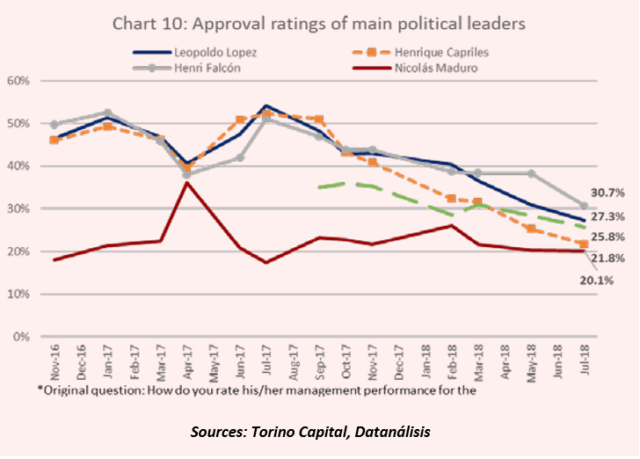
Data from the opposition-aligned pollsters in Venezuela (via Torino Capital) indicates that Henri Falcón was the most popular of the major opposition figures at the time of the May 2018 presidential election. Nicolás Maduro won the election due to widespread opposition boycotting and votes drawn by another opposition candidate, Javier Bertucci.
The constitutional argument that Trump and his accomplices have used to “recognize” Guaidó rests on the preposterous claim that Maduro has “abandoned” the presidency by soundly beating Falcón in the election. Caracas-based journalist Lucas Koerner took apart that argument in more detail.
What about the McClatchy-owned Herald‘s claim that Maduro “continues to reject international aid”? In November 2018, following a public appeal by Maduro, the UN did authorize emergency aid for Venezuela. It was even reported by Reuters (11/26/18), whose headlines have often broadcast the news agency’s contempt for Maduro’s government.
It’s not unusual for Western media to ignore facts they have themselves reported when a major “propaganda blitz” by Washington is underway against a government. For example, it was generally reported accurately in 1998 that UN weapons inspectors were withdrawn from Iraq ahead of air strikes ordered by Bill Clinton, not expelled by Iraq’s government. But by 2002, it became a staple of pro-war propaganda that Iraq had expelled weapons inspectors (Extra! Update, 10/02).
And, incidentally, when a Venezuelan NGO requested aid from the UN-linked Global Fund in 2017, it was turned down. Setting aside how effective foreign aid is at all (the example of Haiti hardly makes a great case for it), it is supposed to be distributed based on relative need, not based on how badly the US government wants somebody overthrown.
But the potential for “aid” to alleviate Venezuela’s crisis is negligible compared to the destructive impact of US economic sanctions. Near the end of Wyss’ article, he cited an estimate from the thoroughly demonized Venezuelan government that US sanctions have cost it $30 billion, with no time period specified for that estimate. Again, this calls to mind the run-up to the Iraq invasion, when completely factual statements that Iraq had no WMDs were attributed to the discredited Iraqi government. Quoting Iraqi denials supposedly balanced the lies spread in the media by US officials like John Bolton, who now leads the charge to overthrow Maduro. Wyss could have cited economists independent of the Maduro government on the impact of US sanctions—like US economist Mark Weisbrot, or the emphatically anti-Maduro Venezuelan economist Francisco Rodríguez.
Illegal US sanctions were first imposed in 2015 under a fraudulent “state of emergency” declared by Obama, and subsequently extended by Trump. The revenue lost to Venezuela’s government due to US economic sanctions since August 2017, when the impact became very easy to quantify, is by now well over $6 billion. That’s enormous in an economy that was only able to import about $11 billion of goods in 2018, and needs about $2 billion per year in medicines. Trump’s “recognition” of Guaidó as “interim president” was the pretext for making the already devastating sanctions much worse. Last month, Francisco Rodríguez revised his projection for the change in Venezuela’s real GDP in 2019, from an 11 percent contraction to 26 percent, after the intensified sanctions were announced.
The $20 million in US “aid” that Wyss is outraged Maduro won’t let in is a rounding error compared to the billions already lost from Trump’s sanctions.
Former US Ambassador to Venezuela William Brownfield, who pressed for more sanctions on Venezuela, dispensed with the standard “humanitarian” cover that US officials have offered for them (Intercept, 2/10/19):
And if we can do something that will bring that end quicker, we probably should do it, but we should do it understanding that it’s going to have an impact on millions and millions of people who are already having great difficulty finding enough to eat, getting themselves cured when they get sick, or finding clothes to put on their children before they go off to school. We don’t get to do this and pretend as though it has no impact there. We have to make the hard decision—the desired outcome justifies this fairly severe punishment.
How does this gruesome candor get missed by reporters like Wyss, and go unreported in his article?
Speaking of “severe punishment,” if the names John Bolton and Elliott Abrams don’t immediately call to mind the punishment they should be receiving for crimes against humanity, it illustrates how well the Western propaganda system functions. Bolton, a prime facilitator of the Iraq War, recently suggested that Maduro could be sent to a US-run torture camp in Cuba. Abrams played a key role in keeping US support flowing to mass murderers and torturers in Central America during the 1980s. Also significant that Abrams, brought in by Trump to help oust Maduro, used “humanitarian aid” as cover to supply weapons to the US-backed Contra terrorists in Nicaragua.
In the Herald article, the use of US “aid” for military purposes is presented as another allegation made by the vilified Venezuelan president: “Maduro has repeatedly said the aid is cover for a military invasion and has ordered his armed forces not to let it in, even as food and medicine shortages sweep the country.”
Calling for international aid and being democratically elected will do as little to protect Maduro’s government from US aggression as being disarmed of WMD did to prevent Iraq from being invaded—unless there is much more pushback from the US public against a lethal propaganda system.
Featured Video
The Sordid History of the CIA – Part 2
or go to
Aletho News Archives – Video-Images
From the Archives
Rabbi Shmuel Eliyahu: Leave No Palestinian or Arab Alive
By Jonas E. Alexis | Veterans Today | July 23, 2017
Israeli Rabbi Shmuel Eliyahu seems to have picked up where the late Rabbi Ovadiah Yosef left off. The Israeli army, Eliyahu said, must slaughter the Palestinians “and leave no one alive.” The Palestinians, the good rabbi continued, must be “destroyed and crushed in order to end violence.” Here is Eliyahu’s algorithm:
“If they don’t stop after we kill 100, then we must kill 1,000. And if they do not stop after 1,000, then we must kill 10,000. If they still don’t stop we must kill 100,000, even a million.”
There is more to this “logic” than meets the eye and ear. Eliyahu even postulated that the Israeli army ought not to get involved in arresting Palestinians because “If you leave him alive, there is a fear that he will be released and kill other people. We must eradicate this evil from within our midst.”
You may say that this is just an isolated case. No Israeli official believes that, right? … continue
Blog Roll
Recent Comments


 Aletho News
- The Sordid History of the CIA – Part 2
- French FM under fire over ‘false’ claims about UN rapporteur
- Israel Wants ISIS-Linked Militias To Control Rafah Crossing — The New Order in Gaza
- ISIS never left Syria, it just changed uniforms
- Why ARE the US and Israel Obsessed With Eliminating Iran’s Ballistic Missiles?
- Kremlin comments on EU ‘myopia’ over dialogue with Russia
- Russia more adapted to contemporary military technology than NATO
- Germany puts caveat on more missiles for Ukraine
- UK High Court rules Palestine Action ban unlawful
- Populations in key NATO nations balk at sacrifices for military spending – poll
- If Americans Knew
- Noor’s short life of unimaginable suffering
- Israel Destroyed Gaza’s Hospitals. Now It’s Banning Doctors Without Borders.
- Is Spite of What Zionists Say, It’s a Good Thing to Criticize Governments
- Palestinian mother, daughter recount strip searches, harsh conditions in Israeli detention
- Israel used weapons in Gaza that made thousands of Palestinians evaporate
- ADL’s Stats Twist Israel’s Critics Into Antisemites
- Why Is the World Silent When the Gaza Genocide Is Not Over?
- In Gaza: 8,000 bodies under rubble, 3,000 missing – Not a ceasefire Day 126
- AZAPAC, the new PAC opposing Israeli domination of U.S policies
- Haim Saban: Billionaire for Israel
- No Tricks Zone
- German Gas Crisis…Chancellor Merz Allegedly Bans Gas Debate Ahead of Elections!
- Pollen Reconstructions Show The Last Glacial’s Warming Events Were Global, 10x Greater Than Modern
- Germany’s Natural Gas Storage Level Dwindles To Just 28%… Increasingly Critical
- New Study Rebuts The Assumption That Anthropogenic CO2 Molecules Have ‘Special’ Properties
- Climate Scientist Who Predicted End Of “Heavy Frost And Snow” Now Refuses Media Inquiries
- Polar Bear Numbers Rising And Health Improving In Areas With The Most Rapid Sea Ice Decline
- One Reason Only For Germany’s Heating Gas Crisis: Its Hardcore-Dumbass Energy Policy
- 130 Years Later: The CO2 Greenhouse Effect Is Still Only An Imaginary-World Thought Experiment
- New Study Affirms Rising CO2’s Greening Impact Across India – A Region With No Net Warming In 75 Years
- Germany’s Natural Gas Crisis Escalates … One Storage Site Near Empty …Government Silent
 Aletho News