Fake Humanitarianism Fails its Big Test in Venezuela
By Maximilian C. Forte | Zero Anthropology | February 24, 2019
There it is: Saturday, February 23, 2019, has now come and gone—and it’s not to say that “nothing has changed”. In fact, some important changes did occur, none of which were the ones hoped for by either the self-declared “president” of Venezuela, Juán Guaidó, nor the ones commanded by the President of the US, Donald “Can I have my Nobel Peace Prize now?!” Trump. US options have thus narrowed, as we enter a protracted and potentially more dangerous phase where possible US military intervention draws closer. So let’s quickly review some of the changes introduced by yesterday’s events.
First, the unelected, self-declared “president” of Venezuela is no longer even in Venezuela. He used the opportunity of the US AID stunt to spirit himself across the border to Colombia, with the apparent well-wishes of ushers in the Venezuelan military (he should have been suspicious, unless he really intended to flee), and Guaidó now finds himself as a tourist in Colombia. Second, the military which Guaidó presumed to order, completely ignored him and remained loyal to the established government, the only legal and legitimate one. Indeed, the third point is that in failing the credibility test, Guaidó also failed the legitimacy test: how can he be viewed as a legitimate leader, without anything to lead, and with none of the state machinery following him? That is not a leader; at best, Guaidó can be defined an aspirant to power. He is a legitimate aspirant. Some in the opposition are already speaking of an alternative deal with the Maduro government. Having failed the credibility and legitimacy tests, a frustrated Guaidó had no option other than to invite foreign military intervention—if his own military won’t listen to him, surely other nations’ militaries will? And what about Richard Branson’s much vaunted aid concert? That takes us to the fourth point: that concert was drowned out, not just by a competing concert on the Venezuelan side of the border, and not just because it failed to draw any major international acts (perhaps thanks to Roger Waters), but the events of the day itself meant that not even a word was mentioned about the concert. It was like it had never happened. The fifth development is probably the most significant: US AID via Colombia, and similar “aid” intrusions from Brazil and Puerto Rico, were a resounding failure. The frustration that had been building up for days about the lack of a viable plan, was well warranted, as was Maduro’s optimism. Not well warranted were the raised expectations.
(Note, while the headline in the The New York Times claims that aid came in via Brazil, its source on the ground instead said, “The whole thing has failed” and the trucks “remained stranded on the border”. The story is misleadingly playing on a technicality: the aid left the Brazilian side of the border, but did not pass the Venezuelan checkpoint.)
What’s Next?
This takes us back to the central question of the previous article: what is the US’ next move? Simply insulting the Venezuelan armed forces, in what some called an “irresponsible speech,” by suggesting they are guilty of dereliction of duty, then insulting them further by saying Cuba directly controls the Venezuelan military, and then insulting them yet again by assuming that they should instead take their orders directly from Washington—will not work, and that much has been proven. Threats to the safety of Venezuelan soldiers only augment the offense. The US, speaking the language of “democracy promotion,” has been openly hoping for a palace coup—no such movement is in evidence however. All we know is that Vice President Mike Pence (who is likely leading the Venezuela intervention to shield Trump from any illegalities likely to be committed) will be meeting with aspirant Guaidó at his new lodgings in Colombia. That, and more sanctions, as if Venezuela’s government expected anything else.
Clearly the obese billionaire in the Oval Office relished the prospect of one day (soon) boasting that he had toppled a “regime” by just throwing some scraps of dog food at the feet of “desperate and starving” Venezuelans. (They just have to be desperate and starving, because their place in the natural order of things is that they are citizens of a “shit hole country”.) It would have pleased him immensely, he would have smiled slyly, to know that a well fed American can dangle a MRE pack in front of “hungry” eyes, and then sit back and listen to them scamper and scuffle. Such images enforce the evolutionist paradigm of progress, development, and global dictatorship. Trump would have told his friends: “You should have seen what happened, I just sent in crap like TV dinners to that shit hole country, and those pathetic losers fell all over themselves to get it, and the regime collapsed. Poof! Beautiful. Then I took their oil”. (The last point is important, because Trump has the ethics of a looter, and his foreign policy is a projection of his business practice: theft, scams, and all sorts of other wrongdoing enough to warrant hiding many years of tax returns behind some old yarn about an audit that is apparently eternal.)
Particularly important about the day’s events was the fact that two partners in an intended coup each failed their respective tests. The US and its regional allies showed that they could not even spirit in some boxes of junk “aid” and that they held no sway over the Venezuelan military. Guaidó failed to show that he commanded any support that mattered. He didn’t even have a few miserable boxes of US aid to selectively hand out to build up a patron-client network. Having auditioned for the role of CIA tool, he only demonstrated he was not worthy of the investment. He then fled. Then the government shut down his rumoured base of operations in Caracas: the Colombian embassy. The US could not have achieved less had it picked up any random person off the streets of Caracas.
Regime Survival Got a Boost
The unintended by-product of the US’ inability to command change, is a recipe for regime survival: everything that Venezuelans suffer from now on can be appropriately and rightly blamed on US intervention; opponents of President Nicolás Maduro can be labelled traitors, CIA proxies, and puppets of Washington, with considerable justification—thanks to US intervention; Venezuela will adapt and survive US sanctions like multiple other states have done; US oil refineries, shipping companies, insurance firms and banks—the other side of Venezuelan exports of oil to the US—will now suffer irreversible loss, and the US thus also loses its chokehold on Venezuela. Rather than American hegemony, it’s multipolarity that is advancing, with Venezuela moving closer into the orbits of Russia, China, and India. (India itself is completely unafraid of US sanctions, according to Indian analysts.) The US, especially under Trump, has responded to almost everything and everyone with either sanctions or their twin, tariffs, to the extent that there is virtually not a nation left on earth that is not subject to some sort of tariff or sanction from the US. The US is sanctioning itself into irrelevance, as the rest of the world devises ways of learning to live without it.
What Did We Not See?
What was strangely absent from the day, in all the live television footage and numerous photographs of the events, were at least two things: one was that however many showed up to back Guaidó, it certainly was not the 700,000 to a million people he had promised. The other was the bizarre absence of any Venezuelan soldiers from virtually all of the photographs and live television coverage. How they could maintain a forceful presence, yet remain invisible to the media, is quite an achievement—one that denies the media any coup-worthy moments of manufactured, orchestrated outrage. Of course what was also absent—and we knew this would be—was any evidence of these supposedly starving Venezuelans. Having grown up in a society saturated with media images of the now classic “starving Ethiopian,” emaciated bodies with distended bellies, it’s noteworthy that the coup media cannot pull off such a display with Venezuela—that would be the same Venezuela with the supermarkets stuffed with goods.
Beware of Alternative “Fake News”
These postscripts are intended as memoranda to RT, CNN, and others: please check your sources for the claim that former US Assistant Secretary of State Elliot Abrams was involved in actually smuggling in weapons in the guise of humanitarian aid. However appealing that image may be, it is a dorky and corny tale that arouses suspicion. It generally does not pass the smell test—check the last two links for further insight, and also see the Wikipedia page. Abrams was, after all, a State Department official, and not a field operative. In addition, he is being blamed for the operations that were conducted by Lt. Col. Oliver North and the CIA. The “humanitarian aid” disguise was aimed at the US Congress: Congress appropriated funds for humanitarian aid, and some of the funds were misused to arm the Contras illegally. It was no secret that the US was arming the Contras either—they were backed by the US, and they were armed. Most of that aid went to US bases in El Salvador and Honduras (US allies), where there was no need to “disguise” the aid, and it went to the Contras, a military force—again no need to disguise the aid. It’s not like Abrams called Contra leaders and surprised them: “We’re sending you some bags of rice. Or are we? Wink, wink”. They certainly were not fooling Nicaragua’s government, nor did Nicaragua allow in any such “aid” only to somehow find out it was not real humanitarian aid at all—that never happened. Nicaraguan authorities did capture a US pilot, after an illegal flight resulted in a crash inside Nicaragua, revealing the contents of what the US was sending the Contras: weapons, when Congress had banned military aid to the Contras. Abrams was just one figure among many in the story, and not the most directly involved.
The “Trojan Horse” charge is thus being misinterpreted and turned into something laughable. No serious person thinks the US was trying to smuggle in weapons in US AID boxes, in front of thousands of cameras in the plain light of day. That’s why not-so-secret flights exist instead. The “Trojan Horse” idea instead seems to be a little too complicated for the media which prefers a cartoonish rendition. The serious argument is that the aid was intended to shore up Guaidó’s power, since the aid was going directly to the opposition; and, the aid expressly bypassed the legal and legitimate government authorities of Venezuela, and was thus meant to undermine their authority. Furthermore, Guaidó spoke of the “aid” effort as being one that would create a “humanitarian corridor”—echoing terminology used by the US in Syria—and which would have meant wresting territory from the hands of the Venezuelan state, thus allowing the US free passage in and out at will. In addition, the hoped-for clash (which did not materialize to the extent that was feared) could have served as a pretext for warming up international opinion in favour of a US military “rescue”. That’s the extent of the Trojan Horse in this case—it’s not about grenades inside bags of rice. Otherwise President Nicolás Maduro did not “reject” any so-called “aid” from the US, because none had been given to him. The only thing the Venezuelan government did was to block its borders from being used for illegal purposes by foreign powers—its sovereign right. It did so, and it won.
Also tenuous is the story, repeated on RT several times now, that seems to take great joy in upbraiding rivals like CNN for reporting that Venezuelan authorities had “closed” the Tienditas bridge, built in 2016 and supposedly never opened (a bridge to nowhere?). Venezuelan authorities did in fact move containers to block that bridge, and were recorded doing so by Colombian authorities on February 5, of this year. Moreover, and this is the more important point: Maduro repeatedly said any attempt to move the aid into Venezuela would be blocked. There was never even the slightest hint that Maduro would just stand aside and let it pass. It seems that some foreign journalists are divided by their partisan loyalties and create the appearance of wanting to have their cake and eat it too: the humanitarian aid is not for humanitarian purposes, and has been denounced by several of the leading international humanitarian aid agencies, but it’s not like Venezuela shut down a bridge to prevent aid from reaching suffering masses—this seems to be their odd narrative, designed to satisfy multiple competing constituencies. The events of February 23 will hopefully clarify any lingering misinterpretations, on any side.
Venezuela Coverage Takes Us Back to Golden Age of Lying About Latin America
By Mark Cook | FAIR | February 22, 2019
I was sitting in my apartment in Caracas, Venezuela, reading the online edition of Time magazine (5/19/16), which carried a report that there was not even something as basic as aspirin to be found anywhere in Venezuela: “Basic medicines like aspirin are nowhere to be found.”
I walked out of the apartment to the nearest pharmacy, four blocks away, where I found plenty of aspirin, as well as acetaminophen (generic Tylenol) and ibuprofen (generic Advil), in a well-stocked pharmacy with a knowledgeable professional staff that would be the envy of any US drugstore.
A few days after the Time story, CNBC (6/22/16) carried a claim that there was no acetaminophen to be found anywhere, either: “Basic things like Tylenol aren’t even available.” That must have taken the Pfizer Corporation by surprise, since it was their Venezuelan subsidiary, Pfizer Venezuela SA, which produced the acetaminophen I purchased. (Neither Time writer Ian Bremer nor CNBC commentator Richard Washington was in Venezuela, and there was no evidence offered that either of them had ever been there.)
I purchased all three products, plus cough syrup and other over-the-counter medications, because I doubted that anyone in the United States would believe me if I couldn’t produce the medications in their packages.
Unrelenting drumbeat of lies
In fact, I myself wouldn’t have believed anyone who made such claims without being able to produce the proof, so intense and unrelenting has been the drumbeat of lies. When the Youth Orchestra of Venezuela gave a concert in New York in early 2016, before I moved to Caracas, I went there thinking, “Gee, I hope that the members of the orchestra are all well-dressed and well-fed.” Yes, of course they were all well-dressed and well-fed!
When I mentioned this in a talk at the University of Vermont, a student told me that he’d had the same feeling when he was following the Pan American soccer championship. He wondered if the Venezuelan players would be able to play, because they’d be so weakened from lack of food. In fact, he said, the Venezuelan team played superbly, and went much further in the competition than expected, since Venezuela has historically been a baseball country, unlike its soccer-obsessed neighbors Brazil and Colombia.
Hard as it may be for followers of the US media to believe, Venezuela is a country where people play sports, go to work, go to classes, go to the beach, go to restaurants and attend concerts. They publish and read newspapers of all political stripes, from right to center-right, to center, to center-left, to left. They produce and watch programs on television, on TV channels that are also of all political stripes.
CNN was ridiculed recently (Redacted Tonight, 2/1/19) when it carried a report on Venezuela, “in the socialist utopia that now leaves virtually every stomach empty,” followed immediately with a cut to a demonstration by the right-wing opposition, where everybody appeared to be quite well-fed.
But surely that’s because most of the anti-government demonstrators were upper-middle class, a viewer might think. The proletarians at pro-government demonstrations must be suffering severe hunger.
Not if one consults photos of the massive pro-government demonstration on February 2, where people seemed to be doing pretty well. This is in spite of the Trump administration’s extreme economic squeeze on the country, reminiscent of the “make the economy scream” strategy used by the Nixon administration and the CIA against the democratic government of President Salvador Allende in Chile, as well as many other democratically elected governments.
Rival demonstrations
That demonstration showed considerable support for the government of President Nicolás Maduro and widespread rejection of Donald Trump’s choice for president of Venezuela, Juan Guaidó.
Guaidó, who proclaimed himself to be president of the country and was recognized minutes later by Trump, even though a public opinion poll showed that 81 percent of Venezuelans had never heard of him, comes from the ultra-right faction in Venezuelan politics.
The pro-Maduro demonstration suggested, not surprisingly, that Guaidó had failed to win much popular support outside the wealthy and upper-middle class. But Guaidó couldn’t even win support from many of them. The day before rival rallies February 2, Henrique Capriles, the leader of a less extreme right-wing faction, gave an interview to the AFP that appeared in Últimas Noticias (2/1/19), the most widely read newspaper in Venezuela. In it, Capriles said that most of the opposition had not supported Guaidó’s self-proclamation as president. That may explain the surprisingly weak turnout at Guaidó’s demonstration, held in the wealthiest district of Caracas, and obviously outshone by the pro-government demonstration on the city’s main boulevard.
The New York Times did not show pictures of that pro-government demonstration, limiting itself to a claim by unnamed “experts” (2/2/19) that the pro-government demonstration was smaller than the anti-government one.
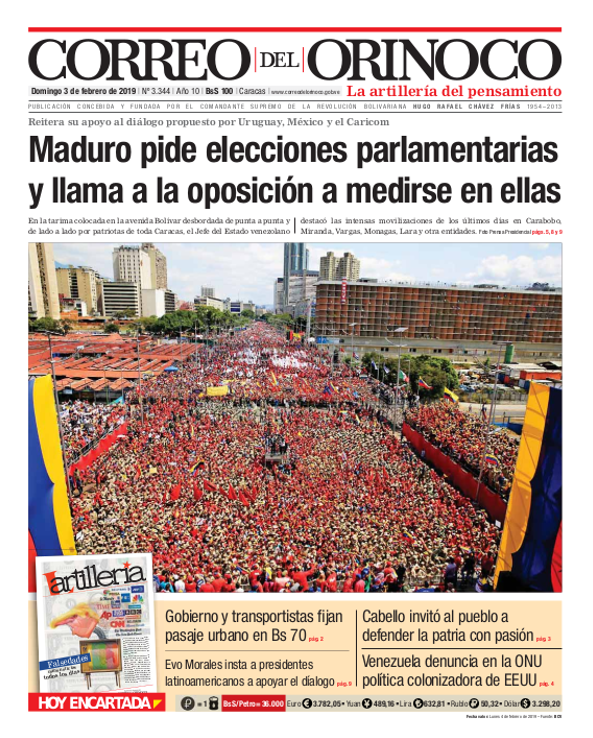
Readers can look at the photos of the rival demonstrations and judge for themselves. Both groups did their best to pull out their faithful, knowing how much is riding on a show of popular support. The stridently right-wing opposition paper El Nacional (2/3/19) carried a photo of the right-wing opposition demonstration:
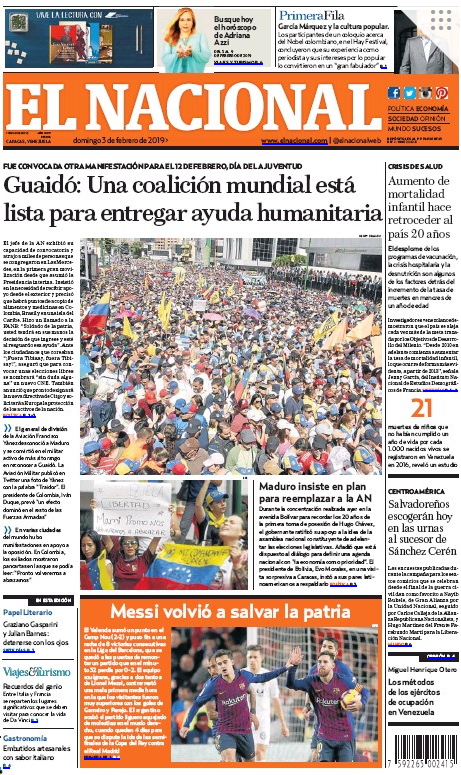
If that was the best photo it could find, it was remarkably unimpressive compared to the photos in the left-wing papers CCS (2/2/19)….
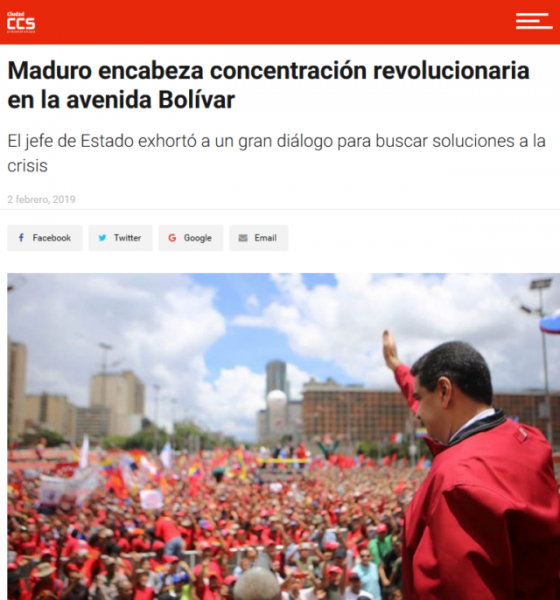
… and Correo del Orinoco (2/3/19), which were only too happy to publish pictures of the pro-government event:
Unlikely humanitarian
A huge anti-government demonstration was supposed to make possible a coup d’état, a maneuver the CIA has used repeatedly—in Iran in 1953, Guatemala in 1954, Brazil in 1964 and many more, straight through to Honduras in 2009 and Ukraine in 2015. The turnout at the Trump administration’s demonstration was disappointing, and the coup d’état never occurred. The result is that Trump has expressed a sudden interest in getting food and medicine to Venezuelans (FAIR.org, 2/9/19).
Trump, who let thousands die in Puerto Rico and put small children in cages on the Mexican border, seems to be an unlikely champion of humanitarian aid to Latin Americans, but the corporate media have straight-facedly pretended to believe it.
Most have suppressed reports that the Red Cross and the UN are providing aid to Venezuela in cooperation with the Venezuelan government, and have protested against US “aid” that is obviously a political and military ploy.
The corporate media have continued to peddle the Trump-as-humanitarian-champion line, even after it was revealed that a US plane was caught smuggling weapons into Venezuela, and even after Trump named Iran/Contra criminal Elliott Abrams to head up Venezuelan operations. Abrams was in charge of the State Department Human Rights Office during the 1980s, when weapons to US-backed terrorists in Nicaragua were shipped in US planes disguised as “humanitarian” relief.
Canada’s CBC (2/15/19) at least had the honesty to acknowledge that it had been had in swallowing a lie from Secretary of State Mike Pompeo that the Venezuelan government had blockaded a bridge between Colombia and Venezuela to prevent aid shipments. The newly built bridge has not yet been opened: it has never been open, apparently because of hostile relations between the two countries, but the non-opening long predates the US government’s alleged food and medicine shipments.
The absurdity of $20 million of US food and medicine aid to a country of 30 million, when US authorities have stolen $30 billion from Venezuela in oil revenue, and take $30 million every day, needs no comment.
‘Failed state’
The campaign of disinformation and outright lies about Venezuela was kicked off in 2016 by the Financial Times. Ironically, it chose the 14th anniversary of the 2002 failed coup d’etat against President Hugo Chávez—April 11, 2016—to claim that Venezuela was in “chaos” and “civil war,” and that Venezuela was a “failed state.” As with the Time and CNBC reports, the Financial Times reporter was not in Venezuela, and there was no evidence in the report that he had ever been there.
I asked right-wing friends in Venezuela whether they agreed with the Financial Times claims. “Well, no, of course not,” said one, stating the obvious, “there is no chaos and no civil war. But Venezuela is a failed state, since it has not been able to provide for all the medical needs of the population.” By that standard, every country in Latin America is a failed state, and obviously the United States too.
The New York Times has run stories (5/15/16, 10/1/16) claiming that conditions in Venezuelan hospitals are horrendous. The reports enraged Colombians in New York, who have noted that a patient can die on the doorstep of a Colombian public hospital if the patient has no insurance. In Venezuela, in contrast, patients are treated for free.
One Colombian resident in New York said that his mother had recently returned to Bogotá after several years in the United States, and had not had time to obtain medical insurance. She fell ill, and went to a public hospital. The hospital left her in the waiting room for four hours, then sent her to a second hospital. The second hospital did the same, leaving her for four hours and then sending her to a third hospital. The third hospital was preparing to send her to a fourth when she protested that she was bleeding internally and was feeling weak.
“I’m sorry, Señora, if you don’t have medical insurance, no public hospital in this country will look at you,” said the woman at the desk. “Your only hope is to go to a private hospital, but be prepared to pay a great deal of money up front.” Luckily, she had a wealthy friend, who took her to a private hospital, and paid a great deal of money up front.
Such conditions in Colombia and other neoliberal states go unmentioned in the US corporate media, which have treated the Colombian government, long a right-wing murder-squad regime, as a US ally (Extra!, 2/09).
Well, OK, but are the reports of conditions in Venezuelan hospitals true or grossly exaggerated? “They are much better than they were ten years ago,” said a friend who works in a Caracas hospital. In fact, he said, ten years before, the hospital where he worked did not exist, and new hospitals are now being opened. One was dedicated recently in the town of El Furrial, and another was opened in El Vigia, as reported by the centrist newspaper Últimas Noticias (3/3/17, 4/27/18). The government has also greatly expanded others, like a burn center in Caracas and three new operating rooms at the hospital in Villa Cura.
Meanwhile, the government is inaugurating a new high-speed train line, The Dream of Hugo Chávez, in March (Correo del Orinoco, 2/6/19). Since the US media have never allowed reporting on any accomplishments in the years since Chávez took office in 1999, but only any alleged, exaggerated or, as noted, completely invented shortcomings, readers have to consult an alternative history. Here is one offered by a Venezuelan on YouTube (3/31/11): “Por Culpa de Chávez” (“It’s Chávez’s Fault”). Depicting new hospitals, transit lines, housing, factories and so on built under Chavismo, it might help many understand why the Maduro government continues to enjoy such strong backing from so many people.
Economic warfare
This is not to minimize Venezuela’s problems. The country was hit, like other oil-producing countries, and as it was in the 1980s and ’90s, by the collapse of oil prices. That failed to bring down the government, so now the Trump administration has created an artificial crisis by using extreme economic warfare to deprive the country of foreign exchange needed to import basic necessities. The Trump measures seem designed to prevent any economic recovery.
Like any country at war (and the Trump administration has placed Venezuela under wartime conditions, and is threatening immediate invasion), there have been shortages, and products that can mostly be found on the black market. This should surprise no one: During World War II in the US, a cornucopia of a country not seriously threatened with invasion, there was strict rationing of products like sugar, coffee and rubber.
The Venezuelan government has made food, medicine and pharmaceuticals available at extremely low prices, but much of the merchandise has made its way to the black market, or over the border to Colombia, depriving Venezuelans of supplies and ruining Colombian producers. The government recently abandoned some of the heavy price subsidies, which resulted initially in higher prices. Over the past few weeks, prices have been coming down as supplies stayed in Venezuela, especially as the government gained greater control over the Colombian border to prevent smuggling.
There has never been a serious discussion of any of this in the US corporate media, much less any discussion of the campaign of lies or the Trump administration warfare. There has been no comparison with conditions in the 1980s and ’90s, when Venezuela’s neoliberal government imposed IMF economic recipes, resulting in a popular rebellion, the bloody 1989 Caracazo, when wholesale government repression took the lives of hundreds (according to the government at the time) or thousands (according to government critics), and martial law took the lives of many more.
Efforts by the right-wing opposition to provoke a similar uprising, and another Caracazo that could justify a foreign “humanitarian intervention,” have failed repeatedly. So the US administration and corporate media simply resort to the most extreme lying about Latin America that has been seen since the Reagan administration wars of the 1980s.
Venezuela Denounces 2nd False Flag Operation at Colombia Border
teleSUR | February 23, 2019
A new episode in the false flag operation being waged against the Venezuelan government to justify a foreign intervention, happened on the Francisco de Paula Santander International Bridge that links Venezuela and Colombia.
Two out of the four trucks with alleged “humanitarian aid” from USAID, which were trying to illegally enter Venezuela, were burned at the border between the two countries. The burning trucks were on the Colombian side of the Francisco de Paula Santander Bridge where Venezuelan opposition leaders have been leading protests.
According to witnesses, violent right-wing opposition members torched the trucks with Molotov cocktails and then tried to incriminate the Bolivarian National Guard (GNB) and the Bolivarian National Police (PNB). teleSUR’s Madelein Garcia, reported that the trucks were supposedly trying to enter Venezuela, but were then burned on the part of the bridge that belongs to Colombia.
The version of events saying that the trucks burned due to a “teargas bomb”, which are not incendiary devices, has been circulating on Colombian and international media networks and on social media.
In addition, some people were trying to illegally enter Venezuela using Red Cross jackets, despite not being affiliated with the international medical organization. The Red Cross has already officially rejected these attempts by the U.S. to deliver politicized “humanitarian aid.”
The International Federation of Red Cross and Red Crescent Societies has stated on its certified Twitter account that they have noticed “some people not affiliated with Red Cross Colombia and Red Cross Venezuela wearing Red Cross emblems at the Colombia-Venezuela and Brazil-Venezuela border.”
The International organization has urged these people ” to stop doing this. They might mean well but they risk jeopardizing our neutrality, impartiality & independence.”
Also Saturday morning another false flag operation was denounced by the Venezuelan government. A group of low-level soldiers of the Venezuelan National Guard Saturday took over multiple armored vehicles that belong to the Venezuelan army and rammed them into border barriers at the Venezuelan-Colombian border in a staged operation ordered by right-wing opposition members in Colombia.
During a massive demonstration in favor of peace and democracy in Venezuela, President Nicolas Maduro declared the coup d’etat defeated because of the unity of civil society with the military.
Venezuela: An Open Letter to the UN Secretary General

Alfred de Zayas, human rights lawyer & UN independent expert on international order. His report on Venezuela has been buried by the MSM.
OPEN LETTER TO THE UNITED NATIONS SECRETARY GENERAL ANTONIO GUTERRES
AND TO THE HIGH COMMISSIONER FOR HUMAN RIGHTS MICHELLE BACHELET
from Alfred de Zayas, 23 February 2019
Dear Michelle Bachelet,
Dear Antonio Guterres
As former UN Independent Expert on the Promotion of a Democratic and Equitable International Order (2012-2018) I would like to urge you to once again make your voices heard and make concrete proposals for mediation and peace in the context of the Venezuelan crisis.
The most noble task of the United Nations is to create the conditions conducive to local, regional and international peace, to work preventively and tirelessly to avoid armed conflicts, to mediate and negotiate to reach peaceful solutions, so that all human beings can live in human dignity and in the enjoyment of the human right to peace and all other civil, cultural, economic, political and social rights. I am particularly worried by the Orwellian corruption of language, the instrumentalization and weaponization of human rights and now even of humanitarian assistance.
I look back at my UN mission to Venezuela in November/December 2017 as a modest contribution to facilitate the cooperation between the United Nations and the Venezuelan government and to open the door to the visits of other rapporteurs. See my report to the UN Human Rights Council and the relevant recommendations.
I believe that it would be timely and necessary for both of you to issue a statement reaffirming General Assembly Resolutions 2625 and 3314 and the 23 Principles of International Order that I formulated in my 2018 report to the Human Rights Council. See para 14 of [the report].
It would be appropriate to recognize the fact that the government of Venezuela has put into effect some of the recommendations contained in my report — and in the six page confidential memo that I personally gave to Foreign Minister Jorge Arreaza upon my departure.
Indeed, first the Venezuelan government released 80 detainees — including Roberto Picón and 23 others whose release I had specifically requested — that was on 23 December 2017, followed by other releases in the course of 2018. Alas, there has been practically no information about this in the mainstream media, although it is easily accessible in the internet. See also the comments of Venezuela on my report.
In particular paragraph 46(xvi):
As a result of this on 23 December 2017, 80 people arrested for acts of violence during the protests in the country were released; and on 1 June 2018, 39 more people were released.
And paragraph 46(xviii):
In this regard, the Venezuelan Government values the willingness and disposition of the Independent Expert, who was pleased to inform the competent authorities of the requests he received from some relatives of the persons deprived of their liberty. His recommendations were accepted.
Shortly after my visit Venezuelan authorities met with the UN agencies and made additional cooperation accords, thanks to the valuable efforts Peter Grohmann, the UNDP representative in Caracas.
Now the government of Venezuela has formally asked the United Nations for humanitarian assistance in connection with the current crisis. We must not let them down.
I think that the US should turn over all the humanitarian assistance and medical supplies it has flown into Colombia and have them distributed as soon as possible with the help of the United Nations and other neutral organizations, including the International Committee of the Red Cross.
Another item of information that is sorely missing from the mainstream media is the delivery last week of 933 tons of food and medicines at port La Guaira — coming from China, Cuba, India, Turkey etc.
Moreover an additional 300 tons of medicines and medical supplies provided by Russia arrived by air.
As I know from my conversations with Venezuelan ministers during my visit in 2017 and the recent conversations I have had with Venezuelan Ambassador to the UN in Geneva Jorge Valero – Venezuela has always welcomed and repeatedly asked for assistance from neutral and friendly governments so as to overcome the adverse human rights impacts of the financial blockade and the sanctions. Such help should be offered in good faith, without strings attached.
I believe that this is the moment for Michelle Bachelet to accept the invitation of the government of Venezuela, extended to her in December 2018, to visit Venezuela personally. Her presence in Venezuela should ban the growing danger of a military intervention by foreign entities. She should endorse the efforts at mediation launched by Mexico and Uruguay at the Montevideo mechanism.
There are ominous parallels with the run-up to the Iraq invasion in 2003 — an illegal war, as Kofi Annan said on repeated occasions.
It is obvious to any first year law student that the constant threats against Venezuela are contrary to article 2(4) of the UN Charter. What many do not realize is that the threats, the economic war, the financial blockade and the sanctions violate the principles contained in Article 3 of the OAS Charter
e. Every State has the right to choose, without external interference, its political, economic, and social system and to organize itself in the way best suited to it, and has the duty to abstain from intervening in the affairs of another State. Subject to the foregoing, the American States shall cooperate fully among themselves, independently of the nature of their political, economic, and social systems; f. The American States condemn war of aggression: victory does not give rights; g. An act of aggression against one American State is an act of aggression against all the other American States; h. Controversies of an international character arising between two or more American States shall be settled by peaceful procedures; I. Social justice and social security are bases of lasting peace…
Moreover, they violate numerous articles of Chapter 4 of the OAS Charter,
Article 17
Each State has the right to develop its cultural, political, and economic life freely and naturally. In this free development, the State shall respect the rights of the individual and the principles of universal morality.
Article 18
Respect for and the faithful observance of treaties constitute standards for the development of peaceful relations among States. International treaties and agreements should be public.
Article 19
No State or group of States has the right to intervene, directly or indirectly, for any reason whatever, in the internal or external affairs of any other State. The foregoing principle prohibits not only armed force but also any other form of interference or attempted threat against the personality of the State or against its political, economic, and cultural elements.
Article 20
No State may use or encourage the use of coercive measures of an economic or political character in order to force the sovereign will of another State and obtain from it advantages of any kind.
Dear Michelle Bachelet, dear Antonio Guterres: The world looks up to you in the hope that you can avert even greater suffering to the peoples of Venezuela. They need international solidarity as expressed in the report of Virginia Dandan, the then independent expert on human rights and international solidarity.
I remain respectfully yours
Professor Dr. Alfred de Zayas, Geneva School of Diplomacy
Red Cross denounces unsanctioned use of its emblems to smuggle US aid to Venezuela
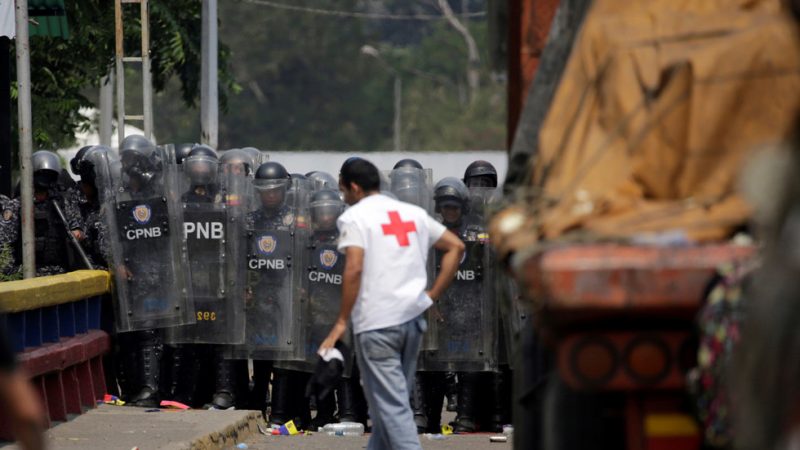
Security forces block the Francisco de Paula Santander bridge between Colombia and Venezuela © Reuters / Marco Bello
RT | February 23, 2019
The largest international aid organization has demanded that activists at the Venezuela-Colombia border not use the insignia of the Red Cross, which isn’t participating in what Caracas has dismissed as a US “propaganda show.”
The Red Cross learned that some “people not affiliated” with the agency are trying to disguise themselves as aid workers to smuggle cargo for Venezuela’s opposition across the closed frontiers.
“They might mean well but they risk jeopardizing our neutrality, impartiality & independence,” the International Federation of Red Cross and Red Crescent Societies said.
Earlier, Venezuelan Foreign Minister Jorge Arreaza stressed that the UN and the International Red Cross are not participating in the “propaganda show” staged by the United States. “It is clearly an action with political objectives, it could never be described as a humanitarian action,” he said on Twitter, accusing the governments involved in the US plot of violating the principles of the UN charter.
The government of Nicolas Maduro has sealed off the borders with neighboring Colombia, Brazil and the Dutch island of Curacao, trying to prevent US shipments from entering the Latin American State. Caracas denounced the ‘aid’ as a highly-publicized attempt to foster division and chaos, and possibly to use it as a cover to smuggle arms to the country’s opposition.
What Strange Corruption
The Racist Venezuelan Bourgeoisie’s Accusations Against Chavistas Are Pure Projection
By Sassy Sourstein | Cien Flamingos | February 21, 2019
Social media truly is the great democratizer. Where else can Twitter trolls and bot armies create a web of baseless rumors that make their way into the empire’s leading publications? For example:
“Maduro is a murdering criminal starving Venezuelan children while he loots the country like Chavez did. When supposed socialist Chavez died the richest Venezuelan in the world was his daughter w billions. Same w Maduro. Looting Venezuelan wealth. Giving it to himself & Cuba!” (source)
So much to unpack, but this is a template used throughout social media in various forms. Make unsourced allegations of mass murder, purposeful starvation (especially of The Children), corruption, and looting. This is a more sophisticated version (really!) in which Chávez is separated from socialism with the word “supposed,” meant to give the accuser some leverage on the left. You see, corruption is what ails Venezuela, not socialism necessarily. Much of the rest has been thoroughly debunked — there is a crime problem but no death squads, there have been a few dozen deaths in years of violent right-wing riots but no campaign of official slaughter of “protesters,” and frankly Cuba has paid for its oil many times over with solidarity and other material support to poor Venezuelans. What persists — in right-wing AND left narratives — is the corruption boogeyman. The tweet above is truly tapping into a rich vein of existing ultraleftism, in which the Bolivarian revolution isn’t socialist at all, but merely an emerging, competing bourgeoisie. I hope here to discuss and counter just some of this bullshit.
First, the claims about the Chávez family are based on the thinnest, most laughable evidence. For Hugo himself, the British tabloid Daily Mail cites a “respected analyst” from a fake “criminal justice” outfit run by a guy with 300 followers. Twitter user Bernardo Canto did the research on this lie and traced it back to a Scribd post devoid of citation or source material. Apart from that, there is absolutely zero evidence that Chávez “died rich,” as they say — which is a pretty idiotic way to do massive corruption.
As for María Gabriela Chávez, why, there must be reams of evidence against her. Well. Get a load of this.
Canto delved into these accusations uncritically published all over corporate media, including Forbes. The claim in Forbes is credited to known CIA front Diario Las Americas, based in Miami, which, “as it happens,” is now owned since 2013 by the Venezuelan backers of opposition presidential candidate Henrique Capriles, himself accused of corruption by the Maduro administration.
It all literally boils down to a receipt shown on a tabloidy TV news show whose host is a Cuban-American Republican who ran for Congress to represent Miami. That receipt? Look for yourself:
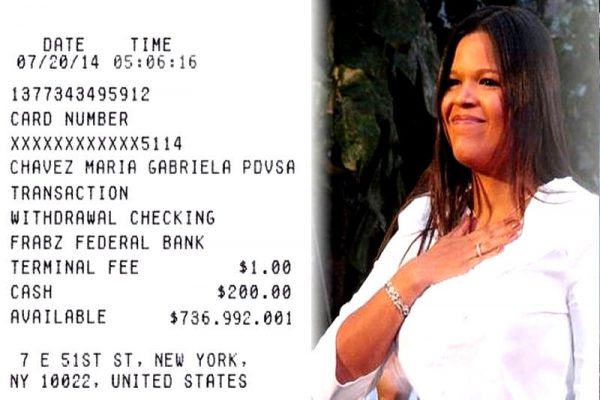
If you think that, within the United States, ATM receipts say at the bottom “United States,” well, charitably, you’ve never used an ATM here. And the address is that of the Venezuelan consulate, not any bank. Another mistake made on this truly pathetic fabrication, is that in the US we use commas, not periods, to denote whole numbers. Of course there is no way to verify if this is Amb. Chávez’s card number, and the scammer who made this knows at least that. Aporrea already debunked this — there is no “Frabz Federal Bank,” as any US resident or a quick Google search will tell you. Frabz is literally a fake ATM receipt generator. Nevertheless, Diario Las Americas claims that the reporting of supermarket-tabloid caliber blog Maduradas.com is “precise and trustworthy,” which of course makes any claim of journalistic rigor in that entire operation a preposterous notion.
Endless insinuations of impropriety against Venezuelan officials litter the internet from troll comments on up to The New York Times. The Atlantic published a particularly nasty set of libels against María Gabriela Chávez, all caged in careful transitions and caveats so as not to actually be required to provide proof. Everything from how much public money she spends (even though she’s a billionaire!) to alleged import corruption (again with no evidence provided) to comments on her musical ability. It even gives credence to a conspiracy theory that her ambassadorship was given so that Cuba would have a trojan-horse advocate at the UN. This is pure smear, a series of fevered speculations, and yet there it is in a leading light of the liberal media.
The rest of the Chávez and Maduro clans’ children are targets as well. Check out this nutty Daily Mail post published presumably to contribute wind to the sails of the ongoing coup attempt. All the María Gabriela claims are breezily restated with no attempt to corroborate, but the “accusations” against her youngest sister Rosinés are uh… well she held up “a fistful of dollar bills” — yes, ONE-dollar bills — and well, goes to school in Paris where, we are assured, she is “care free.” And then of course there’s the time Maduro stopped in Turkey to eat a steak, which is outrageous for the president of a country on his way home from trade talks in China. Diosdado Cabello, a leading PSUV member and one of Chavismo’s most efficacious orators, is mentioned for being accused by the US government of drug running but even this is admitted to be unproven. (More on narco allegations in a future post.) Cabello’s daughter Daniela is mentioned because she is pretty. Yes really. The first lady Celia Flores’s children are said to have spent $45,000 at a hotel in Paris, though the claim seems to originate with a Spanish tabloid that did some paper napkin math and has absolutely no sources whatsoever to confirm any of it — assuming the stay itself even happened.
If Maduro has a billion dollars, if Chávez had two to four — depending on whom you ask — billion fucking dollars, why would they stick around Venezuela suffering endless ridicule, threats and even attempts on their lives, and the general stresses of being responsible for the running of an entire country? Is it just megalomania against all odds? Do you think Maduro feels powerful against all that he has to deal with right now? The prospect is risible, they could buy an entire country with that amount of money and yet there they stay, ready to go down with the ship if the empire torpedoes it. What strange corruption! Something isn’t adding up, probably because it’s all lies. We should apply a high level of skepticism to any claim we see about the empire’s targets, especially if they’re at the top of the news cycle.
There’s also the matter of the so-called Bolibourgeoisie, nouveau-riche types who are said to have leveraged the revolution for personal gain. It’s no secret that — especially after the 2002 coup — the Bolivarian project created a tactical alliance with certain business interests in the country. But reports detailing the purported gluttony and profligacy rarely name anyone and make it clear that this “plugged in” wealthy set is just a consequence of 70% of the Venezuelan economy remaining in private hands. Companies that contract with the state are, of course, compensated, as they are anywhere in the world. These private companies are for profit and these profits are, of course and unfortunately, distributed to the owners and as in any capitalist society, they are free to use this wealth for any idiotic frivolous thing they please.
From personal experience living in Miami, an old-guard Venezuelan typically makes a judgement on the “legitimacy” of the wealth of say, someone exiting an expensive car based on their complexion and features. Darker and more native-featured people are assumed to be Bolibourgeois. They’ve done nothing different from a typical businessman — the white expats are just mad that black and indigenous people may have muscled their way into what should be a purely European- or Arab-descended endeavor.
There’s no evidence that these “plugged-ins” are responsible for the economic problems in Venezuela. After all, some of the most famous episodes of Latin American corruption and economic upheaval happened during the IMF-obedient regimes of the 1990s in which populist polices were rolled back, privatization ran rampant, and austerity reigned.
Real corruption is when you warehouse food to create artificial scarcities and deliberately provoke hunger. The parties who are purposely starving the Venezuelan people are the same types as in Chile who stoked privation and misery in the campaign to overthrow Allende. In Chile we know they were kept solvent by CIA money, and we can assume the same sorts of economic support exists in the case of Venezuela. In addition to smaller importers and producers being able, through whatever means, to create very telegenic scarcities of certain products, there are conglomerates whose resources are deeper, and in whose interests an overthrow is even more intensely represented, than what is available from US intel schemes.
Empresas Polar, makers of the ubiquitous harina PAN used in every single household to make arepas, has had it out for the Revolution from day one. Despite state and communal efforts to break their stranglehold on the corn flour market, their generations-deep imprint on the Venezuelan household rich and poor has persisted. If anyone “retains the ability to keep its products off the shelves just as readily as its ability to keep them on,” it’s La Polar. This is due to their still-gigantic home market share and, ironically, their being a major beneficiary of Venezuelan state subsidies for food importation. In addition, Polar’s various corporate vehicles in the US benefit from United States subsidies on corn for their many products which are sold in a growing market of quite affluent Venezuelans in the US. With all these resources at its disposal, creating artificial scarcities in a comparatively low-revenue market would be a minor line-item on Polar’s books.
There’s also the phenomenon of the “raspao,” or scrape. I don’t pretend to understand all the ways that currency can be manipulated, but merely printing too much money isn’t responsible for a one-million-percent unofficial inflation rate. For many years the Venezuelan state offered USD at an official exchange rate, for imports and travel, etc. People could buy dollars at this official rate with credit cards and then immediately convert these dollars back into bolivares in the black market — instant profit. On a trip to Mexico City last year I had a Mexican tell me with great excitement about how local Venezuelan friends of his who were involved in the scam used the profits to live well in the most exclusive neighborhoods. While the practice seems to have been curbed in recent years, the damage to the currency rate is done and the tightening sanctions compound it. I can only speculate, but with probably more certainty than a Eurotrash tabloid, that some of my Venezuelan neighbors themselves started their own nest eggs by ripping off their country. This truly is corruption, and though official currency policy is what facilitates it, it’s private criminals who take advantage, destroying their country’s economy while they live it up in exile.
The ultimate corruption is when you make millions through inheritance and other people’s labor. The accusations of the elites of Venezuela are a form of projection: they are the corrupt parasites who for generations have fed off the productive people of Venezuela, as in all nations. The same author as the Atlantic Chávez smear list — proud putchist! — has an entire post about the watches worn by some Venezuelan politicians, potentially the most news-unworthy subject of all time. The charge, of course, is “hypocrisy”: lol look at the socialists having quality timepieces! Yet when the idle scions of the Venezuelan elite themselves own safes full of jewels, several luxury cars, houses across the world, this is fine because there’s no hypocrisy involved — they never pretended to care about another soul on this planet but their own. There has never been a cynicism so toxic, so deep.
When “opposition” supporters, in between #SOS posts on Instagram, post stories of themselves on their yachts in Aruba, or their family farm in the mountains, or their beach house in Isla Margarita, or flaneuring around Barcelona and Madrid, are we meant to consider this a life of suffering? If they’re doing this, who is “earning” the money they draw to pay for these extravagances most people on earth — let alone Venezuela — can’t afford? This is corruption in every sense of the word: an indolent, lazy, entitled, racist caste of princes and princesses living off interest in foreign banks made from exploiting generations of poor workers going back into the times of chattel slavery and primitive accumulation. What is “nepotism” if not passing immense ill-gotten fortunes and estates to your children? What makes a country-club brat particularly adept at guiding such large agglomerations of the national wealth?
And even if it’s not strictly corruption, there is a certain moral emptiness to receiving a free education in Venezuela and then immediately going abroad to use your degree for personal gain, as many have done. These people are true leeches, not those demanding a fairer share of the national produce they helped create.
We also know that they consider “corruption” — or at least the even more vague “waste” — to include the building of 2.5 million homes, universities, collective farms, markets, food programs, medical facilities. To the bruised egos of the waning nobles, it’s unconscionable to give literal peasants a boost up from the dirt floor.
Listen when they talk:
“From 1999 through 2013, Venezuela collected $1.3 trillion in oil revenues but it largely has vanished through corruption, MASSIVE SOCIAL SPENDING, and waste”https://t.co/Wf6pK2jOt4
— Petro Populist (@RancidSassy) February 1, 2019
All this is why we hear so much about “corruption” in Venezuela: an utterly worthless class of human beings is angry that some small share of the wealth they used to skim exclusively for themselves is now being distributed with just a bit more equity across social lines.
Local issues of corruption, whatever they consist of, are for Venezuelans to solve. It is a completely internal matter. Imagine making the case for the bombing and invasion of a country based on the fact that it has economic problems. Now imagine those problems are mostly caused by the party who is meant to “liberate” this country. That is literally what the argument boils down to. It’s bonkers on the surface, without even so much investigation. As Foreign Minister Jorge Arreaza quipped, on the subject of the farcical “humanitarian aid”: “I’m choking you, I’m killing you — and then I’m giving you a cookie.” The US is not now and has never been in the business of securing liberty for anyone other than the financial interests of its wealthy owners. If you believe otherwise, it’s your brain that’s corrupted.
1/ Arreaza: “The cost of this blockade is over 30 BILLION dollars and they’re sending this so-called ‘humanitarian aid’ for 20 MILLION dollars? So what is this? I’m choking you, I’m killing you, and then I’m giving you a cookie?” pic.twitter.com/uUdtbGPK92
— Camila (@camilateleSUR) February 15, 2019
The End of Truth as We Know It – Or Knew It
By Jeremy Salt | American Herald Tribune | February 21, 2019
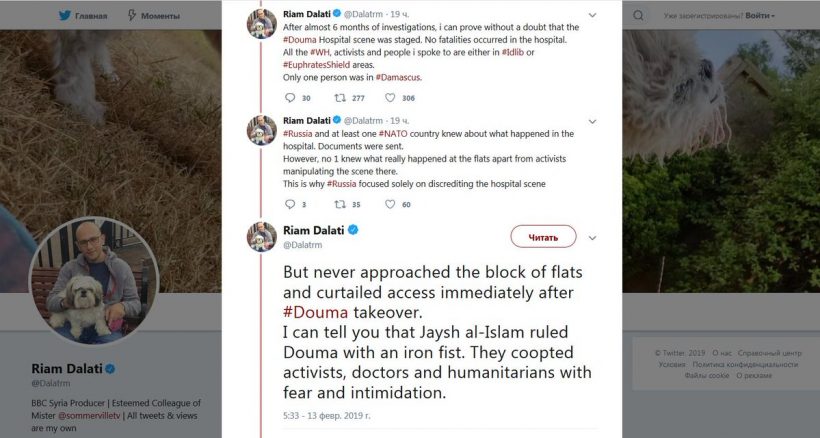
The claim (or admission) by the BBC journalist Riam Dalati that the alleged sarin attack on Douma in April 2018, was staged was received by the Russian embassy in London with glee. “Remarkable that the British MSM chose to ignore it’, whoever it was at the embassy wrote. ‘No breaking news, no articles, nothing.’
Remarkable? Not at all, given the endless track record of the media in ignoring news that does not suit its agenda. The real interest lies in the fact that an insider has owned up. His personal opinion only, according to the BBC, which along with the rest of the media, had taken the initial version of the alleged attack for granted, thus setting Syria up for the cruise missile strike by the US, Britain, and France which soon followed.
‘I can prove without a doubt that the Douma hospital scene was staged,’ Dalati wrote. Well, enough of the evidence has already been produced to prove that. As for the sarin, in July 2018, the OPCW (Organization for the Prevention of Chemical Weapons) put out an interim report indicating that whatever was used at Douma was not sarin, but most probably chlorine.
The next question is ‘used by whom?’ Again the evidence suggests that the yellow gas cylinders shown in the media propaganda blitz were not dropped from an aircraft but planted at the scene by the ‘activists’ who faked the whole episode.
The OPCW now seems to be reaching the point where it will release its full report. What it might contain opens the doors to endless speculation. It has already indicated that it found traces of chlorine and it may point an accusing finger at ‘the regime’ but without having the proof that it did it.
So expect something ultimately inconclusive, i.e. there is evidence of chlorine having been used, the Syrian regime might have used it but we really can’t say, leaving enough room for western governments to argue that they were right to bomb on the basis of the facts that were known at the time and for E. Higgins and company to argue that their version has not been disproved.
With Idlib, the last redoubt of the takfiris in Syria, now the focal point of political maneuvers and possibly military action, any credibility given by the OPCW to the accusations against the Syrian military might encourage the takfiris to try again, most likely in Idlib province, the location of the alleged chemical weapons attack in Khan Shaikhun in April, 2017. Without having the proof, the US launched a missile strike against a Syrian air base by way of retaliation.
Another faked attack would give the US and its law-breaking friends the pretext needed to disrupt or forestall any Syrian military campaign to drive the takfiris out of Idlib, which, far from having quietened down following the ‘de-escalation’ agreement reached by Turkey, Iran and Russia, is now an even hotter hothouse of takfiri activity.
The main group, Hayat Tahrir al Sham (HTS) basically still Jabhat al Nusra/Al Qaida in Syria despite the name change, and its allies have routed their ‘moderate’ enemies and taken control of between 70 to 90 per cent of the province, including Idlib city, which lives under a harsh form of sharia law.
The HTS collective has tens of thousands of armed fighters on call. So does the rival Turkish-supported National Liberation Front. The entire province is awash with arms and armed groups refusing to adhere to any agreements drawn up in Astana or Sochi and saying they will fight to the last.
Along with the fighting men are the civilians, the families of the takfiris and the normal civilian population of the province who are helpless in the face of the violence and intimidation all around them and the scheming of powerful actors far from the scene.
At present nothing is clear. The US is apparently planning to withdraw troops from northern Syria but has not withdrawn them. Erdogan and Putin have met to discuss what the US is up to, as well as the situation in Idlib and Turkey’s desire to set up a buffer zone running 460 kms and 32 kms deep along the Syrian border (on the Syrian side). Russia and Iran have so far refused to support the idea.
The buffer zone would be set up against the Kurdish People’s Protection Units (YPG), aligned with Turkey’s Kurdistan Workers’ Party (PKK) and ‘terrorists’ in the view of the Turkish government but not in the eyes of the US, which, of course, has been using the Kurds in pursuit of its own strategic interests
Turkey has recently been committing itself to the territorial and political integrity of Syria, raising an obvious question: if this is the case, why did you make such strenuous attempts to destroy both over the past eight years?
The US is on the brink of defeat in Syria. Not just defeat but defeat by Russia, which is why Trump’s plan to withdraw is facing furious criticism at home by neocons who want more war, somewhere, anywhere, and ‘liberals’ who hate Trump and will buy into almost anything that brings him down. In their views on Syria, Iran, Hizbullah, Hamas and now Venezuela the two groups are indistinguishable, even if they also affect to hate each other.
Idlib will be liberated sooner or later. If the takfiris are insisting that they will fight to the last drop of their blood that is because they have nowhere else to go. The foreigners among them can’t go back to their own countries. Turkey does not want them on its side of the border although, as the Syrian Kurds claim, it might allow them to move into Afrin, occupied by the Turkish army in March 2018. As fighters or police, they would have their uses. What happens to them when Afrin is finally returned to the hands of the Syrian state is an issue for the future.
But back to Douma. Was the district being bombed at the time a chemical weapons attack was alleged? Of course, it was. It had been taken over by one of the most murderous takfiri groups in Syria, Jaysh al Islam, and the army was shelling Douma to drive them out. What government and what army would not be constitutionally bound to do the same?
Douma was not under siege by the Syrian army, as the corporate media kept telling the world. It was being held hostage by a murderous armed group, for which the presence of civilians, deterring the army from a full-on ground military assault, was a prized asset. Civilians died in the shelling but the most likely cause of the breathing difficulties suffered by those given genuine medical treatment was smoke and dust inhalation. Jaysh al Islam and the White Helmets converted their distress into a chemical weapons attack and then ran around a clinic spraying water over everyone to prove the point.
The arguments will continue over the provenance of the yellow cylinders that gave Eliot Higgins something else to do. These were normal industrial gas cylinders that had been filled with chlorine which could only be released if someone opened the valve with a monkey wrench or if the valve had opened on impact. That a Syrian military helicopter would drop these cylinders in the hope that somehow the valve would open or break on landing is surely nonsensical.

The valves were intact so how the chlorine could have got out of the cylinders without someone manually opening them remains unexplained by those making the claim that the cylinders were dropped from a helicopter. There was no evidence of anyone in the house where the cylinders were found having been affected and as someone has observed, even the chickens running around nearby were unharmed. In short, the whole scenario screams one word: fake.
One thing not to be forgotten is that when the takfiris finally were pushed out of Douma, a makeshift chemical weapons factory, complete with how-to-make instructions and receipts for the machinery and chemical compounds received, was found underground in an elaborate network of tunnels.
Neither the factory nor the tunnels, nor the brutal nature of the takfiris holding Douma, or their previous crimes, including their previous alleged use of chemical weapons were items for show or discussion in the media.
Neither was the story one of armed fanatics taking over a district close to a national capital and holding its citizens hostage. Neither was the story one of foreign governments and the armed groups they were supporting besieging an entire country. The facts were reversed so that it was the Syrian government and army laying siege to its own people and killing them with chemical weapons.
Over the past eight years, the propaganda onslaught by these governments and the corporate media has been total. No authoritarian state or dictatorship could have done a better hatchet job on public opinion but these arch manipulators of public opinion are self-described liberals.
Therein lies their advantage. The citizens of an authoritarian state don’t believe their government or their media in the first place but western media consumers still cling to the illusion of a free press guarding their interests and are thus sucked in all the time. ‘Free for whom?’ and ‘Whose interests is the media really guarding?’ are questions that are rarely asked except by seekers after truth pushed to the margins of public debate.
The worst excesses of the takfiris – Islamic State beheadings, the throwing of people off the roofs of high buildings, the drowning of caged captives in a swimming pool and the burning of a Syrian soldier – had to be reported because they were indescribably inhuman and could not be ignored but the mundane terrorism of groups just a cut below the Islamic State in barbarity was either underplayed, ignored or blamed where possible on the Syrian military.
In the eyes of the media these groups were not terrorists but rather the ‘opposition’ or ‘rebels’ standing up to the ‘regime,’ its barrel bombs and its chemical weapons attacks, all of them, the best evidence suggests, launched by the takfiris with the intent of incriminating the Syrian government and bringing on a US-led air war.
Roughly about the same time as Riam Dalati was uttering his truth on his tweet, a Berlin-based outfit calling itself the ‘Global Public Policy Institute’ was putting out a report on chemical weapon use in Syria entitled ‘Nowhere to Hide: The Logic of Chemical Weapons Use in Syria.’
This ‘institute’ counted the number of such attacks in Syria, 336, of which number it attributed 98 percent to the ‘Assad regime’ and the rest to the Islamic State. The fact that it uses the word ‘regime’ to describe the legitimate government of Syria is the first tell-tale sign of where this report is going to lead.
The next is the sources of information, ‘our friends and partners,’ as the GPPI calls them: the Syrian Archive, the Syrian American Medical Society (SAMS) Mayday Rescue, the White Helmets, the Syrian Network of Human Rights, the VDC (Violations Documentation Centre) and Human Rights Watch, every single one of them fully engaged in propaganda attacks on the Syrian government if not actually embedded (like the White Helmets) with the takfiri groups.
The 47 pages of this report are beautifully laid out. The graphics and maps are meticulously done. As a school project, the GPPI would get 10 marks for presentation but nothing for content. On the basis of ‘evidence’ coming from such tainted sources, what makes the authors think that any reasonably well-informed person could believe their claims, and how is it that well-established German charitable foundations can hand over money for the production of such garbage?
The Syrian crisis has spawned an industry of parasites, feeding off its agony. There is no shortage of money for anyone smart enough to harvest it by giving the media what it wants and setting themselves up as a conduit for government propaganda. There is a market for lies and deceit and the laws of supply and demand being what they are, the demand is being met.
There is a truth here about the media that needs to be said. It was never truly independent, never the watchdog of the people’s interests in all seasons but it was arguably a lot better than what it has become. The explanation for this state of affairs lies partly in the death of the independent proprietor and the monopoly corporatization of the media. The proprietor’s or the board’s interest is now immeasurably greater than those of the independent owner who used to wander around the editorial floor once a week to make sure everything was ok and the staff was happy.
The corporation is global, not local, with interests that the small independent owner would hardly be able to comprehend because the leading newspaper or the television station is usually just one small part, and mostly a lesser part, of an empire that spans communications in all its branches. Conflict of interest, affecting news presentation, is inbuilt.
If the newspaper has value, it lies in its use as a weapon against or for a government depending on what the government is willing to give in return. Rupert Murdoch is the past master in using the media this way. Even if they lose money, he will keep his flagship papers going.
In the past 20 years, we have seen an abrogation of journalistic integrity for which it is hard to find a parallel in modern history. The Vietnam war was launched and maintained on the basis of lies but it did not take long for journalists to emerge who challenged the official narrative and exposed it for what it was. Compare this with Iraq and the way the media ran with the official narrative on ‘weapons of mass destruction’ from the beginning until the very one, when not one could be found.
Seymour Hersh was the leading example of journalistic integrity in Vietnam (which is not to minimize the reporting of others in the small group exposing the official lies) and, amazingly enough, is still the leading example half a century later.
For his audacity in challenging the accusation that the Syrian government was responsible for the apparent chemical weapons on the outskirts of Damascus in August 2013, and showing that it was the so-called rebels, supported by outside governments, who were most probably responsible for this atrocity, Hersh was pushed to the margins of mainstream journalism in his own country and eventually out of it altogether.
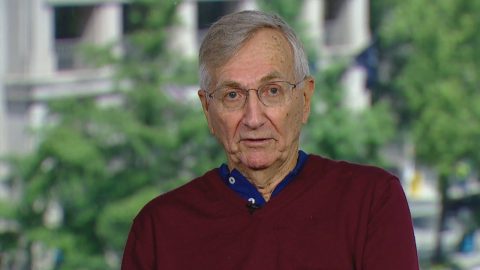
*(Seymour Hersh)
Syria is only part of a broad mosaic of ill intent, however. It was attacked in the first place because it was a strategic ally of Iran. Russia’s twin successes, in deflecting US penetration of Ukraine and making the Americans look stupid in Syria, was followed by allegations of Russian interference in the 2016 US elections. There was no proof then and there is no proof now but the same empty accusations are being repeated by the same columnists, anchors and talk show hosts all the time.
We are now facing a multi-pronged assault on truth in which governments and the corporate media are partners. On both sides of the Atlantic, they have lined up against the renewed primary enemy, Russia, wherever it is and whatever it does.
Russia lost the Democrats the US elections. Russia stole Crimea from Ukraine.
Russia saved the Syrian dictator from defeat. Russia is supporting the dictator Maduro. Russia trades with Iran. Russia does not regard Hizbullah and Hamas as terrorists as we do. Russia does not give open-ended support to Israel but rather regards it as a primary fomenter of disorder in the Middle East.
Russia poisoned the Skripals, of course. Skripal senior was a former double agent, double-crossing Russia while working for British intelligence. There is no obvious reason why Russia would want a washed-out former spy dead but of course, it had to be Russia that daubed the door handle of his house with Novichok. There was no proof, but who else could it be but Russia, and if you say ‘British intelligence,’ setting up a new round of Russia-bashing, then wash your mouth out with soap.
Mysterious Russian figures turn up in Salisbury. The British government says they are agents, stopping off at the Skripals’ house to put a few drops of Novichok on the door handle before sauntering off down the main street to look into the window of a shop selling collectibles and rare stamps.
They seemed to be enjoying themselves. They seemed in no hurry at all to get away from the scene of the crime and take the first plane back to Moscow, but isn’t that exactly the way well-trained Russian agents would behave?
Somewhere along the way they dropped what was left of their Novichok into a rubbish bin, cunningly concealed in a hi-tech perfume bottle, Nina Ricci, ‘Premier Jour.’ Enough still left to kill 4000 people, said the newspapers, but failing to kill the Skripals and killing only poor Dawn Burgess, who pulled it out of the bin and apparently sprayed or dabbed herself with some.
We don’t really know who these Russians were and what they were doing in Salisbury but we need proof, not accusations and suppositions, and the British government does not have it. We can reach conclusions on the basis of what we know or think we know but the lies told by the British government over the attack on Iraq in 2003, plus the death/murder of the UN weapons inspector David Kelly five months after the war was launched, are sufficient reasons not to believe or trust anything this government says.
This new cold war is drifting steadily towards the brink of a hot one. The US is confronting Russia through missile bases, economic sanctions and interference in the politics of states around Russia’s borders.
Trump has just announced the withdrawal of the US from the Intermediate-range Nuclear Forces (INF) treaty, accusing Russia of breaching it and saying ‘we will move forward with developing our own military response options.’
In fact, Russia had already accused the US of violating the treaty. In May, 2018, the US/NATO opened a missile base in Romania where, Russia claimed, the US had simply transferred the launchpad for the Aegis integrated naval weapons system, which utilizes Tomahawk cruise and intermediate range missile banned by the INF treaty, from sea to land.
These missiles have a range of 300-3400 miles and their apparent positioning in Romania was naturally regarded as a direct threat by Russia.
The withdrawal of the US from the INF and Trump’s threat that the US will ‘move forward’ by developing its own options raises the apprehension in Russia that the US will station other cruise and intermediate range missiles in Europe once it finds willing partners.
In his state of the union address, Putin said that such missiles could reach Russia in 10 to 12 minutes and warned of a symmetrical response, if the US deployed them in Europe, directed not just at the US but at the states hosting its missiles.
To those contemplating such measures, he said: ‘Let them count the speed and range of our missiles. That is all I ask.’
It is not just Russia that the US is threatening, however, but China. If China held naval exercises off the US or British coasts the world would quickly be facing another 1962 Cuba crisis, only much more dangerous, but the US and Britain give themselves the right to hold such exercises off the Chinese coast in the South China Sea.
As for Venezuela, the US has reverted to the crude gunboat imperialism of the late 19th century (not that gunboat imperialism ever went away). ‘Do what we want or else’ is the message sent to Maduro and the Venezuelan people. What the US wants is the resurrection of the 1823 Monroe Doctrine, and the complete domination of Latin America, including open access to its resources.
In essence, the imperialism of the 21st century is the same as the imperialism of the 20th or the 19th centuries. In the 1940s and 1950s the people of Asia, the Middle East and Africa struggled to lift the yoke of occupation, economic domination and the plundering of their natural resources off their necks. In the third millennium, they are still struggling, especially in the Middle East and Latin America.
The members of the ‘western’ collective fight among themselves but always fall into line when the alpha dog barks at them. Considerations of right and wrong, law, ethics, morality and justice are irrelevant. The alpha dog has barked and the pack must obey. Riam Dalati’s exposure of media deceit is interesting but still a mere detail on a very large and dirty canvas as the ‘west’, its governments and its media, tries to maintain control of a world fast slipping from its hands.
Jeremy Salt has taught at the University of Melbourne, Bosporus University (Istanbul) and Bilkent University (Ankara), specialising in the modern history of the Middle East. His most recent book is “The Unmaking of the Middle East. A History of Western Disorder in Arab Lands” (Berkeley: University of California Press, 2008.)
From Madero to Maduro: Lessons of the Mexican Revolution for 21st Century Venezuela

By Martin SIEFF | Strategic Culture Foundation | 21.02.2019
Just over 100 years ago, Mexico had a popular, much beloved democratically elected President determined to reduce foreign influence and obscene profits flowing out of the country and raise the standard of living for his people. The US financial interests on Wall Street orchestrated a military coup and made sure he was brutally murdered.
The president obviously was not Nicolas Maduro of Venezuela, who has been set up to receive the same treatment this year, but his name was remarkably close – Madero not Maduro. The parallels and contrasts between the two men are thought-provoking.
Unfortunately poor Francisco Madero, an idealistic reformer who ruled as President of Mexico from 1911 to 1913 did not have the tough political street smarts and plain common sense that Venezuela’s Maduro has exhibited throughout his long, controversial but undeniably successful career.
Madero naively trusted in the army commander-in-chief he had inherited from his predecessor President Porfirio Diaz, General Victoriano Huerta. Huerta had prospered throughout the long 35-year rule of Diaz from 1876 to 1911 by carrying out genocidal campaigns for him against the Yaqui Indians and the Mayans.
In 1913, Wall Street interests enthusiastically supported Huerta when he carried out a coup against the innocent Madero. Woodrow Wilson, the US president of the day was an exceptionally ugly racist who despised the Mexican people and at first went along with Huerta’s coup.
The huge financial and mining interests in New York were eager to continue plundering Mexico’s resources while more than 90 percent of its people lived virtually as slaves in appalling poverty under Diaz.
In the last decade of Diaz’s rule – securely supported by the Wall Street financial robber barons, as historian Matthew Josephson called them and by the complacent administrations of Theodore Roosevelt and William Howard Taft – at least 600,000 people were worked to death as real slaves on the estates of Diaz’s supporters. Not a whisper of disapproval was heard from Washington.
Huerta ruled with his usual mindless thuggish brutality for less than a year and a half before provoking such national revulsion that he was ousted in a brief and bloody civil war. He fled of course to the United States but then made the mistake of alienating US business and military leaders alike by openly embracing Imperial Germany to plot his militaristic comeback.
Huerta died in loose US military custody in 1916 after a night of dining out and carousing. Poisoning by the Americans was widely suspected but the cause may well just have been heavy drinking. His autopsy revealed extreme cirrhosis of the liver.
To this day Huerta is reviled as the murderous mass killer and cowardly murderer and tool of cynical foreign interests he was while the well-meaning, but tragically ineffectual Madero is genuinely loved by the people of Mexico. The days from the start of Huerta’s coup to the president’s murder – gunned down by an impromptu firing squad of assassins by night along with his own brother and vice president are remembered as La Decena Tragica, The Ten Tragic Days.
In the years that followed, Mexico endured all the horrors of a collapsed state with rival feuding bands slaughtering each other and everyone else they came across. The population of the country plummeted from 15 million in 1910 to 11.6 million a decade later. Factoring in how many deaths were masked by the high birth rate, well over four million people, or more than 25 percent of the total population died in the years of anarchic violence that Huerta’s murder of President Madero set in motion.
La Decena Tragica continues to reverberate in Mexico to this day. When current President Andres Manuel Lopez Obrador continues to withstand massive pressures from the Trump administration to recognize their preferred puppet, Juan Guaido as Washington’s preferred figurehead president of Venezuela, he is heeding his people’s reverence for martyred President Madero and remembering the bloodbaths and chaos that the hated Huerta unleashed in his place.
Madero naively trusted in the honor of his army commander, the murderous Huerta. By contrast, President Maduro in Venezuela, like his political mentor and predecessor Hugo Chavez, has taken care to always have an army high command loyal to the democratically elected national civilian leadership. Nevertheless, today, US leaders have openly called on Venezuela’s military leaders to scrap their own cherished constitution and political processes and violently topple President Maduro – All of course in the name of their usual mythical and never-defined “freedom.”
However, Bloomberg News pointedly noted in a recent report that in a Venezuelan military establishment of more than 2,000 generals and admirals, only a single officer who did not even command any troops has sworn allegiance to National Assembly Speaker Juan Guaido, the farcical boy toy whom the Trump administration is trying to set up as “president” of Venezuela in Maduro’s place.
It is just as well. The precedent of Mexico more than a century ago teaches us that if the US plot to topple President Maduro were to succeed, as the one to remove and murder President Madero did so tragically 106 years ago, then civil war, chaos and the violent death of multiple millions of innocent people would rapidly follow.
In the seven years following the murder of Francisco Madero, more than a quarter of the population of Mexico were slaughtered or starved to death. The history of states where 21st century US administrations have successfully orchestrated “regime change” makes clear that Venezuela would suffer a similar fate.
Afghanistan, Iraq, Libya, Yemen, South Sudan and Ukraine remain appalling object-lessons to the world in US criminal incompetence – at the very least – in “nation-building.” The consequences of the endless failed attempts to topple the government of Syria tell the same terrible story.
The bullets that slammed into gentle, naïve little President Madero more than a century ago continue to ricochet in our own bloodstained age.
US Threats to Venezuelan Military Violate UN Charter – Lavrov
Sputnik – 20.02.2019
Russian Foreign Minister Sergei Lavrov said on Wednesday that Washington’s threats to Venezuela’s military violated the United Nations Charter, and are representative of direct interference in the state’s internal affairs.
He also stated that Moscow grew worried about developments in Venezuela following US President Donald Trump’s recent statement urging the Venezuelan military to accept opposition leader Juan Guaido’s offer of amnesty.
“We are concerned about what is happening around Venezuela. The threats heard from the US, which are actively supported and stimulated by the Venezuelan opposition, which in fact directly invites external intervention, are certainly a violation of the UN Charter and direct interference in the internal affairs of an independent country,” Lavrov said during a press conference following talks with his Zambian counterpart Joseph Malanji.
Lavrov’s remarks come after US President Donald Trump said on Monday in a speech to Venezuelan Americans in Miami that the military of the Latin American country could either accept opposition leader Juan Guaido’s amnesty offer or “lose everything” as there would otherwise be no way out for them.
On 16 February Venezuelan opposition leader Juan Guaido, who earlier declared himself the country’s interim president, called on the Venezuelan Armed Forces, supporting President Nicolas Maduro, to change sides, giving the military seven days to do so, in the anticipation of humanitarian aid arrivals to the crisis-hit country. Prior to that, Venezuela’s Ambassador to Russia Carlos Rafael Faria Tortosa said US humanitarian aid could be a trap to be followed by military invasion.
Venezuela has long been facing political turmoil and the situation deteriorated on 23 January, when opposition leader Juan Guaido declared himself interim president, disputing President Nicolas Maduro’s re-election last year. While the United States has openly backed Guaido, the European Union did not issue a joint statement following suit because the motion was vetoed by Italy, according to a diplomatic source. Despite this, however, many European countries have individually voiced their support for the Venezuelan opposition leader.
Russia, China, Mexico, among other nations, voiced support for Maduro, who, in turn, accused Washington of orchestrating an attempted coup.
Canadian policy on Venezuela, Haiti reveals hypocrisy that media ignores
By Yves Engler · February 19, 2019
If the dominant media was serious about holding the Canadian government to account for its foreign policy decisions, there would be numerous stories pointing out the hypocrisy of Ottawa’s response to recent political developments in Haiti and Venezuela.
Instead silence, or worse, cheer-leading.
Venezuela is a deeply divided society. Maybe a quarter of Venezuelans want the president removed by (almost) any means. A similar proportion backs Nicolas Maduro. A larger share of the population oscillates between these two poles, though they generally prefer the president to opposition forces that support economic sanctions and a possible invasion.
There are many legitimate criticisms of Maduro, including questions about his electoral bonafides after a presidential recall referendum was scuttled and the Constituent Assembly usurped the power of the opposition dominated National Assembly (of course many opposition actors’ democratic credentials are far more tainted). But, the presidential election in May demonstrates that Maduro and his PSUV party maintain considerable support. Despite the opposition boycott, the turnout was over 40% and Maduro received a higher proportion of the overall vote than leaders in the US, Canada and elsewhere. Additionally, Venezuela has an efficient and transparent electoral system — “best in the world” according to Jimmy Carter in 2012 — and it was the government that requested more international electoral observers.
Unlike Venezuela, Haiti is not divided. Basically, everyone wants the current “president” to go. While the slums have made that clear for months, important segments of the establishment (Reginald Boulos, Youri Latortue, Chamber of Commerce, etc) have turned on Jovenel Moïse. Reliable polling is limited, but it’s possible 9 in 10 Haitians want President Moïse to leave immediately. Many of them are strongly committed to that view, which is why the country’s urban areas have been largely paralyzed since February 7.
In a bid to squelch the protests, government forces (and their allies) have killed dozens in recent months. If you include the terrible massacre reported here and here in the Port-au-Prince neighborhood of La Saline on November 11-13 that number rises far above 100.
Even prior to recent protests the president’s claim to legitimacy was paper-thin. Moïse assumed the job through voter suppression and electoral fraud. Voter turnout was 18%. His predecessor and sponsor, Michel Martelly, only held elections after significant protests. For his part, Martelly took office with about 16 per cent of the vote, since the election was largely boycotted. After the first round, US and Canadian representatives pressured the electoral council to replace the second-place candidate, Jude Celestin, with Martelly in the runoff.
While you won’t have read about it in the mainstream media, recent protests in Haiti are connected to Venezuela. The protesters’ main demand is accountability for the billions of dollars pilfered from Petrocaribe, a discounted oil program set up by Venezuela in 2006. In the summer demonstrators forced out Moïse’s prime minister over an effort to eliminate fuel subsidies and calls for the president to go have swelled since then. Adding to popular disgust with Moïse, his government succumbed to US/Canadian pressure to vote against Venezuela at the OAS last month.
So what has been Ottawa’s response to the popular protests in Haiti? Has Global Affairs Canada released a statement supporting the will of the people? Has Canada built a regional coalition to remove the president? Has Canada’s PM called other international leaders to lobby them to join his effort to remove Haiti’s President? Have they made a major aid announcement designed to elicit regime change? Have they asked the International Criminal Court to investigate the Haitian government? Has Justin Trudeau called the Haitian President a “brutal dictator”?
In fact, it’s the exact opposite to the situation in Venezuela. The only reason the Haitian president is hanging on is because of support from the so-called “Core Group” of “Friends of Haiti”. Comprising the ambassadors of Canada, France, Brazil, Germany and the US, as well as representatives of Spain, EU and OAS, the “Core Group” released a statement last week “acknowledging the professionalism shown by the Haitian National Police.” The statement condescendingly “reiterated the fact that in a democracy change must come through the ballot box, and not through violence.” The “Core Group’s” previous responses to the protests expressed stronger support of the unpopular government. As I detailed 10 weeks ago in a story headlined “Canada backs Haitian government, even as police force kills demonstrators”, Ottawa has provided countless forms of support to Moïse’s unpopular government. Since then Justin Trudeau had a “very productive meeting” with Haitian Prime Minister Jean Henry Ceant, International development minister Marie-Claude Bibeau declared a desire to “come to the aid” of the Haitian government and Global Affairs Canada released a statement declaring that “acts of political violence have no place in the democratic process.” Trudeau’s government has provided various forms of support to the repressive police that maintains Moïse’s rule. Since Paul Martin’s Liberals played an important role in violently ousting Jean-Bertrand Aristide’s government in 2004 Canada has financed, trained and overseen the Haitian National Police. As took place the night Aristide was forced out of the country by US Marines, Canadian troops were recently photographed patrolling the Port-au-Prince airport.
Taking their cue from Ottawa, the dominant media have downplayed the scope of the recent protests and repression in Haiti. There have been few (any?) stories about protesters putting their bodies on the line for freedom and the greater good. Instead the media has focused on the difficulties faced by a small number of Canadian tourists, missionaries and aid workers. While the long-impoverished country of 12 million people is going through a very important political moment, Canada’s racist/nationalist media is engrossed in the plight of Canucks stuck at an all-inclusive resort!
The incredible hypocrisy in Ottawa’s response to recent political developments in Haiti and Venezuela is shameful. Why has no major media dared contrast the two?
Russia’s Lukoil Halts Oil Swaps In Venezuela After U.S. Sanctions
By Tsvetana Paraskova | Oilprice.com | February 15, 2019
Litasco, the international trading arm of Russia’s second-biggest oil producer Lukoil, stopped its oil swaps deals with Venezuela immediately after the U.S. imposed sanctions on Venezuela’s oil industry and state oil firm PDVSA, Lukoil’s chief executive Vagit Alekperov said at an investment forum in Russia.
Russia, which stands by Nicolas Maduro in the ongoing Venezuelan political crisis, has vowed to defend its interests in Venezuela—including oil interests—within the international law using “all mechanisms available to us.”
Because of Moscow’s support for Maduro, the international community and market analysts are closely watching the relationship of Russian oil companies with Venezuela.
“Litasco does not work with Venezuela. Before the restrictions were imposed, Litasco had operations to deliver oil products and to sell oil. There were swap operations. Today there are none, since the sanctions were imposed,” Lukoil’s Alekperov said at the Russian Investment Forum in the Black Sea resort of Sochi.
Another Russian oil producer, Gazprom Neft, however, does not see major risks for its oil business in Venezuela, the company’s chief executive officer Alexander Dyukov said at the same event.
Gazprom Neft has not supplied and does not supply oil products to Venezuela needed to dilute the thick heavy Venezuelan oil, Dyukov said, noting that the Latin American country hadn’t approached Gazprom Neft for possible supply of oil products for diluents.
Under the new wide-ranging U.S. sanctions, Venezuela will not be able to import U.S. naphtha which it has typically used to dilute its heavy crude grades. Analysts expect that a shortage of diluents could accelerate beginning this month the already steadily declining Venezuelan oil production and exports.
Venezuela’s crude oil production plunged by another 59,000 bpd from December 2018 to stand at just 1.106 million bpd in January 2019, OPEC’s secondary sources figures showed in the cartel’s closely watched Monthly Oil Market Report (MOMR) this week.
Featured Video

Racist Seinfeld Dances for Joy as Bibi Unveils His New Map
or go to
Aletho News Archives – Video-Images
TV Drama Review
Japanese drama projects Japan’s wartime atrocities onto Chinese characters

Global Times | October 25, 2026
By portraying Chinese characters as perpetrators of ruthless violence while casting Japanese Self-Defense Forces (SDF) intelligence operatives as defenders, the season 2 of the Japanese drama Vivant has recently drawn criticism from Chinese netizens, who argue that its depiction turns historical reality on its head while ignoring Japan’s wartime atrocities.
The TBS drama series – a spy suspense story in which an alleged unofficial intelligence unit of the SDF operates across the globe — has attracted a passionate fanbase. Its currently airing season 2 opened with a household rating of 18.8 percent, the highest for a TV drama this year, according toa commentary article by Japanese media Toyo Keizai.
What draws attention is the portrayal of the enemies in the series, the article noted. Scenes in which the Chinese organization subjects kidnapped members of the SDF unit to brutal torture are repeated with unrelenting intensity.
It is rare for Japanese TV dramas to explicitly portray a real-life country as the enemy, the article noted.
Japanese Prime Minister Sanae Takaichi also made a reference to the drama, saying that she has been recording Vivant and hopes to binge-watch it over the year-end and New Year holidays, according to Japanese media outlets.
China’s CCTV News report on Sunday revealed that the drama features scenes in which Chinese personnel cut off the fingers of and stab Japanese intelligence operatives in the abdomen. Such acts bear striking similarities to the torture inflicted on Chinese nationals by invading Japanese troops during the World War II.
The drama distorts the truth by attributing these atrocities to modern Chinese characters. Beneath the surface, it subtly glorifies Japan’s cross-border overseas operations, blurs the functional boundaries of the SDF and implicitly promotes an expansionist narrative, per CCTV News. … continue
Blog Roll
 Aletho News
- Iran FM Araghchi: “Hormuz Will No Longer Be the Same”
- EU facing trillion-euro debt hole while seeking more cash for Kiev
- How US, Europe, Persian Gulf states exhausted missile stockpiles, splurged billions to defend Israel
- Up in arms… Koreans reject U.S. empire’s plan to make South Korea the next Ukraine
- Iran, Turkey, Pakistan, Saudi Arabia could advance region-led security framework in Tehran: FM spox
- Netizens condemn Japanese drama for projecting Japan’s wartime atrocities onto Chinese characters
- Racist Seinfeld Dances for Joy as Bibi Unveils His New Map
- A West Bank War for Netanyahu’s Election Campaign, Could It Backfire?
- Yemen denounces European Parliament’s ‘hypocritical’ push to blacklist Ansarullah
- Qalibaf: UAE’s UN bid aims to ‘clear the runway’ for ‘Greater Israel’, whitewash genocide
- If Americans Knew
- Israel punishes Palestinian prisoners with solitary confinement for making a cake
- US midterms: Where do candidates in key Senate races stand on Israel, Gaza, and Iran?
- Israeli forces demolish Hebron homes, displace thousands of Palestinians as raids expand
- Their Son Died in Israeli Prison. No Answers. No Body
- Biden’s Israel Catastrophe
- Why Israel’s latest assault on Hebron is so significant for the West Bank
- Israel Used “Where’s Daddy?” AI to Relentlessly Murder Palestinian Journalists and Their Families in Their Homes from October to December 2023
- DAILY UPDATE: Latest essential news on Palestine, Israel, & region
- Netanyahu Says Israel Must Prepare for Banking Sanctions, Floats Crypto as a Possible Bypass
- Latest updates from Israeli assault on West Bank
- No Tricks Zone
- Sudden Stratospheric Warming, Powerful El Niño Combination May Lead To Extreme Europe Cold, Energy Crisis!
- Two New Studies Find Thwaites Glacier Melt Cannot Be Driven By Human Activity Or A Warming Ocean
- E-Cars Reduce CO2 Emissions By Only 41% Compared To Internal Combustion Engine Vehicles
- Predictions Made By Renowned Climate Professor Over Past Decades Have Been Proven To Be Poor
- New Study Suggests Large Regions Of The Pacific Ocean Have Been Cooling For The Last 80 Years
- Germany’s Green Energy Debacle: High Energy Costs Force Kahla Porzellan to Close After 182 Years!
- New Study: 50 Years Of The Most Aggressive ‘Net Zero’ Policies Can Only Affect The Global Climate By 0.03°C
- US September “Heat” Was No Record…Many Records Set Decades Ago
- Latest European Green Energy Debacle; Portugal’s Largest Flagship Solar Park Insolvent!
- Green Energy Debacle: German Expert Professor Fritz Vahrenholt Warns Of Severe Economic And Social Consequences